EP0319193A2 - Procédé et dispositif pour l'identification de mots entrés par des boutons-poussoir de type DTMF - Google Patents
Procédé et dispositif pour l'identification de mots entrés par des boutons-poussoir de type DTMF Download PDFInfo
- Publication number
- EP0319193A2 EP0319193A2 EP88311080A EP88311080A EP0319193A2 EP 0319193 A2 EP0319193 A2 EP 0319193A2 EP 88311080 A EP88311080 A EP 88311080A EP 88311080 A EP88311080 A EP 88311080A EP 0319193 A2 EP0319193 A2 EP 0319193A2
- Authority
- EP
- European Patent Office
- Prior art keywords
- word
- letter
- words
- dictionary
- string
- Prior art date
- Legal status (The legal status is an assumption and is not a legal conclusion. Google has not performed a legal analysis and makes no representation as to the accuracy of the status listed.)
- Withdrawn
Links
- 238000000034 method Methods 0.000 title claims description 53
- 230000005540 biological transmission Effects 0.000 claims description 9
- 230000002194 synthesizing effect Effects 0.000 claims 2
- 238000002716 delivery method Methods 0.000 abstract description 2
- 230000015572 biosynthetic process Effects 0.000 abstract 1
- 230000009977 dual effect Effects 0.000 abstract 1
- 239000012634 fragment Substances 0.000 abstract 1
- 238000003786 synthesis reaction Methods 0.000 abstract 1
- 230000006870 function Effects 0.000 description 50
- 241001248035 Trigonidiinae Species 0.000 description 46
- 230000008569 process Effects 0.000 description 23
- 238000012545 processing Methods 0.000 description 13
- 238000010586 diagram Methods 0.000 description 8
- 238000005516 engineering process Methods 0.000 description 7
- 210000001072 colon Anatomy 0.000 description 5
- 238000004891 communication Methods 0.000 description 4
- 230000006835 compression Effects 0.000 description 4
- 238000007906 compression Methods 0.000 description 4
- 230000006872 improvement Effects 0.000 description 4
- 230000003993 interaction Effects 0.000 description 4
- 230000004044 response Effects 0.000 description 4
- 238000013519 translation Methods 0.000 description 4
- 230000014616 translation Effects 0.000 description 4
- PENWAFASUFITRC-UHFFFAOYSA-N 2-(4-chlorophenyl)imidazo[2,1-a]isoquinoline Chemical compound C1=CC(Cl)=CC=C1C1=CN(C=CC=2C3=CC=CC=2)C3=N1 PENWAFASUFITRC-UHFFFAOYSA-N 0.000 description 3
- 230000001174 ascending effect Effects 0.000 description 3
- 238000010276 construction Methods 0.000 description 3
- 238000013479 data entry Methods 0.000 description 3
- 241000643923 Dictis Species 0.000 description 2
- 230000003213 activating effect Effects 0.000 description 2
- 230000003466 anti-cipated effect Effects 0.000 description 2
- 230000008901 benefit Effects 0.000 description 2
- 235000019693 cherries Nutrition 0.000 description 2
- 239000012141 concentrate Substances 0.000 description 2
- 230000007423 decrease Effects 0.000 description 2
- 230000007246 mechanism Effects 0.000 description 2
- 230000008520 organization Effects 0.000 description 2
- 238000012163 sequencing technique Methods 0.000 description 2
- 230000009471 action Effects 0.000 description 1
- 238000007630 basic procedure Methods 0.000 description 1
- 239000006227 byproduct Substances 0.000 description 1
- 230000008859 change Effects 0.000 description 1
- 238000006243 chemical reaction Methods 0.000 description 1
- 238000012790 confirmation Methods 0.000 description 1
- 125000004122 cyclic group Chemical group 0.000 description 1
- 230000001419 dependent effect Effects 0.000 description 1
- 230000000994 depressogenic effect Effects 0.000 description 1
- 238000009795 derivation Methods 0.000 description 1
- 230000003292 diminished effect Effects 0.000 description 1
- 230000003203 everyday effect Effects 0.000 description 1
- 230000007717 exclusion Effects 0.000 description 1
- 239000000284 extract Substances 0.000 description 1
- 238000000605 extraction Methods 0.000 description 1
- 230000002349 favourable effect Effects 0.000 description 1
- 230000001976 improved effect Effects 0.000 description 1
- 239000000203 mixture Substances 0.000 description 1
- 238000012986 modification Methods 0.000 description 1
- 230000004048 modification Effects 0.000 description 1
- 239000000047 product Substances 0.000 description 1
- 230000001737 promoting effect Effects 0.000 description 1
- 238000011160 research Methods 0.000 description 1
- 238000012552 review Methods 0.000 description 1
- 238000006467 substitution reaction Methods 0.000 description 1
- 230000008093 supporting effect Effects 0.000 description 1
Images





Classifications
-
- H—ELECTRICITY
- H04—ELECTRIC COMMUNICATION TECHNIQUE
- H04M—TELEPHONIC COMMUNICATION
- H04M11/00—Telephonic communication systems specially adapted for combination with other electrical systems
- H04M11/06—Simultaneous speech and data transmission, e.g. telegraphic transmission over the same conductors
- H04M11/066—Telephone sets adapted for data transmision
-
- Y—GENERAL TAGGING OF NEW TECHNOLOGICAL DEVELOPMENTS; GENERAL TAGGING OF CROSS-SECTIONAL TECHNOLOGIES SPANNING OVER SEVERAL SECTIONS OF THE IPC; TECHNICAL SUBJECTS COVERED BY FORMER USPC CROSS-REFERENCE ART COLLECTIONS [XRACs] AND DIGESTS
- Y10—TECHNICAL SUBJECTS COVERED BY FORMER USPC
- Y10S—TECHNICAL SUBJECTS COVERED BY FORMER USPC CROSS-REFERENCE ART COLLECTIONS [XRACs] AND DIGESTS
- Y10S379/00—Telephonic communications
- Y10S379/906—Touchtone message transmission
-
- Y—GENERAL TAGGING OF NEW TECHNOLOGICAL DEVELOPMENTS; GENERAL TAGGING OF CROSS-SECTIONAL TECHNOLOGIES SPANNING OVER SEVERAL SECTIONS OF THE IPC; TECHNICAL SUBJECTS COVERED BY FORMER USPC CROSS-REFERENCE ART COLLECTIONS [XRACs] AND DIGESTS
- Y10—TECHNICAL SUBJECTS COVERED BY FORMER USPC
- Y10S—TECHNICAL SUBJECTS COVERED BY FORMER USPC CROSS-REFERENCE ART COLLECTIONS [XRACs] AND DIGESTS
- Y10S379/00—Telephonic communications
- Y10S379/908—Multimedia
Definitions
- the invention relates to a method and apparatus for identifying words from letters entered on a DTMF pushbutton pad, and, once the word is identified, transmits the information in ASCII digital form on a packet transport network to a location near the receiver where it is converted into speech.
- the prior art also discloses some systems for using a DTMF keypad to transmit messages to a remote location where a speech synthesizer reproduces a word.
- Typical of such systems is the invention described in U.S. Patent No. 4,307,266 entitled COMMUNICATION APPARATUS FOR THE HANDICAPPED.
- a sender enters the appropriate position for the letter of the alphabet to be communicated.
- a second entry identifies which one of the plurality of letters attached to the telephone set which decodes the two digit code entry and converts the two-digit code to a standard machine readable format which can be displayed on a standard output device such as an alphanumeric display or, for blind persons, a braille or similar output message.
- the sending party can transmit the message to the receiving party by keying characters into a keyboard. Keyed-in characters are converted to speech by a speech synthesizer for transmission to the receiving party.
- the sender types the word in DTMF code and the resultant word is reproduced at the receiving station by synthesized voice. While the foregoing system may be useful for certain applications, it seems to be rather cumbersome, limited in its vocabulary, and relatively inefficient in its transmission mode.
- U.S. application 4,737,980 entitled COMPUTER DATA ENTRY METHOD AND APPARATUS describes a device mounted near a telephone for identifying numbers and letters entered on telephone DTMF tone buttons.
- a very simple algorithm is employed to identify letters and numbers one at a time.
- the device has the drawback that it must be mounted near the telephone, requires more keystrokes to correctly identify a letter and is prone to making more incorrect guesses than the present invention.
- U.S. patent 3,677,659 entitled TELEPHONIC DATA ACCESS AND TRANSMISSION SYSTEM describes a system for transmitting and accessing data through a standard telephone network.
- the system includes the activating of a key or sequence of keys wherein each key represents a plurality of letters on a telephone.
- the signals produced by activating the keys are compared to a data base having indexed entries of words or names.
- the data base preferably comprises a telephone directory so that an individual can look up a name and get a telephone number.
- the invention places emphasis on Boolean exclusion which requires a significant amount of interaction with the caller to eliminate collisions. Accordingly, the system is much more difficult and inefficient than the present invention described in this disclosure.
- U.S. patent 4,614,841 entitled GEOGRAPHICALLY DISTRIBUTED MULTIPROCESSOR TIME-SHARED COMMUNICATION PROCESSING SYSTEM describes a packet transport-like system including intelligent terminals at both ends connected to independent data bases. The system otherwise does not appear to teach or suggest a mechanism for efficiently guessing the meaning of words entered letter-by-letter on DTMF pushbuttons, converting the information to ASCII code, transporting the code over a packet transport network and converting the code into synthesized speech at the remote end.
- U.S. patent 4,685,125 entitled COMPUTER SYSTEM WITH TASKING describes a packet transport network that includes a plurality of nodes.
- the invention comprises a method and apparatus for determining the identity of a word entered on a DTMF pushbutton pad by identifying letters according to their frequency in groups of n letters where n preferably equals two or three but can be much larger.
- a word is typically entered on a DTMF pushbutton pad one letter at a time.
- Six (6) of the numbered buttons on the DTMF pad correspond to three (3) letters of the alphabet and button #7 is PQRS and button #9 is WXYZ.
- the number string is compared against a dictionary of words in internal memory. The system feeds back the guessed word is rejected by the sender or from the dictionary to the sender to determine if the guessed word is correct.
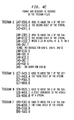
- Trigrams are preferably broken down into five (5) files, namely: Trigram I, which is a file for guessing the initial letter of a word; Trigram 2, which is a file for guessing the second letter of a word based upon the first letter of a previously guessed and confirmed alphabetic output string; Trigram 3, which is a file for guessing the third letter of a string based upon the first two letters of a previously guessed and confirmed alphabetic output string; Trigram Middle, which is a file employed to guess at the identity of any middle letter based upon the known identity of the previous two letters of a three letter string; and, finally, Trigram Final, which is employed to guess at the final letter of a word based upon the known identity of the previous two letters.
- Trigram I which is a file for guessing the initial letter of a word
- Trigram 2 which is a file for guessing the second letter of a word based upon the first letter of a previously guessed and confirmed alphabetic output string
- Trigram 3 which is a file for guessing the
- Trigram files The reason for employing five (5) Trigram files is because the initial, second, third and final letters of a word have different frequencies of individual occurrences and different frequencies of three letter combinations than letters in other positions in words. Using five (5) different files takes maximum advantage of the knowledge of the subject string in terms of each letter in its position within the word and within the context of its surrounding letters and/or digits.
- Trigram record does not exist for a particular three letter string, then the system will default to analyzing groups of two letters referred to as Digrams.
- the system can also be expanded to letter groups of size n where n is greater than two or three.
- n is greater than two or three.
- the system transmits the information via a packet transport network to a remote location where the ASCII code is converted by a digital-to-speech synthesizer to an audio output understandable to a receiver at the remote location or to one of several other delivery modes.
- a simplified alternative embodiment of the invention it is possible to identify a word at a time rather than a letter at a time.
- a data base is generated in which the words are stored according to the length, numeric equivalent and relative frequency.
- An individual using the alternative embodiment types in the word on a DTMF pushbutton pad and the system guesses at the word based upon the information stored in the word guessing dictionary.
- the alternative system appears to work better for unique words, however there are a lot of short words that have the same numeric string.
- the preferred embodiment of the invention combines both full word guessing with sophisticated letter-by-letter guessing and as a consequence operates faster.
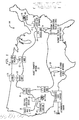
- FIG. 1 is a general schematic diagram of the preferred embodiment of the invention 100 showing how a message can be sent from a sender in the northeastern United States to a receiver 22 in the southwestern United States. The message will be delivered by synthetic voice via an ordinary telephone.
- FIG. 1 also illustrates potential alternative routine via gateways to destinations anywhere in the world and via a variety of different delivery modes including Telex, cable, alphanumeric pager and electronic mail.
- Entrance telephone access node 12 is connected by one or more telephone lines to a nearby packet transport network access node (PTN access node) which in turn is connected to a PTN (Packet transport network) 16.
- PTN access node packet transport network access node
- the telephone access nodes 12 and 20, in addition to their PTN connections are also connected to telephone networks associated with the sender 10 or receiver 22 or both.
- Each telephone access node 12 or 20 preferably includes multiple connections to the telephone networks so as to be capable of conducting many dialogues simultaneously.
- the entrance telephone access node 12 functions to provide both entrance and egress to and from PTN 16 via PTN access node 14.
- Node 12 is labeled "entrance” in FIG. 1 and node 20 is labeled “egress” because it is the function that they perform for the purpose of illustrating the invention 100.
- both nodes 12 and 20 are identical to each other and, their roles could be easily reversed if it was desired to send a message from receiver 22 to sender 10.
- the caller or sender 10 initially dials up the closest telephone access node to him using the DTMF buttons 60 on his or her telephone instrument and the entrance telephone access node 12 will respond to the call.
- Telephone access node 12 then conducts a dialogue with the sender 10 concerning the preferred routing of the call.
- the sender 10 interacting with the entrance telephone access node 12 determines the preferred delivery mode of the message.
- the delivery may be by synthetic voice through a telephone, Telex I, Telex II, foreign or domestic cable, alphanumeric pager, FAX, computer printout or by electronic mail (E-Mail). This is possible because the entrance telephone access node 12 includes routing tables 46 shown in FIGURE 2B which can route via multiple gateways and via multiple delivery modes.
- the access node 12 requests the sender 10 to enter the Telex number and optional answer back. Then, this part of the initial dialogue is completed. If the delivery is to be via voice over the telephone, the entrance telephone access node 12 asks the telephone number of the receiver 22.
- the telephone number may represent a voice telephone instrument or a computer equipped with a modem if the delivery mode is dial-up E-mail.
- the E-mail option can also be accomplished by soliciting the network membership and mail box identification number of the receiver 22. If the receiving device is an alphanumeric pager, the dialogue will request the pager number.
- the dialogue can be further continued to request from the sender, requiring only "Yes' or "No" answers, his or her preference for options such as proof of delivery or other additional parties that he or she wants to receive the message. If additional parties are to receive the message, then the entrance telephone access node 12 will request additional Telex, pager or telephone numbers.
- the entrance access node 12 will examine a table to determine the PTN access node 18 nearest to the egress telephone access node 20 serving that telephone number.
- the table is composed of telephone number NPA-NNX's and their associated approximate latitudes and longitudes. This table is referred to by the publisher, Bell Communiations Research, as the "V-H" File (Vertical-Horizontal). Given this table and the listing of all of the access nodes in the system 100, the entrance telephone access node 12 will determine the PTN access node 18 which is closest to the receiver's telephone access node 20 which is in turn closest to the receiver's telephone number. According to FIG. 1, the selected PTN access node 18 is the closest to egress access node 20 which is closest to receiver 22.
- the word "closest" here is meant to refer to the lowest cost telephone call charge.
- the entrance access node 12 having selected PTN access mode 18 as the exit PTN access node, will address all of the packets it creates to that PTN access node for referral to egress telephone access node 20. This completes the entrance telephone access node 12 routing procedure for transmission from a sender 10 to a receiver 22 in the United States in the case of message delivery by synthetic voice.
- the system 100 also has the capacity to deliver messages on alphanumeric pager 29, or on a voice mail box 25, or by printed mail from hard copy printers 19 or may access data bases 21.
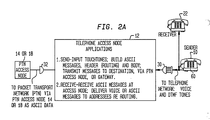
- FIG. 2A is a block diagram of a typical telephone access mode 12 which can function as either an entrance telephone access mode 12 or an egress telephone access node 20.
- a typical telephone access node 12 or 20 has multiple connections 30 to a standard conventional telephone network so as to be able to conduct many conversations with senders 10 and receivers 22 simultaneously.
- the standard conventional telephone network is not illustrated or discussed in detail in this disclosure since it is well known to those of ordinary skill in the art.
- the telephone access nodes 12 also include a data link 32 to PTN access node 14 which in turn connects with PTN 16.
- the telephone access modes 12 and 20 In addition to its function of communicating with the standard telephone network and the PTN 16, the telephone access modes 12 and 20 also discharge two general applications with respect to sending and receiving messages. These applications are described in greater detail in FIGS. 2B-2C and 3.
- the major functions supporting the sending and receiving applications are the prompter, speaker and dictionary functions.
- the prompter function "listens" to the DTMF tones sent by the sender 10 and guesses the meaning of the word entered by the sender 10.
- the speaker function relays to the sender 10 the guesses selected by the prompter function.
- the speaker function is performed in part by a conventional text-to-speech circuit board which can read the alphabetic data in the dictionary and pronounce the words in audible speech by interpretation of the characters contained in memory. Devices of this description are manufactured by Digital Equipment Corp., Texas Instruments and Natural Micro Systems. Software for this function is provided by Berkeley Speech Technology and others.
- the dictionary contains several thousand English words from which the prompter function selects its guesses.
- the entrance telephone access node 12 will invite the sender 10 to type his or her message on the DTMF telephone buttons.
- the basic procedure followed by the sender 10 is to type on the DTMF keyboard buttons 60 as if the letters inscribed thereon were actually functional.
- the actual information transmitted by the sender's telephone to the telephone access node 12 is, of course, only one of twelve distinct pairs of tones per each button depression.
- the letters employed by the system are those commonly inscribed on the DTMF telephone buttons 60 with the exception that the letter Q is assigned to the 7 button (PQRS) and the letter Z is assigned to the 9 button (WXYZ).
- the letters Q and Z are usually not found on conventional telephone dials or DTMF buttons 60.
- the pound sign (#) on the DTMF telephone buttons 60 represents, according to the preferred embodiment of the present invention 100, the space bar on a standard typewriter.
- the telephone access node 12 will assume the sender 10 has finished typing a word. It will then guess the word and, using its speaker function, speak the word to the sender 10.
- the prompter function has two clues which it uses to decipher a numeric string typed by the sender 10 into an alphabetic word, namely the number of digits and the digit string.
- the prompter function contains a dictionary of a majority of the words in common usage in the English language in its random access memory.
- the sequence of the dictionary entries is by (1) number of digits in the word (word size) (2) string definition being the numeric equivalent of the alphabetic word emitted by typing on a DTMF pad, e.g. 843 for THE, and (3) possible meanings of the string sequenced by probability of use.
- the prompter function will contain an entry of word size 3 digits, the string 843, and, e.g.
- the dictionary contains a list of words corresponding to each numeric combination (e.g., 843). The choice of words is based on their frequency and words will be carried in the dictionary until it is calculated that their frequency is below some predetermined threshold. This threshold is definable in expected occurrences per million words of text.
- the most frequent interpretation expected of the string 843 is THE.
- the entrance telephone access node 12, using the speaker function, will speak the word THE to the sender 10. If THE is the correct interpretation for 843, the sender 10 wil proceed to type the next word. If THE is not the correct interpretation for 843, the sender 10 will deny the guess by typing another #.
- the speaker 48 will then speak the next most likely word, in this example, TIE, If the sender 10 denies TIE by typing another # sign, the speaker 48 will speak VIE.
- the access node will announce to the sender 10 that it is shifting modes and will decode the word by reference to the Forward Dictionary 43a, Reverse Dictionary 43b, Trigrams 43e-43i, and Digrams 43c and 43d.
- numeric string such as 843
- numeric DTMF string Given a particular numeric string such as 843, there are very few valid words that correspond to it. These valid words usually display widely divergent possibilities of use in English text. Therefore, guessing a word, given its size and numeric DTMF string, has been discovered to be an efficient and practical method for identifying words.
- the dictionary function can be easily contained in the conventional equipment manufactured for micro-computers.
- An uncompressed dictionary of some 300,000 words can be contained in a memory board of 3 million bytes.
- some compression would be used, at a minimum to represent multiple forms of a verb in a single entry.
- the word WALK would represent walker, walking, walked, etc. Compression is useful because it minimizes computer memory.
- the cost of RAM memory has become sufficiently low so that it may be preferable to minimize or eliminate the compression so as to maximize response performance and minimize software effort.
- the system includes additional information about the frequency of an individual letter within a given string of n letters where n is at least two (2) and is preferably three (3) or more so as to further enhance the capability of identifying the word. Moreover, once the word is correctly identified, it will be automatically added to the memory of the system so that a second occurrence of the word will be automatically guessed at the next time that it is entered by the caller.
- FIGS. 3A - 3E describe "Letter-at-a-Time" processing.
- the invention employs a dictionary 42 of the 18,000 most common words in the English language selected according to their expected occurrence per million words of text.
- the expected occurrence per million words of text is associated with each word in the dictionary.
- the number 18,000 is arbitrarily chosen as this is the point below which words have an expected occurrence below one per million words of text.
- the dictionary represents over 95% of the words commonly used in English text.
- DTMF numeric refers to the numbers letters on the DTMF buttons, for example the 2 button has the letters A, B and C; the 3 button has the letters D, E, and F and so forth.
- the primary goal of translating from an input DTMF numeric string to a letter string of an unknown (not in the original dictionary) word is to minimize the number of guesses to achieve the intent of the user.
- the penalty assessed against an incorrect guess must be optimized against the amount of dictionary data and their storage and processing requirements.
- the invention assumes that words which are not in the dictionary will have the same "structure" as words which are in the dictionary. This assumption applies to proper nouns as well as to common words but will not be as true for proper nouns as for common words.
- the reason for the diminished expectation of accuracy in processing proper nouns is that they are frequently of foreign origin whereas the dictionary is specifically based on English text. (Accuracy in processing proper nouns can be enhanced by including samples of proper nouns in the original dictionary taken from all possible ethnic derivations.) Structure is characteristic of a particular language and the structure involved in this discussion is peculiar to English in that the dictionaries are derived from English words. The general notions apply to any language but a different set of dictionaries is required for each language.
- these words Given the expected occurrence per million words of text for each word in the dictionary, these words can provide the basis for the extraction of text "snippets" (letter sequences) which will have the same expected occurrences per million words as the words from which they are extracted. These snippets can be ordered and tabulated by their expected frequencies per million words of text to that for a given n-letter snippet, the expected frequency per million words of text for that snippet can be computed.
- N-grams can be extracted from the original dictionary which may be only one letter less than the words from which they are extracted.
- the assumption is that letters occur in predictable frequencies, and that these frequencies are dependent in part on the position of a letter in the word. For example, the letter Q is more frequently found as the first letter of a word than as the last letter of a word.
- the particular letter positions addressed by this invention are the first, second, third, final, and "all-other" positions. Therefore, five sets of trigrams are used to guess the alphabetic interpretation of a DTMF numeric string.
- a computerized dictionary of 18,000 words each associated with an expected occurrence per million words of text is used as the primary word source and also as a source of two special dictionaries - a Forward Dictionary and a Reverse Dictionary, and of trigrams each also associated with expected occurrence per million words of text.
- the composition of the two special dictionaries and of the trigrams and the associated expected frequencies per million words of text are defined as the 'structure" of the language.
- collisions may occur.
- the word “collision” is defined to mean multiple alphabetic strings which translate to the same DTMF numeric string. A collision occurs when the system finds more than one alphabetic string corresponding to a given numeric string.
- the numeric string 66 is an example of a collision because it corresponds to ON or NO. Another example is 843 which corresponds to THE or TIE.
- the number 3 is selected as the exponent because there are three alphabetic characters on each numeric DTMF button except for the 7-PQRS and the 9-WXYZ.
- the letters Q and Z occur so infrequently in English text as to be negligible in estimating probabilities. This probability estimate ignores the redundancy in English language which tends to make the chance of success even more favorable).
- the resolution of collisions between words found in the dictionary is achieved by guessing the interpretation of the numeric string in the sequence of the expected occurrence per million words of text. For example, for the string 843, THE is the first guess and TIE is the second guess because that is the sequence of their expected occurrence per million words. The same process is used when guessing letters based on trigrams. If there are several trigrams which might translate to the given string, the best guess is achieved by guessing in the sequence of expected occurrence per million words of text. The strategy for guessing with n-grams is to find the longest n-gram which matches the input numeric string.
- the system delivers a complete word to the caller via the text-to-speech unit if the caller's DTMF string exactly matches a dictionary entry or if the word can be pieced together by reference only to the Forward and Reverse Dictionaries. (These two dictionaries are described in the next paragraph.) Otherwise, the system delivers the word to the caller one letter at a time, i.e., it spells out one guessed letter at a time moving from left to right.
- Various improvements are possible. For example, several alphabetic interpretations of an input numeric string may result from the process of piecing together a word from the multiple sources of string interpretations. These can be temporarily stored according to their probability and if the caller rejects a word, then the system can then present the next most likely word. If the caller rejects all of the pieced together words, the system can back off to a single letter at a time presentation.
- the Forward Dictionary contains the original 18,000 words arranged in DTMF numeric sequence and within identical DTMF numeric sequence by expected frequency per million words regardless of word size whereas the original 18,000 word dictionary is arranged primarily according to word size. (Note that the actual alphabetic character string does not participate in the sorting sequence.)
- the Forward Dictionary is constructed by repeatedly truncating the least significant letter from each word in the original dictionary until the remaining string is four letters long. For example, from the word DICTIONARY, the truncation produces DICTIONAR, DICTIONA, DICTION, DICTIO, DICTI, and DICT. Each of these snippets has its original expected occurrence per million words associated with it as copied from the figure for DICTIONARY. Each of these snippets is sorted and the frequency figure tabulated together with identical snippets taken from the same character position of other words. For example, the snippet DICT is tabulated with the snippet DICT taken from the word DICTATOR.
- the result is a single occurrence in the Forward Dictionary of each snippet associated with its tabulated occurrence.
- the DTMF numeric is then computed for each snippet. For example, 3428 is computed for DICT.
- the tabulated snippets are sorted on the DTMF numeric so that the longest is encountered first in the searching. If several snippets exist with identical DTMF numerics, the snippet with the highest frequency is caused to be sorted first within the identical numerics. If the searching fails against the longest snippet, then the searching will try the next smallest and so forth until a match is made or until the search string becomes smaller than four digits.
- the truncation can terminate at five or six or more letters instead of at four. This would cause the strategy to turn to trigrams sooner than the present plan.
- the snippet DICT from DICTIONARY could be tabulated with the snippet DICT from INDICT, i.e, from a different letter position. (This suggests the construction of n-grams.)
- the sorting could discard multiple snippets with identical DTMF numerics except for the first-the one with the largest frequency value. This is appropriate to the strategy of making only one word-at-a-time guess and then using trigrams and digrams to construct letter-at-a-time guesses.
- the Reverse Dictionary also contains the original 18,000 words. The entries are reversed so that the word DICTIONARY for example, appears as YRANOITCID and the corresponding DTMF numerics are also reversed. The sequence is by reversed numeric and within identical DTMF numeric by expected frequency per million words. The construction of the dictionary is the same as the Forward Dictionary except that the letters are first reversed.
- the trigram tables are built similarly to the Forward and Reverse Dictionaries with several variations. There are five tables, one for the first, second, third, final, and "middle" digit guessing. They are used for guessing one letter moving from left to right so the assumption is that there are two previously confirmed letters preceding each digit to be guessed.
- the search argument format for e.g, a Trigram M (middle) record is AAD meaning two Alphas which are known and one Digit which is to be guessed.
- the D in this example is a "middle" digit - not the first, second, third, or final.
- the function returned by the search is three guesses for the D listed in the sequence of frequency, highest first.
- Each of the five tables is constructed by extracting three letter snippets from the original dictionary. The snippets are included in one of the five files depending on the character position of the word from which they are extracted. Snippets taken from characters 1,2, and 3 of a word are sent to Trigrams Initial. Snippets from 2,3, and 4 are sent to Trigrams 2. Snippets from 3, 4, and 5 are sent to Trigrams 3. Snippets taken from the final letter of the word and the two preceding letters are sent to Trigrams Final. All other snippets are sent to Trigrams Middle. These are then sorted, the frequencies are tabulated, DTMF numerics generated and sorted again by DTMF numerics and within identical numerics by frequency, and stored in tables similarly to the Forward and Reverse Dictionaries.
- Trigrams Initial there are some variations from the above procedure applied to building the Trigrams Initial and Trigrams 2 tables.
- the Reverse Dictionary search was provided one or two letters useful in the Trigrams Initial Search.
- the one letter could be the third letter of the word.
- the two letters could be the second and third letters of the word.
- the search argument formats could be DDD (no letters known of the first three in the word), DDA (the third letter is known from the Reverse Dictionary search), or DAA (the second and third letters are known from the Reverse Search.)
- the functions returned from the search will be formatted properly to respond to these search arguments.
- the expectation of a proper guess for the D (the first digit of the Trigrams Initial record) will be more accurate if one or two letters are part of the search argument (DDA or DAA) than if the argument is DDD.
- Trigrams 2 it may be that the Reverse Dictionary search has provided the third letter of the word. (If the Reverse Dictionary search also provided the second letter of the word, then it would not be necessary to reference Trigrams 2). If the third letter is available, the search argument will be ADA, otherwise it will be ADD. (The first letter has been confirmed by the user after presenting him with the results of the Trigrams Initial search.) Similarly to the Trigrams Initial search, the Trigrams 2 search will be more accurate with the search argument format ADA than with ADD.
- this invention uses the maximum length string available from a Forward Dictionary search, combining this with the maximum length string available from a Reverse Dictionary search, and then using forward trigrams and digrams to bridge (chain) the gaps which may remain after combining the forward and reverse alphabetic strings.
- the forward and reverse dictionary searching extracts prefixes and suffixes as a by-product" of the searching.
- the results of the combination of the two strings can be longer than the input string, shorter than the input string, or the same size as the input string. If the combined strings are longer than the input string, then the "overlap" letters may or may not match. If the overlap letters match, then this is further evidence that the correct and only correct interpretation of the input numeric string has been found. If the overlap letters do not match, the two alphabetic strings concatenated together may still be the correct interpretation of the input numeric string. If one or more letters overlap, the overlap letters are unequal, and the strings are not the same size, the overlap letter is chosen from the longer of the two strings. If the strings are the same size, the overlap letter is chosen by reference to a trigram or digram table to select the most likely alphabetic according to the frequency data. If the combined strings are the same size as the input string, then there are no overlap letters. If the two matched alphabetic strings are shorter than the input numeric string, then the gap between the forward string and the reverse string will be filled in by reference to trigrams and digrams.
- the process is performed if the search against the original dictionary (the 18,000 words) fails.
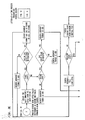
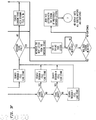
- the first search in FIG. 3A is made against the Forward Dictionary. Since the original search against the 18,000 words is known at this point to have failed, this search begins with truncating the last digit from the input string and attempting to find a match against a Forward Dictionary entry one character shorter than the input string.
- the input numeric string is 34726837437 intended to mean DISCOVERIES and that DISCOVERIES is not one of the 18,000 words.
- the words DISCOVER and CHERRIES are assumed to be contained in the 18,000 words and are thus also in the Forward Dictionary and the Reverse Dictionary.
- the Forward Dictionary is searched with the argument string size of 10 but no match is found on the 10 digit string.
- DISCOVER is saved and the process continues at circle #2.
- the string is reversed so that it is now 73473862743 and it is in the proper format to match against the Reverse Dictionary.
- prefixes in the Forward Dictionary search and to suffixes in the Reverse Dictionary Search.
- FIG. 3D - 3E diagrams the process used if the Forward and Reverse Dictionaries did not yield a guess for the input numeric string.
- the first unsolved digit is located and its digit position denoted. The digit position determines which of the five Trigram files will be used to decode it. If the Trigram Files do not contain sufficient entries to provide a full Guessing stage for each digit, then the final default, the Digram File is used to finish loading the stage. Since there are three letters per DTMF button, (except for 7-PQRS and 9-WXYZ) there must be three guesses to offer the caller per each button push he enters and they must be presented in the sequence of their likelihood as a successful guess.
- the Guessing Stage provides the mechanism for presenting each possible letter per numeric button in its proper sequence and for presenting the letters once and only once.
- FIGS. 3C-3F The guessing process of FIGS. 3C-3F is one letter at a time whereas the guessing of FIG. 3A-3B is a complete word using the assumption that a complete word guess had been successfully constructed from the Forward and Reverse dictionaries.
- the length of the combination of the matched forward string plus the matched backward string is greater than or equal to the length of the input string.
- strings are of different lengths, take the letter from the longest string, in this case, the SATUR. If the strings are the same lengths, refer to the expected frequencies per million associated with the two strings and choose the letter from the string with the highest frequency. (Recall that the n-grams are stored together with their expected occurrence per million words of text.
- the length of the combination of the matched forward string plus the matched backward string is less than the length of the input string.
- there are one or more unmatched digits. These are processed by further reference to n-grams until the length of any substring is less than four digits. Then the remaining unmatched substrings are decoded by reference to trigrams and digrams.
- the trigrams will usually decode any unmatched digits (except for foreign proper nouns and words) and the digrams are the final default reference.
- the digram table contains every possible combination of two letters.
- the basic dictionary building system illustrated in FIGS. 4A-4C is used to build the following dictionaries.
- the basic system illustrated in FIG. 2B and described in FIGS. 3A-3F includes a group of dictionary files 43a-43n which are discussed in detail as follows:
- the Forward Dictionary file is constructed by taking each word in the Original Dictionary and successively truncating the final character to make a new record until the new record is four characters long.
- the original entry DICTIONARY would provide the records DICTIONAR, DICTIONA, DICTION, DICTIO, DICTI, and DICT.
- the records with equal DTMF numerics are tabulated and their EM are added together to produce the total EM for that alphabetic-numeric string combination.
- the EM associated with each string are the total EM taken from all strings with the same alphabetic and thus the same numeric. For identical numeric strings with different alphabetic strings, the string with the highest EM occurs first.
- Trigram files There are five trigram files: TRIGS 1 43e; TRIGS 2 43f; TRIGS 3 43g; TRIGS M 43h and TRIGS F 43i; also referred to respectively as: Trigrams Initial; Trigrams 2; Trigrams 3; Trigrams Middle and Trigrams Final.
- the reason for using five files is that letters have different expected frequencies of occurrence depending on their positions in a word.
- the particular letter positions considered to have special frequencies associated with them are the first, second, third, and final positions in a word. These four positions have special trigram files for guessing unknown digits in these positions and there is a fifth file for 'all other" digit positions.
- AAD The format of a search argument into a trigram file is usually AAD where AA represents two known alphabetic characters and D represents an unkown digit which is to be guessed by reference to the trigram files.
- the AA are known because the guessing proceeds from left to right when using the trigram files and the letters are presented to the caller one at a time for confirmation or denial.
- Trigrams Initial 43e and Trigrams 2 43f have special search arguments because for these two files, there are not two known alphabets available to use as the search argument. These two files may be used in searching input DTMF strings which have previously matched the Reverse Dictionary (but not the Forward Dictionary) and possibly picked up one or two alphabetic characters in the second and third character positions. If no alphas were retrieved by the Reverse match, then the format of a search argument against the Trigrams Initial File 43e is DDD, i.e., three numeric Digits because no alphas are known. If the third character was retrieved by the search against the Reverse Dictionary, then the search argument format is DDA (two unkown digits and one known Alphabetic). If the second and third characters were retrieved by the search against the Reverse Dictionary, then the search argument format is DAA (one unknown Digit and two known Alphabetic).
- Trigrams 2 43f may have a search argument format of ADD if no character was located in the Reverse search or ADA if the third character was matched in the Reverse search.
- the sequence of the trigram files 43e-43i is numeric or alphanumeric search argument as above, totalled EM, and three or four guesses for each DTMF digit depending on whether the digit is a 7 or 9 (four guesses) or otherwise (three guesses).
- the Digram File 43c and 43d is a set of two letter pairs which combine each letter of the alphabet with every other letter of the alphabet sequenced according to their expected appearance on the DTMF keypad. There are 26 times 26 entries which is every possible combination of two letters.
- the Trigram files 43e-43i will not necessarily have an entry for every possible letter combination but the Digram File 43c and 43d does. It is the fall-back tool used to guess the meaning of a DTMF digit if the Original Dictionary 42, the Forward Dictionary 43a, the Reverse Dictionary 43b, and the trigram files 43e-43i do not provide adequate input to enable a guess for a DTMF digit.
- the Digram Files 43c and 43d are produced from an independent data source, not from the Original Dictionary 42.
- the format of a search argument to the Digram File 43d is AD where A is a previously confirmed Alphabetic character and D is an unknown Digit from 2 to 9.
- the functions returned from searching Digram File 43d are the guesses for the unknown digit. There are three guesses for an unknown digit listed in order of their expected frequency. For example, for the argument T4, the search of the Digram File 43d yields three records in the sequence TH, TI, and TG.
- the Trigram files 43e-43i may not yield a complete "set" of guesses for a digit, e.g., H, I, and G, for the T4 search but the Digram files 43c and 43d are constructed to contain an exhaustive listing for every possible interpretation of the unknown digits. This is why the Digram Files 43c and 43d are referred to as the "final default”.
- Digram Initial There is a special Digram File 43c with 26 entries called Digram Initial. This is used for the first letter of the word when there is no alphabet to supply the A of the AD format.
- the search argument is just D.
- the Digram Initial File 43c (as well as the other Digram File 43d) are expected to be used infrequently as the system first refers to the Forward Dictionaries and the Trigrams 43e-43i.
- the first letter of an entry in the N-gram Initial File 43j is the first letter of the dictionary entry from which it was extracted. "Initial” refers to the letter position in the word from the n-gram was extracted. "Initial” is the first letter of the word.
- n-gram 43j-43n files are maintained for five different letter positions because the frequency of occurrence of a letter depends in part on its position in a word.
- the last letter of an entry in the N-Gram Initial File 3j is the next-to-the-last letter of the dictionary entry from which it was extracted.
- the last letter is not included because the search against the original dictionary containing the entry, e.g., SATURDAY, has apparently failed or the system would not be using n-grams.
- the EM is taken from the dictionary entry.
- Example: The n-gram SATURDA is extracted from the dictionary entry SATURDAY.
- the EM of SATURDAY is, e.g., 243, which is also applied to the n-gram SATURDA.
- THe n of the n-gram SATURDA is 7-gram I (I meaning "Initial").
- SATURDA is a seven letter n-gram whose first letter is the first letter of the dictionary entry from which it was extracted.
- the process of generating entries for the N-Gram-Initial File 43j continues with successively truncating the last letter of each original dictionary entry.
- the successive truncation of SATURDAY yields SATURDA, SATURD, SATUR, SATU, and SAT each with the associated EM of SATURDAY.
- the process stops when the remaining letter string is three characters long.
- Each entry stops resulting from the truncation process is tabulated against identical letter strings. As the letter strings get shorter and shorter, e.g., from SATURDA to SAT, the EM totals get higher and higher.
- the final operation in creating the n-gram files 43j-43n is to generate the DTMF numeric equivalent from the letters, sort on the numeric equivalents in ascending order and the summarized EM in descending order.
- the alpha does not take part in the sort as it is now unique (only one occurrence of a given alpha string) because of the tabulation.
- SAT, SAU, SAV, RAT, and PAT would be the most likely interpretations of 728 in order of their expected EM.
- the attempted decoding of 728 would only occur after failing to decode the longest possible string in the input numeric.
- SATURDA for which the input numeric string is 7288732
- the decoding process attempts to decode 7288732, then 728873, then 72887, then 7288, and lastly 728.
- the n-gram files 43j-43n are organized to facilitate the "longest string first" search.
- the first letter of an entry in the N-Gram-2 File 43K is second letter of the dictionary entry from which it was extracted.
- the first entry in the N-Gram-2 file 43k is ATURDA.
- the entry is successively truncated as in 1.6 above yielding ATURD, ATUR, and ATU each with the associated EM of SATURDAY. These entries are tabulated and sorted as in 1.7 above to yield the N-Gram-2 File 43k.
- the first letter of an entry in the N-Gram-3 file 43l is the third letter of the dictionary entry from which it was extracted.
- the first entry in the N-Gram-3 File 43l is TURDA.
- the entry is successively truncated as in 1.6 above yielding TURD, and TUR each with the associated EM of SATURDAY.
- These entries are tabulated and sorted as in 1.7 above to yield the N-Gram-3 File 43l.
- the first letter of an entry in the N-Gram-M (“M" means "middle of the word") File 43m is any letter which is not the first, second, third, or last letter of the dictionary entry from which it was extracted.
- M means "middle of the word”
- File 43m is any letter which is not the first, second, third, or last letter of the dictionary entry from which it was extracted.
- the first entry in the N-Gram-M File 43m is URDA. This is truncated to yield URD.
- the next entry is RDA.
- Each entry is associated with the EM of Saturday. These entries are tabulated and sorted as in 1.7 above to yield the N-Gram-M File 43m.
- the last letter of an entry in the N-Gram-F ("F" means "final letter of the word) file 43n is the final letter of the dictionary entry.
- the entries are stored in reverse order. This makes them available for retrieval from the right side of the word moving in the direction from right to left.
- the first entry in the N-Gram-F File 43n is YADRUTA.
- the entry is successively truncated yielding YADRUT, YADRU, YADR, and YAD, each with the associated EM of SATURDAY.
- These entries are tabulated and sorted as in 1.7 above to yield the N-Gram-F File 43n.
- FIGS. 4A, 4B, and 4C illustrate in detail the method by which Trigrams are generated and employed in accordance to the preferred embodiment of the invention 200.
- the improvement 200 lies in the method and apparatus for using tables of 3 letter groups called Trigrams and tables of 2 letter groups referred to as Digrams.
- the tables yield letter guesses which are spoken to the user 10 one letter at a time. The guesses can be denied by the user by pressing the # button or confirmed by taking no action.
- Trigram files referred to respectively as: TRIGS I (Trigrams I); TRIGS 2 (Trigrams 2); TRIGS 3 (Trigrams); TRIGS M (Trigrams Middle); and TRIGS F (Trigrams Final).
- TRIGS I is used to guess at the first letter of a string based on the first three digits of a word.
- the argument of a TRIGS I record is the first three numeric digits corresponding to the first three letters of a word.
- the function of a TRIGS I record is a guess for letter #1 of the subject string.
- the argument of 742 for four TRIGSI records yields functions of e.g., R,S,P,Q which are the possible guesses for the 7 listed in order of their expected frequency in English.
- TRIGS I was derived from a study of over eight million English words.
- the table was processed so as to add the numeric for the Trigrams.
- the entry RIC (the first three letters of RICHARD) was processed to generate 742R-107.9.
- the 742 is the DTMF numeric equivalent of RIC.
- the 107.9 is the frequency of RICHARD per one million words of English text.
- Trigrams were sorted on the numerics (742) and reverse sorted on their frequencies (to make the larger numbers fall before the smaller frequencies - e.g., 107.9 above) and tabulated to derive TRIGS I.
- TRIGS I has the format nnnXf where nnn is the numeric string as in the example of 742 above.
- the X is the guess for the first digit of nnn as the R in the example of 742 R above.
- the f is the summation of all initial strings 742 for which the 7 was found to be the letter R.
- An entry may be missing if it was so infrequent as to be missing from the original table of English Trigrams. For example, 742Q may not exist. There is a procedure for missing entries. If a single entry out of a possible three or four (the number of letters on a DTMF button) entries is missing, it is assumed to be the least frequent of the three or four possible entries. If one or more are missing, the system defaults to using the DIGRAMS table described below to supplant the missing entries expected from the Trigram tables.
- TRIGS 2 is used to guess at the second letter of a string based on the first letter of a previously guessed and confirmed output string combined with the next two digits of the input strings.
- TRIGS 2 records have arguments of one letter plus two numeric digits.
- the TRIGS 2 function is a letter guess for letter #2 of the subject string (7424273).
- searching TRIGS 2 on R42 would yield three records with functions of I,H, and G which are the possible guesses for the 4 listed in the sequence of their expected frequency (occurrences per million words of text) in the English language.
- the expected frequency is included in each record. This is the frequency figure taken from the word from which the Trigram was obtained, i.e., in this case, RICHARD and Tabulated together with other identical letter strings.
- TRIGS 3 is used to guess at the third letter of a string based on the first two letters of a previously guessed and confirmed output string combined with the next digit of the input string.
- TRIGS 3 records have arguments of two letters plus one numeric digit.
- the TRIGS 3 function is a letter guess for letter #3 of the subject string (7424273).
- searching TRIGS 3 on RI2 would yield functions of e.g., C,A,B which are the possible guesses for the 2 listed in order of their expected frequency in English and the expected frequency figures.
- TRIGS M is used to process all the digits in the input string after digit 3- i.e., beginning at digit 4 and continuing to the next to the last digit of the input string.
- the output string is RIC after reference to TRIGS 3 and the next digit to be processed is the 4 (meaning the H).
- the argument is IC4 and TRIGS M will yield the functions of e.g., H,I,G which are the possible guesses for the 4 listed in order of their expected frequency in English.
- the output string is then RICH and the next digit to be guessed is the 2 (meaning the A). This continues until the next to the last digit has been processed.
- TRIGS 1, TRIGS 2, TRIGS 3, TRIGS M, and TRIGS F The reason for employing five files: TRIGS 1, TRIGS 2, TRIGS 3, TRIGS M, and TRIGS F is because the initial, second, third, and final letters of words have different frequencies of individual occurrence and different frequencies of three letter combinations than the letters in other positions in words.
- Using five different files takes maximum advantage of the knowledge of the subject string in terms of each letter in its position within the word and within the context of its surrounding letters and digits.
- FIGS. 4A diagrams the process of creating the Trigram files from the dictionary.
- the dictionary contains some 18,000 words in the English language together with their expected occurrence per million words of text. Words of four or less letters are excluded from the Trigrams population as they are all assumed to be included in the dictionary whereas the Trigram files are created for the purpose of guessing words which are not in the dictionary.
- the word DISCOVERY is chosen to illustrate the process of creating the Trigram files.
- the Trigram I Records are generated for the purpose of guessing the first letter in the string.
- the first three letters are converted to their DTMF numerics-i.e., the DTMF button on which they occur.
- DIS is converted to 347 which is stored in the Trigram I record.
- the first letter of the word, D is inserted into the record.
- the expected occurrences per million words of text (265.8) is added to the record.
- the 347 is the argument and the D is the function.
- the dash is shown to illustrate what is known versus what is to be guessed when the record is referenced.
- the known data (e.g., the 347 or the 34S or the 3iS) is to the left of the dash and the data to be guessed (e.g., the D) is to the right of the dash.
- the use of the expected occurrences per million words of text (e.g., 265.8) will be explained below.
- the Trigram 2 Records are generated for the purpose of guessing the second letter in the string.
- the argument to the left of the dash is D47 or D4S.
- the Trigram 2 records contain one known first letter and two numeric digits representing two unknown letters, the second and third.
- the I to the right of the dash is the guess for the digit 4 of the 47 in this particular record.
- the expected occurrences per million words of text apply to this combination of letters and numbers. This frequency applies particularly to the I as a second letter and the string of D47 will have different statistics if the I is any letter other than the second in the string and if the first letter is other than a D and the third digit in the string is other than a 7.
- Trigram 3 records, Trigram N records, and the Trigram F records have the same format.
- the argument is two known letters and one unkown digit.
- the argument is I7 to the left of the dash and the function is the letter S to the right of the dash.
- the S is the guess for the 7 and the 265.8 is as above.
- the statistic applies particularly for the DI7 where the 7 is the third digit of the string and the DI are the first and second letters of the word.
- the argument is SC6 to the left of the dash and the function is the letter O to the right of the dash.
- the O is the guess for the 6 and the 265.8 is as above.
- the statistic applies particularly for the SC6 where the 6 is not the first, second, third or final digit of the string and the SC are not the first or second letters of the word nor are they the third and second from the last letter.
- Trigram F record which is especially created for guessing the last letter of a word. This has the same format as a Trigram M record but the expected frequencies of the letters as corresponding to the digits are not the same at the end of a word as they are in the middle or beginning of a word. The statistic applies particularly for the ER9 where the 9 is the last digit of the string and the ER are the third and second from the last letter.
- Trigram I records which match DISCOVERY on the digits 347 but which have different functions for the first letter and different values for the expected occurrences per million words of text.
- TRIGS I Trigrams Initial
- TRIGS 2 Trigrams 2
- TRIGS 3 Trigrams 3
- TRIGS M Trigrams Middle
- TRIGS F Trigrams Final
- the probability that all the letters on a particular button contain the correct guess for a particular DTMF button depression is 1.0 in total.
- the probability that the correct guess is A, or B, or C for a DTMF button depression of "2" is 1.0.
- the probability that a particular letter choice is correct is the frequency for that letter divided by the total frequencies for all the letters on the button.
- the probability that D is the correct guess for the 3 of the 347 is the sum of 498.7 plus 311.6 plus 202.7 which is 1013 divided into 498.7 which is .49.
- the probability that the complete word would be correct if spoken (instead of speaking one letter at a time) is the product of the probabilities for all of the letters in the word.
- the system refers to a table of Digrams, DIGRAMS, which lists each of the twenty-six letters as the first letter of a pair combined with each of the twenty-six letters as the second letter of a pair.
- the argument to the table is a letter and a digit.
- the letter is the last confirmed one of the current alphabetic output string and the number is the next one of the current numeric input string.
- RICHARD if IC4 had no entry in TRIGS3, then the system looks in DIGRAMS with the argument C4.
- the table would yield the functions, e.g., I,H, and G, which are the possible guesses for the digit 4 preceded by the letter C listed in order of their expected frequency.
- the DIGRAMS table is based on "Chart Showing FREQUENCIES of English DIGRAMS” - Prepared by O. Phelps Meaker which is an appendix to "Elementary Cryptanalysis".
- the system may assume the frequency to be zero and make a whole word guess on that basis.
- the system maintains a "Guessing Stage” when processing letters one at a time.
- This is a storage area where all of the letters for a given DTMF digit are assembled in the sequence in which they will be presented for guessing by the user. For example, if the digit to be guessed is a "2", then the stage will contain e.g., C,A,B which is the order of their frequency and the order in which they will be presented for guessing.
- the Stage is loaded by reference to the Trigram tables and possibly by reference to the Digram Tables. The stage is first loaded from the Trigram tables and if it contains all the letters for a DTMF digit, e..g, the three letters C,A, and B taken from the Trigram files then the load is completed. If a letter or letters is missing, e.g., the B because it was not present in the Trigram file, then the Digram file would supply the missing letter (not the frequency per million statistic.
- the Guessing Stage is used to ensure that each possible letter is presented to the user for approval or rejection once and only once and in the proper sequence. If the user rejects ALL the letters of the stage, the system makes the assumption that the letters were spoken too quickly and that the user did not have time to reject the incorrect letters. In this case, the system increases the time available to the user to perform rejection and the whole stage is repeated for the rejected letters.
- the user may reject a word at a time as well as a letter at a time.
- the system waits a time-out period for a reject. If the system receives a reject (the user pushes the # button), it will present the next choice word to the user. For example, the system speaks the first choice THE. If the user rejects, it then speaks the second choice TIE. If no more words are available in the dictionary that match the current string (in this case, 843) then the system enters LETTERS mode. If no reject is received before the timer expires, the system assumes the word was correct.
- the meaning to the system is CANCEL THE LAST WORD.
- the system cancels the last word and assumes that the user did not have enough time to reject in the normal manner. It then extends the time-out period as described above.
- the current patent discusses guessing single letters as isolated events, e.g., to guess an 8, the system would offer T,U, and V.
- the improvements encompass guessing digits in context of their surrounding digits, in the context of previously confirmed guesses of preceding letters, and in the context of their position within the subject string.
- the devices employed to execute this improved guessing procedures are the Forward Dictionary 43a, Reverse Dictionary 43b, Trigram 43e and 43i and Digram files 43c and 43d and may n-grams 43j and 43n.
- the paper 29 is connected to the system 100 of FIG. 1 by an alphanumeric pager computer 27 and a PTN access node 17.
- pagers 29, illustrated in FIG. 1, also known as “beepers” can be classified according to functionality in several levels.
- the plain beeper 9 At the lowest level of functionality is the plain beeper 9. When the "beep" sounds, it tells the carrier of the beeper 29 to call his office. His office will then tell him who was trying to call him, the number to call, etc.
- the numeric pager 29 displays the next higher level of functionality.
- this machine sounds a "beep”
- the pager 29 displays a digital readout of the caller's telephone number.
- the carrier can then call this person directly instead of calling his office to find out who the person is.
- Pagers 29 may receive and store voice messages similarly to telephone answering machines.
- the alphanumeric pager 29 displays the highest level of functionality. It receives and stores alphanumeric messages such as "Flight cancelled. What do I do now?"
- the sender calls an 800 (Inward Wide Area Telephone Service) number supplied by the paging company and dictates the message to an operator.
- the operator using an alphanumeric keyboard, types the message into a computer 27 and the computer 27 sends the message to the recipient.
- This technology of this invention allows transmission of alpha paging messages without the assistance of an operator and without the requirement to call an 800 number.
- the TAN telephone access node
- a data network rather than a voice network
- an alphanumeric data entry device such as a Telex terminal 24 and 26 shown in FIG. 1, is required in order to send a message to a receiving Telex terminal 24 and 26.
- This technology obviates the need for a sender to have access to a Telex 24 or 26 or other alphanumeric input device.
- the sender can enter the message using a DTMF keypad communicating with a TAN.
- the TAN interacts with the sender ensuring the validity of the message.
- the TAN converts the message to Telex format and sends it to the destination Telex terminal 24 or 26.
- This application is similar to Telex 24 or 26 except that the DTMF telephone and TAN combination is substituted for a computer equipped with a modem.
- the caller can enter his message on a DTMF telephone without the need for using a computer.
- the TAN will transmit the message in the proper format to the recipient's E-Mail mailbox where it will appear to the receiving equipment as if it had been sent by communicating personal computer.
- Telegrams and cables 24 or 26 are similar to Telex 24 or 25 messages except that the recipient does not have a Telex machine 24 or 26 to receive the message. Therefore, the message must be sent to a public telegraph office and then relayed to the recipient.
- the present method of sending a telegram is similar to the method of sending an alphanumeric page as described as above.
- the caller must dial an 800 number and dictate the message to an operator who types it into a computer.
- the message is transmitted to the telegraph office nearest to the recipient.
- An operator in the destination office then calls the recipient and reads him the telegram.
- This technology eliminates the need for the caller to make an 800 call, eliminates the need for an operator to type the message, and eliminates the need for the operator at the destination office to call the recipient.
- the caller calls the TAN nearest him and enters the message which is validated by interaction with the TAN.
- the message is transmitted by the caller's TAN to the TAN nearest the recipient.
- This TAN dials out to the recipient and reads the message to him using the synthetic voice function of the TAN.
- the caller 10 can enter his message interacting with his local TAN.
- the local TAN sends the message to the recipient's TAN 20 which then dials out and delivers the message using the synthetic voice function of the TAN for delivery by a voice mail box 25.
- the same result is achieved at a much lower cost because the message was transmitted using a packet transport network at costs of cents per thousand bytes instead of a voice network.
- the TAN will keep periodically attempting to deliver the message.
- the TAN substitutes for a recipient's answering machine 23.
- databases 21 which can be accessed using the present invention are telephone directory assistance, sports, weather, stock quotes, and entertainment, such as movie reviews, showtimes, and promotional messages.
- Databases 21 are typically accessed using a terminal or a PC or by a voice call to a human operator. Some databases 21 can be directly accessed by a telephone call to a computer but they require the use of a code book and an 800 telephone call. For example, if a caller wants a quote on IBM, he must make an 800 call to the central database, he must look in his code book for the numeric code for IBM, e.g., 4112, and enter this on the DTMF keypad. The code book is required in this scenario because present systems only accept numeric (not alphabetic) input from a DTMF telephone.
- This invention allows operator unassisted access to a database 21 with a local telephone call to a nearby TAN. No code book is necessary as the caller merely enters, e.g., IBM, and interacts with the TAN to ensure that the message is received correctly.
- the database 21 is connected to the network 16 by a PTN access node 15.
- the TAN queries the central database via a packet transport network data call instead of an 800 voice call.
- this invention eliminates the need for a PC, eliminates the need for a code book, and eliminates the need for an 800 telephone call.
- the United States Post Office nine digit zip code program is a specific example of a data base which could be made available for direct access using this invention.
- the database 21 comprises some 22 million records which are available to large volume mailers using computer matching software.
- the TAN can provide service to individuals desiring low volume retrieval of nine digit zips.
- the caller can access a TAN with a local telephone call and enter data such as state, city, street name and number.
- the local TAN will relay this information to the central database over a packet transport network.
- a central database computer will find the nine digit zip code and return it to the calling TAN which will then deliver it to the caller using the synthetic voice function.
- Messages entered via a TAN will be transmitted to the TAN nearest the recipient anywhere in the world.
- the TAN can be equipped to print on a printer 19 and mail the message to the recipient. This is especially useful for countries which have sparsely deployed telegraph offices.
- Messages entered via a TAN can be converted to facsimile format in the TAN or sent to a value-added network service provider which performs the conversion. In either case, the DTMF input message is delivered to the receiver's FAX machine.
- Figures 5A-5C illustrate a simplified, alternative embodiment of the invention similar to that described in my copending U.S. patent application serial no. 07/126,633 filed in the United States on November 30, 1987.
- the alternative embodiment provides for guessing a word at a time through the use of a look-up dictionary in which the words are stored in a data bank according to length, numeric equivalent and relevant frequency.
- the alternative embodiment lends itself best to unique words which do not have numerous numeric string equivalents.
- the alternative embodiment is not as effective as the preferred embodiment of the invention in overall efficiency where the best features of full word guessing are combined with sophisticated work guessing in which words are guessed letter-by-letter.
- the method for building a string of tones for the simplified alternative embodiment is illustrated in Figure 5A.
- the prompter 36 senses that the string is complete. Then it takes the complete string and looks it up in the word guessing dictionary 42. Using the look up function, to find words corresponding to the string of tones, the system guesses the words according to their probability for that particular string of tones, and passes them to the speaker 48 for output to sender 10.
- the sender 10 either denies the guess by pressing another # or accepts the guessed word by continuing with typing the next word, that is, by pressing any button but the # button.
- the correctly guessed words are appended to the current string of correctly guessed words and in this way, a complete message is constructed one word at a time.
- the word guessing dictionary 42 is illustrated schematically in detail in Figure 5B.
- Word guessing dictionary 42 is employed by the look up function diagrammed in Figures 5A to translate from DTMF strings to ASCII words.
- the input for the look up function is a string of DTMF digits.
- the output of the look up function is an ASCII word or words.
- the look up function is invoked by the prompter 36 of FIGURE 2B when the prompter 36 senses that the sender 10 has entered a # digit. This is the equivalent of a space bar on a typewriter.
- the acceptable digits used as input to the look up function are 2 through 9. These digits represent the twenty-six letters of the alphabet.
- the correspondence between the DTMF digits and the 26 letters is exactly that inscribed on an ordinary DTMF keyboard button pad with the exception that the letter Q is assigned to the 7 digit and the letter Z is assigned to the 9 digit.
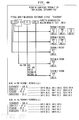
- Figure 5B is essentially a map of the layout of the word guessing dictionary 42 and a scheme for processing a string of DTMF tone digits to produce a guessed ASCII word.
- the guessed word is sent to the speaker 48 which produces an audio output to the sender 10.
- the map of Figure 5B proposes the ability of the look up function to find and guess words of size 2 to size 48 characters. In practice, most number combinations such as 22 have no words at all which correspond to them.
- the first task of the look up function is to remove trailing "one" digits which in this invention designate punctuation and the terminating # are counted. Then the look up function searches the base address table 42a to find the base address of the table for the word of the string size just counted. In the example used herein with regard to the word THE, the string is taken to be 843 which in the map diagram of Figure 5B will be found in the size 03 table 42d being at address BA03.
- a feasible, if somewhat inefficient method of finding the THE in response to an 843 string is to (1) find the base address of the size 03 table in the base address table 42a (this address is shown as BA03); (2) search table BA03 for colons; and (3) inspect the 3 digit number preceding each colon until the string 843 is encountered. Then, the right side of the colon will have acceptable word guesses for the string 843 in the sequence of their probability.
- the actual probability of a word does not necessarily appear in the tables of the word guessing dictionary 42 illustrated in Figure 5B. It is present only by the implication of the sequence of the word within a given n digit numeric entry.
- the sequence of the words within a given n digit numeric entry implies the relative, though not absolute, frequency of the word.
- Each word in turn, will be retrieved and sent to the speaker 48 for audio output to the caller 10.
- the caller 10 will accept or reject the guessed words. If the caller rejects VIE, the last word in the table for 843, then the system will shift to single letter mode and will announce the shift to the sender 10.
- the single letter mode is equivalent of guessing one digit strings.
- the size 01 table 42b at address BA01 is shown in diagram 5B. Note that the 26 letters of the alphabet are contained in the size 01 table 42b in the sequence of their probability within a given numeric digit.
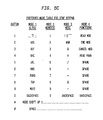
- Figure 5C discloses the mode arrangement choices for the DTMF multi-button pad.
- the DTMF keypad can be made to represent any number of different characters by a mode shift function analogous to the Figs/Lets key on a Telex keyboard.
- Figure 5C is an exemplary table of such an arrangement having four modes. Users of the system 100 would be supplied with overlays fitting over the DTMF keypad buttons. The overlay, or template, would display the mode arrangement choices.
- the 1 button represents the word terminators in addition to the # which means a space bar. After guessing the word, the prompter 36 will proceed to guess the terminator.
- the terminators are arranged in approximate order of their frequency. The terminators are, in order: period(.), comma(,), question mark(?), colon(:), and semicolon(;).
- the zero (0) button is always the mode shift "UP" 1 button.
- the mode shift is always UP - 1, 2, 3, 4 followed by 1.
- the shift is cyclic.
- the mode shift key is always available from any mode.
- the sender 10 or the prompter 36 may shift modes. Whenever either the sender 10 or the prompter 36 shifts modes, the prompter 36 will announce the new mode.
- the # is always the terminator button.
- buttons 1 and 2 have a collection of symbols of low expected usage. Note that there is a # followed by the ampersand (&) symbol on the 2 button in Mode 3 which is not to be confused with the # button meaning space.
- Special modes can be constructed for foreign languages.
- special tables can be constructed and saved on mass storage for closed user groups, i.e. a group of people or businesses with a particular set of communication requirements in common.
- closed user groups i.e. a group of people or businesses with a particular set of communication requirements in common.
- a national group of florists might have a special directory of numeric strings and their interpretation that might vary from that used by a casual user.
- a special numeric string might identify a special arrangement of flowers to be delivered at a particular location.
- each sender 10 will have his or her own unique subscriber identification number and password in order to access the alternative system similar to the manner in which conventional data base systems are accessed.
Landscapes
- Engineering & Computer Science (AREA)
- Computer Networks & Wireless Communication (AREA)
- Signal Processing (AREA)
- Telephonic Communication Services (AREA)
- Machine Translation (AREA)
Applications Claiming Priority (4)
| Application Number | Priority Date | Filing Date | Title |
|---|---|---|---|
| US07/126,630 US4866759A (en) | 1987-11-30 | 1987-11-30 | Packet network telecommunication system having access nodes with word guessing capability |
| US126630 | 1987-11-30 | ||
| US225266 | 1988-07-28 | ||
| US07/225,266 US5031206A (en) | 1987-11-30 | 1988-07-28 | Method and apparatus for identifying words entered on DTMF pushbuttons |
Publications (2)
| Publication Number | Publication Date |
|---|---|
| EP0319193A2 true EP0319193A2 (fr) | 1989-06-07 |
| EP0319193A3 EP0319193A3 (fr) | 1991-04-17 |
Family
ID=26824887
Family Applications (1)
| Application Number | Title | Priority Date | Filing Date |
|---|---|---|---|
| EP19880311080 Withdrawn EP0319193A3 (fr) | 1987-11-30 | 1988-11-23 | Procédé et dispositif pour l'identification de mots entrés par des boutons-poussoir de type DTMF |
Country Status (5)
| Country | Link |
|---|---|
| US (1) | US5031206A (fr) |
| EP (1) | EP0319193A3 (fr) |
| AU (1) | AU620359B2 (fr) |
| CA (1) | CA1296115C (fr) |
| FI (1) | FI885561A7 (fr) |
Cited By (37)
| Publication number | Priority date | Publication date | Assignee | Title |
|---|---|---|---|---|
| GB2298166A (en) * | 1995-01-31 | 1996-08-28 | Fujitsu Ltd | Single handed keyboard arrangement |
| DE19516856A1 (de) * | 1995-05-11 | 1996-11-14 | Rolf Uhlig | Verfahren und Vorrichtung zum Übertragen von alphanumerischen Nachrichten im Telefonleitungsnetz |
| WO1997005541A1 (fr) * | 1995-07-26 | 1997-02-13 | King Martin T | Systeme d'elimination des ambiguites d'un clavier reduit |
| GB2307822A (en) * | 1995-11-28 | 1997-06-04 | Intellprop Ltd | Text communication systems |
| WO1998016055A1 (fr) * | 1996-10-04 | 1998-04-16 | Intellprop Limited | Systemes de transmission de texte |
| US5818437A (en) * | 1995-07-26 | 1998-10-06 | Tegic Communications, Inc. | Reduced keyboard disambiguating computer |
| EP0848536A3 (fr) * | 1996-12-13 | 1999-03-17 | AT&T Corp. | Correction statistique des bases de données des numéros de compte utilisant la reconnaissance de la parole et des tonalités d'appel |
| US5952942A (en) * | 1996-11-21 | 1999-09-14 | Motorola, Inc. | Method and device for input of text messages from a keypad |
| US5953541A (en) * | 1997-01-24 | 1999-09-14 | Tegic Communications, Inc. | Disambiguating system for disambiguating ambiguous input sequences by displaying objects associated with the generated input sequences in the order of decreasing frequency of use |
| US6054941A (en) * | 1997-05-27 | 2000-04-25 | Motorola, Inc. | Apparatus and method for inputting ideographic characters |
| US6141661A (en) * | 1997-10-17 | 2000-10-31 | At&T Corp | Method and apparatus for performing a grammar-pruning operation |
| US6154579A (en) * | 1997-08-11 | 2000-11-28 | At&T Corp. | Confusion matrix based method and system for correcting misrecognized words appearing in documents generated by an optical character recognition technique |
| GB2353621A (en) * | 1998-08-26 | 2001-02-28 | Symtec Ltd | Selecting items |
| US6205428B1 (en) | 1997-11-20 | 2001-03-20 | At&T Corp. | Confusion set-base method and apparatus for pruning a predetermined arrangement of indexed identifiers |
| US6205261B1 (en) | 1998-02-05 | 2001-03-20 | At&T Corp. | Confusion set based method and system for correcting misrecognized words appearing in documents generated by an optical character recognition technique |
| US6219453B1 (en) | 1997-08-11 | 2001-04-17 | At&T Corp. | Method and apparatus for performing an automatic correction of misrecognized words produced by an optical character recognition technique by using a Hidden Markov Model based algorithm |
| US6223158B1 (en) | 1998-02-04 | 2001-04-24 | At&T Corporation | Statistical option generator for alpha-numeric pre-database speech recognition correction |
| US6400805B1 (en) | 1998-06-15 | 2002-06-04 | At&T Corp. | Statistical database correction of alphanumeric identifiers for speech recognition and touch-tone recognition |
| US6636162B1 (en) | 1998-12-04 | 2003-10-21 | America Online, Incorporated | Reduced keyboard text input system for the Japanese language |
| US6646573B1 (en) | 1998-12-04 | 2003-11-11 | America Online, Inc. | Reduced keyboard text input system for the Japanese language |
| RU2221268C2 (ru) * | 1996-06-10 | 2004-01-10 | Теджик Коммьюникейшнз, Инк. | Система устранения неоднозначности редуцированной клавиатуры |
| US6799303B2 (en) | 1999-01-26 | 2004-09-28 | Marvin R. Blumberg | Speed typing apparatus and method |
| EP1359515A3 (fr) * | 2002-05-02 | 2006-03-08 | Microsoft Corporation | Système et procédé de filtration de langage extrême-orientale |
| US7031925B1 (en) | 1998-06-15 | 2006-04-18 | At&T Corp. | Method and apparatus for creating customer specific dynamic grammars |
| GB2427322A (en) * | 2005-06-17 | 2006-12-20 | Mgt Plc | Predictive text string entry via telephone keypad |
| US7257528B1 (en) | 1998-02-13 | 2007-08-14 | Zi Corporation Of Canada, Inc. | Method and apparatus for Chinese character text input |
| WO2008116843A3 (fr) * | 2007-03-26 | 2009-01-29 | Frank Deinzer | Procédé de reconnaissance de mots dans des séquences de signes |
| US7630899B1 (en) | 1998-06-15 | 2009-12-08 | At&T Intellectual Property Ii, L.P. | Concise dynamic grammars using N-best selection |
| US7679534B2 (en) | 1998-12-04 | 2010-03-16 | Tegic Communications, Inc. | Contextual prediction of user words and user actions |
| US7712053B2 (en) | 1998-12-04 | 2010-05-04 | Tegic Communications, Inc. | Explicit character filtering of ambiguous text entry |
| US7720682B2 (en) | 1998-12-04 | 2010-05-18 | Tegic Communications, Inc. | Method and apparatus utilizing voice input to resolve ambiguous manually entered text input |
| US7881936B2 (en) | 1998-12-04 | 2011-02-01 | Tegic Communications, Inc. | Multimodal disambiguation of speech recognition |
| US8095364B2 (en) | 2004-06-02 | 2012-01-10 | Tegic Communications, Inc. | Multimodal disambiguation of speech recognition |
| USRE43082E1 (en) | 1998-12-10 | 2012-01-10 | Eatoni Ergonomics, Inc. | Touch-typable devices based on ambiguous codes and methods to design such devices |
| US8583440B2 (en) | 2002-06-20 | 2013-11-12 | Tegic Communications, Inc. | Apparatus and method for providing visual indication of character ambiguity during text entry |
| US8938688B2 (en) | 1998-12-04 | 2015-01-20 | Nuance Communications, Inc. | Contextual prediction of user words and user actions |
| US10152532B2 (en) | 2014-08-07 | 2018-12-11 | AT&T Interwise Ltd. | Method and system to associate meaningful expressions with abbreviated names |
Families Citing this family (58)
| Publication number | Priority date | Publication date | Assignee | Title |
|---|---|---|---|---|
| US5210689A (en) * | 1990-12-28 | 1993-05-11 | Semantic Compaction Systems | System and method for automatically selecting among a plurality of input modes |
| GB9220404D0 (en) * | 1992-08-20 | 1992-11-11 | Nat Security Agency | Method of identifying,retrieving and sorting documents |
| US5390240A (en) * | 1992-10-08 | 1995-02-14 | Williams Telecommunications Group, Inc. | Data dial system and method |
| US5442457A (en) * | 1993-01-11 | 1995-08-15 | Najafi; Hamid | Multi-line pooling facsimile apparatus |
| DE4436175B4 (de) * | 1993-10-12 | 2005-02-24 | Intel Corporation, Santa Clara | Vorrichtung zum Fernzugreifen auf einen Computer ausgehend von einem Telefonhandapparat |
| US7110520B1 (en) * | 1994-04-28 | 2006-09-19 | Metro One Telecommunications, Inc. | Method and system for directory assistance services |
| US5873032A (en) | 1994-04-28 | 1999-02-16 | Metro One Telecommunications, Inc. | Method and system for providing directory assistance services during attempt to complete customer or after call termination via an alphanumeric page |
| US5619563A (en) * | 1994-12-19 | 1997-04-08 | Lucent Technologies Inc. | Mnemonic number dialing plan |
| US6269171B1 (en) * | 1995-04-12 | 2001-07-31 | Lockheed Martin Corporation | Method for exploiting correlated mail streams using optical character recognition |
| US5828991A (en) * | 1995-06-30 | 1998-10-27 | The Research Foundation Of The State University Of New York | Sentence reconstruction using word ambiguity resolution |
| SE9503211L (sv) * | 1995-09-15 | 1997-03-16 | Telia Ab | Metod och anordning vid teckeninmatning |
| US5911485A (en) * | 1995-12-11 | 1999-06-15 | Unwired Planet, Inc. | Predictive data entry method for a keypad |
| US6473006B1 (en) | 1995-12-11 | 2002-10-29 | Openwave Systems Inc. | Method and apparatus for zoomed display of characters entered from a telephone keypad |
| US6072862A (en) * | 1996-07-02 | 2000-06-06 | Srinivasan; Thiru | Adaptable method and system for message delivery |
| US5813002A (en) * | 1996-07-31 | 1998-09-22 | International Business Machines Corporation | Method and system for linearly detecting data deviations in a large database |
| US6005495A (en) | 1997-02-27 | 1999-12-21 | Ameritech Corporation | Method and system for intelligent text entry on a numeric keypad |
| US6021180A (en) * | 1997-04-30 | 2000-02-01 | The Business Edge Group, Inc. | Processing of telecommunications transmissions and directing consumers to need providers |
| US6381633B2 (en) | 1997-05-09 | 2002-04-30 | Carmel Connection, Inc. | System and method for managing multimedia messaging platforms |
| JPH1117798A (ja) * | 1997-06-25 | 1999-01-22 | Matsushita Electric Ind Co Ltd | 選択呼出受信機 |
| US5903630A (en) * | 1997-06-30 | 1999-05-11 | Movo Media, Inc. | Method and apparatus for specifying alphanumeric information with a telephone keypad |
| US5963951A (en) * | 1997-06-30 | 1999-10-05 | Movo Media, Inc. | Computerized on-line dating service for searching and matching people |
| US6061681A (en) * | 1997-06-30 | 2000-05-09 | Movo Media, Inc. | On-line dating service for locating and matching people based on user-selected search criteria |
| US6094651A (en) * | 1997-08-22 | 2000-07-25 | International Business Machines Corporation | Discovery-driven exploration of OLAP data cubes |
| US6003029A (en) * | 1997-08-22 | 1999-12-14 | International Business Machines Corporation | Automatic subspace clustering of high dimensional data for data mining applications |
| US6385202B1 (en) * | 1997-10-01 | 2002-05-07 | At&T Corp. | Method and system for allowing access to traditional voice mail and interactive voice response systems over internet-like networks |
| US6104789A (en) * | 1997-12-29 | 2000-08-15 | U S West, Inc. | Method and system for transmitting text messages from a caller to a subscriber at an unknown address |
| US6118864A (en) * | 1997-12-31 | 2000-09-12 | Carmel Connection, Inc. | System and method for providing communication on a wide area network |
| US6226363B1 (en) | 1998-04-20 | 2001-05-01 | James H. Miller | Method and system for the recording and selective accessing of messages using a computer, a remote unit, and a public communication system |
| US6137867A (en) * | 1998-05-14 | 2000-10-24 | Motorola, Inc. | Alphanumeric message composing method using telephone keypad |
| US6052443A (en) * | 1998-05-14 | 2000-04-18 | Motorola | Alphanumeric message composing method using telephone keypad |
| US5974121A (en) * | 1998-05-14 | 1999-10-26 | Motorola, Inc. | Alphanumeric message composing method using telephone keypad |
| US6219731B1 (en) | 1998-12-10 | 2001-04-17 | Eaton: Ergonomics, Inc. | Method and apparatus for improved multi-tap text input |
| WO2001033409A2 (fr) * | 1999-11-01 | 2001-05-10 | Kurzweil Cyberart Technologies, Inc. | Systeme generateur de poesie informatise |
| US7447299B1 (en) * | 2000-05-02 | 2008-11-04 | Microsoft Corporation | Voice and telephone keypad based data entry for interacting with voice information services |
| US7369648B1 (en) | 2000-07-06 | 2008-05-06 | Purplecomm, Inc. | Apparatus and method for PBX-integrated unified messaging services on a switched backbone |
| US6553103B1 (en) | 2000-07-20 | 2003-04-22 | International Business Machines Corporation | Communication macro composer |
| US20060143007A1 (en) * | 2000-07-24 | 2006-06-29 | Koh V E | User interaction with voice information services |
| US7623648B1 (en) * | 2004-12-01 | 2009-11-24 | Tellme Networks, Inc. | Method and system of generating reference variations for directory assistance data |
| ATE460700T1 (de) | 2000-09-27 | 2010-03-15 | Eatoni Ergonomics Inc | Verfahren und vorrichtung für die beschleunigte eingabe von symbolen auf einem reduzierten tastenfeld |
| US6728348B2 (en) * | 2000-11-30 | 2004-04-27 | Comverse, Inc. | System for storing voice recognizable identifiers using a limited input device such as a telephone key pad |
| JP4084582B2 (ja) | 2001-04-27 | 2008-04-30 | 俊司 加藤 | タッチ式キー入力装置 |
| US7761175B2 (en) | 2001-09-27 | 2010-07-20 | Eatoni Ergonomics, Inc. | Method and apparatus for discoverable input of symbols on a reduced keypad |
| US7254227B2 (en) * | 2001-10-01 | 2007-08-07 | Inderpal Singh Mumick | Signal-based session management for telephonic applications |
| US7111248B2 (en) * | 2002-01-15 | 2006-09-19 | Openwave Systems Inc. | Alphanumeric information input method |
| US7386319B2 (en) * | 2003-01-08 | 2008-06-10 | Vtech Telecommunications Limited | System and method for two-way messaging between a personal computer and a cordless device including stereo |
| US8200865B2 (en) * | 2003-09-11 | 2012-06-12 | Eatoni Ergonomics, Inc. | Efficient method and apparatus for text entry based on trigger sequences |
| US7363224B2 (en) * | 2003-12-30 | 2008-04-22 | Microsoft Corporation | Method for entering text |
| US20050192802A1 (en) * | 2004-02-11 | 2005-09-01 | Alex Robinson | Handwriting and voice input with automatic correction |
| GB0406451D0 (en) | 2004-03-23 | 2004-04-28 | Patel Sanjay | Keyboards |
| JP3824168B2 (ja) * | 2004-11-08 | 2006-09-20 | 松下電器産業株式会社 | ディジタル映像再生装置 |
| US20080138135A1 (en) * | 2005-01-27 | 2008-06-12 | Howard Andrew Gutowitz | Typability Optimized Ambiguous Keyboards With Reduced Distortion |
| GB0505941D0 (en) * | 2005-03-23 | 2005-04-27 | Patel Sanjay | Human-to-mobile interfaces |
| GB0505942D0 (en) | 2005-03-23 | 2005-04-27 | Patel Sanjay | Human to mobile interfaces |
| US8296484B2 (en) * | 2006-03-30 | 2012-10-23 | Harris Corporation | Alphanumeric data entry apparatus and method using multicharacter keys of a keypad |
| US20080103772A1 (en) * | 2006-10-31 | 2008-05-01 | Duncan Bates | Character Prediction System |
| US8195448B2 (en) * | 2006-12-28 | 2012-06-05 | John Paisley Dargan | Method and apparatus for predicting text |
| US20160098781A1 (en) * | 2014-10-07 | 2016-04-07 | Sekhar Rao Balaga | Real time charging mechanism for purchasing a product |
| CN114722815B (zh) * | 2022-04-18 | 2025-08-01 | 上海喜马拉雅科技有限公司 | 词缀确定方法、装置、电子设备及存储介质 |
Family Cites Families (13)
| Publication number | Priority date | Publication date | Assignee | Title |
|---|---|---|---|---|
| US4307266A (en) * | 1978-08-14 | 1981-12-22 | Messina John D | Communication apparatus for the handicapped |
| JPS57196656A (en) * | 1981-05-28 | 1982-12-02 | Toshiba Corp | Telephone set for character input |
| US4427848B1 (en) * | 1981-12-29 | 1994-03-29 | Telephone Lottery Company Inc | Telephonic alphanumeric data transmission system |
| US4649563A (en) * | 1984-04-02 | 1987-03-10 | R L Associates | Method of and means for accessing computerized data bases utilizing a touch-tone telephone instrument |
| US4633041A (en) * | 1984-04-09 | 1986-12-30 | At&T Information Systems Inc. | Station set directory assistance arrangement |
| US4608457A (en) * | 1984-04-11 | 1986-08-26 | Fowler Stephen L | Telecommunications device for the hearing impared |
| US4650927A (en) * | 1984-11-29 | 1987-03-17 | International Business Machines Corporation | Processor-assisted communication system using tone-generating telephones |
| US4737980A (en) * | 1985-07-19 | 1988-04-12 | Amtelco | Computer data entry method and apparatus |
| US4677659A (en) * | 1985-09-03 | 1987-06-30 | John Dargan | Telephonic data access and transmission system |
| US4674112A (en) * | 1985-09-06 | 1987-06-16 | Board Of Regents, The University Of Texas System | Character pattern recognition and communications apparatus |
| US4817129A (en) * | 1987-03-05 | 1989-03-28 | Telac Corp. | Method of and means for accessing computerized data bases utilizing a touch-tone telephone instrument |
| US4757267A (en) * | 1987-06-17 | 1988-07-12 | Applied Telematics, Inc. | Telephone system for connecting a customer to a supplier of goods |
| US4866759A (en) * | 1987-11-30 | 1989-09-12 | Riskin Bernard N | Packet network telecommunication system having access nodes with word guessing capability |
-
1988
- 1988-07-28 US US07/225,266 patent/US5031206A/en not_active Expired - Fee Related
- 1988-11-23 EP EP19880311080 patent/EP0319193A3/fr not_active Withdrawn
- 1988-11-24 CA CA000584024A patent/CA1296115C/fr not_active Expired - Lifetime
- 1988-11-30 FI FI885561A patent/FI885561A7/fi not_active Application Discontinuation
- 1988-11-30 AU AU26370/88A patent/AU620359B2/en not_active Ceased
Cited By (55)
| Publication number | Priority date | Publication date | Assignee | Title |
|---|---|---|---|---|
| GB2298166B (en) * | 1995-01-31 | 1999-04-28 | Fujitsu Ltd | Data entry system |
| US5847697A (en) * | 1995-01-31 | 1998-12-08 | Fujitsu Limited | Single-handed keyboard having keys with multiple characters and character ambiguity resolution logic |
| GB2298166A (en) * | 1995-01-31 | 1996-08-28 | Fujitsu Ltd | Single handed keyboard arrangement |
| DE19516856A1 (de) * | 1995-05-11 | 1996-11-14 | Rolf Uhlig | Verfahren und Vorrichtung zum Übertragen von alphanumerischen Nachrichten im Telefonleitungsnetz |
| WO1997005541A1 (fr) * | 1995-07-26 | 1997-02-13 | King Martin T | Systeme d'elimination des ambiguites d'un clavier reduit |
| US6307549B1 (en) | 1995-07-26 | 2001-10-23 | Tegic Communications, Inc. | Reduced keyboard disambiguating system |
| US6011554A (en) * | 1995-07-26 | 2000-01-04 | Tegic Communications, Inc. | Reduced keyboard disambiguating system |
| US5818437A (en) * | 1995-07-26 | 1998-10-06 | Tegic Communications, Inc. | Reduced keyboard disambiguating computer |
| GB2307822A (en) * | 1995-11-28 | 1997-06-04 | Intellprop Ltd | Text communication systems |
| GB2307822B (en) * | 1995-11-28 | 1999-09-15 | Intellprop Ltd | Text communication systems |
| RU2221268C2 (ru) * | 1996-06-10 | 2004-01-10 | Теджик Коммьюникейшнз, Инк. | Система устранения неоднозначности редуцированной клавиатуры |
| WO1998016055A1 (fr) * | 1996-10-04 | 1998-04-16 | Intellprop Limited | Systemes de transmission de texte |
| US5952942A (en) * | 1996-11-21 | 1999-09-14 | Motorola, Inc. | Method and device for input of text messages from a keypad |
| US6137863A (en) * | 1996-12-13 | 2000-10-24 | At&T Corp. | Statistical database correction of alphanumeric account numbers for speech recognition and touch-tone recognition |
| EP0848536A3 (fr) * | 1996-12-13 | 1999-03-17 | AT&T Corp. | Correction statistique des bases de données des numéros de compte utilisant la reconnaissance de la parole et des tonalités d'appel |
| US5953541A (en) * | 1997-01-24 | 1999-09-14 | Tegic Communications, Inc. | Disambiguating system for disambiguating ambiguous input sequences by displaying objects associated with the generated input sequences in the order of decreasing frequency of use |
| US6054941A (en) * | 1997-05-27 | 2000-04-25 | Motorola, Inc. | Apparatus and method for inputting ideographic characters |
| US6154579A (en) * | 1997-08-11 | 2000-11-28 | At&T Corp. | Confusion matrix based method and system for correcting misrecognized words appearing in documents generated by an optical character recognition technique |
| US6219453B1 (en) | 1997-08-11 | 2001-04-17 | At&T Corp. | Method and apparatus for performing an automatic correction of misrecognized words produced by an optical character recognition technique by using a Hidden Markov Model based algorithm |
| US6141661A (en) * | 1997-10-17 | 2000-10-31 | At&T Corp | Method and apparatus for performing a grammar-pruning operation |
| US6205428B1 (en) | 1997-11-20 | 2001-03-20 | At&T Corp. | Confusion set-base method and apparatus for pruning a predetermined arrangement of indexed identifiers |
| US6223158B1 (en) | 1998-02-04 | 2001-04-24 | At&T Corporation | Statistical option generator for alpha-numeric pre-database speech recognition correction |
| US6205261B1 (en) | 1998-02-05 | 2001-03-20 | At&T Corp. | Confusion set based method and system for correcting misrecognized words appearing in documents generated by an optical character recognition technique |
| US7257528B1 (en) | 1998-02-13 | 2007-08-14 | Zi Corporation Of Canada, Inc. | Method and apparatus for Chinese character text input |
| US7031925B1 (en) | 1998-06-15 | 2006-04-18 | At&T Corp. | Method and apparatus for creating customer specific dynamic grammars |
| US6400805B1 (en) | 1998-06-15 | 2002-06-04 | At&T Corp. | Statistical database correction of alphanumeric identifiers for speech recognition and touch-tone recognition |
| US8682665B2 (en) | 1998-06-15 | 2014-03-25 | At&T Intellectual Property Ii, L.P. | Concise dynamic grammars using N-best selection |
| US7937260B1 (en) | 1998-06-15 | 2011-05-03 | At&T Intellectual Property Ii, L.P. | Concise dynamic grammars using N-best selection |
| US9286887B2 (en) | 1998-06-15 | 2016-03-15 | At&T Intellectual Property Ii, L.P. | Concise dynamic grammars using N-best selection |
| US7630899B1 (en) | 1998-06-15 | 2009-12-08 | At&T Intellectual Property Ii, L.P. | Concise dynamic grammars using N-best selection |
| GB2353621B (en) * | 1998-08-26 | 2004-05-05 | Symtec Ltd | Methods and devices enabling selection |
| GB2353621A (en) * | 1998-08-26 | 2001-02-28 | Symtec Ltd | Selecting items |
| US6636162B1 (en) | 1998-12-04 | 2003-10-21 | America Online, Incorporated | Reduced keyboard text input system for the Japanese language |
| US9626355B2 (en) | 1998-12-04 | 2017-04-18 | Nuance Communications, Inc. | Contextual prediction of user words and user actions |
| US7679534B2 (en) | 1998-12-04 | 2010-03-16 | Tegic Communications, Inc. | Contextual prediction of user words and user actions |
| US7712053B2 (en) | 1998-12-04 | 2010-05-04 | Tegic Communications, Inc. | Explicit character filtering of ambiguous text entry |
| US7720682B2 (en) | 1998-12-04 | 2010-05-18 | Tegic Communications, Inc. | Method and apparatus utilizing voice input to resolve ambiguous manually entered text input |
| US7881936B2 (en) | 1998-12-04 | 2011-02-01 | Tegic Communications, Inc. | Multimodal disambiguation of speech recognition |
| US6646573B1 (en) | 1998-12-04 | 2003-11-11 | America Online, Inc. | Reduced keyboard text input system for the Japanese language |
| US8938688B2 (en) | 1998-12-04 | 2015-01-20 | Nuance Communications, Inc. | Contextual prediction of user words and user actions |
| USRE43082E1 (en) | 1998-12-10 | 2012-01-10 | Eatoni Ergonomics, Inc. | Touch-typable devices based on ambiguous codes and methods to design such devices |
| US6799303B2 (en) | 1999-01-26 | 2004-09-28 | Marvin R. Blumberg | Speed typing apparatus and method |
| US8381137B2 (en) | 1999-12-03 | 2013-02-19 | Tegic Communications, Inc. | Explicit character filtering of ambiguous text entry |
| US8782568B2 (en) | 1999-12-03 | 2014-07-15 | Nuance Communications, Inc. | Explicit character filtering of ambiguous text entry |
| US8972905B2 (en) | 1999-12-03 | 2015-03-03 | Nuance Communications, Inc. | Explicit character filtering of ambiguous text entry |
| US8990738B2 (en) | 1999-12-03 | 2015-03-24 | Nuance Communications, Inc. | Explicit character filtering of ambiguous text entry |
| EP1359515A3 (fr) * | 2002-05-02 | 2006-03-08 | Microsoft Corporation | Système et procédé de filtration de langage extrême-orientale |
| US8583440B2 (en) | 2002-06-20 | 2013-11-12 | Tegic Communications, Inc. | Apparatus and method for providing visual indication of character ambiguity during text entry |
| US8606582B2 (en) | 2004-06-02 | 2013-12-10 | Tegic Communications, Inc. | Multimodal disambiguation of speech recognition |
| US8311829B2 (en) | 2004-06-02 | 2012-11-13 | Tegic Communications, Inc. | Multimodal disambiguation of speech recognition |
| US8095364B2 (en) | 2004-06-02 | 2012-01-10 | Tegic Communications, Inc. | Multimodal disambiguation of speech recognition |
| US9786273B2 (en) | 2004-06-02 | 2017-10-10 | Nuance Communications, Inc. | Multimodal disambiguation of speech recognition |
| GB2427322A (en) * | 2005-06-17 | 2006-12-20 | Mgt Plc | Predictive text string entry via telephone keypad |
| WO2008116843A3 (fr) * | 2007-03-26 | 2009-01-29 | Frank Deinzer | Procédé de reconnaissance de mots dans des séquences de signes |
| US10152532B2 (en) | 2014-08-07 | 2018-12-11 | AT&T Interwise Ltd. | Method and system to associate meaningful expressions with abbreviated names |
Also Published As
| Publication number | Publication date |
|---|---|
| FI885561A7 (fi) | 1989-05-31 |
| AU2637088A (en) | 1989-06-01 |
| FI885561A0 (fi) | 1988-11-30 |
| US5031206A (en) | 1991-07-09 |
| AU620359B2 (en) | 1992-02-20 |
| CA1296115C (fr) | 1992-02-18 |
| EP0319193A3 (fr) | 1991-04-17 |
Similar Documents
| Publication | Publication Date | Title |
|---|---|---|
| US5031206A (en) | Method and apparatus for identifying words entered on DTMF pushbuttons | |
| US4866759A (en) | Packet network telecommunication system having access nodes with word guessing capability | |
| US6580790B1 (en) | Calling assistance system and method | |
| US6014136A (en) | Data processing apparatus with communication function | |
| CN1197273C (zh) | 初始化进行调度呼叫的移动通信设备的方法 | |
| US20040024754A1 (en) | System and method for automatically processing a user's request by an automated assistant | |
| WO1996010795A1 (fr) | Systeme d'acces a une base de donnees | |
| US20030041068A1 (en) | System and method for creating and maintaining data records to improve accuracy thereof | |
| US6052443A (en) | Alphanumeric message composing method using telephone keypad | |
| US20040153444A1 (en) | Technique for effectively providing search results by an information assistance service | |
| Rau et al. | Dialing for documents: An experiment in information theory | |
| CN100461810C (zh) | 数字文本信息系统和方法 | |
| US6868145B1 (en) | Alphanumeric keyboard with telephone dialing capability | |
| US6137867A (en) | Alphanumeric message composing method using telephone keypad | |
| US5974121A (en) | Alphanumeric message composing method using telephone keypad | |
| KR20020079121A (ko) | 이동통신 단말기를 이용한 정보 검색 시스템과 그시스템을 이용한 정보 검색방법 | |
| CN1956579B (zh) | 便携式终端 | |
| JP2654629B2 (ja) | 文字入力用電話機システムおよび入力文字列とキーワードとの近似的一致方法 | |
| KR0183140B1 (ko) | 초성 자음을 이용한 음성정보 서비스 검색방법 | |
| GB2307822A (en) | Text communication systems | |
| JP2002183127A (ja) | ユーザ辞書生成登録システム、辞書サーバ、端末、ユーザ辞書生成方法、ユーザ辞書登録方法、ならびに、情報記録媒体 | |
| JP2001298540A (ja) | 音声受付・通知処理装置 | |
| JPH0216623B2 (fr) | ||
| KR100205955B1 (ko) | 전화버튼을 이용한 문자 처리 방법 | |
| KR100427225B1 (ko) | 훈민정음의 기본 자음에 의한 문자열 검색장치 |
Legal Events
| Date | Code | Title | Description |
|---|---|---|---|
| PUAI | Public reference made under article 153(3) epc to a published international application that has entered the european phase |
Free format text: ORIGINAL CODE: 0009012 |
|
| AK | Designated contracting states |
Kind code of ref document: A2 Designated state(s): AT BE CH DE ES FR GB GR IT LI LU NL SE |
|
| PUAL | Search report despatched |
Free format text: ORIGINAL CODE: 0009013 |
|
| AK | Designated contracting states |
Kind code of ref document: A3 Designated state(s): AT BE CH DE ES FR GB GR IT LI LU NL SE |
|
| 17P | Request for examination filed |
Effective date: 19911107 |
|
| STAA | Information on the status of an ep patent application or granted ep patent |
Free format text: STATUS: THE APPLICATION IS DEEMED TO BE WITHDRAWN |
|
| 18D | Application deemed to be withdrawn |
Effective date: 19930602 |