EP0319201A2 - Elektrorheologische Flüssigkeiten - Google Patents
Elektrorheologische Flüssigkeiten Download PDFInfo
- Publication number
- EP0319201A2 EP0319201A2 EP88311167A EP88311167A EP0319201A2 EP 0319201 A2 EP0319201 A2 EP 0319201A2 EP 88311167 A EP88311167 A EP 88311167A EP 88311167 A EP88311167 A EP 88311167A EP 0319201 A2 EP0319201 A2 EP 0319201A2
- Authority
- EP
- European Patent Office
- Prior art keywords
- fluid
- suspension
- lithium
- electrorheological
- admixing
- Prior art date
- Legal status (The legal status is an assumption and is not a legal conclusion. Google has not performed a legal analysis and makes no representation as to the accuracy of the status listed.)
- Withdrawn
Links
- 239000012530 fluid Substances 0.000 title claims abstract description 147
- KVIDBZSKFOMSBM-UHFFFAOYSA-M lithium;aminoazanium;sulfate Chemical compound [Li+].[NH3+]N.[O-]S([O-])(=O)=O KVIDBZSKFOMSBM-UHFFFAOYSA-M 0.000 claims abstract description 50
- XLYOFNOQVPJJNP-UHFFFAOYSA-N water Substances O XLYOFNOQVPJJNP-UHFFFAOYSA-N 0.000 claims abstract description 42
- 239000003381 stabilizer Substances 0.000 claims abstract description 40
- 239000000725 suspension Substances 0.000 claims abstract description 27
- 229920002545 silicone oil Polymers 0.000 claims abstract description 23
- 230000036571 hydration Effects 0.000 claims abstract description 9
- 238000006703 hydration reaction Methods 0.000 claims abstract description 9
- 239000002245 particle Substances 0.000 claims description 50
- 239000012071 phase Substances 0.000 claims description 36
- 239000007788 liquid Substances 0.000 claims description 25
- 239000013078 crystal Substances 0.000 claims description 16
- 239000000463 material Substances 0.000 claims description 16
- 238000000034 method Methods 0.000 claims description 12
- 239000003921 oil Substances 0.000 claims description 12
- 230000010287 polarization Effects 0.000 claims description 9
- 239000002178 crystalline material Substances 0.000 claims description 8
- 230000009974 thixotropic effect Effects 0.000 claims description 7
- 235000013870 dimethyl polysiloxane Nutrition 0.000 claims description 5
- 239000007791 liquid phase Substances 0.000 claims description 5
- 229920000435 poly(dimethylsiloxane) Polymers 0.000 claims description 5
- 229920001400 block copolymer Polymers 0.000 claims description 4
- 239000004205 dimethyl polysiloxane Substances 0.000 claims description 4
- 239000002480 mineral oil Substances 0.000 claims description 4
- 125000003118 aryl group Chemical group 0.000 claims description 3
- 229920000578 graft copolymer Polymers 0.000 claims description 3
- 239000012188 paraffin wax Substances 0.000 claims description 3
- 229920000570 polyether Polymers 0.000 claims description 3
- 230000002209 hydrophobic effect Effects 0.000 claims description 2
- 239000011343 solid material Substances 0.000 claims description 2
- 239000011236 particulate material Substances 0.000 claims 3
- WHXSMMKQMYFTQS-UHFFFAOYSA-N Lithium Chemical compound [Li] WHXSMMKQMYFTQS-UHFFFAOYSA-N 0.000 claims 2
- QAOWNCQODCNURD-UHFFFAOYSA-L Sulfate Chemical compound [O-]S([O-])(=O)=O QAOWNCQODCNURD-UHFFFAOYSA-L 0.000 claims 2
- 229910052744 lithium Inorganic materials 0.000 claims 2
- 239000010692 aromatic oil Substances 0.000 claims 1
- 229910052500 inorganic mineral Inorganic materials 0.000 claims 1
- 239000012212 insulator Substances 0.000 claims 1
- 239000011707 mineral Substances 0.000 claims 1
- 125000002924 primary amino group Chemical group [H]N([H])* 0.000 claims 1
- 230000000694 effects Effects 0.000 description 27
- 230000005684 electric field Effects 0.000 description 23
- 230000035882 stress Effects 0.000 description 16
- 230000004044 response Effects 0.000 description 12
- 239000000499 gel Substances 0.000 description 10
- 239000002270 dispersing agent Substances 0.000 description 8
- 239000007787 solid Substances 0.000 description 8
- 230000001965 increasing effect Effects 0.000 description 7
- -1 polydimethylsiloxane Polymers 0.000 description 7
- 239000000843 powder Substances 0.000 description 7
- 239000013049 sediment Substances 0.000 description 7
- 239000000126 substance Substances 0.000 description 6
- 230000007423 decrease Effects 0.000 description 5
- 238000005189 flocculation Methods 0.000 description 5
- 230000016615 flocculation Effects 0.000 description 5
- 239000000203 mixture Substances 0.000 description 5
- 238000001179 sorption measurement Methods 0.000 description 5
- 239000004094 surface-active agent Substances 0.000 description 5
- CURLTUGMZLYLDI-UHFFFAOYSA-N Carbon dioxide Chemical compound O=C=O CURLTUGMZLYLDI-UHFFFAOYSA-N 0.000 description 4
- 230000008859 change Effects 0.000 description 4
- 238000006243 chemical reaction Methods 0.000 description 4
- 239000004519 grease Substances 0.000 description 4
- 229920001519 homopolymer Polymers 0.000 description 4
- 150000002500 ions Chemical class 0.000 description 4
- GWEVSGVZZGPLCZ-UHFFFAOYSA-N Titan oxide Chemical compound O=[Ti]=O GWEVSGVZZGPLCZ-UHFFFAOYSA-N 0.000 description 3
- 238000004458 analytical method Methods 0.000 description 3
- 230000015572 biosynthetic process Effects 0.000 description 3
- 150000001875 compounds Chemical class 0.000 description 3
- XGZVUEUWXADBQD-UHFFFAOYSA-L lithium carbonate Chemical compound [Li+].[Li+].[O-]C([O-])=O XGZVUEUWXADBQD-UHFFFAOYSA-L 0.000 description 3
- 235000013336 milk Nutrition 0.000 description 3
- 239000008267 milk Substances 0.000 description 3
- 210000004080 milk Anatomy 0.000 description 3
- FUSNOPLQVRUIIM-UHFFFAOYSA-N 4-amino-2-(4,4-dimethyl-2-oxoimidazolidin-1-yl)-n-[3-(trifluoromethyl)phenyl]pyrimidine-5-carboxamide Chemical compound O=C1NC(C)(C)CN1C(N=C1N)=NC=C1C(=O)NC1=CC=CC(C(F)(F)F)=C1 FUSNOPLQVRUIIM-UHFFFAOYSA-N 0.000 description 2
- IJGRMHOSHXDMSA-UHFFFAOYSA-N Atomic nitrogen Chemical compound N#N IJGRMHOSHXDMSA-UHFFFAOYSA-N 0.000 description 2
- VYPSYNLAJGMNEJ-UHFFFAOYSA-N Silicium dioxide Chemical compound O=[Si]=O VYPSYNLAJGMNEJ-UHFFFAOYSA-N 0.000 description 2
- 239000012190 activator Substances 0.000 description 2
- 230000032683 aging Effects 0.000 description 2
- 238000013019 agitation Methods 0.000 description 2
- 230000004888 barrier function Effects 0.000 description 2
- 230000008901 benefit Effects 0.000 description 2
- 229910002092 carbon dioxide Inorganic materials 0.000 description 2
- 230000015556 catabolic process Effects 0.000 description 2
- 239000004020 conductor Substances 0.000 description 2
- 229920001577 copolymer Polymers 0.000 description 2
- 239000007789 gas Substances 0.000 description 2
- XLYOFNOQVPJJNP-ZSJDYOACSA-N heavy water Substances [2H]O[2H] XLYOFNOQVPJJNP-ZSJDYOACSA-N 0.000 description 2
- 229910000377 hydrazine sulfate Inorganic materials 0.000 description 2
- 239000012493 hydrazine sulfate Substances 0.000 description 2
- OAKJQQAXSVQMHS-UHFFFAOYSA-O hydrazinium(1+) Chemical compound [NH3+]N OAKJQQAXSVQMHS-UHFFFAOYSA-O 0.000 description 2
- 229910052808 lithium carbonate Inorganic materials 0.000 description 2
- 230000007246 mechanism Effects 0.000 description 2
- 238000002156 mixing Methods 0.000 description 2
- 229920000642 polymer Polymers 0.000 description 2
- 239000000523 sample Substances 0.000 description 2
- 239000004065 semiconductor Substances 0.000 description 2
- 230000006641 stabilisation Effects 0.000 description 2
- 238000011105 stabilization Methods 0.000 description 2
- RELMFMZEBKVZJC-UHFFFAOYSA-N 1,2,3-trichlorobenzene Chemical class ClC1=CC=CC(Cl)=C1Cl RELMFMZEBKVZJC-UHFFFAOYSA-N 0.000 description 1
- LWCVWGNRFYSORH-UHFFFAOYSA-N BBBBBBB Chemical compound BBBBBBB LWCVWGNRFYSORH-UHFFFAOYSA-N 0.000 description 1
- 230000005653 Brownian motion process Effects 0.000 description 1
- PYGXAGIECVVIOZ-UHFFFAOYSA-N Dibutyl decanedioate Chemical compound CCCCOC(=O)CCCCCCCCC(=O)OCCCC PYGXAGIECVVIOZ-UHFFFAOYSA-N 0.000 description 1
- DLTRKOONGHEXQY-UHFFFAOYSA-N NN.[Li+] Chemical compound NN.[Li+] DLTRKOONGHEXQY-UHFFFAOYSA-N 0.000 description 1
- 229920002472 Starch Polymers 0.000 description 1
- 238000010521 absorption reaction Methods 0.000 description 1
- 239000003463 adsorbent Substances 0.000 description 1
- XAGFODPZIPBFFR-UHFFFAOYSA-N aluminium Chemical compound [Al] XAGFODPZIPBFFR-UHFFFAOYSA-N 0.000 description 1
- 229910052782 aluminium Inorganic materials 0.000 description 1
- 235000010290 biphenyl Nutrition 0.000 description 1
- 150000004074 biphenyls Chemical class 0.000 description 1
- 238000005537 brownian motion Methods 0.000 description 1
- 239000001569 carbon dioxide Substances 0.000 description 1
- 239000002800 charge carrier Substances 0.000 description 1
- 238000001246 colloidal dispersion Methods 0.000 description 1
- 230000007547 defect Effects 0.000 description 1
- 238000006731 degradation reaction Methods 0.000 description 1
- 239000006185 dispersion Substances 0.000 description 1
- 238000006073 displacement reaction Methods 0.000 description 1
- 239000012153 distilled water Substances 0.000 description 1
- 230000005611 electricity Effects 0.000 description 1
- 238000005370 electroosmosis Methods 0.000 description 1
- 238000011156 evaluation Methods 0.000 description 1
- 230000001747 exhibiting effect Effects 0.000 description 1
- 239000003292 glue Substances 0.000 description 1
- 230000005484 gravity Effects 0.000 description 1
- 238000000227 grinding Methods 0.000 description 1
- 230000001939 inductive effect Effects 0.000 description 1
- 238000009413 insulation Methods 0.000 description 1
- 238000011835 investigation Methods 0.000 description 1
- 230000001788 irregular Effects 0.000 description 1
- 238000004519 manufacturing process Methods 0.000 description 1
- 238000002844 melting Methods 0.000 description 1
- 230000008018 melting Effects 0.000 description 1
- 230000005012 migration Effects 0.000 description 1
- 238000013508 migration Methods 0.000 description 1
- 235000010446 mineral oil Nutrition 0.000 description 1
- 229910052757 nitrogen Inorganic materials 0.000 description 1
- 238000012856 packing Methods 0.000 description 1
- 239000003973 paint Substances 0.000 description 1
- 230000035515 penetration Effects 0.000 description 1
- RVZRBWKZFJCCIB-UHFFFAOYSA-N perfluorotributylamine Chemical compound FC(F)(F)C(F)(F)C(F)(F)C(F)(F)N(C(F)(F)C(F)(F)C(F)(F)C(F)(F)F)C(F)(F)C(F)(F)C(F)(F)C(F)(F)F RVZRBWKZFJCCIB-UHFFFAOYSA-N 0.000 description 1
- 238000005191 phase separation Methods 0.000 description 1
- 239000000049 pigment Substances 0.000 description 1
- 230000008569 process Effects 0.000 description 1
- 230000002441 reversible effect Effects 0.000 description 1
- 238000000518 rheometry Methods 0.000 description 1
- 150000003839 salts Chemical class 0.000 description 1
- 230000035945 sensitivity Effects 0.000 description 1
- 238000010008 shearing Methods 0.000 description 1
- 239000000377 silicon dioxide Substances 0.000 description 1
- 239000002904 solvent Substances 0.000 description 1
- 239000006076 specific stabilizer Substances 0.000 description 1
- 235000019698 starch Nutrition 0.000 description 1
- 239000008107 starch Substances 0.000 description 1
- 238000003756 stirring Methods 0.000 description 1
- 238000009662 stress testing Methods 0.000 description 1
- 238000012360 testing method Methods 0.000 description 1
- 239000004408 titanium dioxide Substances 0.000 description 1
- 238000013519 translation Methods 0.000 description 1
- 230000003442 weekly effect Effects 0.000 description 1
Images
Classifications
-
- C—CHEMISTRY; METALLURGY
- C10—PETROLEUM, GAS OR COKE INDUSTRIES; TECHNICAL GASES CONTAINING CARBON MONOXIDE; FUELS; LUBRICANTS; PEAT
- C10M—LUBRICATING COMPOSITIONS; USE OF CHEMICAL SUBSTANCES EITHER ALONE OR AS LUBRICATING INGREDIENTS IN A LUBRICATING COMPOSITION
- C10M169/00—Lubricating compositions characterised by containing as components a mixture of at least two types of ingredient selected from base-materials, thickeners or additives, covered by the preceding groups, each of these compounds being essential
- C10M169/04—Mixtures of base-materials and additives
-
- C—CHEMISTRY; METALLURGY
- C10—PETROLEUM, GAS OR COKE INDUSTRIES; TECHNICAL GASES CONTAINING CARBON MONOXIDE; FUELS; LUBRICANTS; PEAT
- C10M—LUBRICATING COMPOSITIONS; USE OF CHEMICAL SUBSTANCES EITHER ALONE OR AS LUBRICATING INGREDIENTS IN A LUBRICATING COMPOSITION
- C10M107/00—Lubricating compositions characterised by the base-material being a macromolecular compound
- C10M107/50—Lubricating compositions characterised by the base-material being a macromolecular compound containing silicon
-
- C—CHEMISTRY; METALLURGY
- C10—PETROLEUM, GAS OR COKE INDUSTRIES; TECHNICAL GASES CONTAINING CARBON MONOXIDE; FUELS; LUBRICANTS; PEAT
- C10M—LUBRICATING COMPOSITIONS; USE OF CHEMICAL SUBSTANCES EITHER ALONE OR AS LUBRICATING INGREDIENTS IN A LUBRICATING COMPOSITION
- C10M125/00—Lubricating compositions characterised by the additive being an inorganic material
- C10M125/20—Compounds containing nitrogen
-
- C—CHEMISTRY; METALLURGY
- C10—PETROLEUM, GAS OR COKE INDUSTRIES; TECHNICAL GASES CONTAINING CARBON MONOXIDE; FUELS; LUBRICANTS; PEAT
- C10M—LUBRICATING COMPOSITIONS; USE OF CHEMICAL SUBSTANCES EITHER ALONE OR AS LUBRICATING INGREDIENTS IN A LUBRICATING COMPOSITION
- C10M171/00—Lubricating compositions characterised by purely physical criteria, e.g. containing as base-material, thickener or additive, ingredients which are characterised exclusively by their numerically specified physical properties, i.e. containing ingredients which are physically well-defined but for which the chemical nature is either unspecified or only very vaguely indicated
- C10M171/001—Electrorheological fluids; smart fluids
-
- C—CHEMISTRY; METALLURGY
- C10—PETROLEUM, GAS OR COKE INDUSTRIES; TECHNICAL GASES CONTAINING CARBON MONOXIDE; FUELS; LUBRICANTS; PEAT
- C10M—LUBRICATING COMPOSITIONS; USE OF CHEMICAL SUBSTANCES EITHER ALONE OR AS LUBRICATING INGREDIENTS IN A LUBRICATING COMPOSITION
- C10M2201/00—Inorganic compounds or elements as ingredients in lubricant compositions
-
- C—CHEMISTRY; METALLURGY
- C10—PETROLEUM, GAS OR COKE INDUSTRIES; TECHNICAL GASES CONTAINING CARBON MONOXIDE; FUELS; LUBRICANTS; PEAT
- C10M—LUBRICATING COMPOSITIONS; USE OF CHEMICAL SUBSTANCES EITHER ALONE OR AS LUBRICATING INGREDIENTS IN A LUBRICATING COMPOSITION
- C10M2201/00—Inorganic compounds or elements as ingredients in lubricant compositions
- C10M2201/06—Metal compounds
- C10M2201/061—Carbides; Hydrides; Nitrides
-
- C—CHEMISTRY; METALLURGY
- C10—PETROLEUM, GAS OR COKE INDUSTRIES; TECHNICAL GASES CONTAINING CARBON MONOXIDE; FUELS; LUBRICANTS; PEAT
- C10M—LUBRICATING COMPOSITIONS; USE OF CHEMICAL SUBSTANCES EITHER ALONE OR AS LUBRICATING INGREDIENTS IN A LUBRICATING COMPOSITION
- C10M2201/00—Inorganic compounds or elements as ingredients in lubricant compositions
- C10M2201/08—Inorganic acids or salts thereof
-
- C—CHEMISTRY; METALLURGY
- C10—PETROLEUM, GAS OR COKE INDUSTRIES; TECHNICAL GASES CONTAINING CARBON MONOXIDE; FUELS; LUBRICANTS; PEAT
- C10M—LUBRICATING COMPOSITIONS; USE OF CHEMICAL SUBSTANCES EITHER ALONE OR AS LUBRICATING INGREDIENTS IN A LUBRICATING COMPOSITION
- C10M2201/00—Inorganic compounds or elements as ingredients in lubricant compositions
- C10M2201/08—Inorganic acids or salts thereof
- C10M2201/081—Inorganic acids or salts thereof containing halogen
-
- C—CHEMISTRY; METALLURGY
- C10—PETROLEUM, GAS OR COKE INDUSTRIES; TECHNICAL GASES CONTAINING CARBON MONOXIDE; FUELS; LUBRICANTS; PEAT
- C10M—LUBRICATING COMPOSITIONS; USE OF CHEMICAL SUBSTANCES EITHER ALONE OR AS LUBRICATING INGREDIENTS IN A LUBRICATING COMPOSITION
- C10M2201/00—Inorganic compounds or elements as ingredients in lubricant compositions
- C10M2201/08—Inorganic acids or salts thereof
- C10M2201/082—Inorganic acids or salts thereof containing nitrogen
-
- C—CHEMISTRY; METALLURGY
- C10—PETROLEUM, GAS OR COKE INDUSTRIES; TECHNICAL GASES CONTAINING CARBON MONOXIDE; FUELS; LUBRICANTS; PEAT
- C10M—LUBRICATING COMPOSITIONS; USE OF CHEMICAL SUBSTANCES EITHER ALONE OR AS LUBRICATING INGREDIENTS IN A LUBRICATING COMPOSITION
- C10M2201/00—Inorganic compounds or elements as ingredients in lubricant compositions
- C10M2201/08—Inorganic acids or salts thereof
- C10M2201/082—Inorganic acids or salts thereof containing nitrogen
- C10M2201/083—Inorganic acids or salts thereof containing nitrogen nitrites
-
- C—CHEMISTRY; METALLURGY
- C10—PETROLEUM, GAS OR COKE INDUSTRIES; TECHNICAL GASES CONTAINING CARBON MONOXIDE; FUELS; LUBRICANTS; PEAT
- C10M—LUBRICATING COMPOSITIONS; USE OF CHEMICAL SUBSTANCES EITHER ALONE OR AS LUBRICATING INGREDIENTS IN A LUBRICATING COMPOSITION
- C10M2201/00—Inorganic compounds or elements as ingredients in lubricant compositions
- C10M2201/08—Inorganic acids or salts thereof
- C10M2201/084—Inorganic acids or salts thereof containing sulfur, selenium or tellurium
-
- C—CHEMISTRY; METALLURGY
- C10—PETROLEUM, GAS OR COKE INDUSTRIES; TECHNICAL GASES CONTAINING CARBON MONOXIDE; FUELS; LUBRICANTS; PEAT
- C10M—LUBRICATING COMPOSITIONS; USE OF CHEMICAL SUBSTANCES EITHER ALONE OR AS LUBRICATING INGREDIENTS IN A LUBRICATING COMPOSITION
- C10M2201/00—Inorganic compounds or elements as ingredients in lubricant compositions
- C10M2201/16—Carbon dioxide
-
- C—CHEMISTRY; METALLURGY
- C10—PETROLEUM, GAS OR COKE INDUSTRIES; TECHNICAL GASES CONTAINING CARBON MONOXIDE; FUELS; LUBRICANTS; PEAT
- C10M—LUBRICATING COMPOSITIONS; USE OF CHEMICAL SUBSTANCES EITHER ALONE OR AS LUBRICATING INGREDIENTS IN A LUBRICATING COMPOSITION
- C10M2201/00—Inorganic compounds or elements as ingredients in lubricant compositions
- C10M2201/18—Ammonia
-
- C—CHEMISTRY; METALLURGY
- C10—PETROLEUM, GAS OR COKE INDUSTRIES; TECHNICAL GASES CONTAINING CARBON MONOXIDE; FUELS; LUBRICANTS; PEAT
- C10M—LUBRICATING COMPOSITIONS; USE OF CHEMICAL SUBSTANCES EITHER ALONE OR AS LUBRICATING INGREDIENTS IN A LUBRICATING COMPOSITION
- C10M2229/00—Organic macromolecular compounds containing atoms of elements not provided for in groups C10M2205/00, C10M2209/00, C10M2213/00, C10M2217/00, C10M2221/00 or C10M2225/00 as ingredients in lubricant compositions
- C10M2229/02—Unspecified siloxanes; Silicones
-
- C—CHEMISTRY; METALLURGY
- C10—PETROLEUM, GAS OR COKE INDUSTRIES; TECHNICAL GASES CONTAINING CARBON MONOXIDE; FUELS; LUBRICANTS; PEAT
- C10M—LUBRICATING COMPOSITIONS; USE OF CHEMICAL SUBSTANCES EITHER ALONE OR AS LUBRICATING INGREDIENTS IN A LUBRICATING COMPOSITION
- C10M2229/00—Organic macromolecular compounds containing atoms of elements not provided for in groups C10M2205/00, C10M2209/00, C10M2213/00, C10M2217/00, C10M2221/00 or C10M2225/00 as ingredients in lubricant compositions
- C10M2229/02—Unspecified siloxanes; Silicones
- C10M2229/025—Unspecified siloxanes; Silicones used as base material
-
- C—CHEMISTRY; METALLURGY
- C10—PETROLEUM, GAS OR COKE INDUSTRIES; TECHNICAL GASES CONTAINING CARBON MONOXIDE; FUELS; LUBRICANTS; PEAT
- C10M—LUBRICATING COMPOSITIONS; USE OF CHEMICAL SUBSTANCES EITHER ALONE OR AS LUBRICATING INGREDIENTS IN A LUBRICATING COMPOSITION
- C10M2229/00—Organic macromolecular compounds containing atoms of elements not provided for in groups C10M2205/00, C10M2209/00, C10M2213/00, C10M2217/00, C10M2221/00 or C10M2225/00 as ingredients in lubricant compositions
- C10M2229/04—Siloxanes with specific structure
- C10M2229/0405—Siloxanes with specific structure used as base material
-
- C—CHEMISTRY; METALLURGY
- C10—PETROLEUM, GAS OR COKE INDUSTRIES; TECHNICAL GASES CONTAINING CARBON MONOXIDE; FUELS; LUBRICANTS; PEAT
- C10M—LUBRICATING COMPOSITIONS; USE OF CHEMICAL SUBSTANCES EITHER ALONE OR AS LUBRICATING INGREDIENTS IN A LUBRICATING COMPOSITION
- C10M2229/00—Organic macromolecular compounds containing atoms of elements not provided for in groups C10M2205/00, C10M2209/00, C10M2213/00, C10M2217/00, C10M2221/00 or C10M2225/00 as ingredients in lubricant compositions
- C10M2229/04—Siloxanes with specific structure
- C10M2229/041—Siloxanes with specific structure containing aliphatic substituents
- C10M2229/0415—Siloxanes with specific structure containing aliphatic substituents used as base material
-
- C—CHEMISTRY; METALLURGY
- C10—PETROLEUM, GAS OR COKE INDUSTRIES; TECHNICAL GASES CONTAINING CARBON MONOXIDE; FUELS; LUBRICANTS; PEAT
- C10M—LUBRICATING COMPOSITIONS; USE OF CHEMICAL SUBSTANCES EITHER ALONE OR AS LUBRICATING INGREDIENTS IN A LUBRICATING COMPOSITION
- C10M2229/00—Organic macromolecular compounds containing atoms of elements not provided for in groups C10M2205/00, C10M2209/00, C10M2213/00, C10M2217/00, C10M2221/00 or C10M2225/00 as ingredients in lubricant compositions
- C10M2229/04—Siloxanes with specific structure
- C10M2229/042—Siloxanes with specific structure containing aromatic substituents
- C10M2229/0425—Siloxanes with specific structure containing aromatic substituents used as base material
-
- C—CHEMISTRY; METALLURGY
- C10—PETROLEUM, GAS OR COKE INDUSTRIES; TECHNICAL GASES CONTAINING CARBON MONOXIDE; FUELS; LUBRICANTS; PEAT
- C10M—LUBRICATING COMPOSITIONS; USE OF CHEMICAL SUBSTANCES EITHER ALONE OR AS LUBRICATING INGREDIENTS IN A LUBRICATING COMPOSITION
- C10M2229/00—Organic macromolecular compounds containing atoms of elements not provided for in groups C10M2205/00, C10M2209/00, C10M2213/00, C10M2217/00, C10M2221/00 or C10M2225/00 as ingredients in lubricant compositions
- C10M2229/04—Siloxanes with specific structure
- C10M2229/043—Siloxanes with specific structure containing carbon-to-carbon double bonds
- C10M2229/0435—Siloxanes with specific structure containing carbon-to-carbon double bonds used as base material
-
- C—CHEMISTRY; METALLURGY
- C10—PETROLEUM, GAS OR COKE INDUSTRIES; TECHNICAL GASES CONTAINING CARBON MONOXIDE; FUELS; LUBRICANTS; PEAT
- C10M—LUBRICATING COMPOSITIONS; USE OF CHEMICAL SUBSTANCES EITHER ALONE OR AS LUBRICATING INGREDIENTS IN A LUBRICATING COMPOSITION
- C10M2229/00—Organic macromolecular compounds containing atoms of elements not provided for in groups C10M2205/00, C10M2209/00, C10M2213/00, C10M2217/00, C10M2221/00 or C10M2225/00 as ingredients in lubricant compositions
- C10M2229/04—Siloxanes with specific structure
- C10M2229/044—Siloxanes with specific structure containing silicon-to-hydrogen bonds
- C10M2229/0445—Siloxanes with specific structure containing silicon-to-hydrogen bonds used as base material
-
- C—CHEMISTRY; METALLURGY
- C10—PETROLEUM, GAS OR COKE INDUSTRIES; TECHNICAL GASES CONTAINING CARBON MONOXIDE; FUELS; LUBRICANTS; PEAT
- C10M—LUBRICATING COMPOSITIONS; USE OF CHEMICAL SUBSTANCES EITHER ALONE OR AS LUBRICATING INGREDIENTS IN A LUBRICATING COMPOSITION
- C10M2229/00—Organic macromolecular compounds containing atoms of elements not provided for in groups C10M2205/00, C10M2209/00, C10M2213/00, C10M2217/00, C10M2221/00 or C10M2225/00 as ingredients in lubricant compositions
- C10M2229/04—Siloxanes with specific structure
- C10M2229/045—Siloxanes with specific structure containing silicon-to-hydroxyl bonds
- C10M2229/0455—Siloxanes with specific structure containing silicon-to-hydroxyl bonds used as base material
-
- C—CHEMISTRY; METALLURGY
- C10—PETROLEUM, GAS OR COKE INDUSTRIES; TECHNICAL GASES CONTAINING CARBON MONOXIDE; FUELS; LUBRICANTS; PEAT
- C10M—LUBRICATING COMPOSITIONS; USE OF CHEMICAL SUBSTANCES EITHER ALONE OR AS LUBRICATING INGREDIENTS IN A LUBRICATING COMPOSITION
- C10M2229/00—Organic macromolecular compounds containing atoms of elements not provided for in groups C10M2205/00, C10M2209/00, C10M2213/00, C10M2217/00, C10M2221/00 or C10M2225/00 as ingredients in lubricant compositions
- C10M2229/04—Siloxanes with specific structure
- C10M2229/046—Siloxanes with specific structure containing silicon-oxygen-carbon bonds
- C10M2229/0465—Siloxanes with specific structure containing silicon-oxygen-carbon bonds used as base material
-
- C—CHEMISTRY; METALLURGY
- C10—PETROLEUM, GAS OR COKE INDUSTRIES; TECHNICAL GASES CONTAINING CARBON MONOXIDE; FUELS; LUBRICANTS; PEAT
- C10M—LUBRICATING COMPOSITIONS; USE OF CHEMICAL SUBSTANCES EITHER ALONE OR AS LUBRICATING INGREDIENTS IN A LUBRICATING COMPOSITION
- C10M2229/00—Organic macromolecular compounds containing atoms of elements not provided for in groups C10M2205/00, C10M2209/00, C10M2213/00, C10M2217/00, C10M2221/00 or C10M2225/00 as ingredients in lubricant compositions
- C10M2229/04—Siloxanes with specific structure
- C10M2229/047—Siloxanes with specific structure containing alkylene oxide groups
- C10M2229/0475—Siloxanes with specific structure containing alkylene oxide groups used as base material
-
- C—CHEMISTRY; METALLURGY
- C10—PETROLEUM, GAS OR COKE INDUSTRIES; TECHNICAL GASES CONTAINING CARBON MONOXIDE; FUELS; LUBRICANTS; PEAT
- C10M—LUBRICATING COMPOSITIONS; USE OF CHEMICAL SUBSTANCES EITHER ALONE OR AS LUBRICATING INGREDIENTS IN A LUBRICATING COMPOSITION
- C10M2229/00—Organic macromolecular compounds containing atoms of elements not provided for in groups C10M2205/00, C10M2209/00, C10M2213/00, C10M2217/00, C10M2221/00 or C10M2225/00 as ingredients in lubricant compositions
- C10M2229/04—Siloxanes with specific structure
- C10M2229/048—Siloxanes with specific structure containing carboxyl groups
- C10M2229/0485—Siloxanes with specific structure containing carboxyl groups used as base material
-
- C—CHEMISTRY; METALLURGY
- C10—PETROLEUM, GAS OR COKE INDUSTRIES; TECHNICAL GASES CONTAINING CARBON MONOXIDE; FUELS; LUBRICANTS; PEAT
- C10M—LUBRICATING COMPOSITIONS; USE OF CHEMICAL SUBSTANCES EITHER ALONE OR AS LUBRICATING INGREDIENTS IN A LUBRICATING COMPOSITION
- C10M2229/00—Organic macromolecular compounds containing atoms of elements not provided for in groups C10M2205/00, C10M2209/00, C10M2213/00, C10M2217/00, C10M2221/00 or C10M2225/00 as ingredients in lubricant compositions
- C10M2229/04—Siloxanes with specific structure
- C10M2229/05—Siloxanes with specific structure containing atoms other than silicon, hydrogen, oxygen or carbon
-
- C—CHEMISTRY; METALLURGY
- C10—PETROLEUM, GAS OR COKE INDUSTRIES; TECHNICAL GASES CONTAINING CARBON MONOXIDE; FUELS; LUBRICANTS; PEAT
- C10M—LUBRICATING COMPOSITIONS; USE OF CHEMICAL SUBSTANCES EITHER ALONE OR AS LUBRICATING INGREDIENTS IN A LUBRICATING COMPOSITION
- C10M2229/00—Organic macromolecular compounds containing atoms of elements not provided for in groups C10M2205/00, C10M2209/00, C10M2213/00, C10M2217/00, C10M2221/00 or C10M2225/00 as ingredients in lubricant compositions
- C10M2229/04—Siloxanes with specific structure
- C10M2229/05—Siloxanes with specific structure containing atoms other than silicon, hydrogen, oxygen or carbon
- C10M2229/0505—Siloxanes with specific structure containing atoms other than silicon, hydrogen, oxygen or carbon used as base material
-
- C—CHEMISTRY; METALLURGY
- C10—PETROLEUM, GAS OR COKE INDUSTRIES; TECHNICAL GASES CONTAINING CARBON MONOXIDE; FUELS; LUBRICANTS; PEAT
- C10M—LUBRICATING COMPOSITIONS; USE OF CHEMICAL SUBSTANCES EITHER ALONE OR AS LUBRICATING INGREDIENTS IN A LUBRICATING COMPOSITION
- C10M2229/00—Organic macromolecular compounds containing atoms of elements not provided for in groups C10M2205/00, C10M2209/00, C10M2213/00, C10M2217/00, C10M2221/00 or C10M2225/00 as ingredients in lubricant compositions
- C10M2229/04—Siloxanes with specific structure
- C10M2229/05—Siloxanes with specific structure containing atoms other than silicon, hydrogen, oxygen or carbon
- C10M2229/051—Siloxanes with specific structure containing atoms other than silicon, hydrogen, oxygen or carbon containing halogen
- C10M2229/0515—Siloxanes with specific structure containing atoms other than silicon, hydrogen, oxygen or carbon containing halogen used as base material
-
- C—CHEMISTRY; METALLURGY
- C10—PETROLEUM, GAS OR COKE INDUSTRIES; TECHNICAL GASES CONTAINING CARBON MONOXIDE; FUELS; LUBRICANTS; PEAT
- C10M—LUBRICATING COMPOSITIONS; USE OF CHEMICAL SUBSTANCES EITHER ALONE OR AS LUBRICATING INGREDIENTS IN A LUBRICATING COMPOSITION
- C10M2229/00—Organic macromolecular compounds containing atoms of elements not provided for in groups C10M2205/00, C10M2209/00, C10M2213/00, C10M2217/00, C10M2221/00 or C10M2225/00 as ingredients in lubricant compositions
- C10M2229/04—Siloxanes with specific structure
- C10M2229/05—Siloxanes with specific structure containing atoms other than silicon, hydrogen, oxygen or carbon
- C10M2229/052—Siloxanes with specific structure containing atoms other than silicon, hydrogen, oxygen or carbon containing nitrogen
- C10M2229/0525—Siloxanes with specific structure containing atoms other than silicon, hydrogen, oxygen or carbon containing nitrogen used as base material
-
- C—CHEMISTRY; METALLURGY
- C10—PETROLEUM, GAS OR COKE INDUSTRIES; TECHNICAL GASES CONTAINING CARBON MONOXIDE; FUELS; LUBRICANTS; PEAT
- C10M—LUBRICATING COMPOSITIONS; USE OF CHEMICAL SUBSTANCES EITHER ALONE OR AS LUBRICATING INGREDIENTS IN A LUBRICATING COMPOSITION
- C10M2229/00—Organic macromolecular compounds containing atoms of elements not provided for in groups C10M2205/00, C10M2209/00, C10M2213/00, C10M2217/00, C10M2221/00 or C10M2225/00 as ingredients in lubricant compositions
- C10M2229/04—Siloxanes with specific structure
- C10M2229/05—Siloxanes with specific structure containing atoms other than silicon, hydrogen, oxygen or carbon
- C10M2229/053—Siloxanes with specific structure containing atoms other than silicon, hydrogen, oxygen or carbon containing sulfur
- C10M2229/0535—Siloxanes with specific structure containing atoms other than silicon, hydrogen, oxygen or carbon containing sulfur used as base material
-
- C—CHEMISTRY; METALLURGY
- C10—PETROLEUM, GAS OR COKE INDUSTRIES; TECHNICAL GASES CONTAINING CARBON MONOXIDE; FUELS; LUBRICANTS; PEAT
- C10M—LUBRICATING COMPOSITIONS; USE OF CHEMICAL SUBSTANCES EITHER ALONE OR AS LUBRICATING INGREDIENTS IN A LUBRICATING COMPOSITION
- C10M2229/00—Organic macromolecular compounds containing atoms of elements not provided for in groups C10M2205/00, C10M2209/00, C10M2213/00, C10M2217/00, C10M2221/00 or C10M2225/00 as ingredients in lubricant compositions
- C10M2229/04—Siloxanes with specific structure
- C10M2229/05—Siloxanes with specific structure containing atoms other than silicon, hydrogen, oxygen or carbon
- C10M2229/054—Siloxanes with specific structure containing atoms other than silicon, hydrogen, oxygen or carbon containing phosphorus
- C10M2229/0545—Siloxanes with specific structure containing atoms other than silicon, hydrogen, oxygen or carbon containing phosphorus used as base material
-
- C—CHEMISTRY; METALLURGY
- C10—PETROLEUM, GAS OR COKE INDUSTRIES; TECHNICAL GASES CONTAINING CARBON MONOXIDE; FUELS; LUBRICANTS; PEAT
- C10N—INDEXING SCHEME ASSOCIATED WITH SUBCLASS C10M RELATING TO LUBRICATING COMPOSITIONS
- C10N2040/00—Specified use or application for which the lubricating composition is intended
- C10N2040/14—Electric or magnetic purposes
-
- C—CHEMISTRY; METALLURGY
- C10—PETROLEUM, GAS OR COKE INDUSTRIES; TECHNICAL GASES CONTAINING CARBON MONOXIDE; FUELS; LUBRICANTS; PEAT
- C10N—INDEXING SCHEME ASSOCIATED WITH SUBCLASS C10M RELATING TO LUBRICATING COMPOSITIONS
- C10N2040/00—Specified use or application for which the lubricating composition is intended
- C10N2040/14—Electric or magnetic purposes
- C10N2040/16—Dielectric; Insulating oil or insulators
-
- C—CHEMISTRY; METALLURGY
- C10—PETROLEUM, GAS OR COKE INDUSTRIES; TECHNICAL GASES CONTAINING CARBON MONOXIDE; FUELS; LUBRICANTS; PEAT
- C10N—INDEXING SCHEME ASSOCIATED WITH SUBCLASS C10M RELATING TO LUBRICATING COMPOSITIONS
- C10N2040/00—Specified use or application for which the lubricating composition is intended
- C10N2040/14—Electric or magnetic purposes
- C10N2040/17—Electric or magnetic purposes for electric contacts
-
- C—CHEMISTRY; METALLURGY
- C10—PETROLEUM, GAS OR COKE INDUSTRIES; TECHNICAL GASES CONTAINING CARBON MONOXIDE; FUELS; LUBRICANTS; PEAT
- C10N—INDEXING SCHEME ASSOCIATED WITH SUBCLASS C10M RELATING TO LUBRICATING COMPOSITIONS
- C10N2040/00—Specified use or application for which the lubricating composition is intended
- C10N2040/14—Electric or magnetic purposes
- C10N2040/175—Pantographs, i.e. printing devices
-
- C—CHEMISTRY; METALLURGY
- C10—PETROLEUM, GAS OR COKE INDUSTRIES; TECHNICAL GASES CONTAINING CARBON MONOXIDE; FUELS; LUBRICANTS; PEAT
- C10N—INDEXING SCHEME ASSOCIATED WITH SUBCLASS C10M RELATING TO LUBRICATING COMPOSITIONS
- C10N2040/00—Specified use or application for which the lubricating composition is intended
- C10N2040/14—Electric or magnetic purposes
- C10N2040/18—Electric or magnetic purposes in connection with recordings on magnetic tape or disc
-
- C—CHEMISTRY; METALLURGY
- C10—PETROLEUM, GAS OR COKE INDUSTRIES; TECHNICAL GASES CONTAINING CARBON MONOXIDE; FUELS; LUBRICANTS; PEAT
- C10N—INDEXING SCHEME ASSOCIATED WITH SUBCLASS C10M RELATING TO LUBRICATING COMPOSITIONS
- C10N2040/00—Specified use or application for which the lubricating composition is intended
- C10N2040/14—Electric or magnetic purposes
- C10N2040/185—Magnetic fluids
Definitions
- the present invention relates to fluid compositions which demonstrate significant changes in their fluid properties in the presence of an electric field.
- Fluids which exhibit significant change in their properties of flow in the presence of an electric field have been known for several decades. Such fluids were first referred to as “electroviscous” because their apparent viscosity changes in the presence of electric fields. As understanding of these types of fluids has grown, it has now become apparent that the phenomena being observed is a change in the minimum stress required to induce shear in the fluid, while the actual viscosity may remain generally constant. Accordingly, these effects are better understood in terms of the total rheology of the fluids and such compositions are now more commonly referred to as “electrorheological" (“ER”) fluids.
- ER electroheological
- an ER fluid initially appears as a liquid which, when an electric field is applied, acts almost as if it had become a solid.
- Electrorheological fluids change their characteristics very rapidly when electric fields are applied or released, with typical response times being on the order of one millisecond.
- the ability of ER fluids to respond rapidly to electrical signals gives them unique characteristics as elements in mechanical devices.
- the frequency range of a mechanical device can be greatly expanded by using an ER fluid element rather than an electromechanical element having a response time which is limited by the inertia of moving mechanical parts. Therefore, electrorheological fluids offer important advantages in a variety of mechanical systems, particularly those which require a rapid response interface between electronic controls and mechanical devices.
- ER fluid fine dielectric particles, the surface of which typically contains adsorbed water or some other surfactant or both, suspended in a non-polar dielectric fluid having a permittivity less than that of the particle and a high breakdown strength.
- dielectric refers to substances having very low electrical conductivities. Such substances have conductivities of less than 1 X 10 ⁇ 6 mho per centimeter.
- a first theory is that the applied electric field restricts the freedom of particles to rotate, thus changing their bulk behavior.
- a second theory describes the change in properties to the formation of filament-like aggregates which form along the lines of the applied electric field.
- This "induced fibration" results from small lateral migrations of particles to regions of high field intensity between gaps of incomplete chains of particles, followed by mutual attraction of the particles.
- a third theory refers to the "electric double layer" in which the effect is explained by hypothesizing that the application of an electric field causes a layer of materials adsorbed upon the discrete phase particles to move, relative to the particles, in a direction along the field toward the electrode having a charge opposite that of the mobile ions in the adsorbed layer.
- adsorption refers to the adherence of the atoms, ions or molecules of a gas or liquid to the surface of another substance which is referred to as the adsorbent. This differs from absorption which refers to the penetration of one substance into the inner structure of another.
- Particle size and concentration In general, higher volume fractions of the dispersed phase afford higher induced yield stresses at constant field strength and shear rate conditions. Some researchers have found it advantageous to use smaller particles, while others have argued that a distribution of particle sizes is desirable. Yet another has concluded that electrorheological effects of a fluid will increase with an increase in particle diameter until a certain size is reached which maximizes the effect, after which a further increase in the size of the particles causes a decrease in the effect. Alternatively, for a given size particle, the electrorheological effects of the fluid will increase linearly with concentration of particles until a maximum value is reached, after which the effect again begins to fall off.
- Particle porosity and adsorbed moisture Some researchers have postulated that the dispersed particles should be sufficiently porous to be capable of adsorbing at least 10 percent by weight of water, and that the adsorption of water on the particles is a prerequisite to the electrorheological effect in a fluid. Although it has been determined that adsorbed water is not always a prerequisite for the electrorheological effect, adsorbed water does have a marked effect on producing electrorheological effects in a great many cases. Overly large amounts of water, however, increase the electrical conductivity of electrorheological fluids and the resulting amount of current required to produce the effect increases exponentially with an increase in water content.
- suspension stabilizers such as surface activators or surfactants demonstrate an increase in the electrorheological response of the fluid, or assist in keeping the solid particles from settling, or both.
- Electrorheological effects increase with increasing field strength. In studying applied fields, it has been determined that constant applied field strengths at different electrode spacings result in about the same electrorheological behavior, demonstrating that the electrorheological properties of a given fluid are bulk properties of the system, rather than "wall effects" or other geometric factors.
- the viscosity of electrorheological fluids has been observed to increase with increasing temperature under an electric field, and under a given set of conditions the relative viscosity is higher at higher temperatures.
- the resistivity of electrorheological fluids has been found to decrease as temperature increases. For example, in water-activated systems the current which will be passed by an electrorheological fluid at a fixed voltage field generally doubles for each rise in temperature of 6°C.
- Shear rate The shear stress of electrorheological fluids increases slightly with shear rate, but not as quickly as shear stress rises in the absence of a field. Accordingly, the "electroviscosity" (the arithmetic difference between apparent viscosity and viscosity in the absence of a field) decreases with increasing shear rate.
- electrorheological fluids in order to fulfill their potential as a unique interface between electronic controls and mechanical systems, appropriate electrorheological fluids must demonstrate certain practical characteristics. For example, for certain applications an ER fluid should be able to withstand relatively high operating temperatures. Under other circumstances, low power consumption is important. In yet other circumstances, the dispersed phase particles must be non-abrasive. In other circumstances, the dispersed phase must remain dispersed even where some sort of dispersing agitation cannot be provided. As would be expected, the chemical nature of the continuous liquid, the dispersed solid, and any resulting combination should be compatible with the mechanical materials used to produce the electrorheological device.
- electrorheological devices are more desirably operated at relatively high operating temperatures and low electric field strengths. Such conditions can be less suitable for inducing the electrorheological effect in fluids which rely on water adsorption as part of their electrorheological mechanism, because of the thermal and electrical properties of water. Nevertheless, any electrorheological fluid used in such devices must still demonstrate sufficient electrorheological capabilities as to be useful.
- Makatun et al, Inzh.-Fiz. Zh. , 45, 4, 597-602 (1983) discuss the behavior of several ER fluids, using aluminum dihydrotripolyphosphate (H2AlP3O10 2H2O) as a primary example for the dispersed particulate phase.
- H2AlP3O10 2H2O aluminum dihydrotripolyphosphate
- Makatun does not discuss adsorbed water as being necessary to such systems, he reports that the hydrated character of the compound contributes to the ER effect. Therefore, because H2Al3O10 2H2O will dehydrate at temperatures of about 130°C and above, Makatun's compositions would be expected to lose their ER effectiveness in applications taking place at such temperatures.
- Block and Kelly U.K. Patent Application GB 2 170 510 A, 6 August 1986
- Block and Kelly recognize some of the disadvantages of water-activated ER fluids, but like Cherthova et al suggest that semiconductors--and preferably organic semiconductors--be used as the dispersed phase material. The materials they suggest are generally pigments and tend to form messy fluids which are difficult to handle. Additionally, because the dispersed phase materials are semiconductors, the current densities and power consumption required by the Block and Kelly fluids can be as high as in water-activated systems. This, of course, makes the use of such materials disadvantageous, if not impossible, in applications calling for low current density.
- the present invention provides an electrorheological fluid which exhibits appropriate capabilities in the absence of water and at relatively low current densities.
- the invention also provides an improved electrorheological fluid in which the dispersed phase is suffuciently polarizable to give rise to the electrorheological effect, while having a sufficiently low conductivity to prevent electric discharge or excessive current densities while in use.
- this invention provides an electrorheological fluid in which the dispersed phase is a hyperprotonic conductor.
- this invention provides an electrorheological fluid in which the properties of polarizability and low conductivity are provided by a dispersed phase solid crystalline material which conducts electricity favorably along only one of the three crystal axes.
- the invention provides a method of preparing an electrorheological fluid which is effective at low current densities and in the absence of adsorbed water or water of hydration by admixing a dielectric liquid with a particulate phase formed from a crystalline material which conducts current only along one of the three crystal axes to form a suspension of the crystalline material in the dielectric liquid.
- the present invention provides a fluid which exhibits excellent electrorheological properties at low current densities, at high temperatures, and in the complete absence of adsorbed water or water of hydration.
- the fluid may comprise a suspension of a liquid phase formed of a dielectric liquid and a dispersed particulate phase formed from a crystalline material which conducts current only along one of the three crystal axes.
- the present invention comprises an electrorheological fluid having electrorheological properties at low current densities and in the absence of water.
- the fluid comprises a liquid phase formed of an appropriate dielectric liquid and a dispersed particulate phase formed of a polarizable solid material.
- the particulate phase is characterized as being one-dimensional in its conductivity--i.e. one which conducts current substantially along only one of the three crystal axes--the exemplary choice of which is lithium hydrazinium sulfate (LiN2H5SO4), which in turn has the additional characteristics of being hyperprotonic and exhibiting nomadic conduction.
- Other such one-dimensional conductive materials will be available to those skilled in the art.
- the invention develops a large, electric field induced yield stress in the absence of either adsorbed water on the surface of the particles or water of hydration present as part of the crystal structure.
- most electrorheological fluids are water activated and their electrorheological response diminishes greatly or disappears entirely when they are dried, or raised to elevated temperatures, characteristics which limit their useful operating applications.
- Lithium hydrazinium sulfate is an unusual material, and its use in an electrorheological fluid is novel. Lithium hydrazinium sulfate displays an enormous anisotropic dielectric constant; i.e. its conductivity varies from axis to axis within the crystal structure. Lithium hydrazinium sulfate displays its anisotropic dielectric constant over a very broad temperature and frequently range but maintains low conductivity at low frequencies. Studies of lithium hydrazinium sulfate indicate that the irregular or unusual dielectric behavior of this compound is the result of nearly one-dimensional protonic conductivity and of the sensitivity of its conduction characteristics to barriers caused by local crystal defects.
- the crystal structure of lithium hydrazinium sulfate is such that a framework of SO4 and LiO4 tetrahedra form channels parallel to one axis in which hydrazinium (N2H5+1) ions are located; Kreuer et al, Investigation of Proton-Conducting Solids , Solid State Ionics 3/4 (1981) 353-358.
- hyperprotonic conduction refers to a given material's characteristic of conducting current through the movement of protons rather than the movement of electrons or holes.
- "Holes" are empty electron energy states that are present in a crystal as a result of “foreign” atoms or lattice imperfections. Because electrons are mobile, holes can migrate in a manner similar to electrons. In contrast, in lithium hydrazinium sulfate, protons may attach to molecular "vehicles” to form ions like N2H5+1 which in turn are mobile as a whole, Kreuer, supra .
- lithium hydrazinium sulfate is easily polarizable, a desirable characteristic for the particulate phase of an electrorheological fluid, but has a low conductivity, another desirable characteristic for the particulate phase of an electrorheological fluid. It will be understood, however, that the electrorheological fluid of the present invention is novel in its characteristics and applications regardless of any current understanding of the underlying atomic and molecular phenomena.
- electrorheological fluids which include lithium hydrazinium sulfate as the dispersed phase display outstanding electrorheological properties in the absence of any adsorbed water or water of hydration and at current densities which are one or more orders of magnitude lower than those required by other electrorheological fluids designed to operate under anhydrous conditions.
- the hyperprotonic polarization exhibited by lithium hydrazinium sulfate can also be considered to be a special case of nomadic polarization.
- Nomadic polarization results from the pliant response of thermally excited charges situated on long polymer chains or crystal lattice domains.
- the term "nomadic" is descriptive of the movement of the charges in response to an external electric field, which movement is relatively wide-ranging; i.e. over distances corresponding to many molecular lengths or lattice sites.
- the charged displacements in normal electronic (movement of electrons or holes), atomic or orientational polarization are quite small.
- the large dielectric constant of lithium hydrazinium sulfate reflects the high polarizability of its crystals. Accordingly, when an electrorheological fluid is formed using lithium hydrazinium sulfate as the dispersed particulate phase, a very large induced yield stress occurs under the influence of an external electric field. In short, such a fluid gives a very strong electrorheological response. At the same time, the low, anisotropic conductivity at low frequencies allows the applied current and the resulting power consumption of such a fluid to remain desirably small.
- lithium hydrazinium sulfate is a salt, it is very stable under most conditions and has a melting point greater than 300°C.
- electrorheological fluids within the present invention are capable of operating at very high temperatures, typically almost 200°C higher than materials which are effective only in the presence of adsorbed water or water of hydration.
- Crystals of lithium hydrazinium sulfate can be synthesized by combining stoichiometric amounts of lithium carbonate and hydrazine sulfate according to the following reaction: Li2CO3 + 2(NH2)2H2SO4 ⁇ 2LiN2H5SO4 + CO2 + H2O
- the hydrazine sulfate powder is first partially dissolved in distilled water.
- the lithium carbonate powder is added slowly while stirring the water.
- the reaction generates bubbles of carbon dioxide gas rather profusely as the reaction proceeds.
- the reaction When the reaction is complete, water is allowed to evaporate. The resulting crystalline lithium hydrazinium sulfate is crushed, ground and dried. In preferred embodiments, the crystals are ground to yield a fine powder of between about one and about twenty microns in size with sizes of between about five and ten microns preferred. The powder is then stored in a convection oven at about 115°C to prevent any water adsorption or caking until it is used to form the electrorheological fluid.
- the electrorheological fluid itself can be prepared by simply mixing the lithium hydrazinium sulfate powder with an appropriate amount of a dielectric liquid, typically a silicone oil.
- a dielectric liquid typically a silicone oil.
- the lithium hydrazinium sulfate is added until it is present in a volume fraction of the total fluid of between about 15 and about 50 percent.
- the amount of lithium hydrazinium sulfate is present in a ratio by weight of between about 1:1 and about 1.7:1, lithium hydrazinium sulfate to silicone oil.
- a first type of stabilizer is referred to as a "steric" stabilizer, meaning that the molecular structure of the stabilizer is such that when present with the lithium hydrazinium sulfate, the stabilizer retards or eliminates the tendency of the lithium hydrazinium sulfate particles to thicken or settle.
- a steric stabilizer is an amino-functionalized polydimethylsiloxane. This material acts as a fluidizer which prevents the uncontrolled flocculation of the lithium hydrazinium particles, and results in an electrorheological fluid that has a consistency similar to that of milk.
- this dispersant can be added to, and dissolved in, the silicone oil before the lithium hydrazinium sulfate powder is added.
- the steric stabilizer when added in proper proportions the steric stabilizer does not totally stabilize the lithium hydrazinium sulfate particles but instead allows a controlled amount of weak flocculation to take place.
- This aspect of weak flocculation keeps the relatively dense lithium hydrazinium sulfate particles in a desired suspension.
- the lithium hydrazinium sulfate particles have a specific gravity of about 2.0, which is slightly more than twice that of the silicone oil. Because the particles are too large for Brownian motion to keep them suspended, individual lithium hydrazinium sulfate particles are gravitationally unstable when suspended in the silicone oil. If the suspension stabilizer totally stabilized the particles and prevented any flocculation whatsoever, a very dense sediment would result as the particles rolled over and past one another until the closest possible packing density was reached. If, however, the system is slightly unstable, weak flocculation takes place, forming a loose network of flocculated particles which results in a "sediment" volume large enough to fill the entire suspension. This effectively results in the formation of a gel. As used herein, the term "gel” refers to the condition in which the dispersed particles are combined with the liquid continuous phase to form submicroscopic particle groups which retain a great deal of solvent in the interstices therebetween.
- the lithium hydrazinium sulfate particles form a rather heavy flocculated grease.
- the weakly flocculated suspension resulting from the stabilizer becomes fluid when moderately shaken or stirred as a sufficient number of bonds between particles are broken. If left undisturbed for a period of time, however, the fluid will return to the gel state.
- thixotropy is defined as the ability of certain gels to liquify when agitated and then to return to the gel form when at rest.
- thixotropy is a desirable property in higher quality paints.
- a thixotropic fluid depends strongly upon the type and amount of steric stabilizer present. If the fluid lacks stabilizer, a permanent paste results. If too much stabilizer is added, the particles are free to settle into a dense sediment.
- an amino-functionalized polydimethylsiloxane steric stabilizer having a molecular weight of about 5,000 is added to the fluid in amounts between about 0.05 percent and 0.3 percent by weight relative to lithium hydrazinium sulfate.
- One currently available such stabilizer is Baysilone OF-4061 which is available in the United States from Mobay, a distributor for Bayer of Germany.
- the stabilizer is added in amounts of between about 0.1 percent and 0.2 percent by weight relative to the lithium hydrazinium sulfate.
- dispersant amounts in the upper end of these ranges are preferred.
- a vial containing a few milliliters of this fluid can be inverted and the fluid will not run out. The fluid will remain in this condition indefinitely with no settling or phase separation occurring. Nevertheless, a small agitation, such as a single, light finger tap, is sufficient to refluidize the suspension.
- steric stabilizers may be used as dispersants and include amino-, hydroxy-, acetoxy-, or alkoxy-functionalized polydimethylsiloxanes having molecular weights in excess of 800, or more specifically, between about 10 and about 1000 repeat units in the polysiloxane chain.
- suitable steric stabilizers include the wide range of block and graft copolymers as described by D.H. Napper in "Polymeric Stabilization of Colloidal Dispersions", Academic Press, London, 1983. These include materials originally pioneered by D.W.J. Osmond and co-workers at ICI and the polymeric dispersants currently available under the trade name HYPERMER from ICI.
- Block copolymers are molecules in which two different types of homopolymer chains (...AAAAAAAA .. and ...BBBBBBB%) are joined end to end. While any number of homopolymer blocks can be joined together, typically only one block of each type are involved so that the final copolymer has one end of type A and the other end of type B (AAAAAAAAAABBBBBBBBBBB). In the case of a block copolymer stabilizer, one block forms an anchor group which is nominally insoluble in the fluid media and attaches to the particle surface. The other block is soluble in the fluid, will generally be very long and provides the steric stabilization barrier. Graft copolymers are somewhat different.
- a long polymeric backbone is formed by one of the homopolymers with side chains of the other homopolymer attached at intervals along its length to form a comblike copolymer structure:
- the polymer backbone would form the anchor for attaching the molecule to the particle and the side chains would be solvated by the fluid media.
- the optimal amount of stabilizer will depend on the actual surface area of the particles and the molecular weight of the specific stabilizer (surfactant, dispersant) selected.
- the surface area of lithium hydrazinium sulfate particles prepared as described herein has been estimated from microscopic analyses and analysis of nitrogen adsorption isotherms to be about 1 m2/gram. Based upon this surface area, the preferred amounts of the Baysilone OF-4061 stabilizer referred to above corresponds to between about 0.05 and about 1 molecules of stabilizer per square nanometer of lithium hydrazinium sulfate surface, with about 0.16 molecules per square nanometer preferred; i.e. 1.6 X 10¹⁷ molecules per square meter.
- the continuous liquid phase of the electrorheological fluids of the present invention can be selected from any one of a large number of electrically insulating, hydrophobic liquids.
- These include mineral oils, transformer oils, transformer insulating fluids, paraffin oils, halogenated aromatic liquids and halogenated paraffins.
- transformer oils refer to those liquids having characteristics properties of both electrical and thermal insulation.
- Naturally occurring transformer oils include refined mineral oils which have low viscosity and high chemical stability.
- Synthetic transformer oils generally comprise chlorinated aromatics (chlorinated biphenyls and trichlorobenzene) which are known collectively as "askarels"; silicone oils; and esteric liquids such as dibutyl sebacate.
- One class of fluids that has been found to be particularly useful in conjunction with the present invention are certain perfluorinated polyethers and related derivatives which are currently sold under the trade names of FOMBLIN and GALDEN by the Montedison Group and the FLUORINERT liquids sold by 3M.
- Evaluation of the properties and characteristics of the electrorheological fluids of the present invention, as well as other ER fluids, can be carried out by directing the fluids through a defined channel, the sides of which form parallel electrodes with definite spacing therebetween.
- a pressure transducer measures the pressure drop between the entry and exit ends of the flow channel as a function of applied voltage. By keeping flow rates low, the viscous contribution to the pressure drop is kept negligible.
- the numerical constant 2 is generally valid for the normally encountered ranges of flow rates, viscosities, yield stresses and flow channel sizes.
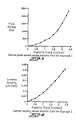
- This fluid comprised 100 parts of lithium hydrazinium sulfate powder prepared as described above, having a particle size of between about 5 and about 10 microns, and dispersed in 59 parts of 10 centistoke silicone oil with 0.13 parts of Baysilone OF-4061 added. Upon standing quiesent for approximately one hour, this fluid formed a weak gel and did not settle into a hard sediment. The yield stress results are illustrated in Figures 1 and 2.
- Figure 1 shows the induced yield stress as a function of electric field for the fluid of Example 1.
- FIG. 2 shows the corresponding current density passing through the fluid of Example 1 over the same range of electric field.
- This fluid was prepared identically to that of Example I with the exception that the amount of dispersant was doubled. A sample of this fluid was maintained in an oven in an open container at 115°C for 15 hours and showed no degradation in performance as determined by an ER test probe.
- This fluid comprised 100 parts of lithium hydrazinium sulfate prepared as described above and 100 parts of silicone oil. This fluid was prepared in the absence of any suspension stabilizer and had the consistency of thick axle grease. Its thickness prevented any appropriate yield stress testing.
- This fluid was produced by adding 0.26 parts of Baysilone OF-4061 to the fluid of Example III. Upon addition of the stabilizer, the consistency of the fluid immediately changed to that of milk. This amount of dispersant, however, was slightly more than appropriate for formation of the weekly flocculated gel. Upon standing, this fluid separated to form a small clear layer of fluid above a thick, loose, weakly flocculated sediment layer.
- This fluid was prepared in an identical manner to Example IV with the exception that only 0.1 part of Baysilone OF-4061 was added. This fluid had the consistency of milk, showed a strong electrorheological response, and did not settle to form sediment. After a standing time of about one hour, this fluid forms a thixotropic gel throughout its entire volume.
- This fluid comprised 100 parts of lithium hydrazinium sulfate which was subjected to limited grinding and had an average particle size of about 100 microns, mixed with 100 parts of silicone oil. Although this fluid had the same absolute proportions as the fluid of Example III, it remained fluid in the absence of any dispersant because of its larger particle size. The larger particles, however, settled out rather quickly. This fluid was maintained in an open container in a convection oven at about 120°C for about 60 hours. It displayed the same strong electrorheological response both before and after the oven treatment.
Landscapes
- Chemical & Material Sciences (AREA)
- Chemical Kinetics & Catalysis (AREA)
- General Chemical & Material Sciences (AREA)
- Oil, Petroleum & Natural Gas (AREA)
- Organic Chemistry (AREA)
- Inorganic Chemistry (AREA)
- Lubricants (AREA)
Applications Claiming Priority (2)
| Application Number | Priority Date | Filing Date | Title |
|---|---|---|---|
| US07/127,448 US4772407A (en) | 1987-12-02 | 1987-12-02 | Electrorheological fluids |
| US127448 | 1987-12-02 |
Publications (2)
| Publication Number | Publication Date |
|---|---|
| EP0319201A2 true EP0319201A2 (de) | 1989-06-07 |
| EP0319201A3 EP0319201A3 (de) | 1989-10-11 |
Family
ID=22430173
Family Applications (1)
| Application Number | Title | Priority Date | Filing Date |
|---|---|---|---|
| EP88311167A Withdrawn EP0319201A3 (de) | 1987-12-02 | 1988-11-25 | Elektrorheologische Flüssigkeiten |
Country Status (3)
| Country | Link |
|---|---|
| US (1) | US4772407A (de) |
| EP (1) | EP0319201A3 (de) |
| JP (1) | JPH01170693A (de) |
Cited By (5)
| Publication number | Priority date | Publication date | Assignee | Title |
|---|---|---|---|---|
| US5437806A (en) * | 1991-10-10 | 1995-08-01 | The Lubrizol Corporation | Electrorheological fluids containing polyanilines |
| US5595680A (en) * | 1991-10-10 | 1997-01-21 | The Lubrizol Corporation | Electrorheological fluids containing polyanilines |
| EP1316601A1 (de) * | 2001-11-29 | 2003-06-04 | Ykk Corporation | Elektrorheologische Zusammensetzung |
| EP1443097A1 (de) * | 2003-01-30 | 2004-08-04 | Shin-Etsu Chemical Company, Ltd. | Dilatante Flüssigkeitszusammensetzung |
| CN111025269A (zh) * | 2019-12-19 | 2020-04-17 | 哈尔滨工程大学 | 一种水下机器人传感器安装偏差估计方法 |
Families Citing this family (70)
| Publication number | Priority date | Publication date | Assignee | Title |
|---|---|---|---|---|
| US5603983A (en) * | 1986-03-24 | 1997-02-18 | Ensci Inc | Process for the production of conductive and magnetic transitin metal oxide coated three dimensional substrates |
| US5271858A (en) * | 1986-03-24 | 1993-12-21 | Ensci Inc. | Field dependent fluids containing electrically conductive tin oxide coated materials |
| US4986689A (en) * | 1988-01-11 | 1991-01-22 | Trw Inc. | Ball joint |
| US4900387A (en) * | 1988-02-24 | 1990-02-13 | The Boeing Company | Method of bonding via electrorheological adhesives |
| JPH01266195A (ja) * | 1988-04-19 | 1989-10-24 | Bridgestone Corp | 電気粘性液体 |
| US5904977A (en) * | 1989-09-11 | 1999-05-18 | The United States Of America As Represented By The Secretary Of The Navy | Electroset composite articles and process |
| US4896754A (en) * | 1988-08-25 | 1990-01-30 | Lord Corporation | Electrorheological fluid force transmission and conversion device |
| JPH02240197A (ja) * | 1989-03-14 | 1990-09-25 | Mitsubishi Kasei Corp | 電気粘性流体 |
| US5014829A (en) * | 1989-04-18 | 1991-05-14 | Hare Sr Nicholas S | Electro-rheological shock absorber |
| US4930463A (en) * | 1989-04-18 | 1990-06-05 | Hare Sr Nicholas S | Electro-rheological valve control mechanism |
| US5158109A (en) * | 1989-04-18 | 1992-10-27 | Hare Sr Nicholas S | Electro-rheological valve |
| US5103779A (en) * | 1989-04-18 | 1992-04-14 | Hare Sr Nicholas S | Electro-rheological valve control mechanism |
| US5073282A (en) * | 1989-04-21 | 1991-12-17 | Hercules Incorporated | Electrorheological fluids |
| US4992192A (en) * | 1989-04-21 | 1991-02-12 | Hercules Incorporated | Electrorheological fluids |
| US4990279A (en) * | 1989-04-21 | 1991-02-05 | Hercules Incorporated | Electrorheological fluids |
| FR2647116B1 (fr) * | 1989-05-16 | 1991-08-30 | Levy Maurice | Composition liquide a base de solvants organiques facilitant l'adherence de tout revetement sur un support |
| US5032308A (en) * | 1989-11-07 | 1991-07-16 | The Dow Chemical Company | Layered mixed metal hydroxides in electrorheological fluids |
| US5496483A (en) * | 1989-12-14 | 1996-03-05 | Bayer Ag | Electroviscous liquid based on dispersed modified polyethers |
| US5071581A (en) * | 1990-03-01 | 1991-12-10 | The Dow Chemical Company | Electrorheological fluids based on crown ethers and quaternary amines |
| US5007513A (en) * | 1990-04-03 | 1991-04-16 | Lord Corporation | Electroactive fluid torque transmission apparatus with ferrofluid seal |
| US5032307A (en) * | 1990-04-11 | 1991-07-16 | Lord Corporation | Surfactant-based electrorheological materials |
| EP0460808A3 (en) * | 1990-05-17 | 1992-09-23 | Imperial Chemical Industries Plc | Apparatus capable of containing an electro-rheological fluid |
| US5122293A (en) * | 1991-04-15 | 1992-06-16 | General Motors Corporation | Method of activating and deactivating an electrorheological response at constant alternating current |
| US5252239A (en) * | 1991-04-15 | 1993-10-12 | General Motors Corporation | ER fluids having chemically defoliated vermiculite treated with an alkyl ammonium halide and methods of making and using the same |
| EP0509572B1 (de) * | 1991-04-15 | 1994-05-18 | General Motors Corporation | Elektrorheologische Flüssigkeiten und Verfahren zu ihrer Herstellung und Verwendung |
| US5122292A (en) * | 1991-04-15 | 1992-06-16 | General Motors Corporation | Methods of varying the frequency to produce predetermined electrorheological responses |
| EP0509573B1 (de) * | 1991-04-15 | 1994-05-18 | General Motors Corporation | Elektrorheologische Flüssigkeiten und Verfahren zu ihrer Herstellung und Verwendung |
| US5316687A (en) * | 1991-05-20 | 1994-05-31 | General Motors Corporation | Electrorheological compositions including A1+x Zr2 Six P-x O12 |
| US5139690A (en) * | 1991-05-20 | 1992-08-18 | General Motors Corporation | Electrorheological compositions including Ax (Lx/2 Sn1-(x/2))O2 |
| US5130040A (en) * | 1991-05-20 | 1992-07-14 | General Motors Corporation | Anhydrous electrorheological compositions including Zr(HPO4)2 |
| US5130039A (en) * | 1991-05-20 | 1992-07-14 | General Motors Corporation | Anhydrous electrorheological compositions including Liy Si1-x Ax O4 |
| US5139691A (en) * | 1991-05-20 | 1992-08-18 | General Motors Corporation | Anhydrous electrorheological compositions including Na3 PO4 |
| US5149454A (en) * | 1991-05-20 | 1992-09-22 | General Motors Corporation | Electrorheological compositions including am5-11 O8-17 |
| US5130038A (en) * | 1991-05-20 | 1992-07-14 | General Motors Corporation | Anhydrous electrorheological compositions including A5 MSi4 O.sub. |
| US5139692A (en) * | 1991-05-20 | 1992-08-18 | General Motors Corporation | Electrorheological compositions including an amine-terminated polyester steric stabilizer |
| USRE35773E (en) * | 1991-08-29 | 1998-04-21 | Nippon Shokubai Co., Ltd. | Electrorhelogical fluid |
| US5376294A (en) * | 1991-08-29 | 1994-12-27 | Nippon Shokubai Co., Ltd. | Electrorhelogical fluid |
| US5558803A (en) * | 1991-08-29 | 1996-09-24 | Nippon Shokubai Co., Ltd. | Electrorheological fluid with improved properties comprising composite polymer |
| EP0529166A1 (de) * | 1991-08-29 | 1993-03-03 | Nippon Shokubai Co., Ltd. | Elektrorheologische Flüssigkeiten |
| US5364565A (en) * | 1991-08-30 | 1994-11-15 | Ford Motor Company | Electroviscoelastic gel-like solids |
| US5396973A (en) * | 1991-11-15 | 1995-03-14 | Lord Corporation | Variable shock absorber with integrated controller, actuator and sensors |
| US5445759A (en) * | 1992-02-25 | 1995-08-29 | General Motors Corporation | Preparation of electrorheological fluids using fullerenes and other crystals having fullerene-like anisotropic electrical properties |
| US6503414B1 (en) | 1992-04-14 | 2003-01-07 | Byelocorp Scientific, Inc. | Magnetorheological polishing devices and methods |
| US5449313A (en) * | 1992-04-14 | 1995-09-12 | Byelocorp Scientific, Inc. | Magnetorheological polishing devices and methods |
| US6022600A (en) * | 1992-04-24 | 2000-02-08 | Lord Corporation | High-temperature fluid mounting |
| JP3335630B2 (ja) * | 1992-10-30 | 2002-10-21 | ロード・コーポレーション | チキソトロープ磁気レオロジー材料 |
| JPH0712167A (ja) * | 1993-06-24 | 1995-01-17 | Hitachi Ltd | 振動制御装置、洗濯機、コンプレッサ、配管系および空調機 |
| US5598908A (en) * | 1995-06-05 | 1997-02-04 | Gse, Inc. | Magnetorheological fluid coupling device and torque load simulator system |
| CN1073739C (zh) * | 1995-07-06 | 2001-10-24 | 中国科学院物理研究所 | 掺杂的钛酸锶电流变液及其制备方法 |
| US5795212A (en) * | 1995-10-16 | 1998-08-18 | Byelocorp Scientific, Inc. | Deterministic magnetorheological finishing |
| US5827331A (en) * | 1996-05-24 | 1998-10-27 | W. R. Grace & Co.-Conn. | Electrode compositions |
| US5800421A (en) * | 1996-06-12 | 1998-09-01 | Lemelson; Jerome H. | Medical devices using electrosensitive gels |
| US5845646A (en) * | 1996-11-05 | 1998-12-08 | Lemelson; Jerome | System and method for treating select tissue in a living being |
| US5902048A (en) * | 1997-12-19 | 1999-05-11 | Dana Corporation | Center bearing assembly having shear plate |
| US6168634B1 (en) | 1999-03-25 | 2001-01-02 | Geoffrey W. Schmitz | Hydraulically energized magnetorheological replicant muscle tissue and a system and a method for using and controlling same |
| US6691805B2 (en) * | 2001-08-27 | 2004-02-17 | Halliburton Energy Services, Inc. | Electrically conductive oil-based mud |
| US6719055B2 (en) * | 2002-01-23 | 2004-04-13 | Halliburton Energy Services, Inc. | Method for drilling and completing boreholes with electro-rheological fluids |
| EP1350972A3 (de) * | 2002-04-04 | 2004-06-23 | Dana Corporation | Kardanwellen-Mittellageranordnung mit einer eine rheologische Flüssigkeit enthaltenden Halterung |
| BR0300859A (pt) * | 2002-04-04 | 2005-03-01 | Dana Corp | Conjunto de mancal central |
| EP1649322A4 (de) | 2003-07-17 | 2007-09-19 | Honeywell Int Inc | Planarisierungsfilme für fortschrittliche mikroelektronsiche anwendungen und einrichtungen und herstellungsverfahren dafür |
| US7254908B2 (en) * | 2004-02-06 | 2007-08-14 | Nike, Inc. | Article of footwear with variable support structure |
| US20050274455A1 (en) * | 2004-06-09 | 2005-12-15 | Extrand Charles W | Electro-active adhesive systems |
| US8256147B2 (en) | 2004-11-22 | 2012-09-04 | Frampton E. Eliis | Devices with internal flexibility sipes, including siped chambers for footwear |
| US20100279904A1 (en) * | 2007-07-31 | 2010-11-04 | Chevron U.S.A. Inc. | Electrical insulating oil compositions and preparation thereof |
| CN102099010B (zh) * | 2008-05-16 | 2016-09-14 | 悉尼大学 | 可给予的组合物 |
| DE102011018177A1 (de) | 2011-04-19 | 2012-10-25 | Raino Petricevic | Paste und deren Verwendung |
| DE102012207627B3 (de) * | 2012-05-08 | 2013-05-02 | Siemens Aktiengesellschaft | Adaptives Röntgenfilter zur Veränderung der lokalen Intensität einer Röntgenstrahlung |
| FR3014882B1 (fr) * | 2013-12-17 | 2016-01-01 | Michelin & Cie | Pneumatique pourvu d'une bande de roulement comprenant un elastomere thermoplastique copolymere a bloc polyester aromatique |
| CN110776986B (zh) * | 2019-11-19 | 2022-02-01 | 青岛科技大学 | 一种球状粗糙表面具有多纳米孔道氧化钛纳米颗粒电流变液材料的制备方法 |
| CN112175699A (zh) * | 2020-09-29 | 2021-01-05 | 浙江诺亚氟化工有限公司 | 一种氟化液组合物及其在变压器中的应用 |
Family Cites Families (21)
| Publication number | Priority date | Publication date | Assignee | Title |
|---|---|---|---|---|
| US2417850A (en) * | 1942-04-14 | 1947-03-25 | Willis M Winslow | Method and means for translating electrical impulses into mechanical force |
| US3047507A (en) * | 1960-04-04 | 1962-07-31 | Wefco Inc | Field responsive force transmitting compositions |
| US3427247A (en) * | 1961-08-25 | 1969-02-11 | Textron Inc | Electroviscous compositions |
| US3412031A (en) * | 1962-03-29 | 1968-11-19 | Union Oil Co | Electric-field-responsive compositions |
| US3255853A (en) * | 1963-01-16 | 1966-06-14 | Union Oil Co | Electro fluid clutch responsive to electrophoretic principles |
| US3484162A (en) * | 1963-10-03 | 1969-12-16 | Xerox Corp | Electroviscous recording |
| US3399145A (en) * | 1964-08-05 | 1968-08-27 | Union Oil Co | Dispersion of finely divided solid in non-aqueous liquid |
| US3385793A (en) * | 1965-03-19 | 1968-05-28 | Union Oil Co | Electroviscous fluid and method of using same |
| GB1178301A (en) * | 1966-01-26 | 1970-01-21 | Xerox Corp | Method of, and Apparatus for, Image Recording. |
| US3367872A (en) * | 1967-02-15 | 1968-02-06 | Union Oil Co | Electroviscous fluid composition |
| US3397147A (en) * | 1968-01-10 | 1968-08-13 | Union Oil Co | Electroviscous fluid composition |
| US3984339A (en) * | 1973-10-05 | 1976-10-05 | Fmc Corporation | Hydraulic oil composition |
| US4129513A (en) * | 1974-07-09 | 1978-12-12 | The Secretary Of State For Defence In Her Britannic Majesty's Government Of The United Kingdom Of Great Britain And Northern Ireland | Electric field responsive fluids |
| GB1501635A (en) * | 1974-07-09 | 1978-02-22 | Secr Defence | Electric field responsive fluids |
| US3970573A (en) * | 1975-08-25 | 1976-07-20 | Westhaver James W | Electroviscous fluids |
| US4502973A (en) * | 1981-06-19 | 1985-03-05 | National Research Development Corporation | Electroviscous fluids |
| US4483788A (en) * | 1982-03-25 | 1984-11-20 | The National Research Development Corp. | Electric field responsive fluids |
| GB8402068D0 (en) * | 1984-01-26 | 1984-02-29 | Stangroom J E | Fluid compositions |
| DE3427499A1 (de) * | 1984-07-26 | 1986-02-13 | Bayer Ag, 5090 Leverkusen | Elektroviskose fluessigkeiten |
| US4687589A (en) * | 1985-02-06 | 1987-08-18 | Hermann Block | Electronheological fluids |
| DE3536934A1 (de) * | 1985-10-17 | 1987-04-23 | Bayer Ag | Elektroviskose fluessigkeiten |
-
1987
- 1987-12-02 US US07/127,448 patent/US4772407A/en not_active Expired - Fee Related
-
1988
- 1988-11-04 JP JP63277574A patent/JPH01170693A/ja active Pending
- 1988-11-25 EP EP88311167A patent/EP0319201A3/de not_active Withdrawn
Cited By (8)
| Publication number | Priority date | Publication date | Assignee | Title |
|---|---|---|---|---|
| US5437806A (en) * | 1991-10-10 | 1995-08-01 | The Lubrizol Corporation | Electrorheological fluids containing polyanilines |
| US5595680A (en) * | 1991-10-10 | 1997-01-21 | The Lubrizol Corporation | Electrorheological fluids containing polyanilines |
| EP1316601A1 (de) * | 2001-11-29 | 2003-06-04 | Ykk Corporation | Elektrorheologische Zusammensetzung |
| US7001532B2 (en) | 2001-11-29 | 2006-02-21 | Kinsei Matec Co. Ltd. | Electro-rheological composition |
| EP1443097A1 (de) * | 2003-01-30 | 2004-08-04 | Shin-Etsu Chemical Company, Ltd. | Dilatante Flüssigkeitszusammensetzung |
| US7342049B2 (en) | 2003-01-30 | 2008-03-11 | Shin-Etsu Chemical Co., Ltd. | Dilatant fluid composition |
| CN111025269A (zh) * | 2019-12-19 | 2020-04-17 | 哈尔滨工程大学 | 一种水下机器人传感器安装偏差估计方法 |
| CN111025269B (zh) * | 2019-12-19 | 2022-11-15 | 哈尔滨工程大学 | 一种水下机器人传感器安装偏差估计方法 |
Also Published As
| Publication number | Publication date |
|---|---|
| US4772407A (en) | 1988-09-20 |
| JPH01170693A (ja) | 1989-07-05 |
| EP0319201A3 (de) | 1989-10-11 |
Similar Documents
| Publication | Publication Date | Title |
|---|---|---|
| EP0319201A2 (de) | Elektrorheologische Flüssigkeiten | |
| US5032307A (en) | Surfactant-based electrorheological materials | |
| KR940008392B1 (ko) | 전기점성 유체 | |
| Otsubo et al. | Electrorheological properties of silica suspensions | |
| Block et al. | Electro-rheology | |
| CA1255091A (en) | Electroviscous liquids | |
| EP0626003A1 (de) | Atomisch polarisierbare elektrorheologische materialien | |
| EP0394049A1 (de) | Elektrorheologische Flüssigkeiten und Herstellung von Partikeln dafür | |
| KR20010019614A (ko) | 다상계 전기유변유체 | |
| Prekas et al. | Sedimentation behaviour in electrorheological fluids based on suspensions of zeolite particles in silicone oil | |
| Bondi et al. | Some electrical properties of colloidal suspensions in oils | |
| US5071581A (en) | Electrorheological fluids based on crown ethers and quaternary amines | |
| Malfoy et al. | Effects of the nature of the exchangeable cation and clay concentration on the rheological properties of smectite suspensions | |
| US5445759A (en) | Preparation of electrorheological fluids using fullerenes and other crystals having fullerene-like anisotropic electrical properties | |
| US5149454A (en) | Electrorheological compositions including am5-11 O8-17 | |
| US5139692A (en) | Electrorheological compositions including an amine-terminated polyester steric stabilizer | |
| US5316687A (en) | Electrorheological compositions including A1+x Zr2 Six P-x O12 | |
| US5139691A (en) | Anhydrous electrorheological compositions including Na3 PO4 | |
| Lykov et al. | Mechanical behavior of electroviscous nonaqueous disperse systems in shear flow in a transverse electric field | |
| US5122293A (en) | Method of activating and deactivating an electrorheological response at constant alternating current | |
| KR100593483B1 (ko) | 전도성 입자로서 폴리아닐린/타이타늄 다이옥사이드복합체를 구성한 전기유변유체 및 그 제조 방법 | |
| US5252239A (en) | ER fluids having chemically defoliated vermiculite treated with an alkyl ammonium halide and methods of making and using the same | |
| US5130038A (en) | Anhydrous electrorheological compositions including A5 MSi4 O.sub. | |
| Miller et al. | Electrorheological properties of BaTiO3 suspensions | |
| US5139690A (en) | Electrorheological compositions including Ax (Lx/2 Sn1-(x/2))O2 |
Legal Events
| Date | Code | Title | Description |
|---|---|---|---|
| PUAI | Public reference made under article 153(3) epc to a published international application that has entered the european phase |
Free format text: ORIGINAL CODE: 0009012 |
|
| AK | Designated contracting states |
Kind code of ref document: A2 Designated state(s): DE FR GB IT SE |
|
| PUAL | Search report despatched |
Free format text: ORIGINAL CODE: 0009013 |
|
| AK | Designated contracting states |
Kind code of ref document: A3 Designated state(s): DE FR GB IT SE |
|
| STAA | Information on the status of an ep patent application or granted ep patent |
Free format text: STATUS: THE APPLICATION IS DEEMED TO BE WITHDRAWN |
|
| 18D | Application deemed to be withdrawn |
Effective date: 19900412 |