EP0319328A2 - Elektronenkanonen für Kathodenstrahl-Röhren - Google Patents
Elektronenkanonen für Kathodenstrahl-Röhren Download PDFInfo
- Publication number
- EP0319328A2 EP0319328A2 EP88311466A EP88311466A EP0319328A2 EP 0319328 A2 EP0319328 A2 EP 0319328A2 EP 88311466 A EP88311466 A EP 88311466A EP 88311466 A EP88311466 A EP 88311466A EP 0319328 A2 EP0319328 A2 EP 0319328A2
- Authority
- EP
- European Patent Office
- Prior art keywords
- anode
- voltage
- grid
- gun
- cathode
- Prior art date
- Legal status (The legal status is an assumption and is not a legal conclusion. Google has not performed a legal analysis and makes no representation as to the accuracy of the status listed.)
- Granted
Links
Images



Classifications
-
- H—ELECTRICITY
- H01—ELECTRIC ELEMENTS
- H01J—ELECTRIC DISCHARGE TUBES OR DISCHARGE LAMPS
- H01J29/00—Details of cathode-ray tubes or of electron-beam tubes of the types covered by group H01J31/00
- H01J29/46—Arrangements of electrodes and associated parts for generating or controlling the ray or beam, e.g. electron-optical arrangement
- H01J29/48—Electron guns
- H01J29/488—Schematic arrangements of the electrodes for beam forming; Place and form of the elecrodes
Definitions
- This invention relates to cathode ray tubes and to electron guns therefor.
- a known type of gun with which the invention is concerned comprises a cathode for emitting a beam of electrons, a grid for controlling the beam current, a series of anodes for directing and focussing the electron beam, and means for applying voltages to the cathode, grid and anodes.
- the gun comprises a tetrode emission zone and a bipotential electron lens.
- the emission zone comprises an oxide cathode C′ heated by a heater and considered to be maintained at a zero voltage; a grid G′ to which a beam current modulating voltage ranging typically between 0V and -50V is applied; a first anode A1′ to which a voltage of 350V is applied; and a second anode A2′ to which a voltage of 2.4kV is applied.
- the bipotential lens is formed by the second anode A2′ and a third or final accelerating anode A3′ to which an EHT voltage of 23kV is applied.
- the emission zone comprising the cathode C′, grid G′, first anode A1′ and second anode A2′ serves to form a beam of electrons which converge to a crossover point X′ between the grid G′ and first anode A1′ and thereafter diverge.
- the second and third anodes A2′, A3′ function as an electron lens L′ which images the crossover point X′ onto the screen S of the CRT.
- the size of the image on the screen S is dependent on the size of the crossover point and the magnification factor of the gun.
- the focal length of the lens L′ is adjusted by adjusting the voltage of the second anode A2′, which is conventionally referred to as the focussing anode.
- One aspect of the present invention is concerned with reducing the size of the crossover, and thus of the image thereof on the screen, compared with the known gun.
- the voltage applied to the first anode is higher than in a corresponding conventional gun and in particular is greater than the voltage applied to the focussing anode.
- a high electric field is formed between the grid and the first anode which tends to reduce the size of the crossover.
- a second aspect of the present invention is concerned with reducing the dependence of focus on grid voltage.
- the ratio between the voltage of the first anode and the range of the grid modulating voltage is greater than in a corresponding conventional gun, and in particular the first anode voltage is at least twenty times greater than the grid voltage range.
- said ratio is at least thirty, more preferably at least fifty, and desirably at least eighty.
- the third aspect of the invention seeks to utilise this high voltage in controlling the beam size.
- a beam limiting member is disposed to the side of the first anode which is remote from the grid, the beam limiting member having an aperture to limit the cross-section of the electron beam passing therethrough, and a voltage being applied to the beam limiting member about equal to that of the first anode and substantially more than the voltage of the second anode.
- the electron gun comprises a cathode C a control grid G, a first anode A1, a second anode A2 and a third anode A3.
- a beam limiting aperture BL is provided.
- the aperture BL is provided in the first anode A1.
- the grid G and anodes A1, A2 and A3 are energised by a voltage supply arrangement VS; such a voltage supply arrangement is well known in the art.
- a conventional heater power supply energises the heater H of the cathode, which in this example is a conventional oxide cathode with a planar emission surface.
- the voltage supply arrangement VS energies the electrodes, as follows: Cathode C: OV Grid G: Variable (VG) varying between: -50V (VGC) at cut off; and 0V (VGF) at full emission Anode A1 +5kV (V1) Anode A2 500V (V2) focus voltage Anode A3 25kV (V3) EHT
- the spacing S between the grid G and the first anode A1 is about 1.5mm.
- the result of the high field strength and the high voltage of the first anode is a small crossover between the grid G and first anode A1. At the crossover part the electrons are packed closely together and they tend to mutually repel each other increasing the size of the crossover. The high field strength combined with the high voltage of the first anode tends to cause the electrons to pack more closely together producing a small crossover.
- the position of the crossover varies as the modulating voltage VG applied to the grid G varies resulting in variation of focussing with modulating voltage.
- the modulating voltage VG is varied between cut off VGC (-50V in this example) to full emission VGF (0V).
- VGC cut off VGC
- VGF full emission VGF
- the focus voltage applied to the focus electrode A2 is 500 V as compared to the 2.3 KV of the known gun. This is advantageous because it greatly simplifies the production of the focus voltage and allows "direct drive" of the focus electrode A2, and also simplifies dynamic variation of focus as the beam is scanned across the screen of a CRT, if dynamic focus variation is desired.
- the focus voltage (+500V) applied to the focus electrode A2 is less than the voltage (+5kV) applied to the first anode A1. If the beam limiter BL is provided on the first anode A1, electrons hitting it generate secondary electrons which, if they reached the screen of the CRT, would tend to reduce contrast and resolution. However, because the voltage of A2 is less than the voltage of A1, the secondary electrons are attracted back to A1 and so do not reach the screen improving contrast and resolution.
- the electron gun of Figure 2 is short, being shorter than the known gun of Figure 1.
- the main focus lens is dependent not only on the voltages applied to anodes A2 and A3 but also dependent on the voltage applied to A1. That dependence is apparent from the equipotential diagram of Figure 3.
- the electron gun of Figure 2 provides constant throughput independent of the EHT voltage applied to anode A3.
- Throughput is the ratio of beam current reaching the screen of the CRT to the current emitted by the cathode.
- Throughput is constant because, although changing the EHT voltage will change the focussing potential, since the beam limiting aperture connected to A1 is in a field free region, at e.g. a fixed voltage of 3 to 5kV, no change in the beam envelope at, or prior to, the aperture will occur.
- the high field strength in anode A1-grid G region gives a high cut-off value which is reduced by increasing the spacing of the grid G from the cathode C, thus easing problems of construction of the gun.
- EHT voltage applied to anode A3 has been described above as constant, it may be varied in the range approximately 7kV to 30kV.
- the gun may then be used in a penetron CRT in which the phosphors are selected according to the energy of the beam.
- the field strength between grid G and anode A1 is preferably greater than 2kV per mm and is preferably 3kV per mm or more, for a gun in which the grid aperture diameter is approximately 0.4mm.
- spot size at the screen can be increased or decreased by an increase or reduction of the grid aperture diameter, and that for an electron gun having a given beam exit angle at a given drive level, the spacing between grid and first anode is scaled in accordance with the change made in grid aperture diameter.
- An electron gun in accordance with the invention is applicable to a wide range of cathode ray tube screen sizes and resolution values, therefore it may use any grid aperture diameter in the range 0.2 to 1mm.
- the first anode voltage required must be at least 2kV, for the smaller grid aperture diameters (0.2 to 0.25 mm), but at least 3kV and preferably 5kV for the larger grid aperture diameters (0.5 to 1mm).
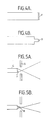
- the cathode C has been described hereinbefore as an oxide cathode having a planar emission face F. It may be replaced by a dispenser cathode having a planar emission face F; see Figure 4A.
- the cathode C may be replaced by a dispenser cathode having a more restricted planar emission face R as shown in Figure 4B.
- the emission surface is substantially smaller than the axially facing cross sectional area of the cathode.
- Such a cathode has the advantage of producing a beam of smaller conical angle than the cathode of Figure 4A (see Figures 5A, 5B) especially under conditions of maximum current output. The area from which the current is emitted increases with increasing emission.
- a gun in accordance with the invention is capable of being designed to give better corner resolution and depth of focus than a known bipotential gun as described with reference to Figures 1A and B. This is achievable by having a short gun having high through-put and a small angle of beam convergence at the screen of the CRT.
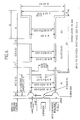
- Figure 6 shows an electron gun having good resolution in accordance with the invention, the Figure bearing illustrative dimensions. (Another gun (not illustrated) in accordance with the invention is shorter and has higher throughput but lesser resolution).
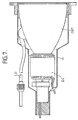
- Figure 7 is a cross section diagram of a CRT including the gun of Figure 6.
- the CRT is provided with a deflection coil DC and the assembly of the CRT and deflector coil is sealed within a housing H.
- the CRT is, as is conventional, provided with an EHT lead LD.
- an additional anode A4 is interposed between the main focus electrode A2 and final anode A3, connected to an intermediate voltage between V2 and V3, so that acceleration of the beam after passage though the focus electrode is accomplished in two stages (or, in a further extension, by a plurality of accelerating electrodes).
- the extra electrode A4 is connected electrically to the first anode A1.
- the resulting four-electrode focusing lens comprising A1, A2, A4, A3, has the ability to produce lower aberrations than a three-electrode lens A1, A2, A3, and the voltage applied to A2 (typically 1 to 4kV) remains lower than VA1, VA4 and VA3.
- a further short anode A5 is disposed between the first anode A1 and the main focus anode A2, and another short anode A6 is disposed between main focus anode A2 and the additional anode A4.
- the voltages applied to the electrodes may be as follows: Cathode C 0V Grid G 0-150V First Anode A1 5kV Anode A5 4kV Focus Anode A2 3kV Anode A6 4kV Anode A4 5kV Final Anode 25kV
- the additional electrode A5 provide progressively controlled deceleration to the main focus anode A2 (which of the electrodes forming the electron lens is at the lowest voltage), and the additional anodes A6, A4 provide progressively controlled acceleration.
- This progressive control serves to reduce aberrations.
Landscapes
- Cold Cathode And The Manufacture (AREA)
- Manufacture Of Electron Tubes, Discharge Lamp Vessels, Lead-In Wires, And The Like (AREA)
- Electron Sources, Ion Sources (AREA)
- Particle Accelerators (AREA)
- Formation Of Various Coating Films On Cathode Ray Tubes And Lamps (AREA)
- X-Ray Techniques (AREA)
Applications Claiming Priority (2)
| Application Number | Priority Date | Filing Date | Title |
|---|---|---|---|
| GB8728481 | 1987-12-04 | ||
| GB878728481A GB8728481D0 (en) | 1987-12-04 | 1987-12-04 | Electron gun |
Publications (3)
| Publication Number | Publication Date |
|---|---|
| EP0319328A2 true EP0319328A2 (de) | 1989-06-07 |
| EP0319328A3 EP0319328A3 (en) | 1990-05-30 |
| EP0319328B1 EP0319328B1 (de) | 1995-09-13 |
Family
ID=10628047
Family Applications (1)
| Application Number | Title | Priority Date | Filing Date |
|---|---|---|---|
| EP88311466A Expired - Lifetime EP0319328B1 (de) | 1987-12-04 | 1988-12-02 | Elektronenkanonen für Kathodenstrahl-Röhren |
Country Status (6)
| Country | Link |
|---|---|
| US (1) | US5034654A (de) |
| EP (1) | EP0319328B1 (de) |
| JP (1) | JPH01200541A (de) |
| AT (1) | ATE127957T1 (de) |
| DE (1) | DE3854466T2 (de) |
| GB (1) | GB8728481D0 (de) |
Cited By (3)
| Publication number | Priority date | Publication date | Assignee | Title |
|---|---|---|---|---|
| WO1992016007A1 (en) * | 1991-03-05 | 1992-09-17 | The Secretary Of State For Defence In Her Britannic Majesty's Government Of The United Kingdom Of Great Britain And Northern Ireland | Focusing means for cathode ray tubes |
| GB2269267A (en) * | 1991-03-05 | 1994-02-02 | Secr Defence | Focusing means for cathode ray tubes |
| EP0570541A4 (en) * | 1991-12-09 | 1994-06-08 | Chen Hsing Yao | Low voltage limiting aperture electron gun |
Families Citing this family (4)
| Publication number | Priority date | Publication date | Assignee | Title |
|---|---|---|---|---|
| US5287038A (en) * | 1992-05-14 | 1994-02-15 | Litton Systems, Inc. | High resolution electron gun |
| KR970009209B1 (en) * | 1994-01-22 | 1997-06-07 | Lg Electronics Inc | In-line type electron gun for crt |
| JPH11345577A (ja) * | 1998-06-03 | 1999-12-14 | Hitachi Ltd | カラー陰極線管 |
| US8084929B2 (en) * | 2009-04-29 | 2011-12-27 | Atti International Services Company, Inc. | Multiple device shaping uniform distribution of current density in electro-static focusing systems |
Family Cites Families (4)
| Publication number | Priority date | Publication date | Assignee | Title |
|---|---|---|---|---|
| JPS53146531A (en) * | 1977-05-27 | 1978-12-20 | Hitachi Ltd | Pickup tube |
| US4374341A (en) * | 1980-10-15 | 1983-02-15 | North American Philips Consumer Electronics Corp. | Beam focusing means in a unitized tri-potential CRT electron gun assembly |
| EP0113113B1 (de) * | 1982-12-29 | 1987-09-16 | Matsushita Electronics Corporation | Kathodenstrahlröhre |
| JPS6251137A (ja) * | 1985-08-29 | 1987-03-05 | Sony Corp | 陰極線管 |
-
1987
- 1987-12-04 GB GB878728481A patent/GB8728481D0/en active Pending
-
1988
- 1988-12-02 JP JP63306757A patent/JPH01200541A/ja active Pending
- 1988-12-02 DE DE3854466T patent/DE3854466T2/de not_active Expired - Fee Related
- 1988-12-02 EP EP88311466A patent/EP0319328B1/de not_active Expired - Lifetime
- 1988-12-02 AT AT88311466T patent/ATE127957T1/de not_active IP Right Cessation
-
1990
- 1990-06-21 US US07/541,486 patent/US5034654A/en not_active Expired - Fee Related
Cited By (5)
| Publication number | Priority date | Publication date | Assignee | Title |
|---|---|---|---|---|
| WO1992016007A1 (en) * | 1991-03-05 | 1992-09-17 | The Secretary Of State For Defence In Her Britannic Majesty's Government Of The United Kingdom Of Great Britain And Northern Ireland | Focusing means for cathode ray tubes |
| GB2269267A (en) * | 1991-03-05 | 1994-02-02 | Secr Defence | Focusing means for cathode ray tubes |
| GB2269267B (en) * | 1991-03-05 | 1995-02-15 | Secr Defence | Focusing means for cathode ray tubes |
| US5489814A (en) * | 1991-03-05 | 1996-02-06 | The Secretary Of State For Defense In Her Britannic Majesty's Government Of The United Kingdom Of Great Britain And Northern Ireland | Focusing means for cathode ray tubes |
| EP0570541A4 (en) * | 1991-12-09 | 1994-06-08 | Chen Hsing Yao | Low voltage limiting aperture electron gun |
Also Published As
| Publication number | Publication date |
|---|---|
| DE3854466D1 (de) | 1995-10-19 |
| EP0319328A3 (en) | 1990-05-30 |
| EP0319328B1 (de) | 1995-09-13 |
| DE3854466T2 (de) | 1996-05-02 |
| US5034654A (en) | 1991-07-23 |
| ATE127957T1 (de) | 1995-09-15 |
| GB8728481D0 (en) | 1988-04-27 |
| JPH01200541A (ja) | 1989-08-11 |
Similar Documents
| Publication | Publication Date | Title |
|---|---|---|
| US6331752B1 (en) | Color cathode ray tube having a low dynamic focus voltage | |
| KR960016260B1 (ko) | 인라인형 칼라 음극선관용 전자총의 전압 인가 방법 및 전극 구조 | |
| EP0319328B1 (de) | Elektronenkanonen für Kathodenstrahl-Röhren | |
| CN1155046C (zh) | 阴极射线管 | |
| US6225765B1 (en) | Color cathode ray tube with a reduced dynamic focus voltage for an electrostatic quadrupole lens thereof | |
| CN1058103C (zh) | 改善聚焦的阴极射线管 | |
| EP0570541B1 (de) | Niederspannungs-elektronenkanone mit begrenzender apertur | |
| KR910001400B1 (ko) | 비임 형성 영역을 가진 음극 선관용 전자총 | |
| KR960016431B1 (ko) | 음극선관용 전자총 | |
| CN1359134A (zh) | 阴极射线管装置 | |
| KR920010660B1 (ko) | 칼라음극선관용 전자총 | |
| US5489814A (en) | Focusing means for cathode ray tubes | |
| EP0589522B1 (de) | Kathodenstrahlröhre | |
| KR900009078B1 (ko) | 전자총 | |
| EP0247688A2 (de) | Kathodenstrahlröhre | |
| US4994713A (en) | Asymmetric unipotential electron beam focusing lens | |
| KR0173720B1 (ko) | 컬러음극선관 | |
| US4705985A (en) | Cathode-ray tube and electron gun structure therefor | |
| US7122977B2 (en) | Cathode-ray tube apparatus | |
| EP0725973B1 (de) | Kathodenstrahlröhre mit elektronenkanone, und elektrostatisches linsensystem | |
| US20050001552A1 (en) | Cathode-ray tube | |
| KR950004851Y1 (ko) | 칼라 음극선관용 b-u 타입 전자총의 g₃ 계 방전구조 | |
| CN1088355A (zh) | 动态聚焦的电子枪 | |
| JPH0121582B2 (de) | ||
| JPH09134678A (ja) | カラー受像管 |
Legal Events
| Date | Code | Title | Description |
|---|---|---|---|
| PUAI | Public reference made under article 153(3) epc to a published international application that has entered the european phase |
Free format text: ORIGINAL CODE: 0009012 |
|
| AK | Designated contracting states |
Kind code of ref document: A2 Designated state(s): AT CH DE FR GB IT LI NL SE |
|
| PUAL | Search report despatched |
Free format text: ORIGINAL CODE: 0009013 |
|
| AK | Designated contracting states |
Kind code of ref document: A3 Designated state(s): AT CH DE FR GB IT LI NL SE |
|
| 17P | Request for examination filed |
Effective date: 19901130 |
|
| RAP1 | Party data changed (applicant data changed or rights of an application transferred) |
Owner name: RANK BRIMAR LIMITED |
|
| 17Q | First examination report despatched |
Effective date: 19930709 |
|
| RAP1 | Party data changed (applicant data changed or rights of an application transferred) |
Owner name: RANK BRIMAR LIMITED (UK REG. NO. 1365015) |
|
| RAP1 | Party data changed (applicant data changed or rights of an application transferred) |
Owner name: RANK BRIMAR LIMITED |
|
| GRAA | (expected) grant |
Free format text: ORIGINAL CODE: 0009210 |
|
| AK | Designated contracting states |
Kind code of ref document: B1 Designated state(s): AT CH DE FR GB IT LI NL SE |
|
| PG25 | Lapsed in a contracting state [announced via postgrant information from national office to epo] |
Ref country code: IT Free format text: LAPSE BECAUSE OF FAILURE TO SUBMIT A TRANSLATION OF THE DESCRIPTION OR TO PAY THE FEE WITHIN THE PRE;WARNING: LAPSES OF ITALIAN PATENTS WITH EFFECTIVE DATE BEFORE 2007 MAY HAVE OCCURRED AT ANY TIME BEFORE 2007. THE CORRECT EFFECTIVE DATE MAY BE DIFFERENT FROM THE ONE RECORDED.SCRIBED TIME-LIMIT Effective date: 19950913 Ref country code: AT Effective date: 19950913 |
|
| REF | Corresponds to: |
Ref document number: 127957 Country of ref document: AT Date of ref document: 19950915 Kind code of ref document: T |
|
| REF | Corresponds to: |
Ref document number: 3854466 Country of ref document: DE Date of ref document: 19951019 |
|
| ET | Fr: translation filed | ||
| PG25 | Lapsed in a contracting state [announced via postgrant information from national office to epo] |
Ref country code: SE Effective date: 19951213 |
|
| PGFP | Annual fee paid to national office [announced via postgrant information from national office to epo] |
Ref country code: CH Payment date: 19951231 Year of fee payment: 8 |
|
| REG | Reference to a national code |
Ref country code: CH Ref legal event code: PL |
|
| PLBE | No opposition filed within time limit |
Free format text: ORIGINAL CODE: 0009261 |
|
| STAA | Information on the status of an ep patent application or granted ep patent |
Free format text: STATUS: NO OPPOSITION FILED WITHIN TIME LIMIT |
|
| 26N | No opposition filed | ||
| PG25 | Lapsed in a contracting state [announced via postgrant information from national office to epo] |
Ref country code: LI Free format text: LAPSE BECAUSE OF FAILURE TO SUBMIT A TRANSLATION OF THE DESCRIPTION OR TO PAY THE FEE WITHIN THE PRESCRIBED TIME-LIMIT Effective date: 19961231 Ref country code: CH Free format text: LAPSE BECAUSE OF FAILURE TO SUBMIT A TRANSLATION OF THE DESCRIPTION OR TO PAY THE FEE WITHIN THE PRESCRIBED TIME-LIMIT Effective date: 19961231 |
|
| REG | Reference to a national code |
Ref country code: GB Ref legal event code: 732E |
|
| REG | Reference to a national code |
Ref country code: GB Ref legal event code: 732E |
|
| NLS | Nl: assignments of ep-patents |
Owner name: BRIMAR LIMITED |
|
| NLT1 | Nl: modifications of names registered in virtue of documents presented to the patent office pursuant to art. 16 a, paragraph 1 |
Owner name: RANK NEMO (RB) LIMITED |
|
| REG | Reference to a national code |
Ref country code: FR Ref legal event code: TP |
|
| PGFP | Annual fee paid to national office [announced via postgrant information from national office to epo] |
Ref country code: FR Payment date: 19981106 Year of fee payment: 11 |
|
| PGFP | Annual fee paid to national office [announced via postgrant information from national office to epo] |
Ref country code: GB Payment date: 19981118 Year of fee payment: 11 |
|
| PGFP | Annual fee paid to national office [announced via postgrant information from national office to epo] |
Ref country code: NL Payment date: 19981229 Year of fee payment: 11 |
|
| PGFP | Annual fee paid to national office [announced via postgrant information from national office to epo] |
Ref country code: DE Payment date: 19990223 Year of fee payment: 11 |
|
| PG25 | Lapsed in a contracting state [announced via postgrant information from national office to epo] |
Ref country code: GB Free format text: LAPSE BECAUSE OF NON-PAYMENT OF DUE FEES Effective date: 19991202 |
|
| PG25 | Lapsed in a contracting state [announced via postgrant information from national office to epo] |
Ref country code: NL Free format text: LAPSE BECAUSE OF NON-PAYMENT OF DUE FEES Effective date: 20000701 |
|
| GBPC | Gb: european patent ceased through non-payment of renewal fee |
Effective date: 19991202 |
|
| PG25 | Lapsed in a contracting state [announced via postgrant information from national office to epo] |
Ref country code: FR Free format text: LAPSE BECAUSE OF NON-PAYMENT OF DUE FEES Effective date: 20000831 |
|
| NLV4 | Nl: lapsed or anulled due to non-payment of the annual fee |
Effective date: 20000701 |
|
| PG25 | Lapsed in a contracting state [announced via postgrant information from national office to epo] |
Ref country code: DE Free format text: LAPSE BECAUSE OF NON-PAYMENT OF DUE FEES Effective date: 20001003 |
|
| REG | Reference to a national code |
Ref country code: FR Ref legal event code: ST |