EP0319962A2 - Piperidinyl methanol derivatives for the treatment of anxiety - Google Patents
Piperidinyl methanol derivatives for the treatment of anxiety Download PDFInfo
- Publication number
- EP0319962A2 EP0319962A2 EP88120476A EP88120476A EP0319962A2 EP 0319962 A2 EP0319962 A2 EP 0319962A2 EP 88120476 A EP88120476 A EP 88120476A EP 88120476 A EP88120476 A EP 88120476A EP 0319962 A2 EP0319962 A2 EP 0319962A2
- Authority
- EP
- European Patent Office
- Prior art keywords
- methanol
- compound
- piperidinyl
- phenyl
- phenethyl
- Prior art date
- Legal status (The legal status is an assumption and is not a legal conclusion. Google has not performed a legal analysis and makes no representation as to the accuracy of the status listed.)
- Withdrawn
Links
- 208000019901 Anxiety disease Diseases 0.000 title claims abstract description 14
- 230000036506 anxiety Effects 0.000 title claims abstract description 12
- RJUAEBLXGFKZMS-UHFFFAOYSA-N piperidin-1-ylmethanol Chemical class OCN1CCCCC1 RJUAEBLXGFKZMS-UHFFFAOYSA-N 0.000 title 1
- 238000000034 method Methods 0.000 claims abstract description 27
- 150000001875 compounds Chemical class 0.000 claims description 39
- 150000003839 salts Chemical class 0.000 claims description 7
- 239000002253 acid Substances 0.000 claims description 5
- OKKJLVBELUTLKV-UHFFFAOYSA-N methanol Substances OC OKKJLVBELUTLKV-UHFFFAOYSA-N 0.000 claims description 5
- 229910052739 hydrogen Inorganic materials 0.000 claims description 4
- 239000001257 hydrogen Substances 0.000 claims description 4
- 125000004191 (C1-C6) alkoxy group Chemical group 0.000 claims description 3
- 125000004169 (C1-C6) alkyl group Chemical group 0.000 claims description 3
- 229910052736 halogen Inorganic materials 0.000 claims description 3
- 150000002367 halogens Chemical class 0.000 claims description 3
- 150000002431 hydrogen Chemical group 0.000 claims description 3
- 125000002887 hydroxy group Chemical group [H]O* 0.000 claims description 3
- NDUXPFOUNLZOGM-UHFFFAOYSA-N 4-[1-[4-(hydroxymethyl)piperidin-1-yl]-2-phenylethyl]phenol Chemical compound C1CC(CO)CCN1C(C=1C=CC(O)=CC=1)CC1=CC=CC=C1 NDUXPFOUNLZOGM-UHFFFAOYSA-N 0.000 claims description 2
- BIHNARYHEDWRPT-UHFFFAOYSA-N [1-(1,4-diphenylbutyl)piperidin-4-yl]methanol Chemical compound C1CC(CO)CCN1C(C=1C=CC=CC=1)CCCC1=CC=CC=C1 BIHNARYHEDWRPT-UHFFFAOYSA-N 0.000 claims description 2
- HJFAKODAISTZKQ-UHFFFAOYSA-N [1-[1,2-bis(4-methoxyphenyl)ethyl]piperidin-4-yl]methanol Chemical compound C1=CC(OC)=CC=C1CC(C=1C=CC(OC)=CC=1)N1CCC(CO)CC1 HJFAKODAISTZKQ-UHFFFAOYSA-N 0.000 claims description 2
- HJBYJZDSFGORII-UHFFFAOYSA-N [1-[1-(2,3-dimethoxyphenyl)-2-(4-methoxyphenyl)ethyl]piperidin-4-yl]methanol Chemical compound C1=CC(OC)=CC=C1CC(C=1C(=C(OC)C=CC=1)OC)N1CCC(CO)CC1 HJBYJZDSFGORII-UHFFFAOYSA-N 0.000 claims description 2
- 125000003277 amino group Chemical group 0.000 claims description 2
- 239000003814 drug Substances 0.000 claims description 2
- 238000002360 preparation method Methods 0.000 claims description 2
- 125000002023 trifluoromethyl group Chemical group FC(F)(F)* 0.000 claims description 2
- NDXWFWBAPJNIFY-UHFFFAOYSA-N [1-[2-(4-methoxyphenyl)-1-phenylethyl]piperidin-4-yl]methanol Chemical compound C1=CC(OC)=CC=C1CC(C=1C=CC=CC=1)N1CCC(CO)CC1 NDXWFWBAPJNIFY-UHFFFAOYSA-N 0.000 claims 2
- QPLPLMPOELCQOV-UHFFFAOYSA-N FC1=CC=C(C=C1)C(CC1=CC=CC=C1)N1CCC(CC1)CO Chemical compound FC1=CC=C(C=C1)C(CC1=CC=CC=C1)N1CCC(CC1)CO QPLPLMPOELCQOV-UHFFFAOYSA-N 0.000 claims 1
- NFCDUSKFOGBTMD-UHFFFAOYSA-N [1-[1-(3,4-dimethoxyphenyl)-2-phenylethyl]piperidin-4-yl]methanol Chemical compound C1=C(OC)C(OC)=CC=C1C(N1CCC(CO)CC1)CC1=CC=CC=C1 NFCDUSKFOGBTMD-UHFFFAOYSA-N 0.000 claims 1
- UEMKRFNPVCBYAD-UHFFFAOYSA-N [1-[2-(4-aminophenyl)-1-phenylethyl]piperidin-4-yl]methanol Chemical compound C1=CC(N)=CC=C1CC(C=1C=CC=CC=1)N1CCC(CO)CC1 UEMKRFNPVCBYAD-UHFFFAOYSA-N 0.000 claims 1
- XMMHQDAJLJWJHB-UHFFFAOYSA-N [1-[2-(4-fluorophenyl)-1-phenylethyl]piperidin-4-yl]methanol Chemical compound C1CC(CO)CCN1C(C=1C=CC=CC=1)CC1=CC=C(F)C=C1 XMMHQDAJLJWJHB-UHFFFAOYSA-N 0.000 claims 1
- -1 1,4-disubstituted piperidinyl methanol Chemical class 0.000 abstract description 6
- 230000000949 anxiolytic effect Effects 0.000 description 4
- 206010039897 Sedation Diseases 0.000 description 3
- 238000007792 addition Methods 0.000 description 3
- 230000006735 deficit Effects 0.000 description 3
- 239000002552 dosage form Substances 0.000 description 3
- 230000036280 sedation Effects 0.000 description 3
- 125000001424 substituent group Chemical group 0.000 description 3
- 208000008454 Hyperhidrosis Diseases 0.000 description 2
- AFVFQIVMOAPDHO-UHFFFAOYSA-N Methanesulfonic acid Chemical compound CS(O)(=O)=O AFVFQIVMOAPDHO-UHFFFAOYSA-N 0.000 description 2
- NBIIXXVUZAFLBC-UHFFFAOYSA-N Phosphoric acid Chemical compound OP(O)(O)=O NBIIXXVUZAFLBC-UHFFFAOYSA-N 0.000 description 2
- QAOWNCQODCNURD-UHFFFAOYSA-N Sulfuric acid Chemical compound OS(O)(=O)=O QAOWNCQODCNURD-UHFFFAOYSA-N 0.000 description 2
- 208000001871 Tachycardia Diseases 0.000 description 2
- 206010044565 Tremor Diseases 0.000 description 2
- 125000003545 alkoxy group Chemical group 0.000 description 2
- 125000000217 alkyl group Chemical group 0.000 description 2
- 239000002249 anxiolytic agent Substances 0.000 description 2
- 229940049706 benzodiazepine Drugs 0.000 description 2
- 150000001557 benzodiazepines Chemical class 0.000 description 2
- GDTBXPJZTBHREO-UHFFFAOYSA-N bromine Chemical compound BrBr GDTBXPJZTBHREO-UHFFFAOYSA-N 0.000 description 2
- 125000004432 carbon atom Chemical group C* 0.000 description 2
- 229910052801 chlorine Inorganic materials 0.000 description 2
- 239000000460 chlorine Substances 0.000 description 2
- 125000001495 ethyl group Chemical group [H]C([H])([H])C([H])([H])* 0.000 description 2
- 229910052731 fluorine Inorganic materials 0.000 description 2
- 239000011737 fluorine Substances 0.000 description 2
- SUMDYPCJJOFFON-UHFFFAOYSA-N isethionic acid Chemical compound OCCS(O)(=O)=O SUMDYPCJJOFFON-UHFFFAOYSA-N 0.000 description 2
- 125000002496 methyl group Chemical group [H]C([H])([H])* 0.000 description 2
- 150000007522 mineralic acids Chemical class 0.000 description 2
- 150000007524 organic acids Chemical class 0.000 description 2
- QZAYGJVTTNCVMB-UHFFFAOYSA-N serotonin Chemical compound C1=C(O)C=C2C(CCN)=CNC2=C1 QZAYGJVTTNCVMB-UHFFFAOYSA-N 0.000 description 2
- 230000035900 sweating Effects 0.000 description 2
- 230000006794 tachycardia Effects 0.000 description 2
- BMYNFMYTOJXKLE-UHFFFAOYSA-N 3-azaniumyl-2-hydroxypropanoate Chemical compound NCC(O)C(O)=O BMYNFMYTOJXKLE-UHFFFAOYSA-N 0.000 description 1
- ZCYVEMRRCGMTRW-UHFFFAOYSA-N 7553-56-2 Chemical group [I] ZCYVEMRRCGMTRW-UHFFFAOYSA-N 0.000 description 1
- 241000283690 Bos taurus Species 0.000 description 1
- 241000282472 Canis lupus familiaris Species 0.000 description 1
- 241000700198 Cavia Species 0.000 description 1
- KZBUYRJDOAKODT-UHFFFAOYSA-N Chlorine Chemical compound ClCl KZBUYRJDOAKODT-UHFFFAOYSA-N 0.000 description 1
- ZAMOUSCENKQFHK-UHFFFAOYSA-N Chlorine atom Chemical compound [Cl] ZAMOUSCENKQFHK-UHFFFAOYSA-N 0.000 description 1
- 241000283086 Equidae Species 0.000 description 1
- 241000282326 Felis catus Species 0.000 description 1
- PXGOKWXKJXAPGV-UHFFFAOYSA-N Fluorine Chemical compound FF PXGOKWXKJXAPGV-UHFFFAOYSA-N 0.000 description 1
- YCKRFDGAMUMZLT-UHFFFAOYSA-N Fluorine atom Chemical compound [F] YCKRFDGAMUMZLT-UHFFFAOYSA-N 0.000 description 1
- VEXZGXHMUGYJMC-UHFFFAOYSA-N Hydrochloric acid Chemical compound Cl VEXZGXHMUGYJMC-UHFFFAOYSA-N 0.000 description 1
- UFHFLCQGNIYNRP-UHFFFAOYSA-N Hydrogen Chemical compound [H][H] UFHFLCQGNIYNRP-UHFFFAOYSA-N 0.000 description 1
- 241000124008 Mammalia Species 0.000 description 1
- 241001465754 Metazoa Species 0.000 description 1
- 241000699670 Mus sp. Species 0.000 description 1
- PHIIUKBSUULXOH-UHFFFAOYSA-N OC=1C=C(C=CC1O)C(CC1=CC=CC=C1)N1CCC(CC1)CO Chemical compound OC=1C=C(C=CC1O)C(CC1=CC=CC=C1)N1CCC(CC1)CO PHIIUKBSUULXOH-UHFFFAOYSA-N 0.000 description 1
- 241001494479 Pecora Species 0.000 description 1
- 241000288906 Primates Species 0.000 description 1
- 241000700159 Rattus Species 0.000 description 1
- 150000007513 acids Chemical class 0.000 description 1
- 229910000147 aluminium phosphate Inorganic materials 0.000 description 1
- WPYMKLBDIGXBTP-UHFFFAOYSA-N benzoic acid group Chemical group C(C1=CC=CC=C1)(=O)O WPYMKLBDIGXBTP-UHFFFAOYSA-N 0.000 description 1
- 229910052794 bromium Inorganic materials 0.000 description 1
- 239000002775 capsule Substances 0.000 description 1
- ANTSCNMPPGJYLG-UHFFFAOYSA-N chlordiazepoxide Chemical compound O=N=1CC(NC)=NC2=CC=C(Cl)C=C2C=1C1=CC=CC=C1 ANTSCNMPPGJYLG-UHFFFAOYSA-N 0.000 description 1
- 229960004782 chlordiazepoxide Drugs 0.000 description 1
- 125000001511 cyclopentyl group Chemical group [H]C1([H])C([H])([H])C([H])([H])C([H])(*)C1([H])[H] 0.000 description 1
- 125000001559 cyclopropyl group Chemical group [H]C1([H])C([H])([H])C1([H])* 0.000 description 1
- 239000003405 delayed action preparation Substances 0.000 description 1
- AAOVKJBEBIDNHE-UHFFFAOYSA-N diazepam Chemical compound N=1CC(=O)N(C)C2=CC=C(Cl)C=C2C=1C1=CC=CC=C1 AAOVKJBEBIDNHE-UHFFFAOYSA-N 0.000 description 1
- 229960003529 diazepam Drugs 0.000 description 1
- 201000010099 disease Diseases 0.000 description 1
- 208000037265 diseases, disorders, signs and symptoms Diseases 0.000 description 1
- BNIILDVGGAEEIG-UHFFFAOYSA-L disodium hydrogen phosphate Chemical compound [Na+].[Na+].OP([O-])([O-])=O BNIILDVGGAEEIG-UHFFFAOYSA-L 0.000 description 1
- 229940079593 drug Drugs 0.000 description 1
- 230000000694 effects Effects 0.000 description 1
- 125000004051 hexyl group Chemical group [H]C([H])([H])C([H])([H])C([H])([H])C([H])([H])C([H])([H])C([H])([H])* 0.000 description 1
- 125000003707 hexyloxy group Chemical group [H]C([H])([H])C([H])([H])C([H])([H])C([H])([H])C([H])([H])C([H])([H])O* 0.000 description 1
- UWYVPFMHMJIBHE-OWOJBTEDSA-N hydroxymaleic acid group Chemical group O/C(/C(=O)O)=C/C(=O)O UWYVPFMHMJIBHE-OWOJBTEDSA-N 0.000 description 1
- 238000002347 injection Methods 0.000 description 1
- 239000007924 injection Substances 0.000 description 1
- 229910052740 iodine Inorganic materials 0.000 description 1
- 125000001449 isopropyl group Chemical group [H]C([H])([H])C([H])(*)C([H])([H])[H] 0.000 description 1
- 238000002483 medication Methods 0.000 description 1
- 229910052751 metal Inorganic materials 0.000 description 1
- 239000002184 metal Substances 0.000 description 1
- 229940098779 methanesulfonic acid Drugs 0.000 description 1
- 239000000203 mixture Substances 0.000 description 1
- SYSQUGFVNFXIIT-UHFFFAOYSA-N n-[4-(1,3-benzoxazol-2-yl)phenyl]-4-nitrobenzenesulfonamide Chemical class C1=CC([N+](=O)[O-])=CC=C1S(=O)(=O)NC1=CC=C(C=2OC3=CC=CC=C3N=2)C=C1 SYSQUGFVNFXIIT-UHFFFAOYSA-N 0.000 description 1
- 125000004108 n-butyl group Chemical group [H]C([H])([H])C([H])([H])C([H])([H])C([H])([H])* 0.000 description 1
- 231100000252 nontoxic Toxicity 0.000 description 1
- 230000003000 nontoxic effect Effects 0.000 description 1
- 230000003287 optical effect Effects 0.000 description 1
- 235000005985 organic acids Nutrition 0.000 description 1
- 125000001147 pentyl group Chemical group C(CCCC)* 0.000 description 1
- 125000001997 phenyl group Chemical group [H]C1=C([H])C([H])=C(*)C([H])=C1[H] 0.000 description 1
- CTDVLAJTGZQELM-UHFFFAOYSA-N phenyl-[1-(3-phenylpropyl)piperidin-4-yl]methanol Chemical compound C=1C=CC=CC=1C(O)C(CC1)CCN1CCCC1=CC=CC=C1 CTDVLAJTGZQELM-UHFFFAOYSA-N 0.000 description 1
- WLJVXDMOQOGPHL-UHFFFAOYSA-N phenylacetic acid Chemical compound OC(=O)CC1=CC=CC=C1 WLJVXDMOQOGPHL-UHFFFAOYSA-N 0.000 description 1
- CHKVPAROMQMJNQ-UHFFFAOYSA-M potassium bisulfate Chemical compound [K+].OS([O-])(=O)=O CHKVPAROMQMJNQ-UHFFFAOYSA-M 0.000 description 1
- 229910000343 potassium bisulfate Inorganic materials 0.000 description 1
- 125000002924 primary amino group Chemical group [H]N([H])* 0.000 description 1
- 125000001436 propyl group Chemical group [H]C([*])([H])C([H])([H])C([H])([H])[H] 0.000 description 1
- 230000003252 repetitive effect Effects 0.000 description 1
- 229940076279 serotonin Drugs 0.000 description 1
- 239000003215 serotonin 5-HT2 receptor antagonist Substances 0.000 description 1
- 239000000243 solution Substances 0.000 description 1
- 239000008174 sterile solution Substances 0.000 description 1
- 150000003460 sulfonic acids Chemical class 0.000 description 1
- 239000003826 tablet Substances 0.000 description 1
- 125000000999 tert-butyl group Chemical group [H]C([H])([H])C(*)(C([H])([H])[H])C([H])([H])[H] 0.000 description 1
- 150000003628 tricarboxylic acids Chemical class 0.000 description 1
Classifications
-
- A—HUMAN NECESSITIES
- A61—MEDICAL OR VETERINARY SCIENCE; HYGIENE
- A61K—PREPARATIONS FOR MEDICAL, DENTAL OR TOILETRY PURPOSES
- A61K31/00—Medicinal preparations containing organic active ingredients
- A61K31/33—Heterocyclic compounds
- A61K31/395—Heterocyclic compounds having nitrogen as a ring hetero atom, e.g. guanethidine or rifamycins
- A61K31/435—Heterocyclic compounds having nitrogen as a ring hetero atom, e.g. guanethidine or rifamycins having six-membered rings with one nitrogen as the only ring hetero atom
- A61K31/44—Non condensed pyridines; Hydrogenated derivatives thereof
- A61K31/445—Non condensed piperidines, e.g. piperocaine
-
- A—HUMAN NECESSITIES
- A61—MEDICAL OR VETERINARY SCIENCE; HYGIENE
- A61P—SPECIFIC THERAPEUTIC ACTIVITY OF CHEMICAL COMPOUNDS OR MEDICINAL PREPARATIONS
- A61P25/00—Drugs for disorders of the nervous system
- A61P25/18—Antipsychotics, i.e. neuroleptics; Drugs for mania or schizophrenia
Definitions
- the present invention pertains to a method for the treatment of anxiety.
- each of R1, R2, R3, and R4 is independently selected from the group consisting of hydrogen, a C1 ⁇ 6 alkyl group, halogen, trifluoromethyl, hydroxy, a C1 ⁇ 6 alkoxy group, or an amino group; n is 2, 3, or 4; and the pharmaceutically acceptable acid addition salts thereof.
- pharmaceutically acceptable acid addition salts is intended to apply to any non-toxic organic or inorganic acid addition salt of the base compounds represented by Formula I.
- inorganic acids which form suitable salts include hydrochloric, hydrobromic, sulfuric and phosphoric acid and acid metal salts such as sodium monohydrogen orthophosphate and potassium hydrogen sulfate.
- organic acids which form suitable salts include the mono-, di- and tricarboxylic acids.
- Such acids are, for example, acetic, glycolic, lactic, pyruvic, malonic, succinic, glutaric, fumaric, malic, tartaric, citric, ascorbic, maleic, hydroxymaleic, benzoic, hydroxybenzoic, phenylacetic, cinnamic, salicyclic, 2-phenoxybenzoic and sulfonic acids such as methane sulfonic acid and 2-hydroxyethane sulfonic acid.
- R1-R4 are other than hydrogen
- the substituents may be located at any position of the phenyl ring (i.e., meta, para, or ortho). Para is currently preferred for monosubstituted phenyl moieties.
- the 2,3-, 2,4- 2,5-, 3,4-, or 3,5-disubstituted phenyl moieties are also embraced herein.
- R1, R2, R3, and R4 can each be the same or different substituents.
- n is either 2 or 3, with 2 being most preferred. It is also currently preferred for R3 and R4 to be hydrogen.
- the compounds of Formula I are useful in the treatment of anxiety; that is relieving or alleviating the apprehension, fear, or uncertainty, etc., that patients suffering from anxiety commonly experience, as well as relieving or alleviating the physiological changes associated with anxiety such as tachycardia, tremors, sweating, etc.
- the compounds of Formula I possess a significant advantage over the anxiolytic agents which are currently available to clinicians, such as chlordiazepoxide, diazepam, and other benzodiazepines.
- the benzodiazepines commonly cause sedation and impairment of motor skills at the dosage levels commonly used in the treatment of anxiety.
- the compounds of Formula I do not suffer from this disadvantage. They exhibit a wide dosage range at which they demonstrate anxiolytic activity, without causing either sedation or impairment of motor skills.
- the compounds can cause sedation and impairment of motor skills. These elevated dosage ranges are not required to achieve a therapeutically effective anxiolytic effect, and therefore patients being treated with these compounds should not experience these side effects.
- the quantity of compound required to produce the anxiolytic effect described above will vary with the particular compound utilized, the patient, the route of administration, the severity of the patient's anxiety, the presence of other underlying disease states in the patient, and other medications which are being administered concurrently to the patient. Generally though, a patients anxiety will respond to dosage range of from 0.25 to 25 mg/kg/day.
- the compounds of Formula I can be administered either orally or parenterally. Repetitive daily administration may be desirable and will vary with the dosage form utilized as well as the other parameters described above for the quantity of compound required.
- the compounds of Formula I can be compounded into a variety of dosage forms, such as for example, tablets, capsules, solutions, elixirs, sterile solutions for injection and sustained release preparations. Methods for producing these dosage forms are well known in the art and are disclosed in European Patent Application 0208235.
Landscapes
- Health & Medical Sciences (AREA)
- Animal Behavior & Ethology (AREA)
- Public Health (AREA)
- Veterinary Medicine (AREA)
- Pharmacology & Pharmacy (AREA)
- General Health & Medical Sciences (AREA)
- Life Sciences & Earth Sciences (AREA)
- Chemical & Material Sciences (AREA)
- Medicinal Chemistry (AREA)
- Epidemiology (AREA)
- Engineering & Computer Science (AREA)
- Bioinformatics & Cheminformatics (AREA)
- Psychiatry (AREA)
- Nuclear Medicine, Radiotherapy & Molecular Imaging (AREA)
- Neurology (AREA)
- General Chemical & Material Sciences (AREA)
- Biomedical Technology (AREA)
- Neurosurgery (AREA)
- Organic Chemistry (AREA)
- Chemical Kinetics & Catalysis (AREA)
- Hydrogenated Pyridines (AREA)
- Pharmaceuticals Containing Other Organic And Inorganic Compounds (AREA)
Abstract
Description
- The present invention pertains to a method for the treatment of anxiety.
- In accordance with the present invention it has been discovered, that anxiety can be treated, that is relieved or alleviated, in a patient in need thereof, by the administration of an anxiolytic amount of a compound of the formula:

each of R¹, R², R³, and R⁴ is independently selected from the group consisting of hydrogen, a C₁₋₆ alkyl group, halogen, trifluoromethyl, hydroxy, a C₁₋₆ alkoxy group, or an amino group; n is 2, 3, or 4; and the pharmaceutically acceptable acid addition salts thereof. - As used in this application:
- a) The term C₁₋₆ alkyl refers to a straight chain or branched alkyl group containing up to 6 carbon atoms. Representative examples of suitable alkyl groups include, methyl, ethyl, propyl, isopropyl, n-butyl, t-butyl, pentyl, hexyl, cyclopropyl, and cyclopentyl. Methyl and ethyl are currently preferred.
- b) The term halogen refers to a fluorine, bromine, chlorine or iodine atom. Fluorine and chlorine are currently preferred.
- c) The term C₁₋₆ alkoxy refers to a straight chain or branched alkoxy group containing up to 6 carbon atoms. Representative examples of suitable alkoxy groups include methoxy, ethoxy, propoxy, isopropoxy, butoxy, pentoxy, and hexyloxy.
- d) The term hydroxy in this application refers to the following substituent -OH.
- e) The term amino refers to -NH₂.
- f) The term "patient" as used herein is taken to mean warm-blooded animals, such as mammals, for example, dogs, rats, mice, cats, guinea pigs, horses, cattle, sheep and primates, including humans.
- g) The term anxiety refers to a condition where a patient is experiencing fear, apprehension, uncertainty, etc., and can be accompanied with physical manifestations such as, tachycardia, tremors, sweating, etc.
- The expression "pharmaceutically acceptable acid addition salts" is intended to apply to any non-toxic organic or inorganic acid addition salt of the base compounds represented by Formula I. Illustrative inorganic acids which form suitable salts include hydrochloric, hydrobromic, sulfuric and phosphoric acid and acid metal salts such as sodium monohydrogen orthophosphate and potassium hydrogen sulfate. Illustrative organic acids which form suitable salts include the mono-, di- and tricarboxylic acids. Illustrative of such acids are, for example, acetic, glycolic, lactic, pyruvic, malonic, succinic, glutaric, fumaric, malic, tartaric, citric, ascorbic, maleic, hydroxymaleic, benzoic, hydroxybenzoic, phenylacetic, cinnamic, salicyclic, 2-phenoxybenzoic and sulfonic acids such as methane sulfonic acid and 2-hydroxyethane sulfonic acid.
- Some of the compounds represented by Formula I exist as optical isomers. Any reference in this application to the compounds of Formula I, is meant to encompass a specific isomer or a mixture of isomers.
- In those instances where R¹-R⁴ are other than hydrogen, the substituents may be located at any position of the phenyl ring (i.e., meta, para, or ortho). Para is currently preferred for monosubstituted phenyl moieties. The 2,3-, 2,4- 2,5-, 3,4-, or 3,5-disubstituted phenyl moieties are also embraced herein.
- R¹, R², R³, and R⁴ can each be the same or different substituents.
- It is currently preferred for n to be either 2 or 3, with 2 being most preferred. It is also currently preferred for R³ and R⁴ to be hydrogen.
- Representative examples of preferred compounds include:
- 1) α-phenyl-1-(2-phenethyl)-4-piperidine methanol;
- 2) α-phenyl-1-(3-phenylpropyl)-4-piperidine methanol;
- 3) α-(4-methylphenyl)-1-(2-phenethyl)-4-piperidine methanol;
- 4) α-(4-methoxyphenyl)-1-(2-phenethyl)-4-piperidine methanol;
- 5) α-(3,5-dimethylphenyl)-1-(2-phenethyl)-4-piperidine methanol;
- 6) α-(3-(trifluoromethyl)phenyl)-1-(2-phenethyl)-4-piperidine methanol;
- 7) α-(2,3-dimethoxyphenyl)-1-(2-phenethyl)-4-piperidine methanol;
- 8) α-(4-fluorophenyl)-[1-(2-phenylethyl)-4-piperidinyl]-methanol;
- 9) α-phenyl-[1-(4-phenylbutyl)-4-piperidinyl]-methanol;
- 10) α-(3,4-dimethoxyphenyl-[1-(2-phenylethyl)-4-piperidinyl]-methanol;
- 11) α-phenyl-[1-(4-aminophenylethyl)-4-piperidinyl]-methanol;
- 12) α-phenyl[l-(4-methoxyphenylethyl)-4-piperidinyl]-methanol;
- 13) α-(4-methoxyphenyl)-[1-(4-methoxyphenylethyl)-4-piperidinyl]-methanol;
- 14) α-(2,3-dimethoxyphenyl)-[1-(4-methoxyphenylethyl)-4-piperidinyl]-methanol;
- 15) α-phenyl-[1-(4-methoxyphenylethyl)-4-piperidinyl]-methanol;
- 16) α-phenyl-[1-(4-fluorophenylethyl)-4-piperidinyl]-methanol;
- 17) α-(4-hydroxyphenyl)-[1-(2-phenylethyl)-4-piperidinyl]-methanol;
- 18) α-(3,4-dihydroxyphenyl)-[1-(2-phenylethyl)-4-piperidinyl]-methanol;
- 19) α-(3,4-dichlorophenyl)-1-(2-phenylethyl)-4-piperidine methanol.
- The compounds of Formula I, their methods of preparation and their use as serotonin 5HT₂ antagonists are known in the art. European Patent Application 0 208 235 discloses these compounds and several methods for preparing these compounds. Any of these methods, or any other method known in the art, are suitable for preparing the compounds to be utilized in the method of the present invention.
- The compounds of Formula I are useful in the treatment of anxiety; that is relieving or alleviating the apprehension, fear, or uncertainty, etc., that patients suffering from anxiety commonly experience, as well as relieving or alleviating the physiological changes associated with anxiety such as tachycardia, tremors, sweating, etc.
- The compounds of Formula I possess a significant advantage over the anxiolytic agents which are currently available to clinicians, such as chlordiazepoxide, diazepam, and other benzodiazepines. The benzodiazepines commonly cause sedation and impairment of motor skills at the dosage levels commonly used in the treatment of anxiety.
- The compounds of Formula I do not suffer from this disadvantage. They exhibit a wide dosage range at which they demonstrate anxiolytic activity, without causing either sedation or impairment of motor skills.
- However, at elevated dosage ranges the compounds can cause sedation and impairment of motor skills. These elevated dosage ranges are not required to achieve a therapeutically effective anxiolytic effect, and therefore patients being treated with these compounds should not experience these side effects.
- The quantity of compound required to produce the anxiolytic effect described above will vary with the particular compound utilized, the patient, the route of administration, the severity of the patient's anxiety, the presence of other underlying disease states in the patient, and other medications which are being administered concurrently to the patient. Generally though, a patients anxiety will respond to dosage range of from 0.25 to 25 mg/kg/day.
- The compounds of Formula I can be administered either orally or parenterally. Repetitive daily administration may be desirable and will vary with the dosage form utilized as well as the other parameters described above for the quantity of compound required.
- The compounds of Formula I can be compounded into a variety of dosage forms, such as for example, tablets, capsules, solutions, elixirs, sterile solutions for injection and sustained release preparations. Methods for producing these dosage forms are well known in the art and are disclosed in European Patent Application 0208235.
Claims (20)
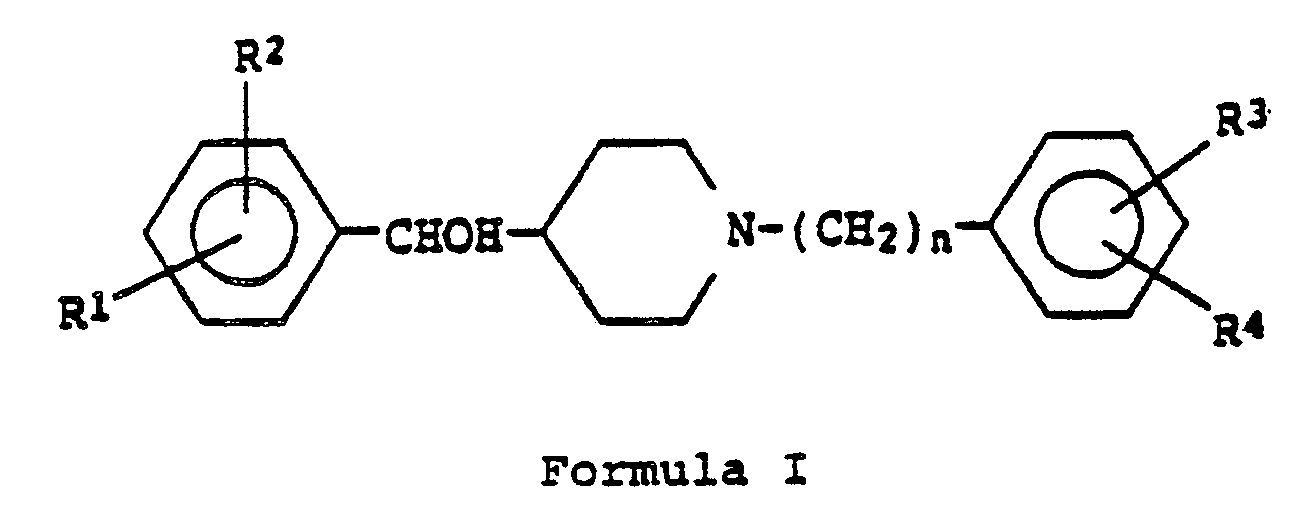
each of R¹, R², R³, and R⁴ is independently selected from the group consisting of hydrogen, a C₁₋₆ alkyl group, halogen, trifluoromethyl, hydroxy, a C₁₋₆ alkoxy group, or an amino group; n is 2, 3, or 4; and the pharmaceutically acceptable acid addition salts thereof, for use in the preparation of a medicament for the treatment of anxiety.
Applications Claiming Priority (2)
| Application Number | Priority Date | Filing Date | Title |
|---|---|---|---|
| US13116087A | 1987-12-10 | 1987-12-10 | |
| US131160 | 1987-12-10 |
Publications (2)
| Publication Number | Publication Date |
|---|---|
| EP0319962A2 true EP0319962A2 (en) | 1989-06-14 |
| EP0319962A3 EP0319962A3 (en) | 1990-08-22 |
Family
ID=22448169
Family Applications (1)
| Application Number | Title | Priority Date | Filing Date |
|---|---|---|---|
| EP88120476A Withdrawn EP0319962A3 (en) | 1987-12-10 | 1988-12-07 | Piperidinyl methanol derivatives for the treatment of anxiety |
Country Status (6)
| Country | Link |
|---|---|
| EP (1) | EP0319962A3 (en) |
| JP (1) | JPH02138214A (en) |
| KR (1) | KR890009398A (en) |
| AU (1) | AU608922B2 (en) |
| DK (1) | DK689188A (en) |
| ZA (1) | ZA889110B (en) |
Cited By (11)
| Publication number | Priority date | Publication date | Assignee | Title |
|---|---|---|---|---|
| US5106855A (en) * | 1989-12-20 | 1992-04-21 | Merrell Dow Pharmaceuticals Inc. | Method for the treatment of glaucoma |
| WO1995024194A1 (en) * | 1994-03-09 | 1995-09-14 | Merrell Pharmaceuticals Inc. | Treatment of obsessive-compulsive disorders with 5-ht2 antagonists |
| US5874445A (en) * | 1990-06-01 | 1999-02-23 | Merrell Pharmaceutical, Inc. | (+) -α- (2,3-dimethoxyphenyl)-1-(2-(4-fluorephenyl) ethyl)-4-piepridinemethanol |
| RU2139867C1 (en) * | 1991-09-11 | 1999-10-20 | Мак Нейлэб, Инк. | New 4-arylpiperazines and 4-arylpiperidines, pharmaceutical composition and method of inhibition of dopamine-2-receptors |
| US6004980A (en) * | 1990-06-01 | 1999-12-21 | Merrell Pharmaceuticals, Inc. | (+)-α-(2,3-dimethoxyphenyl)-1-[2-(4-fluorophenyl)ethyl]-4-piperidinemethanol |
| US6022877A (en) * | 1996-03-21 | 2000-02-08 | Hoechst Marion Roussel, Inc. | Use of (+)-α-(2,3-dimethoxyphenyl-1-[2-(4-fluorophenyl)ethyl]-4-piperidin emethanol in treating depressive disorders and bipolar disorders |
| US6028083A (en) * | 1997-07-25 | 2000-02-22 | Hoechst Marion Roussel, Inc. | Esters of (+)-α-(2,3-dimethoxyphenyl)-1-[2-(4-fluorophenyl) ethyl]-4-piperidinemethanol |
| US6277864B1 (en) | 1998-08-28 | 2001-08-21 | Aventis Pharmaceuticals Inc. | Use of R- +)-α-(2,3-dimethoxyphenyl-1-[2-(4-fluorophenyl) ethyl]-4-piperidinemethanol for the treatment of sleep disorders |
| US6713627B2 (en) | 1998-03-13 | 2004-03-30 | Aventis Pharmaceuticals Inc. | Processes for the preparation of (R)-α-(2,3-dimethoxyphenyl)-1-[2-(4-fluorophenyl)ethyl]-4-piperidinemethanol |
| US6939879B2 (en) | 1998-08-28 | 2005-09-06 | Aventis Pharmaceuticals Inc. | Use of R (+)-α-(2,3-dimethoxyphenyl)-1-[2-(4-fluorophenyl)ethyl]-4-piperidinemethanol for the treatment of substance induced insomnia |
| WO2005082886A1 (en) * | 2004-02-27 | 2005-09-09 | Merck Patent Gmbh | Piperidine derivatives |
Families Citing this family (1)
| Publication number | Priority date | Publication date | Assignee | Title |
|---|---|---|---|---|
| US5093341A (en) * | 1987-12-17 | 1992-03-03 | Merrell Dow Pharmaceuticals Inc. | N-aralkyl piperidine derivatives useful as antithrombolytic agents |
Family Cites Families (2)
| Publication number | Priority date | Publication date | Assignee | Title |
|---|---|---|---|---|
| CA1280421C (en) * | 1985-07-02 | 1991-02-19 | Albert A. Carr | 1,4-disubstituted piperidinyl derivatives |
| US5093341A (en) * | 1987-12-17 | 1992-03-03 | Merrell Dow Pharmaceuticals Inc. | N-aralkyl piperidine derivatives useful as antithrombolytic agents |
-
1988
- 1988-12-02 JP JP63304331A patent/JPH02138214A/en active Pending
- 1988-12-05 AU AU26590/88A patent/AU608922B2/en not_active Ceased
- 1988-12-05 ZA ZA889110A patent/ZA889110B/en unknown
- 1988-12-07 EP EP88120476A patent/EP0319962A3/en not_active Withdrawn
- 1988-12-08 KR KR1019880016295A patent/KR890009398A/en not_active Ceased
- 1988-12-09 DK DK689188A patent/DK689188A/en not_active Application Discontinuation
Cited By (17)
| Publication number | Priority date | Publication date | Assignee | Title |
|---|---|---|---|---|
| US5106855A (en) * | 1989-12-20 | 1992-04-21 | Merrell Dow Pharmaceuticals Inc. | Method for the treatment of glaucoma |
| US5874445A (en) * | 1990-06-01 | 1999-02-23 | Merrell Pharmaceutical, Inc. | (+) -α- (2,3-dimethoxyphenyl)-1-(2-(4-fluorephenyl) ethyl)-4-piepridinemethanol |
| US6004980A (en) * | 1990-06-01 | 1999-12-21 | Merrell Pharmaceuticals, Inc. | (+)-α-(2,3-dimethoxyphenyl)-1-[2-(4-fluorophenyl)ethyl]-4-piperidinemethanol |
| RU2139867C1 (en) * | 1991-09-11 | 1999-10-20 | Мак Нейлэб, Инк. | New 4-arylpiperazines and 4-arylpiperidines, pharmaceutical composition and method of inhibition of dopamine-2-receptors |
| WO1995024194A1 (en) * | 1994-03-09 | 1995-09-14 | Merrell Pharmaceuticals Inc. | Treatment of obsessive-compulsive disorders with 5-ht2 antagonists |
| US5618824A (en) * | 1994-03-09 | 1997-04-08 | Merrell Pharmaceuticals Inc. | Treatment of obsessive-compulsive disorders with 5-HT2 antagonists |
| US6022877A (en) * | 1996-03-21 | 2000-02-08 | Hoechst Marion Roussel, Inc. | Use of (+)-α-(2,3-dimethoxyphenyl-1-[2-(4-fluorophenyl)ethyl]-4-piperidin emethanol in treating depressive disorders and bipolar disorders |
| US6380216B1 (en) | 1996-03-21 | 2002-04-30 | Aventis Pharmaceuticals Inc. | Use of (+)-α-(2,3-dimethoxyphenyl)-1-[2-(4-fluorophenyl) ethyl]-4-piperidinemethanol in treating depressive disorders and bipolar disorders |
| US6063793A (en) * | 1997-07-25 | 2000-05-16 | Hoechst Marion Roussel, Inc. | Esters of (+)-α-(2,3-dimethoxyphenyl)-1-[2-(4-fluorophenyl)ethyl]-4-piperidi nemethanol |
| US6028083A (en) * | 1997-07-25 | 2000-02-22 | Hoechst Marion Roussel, Inc. | Esters of (+)-α-(2,3-dimethoxyphenyl)-1-[2-(4-fluorophenyl) ethyl]-4-piperidinemethanol |
| US6713627B2 (en) | 1998-03-13 | 2004-03-30 | Aventis Pharmaceuticals Inc. | Processes for the preparation of (R)-α-(2,3-dimethoxyphenyl)-1-[2-(4-fluorophenyl)ethyl]-4-piperidinemethanol |
| US7332607B2 (en) | 1998-03-13 | 2008-02-19 | Aventis Holdings Inc. | Processes for the preparation of (R)-α-(2,3-dimethoxyphenyl)-1-[2-(4-fluorophenyl)ethyl]-4-piperidinemethanol |
| US6277864B1 (en) | 1998-08-28 | 2001-08-21 | Aventis Pharmaceuticals Inc. | Use of R- +)-α-(2,3-dimethoxyphenyl-1-[2-(4-fluorophenyl) ethyl]-4-piperidinemethanol for the treatment of sleep disorders |
| US6613779B2 (en) | 1998-08-28 | 2003-09-02 | Aventis Pharmaceuticals Inc. | Use of R(+) -α-(2,3-Dimethoxyphenyl)-1-[2-(4-fluorophenyl)ethyl]-4-piper idinemethanol for the treatment of sleep disorders |
| US6939879B2 (en) | 1998-08-28 | 2005-09-06 | Aventis Pharmaceuticals Inc. | Use of R (+)-α-(2,3-dimethoxyphenyl)-1-[2-(4-fluorophenyl)ethyl]-4-piperidinemethanol for the treatment of substance induced insomnia |
| WO2005082886A1 (en) * | 2004-02-27 | 2005-09-09 | Merck Patent Gmbh | Piperidine derivatives |
| US7834032B2 (en) | 2004-02-27 | 2010-11-16 | Merck Patent Gesellschaft Mit Beschrankter Haftung | Piperidine derivatives |
Also Published As
| Publication number | Publication date |
|---|---|
| JPH02138214A (en) | 1990-05-28 |
| EP0319962A3 (en) | 1990-08-22 |
| DK689188D0 (en) | 1988-12-09 |
| KR890009398A (en) | 1989-08-01 |
| AU2659088A (en) | 1989-06-15 |
| ZA889110B (en) | 1989-08-30 |
| AU608922B2 (en) | 1991-04-18 |
| DK689188A (en) | 1989-06-11 |
Similar Documents
| Publication | Publication Date | Title |
|---|---|---|
| EP0325063B1 (en) | Use of 1,4-disubstituted-piperidinyl compounds in the manufacture of a medicament for the treatment of insomnia | |
| KR100236562B1 (en) | Composition comprising a tramadol and a non-steroidal anti-inflammatory drug | |
| RU2095062C1 (en) | Blocking agent of withdrawal syndrome that is a result of drug habituation to over intaking drugs and substances causing habituation, pharmacological composition based on thereof and a method of relief or prevention of withdrawal syndrome | |
| US4877798A (en) | Treatment of fibromyalgia | |
| EP0337136A2 (en) | Piperidine derivatives in the treatment of extrapyramidal side effects associated with neuroleptic therapy | |
| AU608922B2 (en) | Method for the treatment of anxiety | |
| EP1014974B1 (en) | Treatment of schizophrenia and psychosis | |
| CA2345406A1 (en) | Analgesic | |
| CA2370834C (en) | Use of saredutant and the pharmaceutically acceptable salts thereof to produce medicaments used to treat or prevent mood disorders, adjustment disorders or mixed anxiety-depression disorders | |
| JPH05132430A (en) | Use of glycine/nmda receptor ligand relating to therapy of drug dependence and withdrawal symptoms | |
| EP0317933A2 (en) | Treatment of fibromyalgia | |
| JPH04504859A (en) | Extended-release (tight-binding) dopamine, serotonin or norepinephrine reuptake inhibitors as cocaine, amphetamine and phencyclidine antagonists | |
| CZ2004524A3 (en) | Agonists of nicotine acetylcholine receptor useful for the treatment of restless legs | |
| US20050070577A1 (en) | Compositions containing a serotonin selective reuptake inhibitor and a 5-HT2A receptor antagonist | |
| CN1276753C (en) | Pyridin-2-yl-methylamine derivatives for the treatment of opioid dependence | |
| IE904607A1 (en) | Method for the treatment of glaucoma | |
| TH29666A (en) | A novel heterolic compound. | |
| JPWO2018159716A1 (en) | Drugs for alcohol use disorders | |
| KR20080034475A (en) | Hypnotics and complexes of R (+)-alpha- (2,3-dimethoxy-phenyl) -1- [2- (4-fluorophenyl) ethyl] -4-piperidinemethanol and therapeutic uses thereof | |
| HK1156248A (en) | Therapeutic uses of compounds having combined sert, 5-ht3, and 5-ht1a activity | |
| MX2007014396A (en) | Pharmaceutical composition comprising a 1-(3-chlorophenyl)-3- alkylpiperazine for treating apetite disorder. |
Legal Events
| Date | Code | Title | Description |
|---|---|---|---|
| PUAI | Public reference made under article 153(3) epc to a published international application that has entered the european phase |
Free format text: ORIGINAL CODE: 0009012 |
|
| AK | Designated contracting states |
Kind code of ref document: A2 Designated state(s): AT BE CH DE ES FR GB GR IT LI LU NL SE |
|
| PUAL | Search report despatched |
Free format text: ORIGINAL CODE: 0009013 |
|
| AK | Designated contracting states |
Kind code of ref document: A3 Designated state(s): AT BE CH DE ES FR GB GR IT LI LU NL SE |
|
| 17P | Request for examination filed |
Effective date: 19901122 |
|
| 17Q | First examination report despatched |
Effective date: 19910614 |
|
| STAA | Information on the status of an ep patent application or granted ep patent |
Free format text: STATUS: THE APPLICATION IS DEEMED TO BE WITHDRAWN |
|
| 18D | Application deemed to be withdrawn |
Effective date: 19911025 |