EP0320239B1 - Verfahren zur Zubereitung von Pflanzengewebestreifen für die Züchtung von Planzengeweben - Google Patents
Verfahren zur Zubereitung von Pflanzengewebestreifen für die Züchtung von Planzengeweben Download PDFInfo
- Publication number
- EP0320239B1 EP0320239B1 EP88311592A EP88311592A EP0320239B1 EP 0320239 B1 EP0320239 B1 EP 0320239B1 EP 88311592 A EP88311592 A EP 88311592A EP 88311592 A EP88311592 A EP 88311592A EP 0320239 B1 EP0320239 B1 EP 0320239B1
- Authority
- EP
- European Patent Office
- Prior art keywords
- plant
- blade
- circular plate
- cut
- plant material
- Prior art date
- Legal status (The legal status is an assumption and is not a legal conclusion. Google has not performed a legal analysis and makes no representation as to the accuracy of the status listed.)
- Expired - Lifetime
Links
Images


Classifications
-
- A—HUMAN NECESSITIES
- A01—AGRICULTURE; FORESTRY; ANIMAL HUSBANDRY; HUNTING; TRAPPING; FISHING
- A01G—HORTICULTURE; CULTIVATION OF VEGETABLES, FLOWERS, RICE, FRUIT, VINES, HOPS OR SEAWEED; FORESTRY; WATERING
- A01G7/00—Botany in general
-
- A—HUMAN NECESSITIES
- A01—AGRICULTURE; FORESTRY; ANIMAL HUSBANDRY; HUNTING; TRAPPING; FISHING
- A01H—NEW PLANTS OR NON-TRANSGENIC PROCESSES FOR OBTAINING THEM; PLANT REPRODUCTION BY TISSUE CULTURE TECHNIQUES
- A01H4/00—Plant reproduction by tissue culture techniques ; Tissue culture techniques therefor
- A01H4/002—Culture media for tissue culture
Definitions
- the present invention relates to a method of preparation of a large amount of plant tissue strips which can be regenerated to plants in plant tissue culture.
- sections of plant organs or tissues used in plant tissue culture are prepared manually, for example, by slicing plant material with a scalpel or cutting plant discs from a plant material with a cork borer.
- These methods are advantageous in that the operator can select a part of a plant material most suitable for the culture, and can cut the plant material into a shape most preferable for the culture. Nevertheless, the operation requires a high level of skill and is labor and time-consuming. Therefore, although such conventional methods can be used for experimental activities in a laboratory, it is difficult to apply such methods to the preparation of plant tissue strips for commercial proliferation of plants.
- EP No. 132414A describes a semi-automated plant tissue culturing, it does not suggest a particular cutting apparatus similar to that of the present invention.
- the present inventors surprisingly found that, by selecting a method of cutting a plant material appropriate to the kind of plant material to be cut, mechanical cutting will provide sections which can be successfully grown without problems or difficulty.
- a method of preparation of a plurality of plant tissue strips which can regenerate to plants in plant tissue culture characterized by: preparing a sterilized or uncontaminated plant material, and supplying the plant material to a cutting apparatus to prepare plant strips, wherein the cutting apparatus comprises a circular plate 3 or 53 having one or more than one long cutout 4 or 54 positioned at an angle to a tangential line of the circular plate 3 or 53, which plate is rotated by a drive unit 2 or 52, and one more than one blade 5 or 54 fixed to the circular plate 3 or 53 so that a cutting edge 6 of the blade 5 or 55 is positioned above the cutout 4 or 54 with a space between the edge 6 and a plane extending from a surface of the circular plate in the proximity of the blade.
- the present invention provides a method of preparation of a plurality of plant tissue strips which can be regenerated to plants in plant tissue culture, characterized by: preparing a liquid medium in which pieces of a sterilized or uncontaminated plant material are contained, and cutting the pieces of the plant using the above-mentioned apparatus inserted in a conduit through which the liquid medium flows.
- tissue strips of various kinds of plants can be prepared.
- various organs or parts of plants including bulbs, tubers, stems and the like (hereinafter referred to as "plant material") can be sectional by the present methods.
- the plant material may be obtained from a plant which has not been contaminated with plant pathogens such as bacteria or fungi, such as a plant cultured under aseptic conditions, or the plant material can be sterilised by any conventional method which does not destroy the viability of the plant, for example, a treatment of the plant material with a bacteriocide, fungicide, detergent, or the like.
- plant sections are prepared using an apparatus shown in Figs. 1 to 6.
- the apparatus comprises a housing 1, and a circular plate 3 driven by a drive unit 2.
- the circular plate 3 has one or more than one cutout 4 arranged at a predetermined angle relative to a tangential line of the circular plate 3. In this embodiment, this angle is approximately a right angle, i.e., the cutout is roughly radially arranged.
- a blade 5 is attached to the circular plate 3 so that a cutting edge 6 thereof is positioned above the cutout, to force the plant sections cut from a plant material by the blade 5 to fall into the housing 1 through the cutout 4.
- a space is provided between the cutting edge 6 and a plane 7 extending from the surface of the circular plate 3 in the proximity of the blade 5. This space can be adjusted, to control the thickness of the cut plant section, by selecting the thickness of the blade 5 or by inserting a spacer (not shown) having a desired thickness between the blade 5 and the plate 3.
- Plant material especially a bulb or tuber is preferably "slip-cut” rather than “press-cut”, to minimize destruction of the plant tissue.
- “slip-cut” means that a cutting edge “slips” or “slides” on a cutting front of a plant material while cutting the plant material.
- the blade 5 and the cutout 4 have an arc-shape.
- the blade 5 is changed. Accordingly, the blade 5 is removably attached to the plate 3 by, for example, screws 8.
- the plate 3 is driven by a drive unit, such as an electric motor, via a shaft.
- the plate 3 is removably attached to the top of the shaft to enable an easy recovery of cut sections accumulated in the housing 1.
- the apparatus shown in Fig. 1 further comprises a cover 10 having an inlet 9.
- a speed of rotation of the circular plate 3 driven by the drive unit 2 is adjusted, for example, to between 100 and 400 rpm, and the space between the cutting edge 6 and a plane 7 extending along the plate surface is adjusted to, for example, between 1 and 4 mm.
- the particular conditions are chosen according to a desired thickness of the cut section, the hardness of the plant material to be cut, and the like.
- the apparatus shown in Fig. 1 is preferably used to prepare plant strips from the bulb of a lily or the like, or a potato tuber or the like.
- the plant material is inserted into the inlet 9, and the material is then cut by the blade 5 moved by the rotation of the circular plate 3.
- a soft material such as a lily bulb
- the weight of the plant material per se is sufficient to press the material against the blade, and therefore, the operator can simply place the material on the circular plate.
- an additional force must be applied to the material, and accordingly, a force of about 50 to 500 g/cm2 is applied to the plant material. This force may be applied by placing a weight directly or via a pressing plate on the plant material, or by applying a spring force to the pressing plate, or by manually pressing down on the pressing plate.
- the plant material is cut into a plurality of strips, and the cut strips fall through the cutout 4 into the housing 1.
- the cut strips accumulate in the housing 1, and the cover 10 and the circular plate 3 are then removed and the cut strips recovered.
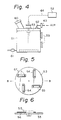
- Figures 4 to 6 show a variation of the embodiment shown in Fig.1.
- a circular plate 53 is provided with four cutouts 54, and accordingly, four blades 55 are attached to the circular plate 53 by screws 57.
- the blades 55 have a straight cutting edge.
- the blades 55, and therefore the cutouts 54 are positioned at an angle which is not a right angle relative to a tangential line of the circular plate 53, as shown in Fig. 5.
- Figure 6 shows a cross-sectional view of the plate 53 shown in Fig. 5, taken along the line B-B in Fig. 5.
- the blade 55 is attached to the plate 53 via a spacer 56.
- the purpose of the spacer 56 has been explained in detail in the description of the embodiment shown in Fig. 1.
- the circular plate 53 and the blades 55 attached thereon are contained in a housing 51.
- the housing 51 is provided with windows 59 through which the inside of the housing 51 can be observed, for example, to determine the amount of cut sections accumulated therein.
- the housing 51 is also provided with an air inlet tube 62 fitted with an air filter 63.
- the inside of the housing 51 can be maintained in an aseptic condition during the operation, if the whole apparatus has been sterilized before the start of the operation.
- the whole apparatus can be made from metal, and thus can be sterilized by heating, for example, steaming.
- the circular plate 53 is rotated by a drive force transmitted through a flexible drive shaft 64 from a drive unit such as an electric motor 52 provided outside of the housing 51.
- the apparatus shown in Fig. 4 further comprises an inlet 60 through which a plant material is fed, and an outlet 61 through which plant sections are recovered.
- the inlet 60 is inclined, to facilitate the introduction of plant material while taking into consideration the presence of the flexible driving shaft 64.
- the apparatus shown in Fig. 4 can be used in the same manner as described in detail for the apparatus shown in Fig. 1
- the apparatus shown in Fig. 4 can be preferably used to cut a plant material in a liquid medium such as water, a buffer solution, a culture medium for plant tissue culture, or the like.
- a liquid medium and pieces of plant material are introduced through the inlet 60, and the liquid medium containing the cut plant strips is removed through the outlet 62.
- a large amount of plant tissue strips which can be regenerated to plants in plant tissue culture is easily prepared without contamination and without necrosis of the plant tissue.
- the present method can be applied to the preparation of sections from a whole plant, or from parts of a plant, such as the flower, leaf, stem, tip, bulb, tuber, callus or the like, and the resulting sections can be cultured for the production of a useful substance or for the regeneration of the entire plant.
- the apparatus shown in Fig. 1 was used for this example, and the space between the cutting edge 6 and a plane extending from a surface of the circular plate 3 was adjusted to 2 mm.
- the whole apparatus with cap 10 was enveloped in aluminum foil, and then autoclaved. Then, 60 virus-free bulbs of Lilium longiflorum having a diameter of 5 to 8 mm, obtained by shoot tip culture, were introduced through the inlet 9, a pressing plate (not shown) was placed on the bulb in the inlet, and a weight was placed on the pressing plate to apply a pressure of 400 g/cm2 to the bulb.
- the cutting blades in the form of a circular plate were rotated at a speed of 350 rpm.
- the cut strips were cultured in a 1 l mini-jar fermenter while bubbling 100% O2 gas therein for 15 weeks, and 2360 bulbs having a diameter of about 3 mm were obtained.
- Example 2 The same apparatus as used in Example 1 was used, but the space between the cutting edge and a plane extending from the surface of the circular plate was adjusted to 2 mm.
- a mass of potato having a diameter of 28 mm and a length of 65 mm was introduced through the inlet 9, and a pressure of 45 g/cm2 was applied to the mass.
- the speed of rotation was varied between 20 rpm and 400 rpm.
- the thickness of the cut strips and the dispersion thereof as a result of the speed of rotation are shown in Fig. 7.
- a rotation speed of between 100 and 300 rpm provided sections having a homogeneous thickness.
- Example 2 The same procedure as described in Example 2 was repeated, except that the speed of rotation was adjusted to 350 rpm, and the pressure applied to the potato mass was varied between 50 g/cm2 and 400 g/cm2. As shown in Fig. 8, a pressure between 200 g/cm2 and 350 g/cm2 provided cut strips having a homogeneous thickness.
Landscapes
- Life Sciences & Earth Sciences (AREA)
- Engineering & Computer Science (AREA)
- Biotechnology (AREA)
- Developmental Biology & Embryology (AREA)
- Botany (AREA)
- Environmental Sciences (AREA)
- Cell Biology (AREA)
- Biodiversity & Conservation Biology (AREA)
- Ecology (AREA)
- Forests & Forestry (AREA)
- Breeding Of Plants And Reproduction By Means Of Culturing (AREA)
- Apparatus Associated With Microorganisms And Enzymes (AREA)
Claims (10)
- Verfahren zur Herstellung einer Vielzahl von Pflanzengewebestreifen, die bei der Pflanzengewebezüchtung zu Pflanzen regeneriert werden können, gekennzeichnet durch:
Herstellung eines sterilisierten oder nicht verunreinigten Pflanzenmaterials; und
Zuführung dieses Pflanzenmaterials zu einer Trennvorrichtung, um Pflanzenstreifen herzustellen, wobei diese Trennvorrichtung eine kreisförmige Platte (3, 53) mit einem oder mehr als einem Längsausschnitt (4, 54), der in einem Winkel zur Tangentiallinie der kreisförmigen Platte (3, 53) angeordnet ist, wobei diese Platte von einer Antriebseinheit (2, 52) gedreht wird, und eine oder mehr als eine Klinge (5, 55) umfaßt, die an die kreisförmige Platte (3, 53) angebracht sind, so daß eine Schnittkante (6) jeder Klinge (5, 55) mit einem Abstand zwischen der Schnittkante (6) und einer Ebene oberhalb jedes Ausschnittes (4, 54) angeordnet ist, die sich von der Oberfläche der kreisförmigen Platte in der Nähe der Klinge erstreckt. - Verfahren nach Anspruch 1, worin die Klinge (5) radial angeordnet ist und eine gekrümmte Form aufweist, wodurch das Pflanzenmaterial gleitend geschnitten wird.
- Verfahren nach Anspruch 1 oder 2, worin die Klinge (5) durch Schrauben (8) abnehmbar an die kreisförmige Platte angebracht ist.
- Verfahren nach Anspruch 1, 2 oder 3, worin die Klinge (55) durch einen Abstandhalter (56) von der kreisförmigen Platte getrennt ist.
- Verfahren nach einem der vorstehenden Ansprüche, worin die kreisförmige Platte (3, 53) in einem Behälter (1, 51) angeordnet ist und sowohl die Platte (3, 53) als auch der Behälter (1, 51) aus Metall bestehen, wodurch das Ganze durch Erwärmen sterilisiert werden kann.
- Verfahren nach einem der vorstehenden Ansprüche, worin der Abstand zwischen der Schnittkante (6) der Klinge (5) und der Ebene, die sich von der Oberfläche der kreisförmigen Platte (3, 53) in der Nähe der Klinge erstreckt, zwischen 1 und 4 mm beträgt und sich die Platte mit einer Geschwindigkeit von 100 bis 400 U/min dreht und die zu zerschneidende Pflanze mit einem Druck von 0 bis 500 g/cm² gegen die Klinge gedrückt wird, und diese Bedingungen in Abhängigkeit von der Pflanzenart, der Art der Pflanzenorgane und der Teile der zu trennenden Pflanze ausgewählt werden.
- Verfahren nach einem der vorstehenden Ansprüche, worin die Klinge in einem Winkel angeordnet ist, der geringer als der rechte Winkel zur Tangentiallinie der kreisförmigen Platte (3, 53) ist, und das Pflanzenmaterial gleitend geschnitten wird.
- Verfahren zur Herstellung einer Vielzahl von Inoculum-Abschnitten zur Pflanzengewebezüchtung unter Anwendung des Verfahrens nach einem der vorstehenden Ansprüche, wobei ein flüssiges Medium hergestellt wird, in dem das sterilisierte oder nicht verunreinigte Pflanzenmaterial enthalten ist, und dieses Pflanzenmaterial mit der Vorrichtung geschnitten wird, die in eine Leitung eingesetzt ist, durch die das flüssige Medium strömt.
- Verfahren nach einem der vorstehenden Ansprüche, worin eine Zwiebel oder ein Knollengewächs der Pflanze geschnitten wird.
- Verfahren nach einem der Ansprüche 1 bis 8, worin das Pflanzenmaterial ein Pflanzenstiel mit seitlichen Knospen ist.
Priority Applications (1)
| Application Number | Priority Date | Filing Date | Title |
|---|---|---|---|
| AT88311592T ATE78973T1 (de) | 1987-12-08 | 1988-12-07 | Verfahren zur zubereitung von pflanzengewebestreifen fuer die zuechtung von planzengeweben. |
Applications Claiming Priority (10)
| Application Number | Priority Date | Filing Date | Title |
|---|---|---|---|
| JP31119687 | 1987-12-08 | ||
| JP311196/87 | 1987-12-08 | ||
| JP10802988 | 1988-04-30 | ||
| JP108029/88 | 1988-04-30 | ||
| JP15358688 | 1988-06-23 | ||
| JP153586/88 | 1988-06-23 | ||
| JP276530/88 | 1988-10-31 | ||
| JP27653088 | 1988-10-31 | ||
| JP27845688 | 1988-11-01 | ||
| JP278456/88 | 1988-11-01 |
Publications (3)
| Publication Number | Publication Date |
|---|---|
| EP0320239A2 EP0320239A2 (de) | 1989-06-14 |
| EP0320239A3 EP0320239A3 (en) | 1989-09-06 |
| EP0320239B1 true EP0320239B1 (de) | 1992-08-05 |
Family
ID=27526346
Family Applications (1)
| Application Number | Title | Priority Date | Filing Date |
|---|---|---|---|
| EP88311592A Expired - Lifetime EP0320239B1 (de) | 1987-12-08 | 1988-12-07 | Verfahren zur Zubereitung von Pflanzengewebestreifen für die Züchtung von Planzengeweben |
Country Status (6)
| Country | Link |
|---|---|
| EP (1) | EP0320239B1 (de) |
| KR (1) | KR960016185B1 (de) |
| AU (1) | AU631110B2 (de) |
| CA (1) | CA1333333C (de) |
| DE (1) | DE3873498T2 (de) |
| WO (1) | WO1989005090A2 (de) |
Families Citing this family (8)
| Publication number | Priority date | Publication date | Assignee | Title |
|---|---|---|---|---|
| JP2580248B2 (ja) * | 1987-07-07 | 1997-02-12 | 三井石油化学工業株式会社 | 培養装置 |
| JPH01243985A (ja) * | 1988-03-25 | 1989-09-28 | P C C Technol:Kk | 植物器官の培養法及びその培養槽 |
| GB9007685D0 (en) * | 1990-04-05 | 1990-06-06 | Allard Jane M | Methods and apparatus relating to micropropagation |
| GB9106422D0 (en) * | 1991-03-26 | 1991-05-15 | British Res Agricult Eng | Method of and apparatus for separating plant material |
| CN101372665B (zh) * | 2008-05-16 | 2012-12-26 | 北京航空航天大学 | 一种具有拉压和培养腔旋转功能的组织工程反应器 |
| GB2482909A (en) * | 2010-08-20 | 2012-02-22 | Kenwood Ltd | Disc Cutter with Concave Blade |
| CN110741932B (zh) * | 2019-11-13 | 2020-06-09 | 济南市第二农业科学研究院 | 一种用于生姜脱毒组培装置与培养方法 |
| EP3903565B1 (de) * | 2020-04-30 | 2025-08-27 | Antonio Palumbo | Pflanzenschneid- und klonzuchtvorrichtung und zugehörige verfahren |
Family Cites Families (7)
| Publication number | Priority date | Publication date | Assignee | Title |
|---|---|---|---|---|
| FR1318483A (fr) * | 1962-03-29 | 1963-02-15 | Machine à couper en tranches d'épaisseurs réglables, notamment les pommes de terre, fruits, légumes et autres produits | |
| NL7812110A (nl) * | 1978-12-13 | 1980-06-17 | Philips Nv | Keukenmachine. |
| US4350768A (en) * | 1980-09-19 | 1982-09-21 | Bristol Myers Company | Method for preparing single cell suspension |
| IL69333A (en) * | 1983-07-26 | 1986-04-29 | Biolog Ind | Process for plant tissue culture propagation |
| EP0232628A1 (de) * | 1986-01-04 | 1987-08-19 | P.B. Ind. Plant Biotech Industries Ltd. | Vorrichtung und Verfahren für den Wuchs von Pflanzen und deren Entwicklung |
| JP2580248B2 (ja) * | 1987-07-07 | 1997-02-12 | 三井石油化学工業株式会社 | 培養装置 |
| IL83289A0 (en) * | 1987-07-22 | 1987-12-31 | Plant Biotec Ltd | Apparatus and method for plant growth and development |
-
1988
- 1988-12-07 AU AU27999/89A patent/AU631110B2/en not_active Ceased
- 1988-12-07 WO PCT/JP1988/001232 patent/WO1989005090A2/en not_active Ceased
- 1988-12-07 EP EP88311592A patent/EP0320239B1/de not_active Expired - Lifetime
- 1988-12-07 KR KR1019890701486A patent/KR960016185B1/ko not_active Expired - Fee Related
- 1988-12-07 CA CA000585172A patent/CA1333333C/en not_active Expired - Fee Related
- 1988-12-07 DE DE8888311592T patent/DE3873498T2/de not_active Expired - Lifetime
Also Published As
| Publication number | Publication date |
|---|---|
| WO1989005090A2 (en) | 1989-06-15 |
| CA1333333C (en) | 1994-12-06 |
| EP0320239A3 (en) | 1989-09-06 |
| KR960016185B1 (ko) | 1996-12-06 |
| DE3873498D1 (de) | 1992-09-10 |
| DE3873498T2 (de) | 1992-12-03 |
| AU2799989A (en) | 1989-07-05 |
| AU631110B2 (en) | 1992-11-19 |
| WO1989005090A3 (en) | 1989-07-27 |
| KR900700003A (ko) | 1990-08-11 |
| EP0320239A2 (de) | 1989-06-14 |
Similar Documents
| Publication | Publication Date | Title |
|---|---|---|
| EP1433423B1 (de) | Gewebebiopsie und Bearbeitungsvorrichtung | |
| US7015032B2 (en) | Intermittent immersion vessel apparatus and process for plant propagation | |
| EP1514521B1 (de) | Vorrichtung zur Extraktion und Mazeration von Gewebe | |
| MX2007001564A (es) | Metodo y aparato para aislar sustancialmente tejidos de planta. | |
| CA1333333C (en) | Method of preparation of inoculum sections for plant tissue culture | |
| EP0298722B1 (de) | Kulturapparat | |
| CN1016857B (zh) | 制备培养植物组织所需接种切片的方法 | |
| JPH03502879A (ja) | 植物組織培養用植込み切片の調製方法 | |
| WO1992001369A1 (en) | Cutting and/or manoeuvring apparatus and methods | |
| JP2951973B2 (ja) | 植物切片作成用切断装置 | |
| JP2686114B2 (ja) | 植物組織の培養切片作成方法 | |
| WO2001011945A2 (en) | Methods for mass production of plantlets | |
| WO1992017055A1 (en) | Method of and apparatus for separating plant material | |
| JPH02126133A (ja) | 細切方法および細切装置 | |
| Simpson et al. | Intermittent immersion vessel apparatus and process for plant propagation | |
| IE78300B1 (en) | Improved micropropagation apparatus and method | |
| JPH0549359A (ja) | 不定胚の連続的増殖方法及びその装置 | |
| JPS62265977A (ja) | 微生物または微生物培養物移殖装置 |
Legal Events
| Date | Code | Title | Description |
|---|---|---|---|
| PUAI | Public reference made under article 153(3) epc to a published international application that has entered the european phase |
Free format text: ORIGINAL CODE: 0009012 |
|
| AK | Designated contracting states |
Kind code of ref document: A2 Designated state(s): AT BE CH DE ES FR GB GR IT LI LU NL SE |
|
| PUAL | Search report despatched |
Free format text: ORIGINAL CODE: 0009013 |
|
| AK | Designated contracting states |
Kind code of ref document: A3 Designated state(s): AT BE CH DE ES FR GB GR IT LI LU NL SE |
|
| 17P | Request for examination filed |
Effective date: 19900227 |
|
| 17Q | First examination report despatched |
Effective date: 19910208 |
|
| GRAA | (expected) grant |
Free format text: ORIGINAL CODE: 0009210 |
|
| AK | Designated contracting states |
Kind code of ref document: B1 Designated state(s): AT BE CH DE ES FR GB GR IT LI LU NL SE |
|
| PG25 | Lapsed in a contracting state [announced via postgrant information from national office to epo] |
Ref country code: SE Free format text: THE PATENT HAS BEEN ANNULLED BY A DECISION OF A NATIONAL AUTHORITY Effective date: 19920805 Ref country code: LI Effective date: 19920805 Ref country code: GR Free format text: LAPSE BECAUSE OF FAILURE TO SUBMIT A TRANSLATION OF THE DESCRIPTION OR TO PAY THE FEE WITHIN THE PRESCRIBED TIME-LIMIT Effective date: 19920805 Ref country code: ES Free format text: THE PATENT HAS BEEN ANNULLED BY A DECISION OF A NATIONAL AUTHORITY Effective date: 19920805 Ref country code: CH Effective date: 19920805 Ref country code: AT Effective date: 19920805 |
|
| REF | Corresponds to: |
Ref document number: 78973 Country of ref document: AT Date of ref document: 19920815 Kind code of ref document: T |
|
| ITF | It: translation for a ep patent filed | ||
| REF | Corresponds to: |
Ref document number: 3873498 Country of ref document: DE Date of ref document: 19920910 |
|
| ET | Fr: translation filed | ||
| REG | Reference to a national code |
Ref country code: CH Ref legal event code: PL |
|
| PG25 | Lapsed in a contracting state [announced via postgrant information from national office to epo] |
Ref country code: LU Free format text: LAPSE BECAUSE OF NON-PAYMENT OF DUE FEES Effective date: 19921231 |
|
| PLBE | No opposition filed within time limit |
Free format text: ORIGINAL CODE: 0009261 |
|
| STAA | Information on the status of an ep patent application or granted ep patent |
Free format text: STATUS: NO OPPOSITION FILED WITHIN TIME LIMIT |
|
| 26N | No opposition filed | ||
| REG | Reference to a national code |
Ref country code: FR Ref legal event code: CD |
|
| NLT1 | Nl: modifications of names registered in virtue of documents presented to the patent office pursuant to art. 16 a, paragraph 1 |
Owner name: MITSUI CHEMICALS, INC. |
|
| PGFP | Annual fee paid to national office [announced via postgrant information from national office to epo] |
Ref country code: BE Payment date: 19990215 Year of fee payment: 11 |
|
| PG25 | Lapsed in a contracting state [announced via postgrant information from national office to epo] |
Ref country code: BE Free format text: LAPSE BECAUSE OF NON-PAYMENT OF DUE FEES Effective date: 19991231 |
|
| BERE | Be: lapsed |
Owner name: MITSUI CHEMICALS INC. Effective date: 19991231 |
|
| PGFP | Annual fee paid to national office [announced via postgrant information from national office to epo] |
Ref country code: GB Payment date: 20011205 Year of fee payment: 14 |
|
| PGFP | Annual fee paid to national office [announced via postgrant information from national office to epo] |
Ref country code: FR Payment date: 20011212 Year of fee payment: 14 |
|
| PGFP | Annual fee paid to national office [announced via postgrant information from national office to epo] |
Ref country code: NL Payment date: 20011228 Year of fee payment: 14 |
|
| REG | Reference to a national code |
Ref country code: GB Ref legal event code: IF02 |
|
| PGFP | Annual fee paid to national office [announced via postgrant information from national office to epo] |
Ref country code: DE Payment date: 20020109 Year of fee payment: 14 |
|
| PG25 | Lapsed in a contracting state [announced via postgrant information from national office to epo] |
Ref country code: GB Free format text: LAPSE BECAUSE OF NON-PAYMENT OF DUE FEES Effective date: 20021207 |
|
| PG25 | Lapsed in a contracting state [announced via postgrant information from national office to epo] |
Ref country code: NL Free format text: LAPSE BECAUSE OF NON-PAYMENT OF DUE FEES Effective date: 20030701 Ref country code: DE Free format text: LAPSE BECAUSE OF NON-PAYMENT OF DUE FEES Effective date: 20030701 |
|
| GBPC | Gb: european patent ceased through non-payment of renewal fee | ||
| NLV4 | Nl: lapsed or anulled due to non-payment of the annual fee |
Effective date: 20030701 |
|
| PG25 | Lapsed in a contracting state [announced via postgrant information from national office to epo] |
Ref country code: FR Free format text: LAPSE BECAUSE OF NON-PAYMENT OF DUE FEES Effective date: 20030901 |
|
| REG | Reference to a national code |
Ref country code: FR Ref legal event code: ST |
|
| PG25 | Lapsed in a contracting state [announced via postgrant information from national office to epo] |
Ref country code: IT Free format text: LAPSE BECAUSE OF NON-PAYMENT OF DUE FEES;WARNING: LAPSES OF ITALIAN PATENTS WITH EFFECTIVE DATE BEFORE 2007 MAY HAVE OCCURRED AT ANY TIME BEFORE 2007. THE CORRECT EFFECTIVE DATE MAY BE DIFFERENT FROM THE ONE RECORDED. Effective date: 20051207 |