EP0320290A2 - Radialer Luftreifen - Google Patents
Radialer Luftreifen Download PDFInfo
- Publication number
- EP0320290A2 EP0320290A2 EP88311693A EP88311693A EP0320290A2 EP 0320290 A2 EP0320290 A2 EP 0320290A2 EP 88311693 A EP88311693 A EP 88311693A EP 88311693 A EP88311693 A EP 88311693A EP 0320290 A2 EP0320290 A2 EP 0320290A2
- Authority
- EP
- European Patent Office
- Prior art keywords
- belt
- tire
- cord
- cords
- layers
- Prior art date
- Legal status (The legal status is an assumption and is not a legal conclusion. Google has not performed a legal analysis and makes no representation as to the accuracy of the status listed.)
- Granted
Links
- 229920002302 Nylon 6,6 Polymers 0.000 claims abstract description 11
- 239000000835 fiber Substances 0.000 claims abstract description 7
- 229920000642 polymer Polymers 0.000 claims abstract description 3
- 239000000853 adhesive Substances 0.000 claims description 5
- 230000001070 adhesive effect Effects 0.000 claims description 5
- 230000003014 reinforcing effect Effects 0.000 claims description 2
- 238000000926 separation method Methods 0.000 description 6
- 230000006378 damage Effects 0.000 description 4
- 239000011324 bead Substances 0.000 description 3
- 230000000052 comparative effect Effects 0.000 description 3
- XEEYBQQBJWHFJM-UHFFFAOYSA-N Iron Chemical compound [Fe] XEEYBQQBJWHFJM-UHFFFAOYSA-N 0.000 description 2
- 208000027418 Wounds and injury Diseases 0.000 description 2
- 208000014674 injury Diseases 0.000 description 2
- 238000004088 simulation Methods 0.000 description 2
- 241000531908 Aramides Species 0.000 description 1
- 239000004952 Polyamide Substances 0.000 description 1
- 230000002411 adverse Effects 0.000 description 1
- 238000013459 approach Methods 0.000 description 1
- 229920003235 aromatic polyamide Polymers 0.000 description 1
- 238000004364 calculation method Methods 0.000 description 1
- 239000002131 composite material Substances 0.000 description 1
- 239000012141 concentrate Substances 0.000 description 1
- 238000010276 construction Methods 0.000 description 1
- 238000007598 dipping method Methods 0.000 description 1
- 238000011978 dissolution method Methods 0.000 description 1
- 230000005484 gravity Effects 0.000 description 1
- 229910052742 iron Inorganic materials 0.000 description 1
- 238000003475 lamination Methods 0.000 description 1
- 238000000034 method Methods 0.000 description 1
- 230000000116 mitigating effect Effects 0.000 description 1
- 229920002647 polyamide Polymers 0.000 description 1
Images
Classifications
-
- B—PERFORMING OPERATIONS; TRANSPORTING
- B60—VEHICLES IN GENERAL
- B60C—VEHICLE TYRES; TYRE INFLATION; TYRE CHANGING; CONNECTING VALVES TO INFLATABLE ELASTIC BODIES IN GENERAL; DEVICES OR ARRANGEMENTS RELATED TO TYRES
- B60C9/00—Reinforcements or ply arrangement of pneumatic tyres
- B60C9/0042—Reinforcements made of synthetic materials
-
- B—PERFORMING OPERATIONS; TRANSPORTING
- B60—VEHICLES IN GENERAL
- B60C—VEHICLE TYRES; TYRE INFLATION; TYRE CHANGING; CONNECTING VALVES TO INFLATABLE ELASTIC BODIES IN GENERAL; DEVICES OR ARRANGEMENTS RELATED TO TYRES
- B60C9/00—Reinforcements or ply arrangement of pneumatic tyres
- B60C9/18—Structure or arrangement of belts or breakers, crown-reinforcing or cushioning layers
- B60C9/20—Structure or arrangement of belts or breakers, crown-reinforcing or cushioning layers built-up from rubberised plies each having all cords arranged substantially parallel
Definitions
- This invention relates to pneumatic radial tires used under high internal pressure and heavy load, such as airplane tires and so on, and more particularly to an improvement of a belt structure in the pneumatic radial tire capable of simultaneously improving cut resistance, durability and resistance to uneven wear.
- the tires used under high internal pressure and heavy load are required to have a belt composed of plural cord layers from a viewpoint of pressure resistance.
- a belt composed of plural cord layers from a viewpoint of pressure resistance.
- the breakage is not caused at a pressure of four times higher than the service pressure in the pressure test.
- circumferential direction a circumferential belt structure containing cords arranged in a direction substantially parallel to the equator of the tire (hereinafter referred to as circumferential direction), which can advantageously satisfy the desired pressure strength at a minimum number of belt layers.
- a composite belt structure composed of the above circumferential cord layer and cross cord layers, cords of which layers being crossed with each other with respect to the equator of the tire.
- the stretching is apt to be caused due to the change of cord angle or deformation of rubber between cords as compared with the case of the circumferential cord layer, so that the above resistance to uneven wear and cut resistance are largely improved, but the number of belt layers required for the pressure resistance increases as compared with the belt structure of circumferential cord layers, and when it is particularly used under heavy load, the heat built-up increases to raise the temperature of the belt portion and consequently the separation failure at the belt portion is prematurely caused.
- an object of the invention to advantageously solve the aforementioned problems and to provide a belt structure simultaneously satisfying the cut resistance, resistance to uneven wear and durability.
- a heavy duty pneumatic radial tire under a high internal pressure comprising a carcass of a toroidal radial structure composed of plural plies each containing organic fiber cords arranged in parallel to each other, and a belt superimposed about a crown of said carcass for reinforcing a tread and containing organic fiber cords arranged in parallel to each other, characterized in that said belt is formed by arranging plural rubberized layers each containing cords made from fibers of nylon-6,6 polymer having not less than 95 mol% of polyhexamethylene adipamide repeating structural unit, which have a strength of not less than 9.0 g/d and an initial modulus of not more than 80 g/d at a state of dipped cord after twisting and treating with an adhesive, so as to cross the cords of these layers with each other at an inclination angle of 10° to 70° with respect to the equator of the tire.
- the cord has a strength of not less than 9.5 g/d at the dipped cord state.
- S Sd/D (g/d)
- D Dd ⁇ (100/100+Pd)
- Sd is a load at rupture under a load (g)
- Dd is a weight denier measured in the dipped cord (d)
- Pd is a dipping pick up measured by dissolution method (%).
- Sd, Dd and Pd are measured according to JIS L1017.
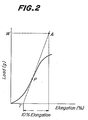
- the initial modulus M is an initial tensile resistance degree (g/d) in the load-elongation curve of the dipped cord at standard test according to JIS L1017. That is, in the load-elongation curve, a maximum point of load change to elongation change is measured near to origin, and a normal line drawn from an intersect between tangent at this point and abscissa to 10% elongation intersects with the above tangent, at which a load W is measured.
- the initial modulus is given as an average value of 10 or more measured values.
- the deformation state of the cross cord layers i.e. deformation of the belt bears the whole deformation by the elongation of the cord itself, deformation of rubber between cords and the change of cord angle, so that when the modulus of the cord is high as in the aramide or the like, the cord itself hardly elongates and consequently the deformation concentrates in the rubber between cords to prematurely cause the separation failure.
- a structure mitigating the concentration of strain in the end portion of the belt by particularly folding another cord layer to enclose the belt end portion therein, but in this case the durability is still insufficient.
- high-strength nylon-6,6 cords containing not less than 95 mol% of polyhexamethylene adipamide repeating structural unit and having a strength of not less than 9.0 g/d, preferably not less than 9.5 g/d and an initial modulus of not more than 80 g/d at a state of dipped cord after twisting and treating with adhesive are arranged in parallel to each other in each of the plural belt cord layers and the cords of these layers are crossed with each other at an inclination angle of 10° to 70° with respect to the equator of the tire.
- the belt composed of the above cross cord layers according to the invention satisfies the pressure test without excessively increasing the number of belt cord layers, and the separation failure at the belt portion due to the excessive heat build-up can be prevented. Further, this cord is relatively low in the modulus, so that the strain concentration in rubber between cords at the end portion of the belt is small and the durability is considerably improved. Moreover, the belt according to the invention is composed of cross cord layers as mentioned above, so that the belt is easy to stretch in the circumferential direction, and the resistance to uneven wear and cut resistance are simultaneously improved.
- the belt is preferable to be constructed by folding both end portions of the belt cord layer.
- a single circumferential cord layer may be arranged on the outer periphery of the above belt for improving resistance to standing wave and resistance to peeling at the belt portion through centrifugal force. If plural circumferential cord layers are arranged on the outer periphery of the belt, the cut resistance and resistance to uneven wear are undesirably damaged as previously mentioned.
- NT T ⁇ ⁇ 0.139 ⁇ (D/2)/ ⁇ ⁇ 10 ⁇ 3 (1)
- T twisting number (twists/10 cm)
- D total denier
- ⁇ a specific gravity of cord.
- Example 1 Yarn denier (d) 6.0 3.1 Total denier (d) 1260 1260 Strength (g/d) 8.8 12.5 Initial modulus (g/d) 36.0 65.0 Elongation at break (%) 22.8 13.5 Heat shrinkage 150°C (%) 8.6 9.0
- M (g/d) 10 ⁇ W/D
- D Dd ⁇ (100/100+Pd)
- the load-elongation curve of the dipped cord is depicted as shown by a solid line in Fig. 2, from which is determined a maximum point (P) of load change to elongation change near to the origin.
- a tangent line (dotted lines) is depicted at this point to measure an intersect (T) with the abscissa.
- the above cords are used in a cord layer of the belt to produce various tires as mentioned below.
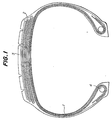
- Fig. 1 is shown an embodiment of the airplane tire according to the invention, wherein numeral 1 is a carcass, numeral 2 a belt composed of cross cord layers, numeral 3 a tread and numeral 4 a bead core.
- This airplane tire has a tire size of H46 ⁇ 18.0 R20, wherein nylon-6,6 cords (1680 d/3) are arranged in the carcass at an angle of approximately 90° with respect to the equator of the tire.
- the carcass 1 has up-down lamination structure consisting of 4 turnup plies turned around the bead core 4 from inside to outside of the tire and 1 down ply extending along the outside of the turnup portion toward bead toe.
- the cross cord layers of the belt 2 in this embodiment are 10 as a whole, wherein one belt ply is folded to form two belt layers and further two belt plies each having free side ends are included in the folded belt ply.
- the carcass structure of each tire in Table 3 is the same as in Fig. 1. Further, the number of cord layers in each belt structure of Table 3 is set so as to satisfy the pressure test (no breakage at a pressure corresponding to 4 times of service pressure).
- the test for the belt durability is according to FAA standard, wherein a take-off simulation raising a speed from 0 mile/h to 225 mile/h under a load and removing the load is repeated 50 times. If the take-off simulation of 50 times is completed, the tire is cut and the crack state in the belt portion is observed.
- the worn amount of rib at the tread shoulder portion (average worn depth of each rib) after the wear accelerating test on a drum is represented by an index on the basis that the worn amount of rib at the central rib is 100. As the index value becomes near to 100, the worn amount of shoulder rib approaches to the worn amount of rib at the tread central portion, which shows the improvement of resistance to uneven wear in the shoulder ribs.
- a protrusion having a semispherical tip of 20 ⁇ is pushed to the tire to measure a load causing the breakage of belt cord.
- the resistanoe to uneven wear and the cut resistance of the heavy duty pneumatic radial tire can be simulataneously improved without adversely affecting the durability, which has not previously been possible with the conventional tires.
- the tires according to the invention are pneumatic radial tires for use on heavy load vehicles under high internal pressure.
Landscapes
- Engineering & Computer Science (AREA)
- Mechanical Engineering (AREA)
- Tires In General (AREA)
- Yarns And Mechanical Finishing Of Yarns Or Ropes (AREA)
Applications Claiming Priority (2)
| Application Number | Priority Date | Filing Date | Title |
|---|---|---|---|
| JP31105687 | 1987-12-10 | ||
| JP311056/87 | 1987-12-10 |
Publications (3)
| Publication Number | Publication Date |
|---|---|
| EP0320290A2 true EP0320290A2 (de) | 1989-06-14 |
| EP0320290A3 EP0320290A3 (en) | 1989-10-18 |
| EP0320290B1 EP0320290B1 (de) | 1993-11-18 |
Family
ID=18012580
Family Applications (1)
| Application Number | Title | Priority Date | Filing Date |
|---|---|---|---|
| EP19880311693 Expired - Lifetime EP0320290B1 (de) | 1987-12-10 | 1988-12-09 | Radialer Luftreifen |
Country Status (3)
| Country | Link |
|---|---|
| EP (1) | EP0320290B1 (de) |
| DE (1) | DE3885719T2 (de) |
| ES (1) | ES2048208T3 (de) |
Cited By (6)
| Publication number | Priority date | Publication date | Assignee | Title |
|---|---|---|---|---|
| EP0351199A3 (en) * | 1988-07-12 | 1990-11-14 | Bridgestone Corporation | Heavy duty pneumatic radial tire under high internal pressure |
| EP0387181A3 (de) * | 1989-03-08 | 1991-05-02 | The Goodyear Tire & Rubber Company | Gürtel für Luftreifen |
| US5379820A (en) * | 1991-01-14 | 1995-01-10 | Compagnie Generale Des Etablissements Michelin - Michelin & Cie | Tire intended for heavy loads and to be inflated to a high pressure |
| EP1477333B1 (de) * | 2002-01-24 | 2018-06-20 | Bridgestone Corporation | Radialluftreifen |
| US11572640B2 (en) | 2017-03-31 | 2023-02-07 | Asahi Kasei Kabushiki Kaisha | Organic fiber twisted yarn cord |
| CN117043402A (zh) * | 2021-04-30 | 2023-11-10 | 可隆工业株式会社 | 包含生物基组分的帘线及其制备方法 |
Family Cites Families (5)
| Publication number | Priority date | Publication date | Assignee | Title |
|---|---|---|---|---|
| GB536133A (en) * | 1938-11-01 | 1941-05-05 | Du Pont | Improvements in or relating to the manufacture of reinforced rubber structures |
| US3298417A (en) * | 1962-12-26 | 1967-01-17 | Du Pont | Pneumatic tire |
| CA1198255A (en) * | 1982-07-08 | 1985-12-24 | Kazuyuki Kitamura | High tenacity polyhexamethylene adipamide fiber |
| US4485063A (en) * | 1983-09-15 | 1984-11-27 | E. I. Du Pont De Nemours & Company | Process for drawing polyamide yarn |
| GB2151670B (en) * | 1983-12-19 | 1987-03-11 | Asahi Chemical Ind | Tire-reinforcing dip cord and process for preparation thereof |
-
1988
- 1988-12-09 EP EP19880311693 patent/EP0320290B1/de not_active Expired - Lifetime
- 1988-12-09 DE DE19883885719 patent/DE3885719T2/de not_active Expired - Fee Related
- 1988-12-09 ES ES88311693T patent/ES2048208T3/es not_active Expired - Lifetime
Cited By (7)
| Publication number | Priority date | Publication date | Assignee | Title |
|---|---|---|---|---|
| EP0351199A3 (en) * | 1988-07-12 | 1990-11-14 | Bridgestone Corporation | Heavy duty pneumatic radial tire under high internal pressure |
| EP0387181A3 (de) * | 1989-03-08 | 1991-05-02 | The Goodyear Tire & Rubber Company | Gürtel für Luftreifen |
| US5115853A (en) * | 1989-03-08 | 1992-05-26 | The Goodyear Tire & Rubber Company | Pneumatic tire with belt overlay structure reinforced with low denier nylon cords |
| US5379820A (en) * | 1991-01-14 | 1995-01-10 | Compagnie Generale Des Etablissements Michelin - Michelin & Cie | Tire intended for heavy loads and to be inflated to a high pressure |
| EP1477333B1 (de) * | 2002-01-24 | 2018-06-20 | Bridgestone Corporation | Radialluftreifen |
| US11572640B2 (en) | 2017-03-31 | 2023-02-07 | Asahi Kasei Kabushiki Kaisha | Organic fiber twisted yarn cord |
| CN117043402A (zh) * | 2021-04-30 | 2023-11-10 | 可隆工业株式会社 | 包含生物基组分的帘线及其制备方法 |
Also Published As
| Publication number | Publication date |
|---|---|
| EP0320290A3 (en) | 1989-10-18 |
| ES2048208T3 (es) | 1994-03-16 |
| DE3885719T2 (de) | 1994-04-14 |
| DE3885719D1 (de) | 1993-12-23 |
| EP0320290B1 (de) | 1993-11-18 |
Similar Documents
| Publication | Publication Date | Title |
|---|---|---|
| US6382287B1 (en) | Pneumatic radial tires with circumferential cord belt layer having specified cord twisting structure | |
| EP0621143B1 (de) | Luftreifen | |
| EP3196343B1 (de) | Hybridcord und reifen damit | |
| EP1260385A1 (de) | Luftreifen | |
| EP1902867B1 (de) | Radialluftreifen | |
| US5894875A (en) | Pneumatic radial tire with flat 1×6 steel belt cord | |
| EP2085250B1 (de) | Luftreifen | |
| EP2604448B1 (de) | Verbundstoffcord und Deckschicht für einen Luftreifen | |
| EP1270270B1 (de) | Luftreifen | |
| JP3611395B2 (ja) | 空気入りラジアルタイヤ | |
| EP2380754A2 (de) | Hybridkord in einer Gürtellage für einen Luftreifen | |
| EP0542567B1 (de) | Luftreifen | |
| US4340105A (en) | Heavy load tire with plural ply groups of different cord diameter | |
| EP0320290B1 (de) | Radialer Luftreifen | |
| CA2019800C (en) | Heavy duty, high-speed, radial tire | |
| EP1063346B1 (de) | Stahlseile zur Verstärkung von Gummiartikeln, insbesondere Luftreifen | |
| GB2045176A (en) | Pneumatic tyre | |
| EP0351199B1 (de) | Radialer Luftreifen mit hohem Druck für LKW | |
| JP2677400B2 (ja) | 高内圧重荷重用空気入りラジアルタイヤ | |
| JP2824653B2 (ja) | 空気入りラジアルタイヤ | |
| JP5345378B2 (ja) | 空気入りラジアルタイヤ | |
| US5115854A (en) | Low rolling resistance pneumatic radial tires having an improved appearance | |
| JP4737856B2 (ja) | タイヤ | |
| EP0937587A2 (de) | Radialluftreifen mit Litzen aus unverdrillten Stahlfäden in der Karkassenlage | |
| JPH08156512A (ja) | 航空機用空気入りラジアルタイヤ |
Legal Events
| Date | Code | Title | Description |
|---|---|---|---|
| PUAI | Public reference made under article 153(3) epc to a published international application that has entered the european phase |
Free format text: ORIGINAL CODE: 0009012 |
|
| AK | Designated contracting states |
Kind code of ref document: A2 Designated state(s): DE ES FR GB IT LU |
|
| PUAL | Search report despatched |
Free format text: ORIGINAL CODE: 0009013 |
|
| AK | Designated contracting states |
Kind code of ref document: A3 Designated state(s): DE ES FR GB IT LU |
|
| 17P | Request for examination filed |
Effective date: 19891228 |
|
| 17Q | First examination report despatched |
Effective date: 19910726 |
|
| GRAA | (expected) grant |
Free format text: ORIGINAL CODE: 0009210 |
|
| AK | Designated contracting states |
Kind code of ref document: B1 Designated state(s): DE ES FR GB IT LU |
|
| REF | Corresponds to: |
Ref document number: 3885719 Country of ref document: DE Date of ref document: 19931223 |
|
| ET | Fr: translation filed | ||
| ITF | It: translation for a ep patent filed | ||
| EPTA | Lu: last paid annual fee | ||
| REG | Reference to a national code |
Ref country code: ES Ref legal event code: FG2A Ref document number: 2048208 Country of ref document: ES Kind code of ref document: T3 |
|
| PLBE | No opposition filed within time limit |
Free format text: ORIGINAL CODE: 0009261 |
|
| STAA | Information on the status of an ep patent application or granted ep patent |
Free format text: STATUS: NO OPPOSITION FILED WITHIN TIME LIMIT |
|
| 26N | No opposition filed | ||
| PGFP | Annual fee paid to national office [announced via postgrant information from national office to epo] |
Ref country code: DE Payment date: 19961216 Year of fee payment: 9 |
|
| PGFP | Annual fee paid to national office [announced via postgrant information from national office to epo] |
Ref country code: ES Payment date: 19961228 Year of fee payment: 9 |
|
| PGFP | Annual fee paid to national office [announced via postgrant information from national office to epo] |
Ref country code: LU Payment date: 19970407 Year of fee payment: 9 |
|
| PG25 | Lapsed in a contracting state [announced via postgrant information from national office to epo] |
Ref country code: LU Free format text: LAPSE BECAUSE OF NON-PAYMENT OF DUE FEES Effective date: 19971209 |
|
| PG25 | Lapsed in a contracting state [announced via postgrant information from national office to epo] |
Ref country code: ES Free format text: LAPSE BECAUSE OF THE APPLICANT RENOUNCES Effective date: 19971210 |
|
| PG25 | Lapsed in a contracting state [announced via postgrant information from national office to epo] |
Ref country code: DE Free format text: LAPSE BECAUSE OF NON-PAYMENT OF DUE FEES Effective date: 19980901 |
|
| REG | Reference to a national code |
Ref country code: ES Ref legal event code: FD2A Effective date: 20010402 |
|
| REG | Reference to a national code |
Ref country code: GB Ref legal event code: IF02 |
|
| PG25 | Lapsed in a contracting state [announced via postgrant information from national office to epo] |
Ref country code: IT Free format text: LAPSE BECAUSE OF NON-PAYMENT OF DUE FEES;WARNING: LAPSES OF ITALIAN PATENTS WITH EFFECTIVE DATE BEFORE 2007 MAY HAVE OCCURRED AT ANY TIME BEFORE 2007. THE CORRECT EFFECTIVE DATE MAY BE DIFFERENT FROM THE ONE RECORDED. Effective date: 20051209 |
|
| PGFP | Annual fee paid to national office [announced via postgrant information from national office to epo] |
Ref country code: FR Payment date: 20071210 Year of fee payment: 20 Ref country code: GB Payment date: 20071205 Year of fee payment: 20 |
|
| REG | Reference to a national code |
Ref country code: GB Ref legal event code: PE20 Expiry date: 20081208 |
|
| PG25 | Lapsed in a contracting state [announced via postgrant information from national office to epo] |
Ref country code: GB Free format text: LAPSE BECAUSE OF EXPIRATION OF PROTECTION Effective date: 20081208 |