EP0320558A1 - Verfahren und Werkzeug zum Herstellen einer Schleif- oder Poliervorrichtung, so hergestellte Vorrichtung und Anwendung derselben - Google Patents
Verfahren und Werkzeug zum Herstellen einer Schleif- oder Poliervorrichtung, so hergestellte Vorrichtung und Anwendung derselben Download PDFInfo
- Publication number
- EP0320558A1 EP0320558A1 EP87850392A EP87850392A EP0320558A1 EP 0320558 A1 EP0320558 A1 EP 0320558A1 EP 87850392 A EP87850392 A EP 87850392A EP 87850392 A EP87850392 A EP 87850392A EP 0320558 A1 EP0320558 A1 EP 0320558A1
- Authority
- EP
- European Patent Office
- Prior art keywords
- grinding
- string
- polishing
- ring halves
- sheet
- Prior art date
- Legal status (The legal status is an assumption and is not a legal conclusion. Google has not performed a legal analysis and makes no representation as to the accuracy of the status listed.)
- Withdrawn
Links
- 238000000227 grinding Methods 0.000 title claims abstract description 126
- 238000005498 polishing Methods 0.000 title claims abstract description 91
- 238000000034 method Methods 0.000 title claims abstract description 27
- 239000000463 material Substances 0.000 claims abstract description 37
- 230000015572 biosynthetic process Effects 0.000 claims abstract description 22
- 230000002787 reinforcement Effects 0.000 claims abstract description 11
- 239000000155 melt Substances 0.000 claims abstract description 8
- 238000010438 heat treatment Methods 0.000 claims description 7
- 239000002184 metal Substances 0.000 claims description 7
- 238000005476 soldering Methods 0.000 claims description 4
- 238000001816 cooling Methods 0.000 abstract description 4
- 238000005755 formation reaction Methods 0.000 description 14
- 238000004804 winding Methods 0.000 description 7
- 238000004519 manufacturing process Methods 0.000 description 4
- 238000002844 melting Methods 0.000 description 4
- 230000008018 melting Effects 0.000 description 4
- 239000004033 plastic Substances 0.000 description 3
- 229920002522 Wood fibre Polymers 0.000 description 2
- 239000011247 coating layer Substances 0.000 description 2
- 238000000576 coating method Methods 0.000 description 2
- 238000005304 joining Methods 0.000 description 2
- 239000004922 lacquer Substances 0.000 description 2
- 239000012528 membrane Substances 0.000 description 2
- 229910000831 Steel Inorganic materials 0.000 description 1
- 239000011248 coating agent Substances 0.000 description 1
- 238000010276 construction Methods 0.000 description 1
- 239000002826 coolant Substances 0.000 description 1
- 238000005260 corrosion Methods 0.000 description 1
- 230000007797 corrosion Effects 0.000 description 1
- 238000005520 cutting process Methods 0.000 description 1
- 230000001419 dependent effect Effects 0.000 description 1
- 230000000694 effects Effects 0.000 description 1
- 229910001651 emery Inorganic materials 0.000 description 1
- 239000004744 fabric Substances 0.000 description 1
- 230000035611 feeding Effects 0.000 description 1
- 239000003292 glue Substances 0.000 description 1
- JEIPFZHSYJVQDO-UHFFFAOYSA-N iron(III) oxide Inorganic materials O=[Fe]O[Fe]=O JEIPFZHSYJVQDO-UHFFFAOYSA-N 0.000 description 1
- 239000010985 leather Substances 0.000 description 1
- 229910000679 solder Inorganic materials 0.000 description 1
- 239000010959 steel Substances 0.000 description 1
- 230000007704 transition Effects 0.000 description 1
- 239000002699 waste material Substances 0.000 description 1
- XLYOFNOQVPJJNP-UHFFFAOYSA-N water Substances O XLYOFNOQVPJJNP-UHFFFAOYSA-N 0.000 description 1
- 230000003313 weakening effect Effects 0.000 description 1
Images


Classifications
-
- B—PERFORMING OPERATIONS; TRANSPORTING
- B24—GRINDING; POLISHING
- B24D—TOOLS FOR GRINDING, BUFFING OR SHARPENING
- B24D18/00—Manufacture of grinding tools or other grinding devices, e.g. wheels, not otherwise provided for
- B24D18/0009—Manufacture of grinding tools or other grinding devices, e.g. wheels, not otherwise provided for using moulds or presses
-
- B—PERFORMING OPERATIONS; TRANSPORTING
- B24—GRINDING; POLISHING
- B24D—TOOLS FOR GRINDING, BUFFING OR SHARPENING
- B24D13/00—Wheels having flexibly-acting working parts, e.g. buffing wheels; Mountings therefor
- B24D13/02—Wheels having flexibly-acting working parts, e.g. buffing wheels; Mountings therefor acting by their periphery
- B24D13/08—Wheels having flexibly-acting working parts, e.g. buffing wheels; Mountings therefor acting by their periphery comprising annular or circular sheets packed side by side
Definitions
- the invention relates to a method of producing a grinding or polishing device comprising one or more substantially circular grinding or polishing discs each comprising a grinding element formed by a substantially rectangular sheet which in its entire length from a line positioned a distance from the longitudinal centre line of the sheet to the adjacent longitudinal edge is provided with cuts being parallel and at equal distance to each other for the formation of a number of grinding or polishing segments, whereafter the sheet is folded on its centre line so that the segments lie on top of each other, and the centre line is then bent and joined at the centre point of the two opposed end edges for the formation of a central annular portion consisting of two substantially parallel ring halves joined by a folding edge, said ring halves having a circular shape around a central hole, and from which central annular portion the said segments extend radially in substantially two parallel levels, whereafter a string is placed between the ring halves along the edge of the central hole in order that the circular shape of the sheet is
- Grinding or polishing discs are used as rotating tools of different kinds.
- the grinding material is provided with abrasive grits but also non-grinding materials are used for removing for instance surface coatings such as rust and similar types of corrosion.
- the grinding or polishing discs are often placed side by side on a spindle whereby they form a grinding or polishing device which on the whole appears as a circular cylinder whose round-going surface is used for grinding or polishing.
- the individual grinding or polishing discs are cut up into segments by cutting up part of the distance from the periphery towards the centre.
- a grinding or polishing disc of the above mentioned type is known from US patent no. 2,879,631.
- this patent teaches the use of a rectangular sheet in order to avoid this waste of material.
- Materials such as steel, plastic or wowen materials are used for these sheets, which materials can for instance be laminate, whereby the sheets depending on their basic material may in themselves be grinding or polishing, or the sheets can be provided with a coating of a grinding material.
- the sheet is cut up in its entire length by a number of cuts being parallel to the end edges for the formation of uniform segments in that the cuts can extend from a line a distance removed from the centre line of the sheet to the adjacent as well as to the opposite side edge. Having been cut, the sheet is folded on its centre line so that the segments lie on top of each other, and the centre of the sheet is then folded and joined at the centre of the two end edges so that a central annular portion is produced consisting of two substantially parallel ring halves being joined at a folding edge and having a circular shape around a central hole from which the segments extend radially in two parallel levels.
- the folding edge which holds together the two ring halves along the central hole, is arranged in a channel having a U-shaped cross section, whereafter the two limbs of the U are squeezed axially together against the two opposite sides of the grinding disc.
- the U-shaped channel is provided with flaps which are hit through openings in the sheet.
- This method of producing a grinding or polishing disc by means of a U-shaped channel involves a considerable increase in cost of the grinding or polishing disc, in that the production of the U-shaped channel and the placing of this on the folded sheet is considerably more expensive than the production of the sheet itself with its segments.
- This weight also has another disadvantage in that it increases the moment of inertia of the grinding or polishing disc so that frequent starts and stops of the disc requires an increase of the necessary tool or machine power.
- a method of producing a grinding or polishing device of the mentioned kind as disclosed in DE published specification no. 31 52 552 is thus an attempt at solving this problem.
- a string is used having a length corresponding to the length of the sheet, and heat is supplied in order to join the two ends of the string in order thereby to join the centres of the two opposed end edges of the sheet for the formation of the central annular portion having a circular shape around the central hole.
- the grinding or polishing disc produced according to this method is not strong enough to withstand such influences as such a grinding or polishing disc is subjected to in use, because the two ring halves tend to crack along the folding edge just as the hub consisting of the two ring halves do not provide sufficient control of the grinding or polishing disc on a rotating spindle whereby the segments are not held fixedly and are not controlled in a sufficiently reliable manner.
- a grinding or polishing disc can be produced which is extremely inexpensive and also very light in that it weighs only slightly more than the sheet itself meaning that a great number of grinding or polishing discs according to the invention can be placed in a manually operated tool requiring only minimum strength of the user.
- the heat-activatable material creates a reinforcement area which will also hold together the two halves in a reliable and fixed manner and after hardening forms a closed semi-rigid inner ring which makes it easy to fit the ring onto a spindle.
- this zone provides a suitably rigid base for the segments which are held in a very secure and reliable manner. All the segments are thus controlled at their base whereby they remain in the same level.
- soldering string as string which by the effect of heat will melt and solder together the two ring halves.
- the sheet can first be joined at the centre of the two opposed end edges for the formation of a tube, whereafter a string is placed at the centre of the sheet, which is then folded around the centre for the formation of the central annular portion.
- a string is placed at the centre of the sheet, which is then folded around the centre for the formation of the central annular portion.
- an endless ring of string as heat-activatable string in that an immediate fixture of the tubular shape is provided merely by the placement of the ring of string.
- annular heatable press trays which, as presented in claim 4, are constructed to be able to press the bent and folded parts together in the area around the folding edge while the press trays heat the string so that it melts.
- the invention also relates to a grinding or polishing device produced according to the above method, said grinding or polishing device comprising one or more substantially circular grinding or polishing discs each having a central annular portion formed by two substantially parallel ring halves joined at a folding edge and having a circular shape around a central hole from which a number of grinding segments extend radially outwards in substantially two parallel levels, said grinding or polishing discs according to the invention being characteristic in that a heat-activatable material intimately connected with the ring halves is placed between the two ring halves creating a reinforcement area extending around the folding edge and between this and the radially inner-most end of the grinding segments.
- Such grinding or polishing discs have an extremely light and yet strong hub facilitating an exact centering on a spindle when either one or several discs together are to be arranged in a grinding or polishing device, and the ring halves are fixedly connected to each other so that no cracks will occur along the folding edge which might have become weaker due to the folding.
- the close joint of the two ring halves also provides a good and reliable control of the segments.
- a grinding or polishing device comprising several grinding or polishing discs which can be arranged on the one and same rotary spindle of a tool is according to the invention characteristic in that the grinding or polishing device comprises a retaining disc which can be fitted between each grinding or polishing disc, said retaining disc either being able to squeeze axially in the reinforcement area or which may be glued on.
- the grinding or polishing discs can be held at such an axial distance to each other that the segments have the best possible conditions for adapting themselves to the surface of a workpiece to be ground.
- the invention also relates to a tool for carrying out the method of producing a grinding or polishing disc having a central annular portion consisting of two substantially parallel ring halves being joined at a folding edge and having a circular shape around a central hole, from which a number of grinding segments extend radially outwards in substantially two parallel levels, whereby a heat-activatable material by the method according to the invention is placed between the two ring halves, said tool according to the invention being characteristic in that the tool comprises at least one and a second press tray provided with heating means, said press trays being constructed so that they can be pressed against the axial sides of a grinding or polishing disc and heat both the ring halves as well as the string of heat-activatable material between these so that the string is substantially brought to melt.
- the grinding or polishing device produced by the method according to the invention and having at least one grinding or polishing disc is extremely advantageous when grinding wooden objects, such as particularly profiled wooden objects appearing with depressions and projections that make up a pattern.
- the light segments extending radially will follow the contours of the machined surface, so that it becomes possible to polish a concave surface by means of a polishing disc.
- the segments in such a grinding disc will when grinding workpieces with depressions turn around their longitudinal axis and move outwards towards the bottom of such depressions.
- the grinding disc will thus adapt itself to even very angular surfaces and is so to speak self-adjusting meaning that fine details are not damaged.
- the grinding or polishing can be carried out both before and after lacquering of the wooden surface in that the grinding or polishing is not carried out with the intention of actually removing any material nor of changing the dimension of the workpiece.
- grinding prior to the lacquering merely those fine wood fibres are removed as would otherwise rise by a lacquering and make the dried lacquered surface uneven.
- the consumption of lacquer is highly reduced in that most of the fibres are removed by the grinding, which is why the lacquered surface will appear very smooth even prior to any subsequent grinding. This smooth surface can, however, be further improved by subsequent grinding.
- the starting point is a rectangular sheet 1 which can be of a grinding type, such as emery cloth or of a non-grinding type, such as plastic, leather or metal.
- the sheet 1 has a longitudinal centre line 2, two longitudinal edges 3, 4 and two end edges 5, 6.
- parallel cuts 7 are made on both sides of the centre line 2, said cuts 7 extending from a longitudinal line 8 positioned a distance from the centre line 2 and to the neighbouring longitudinal edge 3 and 4, respectively, whereby grinding or polishing segments 9 of equal length and width are formed.
- the sheet 1 is now folded on the centre line 2 so that the segments 9 along the two longitudinal edges 3, 4 lie on top of each other.
- the centre 2 of the sheet is then folded and joined at the centre 10, 11 of the two opposite end edges 5, 6 for the formation of a central annular portion 12 consisting of two substantially parallel ring halves 13, 14 being joined at the centre line 2 of the sheet 1 in the following referred to as a folding edge 15.
- the central annular portion 12 encircles a central hole 20.
- the segments 9 extend radially outwards from the ring halves 13, 14 in two substantially parallel levels 16, 17.
- a string 18 is positioned between the two ring halves 13, 14 so that the string 18 rests on the radially outermost side of the folding edge 15.
- the string 18 must have a length which is at least equal to the length of the sheet 1 in its longitudinal direction so that the ends of the string 18 will at least reach each other for obtaining a fixed connection between the ends.
- the string 18 has, however, preferably a length being several times that of the sheet 1, whereby the string 18 can be wound several times round along the outermost side of the folding edge 15.
- the second winding can be brought to squeeze against the first winding so that this is prevented from working loose under the influence of the sheet's 1 tendency to straighten itself whereby the folding edge 15 would leave its circular shape and become substantially straight, and by winding the string 18 several times round this squeezing will be further emphasized.
- an endless ring of string can be used as string 18, said ring being fitted axially around the outside of the tubular piece until the ring of string rests along the centre line 2, whereafter the ends of the tubular piece, i.e. the segments 9 are folded radially outwards in relation to the axis of the tubular piece for the formation of the mentioned disc shape.
- the sheet 1 is folded in such a manner that the free ends of the segments 9 in the one parallel level 16, 17, are positioned preferably opposite the spaces between free ends of the segments 9 in the adjacent parallel level 17 and 16, respectively, whereby sufficient room is obtained for the segments 9 to turn around their longitudinal axis and turn their grinding material towards the workpiece which is to be ground or polished.
- the string 18 and/or the endless ring of string is of a heat-activatable material.
- the heat-activatable string 18 or ring of string will melt and spread between the two ring halves 13, 14 while adapting the heat supply so that only part of the heat-activatable material 18 spreads, whereas part of it, preferably, the major part of it, remains close to the outermost side of the folding edge 15 for the formation of a strong hub for the disc.
- the string 18 is wound several times round along the radially outermost side of the folding edge 15, it is not necessary to supply so much heat to the grinding or polishing disc that the heat-activatable material 18 melts completely. It will thus suffice that the material 18 melts to such a degree that it can spread between the ring halves 13, 14 between the folding edge 15 and the radially innermost end of the segments 9, and that the material 18 along the fold 15 melts for the formation of a coating layer or membrane which completely surrounds a core of circumferential unmolten strings 18 in that said coating layer or membrane must, however, be melted together with the material 18 arranged between the ring halves 13, 14.
- Fig. 4 shows a grinding or polishing device according to the invention comprising one or several grinding or polishing discs produced according to the method.
- a rotary spindle 21 At the one end of the spindle 21 there is shown a stop 22 on which a disc 23 rests. On the side of the disc 23 turning away from the stop 22 a retaining disc 24 is placed, for instance made of a plastic material. At the side facing the disc 23 the retaining disc 24 is provided with a hollowing 25 in the centre portion and on the opposite side with a shoulder 26 along the edge. The cross sectional shape is clearly seen in fig. 4. At the places of transition from the hollowing 25, bevelled edges are formed both in the retaining disc 24 and in the disc 23.
- the retaining discs 24 and the grinding or polishing discs are placed alternately on the spindle 21.
- the central annular portion 12 of the grinding or polishing disc with the folding edge 15, the ring halves 13, 14 and the heat-activatable material 18 are hereby held fixedly between two retaining discs 24.
- the grinding or polishing discs and the retaining discs 24 can in this manner be fastened on the spindle 21 so that it all will form part of a rotatable unit.
- the retaining discs 24 can be glued together with the grinding or polishing discs for the formation of a grinding or polishing cylinder which can be inserted on the spindle 21 and fixed by means of the nut 28.
- the spindle 21 can either be arranged on a manual tool which may be operated either by one or both hands, or several spindles 21 can form part of an apparatus or machine with mechanical or manual feeding of workpieces to be ground or polished.
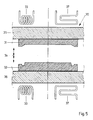
- the supply of heat for melting the heat-activatable material is advantageously done by means of annular heatable press trays 31, 32 which from both sides of a grinding or polishing disc are pressed together around this at least in the area immediately along the folding edge 15 and the central annular portion 12.
- the press trays 31, 32 form part of a press tool 30 of a generally known construction enabling a movement towards and away from each other in the direction in dicated by the arrow 34.
- the two press trays 31, 32 are each attached to a plate 35, 36 which can be fixed in a press.
- the press trays 31, 32 are provided with heating means for heating the trays to a temperature being dependent on the melting temperature of the heat-activatable material 18, said heating means being schematically implied by 33 whereby the heating means may be of any known type.
- the press trays 31, 32 can furthermore be provided with cooling means 37, for instance a heat exchanger through which a coolant, such as water, is passed in order that the material 18 shortly after melting will soon again harden.
- the grinding or polishing device produced by the method according to the invention comprising at least one grinding or polishing disc is highly advantageous to be used for grinding wooden objects, such as particularly profiled wooden objects appearing with depressions and projections that make up a pattern.
- the light segments extending radially will follow the contours of the machined surface, so that it becomes possible to polish a concave surface by means of a polishing disc.
- Segments in such a grinding disc will when grinding workpieces with depressions turn around their longitudinal axis and move outwards towards the bottom of such depressions.
- the grinding disc will thus adapt itself to even very angular surfaces and is so to speak self-adjusting meaning that fine details are not damaged.
- the grinding or polishing can be carried out both before and after lacquering of the wooden surface in that the grinding or polishing is not carried out with the intention of actually removing any material nor of changing the dimension of the workpiece.
- grinding prior to the lacquering merely those fine wood fibres are removed as would otherwise rise by the lacquering and make the dried lacquered surface uneven.
- the consumption of lacquer is highly reduced in that most of the fibres are removed by the grinding, which is why the lacquered surface will appear very smooth even prior to any subsequent grinding. This smooth surface can, however, be further improved by subsequent grinding.
Landscapes
- Engineering & Computer Science (AREA)
- Mechanical Engineering (AREA)
- Manufacturing & Machinery (AREA)
- Polishing Bodies And Polishing Tools (AREA)
Priority Applications (1)
| Application Number | Priority Date | Filing Date | Title |
|---|---|---|---|
| EP87850392A EP0320558A1 (de) | 1987-12-18 | 1987-12-18 | Verfahren und Werkzeug zum Herstellen einer Schleif- oder Poliervorrichtung, so hergestellte Vorrichtung und Anwendung derselben |
Applications Claiming Priority (1)
| Application Number | Priority Date | Filing Date | Title |
|---|---|---|---|
| EP87850392A EP0320558A1 (de) | 1987-12-18 | 1987-12-18 | Verfahren und Werkzeug zum Herstellen einer Schleif- oder Poliervorrichtung, so hergestellte Vorrichtung und Anwendung derselben |
Publications (1)
| Publication Number | Publication Date |
|---|---|
| EP0320558A1 true EP0320558A1 (de) | 1989-06-21 |
Family
ID=8198493
Family Applications (1)
| Application Number | Title | Priority Date | Filing Date |
|---|---|---|---|
| EP87850392A Withdrawn EP0320558A1 (de) | 1987-12-18 | 1987-12-18 | Verfahren und Werkzeug zum Herstellen einer Schleif- oder Poliervorrichtung, so hergestellte Vorrichtung und Anwendung derselben |
Country Status (1)
| Country | Link |
|---|---|
| EP (1) | EP0320558A1 (de) |
Cited By (3)
| Publication number | Priority date | Publication date | Assignee | Title |
|---|---|---|---|---|
| US6015334A (en) * | 1996-08-05 | 2000-01-18 | Hh Patent A/S | Method for the deburring of items, particularly items of metal, and use of the method |
| US6234887B1 (en) | 1997-11-03 | 2001-05-22 | Hh Patent A/S | Method for sanding surfaces on items |
| CN113123627A (zh) * | 2021-03-05 | 2021-07-16 | 张贤星 | 一种使用碳纤维布加固横梁的辅助施工装置 |
Citations (5)
| Publication number | Priority date | Publication date | Assignee | Title |
|---|---|---|---|---|
| US2680335A (en) * | 1951-12-29 | 1954-06-08 | United Cotton Products Company | Abrading device and method of making |
| US3043063A (en) * | 1958-12-08 | 1962-07-10 | Osborn Mfg Co | Rotary tool |
| WO1982001845A1 (en) * | 1980-11-24 | 1982-06-10 | Keld O Hundebol | Method of forming a grinding or polishing disc and a grinding or polishing implement composed of several such discs |
| GB2169227A (en) * | 1984-12-31 | 1986-07-09 | Hansen & Hundebol | Rotary grinding or polishing device |
| US4615151A (en) * | 1982-12-21 | 1986-10-07 | Tyrolit Schleifmittelwerke Swarovski K.G. | Method for manufacturing of grinding wheel |
-
1987
- 1987-12-18 EP EP87850392A patent/EP0320558A1/de not_active Withdrawn
Patent Citations (5)
| Publication number | Priority date | Publication date | Assignee | Title |
|---|---|---|---|---|
| US2680335A (en) * | 1951-12-29 | 1954-06-08 | United Cotton Products Company | Abrading device and method of making |
| US3043063A (en) * | 1958-12-08 | 1962-07-10 | Osborn Mfg Co | Rotary tool |
| WO1982001845A1 (en) * | 1980-11-24 | 1982-06-10 | Keld O Hundebol | Method of forming a grinding or polishing disc and a grinding or polishing implement composed of several such discs |
| US4615151A (en) * | 1982-12-21 | 1986-10-07 | Tyrolit Schleifmittelwerke Swarovski K.G. | Method for manufacturing of grinding wheel |
| GB2169227A (en) * | 1984-12-31 | 1986-07-09 | Hansen & Hundebol | Rotary grinding or polishing device |
Cited By (4)
| Publication number | Priority date | Publication date | Assignee | Title |
|---|---|---|---|---|
| US6015334A (en) * | 1996-08-05 | 2000-01-18 | Hh Patent A/S | Method for the deburring of items, particularly items of metal, and use of the method |
| CN1076651C (zh) * | 1996-08-05 | 2001-12-26 | Hh专利股份有限公司 | 物品、特别是金属物品去毛刺的方法和该方法的应用 |
| US6234887B1 (en) | 1997-11-03 | 2001-05-22 | Hh Patent A/S | Method for sanding surfaces on items |
| CN113123627A (zh) * | 2021-03-05 | 2021-07-16 | 张贤星 | 一种使用碳纤维布加固横梁的辅助施工装置 |
Similar Documents
| Publication | Publication Date | Title |
|---|---|---|
| FI71251C (fi) | Foerfarande foer framstaellning av en slip- eller poleringsskiva | |
| US5746863A (en) | Method of making wood tubing | |
| CA1309884C (en) | Friction-weldable stud | |
| US9050706B2 (en) | Segmented profiled wheel and method for making same | |
| US4205493A (en) | Portable chamfering grinding device | |
| US6902471B2 (en) | Heavy-duty tool with a rotationally driven, disk-shaped hub | |
| JPH01107962A (ja) | チュービングの一部を交換する方法と装置 | |
| EP0320558A1 (de) | Verfahren und Werkzeug zum Herstellen einer Schleif- oder Poliervorrichtung, so hergestellte Vorrichtung und Anwendung derselben | |
| US4668248A (en) | Grinding disk and method of manufacturing such a disk | |
| EP0626238A1 (de) | Verfahren zum Herstellen von endlosen überzogenen Schleifartikeln | |
| JPH044108B2 (de) | ||
| US5125192A (en) | Flexible sanding/deburring head | |
| BE1015278A0 (nl) | Schuurelement. | |
| WO2003020473A1 (en) | Embedded quick change connector for grinding wheel | |
| IE910063A1 (en) | A method for seam welding | |
| US5232316A (en) | Hob construction | |
| US6551180B2 (en) | Grinding tool | |
| US4302911A (en) | Rotary flap wheel type grinding tool with outwardly flaring flaps | |
| US20040058634A1 (en) | Adjustable abrading tool, abrasive star and abrading kit | |
| US3451093A (en) | Cartridge work wheel | |
| CA2357241A1 (en) | Method and apparatus for the production of a cylindrical embossing sheet | |
| US5470414A (en) | Method of making flat stock having a bearing surface and the flat stock made thereby | |
| US2755608A (en) | Buffing tool | |
| US4212187A (en) | Method and apparatus for resizing torque converter impeller drive shafts | |
| US6595842B2 (en) | Abrasive pad and method of making same |
Legal Events
| Date | Code | Title | Description |
|---|---|---|---|
| PUAI | Public reference made under article 153(3) epc to a published international application that has entered the european phase |
Free format text: ORIGINAL CODE: 0009012 |
|
| 17P | Request for examination filed |
Effective date: 19881219 |
|
| AK | Designated contracting states |
Kind code of ref document: A1 Designated state(s): AT BE CH DE ES FR GB GR IT LI LU NL SE |
|
| 17Q | First examination report despatched |
Effective date: 19901023 |
|
| STAA | Information on the status of an ep patent application or granted ep patent |
Free format text: STATUS: THE APPLICATION IS DEEMED TO BE WITHDRAWN |
|
| 18D | Application deemed to be withdrawn |
Effective date: 19910629 |