EP0320632A2 - Beschichtete Formkörper und ein Verfahren zu ihrer Herstellung - Google Patents
Beschichtete Formkörper und ein Verfahren zu ihrer Herstellung Download PDFInfo
- Publication number
- EP0320632A2 EP0320632A2 EP88119076A EP88119076A EP0320632A2 EP 0320632 A2 EP0320632 A2 EP 0320632A2 EP 88119076 A EP88119076 A EP 88119076A EP 88119076 A EP88119076 A EP 88119076A EP 0320632 A2 EP0320632 A2 EP 0320632A2
- Authority
- EP
- European Patent Office
- Prior art keywords
- alkyl
- formula
- absorbers
- aralkyl
- layer
- Prior art date
- Legal status (The legal status is an assumption and is not a legal conclusion. Google has not performed a legal analysis and makes no representation as to the accuracy of the status listed.)
- Granted
Links
Classifications
-
- B—PERFORMING OPERATIONS; TRANSPORTING
- B32—LAYERED PRODUCTS
- B32B—LAYERED PRODUCTS, i.e. PRODUCTS BUILT-UP OF STRATA OF FLAT OR NON-FLAT, e.g. CELLULAR OR HONEYCOMB, FORM
- B32B27/00—Layered products comprising a layer of synthetic resin
- B32B27/06—Layered products comprising a layer of synthetic resin as the main or only constituent of a layer, which is next to another layer of the same or of a different material
- B32B27/08—Layered products comprising a layer of synthetic resin as the main or only constituent of a layer, which is next to another layer of the same or of a different material of synthetic resin
-
- B—PERFORMING OPERATIONS; TRANSPORTING
- B32—LAYERED PRODUCTS
- B32B—LAYERED PRODUCTS, i.e. PRODUCTS BUILT-UP OF STRATA OF FLAT OR NON-FLAT, e.g. CELLULAR OR HONEYCOMB, FORM
- B32B27/00—Layered products comprising a layer of synthetic resin
- B32B27/18—Layered products comprising a layer of synthetic resin characterised by the use of special additives
-
- B—PERFORMING OPERATIONS; TRANSPORTING
- B32—LAYERED PRODUCTS
- B32B—LAYERED PRODUCTS, i.e. PRODUCTS BUILT-UP OF STRATA OF FLAT OR NON-FLAT, e.g. CELLULAR OR HONEYCOMB, FORM
- B32B27/00—Layered products comprising a layer of synthetic resin
- B32B27/36—Layered products comprising a layer of synthetic resin comprising polyesters
- B32B27/365—Layered products comprising a layer of synthetic resin comprising polyesters comprising polycarbonates
-
- C—CHEMISTRY; METALLURGY
- C08—ORGANIC MACROMOLECULAR COMPOUNDS; THEIR PREPARATION OR CHEMICAL WORKING-UP; COMPOSITIONS BASED THEREON
- C08K—Use of inorganic or non-macromolecular organic substances as compounding ingredients
- C08K5/00—Use of organic ingredients
- C08K5/16—Nitrogen-containing compounds
- C08K5/34—Heterocyclic compounds having nitrogen in the ring
- C08K5/3467—Heterocyclic compounds having nitrogen in the ring having more than two nitrogen atoms in the ring
- C08K5/3472—Five-membered rings
- C08K5/3475—Five-membered rings condensed with carbocyclic rings
-
- Y—GENERAL TAGGING OF NEW TECHNOLOGICAL DEVELOPMENTS; GENERAL TAGGING OF CROSS-SECTIONAL TECHNOLOGIES SPANNING OVER SEVERAL SECTIONS OF THE IPC; TECHNICAL SUBJECTS COVERED BY FORMER USPC CROSS-REFERENCE ART COLLECTIONS [XRACs] AND DIGESTS
- Y10—TECHNICAL SUBJECTS COVERED BY FORMER USPC
- Y10T—TECHNICAL SUBJECTS COVERED BY FORMER US CLASSIFICATION
- Y10T428/00—Stock material or miscellaneous articles
- Y10T428/26—Web or sheet containing structurally defined element or component, the element or component having a specified physical dimension
- Y10T428/263—Coating layer not in excess of 5 mils thick or equivalent
-
- Y—GENERAL TAGGING OF NEW TECHNOLOGICAL DEVELOPMENTS; GENERAL TAGGING OF CROSS-SECTIONAL TECHNOLOGIES SPANNING OVER SEVERAL SECTIONS OF THE IPC; TECHNICAL SUBJECTS COVERED BY FORMER USPC CROSS-REFERENCE ART COLLECTIONS [XRACs] AND DIGESTS
- Y10—TECHNICAL SUBJECTS COVERED BY FORMER USPC
- Y10T—TECHNICAL SUBJECTS COVERED BY FORMER US CLASSIFICATION
- Y10T428/00—Stock material or miscellaneous articles
- Y10T428/27—Web or sheet containing structurally defined element or component, the element or component having a specified weight per unit area [e.g., gms/sq cm, lbs/sq ft, etc.]
- Y10T428/273—Web or sheet containing structurally defined element or component, the element or component having a specified weight per unit area [e.g., gms/sq cm, lbs/sq ft, etc.] of coating
- Y10T428/277—Cellulosic substrate
Definitions
- the present invention relates to a process for coating molded articles made of thermoplastic materials by means of a co-extruded, 5 ⁇ m to 100 ⁇ m, preferably 20 ⁇ m to 50 ⁇ m thick layer made of thermoplastic materials, which is characterized in that the layer contains 0.1% by weight. % to 20% by weight, preferably 2% by weight to 10% by weight and in particular 5% by weight to 10% by weight, of UV absorbers of the formula I.
- Preferred residues R1 and R2 are H, Cl and -CH3
- preferred residues R3 and R4 are H and C1-C4-alkyl
- preferred residues R5 and R6 are C4-C8-alkyl, cyclohexyl, C7-C9-aralkyl, phenyl and naphthyl
- preferred value for a, b, c and d is 1.
- Both one and more UV absorbers of the formula I can be used in a mixture.
- the present invention also relates to the coated moldings obtainable by the process according to the invention.
- the present invention also relates to molded articles made of thermoplastic materials coated with a 5 ⁇ m to 100 ⁇ m, preferably 20 ⁇ m to 50 ⁇ m thick layer of thermoplastic materials, which are characterized in that the layer 0.1% by weight to 20% by weight. %, preferably 2% by weight to 15% by weight and in particular 5% by weight to 10% by weight of UV absorber of the formula I.
- thermoplastic materials from which the molded body and protective layer consist can be of different types or of the same type, they can even be identical; preferably molded body and protective layer made of similar plastics are suitable.
- thermoplastic plastics from which the shaped bodies and / or protective layers consist are, for example, thermoplastic, aromatic polycarbonates, thermoplastic, aromatic polyester carbonates, ther moplastic, aromatic polyesters, thermoplastic, aliphatic-aromatic polyesters of iso- and / or terephthalic acid, polyvinyl chloride, polyvinylidene chloride, thermoplastic copolymers of styrene and / or methyl styrene with maleic anhydride and / or with acrylonitrile, thermoplastic graft polymers of styrene and acrylonitrile on polybutadiene rubber ⁇ -olefins such as polyethylene and polypropylene, thermoplastic polyacrylates and polymethacrylates, which may or may not be modified, and polystyrenes and blends consisting of any combination of the above-mentioned thermoplastics and of polystyrene with polyphenylene oxide.
- thermoplastic, linear, Si-free polycarbonates, thermoplastic, branched Si-free polycarbonates and thermoplastic Si-containing polycarbonates are preferred.
- thermoplastic, aromatic, Si-free polyester carbonates thermoplastic aromatic polyesters, aliphatic-aromatic polyesters of iso- and / or terephthalic acid and blends of the above-mentioned thermoplastics suitable for the process according to the invention, such as e.g. from polycarbonates from 2,2-bis (4-hydroxy-3,5-dimethylphenyl) propane and styrene-acrylonitrile copolymers.
- thermoplastics are known or can be obtained by known processes.
- Preferred molded body / protective layer combinations consist of branched or linear, thermoplastic, aromatic polycarbonates (molded body and protective layer) or of thermoplastic, aromatic polycarbonates (linear or branched) or thermoplastic, Si-containing polycarbonates (molded body and protective layer).
- thermoplastics are known in practice and in the literature or can be obtained by processes known from the literature.
- the linear, Si-free polycarbonates are preferably diphenols of the formula (D) on the basis, which as such are known from the literature or can be produced by processes known from the literature.
- (D) are A C1-C8 alkylene, C2-C8 alkylidene, C5-C15 cycloalkylene or cycloalkylidene, C7-C18 aralkyl, such as e, f independently of one another 0 or 1, X1, X2 are the same or different and are H, halogen or C1-C4-alkyl, n, m independent of each other 0, 1, 2, 3 or 4.
- Suitable bisphenols are, for example, hydroquinone, resorcinol, 4,4'-dihydroxydiphenyl, bis (hydroxyphenyl) alkanes, cycloalkanes, ethers, ketones, sulfoxides, sulfonates, sulfides, and also ⁇ , ⁇ -bis (hydroxypenyl) -ethylbenzene and -diisopropylbenzene and the corresponding nuclear alkylated or -halogenated compounds.
- Bisphenols containing alkyl groups can also be used in the form of or bisphenols substituted entirely by fluoroalkyl groups or partially fluorinated alkyl groups, e.g. bis (4-hydroxyphenyl) hexafluoropropane-2,2.
- the branched Si-free polycarbonates preferably have, in a known manner, three-functional or more than three-functional branching agents in known amounts, for example those with three or more than three phenolic OH groups.
- branching agents that can be used with three or more than three phenolic hydroxyl groups are, for example, 2,4-bis (4-hydroxyphenylisopropyl) phenol, 2,6-bis (2′-hydroxy-5′-methyl-benzyl) - 4-methylphenol, 2- (4-hydroxyphenyl) -2- (2,4-dihydroxyphenyl) propane and 1,4-bis (4,4'-dihydroxytriphenylmethyl) benzene.
- Some of the other trifunctional compounds are 2,4-dihydroxybenzoic acid, trimesic acid, cyanuric chloride and 3,3-bis- (4-hydroxyphenyl) -2-oxo-2,3-dihydroindole and 3,3-bis- (4-hydroxy-3) -methyl-phenyl) -2-oxo-2,3-dihydroindole.
- the branched polycarbonates are produced by known production processes for aromatic thermoplastic polycarbonates, either by the transesterification process in the melt with diphenyl carbonate or by the two-phase interface process with phosgene (see, for example, H. Schnell, Chemistry and Physics of Polycarbonates, Polymer Rev., Vol IX , page 27 ff., Interscience Publishers New York, 1964, DE-OS 1 570 533, DE-OS 1 595 762, DE-PS 2 500 092 and US-PS 3 544 514 or US-RE 27 682) .
- the Si-containing, thermoplastic polycarbonates can be linear or branched and are preferably polydiorganosiloxane-polycarbonate block co-condensates as are known, for example, from EP-OS 013 5794 (Le A 22 390-EP).
- Alkyl in the above formula (1) is, for example, C1-C20 alkyl; Alkenyl in the above formula (1) is, for example, C2-C6 alkenyl; Aryl is C6-C14 aryl in formula (1) above.
- Halogenated in the above formula means partially or completely chlorinated, brominated or fluorinated. Examples of alkyls, alkenyls, aryls, halogenated alkyls and halogenated aryls are methyl, ethyl, propyl, n-butyl, tert-butyl, vinyl, phenyl, naphthyl, chloromethyl, perfluorobutyl, perfluorooctyl and chlorophenyl.
- Such polydiorganosiloxane-polycarbonate block copolymers are known, for example, from US Pat. No. 3,189,662, US Pat. No. 3,821,325 and US Pat. No. 3,832,419.
- the relevant literature describes their improved mechanical properties at low temperatures (for example BM Beach, RP Kambour and AR Schultz, J. Polym. Sci., Polym. Lett. Ed. 12 , 247 (1974)).
- Preferred polydiorganosiloxane-polycarbonate block copolymers with medium molecular weights M w (weight average as determined by ultracentrifugation or scattered light measurement) from 10,000 to 200,000 and with a content of aromatic carbonate structural units between approximately 75% by weight and 97.5% by weight and with a content of diorganosiloxy units between 25 and 2.5 % By weight are prepared by adding polydiorganosiloxanes containing ⁇ , ⁇ -bishydroxyaryloxy end groups together with other diphenols, optionally with the use of chain terminators in the usual amounts and optionally with the use of branching agents in the usual amounts, for example according to the two-phase interface process (see H.
- Such ⁇ , ⁇ -bishydroxyaryloxy end group-containing polydiorganosiloxanes are known, for example, from US 3,419,634.
- Diphenols to be used to prepare the ⁇ , ⁇ -bishydroxyaryloxy end group-containing polydiorganosiloxanes and the polydiorganosiloxane-polycarbonate block copolymers are again preferably those of the formula (D)
- thermoplastic aromatic polyester carbonates or thermoplastic, aromatic polyesters are made up of aromatic dicarboxylic acids and diphenols, with at least one carbonic acid derivative, e.g. Phosgene is involved.
- Preferred aromatic dicarboxylic acids are, for example: isophthalic acid, terephthalic acid, diphenyl ether-4,4'-dicarboxylic acid, naphthalene-2,6-dicarboxylic acid. Isophthalic acid and terephthalic acid are particularly preferred.
- the preferred carbonic acid derivative is phosgene.
- Preferred diphenols for the production of the aromatic polyesters and polyester carbonates according to the invention are compounds of the formula: HO - Z - OH (III), in which Z is a divalent mono- or polynuclear aromatic radical having 6-30 C atoms, Z being constructed in such a way that the two OH groups are each bonded directly to one C atom of an aromatic system.
- Particularly preferred diphenols are compounds of the formula IV in the Y is a single bond, an alkylene or alkylidene radical with 1-7 C atoms, a cycloalkylene or cycloalkylidene radical with 5-12 C atoms, -O-, -S-, - -, -SO2- or - - means, and their nuclear alkylated and nuclear halogenated derivatives, for example Hydroquinone, Resorcinol, Dihydroxydiphenyls, Bis (hydroxyphenyl) alkanes, Bis (hydroxyphenyl) cycloalkanes, Bis (hydroxyphenyl) ether, Bis (hydroxyphenyl) ketones, Bis (hydroxyphenyl) sulfoxides, Bis (hydroxyphenyl) sulfones and ⁇ , ⁇ ′-bis (hydroxyphenyl) diisopropylbenzenes, as well as their nuclear alkylated and nuclear halogenated derivatives.
- diphenols The most important diphenols are: bisphenol A, tetramethylbisphenol A, 1,1-bis (4-hydroxyphenyl) isobutane, 1,1-bis (4-hydroxyphenyl) cyclohexane, 4,4′-dihydroxydiphenyl sulfide, 4,4 ′ -Dihydroxydiphenylsulfon, and their di- and tetrahalogenated derivatives.
- Bisphenol A is particularly preferred. Any mixtures of the diphenols mentioned can also be used.
- chain terminators for the aromatic polyesters and polyester carbonates are preferably phenol, alkylphenol with C1-C12-alkyl groups, halogenated phenols, hydroxydiphenyl, naphthols, chlorocarbonic acid esters from such phenolic compounds and chlorides of aromatic monocarboxylic acids, which are optionally substituted by C1-C22-alkyl groups and halogen atoms can, in amounts of 0.1 to 10 mol% (in the case of phenols based on acid dichloride) used.
- the chlorides of aliphatic monocarboxylic acids with up to 22 C atoms are also suitable.
- the chain terminators if they are phenolic compounds, can be added to the reaction mixture before or during the reaction. However, sufficient acid chloride and / or phosgene must still be available so that they can react and limit the chain; for example, the chain terminator can be put together be used with the diphenol, be contained in the solution of the chlorides of aromatic dicarboxylic acids, or be added to the reaction mixture after the preparation of a precondensate.
- acid chlorides and chlorocarbonic acid esters are used as chain terminators, they are preferably used together with the aromatic dicarboxylic acid dichlorides and / or phosgene. These chain terminators can also be added to the reaction mixture at a time when the chlorides of the dicarboxylic acids and the phosgene have already reacted largely or completely.
- the structure of the aromatic polyesters and polyester carbonates can also contain up to 30 mol% of the dicarboxylic acids and dihydroxy compounds aliphatic components, e.g. Adipic acid, 1,4-butanediol may be involved.
- aromatic polyesters and polyester carbonates can be made partly from aromatic hydroxycarboxylic acids, e.g. be built up p-hydroxy-benzoic acid.
- the proportion of such hydroxycarboxylic acids can be up to 100 mol% (based on bisphenol).
- iso- and terephthalic acid are jointly involved in the formation of the aromatic polyesters and polyester carbonates, their ratio can be 1:20 to 20: 1.
- the aromatic polyester carbonates suitable according to the invention can contain up to 80 mol%, preferably up to 50 mol%, of carbonate groups, based on the sum of ester and carbonate groups.
- Both the ester and the carbonate content of the aromatic polyester carbonates according to the invention can be present in the form of blocks or randomly distributed in the polycondensate.
- the relative solution viscosity ( ⁇ rel) of the aromatic polyesters and polyester carbonates is in the range 1.18 to 1.4, preferably 1.22 to 1.3 (measured on solutions of 0.5 g, polyester or polyester carbonate in 100 ml CH2Cl2 solution at 25 ° C).
- the molded articles to be protected according to the invention are preferably plates, multi-wall sheets, profiles, multi-wall profiles, foils, hollow chamber plates and components of any kind, for example lamp housings, protective disks, cover plates and the like.
- the production of such shaped bodies by extrusion is known.
- the plates these should preferably have a thickness of 0.5 mm to 30 mm.
- Plastics containing UV absorbers are known (see, for example, US Pat. No. 3,004,896, Kunststoffe 74 (1984) pages 620 to 623, Taschenbuch der Kunststoff-Additive, 2nd edition, Dr. F. Gugumus, "Light stabilizers for thermoplastics" Pages 124 ff and U.S. Patent 2,965,578).
- thermoplastic materials are also known (see, for example, "Fundamentals of the Coextrusion of Sheets and Films” Kunststoff Scheme 10 (1976) pages 538 to 541, DE-OS 2 832 676, EP-OS 0 065 619, EP-PS 0 110 221 and DE-OS 3 244 953), which also shows the coating of plastics with plastics containing UV absorbers from this prior art.
- these methods always have problems with the potential migration of the UV absorber, especially if the production of hollow chamber profiles has to be carried out under vacuum. For this reason, in order to be sure, one has to switch to a two-layer process (see DE-OS 3 244 953 and EP-OS 0 110 238), which, however, requires additional process expenditure.
- polymeric UV absorbers inherently UV-unstable and / or lead to embrittlement of the matrix to be protected (e.g. in the case of polymeric UV absorbers based on PMMA for polycarbonate).
- UV absorbers of the formula (I) to be used according to the invention are known (see, for example, DE-OS 1 670 951, Czech patent specification 146 360, EP-OS 0 180 993, EP-OS 0 180 991 and EP-OS 0 180 992).
- UV absorbers of the formula I has so far been described in four different applications.
- DE-OS 1 670 951 describes the use of alkylene-bis (benzotriazolylphenols) as UV absorbers in polyolefins, polyesters, PVC and polyvinylidene chloride, in particular in polyethylene, polypropylene, polycarbonate and polyvinyl chloride.
- EP-A 0 180 991 describes the UV protection of thermally curable lacquer resin compositions based on acrylic, alkyl or unsaturated polyester resins.
- EP-A 0 180 992 describes a stabilizer system consisting of a UV absorber of the formula I and a 2,2,6,6-tetramethylpiperidine derivative for the UV protection of PVC, poly- ⁇ -olefins, ABS terpolymers and Polyurethane resins.
- the fourth application is Japanese Laid-Open Publication 62-146 951.
- UV and weather-protected compositions are produced by mixing the UV absorber or UV absorbers with the polymers to be protected.
- the method according to the invention thus has the advantages over the prior art of simplified production and improved protective equipment of large-area thermoplastic molded articles of different thicknesses against UV light and weathering.
- the present invention thus also relates to moldings of light-sensitive, thermoplastic plastics coated with a 5 ⁇ m to 100 ⁇ m, preferably 20 ⁇ m to 50 ⁇ m thick layer of thermoplastic materials, which are characterized in that the layer contains 0.1% by weight. contains up to 20% by weight, preferably 2% by weight to 15% by weight and in particular 5% by weight to 10% by weight, of UV absorber of the formula I.
- the UV absorbers of the formula I are incorporated into the thermoplastic materials to be used as cover layers by customary methods, for example by mixing the UV absorber with the plastic granulate or plastic powder in substance or by mixing solutions of the UV absorber with solutions of the plastics in suitable organic solvents such as CH2Cl2, halogen alkanes, halogen aromatics, chlorobenzene, xylenes etc.
- suitable organic solvents such as CH2Cl2, halogen alkanes, halogen aromatics, chlorobenzene, xylenes etc.
- the substance mixtures are then in a known manner via extrusion homogenized; the solvent mixtures are compounded in a known manner, for example after the solvent has been evaporated.
- top layers according to the invention are applied via coextrusion in a known manner on the extruders known for coextrusion.
- a preferred method of coextrusion is, for example, the adapter method (see examples).
- Both the photosensitive thermoplastics that are used as the core layer and the thermoplastic but not necessarily photosensitive plastics of the cover layer can contain the additives customary for the respective plastics, such as fillers, reinforcing materials, flame retardants, pigments, antistatic agents, dyes, lubricants and / or mold release agents. They can be incorporated in the usual way.
- UV absorber used according to the invention
- Polycarbonate based on bisphenol A regulated with phenol as chain terminator with a relative solution viscosity of 1.31 (measured at 25 ° C in 0.5% solution in dichloromethane).
- the UV absorbers were incorporated in the thermoplastics at 10% by weight at 280 ° C. and 80 rpm on a twin-screw extruder (ZSK 32, Werner & Pfleiderer) and the extrudate was granulated.
- the single-coated plastic sheets (core layer 10 mm, top layer 40 ⁇ m) were continuously co-extruded using a slot die using the adapter method. In order to prevent deformation of the still hot web double plate strand, it is passed over a calibrator before leaving the nozzle. Finally, the sheet is cut to the specified length.
- UV absorber I With the UV absorber I to be used according to the invention, this single-layer process can be carried out over longer production periods without disturbances in plant parts or in the product.
- the use of UV absorber II leads to evaporation and deposition problems very quickly. The calibrators become blocked and / or the optical quality of the plates is impaired.
- double-wall sheets with two outer layers were also co-extruded using the adapter process in such a way that a further thin outer layer (10 ⁇ m), but with a lower UV absorber content (0.3% by weight), was added to the first outer layer of the single-layer variant, which contained high UV absorber. %) was applied.
- the weathering of these plates was carried out in the Weather-ometer from Atlas, USA, using a 6.5 W xenon burner with a cycle of 102 min exposure and 18 min spraying with demineralized water with exposure.
- the maximum blackboard temperature was 60 ° C ( ⁇ 5 ° C).
- the plates were patterned and a modified ball drop test developed on multi-wall sheets in accordance with DIN 53 443 was carried out for practical testing of the toughness, in which a puncture body with a diameter of 5 mm, which is supposed to cause a similar biaxial load as a falling one, was carried out Hailstone, the damage work W s is measured.
- a drop weight of 36 kg from a drop height of 0.2 m hits the test specimens, which lie freely on a support ring with an inner diameter of 20 mm.
- the yellowness index YI is the yellowness index determined according to DIN 6167.
- the gloss value of the panels is determined at an angle of incidence of 60 ° according to DIN 67 530.
- Tables 2 and 3 contain the data for the double-skin sheets produced and the weathering results.
- the version with two top layers shows good weathering behavior only when using a migratable UV absorber, since only it can accumulate in the surface area.
- the version according to the invention with a cover layer is easier to implement. The result is a further improvement in terms of gloss, yellowing and puncture resistance when weathered.
Landscapes
- Chemical & Material Sciences (AREA)
- Health & Medical Sciences (AREA)
- Chemical Kinetics & Catalysis (AREA)
- Medicinal Chemistry (AREA)
- Polymers & Plastics (AREA)
- Organic Chemistry (AREA)
- Laminated Bodies (AREA)
- Compositions Of Macromolecular Compounds (AREA)
- Extrusion Moulding Of Plastics Or The Like (AREA)
- Polymers With Sulfur, Phosphorus Or Metals In The Main Chain (AREA)
- Processing And Handling Of Plastics And Other Materials For Molding In General (AREA)
- Application Of Or Painting With Fluid Materials (AREA)
- Vehicle Interior And Exterior Ornaments, Soundproofing, And Insulation (AREA)
Abstract
Description
- Gegenstand der vorliegenden Erfindung ist ein Verfahren zum Beschichten von Formkörpern aus thermoplastischen Kunststoffen mittels einer coextrudierten, 5 µm bis 100 µm, vorzugsweise 20 µm bis 50 µm dicken Schicht aus thermoplastischen Kunststoffen, das dadurch gekennzeichnet ist, daß die Schicht 0,1 Gew.-% bis 20 Gew.-%, vorzugsweise 2 Gew.-% bis 10 Gew.-% und insbesondere 5 Gew.-% bis 10 Gew.-% an UV-Absorbern der Formel I

R¹ und R² gleich oder verschieden sind und H, Halogen, C₁-C₁₀-Alkyl, C₅-C₁₀-Cycloalkyl, C₇-C₁₃-Aralkyl, C₆-C₁₄-Aryl, -OR⁷ oder -COOR⁷ bedeuten, mit
R⁷ = H, C₁-C₁₀-Alkyl, C₅-C₁₀-Cycloalkyl, C₇-C₁₃-Aralkyl, C₆-C₁₄-Aryl,
R³ und R⁴ gleich oder verschieden sind und H, C₁-C₁₅-Alkyl, C₅-C₆-Cycloalkyl, C₇-C₂₀-Aralkyl oder C₆-C₁₄-Aryl bedeuten,
R⁵ und R⁶ gleich oder verschieden sind und C₂-C₁₅-Alkyl, C₅-C₁₀-Cycloalkyl, C₇-C₂₀-Aralkyl, C₆-C₁₄-Aryl, -OR⁷ oder -COOR⁷ bedeuten,
a, b gleich oder verschieden und 1, 2, 3 oder 4 sind und
c, d gleich oder verschieden und 1, 2 oder 3 sind. - Bevorzugte Reste R¹ und R² sind H, Cl und -CH₃, bevorzugte Reste R³ und R⁴ sind H und C₁-C₄-Alkyl, bevorzugte Reste R⁵ und R⁶ sind C₄-C₈-Alkyl, Cyclohexyl, C₇-C₉-Aralkyl, Phenyl und Naphthyl, bevorzugter Wert für a, b, c und d ist 1.
- Bevorzugte Verbindungen I sind solche, in denen R¹ und R² = H, R³ und R⁴ = H oder CH₃, R⁵ und R⁶ = C₄-C₈-Alkyl oder C₇-C₉-Aralkyl und a, b, c, d = 1 sind.
- Es können sowohl ein als auch mehrere UV-Absorber der Formel I im Gemisch eingesetzt werden.
- Gegenstand der vorliegenden Erfindung sind außerdem die nach dem erfindungsgemäßen Verfahren erhältlichen beschichteten Formkörper.
- Gegenstand der vorliegender Erfindung sind außerdem mit einer 5 µm bis 100 µm, vorzugsweise 20 µm bis 50 µm dicken Schicht aus thermoplastischen Kunststoffen beschichtete Formkörper aus thermoplastischen Kunststoffen, die dadurch gekennzeichnet sind, daß die Schicht 0,1 Gew.-% bis 20 Gew.-%, vorzugsweise 2 Gew.-% bis 15 Gew.-% und insbesondere 5 Gew.-% bis 10 Gew.-% an UV-Absorber der Formel I enthält.
- Die thermoplastischen Kunststoffe aus denen Formkörper und Schutzschicht bestehen können verschiedenartig oder gleichartig sein, sie können sogar identisch sein; vorzugsweise sind Formkörper und Schutzschicht aus gleichartigen Kunststoffen geeignet.
- Geeignete thermoplastische Kunststoffe, aus denen die Formkörper und/oder Schutzschichten bestehen sind beispielsweise thermoplastische, aromatische Polycarbonate, thermoplastische, aromatische Polyestercarbonate, ther moplastische, aromatische Polyester, thermoplastische, aliphatisch-aromatische Polyester der Iso- und/oder Terephthalsäure, Polyvinylchlorid, Polyvinylidenchlorid, thermoplastische Copolymerisate aus Styrol und/oder Methylstyrol mit Maleinsäureanhydrid und/oder mit Acrylnitril, thermoplastische Pfropfpolymerisate von Styrol und Acrylnitril auf Polybutadienkautschuke, thermoplastische Poly-α-olefine wie Polyethylen und Polypropylen, thermoplastische Polyacrylate und Polymethacrylate, die gegebenenfalls modifiziert sein können, und Polystyrole und Blends, bestehend aus irgendeiner Kombination der vorstehend angeführten Thermoplasten sowie aus Polystyrol mit Polyphenylenoxid.
- Bevorzugt sind thermoplastische, lineare, Si-freie Polycarbonate, thermoplastische, verzweigte Si-freie Polycarbonate und thermoplastische Si-haltige Polycarbonate.
- Bevorzugt sind weiterhin thermoplastische, aromatische, Si-freie Polyestercarbonate, thermoplastische aromatische Polyester, aliphatisch-aromatische Polyester der Iso- und/oder Terephthalsäure sowie Blends der o.g., für das erfindungsgemäße Verfahren geeigneten Thermoplasten, wie z.B. aus Polycarbonaten aus 2,2-Bis-(4-hydroxy-3,5-dimethylphenyl)-propan und Styrol-Acrylnitril-Copolymerisaten.
- Die vorstehend genannten thermoplastischen Kunststoffe sind bekannt oder nach bekannten Verfahren erhaltlich.
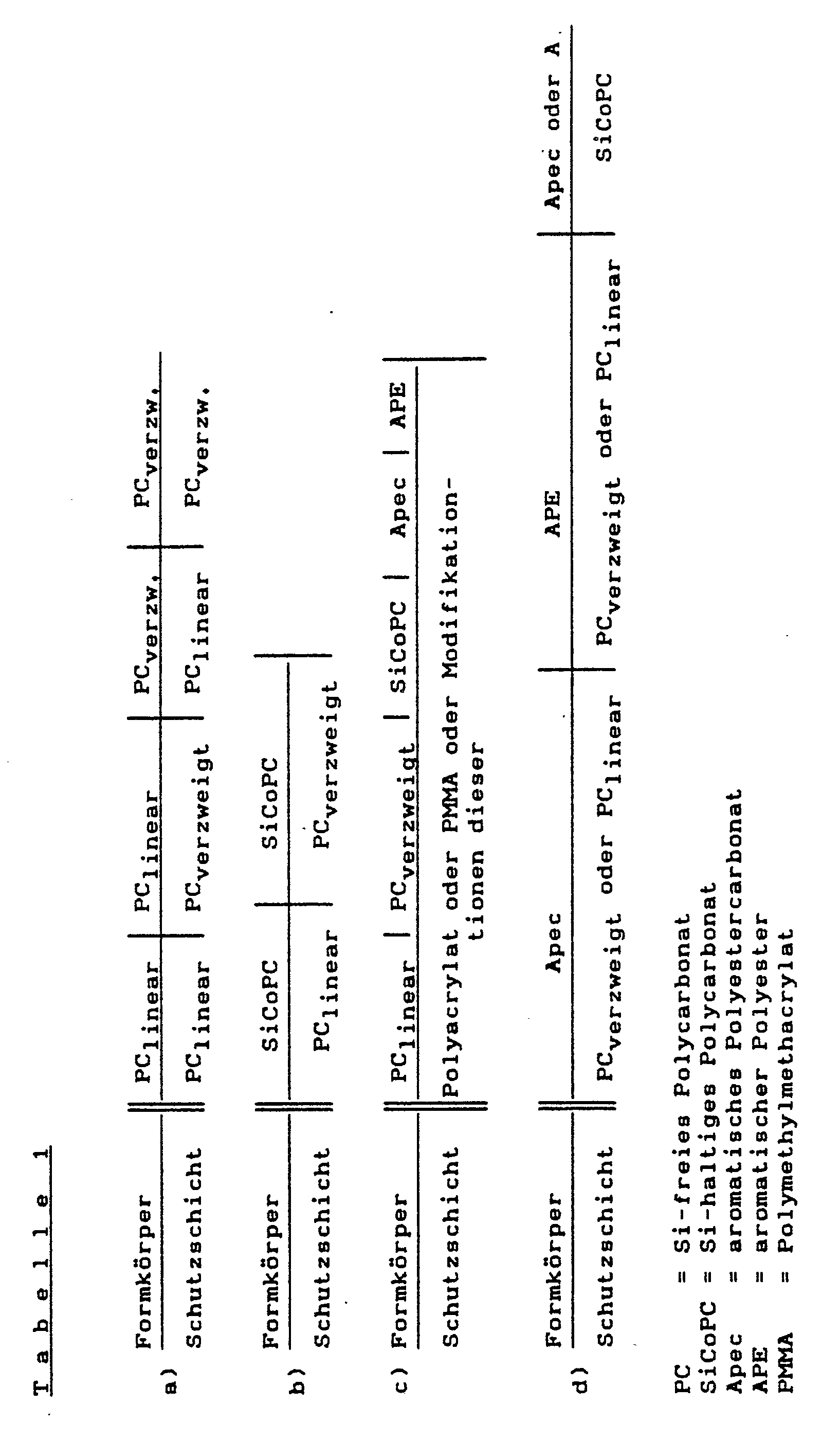
- Geeignete Formkörper/Schutzschicht-Kombinationen ergeben sich beispielsweise aus folgender Tabelle 1:
- Bevorzugte Formkörper/Schutzschicht-Kombinationen bestehen aus verzweigten oder linearen, thermoplastischen, aromatischen Polycarbonaten (Formkörper und Schutzschicht) bzw. aus thermoplastischen, aromatischen Polycarbonaten (linear oder verzweigt) oder thermoplastischen, Si-haltigen Polycarbonaten (Formkörper und Schutzschicht).
- Die vorstehend genannten thermoplastischen Kunststoffe sind in Praxis und Literatur bekannt oder nach literaturbekannten Verfahren erhältlich.
- Den linearen, Si-freien Polycarbonaten liegen als Diphenole vorzugsweise solche der Formel (D)

- In (D) sind
A C₁-C₈-Alkylen, C₂-C₈-Alkyliden, C₅-C₁₅-Cycloalkylen bzw. -Cycloalkyliden, C₇-C₁₈-Aralkyl, wie z.B.
X¹, X² gleich oder verschieden und bedeuten H, Halogen oder C₁-C₄-Alkyl,
n, m unahängig voneinander 0, 1, 2, 3 oder 4. - Geeignete Bisphenole sind beispielsweise Hydrochinon, Resorcin, 4,4′-Dihydroxydiphenyl, Bis-(hydroxyphenyl)-alkane, -cycloalkane, -ether, -ketone, -sulfoxide, -sulfonate, -sulfide, ferner α,α-Bis(hydroxypenyl)-ethylbenzol und -diisopropylbenzol sowie die entsprechenden kernalkylierten bzw. -halogenierten Verbindungen.
- Alkylgruppenhaltige Bisphenole können auch in Form der z.T. oder völlig durch Fluoralkylgruppen oder teilweise fluorierten Alkylgruppen substituierten Bisphenole eingesetzt werden, wie z.B. das Bis-(4-hydroxyphenyl)-hexafluorpropan-2,2.
- Es können auch beliebige Mischungen der vorgenannten Diphenole verwendet werden.
- Bevorzugt sind Polycarbonate auf der Basis von Bis (4-hydroxyphenyl)-propan-2,2 (Bisphenol A), Bis(4-hydroxy-3,5-dichlorphenyl)-propan-2,2 (Tetrachlorbisphenol A), Bis(4-hydroxy-3,5-dibromphenyl)-propan-2,2 (Tetrabrombisphenol A), Bis(4-hydroxy-3,5-dimethylphenyl)-propan-2,2 (Tetramethylbisphenol A), Bis(4-hydroxyphenyl)-cyclohexan-1,1 (Bisphenol Z), bis (4-hydroxy-3,5-dimethylphenyl)-sulfon (Dixylenolsulfon) sowie auf der Basis von Dreikernbisphenolen wie α,α-Bis(4-hydroxyphenyl)-p-diisopropylbenzol und Mischungen dieser Verbindungen.
- Die verzweigten Si-freien Polycarbonate haben vorzugsweise außer den Diphenolen der Formel D noch in bekannter Weise dreifunktionelle oder mehr als dreifunktionelle Verzweiger in bekannten Mengen eingebaut, beispielsweise solche mit drei oder mehr als drei phenolischen OH-Gruppen.
- Einige der verwendbaren Verzweiger mit drei oder mehr als drei phenolischen Hydroxylgruppen sind beispielsweise 2,4-Bis-(4-hydroxyphenyl-isopropyl)-phenol, 2,6-Bis-(2′-hydroxy-5′-methyl-benzyl)-4-methylphenol, 2- (4-Hydroxyphenyl)-2-(2,4-dihydroxyphenyl)-propan und 1,4-Bis-(4,4′-dihydroxytriphenyl-methyl)-benzol. Einige der sonstigen trifunktionellen Verbindungen sind 2,4-Dihydroxybenzoesäure, Trimesinsäure, Cyanurchlorid und 3,3-Bis-(4-hydroxyphenyl)-2-oxo-2,3-dihydroindol sowie 3,3-Bis-(4-hydroxy-3-methyl-phenyl )-2-oxo-2,3-dihydroindol.
- Die Herstellung der verzweigten Polycarbonate erfolgt nach bekannten Herstellungsverfahren für aromatische thermoplastische Polycarbonate, und zwar entweder nach dem Umesterungsverfahren in der Schmelze mit Diphenylcarbonat oder nach dem Zweiphasengrenzflächenverfahren mit Phosgen (siehe dazu beispielsweise H. Schnell, Chemistry and Physics of Polycarbonates, Polymer Rev., Vol. IX, Seite 27 ff., Interscience Publishers New York, 1964, DE-OS 1 570 533, DE-OS 1 595 762, DE-PS 2 500 092 und US-PS 3 544 514 bzw. US-RE 27 682).
- Die Reaktionsbedingungen für beide Herstellungsverfahren sind geläufig.
- Die Si-haltigen, thermoplastischen Polycarbonate können linear oder verzweigt sein und sind vorzugsweise Polydiorganosiloxan-Polycarbonat-Blockcokondensate wie sie beispielsweise aus der EP-OS 013 5794 (Le A 22 390-EP) bekannt sind.
- Solche Polydiorganosiloxan-Polycarbonat-Blockcopolymere sind dadurch gekennzeichnet, daß sie in der Polymerkette einerseits aromatische Carbonatstruktureinheiten (1) und andererseits Aryloxyendgruppen-haltige Polydiorganosiloxane (2) enthalten,
-O-Ar-O--O-Ar-O- (1)

Ar gleiche oder verschiedene Arylenreste aus Diphenolen der o.a. Art sind und
R und R¹ gleich oder verschieden sind und lineares Alkyl, verzweigtes Alkyl, Alkenyl, halogeniertes lineares Alkyl, halogeniertes verzweigtes Alkyl, Aryl oder halogeniertes Aryl, vorzugsweise aber Methyl bedeuten,
und
die Anzahl der Diorganosiloxy-Einheiten n = a + b + c = 2 bis 120, vorzugsweise 40 bis 50, ist. - Alkyl ist in vorstehender Formel (1) beispielsweise C₁-C₂₀-Alkyl; Alkenyl ist in vorstehender Formel (1) beispielsweise C₂-C₆-Alkenyl; Aryl ist in vorstehender Formel (1) C₆-C₁₄-Aryl. Halogeniert bedeutet in vorstehender Formel teilweise oder vollständig chloriert, bromiert oder fluoriert. Beispiele für Alkyle, Alkenyle, Aryle, halogenierte Alkyle und halogenierte Aryle sind Methyl, Ethyl, Propyl, n-Butyl, tert.-Butyl, Vinyl, Phenyl, Naphthyl, Chlormethyl, Perfluorbutyl, Perfluoroctyl und Chlorphenyl.
- Derartige Polydiorganosiloxan-Polycarbonat-Blockcopolymere sind z.B. aus US-PS 3 189 662, US-PS 3 821 325 und US-PS 3 832 419 bekannt. In der einschlägigen Literatur werden ihre verbesserten mechanischen Eigenschaften bei tiefen Temperaturen beschrieben (z.B. B.M. Beach, R.P. Kambour und A.R. Schultz, J. Polym. Sci., Polym. Lett. Ed. 12, 247 (1974)).
- Bevorzugte Polydiorganosiloxan-Polycarbonat-Blockcopolymere mit mittleren Molekulargewichten
M w (Gewichtsmittel wie durch Ultrazentrifugation oder Streulichtmessung bestimmt) von 10.000 bis 200.000 und mit einem Gehalt an aromatischen Carbonatstruktureinheiten zwischen etwa 75 Gew.-% und 97,5 Gew.-% und mit einem Gehalt an Diorganosiloxy-Einheiten zwischen 25 und 2,5 Gew.-% werden hergestellt, indem man α,ω-Bishydroxyaryloxyendgruppen-haltige Polydiorganosiloxane zusammen mit anderen Diphenolen, gegebenenfalls unter Mitverwendung von Kettenabbrechern in den üblichen Mengen und gegebenenfalls unter Mitverwendung von Verzweigern in den üblichen Mengen, z.B. nach dem Zweiphasengrenzflächenverfahren (s. dazu H. Schnell, Chemistry and Physics of Polycarbonates, Polymer Rev., Vo. IX, Seite 27 ff., Interscience Publishers New York, 1964) umsetzt, wobei jeweils das Verhältnis der bifunktionellen phenolischen Reaktanten so gewählt wird, daß daraus der erfindungsgemäße Gehalt an aromatischen Carbonatstruktureinheiten und Diorganosiloxy-Einheiten resultiert. - Derartige α,ω-Bishydroxyaryloxyendgruppen-haltige Polydiorganosiloxane sind z.B. aus US 3 419 634 bekannt.
- Zur Herstellung der α,ω-Bishydroxyaryloxyendgruppen-haltigen Polydiorganosiloxane sowie der Polydiorganosiloxan-Polycarbonat-Blockcopolymeren einzusetzende Diphenole sind wiederum vorzugsweise die der Formel (D)
- Geeignete thermoplastische aromatische Polyestercarbonate bzw. thermoplastische, aromatische Polyester sind aus aromatischen Dicarbonsäuren und Diphenolen aufgebaut, wobei am Aufbau der Polyestercarbonate zusätzich noch mindestens ein Kohlensäurederivat, z.B. Phosgen, beteiligt ist.
- Bevorzugte aromatische Dicarbonsäuren sind beispielsweise: Isophthalsäure, Terephthalsäure, Diphenylether-4,4′-dicarbonsäure, Naphthalin-2,6-dicarbonsäure. Besonders bevorzugt sind Iso- und Terephthalsäure. Bevorzugtes Kohlensäurederivat ist Phosgen.
- Bevorzugte Diphenole für die Herstellung der erfindungsgemäßen aromatischen Polyester und Polyestercarbonate sind Verbindungen der Formel:
HO - Z - OH (III),
worin Z einen zweiwertigen ein- oder mehrkernigen aromatischen Rest mit 6-30 C-Atomen bedeutet, wobei Z derart gebaut ist, daß die beiden OH-Gruppen direkt an je ein C-Atom eines aromatischen Systems gebunden sind. - Besonders bevorzgute Diphenole sind Verbindungen der Formel IV

Y eine Einfachbindung, einen Alkylen- oder Alkylidenrest mit 1-7 C-Atomen, einen Cycloalkylen-oder Cycloalkylidenrest mit 5-12 C-Atomen, -O-, -S-,
--,
-SO₂- oder --
beduetet, sowie deren kernalkylierte und kernhalogenierte Derivate, z.B.
Hydrochinon,
Resorcin,
Dihydroxydiphenyle,
Bis-(hydroxyphenyl)-alkane,
Bis-(hydroxyphenyl)-cycloalkane,
Bis-(hydroxyphenyl)-ether,
Bis-(hydroxyphenyl)-ketone,
Bis-(hydroxyphenyl)-sulfoxide,
Bis-(hydroxyphenyl)-sulfone und
α,α′-Bis-(hydroxyphenyl)-diisopropylbenzole,
sowie deren kernalkylierte und kernhalogenierte Derivate. - Die wichtigsten Diphenole sind: Bisphenol A, Tetramethylbisphenol A, 1,1-Bis-(4-hydroxyphenyl)-isobutan, 1,1-Bis-(4-hydroxyphenyl)-cyclohexan, 4,4′-Dihydroxydiphenylsulfid, 4,4′-Dihydroxydiphenylsulfon, sowie deren di- und tetrahalogenierte Derivate. Besonders bevorzugt ist Bisphenol A. Es können auch beliebige Mischungen der genannten Diphenole verwendet werden.
- Mögilche Verzweigungsmittel sind in den DOS 2 949 924 und 3 007 934 genannt.
- Als Kettenabbrecher für die aromatischen Polyester und Polyestercarbonate werden vorzugsweise Phenol, Alkylphenol mit C₁-C₁₂-Alkylgruppen, halogenierte Phenole, Hydroxydiphenyl, Naphthole, Chlorkohlensäureester aus solchen phenolischen Verbindungen und Chloride von aromatischen Monocarbonsäuren, die gegebenenfalls durch C₁-C₂₂-Alkylgruppen und Halogenatome substituiert sein können, in Mengen von 0,1 bis 10 Mol-% (im Falle von Phenolen bezogen auf Säuredichlorid) verwendet. Weiterhin kommen die Chloride von aliphatischen Monocarbonsäuren mit bis zu 22 C-Atomen in Betracht.
- Die Kettenabbrecher können, soweit es sich um phenolische Verbindungen handelt, dem Reaktionsgemisch vor Beginn oder während der Reaktion zugesetzt werden. Es muß jedoch noch genügend Säurechlorid und/oder Phosgen zur Verfügung stehen, damit sie reagieren und die Kette begrenzen können; z.B. kann der Kettenabbrecher zusammen mit dem Diphenol eingesetzt werden, in der Lösung der Chloride der aromatischen Dicarbonsäuren enthalten sein, oder dem Reaktionsgemisch nach Herstellung eines Vorkondensats zugesetzt werden.
- Sofern man als Kettenabbrecher Säurechloride und Chlorkohlensäureester verwendet, werden sie vorzugsweise gemeinsam mit den aromatischen Dicarbonsäuredichloriden und/oder Phosgen eingesetzt. Diese Kettenabbrecher können dem Reaktionsgemisch auch noch zu einem Zeitpunkt zugesetzt werden, wenn die Chloride der Dicarbonsäuren und das Phosgen schon weitgehend oder vollständig abreagiert haben.
- Am Aufbau der aromatischen Polyester und Polyestercarbonate können auch bis zu jeweils 30 Mol-% der Dicarbonsäuren und Dihydroxyverbindungen aliphatische Baugruppen, z.B. Adipinsäure, Butandiol-1,4 beteiligt sein.
- Weiterhin können die aromatischen Polyester und Polyestercarbonate teilweise aus aromatischen Hydroxycarbonsäuren, z.B. p-Hydroxy-benzoesäure aufgebaut sein. Der Anteil solcher Hydroxycarbonsäuren kann bis zu 100 Mol-% (bezogen auf Bisphenol) betragen.
- Falls Iso- und Terephthalsäure gemeinsam am Aufbau der aromatischen Polyester und Polyestercarbonate beteiligt sind, kann deren Verhältnis 1:20 bis 20:1 betragen.
- Die erfindungsgemäß geeigneten aromatischen Polyestercarbonate können bis zu 80 Mol-%, vorzugsweies bis zu 50 Mol-% Carbonatgruppen enthalten, bezogen auf die Summe von Ester- und Carbonatgruppen.
- Sowohl der Ester- als auch der Carbonatanteil der erfindungsgemäßen aromatischen Polyestercarbonate kann in Form von Blöcken oder statistisch verteilt im Polykondensat vorliegen.
- Die Herstellung der aromatischen Polyester und Polyestercarbonate ist bekannt und z.B. in DOS 1 495 626, 2 232 877, 2 703 376, 3 000 610, 2 949 924, 3 007 934 beschrieben. Besonders bevorzugt ist das Phasengrenzflächenverfahren.
- Die relative Lösungsviskosität (µrel) der aromatischen Polyester und Polyestercarbonate liegt im Bereich 1,18 bis 1,4, vorzugsweise 1,22 bis 1,3 (gemessen an Lösungen von 0,5 g, Polyester bzw. Polyestercarbonat in 100 ml CH₂Cl₂-Lösung bei 25°C).
- Die erfindungsgemäß zu schützenden Formkörper sind vorzugsweise Platten, Stegplatten, Profile, Stegprofile, Folien, Hohlkammerplatten und Bauteile jeglicher Art, also beispielsweise Lampengehäuse, Schutzscheiben, Abdeckplatten und ähnliches. Die Herstellung derartiger Formkörper durch Extrusion ist bekannt. Im Falle der Platten sollen diese vorzugsweise eine Dicke von 0,5 mm bis 30 mm haben.
- UV-Absorber-haltige Kunststoffe sind bekannt (siehe beispielsweise US-Patent 3 004 896, Kunststoffe 74 (1984) Seiten 620 bis 623, Taschenbuch der Kunststoff-Additive, 2. Ausgabe, Dr. F. Gugumus, "Lichtschutzmittel für thermoplastische Kunststoffe" Seiten 124 ff und US-Patent 2 965 578).
- Die Coextrusion von thermoplastischen Kunststoffen ist ebenfalls bekannt (siehe beispielsweise "Grundzüge der Coextrusion von Platten und Folien" Kunststoffberater 10 (1976) Seiten 538 bis 541, DE-OS 2 832 676, EP-OS 0 065 619, EP-PS 0 110 221 und DE-OS 3 244 953), wobei aus diesem angezogenen Stand der Technik auch die Beschichtung von Kunststoffen mit UV-Absorber-haltigen Kunststoffen hervorgeht. Diese Verfahren haben jedoch immer mit der potentiellen Migration des UV-Absorbers Probleme, vor allem dann, wenn für die Herstellung von Hohlkammerprofilen die Coextrusion unter Vakuum erfolgen muß. Aus diesem Grund muß man, um sicher zu gehen, auf ein Zweischichtverfahren übergehen (siehe DE-OS 3 244 953 und EP-OS 0 110 238), was jedoch einen zusätzlichen Verfahrensaufwand erforderlich macht.
- Eine andere Möglichkeit besteht in der Verwendung von polymeren UV-Absorbern (siehe beispielsweise DE-OS 2 231 531, DE-OS 2 231 532, EP-OS 0 141 140, DE-OS 3 424 066 und DE-OS 3 424 555). Die Verwendung von derartigen polymeren UV-Absorbern hat jedoch den Nachteil daß Unverträglichkeiten zwischen UV-Absorber und zu schützender Matrix auftreten können.
- Zudem sind die z.B. bekannten polymeren UV-Absorber inhärent UV-instabil und/oder führen zur Versprödung der zu schützenden Matrix (z.B. bei polymeren UV-Absorbern auf PMMA-Basis für Polycarbonat).
- Bekannt ist außerdem die Beschichtung von Polyacrylat- oder Polycarbonat-Formkörpern mittels UV-Absorberhaltigen Lösungen von den gleichen oder anderen Thermoplasten (siehe DE-OS 1 694 273). Ein derartiges Verfahren hat jedoch den Nachteil der notwendigen Trocknung und Härtung der Beschichtungen bei gleichzeitig technisch aufwendiger Handhabung großer Formteile.
- Bekannt ist auch das Imprägnieren von Polycarbonaten mit UV-Absorber-haltigen Lösungen (siehe beispielsweise US-Patent 3 617 330 und US-Patent 3 892 889). Dieses Verfahren hat jedoch ebenfalls den Nachteil des zusätzlichen Trocknungsschrittes und der komplizierten Handhabung großer Formteile und Bäder.
- Die erfindungsgemäß einzusetzenden UV-Absorber der Formel (I) sind bekannt (siehe beispielsweise DE-OS 1 670 951, tschechische Patentschrift 146 360, EP-OS 0 180 993, EP-OS 0 180 991 und EP-OS 0 180 992).
- Hierbei erfolgt der Einsatz sowohl in Kunststoffen (siehe DE-OS 1 670 951) als auch in Lacken (siehe EP-OS 0 180 991).
- Die Verwendung von UV-Absorbern der Formel I ist bis jetzt in vier verschiedenen Anmeldungen beschrieben worden. In der DE-OS 1 670 951 wir die Verwendung von Alkylen-bis-(benzotriazolylphenolen) als UV-Absorber in Polyolefinen, Polyestern, PVC und Polyvinylidenchlorid, insbesondere in Polyethylen, Polypropylen, Polycarbonat und Polyvinylchlorid beschrieben. Die EP-A 0 180 991 beschreibt den UV-Schutz von thermisch härtbaren Lackharzkompositionen auf der Basis von Acryl-, Alkyl- oder ungesättigten Polyesterharzen. Die EP-A 0 180 992 beschreibt ein Stabilisatorsystem, bestehend aus einem UV-Absorber der Formel I und einem 2,2,6,6-Tetramethylpiperidin-Derivat zur UV-Schutzausrüstung von PVC, Poly-α-olefinen, ABS-Terpolymeren und Polyurethanharzen. Die vierte Anmeldung ist die japanische Offenlegungsschrift 62-146 951.
- Allen vier Anmeldungen ist gemeinsam, daß die UV- und bewitterungsgeschützten Kompositionen durch Mischen des bzw. der UV-Absorber mit den zu schützenden Polymeren hergestellt werden.
- Es lag jedoch nicht nahe, diese speziellen UV-Absorber in Deckschichten via Coextrusion auf Formkörper aus lichtempfindlichen, thermoplastischen Kunststoffen aufzubringen, weil die erhaltenen, beschichteten Formkörper eine überraschend günstige Eigenschaftskombination aufweisen, nämlich die einer geringen elektrostatischen Aufladbarkeit verbunden mit einem besseren Bewitterungsverhalten, als dies nach dem Zwischenschichtverfahren - selbst unter Verwendung von UV-Absorbern der Formel I - möglich ist. Neben geringeren Werten der Vergilbung wird - und dies ist besonders überraschend - auch ein höheres Zähigkeitsniveau gemessen. Ebenfalls überraschend ist die geringe elektrostatische Aufladbarkeit derartig coextrudierter Formkörper. Eine Stegdoppelplatte aus Polycarbonat, ausgerüstet mit einer 40 µm dicken Schicht, bestehend aus 90 Gew.-Teilen Polycarbonat und 10 Gew.-Teilen eines UV-Absorbers der Formel I (R¹⁻⁴ = H, R5,6 = i-Ocryl, c,d = 1), weist nach 50 maligem Reiben mit einem Dralontuch eine um die Hälfte geringere elektrostatische Aufladung auf als unbeschichtetes Polycarbonat auf.
- Das erfindungsgemäße Verfahren weist damit gegenüber dem Stand der Technik die Vorteile der vereinfachten Herstellung und verbesserten Schutzausrüstung von großflächigen Thermoplastformkörpern unterschiedlicher Dicke gegen UV-Licht und Bewitterung auf.
- Gegenstand der vorliegenden Erfindung sind somit auch mit einer 5 µm bis 100 µm, vorzugsweise mit 20 µm bis 50 µm dicken Schicht aus thermoplastischen Kunststoffen beschichtete Formkörper aus lichtempfindlichen, thermoplastischen Kunststoffen, die dadurch gekennzichnet sind, daß die Schicht 0,1 Gew.-% bis 20 Gew.-%, vorzugsweise 2 Gew.-% bis 15 Gew.-% und insbesondere 5 Gew.-% bis 10 Gew.-% an UV-Absorber der Formel I enthält.
- Die Einarbeitung der UV-Absorber der Formel I in die als Deckschichten zu verwendenden, thermoplastischen Kunststoffe erfolgt nach üblichen Methoden, beispielsweise durch Vermischen der UV-Absorber mit dem Kunststoffgranulat oder Kunststoffpulver in Substanz oder durch Vermischen von Lösungen der UV-Absorber mit Lösungen der Kunststoffe in geeigneten organischen Lösungsmitteln wie CH₂Cl₂, Halogenalkane, Halogenaromaten, Chlorbenzol, Xylole u.a. Die Substanzgemische werden dann in bekannter Weise via Extrusion homogenisiert; die Lösungsgemische werden in bekannter Weise nach Ausdampfen des Lösungsmittels beispielsweise compoundiert.
- Das erfindungsgemäße Aufbringen der Deckschichten via Coextrusion erfolgt in bekannter Weise auf den für die Coextrusion bekannten Extrudern.
- Ein bevorzugtes Verfahren der Coextrusion erfolgt beispielsweise nach dem Adapterverfahren (siehe Beispiele).
- Sowohl die lichtempfindlichen thermoplastischen Kunststoffe, die als Kernschicht eingesetzt werden, als auch die thermoplastischen aber nicht notwendigerweise lichtempfindlichen Kunststoff der Deckschicht, können die für die jeweiligen Kunststoffe üblichen Additive enthalten, wie Füllstoffe, Verstärkungsstoffe, Flammschutzmittel, Pigmente, Antistatika, Farbstoffe, Gleitmittel und/oder Entformungsmittel. Sie können in übilcher Weise eingearbeitet werden.
-

-

- Mit Phenol als Kettenabbrecher geregeltes Polycarbonat auf Basis Bisphenol A mit einer relativen Losungsviskosität von 1,31 (gemessen bei 25°C in 0,5 %iger Lösung in Dichlormethan).
- Die UV-Absorber wurden zu 10 Gew.-% bei 280°C und 80 U/min auf einem Doppelwellenextruder (ZSK 32, Werner & Pfleiderer) in den Thermoplasten eingearbeitet und das Extrudat granuliert.
- Die einfach beschichteten Kunststoffplatten (Kernschicht 10 mm, Deckschicht 40 µm) wurden mit Hilfe einer Breitschlitzdüse nach dem Adapterverfahren kontinuierlich coextrudiert. Um eine Verformung des noch heißen Stegdoppelplattenstranges zu verhindern, wird dieser vor Verlassen der Düse über einen Kalibrator geführt. Schließlich erfolgt der Zuschnitt auf die vorgegebene Plattenlänge.
- Mit dem erfindungsgemäß einzusetzenden UV-Absorber I kann dieses Einschichtverfahren über längere Produktionszeiträume, ohne daß Störungen an Anlagenteilen oder am Produkt auftreten, durchgeführt werden. Der Einsatz des UV-Absorbers II führt sehr schnell zu Ausdampf- und Ablagerungsproblemen. Die Kalibratoren verstopfen und/oder die optische Qualität der Platten wird beeinträchtigt.
- Zum Vergleich wurden ebenfalls nach dem Adapterverfahren coextrudierte Stegdoppelplatten mit zwei Deckschichten derart hergestellt, daß auf die hoch UV-Absorber-haltige erste Deckschicht der Einschichtvariante eine weitere dünne Deckschicht (10 µm), jedoch mit geringerem UV-Absorbergehalt (0,3 Gew.-%), aufgetragen wurde.
- Die Bewitterung dieser Platten erfolgte im Weather-ometer der Fa. Atlas, USA, mit einem 6,5 W-Xenon-Brenner bei einem Zyklus von 102 min Belichtung und 18 min Besprühung mit entmineralisiertem Wasser unter Belichtung. Die maximale Schwarztafeltemperatur betrug 60°C (±5°C). Nach jeweils 1000 h wurden die Platten gemustert und zur praxisnahen Prüfung der Zähigkeit ein an Stegmehrfachplatten in Anlehnung an DIN 53 443 entwickelter, modifizierter Kugelfallversuch durchgeführt, bei dem mittels eines Durchstoßkörpers von 5 mm Durchmesser, welcher eine ähnliche biaxiale Beanspruchung hervorrufen soll, wie ein herabfallendes Hagelkorn, die Schädigungsarbeit Ws gemessen wird. Bei Raumtemperatur schlägt eine Fallmasse von 36 kg aus 0,2 m Fallhöhe auf die Probekörper, die auf einem Auflagering von 20 mm Innendurchmesser frei aufliegen.
- Es wird mit der bewitterten Seite des Probekörpers in Druckzone geprüft. Das Bruchbild (BB) wird durch Zahlen charakterisiert: 1 = spitternd, 2 = glatter Riß, 3 = zähspröd, 4 = zäh.
- Als Yellowness Index YI wird der nach DIN 6167 ermittelte Gelbwert angegeben.
- Der Glanzwert der Platten wird bei einem Einstrahlungswinkel von 60° nach DIN 67 530 ermittelt.
- Die Tabellen 2 und 3 enthalten die Daten der hergestellten Stegdoppelplatten bzw. die Bewitterungsergebnisse.
- Zusammenfassend läßt sich sagen: Die Version mit zwei Deckschichten zeigt ein gutes Bewitterungsverhalten nur bei Verwendung eines migrationsfähigen UV-Absorvers, da nur er sich im Oberflächenbereich anreichern kann. Die erfindungsgemäße Version mit einer Deckschicht läßt sich leichter realisieren. Es resultiert eine weitere Verbesserung hinsichtlich Glanz, Vergilbung und Durchstoßfestigkeit bei Bewitterung.
Tabelle 2 Versuch Trägerschicht1) Mittelschicht Deckschicht Einschichtplatte (A) PC - PC + 10 % UV-Absorber I Zweischichtplatte (B1) PC PC + 10 % UV-Absorber I PC + 0,3 % UV-Absorber I Zweischichtplatte (B2) PC PC + 10 % UV-Absorber II PC + 0,3 % UV-Absorber II 1) Polycarbonat, Mw = 30 000 Tabelle 3 Versuch Bewitterung Xenon WOM Glanz (60°C) YI W s (J) BB 0 h 500 h 0 h 500 h 0 h 500 h 500 h 1000 h 1000 h 1000 h 1000 h A 123 116 1,3 5,2 2,3 2,3 4 B1 129 113 1,5 6,2 - - 4 B2 - - 2,0 6,8 2,0 1,1 3 - Die Gegenstände unserer älteren deutschen Patentanmeldung P 36 17 978.7 (Le A 24 568) und P 37 09 779.2 (Le A 24 164) sind vom Gegenstand der vorliegenden Erfindung ausgenommen.
Claims (10)

R¹ und R² gleich oder verschieden sind und H, Halogen, C₁-C₁₀-Alkyl, C₅-C₁₀-Cycloalkyl, C₇-C₁₃-Aralkyl, C₆-C₁₄-Aryl, -OR⁷ oder -COOR⁷ bedeuten, mit
R⁷ = H, C₁-C₁₀-Alkyl, C₅-C₁₀-Cycloalkyl, C₇-C₁₃-Aralkyl, C₆-C₁₄-Aryl,
R³ und R⁴ gleich oder verschieden sind und H, C₁-C₁₅-Alkyl, C₅-C₆-Cycloalkyl, C₇-C₂₀-Aralkyl oder C₆-C₁₄-Aryl bedeuten,
R⁵ und R⁶ gleich oder verschieden sind und C₂-C₁₅-Alkyl, C₅-C₁₀-Cycloalkyl, C₇-C₂₀-Aralkyl C₆-C₁₄-Aryl -OR⁷ oder -COOR⁷ bedeuten,
a, b gleich oder verschieden und 1, 2, 3 oder 4 sind und
c, d gleich oder verschieden und 1, 2 oder 3 sind,
wobei die Gegenstände der älteren deutschen Patentanmeldung P 36 17 978.7 und P 37 09 779.2 ausgenommen sind.
R¹ und R² H, Cl oder CH₃
R³ und R⁴ H oder C₁-C₄-Alkyl,
R⁵ und R⁶ C₄-C₈-Alkyl, Cyclohexyl, C₇-C₉-Aralkyl, Phenyl oder Naphthyl und
a = b = c = d = 1 sind.
R¹ = R² = H,
R³ und R⁴ H oder CH₃ und
R⁵ und R⁶ C₄-C₈-Alkyl oder C₇-C₉-Aralkyl sind.
Priority Applications (1)
| Application Number | Priority Date | Filing Date | Title |
|---|---|---|---|
| AT88119076T ATE82308T1 (de) | 1987-11-24 | 1988-11-17 | Beschichtete formkoerper und ein verfahren zu ihrer herstellung. |
Applications Claiming Priority (2)
| Application Number | Priority Date | Filing Date | Title |
|---|---|---|---|
| DE19873739765 DE3739765A1 (de) | 1987-11-24 | 1987-11-24 | Beschichtete formkoerper und ein verfahren zu ihrer herstellung |
| DE3739765 | 1987-11-24 |
Publications (3)
| Publication Number | Publication Date |
|---|---|
| EP0320632A2 true EP0320632A2 (de) | 1989-06-21 |
| EP0320632A3 EP0320632A3 (de) | 1991-01-02 |
| EP0320632B1 EP0320632B1 (de) | 1992-11-11 |
Family
ID=6341133
Family Applications (1)
| Application Number | Title | Priority Date | Filing Date |
|---|---|---|---|
| EP88119076A Expired - Lifetime EP0320632B1 (de) | 1987-11-24 | 1988-11-17 | Beschichtete Formkörper und ein Verfahren zu ihrer Herstellung |
Country Status (12)
| Country | Link |
|---|---|
| US (1) | US5108835A (de) |
| EP (1) | EP0320632B1 (de) |
| JP (1) | JPH0641162B2 (de) |
| AT (1) | ATE82308T1 (de) |
| BR (1) | BR8806153A (de) |
| CA (1) | CA1325703C (de) |
| DE (2) | DE3739765A1 (de) |
| ES (1) | ES2036247T3 (de) |
| IL (1) | IL88430A (de) |
| RU (1) | RU1782211C (de) |
| UA (1) | UA15669A (de) |
| ZA (1) | ZA888761B (de) |
Cited By (22)
| Publication number | Priority date | Publication date | Assignee | Title |
|---|---|---|---|---|
| EP0338355B1 (de) * | 1988-04-22 | 1992-11-11 | Miles Inc. | Verschmutzungsbeständige Polycarbonat-Platten |
| EP0568988A1 (de) * | 1992-05-06 | 1993-11-10 | Ems-Inventa Ag | Oberflächenresistente Bauteile |
| EP0569878A3 (de) * | 1992-05-15 | 1994-02-16 | Roehm Gmbh | |
| EP0649724A1 (de) * | 1993-10-18 | 1995-04-26 | Bayer Ag | Verfahren zur Herstellung von mehrschichtigen Kunststofftafeln |
| EP0678376A1 (de) * | 1994-04-18 | 1995-10-25 | Axxis N.V. | Copolyesterhaltige Kunststofffolie, Verfahren zu ihrer Herstellung und aus dieser Folie hergestellte Formteile |
| EP0709442A2 (de) | 1994-10-28 | 1996-05-01 | Bayer Ag | UV-geschützte, beschichtete Polycarbonatformkörper |
| EP0712888A1 (de) * | 1994-11-18 | 1996-05-22 | Bayer Corporation | Farbstabile Polycarbonatzusammensetzungen und daraus geformter Artikel |
| EP0716919A3 (de) * | 1994-12-16 | 1996-12-27 | Bayer Ag | UV-geschütze, mehrschichtige Polycarbonatplatten |
| WO1998005498A1 (de) * | 1996-07-31 | 1998-02-12 | Aventis Research & Technologies Gmbh & Co Kg | Mehrschichtige, transparent eingefärbte platte aus einem kristallisierbaren thermoplast, verfahren zu ihrer herstellung und verwendung |
| WO1998005499A1 (de) * | 1996-07-31 | 1998-02-12 | Aventis Research & Technologies Gmbh & Co. Kg | Mehrschichtige, eingefärbte platte aus einem kristallisierbaren thermoplast, verfahren zu ihrer herstellung und verwendung |
| US5856012A (en) * | 1993-10-18 | 1999-01-05 | Bayer Ag | Process for the production of multilayer plastic sheets |
| WO1999005205A1 (de) * | 1997-07-25 | 1999-02-04 | Bayer Aktiengesellschaft | Polycarbonatformmassen und ihre verwendung als beschichtungen in coextrudierten platten |
| WO2001060902A1 (de) | 2000-02-15 | 2001-08-23 | Bayer Aktiengesellschaft | Zusammensetzung enthaltend polycarbonat und pigmente |
| US6297300B1 (en) * | 2000-05-19 | 2001-10-02 | The Dow Chemical Company | Carbonate polymer compositions comprising low volatile UV absorbers |
| US6441071B1 (en) | 1999-09-01 | 2002-08-27 | Dow Global Technologies Inc. | Polycarbonate resin compositions comprising cyanacrylic acid ester stabilizer compounds |
| WO2004035674A1 (de) * | 2002-10-09 | 2004-04-29 | Bayer Materialscience Ag | Polycarbonat enthaltend diphenylcarbonat und platten enthaltend dieses polycarbonat |
| EP1792703A2 (de) | 2003-05-16 | 2007-06-06 | Bayer Sheet Europe GmbH | Durch Coextrusion beschichtete Stegplatte ohne Triangeleffekt |
| DE102007013273A1 (de) | 2007-03-16 | 2008-09-18 | Bayer Materialscience Ag | Verfahren zur Herstellung mehrschichtiger Behälter |
| DE102009020938A1 (de) | 2009-05-12 | 2010-11-18 | Bayer Materialscience Ag | Witterungsstabile Mehrschichtsysteme |
| DE102009020933A1 (de) | 2009-05-12 | 2010-11-18 | Bayer Materialscience Ag | Langzeit UV-stabile kälte schlagzähe Coextrusionsfolien |
| RU2415161C2 (ru) * | 2005-09-03 | 2011-03-27 | Басф Се | Состав, содержащий поликарбонат, и изделие, содержащее названный состав |
| US20200256065A1 (en) * | 2019-02-08 | 2020-08-13 | Certainteed Corporation | Layered Thermoplastic Structure With Reflective Intermediate Layer and Method of Manufacture |
Families Citing this family (40)
| Publication number | Priority date | Publication date | Assignee | Title |
|---|---|---|---|---|
| US5387691A (en) * | 1993-03-05 | 1995-02-07 | Ciba-Geigy Corporation | 2-(benzotriazol-2-yl)-4-alkyl-6-(2-hydroxy-3-benzoyl-6-alkoxybenzyl)phenols and stabilized compositions |
| US5306456A (en) * | 1993-03-10 | 1994-04-26 | Ciba-Geigy Corporation | Preparing laminated thermoplastics stabilized with bisbenzophenones |
| US5292890A (en) * | 1993-05-05 | 1994-03-08 | Fairmount Chemical Company, Inc. | Asymmetrical benzotriazolylphenols |
| EP0732355B1 (de) * | 1995-03-18 | 1997-07-16 | General Electric Company | Beschichtete Thermoplastgegenstände |
| US5585422A (en) * | 1995-09-20 | 1996-12-17 | Ciba-Geigy Corporation | Hybrid s-triazine light stabilizers substituted by benzotriazole or benzophenone moieties and compositions stabilized therewith |
| EP0786675B1 (de) * | 1996-01-26 | 2002-11-06 | Teijin Chemicals, Ltd. | Brillenglas |
| US5759689A (en) * | 1996-06-13 | 1998-06-02 | General Electric Company | Coextruded polycarbonate sheet with improved weathering |
| TW357175B (en) * | 1996-07-12 | 1999-05-01 | Ciba Sc Holding Ag | Stabilizer mixtures |
| US5902683A (en) * | 1996-08-30 | 1999-05-11 | General Electric Company | Construction shingle |
| US6166218A (en) * | 1996-11-07 | 2000-12-26 | Ciba Specialty Chemicals Corporation | Benzotriazole UV absorbers having enhanced durability |
| JP4259697B2 (ja) | 1999-03-02 | 2009-04-30 | 株式会社Adeka | ポリカーボネート樹脂成形物 |
| CN1186417C (zh) * | 1999-05-03 | 2005-01-26 | 西巴特殊化学品控股有限公司 | 含有高溶解性的、红移的、光稳定的苯并三唑紫外线吸收剂的稳定化粘合剂组合物和从其制得的层压制品 |
| TWI228137B (en) | 1999-06-17 | 2005-02-21 | Rohm & Haas | Capstock composition and process providing weatherability, reduced gloss, and high impact |
| DE19954313A1 (de) | 1999-11-11 | 2001-05-17 | Bayer Ag | Polycarbonatformmassen |
| US6368724B1 (en) | 1999-12-13 | 2002-04-09 | Eastman Chemical Company | Copolyester containing isophthalic acid, 1,4-cyclohexanedimethanol and an ultraviolet light absorbing compound and articles made therefrom |
| US6352783B1 (en) | 1999-12-13 | 2002-03-05 | Eastman Kodak Company | Copolyester containing 4,4'-biphenyldicarboxylic acid, 1,4-cyclohexanedimethanol and an ultraviolet light absorbing compound and articles made therefrom |
| US6218450B1 (en) | 1999-12-13 | 2001-04-17 | Eastman Chemical Company | Copolyester containing isophthalic acid, 1,4-cyclohexanedimethanol, 4,4′-biphenyldicarboxylic acid and an ultraviolet light absorbing compound and articles made therefrom |
| DE10015863A1 (de) * | 2000-03-30 | 2001-10-11 | Bayer Ag | Zusammensetzungen enthaltend Polycarbonat |
| DE10026628A1 (de) * | 2000-05-29 | 2001-12-06 | Bayer Ag | Transparente thermoplastische Zusammensetzungen |
| DE10028412A1 (de) * | 2000-06-08 | 2001-12-13 | Bayer Ag | Zusammensetzungen enthaltend Polycarbonat |
| DE10053151A1 (de) | 2000-10-26 | 2002-05-08 | Bayer Ag | Zusammensetzung enthaltend thermoplastische Kunststoffe |
| US6921743B2 (en) * | 2001-04-02 | 2005-07-26 | The Procter & Gamble Company | Automatic dishwashing compositions containing a halogen dioxide salt and methods for use with electrochemical cells and/or electrolytic devices |
| DE10117786A1 (de) | 2001-04-10 | 2002-10-17 | Bayer Ag | Wärmeabsorbierendes Schichtsystem |
| DE20118862U1 (de) | 2001-11-19 | 2002-02-21 | ALLOD GmbH & Co. KG, 91587 Adelshofen | Kunststoffcompound für die Beschichtung von Oberflächen von aus synthetischen Werkstoffen hergestellten Erzeugnissen |
| DE10159373A1 (de) * | 2001-12-04 | 2003-06-12 | Bayer Ag | Mehrschichtiges Erzeugnis |
| DE10160569A1 (de) * | 2001-12-10 | 2003-06-26 | Bayer Ag | Mehrschichtiges Erzeugnis |
| DE10204524A1 (de) | 2002-02-05 | 2003-08-07 | Bayer Ag | Zusammensetzungen enthaltend Polycarbonat |
| DE10230983A1 (de) * | 2002-07-10 | 2004-01-22 | Bayer Ag | Mehrschichtiges Erzeugnis enthaltend Polycarbonat |
| US20050003208A1 (en) * | 2003-07-01 | 2005-01-06 | Graf John Frederick | Method of reducing the color contribution of a coated top layer in a multi-layer material |
| US7691477B2 (en) * | 2003-07-25 | 2010-04-06 | Bayer Materialscience Ag | Polyformals as a coextrusion protective layer on polycarbonate |
| DE10333927A1 (de) * | 2003-07-25 | 2005-02-24 | Bayer Materialscience Ag | Polyformale als Coextrusionsschutzschicht auf Polycarbonat |
| US7473723B2 (en) | 2004-01-20 | 2009-01-06 | Teijin Chemicals, Ltd. | Spectacles lens and production method thereof |
| DE102004042095A1 (de) * | 2004-08-30 | 2006-03-02 | Röhm GmbH & Co. KG | Schwer entflammbare Plattenmaterialien mit Metallic-Effekt |
| ATE534933T1 (de) * | 2004-11-05 | 2011-12-15 | Teijin Chemicals Ltd | Polycarbonat-harzmaterial zum formen von brillenlinsen und optischen elementen |
| DE102005017023A1 (de) * | 2005-04-13 | 2006-10-19 | Bayer Materialscience Ag | UV-stabilisierte Polycarbonatformkörper |
| CA2659082A1 (en) * | 2006-06-07 | 2007-12-21 | Tethys Bioscience, Inc. | Markers associated with arteriovascular events and methods of use thereof |
| US8642176B2 (en) * | 2007-06-19 | 2014-02-04 | Sabic Innovative Plastics Ip B.V. | Plastic laminates and methods for making the same |
| US20080318053A1 (en) * | 2007-06-19 | 2008-12-25 | General Electric Company | Plastic Laminates and Methods for Making the Same |
| JP5011398B2 (ja) * | 2008-02-13 | 2012-08-29 | 帝人化成株式会社 | ポリカーボネート樹脂積層シート |
| US10011095B2 (en) * | 2012-02-22 | 2018-07-03 | Mitsubishi Gas Chemical Company, Inc. | Synthetic resin laminate |
Family Cites Families (10)
| Publication number | Priority date | Publication date | Assignee | Title |
|---|---|---|---|---|
| DE1670951A1 (de) * | 1967-11-21 | 1971-02-18 | Bayer Ag | Alkylen-bis-(benztriazolyl-phenole) |
| DE2832676A1 (de) * | 1978-07-26 | 1980-02-07 | Roehm Gmbh | Beschichtungsverfahren |
| DE8233007U1 (de) * | 1982-11-25 | 1983-03-24 | Röhm GmbH, 6100 Darmstadt | Polycarbonat-kunststofftafel |
| JPS61113667A (ja) * | 1984-11-07 | 1986-05-31 | Adeka Argus Chem Co Ltd | 耐光性の改善された熱硬化性合成樹脂塗料組成物 |
| JPS61113649A (ja) * | 1984-11-07 | 1986-05-31 | Adeka Argus Chem Co Ltd | 耐光性の改善された高分子材料組成物 |
| JPS61115073A (ja) * | 1984-11-09 | 1986-06-02 | Adeka Argus Chem Co Ltd | 2,2’−メチレンビス(4−置換−6−ベンゾトリアゾリルフェノ−ル)の製造方法 |
| JPH0651840B2 (ja) * | 1985-12-20 | 1994-07-06 | 旭電化工業株式会社 | ポリカ−ボネ−ト樹脂組成物 |
| DE3617978A1 (de) * | 1986-05-28 | 1987-12-03 | Bayer Ag | Verzweigte thermoplastische polycarbonate mit verbessertem schutz gegen uv-licht |
| DE3709779A1 (de) * | 1987-03-25 | 1988-10-06 | Bayer Ag | Polydiorganosiloxan-polycarbonat- blockcokondensate mit verbessertem schutz gegen uv-licht |
| US4948666A (en) * | 1988-04-22 | 1990-08-14 | Mobay Corporation | Stain resistant polycarbonate panels |
-
1987
- 1987-11-24 DE DE19873739765 patent/DE3739765A1/de not_active Withdrawn
-
1988
- 1988-11-17 EP EP88119076A patent/EP0320632B1/de not_active Expired - Lifetime
- 1988-11-17 ES ES198888119076T patent/ES2036247T3/es not_active Expired - Lifetime
- 1988-11-17 AT AT88119076T patent/ATE82308T1/de active
- 1988-11-17 DE DE8888119076T patent/DE3875923D1/de not_active Expired - Lifetime
- 1988-11-18 CA CA000583538A patent/CA1325703C/en not_active Expired - Lifetime
- 1988-11-18 JP JP63290295A patent/JPH0641162B2/ja not_active Expired - Lifetime
- 1988-11-21 IL IL88430A patent/IL88430A/xx not_active IP Right Cessation
- 1988-11-23 ZA ZA888761A patent/ZA888761B/xx unknown
- 1988-11-23 BR BR888806153A patent/BR8806153A/pt not_active IP Right Cessation
- 1988-11-24 RU SU884356979A patent/RU1782211C/ru active
- 1988-11-24 UA UA4356979A patent/UA15669A/uk unknown
-
1991
- 1991-04-18 US US07/687,705 patent/US5108835A/en not_active Expired - Lifetime
Cited By (31)
| Publication number | Priority date | Publication date | Assignee | Title |
|---|---|---|---|---|
| EP0338355B1 (de) * | 1988-04-22 | 1992-11-11 | Miles Inc. | Verschmutzungsbeständige Polycarbonat-Platten |
| EP0568988A1 (de) * | 1992-05-06 | 1993-11-10 | Ems-Inventa Ag | Oberflächenresistente Bauteile |
| EP0569878A3 (de) * | 1992-05-15 | 1994-02-16 | Roehm Gmbh | |
| EP0649724A1 (de) * | 1993-10-18 | 1995-04-26 | Bayer Ag | Verfahren zur Herstellung von mehrschichtigen Kunststofftafeln |
| US5856012A (en) * | 1993-10-18 | 1999-01-05 | Bayer Ag | Process for the production of multilayer plastic sheets |
| US5654083A (en) * | 1994-04-18 | 1997-08-05 | Axxis N.V. | Copolyester-containing plastic sheet a process for the manufacturing of the plastic sheet and molded articles manufactured from the plastic sheet |
| BE1008335A3 (nl) * | 1994-04-18 | 1996-04-02 | Axxis Nv | Kunststofplaat die een copolyester bevat, een werkwijze voor de vervaardiging van de kunststofplaat en vormdelen vervaardigd uit de kunststofplaat. |
| EP0678376A1 (de) * | 1994-04-18 | 1995-10-25 | Axxis N.V. | Copolyesterhaltige Kunststofffolie, Verfahren zu ihrer Herstellung und aus dieser Folie hergestellte Formteile |
| EP0709442A2 (de) | 1994-10-28 | 1996-05-01 | Bayer Ag | UV-geschützte, beschichtete Polycarbonatformkörper |
| EP0712888A1 (de) * | 1994-11-18 | 1996-05-22 | Bayer Corporation | Farbstabile Polycarbonatzusammensetzungen und daraus geformter Artikel |
| EP0716919A3 (de) * | 1994-12-16 | 1996-12-27 | Bayer Ag | UV-geschütze, mehrschichtige Polycarbonatplatten |
| US5846659A (en) * | 1994-12-16 | 1998-12-08 | Bayer Aktiengesellschaft | UV-protected, multilayer polycarbonate sheets |
| WO1998005498A1 (de) * | 1996-07-31 | 1998-02-12 | Aventis Research & Technologies Gmbh & Co Kg | Mehrschichtige, transparent eingefärbte platte aus einem kristallisierbaren thermoplast, verfahren zu ihrer herstellung und verwendung |
| WO1998005499A1 (de) * | 1996-07-31 | 1998-02-12 | Aventis Research & Technologies Gmbh & Co. Kg | Mehrschichtige, eingefärbte platte aus einem kristallisierbaren thermoplast, verfahren zu ihrer herstellung und verwendung |
| WO1999005205A1 (de) * | 1997-07-25 | 1999-02-04 | Bayer Aktiengesellschaft | Polycarbonatformmassen und ihre verwendung als beschichtungen in coextrudierten platten |
| DE19732090C1 (de) * | 1997-07-25 | 1999-03-25 | Bayer Ag | Polycarbonatformmassen, Verfahren zu ihrer Herstellung und ihre Verwendung als Beschichtungen in coextrudierten Platten |
| US6359042B1 (en) * | 1997-07-25 | 2002-03-19 | Bayer Aktiengesellschaft | Polycarbonate moulding compounds and their use as layers in coextruded sheets |
| US6441071B1 (en) | 1999-09-01 | 2002-08-27 | Dow Global Technologies Inc. | Polycarbonate resin compositions comprising cyanacrylic acid ester stabilizer compounds |
| WO2001060902A1 (de) | 2000-02-15 | 2001-08-23 | Bayer Aktiengesellschaft | Zusammensetzung enthaltend polycarbonat und pigmente |
| US6297300B1 (en) * | 2000-05-19 | 2001-10-02 | The Dow Chemical Company | Carbonate polymer compositions comprising low volatile UV absorbers |
| CN100422248C (zh) * | 2002-10-09 | 2008-10-01 | 拜尔材料科学股份公司 | 含有碳酸二苯酯的聚碳酸酯和含有该聚碳酸酯的板材 |
| WO2004035674A1 (de) * | 2002-10-09 | 2004-04-29 | Bayer Materialscience Ag | Polycarbonat enthaltend diphenylcarbonat und platten enthaltend dieses polycarbonat |
| EP1792703A2 (de) | 2003-05-16 | 2007-06-06 | Bayer Sheet Europe GmbH | Durch Coextrusion beschichtete Stegplatte ohne Triangeleffekt |
| RU2415161C2 (ru) * | 2005-09-03 | 2011-03-27 | Басф Се | Состав, содержащий поликарбонат, и изделие, содержащее названный состав |
| DE102007013273A1 (de) | 2007-03-16 | 2008-09-18 | Bayer Materialscience Ag | Verfahren zur Herstellung mehrschichtiger Behälter |
| DE102009020938A1 (de) | 2009-05-12 | 2010-11-18 | Bayer Materialscience Ag | Witterungsstabile Mehrschichtsysteme |
| WO2010130350A1 (de) | 2009-05-12 | 2010-11-18 | Bayer Materialscience Ag | Witterungsstabile mehrschichtsysteme |
| DE102009020933A1 (de) | 2009-05-12 | 2010-11-18 | Bayer Materialscience Ag | Langzeit UV-stabile kälte schlagzähe Coextrusionsfolien |
| US8697227B2 (en) | 2009-05-12 | 2014-04-15 | Bayer Materialscience Ag | Weather-resistant multilayer systems |
| US20200256065A1 (en) * | 2019-02-08 | 2020-08-13 | Certainteed Corporation | Layered Thermoplastic Structure With Reflective Intermediate Layer and Method of Manufacture |
| US11702845B2 (en) * | 2019-02-08 | 2023-07-18 | Certainteed Llc | Layered thermoplastic structure with reflective intermediate layer and method of manufacture |
Also Published As
| Publication number | Publication date |
|---|---|
| BR8806153A (pt) | 1989-08-15 |
| ES2036247T3 (es) | 1993-05-16 |
| DE3875923D1 (de) | 1992-12-17 |
| US5108835A (en) | 1992-04-28 |
| EP0320632A3 (de) | 1991-01-02 |
| ZA888761B (en) | 1990-08-29 |
| DE3739765A1 (de) | 1989-06-08 |
| CA1325703C (en) | 1994-01-04 |
| UA15669A (uk) | 1997-06-30 |
| RU1782211C (ru) | 1992-12-15 |
| ATE82308T1 (de) | 1992-11-15 |
| JPH01165419A (ja) | 1989-06-29 |
| IL88430A0 (en) | 1989-06-30 |
| IL88430A (en) | 1991-03-10 |
| JPH0641162B2 (ja) | 1994-06-01 |
| EP0320632B1 (de) | 1992-11-11 |
Similar Documents
| Publication | Publication Date | Title |
|---|---|---|
| DE3739765A1 (de) | Beschichtete formkoerper und ein verfahren zu ihrer herstellung | |
| EP0247480B1 (de) | Verzweigte thermoplastische Polycarbonate mit verbessertem Schutz gegen UV-Licht | |
| EP1874856B1 (de) | Uv-stabilisierte polycarbonatformkörper | |
| DE69731351T2 (de) | Bauschindel | |
| EP1456029B1 (de) | Ir-reflektierende, transparante mehrschicht-kunststofflaminate | |
| EP1392505B1 (de) | Wärmeabsorbierendes schichtsystem | |
| DE60011608T2 (de) | Uv-stabilisierte polymerstrukturen | |
| CH663574A5 (de) | Verfahren zur herstellung uv-geschuetzter mehrschichtiger kunststoff-formkoerper. | |
| EP0338355B1 (de) | Verschmutzungsbeständige Polycarbonat-Platten | |
| DE10230983A1 (de) | Mehrschichtiges Erzeugnis enthaltend Polycarbonat | |
| DE3414116A1 (de) | Uv-stabilisierte polycarbonatformkoerper | |
| EP1257597A1 (de) | Zusammensetzung enthaltend polycarbonat und pigmente | |
| EP1210388B2 (de) | Antistatikum | |
| DE69701782T2 (de) | Polycarbonatzusammensetzungen mit geringer Belagbildung | |
| KR20060052878A (ko) | 폴리카보네이트에 대한 공압출 보호층으로서의 폴리포르말 | |
| WO2002083412A1 (de) | Wärmeabsorbierendes schichtsystem | |
| WO2002085613A2 (de) | Mehrschichtsysteme enthaltend antistatische formmassen | |
| EP0284865A2 (de) | Polydiorganosiloxan-Polycarbonat-Blockcokondensate mit verbessertem Schutz gegen UV-licht | |
| DE69514624T2 (de) | Methode zur Verhinderung der Fluoreszenzemission aus Polyalkylennaphthalin-2,6-dicarboxylat | |
| DE69500446T2 (de) | Beschichtete Thermoplastgegenstände | |
| EP2157133A1 (de) | Folien mit verbesserten Eigenschaften | |
| DE69529655T2 (de) | Farbstabile Polycarbonatzusammensetzungen und daraus geformter Artikel | |
| DE60133221T2 (de) | Aus uv-licht absorbierendem polymer hergestellte fluoreszente polymergegenstände | |
| DE4232897C2 (de) | Flammwidrige thermoplastische Polycarbonat-Formmassen und Verfahren zu ihrer Herstellung | |
| WO2008107133A1 (de) | Erzeugnis mit verbesserter lackhaftung |
Legal Events
| Date | Code | Title | Description |
|---|---|---|---|
| PUAI | Public reference made under article 153(3) epc to a published international application that has entered the european phase |
Free format text: ORIGINAL CODE: 0009012 |
|
| 17P | Request for examination filed |
Effective date: 19881117 |
|
| AK | Designated contracting states |
Kind code of ref document: A2 Designated state(s): AT DE ES FR GB IT NL |
|
| PUAL | Search report despatched |
Free format text: ORIGINAL CODE: 0009013 |
|
| AK | Designated contracting states |
Kind code of ref document: A3 Designated state(s): AT DE ES FR GB IT NL |
|
| 17Q | First examination report despatched |
Effective date: 19910430 |
|
| GRAA | (expected) grant |
Free format text: ORIGINAL CODE: 0009210 |
|
| AK | Designated contracting states |
Kind code of ref document: B1 Designated state(s): AT DE ES FR GB IT NL |
|
| REF | Corresponds to: |
Ref document number: 82308 Country of ref document: AT Date of ref document: 19921115 Kind code of ref document: T |
|
| REF | Corresponds to: |
Ref document number: 3875923 Country of ref document: DE Date of ref document: 19921217 |
|
| ITF | It: translation for a ep patent filed | ||
| ET | Fr: translation filed | ||
| GBT | Gb: translation of ep patent filed (gb section 77(6)(a)/1977) |
Effective date: 19920205 |
|
| REG | Reference to a national code |
Ref country code: ES Ref legal event code: FG2A Ref document number: 2036247 Country of ref document: ES Kind code of ref document: T3 |
|
| PLBI | Opposition filed |
Free format text: ORIGINAL CODE: 0009260 |
|
| PLBI | Opposition filed |
Free format text: ORIGINAL CODE: 0009260 |
|
| 26 | Opposition filed |
Opponent name: GENERAL ELECTRIC COMPANY Effective date: 19930702 |
|
| 26 | Opposition filed |
Opponent name: THE DOW CHEMICAL COMPANY Effective date: 19930810 Opponent name: KAYSERSBERG S.A. Effective date: 19930809 Opponent name: DEGUSSA AG, FRANKFURT - ZWEIGNIEDERLASSUNG WOLFGAN Effective date: 19930809 Opponent name: GENERAL ELECTRIC COMPANY Effective date: 19930702 |
|
| NLR1 | Nl: opposition has been filed with the epo |
Opponent name: GENERAL ELECTRIC COMPANY |
|
| NLR1 | Nl: opposition has been filed with the epo |
Opponent name: THE DOW CHEMICAL COMPANY Opponent name: KAYSERSBERG S.A. Opponent name: DEGUSSA AG, FRAKFURT - ZWEIGNIEDERLASSUNG WOLFGANG |
|
| PGFP | Annual fee paid to national office [announced via postgrant information from national office to epo] |
Ref country code: DE Payment date: 19981010 Year of fee payment: 11 |
|
| PGFP | Annual fee paid to national office [announced via postgrant information from national office to epo] |
Ref country code: AT Payment date: 19981028 Year of fee payment: 11 |
|
| PGFP | Annual fee paid to national office [announced via postgrant information from national office to epo] |
Ref country code: ES Payment date: 19981116 Year of fee payment: 11 |
|
| PGFP | Annual fee paid to national office [announced via postgrant information from national office to epo] |
Ref country code: FR Payment date: 19981118 Year of fee payment: 11 |
|
| PGFP | Annual fee paid to national office [announced via postgrant information from national office to epo] |
Ref country code: GB Payment date: 19981120 Year of fee payment: 11 |
|
| PGFP | Annual fee paid to national office [announced via postgrant information from national office to epo] |
Ref country code: NL Payment date: 19981130 Year of fee payment: 11 |
|
| PLBQ | Unpublished change to opponent data |
Free format text: ORIGINAL CODE: EPIDOS OPPO |
|
| PLAB | Opposition data, opponent's data or that of the opponent's representative modified |
Free format text: ORIGINAL CODE: 0009299OPPO |
|
| R26 | Opposition filed (corrected) |
Opponent name: GENERAL ELECTRIC COMPANY * 930809 DEGUSSA AG, FRAN Effective date: 19930702 |
|
| APAC | Appeal dossier modified |
Free format text: ORIGINAL CODE: EPIDOS NOAPO |
|
| RDAG | Patent revoked |
Free format text: ORIGINAL CODE: 0009271 |
|
| STAA | Information on the status of an ep patent application or granted ep patent |
Free format text: STATUS: PATENT REVOKED |
|
| NLR1 | Nl: opposition has been filed with the epo |
Opponent name: THE DOW CHEMICAL COMPANY Opponent name: FORT JAMES FRANCE Opponent name: DEGUSSA AG, FRANKFURT - ZWEIGNIEDERLASSUNG WOLFGAN Opponent name: GENERAL ELECTRIC COMPANY |
|
| 27W | Patent revoked |
Effective date: 19990223 |
|
| GBPR | Gb: patent revoked under art. 102 of the ep convention designating the uk as contracting state |
Free format text: 990223 |
|
| NLR2 | Nl: decision of opposition | ||
| APAH | Appeal reference modified |
Free format text: ORIGINAL CODE: EPIDOSCREFNO |
|
| PLAB | Opposition data, opponent's data or that of the opponent's representative modified |
Free format text: ORIGINAL CODE: 0009299OPPO |
|
| PLAB | Opposition data, opponent's data or that of the opponent's representative modified |
Free format text: ORIGINAL CODE: 0009299OPPO |