EP0320933A2 - Pulsierend betriebene Metallhalogenlichtquelle - Google Patents
Pulsierend betriebene Metallhalogenlichtquelle Download PDFInfo
- Publication number
- EP0320933A2 EP0320933A2 EP88120992A EP88120992A EP0320933A2 EP 0320933 A2 EP0320933 A2 EP 0320933A2 EP 88120992 A EP88120992 A EP 88120992A EP 88120992 A EP88120992 A EP 88120992A EP 0320933 A2 EP0320933 A2 EP 0320933A2
- Authority
- EP
- European Patent Office
- Prior art keywords
- metal halide
- mercury
- free
- pulsed
- arc lamp
- Prior art date
- Legal status (The legal status is an assumption and is not a legal conclusion. Google has not performed a legal analysis and makes no representation as to the accuracy of the status listed.)
- Withdrawn
Links
- 229910001507 metal halide Inorganic materials 0.000 title claims abstract description 50
- 150000005309 metal halides Chemical class 0.000 title claims abstract description 30
- 239000011521 glass Substances 0.000 claims abstract description 16
- 239000011261 inert gas Substances 0.000 claims abstract description 6
- 239000000463 material Substances 0.000 claims abstract description 6
- XKRFYHLGVUSROY-UHFFFAOYSA-N Argon Chemical compound [Ar] XKRFYHLGVUSROY-UHFFFAOYSA-N 0.000 claims description 15
- AMXOYNBUYSYVKV-UHFFFAOYSA-M lithium bromide Chemical group [Li+].[Br-] AMXOYNBUYSYVKV-UHFFFAOYSA-M 0.000 claims description 13
- 238000000034 method Methods 0.000 claims description 10
- 229910052786 argon Inorganic materials 0.000 claims description 7
- 238000007789 sealing Methods 0.000 claims description 4
- WHXSMMKQMYFTQS-UHFFFAOYSA-N Lithium Chemical compound [Li] WHXSMMKQMYFTQS-UHFFFAOYSA-N 0.000 claims description 3
- 239000003513 alkali Substances 0.000 claims description 3
- 229910052744 lithium Inorganic materials 0.000 claims description 3
- 238000004519 manufacturing process Methods 0.000 claims description 3
- WFKWXMTUELFFGS-UHFFFAOYSA-N tungsten Chemical compound [W] WFKWXMTUELFFGS-UHFFFAOYSA-N 0.000 claims description 3
- 229910052721 tungsten Inorganic materials 0.000 claims description 3
- 239000010937 tungsten Substances 0.000 claims description 3
- 229910001513 alkali metal bromide Inorganic materials 0.000 claims description 2
- 229910001516 alkali metal iodide Inorganic materials 0.000 claims description 2
- 150000003842 bromide salts Chemical class 0.000 claims description 2
- 238000010438 heat treatment Methods 0.000 claims description 2
- 150000004694 iodide salts Chemical class 0.000 claims description 2
- 239000005388 borosilicate glass Substances 0.000 claims 2
- CPELXLSAUQHCOX-UHFFFAOYSA-M Bromide Chemical compound [Br-] CPELXLSAUQHCOX-UHFFFAOYSA-M 0.000 claims 1
- DGAQECJNVWCQMB-PUAWFVPOSA-M Ilexoside XXIX Chemical compound C[C@@H]1CC[C@@]2(CC[C@@]3(C(=CC[C@H]4[C@]3(CC[C@@H]5[C@@]4(CC[C@@H](C5(C)C)OS(=O)(=O)[O-])C)C)[C@@H]2[C@]1(C)O)C)C(=O)O[C@H]6[C@@H]([C@H]([C@@H]([C@H](O6)CO)O)O)O.[Na+] DGAQECJNVWCQMB-PUAWFVPOSA-M 0.000 claims 1
- HCHKCACWOHOZIP-UHFFFAOYSA-N Zinc Chemical compound [Zn] HCHKCACWOHOZIP-UHFFFAOYSA-N 0.000 claims 1
- 229910001514 alkali metal chloride Inorganic materials 0.000 claims 1
- 150000001805 chlorine compounds Chemical class 0.000 claims 1
- XMBWDFGMSWQBCA-UHFFFAOYSA-N hydrogen iodide Chemical compound I XMBWDFGMSWQBCA-UHFFFAOYSA-N 0.000 claims 1
- 229910052708 sodium Inorganic materials 0.000 claims 1
- 239000011734 sodium Substances 0.000 claims 1
- 229910052716 thallium Inorganic materials 0.000 claims 1
- BKVIYDNLLOSFOA-UHFFFAOYSA-N thallium Chemical compound [Tl] BKVIYDNLLOSFOA-UHFFFAOYSA-N 0.000 claims 1
- 229910052725 zinc Inorganic materials 0.000 claims 1
- 239000011701 zinc Substances 0.000 claims 1
- 150000003839 salts Chemical class 0.000 description 12
- 229910052751 metal Inorganic materials 0.000 description 6
- 239000002184 metal Substances 0.000 description 6
- RZVAJINKPMORJF-UHFFFAOYSA-N Acetaminophen Chemical compound CC(=O)NC1=CC=C(O)C=C1 RZVAJINKPMORJF-UHFFFAOYSA-N 0.000 description 3
- 230000000694 effects Effects 0.000 description 3
- 239000007789 gas Substances 0.000 description 3
- QSHDDOUJBYECFT-UHFFFAOYSA-N mercury Chemical compound [Hg] QSHDDOUJBYECFT-UHFFFAOYSA-N 0.000 description 3
- 239000005297 pyrex Substances 0.000 description 3
- FVAUCKIRQBBSSJ-UHFFFAOYSA-M sodium iodide Chemical compound [Na+].[I-] FVAUCKIRQBBSSJ-UHFFFAOYSA-M 0.000 description 3
- VYPSYNLAJGMNEJ-UHFFFAOYSA-N Silicium dioxide Chemical compound O=[Si]=O VYPSYNLAJGMNEJ-UHFFFAOYSA-N 0.000 description 2
- 239000005350 fused silica glass Substances 0.000 description 2
- 229910052753 mercury Inorganic materials 0.000 description 2
- VNWKTOKETHGBQD-UHFFFAOYSA-N methane Chemical compound C VNWKTOKETHGBQD-UHFFFAOYSA-N 0.000 description 2
- 238000001228 spectrum Methods 0.000 description 2
- 230000002459 sustained effect Effects 0.000 description 2
- PRPINYUDVPFIRX-UHFFFAOYSA-N 1-naphthaleneacetic acid Chemical compound C1=CC=C2C(CC(=O)O)=CC=CC2=C1 PRPINYUDVPFIRX-UHFFFAOYSA-N 0.000 description 1
- ZCYVEMRRCGMTRW-UHFFFAOYSA-N 7553-56-2 Chemical compound [I] ZCYVEMRRCGMTRW-UHFFFAOYSA-N 0.000 description 1
- 230000002411 adverse Effects 0.000 description 1
- 238000010276 construction Methods 0.000 description 1
- 238000001816 cooling Methods 0.000 description 1
- 238000010494 dissociation reaction Methods 0.000 description 1
- 230000005593 dissociations Effects 0.000 description 1
- 238000004134 energy conservation Methods 0.000 description 1
- 238000005516 engineering process Methods 0.000 description 1
- 230000003628 erosive effect Effects 0.000 description 1
- 230000005284 excitation Effects 0.000 description 1
- 150000004820 halides Chemical class 0.000 description 1
- 229910052740 iodine Inorganic materials 0.000 description 1
- 239000011630 iodine Substances 0.000 description 1
- 238000012423 maintenance Methods 0.000 description 1
- 238000002844 melting Methods 0.000 description 1
- 230000008018 melting Effects 0.000 description 1
- 238000012986 modification Methods 0.000 description 1
- 230000004048 modification Effects 0.000 description 1
- 239000003345 natural gas Substances 0.000 description 1
- 230000005855 radiation Effects 0.000 description 1
- 235000009518 sodium iodide Nutrition 0.000 description 1
- 239000007787 solid Substances 0.000 description 1
- CMJCEVKJYRZMIA-UHFFFAOYSA-M thallium(i) iodide Chemical compound [Tl]I CMJCEVKJYRZMIA-UHFFFAOYSA-M 0.000 description 1
- 230000008016 vaporization Effects 0.000 description 1
- 238000009834 vaporization Methods 0.000 description 1
- 230000000007 visual effect Effects 0.000 description 1
Images
Classifications
-
- H—ELECTRICITY
- H01—ELECTRIC ELEMENTS
- H01J—ELECTRIC DISCHARGE TUBES OR DISCHARGE LAMPS
- H01J61/00—Gas-discharge or vapour-discharge lamps
- H01J61/82—Lamps with high-pressure unconstricted discharge having a cold pressure > 400 Torr
- H01J61/827—Metal halide arc lamps
Definitions
- Conventional metal halide discharge light sources typically comprise a fused silica tube with two electrodes, a rare gas for starting, a charge of mercury, and a fill comprising one or more metal halide salts, generally the iodides.
- a starting voltage of about 300V is applied across the electrode gap causing the contents of the arc tube to vaporize, resulting in a high temperature, high pressure, wall stabilized arc in a gas, consisting principally of mercury vapor, ionized metal atoms and iodine molecules.
- the output spectrum (i.e. , the color of the discharge) of metal halide discharge lamps consists predominantly of the spectrum of the added metal halides. Color output for such lamps is tailored by varying the types of metal halides added to the arc tube. See for example, Waymouth, "Electric Discharge Lamps," Chapter 8, MIT Press, (1971).
- the present invention represents a radical departure from the preexisting technology, namely the discovery of a metal halide arc lamp that does not employ mercury, the source cell of which can be formed from conventional glass, and which operates at near ambient temperature by means of a short duration, high pulse current.
- the present invention is directed to a metal halide arc lamp which generates a flashing colored, preferably monochromatic, light.
- the applications for such a source include signal and warning lights as well as applications in the visual aids field.
- the lamp of the present invention can be easily fabricated from conventional borosilicate or alkali resistant glass (e.g. , Pyrex ® ) and requires no auxiliary heating, even though the emissive material, i.e. , the metal halide fill, is contained as a stable salt.
- conventional borosilicate or alkali resistant glass e.g. , Pyrex ®
- the emissive material i.e. , the metal halide fill
- the pulsed metal halide lamp of the present invention comprises in combination:
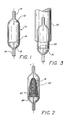
- Figure 1 illustrates a preferred configuration for the arc tube light source prepared according to the present invention.
- Figure 2 represents the color output of an arc tube light source when lithium bromide is pulsed in accordance with the present invention.
- Figure 3 illustrates one means for adjusting the color output of an arc source prepared in accordance with the teachings of the present invention, namely, the use of a coated reflector shield.
- FIG. 1 A schematical drawing of the preferred arc tube light source of the present invention is shown in Figure 1.
- the source of radiant energy in the lamp of the present invention comprises a light transmissive radiating chamber 10, which is preferably cylindrical, being defined in preferred embodiments by a tubular section of thin walled Pyrex ® glass.
- Opposing electrodes 12, preferably formed of tungsten, are sealed into either end of the chamber 14, preferably using a vacuum sealing technique.
- the emissive fill 16 comprises one or more metal halide salts, preferably alkali metal iodides or bromides, and this fill may be added to the radiating chamber 10 after one of the electrodes 12 has been sealed into the end of the chamber 14.
- this fill is added as described, i.e. , before the addition of a second electrode 12, thus providing a source with no auxiliary tubing on the side.
- An inert gas preferably argon, is then added to the source, and the second electrode 12 is sealed in place 14.
- Such a construction is referred to as "tipless" which is generally not possible in traditional metal halide lamps.
- An outer glass jacket (not illustrated) may be added to provide for convenient handling of the lamp.
- a pulsed metal halide source prepared according to the present invention must have its cathode (negative (-) electrode) completely covered with the metal halide salt.
- the metal halide salt is typically added as a granular or powdered fill which is thereafter melted and recrystallized around and over the cathode.
- a natural gas torch is used to lightly heat up the cathode end of the cell during fabrication, causing melting of the metal halide salt around the cathode. Upon cooling, a solid mass of recrystallized (or fused) metal halide salt surrounds the cathode.
- the cathode should be covered by at least about 0.5 mm of solidified metal halide salt. Lesser amounts will still work (providing the cathode is covered), but this represents a best estimate for the minimum amount of coverage required for consistently good performance.
- the gap remaining between the anode and the top of the salt layer should range from about 3 to 10 mm for conventional arc tubes (about 10-15 mm x 3 mm).
- a 1-2 kV potential with a time duration of a few microseconds (e.g. , 1-100, preferably 1-50, most preferably 1-10) is initially applied across the electrodes, which readily produces a low level of ionization of the argon and subsequent glow in the arc tube between the bare anode and the salt covering the cathode.
- About a 300-400 volt potential is sustained across the gap between the anode and the salt during the high current pulse.
- Figure 2 typifies what is observed when a cell prepared in accordance with the teachings of the present invention, and containing a preferred salt, lithium bromide, is pulsed in accordance with the above described procedures.
- the arc glows a bluish-white color, while away from the central core 20, the color shifts toward blue-green, mixed with red.
- a red colored light is emitted from the lithium vapor, as well as from the LiBr salt 24.
- ionized argon atoms are accelerated toward the bottom electrode since that electrode is preferably the cathode.
- Many collisions between the argon and metal halide salt occur as the argon migrates toward the bottom electrode. Some of these collisions will produce dissociation of the metal from the halide and eventual excitation of the metal. The resulting emission from the excited metal provides the desired effect, i.e. , colored light output.
- such a metal rich region forms slightly above the salt level.
- the metal can become excited so that emission is observed everywhere around the bottom electrode.
- the lithium generates its resonance radiation at 610 and 670 nanometers wavelength, which is observed as a red color by the human eye.
- lithium bromide emissive source In addition to the preferred lithium bromide emissive source, other metal halide salt systems such as sodium iodide and thallium iodide have been tested, and they exhibit a similar effect.
- metal halide salt systems such as sodium iodide and thallium iodide have been tested, and they exhibit a similar effect.
- the glow from the argon can be masked leaving visible only the emission from the salt region.
- a mask 26 can be prepared from a reflector or a coated shield, which would be used to reflect energy back into the cell's interior as depicted in Figure 3. Since the pressure of the argon is only a fraction of an atmosphere and the preferred electrode gap is less than about 1 cm, the glow transfers into an arc within several microseconds.
- the cell material can be Pyrex ® or alkali resistant glass which is more easily worked than fused silica which requires high heat for forming. Moreover, the geometry of the cell apparently does not affect the performance. Ellipsoidal, tubular, and spherical shaped cells have been utilized in the present invention, all with success.
- the absence of a tip-off greatly improves the light distribution of the source in the present lamp.
- the source also has fairly uniform light output in the horizontal plane.
- the radiating region is effectively cylindrical so that no preforming of the glass is necessary; merely a straight section of glass tubing is sufficient.
- the energy conservation with this source should be improved over an externally heated system since bulk vaporization of the salt will not be necessary.
- the cell is basically cold.
- Electrode maintenance should be improved since a diffuse contact at the cathode is guaranteed because of the salt coverage.
- the salt disperses the plasma flow and provides many current paths to the electrode. Normally a gas arc will terminate on the cathode as a high current density spot which increases the local temperature of the electrode and contributes to erosion of the electrode.
Landscapes
- Discharge Lamp (AREA)
- Vessels And Coating Films For Discharge Lamps (AREA)
Applications Claiming Priority (2)
| Application Number | Priority Date | Filing Date | Title |
|---|---|---|---|
| US13540587A | 1987-12-18 | 1987-12-18 | |
| US135405 | 2002-05-01 |
Publications (2)
| Publication Number | Publication Date |
|---|---|
| EP0320933A2 true EP0320933A2 (de) | 1989-06-21 |
| EP0320933A3 EP0320933A3 (de) | 1990-05-23 |
Family
ID=22467964
Family Applications (1)
| Application Number | Title | Priority Date | Filing Date |
|---|---|---|---|
| EP88120992A Withdrawn EP0320933A3 (de) | 1987-12-18 | 1988-12-15 | Pulsierend betriebene Metallhalogenlichtquelle |
Country Status (2)
| Country | Link |
|---|---|
| EP (1) | EP0320933A3 (de) |
| CA (1) | CA1316975C (de) |
Cited By (2)
| Publication number | Priority date | Publication date | Assignee | Title |
|---|---|---|---|---|
| DE4035561A1 (de) * | 1989-11-08 | 1991-05-16 | Matsushita Electric Works Ltd | Lampe mit hochintensitaets-entladungsroehre |
| DE102008013607B3 (de) * | 2008-03-11 | 2010-02-04 | Blv Licht- Und Vakuumtechnik Gmbh | Quecksilberfreie Metallhalogenid-Hochdruckentladungslampe |
Family Cites Families (4)
| Publication number | Priority date | Publication date | Assignee | Title |
|---|---|---|---|---|
| CA577060A (en) * | 1959-06-02 | W. L. Cumming Harry | Electric discharge lamps | |
| US3622217A (en) * | 1969-06-30 | 1971-11-23 | Xerox Corp | Light producing system |
| US3840767A (en) * | 1973-08-23 | 1974-10-08 | Gen Electric | Selective spectral output metal halide lamp |
| US4389201A (en) * | 1979-03-12 | 1983-06-21 | General Electric Company | Method of manufacturing a lamp |
-
1988
- 1988-12-15 EP EP88120992A patent/EP0320933A3/de not_active Withdrawn
- 1988-12-16 CA CA000586186A patent/CA1316975C/en not_active Expired - Fee Related
Cited By (2)
| Publication number | Priority date | Publication date | Assignee | Title |
|---|---|---|---|---|
| DE4035561A1 (de) * | 1989-11-08 | 1991-05-16 | Matsushita Electric Works Ltd | Lampe mit hochintensitaets-entladungsroehre |
| DE102008013607B3 (de) * | 2008-03-11 | 2010-02-04 | Blv Licht- Und Vakuumtechnik Gmbh | Quecksilberfreie Metallhalogenid-Hochdruckentladungslampe |
Also Published As
| Publication number | Publication date |
|---|---|
| EP0320933A3 (de) | 1990-05-23 |
| CA1316975C (en) | 1993-04-27 |
Similar Documents
| Publication | Publication Date | Title |
|---|---|---|
| CA1201756A (en) | Discharge lamp | |
| JP2004172056A (ja) | 放電ランプ装置用水銀フリーアークチューブ | |
| JPS5954167A (ja) | 低出力の高圧放電ランプ | |
| US4874988A (en) | Pulsed metal halide arc discharge light source | |
| EP0330268B1 (de) | Elektrische Lampe | |
| US5394057A (en) | Protective metal silicate coating for a metal halide arc discharge lamp | |
| JP4037142B2 (ja) | メタルハライドランプおよび自動車用前照灯装置 | |
| JP2775694B2 (ja) | 放電ランプ | |
| US20050122047A1 (en) | Metal halide lamp, metal halide lamp operating device, and headlamp device for automobiles | |
| US4850918A (en) | Pulsed metal halide source | |
| US4591759A (en) | Ingredients for solenoidal metal halide arc lamps | |
| GB2165392A (en) | Arc tubes | |
| EP0183247A2 (de) | Hochdruckmetallhalogenidbogenlampe mit Xenonpuffergas | |
| CA1316975C (en) | Pulsed metal halide salt source | |
| JP2001313001A (ja) | メタルハライドランプおよび自動車用前照灯装置 | |
| EP0101519B1 (de) | Metal-dampf entladungs lampe | |
| KR920010056B1 (ko) | 편밀봉형 금속증기 방전등 | |
| CA1281761C (en) | Metal halide arc tube and lamp having improved uniformity of azimuthal luminous intensity | |
| GB2080020A (en) | Electrical Light Source with a Metal Halide Discharge Tube and a Tungsten Filament Connected in Series with the Discharge Tube | |
| JPH10283998A (ja) | 直流ショートアークランプ | |
| US5136208A (en) | Metal halide lamp maintaining a high lumen maintenance factor over an extended operation period | |
| JPH10283992A (ja) | 直流アークランプ | |
| KR100332636B1 (ko) | 메탈헬라이드램프 | |
| JPH01264163A (ja) | パルス作動メタルハライド光源 | |
| US6366020B1 (en) | Universal operating DC ceramic metal halide lamp |
Legal Events
| Date | Code | Title | Description |
|---|---|---|---|
| PUAI | Public reference made under article 153(3) epc to a published international application that has entered the european phase |
Free format text: ORIGINAL CODE: 0009012 |
|
| 17P | Request for examination filed |
Effective date: 19890111 |
|
| AK | Designated contracting states |
Kind code of ref document: A2 Designated state(s): BE DE FR GB NL |
|
| PUAL | Search report despatched |
Free format text: ORIGINAL CODE: 0009013 |
|
| AK | Designated contracting states |
Kind code of ref document: A3 Designated state(s): BE DE FR GB NL |
|
| 17Q | First examination report despatched |
Effective date: 19920601 |
|
| STAA | Information on the status of an ep patent application or granted ep patent |
Free format text: STATUS: THE APPLICATION IS DEEMED TO BE WITHDRAWN |
|
| 18D | Application deemed to be withdrawn |
Effective date: 19930507 |