EP0321054A2 - Herstellungsverfahren von Propionsäureestern - Google Patents
Herstellungsverfahren von Propionsäureestern Download PDFInfo
- Publication number
- EP0321054A2 EP0321054A2 EP88202870A EP88202870A EP0321054A2 EP 0321054 A2 EP0321054 A2 EP 0321054A2 EP 88202870 A EP88202870 A EP 88202870A EP 88202870 A EP88202870 A EP 88202870A EP 0321054 A2 EP0321054 A2 EP 0321054A2
- Authority
- EP
- European Patent Office
- Prior art keywords
- methanol
- alcohol
- line
- methyl propionate
- fraction
- Prior art date
- Legal status (The legal status is an assumption and is not a legal conclusion. Google has not performed a legal analysis and makes no representation as to the accuracy of the status listed.)
- Granted
Links
Images

Classifications
-
- C—CHEMISTRY; METALLURGY
- C07—ORGANIC CHEMISTRY
- C07C—ACYCLIC OR CARBOCYCLIC COMPOUNDS
- C07C69/00—Esters of carboxylic acids; Esters of carbonic or haloformic acids
- C07C69/02—Esters of acyclic saturated monocarboxylic acids having the carboxyl group bound to an acyclic carbon atom or to hydrogen
- C07C69/22—Esters of acyclic saturated monocarboxylic acids having the carboxyl group bound to an acyclic carbon atom or to hydrogen having three or more carbon atoms in the acid moiety
- C07C69/24—Esters of acyclic saturated monocarboxylic acids having the carboxyl group bound to an acyclic carbon atom or to hydrogen having three or more carbon atoms in the acid moiety esterified with monohydroxylic compounds
-
- C—CHEMISTRY; METALLURGY
- C07—ORGANIC CHEMISTRY
- C07C—ACYCLIC OR CARBOCYCLIC COMPOUNDS
- C07C67/00—Preparation of carboxylic acid esters
- C07C67/03—Preparation of carboxylic acid esters by reacting an ester group with a hydroxy group
-
- C—CHEMISTRY; METALLURGY
- C07—ORGANIC CHEMISTRY
- C07C—ACYCLIC OR CARBOCYCLIC COMPOUNDS
- C07C67/00—Preparation of carboxylic acid esters
- C07C67/36—Preparation of carboxylic acid esters by reaction with carbon monoxide or formates
- C07C67/38—Preparation of carboxylic acid esters by reaction with carbon monoxide or formates by addition to an unsaturated carbon-to-carbon bond
-
- Y—GENERAL TAGGING OF NEW TECHNOLOGICAL DEVELOPMENTS; GENERAL TAGGING OF CROSS-SECTIONAL TECHNOLOGIES SPANNING OVER SEVERAL SECTIONS OF THE IPC; TECHNICAL SUBJECTS COVERED BY FORMER USPC CROSS-REFERENCE ART COLLECTIONS [XRACs] AND DIGESTS
- Y02—TECHNOLOGIES OR APPLICATIONS FOR MITIGATION OR ADAPTATION AGAINST CLIMATE CHANGE
- Y02P—CLIMATE CHANGE MITIGATION TECHNOLOGIES IN THE PRODUCTION OR PROCESSING OF GOODS
- Y02P20/00—Technologies relating to chemical industry
- Y02P20/10—Process efficiency
Definitions
- the invention relates to a process for the production of propionate esters.
- R represents an organic group.
- methyl propionate can be produced starting from methanol as the alcohol ROH.
- Simultaneous production of methyl propionate and the propionate ester of an alcohol, other than methanol may take place by carrying out two such carbonylation processes, one starting from methanol and the other starting from the alcohol other than methanol.
- the invention provides a process for the production of propionate esters which process comprises the simultaneous production of methyl propionate and the propionate ester of an alcohol other than methanol by means of the following steps:-
- the simplicity of the process according to the present invention resides in the fact that the methanol-methyl propionate azeotrope can very easily be isolated in step 4 and re-used for reaction in the carbonylation of step 1, irrespective of which alcohol other than methanol is used in step 3.
- the "alcohol other than methanol” is also referred to hereinafter as “second alcohol”.
- the "propionate ester of the alcohol other than methanol” is also referred to hereinafter as "second ester”.
- the methyl propionate for step 3 may originate from any source, but it is a preferred feature of the present invention that this methyl propionate has been isolated in step 1.
- the carbonylation in step 1 involves the reaction of ethylene with carbon monoxide and methanol with formation of methyl propionate.
- the reaction mixture obtained in step 1 therefore contains methyl propionate, methanol, carbon monoxide, ethylene and carbonylation catalyst.
- step 2 is carried out by separating the liquid phase obtained after gas-liquid separation of the reaction mixture obtained in step 1 by means of distillation into a lighter fraction comprising an azeotrope of methanol and methyl propionate, a heavier fraction comprising methyl propionate, and a residual fraction containing the carbonylation catalyst, the term "heavier” meaning that the boiling point of this fraction is higher than that of said lighter fraction.
- the gas-liquid separation is what is usually referred to as a "flash" and is therefore carried out at such a temperature and pressure that the gaseous phase which is flashed off substantially consists of carbon monoxide and ethylene.
- Said azeotrope contains about 50% by weight of methanol and about 50% by weight of methyl propionate and has a boiling point at atmospheric pressure of 62°C. In this manner, a heavier fraction having a methyl propionate content of more than 99.9% by weight can be obtained.
- the lighter fraction can be given any desired destination but is preferably recirculated to the carbonylation in step 1 so as to re-use the methanol present in it for the production of further quantities of methyl propionate, thereby simultaneously separating the azeotrope into its two components.
- the distillation of step 2 may take place in a first column in which a non-azeotropic top fraction comprising methanol and methyl propionate, and said residual fraction containing the carbonylation catalyst are obtained, and a second column in which the top fraction from the first column is separated into a top fraction comprising the azeotrope (which is the lighter fraction mentioned hereinbefore) and said heavier fraction comprising methyl propionate.
- Said residual fraction containing the carbonylation catalyst and also some methyl propionate can be given any desired destination but is preferably recirculated to the carbonylation in step 1 so as to carbonylate further quantities of ethylene.
- step 2 is carried out by separating the reaction mixture obtained in step 1 after flashing into a gaseous fraction comprising methanol and methyl propionate, and a liquid fraction containing the carbonylation catalyst.
- the gaseous fraction is condensed and the condensate thus obtained separated by means of distillation into (a) a top fraction comprising an azeotrope of methanol and methyl propionate which azeotrope may be recirculated to the carbonylation in step 1, (b) an intermediate fraction comprising methyl propionate which may have a purity of more than 99.9 % by weight, and (c) a relatively small residual fraction.
- the liquid fraction containing the carbonylation catalyst may be recirculated to the carbonylation in step 1.
- the reaction mixture obtained in step 3 contains the second ester, methanol, methyl propionate, the second alcohol and the transesterification catalyst, transesterification being an equilibrium reaction, and is distilled in step 4 so as to isolate an azeotrope of methanol and methyl propionate.
- the process according to the present invention excels in simplicity because the recirculation of this azeotrope to the carbonylation of step 1 involves simultaneous separation thereof into its components, the separated methanol being used for the production of further quantities of methyl propionate in step 1 and the separated methyl propionate finally becoming available in step 2.
- step 5 Amending the process according to the present invention by replacing step 5 with recirculation of the azeotrope to the transesterification of step 3 would result in shifting the equilibrium reaction of the transesterification to the left, this azeotrope containing methanol and methyl propionate in a molar ratio of about 3:1.
- the distillation in step 4 is preferably carried out so as to yield an intermediate fraction comprising alcohol other than methanol (the second alcohol), an intermediate fraction comprising the propionate ester of said alcohol other than methanol (the second ester) and a residual fraction comprising the transesterification catalyst.
- the intermediate fraction comprising the second ester may have a purity of more than 99.9% by weight.
- the intermediate fraction, comprising the second alcohol, and the residual fraction comprising the transesterification catalyst may be given any desired destination, but are preferably recirculated to the transesterification of step 3.
- the alcohols may be aliphatic, cycloaliphatic or aromatic and may be substituted with one or more substituents, for example with one or more halogen atoms or cyano, ester, alkoxy, carboxy or aryl groups.
- the alcohol may therefore also be a phenol.
- the alcohols preferably do not contain more than 20 carbon atoms per molecule and, in particular, have in the range of from 2 to 10 carbon atoms per molecule. Alkanols are particularly preferred; among these, very good results have been obtained with 2-butanol.
- suitable alcohols are ethanol, propanol, 2-propanol, butanol, tert.-butyl alcohol, pentanol, 2-pentanol, 2-methylbutanol, 2-methylpentanol, hexanol, heptanol, octanol, nonanol, decanol, stearyl alcohol, benzyl alcohol, cyclohexanol, chlorocapryl alcohol and phenethyl alcohol.
- the alcohol may be polyhydric, examples of which are ethylene glycol, 1,2-propanediol, 1,4-butanediol, 1,3-butanediol, glycerol, pentaerythritol, pinacol, 1,6-hexanediol and polyethylene glycol.
- Other examples are phenol, o-, m- and p-cresol, 2-naphthol and 9-anthrol.
- Step 1 of the process according to the present invention can be carried out in the presence of any carbonylation catalyst. Preference is given to carbonylation catalysts which have been prepared by combining:-
- Step 1 may be carried out using a molar ratio ethylene to methanol which is not critical and may vary within wide ranges, preferably between 0.1:1 to 10:1, in particular 0.2:1 to 1:1.
- the carbon monoxide to be used in step 1 may be used pure or diluted with an inert gas, such as nitrogen, noble gases or carbon dioxide.
- an inert gas such as nitrogen, noble gases or carbon dioxide.
- the presence of more than 10% by volume of hydrogen is undesirable, since under the carbonylation conditions it may cause hydrogenation of the ethylene.
- transesterification catalysts may be used in step 3 of the process according to the present invention.
- Such catalysts may also be referred to as "alcoholysis catalysts", and may be acid or basic.
- Suitable catalysts include sulphuric acid, orthophosphoric acid, p-toluenesulphonic acid, ethyl hydrogen sulphate, ethanesulphuric acid, aluminium chloride, zinc chloride, sodium isobutoxide, aluminium isobutoxide and methanesulphonic acid.
- the transesterification in step 3 may be carried out using a molar ratio transesterification catalyst to methyl propionate, a molar ratio second alcohol to methyl propionate and at a temperature and pressure which are not critical and may vary within wide ranges.
- a molar ratio transesterification catalyst to methyl propionate in the range of from 1:20 to 1:1000, a molar ratio second alcohol to methyl propionate in the range of from 1:0.2 to 1:5, a temperature in the range of from 50°C to 150°C and a pressure in the range of from 1 to 10 bar are applied.
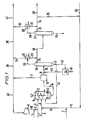
- Figure 1 shows a simplified process flow scheme of steps 1, 2 and 5 and Figure 2 of steps 3 and 4 of the process according to the present invention.
- carbon monoxide is supplied via a line 1, a line 2 and a line 3, ethylene via a line 4 and the line 3, methanol via a line 5 and a line 6 and a catalytic system via a line 7, a line 8 and the line 6 to a reactor 9.
- Compressed recycle gas is conducted via a line 10 and the lines 2 and 3 to the reactor 9.
- a recycle of azeotrope is conducted via a line 11 to the line 8.
- the reactor 9 is provided with a stirrer 12 and cooling means 13.
- the temperature in the reactor is 110°C, the pressure is 40 bar and the residence time of the reaction mixture 2 hours.
- the reaction mixture formed in the reactor 9 (step 1) is withdrawn therefrom via a line 14 and introduced into a flash vessel 15 in which it is separated into a liquid phase and a gaseous phase, withdrawn from the flash vessel 15 via a line 16 and a line 17, respectively.
- the liquid phase conducted through the line 16 is further conducted through a line 18 and then introduced into a distillation column 19 in which it is separated into a non-azeotropic top fraction comprising methanol and methyl propionate and a residual fraction containing the carbonylation catalyst, which are withdrawn from the column 19 via a line 20 and a line 21, respectively.
- the non-azeotropic top fraction conducted through the line 20 is separated by condensation in a condenser 22 into a condensate and a gas fraction which are withdrawn from the condenser 22 via a line 23 and a line 24, respectively.
- a portion of the condensate conducted through the line 23 is returned as reflux to the distillation column 19 via a line 25; the balance is conducted via a line 26 to a distillation column 27 in which it is separated into a top fraction comprising an azeotrope of methanol and methyl propionate and a heavier fraction comprising methyl propionate, withdrawn from the column 27 via a line 28 and a line 29, respectively.
- the heavier fraction in line 29 has a methyl propionate content of more than 99.9% by weight. A portion of this methyl propionate is fed to steps 3 and 4 which are further discussed hereinafter with respect to Figure 2.
- the top fraction conducted through the line 28 is separated by condensation in a condenser 30 in a condensate comprising an azeotrope of methanol and methyl propionate and a gas fraction, which are withdrawn from the condenser 30 via a line 31 and a line 32, respectively.
- a portion of the condensate conducted through the line 31 is returned as reflux to the distillation column 27 via a line 33 and the balance thereof is returned via a line 34, a line 35 and the line 11 to the line 8.
- the gases conducted via the line 32 are conducted via a line 38, a line 39 and a line 40, those from the line 24 via the lines 39 and 40 and those from the line 17 via the line 40 to a compressor 41.
- the gases compressed in the compressor 41 become available as the compressed recycle gas mentioned hereinbefore and conducted via the line 10.
- the residual fraction containing the carbonylation catalyst and conducted via the line 21 is partly recycled via a line 42 to the reactor 9 and partly conducted via a line 43 to a stripper 44 in which methyl propionate is stripped off and conducted via a line 45 to the line 18, leaving a small residue of heavy ends which is withdrawn from the stripper 44 via a line 46.
- Bleed streams are withdrawn from the line 38 via a line 47 and from the line 34 via a line 48.
- methyl propionate is supplied via a line 50 and a line 51 and 2-butanol via a line 52, a line 53 and the line 51 to a reactor 54.
- the methyl propionate in line 50 originates from the line 29 depicted in Figure 1 and, therefore, has been produced according to steps 1 and 2.
- the balance of the methyl propionate from line 29 has been given another destination.
- the mixture of methyl propionate and 2-butanol is heated in a heater 55 prior to entering the reactor 54.
- the transesterification catalyst is supplied via a line 56 and a line 57 to the line 53.
- the reactor 54 is operated in plug-flow, at a temperature of 90° C and a pressure of 6 bar.
- the reaction mixture formed in the reactor 54 (step 3) is withdrawn therefrom via a line 58 and introduced into a distillation column 59 in which it is separated into a top fraction, withdrawn from the column 59 via the line 36, an intermediate fraction withdrawn via a line 60 and a bottom fraction withdrawn via a line 61.
- the top fraction is the azeotrope comprising methanol and methyl propionate isolated according to step 4, line 36 in Figure 2 being the same line as line 36 in Figure 1.
- the bottom fraction withdrawn via the line 61 is introduced into a distillation column 62 in which it is separated into a top fraction having a content of sec-butyl propionate of more than 99.9% by weight and withdrawn via a line 63, and a bottom fraction withdrawn via a line 64.
- This bottom fraction is further conducted via a line 65 and a line 66 to the line 57 and the intermediate fraction from the line 60 is introduced into the line 66.
- a bleed stream is withdrawn from the line 64 via a line 67.
Landscapes
- Chemical & Material Sciences (AREA)
- Organic Chemistry (AREA)
- Chemical Kinetics & Catalysis (AREA)
- Organic Low-Molecular-Weight Compounds And Preparation Thereof (AREA)
- Low-Molecular Organic Synthesis Reactions Using Catalysts (AREA)
Applications Claiming Priority (2)
| Application Number | Priority Date | Filing Date | Title |
|---|---|---|---|
| GB8729267 | 1987-12-15 | ||
| GB878729267A GB8729267D0 (en) | 1987-12-15 | 1987-12-15 | Process for production of propionate esters |
Publications (3)
| Publication Number | Publication Date |
|---|---|
| EP0321054A2 true EP0321054A2 (de) | 1989-06-21 |
| EP0321054A3 EP0321054A3 (en) | 1990-07-25 |
| EP0321054B1 EP0321054B1 (de) | 1996-03-06 |
Family
ID=10628536
Family Applications (1)
| Application Number | Title | Priority Date | Filing Date |
|---|---|---|---|
| EP88202870A Expired - Lifetime EP0321054B1 (de) | 1987-12-15 | 1988-12-13 | Herstellungsverfahren von Propionsäureestern |
Country Status (6)
| Country | Link |
|---|---|
| EP (1) | EP0321054B1 (de) |
| JP (1) | JP2686631B2 (de) |
| AU (1) | AU610310B2 (de) |
| CA (1) | CA1318328C (de) |
| DE (1) | DE3855070T2 (de) |
| GB (1) | GB8729267D0 (de) |
Cited By (4)
| Publication number | Priority date | Publication date | Assignee | Title |
|---|---|---|---|---|
| EP0411721A3 (en) * | 1989-08-01 | 1992-08-26 | Shell Internationale Research Maatschappij B.V. | Preparation of alkyl propionates |
| US9938226B2 (en) | 2013-09-30 | 2018-04-10 | Dow Global Technologies Llc | Gas phase production of alkyl alkanoate |
| JP2020200328A (ja) * | 2019-06-12 | 2020-12-17 | エボニック オペレーションズ ゲーエムベーハー | アルコキシカルボニル化によるエステルの製造方法 |
| WO2023108799A1 (zh) * | 2021-12-15 | 2023-06-22 | 江苏湖大化工科技有限公司 | 一种以甲醇和co合成丙酸甲酯等多酯和醇的联产工艺方法 |
Families Citing this family (4)
| Publication number | Priority date | Publication date | Assignee | Title |
|---|---|---|---|---|
| KR960006546B1 (ko) * | 1993-07-28 | 1996-05-17 | 한국과학기술연구원 | 초산에스테르의 제조 방법 |
| EP2165997A1 (de) * | 2008-09-18 | 2010-03-24 | Rohm and Haas Company | Verbessertes Verfahren zur oxidativen Dehydrierung von Ethan |
| US11440863B2 (en) * | 2019-06-12 | 2022-09-13 | Evonik Operations Gmbh | Process for preparing an alcohol from hydrocarbons |
| US11008275B2 (en) * | 2019-06-12 | 2021-05-18 | Evonik Operations Gmbh | Process for preparing carboxylic acids or salts thereof from hydrocarbons |
Family Cites Families (3)
| Publication number | Priority date | Publication date | Assignee | Title |
|---|---|---|---|---|
| US3098093A (en) * | 1961-02-06 | 1963-07-16 | Eastman Kodak Co | Process for the production of esters by alcoholysis |
| EP0017441B2 (de) * | 1979-04-09 | 1987-10-28 | CHEM SYSTEMS, Inc. | Herstellung von Estern |
| GB8605034D0 (en) * | 1986-02-28 | 1986-04-09 | Shell Int Research | Carbonylation of compounds |
-
1987
- 1987-12-15 GB GB878729267A patent/GB8729267D0/en active Pending
-
1988
- 1988-11-28 CA CA000584294A patent/CA1318328C/en not_active Expired - Fee Related
- 1988-12-13 EP EP88202870A patent/EP0321054B1/de not_active Expired - Lifetime
- 1988-12-13 DE DE3855070T patent/DE3855070T2/de not_active Expired - Fee Related
- 1988-12-14 AU AU26884/88A patent/AU610310B2/en not_active Ceased
- 1988-12-14 JP JP63314013A patent/JP2686631B2/ja not_active Expired - Fee Related
Cited By (5)
| Publication number | Priority date | Publication date | Assignee | Title |
|---|---|---|---|---|
| EP0411721A3 (en) * | 1989-08-01 | 1992-08-26 | Shell Internationale Research Maatschappij B.V. | Preparation of alkyl propionates |
| US9938226B2 (en) | 2013-09-30 | 2018-04-10 | Dow Global Technologies Llc | Gas phase production of alkyl alkanoate |
| JP2020200328A (ja) * | 2019-06-12 | 2020-12-17 | エボニック オペレーションズ ゲーエムベーハー | アルコキシカルボニル化によるエステルの製造方法 |
| US11365171B2 (en) * | 2019-06-12 | 2022-06-21 | Evonik Operations Gmbh | Process for preparing an ester by alkoxycarbonylation |
| WO2023108799A1 (zh) * | 2021-12-15 | 2023-06-22 | 江苏湖大化工科技有限公司 | 一种以甲醇和co合成丙酸甲酯等多酯和醇的联产工艺方法 |
Also Published As
| Publication number | Publication date |
|---|---|
| JPH01199935A (ja) | 1989-08-11 |
| EP0321054A3 (en) | 1990-07-25 |
| DE3855070T2 (de) | 1996-09-12 |
| DE3855070D1 (de) | 1996-04-11 |
| AU610310B2 (en) | 1991-05-16 |
| AU2688488A (en) | 1989-06-15 |
| EP0321054B1 (de) | 1996-03-06 |
| JP2686631B2 (ja) | 1997-12-08 |
| CA1318328C (en) | 1993-05-25 |
| GB8729267D0 (en) | 1988-01-27 |
Similar Documents
| Publication | Publication Date | Title |
|---|---|---|
| EP0786447B1 (de) | Verfahren zur Reagierung der Kohlensäure mit einer carbonylierungsfähigen Reaktionskomponente und/oder mit ihrem Esterderivat | |
| EP1125915B1 (de) | Verfahren zur gleichzeitigen Herstellung von Ethylenglykol und Carbonatester | |
| US7385075B2 (en) | Method for producing esters of multibasic acids | |
| JPS617222A (ja) | エタノ−ルの製造方法 | |
| CN1143948A (zh) | 生产己二酸环己酯和己二酸的方法 | |
| EP0321054B1 (de) | Herstellungsverfahren von Propionsäureestern | |
| EP1699750B1 (de) | Verfahren zur herstellung eines alkylalkenoates | |
| JP2557099B2 (ja) | ジメチルカーボネートの分離方法 | |
| US20030109742A1 (en) | Process for preparing a carboxylic ester | |
| JP2920662B2 (ja) | プロピオン酸アルキルの製造方法 | |
| JP2003521478A (ja) | 平衡律速反応を行う方法 | |
| JP2854279B2 (ja) | 反応蒸留装置および反応蒸留方法 | |
| JP2000063319A (ja) | Dme/メタノ―ルのカルボニル化に基づく酢酸反応性蒸留プロセス | |
| CZ294277B6 (cs) | Způsob přípravy esterů kyseliny methakrylové | |
| JP2768681B2 (ja) | 酢酸エステルの連続製造方法 | |
| EP0521578A2 (de) | Kontinuierverfahren zur Carbonylierung von Acetylenen | |
| US5990347A (en) | Process for preparing a carboxylic acid | |
| CN113166025A (zh) | 烷基羧酸酯的制备方法及烷基羧酸酯的制备装置 | |
| KR20010014169A (ko) | (메트)아크릴산의 에스테르화 방법 | |
| US3987089A (en) | Preparation of β-alkoxy esters from olefins | |
| JP2733036B2 (ja) | 炭酸エステルの製造方法 | |
| CA2476034C (en) | Process for the recovery of a carbonylation product | |
| JP2733034B2 (ja) | カルボン酸エステルの製造方法 | |
| KR20050025946A (ko) | 아크릴산으로부터 디카르복실산의 제조 방법 | |
| KR20010101275A (ko) | 베타-감마 불포화 에스테르의 제조 방법 |
Legal Events
| Date | Code | Title | Description |
|---|---|---|---|
| PUAI | Public reference made under article 153(3) epc to a published international application that has entered the european phase |
Free format text: ORIGINAL CODE: 0009012 |
|
| AK | Designated contracting states |
Kind code of ref document: A2 Designated state(s): BE DE FR GB IT NL |
|
| PUAL | Search report despatched |
Free format text: ORIGINAL CODE: 0009013 |
|
| AK | Designated contracting states |
Kind code of ref document: A3 Designated state(s): BE DE FR GB IT NL |
|
| 17P | Request for examination filed |
Effective date: 19901128 |
|
| 17Q | First examination report despatched |
Effective date: 19920720 |
|
| GRAA | (expected) grant |
Free format text: ORIGINAL CODE: 0009210 |
|
| AK | Designated contracting states |
Kind code of ref document: B1 Designated state(s): BE DE FR GB IT NL |
|
| REF | Corresponds to: |
Ref document number: 3855070 Country of ref document: DE Date of ref document: 19960411 |
|
| ITF | It: translation for a ep patent filed | ||
| ET | Fr: translation filed | ||
| PLBE | No opposition filed within time limit |
Free format text: ORIGINAL CODE: 0009261 |
|
| STAA | Information on the status of an ep patent application or granted ep patent |
Free format text: STATUS: NO OPPOSITION FILED WITHIN TIME LIMIT |
|
| 26N | No opposition filed | ||
| REG | Reference to a national code |
Ref country code: GB Ref legal event code: IF02 |
|
| PGFP | Annual fee paid to national office [announced via postgrant information from national office to epo] |
Ref country code: NL Payment date: 20031030 Year of fee payment: 16 |
|
| PGFP | Annual fee paid to national office [announced via postgrant information from national office to epo] |
Ref country code: DE Payment date: 20031114 Year of fee payment: 16 Ref country code: BE Payment date: 20031114 Year of fee payment: 16 |
|
| PGFP | Annual fee paid to national office [announced via postgrant information from national office to epo] |
Ref country code: FR Payment date: 20041025 Year of fee payment: 17 |
|
| PGFP | Annual fee paid to national office [announced via postgrant information from national office to epo] |
Ref country code: GB Payment date: 20041130 Year of fee payment: 17 |
|
| PG25 | Lapsed in a contracting state [announced via postgrant information from national office to epo] |
Ref country code: BE Free format text: LAPSE BECAUSE OF NON-PAYMENT OF DUE FEES Effective date: 20041231 |
|
| BERE | Be: lapsed |
Owner name: *SHELL INTERNATIONALE RESEARCH MAATSCHAPPIJ B.V. Effective date: 20041231 |
|
| PG25 | Lapsed in a contracting state [announced via postgrant information from national office to epo] |
Ref country code: NL Free format text: LAPSE BECAUSE OF NON-PAYMENT OF DUE FEES Effective date: 20050701 Ref country code: DE Free format text: LAPSE BECAUSE OF NON-PAYMENT OF DUE FEES Effective date: 20050701 |
|
| NLV4 | Nl: lapsed or anulled due to non-payment of the annual fee |
Effective date: 20050701 |
|
| APAH | Appeal reference modified |
Free format text: ORIGINAL CODE: EPIDOSCREFNO |
|
| PG25 | Lapsed in a contracting state [announced via postgrant information from national office to epo] |
Ref country code: IT Free format text: LAPSE BECAUSE OF NON-PAYMENT OF DUE FEES;WARNING: LAPSES OF ITALIAN PATENTS WITH EFFECTIVE DATE BEFORE 2007 MAY HAVE OCCURRED AT ANY TIME BEFORE 2007. THE CORRECT EFFECTIVE DATE MAY BE DIFFERENT FROM THE ONE RECORDED. Effective date: 20051213 Ref country code: GB Free format text: LAPSE BECAUSE OF NON-PAYMENT OF DUE FEES Effective date: 20051213 |
|
| GBPC | Gb: european patent ceased through non-payment of renewal fee |
Effective date: 20051213 |
|
| PG25 | Lapsed in a contracting state [announced via postgrant information from national office to epo] |
Ref country code: FR Free format text: LAPSE BECAUSE OF NON-PAYMENT OF DUE FEES Effective date: 20060831 |
|
| REG | Reference to a national code |
Ref country code: FR Ref legal event code: ST Effective date: 20060831 |
|
| BERE | Be: lapsed |
Owner name: *SHELL INTERNATIONALE RESEARCH MAATSCHAPPIJ B.V. Effective date: 20041231 |