EP0321253A2 - Schnittstellenanpassungsgerät zur Anpassung eines Fernsteurgerätes an geschäftliche Kühl- und Klimaanlagensteuersysteme - Google Patents
Schnittstellenanpassungsgerät zur Anpassung eines Fernsteurgerätes an geschäftliche Kühl- und Klimaanlagensteuersysteme Download PDFInfo
- Publication number
- EP0321253A2 EP0321253A2 EP88311891A EP88311891A EP0321253A2 EP 0321253 A2 EP0321253 A2 EP 0321253A2 EP 88311891 A EP88311891 A EP 88311891A EP 88311891 A EP88311891 A EP 88311891A EP 0321253 A2 EP0321253 A2 EP 0321253A2
- Authority
- EP
- European Patent Office
- Prior art keywords
- control
- signal
- remote
- relay
- remote controller
- Prior art date
- Legal status (The legal status is an assumption and is not a legal conclusion. Google has not performed a legal analysis and makes no representation as to the accuracy of the status listed.)
- Ceased
Links
Images


Classifications
-
- F—MECHANICAL ENGINEERING; LIGHTING; HEATING; WEAPONS; BLASTING
- F24—HEATING; RANGES; VENTILATING
- F24F—AIR-CONDITIONING; AIR-HUMIDIFICATION; VENTILATION; USE OF AIR CURRENTS FOR SCREENING
- F24F11/00—Control or safety arrangements
- F24F11/30—Control or safety arrangements for purposes related to the operation of the system, e.g. for safety or monitoring
- F24F11/46—Improving electric energy efficiency or saving
-
- F—MECHANICAL ENGINEERING; LIGHTING; HEATING; WEAPONS; BLASTING
- F24—HEATING; RANGES; VENTILATING
- F24F—AIR-CONDITIONING; AIR-HUMIDIFICATION; VENTILATION; USE OF AIR CURRENTS FOR SCREENING
- F24F11/00—Control or safety arrangements
- F24F11/50—Control or safety arrangements characterised by user interfaces or communication
- F24F11/56—Remote control
-
- F—MECHANICAL ENGINEERING; LIGHTING; HEATING; WEAPONS; BLASTING
- F24—HEATING; RANGES; VENTILATING
- F24F—AIR-CONDITIONING; AIR-HUMIDIFICATION; VENTILATION; USE OF AIR CURRENTS FOR SCREENING
- F24F11/00—Control or safety arrangements
- F24F11/62—Control or safety arrangements characterised by the type of control or by internal processing, e.g. using fuzzy logic, adaptive control or estimation of values
- F24F11/63—Electronic processing
-
- F—MECHANICAL ENGINEERING; LIGHTING; HEATING; WEAPONS; BLASTING
- F24—HEATING; RANGES; VENTILATING
- F24F—AIR-CONDITIONING; AIR-HUMIDIFICATION; VENTILATION; USE OF AIR CURRENTS FOR SCREENING
- F24F11/00—Control or safety arrangements
- F24F11/88—Electrical aspects, e.g. circuits
-
- F—MECHANICAL ENGINEERING; LIGHTING; HEATING; WEAPONS; BLASTING
- F25—REFRIGERATION OR COOLING; COMBINED HEATING AND REFRIGERATION SYSTEMS; HEAT PUMP SYSTEMS; MANUFACTURE OR STORAGE OF ICE; LIQUEFACTION SOLIDIFICATION OF GASES
- F25D—REFRIGERATORS; COLD ROOMS; ICE-BOXES; COOLING OR FREEZING APPARATUS NOT OTHERWISE PROVIDED FOR
- F25D29/00—Arrangement or mounting of control or safety devices
-
- G—PHYSICS
- G05—CONTROLLING; REGULATING
- G05D—SYSTEMS FOR CONTROLLING OR REGULATING NON-ELECTRIC VARIABLES
- G05D23/00—Control of temperature
- G05D23/19—Control of temperature characterised by the use of electric means
- G05D23/1902—Control of temperature characterised by the use of electric means characterised by the use of a variable reference value
- G05D23/1905—Control of temperature characterised by the use of electric means characterised by the use of a variable reference value associated with tele control
-
- F—MECHANICAL ENGINEERING; LIGHTING; HEATING; WEAPONS; BLASTING
- F24—HEATING; RANGES; VENTILATING
- F24F—AIR-CONDITIONING; AIR-HUMIDIFICATION; VENTILATION; USE OF AIR CURRENTS FOR SCREENING
- F24F11/00—Control or safety arrangements
- F24F11/30—Control or safety arrangements for purposes related to the operation of the system, e.g. for safety or monitoring
-
- F—MECHANICAL ENGINEERING; LIGHTING; HEATING; WEAPONS; BLASTING
- F24—HEATING; RANGES; VENTILATING
- F24F—AIR-CONDITIONING; AIR-HUMIDIFICATION; VENTILATION; USE OF AIR CURRENTS FOR SCREENING
- F24F11/00—Control or safety arrangements
- F24F11/50—Control or safety arrangements characterised by user interfaces or communication
- F24F11/54—Control or safety arrangements characterised by user interfaces or communication using one central controller connected to several sub-controllers
-
- F—MECHANICAL ENGINEERING; LIGHTING; HEATING; WEAPONS; BLASTING
- F24—HEATING; RANGES; VENTILATING
- F24F—AIR-CONDITIONING; AIR-HUMIDIFICATION; VENTILATION; USE OF AIR CURRENTS FOR SCREENING
- F24F2110/00—Control inputs relating to air properties
- F24F2110/10—Temperature
-
- F—MECHANICAL ENGINEERING; LIGHTING; HEATING; WEAPONS; BLASTING
- F25—REFRIGERATION OR COOLING; COMBINED HEATING AND REFRIGERATION SYSTEMS; HEAT PUMP SYSTEMS; MANUFACTURE OR STORAGE OF ICE; LIQUEFACTION SOLIDIFICATION OF GASES
- F25B—REFRIGERATION MACHINES, PLANTS OR SYSTEMS; COMBINED HEATING AND REFRIGERATION SYSTEMS; HEAT PUMP SYSTEMS
- F25B2400/00—Component parts or details not otherwise provided for in this subclass
- F25B2400/22—Refrigeration systems for supermarkets
Definitions
- This invention relates generally to the refrigeration and environmental control arts, and more particularly to an interface adapter for interconnecting a remote controller with a refrigeration or environmental control system having local control apparatus for operating the system components.
- Commercial refrigeration systems are used, for example, to provide the large refrigeration requirements in a supermarket installation.
- Industrial refrigeration systems are used, for example, for operation in refrigerated warehousing, ice plants and like installations.
- Environmental control systems are used, for example, for effecting the space air heating, ventilating and air conditioning in various commercial and industrial installations.
- These systems include local electrical or electro-mechanical control apparatus for operating the system components.
- the local control apparatus senses temperature and pressure, compressor oil levels, condensing requirements, evaporator defrost needs and the like component operating conditions.
- the local control apparatus operates the controlled system components in response to such sensed conditions to provide efficient refrigeration while also providing safety features to compensate for compressor overloading, high and low pressure limits, low oil levels, etc.
- the local control apparatus senses temperature and humidity conditions and operates the controlled heating, air conditioning and/or ventilating components to provide optimum comfort levels and the like.
- remote controllers are generally part of an energy management system, which operates the entire controlled system and separate system components thereof according to environmental and/or other external parameters in order to use the system in the most efficient manner with minimum power usage.
- remote controllers are designed to operate several systems in a coordinated manner in order to achieve a particular, desired result.
- a remote controller having a microprocessor may be programmed to operate all refrigeration systems in a supermarket installation, and also efficiently operate the environmental air handler package containing heating and air conditioning for controlling the temperature and humidity of the store's space air.
- the remote electrical controller most frequently has been incompatible with the local control apparatus and/or the external control ports of the system components, such as compressors, condenser fans, etc.
- This incompatibility may be the result of a local control and controlled system which is made by a different manufacturer than the remote electrical controller.
- the inputs which are used to control the compressor motors of a refrigeration system may have different electrical characteristics than the outputs of the remote controller.
- the remote controller is, in many cases, connected directly in series with the local control apparatus and may override or inhibit safety limit circuits incorporated in the local control apparatus for protection of the equipment, such as motor compressor overheating and high pressure limit cutout.
- Such connection of the remote controller to the local control apparatus will affect the safety or limit circuits and negate their intended safety purpose.
- the remote controller should be electrically isolated from the local control apparatus. This isolation is required so that the local control apparatus may operate as a self-contained unit or operate under the primary control of the remote controller without an interconnection between the respective power systems of the local control apparatus and the remote controller.
- Remote controller operation must also be accomplished with the failsafe condition of control by the local control apparatus.
- the local apparatus must be able to take back control of the system from the remote controller in order to insure the reliable and safe operation of the controlled system while preventing simultaneous control by the remote and the local controllers.
- the remote controller should be provided with monitoring signals to verify and execute its control routine. For example, the compressor status (on or off) must be communicated to the remote controller in order that the remote controller can verify that there is an appropriate response by the refrigeration or air conditioning system which it is operating.
- U.S. Patent No. 3,871,443 to Jones describes a safety control for a remote control system.
- the remote system turns a zone heating and cooling air conditioning system unit on and off from a central control point .
- a safety freeze control system simultaneously switches the unit from a normal operating mode to a heating mode at a predetermined temperature and overrides the remote control system.
- the remote control of Jones does not monitor the local unit and does not permit comprehensive remote control over the local unit in substitution for local control.
- U.S. Patent No. 4, 206,612 to Gardner discloses a refrigeration system control.
- the system contains a compressor supplying refrigerant to several evaporators that are independently operated.
- Each evaporator has separate controls connected to a master control which prevents all of the evaporators from being defrosted at one time.
- no switchback or isolation is suggested.
- U.S. Patent No. 4,272,012 to Molnar et al. describes a method and system for controlling a plurality of temperature conditioning units. The units are sequentially enabled and disabled. A setback feature which can be overridden by a thermostatic control is provided for off hours. An interface with monitoring and isolation is not discussed.
- U.S. Patent No. 4,333,519 to Shafrir et al. shows a controller for air conditioning units.
- a switch connects the unit to its energy source. In a first mode, the switch interrupts the connection; in a second mode the connection is uninterrupted.
- a control operates the switch in response to various conditions. However, no switchback or remote control is proposed.
- the invention relates to an interface adapter for use with a remote controller which generates a control signal and a command signal indicating that the control signal should be recognized.
- the interface adapter interfaces the remote controller with a refrigeration or environmental control wherein the system has remote control input ports incompatible with the control signal.
- the adapter according to the invention includes first means for receiving the command signal, and second means responsive to the first means for receiving the control signal. The second means provides the control signal to one of the remote control input ports of the controlled system component in by-pass relation to local control apparatus therefor.
- an interface adapter that permits the connection of a remote controller to a refrigeration or environmental control system having a local control apparatus; the provision of such interface adapter which permits control inputs of the local control apparatus to be compatible with electric control signals from the remote controller; the provision of such an interface adapter with which the local control apparatus continues to control the safety circuits; the provision of such apparatus which requires the remote controller to request control prior to recognizing any control signals; the provision of such an interface adapter which isolates and prevents dual operation by the remote controller and local control apparatus; the provision of such interface adapter which permits the local control apparatus to function as an self-contained unit when the remote controller does not request control; the provision of an apparatus for interfacing remote controllers with heating, ventilating and/or air conditioning and refrigeration equipment in a safe and reliable manner; the provision of such an interface for providing monitored information from the system equipment to the remote controller; the provision of such an interface for providing complete electrical isolation between the system equipment and the remote controller; and the provision of such adapter which permits monitor outputs of the
- an interface adapter 100 embodying the present invention for interfacing an energy management system (EMS) or remote controller 102 with the operative system components of a commercial refrigeration system 104 having a multi-compressor rack of compressors 106-110 for providing the normal or low temperature refrigeration requirements of a supermarket installation.
- EMS energy management system
- other basic components (not shown) of such a system include: an outdoor or roof-mounted condenser assembly with multiple fans, a rack-mounted receiver, a large number of refrigerated display and storage fixtures located throughout the installation, an oil system for the compressors, a defrost system for the fixture evaporators, receiver refrigerant level piping and a variety of valves.
- local control apparatus 112 The operation of these various components is traditionally controlled by local control apparatus 112 in response to sensed internal temperature, pressure, oil level, refrigerant level, frosting and other conditions and/or sensed external conditions, such as ambient temperature and store space air temperature and humidity.
- local control apparatus 112 is shown in diagrammatic form because its construction varies widely, but various forms and their operation are well known to those skilled in the art.
- the compressor motors are cyclically turned on and off to maintain suction pressure in the system within a preselected range and to operate thecompressors within a high-low head pressure range.
- the local control apparatus 112 thus provides safety features in setting high pressure limits and preventing compressor overload.
- the interface adapter 100 is illustrated in block diagram form in FIGURE 1, and comprises control input ports 101b for receiving control and command signals from output ports 101a of the energy management system (EMS) or remote controller 102.
- Control input ports 101b are isolated from the control input ports 101d to the components of system 104 by use of a relay structure described in detail herein.
- Input ports 101d are connected to output ports 101c of interface 100 and are provided with signals corresponding to the remote control signals provided by control output ports 101a.
- Status output ports 103a from the system components provide monitoring signals, such as status of system components or sensed data pertaining thereto, to input port 103b of interface adapter 100.
- monitoring signals are passed along through the interface 100 to the status input ports 103d of remote controller 102 via output ports 103c of interface 100.
- Status output ports 103a may be isolated from status input ports 103d by use of the relay structure described herein. Any number of isolated circuits for input into the interface adapter 100 from remote controller 102 or for status output from the system 104 into the interface adapter 100 may be used. Connection to the adapter 100 is through a multiple circuit connector/cable 105, 111.
- the interface adapter 100 has particular application in installations where the electrical characteristics of the control output signals provided by remote controller 102 through output ports 101a do not match the logic or electrical characteristics of the control input ports 101d to the controlled components of the system 104; and/or where the electrical characteristics of the monitor signals from the system 104 provided through status output ports 103a do not match the electrical characteristics of the status or monitoring input ports 103d of the adapter 100.
- the separate compressors 106-110 of system 104 would include electro-mechanical motor and/or capacity controls for normal operation.
- System 104 would normally include a plurality of control input ports 101d which are compatible with the same manufacturer's remote controller. The signals from these remote ports override or work in conjunction with the mechanical controls.
- controllers or energy management systems provide control signals with electrical characteristics compatible with different manufacturers' systems and, to overcome this incompatibility, an interface adapter 100 embodying the invention may be used. Such characteristics include voltage, current, power, format and duration.
- FIGURE 2 illustrates one preferred embodiment of the invention wherein one compressor 106 of the system 104 is shown, and interface adapter 100 is located between compressor 106 and remote controller 102.
- Remote controller 102 has output ports 101a for providing a switchback or command signal 201 and a control signal 202.
- Remote controller 102 may also have monitor or status input ports 103d for receiving a limit signal 203 as for indicating high or low side compressor pressure, a status signal 204 as for indicating that the compressor 106 is on or off, and/or a temperature signal 205 as for indicating the temperature of the system.
- remote controller 102 may have an output port 105a as for providing an alternate or dedicated control signal 206.
- Switchback or command signal 201 is the signal provided by the remote controller 102 to indicate that it is seizing control of system 104.
- Command signal 201 is provided to control input port 101b for connection to the coil or control of a primary or switchback relay 207.
- the primary relay 207 is connected to energize (enable) other ganged relays 208, 209, 210 and 211 of the interface 100.
- the power signal output 207a of relay 207 may also be provided as a control signal through relay 212.
- Relay 207 comprises means for receiving the command signal 201 and for providing a power signal 207a in response thereto.
- An external power source 213 may be any standard power source for providing power to energize the relay coils of the interface adapter 100.
- such power for the interface adapter may be tapped from the internal power source 213A of the remote controller 102 via line 214 or from the internal power source 213B of the system 104 via line 215.
- command signal may be directly provided to energize the other ganged relays 208-211 via line 238 and switch 239.
- switch 240 may be employed to selectively connect a power source 213, 213A, or 213B for providing power through relay 207.
- the control signal 202 provided by the output port 101a of remote controller 102 may or may not be compatible with the input port 101d of the system 104 for receiving the control signal.
- a corresponding, compatible signal such as command signal 201 may be provided via power supply 213, or some other power supply, and routed through relay 212.
- Relay 212 is then energized by the control signal 202 from remote controller 102 to pass the compatible signal.
- the frequency, phase, amplitude and/or any other parameter of control signal 202 may be reconfigured by any circuit 230, well known in the art, in order to energize relay 212 or in order to be compatible with the input port 101d of system 104.
- control signal 202 is compatible or has been reconfigured to be compatible with the input port of system 104
- a circuit configuration as illustrated with respect to alternate control signal 206 may be used.
- relay 211 is energized by the command signal 201 via relay 207.
- Relay 211 passes the alternate control signal 206 to the input port of system 104.
- System 104 also has several status output ports 103a for providing various monitor signals which may be necessary for the remote controller 102 to properly control system 104. If these monitor signals are compatible with the monitor input ports of remote controller 102, the signals may be directly provided as indicated by dotted line 216. Alternatively, if isolation is necessary between the monitor output ports 103a of system 104 and the monitor input ports 103d into remote controller 102, the relays 208, 209 and 210 (energized via the command signal 201 to relay 207) may be used to transfer the monitoring signals during periods when the remote controller is providing a command signal and has seized control of the system 104. Also, the monitoring signals may be reconfigured or replaced in the interface adapter 100 by other signals which would be compatible with the monitoring input ports of remote controller 102, if such is necessary.
- Temperature sensor (T.S.) 221 such as a thermocouple, senses the temperature of the system evaporator or space zone to be cooled. When the temperature goes above the preset temperature, temperature sensor 221 activates and closes relay 222 to provide power through normally closed relay 223 to activate the compressor 106.
- limit sensor 224 of the compressor 106 senses that a system limit has been exceeded, a limit sensor signal is provided to activate normally closed (N.C.) relay 223 thereby opening the relay and preventing power from being provided to compressor 106.
- N.C. normally closed
- remote controller 102 When remote controller 102 is ready to take control of system 104, it provides command signal 201 and control signal 202.
- Command signal 201 activates relay 207 so that the control signal 202 activates relay 212 or the alternate control signal is passed via relay 211. This results in activation of relay 225 which closes and provides power through relay 223 to the compressor 106.
- Relay 225 is part of system 104 and provides the input port 101d for remote control operation of system 104.
- remote controller 102 is constantly receiving monitored temperature signals 205 from temperature sensor 221 via relay 210 of the interface 100.
- control signal 202 is withdrawn thereby opening relay 212 and relay 225 disrupting power and stopping the compressor 106 or, alternatively, starting the compressor when the temperature increases to a preselected level.
- remote controller 102 is also receiving status signal 204 via, for example, the motor contacts 226 of compressor 106. This status signal allows the remote controller 102 to verify that the compressor 106 is operational during periods that a control signal 202 therefor is being provided.
- Remote controller 102 also receives a monitoring limit signal 203 such as a signal indicating a pressure or fluid level via relay 208 which indicates that a system limit has been exceeded and that the compressor 106 has been shut down by limit relay 223. In such an event, the remote controller 102 generally will give up control of the system 104 by withdrawing the command signal 201 since this may involve a locally controlled safety limit feature of the system 104.
- a monitoring limit signal 203 such as a signal indicating a pressure or fluid level via relay 208 which indicates that a system limit has been exceeded and that the compressor 106 has been shut down by limit relay 223.
- the remote controller 102 generally will give up control of the system 104 by withdrawing the command signal 201 since this may involve a locally controlled safety limit feature of the system 104.
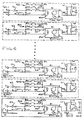
- bridge rectified circuits BR1-BR9 are used for all control input circuits 101b to the interface 100.
- the bridge rectifier makes the input universal to either a 24 volt A.C. or D.C. signal.
- the only limit to the input circuit is a voltage maximum and a minimum drive current.
- the first point of isolation is the command or switchback circuit 300.
- This circuit is comprised of a relay K1 having normally open (N.O.) contacts 1K1 and 2K1 and normally closed (N.C.) contacts 3K1 and a bridge rectifier BR9.
- the input to the relay is through the diode bridge rectifier BR9.
- This bridge rectifier BR9 permits either an A.C. or D.C. signal to be used to energize the relay.
- Normally open (N.O.) contact 1K1 on the switchback relay K1 is in series with relays K2-K12 and provides the common connection via line 301 for energizing the coil circuits of the other input relays K2-K12.
- a remote control device 102 would be connected to pins P1-13 and P1-22 to activate the switchback relay K1 seizing control of the heating, ventilating or air conditioning and refrigeration equipment.
- N.O. contact 1K1 is closed and provides a common connection to each of the rectifier bridges BR1-BR9 so that control ports P1-1, P1-3, P1-5, P1-7, P1-9, P1-11, P1-13, P1-15, and P1-17 are ready to receive input control signals from controller 102.
- the remote control device 102 selectively applies signals to these ports to activate the input relays K2-K7, K9 and K10.
- the relays open and/or close contacts to activate various control circuits of the refrigeration system 104 or the heating, ventilating or air conditioning of an environmental control system (not shown).
- the system 104 As the system 104 operates, it would provide various monitor signals back to the remote controller by a change of status of an isolated contact or sensor in the system.
- the remote controller 102 could release control by deactivating the switchback relay K1. This would return direct control of the refrigeration or environmental control equipment to local controllers therefor. This will insure continued failsafe operation of the equipment.
- switchback relay K1 Upon activation, switchback relay K1 also closes N.O. contacts 2K1 which is connected between common pin P1-21 and pin P1-14 which are connected back to the remote controller 102.
- Contact 2K1 is a monitor contact which indicates to the remote controller 102 that switchback circuit 300 has been activated and which verifies that the switchback relay K1 is operational and that interface 100 has seized control of the system 104.
- Activation of relay K1 also opens N.C. contacts 3K1 which are connected between pins P9-1 and P9-2 which are connected back to the system 104.
- Contact 3K1 is a second monitor contact which indicates to the system that switchback circuit 300 has been activated and which verifies that the switchback relay K1 is operational and that remote controller 102 has seized control of the system. If switch 302 is manually opened to inhibit the controller from taking control of the system, the controller will be able to determine that switch 302 is open because contact 2K1 will not close or contact 3K1 will not open in response to a
- An interface signal plug is located at the end of a communications cable (see FIGURE 1, plug 105) extending from the interface 100.
- This 50 pin plug is provided for the installer to connect to the "vendor of choice" remote controller.
- a light emitting diode (LED) indicator L1 is connected in parallel (along with filtering capacitor C1, resistor R1, and polarizing diode D1) to each of the coils of relays K1-K7, K9, K10 to visually indicate to an operator that the relay is functioning and, therefore, a particular control is active.
- Each of these relays has a N.O. contact 1K and a N.C. contact 2K for connection to the system 104.
- relay K2 has N.O. contact 1K2 and N.C. contact 2K2 connected to pins P3-1, P3-2, P3-3. The opening and/or closing of these contacts can be used to control the system 104.
- pin P3-1 may be adapted to directly receive the control signal (by connecting P3-1 to P1-1) or to receive the command signal (by connecting P3-1 to P1-22). Similar circuitry with corresponding labeling is provided for the other relays. Terminals T1 and T2 may be connected to system 104 so that pins P1-23 and P1-24 provide 24VAC power, if necessary, to the remote controller 102.
- the invention provides isolation between the remote controller 102 and the system 104.
- the relay configuration described herein does not permit an extraneous voltage from the system to pass through the interface 100 to the controller and prevents the controller from putting a damaging signal into the system.
- connection to interface 100 can still be accomplished, for example, at the software level by the controller manufacturer or by using a simple pull-up circuit (not shown). This arrangement requires pull-up resistors to be connected to the signal bus, pulling the lines up to a positive voltage.
- Voltage input is specified as one of the following: 24VAC or DC, "12 or 5 VDC". Input voltage is selectable and polarity must be observed when driving with DC and other than bridge rectifier circuits are used to receive inputs from the remote controller 102.
- the user must determine how many features of the interface 100 will be used.
- a standard plug such as an ITT Cannon type DDC-50P plug is required.
- the interface socket is attached to a fifty wire cable that hangs on the system rack.
- Interface 100 is a device allowing a controller of any manufacturer which has the proper control parameters to send and receive signals to operate a refrigeration system of a different manufacturer.
- Interface 100 accepts low voltage and low current control signals from the remote controller 102 and then activates the appropriate interface control relays K1-K7, K9, K10. The contacts associated with these control relays are wired to the remote control input ports 101d of each compressor control circuit of system 104.
- Remote controller 102 is in a parallel (positive) scheme to the mechanical pressure controls i.e., local control 112 of FIGURE 1).
- Interface 100 capability includes full switchback, auxiliary monitoring such as monitoring an auxiliary contact to a motor controller, high pressure hot or desuperheated gas defrost, heat reclaim and refrigeration alarm monitoring. Other control inputs available are switchback control, control alarm, and heat reclaim.
- Interface 100 permits remote control of all system 104 functions and maintains fully electrical isolation between remote controller 102 and the local control apparatus of system 104. Remote monitoring of all system rack and other component functions is now possible. Interface 100 meets or exceeds UL requirements for separating or isolating controller 102 wiring from the control panel voltage of system 104.
- Interface 100 is prewired such that the installer only needs to connect the extended cable to the vendor's remote controller 102.
- the pin connects are identified in an instruction manual and the installer need only identify the proper connect/pin position in the vendor controller mating plug for proper interfacing.
- Failsafe controls are in parallel with any external control provided by remote controller 102, but are not active until switchback (command) is released.
- the system 104 control turns to failsafe backup on low pressure, mechanical controls. This is accomplished by effectively placing each low pressure control in parallel with the remote controller 102 by running the pressure control through the N.C. contacts of the interface control relay.
- switchback relay 207 When switchback relay 207 is de-energized system 104 applies power to the mechanical controls 112 of system 104 and compressor control (sequencing) is accomplished. This allows for either, but not both to operate.
- Indicator lights L1 showing the compressor, heat reclaim, alarm and switchback status of the interface are on the circuit board located in the control panel. These are of primary use to the operator in troubleshooting. If there are no visual indicators on the vendor controller, an operator can observe indicators provided on the interface 100 for confirmation of controller operation.
- the positive logic aspect discussed above assures the operation of system 104 by disabling the switchback relay K1 and returning control to the local controllers of system 104.
- FIGURE 4 illustrates an alternative, preferred embodiment of the invention wherein optical isolators 401-409 are used in place of bridges BRl-BR9 of FIGURE 3.
- the external remote controller 102 for system 104 should be capable of providing to interface adapter 100 compressor input terminal signals having a minimum of 3.0VDC at 3.6 mA to a maximum of 27VDC at 13.1 mA.
- the selectable input voltage to be provided to interface 100 by remote controller 102 is divided into three ranges: 5, 12 and 24 volts and is selected by use of a three position dual in-line package switch having a (DIP) shorting jumper which interconnects the positive input through the appropriate resistor (R2, R3 or R4) to terminal 1 of Darlington switch Q1.
- DIP dual in-line package switch
- controller 102 provides a dc input voltage
- the polarity must be known in order to properly drive the optical isolators 401-409.
- Polarity diode D2 protects each Darlington switch Q1.
- FIGURE 4 illustrates the polarity for dc operation.
- Each input circuit also includes resistor R5 to protect LED L1.
- Each Darlington switch Ql includes a light emitting diode 420 connected across input terminals 1, 2.
- a Darlington amplifier pair 421 is connected across output terminals 5, 6.
- the light emitting diode 420 is activated and is caused to glow through a quartz window to illuminate the gates of the Darlington amplifier pair 421.
- the gates of the amplifier pair are exposed and, therefore, light sensitive.
- the gates become conductive and turn on the amplifier pair to interconnect terminals 4 and 5 and ground the one terminal of the coil of relay K2 which is connected to terminal 5 (terminal 4 is grounded).
- relay K2 is activated because B+ power (V1,F s ) is already connected to the other terminai of the coil of relay K2 by contact 1K1 of switchback circuit 1K1.
- B+ power V1,F s
- switchback circuit 1K1 any optical switch may be used in place of switch Q1 such as a photoresistor in combination with a silicon controlled rectifier.
- the jumper for each control relay is preset for the highest voltage, 24VAC or DC, which may be applied.
- the jumper can be removed and repositioned over another pair of pins in that DIP.
- the pins are to be selected according to the above mentioned ranges.
- the pins to be selected are identified on a legend on the interface board showing typical positions.
- the 24V select is also suitable for 24VAC RMS operation in the event that a specific control is not capable of meeting the input voltage and current requirements.
- the control can use dry contacts to switch 24VAC from the supplied control transformer to switch input voltage to the interface inputs.
- the coils of compressor control relays K2-K7 are activated.
- the switchback relay K1 assures that action by supplying power via contact 1K1 which connects the power supply voltage VS to V1 which powers each coil (K2-K7) of the interface control relays.
- the switchback relay K1 also powers the coils of relays K9 and K10.
- a time delay relay may be provided as part of the interface 100 wiring to allow a factory preset period of time before the backup system takes control.
- the switchback relay K1 is an electrically held relay with N.O. contacts in series with the TDSB (time delay switchback) relay.
- the TDSB relay operation is delay on reverse. This means a defined period of time, set by the relay, will pass before the contacts will operate in the switchback state. At that time, the TDSB N.C. contacts operate.
- Pins P8-12 and P8-15 are connected to the panel time delay unit of the system 104 to provide power to the controller 102 via contacts 3K1.
- the TDSB relay contacts will operate as follows: the N.C. contacts will close after switchback and allow power to flow to the compressors through the respective low pressure switches and to prevent remote controller 102 from seizing control before the preset time delay has expired.
- Another time delay relay with N.O. contacts may be used for sequencing compressors. The purpose is to provide some additional time delay after switchback so that not all compressors will operate at once if the low pressure switches are set closely or not at all.
- switchback relay An additional feature of the switchback relay is to assure that drop out of each interface compressor control relay K2-K7, K9 and K10 occurs through the switchback contacts.
- the switchback contacts operate within the interface such that each control relay coil must receive its power through them. Also, 24 VAC power is supplied to the TDSB coil through the switchback contacts.
Landscapes
- Engineering & Computer Science (AREA)
- Chemical & Material Sciences (AREA)
- Combustion & Propulsion (AREA)
- Mechanical Engineering (AREA)
- General Engineering & Computer Science (AREA)
- Physics & Mathematics (AREA)
- Signal Processing (AREA)
- Mathematical Physics (AREA)
- Fuzzy Systems (AREA)
- Human Computer Interaction (AREA)
- General Physics & Mathematics (AREA)
- Automation & Control Theory (AREA)
- Thermal Sciences (AREA)
- Air Conditioning Control Device (AREA)
- Selective Calling Equipment (AREA)
- Devices That Are Associated With Refrigeration Equipment (AREA)
Applications Claiming Priority (2)
| Application Number | Priority Date | Filing Date | Title |
|---|---|---|---|
| US133370 | 1987-12-15 | ||
| US07/133,370 US4829779A (en) | 1987-12-15 | 1987-12-15 | Interface adapter for interfacing a remote controller with commercial refrigeration and environmental control systems |
Publications (2)
| Publication Number | Publication Date |
|---|---|
| EP0321253A2 true EP0321253A2 (de) | 1989-06-21 |
| EP0321253A3 EP0321253A3 (de) | 1990-09-26 |
Family
ID=22458283
Family Applications (1)
| Application Number | Title | Priority Date | Filing Date |
|---|---|---|---|
| EP19880311891 Ceased EP0321253A3 (de) | 1987-12-15 | 1988-12-15 | Schnittstellenanpassungsgerät zur Anpassung eines Fernsteurgerätes an geschäftliche Kühl- und Klimaanlagensteuersysteme |
Country Status (5)
| Country | Link |
|---|---|
| US (1) | US4829779A (de) |
| EP (1) | EP0321253A3 (de) |
| JP (1) | JPH01244235A (de) |
| AU (1) | AU604451B2 (de) |
| CA (1) | CA1295034C (de) |
Cited By (4)
| Publication number | Priority date | Publication date | Assignee | Title |
|---|---|---|---|---|
| WO1991012572A1 (en) * | 1990-02-08 | 1991-08-22 | Esl-Kontormiljø A/S | Remote controlled interface adapter for temperature control comprising safeguarding circuit |
| EP0647820A4 (de) * | 1993-04-28 | 1996-04-10 | Daikin Ind Ltd | Betriebssteuervorrichtung für eine klimaanlage. |
| WO2001033149A1 (en) * | 1999-11-03 | 2001-05-10 | Synchro Data Limited | A refrigerated container control system |
| CN111076381A (zh) * | 2019-11-29 | 2020-04-28 | 广东美的暖通设备有限公司 | 家电的运行控制方法、装置、电子设备和存储介质 |
Families Citing this family (74)
| Publication number | Priority date | Publication date | Assignee | Title |
|---|---|---|---|---|
| JP2701911B2 (ja) * | 1989-01-20 | 1998-01-21 | 株式会社日立製作所 | 冷却設備の制御方式 |
| US5318106A (en) * | 1990-01-12 | 1994-06-07 | Dorini Donald K | Method and apparatus for controlling the flow of process fluids |
| KR920003005A (ko) * | 1990-07-05 | 1992-02-28 | 강진구 | 공기조화기 |
| US5039009A (en) * | 1990-07-16 | 1991-08-13 | American Standard Inc. | Thermostat interface for a refrigeration system controller |
| JP2926282B2 (ja) * | 1991-06-06 | 1999-07-28 | 株式会社日立製作所 | 空気調和機及びその運転制御プログラムを記録した媒体 |
| US5279458A (en) * | 1991-08-12 | 1994-01-18 | Carrier Corporation | Network management control |
| JP3113422B2 (ja) * | 1992-11-11 | 2000-11-27 | 三洋電機株式会社 | 空気調和機のアドレス自動設定方式 |
| JP2799809B2 (ja) * | 1993-02-16 | 1998-09-21 | 株式会社日立製作所 | 空調管理システム |
| US5499512A (en) * | 1994-05-09 | 1996-03-19 | Thermo King Corporation | Methods and apparatus for converting a manually operable refrigeration unit to remote operation |
| US5570586A (en) * | 1995-05-11 | 1996-11-05 | Carrier Corporation | Interface circuit for use in multi-split air conditioning systems |
| US5934096A (en) * | 1997-10-21 | 1999-08-10 | Hussmann Corporation | Wiring system for commercial refrigeration |
| DE19750053A1 (de) * | 1997-11-12 | 1999-05-20 | Etc Energietechnik Und Chemie | Haushaltskühlgerät |
| FR2774749B1 (fr) * | 1998-02-12 | 2000-03-31 | Guillot | Dispositif de gestion du froid pour installations frigorifiques et modules de regulation et de surveillance associes |
| US6505475B1 (en) | 1999-08-20 | 2003-01-14 | Hudson Technologies Inc. | Method and apparatus for measuring and improving efficiency in refrigeration systems |
| US6954799B2 (en) * | 2000-02-01 | 2005-10-11 | Charles Schwab & Co., Inc. | Method and apparatus for integrating distributed shared services system |
| US6302654B1 (en) * | 2000-02-29 | 2001-10-16 | Copeland Corporation | Compressor with control and protection system |
| US6332327B1 (en) * | 2000-03-14 | 2001-12-25 | Hussmann Corporation | Distributed intelligence control for commercial refrigeration |
| US7047753B2 (en) * | 2000-03-14 | 2006-05-23 | Hussmann Corporation | Refrigeration system and method of operating the same |
| US6973794B2 (en) * | 2000-03-14 | 2005-12-13 | Hussmann Corporation | Refrigeration system and method of operating the same |
| US6999996B2 (en) | 2000-03-14 | 2006-02-14 | Hussmann Corporation | Communication network and method of communicating data on the same |
| US6647735B2 (en) * | 2000-03-14 | 2003-11-18 | Hussmann Corporation | Distributed intelligence control for commercial refrigeration |
| US7000422B2 (en) | 2000-03-14 | 2006-02-21 | Hussmann Corporation | Refrigeration system and method of configuring the same |
| KR100381667B1 (ko) * | 2000-04-29 | 2003-05-01 | 박태업 | 센서에 의해 공기조화장치 전원이 자동 제어되는 아답타 |
| US6502409B1 (en) * | 2000-05-03 | 2003-01-07 | Computer Process Controls, Inc. | Wireless method and apparatus for monitoring and controlling food temperature |
| TW593950B (en) * | 2000-09-11 | 2004-06-21 | Toshiba Corp | Remote inspection system for refrigerator |
| US6863222B2 (en) * | 2002-09-04 | 2005-03-08 | Statrak Llc | System and method for freight refrigeration power control |
| US7775452B2 (en) * | 2004-01-07 | 2010-08-17 | Carrier Corporation | Serial communicating HVAC system |
| US20070150305A1 (en) * | 2004-02-18 | 2007-06-28 | Klaus Abraham-Fuchs | Method for selecting a potential participant for a medical study on the basis of a selection criterion |
| US7412842B2 (en) | 2004-04-27 | 2008-08-19 | Emerson Climate Technologies, Inc. | Compressor diagnostic and protection system |
| US7275377B2 (en) | 2004-08-11 | 2007-10-02 | Lawrence Kates | Method and apparatus for monitoring refrigerant-cycle systems |
| JP3963190B2 (ja) * | 2005-04-07 | 2007-08-22 | ダイキン工業株式会社 | 空気調和装置の冷媒量判定システム |
| US8590325B2 (en) | 2006-07-19 | 2013-11-26 | Emerson Climate Technologies, Inc. | Protection and diagnostic module for a refrigeration system |
| US20080216494A1 (en) | 2006-09-07 | 2008-09-11 | Pham Hung M | Compressor data module |
| US20080295030A1 (en) * | 2007-05-22 | 2008-11-27 | Honeywell International Inc. | User interface for special purpose controller |
| US20090037142A1 (en) | 2007-07-30 | 2009-02-05 | Lawrence Kates | Portable method and apparatus for monitoring refrigerant-cycle systems |
| US8393169B2 (en) | 2007-09-19 | 2013-03-12 | Emerson Climate Technologies, Inc. | Refrigeration monitoring system and method |
| US8160827B2 (en) | 2007-11-02 | 2012-04-17 | Emerson Climate Technologies, Inc. | Compressor sensor module |
| US9140728B2 (en) | 2007-11-02 | 2015-09-22 | Emerson Climate Technologies, Inc. | Compressor sensor module |
| US7992794B2 (en) * | 2008-07-10 | 2011-08-09 | Honeywell International Inc. | Backup control for HVAC system |
| TWM382216U (en) * | 2010-01-06 | 2010-06-11 | World Friendship Co Ltd | Vehicle energy management device and vehicle energy management module |
| CN102934036B (zh) * | 2010-02-15 | 2016-04-27 | 开利公司 | 用于估计温度受控空间内的参数和状态的基于模型的系统和方法 |
| CA2828740C (en) | 2011-02-28 | 2016-07-05 | Emerson Electric Co. | Residential solutions hvac monitoring and diagnosis |
| US8964338B2 (en) | 2012-01-11 | 2015-02-24 | Emerson Climate Technologies, Inc. | System and method for compressor motor protection |
| US10139843B2 (en) | 2012-02-22 | 2018-11-27 | Honeywell International Inc. | Wireless thermostatic controlled electric heating system |
| US9480177B2 (en) | 2012-07-27 | 2016-10-25 | Emerson Climate Technologies, Inc. | Compressor protection module |
| US9310439B2 (en) | 2012-09-25 | 2016-04-12 | Emerson Climate Technologies, Inc. | Compressor having a control and diagnostic module |
| US9803902B2 (en) | 2013-03-15 | 2017-10-31 | Emerson Climate Technologies, Inc. | System for refrigerant charge verification using two condenser coil temperatures |
| CA2904734C (en) | 2013-03-15 | 2018-01-02 | Emerson Electric Co. | Hvac system remote monitoring and diagnosis |
| US9551504B2 (en) | 2013-03-15 | 2017-01-24 | Emerson Electric Co. | HVAC system remote monitoring and diagnosis |
| US9338526B2 (en) * | 2013-04-04 | 2016-05-10 | Behrouz Golabil | Enhanced updating of control mechanisms |
| AU2014248049B2 (en) | 2013-04-05 | 2018-06-07 | Emerson Climate Technologies, Inc. | Heat-pump system with refrigerant charge diagnostics |
| US9806705B2 (en) | 2013-04-23 | 2017-10-31 | Honeywell International Inc. | Active triac triggering circuit |
| US9584119B2 (en) | 2013-04-23 | 2017-02-28 | Honeywell International Inc. | Triac or bypass circuit and MOSFET power steal combination |
| US9264035B2 (en) | 2013-04-23 | 2016-02-16 | Honeywell International Inc. | MOSFET gate driving circuit for transition softening |
| US20140324227A1 (en) | 2013-04-30 | 2014-10-30 | Honeywell International Inc. | Hvac controller having a fixed segment display with an interactive message center |
| US9983244B2 (en) | 2013-06-28 | 2018-05-29 | Honeywell International Inc. | Power transformation system with characterization |
| US11054448B2 (en) | 2013-06-28 | 2021-07-06 | Ademco Inc. | Power transformation self characterization mode |
| US10811892B2 (en) | 2013-06-28 | 2020-10-20 | Ademco Inc. | Source management for a power transformation system |
| JP6037980B2 (ja) * | 2013-09-04 | 2016-12-07 | 三菱電機株式会社 | 空気調和機 |
| US9857091B2 (en) | 2013-11-22 | 2018-01-02 | Honeywell International Inc. | Thermostat circuitry to control power usage |
| US9673811B2 (en) | 2013-11-22 | 2017-06-06 | Honeywell International Inc. | Low power consumption AC load switches |
| JP2015169386A (ja) * | 2014-03-07 | 2015-09-28 | 三菱電機株式会社 | 空気調和装置 |
| US10197304B2 (en) * | 2014-05-23 | 2019-02-05 | Lennox Industries Inc. | Tandem compressor discharge pressure and temperature control logic |
| US9419602B2 (en) | 2014-06-19 | 2016-08-16 | Honeywell International Inc. | Passive drive control circuit for AC current |
| US9628074B2 (en) | 2014-06-19 | 2017-04-18 | Honeywell International Inc. | Bypass switch for in-line power steal |
| US9683749B2 (en) | 2014-07-11 | 2017-06-20 | Honeywell International Inc. | Multiple heatsink cooling system for a line voltage thermostat |
| US9920962B2 (en) * | 2015-06-12 | 2018-03-20 | Haier Us Appliance Solutions, Inc. | Packaged terminal air conditioner unit |
| US11009250B2 (en) * | 2015-06-30 | 2021-05-18 | Emerson Climate Technologies Retail Solutions, Inc. | Maintenance and diagnostics for refrigeration systems |
| US10240836B2 (en) | 2015-06-30 | 2019-03-26 | Emerson Climate Technologies Retail Solutions, Inc. | Energy management for refrigeration systems |
| US9768572B1 (en) | 2016-04-29 | 2017-09-19 | Banner Engineering Corp. | Quick-connector conversion system for safety controller |
| US10240802B2 (en) | 2016-06-10 | 2019-03-26 | Ademco Inc. | HVAC control system with user interface provided by a mobile wireless device |
| US10408473B2 (en) | 2016-10-05 | 2019-09-10 | Johnson Controls Technology Company | Method for sequencing compressor operation based on space humidity |
| US10627146B2 (en) | 2016-10-17 | 2020-04-21 | Emerson Climate Technologies, Inc. | Liquid slugging detection and protection |
| US10473351B2 (en) | 2017-02-03 | 2019-11-12 | Ademco Inc. | HVAC control with a remote user interface and a remote temperature sensor |
Family Cites Families (35)
| Publication number | Priority date | Publication date | Assignee | Title |
|---|---|---|---|---|
| US3343132A (en) * | 1963-05-16 | 1967-09-19 | Sperry Rand Corp | Data processing system |
| BE664560A (de) * | 1964-05-27 | |||
| FR1482852A (fr) * | 1966-01-05 | 1967-06-02 | Procédé de mesure pour la quantification de notions subjectives multidimensionnelles et dispositifs pour la mise en oeuvre de ce procédé, constitués de programmes de calculateur électronique | |
| US3513662A (en) * | 1968-11-12 | 1970-05-26 | Armour & Co | Feedback control system for sequencing motors |
| US3697953A (en) * | 1970-12-28 | 1972-10-10 | Honeywell Inc | System for monitoring abnormal system operations in a system having a central station and a plurality of remote stations |
| US3707080A (en) * | 1971-08-18 | 1972-12-26 | Westinghouse Electric Corp | Self-advancing programmer and pressure actuated devices control arrangement |
| US3813533A (en) * | 1972-06-02 | 1974-05-28 | Garrett Comtronics Corp | Clock calculator |
| US3871443A (en) * | 1974-04-17 | 1975-03-18 | Gen Electric | Safety control for a remote control system |
| US4593533A (en) * | 1974-12-05 | 1986-06-10 | Alsenz Richard H | Method and apparatus for detecting and controlling the formation of ice or frost |
| US4077566A (en) * | 1976-02-19 | 1978-03-07 | International Telephone And Telegraph Corporation | Night setback-morning ready control system for unit ventilators |
| US4206612A (en) * | 1977-07-15 | 1980-06-10 | Emhart Industries, Inc. | Refrigeration system control method and apparatus |
| US4578959A (en) * | 1977-10-28 | 1986-04-01 | Alsenz Richard H | Method and apparatus for detecting and controlling the formation of ice or frost |
| US4272012A (en) * | 1979-03-09 | 1981-06-09 | Molnar John R | Method and system for controlling a plurality of temperature conditioning units |
| US4253153A (en) * | 1979-06-28 | 1981-02-24 | United Technologies Corporation | Energy conservative control of terminal reheat heating, ventilating, and air conditioning (HVAC) systems |
| US4628700A (en) * | 1979-07-31 | 1986-12-16 | Alsenz Richard H | Temperature optimizer control apparatus and method |
| US4612776A (en) * | 1979-07-31 | 1986-09-23 | Alsenz Richard H | Method and apparatus for controlling capacity of a multiple-stage cooling system |
| US4333519A (en) * | 1980-05-08 | 1982-06-08 | Doron Shafrir | Controller for air conditioning units, heating units and the like |
| US4287939A (en) * | 1980-08-21 | 1981-09-08 | General Electric Company | Air conditioning control system with local and remote control capabilities |
| US4413672A (en) * | 1982-04-05 | 1983-11-08 | General Electric Company | Central desk air conditioning control system |
| US4537038A (en) * | 1982-04-30 | 1985-08-27 | Alsenz Richard H | Method and apparatus for controlling pressure in a single compressor refrigeration system |
| EP0114812A1 (de) * | 1982-07-22 | 1984-08-08 | BENDIKSON, Donald L. | Energieregelung eines kühlsystems |
| US4441545A (en) * | 1982-07-26 | 1984-04-10 | General Electric Company | Air conditioning thermostatic control system having modular inclusion of remote temperature set-back capability |
| US4500034A (en) * | 1982-09-30 | 1985-02-19 | Tempmaster Corporation | Electronic control arrangement for system powered HVAC terminal units |
| US4581901A (en) * | 1983-01-21 | 1986-04-15 | Emhart Industries, Inc. | Control system for a heat pump system |
| US4604619A (en) * | 1983-09-16 | 1986-08-05 | Goodwater Harry C | Apparatus and method for multiple mode remote control switching |
| US4594858A (en) * | 1984-01-11 | 1986-06-17 | Copeland Corporation | Highly efficient flexible two-stage refrigeration system |
| US4612775A (en) * | 1984-05-04 | 1986-09-23 | Kysor Industrial Corporation | Refrigeration monitor and alarm system |
| US4553400A (en) * | 1984-05-04 | 1985-11-19 | Kysor Industrial Corporation | Refrigeration monitor and alarm system |
| US4598556A (en) * | 1984-09-17 | 1986-07-08 | Sundstrand Corporation | High efficiency refrigeration or cooling system |
| US4608833A (en) * | 1984-12-24 | 1986-09-02 | Borg-Warner Corporation | Self-optimizing, capacity control system for inverter-driven centrifugal compressor based water chillers |
| US4621502A (en) * | 1985-01-11 | 1986-11-11 | Tyler Refrigeration Corporation | Electronic temperature control for refrigeration system |
| JPH0686960B2 (ja) * | 1985-01-30 | 1994-11-02 | 株式会社日立製作所 | 冷媒流量制御装置 |
| US4614089A (en) * | 1985-03-19 | 1986-09-30 | General Services Engineering, Inc. | Controlled refrigeration system |
| NL8503077A (nl) * | 1985-11-08 | 1987-06-01 | Grasso Koninkl Maschf | Koelinstallatie. |
| US4673127A (en) * | 1986-07-17 | 1987-06-16 | Grant Willie T | Remote control means for heating/cooling devices |
-
1987
- 1987-12-15 US US07/133,370 patent/US4829779A/en not_active Expired - Fee Related
-
1988
- 1988-11-23 CA CA000583831A patent/CA1295034C/en not_active Expired - Fee Related
- 1988-12-15 EP EP19880311891 patent/EP0321253A3/de not_active Ceased
- 1988-12-15 AU AU27593/88A patent/AU604451B2/en not_active Ceased
- 1988-12-15 JP JP63318310A patent/JPH01244235A/ja active Pending
Cited By (6)
| Publication number | Priority date | Publication date | Assignee | Title |
|---|---|---|---|---|
| WO1991012572A1 (en) * | 1990-02-08 | 1991-08-22 | Esl-Kontormiljø A/S | Remote controlled interface adapter for temperature control comprising safeguarding circuit |
| EP0647820A4 (de) * | 1993-04-28 | 1996-04-10 | Daikin Ind Ltd | Betriebssteuervorrichtung für eine klimaanlage. |
| US5592824A (en) * | 1993-04-28 | 1997-01-14 | Daikin Industries, Ltd. | Driving control device for air conditioner |
| WO2001033149A1 (en) * | 1999-11-03 | 2001-05-10 | Synchro Data Limited | A refrigerated container control system |
| US6679071B1 (en) | 1999-11-03 | 2004-01-20 | Synchro Data Limited | Refrigerated container control system |
| CN111076381A (zh) * | 2019-11-29 | 2020-04-28 | 广东美的暖通设备有限公司 | 家电的运行控制方法、装置、电子设备和存储介质 |
Also Published As
| Publication number | Publication date |
|---|---|
| JPH01244235A (ja) | 1989-09-28 |
| US4829779A (en) | 1989-05-16 |
| AU604451B2 (en) | 1990-12-13 |
| AU2759388A (en) | 1989-06-15 |
| EP0321253A3 (de) | 1990-09-26 |
| CA1295034C (en) | 1992-01-28 |
Similar Documents
| Publication | Publication Date | Title |
|---|---|---|
| US4829779A (en) | Interface adapter for interfacing a remote controller with commercial refrigeration and environmental control systems | |
| US4942613A (en) | Service thermostat | |
| US5316073A (en) | Twinning control | |
| US5435147A (en) | Air conditioning control system | |
| EP1087184B1 (de) | Klimaanlage | |
| US20130324027A1 (en) | Economizer hvac and control system | |
| US5237826A (en) | Configuration wiring harness for HVAC controller | |
| US5161387A (en) | Method and apparatus for configuring and controlling a load | |
| US5816059A (en) | Artificial input controller for HVAC system | |
| JP2010054065A (ja) | 空気調和機 | |
| US6220043B1 (en) | Apparatus and method for control of a heat pump system | |
| WO2007130051A1 (en) | Climate control system with automatic wiring detection | |
| US4333519A (en) | Controller for air conditioning units, heating units and the like | |
| US6008733A (en) | Air conditioning system master/slave control unit determination | |
| US4158383A (en) | Apparatus for coupling the components of a heat pump system | |
| US6711445B1 (en) | Refrigeration control apparatus and method | |
| US5218837A (en) | Control system for controlling the operation of an air conditioning compressor and method of making the same | |
| JP2001012782A (ja) | セパレート形空気調和機 | |
| JPH0317467A (ja) | 冷凍システム及びその制御装置 | |
| JPH11248235A (ja) | 空気調和システム | |
| JPH0744942Y2 (ja) | 冷凍冷蔵ショーケース | |
| JPH0875335A (ja) | ショーケースの集中制御装置 | |
| JP3075767B2 (ja) | 空気調和機の故障診断方法 | |
| KR20070072259A (ko) | 공기조화기의 오결선 감지장치 | |
| JP3175078B2 (ja) | ショーケース等の集中管理装置 |
Legal Events
| Date | Code | Title | Description |
|---|---|---|---|
| PUAI | Public reference made under article 153(3) epc to a published international application that has entered the european phase |
Free format text: ORIGINAL CODE: 0009012 |
|
| AK | Designated contracting states |
Kind code of ref document: A2 Designated state(s): DE FR GB |
|
| PUAL | Search report despatched |
Free format text: ORIGINAL CODE: 0009013 |
|
| AK | Designated contracting states |
Kind code of ref document: A3 Designated state(s): DE FR GB |
|
| 17P | Request for examination filed |
Effective date: 19901227 |
|
| 17Q | First examination report despatched |
Effective date: 19910807 |
|
| STAA | Information on the status of an ep patent application or granted ep patent |
Free format text: STATUS: THE APPLICATION HAS BEEN REFUSED |
|
| 18R | Application refused |
Effective date: 19921115 |