EP0321276B1 - Produits obtenus à partir de tissu recouvert d'élastomère et procédé de fabrication - Google Patents
Produits obtenus à partir de tissu recouvert d'élastomère et procédé de fabrication Download PDFInfo
- Publication number
- EP0321276B1 EP0321276B1 EP88311929A EP88311929A EP0321276B1 EP 0321276 B1 EP0321276 B1 EP 0321276B1 EP 88311929 A EP88311929 A EP 88311929A EP 88311929 A EP88311929 A EP 88311929A EP 0321276 B1 EP0321276 B1 EP 0321276B1
- Authority
- EP
- European Patent Office
- Prior art keywords
- fabric
- yarns
- warp
- base fabric
- elastomer
- Prior art date
- Legal status (The legal status is an assumption and is not a legal conclusion. Google has not performed a legal analysis and makes no representation as to the accuracy of the status listed.)
- Expired - Lifetime
Links
Images
Classifications
-
- B—PERFORMING OPERATIONS; TRANSPORTING
- B29—WORKING OF PLASTICS; WORKING OF SUBSTANCES IN A PLASTIC STATE IN GENERAL
- B29D—PRODUCING PARTICULAR ARTICLES FROM PLASTICS OR FROM SUBSTANCES IN A PLASTIC STATE
- B29D29/00—Producing belts or bands
-
- B—PERFORMING OPERATIONS; TRANSPORTING
- B29—WORKING OF PLASTICS; WORKING OF SUBSTANCES IN A PLASTIC STATE IN GENERAL
- B29C—SHAPING OR JOINING OF PLASTICS; SHAPING OF MATERIAL IN A PLASTIC STATE, NOT OTHERWISE PROVIDED FOR; AFTER-TREATMENT OF THE SHAPED PRODUCTS, e.g. REPAIRING
- B29C70/00—Shaping composites, i.e. plastics material comprising reinforcements, fillers or preformed parts, e.g. inserts
- B29C70/04—Shaping composites, i.e. plastics material comprising reinforcements, fillers or preformed parts, e.g. inserts comprising reinforcements only, e.g. self-reinforcing plastics
- B29C70/06—Fibrous reinforcements only
- B29C70/10—Fibrous reinforcements only characterised by the structure of fibrous reinforcements, e.g. hollow fibres
- B29C70/16—Fibrous reinforcements only characterised by the structure of fibrous reinforcements, e.g. hollow fibres using fibres of substantial or continuous length
- B29C70/22—Fibrous reinforcements only characterised by the structure of fibrous reinforcements, e.g. hollow fibres using fibres of substantial or continuous length oriented in at least two directions forming a two-dimensional [2D] structure
-
- B—PERFORMING OPERATIONS; TRANSPORTING
- B29—WORKING OF PLASTICS; WORKING OF SUBSTANCES IN A PLASTIC STATE IN GENERAL
- B29C—SHAPING OR JOINING OF PLASTICS; SHAPING OF MATERIAL IN A PLASTIC STATE, NOT OTHERWISE PROVIDED FOR; AFTER-TREATMENT OF THE SHAPED PRODUCTS, e.g. REPAIRING
- B29C70/00—Shaping composites, i.e. plastics material comprising reinforcements, fillers or preformed parts, e.g. inserts
- B29C70/04—Shaping composites, i.e. plastics material comprising reinforcements, fillers or preformed parts, e.g. inserts comprising reinforcements only, e.g. self-reinforcing plastics
- B29C70/28—Shaping operations therefor
- B29C70/54—Component parts, details or accessories; Auxiliary operations, e.g. feeding or storage of prepregs or SMC after impregnation or during ageing
- B29C70/56—Tensioning reinforcements before or during shaping
-
- B—PERFORMING OPERATIONS; TRANSPORTING
- B29—WORKING OF PLASTICS; WORKING OF SUBSTANCES IN A PLASTIC STATE IN GENERAL
- B29K—INDEXING SCHEME ASSOCIATED WITH SUBCLASSES B29B, B29C OR B29D, RELATING TO MOULDING MATERIALS OR TO MATERIALS FOR MOULDS, REINFORCEMENTS, FILLERS OR PREFORMED PARTS, e.g. INSERTS
- B29K2021/00—Use of unspecified rubbers as moulding material
-
- B—PERFORMING OPERATIONS; TRANSPORTING
- B29—WORKING OF PLASTICS; WORKING OF SUBSTANCES IN A PLASTIC STATE IN GENERAL
- B29L—INDEXING SCHEME ASSOCIATED WITH SUBCLASS B29C, RELATING TO PARTICULAR ARTICLES
- B29L2030/00—Pneumatic or solid tyres or parts thereof
-
- B—PERFORMING OPERATIONS; TRANSPORTING
- B29—WORKING OF PLASTICS; WORKING OF SUBSTANCES IN A PLASTIC STATE IN GENERAL
- B29L—INDEXING SCHEME ASSOCIATED WITH SUBCLASS B29C, RELATING TO PARTICULAR ARTICLES
- B29L2031/00—Other particular articles
- B29L2031/709—Articles shaped in a closed loop, e.g. conveyor belts
-
- Y—GENERAL TAGGING OF NEW TECHNOLOGICAL DEVELOPMENTS; GENERAL TAGGING OF CROSS-SECTIONAL TECHNOLOGIES SPANNING OVER SEVERAL SECTIONS OF THE IPC; TECHNICAL SUBJECTS COVERED BY FORMER USPC CROSS-REFERENCE ART COLLECTIONS [XRACs] AND DIGESTS
- Y10—TECHNICAL SUBJECTS COVERED BY FORMER USPC
- Y10T—TECHNICAL SUBJECTS COVERED BY FORMER US CLASSIFICATION
- Y10T442/00—Fabric [woven, knitted, or nonwoven textile or cloth, etc.]
- Y10T442/20—Coated or impregnated woven, knit, or nonwoven fabric which is not [a] associated with another preformed layer or fiber layer or, [b] with respect to woven and knit, characterized, respectively, by a particular or differential weave or knit, wherein the coating or impregnation is neither a foamed material nor a free metal or alloy layer
- Y10T442/2369—Coating or impregnation improves elasticity, bendability, resiliency, flexibility, or shape retention of the fabric
- Y10T442/2377—Improves elasticity
-
- Y—GENERAL TAGGING OF NEW TECHNOLOGICAL DEVELOPMENTS; GENERAL TAGGING OF CROSS-SECTIONAL TECHNOLOGIES SPANNING OVER SEVERAL SECTIONS OF THE IPC; TECHNICAL SUBJECTS COVERED BY FORMER USPC CROSS-REFERENCE ART COLLECTIONS [XRACs] AND DIGESTS
- Y10—TECHNICAL SUBJECTS COVERED BY FORMER USPC
- Y10T—TECHNICAL SUBJECTS COVERED BY FORMER US CLASSIFICATION
- Y10T442/00—Fabric [woven, knitted, or nonwoven textile or cloth, etc.]
- Y10T442/40—Knit fabric [i.e., knit strand or strip material]
- Y10T442/45—Knit fabric is characterized by a particular or differential knit pattern other than open knit fabric or a fabric in which the strand denier is specified
- Y10T442/456—Including additional strand inserted within knit fabric
-
- Y—GENERAL TAGGING OF NEW TECHNOLOGICAL DEVELOPMENTS; GENERAL TAGGING OF CROSS-SECTIONAL TECHNOLOGIES SPANNING OVER SEVERAL SECTIONS OF THE IPC; TECHNICAL SUBJECTS COVERED BY FORMER USPC CROSS-REFERENCE ART COLLECTIONS [XRACs] AND DIGESTS
- Y10—TECHNICAL SUBJECTS COVERED BY FORMER USPC
- Y10T—TECHNICAL SUBJECTS COVERED BY FORMER US CLASSIFICATION
- Y10T442/00—Fabric [woven, knitted, or nonwoven textile or cloth, etc.]
- Y10T442/40—Knit fabric [i.e., knit strand or strip material]
- Y10T442/494—Including a nonwoven fabric layer other than paper
Definitions
- This invention relates to elastomer-coated fabric products useful as a reinforcing medium in a variety of end use applications (e.g., tires, power transmission belts, conveyor belts, etcetera) and to processes for producing the same.
- it includes an elastomer-coated warp-knit, weft-inserted (WKWI) fabric having warp yarns which exhibit a predetermined elongation potential in the fabric's machine direction.
- WKWI warp-knit, weft-inserted
- Additional elongation potential for the fabric i.e., so as to provide a total elongation potential in excess of that provided by the warp-knit yarns alone
- the total elongation potential of the elastomer-coated fabric of this invention is thus the elongation potential collectively provided inherently by means of the warp knit yarns and that provided by means of the compressed state of the fabric.
- the weft insert yarns are chosen so that the fabric is substantially inextensible in the cross-machine direction.
- a variety of commercial products employ fabrics as a reinforcement medium, for example, tires, power transmission belts, conveyor belts, and the like. These products are typically constructed of layers of fabric impregnated with and/or intimately surrounded by an elastomeric polymer matrix. The fabric thus serves to reinforce the resulting elastomeric product.
- lateral support for the product is important. That is, the product should be substantially inextensible in one direction yet capable of elongation in another direction.
- a fabric using relatively inextensible inlaid warp yarns with an extensible weft insertion yarn provides greater flexibility in the weft direction (see, published U.K. Application No. 2,102,849).
- U.S. Patent No. 4,427,107 to Roberts et al suggests having different stretch characteristics in the warp and weft directions with fibers having a warp to weft elongation ratio in the range of between 1:2 and 1:3.
- the present invention provides an elastomer-coated fabric product comprising a base fabric and an elastomeric coating on said base fabric, characterised in that said base fabric is compressed in the machine direction thereof and is maintained in said compressed state by means of said elastomeric coating.
- elastomer-coated fabric products can be provided which are useful as a reinforcing medium in a variety of end use applications employing the same (e.g. tyres, power transmission belts, conveyor belts, etc.).
- An elastomer-coated fabric product of this invention is preferably a warp-knit, or warp knit weft-inserted fabric whereby the warp yarns exhibit a predetermined elongation potential in the fabric's machine direction, additional elongation potential for the fabric being provided in the machine direction by maintaining the fabric in a compressed state. That is to say, during processing, the fabric is compressed within its plane without buckling, and this compressed state is maintained by means of the dried elastomer coating.
- the amount of fabric compression can also be preselected and controlled in such a manner that the total elongation potential for the resulting fabric is within close tolerances of that desired (e.g. within about plus or minus 2%).
- the warp and weft yarns may be natural or synthetic yarns.
- the fabric of this invention is preferably produced by coating a liquid elastomer onto the fabric so that it at least partially impregnates the same than then compressing the fabric to the desired extent.
- the fabric may be compressed prior to the application of the liquid elastomer coating.
- the liquid-coated and compressed fabric is then dried so as to solidify the elastomer coating thereon and thus maintain the fabric in its compressed state. Compression of the fabric is conveniently accomplished by overfeeding the fabric to a conventional tenter frame -- that is, the rate at which the fabric is fed to the tenter frame is greater than the tenter frame's operating rate.
- an important aspect of the present invention is the fact that the fabric is normally in a compressed state and is maintained in such a compressed state by means of the elastomer coating.
- the term “compressed” is meant to refer to compressing the fabric within its plane without fabric buckling, folding or the like.
- a "compressed” fabric according to this invention will have a decreased distance between adjacent filling yarns of the fabric as compared to a similar fabric in a non-compressed state -- that is, the numerical density of filling yarns per unit length of the fabric is increased when the fabric is in a compressed state as compared to a similar fabric in a non-compressed state.
- this "compression" of the fabric establishes an elongation potential -- that is to say, the fabric may be elongated to the extent where it is no longer in a "compressed” state.
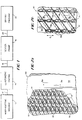
- a base fabric 12 is initially produced on a warp-knitting machine 10 which can be of any type conventional in the art.
- a warp-knitting machine 10 which can be of any type conventional in the art.
- Malimo and Tricot warp-knitting machines may be employed in the successful practice of this invention.
- the filling or weft insert yarns are biased at an angle with respect to the machine direction of the fabric (i.e., between about 45 and 90°, preferably about 60°) by any suitable means known in the art.
- conventional bias weft-insertion machinery such as that disclosed in U.S. Patent Nos. 4,444,025 to Krueger; 4,567,738 to Hutson et al; 4,665,721 to Naumann et al, and 4,677,831 to Wunner may be employed.
- the warp-knitting machine 10 forms a plurality of warp-knitting yarns into stitch patterns (e.g., chain stitches) in which there are inserted weft filling yarns.
- the warp knitting yarns of this invention are preferably chosen so that they exhibit an inherent predetermined amount of extension -- that is, so that the resulting fabric is extensible in the machine direction or has a predetermined elongation in the machine direction.
- the type of yarn chosen as well as the denier and ply thereof will determine the amount of potential elongation provided by means of the warp-knit yarns.
- the yarns may be continuous and/or spun staple selected from any synthetic or natural fiber such as, nylon, cotton, polyester, rayon, aramid filaments or mixtures thereof.
- the cross-machine, filing or weft insert yarns may also be selected from continuous or spun synthetic and/or natural fibers. These fibers are, however, selected so that they provide substantial inextensibility in the cross-machine direction, which selection is dependent upon e.g., the type of fiber chosen and/or the type of fiber blends in addition to the denier, filling density and like fabric parameters.
- the resulting base fabric (designated by reference numeral 12) is then forwarded to a coating zone 14 where it is coated with a liquid polymer or elastomer.
- Coating of the fabric 12 may be accomplished by any apparatus and/or technique well known to those in this art, and thus can be accomplished by padding, rolling, dipping, spraying or the like.
- any suitable elastomer may be employed in the practice of this invention, the selection of any particular elastomer being dependent upon the specific performance characteristics for the resulting reinforced product in which the fabric 12 is employed. Suffice it to say that the elastomer must be compatible with the polymer matrix in which the fabric is employed so as to ensure adequate bonding (both mechanically and chemically).
- the amount of liquid elastomer add-on to the fabric 12 is preferably chosen so that it is sufficient to maintain the fabric in its compressed state (as will described in greater detail below). Thus, liquid elastomer add-on may be in the range of from 30% to about 400% or more by weight of the fabric 12.
- the coated fabric (now designated as reference number 16) is then fed to a tenter frame 18 of any type conventionally used in the textile industry.
- the tenter 18 should be of the continuous type and thus, those having moveable pin-chains in suitable guides may be employed.
- the coated fabric is fed to the tenter frame 18 at a rate greater than the rate at which the tenter frame 18 is moving so that the fabric is "overfed” to the tenter frame 18 thereby being compressed in the machine direction.
- the fabric is compressed in the machine direction but is not stretched in the cross-machine direction as is the case in US-A-4570566 or is not substantially or significantly stretched. Furthermore, the machine direction of the tenter frame corresponds at least substantially to the warp direction of the fabric, whereas in US-A-4570566 the fabric is bias cut and the warp direction is at 45° to the tenter frame machine direction.
- the thus compressed and coated fabric (now designated by reference numeral 20 in FIGURE 1) may then be dried in a drying zone 22 (which may be a conventional industrial oven) so as to solidify the elastomer coating on the fabric 20 and thus maintain the fabric in its compressed state.
- a drying zone 22 which may be a conventional industrial oven
- Other finishing steps may also be employed in zone 22, such as selvage removal, cutting, and/or slitting to the desired width.
- the coated fabric 20 and/or the base fabric 12 may be treated according to any conventional technique so as to obtain maximum adhesion with the polymer matrix of the end-use product in which it is employed.
- yarns of the base fabric 12 may be pretreated with any known adhesion promoting agent (e.g., RFL, isocyanate, epoxy and/or melamine formaldehydes), the selection of any particular agent(s) being, of course, dependent upon the polymer matrix in which the coated fabrics of this invention are used.
- RFL adhesion promoting agent
- the base fabric 12 is comprised of natural fibers, blends of natural fibers and/or textured synthetic fibers, pretreatment with an adhesion promoting agent is usually not necessary for most end use applications.
- adhesion may be enhanced by subjecting the coated fabric 20 to a "precuring" step, for example, by using heat, or by means of an electron beam or gamma radiation precuring system.
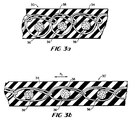
- FIGURES 2a and 3a An exemplary fabric 30 produced by the present invention is shown in accompanying FIGURES 2a and 3a.
- the fabric 30 includes a base fabric 32 which is preferably a weft-biased WKWI fabric and a coating layer 34 of an elastomeric polymer which preferably at least partially impregnates the base fabric 32.
- Adjacent filling (or weft-inserted) yarns 36 have been moved closer to one another due to the compression of the base fabric 32 as was described previously. This compression of the fabric thus, in essence, "loosens" the stitches of the warp knit yarns 38 as is shown schematically in accompanying FIGURES 2a and 3a.
Landscapes
- Engineering & Computer Science (AREA)
- Mechanical Engineering (AREA)
- Chemical & Material Sciences (AREA)
- Composite Materials (AREA)
- Textile Engineering (AREA)
- Knitting Of Fabric (AREA)
- Treatments For Attaching Organic Compounds To Fibrous Goods (AREA)
- Laminated Bodies (AREA)
Claims (13)
- Produit (30) en tissu revêtu d'élastomère, comprenant un tissu de base (32) et un revêtement élastomère (34) sur ledit tissu de base (32), caractérisé en ce que ledit tissu de base (32) est comprimé dans sa direction machine et est maintenu dans cet état comprimé au moyen dudit revêtement élastomère (34).
- Produit (30) en tissu revêtu d'élastomère selon la revendication 1, dans lequel le tissu de base est un tissu de base à chaîne tricotée (32) auquel est fixé ledit revêtement élastomère (34) et qui contient des fils tricotés de chaîne (38) qui lui donnent un degré prédéterminé d'allongement potentiel et des fils de trame (36) pratiquement inextensibles, ledit tissu (32) étant dans ledit état comprimé dans la direction de la chaîne, afin de donner au tissu (32) un degré prédéterminé supplémentaire d'allongement potentiel, en plus de celui qui lui est donné au moyen desdits fils tricotés de chaîne (38) seuls.
- Produit en tissu (30) selon la revendication 1 ou 2, dans lequel ledit tissu de base (32) est un tissu à chaîne tricotée et à trame insérée.
- Produit en tissu (30) selon la revendication 3, dans lequel les fils de trame (36) dudit tissu de base (32) sont en biais par rapport aux fils tricotés de chaîne de ce tissu.
- Produit en tissu (30) selon l'une quelconque des revendications précédents, dans lequel ledit revêtement élastomère (34) est présent dans une proportion d'environ 30% à environ 400% en poids par rapport audit tissu de base (32).
- Produit en tissu (30) selon l'une quelconque des revendications précédents, qui présente une extension potentielle comprise entre 30% environ et 200% environ.
- Produit renforcé de tissu, comprenant une matrice polymère et une couche de renforcement en tissu, laquelle couche est un produit (30) en tissu revêtu d'élastomère selon l'une quelconque des revendications 1 à 6.
- Procédé de fabrication d'un produit (30) en tissu revêtu d'élastomère, comprenant les étapes consistant:(a) à comprimer un tissu de base (32) dans sa direction machine, de sorte que ledit tissu de base (32) soit à l'état comprimé; et(b) à maintenir ledit tissu de base (32) dans son état comprimé au moyen d'un revêtement élastomère (34) appliqué sur lui.
- Procédé selon la revendication 8, dans lequel l'étape (b) est conduite en appliquant un revêtement élastomère liquide sur le tissu de base (32) avant ou après sa compression dans l'étape (a), puis en laissant ledit revêtement élastomère se solidifier sur ledit tissu de base (32).
- Procédé selon la revendication 8 ou 9, dans lequel l'étape (a) est conduite par suralimentation du tissu de base (32) dans un cadre à ramer (18), de façon à comprimer le tissu (32) dans sa direction machine.
- Procédé selon la revendication 9, dans lequel ledit tissu de base (32) est un tissu à chaîne tricotée et à trame insérée dont les fils d'insertion de trame (36) sont en biais par rapport à ses fils tricotés de chaîne (38), et dans lequel lesdits fils d'insertion de trame (36) sont pratiquement inextensibles et lesdits fils tricotés de chaîne (38) présentent un degré prédéterminé d'extension dans ladite direction machine.
- Procédé selon l'une quelconque des revendications 8 à 11, dans lequel ledit élastomère liquide imprègne au moins partiellement ledit tissu de base (32).
- Procédé selon l'une quelconque des revendications 8 à 12, comprenant en outre un traitement dudit tissu de base (32) pour obtenir un maximum d'adhérence avec une matrice polymère.
Applications Claiming Priority (2)
| Application Number | Priority Date | Filing Date | Title |
|---|---|---|---|
| US07/134,351 US4828909A (en) | 1987-12-17 | 1987-12-17 | Elastomer-coated fabric products and process for producing the same |
| US134351 | 1987-12-17 |
Publications (3)
| Publication Number | Publication Date |
|---|---|
| EP0321276A2 EP0321276A2 (fr) | 1989-06-21 |
| EP0321276A3 EP0321276A3 (en) | 1990-08-08 |
| EP0321276B1 true EP0321276B1 (fr) | 1995-09-27 |
Family
ID=22462964
Family Applications (1)
| Application Number | Title | Priority Date | Filing Date |
|---|---|---|---|
| EP88311929A Expired - Lifetime EP0321276B1 (fr) | 1987-12-17 | 1988-12-16 | Produits obtenus à partir de tissu recouvert d'élastomère et procédé de fabrication |
Country Status (5)
| Country | Link |
|---|---|
| US (1) | US4828909A (fr) |
| EP (1) | EP0321276B1 (fr) |
| AT (1) | ATE128411T1 (fr) |
| CA (1) | CA1318554C (fr) |
| DE (1) | DE3854522T2 (fr) |
Families Citing this family (16)
| Publication number | Priority date | Publication date | Assignee | Title |
|---|---|---|---|---|
| US5267487A (en) * | 1990-07-19 | 1993-12-07 | Cabot Safety Corporation | Vibration handle grip and process for making same |
| AU8303891A (en) * | 1990-07-19 | 1992-02-18 | Cabot Safety Corporation | Vibration damping handle grip and grip cover |
| US5262092A (en) * | 1993-01-26 | 1993-11-16 | Walbro Corporation | Synthetic composite fuel metering membrane |
| US5292576A (en) * | 1993-06-21 | 1994-03-08 | Milliken Research Corporation | Wall covering |
| FR2724186B1 (fr) * | 1994-09-02 | 1997-09-19 | Picardie Lainiere | Procede de fabrication d'un support textile composite destine au renfort d'une ceinture et support textile composite ainsi obtenu |
| ES2278641T3 (es) | 1999-11-12 | 2007-08-16 | The Gates Corporation | Correa de transmision de potencia con funda tubular de tricota. |
| US20020194713A1 (en) * | 2001-06-22 | 2002-12-26 | Newell Window Furnishings, Inc. | Method and apparatus for relieving stress in a fabric |
| US7549938B2 (en) * | 2003-01-07 | 2009-06-23 | Forbo Financial Services Ag | Treadmill belt |
| US7732356B2 (en) * | 2004-07-23 | 2010-06-08 | Highland Industries, Inc. | Fabric having balanced elongation |
| US7523626B2 (en) * | 2004-10-01 | 2009-04-28 | Saint-Gobain Performance Plastics Corporation | Conveyor belt |
| CN102066637B (zh) * | 2008-04-14 | 2012-10-03 | 英威达技术有限公司 | 形成可拉伸的弹性织物的方法 |
| EP2544904A1 (fr) * | 2010-03-11 | 2013-01-16 | Milliken & Company | Revêtement à motifs contenant un matériau collant |
| US20120012238A1 (en) * | 2010-07-14 | 2012-01-19 | Michiels Dany F | Tire carcass including stabilizing fabric |
| US9027620B2 (en) * | 2011-09-13 | 2015-05-12 | Milliken & Company | Tire having a double cord stitch knit fabric in sidewall area |
| US20150202837A1 (en) * | 2012-08-15 | 2015-07-23 | Frederick James Coetzee | Reinforced rubberised transport systems |
| CN112793150A (zh) * | 2019-11-14 | 2021-05-14 | 澳迪香港有限公司 | 通过增材打印的三维线圈结构 |
Family Cites Families (23)
| Publication number | Priority date | Publication date | Assignee | Title |
|---|---|---|---|---|
| US3404710A (en) * | 1966-07-14 | 1968-10-08 | Du Pont | Plain-weave unidirectional stretch fabric |
| US3872735A (en) * | 1969-08-16 | 1975-03-25 | Hoxtersche Gummifaden Fabrik E | Power transmitting belting material |
| US3753917A (en) * | 1971-05-26 | 1973-08-21 | Dow Chemical Co | Curing agent for epoxy resins to impart excellent solvent resistance |
| US3914834A (en) * | 1971-10-04 | 1975-10-28 | Charles G Hatay | Process for conditioning textiles in the presence of impacting and vibrating |
| US4034702A (en) * | 1972-10-09 | 1977-07-12 | Mitsubishi Belting, Ltd. | Apparatus for manufacturing bias fabric |
| US4150581A (en) * | 1973-08-27 | 1979-04-24 | Walters Howard G | Belt for transport of materials and transmission of power |
| US3981206A (en) * | 1975-08-20 | 1976-09-21 | Dayco Corporation | Endless power transmission belt |
| US4370784A (en) * | 1979-02-28 | 1983-02-01 | Celanese Corporation | Belting fabric |
| US4427107A (en) * | 1979-05-19 | 1984-01-24 | J. H. Fenner & Co. Ltd. | Belting |
| DE3005038C2 (de) * | 1980-02-11 | 1984-05-10 | Mayfran Gmbh, 4300 Essen | Höhenförderer |
| JPS596279Y2 (ja) * | 1980-09-26 | 1984-02-27 | 三ツ星ベルト株式会社 | Vベルト |
| US4567738A (en) * | 1980-11-26 | 1986-02-04 | Knytex, Inc. | Structural fabric and method for making same |
| GB2102849A (en) * | 1981-07-06 | 1983-02-09 | Milliken Ind Ltd | Improvements in driving belts |
| US4570566A (en) * | 1982-02-22 | 1986-02-18 | Dayco Corporation | Apparatus for producing elastomer-coated bias reinforcement fabric |
| US4444025A (en) * | 1982-05-11 | 1984-04-24 | Proform, Inc. | Carrier mechanism for weft insertion |
| JPS599239A (ja) * | 1982-07-05 | 1984-01-18 | 三ツ星ベルト株式会社 | ベルト用織物 |
| US4437865A (en) * | 1982-08-27 | 1984-03-20 | Carborundum Abrasive Company | Flexible backing material for use in coated abrasives |
| US4514179A (en) * | 1983-03-02 | 1985-04-30 | Uniroyal, Inc. | Power transmission belt with fabric cover |
| US4473521A (en) * | 1983-04-29 | 1984-09-25 | Dayco Corporation | Method and apparatus for making a polymeric coated fabric layer |
| DE3343048C2 (de) * | 1983-11-28 | 1987-05-14 | Liba Maschinenfabrik Gmbh, 8674 Naila | Verfahren und Vorrichtung zum Legen von Querschußfäden für eine Kettenwirkmaschine |
| US4518647A (en) * | 1984-06-11 | 1985-05-21 | Morrison Company, Inc. | Agricultural belting material |
| US4609578A (en) * | 1984-11-06 | 1986-09-02 | Minnesota Mining And Manufacturing Company | Resin-coated extensible heat-set fiberglass knit tape |
| DE3529415C1 (de) * | 1985-08-16 | 1986-12-18 | Karl Mayer Textil-Maschinen-Fabrik Gmbh, 6053 Obertshausen | Kettenwirkmaschine fuer diagonal legbare Kettfaeden |
-
1987
- 1987-12-17 US US07/134,351 patent/US4828909A/en not_active Expired - Lifetime
-
1988
- 1988-12-15 CA CA000585973A patent/CA1318554C/fr not_active Expired - Lifetime
- 1988-12-16 AT AT88311929T patent/ATE128411T1/de not_active IP Right Cessation
- 1988-12-16 EP EP88311929A patent/EP0321276B1/fr not_active Expired - Lifetime
- 1988-12-16 DE DE3854522T patent/DE3854522T2/de not_active Expired - Fee Related
Also Published As
| Publication number | Publication date |
|---|---|
| EP0321276A3 (en) | 1990-08-08 |
| US4828909A (en) | 1989-05-09 |
| ATE128411T1 (de) | 1995-10-15 |
| DE3854522T2 (de) | 1996-02-22 |
| EP0321276A2 (fr) | 1989-06-21 |
| CA1318554C (fr) | 1993-06-01 |
| DE3854522D1 (de) | 1995-11-02 |
Similar Documents
| Publication | Publication Date | Title |
|---|---|---|
| US4828909A (en) | Elastomer-coated fabric products and process for producing the same | |
| US5416961A (en) | Knitted wire carrier having bonded warp threads and method for forming same | |
| EP1228325B2 (fr) | Courroie de transmission d'energie a textile en treillis dans le tissu corde externe ameliorant la penetration du caoutchouc | |
| CN101535152B (zh) | 复合物传送带及其制造方法 | |
| US3998986A (en) | Conveyor belt of rubber reinforced with stitch-bonded web fabric | |
| US20080164127A1 (en) | Needled felt and monofilament fabric conveyor belt | |
| US3724284A (en) | V-belt and method of forming same | |
| KR960033736A (ko) | 강화용 직물층 및 복합물 | |
| US5667882A (en) | Textile reinforcement which can be used for producing composite materials | |
| EP0447807B1 (fr) | Caoutchouc renforcé de fibres | |
| US4813533A (en) | Conveyor belt | |
| US3556892A (en) | Method of manufacture of conveyor belt | |
| US4845963A (en) | Reinforcing fabric for power transmission belts, hoses and the like | |
| US4937925A (en) | Method for producing reinforced V-belt containing fiber-loaded non-woven fabric | |
| EP0069589A2 (fr) | Etoffe de couverture pour une courroie dentée | |
| US4238530A (en) | Method for producing stress-relieved fabric | |
| US4528214A (en) | Polymeric product having a fabric layer means and method of making the same | |
| US4150581A (en) | Belt for transport of materials and transmission of power | |
| CA1245141A (fr) | Ruban cache-joints, et son emploi | |
| JPS6022503A (ja) | 空気タイヤ | |
| US5840635A (en) | Transport and support means for heavy, high temperature articles and its manufacturing process | |
| EP0121833B1 (fr) | Produit sans couture pour le renforcement et la stabilisation de courroies trapézoidales et méthodes pour le fabriquer | |
| US4684569A (en) | Reinforced V-belt containing fiber-loaded non-woven fabric and method for producing same | |
| US3683712A (en) | Lint free spindle drive belt | |
| US20010011442A1 (en) | Reinforced panel structure |
Legal Events
| Date | Code | Title | Description |
|---|---|---|---|
| PUAI | Public reference made under article 153(3) epc to a published international application that has entered the european phase |
Free format text: ORIGINAL CODE: 0009012 |
|
| AK | Designated contracting states |
Kind code of ref document: A2 Designated state(s): AT BE CH DE ES FR GB GR IT LI LU NL SE |
|
| 17P | Request for examination filed |
Effective date: 19890802 |
|
| PUAL | Search report despatched |
Free format text: ORIGINAL CODE: 0009013 |
|
| AK | Designated contracting states |
Kind code of ref document: A3 Designated state(s): AT BE CH DE ES FR GB GR IT LI LU NL SE |
|
| 17Q | First examination report despatched |
Effective date: 19930204 |
|
| GRAA | (expected) grant |
Free format text: ORIGINAL CODE: 0009210 |
|
| ITF | It: translation for a ep patent filed | ||
| AK | Designated contracting states |
Kind code of ref document: B1 Designated state(s): AT BE CH DE ES FR GB GR IT LI LU NL SE |
|
| PG25 | Lapsed in a contracting state [announced via postgrant information from national office to epo] |
Ref country code: NL Free format text: LAPSE BECAUSE OF FAILURE TO SUBMIT A TRANSLATION OF THE DESCRIPTION OR TO PAY THE FEE WITHIN THE PRESCRIBED TIME-LIMIT Effective date: 19950927 Ref country code: GR Free format text: LAPSE BECAUSE OF FAILURE TO SUBMIT A TRANSLATION OF THE DESCRIPTION OR TO PAY THE FEE WITHIN THE PRESCRIBED TIME-LIMIT Effective date: 19950927 Ref country code: ES Free format text: THE PATENT HAS BEEN ANNULLED BY A DECISION OF A NATIONAL AUTHORITY Effective date: 19950927 Ref country code: BE Effective date: 19950927 Ref country code: AT Effective date: 19950927 |
|
| REF | Corresponds to: |
Ref document number: 128411 Country of ref document: AT Date of ref document: 19951015 Kind code of ref document: T |
|
| REF | Corresponds to: |
Ref document number: 3854522 Country of ref document: DE Date of ref document: 19951102 |
|
| ET | Fr: translation filed | ||
| PG25 | Lapsed in a contracting state [announced via postgrant information from national office to epo] |
Ref country code: SE Effective date: 19951227 Ref country code: GB Effective date: 19951227 |
|
| PG25 | Lapsed in a contracting state [announced via postgrant information from national office to epo] |
Ref country code: LU Free format text: LAPSE BECAUSE OF NON-PAYMENT OF DUE FEES Effective date: 19951231 |
|
| PGFP | Annual fee paid to national office [announced via postgrant information from national office to epo] |
Ref country code: CH Payment date: 19951231 Year of fee payment: 8 |
|
| NLV1 | Nl: lapsed or annulled due to failure to fulfill the requirements of art. 29p and 29m of the patents act | ||
| REG | Reference to a national code |
Ref country code: CH Ref legal event code: PL |
|
| PLBE | No opposition filed within time limit |
Free format text: ORIGINAL CODE: 0009261 |
|
| STAA | Information on the status of an ep patent application or granted ep patent |
Free format text: STATUS: NO OPPOSITION FILED WITHIN TIME LIMIT |
|
| GBPC | Gb: european patent ceased through non-payment of renewal fee |
Effective date: 19951227 |
|
| PG25 | Lapsed in a contracting state [announced via postgrant information from national office to epo] |
Ref country code: FR Effective date: 19960830 |
|
| PG25 | Lapsed in a contracting state [announced via postgrant information from national office to epo] |
Ref country code: DE Effective date: 19960903 |
|
| 26N | No opposition filed | ||
| REG | Reference to a national code |
Ref country code: FR Ref legal event code: ST |
|
| PG25 | Lapsed in a contracting state [announced via postgrant information from national office to epo] |
Ref country code: LI Free format text: LAPSE BECAUSE OF FAILURE TO SUBMIT A TRANSLATION OF THE DESCRIPTION OR TO PAY THE FEE WITHIN THE PRESCRIBED TIME-LIMIT Effective date: 19961231 Ref country code: CH Free format text: LAPSE BECAUSE OF FAILURE TO SUBMIT A TRANSLATION OF THE DESCRIPTION OR TO PAY THE FEE WITHIN THE PRESCRIBED TIME-LIMIT Effective date: 19961231 |
|
| PG25 | Lapsed in a contracting state [announced via postgrant information from national office to epo] |
Ref country code: IT Free format text: LAPSE BECAUSE OF NON-PAYMENT OF DUE FEES Effective date: 20051216 |