EP0321311A1 - Luftschleuse - Google Patents
Luftschleuse Download PDFInfo
- Publication number
- EP0321311A1 EP0321311A1 EP88312013A EP88312013A EP0321311A1 EP 0321311 A1 EP0321311 A1 EP 0321311A1 EP 88312013 A EP88312013 A EP 88312013A EP 88312013 A EP88312013 A EP 88312013A EP 0321311 A1 EP0321311 A1 EP 0321311A1
- Authority
- EP
- European Patent Office
- Prior art keywords
- belt
- belt means
- flap
- zone
- duct
- Prior art date
- Legal status (The legal status is an assumption and is not a legal conclusion. Google has not performed a legal analysis and makes no representation as to the accuracy of the status listed.)
- Granted
Links
- 239000000463 material Substances 0.000 claims abstract description 6
- 238000007789 sealing Methods 0.000 claims description 26
- 239000012528 membrane Substances 0.000 claims description 16
- 239000012530 fluid Substances 0.000 claims description 4
- 239000000428 dust Substances 0.000 claims description 2
- 238000004140 cleaning Methods 0.000 claims 1
- 241000208125 Nicotiana Species 0.000 description 56
- 235000002637 Nicotiana tabacum Nutrition 0.000 description 56
- 230000032258 transport Effects 0.000 description 24
- 230000009975 flexible effect Effects 0.000 description 6
- 230000009471 action Effects 0.000 description 5
- 238000010008 shearing Methods 0.000 description 5
- 238000004891 communication Methods 0.000 description 3
- 239000004698 Polyethylene Substances 0.000 description 2
- 230000008901 benefit Effects 0.000 description 2
- 239000002245 particle Substances 0.000 description 2
- -1 polyethylene Polymers 0.000 description 2
- 229920000573 polyethylene Polymers 0.000 description 2
- 229920000642 polymer Polymers 0.000 description 2
- 238000005096 rolling process Methods 0.000 description 2
- 239000004576 sand Substances 0.000 description 2
- 241000272168 Laridae Species 0.000 description 1
- 206010067622 Tobacco interaction Diseases 0.000 description 1
- 238000005299 abrasion Methods 0.000 description 1
- 230000000903 blocking effect Effects 0.000 description 1
- 230000015556 catabolic process Effects 0.000 description 1
- 235000019504 cigarettes Nutrition 0.000 description 1
- 238000006731 degradation reaction Methods 0.000 description 1
- 239000006185 dispersion Substances 0.000 description 1
- 239000004744 fabric Substances 0.000 description 1
- 239000000835 fiber Substances 0.000 description 1
- 230000003993 interaction Effects 0.000 description 1
- 238000002955 isolation Methods 0.000 description 1
- 238000004519 manufacturing process Methods 0.000 description 1
- 238000000034 method Methods 0.000 description 1
- 239000004033 plastic Substances 0.000 description 1
- 229920003023 plastic Polymers 0.000 description 1
- 229920000728 polyester Polymers 0.000 description 1
- 239000011148 porous material Substances 0.000 description 1
- 230000008569 process Effects 0.000 description 1
- 238000000926 separation method Methods 0.000 description 1
- 238000010408 sweeping Methods 0.000 description 1
- 235000019505 tobacco product Nutrition 0.000 description 1
- XLYOFNOQVPJJNP-UHFFFAOYSA-N water Substances O XLYOFNOQVPJJNP-UHFFFAOYSA-N 0.000 description 1
Images




Classifications
-
- A—HUMAN NECESSITIES
- A24—TOBACCO; CIGARS; CIGARETTES; SIMULATED SMOKING DEVICES; SMOKERS' REQUISITES
- A24C—MACHINES FOR MAKING CIGARS OR CIGARETTES
- A24C5/00—Making cigarettes; Making tipping materials for, or attaching filters or mouthpieces to, cigars or cigarettes
- A24C5/39—Tobacco feeding devices
- A24C5/392—Tobacco feeding devices feeding pneumatically
-
- B—PERFORMING OPERATIONS; TRANSPORTING
- B65—CONVEYING; PACKING; STORING; HANDLING THIN OR FILAMENTARY MATERIAL
- B65G—TRANSPORT OR STORAGE DEVICES, e.g. CONVEYORS FOR LOADING OR TIPPING, SHOP CONVEYOR SYSTEMS OR PNEUMATIC TUBE CONVEYORS
- B65G53/00—Conveying materials in bulk through troughs, pipes or tubes by floating the materials or by flow of gas, liquid or foam
- B65G53/34—Details
- B65G53/40—Feeding or discharging devices
- B65G53/44—Endless conveyors
Definitions
- the present invention relates to an airlock used to continuously feed a material through the airlock while obstructing the free flow of a gas. It particularly relates to such an airlock for use in delivering tobacco or other friable material.
- flowing air is often used to transport and/or classify particles of tobacco.
- Such air is generally driven by an induced pressure differential along the flow path.
- FIG. 1 Such an airlock is shown in figure 1 and comprises a funnel shaped feed inlet, a housing having therein a chamber in the shape of a horizontal cylinder, a vaned rotor which coaxially rotates within the cylindrical chamber, and an outlet at the bottom of the chamber. Examples of similar airlocks are referred to in U.S.
- Patents 2,643,768; 2,988,213; 3,043,315; 3,046,998; 3,116,238; 3,362,414; 3,608,716; 3,665,932; 4,166,027; 4,259,032; 4,308,876; and 4,446,876.
- U.S. Patent No. 540,155, to Dula et al. refers to an endless belt provided with cross pieces which conducts leaves from a box and discharges them into a pneumatic conveyor. The discharge of air past the endless belt is prevented by a close fit between the cross strips and one rounded end of the box and on the other end is prevented by flexible strips lapping on the cross pieces.
- This single belt system involves relative motion between the stationary flexible strips and the moving leaves.
- U.S. Patent 3,091,244, to Molins et al. refers to an air-pervious conveyor, the end of which may be closed by a tyre or a plurality of paddle elements on a rotatable wheel. In this arrangement the contact point between conveyor and closure means exists only at the point where the wheel element contacts the conveyor.
- U.S. Patent 3,514,159 to Labbe refers to an endless band forming one wall of a channel. Tobacco moving through the channel forms an airlock. There is relative motion between the non-moving walls of the channel and the tobacco confined thereby.
- the present invention is an airlock which has a pair continuous belts.
- a transport portion of a first belt is in spaced parallel relationship with a transport portion of the surface of a second belt.
- One of the belts comprises a plurality of non-porous flexible cleats or flaps projecting from its surface.
- One end of each flap is mounted perpendicularly on its belt and the opposite end is a free edge.
- the free edge sealingly engages a sealing means, such as a soft surface, on the other belt.
- the flap and sealing means move together to transport particulates such as tobacco fibers. There is no grinding action between the flap edge and the sealing means, since both move together. The lack of grinding helps reduce tobacco breakage.
- one belt has the flaps which seal against the surface of the other belt forming chambers between the flaps and belts. Fingers protrude from the edges of one belt to complete the enclosure. Both belts are driven at the same speed and together they transport tobacco in the chambers thus formed.
- each flap above its belt should be greater than the diameter of the belt rollers.
- the small diameter roller causes the flaps of the belt to rotate quickly through the intake area, sweeping little tobacco with its edge. Thus, very little tobacco is pinched against the sealing means of the other belt.
- Another advantage of the small diameter rollers is that at the bottom of the airlock the flap opens quickly, dropping the tobacco all at once with little rolling action or shearing. Thus, breakage is further avoided.
- This dropping of the tobacco occurs around a nadir or bottom of each belt.
- This nadir is within an arc formed by the bottom roller.
- the tobacco is thus given the longest possible opportunity to fall from the belt, as the outside surface of the belt is stretched around the curve of the roller on both sides of the nadir.
- nadir is a single point on the small diameter arc localizes the dispersion of the tobacco that drops from the belts.
- the lateral edges of the belts are sealed by a thin membrane of polyethylene or other tough, pliable polymer.
- This membrane is pushed against the belts and fingers by a slight air pressure.
- the stationary sealing membrane does not come into contact with the moving tobacco because of the interleaved fingers at the lateral edges of one belt between the membrane and the tobacco.
- the present invention can have sufficient capacity to receive tobacco in free fall rather than by shearing a vane through a pile of tobacco.
- the present invention has the advantage of, shearing and breaking less tobacco.
- Capacity can be increased by increasing speed or belt width, while pressure differential isolating capacity can be increased by increasing belt length and the number of flaps.
- the present invention's larger number of flaps smooths the delivery rate and reduces the uneven surge of tobacco when compared to a four-vaned conventional rotary airlock.
- Fig. 1 shows an airlock of the prior art. It comprises a cylindrical chamber 30 having a funnel shaped feed inlet 32 in which tobacco 34 is deposited.
- Rotor 40 comprising vanes 42, 44, 46, 48, is disposed coaxially within cylindrical chamber 30.
- Outlet 50 opens from the chamber bottom.
- vanes 42, 46 seal against the chamber walls and obstruct airflow while vanes 44, 46 drive tobacco clockwise through the airlock.
- the tobacco is subjected to high shear forces at tip 54 of vane 44 where the tip is driven through the pile of tobacco 34.
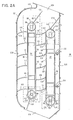
- FIG. 2A A preferred embodiment of the airlock, generally designated 80, of the present invention is shown in Fig. 2. As shown in Fig. 2A, it comprises a housing 82 containing a pair of revolving members 84, 86. Preferably, both members comprise continuous moving belts 88, 90.
- the zones of belts 88, 90 which face each other shall be referred to herein as transport zones or surfaces 92, 94.
- the opposite zones will be called return zones 96, 98.
- the transport zone surface 92, 94 of each belt is in spaced parallel relationship to that of the other belt.
- a plurality of non-porous flap means Projecting from one of the belts 88 is a plurality of non-porous flap means such as flaps 101-14.
- Each flap has a free edge 121-34 disposed outwardly or distally from the surface on which it is mounted. Each such free distal edge is capable of engaging a sealing means on the other belt 90.
- the sealing means comprises surface 94 of belt 90. At least one, but preferably both belts 88, 90 are driven by a drive means such as motor 136 represented in Fig. 3.
- Belts 88, 90 (Figs. 2-3) are borne on small diameter (about 2") rollers 151-54. These belts are suitably constructed of polyester, rubber impregnated fabric, EP Rubber, foamed EP Rubber (closed cell), any combination of the above, or other suitable nonporous materials.
- Each roller has a shaft 156-59 projecting through an elongated slot 161-164 (Fig. 2A) on front wall 170 (Fig. 3) and through another elongated slot 165-68 on back wall 172 (Fig. 3) of housing 82.
- shaft 156 is borne by bearing 181, in bearing mount 191.
- Each bearing mount 191 comprises four elongated slots 195-98 through which it is bolted to its housing wall 170 (Fig. 2), 172 (Fig. 3). In order to adjust belt tension (Fig. 2), bolts 201-04 are loosened slightly and adjustment screw 220 is tightened or loosened as needed. Such bearing mounts 191 are provided at both ends of all four shafts 156-59, for a total of eight adjustable bearing mounts 191 (Fig. 3).
- Drive means such as motor 136 (Fig. 3), drives shafts 156, 159, rollers 151, 154 and both belts 88, 90 at substantially the same surface speed, so that transport surfaces 92, 94 (Fig. 2A) have substantially the same velocity.
- belt 88 In operation, belt 88, revolving clockwise, rotates its flap 101 around roller 151 as freely falling tobacco falls upon flaps 101, 102 from the low pressure airflow zone at intake 224. Flap 102 is shown in a position in which it will carry a charge of tobacco and in which its edge 122 forms a somewhat airtight seal against belt surface 94.
- flaps 102-7, belts 88, 90 and walls 170, 172 form a series of chambers, each transporting a charge of tobacco towards discharge 226.
- the plurality of flaps 102-7 provides a series of low pressure differential isolation chambers which collectively are able to isolate a pressure differential equal to the sum of the pressure capacity of all the individual chambers.
- the area of the belt surfaces which are in spaced parallel relationship is dictated by the volume and number of chambers desired to be transporting tobacco at any given moment. These, in turn, are functions of pressure differential, designed capacity, belt width, flap area, belt speed, sealing ability of each individual chamber, and possibly other factors such as cost or available space.
- pressure differentials from one inch up to about 20 inches of water are accommodated, moving about two-thirds of a cubic foot of material per minute -- about 10 to 15 pounds per minute of tobacco.
- Flap height is about 4 to no more than 6 inches.
- Belt speed is 10 to 20 feet per minute.
- Belt width is 2 feet. Spacing between flaps is about 6 inches.
- Belt length is dictated by pressure drop and by space limitations, and is presently less then 3 feet from roller to roller.
- each roller 151, 152 should be less than the height of each flap from the surface of its belt.
- the arcs 173, 174 formed by belts 88-90 extend 90° to either side of nadirs 175, 176.
- Airflow is sealed off on the return zone of belt 90 by a return sealing means comprising a plurality of flexible flaps 231-33 mounted on wall 235.
- a lateral sealing means associated therewith.
- Such lateral sealing means preferably comprises a back membrane 248 associated with lateral edges 240, 242 and a front membrane 249 associated with lateral edges 244, 246 of belts 88, 90 and flaps 101-14.
- Each membrane is in fluid communication on its outside with the higher of the two ambient pressures, on either the intake or discharge of the airlock.
- the membranes are preferably constructed of a tough pliable polymer such as polyethylene.
- the outside of the membranes may be left open to the ambient atmosphere, as by vents 261-64 through walls 170-172.
- the pressure differential between the atmosphere and the intake air wall press the membrane into sealing contact with the lateral edges of the belts and flaps. Where pressure differentials across the edges are high, sealing force will also be relatively high, and where pressure differentials are low, sealing forces will be less. Therefore, the pressure differential across the membrane will vary as needed for sealing in a way that minimizes the forces of drag and wear between membrane and edges.
- Membranes 248, 249 are designed to be easily replaced, and, by their nature, they self-adjust their positions to compensate for edge wear.
- the airlock of the present invention is more gentle than existing airlocks, but there is still some friction between membranes 248, 249 and the tobacco passing along such membranes.
- Fig. 4 shows a further refinement which substantially eliminates any relative motion between the tobacco and the surfaces in contact with the tobacco.
- a plurality of elongated cylindrical flexible fingers 300-450 protrude out from and at substantially right angles to the surface of belt 88. They project from the edges of belt 88 in one or more rows, preferably two or three parallel staggered rows in close contact with each other as in Fig. 5.
- fingers 390-430 project from transport surface 92 of belt 88, their soft sides abut each other and form an effective sidewall at both the back lateral edge 240 (Fig. 3) and front lateral edge 244 (Figs. 3 & 5) of belt 88.
- the distal end of each of these transport side fingers 390-430 (Fig. 4) is stiffened by its frictional contact with transport surface 94.
- the fingers cooperate with the transport side flaps 102-107 (Figs.
- Fig. 6 illustrates a typical environment in which the present invention would be useful.
- Particulates such as tobacco 500 after one stage of treatment, are dropped from a conveyor 502 into a chute 504.
- Chute 504 is in fluid communication with exhaust fan 506, which draws air through the system and maintains lower air pressure at the fan's intake.
- vent holes 516 are provided along the outside circumference of the turn. Air jets 517 from these vent holes or nozzles prevent tobacco from hugging the outside wall of the turn due to centrifugal force. Such hugging would result in increased tobacco interaction with the wall and in resultant shread breakage.
- a chamber 518 is provided at the intended point of tobacco delivery.
- the cross sectional area of this chamber is much larger than that of ducting 512.
- chamber 518 serves as a large volume settling chamber. Air is drawn from the top region of chamber 518 towards fan 506, while tobacco settles to the bottom region of chamber 518.
- Airlock 80 is located at the bottom of chamber 518, in fluid communication with the bottom region.
- Tobacco lands on the flaps at the top of the airlock, such as flap 102, and is transported on the flap down to discharge 226 for delivery to the next processing step.
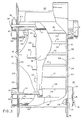
- Fig. 7 shows another variation of the invention.
- Particulates such as tobacco 600 are drawn entrained in high-velocity air through duct 602 into a conically shaped deceleration chamber 604.
- the far surface of chamber 604 comprises a rotating porous belt 606 with non-porous cleats or flaps 611-634 projecting perpendicularly to the belt.
- Behind the belt is a suction box 640 connected to exhaust blower 642.
- Air from duct 602 is directed towards, and sucked through, belt 606 into box 640.
- the tobacco entrained in the air is sucked against porous belt 606 where it remains.
- Belt 606 rotates downward until the free edge of flap 617 mates with the transport surface 644 of sealing belt 646, which cooperates with belt 606, and flaps 617-620 to form transport chambers 651-653.
- These chambers 651-653 transport the tobacco away from the influence of suction box 640, to an area where belt 606 is backed by a back-sealing means such as a flexible, plastic sealing flap 647.
- the tobacco falls from belt 606 and rests in its transport chamber 651-653, until belt 606 rounds roller 652 and swings flap 620 rapidly out from under the tobacco to the position of flap 621.
- the unsupported tobacco falls through discharge 650 which delivers a relatively even supply of tobacco to a cigarette maker at a relatively surge-free rate.
- the inside surface of belt 606 is blasted by air-jet belt cleaner 654. This dislodges dust which is drawn off through duct 656.
- the clean porous belt 606 rotates around various rollers 661-663 back to position at flap 634.
Landscapes
- Engineering & Computer Science (AREA)
- Mechanical Engineering (AREA)
- Manufacturing Of Cigar And Cigarette Tobacco (AREA)
- Structure Of Belt Conveyors (AREA)
Applications Claiming Priority (2)
| Application Number | Priority Date | Filing Date | Title |
|---|---|---|---|
| US07/135,145 US4850749A (en) | 1987-12-18 | 1987-12-18 | Airlock having flaps in continuous feed of material carried by a gas stream while obstructing free flow of gas |
| US135145 | 1987-12-18 |
Publications (2)
| Publication Number | Publication Date |
|---|---|
| EP0321311A1 true EP0321311A1 (de) | 1989-06-21 |
| EP0321311B1 EP0321311B1 (de) | 1992-10-28 |
Family
ID=22466751
Family Applications (1)
| Application Number | Title | Priority Date | Filing Date |
|---|---|---|---|
| EP88312013A Expired EP0321311B1 (de) | 1987-12-18 | 1988-12-19 | Luftschleuse |
Country Status (5)
| Country | Link |
|---|---|
| US (1) | US4850749A (de) |
| EP (1) | EP0321311B1 (de) |
| AU (1) | AU615972B2 (de) |
| BR (1) | BR8806672A (de) |
| DE (1) | DE3875597T2 (de) |
Cited By (1)
| Publication number | Priority date | Publication date | Assignee | Title |
|---|---|---|---|---|
| FR2667799A1 (fr) * | 1990-10-11 | 1992-04-17 | Etude Realisation Tech Indle | Dispositif pour separer d'un flux d'air des dechets de papier et de carton. |
Families Citing this family (5)
| Publication number | Priority date | Publication date | Assignee | Title |
|---|---|---|---|---|
| US5049007A (en) * | 1990-03-12 | 1991-09-17 | Philip Morris Incorporated | Horizontal belt conveyor airlock |
| US9107453B2 (en) | 2011-01-28 | 2015-08-18 | R.J. Reynolds Tobacco Company | Tobacco-derived casing composition |
| US9192193B2 (en) | 2011-05-19 | 2015-11-24 | R.J. Reynolds Tobacco Company | Molecularly imprinted polymers for treating tobacco material and filtering smoke from smoking articles |
| US11641874B2 (en) | 2015-09-09 | 2023-05-09 | R.J. Reynolds Tobacco Company | Flavor delivery article |
| US11878879B1 (en) * | 2022-10-27 | 2024-01-23 | Daniel E. Crawford | Dry granular material transfer |
Citations (6)
| Publication number | Priority date | Publication date | Assignee | Title |
|---|---|---|---|---|
| US540155A (en) * | 1895-05-28 | Apparatus for collecting and conveying stemmed tobacco | ||
| GB206350A (en) * | 1922-10-27 | 1923-11-08 | George Frederick Zimmer | Improved means for delivering pneumatically conveyed grain and other material |
| DE490237C (de) * | 1928-02-07 | 1930-01-25 | Stotz Ag A | Fuer den Durchlass von Strangfoerderern bestimmte Schleuse |
| DE548111C (de) * | 1932-04-08 | Neuerburg Sche Verwaltungsgese | Vorrichtung zum Sichten des aus einer pneumatischen Loeseanlage kommenden Tabaks | |
| DE591577C (de) * | 1934-01-24 | Eduard Quester | Vorrichtung zum Sichten von Tabakblaettern | |
| US3991772A (en) * | 1973-01-05 | 1976-11-16 | Smitherm Industries, Inc. | Methods of and apparatus for expanding tobacco |
Family Cites Families (47)
| Publication number | Priority date | Publication date | Assignee | Title |
|---|---|---|---|---|
| US1571537A (en) * | 1922-01-30 | 1926-02-02 | Frederick H Berold | Tobacco-leaf-stemming machine |
| US1675090A (en) * | 1923-06-25 | 1928-06-26 | Henry J Burns | Pneumatic conveyer |
| US2003141A (en) * | 1932-12-14 | 1935-05-28 | Blaw Knox Co | Apparatus for separating granular material |
| US2163833A (en) * | 1934-10-13 | 1939-06-27 | Universelle Clgarettenmaschine | Apparatus for comminuting and classifying tobacco |
| US2173087A (en) * | 1935-07-31 | 1939-09-19 | Muller J C & Co | Tobacco sorting and separating machine |
| US2173088A (en) * | 1935-09-19 | 1939-09-19 | Muller J C & Co | Separating device |
| US2643768A (en) * | 1947-02-20 | 1953-06-30 | American Machine Dev Corp | Separating apparatus |
| US2667174A (en) * | 1947-11-28 | 1954-01-26 | American Machine Dev Corp | Apparatus and method for ripping and assorting tobacco leaves |
| US2701570A (en) * | 1948-09-25 | 1955-02-08 | American Machine Dev Corp | Apparatus for threshing and winnowing tobacco leaves |
| US2851146A (en) * | 1955-11-10 | 1958-09-09 | Reynolds Tobacco Co R | Apparatus for distributing cartons or the like |
| US2988213A (en) * | 1956-11-19 | 1961-06-13 | American Mach & Foundry | Tobacco separating apparatus |
| US3043315A (en) * | 1958-03-19 | 1962-07-10 | Mignot & De Block Nv | Tobacco threshing-winnowing machines |
| US3046998A (en) * | 1958-08-27 | 1962-07-31 | Vokes Ltd | Tobacco processing machinery |
| NL109688C (de) * | 1958-12-05 | |||
| US3116238A (en) * | 1961-10-02 | 1963-12-31 | Griffin Ind Inc | Centrifugal classifier |
| GB1077410A (en) * | 1964-12-24 | 1967-07-26 | Kurt Koerber | Apparatus for stripping and separating tobacco or other foliate materials |
| US3237753A (en) * | 1965-02-08 | 1966-03-01 | Harper Inc Allen | Elevator for fragile, discrete material |
| US3360125A (en) * | 1965-02-09 | 1967-12-26 | John B Adt Company | Tobacco-leaf separator |
| GB1062350A (en) * | 1965-03-18 | 1967-03-22 | Imp Tobacco Company | Method and apparatus for threshing leaves, e.g. tobacco leaves |
| DE1532063A1 (de) * | 1965-07-06 | 1970-01-08 | Hauni Werke Koerber & Co Kg | Verfahren und Anlage zum Verballen von Gruenballen |
| DE1532092B2 (de) * | 1965-11-03 | 1976-04-22 | Vorrichtung zum entrippen von tabakblaettern und sichten des erhaltenen gutes | |
| FR1483797A (fr) * | 1966-03-14 | 1967-06-09 | Seita | Dispositif pour réduire la section droite d'un flux |
| US3386773A (en) * | 1966-05-03 | 1968-06-04 | Brown & Williamson Tobacco Corp | Pneumatic feed system for cigarettemaking machines |
| GB1192177A (en) * | 1966-11-15 | 1970-05-20 | Molins Machine Co Ltd | Improvements in or relating to Apparatus for Continuously Feeding Cut Tobacco into a Cigarette-Making Machine |
| DE1532213A1 (de) * | 1966-12-09 | 1970-03-12 | Hauni Werke Koerber & Co Kg | Tabakverteiler mit Rippenabscheider |
| US3460869A (en) * | 1967-10-09 | 1969-08-12 | Joseph Stanley Herr | Air lock |
| US3608716A (en) * | 1969-01-27 | 1971-09-28 | Imp Tobacco Co Ltd | Recirculating pneumatic separator |
| DE1932312A1 (de) * | 1969-06-26 | 1971-01-21 | Hauni Werke Koerber & Co Kg | Vorrichtung zum pneumatischen Heraussichten von Tabakrippen aus einem Gemisch von Tabakblatteilen und Tabakrippen |
| US3881590A (en) * | 1971-01-22 | 1975-05-06 | Karl Hartmann | Elevator conveyor |
| GB1397726A (en) * | 1971-07-28 | 1975-06-18 | Molins Ltd | Tobacco feed systems |
| US3989309A (en) * | 1973-04-28 | 1976-11-02 | Imperial Group Limited | Apparatus for the distribution of loose fibrous material |
| US4009912A (en) * | 1974-11-04 | 1977-03-01 | Joseph Mraz | Pneumatic conveying apparatus and method |
| GB1504732A (en) * | 1975-02-01 | 1978-03-22 | Molins Ltd | Cigarette making machines |
| GB1556370A (en) * | 1975-10-16 | 1979-11-21 | Rothmans Of Pall Mall | Tobacco feeding system |
| US4166027A (en) * | 1976-11-03 | 1979-08-28 | Rader Companies, Inc. | Apparatus and method for pneumatically separating fractions of a particulate material |
| US4259032A (en) * | 1978-01-18 | 1981-03-31 | Rothmans Of Pall Mall Canada Limited | Air lock |
| US4250398A (en) * | 1978-03-03 | 1981-02-10 | Delphic Research Laboratories, Inc. | Solid state electrically conductive laminate |
| US4223685A (en) * | 1978-03-18 | 1980-09-23 | Molins Limited | Cigarette making machine hopper |
| DE2843673C2 (de) * | 1978-10-06 | 1986-10-16 | Hauni-Werke Körber & Co KG, 2050 Hamburg | Zellenradschleuse für eine pneumatische Tabakförderanlage |
| US4308876A (en) * | 1979-02-16 | 1982-01-05 | Airco, Inc. | Methods and apparatus for expanding tobacco |
| CA1136514A (en) * | 1979-07-10 | 1982-11-30 | Rothmans Of Pall Mall Canada Limited | Tobacco metering and feeding system |
| US4286910A (en) * | 1980-02-28 | 1981-09-01 | R. J. Reynolds Tobacco Company | Peristaltic valve for transferring material between zones |
| US4474511A (en) * | 1980-12-10 | 1984-10-02 | Molins Limited | Continuous tobacco feed |
| US4408619A (en) * | 1981-06-11 | 1983-10-11 | Philip Morris Incorporated | Vibratory pneumatic tobacco feeder |
| US4475562A (en) * | 1981-10-16 | 1984-10-09 | Philip Morris Incorporated | Method and apparatus for separating tobacco mixture into lighter and heavier fractions |
| CA1188952A (en) * | 1982-03-02 | 1985-06-18 | Rothmans Of Pall Mall Canada Limited | Tobacco lamina and stem processing |
| US4507876A (en) * | 1983-05-23 | 1985-04-02 | R. J. Reynolds Tobacco Company | End seal for rotary treating drum |
-
1987
- 1987-12-18 US US07/135,145 patent/US4850749A/en not_active Expired - Lifetime
-
1988
- 1988-12-16 AU AU27020/88A patent/AU615972B2/en not_active Ceased
- 1988-12-16 BR BR888806672A patent/BR8806672A/pt unknown
- 1988-12-19 EP EP88312013A patent/EP0321311B1/de not_active Expired
- 1988-12-19 DE DE8888312013T patent/DE3875597T2/de not_active Expired - Fee Related
Patent Citations (6)
| Publication number | Priority date | Publication date | Assignee | Title |
|---|---|---|---|---|
| US540155A (en) * | 1895-05-28 | Apparatus for collecting and conveying stemmed tobacco | ||
| DE548111C (de) * | 1932-04-08 | Neuerburg Sche Verwaltungsgese | Vorrichtung zum Sichten des aus einer pneumatischen Loeseanlage kommenden Tabaks | |
| DE591577C (de) * | 1934-01-24 | Eduard Quester | Vorrichtung zum Sichten von Tabakblaettern | |
| GB206350A (en) * | 1922-10-27 | 1923-11-08 | George Frederick Zimmer | Improved means for delivering pneumatically conveyed grain and other material |
| DE490237C (de) * | 1928-02-07 | 1930-01-25 | Stotz Ag A | Fuer den Durchlass von Strangfoerderern bestimmte Schleuse |
| US3991772A (en) * | 1973-01-05 | 1976-11-16 | Smitherm Industries, Inc. | Methods of and apparatus for expanding tobacco |
Cited By (1)
| Publication number | Priority date | Publication date | Assignee | Title |
|---|---|---|---|---|
| FR2667799A1 (fr) * | 1990-10-11 | 1992-04-17 | Etude Realisation Tech Indle | Dispositif pour separer d'un flux d'air des dechets de papier et de carton. |
Also Published As
| Publication number | Publication date |
|---|---|
| BR8806672A (pt) | 1989-08-29 |
| AU2702088A (en) | 1989-06-22 |
| DE3875597T2 (de) | 1993-05-13 |
| AU615972B2 (en) | 1991-10-17 |
| DE3875597D1 (de) | 1992-12-03 |
| US4850749A (en) | 1989-07-25 |
| EP0321311B1 (de) | 1992-10-28 |
Similar Documents
| Publication | Publication Date | Title |
|---|---|---|
| US3789587A (en) | Apparatus for separating material from a pneumatic conveyor | |
| US5669741A (en) | Device for separating powder material from an air flow | |
| US9480282B2 (en) | Feed device for linear airflow separator | |
| US5863155A (en) | Boundary air/laminar flow conveying system | |
| US5394893A (en) | Modular style multi-separator | |
| US6206175B1 (en) | Conveyor cleaning and air-borne residue control system | |
| US4850749A (en) | Airlock having flaps in continuous feed of material carried by a gas stream while obstructing free flow of gas | |
| US4226027A (en) | Material feed system for jet mills and flash dryers | |
| US3920542A (en) | Removal of green bolls and heavy materials from seed cotton by air jets | |
| GB2144967A (en) | Cigarette manufacture | |
| EP0004125A1 (de) | Vorrichtung zum Abscheiden von Teilchen aus Gasen | |
| US2932300A (en) | Cigarette machine | |
| US2681476A (en) | Process and apparatus for separating trash from lint cotton and the like | |
| CN108889623A (zh) | 一种烟丝打散风分机 | |
| US5049007A (en) | Horizontal belt conveyor airlock | |
| US6415474B1 (en) | Apparatus for transferring filter rods containing pulverulent, granular and analogous ingredients | |
| US4128404A (en) | Method for separating light-weight compressible material | |
| US5147593A (en) | Method to prepare extruded particles by breaking with an air stream | |
| US3514159A (en) | Apparatus for continuously feeding cut tobacco into a cigarette-making machine | |
| JPH07184625A (ja) | 紙巻たばこ製造機の刻たばこ給送装置 | |
| JPH091460A (ja) | ショット除去装置 | |
| CN208555006U (zh) | 烟丝梗签结团分离机 | |
| US6454098B1 (en) | Mechanical-pneumatic device to meter, condition, and classify chaffy seed | |
| CN222361614U (zh) | 一种气力输灰系统的管道防堵结构 | |
| US5083577A (en) | Apparatus for metering tobacco |
Legal Events
| Date | Code | Title | Description |
|---|---|---|---|
| PUAI | Public reference made under article 153(3) epc to a published international application that has entered the european phase |
Free format text: ORIGINAL CODE: 0009012 |
|
| AK | Designated contracting states |
Kind code of ref document: A1 Designated state(s): CH DE GB IT LI NL |
|
| 17P | Request for examination filed |
Effective date: 19891114 |
|
| 17Q | First examination report despatched |
Effective date: 19910614 |
|
| GRAA | (expected) grant |
Free format text: ORIGINAL CODE: 0009210 |
|
| AK | Designated contracting states |
Kind code of ref document: B1 Designated state(s): CH DE GB IT LI NL |
|
| REF | Corresponds to: |
Ref document number: 3875597 Country of ref document: DE Date of ref document: 19921203 |
|
| ITF | It: translation for a ep patent filed | ||
| PGFP | Annual fee paid to national office [announced via postgrant information from national office to epo] |
Ref country code: CH Payment date: 19921204 Year of fee payment: 5 |
|
| PGFP | Annual fee paid to national office [announced via postgrant information from national office to epo] |
Ref country code: GB Payment date: 19921211 Year of fee payment: 5 |
|
| PGFP | Annual fee paid to national office [announced via postgrant information from national office to epo] |
Ref country code: DE Payment date: 19921230 Year of fee payment: 5 |
|
| PGFP | Annual fee paid to national office [announced via postgrant information from national office to epo] |
Ref country code: NL Payment date: 19921231 Year of fee payment: 5 |
|
| PLBE | No opposition filed within time limit |
Free format text: ORIGINAL CODE: 0009261 |
|
| STAA | Information on the status of an ep patent application or granted ep patent |
Free format text: STATUS: NO OPPOSITION FILED WITHIN TIME LIMIT |
|
| 26N | No opposition filed | ||
| PG25 | Lapsed in a contracting state [announced via postgrant information from national office to epo] |
Ref country code: GB Effective date: 19931219 |
|
| PG25 | Lapsed in a contracting state [announced via postgrant information from national office to epo] |
Ref country code: LI Effective date: 19931231 Ref country code: CH Effective date: 19931231 |
|
| PG25 | Lapsed in a contracting state [announced via postgrant information from national office to epo] |
Ref country code: NL Effective date: 19940701 |
|
| NLV4 | Nl: lapsed or anulled due to non-payment of the annual fee | ||
| GBPC | Gb: european patent ceased through non-payment of renewal fee |
Effective date: 19931219 |
|
| REG | Reference to a national code |
Ref country code: CH Ref legal event code: PL |
|
| PG25 | Lapsed in a contracting state [announced via postgrant information from national office to epo] |
Ref country code: DE Effective date: 19940901 |
|
| PG25 | Lapsed in a contracting state [announced via postgrant information from national office to epo] |
Ref country code: IT Free format text: LAPSE BECAUSE OF NON-PAYMENT OF DUE FEES;WARNING: LAPSES OF ITALIAN PATENTS WITH EFFECTIVE DATE BEFORE 2007 MAY HAVE OCCURRED AT ANY TIME BEFORE 2007. THE CORRECT EFFECTIVE DATE MAY BE DIFFERENT FROM THE ONE RECORDED. Effective date: 20051219 |