EP0321397A2 - Stuff compositions based on tetrachloroisoindolinone pigments - Google Patents
Stuff compositions based on tetrachloroisoindolinone pigments Download PDFInfo
- Publication number
- EP0321397A2 EP0321397A2 EP88810814A EP88810814A EP0321397A2 EP 0321397 A2 EP0321397 A2 EP 0321397A2 EP 88810814 A EP88810814 A EP 88810814A EP 88810814 A EP88810814 A EP 88810814A EP 0321397 A2 EP0321397 A2 EP 0321397A2
- Authority
- EP
- European Patent Office
- Prior art keywords
- formula
- compound
- group
- oder
- hydrogen
- Prior art date
- Legal status (The legal status is an assumption and is not a legal conclusion. Google has not performed a legal analysis and makes no representation as to the accuracy of the status listed.)
- Granted
Links
Classifications
-
- C—CHEMISTRY; METALLURGY
- C09—DYES; PAINTS; POLISHES; NATURAL RESINS; ADHESIVES; COMPOSITIONS NOT OTHERWISE PROVIDED FOR; APPLICATIONS OF MATERIALS NOT OTHERWISE PROVIDED FOR
- C09B—ORGANIC DYES OR CLOSELY-RELATED COMPOUNDS FOR PRODUCING DYES, e.g. PIGMENTS; MORDANTS; LAKES
- C09B67/00—Influencing the physical, e.g. the dyeing or printing properties of dyestuffs without chemical reactions, e.g. by treating with solvents grinding or grinding assistants, coating of pigments or dyes; Process features in the making of dyestuff preparations; Dyestuff preparations of a special physical nature, e.g. tablets, films
- C09B67/0033—Blends of pigments; Mixtured crystals; Solid solutions
-
- C—CHEMISTRY; METALLURGY
- C09—DYES; PAINTS; POLISHES; NATURAL RESINS; ADHESIVES; COMPOSITIONS NOT OTHERWISE PROVIDED FOR; APPLICATIONS OF MATERIALS NOT OTHERWISE PROVIDED FOR
- C09B—ORGANIC DYES OR CLOSELY-RELATED COMPOUNDS FOR PRODUCING DYES, e.g. PIGMENTS; MORDANTS; LAKES
- C09B67/00—Influencing the physical, e.g. the dyeing or printing properties of dyestuffs without chemical reactions, e.g. by treating with solvents grinding or grinding assistants, coating of pigments or dyes; Process features in the making of dyestuff preparations; Dyestuff preparations of a special physical nature, e.g. tablets, films
- C09B67/0033—Blends of pigments; Mixtured crystals; Solid solutions
- C09B67/0034—Mixtures of two or more pigments or dyes of the same type
-
- C—CHEMISTRY; METALLURGY
- C09—DYES; PAINTS; POLISHES; NATURAL RESINS; ADHESIVES; COMPOSITIONS NOT OTHERWISE PROVIDED FOR; APPLICATIONS OF MATERIALS NOT OTHERWISE PROVIDED FOR
- C09B—ORGANIC DYES OR CLOSELY-RELATED COMPOUNDS FOR PRODUCING DYES, e.g. PIGMENTS; MORDANTS; LAKES
- C09B57/00—Other synthetic dyes of known constitution
- C09B57/04—Isoindoline dyes
Definitions
- the invention relates to compositions of matter containing a bis (tetrachlorisoindolinone) pigment and a sulfonated isoindolinone compound, and to their use for dyeing high molecular weight organic material.
- tetrachlorisoindolinone pigments which have long been used for coloring high molecular weight organic material (see e.g. U.S. Pat. No. 3,076,815 and U.S. Pat. No. 3,758,497), do not always meet the requirements of modern technology, particularly with regard to their rheological behavior.
- any substituents are halogen, they are e.g. around fluorine, preferably bromine and especially chlorine.
- R or R ' is C 1 -C 4 alkyl, it means, for example, methyl, ethyl, n-propyl, isopropyl, n-butyl, sec-butyl or tert-butyl. Methyl is preferred.
- R and R ' represent as C 1 -C 4 alkoxy, for example methoxy, ethoxy, n-propoxy, n-butoxy, or sec-butoxy. Methoxy is preferred.
- a and A ' preferably represent a phenylene group of the formula
- a and A ' represent, for example, the unsubstituted p- or m-phenylene group or the 2-chloro-1,4-phenylene, 2-methyl-1,4-phenylene, 2-ethyl-1,4-phenylene -, 2-n-propyl-1,4-phenylene, 2-isopropyl-1,4-phenylene, 2-tert-butyl-1,4-phenylene, 2-methoxy-1,4-phenylene , 2-ethoxy-1,4-phenylene, 2-tert-butoxy-1,4-phenylene, 2,5-dichloro-1,4-phenylene, 2,5-dimethyl-1,4-phenylene -, 2,5-diethyl-1,4-phenylene, 2,5-dimethoxy-1,4-phenylene, 2,5-diethoxy-1,4-phenylene, 2-chloro-5-methyl 1,4-phenylene, 2-chloro-5-methoxy-1,4-phenylene
- it is the unsubstituted 4,4'-biphenylylene group, or the 3,3'-dichloro, 3,3'-dimethyl, 3,3'-diethyl, 3,3'-diisopropyl, 3 , 3'-di-n-butyl-, 3,3'-di-tert-butyl-, 3,3'-di-methoxy-, 3,3'-diethoxy-, 3,3'-di-tert .
- biphenylylene derivatives for example, it is optionally substituted according to the abovementioned biphenylylene derivatives, but is preferably unsubstituted p, p'-diphenylylene ether, p, p'-diphenylylene sulfide, p, p'-diphenylylene sulfone, p, p'- Diphenylylene-azo-, diphenylylene-methane, p, p'-diphenylylene-ethene, p, p'-diphenylylene-dioxy-methane, p, p'-diphenylylene-dioxy-benzene, p, p'-diphenylylene carbamide, p, p'-diphenylylene urea or p, p'-diphenylylene dicarbamyl hydrazine groups.
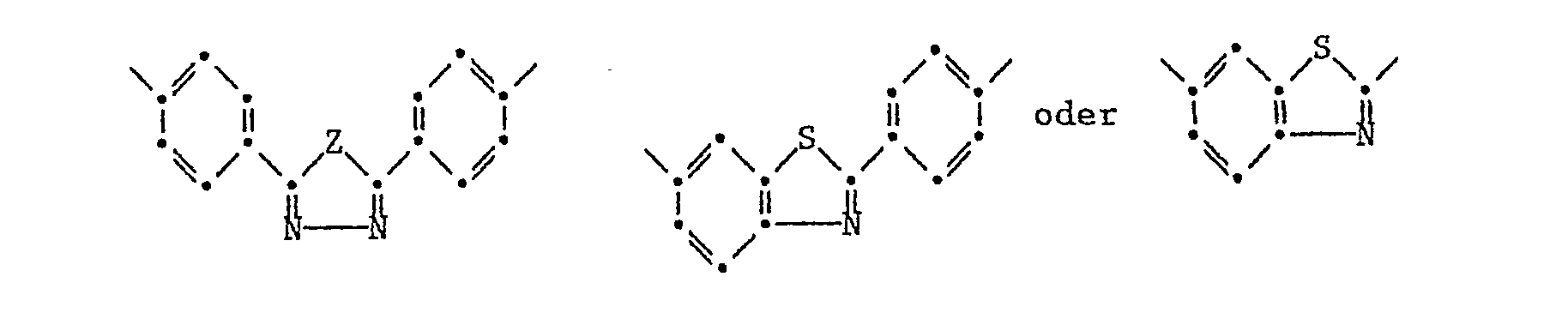
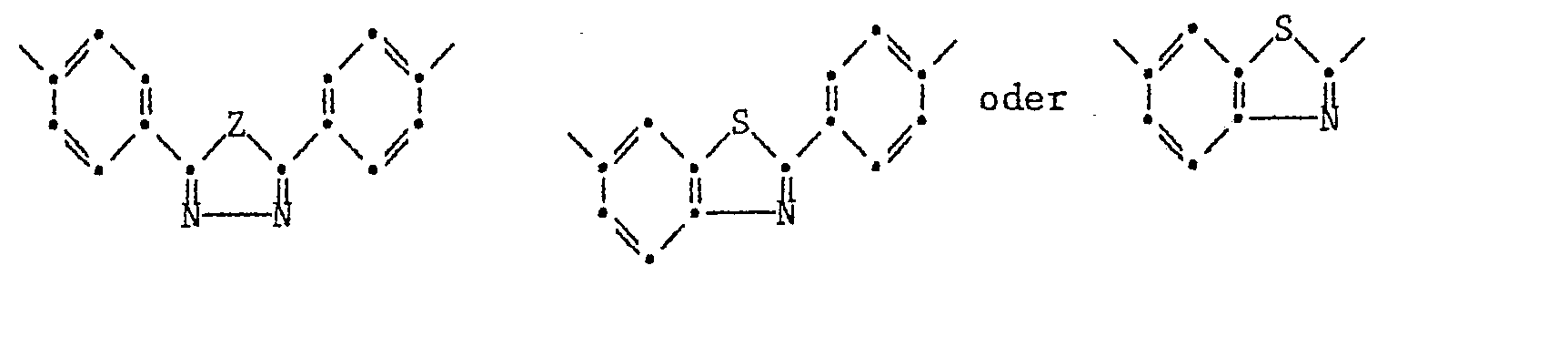
- a and A 'mean e.g. optionally substituted but preferably unsubstituted 1,4-, 1,5- or 2,6-naphthylene, 1,5-anthraquinodiyl, 1,4-anthraquinonediyl, 2,6-pyridinediyl, 2,7-carbazole diyl, optionally substituted according to the biphenylylene derivatives mentioned above, 2,8-dibenzofurandiyl, 3,8-dibenzofurandiyl, 3,7-dibenzofurandiyl, 6,4 '- (2-phenyl) -benzthiazolidyl, 2,6-benzothiazole-diyl, 4', 4 "- (2,5-bisphenyl) -oxadiazole diyl or 4 ', 4 "- (2,5-bisphenyl) thiadiazole diyl.
- -ET represents one of the following groups
- X ⁇ is preferably H ⁇ or in particular a group of the formula
- X ⁇ represents a group of the formula
- substituents are C 1 -C 18 -alkyl, these are, for example, methyl, ethyl, n-propyl, isopropyl, n-butyl, sec-butyl, tert-butyl, n-pentyl, tert-pentyl , Hexyl, heptyl, octyl, decyl, dodecyl, tetradecyl, hexadecyl, heptadecyl or octadecyl.
- R 1 , R 2 , R 3 and R 4 are C 5 -C 6 cycloalkyl, then it is, for example, cyclopentyl or in particular to cyclohexyl.
- R 1 , R 2 , R 3 and R 4 are preferably phenyl substituted by C 12 -C 18 alkyl.
- N ⁇ (R 1 ) (R 2 ) (R 3 ) (R 4 ) are: N ⁇ H 4 , N ⁇ H 3 CH 3 , N ⁇ H 2 (CH 3 ) 2 , N ⁇ H 3 C 2 H 5 , N ⁇ H 2 (C 2 H 5 ) 2 , N ⁇ H 3 C 3 H 7 -iso, N ⁇ H 3 -cyclohexyl, N 9 H 2 - (cyclohexyl) 2 , N ⁇ H 2 ( CH 3 ) (C 6 H 5 ), N ⁇ H 3 C 6 H 5 , N ⁇ H 3 -p-octadecylphenyl and N ⁇ (CH 3 ) 4 .
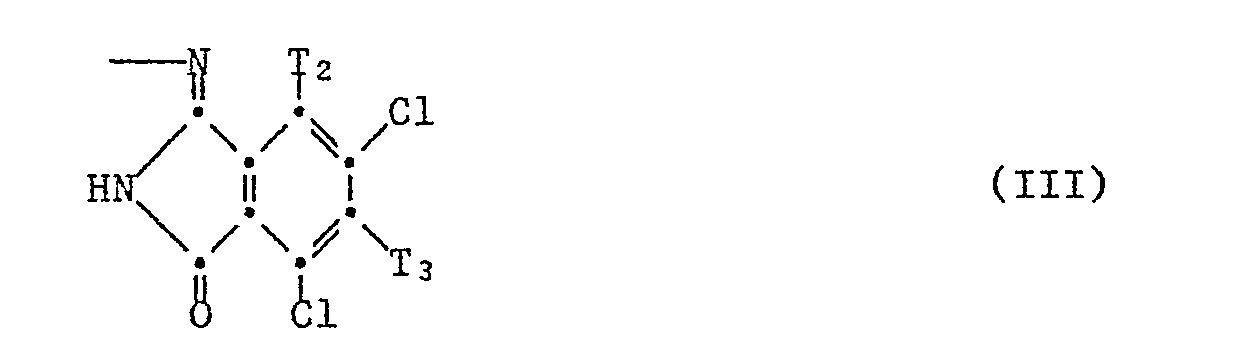
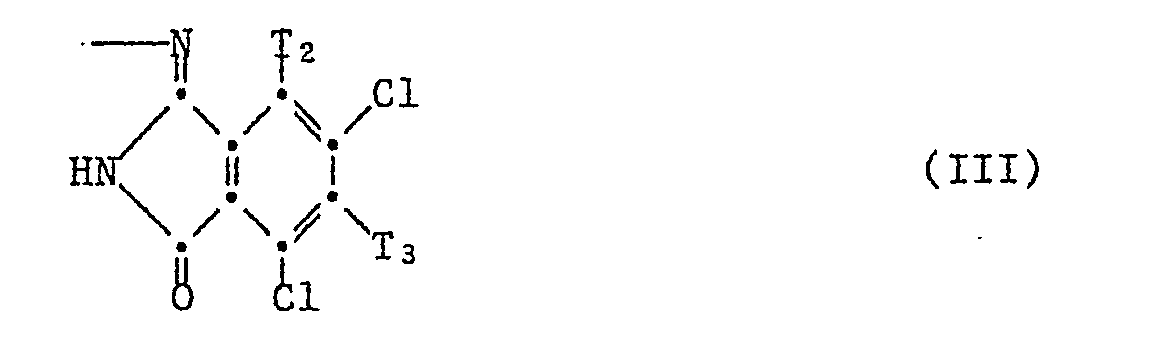
- D is preferably a group of the formula III.
- E preferably means -O-.
- Ti and T 2 are preferably chlorine and T 3 is a group -ET '.
- T ' preferably denotes a group of the formula and Y is hydrogen.
- the tetrachlorisoindolinone pigments of the formula 1 are known and can be prepared by known methods.
- the compounds of formula II are new and represent a further subject of the invention. They are preferably obtained in analogy to processes known per se, for example by reacting lower alkyl 3,4,5,6-tetrachloro-2-cyanobenzoate methyl ester, with an alkali salt of a compound of the formulas
- a hydrophilic organic solvent e.g. an amide such as dimethylformamide, dimethylacetamide, N-methylpyrrolidone, a ketone such as acetone or methyl ethyl ketone or a sulfoxide such as dimethyl sulfoxide (see e.g. U.S. Patent 3,884,955) and subsequent condensation of the product so obtained with an amine of the formula
- a 'and D have the meaning given above, in a molar ratio of 1: 1 or 2: 1, with the exclusion of water, in a polar organic solvent, preferably methanol, ethanol or isopropanol, and in the presence of a base, such as sodium methylate or sodium ethylate , and optionally by subsequent reaction with a salt X ⁇ L ⁇ , wherein X O is one of the groups or N ⁇ (R 1 ) (R 2 ) (R 3 ) (R 4 ) with the meaning given above and L ⁇ zB is a hydroxy, chloride, acetate or nitrate ion.
- component a) is expediently first conditioned by conventional methods and suspended in water.
- Component b) is generally added as free sulfonic acid and the salt X ⁇ L ⁇ is added for precipitation. It is also possible to mix component b) directly in salt form in an aqueous suspension with component a).
- component b) is preferably added after component a) has been conditioned. Conditioning is the production of a fine particle shape, for example by alkaline reprecipitation, dry grinding with or without salt, solvent or aqueous grinding or Salt kneading.
- texture-improving agents to the pigment before or after the conditioning process in addition to the addition of component b) according to the invention.
- fatty acids with at least 18 carbon atoms for example stearic or behenic acid or their amides or metal salts, in particular Mg salts, and plasticizers, waxes, resin acids, such as abietic acid, rosin soap, alkylphenols or aliphatic alcohols, such as stearyl alcohol or vicinal diols , such as dodecanediol-1,2, furthermore modified rosin maleinate resins or fumaric acid rosin resins.
- the texture-improving agents are preferably added in amounts of 0.1-30% by weight, in particular 2-15% by weight, based on the end product.
- compositions according to the invention are suitable as pigments for coloring high molecular weight organic material.
- High molecular weight organic materials which can be colored or pigmented with the substance compositions according to the invention are e.g. Cellulose ethers and esters, such as ethyl cellulose, nitrocellulose, cellulose acetate or cellulose butyrate, natural resins or synthetic resins, such as polymerization resins or condensation resins, such as aminoplasts, in particular urea and melamine-formaldehyde resins, alkyd resins, phenoplasts, polycarbonates, polyolefins, polystamides, polyvinyl chloride , Polyester, rubber, casein, silicone and silicone resins, individually or in mixtures.
- Cellulose ethers and esters such as ethyl cellulose, nitrocellulose, cellulose acetate or cellulose butyrate
- natural resins or synthetic resins such as polymerization resins or condensation resins, such as aminoplasts, in particular urea and melamine-formaldehyde resins, alkyd resins
- High molecular weight organic materials in dissolved form as film formers are also possible, such as Linseed oil varnish, nitrocellulose, alkyd resins, phenolic resins, melamine resins, acrylic resins and urea-formaldehyde resins.
- the high-molecular organic compounds mentioned can be present individually or in mixtures as plastic compositions, melts or in the form of spinning solutions, lacquers, paints or printing inks. Depending on the intended use, it proves to be advantageous to use the substance compositions according to the invention as toners or in the form of preparations. Based on the high molecular weight organic material to be pigmented, the substance compositions according to the invention can be used in an amount of 0.01 to 30% by weight, preferably 0.1 to 10% by weight.
- the pigmentation of the high molecular weight organic substances with the compositions according to the invention takes place, for example, in such a way that such a composition, if appropriate in the form of masterbatches, is added to these substrates using rolling mills, mixing or grinding apparatus.
- the pigmented material is then brought into the desired final shape by methods known per se, such as calendering, pressing, extrusion, brushing, casting or injection molding.
- plasticizers are often desirable to incorporate so-called plasticizers into the high-molecular compounds before the molding in order to produce non-rigid moldings or to reduce their brittleness.
- Esters of phosphoric acid, phthalic acid or sebacic acid are used.
- the plasticizers can be incorporated into the polymers before or after the incorporation of the compositions according to the invention. It is also possible to add fillers or other coloring constituents, such as white, colored or black pigments, to the high molecular weight, organic substances in addition to the substance compositions according to the invention in order to achieve different colors.
- the high molecular weight organic materials and the compositions of the invention if appropriate together with additives, such as fillers, other pigments, siccatives or plasticizers, are finely dispersed or dissolved in a common organic solvent or solvent mixture.
- additives such as fillers, other pigments, siccatives or plasticizers
- the dyeings obtained are distinguished by good general properties, such as good dispersibility, high transparency, good resistance to overcoating, migration, heat, light and weather, and freedom from distortion in plastics.
- the substance compositions according to the invention have improved rheology, lower separation effects, such as floating when white pigments are used, and less tendency to flocculate.
- compositions according to the invention are preferably suitable for dyeing aqueous and / or solvent-based paints, in particular automotive paints. Their use for metallic effect coatings is very particularly preferred.
- the product still contains 20% - 30% table salt.
- the corresponding calcium salt is obtained as follows: 2 g of the sodium salt obtained as described above are heated in 150 ml of water to 70-80 ° C. and mixed with an aqueous solution of 3 g of calcium chloride. The precipitate is filtered off, washed with a little water and dried. 1 g of the dye of the formula V is obtained
Landscapes
- Chemical & Material Sciences (AREA)
- Organic Chemistry (AREA)
- Chemical Kinetics & Catalysis (AREA)
- Compositions Of Macromolecular Compounds (AREA)
- Indole Compounds (AREA)
- Plural Heterocyclic Compounds (AREA)
- Inks, Pencil-Leads, Or Crayons (AREA)
Abstract
Stoffzusammensetzung enthaltend
- a) eine Verbindung der Formel I
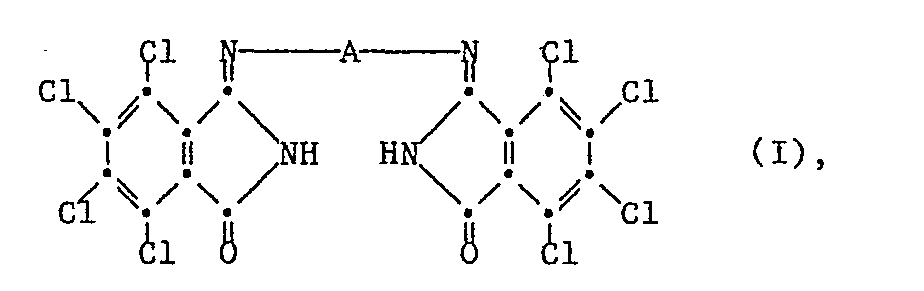
- worin A eine der Gruppen der Formeln
- EMI ID=24/2 HE=85 WI=140 TI=CHE
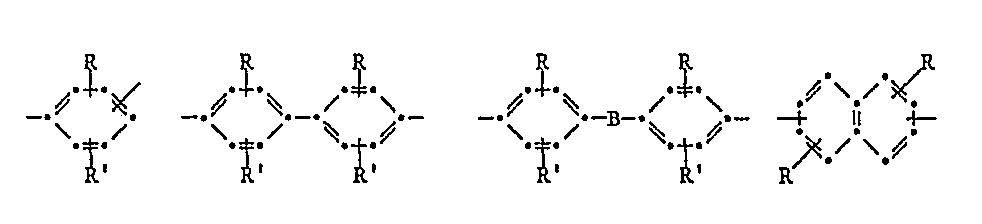

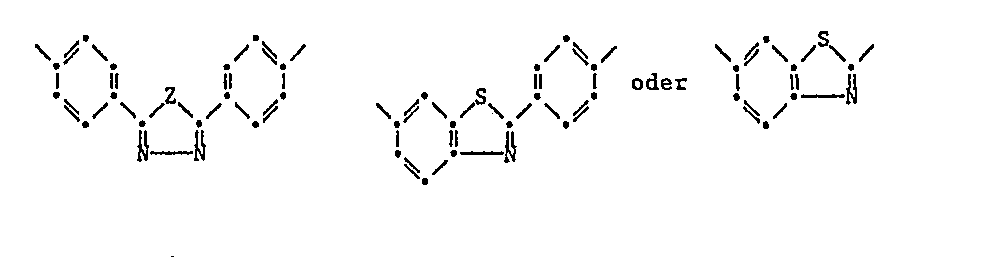
- ist, worin B -O-, -S-, -S02-, -N=N-, -CH2-, -CH=CH-, -O-CH2-O-,

- -CONH-. -NHCONH- oder -CONHNHCO-, Q -O- oder -NH-und Z -O- oder -S- bedeuten und Rund R' unabhängig voneinander Wasserstoff, Halogen, C1-C4-Alkyl, C1-C4-Al- koxy oder Phenoxy sind, und
- b) eine Verbindung der Formel II
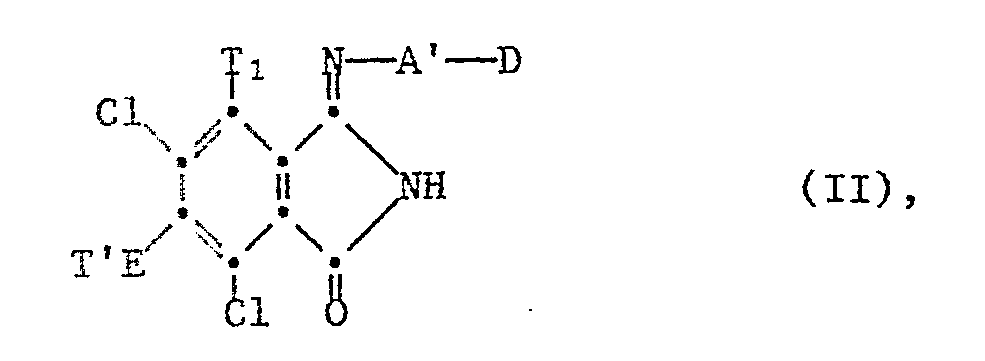
- worin A' die oben für A angegebene Bedeutung hat, D Wasserstoff, Amino oder eine Gruppe der Formel III
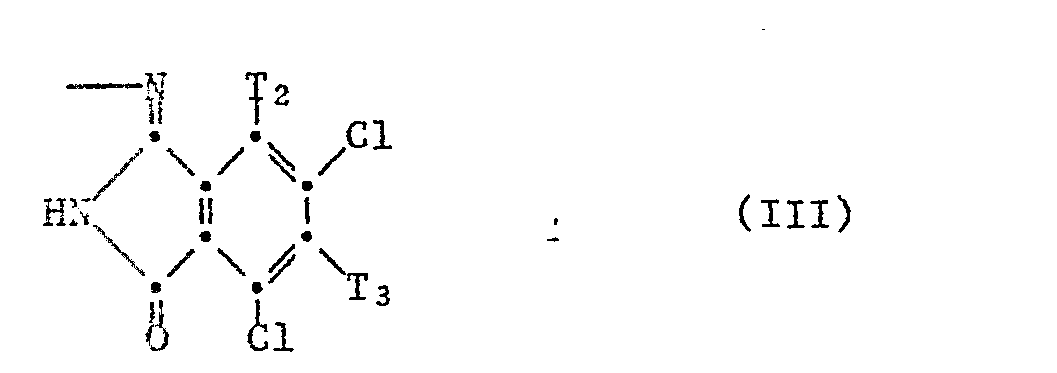
- bedeutet, E -O- oder -S- ist, T1, T2 und T3 unabhängig voneinander Chlor oder eine Gruppe -ET' bedeuten, T' eine der Gruppen der Formeln

- ist. X⊕H⊕ oder eine Gruppe der Formeln
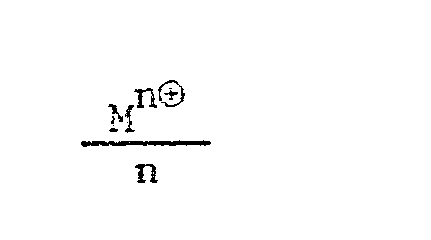
- oder N⊖=(R1)(R2)(R3)(R4) darstellt, Mn⊕ ein n-wertiges Metalikation, n die Zahlen 1, 2 oder 3, R1, R2, Rs, R4 unabhängig voneinander Wasserstoff, Ci-C18-Alkyl, C5-C6-Cycloalkyl, unsubstituiertes oder durch C1-C18-Alkyl substituiertes Phenyl bedeuten oder Rs und R4 zusammen mit dem N-Atom einen Pyrrolidin-, Imidazolidin-, Piperidin-, Piperazin- oder Morpholinrest, oder R2, R3 und R4 zusammen mit dem N-Atom einen Pyrrol-, Pyridin-, Picolin-, Pyrazin-, Chinolin- oder Isochinolinrest bilden und Y Wasserstoff, Halogen, Methyl, Methoxy oder Amino bedeutet.
- worin A' die oben für A angegebene Bedeutung hat, D Wasserstoff, Amino oder eine Gruppe der Formel III
- a) a compound of formula I.
- where A is one of the groups of the formulas
- EMI ID = 24/2 HE = 85 WI = 140 TI = CHE
- where B is -O-, -S-, -S0 2 -, -N = N-, -CH 2 -, -CH = CH-, -O-CH2-O-,
- -CONH-. -NHCONH- or -CONHNHCO-, Q is -O- or -NH- and Z is -O- or -S- and R is independently hydrogen, halogen, C 1 -C 4 -alkyl, C 1 -C 4 - Are alkoxy or phenoxy, and
- b) a compound of formula II
- wherein A 'has the meaning given above for A, D is hydrogen, amino or a group of the formula III
- means E is -O- or -S-, T 1 , T 2 and T 3 independently of one another are chlorine or a group -ET ', T' is one of the groups of the formulas
- is. X ⊕ H ⊕ or a group of the formulas
- or N ⊖ = (R 1 ) (R 2 ) (R 3 ) (R 4 ), M n⊕ is an n-valent metalation, n is the number 1, 2 or 3, R 1 , R 2 , Rs, R 4 independently of one another are hydrogen, Ci-C 18 alkyl, C 5 -C 6 cycloalkyl, unsubstituted or substituted by C 1 -C 18 alkyl or Rs and R 4 together with the N atom represent a pyrrolidine, imidazolidine, Piperidine, piperazine or morpholine residue, or R 2 , R 3 and R 4 together with the N atom form a pyrrole, pyridine, picoline, pyrazine, quinoline or isoquinoline residue and Y is hydrogen, halogen, methyl, methoxy or amino means.
- wherein A 'has the meaning given above for A, D is hydrogen, amino or a group of the formula III
Pigmentgemische dieser Art zeichnen sich insbesondere bei ihrer Anwendung in Lacken vor allem durch erhöhte Farbstärke und hohen Glanz und ganz besonders durch verbesserte Rheologie aus.Pigment mixtures of this type are particularly notable for their use in paints, in particular in terms of their increased color strength and high gloss, and very particularly their improved rheology.
Description
Die Erfindung betrifft Stoffzusammensetzungen enthaltend ein Bis-(tetrachlorisoindolinon)-pigment und eine sulfonierte Isoindolinon-verbindung, sowie ihre Verwendung zum Färben von hochmolekularem organischem Material.The invention relates to compositions of matter containing a bis (tetrachlorisoindolinone) pigment and a sulfonated isoindolinone compound, and to their use for dyeing high molecular weight organic material.
Die Tetrachlorisoindolinonpigmente, die schon lange zum Färben von hochmolekularem organischem Material eingesetzt werden (vgl. z.B. US-PS 3 076 815 und US-PS 3 758 497), erfüllen, insbesondere bezüglich ihres rheologischen Verhaltens, nicht immer die Erfordernisse der modernen Technik.The tetrachlorisoindolinone pigments, which have long been used for coloring high molecular weight organic material (see e.g. U.S. Pat. No. 3,076,815 and U.S. Pat. No. 3,758,497), do not always meet the requirements of modern technology, particularly with regard to their rheological behavior.
Es wurde nun gefunden, dass durch Zusatz von bestimmten sulfonierten -Indolinon-verbindungen zu Bis-(tetrachlorisoindolinon)-pigmenten das rheologische Verhalten der letzteren überraschend verbessert wird.It has now been found that the addition of certain sulfonated indolinone compounds to bis (tetrachlorisoindolinone) pigments surprisingly improves the rheological behavior of the latter.
Die vorliegende Erfindung betrifft demnach eine Stoffzusammensetzung enthaltend
- a) ein Isoindolinonpigment der Formel I

- worin A eine Gruppen der Formeln


- ist, worin B -O-, -S-, -S02-, -N = N-, -CH2-, -CH = CH-, -0-CH2-0-,

- -CONH-, -NHCONH- oder -CONHNHCO-, Q -O- oder -NH-und Z -0- oder -S- bedeuten und R und R' unabhängig voneinander Wasserstoff, Halogen, C1-C4-Alkyl, C1-C4-Alkoxy oder Phenoxy sind, und
- worin A eine Gruppen der Formeln
- b) eine Verbindung der Formel II

- worin A' die oben für A angegebene Bedeutung hat, D Wasserstoff, Amino oder eine Gruppe der Formel III
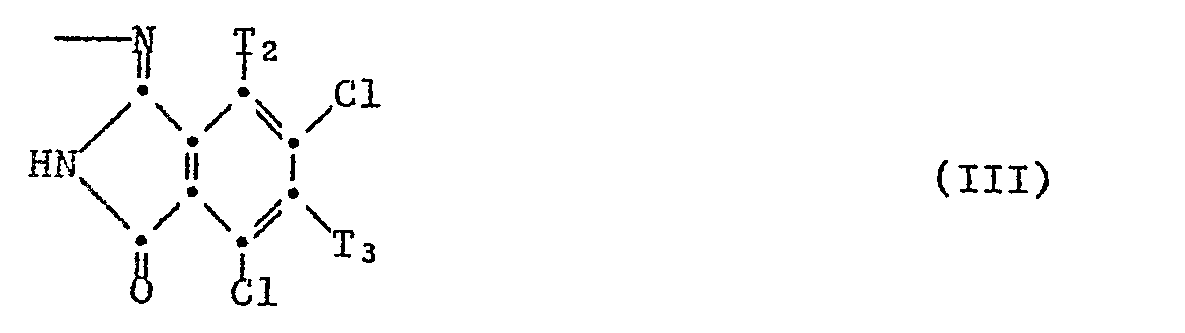
- bedeutet, E -0- oder -S- ist, Ti, T2 und T3 unabhängig voneinander Chlor oder eine Gruppe -ET' bedeuten, T' eine der Gruppen der Formeln

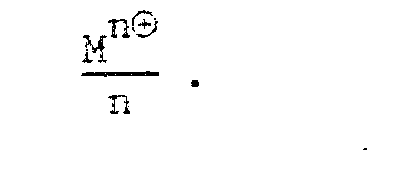
- ist, X⊕ H⊕ oder eine Gruppe der Formeln

- oder N⊕(R1)(R2)(R3)(R4) darstellt, Mn⊕ ein n-wertiges Metallkation, n die Zahlen 1, 2 oder3, R1, R2, R3, R4 unabhängig voneinander Wasserstoff, C1-C18-Alkyl, C5-C6-Cycloalkyl, unsubstituiertes oder durch C1-C18-Alkyl substituiertes Phenyl bedeuten oder R3 und R4 zusammen mit dem N-Atom einen Pyrrolidin-, Imidazolidin-, Piperidin-, oder Morpholinrest, oder R2, R3 und R4 zusammen mit dem N-Atom eine Pyrrol-, Pyridin-, Picolin-, Pyrazin-, Chinolin- oder Isochinolinrest bilden und Y Wasserstoff, Halogen, Methyl, Methoxy oder Amino bedeutet.
- worin A' die oben für A angegebene Bedeutung hat, D Wasserstoff, Amino oder eine Gruppe der Formel III
- a) an isoindolinone pigment of the formula I.
- where A is a group of formulas
- where B is -O-, -S-, -S0 2 -, -N = N-, -CH 2 -, -CH = CH-, -0-CH 2 -0-,
- -CONH-, -NHCONH- or -CONHNHCO-, Q -O- or -NH- and Z mean -0- or -S- and R and R 'independently of one another hydrogen, halogen, C 1 -C 4 alkyl, C Are 1 -C 4 alkoxy or phenoxy, and
- where A is a group of formulas
- b) a compound of formula II
- wherein A 'has the meaning given above for A, D is hydrogen, amino or a group of the formula III
- means E is -0- or -S-, Ti, T 2 and T 3 independently of one another are chlorine or a group -ET ', T' is one of the groups of the formulas
- is X ⊕ H ⊕ or a group of the formulas
- or N ⊕ (R 1 ) (R 2 ) (R 3 ) (R 4 ), M n⊕ is an n-valent metal cation, n the numbers 1, 2 or 3, R 1 , R 2 , R 3 , R 4 independently are hydrogen, C 1 -C 18 alkyl, C 5 -C 6 cycloalkyl, phenyl which is unsubstituted or substituted by C 1 -C 18 alkyl, or R 3 and R 4 together with the N atom represent a pyrrolidine, imidazolidine , Piperidine or morpholine residue, or R 2 , R 3 and R 4 together with the N atom form a pyrrole, pyridine, picoline, pyrazine, quinoline or isoquinoline residue and Y is hydrogen, halogen, methyl, methoxy or Amino means.
- wherein A 'has the meaning given above for A, D is hydrogen, amino or a group of the formula III
Bedeuten etwaige Substituenten Halogen, so handelt es sich dabei z.B. um Fluor, vorzugsweise Brom und insbesondere Chlor.If any substituents are halogen, they are e.g. around fluorine, preferably bromine and especially chlorine.
Bedeutet R oder R' C1-C4-Alkyl, so meint man damit z.B. Methyl, Ethyl, n-Propyl, Isopropyl, n-Butyl, sec.-Butyl oder tert.-Butyl. Bevorzugt ist Methyl.If R or R 'is C 1 -C 4 alkyl, it means, for example, methyl, ethyl, n-propyl, isopropyl, n-butyl, sec-butyl or tert-butyl. Methyl is preferred.
R und R' stellen als C1-C4-Alkoxy z.B. Methoxy, Ethoxy, n-Propoxy, n-Butoxy, oder sec-Butoxy dar. Bevorzugt ist Methoxy.R and R 'represent as C 1 -C 4 alkoxy, for example methoxy, ethoxy, n-propoxy, n-butoxy, or sec-butoxy. Methoxy is preferred.
A und A' bedeuten vorzugsweise eine Phenylengruppe der Formel

In dieser Bedeutung stellen A und A' beispielsweise die unsubstituierte p-oder m-Phenylengruppe oder die 2-Chlor-1,4-phenylen-, 2-Methyl-1,4-phenylen-, 2-Ethyl-1,4-phenylen-, 2-n-Propyl-1,4-phenylen-, 2-Isopropyl-1,4-phenylen-, 2-tert.-Butyl-1,4-phenylen-, 2-Methoxy-1,4-phenylen-, 2-Ethoxy-1,4-phenylen-, 2-tert.-Butoxy-1,4-phenylen-, 2,5-Dichlor-1,4-phenylen-, 2,5-Dimethyl-1,4-phenylen-, 2,5-Diethyl-1,4-phenylen-, 2,5-Dime- thoxy-1,4-phenylen-, 2,5-Diethoxy-1,4-phenylen-, 2-Chlor-5-methyl-1,4-phenylen-, 2-Chlor-5-methoxy-1,4-phenylen-, 2-Methyl-5-methoxy-1,4-phenylen-, 2,6-Dichlor-1,4-phenylen-, 2,6-Dimethyl-1,4-phenylen-, 2-Chlor-6-methoxy-1,4-phenylen-, 2-Chlor-1,3-phenylen-, 2-Methyl-1,3-phenylen-, 2-Methoxy-1,3-phenylen-, 2,5-Dichlor-1,3-phenylen-, 2,5-Dimethyl-1,3-phenylen- oder 2-Chlor-5-methyl-1,3-phenylengruppe, insbesondere jedoch eine mit Chloratomen, Methyl-, Methbxy- oder Ethoxygruppen in 2-Stellung monosubstituierte oder in 2,5-Stellung gleich oder verschieden mit Chloratomen, Methyl-, Methoxy- oder Ethoxygruppen disubstituierte 1,4-Phenylengruppe dar. Bevorzugt ist die unsubstituierte p-Phenylengruppe.In this meaning, A and A 'represent, for example, the unsubstituted p- or m-phenylene group or the 2-chloro-1,4-phenylene, 2-methyl-1,4-phenylene, 2-ethyl-1,4-phenylene -, 2-n-propyl-1,4-phenylene, 2-isopropyl-1,4-phenylene, 2-tert-butyl-1,4-phenylene, 2-methoxy-1,4-phenylene , 2-ethoxy-1,4-phenylene, 2-tert-butoxy-1,4-phenylene, 2,5-dichloro-1,4-phenylene, 2,5-dimethyl-1,4-phenylene -, 2,5-diethyl-1,4-phenylene, 2,5-dimethoxy-1,4-phenylene, 2,5-diethoxy-1,4-phenylene, 2-chloro-5-methyl 1,4-phenylene, 2-chloro-5-methoxy-1,4-phenylene, 2-methyl-5-methoxy-1,4-phenylene, 2,6-dichloro-1,4-phenylene , 2,6-dimethyl-1,4-phenylene, 2-chloro-6-methoxy-1,4-phenylene, 2-chloro-1,3-phenylene, 2-methyl-1,3-phenylene , 2-methoxy-1,3-phenylene, 2,5-dichloro-1,3-phenylene, 2,5-dimethyl-1,3-phenylene or 2-chloro-5-methyl-1,3- phenylene group, but especially one monosubstituted with chlorine atoms, methyl, methyl or ethoxy groups in the 2-position or in the 2,5-position identically or differently with chlorato men, methyl, methoxy or ethoxy groups are disubstituted 1,4-phenylene group. The unsubstituted p-phenylene group is preferred.
Bedeuten A oder A' eine Gruppe der Formel

so handelt es sich beispielsweise um die unsubstituierte 4,4'-Biphenylylengruppe, oder die 3,3'-Dichlor-, 3,3'-Dimethyl-, 3,3'-Diethyl-, 3,3'-Diisopropyl-, 3,3'-Di-n-butyl-, 3,3'-Di-tert.-butyl-, 3,3'-Di-methoxy-, 3,3'-Diethoxy-, 3,3'-Di-tert.-butoxy-, 3,3',5,5'-Tetrachlor-, 3,3',5,5'-Tetramethyl-, 3,3',5,5'-Tetramethoxy-, 3,3'-Dichlor-5,5'-dimethyl-, 3,3'-Dichlor-5,5'-dimethoxy-, 3,3'-Dimethyl-5,5'-methoxy-4,4'-biphenylengruppe, insbesondere jedoch um eine mit Chloratomen, Methyl-, Methoxy- oder Ethoxygruppen in 3,3'-Stellung gleich disubstituierte 4,4'-Biphenylylengruppe.for example, it is the unsubstituted 4,4'-biphenylylene group, or the 3,3'-dichloro, 3,3'-dimethyl, 3,3'-diethyl, 3,3'-diisopropyl, 3 , 3'-di-n-butyl-, 3,3'-di-tert-butyl-, 3,3'-di-methoxy-, 3,3'-diethoxy-, 3,3'-di-tert . -butoxy-, 3,3 ', 5,5'-tetrachloro-, 3,3', 5,5'-tetramethyl-, 3,3 ', 5,5'-tetramethoxy-, 3,3'-dichloro -5,5'-dimethyl-, 3,3'-dichloro-5,5'-dimethoxy-, 3,3'-dimethyl-5,5'-methoxy-4,4'-biphenylene group, but especially one with Chlorine atoms, methyl, methoxy or ethoxy groups in the 3,3'-position are equally disubstituted 4,4'-biphenylylene group.
Stellen A oder A' eine Gruppe der Formel

dar,Make A or A 'a group of the formula
dar,
so handelt es sich beispielsweise um gegebenenfalls entsprechend den obengenannten Biphenylylenderivaten substituierte, vorzugsweise jedoch um unsubstituierte p,p'-Diphenylylenether-, p,p'-Diphenylylen-sulfid-, p,p'-Diphenylylen-sulfon-, p,p'-Diphenylylen-azo-, Diphenylylen-methan-, p,p'-Diphenylylen-ethen-, p,p'-Diphenylylen-dioxy-methan-, p,p'-Diphenylylen-dioxy-benzol-, p,p'-Diphenylylen-carbamid-, p,p'-Diphenylylen- harnstoff- oder p,p'-Diphenylylen-dicarbamyl-hydrazingruppen.for example, it is optionally substituted according to the abovementioned biphenylylene derivatives, but is preferably unsubstituted p, p'-diphenylylene ether, p, p'-diphenylylene sulfide, p, p'-diphenylylene sulfone, p, p'- Diphenylylene-azo-, diphenylylene-methane, p, p'-diphenylylene-ethene, p, p'-diphenylylene-dioxy-methane, p, p'-diphenylylene-dioxy-benzene, p, p'-diphenylylene carbamide, p, p'-diphenylylene urea or p, p'-diphenylylene dicarbamyl hydrazine groups.
Weiter bedeuten A und A' z.B. gegebenenfalls entsprechend den obengenannten Biphenylylenderivaten substituiertes, vorzugsweise jedoch unsubstituiertes 1,4-, 1,5- oder 2,6-Naphthylen, 1,5-Anthrachinodiyl, 1,4-Anthrachinondiyl, 2,6-Pyridindiyl, 2,7-Carbazoldiyl, 2,8-Dibenzofurandiyl, 3,8-Dibenzofurandiyl, 3,7-Dibenzofurandiyl, 6,4'-(2-Phenyl)-benzthiazolidyl, 2,6-Benzthiazoldiyl, 4', 4"-(2,5-Bisphenyl)-oxadiazoldiyl oder 4',4"-(2,5-Bisphenyl)-thiadiazoldiyl.Further, A and A 'mean e.g. optionally substituted but preferably unsubstituted 1,4-, 1,5- or 2,6-naphthylene, 1,5-anthraquinodiyl, 1,4-anthraquinonediyl, 2,6-pyridinediyl, 2,7-carbazole diyl, optionally substituted according to the biphenylylene derivatives mentioned above, 2,8-dibenzofurandiyl, 3,8-dibenzofurandiyl, 3,7-dibenzofurandiyl, 6,4 '- (2-phenyl) -benzthiazolidyl, 2,6-benzothiazole-diyl, 4', 4 "- (2,5-bisphenyl) -oxadiazole diyl or 4 ', 4 "- (2,5-bisphenyl) thiadiazole diyl.
-ET' stellt z.B. eine der folgenden Gruppen dar


X⊖ ist vorzugsweise H⊕ oder insbesondere eine Gruppe der Formel
Stellt X⊕ eine Gruppe der Formel

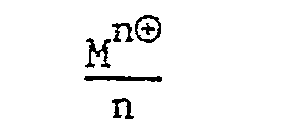
dar. so handelt es sich bei Mn⊕ beispielsweise um ein Alkali-, Erdalkali-, Aluminium- oder Uebergangsmetallkation, wie z.B. Na⊕, K9, Mg2⊕, Ca2⊕, Sr2⊕, Ba2⊕, Mn2⊕, Cu2⊕, Ni2⊕, Cd2⊕, Co3⊕, AI3⊕ und Cr3⊕, insbesondere aber um ein Alkali- oder Erdalkalikation (n = 1 oder 2) und bevorzugt um Ca2⊕.M n⊕ is, for example, an alkali, alkaline earth, aluminum or transition metal cation such as Na ⊕ , K 9 , Mg 2⊕ , Ca 2⊕ , Sr 2⊕ , Ba 2⊕ , Mn 2 ⊕ , Cu 2⊕ , Ni 2⊕ , Cd 2⊕ , Co 3⊕ , AI 3⊕ and Cr 3⊕ , but especially an alkali or alkaline earth metal (n = 1 or 2) and preferably Ca 2⊕ .
Bedeuten etwaige Substituenten C1-C18-Alkyl, so handelt es sich dabei z.B. um Methyl, Ethyl, n-Propyl, Isopropyl, n-Butyl, sec.-Butyl, tert.-Butyl, n-Pentyl, tert.-Pentyl, Hexyl, Heptyl, Octyl, Decyl, Dodecyl, Tetradecyl, Hexadecyl, Heptadecyl oder Octadecyl.If any substituents are C 1 -C 18 -alkyl, these are, for example, methyl, ethyl, n-propyl, isopropyl, n-butyl, sec-butyl, tert-butyl, n-pentyl, tert-pentyl , Hexyl, heptyl, octyl, decyl, dodecyl, tetradecyl, hexadecyl, heptadecyl or octadecyl.
Bedeuten R1, R2, R3 und R4 C5-C6-Cylcoalkyl, dann handelt, es sich z.B. um Cyclopentyl oder insbesondere um Cyclohexyl.If R 1 , R 2 , R 3 and R 4 are C 5 -C 6 cycloalkyl, then it is, for example, cyclopentyl or in particular to cyclohexyl.
Als durch C1-C18-Alkyl substituiertes Phenyl, bedeuten R1, R2, R3 und R4 vorzugsweise durch C12-C18-Alkyl substituiertes Phenyl.As phenyl substituted by C 1 -C 18 alkyl, R 1 , R 2 , R 3 and R 4 are preferably phenyl substituted by C 12 -C 18 alkyl.
Als Beispiele für N⊕(R1)(R2)(R3)(R4) seien genannt: N⊕H4, N⊕H3CH3, N⊕H2(CH3)2, N⊕H3C2H5, N⊕H2(C2H5)2, N⊕H3C3H7-iso, N⊕H3-Cyclohexyl, N9H2-(Cyclohexyl)2, N⊕H2(CH3)(C6H5), N⊕H3C6H5, N⊕H3-p-Octadecylphenyl und N⊕(CH3)4.Examples of N ⊕ (R 1 ) (R 2 ) (R 3 ) (R 4 ) are: N ⊕ H 4 , N ⊕ H 3 CH 3 , N ⊕ H 2 (CH 3 ) 2 , N ⊕ H 3 C 2 H 5 , N ⊕ H 2 (C 2 H 5 ) 2 , N ⊕ H 3 C 3 H 7 -iso, N ⊕ H 3 -cyclohexyl, N 9 H 2 - (cyclohexyl) 2 , N ⊕ H 2 ( CH 3 ) (C 6 H 5 ), N ⊕ H 3 C 6 H 5 , N ⊕ H 3 -p-octadecylphenyl and N ⊕ (CH 3 ) 4 .
D ist bevorzugt eine Gruppe der Formel 111.D is preferably a group of the formula III.
E bedeutet vorzugsweise -O-.E preferably means -O-.
Ti und T2 sind bevorzugt Chlor und T3 eine Gruppe -ET'. T' bedeutet vorzugsweise eine Gruppe der Formel
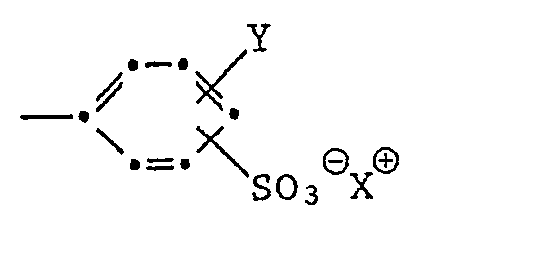
und Y Wasserstoff.Ti and T 2 are preferably chlorine and T 3 is a group -ET '. T 'preferably denotes a group of the formula
and Y is hydrogen.
Die Tetrachlorisoindolinonpigmente der Formel 1 sind bekannt und können nach bekannten Methoden hergestellt werden.The tetrachlorisoindolinone pigments of the formula 1 are known and can be prepared by known methods.
Die Verbundungen der Formel II sind neu und stellen einen weiteren Gegenstand der Erfindung dar. Man erhält sie in Analogie zu an sich bekannten Verfahren, z.B. durch Umsetzung von 3,4,5,6-Tetrachlor-2-cyan- benzoesäure-niederalkylester, bevorzugt -methylester, mit einem Alkalisalz einer Verbindung der Formeln

(welche bekannte Verbindungen darstellen und/oder nach allgemein bekannten Methoden hergestellt werden können) in einem hydrophilen organischen Lösungsmittel, wie z.B. ein Amid, wie Dimethylformamid, Dimethylacetamid, N-Methylpyrrolidon, ein Keton, wie Aceton oder Methylethylketon oder ein Sulfoxid, wie Dimethylsulfoxid (vgl. z.B. US-Patent 3 884 955), und anschliessende Kondensation des so erhaltenen Produktes mit einem Amin der Formel(which are known compounds and / or can be prepared by well known methods) in a hydrophilic organic solvent, e.g. an amide such as dimethylformamide, dimethylacetamide, N-methylpyrrolidone, a ketone such as acetone or methyl ethyl ketone or a sulfoxide such as dimethyl sulfoxide (see e.g. U.S. Patent 3,884,955) and subsequent condensation of the product so obtained with an amine of the formula
H2N-A'-D ,H 2 N-A'-D,
worin A' und D die oben angegebene Bedeutung haben, im Molverhältnis 1:1 oder 2:1, unter Ausschluss von Wasser, in einem polaren organischen Lösungsmittel, vorzugsweise Methanol, Ethanol oder Isopropanol, und in Gegenwart einer Base, wie z.B. Natriummethylat oder Natriumethylat, und gegebenenfalls durch anschliessende Umsetzung mit einem Salz X⊕L⊖, worin XO eine der Gruppen

oder N⊕(R1)(R2)(R3)(R4) mit der oben angegebenen Bedeutung ist und L⊖z.B. ein Hydroxy-, Chlorid-, Acetat-oder Nitrat-Ion bedeutet.wherein A 'and D have the meaning given above, in a molar ratio of 1: 1 or 2: 1, with the exclusion of water, in a polar organic solvent, preferably methanol, ethanol or isopropanol, and in the presence of a base, such as sodium methylate or sodium ethylate , and optionally by subsequent reaction with a salt X ⊕ L ⊖ , wherein X O is one of the groups
or N ⊕ (R 1 ) (R 2 ) (R 3 ) (R 4 ) with the meaning given above and L⊖zB is a hydroxy, chloride, acetate or nitrate ion.
Zur Herstellung der erfindungsgemässen Stoffzusammensetzung wird zweckmässig die Komponente a) zuerst nach üblichen Methoden konditioniert und in Wasser suspendiert. Die Komponente b) wird im allgemeinen als freie Sulfosäure zugefügt und das Salz X⊕L⊖ zur Fällung zugesetzt. Es ist auch möglich die Komponente b) direkt in Salzform in wässriger Suspension mit der Komponente a) zu mischen.To produce the composition of matter according to the invention, component a) is expediently first conditioned by conventional methods and suspended in water. Component b) is generally added as free sulfonic acid and the salt X⊕L⊖ is added for precipitation. It is also possible to mix component b) directly in salt form in an aqueous suspension with component a).
Die Mengenverhältnisse der Komponenten der erfindungsgemässen Stoffzusammensetzungen können beliebig variieren. Bevorzugte Mengenverhältnisse betragen jedoch 1 bis 10 Gew.% der Komponente b) zu 99 bis 90 Gew.% der Komponente a), insbesondere aber 2 bis 8 Gew.% der Komponente b) zu 98 bis 92 Gew.% der Komponente a) und bevorzugt 4 bis 6 Gew.% der Komponente b) zu 96 bis 94 Gew.% der Komponente a). Die Zugabe der Komponente b) erfolgt wie bereits erwähnt vorzugsweise nach der Konditionierung der Komponente a). Unter Konditionierung versteht man die Herstellung einer feinen Partikelform, beispielsweise durch alkalische Umfällung, Trockenmahlung mit oder ohne Salz, Lösungsmittel- oder wässrige Mahlung oder Salzknetung.The proportions of the components of the compositions according to the invention can vary as desired. However, preferred quantitative ratios are 1 to 10% by weight of component b) to 99 to 90% by weight of component a), but in particular 2 to 8% by weight of component b) to 98 to 92% by weight of component a) and preferably 4 to 6% by weight of component b) to 96 to 94% by weight of component a). As already mentioned, component b) is preferably added after component a) has been conditioned. Conditioning is the production of a fine particle shape, for example by alkaline reprecipitation, dry grinding with or without salt, solvent or aqueous grinding or Salt kneading.
Je nach Konditionierverfahren oder Applikationszweck kann es von Vorteil sein, dem Pigment neben dem erfindungsgemässen Zusatz der Komponente b) gewisse Mengen an texturverbessernden Mitteln vor oder nach dem Konditionierprozess zuzufügen. Als solche kommen insbesondere Fettsäuren mit mindestens 18 C-Atomen, beispielsweise Stearin-oder Behensäure oder deren Amide oder Metallsalze, insbesondere Mg-Salze, sowie Weichmacher, Wachse, Harzsäuren, wie Abietinsäure, Kolophoniumseife, Alkylphenole oder aliphatische Alkohole, wie Stearylalkohol oder vicinale Diole, wie Dodecandiol-1,2, ferner modifizierte Kolophoniummaleinatharze oder Fumarsäurekolophoniumharze, in Betracht. Die texturverbessernden Mittel werden vorzugsweise in Mengen von 0,1-30 Gew.% insbesondere 2-15 Gew.0/o, bezogen auf das Endprodukt, zugesetzt.Depending on the conditioning process or application purpose, it may be advantageous to add certain amounts of texture-improving agents to the pigment before or after the conditioning process in addition to the addition of component b) according to the invention. Such as come in particular fatty acids with at least 18 carbon atoms, for example stearic or behenic acid or their amides or metal salts, in particular Mg salts, and plasticizers, waxes, resin acids, such as abietic acid, rosin soap, alkylphenols or aliphatic alcohols, such as stearyl alcohol or vicinal diols , such as dodecanediol-1,2, furthermore modified rosin maleinate resins or fumaric acid rosin resins. The texture-improving agents are preferably added in amounts of 0.1-30% by weight, in particular 2-15% by weight, based on the end product.
Die erfindungsgemässen Stoffkompositionen eignen sich als Pigmente zum Färben von hochmolekularem organischem Material.The substance compositions according to the invention are suitable as pigments for coloring high molecular weight organic material.
Hochmolekulare organische Materialien, die mit den erfindungsgemässen Stoffzusammensetzungen gefärbt bzw. pigmentiert werden können, sind z.B. Celluloseether und -ester, wie Ethylcellulose, Nitrocellulose, Celluloseacetat oder Cellulosebutyrat, natürliche Harze oder Kunstharze, wie Polymerisationsharze oder Kondensationsharze, wie Aminoplaste, insbesondere Harnstoff- und Melamin-Formaldehydharze, Alkydharze, Phenoplaste, Polycarbonate, Polyolefine, Polystyrol, Polyvinylchlorid, Polyamide, Polyurethane, Polyester, Gummi, Casein, Silikon und Silikonharze, einzeln oder in Mischungen.High molecular weight organic materials which can be colored or pigmented with the substance compositions according to the invention are e.g. Cellulose ethers and esters, such as ethyl cellulose, nitrocellulose, cellulose acetate or cellulose butyrate, natural resins or synthetic resins, such as polymerization resins or condensation resins, such as aminoplasts, in particular urea and melamine-formaldehyde resins, alkyd resins, phenoplasts, polycarbonates, polyolefins, polystamides, polyvinyl chloride , Polyester, rubber, casein, silicone and silicone resins, individually or in mixtures.
Hochmolekulare organische Materialien in gelöster Form als Filmbildner kommen auch in Frage, wie z.B. Leinölfirnis, Nitrocellulose, Alkydharze, Phenolharze, Melaminharze, Acrylharze und Harnstoff-Formaldehydharze.High molecular weight organic materials in dissolved form as film formers are also possible, such as Linseed oil varnish, nitrocellulose, alkyd resins, phenolic resins, melamine resins, acrylic resins and urea-formaldehyde resins.
Die erwähnten hochmolekularen organischen Verbindungen können einzeln oder in Gemischen als plastische Massen, Schmelzen oder in Form von Spinnlösungen, Lacken, Anstrichstoffen oder Druckfarben vorliegen. Je nach Verwendungszweck erweist es sich als vorteilhaft, die erfindungsgemässen Stoffzusammensetzungen als Toner oder in Form von Präparaten einzusetzen. Bezogen auf das zu pigmentierende hochmolekulare organische Material kann man die erfindungsgemässen Stoffzusammensetzungen in einer Menge von 0,01 bis 30 Gew.%, vorzugsweise von 0,1 bis 10 Gew.%, einsetzen.The high-molecular organic compounds mentioned can be present individually or in mixtures as plastic compositions, melts or in the form of spinning solutions, lacquers, paints or printing inks. Depending on the intended use, it proves to be advantageous to use the substance compositions according to the invention as toners or in the form of preparations. Based on the high molecular weight organic material to be pigmented, the substance compositions according to the invention can be used in an amount of 0.01 to 30% by weight, preferably 0.1 to 10% by weight.
Die Pigmentierung der hochmolekularen organischen Substanzen mit den erfindungsgemässen Stoffzusammensetzungen erfolgt beispielsweise derart, dass man eine solche Stoffzusammensetzung gegebenenfalls in Form von Masterbatches diesen Substraten unter Verwendung von Walzwerken, Misch-oder Mahlapparaten zumischt. Das pigmentierte Material wird hierauf nach an sich bekannten Verfahren, wie Kalandrieren, Pressen, Strangpressen, Streichen, Giessen oder Spritzguss, in die gewünschte endgültige Form gebracht. Oft ist es erwünscht, zur Herstellung von nicht starren Formlingen oder zur Verringerung ihrer Sprödigkeit den hochmolekularen Verbindungen vor der Verformung sogenannte Weichmacher einzuverleiben. Als solche können z.B. Ester der Phosphorsäure, Phthalsäure ode Sebacinsäure dienen. Die Weichmacher können vor oder nach der Einverleibung der erfindungsgemässen Stoffzusammensetzungen in die Polymeren eingearbeitet werden. Es ist ferner möglich, zwecks Erzielung verschiedener Farbtöne den hochmolekularen, organischen Stoffen neben den erfindungsgemässen Stoffzusammensetzungen noch Füllstoffe bzw. andere farbgebende Bestandteile, wie Weiss-, Bunt- oder Schwarzpigmente, in beliebigen Mengen zuzufügen.The pigmentation of the high molecular weight organic substances with the compositions according to the invention takes place, for example, in such a way that such a composition, if appropriate in the form of masterbatches, is added to these substrates using rolling mills, mixing or grinding apparatus. The pigmented material is then brought into the desired final shape by methods known per se, such as calendering, pressing, extrusion, brushing, casting or injection molding. It is often desirable to incorporate so-called plasticizers into the high-molecular compounds before the molding in order to produce non-rigid moldings or to reduce their brittleness. As such, e.g. Esters of phosphoric acid, phthalic acid or sebacic acid are used. The plasticizers can be incorporated into the polymers before or after the incorporation of the compositions according to the invention. It is also possible to add fillers or other coloring constituents, such as white, colored or black pigments, to the high molecular weight, organic substances in addition to the substance compositions according to the invention in order to achieve different colors.
Zum Pigmentieren von Lacken und Druckfarben werden die hochmolekularen organischen Materialien und die erfindungsgemässen Stoffzusammensetzungen gegebenenfalls zusammen mit Zusatzstoffen, wie Füllmitteln, anderen Pigmenten, Siccativen oder Weichmachern, in einem gemeinsamen organischen Lösungsmittel oder Lösungsmittelgemisch fein dispergiert bzw. gelöst. Man kann dabei so verfahren, dass man die einzelnen Komponenten für sich oder auch mehrere gemeinsam dispergiert bzw. löst, und erst hierauf alle Komponenten zusammenbringt.To pigment lacquers and printing inks, the high molecular weight organic materials and the compositions of the invention, if appropriate together with additives, such as fillers, other pigments, siccatives or plasticizers, are finely dispersed or dissolved in a common organic solvent or solvent mixture. One can proceed in such a way that the individual components are dispersed or dissolved individually or several together, and only then all components are brought together.
Die erhaltenen Färbungen, beispielsweise in Kunststoffen, Fasern, Lacken oder Drucken, zeichnen sich durch gute allgemeine Eigenschaften, wie gute Dispergierbarkeit, hohe Transparenz, gute Ueberlackier-, Migrations-, Hitze-, Licht- und Wetterbeständikeit, sowie Verzugsfreiheit in Kunststoffen, aus. Ausserdem weisen die erfindungsgemässen Stoffzusammensetzungen im Vergleich zu unmodifzierten Tetrachlorisoindolinonpigmenten insbesondere in Lacken und Druckfarben eine verbesserte Rheologie, geringere Trenneffekte, wie Ausschwimmen bei der Mitverwendung von Weisspigmenten und geringere Flokkulationstendenz, auf.The dyeings obtained, for example in plastics, fibers, lacquers or prints, are distinguished by good general properties, such as good dispersibility, high transparency, good resistance to overcoating, migration, heat, light and weather, and freedom from distortion in plastics. In addition, compared to unmodified tetrachlorisoindolinone pigments, especially in lacquers and printing inks, the substance compositions according to the invention have improved rheology, lower separation effects, such as floating when white pigments are used, and less tendency to flocculate.
Infolge der guten rheologischen Eigenschaften der erfindungsgemässen Pigmentmischungen ist es möglich, Lacke hoher Pigmentkonzentration (high loadings) herzustellen.As a result of the good rheological properties of the pigment mixtures according to the invention, it is possible to produce paints with a high pigment concentration (high loads).
Die erfindungsgemässen Stoffzusammensetzungen eigenen sich vorzugsweise zum Färben von wässrigen und/oder lösungsmittelhaltigen Lacken, insbesondere Automobillacken. Ganz besonders bevorzugt ist ihre Verwendung für Metalleffektlackierungen.The substance compositions according to the invention are preferably suitable for dyeing aqueous and / or solvent-based paints, in particular automotive paints. Their use for metallic effect coatings is very particularly preferred.
Die nachfolgenden Beispiele dienen zur Erläuterung der Erfindung.The following examples serve to explain the invention.
Zu einer Lösung von 11,8 g Natriumsalz der Phenol-4-sulfonsäure und 17,1 g Tetrachlor-o-cyanbenzoesäuremethylester in 150 ml Dimethylsulfoxyd werden während einer Stunde 8,1 g wässrige 30 %-ige Natronlauge zugetropft. Anschliessend erwärmt man noch eine Stunde auf 60° C und giesst das Reaktionsgemisch in 500 ml Wasser ein. Man filtriert den unlöslichen Anteil ab und versetzt das Filtrat mit 200 g Kochsalz. Der gebildete Niederschlag wird abfiltriert, mit 10 %iger Kochsalzlösung gewaschen und getrocknet. Man erhält 15,2 g des Natriumsalzes einer Sulfonsäure, der aufgrund der Elementaranalyse folgende Formel zugeordnet wird:
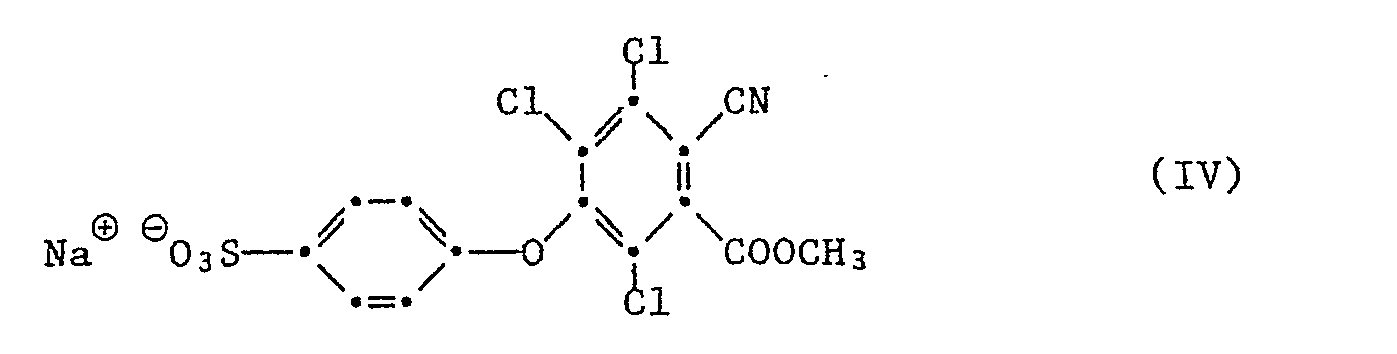
Das Produkt enthält noch 20 % - 30 % Kochsalz.The product still contains 20% - 30% table salt.
Man trägt 12 g des Produktes der Formel IV in eine Lösung von 1,35 g Natriummethylat in 80 ml Methanol ein, rührt 30 Minuten und gibt anschliessend 1,35 g p-Phenylendiamin zu. Es bildet sich eine gelbbraune Suspension, die während 15 Stunden gerührt wird. Nun erhitzt man zum Rückfluss, hält diese Temperatur 2 Stunden und säuert mit 5 ml Eisessig an. Der braune Niederschlag wird heiss abfiltriert, mit Methanol gewaschen und getrocknet. Man erhält 6,8 g Rohprodukt, das als Natriumsalz vorliegt.12 g of the product of the formula IV are introduced into a solution of 1.35 g of sodium methylate in 80 ml of methanol, the mixture is stirred for 30 minutes and then 1.35 g of p-phenylenediamine are added. A yellow-brown suspension is formed, which is stirred for 15 hours. Now heat to reflux, hold this temperature for 2 hours and acidify with 5 ml of glacial acetic acid. The brown precipitate is filtered off hot, washed with methanol and dried. 6.8 g of crude product are obtained, which is present as the sodium salt.
Das entsprechende Calciumsalz wird wie folgt erhalten: 2 g des wie oben beschrieben erhaltenen Natriumsalzes werden in 150 ml Wasser auf 70-80° C erwärmt und mit einer wässrigen Lösung von 3 g Calciumchlorid versetzt. Der Niederschlag wird abfiltriert, mit wenig Wasser gewaschen und getrocknet. Man erhält 1 g des Farbstoffes der Formel V
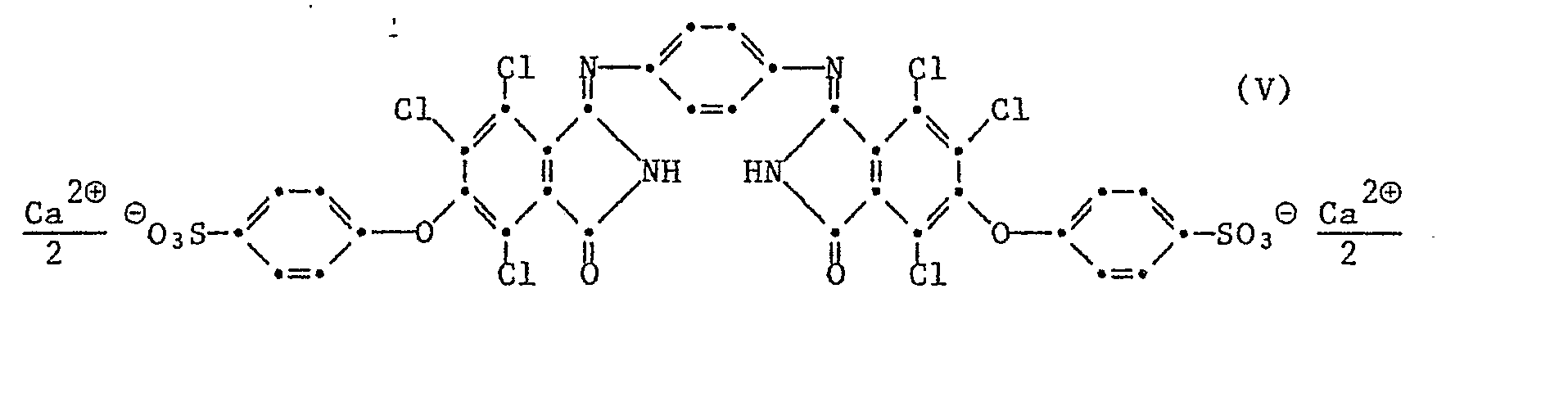
Analyse für C34H14C16N4010S2Ca

2,4 g des Produktes der Formel IV aus Beispiel 1 werden in einer Lösung von 0,6 g Natriummethylat in 50 ml Methanol während 15 Minuten gerührt. Nun gibt man 1,88 g der Verbindung der Formel

zu. Man rührt 15 Stunden bei Raumtemperatur, aschliessend 2 Stunden bei Rückflusstemperatur und säuert dan mit 5 ml Eisessig an. Das unlösliche Reaktionsprodukt wird heiss abfiltriert, mit Methanol gewaschen und getrocknet. Man erhält 2,5 g des Pigmentes der Formel VI:

Analyse für C28H10Cl7N4O6SNa

12 g des Produktes der Formel IV aus Beispiel 1 werden mit 1,35 g Natriummethylat in 80 mi Methanol umgesetzt und mit 2,7 g p-Phenylendiamin unter den Bedingungen von Beispiel 1 kondensiert. Man erhält ein braunes Produkt, dem aufgrund der Elementaranalyse die Formel VII zugeordnet wird:
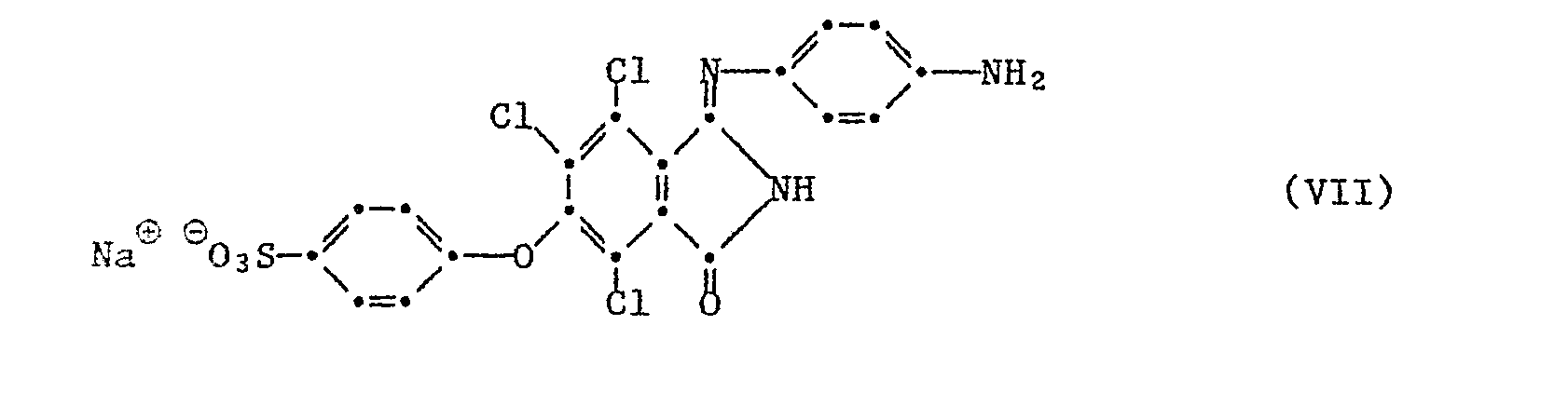
10,9 g Natriumsalz der Phenol-4-sulfosäure und 13,5 g Tetrachlor-o-cyanbenzoesäuremethylester werden in 50 ml Dimethylformamid suspendiert und auf 55-60° C erhitzt. Die Reaktion wird im Dünnschichtchromatogramm verfolgt. Nach 2 Stunden ist nur noch wenig Tetrachlor-o-cyanbenzoesäuremethylester feststellbar. Das Reaktionsgemisch wird nun vollständig eingedampft. Man erhält 22,45 g eines festen Produktes, das als Hauptkomponente die Verbindung der Formel IV enthält. Wird dieses Produkt wie in Beispiel 1 beschrieben weiterverarbeitet, so erhält man den Farbstoff der Formel V mit den gleichen Eigenschaften, wie diejenigen des Beispiels 1.10.9 g of sodium salt of phenol-4-sulfonic acid and 13.5 g of methyl tetrachloro-o-cyanobenzoate are suspended in 50 ml of dimethylformamide and heated to 55-60 ° C. The reaction is followed in the thin layer chromatogram. After 2 hours, only a little methyl tetrachloro-cyanobenzoate can be detected. The reaction mixture is now completely evaporated. 22.45 g of a solid product are obtained, which contains the compound of formula IV as the main component. If this product is processed further as described in Example 1, the dye of the formula V is obtained with the same properties as those of Example 1.
- a) 15 g Bis-[4,5,6,7-tetrachlorisoindolin-3-on-1-yliden]-phenylen-diamin(1,4) werden in 150 ml Dimethylformamid bei Zimmertemperatur angeschlämmt. In die gelbe Suspension lässt man unter Rühren 50 ml einer 1 N methanolischen Natriummethylatlösung einfliessen, wobei sich eine klare gelbe Lösung des Natriumsalzes des eingesetzten Isoindolins bildet. Nach einstündigem Rühren bei Raumtemperatur wird die Lösung mit 500 ml Wasser versetzt, der ausgefallene Niederschlag abfiltriert und das Nutschgut mit Wasser neutral gewaschen.a) 15 g of bis- [4,5,6,7-tetrachlorisoindolin-3-one-1-ylidene] phenylene diamine (1,4) are suspended in 150 ml of dimethylformamide at room temperature. 50 ml of a 1 N methanolic sodium methylate solution are allowed to flow into the yellow suspension while stirring, a clear yellow solution of the sodium salt of the isoindoline used being formed. After stirring for one hour at room temperature, 500 ml of water are added, the precipitate which has precipitated is filtered off and the filter cake is washed neutral with water.
- b) 27,8 g des so erhaltenen feuchten Nutschgutes (36 % Trockengehalt) werden in 150 ml Wasser suspendiert. Dann werden 0,5 g der Verbindung VI von Beispiel 2 und nach einer halben Stunde Rühren bei 70-75°C 3,6 g Calciumchlorid hinzugefügt. Nach einer weiteren halben Stunde wird die Pigmentmischung bei 70° C filtriert und getrocknet. Man erhält 10,55 g gelbes Mischpigment, weiches, in ein Alkyl-Lacksystem eingearbeitet, im Vergleich zum unmodifizierten trockenen Pigment von Beispiel 5a) ein verbessertes Fliessverhalten zeigt.b) 27.8 g of the moist filter material obtained in this way (36% dry content) are suspended in 150 ml of water. Then 0.5 g of compound VI from Example 2 and, after stirring for half an hour at 70-75 ° C., 3.6 g of calcium chloride are added. After another half an hour, the pigment mixture is filtered at 70 ° C. and dried. This gives 10.55 g of yellow mixed pigment, soft, incorporated into an alkyl lacquer system, which shows improved flow behavior compared to the unmodified dry pigment from Example 5a).
Eine ähnliche Verbesserung des Fliessverhaltens in Lacken wird erreicht, wenn in Beispiel 5 anstelle der Verbindung VI aus Beispiel 2 0,5 g der Verbindung VII aus Beispiel 3 verwendet wird.A similar improvement in the flow behavior in paints is achieved if 0.5 g of compound VII from example 3 is used instead of compound VI from example 2 in example 5.
27,8 g wasserfeuchtes Bis-[4,5,6,7-tetrachlorisoindolin-3-on-1-yliden]-phenylendiamin(1,4) (36 % Trockengehalt), welches wie in Beispiel 5a) beschrieben erhalten wird, wird mit 150 ml Wasser unter gutem Rühren auf 70°C erwärmt. Nun gibt man 0,5 g der Verbindung V aus Beispiel 1 hinzu, lässt auf Raumtemperatur erkalten und filtriert die Pigmentmischung ab. Man erhält nach dem Trocknen 10,5 g gelbes Mischpigment, welches, in ein Alkyd-Lacksystem eingearbeitet, im Vergleich zum unmodifizierten trockenen Pigment von Beispiel 5a) ein verbessertes Fliessverhalten zeigt.27.8 g of water-moist bis- [4,5,6,7-tetrachlorisoindolin-3-one-1-ylidene] phenylenediamine (1,4) (36% dry content), which is obtained as described in Example 5a) heated to 70 ° C with 150 ml of water with good stirring. Now add 0.5 g of compound V from Example 1, allow to cool to room temperature and filter off the pigment mixture. After drying, 10.5 g of yellow mixed pigment are obtained which, when incorporated into an alkyd lacquer system, show improved flow behavior compared to the unmodified dry pigment from Example 5a).
- a) 15 g Bis-[4,5,6,7-tetrachlorisoindolin-3-on-1-yliden]-1-methylphenylendiamin(2,6) werden in 100 ml Isopropanol suspendiert und mit 50 ml einer 1 n methanolischen Natriummethylatlösung versetzt. Nach 10 Minuten Rühren giesst man die Pigmentsuspension in eine Lösung von 15 ml Essigsäure in 500 ml Wasser. Das Produkt wird abgenutscht und mit Wasser gewaschen. Das erhaltene Pigment liegt in einer sehr feinverteilten Form vor.a) 15 g of bis- [4,5,6,7-tetrachlorisoindolin-3-one-1-ylidene] -1-methylphenylenediamine (2,6) are suspended in 100 ml of isopropanol and mixed with 50 ml of a 1N methanolic sodium methylate solution . After stirring for 10 minutes, the pigment suspension is poured into a solution of 15 ml of acetic acid in 500 ml of water. The product is filtered off and washed with water. The pigment obtained is in a very finely divided form.
- b) 40,2 g des so erhaltenen feuchten Nutschgutes (25% Trockengehalt werden in 150 ml Wasser suspendiert. Dann werden 0,5 g der Verbindung der Formel V von Beispiel 1 und nach einer halben stunde Rühren bei 70-75° C 3,6 g Calciumchlorid hinzugefügt. Nach einer weiteren halben Stunde wird die Pigmentmischung bei 70°C filtriert und getrocknet. Man erhält 9,75 g gelbes Mischpigment, welches, in ein Alkyd-Lacksystem eingeareitet, im Vergleich zum unmodifizierten trockenen Pigment von Beispiel 8a) ein verbessertes Fliessverhalten zeigt.b) 40.2 g of the moist filter material obtained in this way (25% dry content are suspended in 150 ml of water. Then 0.5 g of the compound of the formula V from Example 1 and after stirring for half an hour at 70-75 ° C. 3, 6 g of calcium chloride are added and after a further half hour the pigment mixture is filtered and dried at 70 ° C. 9.75 g of yellow mixed pigment are obtained, which, when rubbed into an alkyd lacquer system, are compared to the unmodified dry pigment from Example 8a) shows improved flow behavior.
Claims (30)

worin A eine der Gruppen der Formeln



where A is one of the groups of the formulas



bedeutet, worin Rund R' unabhängig voneinander Wasserstoff, Chlor, Methyl, Methoxy oder Ethoxy sind.2. Composition of matter according to claim 1, characterized in that it contains as component a) a compound of formula I, wherein A is a group of the formula
means where R is independently hydrogen, chlorine, methyl, methoxy or ethoxy.

bedeutet, worin Mn⊕ und n die in Anspruch 1 angegebene Bedeutung haben.4. Composition of matter according to claim 1, characterized in that it contains as component b) a compound of formula II, wherein X ⊕ is a group of the formula
means wherein M n⊕ and n have the meaning given in claim 1.

bedeutet, worin Mn⊕ ein Alkali-oder Erdalkalikation und n die Zahlen 1 oder 2 bedeuten.5. Composition of matter according to claim 1, characterized in that it contains as component b) a compound of formula II, wherein X ⊕ is a group of the formula
means in which M n⊕ is an alkali or alkaline earth metalation and n is the numbers 1 or 2.

ist, worin Rund R' unabhängig voneinander Wasserstoff, Chlor, Methyl, Methoxy oder Ethoxy bedeuten.7. Composition of matter according to claim 1, characterized in that it contains as component b) a compound of formula II, wherein A 'is a group of the formula
is where R 'is independently hydrogen, chlorine, methyl, methoxy or ethoxy.

bedeutet.9. Composition of matter according to claim 1, characterized in that it contains as component b) a compound of the formula in which D is a group of the formula III
means.

ist.12. Composition of matter according to claim 1, characterized in that it contains as component b) a compound of formula II, wherein T 'is a group of the formula
is.

und

and

worin A' eine der Gruppen der Formeln,


ist, worin B -O-, -S-, -S02-, -N = N-, -CH2-, -CH = CH-, -O-Ch2-O-,

-CONH-, -NHCONH- oder -CONHNHCO-, Q -O- oder -NH-und Z -O- oder -S- bedeutet und R und R' unabhängig voneinander Wasserstoff, Halogen, C1-C4-Alkyl, C1-C4-Alkoxy oder Phenoxy sind, D Wasserstoff, Amino oder eine Gruppe der Formel III

bedeutet, E -0- oder -S- ist, T1, T2 und T3 unabhängig voneinander Chlor oder eine Gruppe -ET'bedeuten T' eine der Gruppen der Formeln

ist, H⊕ H⊕ oder eine Gruppe der Formeln

oder N⊕(R1)(R2)(R3)(R4)darstellt, Mn⊕ ein n-wertiges Metallkation, n die Zahlen 1,2 oder 3, R1, R2, R3, R4, unabhängig voneinander Wasserstoff, C1-C18-Alkyl, C5-C6-Cycloalkyl, unsubstituiertes oder durch C1-C18-Alkyl substituiertes Phenyl bedeuten oder R3 und R4 zusammen mit dem N-Atom einen Pyrrolidon-, Imidazolidin-, Piperidin-, Piperazin- oder Morpholinrest, oder R2, R3 und R4 zusammen mit dem N-Atom einen Pyrrol-, Pyridin-, Picolin-, Pyrazin-, Chinolin- oder Isochinolinrest bilden und Y Wasserstoff, Halogen, Methyl, Methoxy, oder Amino bedeutet.17. Compound of formula II
where A 'is one of the groups of the formulas
where B is -O-, -S-, -S0 2 -, -N = N-, -CH 2 -, -CH = CH-, -O-Ch 2 -O-,
-CONH-, -NHCONH- or -CONHNHCO-, Q is -O- or -NH- and Z is -O- or -S- and R and R 'independently of one another are hydrogen, halogen, C 1 -C 4 -alkyl, C 1 -C 4 alkoxy or phenoxy, D are hydrogen, amino or a group of formula III
means E is -0- or -S-, T 1 , T 2 and T 3 independently of one another are chlorine or a group -ET 'means T' is one of the groups of the formulas
is H ⊕ H ⊕ or a group of the formulas
or N ⊕ (R 1 ) (R 2 ) (R 3 ) (R 4 ), M n⊕ is an n-valent metal cation, n is the numbers 1 , 2 or 3, R 1 , R 2 , R 3 , R 4 , independently of one another are hydrogen, C 1 -C 18 -alkyl, C 5 -C 6 -cycloalkyl, unsubstituted or substituted by C 1 -C 18 -alkyl, or R 3 and R 4 together with the N atom represent a pyrrolidone, Imidazolidine, piperidine, piperazine or morpholine residue, or R 2 , R 3 and R 4 together with the N atom form a pyrrole, pyridine, picoline, pyrazine, quinoline or isoquinoline residue and Y is hydrogen, halogen, Means methyl, methoxy, or amino.
mit der in Anspruch 18 angegebenen Bedeutung ist.18. A compound of formula II according to claim 17, characterized in that X 9 is a group of the formula
with the meaning given in claim 18.

bedeutet, worin Mn9 ein Alakli- oder Erdalkalikation und n die Zahlen 1 oder 2 bedeuten.19. A compound of formula II according to claim 17, characterized in that X ⊕ is a group of the formula
means in which M n9 is an alkali or alkaline earth metalation and n is the number 1 or 2.

bedeutet.23. A compound of formula II according to claim 17, wherein D is a group of formula III
means.

ist.26. A compound of formula II according to claim 17, wherein T 'is a group of the formula
is.

Applications Claiming Priority (2)
| Application Number | Priority Date | Filing Date | Title |
|---|---|---|---|
| US130245 | 1987-12-08 | ||
| US07/130,245 US4892899A (en) | 1987-12-08 | 1987-12-08 | Novel compositions based on tetrachloroisoindolinone pigments |
Publications (3)
| Publication Number | Publication Date |
|---|---|
| EP0321397A2 true EP0321397A2 (en) | 1989-06-21 |
| EP0321397A3 EP0321397A3 (en) | 1990-12-19 |
| EP0321397B1 EP0321397B1 (en) | 1993-11-03 |
Family
ID=22443764
Family Applications (1)
| Application Number | Title | Priority Date | Filing Date |
|---|---|---|---|
| EP88810814A Expired - Lifetime EP0321397B1 (en) | 1987-12-08 | 1988-11-29 | Stuff compositions based on tetrachloroisoindolinone pigments |
Country Status (5)
| Country | Link |
|---|---|
| US (1) | US4892899A (en) |
| EP (1) | EP0321397B1 (en) |
| JP (1) | JPH01201366A (en) |
| KR (1) | KR890010126A (en) |
| DE (1) | DE3885428D1 (en) |
Cited By (2)
| Publication number | Priority date | Publication date | Assignee | Title |
|---|---|---|---|---|
| US5387281A (en) * | 1993-12-01 | 1995-02-07 | Ciba-Geigy Corporation | Compositions based on 2,9-Dichloroquinacridone pigments |
| US6313300B1 (en) | 1999-09-07 | 2001-11-06 | Ciba Specialty Chemicals Corp. | Oxidation process for preparing quinacridone pigments |
Families Citing this family (3)
| Publication number | Priority date | Publication date | Assignee | Title |
|---|---|---|---|---|
| US5266616A (en) * | 1991-07-12 | 1993-11-30 | Phillips Petroleum Company | Polyolefin resin formulation using organic pigments |
| ES2599031T3 (en) * | 2008-05-09 | 2017-01-31 | Grünenthal GmbH | Process for the preparation of an intermediate powder formulation and a final solid dosage form using a spray freezing step |
| CN103013170A (en) * | 2012-12-13 | 2013-04-03 | 先尼科化工(上海)有限公司 | Preparation method of isoindoline pigment |
Family Cites Families (7)
| Publication number | Priority date | Publication date | Assignee | Title |
|---|---|---|---|---|
| DE1025080B (en) * | 1954-12-18 | 1958-02-27 | Basf Ag | Process for the production of dyes |
| NL104426C (en) * | 1956-07-13 | |||
| CH510088A (en) * | 1968-03-21 | 1971-07-15 | Ciba Geigy Ag | Highly transparent pigments of the isoindoline series |
| CH599310A5 (en) * | 1974-04-30 | 1978-05-31 | Ciba Geigy Ag | |
| DE2913206A1 (en) * | 1978-04-05 | 1979-10-18 | Toyo Soda Mfg Co Ltd | PROCESS FOR THE MANUFACTURING OF A PURIFIED PIGMENT OF THE ISOINDOLINONE SERIES |
| US4692189A (en) * | 1986-07-21 | 1987-09-08 | Ciba-Geigy Corporation | Novel compositions based on indanthrone blue pigments |
| US4764217A (en) * | 1986-12-17 | 1988-08-16 | Ciba-Geigy Corporation | Novel compositions based on isoindoline pigments |
-
1987
- 1987-12-08 US US07/130,245 patent/US4892899A/en not_active Expired - Lifetime
-
1988
- 1988-11-29 DE DE88810814T patent/DE3885428D1/en not_active Expired - Fee Related
- 1988-11-29 EP EP88810814A patent/EP0321397B1/en not_active Expired - Lifetime
- 1988-12-08 JP JP63309000A patent/JPH01201366A/en active Pending
- 1988-12-08 KR KR1019880016470A patent/KR890010126A/en not_active Withdrawn
Cited By (2)
| Publication number | Priority date | Publication date | Assignee | Title |
|---|---|---|---|---|
| US5387281A (en) * | 1993-12-01 | 1995-02-07 | Ciba-Geigy Corporation | Compositions based on 2,9-Dichloroquinacridone pigments |
| US6313300B1 (en) | 1999-09-07 | 2001-11-06 | Ciba Specialty Chemicals Corp. | Oxidation process for preparing quinacridone pigments |
Also Published As
| Publication number | Publication date |
|---|---|
| KR890010126A (en) | 1989-08-07 |
| EP0321397A3 (en) | 1990-12-19 |
| JPH01201366A (en) | 1989-08-14 |
| EP0321397B1 (en) | 1993-11-03 |
| US4892899A (en) | 1990-01-09 |
| DE3885428D1 (en) | 1993-12-09 |
Similar Documents
| Publication | Publication Date | Title |
|---|---|---|
| EP0636666B1 (en) | Pigment preparations with perylene derivatives as dispersing agent | |
| EP0511165B1 (en) | Dicetopyrrolopyrrole compounds | |
| EP0034725B1 (en) | Dyestuffs containing imidazolylethylene groups and their use | |
| EP0273866B1 (en) | Compositions of matter based on ci pigment red 177 | |
| EP0254681A2 (en) | Stuff compositions based on idanthrone blue pigments | |
| CH510088A (en) | Highly transparent pigments of the isoindoline series | |
| DE2263235A1 (en) | HETEROCYCLIC METAL COMPLEX COMPOSITIONS, THEIR PRODUCTION AND USE | |
| EP0009720B1 (en) | Mixtures of quinacridones, process for preparing them and their application as pigments | |
| DE3742388A1 (en) | NEW SUBSTANCE COMPOSITIONS BASED ON ISOINDOL PIGMENTS | |
| EP0321397B1 (en) | Stuff compositions based on tetrachloroisoindolinone pigments | |
| EP0272216B1 (en) | Compositions of matter based on tetrachloroisoindolinone pigments | |
| EP0035672B1 (en) | Dyes of the isoindoline series and their use | |
| DE2733506A1 (en) | NEW ISOINDOLINE PIGMENTS AND THE PROCESS FOR THEIR PRODUCTION | |
| EP0051560B1 (en) | Monoazopigments containing heterocyclic nuclei, their preparation and use | |
| EP0349489A2 (en) | Organic macromolecular material containing a hydrazone-based metal complex pigment | |
| EP0591105A2 (en) | Bisazo, bisazomethine and azo-azomethine compounds | |
| EP0278913A2 (en) | Material compositions based on metallic-complex pigments, and compounds | |
| DE3927028A1 (en) | NEW ISO INDOLE PIGMENTS | |
| EP0183651B1 (en) | Metal complexes, process for their preparation and their use | |
| EP0271818B1 (en) | Isoindolin metal complexes | |
| DE2728864A1 (en) | METAL COMPLEX PIGMENTS | |
| DE2842469A1 (en) | BIS-N-DIALKYLCARBAMOYL-CHINACRIDONE, METHOD FOR THE PRODUCTION AND USE THEREOF | |
| DE2525587A1 (en) | IMINOISOINDOLINONE PIGMENTS AND METHOD FOR THEIR PRODUCTION | |
| CH677927A5 (en) | ||
| DE2447228A1 (en) | PERINON COMPOUNDS, THE PROCESS FOR THEIR PRODUCTION AND THEIR USE AS A COLOR |
Legal Events
| Date | Code | Title | Description |
|---|---|---|---|
| PUAI | Public reference made under article 153(3) epc to a published international application that has entered the european phase |
Free format text: ORIGINAL CODE: 0009012 |
|
| 17P | Request for examination filed |
Effective date: 19881201 |
|
| AK | Designated contracting states |
Kind code of ref document: A2 Designated state(s): CH DE FR GB IT LI |
|
| PUAL | Search report despatched |
Free format text: ORIGINAL CODE: 0009013 |
|
| AK | Designated contracting states |
Kind code of ref document: A3 Designated state(s): CH DE FR GB IT LI |
|
| 17Q | First examination report despatched |
Effective date: 19930331 |
|
| GRAA | (expected) grant |
Free format text: ORIGINAL CODE: 0009210 |
|
| AK | Designated contracting states |
Kind code of ref document: B1 Designated state(s): CH DE FR GB IT LI |
|
| PG25 | Lapsed in a contracting state [announced via postgrant information from national office to epo] |
Ref country code: IT Free format text: LAPSE BECAUSE OF FAILURE TO SUBMIT A TRANSLATION OF THE DESCRIPTION OR TO PAY THE FEE WITHIN THE PRESCRIBED TIME-LIMIT;WARNING: LAPSES OF ITALIAN PATENTS WITH EFFECTIVE DATE BEFORE 2007 MAY HAVE OCCURRED AT ANY TIME BEFORE 2007. THE CORRECT EFFECTIVE DATE MAY BE DIFFERENT FROM THE ONE RECORDED. Effective date: 19931103 |
|
| REF | Corresponds to: |
Ref document number: 3885428 Country of ref document: DE Date of ref document: 19931209 |
|
| GBT | Gb: translation of ep patent filed (gb section 77(6)(a)/1977) |
Effective date: 19940110 |
|
| ET | Fr: translation filed | ||
| PLBE | No opposition filed within time limit |
Free format text: ORIGINAL CODE: 0009261 |
|
| STAA | Information on the status of an ep patent application or granted ep patent |
Free format text: STATUS: NO OPPOSITION FILED WITHIN TIME LIMIT |
|
| PGFP | Annual fee paid to national office [announced via postgrant information from national office to epo] |
Ref country code: FR Payment date: 19941003 Year of fee payment: 7 |
|
| PGFP | Annual fee paid to national office [announced via postgrant information from national office to epo] |
Ref country code: GB Payment date: 19941018 Year of fee payment: 7 |
|
| 26N | No opposition filed | ||
| PGFP | Annual fee paid to national office [announced via postgrant information from national office to epo] |
Ref country code: CH Payment date: 19950214 Year of fee payment: 7 |
|
| PG25 | Lapsed in a contracting state [announced via postgrant information from national office to epo] |
Ref country code: GB Effective date: 19951129 |
|
| PG25 | Lapsed in a contracting state [announced via postgrant information from national office to epo] |
Ref country code: LI Effective date: 19951130 Ref country code: CH Effective date: 19951130 |
|
| REG | Reference to a national code |
Ref country code: CH Ref legal event code: PL |
|
| GBPC | Gb: european patent ceased through non-payment of renewal fee |
Effective date: 19951129 |
|
| PG25 | Lapsed in a contracting state [announced via postgrant information from national office to epo] |
Ref country code: FR Effective date: 19960731 |
|
| REG | Reference to a national code |
Ref country code: FR Ref legal event code: ST |
|
| PGFP | Annual fee paid to national office [announced via postgrant information from national office to epo] |
Ref country code: DE Payment date: 19981006 Year of fee payment: 11 |
|
| PG25 | Lapsed in a contracting state [announced via postgrant information from national office to epo] |
Ref country code: DE Free format text: LAPSE BECAUSE OF NON-PAYMENT OF DUE FEES Effective date: 20000901 |