EP0321399A2 - Preparation of latexes of colour coupler polymers - Google Patents
Preparation of latexes of colour coupler polymers Download PDFInfo
- Publication number
- EP0321399A2 EP0321399A2 EP88810833A EP88810833A EP0321399A2 EP 0321399 A2 EP0321399 A2 EP 0321399A2 EP 88810833 A EP88810833 A EP 88810833A EP 88810833 A EP88810833 A EP 88810833A EP 0321399 A2 EP0321399 A2 EP 0321399A2
- Authority
- EP
- European Patent Office
- Prior art keywords
- colour
- coupler
- couplers
- monomer
- monomeric
- Prior art date
- Legal status (The legal status is an assumption and is not a legal conclusion. Google has not performed a legal analysis and makes no representation as to the accuracy of the status listed.)
- Withdrawn
Links
- QKSULMDZVOMQCO-UHFFFAOYSA-N CC(C=C1)C(C)=CC=C1N Chemical compound CC(C=C1)C(C)=CC=C1N QKSULMDZVOMQCO-UHFFFAOYSA-N 0.000 description 1
- XZDQMZMYXIRJMA-LUAWRHEFSA-N CC1C=CC(S/C(/C)=N\C)=CC1 Chemical compound CC1C=CC(S/C(/C)=N\C)=CC1 XZDQMZMYXIRJMA-LUAWRHEFSA-N 0.000 description 1
- KMWJXFQNOITGBL-UHFFFAOYSA-N CCC(C1)C1C1=CC(C)C(C)CC1 Chemical compound CCC(C1)C1C1=CC(C)C(C)CC1 KMWJXFQNOITGBL-UHFFFAOYSA-N 0.000 description 1
Images

Classifications
-
- G—PHYSICS
- G03—PHOTOGRAPHY; CINEMATOGRAPHY; ANALOGOUS TECHNIQUES USING WAVES OTHER THAN OPTICAL WAVES; ELECTROGRAPHY; HOLOGRAPHY
- G03C—PHOTOSENSITIVE MATERIALS FOR PHOTOGRAPHIC PURPOSES; PHOTOGRAPHIC PROCESSES, e.g. CINE, X-RAY, COLOUR, STEREO-PHOTOGRAPHIC PROCESSES; AUXILIARY PROCESSES IN PHOTOGRAPHY
- G03C7/00—Multicolour photographic processes or agents therefor; Regeneration of such processing agents; Photosensitive materials for multicolour processes
- G03C7/30—Colour processes using colour-coupling substances; Materials therefor; Preparing or processing such materials
- G03C7/32—Colour coupling substances
- G03C7/327—Macromolecular coupling substances
- G03C7/3275—Polymers obtained by reactions involving only carbon-to-carbon unsaturated bonds, e.g. vinyl polymers
-
- C—CHEMISTRY; METALLURGY
- C08—ORGANIC MACROMOLECULAR COMPOUNDS; THEIR PREPARATION OR CHEMICAL WORKING-UP; COMPOSITIONS BASED THEREON
- C08F—MACROMOLECULAR COMPOUNDS OBTAINED BY REACTIONS ONLY INVOLVING CARBON-TO-CARBON UNSATURATED BONDS
- C08F246/00—Copolymers in which the nature of only the monomers in minority is defined
Definitions
- This invention relates to a new process for the preparation of latexes of colour coupler polymers.
- Polymeric colour couplers are finding increasing use in photographic material instead of colour couplers which require to be incorporated in photographic layers dissolved in an oil.
- the presence of the oil leads to several disadvantages including rendering the layer which comprises it soft and thus liable to mechanical deformation.
- photographic material in which the colour couplers are present as a polymer latex can be much thinner than material in which the colour couplers are dissolved in oil. This decrease in thickness leads to sharper images being obtained.
- an inert non-polymerisable solvent may be used to improve solubility of the monomeric coupler.
- the solution of monomeric coupler is then fed over a period of for example 1 to 2 hours into a vessel containing the necessary components to convert the monomer solution into a polymeric latex.
- These components will include water, surfactants and polymerisation intitiators.
- a method of preparing a latex of a colour coupler polymer which method is characterised it that it comprises dissolving in at least one ethylenically unsaturated non-coupling monomer which is liquid at room temperature at least two monomeric colour couplers, the total amount of colour couplers being from 1 to 50 % by weight of the non-coupling monomer, and dispersing this solution in an aqueous solution of a surfactant and a polymerisation initiating system, and wherein the melting point of the mixture of the monomeric colour couplers is below the reaction temperature of said polymerisation system.
- the total amount of colour couplers is from 10 to 30 % by weight of the non-coupling monomer(s) present.
- the total amount of colour couplers is from 10 to 30 % by weight of the non-coupling monomer(s) present.
- the total amount of colour couplers is from 10 to 30 % by weight of the non-coupling monomer(s) present.
- the total amount of colour couplers is from 10 to 30 % by weight of the non-coupling monomer(s) present.
- the ethylenically unsaturated non-coupling monomer or mixtures thereof which are liquid at room temperature are chosen to impart improved physical properties to the monomer.
- they are chosen to ensure that a latex polymer is produced having optimum physical properties, such as glass transition temperature, compatability with the gelatin used in preparing coating solutions, acceptable permeability to developer solutions, suitable refractive index, as well as beneficial rates of copolymerisation with the coupler monomers, and the ability to confer lowered viscosity and reasonable miscibility with the mixture of coupler monomers.
- suitable comonomers include methyl acrylate, ethyl acrylate, butyl acrylate, ethyl hexyl acrylate, vinyl acetate, hydroxyethyl methacrylate, hydroxypropylmethacrylate, methacrylic acid, acrylic acid, itaconic acid, 2-carboxy ethyl acrylates and the salts thereof, methacrylamide, N-hydroxymethyl acrylamide; styrene, N-vinyl pyrrolidone, 1-vinyl imidazole, 4-vinyl pyridine, dimethylamino ethyl methacrylate, tetrahydrofurfuryl methacrylate, acrylonitrite and vinylidene chloride, although this list is not intended to be comprehensive.
- crosslinking monomers may be used such as divinyl benezene, ethylene dimethacrylate, trivinyl cyclohexane and trimethylolpropane triacryl
- Preferred comonomers are methyl acrylate, butyl acrylate and hydroxypropylmethacrylate or a mixture of any two or all three of these monomers.
- the surface active agents used in the preparation of latices of the present invention include ethoxylates, sorbitan esters, aryl phenol alkoxylates; alkyl alkanolamides; sulphonates, sulphosuccinates, aryl sulphonates, polyalkoxy sulphates, alkyl phosphates, aryl phenol phosphates, sarcosinates, copolymerisable surfactants such as allyl sulphosuccinates and preferably alkyl taurates.
- the initiators and intitiator systems used for the preparation of the latices may be persulphates, azo compounds, peroxides or any of the other well known initiators used for emulsion polymerisation, including redox system. Examples of these initiator systems may be found in the book “Emulsion Polymerisation” by D. Blackley, Applied Science Publishers 1975 page Chapter 6 pages 155 - 250.
- latices of the present invention may make use of techniques such as "seed” polymerisation and of core-shell techniques, as well as “power-feed” procedures and other methods well known in the art.
- Latices may be prepared in bulk, semi-continuously or continuously using any of the known designs of apparatus.
- the colour couplers of use in the present invention include monomeric yellow colour couplers, monomeric magenta colour couplers and monomeric cyan colour couplers. Also included are monomers of so called white competing couplers. These compounds have a similar structure to the yellow or magenta colour couplers but one hydrogen of the active methylene groups is replaced by alkyl or substituted alkyl. Such compounds can couple with an oxidised colour developer but the resultant reaction product can not rearrange to form a dye.
- the colour coupler portion of the monomer may comprise ballasting groups or leaving groups for example so that the colour coupler may act as a two equivalent coupler.
- yellow forming monomeric colour couplers include couplers of the general formula I - where R1 is hydrogen, methyl chlorine or bromine, R2 is a divalent organic radical, each of R3, R4, R5 and R6 are hydrogen, halogen, alkoxy, sulphoxy or sulphonamido, R7 is hydrogen or a leaving group and L1 and L2 are direct linkages or -NH-.
- linking groups R2 are -CO-NH- and -O-CH2CH2NHSO2-
- one of L1 and L2 is a direct linkage.
- An example of such a monomer is Monomer B which is used in the Examples which follow.
- This monomer has the formula:
- Another class of yellow dye forming monomeric colour couplers have a pivaloyl end group rather than a benzyl end group.
- Such colour couplers have the general formula IV :- where R1, R2, R6 and R7 have the meanings assigned to the above.
- magenta forming monomeric colour couplers examples include couplers of the general formula VI :- where R1 and R2 are as defined above, R8 is hydrogen or a leaving group and R10 R11 and R12 are each hydrogen, halogen or alkoxy having 1 to 4 carbon atoms.
- R1 is hydrogen or -CH3
- R2 is -CO NH -
- R2 is -CO NH(CH2) x -O-CO-NH where in the above two formulae the phenylene group is optionally substituted by chlorine or alkyl having 1 to 4 carbon atoms.
- Particularly useful monomers of formula VI are those wherein at least two of R10, R11 and R12 are chlorine atoms.
- R8 examples include the group -S- R9 where R9 is a long chain alkyl group having over 10 carbon atoms or is a substituted phenyl group having at least one alkyl or alkoxy group. Preferably R9 when an alkyl group has from 12 to 20 carbon atoms.
- Monomeric magenta colour couplers of formula VI are described in E.P. 133262.
- magenta dye forming monomeric colour couplers are those of general formula X :- wherein R1, R8 and R10 are as defined above and R19 is alkyl, dialkyl amino, optionally substituted phenyl and optionally substituted acylamino.
- R1, R8 and R10 are as defined above and R19 is alkyl, dialkyl amino, optionally substituted phenyl and optionally substituted acylamino.
- Substituents in the phenyl or acylamino groups include alkyl groups having from 2 to 6 carbon atoms and chloric.
- couplers may be prepared by reacting magenta colour couplers of the formula XI : with acryloyl or methacryloyl chlorid.
- cyan forming monomeric colour couplers examples include phenol couplers of the general formula XII :- and of general formula XIII : and a naphthol coupler of the general formula XIV :- wherein the above three formulae R1 is or as defined above, R12 is hydrogen or halogen, R14 is hydrogen or halogen or a substituted alkoxy group, R13 is hydrogen or alkyl having 1 to 5 carbon atoms, R15 is optionally substituted alkyl or acylamino group and R17 is a linking group and y is 0 or 1, and R16 is alkoxy, amino, amido, sulphonamido group or a hydrogen atom.
- R1 is hydrogen or methyl.
- linking groups R17 include alkylene chains of 2 to 6 carbon atoms including interupted alkylene clains and alkyl or substituted alkyl groups for example
- Monomeric colour couplers of general formula XIV are described in B.P. 2,133,170.
- the colour coupler polymer formed by the process of the present invention may comprise a great variety of colour couplers.
- colour couplers For example when two colour coupler monomers are used they may be magenta colour coupler, a yellow colour coupler or a cyan colour coupler together with a white competing coupler. Or they may be a magenta colour coupler, a yellow colour coupler or a cyan colour coupler together with one of these colour couplers which comprises a leaving group. Or two of these couplers may be used together to yield a blue, green or red dye in the photographic material after the colour coupling reaction has taken place.
- three colour coupler monomers When as is preferred three colour coupler monomers are present it may comprise equal amounts of yellow, cyan and magenta coupler residues in which case after coupling a black or blackish dye is obtained. It may comprise three magenta type colour coupler residues, for example a magenta colour coupler of formula I, a magenta colour coupler of the same formula but having a leaving group in the coupling position and a white competing coupler having a benzyl group in the coupling position. It would be possible of course to utilise three entirely different magenta colour couplers but the resultant dye would be of rather uncertain hue.
- the use of at least two monomeric colour couplers has the effect of depressing the cyrstallisation tendency of the couplers.
- the solidification point of a mixture of the couplers is in itself significantly lower than the melting point of the individual coupler monomers and will be below the temperature of the emulsion polymerisation reaction.
- emulsion polymerisations of this type are often carried out at 80 to 90 °C, and it is possible to find mixture of coupler monomers which, while the individual couplers may have melting points exceeding 150 °C, when present as mixtures they solidify well below 70°C.
- a method of preparing colour photographic material which comprises forming a colour coupler polymer latex as just described, mixing this polymer latex with an aqueous gelatino silver halide emulsion and coating the emulsion on a photographic base.
- Photographic material may comprise one gelatino silver halide emulsion layer comprising a colour coupler polymer latex prepared by the method of the present invention, two such silver halide emulsion layers or three such layers.
- the three layers will most likely be a silver halide layer in which on development the polymeric colour coupler yields a yellow dye, a layer in which the polymeric colour coupler yields a cyan dye and a layer in which the polymeric colour coupler yields a magenta dye.
- the vessel containing the monomer solution was kept at about 50°C in order to maintain most of the coupler in solution, and occasionally heated to above 80°C to redissolve crystals of the monomer.
- the monomer and surfactant streams were fed over 2 hours after which the latex was heated for a further 1.5 hours at 80°C then cooled and filtered.
- Example (I) The procedure of Example (I) was followed but substituting Monomer B for Monomer A.
- the coupler monomer eventually dissolved in the butyl acrylate / hydroxypropylmethacrylate mixture by heating to above 80°C. Throughout the monomer addition crystallisation of the yellow monomer occurred, and if the temperature of the coupler monomer solution dropped below 40°C the entire solution solidified. It was therefore necessary to keep the solution at 80°C to avoid crystallisation. Towards the end of the monomer addition period, the coupler monomer solution thickened due to thermal polymerisation.
- the melting point of monomer B was 132°C andthe reaction temperature of the polymerisation system was 80°C.
- Example (I) The procedure of Example (I) was followed except substituting monomer III for monomer A.
- the cyan monomer dissolved quite readily in the butyl acrylate / hydroxypropyl methacrylate mixture.
- the solution was kept warm at about 40°C during monomer addition.
- the latex thus formed was very gritty, as cyan coupler monomer had crystallised on contact with the water in the reaction vessel.
- the latex had solids content 24%, particle size 72 nm, but 0.23 g of grit was filtered from the latex and further gritty material was deposited during several days standing of the latex.
- the melting point of monomer C was 142°C and the reaction temperature of the polymerisation system was 80°C.
- the melting point of the mixture of the two monomers was below 70°C whilst the reaction temperature of the polymerisation temperature was 80°C.
- the preparation was carried out as in comparative Example I except that instread of Monomer A only being used 0.34 g of each of Monomers A, B and C were used.
- the colour coupler monomers dissolved easily in the non-coupling monomer mixture and no crystallisation occurred in the feed lines when this solution was fed to the aqueous polymerisation solution. There was no crystallisation when the monomer solution, which was maintained at 30 - 40 °C for the whole two hours during the feed,was fed into the aqueous solution.
- the resultant latex was heated for a further 1 1/2 hours at 80°C, then cooled and filtered.
- the latex was a faintly pink colour and had a solids content of 22% with a particle size of 72 nm. Only 0.04g of coagulum was present in the reaction vessel after the latex had been removed therefrom.
- the latex as just prepared was used to prepare colour photographic material.
- To 2.2 ml of an undyed twinned crystal iodobromide gelatino emulsion there was added 0.4 ml of the latex and 7 ml of water.
- To this emulsion there was added 0.4 ml of a 3% solution of a triazine hardener.
- the emulsion was then coated on clear cellulose triacetate base to provide a silver coating weight of 12 mg/dm2.
- the coating was dried and inspected in green light to show a clear, glossy coating.
- This photographic material was then exposed to a white light source for 10 seconds and processed in a colour developing solution for 3.25 minutes at 38°C.
- the formula of the developing solution used is as follows :- Potassium Carbonate 37.5 g Sodium Sulphite 4.5 g Nitrilotriacetate (sequestering agent) 2 g Sodium hydroxide 0.6 g Sodium bromide 0.9 g Hydroxylamine sulphate 2.8 g Developing agent 5.25 g Water 1 litre
- the formula of the developing agent is :-
- the photographic material was then passed to a bleach bath for 6.5 minutes at 35°C.
- the formula of the bleach bath used is as follows : ammonium bromide 150 g ferric EDTA 1.8 m 150 g sodium nitrate 20 g water to 1 litre
- the material was then washed for 3 minutes in water at 30°C and then dried. A neutral grey image was present on the photographic material. This image had the visible absorption spectrum shown in the accompanying Figure 1. This shows that the material has good absorption in the blue, green and red regions of the visible spectrum.
- the mixture of the monomers A, B and C remained as a melt at 50°C whilst the reaction temperature of the polymerisation system was 80°C.
- Example V The method of Example V was followed except that 0.34g of Monomers A and B were used together with 0.34 g of another magenta monomer of the formula : hereinafter referred to as Monomer D.
- the non-coupling monomers used were 3.0 g of butyl acrylate as in Example I and 2.0 g of methyl acrylate inst ead of the hydroxypropyl methacrylate.
- the couplers all dissolved at 80 °C very quickly and it was not necessary to heat the solution further to keep them in solution. There was obtained a latex having a solids content of 22 % and a particle size of 84 nm. Only about 0.09 g of coagulum was present in the reaction vessel after the latex had been removed therefrom.
- the mixture of the three monomers remained as a melt below 60°C whilst the reaction temperature of the polymerisation system was 80°C.
- This latex was used to prepare colour photographic material as in Example V. After the photographic material had been exposed and processed as in Example V a reddish magenta image was obtained.
- Example V The method of Example V was followed except that there was used 0.34 g of Monomer A, 0.34g of Monomer D and 0.34 g of third magenta monomer of the formula :- herein after named Monomer E.
- the non-coupling monomers used were the same as in Example V.
- the latex was used to prepare colour photographic material as in Example V. After the photographic material had ben exposed and processed as in Example V a good magenta dye image was obtained.
- the mixture of the three monomers remained as melt below 60°C whilst the reaction temperature of the polymerisation system was 80°C.
Landscapes
- Chemical & Material Sciences (AREA)
- Chemical Kinetics & Catalysis (AREA)
- Physics & Mathematics (AREA)
- Spectroscopy & Molecular Physics (AREA)
- General Physics & Mathematics (AREA)
- Health & Medical Sciences (AREA)
- Medicinal Chemistry (AREA)
- Polymers & Plastics (AREA)
- Organic Chemistry (AREA)
- Addition Polymer Or Copolymer, Post-Treatments, Or Chemical Modifications (AREA)
- Silver Salt Photography Or Processing Solution Therefor (AREA)
- Polymerisation Methods In General (AREA)
Abstract
Description
- This invention relates to a new process for the preparation of latexes of colour coupler polymers. Polymeric colour couplers are finding increasing use in photographic material instead of colour couplers which require to be incorporated in photographic layers dissolved in an oil. The presence of the oil leads to several disadvantages including rendering the layer which comprises it soft and thus liable to mechanical deformation. Furthermore photographic material in which the colour couplers are present as a polymer latex can be much thinner than material in which the colour couplers are dissolved in oil. This decrease in thickness leads to sharper images being obtained.
- However it has been found to be difficult to produce latexes of polymeric colour couplers easily and economically. One reason is that owing to the high melting point of most monomeric colour couplers and their limited solubility in most of the suitable comonomers and/or inert solvents, there is a marked tendency for the couplers to crystalise out of the monomer feed during the time over which the monomer feed is introduced to the reaction vessel. This necessitates keeping the monomer solution hot to prevent crystallisation. However it is known that it is inadvisable to maintain bulk solutions of monomers at elevated temperatures for prolonged periods of time owing to the serious risk of spontaneous thermally-induced polymerisation of the monomer mixture occurring rapidly and exothermically.
- This will result in at worst a solid block of coupler polymer in the feed vessel and at best a partially polymerised and ill-defined mixture of oligomer, monomer and polymer being fed into the reaction vessel. It is possible to control the polymerisation tendency by addition of inhibitors to the monomer solution, but this will of course lead to inhibition of the subsequent emulsion polymerisation.
- A further problem is experienced in these types of reaction in that frequently the coupler monomer will crystallise out of the hot monomer solution as soon as the latter contacts the surface of the water in the polymerisation vessel. This results in the formation of crystals on the vessel, which can act as nuclei for further build up of monomer and/or polymer as coagulum, and further means that the amount of coupler entering the polymer is ill-defined. This in turn means that the activity and colour density of the coupler polymer may differ from batch to batch.
- Although the use of an inert solvent may ease the above problems, it is necessary to remove this solvent after completing the emulsion polymerisation. This not only involves an inconvenient extra stage in the latex synthesis, but can also lead to further coagulation of the latex as the solvent is distilled out of the latex/solvent mixture.
- However in U.S 4,080,211 there is described a method of copolymerisation a solid monomeric coupler (possessing ethylenic unsaturation) with other non-coupling monomers, the monomeric coupler having a melting point above the temperature of the emulsion polymerisation is dissolved in the non-coupling monomer, which is generally a liquid acrylate.
- In addition, an inert non-polymerisable solvent may be used to improve solubility of the monomeric coupler. The solution of monomeric coupler is then fed over a period of for example 1 to 2 hours into a vessel containing the necessary components to convert the monomer solution into a polymeric latex. These components will include water, surfactants and polymerisation intitiators.
- However in most of the examples quoted the temperature during the reaction is raised to well over 100°C with the consequent risk of spontaneous uncontrolled polymerisation.
- We have now found a method of preparing a polymeric latex colour coupler which can be carried out at a much lower temperature.
- Therefore according to the present invention there is provided a method of preparing a latex of a colour coupler polymer which method is characterised it that it comprises dissolving in at least one ethylenically unsaturated non-coupling monomer which is liquid at room temperature at least two monomeric colour couplers, the total amount of colour couplers being from 1 to 50 % by weight of the non-coupling monomer, and dispersing this solution in an aqueous solution of a surfactant and a polymerisation initiating system, and wherein the melting point of the mixture of the monomeric colour couplers is below the reaction temperature of said polymerisation system.
- Preferably the total amount of colour couplers is from 10 to 30 % by weight of the non-coupling monomer(s) present. Preferably when there are two couplers present there is at least 10% by weight of one coupler of the total weight of the couplers used and when there are three couplers used there is at least 10 % by weight of each coupler of the total weight of the colour couplers used.
- Most preferably three monomeric colour couplers are used and substantially about equal weights of the three monomeric colour couplers are used.
- The ethylenically unsaturated non-coupling monomer or mixtures thereof which are liquid at room temperature are chosen to impart improved physical properties to the monomer. Thus they are chosen to ensure that a latex polymer is produced having optimum physical properties, such as glass transition temperature, compatability with the gelatin used in preparing coating solutions, acceptable permeability to developer solutions, suitable refractive index, as well as beneficial rates of copolymerisation with the coupler monomers, and the ability to confer lowered viscosity and reasonable miscibility with the mixture of coupler monomers.
- Thus suitable comonomers include methyl acrylate, ethyl acrylate, butyl acrylate, ethyl hexyl acrylate, vinyl acetate, hydroxyethyl methacrylate, hydroxypropylmethacrylate, methacrylic acid, acrylic acid, itaconic acid, 2-carboxy ethyl acrylates and the salts thereof, methacrylamide, N-hydroxymethyl acrylamide; styrene, N-vinyl pyrrolidone, 1-vinyl imidazole, 4-vinyl pyridine, dimethylamino ethyl methacrylate, tetrahydrofurfuryl methacrylate, acrylonitrite and vinylidene chloride, although this list is not intended to be comprehensive. In addition, crosslinking monomers may be used such as divinyl benezene, ethylene dimethacrylate, trivinyl cyclohexane and trimethylolpropane triacrylate.
- Preferred comonomers are methyl acrylate, butyl acrylate and hydroxypropylmethacrylate or a mixture of any two or all three of these monomers. The surface active agents used in the preparation of latices of the present invention include ethoxylates, sorbitan esters, aryl phenol alkoxylates; alkyl alkanolamides; sulphonates, sulphosuccinates, aryl sulphonates, polyalkoxy sulphates, alkyl phosphates, aryl phenol phosphates, sarcosinates, copolymerisable surfactants such as allyl sulphosuccinates and preferably alkyl taurates.
- The initiators and intitiator systems used for the preparation of the latices may be persulphates, azo compounds, peroxides or any of the other well known initiators used for emulsion polymerisation, including redox system. Examples of these initiator systems may be found in the book "Emulsion Polymerisation" by D. Blackley, Applied Science Publishers 1975 page Chapter 6 pages 155 - 250.
- The methods for the preparation of the latices of the present invention may make use of techniques such as "seed" polymerisation and of core-shell techniques, as well as "power-feed" procedures and other methods well known in the art. Latices may be prepared in bulk, semi-continuously or continuously using any of the known designs of apparatus.
- The colour couplers of use in the present invention include monomeric yellow colour couplers, monomeric magenta colour couplers and monomeric cyan colour couplers. Also included are monomers of so called white competing couplers. These compounds have a similar structure to the yellow or magenta colour couplers but one hydrogen of the active methylene groups is replaced by alkyl or substituted alkyl. Such compounds can couple with an oxidised colour developer but the resultant reaction product can not rearrange to form a dye.
- Examples of all these monomeric colour couplers are to be found in U.S. 3,926,436.
- Any of the monomeric coupler couplers described in the prior art may be used in the polymeric colour former of the present invention. The colour coupler portion of the monomer may comprise ballasting groups or leaving groups for example so that the colour coupler may act as a two equivalent coupler.
- Examples of yellow forming monomeric colour couplers include couplers of the general formula I -

- Particularly useful linking groups R₂ are -CO-NH- and -O-CH₂CH₂NHSO₂-
- Preferably one of L₁ and L₂ is a direct linkage. An example of such a monomer is Monomer B which is used in the Examples which follow.
- This monomer has the formula:

- Another example of a monomer of general formula I has the formula II:

- A further example of a monomer of general formula I which has a leaving groups is the monomer of the formula III :-

- Monomeric yellow colour couplers of formula I are described in U.S. 4,080,211.
- Another class of yellow dye forming monomeric colour couplers have a pivaloyl end group rather than a benzyl end group.
- Such colour couplers have the general formula IV :-

- An example of such a coupler has the formula V :-

- Examples of magenta forming monomeric colour couplers include couplers of the general formula VI :-
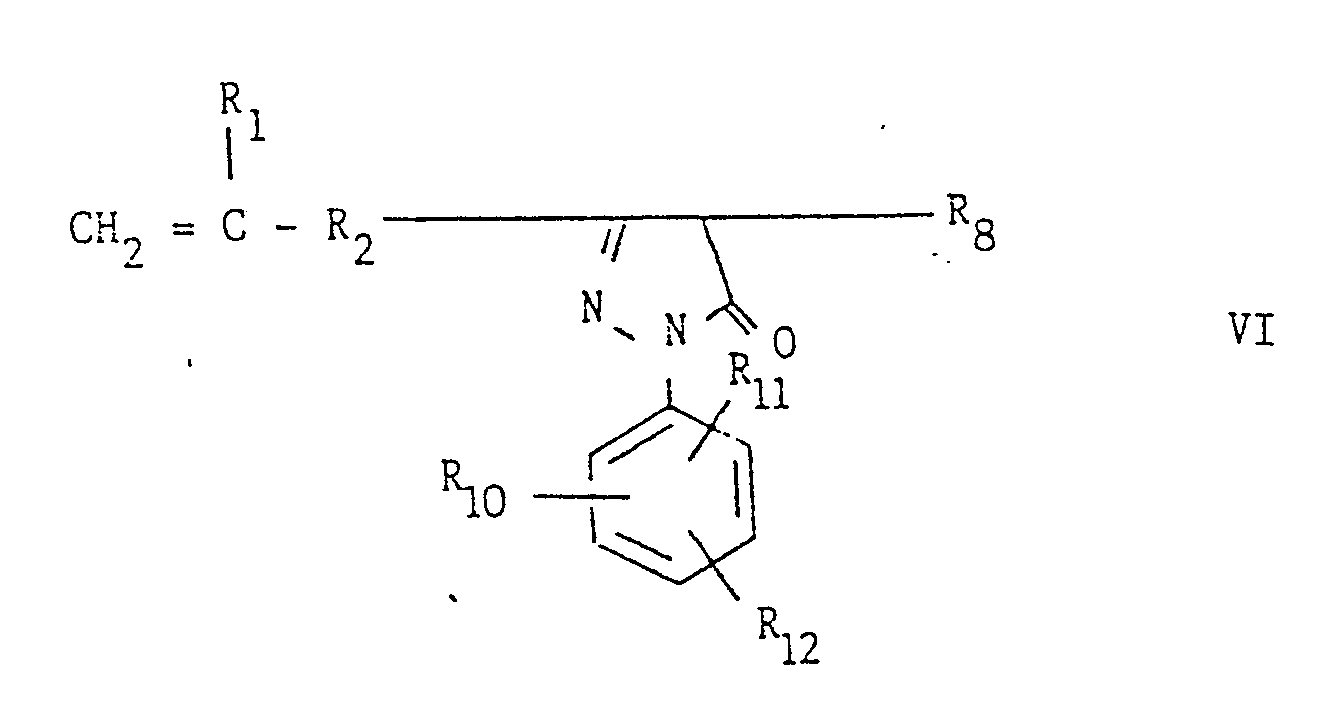
- Preferably R₁ is hydrogen or -CH₃
Preferably R₂ is -CO NH -
However other useful linking groups R₂ include
-CO NH(CH₂)x -O-CO-NH

- Particularly useful monomers of formula VI are those wherein at least two of R₁₀, R₁₁ and R₁₂ are chlorine atoms.
- Examples of leaving groups R₈ include the group -S- R₉ where R₉ is a long chain alkyl group having over 10 carbon atoms or is a substituted phenyl group having at least one alkyl or alkoxy group. Preferably R₉ when an alkyl group has from 12 to 20 carbon atoms.
- Other examples of the leaving group R₈ include.

- Examples of monomers of formula VI are :-


- Monomeric magenta colour couplers of formula VI are described in E.P. 133262.
- Another type of magenta dye forming monomeric colour couplers are those of general formula X :-

- These couplers may be prepared by reacting magenta colour couplers of the formula XI :

- Examples of cyan forming monomeric colour couplers include phenol couplers of the general formula XII :-


- Preferably R₁ is hydrogen or methyl.
- Examples of the linking groups R₁₇ include alkylene chains of 2 to 6 carbon atoms including interupted alkylene clains and alkyl or substituted alkyl groups for example

- Examples of monomers of formula XIV are :-
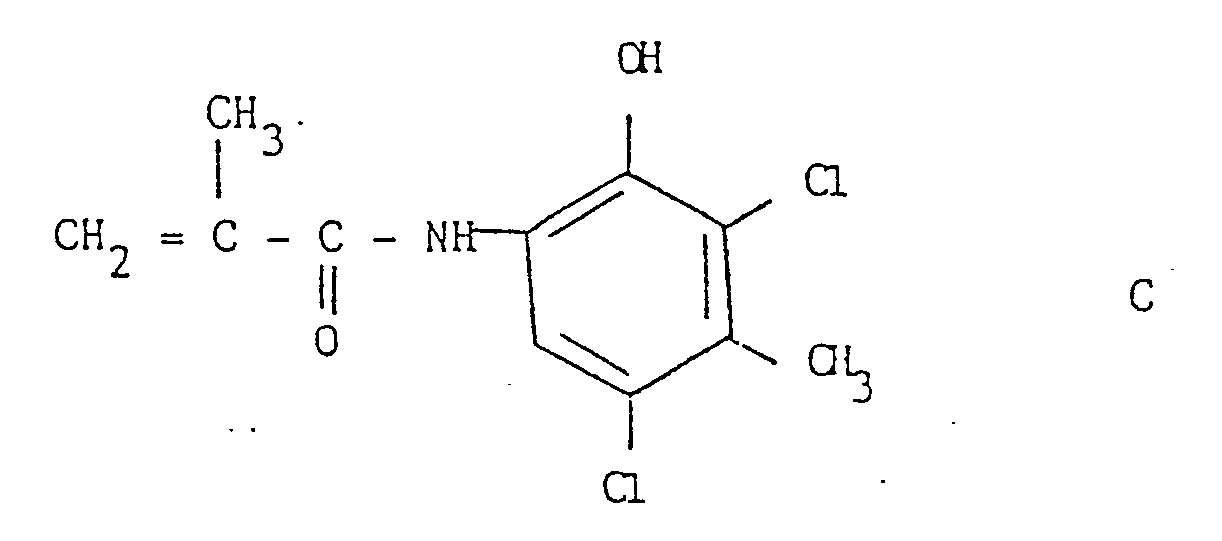
- This is Monomer C which is used in the Examples which follow

- Examples of monomers of formula XIII are :-

- Examples of monomers of formula XIV are :-

- Monomeric colour couplers of general formula XIV are described in B.P. 2,133,170.
- The colour coupler polymer formed by the process of the present invention may comprise a great variety of colour couplers. For example when two colour coupler monomers are used they may be magenta colour coupler, a yellow colour coupler or a cyan colour coupler together with a white competing coupler. Or they may be a magenta colour coupler, a yellow colour coupler or a cyan colour coupler together with one of these colour couplers which comprises a leaving group. Or two of these couplers may be used together to yield a blue, green or red dye in the photographic material after the colour coupling reaction has taken place. When as is preferred three colour coupler monomers are present it may comprise equal amounts of yellow, cyan and magenta coupler residues in which case after coupling a black or blackish dye is obtained. It may comprise three magenta type colour coupler residues, for example a magenta colour coupler of formula I, a magenta colour coupler of the same formula but having a leaving group in the coupling position and a white competing coupler having a benzyl group in the coupling position. It would be possible of course to utilise three entirely different magenta colour couplers but the resultant dye would be of rather uncertain hue.
- If it were required to produce red, green or blue dyes using three colour coupler monomers then a mixture of the two appropriate subtractive monomeric colour couplers with a white competing coupler could be used. Thus a very wide range of dyes can be produced using the polymer prepared by the process of the present invention.
- In the process of the present invention the use of at least two monomeric colour couplers has the effect of depressing the cyrstallisation tendency of the couplers. In general when suitable proportions of the couplers are used the solidification point of a mixture of the couplers is in itself significantly lower than the melting point of the individual coupler monomers and will be below the temperature of the emulsion polymerisation reaction. Thus emulsion polymerisations of this type are often carried out at 80 to 90 °C, and it is possible to find mixture of coupler monomers which, while the individual couplers may have melting points exceeding 150 °C, when present as mixtures they solidify well below 70°C.
- When mixtures of monomeric colour couplers are mixed with an additional non-coupling monomer, such as a simple acrylate ester, there is a considerably reduced tendency of the individual couplers to crystallise either in the feed solution or when the monomer mixture is fed into the reaction vessel. In fact the coupler monomer mixture tends to form oily droplets rather than solid particles when introduced into the polymerisation vessel. Accordingly the following advantages are found in the method of the present invention :-
- 1. Reduced crystallisation tendency when feeding the monomer solution to the aqueous polymerisation solution.
- 2. Less heat required to maintain monomers in solution.
- 3. Reduced incidence of thermally induced polymerisation in feed.
- 4. Reduced tendency for crystallisation in reaction medium.
- 5. Less coagulum build up, consequent on (4.)
- 6. More predictable composition of coupler polymer.
- Additionally, it is possible to use higher concentrations of coupler in the polymer than would normally be the case, since fewer crystallisation and coagulation problems will be experienced.
- However as hereinbefore stated all these benefits are more readily obtainable when three or more colour coupler monomers are used in the process of the present invention. When only two are used a great improvement is exhibited over the process of the prior art wherein only one colour coupler monomer is used.
- According to a further feature of the present invention there is provided a method of preparing colour photographic material which comprises forming a colour coupler polymer latex as just described, mixing this polymer latex with an aqueous gelatino silver halide emulsion and coating the emulsion on a photographic base.
- Photographic material may comprise one gelatino silver halide emulsion layer comprising a colour coupler polymer latex prepared by the method of the present invention, two such silver halide emulsion layers or three such layers. In the last case the three layers will most likely be a silver halide layer in which on development the polymeric colour coupler yields a yellow dye, a layer in which the polymeric colour coupler yields a cyan dye and a layer in which the polymeric colour coupler yields a magenta dye.
- The following examples will serve to illustrate the invention.
-
- To a solution of sodium oleyl methyl taurate (0.16 g) in 15.8 ml distilled water maintained at 80°C in a 100 ml reaction vessel was added, under nitrogen atmosphere and with mechanical stirring, a potassium persulphate (70 mg) and sodium metabisulphite (10 mg). After 2 minutes there was commenced addition of a heated monomer solution comprising Monomer A (1.00 g), hydroxy-propyl methacrylate (2.00g) and butyl acrylate (3.00 g) and of a surfactant solution comprising water 5.00 g, sodium oleyl methyl taurate 0.16 g and potassium persulphate 40 mg.
- The vessel containing the monomer solution was kept at about 50°C in order to maintain most of the coupler in solution, and occasionally heated to above 80°C to redissolve crystals of the monomer. The monomer and surfactant streams were fed over 2 hours after which the latex was heated for a further 1.5 hours at 80°C then cooled and filtered.
- There was obtained a latex of 21% solids content, particle size 117 nm (determined by a Nanosizer of Coulter Instruments Limited) and there was retrieved from the vessel and stirrer a total of 0.15 gram of buff coloured material, identified by thin layer chromatography to be largely unconverted Monomer A. The melting point of Monomer A was 152°C and the reaction temperature of the polymerisation system was 80°C.
-
- The procedure of Example (I) was followed but substituting Monomer B for Monomer A. The coupler monomer eventually dissolved in the butyl acrylate / hydroxypropylmethacrylate mixture by heating to above 80°C. Throughout the monomer addition crystallisation of the yellow monomer occurred, and if the temperature of the coupler monomer solution dropped below 40°C the entire solution solidified. It was therefore necessary to keep the solution at 80°C to avoid crystallisation. Towards the end of the monomer addition period, the coupler monomer solution thickened due to thermal polymerisation.
- There was formed a latex having solids content 15%, particle size 70 nm, and 0.44 g of partly polymeric, partly monomeric material was retrieved from the stirrer and vessel.
- The melting point of monomer B was 132°C andthe reaction temperature of the polymerisation system was 80°C.
- The procedure of Example (I) was followed except substituting monomer III for monomer A.
- The cyan monomer dissolved quite readily in the butyl acrylate / hydroxypropyl methacrylate mixture. The solution was kept warm at about 40°C during monomer addition. The latex thus formed was very gritty, as cyan coupler monomer had crystallised on contact with the water in the reaction vessel. The latex had solids content 24%, particle size 72 nm, but 0.23 g of grit was filtered from the latex and further gritty material was deposited during several days standing of the latex.
- The melting point of monomer C was 142°C and the reaction temperature of the polymerisation system was 80°C.
- The method of the previous examples was followed except that there was used a mixture of 0.5 g of Monomer A and 0.5 g Monomer B.
- Once the coupler mixture had been dissolved by warming in the butyl acrylate / hydroxypropylmethacrylate mixture, there was very little tendency for crystallisation to occur, particularly in the tap of the feed vessel. It was therefore necessary to keep the liquid warmed to about 40°C at most. There was obtained a slightly pinkish latex having solids content 21 %, particle size 82 nm and 0.12 g material was retrieved from the stirrer and vessel walls. This was shown to be polymeric and not to contain unconverted monomer.
- The melting point of the mixture of the two monomers was below 70°C whilst the reaction temperature of the polymerisation temperature was 80°C.
- The preparation was carried out as in comparative Example I except that instread of Monomer A only being used 0.34 g of each of Monomers A, B and C were used. The colour coupler monomers dissolved easily in the non-coupling monomer mixture and no crystallisation occurred in the feed lines when this solution was fed to the aqueous polymerisation solution. There was no crystallisation when the monomer solution, which was maintained at 30 - 40 °C for the whole two hours during the feed,was fed into the aqueous solution. As before the resultant latex was heated for a further 1 1/2 hours at 80°C, then cooled and filtered. The latex was a faintly pink colour and had a solids content of 22% with a particle size of 72 nm. Only 0.04g of coagulum was present in the reaction vessel after the latex had been removed therefrom.
- The latex as just prepared was used to prepare colour photographic material. To 2.2 ml of an undyed twinned crystal iodobromide gelatino emulsion there was added 0.4 ml of the latex and 7 ml of water. To this emulsion there was added 0.4 ml of a 3% solution of a triazine hardener. The emulsion was then coated on clear cellulose triacetate base to provide a silver coating weight of 12 mg/dm². The coating was dried and inspected in green light to show a clear, glossy coating. This photographic material was then exposed to a white light source for 10 seconds and processed in a colour developing solution for 3.25 minutes at 38°C.
- The formula of the developing solution used is as follows :-
Potassium Carbonate 37.5 g Sodium Sulphite 4.5 g Nitrilotriacetate (sequestering agent) 2 g Sodium hydroxide 0.6 g Sodium bromide 0.9 g Hydroxylamine sulphate 2.8 g Developing agent 5.25 g Water 1 litre - The formula of the developing agent is :-

- The photographic material was then passed to a bleach bath for 6.5 minutes at 35°C.
- The formula of the bleach bath used is as follows :
ammonium bromide 150 g ferric EDTA 1.8 m 150 g sodium nitrate 20 g water to 1 litre - The material was then passed to a fixing bath at 35°C for 6 1/2 minutes of the formula :-
ammonium thiosulphate (80% w/v) 190 cm sodium sulphite 19 g sodium EDTA 1.5 g water to 1 litre - The material was then washed for 3 minutes in water at 30°C and then dried. A neutral grey image was present on the photographic material. This image had the visible absorption spectrum shown in the accompanying Figure 1. This shows that the material has good absorption in the blue, green and red regions of the visible spectrum.
- The mixture of the monomers A, B and C remained as a melt at 50°C whilst the reaction temperature of the polymerisation system was 80°C.
- The method of Example V was followed except that 0.34g of Monomers A and B were used together with 0.34 g of another magenta monomer of the formula :

- The mixture of the three monomers remained as a melt below 60°C whilst the reaction temperature of the polymerisation system was 80°C.
- This latex was used to prepare colour photographic material as in Example V. After the photographic material had been exposed and processed as in Example V a reddish magenta image was obtained.
- The method of Example V was followed except that there was used 0.34 g of Monomer A, 0.34g of Monomer D and 0.34 g of third magenta monomer of the formula :-

- The non-coupling monomers used were the same as in Example V.
- The couplers all dissolved at 80°C very quickly and it was necessary to maintain the solution at only 30 - 40°C to maintain the monomers in solution.
- There was obtained a latex having a solids content of 18% and a particle size of 71 nm. Only about 0.06 g of coagulum was present in the reaction vessel after the latex had been removed therefrom.
- The latex was used to prepare colour photographic material as in Example V. After the photographic material had ben exposed and processed as in Example V a good magenta dye image was obtained.
- The mixture of the three monomers remained as melt below 60°C whilst the reaction temperature of the polymerisation system was 80°C.
Claims (16)


Applications Claiming Priority (2)
| Application Number | Priority Date | Filing Date | Title |
|---|---|---|---|
| GB878729197A GB8729197D0 (en) | 1987-12-15 | 1987-12-15 | Preparation of polymeric colour couplers |
| GB8729197 | 1987-12-15 |
Publications (2)
| Publication Number | Publication Date |
|---|---|
| EP0321399A2 true EP0321399A2 (en) | 1989-06-21 |
| EP0321399A3 EP0321399A3 (en) | 1990-06-13 |
Family
ID=10628500
Family Applications (1)
| Application Number | Title | Priority Date | Filing Date |
|---|---|---|---|
| EP88810833A Withdrawn EP0321399A3 (en) | 1987-12-15 | 1988-12-06 | Preparation of latexes of colour coupler polymers |
Country Status (4)
| Country | Link |
|---|---|
| US (1) | US5017667A (en) |
| EP (1) | EP0321399A3 (en) |
| JP (1) | JPH02954A (en) |
| GB (1) | GB8729197D0 (en) |
Cited By (4)
| Publication number | Priority date | Publication date | Assignee | Title |
|---|---|---|---|---|
| WO1990008345A1 (en) * | 1989-01-17 | 1990-07-26 | Eastman Kodak Company | Methods of forming stable dispersions of photographic materials |
| US5354642A (en) * | 1992-08-10 | 1994-10-11 | Eastman Kodak Company | Polymeric couplers for heat image separation systems |
| US5360710A (en) * | 1992-05-06 | 1994-11-01 | Eastman Kodak Company | Color photographic materials containing polymeric couplers |
| EP1561592A1 (en) | 2004-02-05 | 2005-08-10 | Hewlett-Packard Development Company, L.P. | Ink-jet ink-receiver sheet with ultra-violet absorbing latex particles |
Families Citing this family (10)
| Publication number | Priority date | Publication date | Assignee | Title |
|---|---|---|---|---|
| US5141844A (en) * | 1990-05-07 | 1992-08-25 | Eastman Kodak Company | Polymeric dye-forming couplers |
| US5234807A (en) * | 1991-11-21 | 1993-08-10 | Eastman Kodak Company | Microemulsion polymerization - processes for dispersing photographically useful components |
| US5972586A (en) * | 1995-11-22 | 1999-10-26 | Fuji Photo Film Co., Ltd. | Silver halide color photosensitive material |
| US6087437A (en) * | 1996-09-27 | 2000-07-11 | National Starch And Chemical Investment Holding Corporation | Ethylene/vinyl acetate latex binders and paints which are free of volatile coalescents and freeze-thaw additives |
| US6553908B1 (en) | 2000-09-29 | 2003-04-29 | Heidelberger Druckmaschinen Ag | Web fanout control system |
| JP2006245166A (en) * | 2005-03-02 | 2006-09-14 | Sankei Giken:Kk | Radio wave absorber |
| US7662461B2 (en) | 2006-03-31 | 2010-02-16 | Milliken & Company | Synthetic leather articles and methods for producing the same |
| US7872069B2 (en) * | 2006-03-31 | 2011-01-18 | Milliken & Company | Coated substrates and polymer dispersions suitable for use in making the same |
| US8431648B2 (en) * | 2006-03-31 | 2013-04-30 | Milliken & Company | Coated substrates and polymer dispersions suitable for use in making the same |
| US8141667B2 (en) * | 2008-06-17 | 2012-03-27 | The Board Of Trustees Of The University Of Alabama For And On Behalf Of Its Component Institution, The University Of Alabama | Hybrid dinghy pusher |
Family Cites Families (6)
| Publication number | Priority date | Publication date | Assignee | Title |
|---|---|---|---|---|
| US2422680A (en) * | 1944-06-01 | 1947-06-24 | Du Pont | Process for preparing hydrophilic color-former silver halide dispersions |
| CH485782A (en) * | 1964-06-23 | 1970-02-15 | Gevaert Photo Prod Nv | Emulsion polymerization process |
| GB1453057A (en) * | 1973-02-26 | 1976-10-20 | Agfa Gevaert | Polymeric colour forming and competing couplers |
| GB1581439A (en) * | 1976-06-15 | 1980-12-17 | Agfa Gevaert | Polymeric coupler latices for use in silver halide photography |
| JPS5986048A (en) * | 1982-11-09 | 1984-05-18 | Fuji Photo Film Co Ltd | Silver halide color photographic sensitive material |
| EP0185793A1 (en) * | 1984-12-24 | 1986-07-02 | Agfa-Gevaert N.V. | Copolymer latex and photographic silver halide materials containing such latex |
-
1987
- 1987-12-15 GB GB878729197A patent/GB8729197D0/en active Pending
-
1988
- 1988-12-06 EP EP88810833A patent/EP0321399A3/en not_active Withdrawn
- 1988-12-14 US US07/284,117 patent/US5017667A/en not_active Expired - Fee Related
- 1988-12-15 JP JP63315218A patent/JPH02954A/en active Pending
Cited By (6)
| Publication number | Priority date | Publication date | Assignee | Title |
|---|---|---|---|---|
| WO1990008345A1 (en) * | 1989-01-17 | 1990-07-26 | Eastman Kodak Company | Methods of forming stable dispersions of photographic materials |
| US5360710A (en) * | 1992-05-06 | 1994-11-01 | Eastman Kodak Company | Color photographic materials containing polymeric couplers |
| EP0569097A3 (en) * | 1992-05-06 | 1995-04-05 | Eastman Kodak Co | Color photographic materials containing polymeric couplers. |
| US5455147A (en) * | 1992-05-06 | 1995-10-03 | Eastman Kodak Company | Methods of forming polymeric couplers |
| US5354642A (en) * | 1992-08-10 | 1994-10-11 | Eastman Kodak Company | Polymeric couplers for heat image separation systems |
| EP1561592A1 (en) | 2004-02-05 | 2005-08-10 | Hewlett-Packard Development Company, L.P. | Ink-jet ink-receiver sheet with ultra-violet absorbing latex particles |
Also Published As
| Publication number | Publication date |
|---|---|
| GB8729197D0 (en) | 1988-01-27 |
| JPH02954A (en) | 1990-01-05 |
| EP0321399A3 (en) | 1990-06-13 |
| US5017667A (en) | 1991-05-21 |
Similar Documents
| Publication | Publication Date | Title |
|---|---|---|
| EP0321399A2 (en) | Preparation of latexes of colour coupler polymers | |
| US3761272A (en) | Photographic elements containing ultra violet absorbing polymers | |
| US3926436A (en) | Silver halide element containing polymeric colour forming couplers | |
| DE1570672C3 (en) | Process for the preparation of silver halide color photographic emulsions | |
| DE3148125A1 (en) | COLOR PHOTOGRAPHIC LIGHT-SENSITIVE SILVER HALOGENIDE MATERIAL, POLYMER-COUPLER LATEX, THESE EMULSION CONTAINING AND METHOD FOR FORMING A COLOR IMAGE | |
| DE3226163A1 (en) | COLOR PHOTOGRAPHIC, LIGHT-SENSITIVE SILVER HALOGENIDE MATERIAL | |
| US3813255A (en) | Ultraviolet-absorbing polymers compositions and filter | |
| US4409320A (en) | Silver halide color photographic light-sensitive material | |
| JP2002537473A5 (en) | ||
| US4128427A (en) | Silver halide emulsions containing polymeric color couplers | |
| US4388404A (en) | Silver halide color photographic light-sensitive material | |
| EP1039339A1 (en) | Polymer latexes with core-shell morphology | |
| US3163625A (en) | Color-forming monomers and polymers of acrylic acid amides of 3-aminopyrazolone | |
| US4474870A (en) | Silver halide color photographic light-sensitive material | |
| US3767412A (en) | Polymeric colour couplers and their use in colour photography | |
| JPS5965844A (en) | Color photographic sensitive silver halide material | |
| DE3341352A1 (en) | PHOTOGRAPHIC LIGHT-SENSITIVE SILVER HALOGENIDE MATERIAL | |
| DE3223316C2 (en) | ||
| EP0321401B1 (en) | Polymeric colour couplers | |
| DE3324932A1 (en) | COLOR PHOTOGRAPHIC LIGHT SENSITIVE SILVER HALOGENIDE MATERIAL AND METHOD FOR PRODUCING A COLOR IMAGE | |
| US3912513A (en) | Polymeric competing couplers and their use in photographic silver halide colour materials | |
| US3926635A (en) | Photographic material with polymeric stabilizers | |
| US3655389A (en) | Color photographic light-sensitive material containing silver occlusion preventing agent | |
| US3299013A (en) | Dye intermediates | |
| US4247660A (en) | Photo-crosslinkable polymers having azidophthalimidyl side groups |
Legal Events
| Date | Code | Title | Description |
|---|---|---|---|
| PUAI | Public reference made under article 153(3) epc to a published international application that has entered the european phase |
Free format text: ORIGINAL CODE: 0009012 |
|
| 17P | Request for examination filed |
Effective date: 19881208 |
|
| AK | Designated contracting states |
Kind code of ref document: A2 Designated state(s): BE CH DE FR GB IT LI NL |
|
| RAP1 | Party data changed (applicant data changed or rights of an application transferred) |
Owner name: ILFORD LIMITED |
|
| PUAL | Search report despatched |
Free format text: ORIGINAL CODE: 0009013 |
|
| AK | Designated contracting states |
Kind code of ref document: A3 Designated state(s): BE CH DE FR GB IT LI NL |
|
| 17Q | First examination report despatched |
Effective date: 19911212 |
|
| STAA | Information on the status of an ep patent application or granted ep patent |
Free format text: STATUS: THE APPLICATION HAS BEEN WITHDRAWN |
|
| 18W | Application withdrawn |
Withdrawal date: 19920122 |