EP0321432A1 - Process for the preparation of certain substituted aromatic compounds - Google Patents
Process for the preparation of certain substituted aromatic compounds Download PDFInfo
- Publication number
- EP0321432A1 EP0321432A1 EP88870187A EP88870187A EP0321432A1 EP 0321432 A1 EP0321432 A1 EP 0321432A1 EP 88870187 A EP88870187 A EP 88870187A EP 88870187 A EP88870187 A EP 88870187A EP 0321432 A1 EP0321432 A1 EP 0321432A1
- Authority
- EP
- European Patent Office
- Prior art keywords
- group
- reaction
- ether
- mmol
- solution
- Prior art date
- Legal status (The legal status is an assumption and is not a legal conclusion. Google has not performed a legal analysis and makes no representation as to the accuracy of the status listed.)
- Withdrawn
Links
- 238000000034 method Methods 0.000 title claims abstract description 31
- 150000001491 aromatic compounds Chemical class 0.000 title claims abstract description 11
- 238000002360 preparation method Methods 0.000 title claims abstract description 7
- 238000006243 chemical reaction Methods 0.000 claims abstract description 37
- 150000001875 compounds Chemical class 0.000 claims abstract description 15
- 229910021627 Tin(IV) chloride Inorganic materials 0.000 claims abstract description 14
- HPGGPRDJHPYFRM-UHFFFAOYSA-J tin(iv) chloride Chemical compound Cl[Sn](Cl)(Cl)Cl HPGGPRDJHPYFRM-UHFFFAOYSA-J 0.000 claims abstract description 14
- 239000002904 solvent Substances 0.000 claims abstract description 12
- 239000003054 catalyst Substances 0.000 claims abstract description 5
- 239000000126 substance Substances 0.000 claims abstract description 3
- YMWUJEATGCHHMB-UHFFFAOYSA-N Dichloromethane Chemical group ClCCl YMWUJEATGCHHMB-UHFFFAOYSA-N 0.000 claims description 57
- 125000004432 carbon atom Chemical group C* 0.000 claims description 14
- 125000000217 alkyl group Chemical group 0.000 claims description 8
- 125000002496 methyl group Chemical group [H]C([H])([H])* 0.000 claims description 8
- 125000001495 ethyl group Chemical group [H]C([H])([H])C([H])([H])* 0.000 claims description 7
- 125000000999 tert-butyl group Chemical group [H]C([H])([H])C(*)(C([H])([H])[H])C([H])([H])[H] 0.000 claims description 7
- -1 cyclic acetal Chemical class 0.000 claims description 6
- 229920006395 saturated elastomer Polymers 0.000 claims description 6
- 125000001424 substituent group Chemical group 0.000 claims description 5
- 125000000026 trimethylsilyl group Chemical group [H]C([H])([H])[Si]([*])(C([H])([H])[H])C([H])([H])[H] 0.000 claims description 5
- 229910052799 carbon Inorganic materials 0.000 claims description 4
- DHKHKXVYLBGOIT-UHFFFAOYSA-N acetaldehyde Diethyl Acetal Natural products CCOC(C)OCC DHKHKXVYLBGOIT-UHFFFAOYSA-N 0.000 claims description 3
- 125000002023 trifluoromethyl group Chemical group FC(F)(F)* 0.000 claims description 3
- 125000004417 unsaturated alkyl group Chemical group 0.000 claims description 3
- 125000002573 ethenylidene group Chemical group [*]=C=C([H])[H] 0.000 claims 3
- 125000001475 halogen functional group Chemical group 0.000 claims 2
- 125000002887 hydroxy group Chemical group [H]O* 0.000 claims 1
- 125000002777 acetyl group Chemical class [H]C([H])([H])C(*)=O 0.000 abstract description 4
- 125000001931 aliphatic group Chemical group 0.000 abstract description 3
- 125000002485 formyl group Chemical class [H]C(*)=O 0.000 abstract 1
- VLKZOEOYAKHREP-UHFFFAOYSA-N n-Hexane Chemical compound CCCCCC VLKZOEOYAKHREP-UHFFFAOYSA-N 0.000 description 49
- HIXDQWDOVZUNNA-UHFFFAOYSA-N 2-(3,4-dimethoxyphenyl)-5-hydroxy-7-methoxychromen-4-one Chemical compound C=1C(OC)=CC(O)=C(C(C=2)=O)C=1OC=2C1=CC=C(OC)C(OC)=C1 HIXDQWDOVZUNNA-UHFFFAOYSA-N 0.000 description 42
- RTZKZFJDLAIYFH-UHFFFAOYSA-N ether Substances CCOCC RTZKZFJDLAIYFH-UHFFFAOYSA-N 0.000 description 42
- HEDRZPFGACZZDS-MICDWDOJSA-N Trichloro(2H)methane Chemical compound [2H]C(Cl)(Cl)Cl HEDRZPFGACZZDS-MICDWDOJSA-N 0.000 description 40
- 239000000203 mixture Substances 0.000 description 25
- 239000010410 layer Substances 0.000 description 23
- XLYOFNOQVPJJNP-UHFFFAOYSA-N water Substances O XLYOFNOQVPJJNP-UHFFFAOYSA-N 0.000 description 22
- 229910052943 magnesium sulfate Inorganic materials 0.000 description 21
- WYURNTSHIVDZCO-UHFFFAOYSA-N Tetrahydrofuran Chemical compound C1CCOC1 WYURNTSHIVDZCO-UHFFFAOYSA-N 0.000 description 20
- 238000003756 stirring Methods 0.000 description 20
- XEKOWRVHYACXOJ-UHFFFAOYSA-N Ethyl acetate Chemical compound CCOC(C)=O XEKOWRVHYACXOJ-UHFFFAOYSA-N 0.000 description 19
- UIIMBOGNXHQVGW-UHFFFAOYSA-M Sodium bicarbonate Chemical compound [Na+].OC([O-])=O UIIMBOGNXHQVGW-UHFFFAOYSA-M 0.000 description 14
- FAPWRFPIFSIZLT-UHFFFAOYSA-M Sodium chloride Chemical compound [Na+].[Cl-] FAPWRFPIFSIZLT-UHFFFAOYSA-M 0.000 description 13
- UHOVQNZJYSORNB-UHFFFAOYSA-N benzene Substances C1=CC=CC=C1 UHOVQNZJYSORNB-UHFFFAOYSA-N 0.000 description 13
- 238000005160 1H NMR spectroscopy Methods 0.000 description 12
- XKRFYHLGVUSROY-UHFFFAOYSA-N Argon Chemical compound [Ar] XKRFYHLGVUSROY-UHFFFAOYSA-N 0.000 description 12
- VYPSYNLAJGMNEJ-UHFFFAOYSA-N Silicium dioxide Chemical compound O=[Si]=O VYPSYNLAJGMNEJ-UHFFFAOYSA-N 0.000 description 12
- YXFVVABEGXRONW-UHFFFAOYSA-N Toluene Chemical compound CC1=CC=CC=C1 YXFVVABEGXRONW-UHFFFAOYSA-N 0.000 description 12
- 239000011541 reaction mixture Substances 0.000 description 11
- 239000000047 product Substances 0.000 description 10
- YLQBMQCUIZJEEH-UHFFFAOYSA-N tetrahydrofuran Natural products C=1C=COC=1 YLQBMQCUIZJEEH-UHFFFAOYSA-N 0.000 description 10
- 238000001644 13C nuclear magnetic resonance spectroscopy Methods 0.000 description 9
- 230000015572 biosynthetic process Effects 0.000 description 9
- 239000012043 crude product Substances 0.000 description 9
- 235000019439 ethyl acetate Nutrition 0.000 description 9
- WZBQFNAWQPYQPM-UHFFFAOYSA-N hex-5-ynoyl chloride Chemical compound ClC(=O)CCCC#C WZBQFNAWQPYQPM-UHFFFAOYSA-N 0.000 description 9
- 239000000741 silica gel Substances 0.000 description 9
- 229910002027 silica gel Inorganic materials 0.000 description 9
- 238000003786 synthesis reaction Methods 0.000 description 9
- ZMANZCXQSJIPKH-UHFFFAOYSA-N Triethylamine Chemical compound CCN(CC)CC ZMANZCXQSJIPKH-UHFFFAOYSA-N 0.000 description 8
- 239000012074 organic phase Substances 0.000 description 8
- 229910000030 sodium bicarbonate Inorganic materials 0.000 description 7
- WJQOZHYUIDYNHM-UHFFFAOYSA-N 2-tert-Butylphenol Chemical class CC(C)(C)C1=CC=CC=C1O WJQOZHYUIDYNHM-UHFFFAOYSA-N 0.000 description 6
- 229910052786 argon Inorganic materials 0.000 description 6
- RXKJFZQQPQGTFL-UHFFFAOYSA-N dihydroxyacetone Chemical group OCC(=O)CO RXKJFZQQPQGTFL-UHFFFAOYSA-N 0.000 description 6
- 239000011780 sodium chloride Substances 0.000 description 5
- 238000005727 Friedel-Crafts reaction Methods 0.000 description 4
- RDOXTESZEPMUJZ-UHFFFAOYSA-N anisole Chemical class COC1=CC=CC=C1 RDOXTESZEPMUJZ-UHFFFAOYSA-N 0.000 description 4
- 239000012044 organic layer Substances 0.000 description 4
- 239000003208 petroleum Substances 0.000 description 4
- DJPAQOCIUDXBHK-UHFFFAOYSA-N 2,4-dibromo-6-(trifluoromethyl)phenol Chemical compound OC1=C(Br)C=C(Br)C=C1C(F)(F)F DJPAQOCIUDXBHK-UHFFFAOYSA-N 0.000 description 3
- WKBOTKDWSSQWDR-UHFFFAOYSA-N Bromine atom Chemical compound [Br] WKBOTKDWSSQWDR-UHFFFAOYSA-N 0.000 description 3
- OKKJLVBELUTLKV-UHFFFAOYSA-N Methanol Chemical compound OC OKKJLVBELUTLKV-UHFFFAOYSA-N 0.000 description 3
- HEMHJVSKTPXQMS-UHFFFAOYSA-M Sodium hydroxide Chemical compound [OH-].[Na+] HEMHJVSKTPXQMS-UHFFFAOYSA-M 0.000 description 3
- OKJPEAGHQZHRQV-UHFFFAOYSA-N Triiodomethane Natural products IC(I)I OKJPEAGHQZHRQV-UHFFFAOYSA-N 0.000 description 3
- 150000001266 acyl halides Chemical class 0.000 description 3
- GDTBXPJZTBHREO-UHFFFAOYSA-N bromine Substances BrBr GDTBXPJZTBHREO-UHFFFAOYSA-N 0.000 description 3
- 229910052794 bromium Inorganic materials 0.000 description 3
- 238000004587 chromatography analysis Methods 0.000 description 3
- 238000001816 cooling Methods 0.000 description 3
- INQOMBQAUSQDDS-UHFFFAOYSA-N iodomethane Chemical compound IC INQOMBQAUSQDDS-UHFFFAOYSA-N 0.000 description 3
- 239000012280 lithium aluminium hydride Substances 0.000 description 3
- 239000012452 mother liquor Substances 0.000 description 3
- 238000000746 purification Methods 0.000 description 3
- 239000000376 reactant Substances 0.000 description 3
- 238000010992 reflux Methods 0.000 description 3
- 150000007970 thio esters Chemical class 0.000 description 3
- QZYDOKBVZJLQCK-UHFFFAOYSA-N 1,2-diethoxybenzene Chemical class CCOC1=CC=CC=C1OCC QZYDOKBVZJLQCK-UHFFFAOYSA-N 0.000 description 2
- ACDMECIMTJZSCW-UHFFFAOYSA-N 1-tert-butyl-2-prop-2-enoxybenzene Chemical compound CC(C)(C)C1=CC=CC=C1OCC=C ACDMECIMTJZSCW-UHFFFAOYSA-N 0.000 description 2
- SKDGWNHUETZZCS-UHFFFAOYSA-N 2,3-ditert-butylphenol Chemical class CC(C)(C)C1=CC=CC(O)=C1C(C)(C)C SKDGWNHUETZZCS-UHFFFAOYSA-N 0.000 description 2
- IIBWBAUXZPOXIZ-UHFFFAOYSA-N 2-bromo-6-(trifluoromethyl)phenol Chemical compound OC1=C(Br)C=CC=C1C(F)(F)F IIBWBAUXZPOXIZ-UHFFFAOYSA-N 0.000 description 2
- PISMFZKNXHOJFO-UHFFFAOYSA-N 2-methyl-6-(trifluoromethyl)phenol Chemical compound CC1=CC=CC(C(F)(F)F)=C1O PISMFZKNXHOJFO-UHFFFAOYSA-N 0.000 description 2
- BKZXZGWHTRCFPX-UHFFFAOYSA-N 2-tert-butyl-6-methylphenol Chemical compound CC1=CC=CC(C(C)(C)C)=C1O BKZXZGWHTRCFPX-UHFFFAOYSA-N 0.000 description 2
- JHCFLUGYQKACEJ-UHFFFAOYSA-N 2-tert-butyl-6-prop-2-enylphenol Chemical compound CC(C)(C)C1=CC=CC(CC=C)=C1O JHCFLUGYQKACEJ-UHFFFAOYSA-N 0.000 description 2
- VHYFNPMBLIVWCW-UHFFFAOYSA-N 4-Dimethylaminopyridine Chemical compound CN(C)C1=CC=NC=C1 VHYFNPMBLIVWCW-UHFFFAOYSA-N 0.000 description 2
- CSCPPACGZOOCGX-UHFFFAOYSA-N Acetone Chemical compound CC(C)=O CSCPPACGZOOCGX-UHFFFAOYSA-N 0.000 description 2
- HEDRZPFGACZZDS-UHFFFAOYSA-N Chloroform Chemical compound ClC(Cl)Cl HEDRZPFGACZZDS-UHFFFAOYSA-N 0.000 description 2
- 238000000023 Kugelrohr distillation Methods 0.000 description 2
- 239000012359 Methanesulfonyl chloride Substances 0.000 description 2
- 230000001476 alcoholic effect Effects 0.000 description 2
- VSCWAEJMTAWNJL-UHFFFAOYSA-K aluminium trichloride Chemical compound Cl[Al](Cl)Cl VSCWAEJMTAWNJL-UHFFFAOYSA-K 0.000 description 2
- 229940121363 anti-inflammatory agent Drugs 0.000 description 2
- 239000002260 anti-inflammatory agent Substances 0.000 description 2
- 239000013078 crystal Substances 0.000 description 2
- WQOXQRCZOLPYPM-UHFFFAOYSA-N dimethyl disulfide Chemical compound CSSC WQOXQRCZOLPYPM-UHFFFAOYSA-N 0.000 description 2
- 238000003818 flash chromatography Methods 0.000 description 2
- 125000005843 halogen group Chemical group 0.000 description 2
- UBJFKNSINUCEAL-UHFFFAOYSA-N lithium;2-methylpropane Chemical compound [Li+].C[C-](C)C UBJFKNSINUCEAL-UHFFFAOYSA-N 0.000 description 2
- 239000000463 material Substances 0.000 description 2
- QARBMVPHQWIHKH-UHFFFAOYSA-N methanesulfonyl chloride Chemical compound CS(Cl)(=O)=O QARBMVPHQWIHKH-UHFFFAOYSA-N 0.000 description 2
- UZKWTJUDCOPSNM-UHFFFAOYSA-N methoxybenzene Chemical class CCCCOC=C UZKWTJUDCOPSNM-UHFFFAOYSA-N 0.000 description 2
- 238000012986 modification Methods 0.000 description 2
- 230000004048 modification Effects 0.000 description 2
- 230000007935 neutral effect Effects 0.000 description 2
- ISWSIDIOOBJBQZ-UHFFFAOYSA-N phenol group Chemical group C1(=CC=CC=C1)O ISWSIDIOOBJBQZ-UHFFFAOYSA-N 0.000 description 2
- 235000017557 sodium bicarbonate Nutrition 0.000 description 2
- FPGGTKZVZWFYPV-UHFFFAOYSA-M tetrabutylammonium fluoride Chemical compound [F-].CCCC[N+](CCCC)(CCCC)CCCC FPGGTKZVZWFYPV-UHFFFAOYSA-M 0.000 description 2
- VZGDMQKNWNREIO-UHFFFAOYSA-N tetrachloromethane Chemical compound ClC(Cl)(Cl)Cl VZGDMQKNWNREIO-UHFFFAOYSA-N 0.000 description 2
- 239000003039 volatile agent Substances 0.000 description 2
- 0 *c(cc(cc1)C(CCCC#C)=O)c1OI Chemical compound *c(cc(cc1)C(CCCC#C)=O)c1OI 0.000 description 1
- DKCPKDPYUFEZCP-UHFFFAOYSA-N 2,6-di-tert-butylphenol Chemical compound CC(C)(C)C1=CC=CC(C(C)(C)C)=C1O DKCPKDPYUFEZCP-UHFFFAOYSA-N 0.000 description 1
- ZOQOPXVJANRGJZ-UHFFFAOYSA-N 2-(trifluoromethyl)phenol Chemical compound OC1=CC=CC=C1C(F)(F)F ZOQOPXVJANRGJZ-UHFFFAOYSA-N 0.000 description 1
- LMIREHQXDACYCS-UHFFFAOYSA-N CC(C)(C)C1=CC(Br)=CC(Br)=C1O.Br.Br Chemical compound CC(C)(C)C1=CC(Br)=CC(Br)=C1O.Br.Br LMIREHQXDACYCS-UHFFFAOYSA-N 0.000 description 1
- MZRVEZGGRBJDDB-UHFFFAOYSA-N N-Butyllithium Chemical compound [Li]CCCC MZRVEZGGRBJDDB-UHFFFAOYSA-N 0.000 description 1
- VMHLLURERBWHNL-UHFFFAOYSA-M Sodium acetate Chemical compound [Na+].CC([O-])=O VMHLLURERBWHNL-UHFFFAOYSA-M 0.000 description 1
- UIIMBOGNXHQVGW-DEQYMQKBSA-M Sodium bicarbonate-14C Chemical compound [Na+].O[14C]([O-])=O UIIMBOGNXHQVGW-DEQYMQKBSA-M 0.000 description 1
- NINIDFKCEFEMDL-UHFFFAOYSA-N Sulfur Chemical compound [S] NINIDFKCEFEMDL-UHFFFAOYSA-N 0.000 description 1
- HCHKCACWOHOZIP-UHFFFAOYSA-N Zinc Chemical compound [Zn] HCHKCACWOHOZIP-UHFFFAOYSA-N 0.000 description 1
- 125000004036 acetal group Chemical group 0.000 description 1
- 150000001262 acyl bromides Chemical class 0.000 description 1
- 150000001263 acyl chlorides Chemical class 0.000 description 1
- 150000001299 aldehydes Chemical class 0.000 description 1
- BHELZAPQIKSEDF-UHFFFAOYSA-N allyl bromide Chemical compound BrCC=C BHELZAPQIKSEDF-UHFFFAOYSA-N 0.000 description 1
- 230000003110 anti-inflammatory effect Effects 0.000 description 1
- 150000004945 aromatic hydrocarbons Chemical class 0.000 description 1
- 125000003118 aryl group Chemical group 0.000 description 1
- 125000004429 atom Chemical group 0.000 description 1
- 230000000903 blocking effect Effects 0.000 description 1
- 239000006227 byproduct Substances 0.000 description 1
- 125000002915 carbonyl group Chemical group [*:2]C([*:1])=O 0.000 description 1
- 238000002425 crystallisation Methods 0.000 description 1
- 230000008025 crystallization Effects 0.000 description 1
- 125000004122 cyclic group Chemical group 0.000 description 1
- QDGONURINHVBEW-UHFFFAOYSA-N dichlorodifluoroethylene Chemical group FC(F)=C(Cl)Cl QDGONURINHVBEW-UHFFFAOYSA-N 0.000 description 1
- 238000004821 distillation Methods 0.000 description 1
- 238000010828 elution Methods 0.000 description 1
- 150000002148 esters Chemical class 0.000 description 1
- 239000004210 ether based solvent Substances 0.000 description 1
- 239000012259 ether extract Substances 0.000 description 1
- 125000001153 fluoro group Chemical group F* 0.000 description 1
- 150000002240 furans Chemical class 0.000 description 1
- 238000004817 gas chromatography Methods 0.000 description 1
- 239000011521 glass Substances 0.000 description 1
- 238000010438 heat treatment Methods 0.000 description 1
- 150000002390 heteroarenes Chemical class 0.000 description 1
- 230000036571 hydration Effects 0.000 description 1
- 238000006703 hydration reaction Methods 0.000 description 1
- 150000004678 hydrides Chemical class 0.000 description 1
- 125000004356 hydroxy functional group Chemical group O* 0.000 description 1
- 150000002596 lactones Chemical class 0.000 description 1
- WGOPGODQLGJZGL-UHFFFAOYSA-N lithium;butane Chemical compound [Li+].CC[CH-]C WGOPGODQLGJZGL-UHFFFAOYSA-N 0.000 description 1
- 238000004519 manufacturing process Methods 0.000 description 1
- 238000010907 mechanical stirring Methods 0.000 description 1
- 238000002844 melting Methods 0.000 description 1
- 230000008018 melting Effects 0.000 description 1
- 150000004780 naphthols Chemical class 0.000 description 1
- ASAWAIQNAGKJFT-UHFFFAOYSA-N pent-4-ynoyl chloride Chemical compound ClC(=O)CCC#C ASAWAIQNAGKJFT-UHFFFAOYSA-N 0.000 description 1
- 150000002989 phenols Chemical class 0.000 description 1
- LPNYRYFBWFDTMA-UHFFFAOYSA-N potassium tert-butoxide Chemical compound [K+].CC(C)(C)[O-] LPNYRYFBWFDTMA-UHFFFAOYSA-N 0.000 description 1
- 238000002953 preparative HPLC Methods 0.000 description 1
- 238000000526 short-path distillation Methods 0.000 description 1
- 238000007086 side reaction Methods 0.000 description 1
- 238000010898 silica gel chromatography Methods 0.000 description 1
- 239000007787 solid Substances 0.000 description 1
- 238000001228 spectrum Methods 0.000 description 1
- 239000011593 sulfur Substances 0.000 description 1
- 229910052717 sulfur Inorganic materials 0.000 description 1
- BCNZYOJHNLTNEZ-UHFFFAOYSA-N tert-butyldimethylsilyl chloride Chemical compound CC(C)(C)[Si](C)(C)Cl BCNZYOJHNLTNEZ-UHFFFAOYSA-N 0.000 description 1
- VDZOOKBUILJEDG-UHFFFAOYSA-M tetrabutylammonium hydroxide Chemical compound [OH-].CCCC[N+](CCCC)(CCCC)CCCC VDZOOKBUILJEDG-UHFFFAOYSA-M 0.000 description 1
- 238000005406 washing Methods 0.000 description 1
- 239000011701 zinc Substances 0.000 description 1
- 229910052725 zinc Inorganic materials 0.000 description 1
Classifications
-
- C—CHEMISTRY; METALLURGY
- C07—ORGANIC CHEMISTRY
- C07C—ACYCLIC OR CARBOCYCLIC COMPOUNDS
- C07C45/00—Preparation of compounds having >C = O groups bound only to carbon or hydrogen atoms; Preparation of chelates of such compounds
- C07C45/87—Preparation of ketenes or dimeric ketenes
- C07C45/89—Preparation of ketenes or dimeric ketenes from carboxylic acids, their anhydrides, esters or halides
-
- C—CHEMISTRY; METALLURGY
- C07—ORGANIC CHEMISTRY
- C07D—HETEROCYCLIC COMPOUNDS
- C07D307/00—Heterocyclic compounds containing five-membered rings having one oxygen atom as the only ring hetero atom
- C07D307/77—Heterocyclic compounds containing five-membered rings having one oxygen atom as the only ring hetero atom ortho- or peri-condensed with carbocyclic rings or ring systems
- C07D307/78—Benzo [b] furans; Hydrogenated benzo [b] furans
- C07D307/79—Benzo [b] furans; Hydrogenated benzo [b] furans with only hydrogen atoms, hydrocarbon or substituted hydrocarbon radicals, directly attached to carbon atoms of the hetero ring
-
- C—CHEMISTRY; METALLURGY
- C07—ORGANIC CHEMISTRY
- C07C—ACYCLIC OR CARBOCYCLIC COMPOUNDS
- C07C45/00—Preparation of compounds having >C = O groups bound only to carbon or hydrogen atoms; Preparation of chelates of such compounds
- C07C45/45—Preparation of compounds having >C = O groups bound only to carbon or hydrogen atoms; Preparation of chelates of such compounds by condensation
- C07C45/46—Friedel-Crafts reactions
-
- C—CHEMISTRY; METALLURGY
- C07—ORGANIC CHEMISTRY
- C07C—ACYCLIC OR CARBOCYCLIC COMPOUNDS
- C07C45/00—Preparation of compounds having >C = O groups bound only to carbon or hydrogen atoms; Preparation of chelates of such compounds
- C07C45/61—Preparation of compounds having >C = O groups bound only to carbon or hydrogen atoms; Preparation of chelates of such compounds by reactions not involving the formation of >C = O groups
- C07C45/67—Preparation of compounds having >C = O groups bound only to carbon or hydrogen atoms; Preparation of chelates of such compounds by reactions not involving the formation of >C = O groups by isomerisation; by change of size of the carbon skeleton
- C07C45/673—Preparation of compounds having >C = O groups bound only to carbon or hydrogen atoms; Preparation of chelates of such compounds by reactions not involving the formation of >C = O groups by isomerisation; by change of size of the carbon skeleton by change of size of the carbon skeleton
-
- C—CHEMISTRY; METALLURGY
- C07—ORGANIC CHEMISTRY
- C07C—ACYCLIC OR CARBOCYCLIC COMPOUNDS
- C07C49/00—Ketones; Ketenes; Dimeric ketenes; Ketonic chelates
- C07C49/76—Ketones containing a keto group bound to a six-membered aromatic ring
- C07C49/794—Ketones containing a keto group bound to a six-membered aromatic ring having unsaturation outside an aromatic ring
-
- C—CHEMISTRY; METALLURGY
- C07—ORGANIC CHEMISTRY
- C07C—ACYCLIC OR CARBOCYCLIC COMPOUNDS
- C07C49/00—Ketones; Ketenes; Dimeric ketenes; Ketonic chelates
- C07C49/76—Ketones containing a keto group bound to a six-membered aromatic ring
- C07C49/82—Ketones containing a keto group bound to a six-membered aromatic ring containing hydroxy groups
- C07C49/835—Ketones containing a keto group bound to a six-membered aromatic ring containing hydroxy groups having unsaturation outside an aromatic ring
-
- C—CHEMISTRY; METALLURGY
- C07—ORGANIC CHEMISTRY
- C07C—ACYCLIC OR CARBOCYCLIC COMPOUNDS
- C07C49/00—Ketones; Ketenes; Dimeric ketenes; Ketonic chelates
- C07C49/76—Ketones containing a keto group bound to a six-membered aromatic ring
- C07C49/84—Ketones containing a keto group bound to a six-membered aromatic ring containing ether groups, groups, groups, or groups
Definitions
- the present invention relates to a process for preparing certain substituted aromatic compounds, with an aliphatic ketone substituent having a labile moiety, using a modified Friedel-Crafts reaction.
- the present invention relates to processes for the preparation of compounds having the chemical structure:
- the processes of the present invention comprise modified Friedel-Crafts reactions between the reactants Ar-H and
- Ar-H is an aromatic compound which is activated to electrophilic attack. Such compounds include unsubstituted and substituted phenols, anisole, 1,2-diethoxybenzene, furans, naphthols, and other substituted and unsubstituted heteroaromatics.
- Preferred compounds Ar-H useful in the processes of the present invention are substituted tert-butylphenol compounds, especially di-tert-butylphenol compounds and derivatives thereof.
- Preferred compounds Ar-H useful in the processes of the present invention have the general structure:
- -A 1 is selected from the group consisting of -OH, -H, -0 2 CR, wherein -R is a straight or branched chain alkyl group having from 1 to about 10 carbon atoms, preferably methyl or ethyl.
- Preferred -A 1 is -OH or -H, and most preferred -A 1 is -OH.
- - A 2 is selected from the group consisting of unsubstituted or substituted, saturated or unsaturated, straight, branched or cyclic alkyl having from 1 to about 10 carbon atoms and trimethylsilyl.
- Substituents of -A 2 may be one or more of the group consisting of halo, -OR 3 , -0 2 CR 3 , -C0 2 R 3 , and -C(O)R 3 .
- Preferred is unsubstituted -A 2 or -A 2 substituted with hydroxy or halo, especially fluoro.
- More preferred -A 2 is selected from unsubstituted C 1 -C 3 saturated straight-chain alkyl, C 2 -C 6 unsaturated straight-chain alkyl, and C 3 -C 6 saturated or unsaturated branched-chain alkyl, trimethylsilyl and trifluoromethyl.
- Preferred unsaturated -A 2 's have a terminally unsaturated group; where -A 2 has a labile moiety, a blocking group may be attached to the labile group prior to reacting Ar-H with Most preferred A 2 is t-butyl.
- -A 3 is selected from the group consisting of t-butyl, trimethylsilyl and trifluoromethyl.
- -A 2 and -A 3 are the same substituent.
- Preferred -A 3 is t-butyl.
- Preferred compounds Ar-H useful in the processes of the present invention also include derivatives of tert-butylphenol compounds, especially derivatives of di-tert-butylphenol compounds; particularly preferred are those having the structure:
- -A- is selected from the group consisting of -CH 2 -, and Preferred -A- is -CH 2 - or and most preferred -A- is -CH 2 -.
- Each -R 3 is independently selected from the group consisting of -H, methyl and ethyl. Preferably all -R 3 groups are -H.
- Each -R 4 is independently selected from the group consisting of -CH 3 and -CH 2 CH 3 , or the -R 4 's may be joined to form a cyclic acetal such that both -R 4 's together are one group selected from -(CH 2 ) 2 - and -(CH 2 )s-.
- Preferred is both -R 4 groups being methyl, or both -R 4 groups together being -CH 2 CH 2 -. Most preferred is both -R 4 groups being methyl.
- Each -Z- is independently selected from the group consisting of -0-, -S-, and -NR 3- .
- Preferred is -Z- being -0- or -S-, and most preferred is both -Z- groups being the same atom selected from -0- or -S-, especially -0-.
- acetal groups i.e., -CH(ZR 4 ) 2 groups
- acetals are Most preferred specific acetals are and, especially, -CH(OMe) 2 .
- the processes of the present invention are useful for preparing aromatic compounds with an aliphatic ketone substituent having a labile moiety in the aliphatic portion of the substituent, comprising the following reaction step:
- the labile portion of the -Y group may comprise unsaturated bonds (e.g., triple bond, double bond), a carbonyl or an ester in any position.
- the labile portion of the -Y group is a terminally unsaturated moiety, especially the terminally unsaturated groups provided in detail hereinbefore.
- Reaction (1) hereinabove is carried out in a solvent medium at a temperature of from about -40° C to about -100°C using stannic chloride (SnC1 4 ) as a catalyst.
- Reaction (1) hereinabove is preferably carried out at a temperature of from about -50°C to about -80° C, more preferably of from about -60 0 C to about -80° C.
- the time of Reaction (1) is preferably less than about hour, more preferably about 30 minutes.
- Preferred solvent systems for carrying out Reaction (1) include dichloromethane (methylene chloride), toluene/dichloromethane, other chlorinated solvents, and ether solvents; the preferred solvent is dichloromethane.
- a flask with mechanical stirring and a reflux condenser is charged with a mixture of 10% NaOH (117 mL) and zinc (60 g).
- the crude dibromide from above is added as a solid in small portions.
- the mixture is heated to 100°C for 30 min.
- the reacted material is filtered, and acidified in an ice bath using 6N HCI.
- the product is extracted with 3100 mL portions of ether.
- the ether extract is washed with water (2 X 300 mL), dried (MgS0 4 ), filtered, and concentrated in vacuo.
- the crude product is dissolved in hexane (100 mL) and slurried with 50 g silica gel.
- the hexane is filtered off, and the silica gel is washed with 100 mL more hexane. The silica gel treatment is then repeated. The combined hexane portions are concentrated in vacuo to give mono-bromide, which is used without further purification in the next step.
- a solution of 4.38 g (13.0 mmol) of 9 in 70 mL of methylene chloride is sequentially treated at -78° C with 1.85 g (14.3 mmol) of 5-hexynoyl chloride and 1.68 mL (14.3 mmol) of stannic chloride.
- the mixture is stirred at -78°C for one hour and is then allowed to warm up to ca. -50°C and stirred there for 5 min.
- the reaction is poured into 0.1 N HCI and the layers are separated. The aqueous portion is extracted with ether and the combined organic phase is washed with sat. NaHCO 3 and sat. NaCl, and then dried (MgS0 4 ).
- a glass lined 3 L vessel is charged with 1-prop-2-enyloxy-2-t-butylbenzene (11.6 g; 61 mmol), Ac 2 0 (160 ml), and NaOAc (10 g). After heating at 200° C for 18 hr, the mixture is poured into 200 g ice, with stirring for 15 min. It is then extracted with 3 x 300 ml portions of ether. The combined ether layers are slowly added to an ice-cooled flask containing NaHCO 3 and stirred for 40 min. The ether layer is then separated, washed with 2 x 300 ml saturated NaCl solution, dried (MgS0 4 ), filtered, and concentrated in vacuo to give 17.2 g crude product. Chromatography using 3:1 petroleum ether/CH 2 C 12 then gives 7.69 g pure 1-acetoxy-2-allyl-6-t-butylbenzene (54% yield).
- t-Butyllithium (1.7 ml of a 1.8M solution of hexane; 3 equiv.) is added to THF (1 ml) and cooled to -78°C under argon with stirring, and a solution of 2-bromo-6-trifluoromethylphenol in dry THF (1 ml; 1 mmol) is added dropwise via syringe.
- the reaction is stirred 30 minutes, and then iodomethane (340 mg; 2.4 equiv.) is added dropwise via syringe at -78°C under argon, with stirring.
- the mixture is allowed to warm to 0°C with stirring over 15 minutes, and stirring is continued for 45 minutes more.
- reaction is then quenched with 1N HCI (3 ml) and extracted from 1N HCI (10 ml) with 3 x 10 ml portions of ether.
- the combined ether portions are washed with water (3 x 20 ml portions: pH tests neutral), and the solution is then dried (MgS0 4 ), filtered, and concentrated in vacuo to give crude 2-methyl-6-trifluoromethylphenol, which is chromatographed on silica gel with 5% ether in petroleum ether to give pure product.
- the resulting 2-methyl-6-trifluoromethylphenol is converted to 2-methyl-4-(5'-hexynoyl)-6-trifluoromethylphenol by reaction with 5-hexynoyl chloride using a modified Friedel-Crafts reaction as described in Example 3 above.
- the yield of the crude 4-(5'-hexynoyl)-2,6-di-tert-butylphenol is 322.1 g.
- the crude product is recrystallized from hexane at -30°C to yield 259 g (86% yield) of 4-(5'-hexynoyl)-2,6-di-tert-butylphenol, mp 68-68.5°C..
- IR 3590, 3320, 3270, 1658, 1587, 1419, 1375, 1362, 1312, 1257, 1223, 189, 1103, 1004, 875, 663, 616 cm- 1 .
- the compound is prepared from compound 6 of Example 2. -To a solution of 1.78 g (8.00 mmol) of 6 in 30 mL of dichloromethane is added sequentially at 0° C, 0.68 mL (8.8 mmol) of methanesulfonyl chloride (MsCI) and 2.80 mL (20.0 mmol) of triethylamine (Et 3 N). The reaction is stirred for one hour at 0°C and is poured into saturated NaCI. The aqueous layer is extracted with ether and the combined organic phase is washed with saturated NaCl and dried (MgS0 4 ).
- MsCI methanesulfonyl chloride
- Et 3 N triethylamine
Landscapes
- Chemical & Material Sciences (AREA)
- Organic Chemistry (AREA)
- Chemical Kinetics & Catalysis (AREA)
- Organic Low-Molecular-Weight Compounds And Preparation Thereof (AREA)
- Furan Compounds (AREA)
- Low-Molecular Organic Synthesis Reactions Using Catalysts (AREA)
Abstract
The present invention involves process for the preparation of compounds having the chemical structure:

wherein Ar-H is an aromatic compound which is activated to an electrophilic attack, and wherein -Y is an aliphatic group having a labile moiety, especially where the labile moiety is a terminally unsaturated moiety: -C≡CH, - c =CH2,

or aldehydes in the form of their acetals. The process comprises the step of reactinct Ar-H and
wherein -X is -Cl or -Br, and where the reaction step is carried out in a solvent medium at a temperature of from about -40°C to about -100°C using stannic chloride as a catalyst.
Description
- The present invention relates to a process for preparing certain substituted aromatic compounds, with an aliphatic ketone substituent having a labile moiety, using a modified Friedel-Crafts reaction.
- Compounds useful as anti-inflammatory agents which are aromatic compounds, especially substituted tert-butylphenol compounds, and related derivatives thereof, with an aliphatic ketone substituent having a terminally unsaturated moiety are disclosed in U.S. Patent No. 4,708,966, issued to Loomans, Matthews & Miller on November 24, 1987; and in copending patent applications entitled "Cyclic Anti-Inflammatory Derivatives of Di-tert-butylphenol Compounds" of Dobson, Loomans, Matthews & Miller, Serial No. 123,756, and "Tert-Butyl Phenyl Compounds Useful as Anti-Inflammatory Agents of Loomans, Matthews & Miller, Serial No. 123.694. both filed on November 23, 1987.
- Friedel-Crafts reactions of aromatic hydrocarbons with acyl halides in the presence of a catalyst such as anhydrous aluminum chloride to produce aromatic compounds having an aliphatic ketone substituent are well-known. However, when the acyl halide reactant has a labile portion, such as a terminally unsaturated moiety, many unwanted side reactions can occur, such that the yield of the desired product is low. This has made preparation of certain substituted aromatic compounds, with an aliphatic ketone substituent having a labile moiety, in large quantities and with good yields a difficult task.
- It is an object of the present invention to provide a process for the preparation of aromatic compounds, with an aliphatic ketone substituent having a labile portion.
- It is a further object of the present invention to provide a process for the preparation of such compounds from aromatic and acyl halide reactants with good yield.
- The present invention relates to processes for the preparation of compounds having the chemical structure:

- wherein Ar-H is an aromatic compound which is activated to an electrophilic attack, and wherein -Y is an aliphatic group having a labile moiety, especially where the labile moiety is a terminally unsaturated moiety: -C≡ CH. - C =CH2, -C = C = CH2, or aldehydes in the form of their acetals. The process comprises the step of reacting Ar-H and

- wherein -X is -CI or -Br, and where the reaction step is carried out in a solvent medium at a temperature of from about -40° C to about -100° C using stannic chloride as a catalyst.
- The processes of the present invention comprise modified Friedel-Crafts reactions between the reactants Ar-H and

- As used herein, Ar-H is an aromatic compound which is activated to electrophilic attack. Such compounds include unsubstituted and substituted phenols, anisole, 1,2-diethoxybenzene, furans, naphthols, and other substituted and unsubstituted heteroaromatics. Preferred compounds Ar-H useful in the processes of the present invention are substituted tert-butylphenol compounds, especially di-tert-butylphenol compounds and derivatives thereof.
- Preferred compounds Ar-H useful in the processes of the present invention have the general structure:

- In this structure, -A1 is selected from the group consisting of -OH, -H, -02CR, wherein -R is a straight or branched chain alkyl group having from 1 to about 10 carbon atoms, preferably methyl or ethyl. Preferred -A1 is -OH or -H, and most preferred -A1 is -OH.
- -A2 is selected from the group consisting of unsubstituted or substituted, saturated or unsaturated, straight, branched or cyclic alkyl having from 1 to about 10 carbon atoms and trimethylsilyl. Substituents of -A2 may be one or more of the group consisting of halo, -OR3, -02CR3, -C02R3, and -C(O)R3. Preferred is unsubstituted -A2 or -A2 substituted with hydroxy or halo, especially fluoro. More preferred -A2 is selected from unsubstituted C1-C3 saturated straight-chain alkyl, C2-C6 unsaturated straight-chain alkyl, and C3-C6 saturated or unsaturated branched-chain alkyl, trimethylsilyl and trifluoromethyl. Preferred unsaturated -A2's have a terminally unsaturated group; where -A2 has a labile moiety, a blocking group may be attached to the labile group prior to reacting Ar-H with

- -A3 is selected from the group consisting of t-butyl, trimethylsilyl and trifluoromethyl. Preferably -A2 and -A3 are the same substituent. Preferred -A3 is t-butyl.
- Preferred compounds Ar-H useful in the processes of the present invention also include derivatives of tert-butylphenol compounds, especially derivatives of di-tert-butylphenol compounds; particularly preferred are those having the structure:

- In this structure, -A- is selected from the group consisting of -CH2-,


- As used herein, compounds

- 1.-(CR1 2)n-C≡ CH, wherein n is an integer from 0 to about 5;
- 2. -(CR1 2)n-CR3=CH2, wherein n is an integer from 0 to about 5;
- 3. -(CR1 2)n-CR3 = C = CH2, wherein n is an integer from 0 to about 5; and
- 4. -(CR1 2)n-CH(ZR4)2, wherein n is an integer from 1 to about 5; and wherein each -R1 is independently selected from the group consisting of -H, -OR3, -NR3 2, -NR3 s +, -N(R3)C(O)R3, -02CR3, -C02R3, -C(O)NR3 2, straight or branched chain saturated alkyl group having from 1 to about 3 carbon atoms, and straight or branched chain unsaturated alkyl group having from 1 to about 3 carbon atoms, or two -R1's on the same carbon atom are =O or =CR32; each -R3 is independently selected from the group consisting of -H, methyl and ethyl; each -R4 is independently selected from the group consisting of -CHs and -CH2CHs, or the -R4's may be joined to form a cyclic acetal such that both -R4's together are one group selected from -(CH2)2- and -(CH2)3-; and each -Z- is independently selected from the group consisting of -O-, -S-, and -NR3-.
- In these substitutent -Y groups, each -R1 is independently selected from the group consisting of -H, -OR3, -NR3 2, -NR3 3+, -N(R3)C(O)R3, -02CR3, -CO2R3, -C(O)NR3 2, straight or branched chain saturated alkyl group having from 1 to about 3 carbon atoms, and straight or branched chain unsaturated alkyl group having from 1 to about 3 carbon atoms, or two -R1s on the same carbon atom are =O or =CR3 2. Preferably, -R1 is -H, -OH, methyl, or ethyl, or two -R1's on the same carbon atom are = O or = CH2, and further preferred is no more than about two -R1 groups being other than -H. Most preferred is all -R1 groups being -H.
- Each -R3 is independently selected from the group consisting of -H, methyl and ethyl. Preferably all -R3 groups are -H.
- Each -R4 is independently selected from the group consisting of -CH3 and -CH2CH3, or the -R4's may be joined to form a cyclic acetal such that both -R4's together are one group selected from -(CH2)2- and -(CH2)s-. Preferred is both -R4 groups being methyl, or both -R4 groups together being -CH2CH2-. Most preferred is both -R4 groups being methyl.
- Each -Z- is independently selected from the group consisting of -0-, -S-, and -NR3-. Preferred is -Z- being -0- or -S-, and most preferred is both -Z- groups being the same atom selected from -0- or -S-, especially -0-.
- Specifically preferred acetal groups (i.e., -CH(ZR4)2 groups) are


- Preferred -Y groups are those having terminal -C≡ CH or acetal functionalities (-Y groups numbered 1 and 4 hereinabove). Most preferred -Y groups are -(CR1 2)n-C≡CH, wherein n is an integer of from 0 to about 5; more preferred is wherein n is an integer of from 1 to about 4; most preferred is n=3.
- The processes of the present invention are useful for preparing aromatic compounds with an aliphatic ketone substituent having a labile moiety in the aliphatic portion of the substituent, comprising the following reaction step:

- In the processes of the present invention, Reaction (1) hereinabove is carried out in a solvent medium at a temperature of from about -40° C to about -100°C using stannic chloride (SnC14) as a catalyst. Reaction (1) hereinabove is preferably carried out at a temperature of from about -50°C to about -80° C, more preferably of from about -600 C to about -80° C. The time of Reaction (1) is preferably less than about hour, more preferably about 30 minutes. Preferred solvent systems for carrying out Reaction (1) include dichloromethane (methylene chloride), toluene/dichloromethane, other chlorinated solvents, and ether solvents; the preferred solvent is dichloromethane.
- The following Examples further describe and demonstrate the preferred embodiments within the scope of the present invention. The Examples are given solely for the purpose of illustration, and are not to be construed as limitations of the present invention, since many variations thereof are possible without departing from its spirit and scope. All temperature readings are in °C.
-

- To a solution of 2-tert-butylphenol (18 ml, 117 mmol) in 117 mL methylene chloride, stirred at 0° C, is added bromine (2.1 equiv, 39 g). The reaction is allowed to reach room temperature and is stirred 15 minutes more. The product is then extracted from water using 3 100 mL portions of ether. The ether layers are combined and washed sequentially with sodium bicarbonate, and water. The resulting organic layer is dried (MgS04), filtered, and concentrated in vacuo to give the crude dibromide (2,4-dibromo-6-tert-butylphenol), which is used in the next reaction without further purification.
- A flask with mechanical stirring and a reflux condenser is charged with a mixture of 10% NaOH (117 mL) and zinc (60 g). The crude dibromide from above is added as a solid in small portions. The mixture is heated to 100°C for 30 min. After cooling to room temperature, the reacted material is filtered, and acidified in an ice bath using 6N HCI. The product is extracted with 3100 mL portions of ether. The ether extract is washed with water (2 X 300 mL), dried (MgS04), filtered, and concentrated in vacuo. The crude product is dissolved in hexane (100 mL) and slurried with 50 g silica gel. The hexane is filtered off, and the silica gel is washed with 100 mL more hexane. The silica gel treatment is then repeated. The combined hexane portions are concentrated in vacuo to give mono-bromide, which is used without further purification in the next step.
- To 100 mL tetrahydrofuran (THF), cooled to -78°C under argon, is added tert-butyllithium (35.4 mL of 1.8M solution), with stirring. A sample of the mono-bromide from above (4.56 g, 20 mmol), dissolved in 5 mL THF, is added dropwise with stirring. After stirring 30 minutes at -78°C, the reaction is warmed to 0°C and stirred 30 minutes. After re-cooling to -78°C, iodomethane (2.96 mL, 48 mmol) is added dropwise with stirring. The reaction is allowed to warm to 0° C, and stirring is continued for 30 minutes. The reaction is added to 1 N HCI (ca 100 mL) and extracted with 3 100 mL portions of ether. The ether portions are combined, dried (MgS04), filtered, and chromatographed on silica gel (sg) (20/o EtOAc in hexane) to give 1.04 g pure 2-tert-butyl-6-methylphenol.
- To a solution of 2-tert-butyl-6-methylphenol (1.2 g, 7.3 mmol) in methylene chloride (28 ml, 1.1 equiv.), stirred under argon at -78°C, is added 5-hexynoyl chloride (1.0 g) followed by stannic chloride (0.93 mL, 1.1 equiv.). After stirring 30 minutes at -78°C, the reaction is warmed to -50°C and stirred 5 minutes more. The mixture is then quenched with 1 N HCI/ether. The product is extracted from 1 N HCI with 3 portions of ether, and the ether layers are combined and washed with water. The resulting ether layer is dried (MgS04), filtered, and concentrated in vacuo to give 2.14 g crude product. The product is flash chromatographed on silica gel using 10% EtOAc in hexane to give 0.97 g 2-methyl-4-(5'-hexynoyl)-6-t-butylphenol. Crystallization from hexane gives crystals, mp 63-64° C.
- IR (CCI4): 3610(s), 3430(m), 3320(s), 2960(s), 2120(w), 1675(s), 1580(s), 1340(m), 1180(s), 630(m), cm-1.
- 1H-NMR (CDCI3) 8 (ppm): 1.45(s, 9H), 1.98(q, 4H), 2.35(s, 3H), 3.10(t, 2H), 5.60(s, 1H), 7.70 (s, 1H), 7.80(s, 1H); 13C-NMR (CDCl3) 8 16.24, 18.00, 23.39, 29.58, 34.73, 36.65, 69.15, 83.86, 123.53, 125.91, 128.80, 129.51, 136.09, 158.04, 199.26 ppm.
-


- To a mixture of 47.5 g (316 mmol) of o-(t-butyl)-phenol, 91 mL of 40% KOH, and 13 mL of 40% tetra-n-butylammonium hydroxide is added at 0° a solution ofca. 100 mL of 1,1-dichloro-2,2-difluoro-ethylene in 250 mL of CH2CI2. The flask is well-stoppered at 0° and the mixture is allowed to warm to room temperature and is stirred vigorously for 48 h. The reaction mixture is poured into water and extracted with pet. ether. The combined organic phase is washed with sat. NaCl and dried (MgS04). Concentration and short-path distillation gives 83.4 g of 2: bp 95°/I torr; IR (film): 2970 (m), 1445 (m), 1310 (s), 1265 (s), 1235 (s), 1175 (s), 1165 (s), 835 (s), 755 (s) cm-1; 1H-NMR (CDCl3, TMS) 8: 1.40 (s, 9H), 5.95 (t, J=7Hz, 1H), 7.0-7.5 (m, 4H).
- A solution of 82.2 g (291 mmol) of 2 in 875 mL of tetrahydrofuran (THF) is treated at -78°C with 640 mL (1.75 mol) of 2.74 M nBuLi, keeping the temperature below -60°C. The mixture is stirred at -78°C for 6 hours and then is allowed to warm very slowly to room temperature where it is stirred overnight. The reaction is cooled back to -78° C and to it is added 41.1 g (436 mmol) of methyl disulfide. The solution is allowed to warm to 25° C, stirred for 2 hours, and is then poured into 0.1 N HCI. The aqueous portion is extracted with ether and the combined organic phase is washed with sat. NaHCO3 and sat. NaCI, and then dried (MgS04). GC examination of the reaction mixture reveals a very clean reaction, showing very little else besides 3. The volatile solvents are removed in the hood by distillation, with the pot temperature reaching ca. 110°C. GC analysis at this point shows an ca. 3:1 mixture of 3 and the corresponding thioester derived from hydration of the triple bond. Kugelrohr distillation (oven temp. = 110-140° C, 0.5 torr) affords 43.5 g of an approx. 3:1 mixture of 3 and the respective thioester: (Spectra of pure 3) IR (neat): 3480 (m), 2960 (m), 1430 (s), 1225 (m), 745 (s) cm-1; 1H-NMR (CDCl3, TMS) 8 : 1.45 (s, 9H), 2.50 (s, 3H), 6.25 (s, 1H), 6.80 (m, IH), 7.25 (m, 2H).
- A mixture of 43.5 g (ca. 193 mmol) of 3 (containing 25% thioester) and 600 mL each of methanol and 3 N H2S04 is refluxed overnight. The reaction solution is concentrated to ca. one-half of its original volume by distilling away the volatiles, and then is cooled to 25° C and concentrated by means of a water aspirator in the hood (this procedure removes all volatile sulfur-containing by-products). The concentrated reaction is poured into water and extracted with ether. The combined organic phase is washed with sat. NaHCO3 and sat. NaCI, and then dried (MgS04). The volatiles are removed under reduced pressure and the crude lactone is recrystallized from hexane to afford 23.2 g of pure 4. The mother liquor is flash chromatographed (10% EtOAc/hex) to afford an additional 2.01 g of 4. Total yield of 4 is 25.2 g: mp 99.5-100°; IR (CDCl3): 2965 (s), 1795 (vs), 1430 (s), 1085 (s), 1070 (s) cm-1; 1H-NMR (CDCl3, TMS) 8 : 1.40 (s, 9H), 3.65 (s, 2H), 7.15 (m, 3H); 13C-NMR (CDCI3, TMS) 8 : 29.50, 32.56, 34.19, 122.15, 123.54, 123.90, 125.81, 134.16, 152.65, 174.03.
- To a solution of 3.80 g (20.0 mmol) of 4 and 5.0 mL (80 mmol) of iodomethane in 100 mL of THF is added portionwise at 0° C 5.6 g (50 mmol) of potassium t-butoxide. The mixture is stirred at 0° C for 30 min and then is warmed to 25°C and stirred for an additional 2 hours. The reaction is poured into 0.1 N HCI and the aqueous layer is extracted with ether. The combined organic phase is washed with sat. NaHCO3 and sat. NaCI, and then dried (MgS04). The crude, concentration reaction mixture is recrystallized from hexane to afford 2.21 g of pure 5. The mother liquor is Kugelrohr distilled (oven temp = 160°C, 0.5 torr) to provide an additional 1.19 g of 5. The total yield of 5 is 3.40 g: mp 84-85°; IR (CDCl3): 2970 (s), 1795 (vs), 1430 (s), 1280 (s), 1055 (s) cm-1; 1H-NMR (CDCl3, TMS) δ : 1.40 (s, 9H), 1.50 (s, 6H), 7.15 (m, 3H); 13C-NMR (CDCl3 TMS) 8 : (off-resonance multiplicity) 25.38 (q), 29.58 (q), 34.21 (s), 42.09 (s), 120.32 (d), 124.14 (d), 125.59 (d), 134.13 (s, two carbons), 150.11 (s), 180.82 (s).
- A solution of 1.14 g (30.0 mmol) of lithium aluminum hydride in 50 mL of ether is treated at 0°C with 5.45 g (25.0 mmol) of 5. The reaction mixture is warmed to 25°C and stirred for 1 hour. The excess hydride is decomposed at 0°C with 25 mL of ethyl acetate followed by 100 mL of a 1:1 mixture of sat. NH4CI and water. The reaction is filtered through a short pad of celite, washing it well with ether. The combined organic layer is washed with sat. NaCl and dried (MgS04). Concentration leaves essentially pure 6: mp 67-68°C; IR (CCI4): 3640 (m), 3290 (s, br), 2960 (s), 1425 (m), 1385 (m), 1245 (m), 1030 (m) cm-1; 1H-NMR (CDCl3, TMS) δ 1.40 (s, 15H), 1.85 (br s, alcoholic OH, 1 H), 3.65 (br s, 2H), 6.6-7.3 (m, 3H), 9.05 (s, phenolic OH, 1 H); 13C-NMR (CDCl3, TMS) 8 (off-resonance multiplicity): 25.45 (q), 29.99 (q), 34.97 (s), 39.75 (s), 74.13 (t), 118.96 (d), 125.25 (d), 125.58 (d), 133.33 (s), 138.25 (s), 155.28 (s).
- To a mixture of 2.81 g (12.7 mmol) of 6, 2.37 g (15.8 mmol) of tert-butyldimethylchlorosilane, and 0.38 g (3.2 mmol) of 4-dimethylaminopyridine in 60 mL of methylene chloride is added, at room temperature, 5.23 mL (38.0 mmol) of triethylamine. The reaction mixture is stirred overnight at 25° C and is then poured into water. The aqueous layer is extracted with ether and the combined organic layer is washed with sat. NaCl and dried (MgS04). The crude, concentrated reaction solution is flushed through a short column of silica gel eluting with 20/o EtOAc/hex (Rf of 9 = 0.72) directly into a round-bottomed flask. Concentration affords 4.06 g of 9. IR (film): 3225 (s, br), 2950 (s), 2930 (s), 1385 (s), 1250 (s), 1050 (s), 835 (s), 780 (s) cm-1; 1H-NMR (CDCl3, TMS)8 : 0.15 (s, 6H), 0.95 (s, 9H), 1.45 (s, 15H), 3.70 (s, 2H), 6.6-7.3 (m, 3H), 9.50 (s, 1H).
- A solution of 4.38 g (13.0 mmol) of 9 in 70 mL of methylene chloride is sequentially treated at -78° C with 1.85 g (14.3 mmol) of 5-hexynoyl chloride and 1.68 mL (14.3 mmol) of stannic chloride. The mixture is stirred at -78°C for one hour and is then allowed to warm up to ca. -50°C and stirred there for 5 min. The reaction is poured into 0.1 N HCI and the layers are separated. The aqueous portion is extracted with ether and the combined organic phase is washed with sat. NaHCO3 and sat. NaCl, and then dried (MgS04). TLC (100/0 EtOAc/hexane) showed only a trace of 9 (Rf = 0.70) along with the nearly pure 10 (Rf = 0.38). The crude, concentrated 10 is diluted with 75 mL of THF and to it is added at 25°C, 8.19 g (26.0 mmol) of tetra-n-butyl-ammonium fluoride trihydrate. After stirring the mixture for one hour at 25°C it is poured into water and the aqueous layer is extracted with ether. The combined organic phase is washed with sat. NaCl and dried (MgS04). TLC (20% EtOAc/hexane) shows predominantly 11 (Rf = 0.22), with no 10 (Rf = 0.60) remaining. Flash chromatography affords 3.21 g of 11: mp 91-93°; IR (CHCl3): 3620 (m), 3310 (s), 3200 (m, br), 2970 (s), 2110 (w), 1655 (s), 1585 (s), 1270 (s), 635 (m) cm-1; 1H-NMR (CDCl3, TMS)δ : 1.40 (s, 15H), 1.7-2.3 (m, 5H), 3.05 (t, 2H), 3.80 (d, 2H), 5.40 (t, 1H), alcoholic OH), 7.80 (s, 2H), 10.95 (s, 1H, phenolic OH); 13C-NMR (CDCl3, TMS) 8 (off-resonance multiplicity): 18.03 (t), 23.71 (t), 25.38 (q), 29.68 (q), 35.25 (s), 36.58 (t), 40.06 (s), 69.22 (d), 73.55 (t), 83.73 (s), 126.40 (d), 126.69 (d), 127.06 (s), 133.92 (s), 138.34 (s), 161.54 (s), 200.91 (s).
-

- To a stirred solution of o-(t-butyl)-phenol (11.3 g; 75 mmol) in acetone (150 ml) is added allyl bromide (10.9 g, 1.2 equiv.) and anhydrous K2COs. After stirring 18 hr at reflux, the reaction is added to water (200 ml) and extracted with 3 x 150 ml portions of petroleum ether. The combined organic layers are dried (MgS04), filtered, and concentrated in vacuo to give the crude product, which is purified by silica gel (sg) chromatography (hexane elution) to yield 1-prop-2-enyloxy-2-t-butylbenzene (11.6 g; 81% yield).
- A glass lined 3 L vessel is charged with 1-prop-2-enyloxy-2-t-butylbenzene (11.6 g; 61 mmol), Ac20 (160 ml), and NaOAc (10 g). After heating at 200° C for 18 hr, the mixture is poured into 200 g ice, with stirring for 15 min. It is then extracted with 3 x 300 ml portions of ether. The combined ether layers are slowly added to an ice-cooled flask containing NaHCO3 and stirred for 40 min. The ether layer is then separated, washed with 2 x 300 ml saturated NaCl solution, dried (MgS04), filtered, and concentrated in vacuo to give 17.2 g crude product. Chromatography using 3:1 petroleum ether/CH2C12 then gives 7.69 g pure 1-acetoxy-2-allyl-6-t-butylbenzene (54% yield).
- To a solution of 1-acetoxy-2-allyl-6-t-butylbenzene (7.69 g) in dry ether (66 ml) is added lithium aluminum hydride (LAH) (2.2 g) with stirring. After 30 minutes at reflux, the reaction is acidified using 3N HCI (ca. 75 ml) with ice bath cooling. The mixture is then poured into water (200 ml) and extracted with 3 x 100 ml ether. The ether layers are combined, dried (MgS04), filtered, and concentrated in vacuo to give 5.4 g product, which is purified by silica gel chromatography (50:1 ether/CH2CI2) to give pure 2-allyl-6-t-butylphenol (4.69 g; 76% yield).
- A solution of 2-allyl-6-t-butylphenol (0.57 g; 3 mmol) in dry CH2Cl2 (12 ml) is cooled to -78° C, and 5-hexynoyl chloride (0.43 g; 3.3 mmol) is added via syringe, followed by SnC14 (0.375 ml) added dropwise via syringe, with stirring under Argon. After 30 min the reaction is allowed to warm to 0° C and is stirred at that temperature for 5 min; it is then quenched with ca 1 ml of 3N HCI. The reaction is poured into 100 ml water and extracted with 3 x 50 ml portions of ether. The combined ether layers are washed with 150 ml portions of water until the aqueous layer is neutral (pH test). The ether layer is dried (MgS04), filtered, and concentrated in vacuo to give crude product, which is chromatographed with 20:1 hexane/EtOAc, giving 0.64 g 2-allyl-4-(5-hexynoyl)-6-t-butylphenol (770/o yield). The product is recrystallized from hexane at 0°C to give crystals melting at 62-63°C. 13C-NMR (CDCl3) 8 ppm:18.0, 23.3, 29.6, 34.7, 35.9, 36.6, 69.0, 83.9,117.9,124.8,126.5, 129.0, 129.4,1235.6, 136.9. 158.2, 198.9.
- IR (CCl4): 3500cm-1 (m), 3300 (m), 2950 (s), 2100 (w), 1665 (s), 1580 (m), 1410 (m), 1360 (m), 1310 (m), 1250 (m), 1180 (s), 1140 (m), 920 (m).
- 1H-NMR (CDCl3) (60 mH2) 8 ppm: 1.45 (s, 9H), 1.8-2.4 (m, 5H), 3.15 (t, 2H); 3.60 (d, 2H), 5.1-5.4 (m, 1H) 6.08 (s, 1H), 7.80 (d, 1H), 8.0 (d, 1H).
GC/El: C19H2402.
MS: M+ at 284. -

- A solution of 2,4-dibromo-6-trifluoromethylphenol (5.77 g; 18 mmol) is dissolved in dry THF (45 ml), and s-butyllithium (21 ml of 1.7M solution) is added dropwise with stirring at -78°C under argon. After stirring at -78°C for 30 minutes, the mixture is allowed to warm to 0°C and is stirred 40 minutes more. The reaction is quenched with 1 N HCI and extracted from 1 N HCI (50 ml) with 3 x 50 ml portions of ether. The combined ether portions are washed with 1M sodium bicarbonate (100 ml) then dried (MgS04), filtered and concentrated in vacuo to give 3.84 g crude product. Chromatography on silica gel (95.5 petroleum ether/ether) thus gives 2-bromo-6-trifluoromethylphenol.
- t-Butyllithium (1.7 ml of a 1.8M solution of hexane; 3 equiv.) is added to THF (1 ml) and cooled to -78°C under argon with stirring, and a solution of 2-bromo-6-trifluoromethylphenol in dry THF (1 ml; 1 mmol) is added dropwise via syringe. The reaction is stirred 30 minutes, and then iodomethane (340 mg; 2.4 equiv.) is added dropwise via syringe at -78°C under argon, with stirring. The mixture is allowed to warm to 0°C with stirring over 15 minutes, and stirring is continued for 45 minutes more. The reaction is then quenched with 1N HCI (3 ml) and extracted from 1N HCI (10 ml) with 3 x 10 ml portions of ether. The combined ether portions are washed with water (3 x 20 ml portions: pH tests neutral), and the solution is then dried (MgS04), filtered, and concentrated in vacuo to give crude 2-methyl-6-trifluoromethylphenol, which is chromatographed on silica gel with 5% ether in petroleum ether to give pure product.
- The resulting 2-methyl-6-trifluoromethylphenol is converted to 2-methyl-4-(5'-hexynoyl)-6-trifluoromethylphenol by reaction with 5-hexynoyl chloride using a modified Friedel-Crafts reaction as described in Example 3 above.
-

- To a solution of anisole (10.8 g, 100 mmol) in methylene chloride (100 ml) stirred at -60°C is added 5-hexynoyl chloride (13.0 g, 1.00 eq) followed by stannic chloride (26.4 g, 1.01 eq) over a 10 minute period. The reaction mixture is warmed to -50° C and is stirred for 5 minutes. The mixture is quenched with 3 N HCI and the layers are separated. The methylene chloride layer is extracted twice with 3 N HCI, then twice with water, then concentrated in vacuo. Yield of crude product is 18.9 g (94% yield). This is recrystallized from hexane to afford 6.7 g of 1-methoxy-4- (5'-hexynoyl)benzene. Preparative HPLC of the mother liquor affords an additional 3.5 g of this product; m.p. 49.5-51°C.
- IR (Nujol mull) 3280,1680,1600,1511,1340,1308,1257,1207,1168,1021,980,817,702,662, cm-1.
- 1H-NMR (CDCl3) 1.95 (m, 2H), 2.08 (t, 1H), 2.36 (m, 2H), 3.08 (t, 2H), 3.84 (s, 3H), 6.96 (d, 2H), 7.98 (d, 2H), ppm;
- 13C-NMR (CDCl3) 17.6, 22.8, 36.2, 55.0, 68.8, 83.5, 113.4, 129.9, 163.1, 197.5, ppm.
-

- A solution of 5-hexynoyl chloride (12.19 g, 1.68 mmol) and toluene (2.0 ml, 1.12 eq) in methylene chloride (30 ml) is cooled to -60°C. Stannic chloride (4.80 g, 1.11 eq) is added to the solution in two portions five minutes apart and the mixture is allowed to warm to -40°C over a 15 minute period. The reaction mixture is quenched with 2 N HCI and the layers are separated. The methylene chloride layer is extracted twice with 2N HCI, then extracted twice with water, and concentrated in vacuo. The yield of the crude 4-(5'-hexynoyl)toluene is 2.15 g.
-

-

-

- A solution of 2,6-di-tert-butylphenol (206.3 g, 1.00 mmol) in methylene chloride (2L) is cooled to -40°C. The 5-hexynoyl chloride (131.1 g, 1.01 eq) is added in one portion and the resultant solution is cooled to -53° C and the stannic chloride (120 ml, 1.02 eq) is added dropwise to the solution over a half hour period. The temperature of the reaction mixture is dropped to -60°C over the addition period. After stirring for an additional 5 minutes, the reaction mixture is quenched with 3 N HCI, then extracted twice with water, and concentrated in vacuo. The yield of the crude 4-(5'-hexynoyl)-2,6-di-tert-butylphenol is 322.1 g. The crude product is recrystallized from hexane at -30°C to yield 259 g (86% yield) of 4-(5'-hexynoyl)-2,6-di-tert-butylphenol, mp 68-68.5°C..
- IR: 3590, 3320, 3270, 1658, 1587, 1419, 1375, 1362, 1312, 1257, 1223, 189, 1103, 1004, 875, 663, 616 cm-1.
- 1H NMR (CDCl3): 1.56 (s, 18H), 2.08 (m, 3H), 2.41 (m, 2H), 3.29 (t, 2H), 5.96 (s, 1H), 7.97 (s, 2H) ppm. 13C NMR (CDCl3): 17.8, 23.2, 29.9, 34.1, 36.2, 68.8, 83.6, 125.5, 128.7, 135.7, 158.1, 198.6 ppm.
- The compound


- While particular embodiments of the present invention have been described, it will be obvious to those skilled in the art that various changes and modifications to the compounds and compositions disclosed herein can be made without departing from the spirit and scope of the invention. It is intended to cover, in the appended claims, all such modifications that are within the scope of this invention.
Claims (17)
1. A process for the preparation of a compound having the chemical structure:

wherein Ar-H is an aromatic compound which is activated to electrophilic attack; and wherein -Y is a terminally unsaturated group selected from the group consisting of:
and wherein each -R1 is independently selected from the group consisting of -H, -OR3, -NR3 2 , -NR3 3 +, -N(R3)C(O)R3, -02CR3, -C02R3, -C(O)NR3 2 , straight or branched chain saturated alkyl group having from 1 to about 3 carbon atoms, and straight or branched chain unsaturated alkyl group having from 1 to about 3 carbon atoms, or two -R1's on the same carbon atom are =0 or =CR3 2; each -R3 is independently selected from the group consisting of -H, methyl and ethyl; each -R4 is independently selected from the group consisting of -CHs and -CH2CH3, or the -R4's may be joined to form a cyclic acetal such that both -R4's together are one group selected from -(CH2)2- and -(CH2)3; and each -Z- is independently selected from the group consisting of -0-, -S-, and -NR3-; comprising the step of reacting the compounds Ar-H and 
wherein -X is -CI or -Br, and wherein said reaction step is carried out in a solvent medium at a temperature of from about -40° C to about -100° C using stannic chloride as a catalyst.
1. -(CR1 2)n-C≡CH, wherein n is an integer from 0 to about 5;
2. -(CR1 2)n-CR3=CH2, wherein n is an integer from 0 to about 5;
3. -(CR1 2)n-CR3=C=CH2, wherein n is an integer from 0 to about 5; and
4. -(CR1 2)n-CH(ZR4)2, wherein n is an integer from 1 to about 5;
and wherein each -R1 is independently selected from the group consisting of -H, -OR3, -NR3 2 , -NR3 3 +, -N(R3)C(O)R3, -02CR3, -C02R3, -C(O)NR3 2 , straight or branched chain saturated alkyl group having from 1 to about 3 carbon atoms, and straight or branched chain unsaturated alkyl group having from 1 to about 3 carbon atoms, or two -R1's on the same carbon atom are =0 or =CR3 2; each -R3 is independently selected from the group consisting of -H, methyl and ethyl; each -R4 is independently selected from the group consisting of -CHs and -CH2CH3, or the -R4's may be joined to form a cyclic acetal such that both -R4's together are one group selected from -(CH2)2- and -(CH2)3; and each -Z- is independently selected from the group consisting of -0-, -S-, and -NR3-; comprising the step of reacting the compounds Ar-H and
wherein -X is -CI or -Br, and wherein said reaction step is carried out in a solvent medium at a temperature of from about -40° C to about -100° C using stannic chloride as a catalyst.
2. The process of Claim 1 wherein Ar-H has the general structure:

wherein -A1 is selected from the group consisting of -OH, -H, and -02CR, wherein -R is a straight or branched chain alkyl group having from 1 to about 10 carbon atoms; -A2 is selected from the group consisting of unsubstituted or substituted, saturated or unsaturated, straight, branched or cyclic alkyl having from 1 to about 10 carbon atoms, and trimethylsilyl, and wherein substituents of -A2 are nil or one or more of the group consisting of halo, -OR3, -02CR3, -C02R3, and -C(O)R3; and wherein -A3 is selected from the group consisting of t-butyl, trimethylsilyl, and trifluoromethyl.
3. The process of Claim 2 wherein -A is -OH.
4. The process of Claim 3 wherein -A2 and -A3 are the same substituent.
5. The process of Claim 3 wherein -A2 is unsubstituted or substituted with hydroxy or halo and -A3 is t-butyl.
6. The process of Claim 5 wherein -A2 is unsubstituted.
7. The process of Claim 6 wherein -A2 and -A3 are both t-butyl.
8. The process of Claim 1 wherein Ar-H is
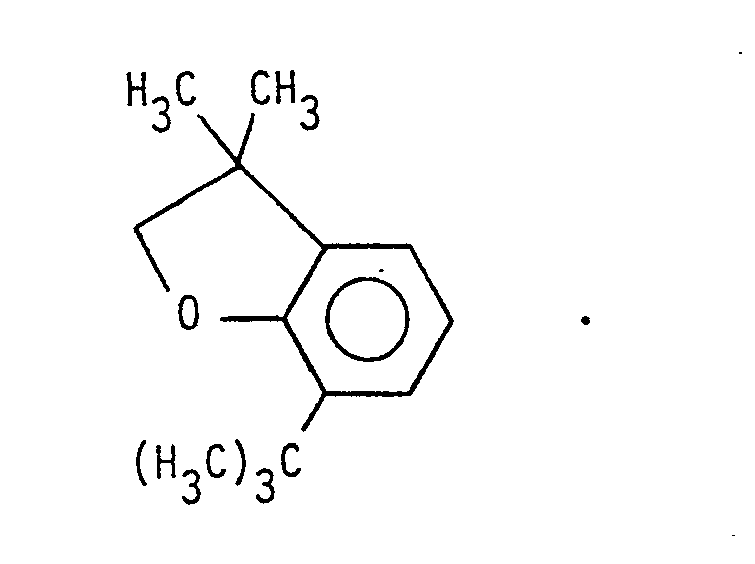
9. The process of Claim 1 wherein -Y is selected from the group consisting of -(CR1)n-C≡CH, -(CR1)n-CR3=CH2, and -(CR1 2)n-CR3=C=CH2.
10. The process of Claim 7 wherein -Y is selected from -(CR1)n-C≡CH.
11. The process of Claim 10 wherein all -R1 are -H.
12. The process of Claim 11 wherein n = 3.
13. The process of Claim 7 wherein -Y is selected from the group consisting of -(CR1)n-C≡CH, -(CR1)nCR3=CH2, and -(CR1 2))n-CR3=C=CH2.
14. The process of Claim 5 wherein said reaction is carried out in said solvent medium at a temperature of from about -50° C to about -80° C for less than about one hour.
15. The process of Claim 13 wherein said reaction is carried out in said solvent medium at a temperature of from about -50° C to about -80° C for less than about one hour.
16. The process of Claim 11 wherein said reaction is carried out in said solvent medium at a temperature of from about -50° C to about -80° C for less than about one hour.
17. The process of Claim 16 wherein said solvent is dichloromethane and wherein n = 3.
Applications Claiming Priority (2)
| Application Number | Priority Date | Filing Date | Title |
|---|---|---|---|
| US13465587A | 1987-12-18 | 1987-12-18 | |
| US134655 | 1987-12-18 |
Publications (1)
| Publication Number | Publication Date |
|---|---|
| EP0321432A1 true EP0321432A1 (en) | 1989-06-21 |
Family
ID=22464348
Family Applications (1)
| Application Number | Title | Priority Date | Filing Date |
|---|---|---|---|
| EP88870187A Withdrawn EP0321432A1 (en) | 1987-12-18 | 1988-12-15 | Process for the preparation of certain substituted aromatic compounds |
Country Status (10)
| Country | Link |
|---|---|
| EP (1) | EP0321432A1 (en) |
| JP (1) | JPH01279847A (en) |
| KR (1) | KR890009834A (en) |
| AU (1) | AU2699988A (en) |
| DK (1) | DK701688A (en) |
| FI (1) | FI885818A7 (en) |
| IL (1) | IL88674A0 (en) |
| NO (1) | NO885591L (en) |
| PT (1) | PT89235A (en) |
| ZA (1) | ZA889439B (en) |
Cited By (7)
| Publication number | Priority date | Publication date | Assignee | Title |
|---|---|---|---|---|
| EP0318090A3 (en) * | 1987-11-23 | 1990-05-16 | The Procter & Gamble Company | Tert-butyl phenyl compounds as anti-inflammatory agents |
| WO1992017432A1 (en) * | 1991-03-26 | 1992-10-15 | The Procter & Gamble Company | Process for the preparation of 2-alkyl-4-acyl-6-tert-butylphenol compounds |
| WO1996003396A1 (en) * | 1994-07-27 | 1996-02-08 | The Procter & Gamble Company | Dihydrobenzofuran and related compounds useful as anti-inflammatory agents |
| US5656661A (en) * | 1994-07-27 | 1997-08-12 | The Procter & Gamble Company | Dihydrobenzofuran and related compounds useful as anti-inflammatory agents |
| US5672620A (en) * | 1996-02-01 | 1997-09-30 | The Procter & Gamble Company | Dihydrobenzofuran and related compounds useful as anti-inflammatory agents |
| US5684002A (en) * | 1994-09-07 | 1997-11-04 | The Procter & Gamble Company | Dihydorbenzofuran and related compounds useful as anti-inflammatory agents |
| US5684031A (en) * | 1996-02-01 | 1997-11-04 | The Procter & Gamble Company | Dihydrobenzofuran and related compounds useful as anti-inflammatory agents |
Citations (4)
| Publication number | Priority date | Publication date | Assignee | Title |
|---|---|---|---|---|
| US3985783A (en) * | 1975-06-09 | 1976-10-12 | The Dow Chemical Company | Process for ring acylation of phenols |
| US4130666A (en) * | 1977-05-16 | 1978-12-19 | Riker Laboratories, Inc. | Anti-inflammatory method |
| DE3323127A1 (en) * | 1983-06-27 | 1985-01-03 | Institut Chimii Akademii Nauk Estonskoj Ssr, Tallin | Phenyl derivatives of 2,4-dimethyl-2-hexene, and their use |
| EP0251408A1 (en) * | 1986-06-27 | 1988-01-07 | The Procter & Gamble Company | Novel anti-inflammatory agents, pharmaceutical compositions and methods for reducing inflammation |
-
1988
- 1988-12-13 IL IL88674A patent/IL88674A0/en unknown
- 1988-12-15 EP EP88870187A patent/EP0321432A1/en not_active Withdrawn
- 1988-12-16 NO NO88885591A patent/NO885591L/en unknown
- 1988-12-16 DK DK701688A patent/DK701688A/en not_active Application Discontinuation
- 1988-12-16 AU AU26999/88A patent/AU2699988A/en not_active Abandoned
- 1988-12-16 PT PT89235A patent/PT89235A/en not_active Application Discontinuation
- 1988-12-16 FI FI885818A patent/FI885818A7/en not_active Application Discontinuation
- 1988-12-17 KR KR1019880016886A patent/KR890009834A/en not_active Withdrawn
- 1988-12-19 ZA ZA889439A patent/ZA889439B/en unknown
- 1988-12-19 JP JP63320320A patent/JPH01279847A/en active Pending
Patent Citations (4)
| Publication number | Priority date | Publication date | Assignee | Title |
|---|---|---|---|---|
| US3985783A (en) * | 1975-06-09 | 1976-10-12 | The Dow Chemical Company | Process for ring acylation of phenols |
| US4130666A (en) * | 1977-05-16 | 1978-12-19 | Riker Laboratories, Inc. | Anti-inflammatory method |
| DE3323127A1 (en) * | 1983-06-27 | 1985-01-03 | Institut Chimii Akademii Nauk Estonskoj Ssr, Tallin | Phenyl derivatives of 2,4-dimethyl-2-hexene, and their use |
| EP0251408A1 (en) * | 1986-06-27 | 1988-01-07 | The Procter & Gamble Company | Novel anti-inflammatory agents, pharmaceutical compositions and methods for reducing inflammation |
Non-Patent Citations (2)
| Title |
|---|
| CHEMICAL ABSTRACTS, vol. 67, no. 11, 11th September 1967, page 5050, abstract no. 53840p, Columbus, Ohio, USA ; J.A. GAUTIER et al.: "Acetylenic aryl aliphatic ketones" & Bulletin de la société Chimique de France 1967 (5) 1551-4 * |
| METHODEN DER ORGANISCHEN CHEMIE, Vol. VII/2a, 4th edition, 1973, Georg Thieme Verlag, Stuttgart, HOUBEN-WEYL et al.: " Friedel-Crafts- Reaktion, Katalysatoren und Kondensationsmittel" * |
Cited By (9)
| Publication number | Priority date | Publication date | Assignee | Title |
|---|---|---|---|---|
| EP0318090A3 (en) * | 1987-11-23 | 1990-05-16 | The Procter & Gamble Company | Tert-butyl phenyl compounds as anti-inflammatory agents |
| WO1992017432A1 (en) * | 1991-03-26 | 1992-10-15 | The Procter & Gamble Company | Process for the preparation of 2-alkyl-4-acyl-6-tert-butylphenol compounds |
| WO1996003396A1 (en) * | 1994-07-27 | 1996-02-08 | The Procter & Gamble Company | Dihydrobenzofuran and related compounds useful as anti-inflammatory agents |
| US5656661A (en) * | 1994-07-27 | 1997-08-12 | The Procter & Gamble Company | Dihydrobenzofuran and related compounds useful as anti-inflammatory agents |
| US5674891A (en) * | 1994-07-27 | 1997-10-07 | The Procter & Gamble Company | Dihydrobenzothiophene compounds useful as anti-inflammatory agents |
| AU704085B2 (en) * | 1994-07-27 | 1999-04-15 | Vanderbilt University | Dihydrobenzofuran and related compounds useful as anti-inflammatory agents |
| US5684002A (en) * | 1994-09-07 | 1997-11-04 | The Procter & Gamble Company | Dihydorbenzofuran and related compounds useful as anti-inflammatory agents |
| US5672620A (en) * | 1996-02-01 | 1997-09-30 | The Procter & Gamble Company | Dihydrobenzofuran and related compounds useful as anti-inflammatory agents |
| US5684031A (en) * | 1996-02-01 | 1997-11-04 | The Procter & Gamble Company | Dihydrobenzofuran and related compounds useful as anti-inflammatory agents |
Also Published As
| Publication number | Publication date |
|---|---|
| IL88674A0 (en) | 1989-07-31 |
| AU2699988A (en) | 1989-06-29 |
| NO885591L (en) | 1989-06-19 |
| ZA889439B (en) | 1989-09-27 |
| JPH01279847A (en) | 1989-11-10 |
| NO885591D0 (en) | 1988-12-16 |
| KR890009834A (en) | 1989-08-04 |
| FI885818A0 (en) | 1988-12-16 |
| DK701688D0 (en) | 1988-12-16 |
| PT89235A (en) | 1989-12-29 |
| FI885818A7 (en) | 1989-06-19 |
| DK701688A (en) | 1989-06-19 |
Similar Documents
| Publication | Publication Date | Title |
|---|---|---|
| Kruse et al. | Synthetic applications of cyclic. alpha.-chloro ethers and thioethers. 4. Use of (thio) acetal esters as reagents for the protection of alcohols. Synthesis of 2-tetrahydrothienyl ethers | |
| EP0321432A1 (en) | Process for the preparation of certain substituted aromatic compounds | |
| US4982006A (en) | Process for the preparation of certain substituted aromatic compounds | |
| JP2690356B2 (en) | Process for producing E7 / Z9-alkadien-1-ol and its hydroxyl-protected derivative | |
| JPS6220176B2 (en) | ||
| GB1599623A (en) | 2-(2,2-dihalovinyl)-thiophenes | |
| GB2098609A (en) | Process for the preparation of wherein (7E,9Z)-alkadienol derivatives | |
| Hashimoto et al. | Oxidative coupling of ketene dithioacetals with silylated carbon nucleophiles by the use of trityl tetrafluoroborate | |
| US3970673A (en) | Process for preparing bicyclic γ-lactone | |
| EP0120368B1 (en) | Alpha-fluoroalkyl carboxylic acid esters and process for preparing the same | |
| JP3212104B2 (en) | Novel thioacetal compound and method for producing the same | |
| HU214303B (en) | Process for the preparation of halogenated alcohols and the product obtained by the process | |
| US4235779A (en) | Bicyclic lactones | |
| Lai et al. | Conformational studies of selectively methylated [2.2](1, 3)(1, 4) cyclophanes. Steric effects in the relative conformational ground states | |
| Potkin et al. | Polychlorobutanoic and polychlorobutenoic acids in the synthesis of polyfunctional derivatives | |
| EP0152003B1 (en) | Process for the preparation of alpha-hydroxyaryl-alkanoic acids | |
| CA1053686A (en) | Furane derivatives and production thereof | |
| JPH0558638B2 (en) | ||
| JP3558681B2 (en) | Hexahydroindane derivative | |
| JP3549576B2 (en) | Hexahydroindanecarboxylic acid ester derivative and method for producing the same | |
| GB2145102A (en) | Fluorinated allylic compounds and a process for their preparation | |
| Ibuka et al. | Highly regioselective α-alkylation of γ-acetoxy-α, β-enoates by reduction–alkylation with lithium dibutylcuprate–alkyl halides: application to the synthesis of spirovetivanes | |
| CA1308731C (en) | Nona-1,3,5-triene derivatives; process for preparing them and their use | |
| US5426233A (en) | Preparation of chiral hydroxyketones | |
| JP3249847B2 (en) | Method for producing Z-cyclohexylideneacetic acid derivative |
Legal Events
| Date | Code | Title | Description |
|---|---|---|---|
| PUAI | Public reference made under article 153(3) epc to a published international application that has entered the european phase |
Free format text: ORIGINAL CODE: 0009012 |
|
| AK | Designated contracting states |
Kind code of ref document: A1 Designated state(s): AT BE CH DE ES FR GB GR IT LI LU NL SE |
|
| 17P | Request for examination filed |
Effective date: 19891213 |
|
| STAA | Information on the status of an ep patent application or granted ep patent |
Free format text: STATUS: THE APPLICATION HAS BEEN WITHDRAWN |
|
| 18W | Application withdrawn |
Withdrawal date: 19900723 |