EP0321841A2 - Ester urethane (met)acrylic-acid derivatives - Google Patents
Ester urethane (met)acrylic-acid derivatives Download PDFInfo
- Publication number
- EP0321841A2 EP0321841A2 EP88120877A EP88120877A EP0321841A2 EP 0321841 A2 EP0321841 A2 EP 0321841A2 EP 88120877 A EP88120877 A EP 88120877A EP 88120877 A EP88120877 A EP 88120877A EP 0321841 A2 EP0321841 A2 EP 0321841A2
- Authority
- EP
- European Patent Office
- Prior art keywords
- carbon atoms
- radical
- meth
- chain
- ester
- Prior art date
- Legal status (The legal status is an assumption and is not a legal conclusion. Google has not performed a legal analysis and makes no representation as to the accuracy of the status listed.)
- Granted
Links
- JOYRKODLDBILNP-UHFFFAOYSA-N Ethyl urethane Chemical compound CCOC(N)=O JOYRKODLDBILNP-UHFFFAOYSA-N 0.000 title claims abstract description 14
- 150000002148 esters Chemical class 0.000 title claims description 10
- -1 polyol silyl ethers Chemical class 0.000 claims abstract description 51
- 239000005548 dental material Substances 0.000 claims abstract description 16
- 229920005862 polyol Polymers 0.000 claims abstract description 14
- 238000006243 chemical reaction Methods 0.000 claims abstract description 12
- VBBUFMFZDHLELS-UHFFFAOYSA-N n-(oxomethylidene)carbamoyl chloride Chemical class ClC(=O)N=C=O VBBUFMFZDHLELS-UHFFFAOYSA-N 0.000 claims abstract description 8
- 125000004432 carbon atom Chemical group C* 0.000 claims description 72
- UFHFLCQGNIYNRP-UHFFFAOYSA-N Hydrogen Chemical compound [H][H] UFHFLCQGNIYNRP-UHFFFAOYSA-N 0.000 claims description 42
- 229910052739 hydrogen Inorganic materials 0.000 claims description 37
- 239000001257 hydrogen Substances 0.000 claims description 37
- 125000002496 methyl group Chemical group [H]C([H])([H])* 0.000 claims description 28
- 229910052760 oxygen Inorganic materials 0.000 claims description 26
- 239000001301 oxygen Substances 0.000 claims description 26
- 238000000034 method Methods 0.000 claims description 18
- RTZKZFJDLAIYFH-UHFFFAOYSA-N ether Substances CCOCC RTZKZFJDLAIYFH-UHFFFAOYSA-N 0.000 claims description 14
- 150000003077 polyols Chemical group 0.000 claims description 13
- 238000011049 filling Methods 0.000 claims description 12
- NIXOWILDQLNWCW-UHFFFAOYSA-M acrylate group Chemical group C(C=C)(=O)[O-] NIXOWILDQLNWCW-UHFFFAOYSA-M 0.000 claims description 11
- DIOQZVSQGTUSAI-UHFFFAOYSA-N n-butylhexane Natural products CCCCCCCCCC DIOQZVSQGTUSAI-UHFFFAOYSA-N 0.000 claims description 10
- 125000001261 isocyanato group Chemical group *N=C=O 0.000 claims description 9
- 238000004519 manufacturing process Methods 0.000 claims description 9
- 239000000463 material Substances 0.000 claims description 8
- 125000001931 aliphatic group Chemical group 0.000 claims description 6
- 239000000945 filler Substances 0.000 claims description 6
- 238000002360 preparation method Methods 0.000 claims description 5
- 150000001338 aliphatic hydrocarbons Chemical class 0.000 claims description 4
- KPUWHANPEXNPJT-UHFFFAOYSA-N disiloxane Chemical compound [SiH3]O[SiH3] KPUWHANPEXNPJT-UHFFFAOYSA-N 0.000 claims description 4
- 125000003976 glyceryl group Chemical group [H]C([*])([H])C(O[H])([H])C(O[H])([H])[H] 0.000 claims description 4
- 239000012442 inert solvent Substances 0.000 claims description 4
- 125000003258 trimethylene group Chemical group [H]C([H])([*:2])C([H])([H])C([H])([H])[*:1] 0.000 claims description 4
- 239000000654 additive Substances 0.000 claims description 3
- 239000008199 coating composition Substances 0.000 claims description 2
- 125000002887 hydroxy group Chemical group [H]O* 0.000 claims description 2
- 229920000642 polymer Polymers 0.000 claims description 2
- HIXDQWDOVZUNNA-UHFFFAOYSA-N 2-(3,4-dimethoxyphenyl)-5-hydroxy-7-methoxychromen-4-one Chemical compound C=1C(OC)=CC(O)=C(C(C=2)=O)C=1OC=2C1=CC=C(OC)C(OC)=C1 HIXDQWDOVZUNNA-UHFFFAOYSA-N 0.000 claims 6
- NIXOWILDQLNWCW-UHFFFAOYSA-N acrylic acid group Chemical group C(C=C)(=O)O NIXOWILDQLNWCW-UHFFFAOYSA-N 0.000 claims 1
- 150000002440 hydroxy compounds Chemical class 0.000 claims 1
- 150000001875 compounds Chemical class 0.000 abstract description 9
- 239000000203 mixture Substances 0.000 description 21
- 239000000178 monomer Substances 0.000 description 21
- 150000003254 radicals Chemical class 0.000 description 16
- YXFVVABEGXRONW-UHFFFAOYSA-N Toluene Chemical compound CC1=CC=CC=C1 YXFVVABEGXRONW-UHFFFAOYSA-N 0.000 description 12
- CERQOIWHTDAKMF-UHFFFAOYSA-N Methacrylic acid Chemical class CC(=C)C(O)=O CERQOIWHTDAKMF-UHFFFAOYSA-N 0.000 description 10
- WEVYAHXRMPXWCK-UHFFFAOYSA-N Acetonitrile Chemical compound CC#N WEVYAHXRMPXWCK-UHFFFAOYSA-N 0.000 description 9
- 239000000047 product Substances 0.000 description 9
- 238000006116 polymerization reaction Methods 0.000 description 8
- 0 C*C1CCCCC1 Chemical compound C*C1CCCCC1 0.000 description 6
- HEDRZPFGACZZDS-UHFFFAOYSA-N Chloroform Chemical compound ClC(Cl)Cl HEDRZPFGACZZDS-UHFFFAOYSA-N 0.000 description 6
- ATUOYWHBWRKTHZ-UHFFFAOYSA-N Propane Chemical compound CCC ATUOYWHBWRKTHZ-UHFFFAOYSA-N 0.000 description 6
- 239000002904 solvent Substances 0.000 description 6
- CSCPPACGZOOCGX-UHFFFAOYSA-N Acetone Chemical compound CC(C)=O CSCPPACGZOOCGX-UHFFFAOYSA-N 0.000 description 5
- VYPSYNLAJGMNEJ-UHFFFAOYSA-N Silicium dioxide Chemical compound O=[Si]=O VYPSYNLAJGMNEJ-UHFFFAOYSA-N 0.000 description 5
- 239000003054 catalyst Substances 0.000 description 5
- 239000004611 light stabiliser Substances 0.000 description 5
- 239000003381 stabilizer Substances 0.000 description 5
- 229930006711 bornane-2,3-dione Natural products 0.000 description 4
- IJOOHPMOJXWVHK-UHFFFAOYSA-N chlorotrimethylsilane Chemical compound C[Si](C)(C)Cl IJOOHPMOJXWVHK-UHFFFAOYSA-N 0.000 description 4
- 239000003112 inhibitor Substances 0.000 description 4
- 239000000376 reactant Substances 0.000 description 4
- VNQXSTWCDUXYEZ-UHFFFAOYSA-N 1,7,7-trimethylbicyclo[2.2.1]heptane-2,3-dione Chemical compound C1CC2(C)C(=O)C(=O)C1C2(C)C VNQXSTWCDUXYEZ-UHFFFAOYSA-N 0.000 description 3
- KWVGIHKZDCUPEU-UHFFFAOYSA-N 2,2-dimethoxy-2-phenylacetophenone Chemical compound C=1C=CC=CC=1C(OC)(OC)C(=O)C1=CC=CC=C1 KWVGIHKZDCUPEU-UHFFFAOYSA-N 0.000 description 3
- 239000004215 Carbon black (E152) Substances 0.000 description 3
- YMWUJEATGCHHMB-UHFFFAOYSA-N Dichloromethane Chemical compound ClCCl YMWUJEATGCHHMB-UHFFFAOYSA-N 0.000 description 3
- PEDCQBHIVMGVHV-UHFFFAOYSA-N Glycerine Chemical compound OCC(O)CO PEDCQBHIVMGVHV-UHFFFAOYSA-N 0.000 description 3
- ZMANZCXQSJIPKH-UHFFFAOYSA-N Triethylamine Chemical group CCN(CC)CC ZMANZCXQSJIPKH-UHFFFAOYSA-N 0.000 description 3
- 238000005299 abrasion Methods 0.000 description 3
- 150000001252 acrylic acid derivatives Chemical class 0.000 description 3
- 125000003118 aryl group Chemical group 0.000 description 3
- 239000011248 coating agent Substances 0.000 description 3
- 229930195733 hydrocarbon Natural products 0.000 description 3
- 125000002768 hydroxyalkyl group Chemical group 0.000 description 3
- 239000011256 inorganic filler Substances 0.000 description 3
- 229910003475 inorganic filler Inorganic materials 0.000 description 3
- 150000002978 peroxides Chemical class 0.000 description 3
- 239000004033 plastic Substances 0.000 description 3
- 229920003023 plastic Polymers 0.000 description 3
- 239000001294 propane Substances 0.000 description 3
- RYHBNJHYFVUHQT-UHFFFAOYSA-N 1,4-Dioxane Chemical compound C1COCCO1 RYHBNJHYFVUHQT-UHFFFAOYSA-N 0.000 description 2
- OZAIFHULBGXAKX-UHFFFAOYSA-N 2-(2-cyanopropan-2-yldiazenyl)-2-methylpropanenitrile Chemical compound N#CC(C)(C)N=NC(C)(C)C#N OZAIFHULBGXAKX-UHFFFAOYSA-N 0.000 description 2
- XFCMNSHQOZQILR-UHFFFAOYSA-N 2-[2-(2-methylprop-2-enoyloxy)ethoxy]ethyl 2-methylprop-2-enoate Chemical compound CC(=C)C(=O)OCCOCCOC(=O)C(C)=C XFCMNSHQOZQILR-UHFFFAOYSA-N 0.000 description 2
- BSKHPKMHTQYZBB-UHFFFAOYSA-N 2-methylpyridine Chemical group CC1=CC=CC=N1 BSKHPKMHTQYZBB-UHFFFAOYSA-N 0.000 description 2
- OMPJBNCRMGITSC-UHFFFAOYSA-N Benzoylperoxide Chemical compound C=1C=CC=CC=1C(=O)OOC(=O)C1=CC=CC=C1 OMPJBNCRMGITSC-UHFFFAOYSA-N 0.000 description 2
- NLZUEZXRPGMBCV-UHFFFAOYSA-N Butylhydroxytoluene Chemical compound CC1=CC(C(C)(C)C)=C(O)C(C(C)(C)C)=C1 NLZUEZXRPGMBCV-UHFFFAOYSA-N 0.000 description 2
- OKTJSMMVPCPJKN-UHFFFAOYSA-N Carbon Chemical compound [C] OKTJSMMVPCPJKN-UHFFFAOYSA-N 0.000 description 2
- QIGBRXMKCJKVMJ-UHFFFAOYSA-N Hydroquinone Chemical compound OC1=CC=C(O)C=C1 QIGBRXMKCJKVMJ-UHFFFAOYSA-N 0.000 description 2
- YIVJZNGAASQVEM-UHFFFAOYSA-N Lauroyl peroxide Chemical compound CCCCCCCCCCCC(=O)OOC(=O)CCCCCCCCCCC YIVJZNGAASQVEM-UHFFFAOYSA-N 0.000 description 2
- JUJWROOIHBZHMG-UHFFFAOYSA-N Pyridine Chemical group C1=CC=NC=C1 JUJWROOIHBZHMG-UHFFFAOYSA-N 0.000 description 2
- WYURNTSHIVDZCO-UHFFFAOYSA-N Tetrahydrofuran Chemical compound C1CCOC1 WYURNTSHIVDZCO-UHFFFAOYSA-N 0.000 description 2
- 238000006887 Ullmann reaction Methods 0.000 description 2
- 150000001412 amines Chemical class 0.000 description 2
- 238000004458 analytical method Methods 0.000 description 2
- QVGXLLKOCUKJST-UHFFFAOYSA-N atomic oxygen Chemical compound [O] QVGXLLKOCUKJST-UHFFFAOYSA-N 0.000 description 2
- 235000019400 benzoyl peroxide Nutrition 0.000 description 2
- 235000010354 butylated hydroxytoluene Nutrition 0.000 description 2
- GHLKSLMMWAKNBM-UHFFFAOYSA-N dodecane-1,12-diol Chemical compound OCCCCCCCCCCCCO GHLKSLMMWAKNBM-UHFFFAOYSA-N 0.000 description 2
- 125000004185 ester group Chemical group 0.000 description 2
- 239000002241 glass-ceramic Substances 0.000 description 2
- FFUAGWLWBBFQJT-UHFFFAOYSA-N hexamethyldisilazane Chemical compound C[Si](C)(C)N[Si](C)(C)C FFUAGWLWBBFQJT-UHFFFAOYSA-N 0.000 description 2
- 239000003999 initiator Substances 0.000 description 2
- 239000007788 liquid Substances 0.000 description 2
- TWNQGVIAIRXVLR-UHFFFAOYSA-N oxo(oxoalumanyloxy)alumane Chemical compound O=[Al]O[Al]=O TWNQGVIAIRXVLR-UHFFFAOYSA-N 0.000 description 2
- 239000002245 particle Substances 0.000 description 2
- WXZMFSXDPGVJKK-UHFFFAOYSA-N pentaerythritol Chemical compound OCC(CO)(CO)CO WXZMFSXDPGVJKK-UHFFFAOYSA-N 0.000 description 2
- 125000001997 phenyl group Chemical group [H]C1=C([H])C([H])=C(*)C([H])=C1[H] 0.000 description 2
- 239000003505 polymerization initiator Substances 0.000 description 2
- 239000011541 reaction mixture Substances 0.000 description 2
- 238000006884 silylation reaction Methods 0.000 description 2
- 239000007787 solid Substances 0.000 description 2
- 150000003513 tertiary aromatic amines Chemical class 0.000 description 2
- DCRQMOJXJXVZFC-UHFFFAOYSA-N trimethyl-[3-trimethylsilyloxy-2,2-bis(trimethylsilyloxymethyl)propoxy]silane Chemical compound C[Si](C)(C)OCC(CO[Si](C)(C)C)(CO[Si](C)(C)C)CO[Si](C)(C)C DCRQMOJXJXVZFC-UHFFFAOYSA-N 0.000 description 2
- 239000005051 trimethylchlorosilane Substances 0.000 description 2
- XLYOFNOQVPJJNP-UHFFFAOYSA-N water Substances O XLYOFNOQVPJJNP-UHFFFAOYSA-N 0.000 description 2
- VNQXSTWCDUXYEZ-LDWIPMOCSA-N (+/-)-Camphorquinone Chemical compound C1C[C@@]2(C)C(=O)C(=O)[C@@H]1C2(C)C VNQXSTWCDUXYEZ-LDWIPMOCSA-N 0.000 description 1
- SWFHGTMLYIBPPA-UHFFFAOYSA-N (4-methoxyphenyl)-phenylmethanone Chemical compound C1=CC(OC)=CC=C1C(=O)C1=CC=CC=C1 SWFHGTMLYIBPPA-UHFFFAOYSA-N 0.000 description 1
- 125000004955 1,4-cyclohexylene group Chemical group [H]C1([H])C([H])([H])C([H])([*:1])C([H])([H])C([H])([H])C1([H])[*:2] 0.000 description 1
- RXYPXQSKLGGKOL-UHFFFAOYSA-N 1,4-dimethylpiperazine Chemical group CN1CCN(C)CC1 RXYPXQSKLGGKOL-UHFFFAOYSA-N 0.000 description 1
- 125000001140 1,4-phenylene group Chemical group [H]C1=C([H])C([*:2])=C([H])C([H])=C1[*:1] 0.000 description 1
- XDIIOLIFZDMGHX-UHFFFAOYSA-N 1-(n,3,5-trimethylanilino)propan-2-yl n-methylcarbamate Chemical compound CNC(=O)OC(C)CN(C)C1=CC(C)=CC(C)=C1 XDIIOLIFZDMGHX-UHFFFAOYSA-N 0.000 description 1
- DKCPKDPYUFEZCP-UHFFFAOYSA-N 2,6-di-tert-butylphenol Chemical compound CC(C)(C)C1=CC=CC(C(C)(C)C)=C1O DKCPKDPYUFEZCP-UHFFFAOYSA-N 0.000 description 1
- JLZIIHMTTRXXIN-UHFFFAOYSA-N 2-(2-hydroxy-4-methoxybenzoyl)benzoic acid Chemical compound OC1=CC(OC)=CC=C1C(=O)C1=CC=CC=C1C(O)=O JLZIIHMTTRXXIN-UHFFFAOYSA-N 0.000 description 1
- JWQRYFYKHVZIDQ-UHFFFAOYSA-N 2-[n-(2-hydroxyethyl)-3,5-dimethylanilino]ethanol Chemical compound CC1=CC(C)=CC(N(CCO)CCO)=C1 JWQRYFYKHVZIDQ-UHFFFAOYSA-N 0.000 description 1
- JUVSRZCUMWZBFK-UHFFFAOYSA-N 2-[n-(2-hydroxyethyl)-4-methylanilino]ethanol Chemical compound CC1=CC=C(N(CCO)CCO)C=C1 JUVSRZCUMWZBFK-UHFFFAOYSA-N 0.000 description 1
- VNAWKNVDKFZFSU-UHFFFAOYSA-N 2-ethyl-2-methylpropane-1,3-diol Chemical compound CCC(C)(CO)CO VNAWKNVDKFZFSU-UHFFFAOYSA-N 0.000 description 1
- PLKYFCNQLSKVBV-UHFFFAOYSA-N 2-isocyanatohexanoyl chloride Chemical compound CCCCC(C(Cl)=O)N=C=O PLKYFCNQLSKVBV-UHFFFAOYSA-N 0.000 description 1
- XDLMVUHYZWKMMD-UHFFFAOYSA-N 3-trimethoxysilylpropyl 2-methylprop-2-enoate Chemical compound CO[Si](OC)(OC)CCCOC(=O)C(C)=C XDLMVUHYZWKMMD-UHFFFAOYSA-N 0.000 description 1
- BGNGWHSBYQYVRX-UHFFFAOYSA-N 4-(dimethylamino)benzaldehyde Chemical compound CN(C)C1=CC=C(C=O)C=C1 BGNGWHSBYQYVRX-UHFFFAOYSA-N 0.000 description 1
- LZAIWKMQABZIDI-UHFFFAOYSA-N 4-methyl-2,6-dioctadecylphenol Chemical compound CCCCCCCCCCCCCCCCCCC1=CC(C)=CC(CCCCCCCCCCCCCCCCCC)=C1O LZAIWKMQABZIDI-UHFFFAOYSA-N 0.000 description 1
- YYVYAPXYZVYDHN-UHFFFAOYSA-N 9,10-phenanthroquinone Chemical compound C1=CC=C2C(=O)C(=O)C3=CC=CC=C3C2=C1 YYVYAPXYZVYDHN-UHFFFAOYSA-N 0.000 description 1
- KXDHJXZQYSOELW-UHFFFAOYSA-N Carbamic acid Chemical class NC(O)=O KXDHJXZQYSOELW-UHFFFAOYSA-N 0.000 description 1
- NTIZESTWPVYFNL-UHFFFAOYSA-N Methyl isobutyl ketone Chemical compound CC(C)CC(C)=O NTIZESTWPVYFNL-UHFFFAOYSA-N 0.000 description 1
- UIHCLUNTQKBZGK-UHFFFAOYSA-N Methyl isobutyl ketone Natural products CCC(C)C(C)=O UIHCLUNTQKBZGK-UHFFFAOYSA-N 0.000 description 1
- VVQNEPGJFQJSBK-UHFFFAOYSA-N Methyl methacrylate Chemical compound COC(=O)C(C)=C VVQNEPGJFQJSBK-UHFFFAOYSA-N 0.000 description 1
- CTQNGGLPUBDAKN-UHFFFAOYSA-N O-Xylene Chemical compound CC1=CC=CC=C1C CTQNGGLPUBDAKN-UHFFFAOYSA-N 0.000 description 1
- YGYAWVDWMABLBF-UHFFFAOYSA-N Phosgene Chemical compound ClC(Cl)=O YGYAWVDWMABLBF-UHFFFAOYSA-N 0.000 description 1
- BLRPTPMANUNPDV-UHFFFAOYSA-N Silane Chemical compound [SiH4] BLRPTPMANUNPDV-UHFFFAOYSA-N 0.000 description 1
- 244000028419 Styrax benzoin Species 0.000 description 1
- 235000000126 Styrax benzoin Nutrition 0.000 description 1
- 235000008411 Sumatra benzointree Nutrition 0.000 description 1
- GSEJCLTVZPLZKY-UHFFFAOYSA-N Triethanolamine Chemical compound OCCN(CCO)CCO GSEJCLTVZPLZKY-UHFFFAOYSA-N 0.000 description 1
- ZJCCRDAZUWHFQH-UHFFFAOYSA-N Trimethylolpropane Chemical compound CCC(CO)(CO)CO ZJCCRDAZUWHFQH-UHFFFAOYSA-N 0.000 description 1
- QCWXUUIWCKQGHC-UHFFFAOYSA-N Zirconium Chemical compound [Zr] QCWXUUIWCKQGHC-UHFFFAOYSA-N 0.000 description 1
- ULQMPOIOSDXIGC-UHFFFAOYSA-N [2,2-dimethyl-3-(2-methylprop-2-enoyloxy)propyl] 2-methylprop-2-enoate Chemical compound CC(=C)C(=O)OCC(C)(C)COC(=O)C(C)=C ULQMPOIOSDXIGC-UHFFFAOYSA-N 0.000 description 1
- UKMBKKFLJMFCSA-UHFFFAOYSA-N [3-hydroxy-2-(2-methylprop-2-enoyloxy)propyl] 2-methylprop-2-enoate Chemical compound CC(=C)C(=O)OCC(CO)OC(=O)C(C)=C UKMBKKFLJMFCSA-UHFFFAOYSA-N 0.000 description 1
- UKLDJPRMSDWDSL-UHFFFAOYSA-L [dibutyl(dodecanoyloxy)stannyl] dodecanoate Chemical compound CCCCCCCCCCCC(=O)O[Sn](CCCC)(CCCC)OC(=O)CCCCCCCCCCC UKLDJPRMSDWDSL-UHFFFAOYSA-L 0.000 description 1
- 238000010521 absorption reaction Methods 0.000 description 1
- 230000002378 acidificating effect Effects 0.000 description 1
- 125000005396 acrylic acid ester group Chemical group 0.000 description 1
- 239000012190 activator Substances 0.000 description 1
- 239000002318 adhesion promoter Substances 0.000 description 1
- 239000000853 adhesive Substances 0.000 description 1
- 230000001070 adhesive effect Effects 0.000 description 1
- 239000003463 adsorbent Substances 0.000 description 1
- 125000005907 alkyl ester group Chemical group 0.000 description 1
- 150000001408 amides Chemical class 0.000 description 1
- WURBFLDFSFBTLW-UHFFFAOYSA-N benzil Chemical compound C=1C=CC=CC=1C(=O)C(=O)C1=CC=CC=C1 WURBFLDFSFBTLW-UHFFFAOYSA-N 0.000 description 1
- 229960002130 benzoin Drugs 0.000 description 1
- RWCCWEUUXYIKHB-UHFFFAOYSA-N benzophenone Chemical compound C=1C=CC=CC=1C(=O)C1=CC=CC=C1 RWCCWEUUXYIKHB-UHFFFAOYSA-N 0.000 description 1
- 239000012965 benzophenone Substances 0.000 description 1
- 238000004061 bleaching Methods 0.000 description 1
- 238000009835 boiling Methods 0.000 description 1
- YHWCPXVTRSHPNY-UHFFFAOYSA-N butan-1-olate;titanium(4+) Chemical compound [Ti+4].CCCC[O-].CCCC[O-].CCCC[O-].CCCC[O-] YHWCPXVTRSHPNY-UHFFFAOYSA-N 0.000 description 1
- 125000000484 butyl group Chemical group [H]C([*])([H])C([H])([H])C([H])([H])C([H])([H])[H] 0.000 description 1
- CGOASDUKZJQFDN-UHFFFAOYSA-N carbonisocyanatidic acid hydrochloride Chemical compound Cl.OC(=O)N=C=O CGOASDUKZJQFDN-UHFFFAOYSA-N 0.000 description 1
- 239000007795 chemical reaction product Substances 0.000 description 1
- 239000003153 chemical reaction reagent Substances 0.000 description 1
- 239000003638 chemical reducing agent Substances 0.000 description 1
- 238000000576 coating method Methods 0.000 description 1
- 239000000470 constituent Substances 0.000 description 1
- 229920006037 cross link polymer Polymers 0.000 description 1
- 238000000354 decomposition reaction Methods 0.000 description 1
- 238000001212 derivatisation Methods 0.000 description 1
- ISAOCJYIOMOJEB-UHFFFAOYSA-N desyl alcohol Natural products C=1C=CC=CC=1C(O)C(=O)C1=CC=CC=C1 ISAOCJYIOMOJEB-UHFFFAOYSA-N 0.000 description 1
- JQZRVMZHTADUSY-UHFFFAOYSA-L di(octanoyloxy)tin Chemical compound [Sn+2].CCCCCCCC([O-])=O.CCCCCCCC([O-])=O JQZRVMZHTADUSY-UHFFFAOYSA-L 0.000 description 1
- 239000012975 dibutyltin dilaurate Substances 0.000 description 1
- ZXDVQYBUEVYUCG-UHFFFAOYSA-N dibutyltin(2+);methanolate Chemical compound CCCC[Sn](OC)(OC)CCCC ZXDVQYBUEVYUCG-UHFFFAOYSA-N 0.000 description 1
- 235000014113 dietary fatty acids Nutrition 0.000 description 1
- 239000003085 diluting agent Substances 0.000 description 1
- XXBDWLFCJWSEKW-UHFFFAOYSA-N dimethylbenzylamine Chemical group CN(C)CC1=CC=CC=C1 XXBDWLFCJWSEKW-UHFFFAOYSA-N 0.000 description 1
- 238000004821 distillation Methods 0.000 description 1
- 238000009826 distribution Methods 0.000 description 1
- 238000004049 embossing Methods 0.000 description 1
- 230000032050 esterification Effects 0.000 description 1
- 238000005886 esterification reaction Methods 0.000 description 1
- 150000002170 ethers Chemical class 0.000 description 1
- 230000007717 exclusion Effects 0.000 description 1
- 239000000194 fatty acid Substances 0.000 description 1
- 229930195729 fatty acid Natural products 0.000 description 1
- 150000004665 fatty acids Chemical class 0.000 description 1
- 238000001914 filtration Methods 0.000 description 1
- YLQWCDOCJODRMT-UHFFFAOYSA-N fluoren-9-one Chemical compound C1=CC=C2C(=O)C3=CC=CC=C3C2=C1 YLQWCDOCJODRMT-UHFFFAOYSA-N 0.000 description 1
- 238000004508 fractional distillation Methods 0.000 description 1
- 235000019382 gum benzoic Nutrition 0.000 description 1
- UQEAIHBTYFGYIE-UHFFFAOYSA-N hexamethyldisiloxane Chemical class C[Si](C)(C)O[Si](C)(C)C UQEAIHBTYFGYIE-UHFFFAOYSA-N 0.000 description 1
- XXMIOPMDWAUFGU-UHFFFAOYSA-N hexane-1,6-diol Chemical compound OCCCCCCO XXMIOPMDWAUFGU-UHFFFAOYSA-N 0.000 description 1
- 238000000338 in vitro Methods 0.000 description 1
- 238000002329 infrared spectrum Methods 0.000 description 1
- 238000002347 injection Methods 0.000 description 1
- 239000007924 injection Substances 0.000 description 1
- 239000012948 isocyanate Substances 0.000 description 1
- IQPQWNKOIGAROB-UHFFFAOYSA-N isocyanate group Chemical group [N-]=C=O IQPQWNKOIGAROB-UHFFFAOYSA-N 0.000 description 1
- 150000002513 isocyanates Chemical class 0.000 description 1
- 238000004898 kneading Methods 0.000 description 1
- 229910052746 lanthanum Inorganic materials 0.000 description 1
- FZLIPJUXYLNCLC-UHFFFAOYSA-N lanthanum atom Chemical compound [La] FZLIPJUXYLNCLC-UHFFFAOYSA-N 0.000 description 1
- 239000011159 matrix material Substances 0.000 description 1
- 229910052751 metal Inorganic materials 0.000 description 1
- 239000002184 metal Substances 0.000 description 1
- 125000005397 methacrylic acid ester group Chemical group 0.000 description 1
- YDKNBNOOCSNPNS-UHFFFAOYSA-N methyl 1,3-benzoxazole-2-carboxylate Chemical compound C1=CC=C2OC(C(=O)OC)=NC2=C1 YDKNBNOOCSNPNS-UHFFFAOYSA-N 0.000 description 1
- 238000002156 mixing Methods 0.000 description 1
- GYVGXEWAOAAJEU-UHFFFAOYSA-N n,n,4-trimethylaniline Chemical compound CN(C)C1=CC=C(C)C=C1 GYVGXEWAOAAJEU-UHFFFAOYSA-N 0.000 description 1
- 239000003605 opacifier Substances 0.000 description 1
- 150000003961 organosilicon compounds Chemical class 0.000 description 1
- 125000004430 oxygen atom Chemical group O* 0.000 description 1
- NWVVVBRKAWDGAB-UHFFFAOYSA-N p-methoxyphenol Chemical compound COC1=CC=C(O)C=C1 NWVVVBRKAWDGAB-UHFFFAOYSA-N 0.000 description 1
- 239000000049 pigment Substances 0.000 description 1
- 229920003229 poly(methyl methacrylate) Polymers 0.000 description 1
- 229920001223 polyethylene glycol Polymers 0.000 description 1
- 229920001228 polyisocyanate Polymers 0.000 description 1
- 239000005056 polyisocyanate Substances 0.000 description 1
- 229920000193 polymethacrylate Polymers 0.000 description 1
- 239000004926 polymethyl methacrylate Substances 0.000 description 1
- 125000002572 propoxy group Chemical group [*]OC([H])([H])C(C([H])([H])[H])([H])[H] 0.000 description 1
- 125000001436 propyl group Chemical group [H]C([*])([H])C([H])([H])C([H])([H])[H] 0.000 description 1
- 238000000746 purification Methods 0.000 description 1
- UMJSCPRVCHMLSP-UHFFFAOYSA-N pyridine Chemical group COC1=CC=CN=C1 UMJSCPRVCHMLSP-UHFFFAOYSA-N 0.000 description 1
- 230000035484 reaction time Effects 0.000 description 1
- 238000007717 redox polymerization reaction Methods 0.000 description 1
- 239000011034 rock crystal Substances 0.000 description 1
- 150000003839 salts Chemical class 0.000 description 1
- 238000000926 separation method Methods 0.000 description 1
- 238000007493 shaping process Methods 0.000 description 1
- 229910000077 silane Inorganic materials 0.000 description 1
- 239000000741 silica gel Substances 0.000 description 1
- 229910002027 silica gel Inorganic materials 0.000 description 1
- 239000000377 silicon dioxide Substances 0.000 description 1
- 238000003756 stirring Methods 0.000 description 1
- 239000000126 substance Substances 0.000 description 1
- 125000001424 substituent group Chemical group 0.000 description 1
- 239000000725 suspension Substances 0.000 description 1
- 230000002195 synergetic effect Effects 0.000 description 1
- 125000001302 tertiary amino group Chemical group 0.000 description 1
- UWHCKJMYHZGTIT-UHFFFAOYSA-N tetraethylene glycol Chemical compound OCCOCCOCCOCCO UWHCKJMYHZGTIT-UHFFFAOYSA-N 0.000 description 1
- YLQBMQCUIZJEEH-UHFFFAOYSA-N tetrahydrofuran Natural products C=1C=COC=1 YLQBMQCUIZJEEH-UHFFFAOYSA-N 0.000 description 1
- 238000012719 thermal polymerization Methods 0.000 description 1
- YRHRIQCWCFGUEQ-UHFFFAOYSA-N thioxanthen-9-one Chemical compound C1=CC=C2C(=O)C3=CC=CC=C3SC2=C1 YRHRIQCWCFGUEQ-UHFFFAOYSA-N 0.000 description 1
- KSBAEPSJVUENNK-UHFFFAOYSA-L tin(ii) 2-ethylhexanoate Chemical compound [Sn+2].CCCCC(CC)C([O-])=O.CCCCC(CC)C([O-])=O KSBAEPSJVUENNK-UHFFFAOYSA-L 0.000 description 1
- 150000003609 titanium compounds Chemical class 0.000 description 1
- ZIBGPFATKBEMQZ-UHFFFAOYSA-N triethylene glycol Chemical compound OCCOCCOCCO ZIBGPFATKBEMQZ-UHFFFAOYSA-N 0.000 description 1
- 230000007306 turnover Effects 0.000 description 1
- 239000002966 varnish Substances 0.000 description 1
- 239000008096 xylene Substances 0.000 description 1
- 229910052726 zirconium Inorganic materials 0.000 description 1
Classifications
-
- C—CHEMISTRY; METALLURGY
- C07—ORGANIC CHEMISTRY
- C07C—ACYCLIC OR CARBOCYCLIC COMPOUNDS
- C07C271/00—Derivatives of carbamic acids, i.e. compounds containing any of the groups, the nitrogen atom not being part of nitro or nitroso groups
- C07C271/06—Esters of carbamic acids
- C07C271/08—Esters of carbamic acids having oxygen atoms of carbamate groups bound to acyclic carbon atoms
- C07C271/10—Esters of carbamic acids having oxygen atoms of carbamate groups bound to acyclic carbon atoms with the nitrogen atoms of the carbamate groups bound to hydrogen atoms or to acyclic carbon atoms
- C07C271/22—Esters of carbamic acids having oxygen atoms of carbamate groups bound to acyclic carbon atoms with the nitrogen atoms of the carbamate groups bound to hydrogen atoms or to acyclic carbon atoms to carbon atoms of hydrocarbon radicals substituted by carboxyl groups
-
- A—HUMAN NECESSITIES
- A61—MEDICAL OR VETERINARY SCIENCE; HYGIENE
- A61K—PREPARATIONS FOR MEDICAL, DENTAL OR TOILETRY PURPOSES
- A61K6/00—Preparations for dentistry
- A61K6/20—Protective coatings for natural or artificial teeth, e.g. sealings, dye coatings or varnish
-
- A—HUMAN NECESSITIES
- A61—MEDICAL OR VETERINARY SCIENCE; HYGIENE
- A61K—PREPARATIONS FOR MEDICAL, DENTAL OR TOILETRY PURPOSES
- A61K6/00—Preparations for dentistry
- A61K6/80—Preparations for artificial teeth, for filling teeth or for capping teeth
- A61K6/884—Preparations for artificial teeth, for filling teeth or for capping teeth comprising natural or synthetic resins
- A61K6/891—Compounds obtained otherwise than by reactions only involving carbon-to-carbon unsaturated bonds
- A61K6/893—Polyurethanes
-
- C—CHEMISTRY; METALLURGY
- C08—ORGANIC MACROMOLECULAR COMPOUNDS; THEIR PREPARATION OR CHEMICAL WORKING-UP; COMPOSITIONS BASED THEREON
- C08G—MACROMOLECULAR COMPOUNDS OBTAINED OTHERWISE THAN BY REACTIONS ONLY INVOLVING UNSATURATED CARBON-TO-CARBON BONDS
- C08G18/00—Polymeric products of isocyanates or isothiocyanates
- C08G18/06—Polymeric products of isocyanates or isothiocyanates with compounds having active hydrogen
- C08G18/28—Polymeric products of isocyanates or isothiocyanates with compounds having active hydrogen characterised by the compounds used containing active hydrogen
- C08G18/67—Unsaturated compounds having active hydrogen
- C08G18/671—Unsaturated compounds having only one group containing active hydrogen
- C08G18/672—Esters of acrylic or alkyl acrylic acid having only one group containing active hydrogen
-
- C—CHEMISTRY; METALLURGY
- C08—ORGANIC MACROMOLECULAR COMPOUNDS; THEIR PREPARATION OR CHEMICAL WORKING-UP; COMPOSITIONS BASED THEREON
- C08G—MACROMOLECULAR COMPOUNDS OBTAINED OTHERWISE THAN BY REACTIONS ONLY INVOLVING UNSATURATED CARBON-TO-CARBON BONDS
- C08G18/00—Polymeric products of isocyanates or isothiocyanates
- C08G18/06—Polymeric products of isocyanates or isothiocyanates with compounds having active hydrogen
- C08G18/70—Polymeric products of isocyanates or isothiocyanates with compounds having active hydrogen characterised by the isocyanates or isothiocyanates used
- C08G18/72—Polyisocyanates or polyisothiocyanates
Definitions
- the invention relates to new ester-urethane (meth) acrylic acid derivatives, their preparation and their use as monomeric components for dental materials.
- EP-A 0 017 936 describes acrylic acid esters and methacrylic acid esters of pentaerythritol.
- the monomers described there, in combination with inorganic fillers, result in dental materials which have an undesirable polymerization shrinkage, which leads to a split between tooth and filling material.
- No. 4,554,336 describes (meth) acrylic acid derivatives containing urethane groups for adhesives in the dental field, in which the urethane groups are substituted by a residue containing a (meth) acrylate group.
- these compounds show insufficient properties, in particular a strength which is too low for practical use.
- Dental materials which are based on the ester-urethane (meth) acrylic acid derivatives according to the invention, surprisingly show a significantly lower polymerization shrinkage, higher wear resistance and greater strength and are therefore particularly suitable for use in practice. It is particularly advantageous that the products have a higher proportion of this monomer due to the low viscosity of the base monomer.
- An aliphatic radical (A) can be a straight-chain or branched hydrocarbon radical having 2 to 20, preferably 3 to 12, carbon atoms.
- the following aliphatic radicals may be mentioned, for example:
- An aromatic radical (A) can be an aromatic hydrocarbon radical having 6 to 24, preferably 6 to 14, carbon atoms.
- aromatic residues are named:
- An araliphatic radical (A) can be a hydrocarbon radical having a straight-chain or branched aliphatic and an aromatic part with 7 to 26 carbon atoms, the aromatic part preferably containing 6 to 12 and the aliphatic part preferably 1 to 14 carbon atoms.
- the following araliphatic radicals may be mentioned, for example:
- a cycloaliphatic radical (A) can be a cyclic hydrocarbon radical having 6 to 26 carbon atoms, preferably 6 to 14 carbon atoms.
- the following cycloaliphatic radicals may be mentioned as examples:
- the radicals A can, preferably in the aliphatic or cycloaliphatic part, contain 1 or 2, preferably 1, oxygen atoms, so that, for example, aliphatic or cycloaliphatic ethers are present.
- radicals A are particularly preferred: ethylene, propylene, 2,2-bismethylene-butan-1-yl, 2,2-bismethylene-propan-1-yl, 2,2-bis-methylene-propane-1,3 -diyl, 1,1'-oxy-bis - [(2,2-methylene) propane-1,3-diyl], propane-1,2,3-triyl, 1,6-hexamethylene, 1,4- Tetramethylene, 1,4-phenylene, xylylene, 1,4-cyclohexylene, 1,4-bismethylene 1.4-cyclohexane, 2,2-bis (1,4-phenylene) propane, 3 (4), 8 ( 9) -Bismethylene-tricyclo- [5.2.1.0 2,6 ] decane and its isomers, 4 (5), 9-bismethylene-3,8-dimethyltricyclo [5.2.1.0 2,6 ] decane.
- radicals 2,2-bismethylene-butan-1-yl, propane-1,2,3-triyl, 2,2-bismethylene propane-1,3-diyl and 3 (4), 8 (9) bismethylene are particularly preferred tricyclo [5.2.1.0 2.6 ] decane.
- a divalent hydrocarbon radical (Z) can mean a straight-chain or branched aliphatic hydrocarbon having 3 to 15 carbon atoms, preferably 3 to 10 carbon atoms.
- the radical Z can optionally contain 1 to 3 oxygen bridges, preferably 1 to 2 oxygen bridges. It is also possible for the Z radical to be substituted by 1 to 4, preferably 1 to 2 (meth) acrylate radicals. For example, the following residues are mentioned:
- Ester-urethane (meth) acrylic acid derivatives of the formula (I) are preferred in which A is a straight-chain or branched, optionally containing 1 to 3 oxygen bridges, aliphatic radical having 3 to 12 carbon atoms, an aromatic radical having 6 to 14 carbon atoms araliphatic radical having 7 to 26 carbon atoms or a cycloaliphatic radical having 6 to 14 carbon atoms, r represents the number of chains starting from A and represents a number from 2 to 6, R 1 and R 2 are identical and are hydrogen or different and represent hydrogen and methyl, n for each chain starting from A independently a number from 0 to 5 means X for a group in the Y represents a divalent aliphatic radical having 2 to 10 carbon atoms, Z is a divalent straight-chain or branched aliphatic hydrocarbon with 3 to 10 carbon atoms, which may optionally contain 1 or 2 oxygen bridges and may optionally be substituted by 1 or 2 (meth) acrylate radicals, and R 3 is
- Z is a divalent straight-chain or branched aliphatic hydrocarbon radical having 3 to 10 carbon atoms, which may optionally contain 1 oxygen bridge and may optionally be substituted by 1 (meth) acrylate radical, and
- R 3 is independently hydrogen or methyl for each chain starting from A.
- ester-urethane (meth) acrylic acid derivatives may be mentioned, for example:
- the polyols on which the trialkylsilyl ethers of the formula II are based are known per se (DE-A 2 931 925) or are commercially available and can be prepared, for example, by oxyalkylation of the known polyols of the formula A (OH) r , for example 2,2-bishydroxymethylbutane, 2,2- Bishhydroxymethylpropan-1,3-diol, 3 (4), 8 (9) -Bishydroxymethyl-tricyclo [5.2.1.0 2,6 ] decane, etc. Due to the preparation, the polyols can also be present as a product with a variable degree of oxyalkylation.
- silyl ethers II are known, e.g. as in the derivatization of polyols for chromatographic purposes, accessible from the corresponding polyols and silylation reagents.
- silylation e.g. Trialkylchlorosilanes, hexaalkyl disilazanes, etc.
- Isocyanatocarboxylic acid chlorides of the formula III are known and can be prepared by reacting the aminocarboxylic acids with phosgene (W. Mormann, S. Hoffmann, W. Hoffmann, Chemical Reports 120, 285-290 (1987); DE-A 2 120 090).
- the reaction of the trialkylsilyl ether of polyol II with the isocyanatocarboxylic acid chloride III is generally carried out in the temperature range from 80 to 150 ° C. without the use of solvents.
- Solvents are optionally used when the isocyanato carboxylic acid chloride is a solid which does not dissolve in the trialkylsilyl ether of the polyol.
- Solvents that do not contain acidic hydrogen are suitable, such as toluene, xylene, dioxane, acetonitrile, methyl isobutyl ketone, etc.
- the reaction is carried out under normal pressure or reduced pressure.
- the reactants are reacted in equimolar amounts; a small excess of III does no harm.
- the reaction is preferably first under atmospheric pressure at 80 - * C performed 150, where already a part of the resulting trialkylchlorosilane distilled off, for example when using trimethylsilyl ethers and triethylsilyl.
- the remaining trialkylchlorosilane is distilled off under vacuum after about 2 hours of reaction time. In the case of silyl ethers with propyl or butyl groups, a vacuum is applied from the start.
- the turnover is almost quantitative and can be followed by gravimetric determination of the distillate.
- the products obtained after the 1st stage are isocyanato (cyclo) alkyl esters of the polyols, as can be shown by spectroscopic examination.
- the conversion to the monomers takes place in a second stage, which is characterized in that the isocyanate obtained in the first stage is reacted with hydroxyalkyl (meth) acrylic acid esters IV.
- Inert solvents are generally used for the second stage of the process according to the invention.
- Examples include acetone, chloroform, tetrahydrofuran, dioxane, methylene chloride, toluene and acetonitrile. Chloroform, toluene, acetonitrile and acetone are particularly preferred.
- the 2nd stage of the process according to the invention is carried out with the exclusion of water.
- Catalysts for the second stage are generally metal salts of higher fatty acids.
- Preferred catalysts can be, for example, dibutyltin dilaurate, dibutyltin dimethoxide and tin (II) octoate.
- compounds with tertiary amino groups such as triethylamine, pyridine, 2-methylpyridine, N, N-dimethylpiperazine and N, N-dimethylbenzylamine can also be used as catalysts. It is also possible to use titanium compounds such as tetrabutyl titanate.
- the catalyst will be used in an amount of 0.1 to 2.5% by weight, preferably 0.1 to 1.5% by weight, based on the total amount of the reactants.
- the second stage of the process according to the invention is carried out in the presence of a polymerization inhibitor.
- Polymerization inhibitors are known per se (Ullmanns Enzyklopadie der techn. Chemie, 4th edition, Verlag Chemie Weinheim, Volume 8, pages 19-45).
- 2,6-di-tert-butyl-4-methylphenol, hydroquinone, hydroquinone monomethyl ether may be mentioned.
- oxygen e.g. Atmospheric oxygen
- the polymerization inhibitor is generally used in an amount of from 0.01 to 1.0% by weight, preferably from 0.1 to 0.2% by weight.
- the second stage of the process according to the invention is generally carried out in the temperature range from 0 to 100 ° C., preferably from 30 to 70 ° C.
- the process according to the invention is generally carried out at normal pressure. However, it is also possible to carry out the process according to the invention at negative or positive pressure (for example in the pressure range from 0.1 to 10 bar).
- the second stage of the process according to the invention can be carried out, for example, as follows: the (meth) acrylic acid ester of the formula (IV) and, if appropriate, the polymerization inhibitor dissolved inert solvent and added dropwise with stirring to the optionally dissolved product from the 1st stage.
- the catalyst is added to one of the two reactants.
- reaction is generally carried out until complete conversion. After the reaction has ended, the reaction product is isolated by removing the solvent. Prior filtration or purification using adsorbents, e.g. Activated carbon, bleaching earth, silica gel or aluminum oxide is possible.
- adsorbents e.g. Activated carbon, bleaching earth, silica gel or aluminum oxide is possible.
- the (meth) acrylic acid derivatives obtained by the process according to the invention represent monomer mixtures with a molecular weight distribution typical of the process.
- the first variant of the method is preferred.
- a separation of the reaction mixtures obtained is not necessary for the use according to the invention of the new ester-urethane (meth) acrylates in the dental field.
- the mixtures themselves can advantageously be used as a component of dental materials, for example tooth filling materials.
- the ester urethane (meth) acrylates according to the invention can be used as monomers for dental materials.
- Dental materials include, for example, filling materials for teeth, coating compositions for teeth and components for the production of dentures, preferably plastic teeth. Depending on the area of application, dental materials can contain further additives.
- the (meth) acrylic acid derivatives according to the invention can be mixed with monomers known per se, for example in order to adapt the viscosity to the intended use. Viscosities in the range from 60 to 10,000 mPas are preferred. This can be achieved by optionally mixing a low viscosity comonomer as a reactive diluent or solvent in the monomers of the invention.
- the compounds according to the invention are used in a mixture with comonomers in a proportion of about 40 to about 90% by weight, preferably from 50 to 80% by weight. It is also preferred to use mixtures of various (meth) acrylic acid derivatives according to the invention.
- glycerol di (meth) acrylate Triethylene glycol di (meth) acrylate, tetraethylene glycol di (meth) acrylate, 1, 12-dodecanediol di (meth) acrylate, 1,6-hexanediol di (meth) acrylate, diethylene glycol dimethacrylate, 2,2-bis- [p- (2-hydroxy -3-methacryioyioxy propoxy) phenyl] propane, 2,2-bis- [p- (2'-methacryloyloxyethoxy) phenyl] propane, trimethylol propane tri- (meth) acrylate, bis (meth) -acryloyloxyethoxymethyl-tricyclo- [5,2,1, 02.6] -decane (DE-A 29 31 925 and DE-A 29 31 926).
- Comonomers which have a boiling point above 100 ° C. at 13 mbar are particularly preferred.
- the polyfunctional ester-urethane (meth) acrylic acid esters according to the invention can optionally harden in a mixture with the comonomers mentioned using known methods to form crosslinked polymers (Am. Chem. Soc., Symp. Ser. 212, 359-371 (1983)).
- peroxides are: dibenzoyl peroxide, dilauroyl peroxide and di-4-chlorobenzoyl peroxide.
- tertiary aromatic amines are N, N-dimethyl-p-toluidine, bis- (2-hydroxyethyl) -p-toluidine, bis- (2-hydroxyethyl) -3,5-dimethylaniline and N-methyl-N- (2 -Methylcarbamoyloxypropyl) -3,5-dimethylaniline called.
- concentration of the peroxide or of the amine is advantageously chosen so that it is 0.1 to 5% by weight, preferably 0.5 to 3% by weight, based on the monomer mixture.
- the peroxide- or amine-containing monomer mixtures are stored separately until use.
- the monomers according to the invention can also be brought to polymerization by irradiation with UV light or visible light (for example in the wavelength range from 230 to 650 nm).
- Suitable initiators for the photo-initiated polymerization are, for example, benzil, benzil dimethyl ketal, benzoin monoalkyl ether, benzophenone, p-methoxybenzophenone, fluorenone, thioxanthone, phenanthrenequinone and 2,3-bornanedione (camphorquinone), optionally in the presence of synergistic activators, such as N, N-dimethylaminoethyl , Triethanolamine, 4-N, N-dimethylaminobenzenesulfonic acid rediallylamide.
- synergistic activators such as N, N-dimethylaminoethyl , Triethanolamine, 4-N, N-dimethylaminobenzenesulfonic acid redi
- the light stabilizers and stabilizers known per se for this purpose can be added to the (meth) acrylic acid derivatives according to the invention.
- Light stabilizers are described, for example, in (Gommeter, Müller, Taschenbuch der Kunststoff-Additive, 2nd Edition, Carl Hanser Verlag). Examples include the following light stabilizers: Cyasorb UV9 @, Tinuvin PO, Tinuvin 770 @, Tinuvin 6220, Tinuvin 7650.
- Stabilizers are described for example in (Ullmanns Encylconädie der technical chemistry, 4th edition, Vol. 8).
- the following stabilizers may be mentioned, for example: 2,6-di-tert-butylphenol, 2,6-di-tert-butyl-4-methylphenol, 2,6-di-octadecyl-4-methylphenol, 1,1 -Methylene-bis (naphthol-2) and others
- the light stabilizers and the stabilizers can each be used in an amount of 0.01 to 0.5 parts by weight, based on 100 parts by weight of the monomer mixture.
- the monomer mixtures can be used as coating agents (tooth varnishes) without the addition of fillers.
- fillers When used as tooth filling compounds, fillers are generally added to the monomer mixtures obtained. In order to be able to achieve a high degree of filling, monomer mixtures which have a viscosity in the range from 60 to 10,000 mPas are particularly advantageous.
- Inorganic fillers are preferably mixed in with the (meth) acrylic acid derivatives according to the invention.
- examples include rock crystal, crystalloballite, quartz glass, highly disperse silica, aluminum oxide and glass ceramics, for example glass ceramics containing lanthanum and zirconium (DE-A 23 47 591).
- the inorganic fillers are preferably pretreated with an adhesion promoter. The adhesion can be achieved, for example, by treatment with organosilicon compounds (Progress in Organic Coatings 11, 297-308 (1983)).
- 3-Methacryloyloxypropyltrimethoxysilane is preferably used.
- the fillers for the dental filling materials according to the invention generally have an average particle diameter of 0.01 to 100 ⁇ m, preferably 0.03 to 50 ⁇ m, particularly preferably 0.03 to 5 ⁇ m. It can also be advantageous to use several fillers next to one another which have a different particle diameter and / or a different silane content.
- the proportion of filler in the tooth filling compound is generally 5 to 85% by weight, preferably 50 to 80% by weight.
- the components are mixed using standard kneading machines to produce the dental filling compounds.
- the proportion of the ester-urethane (meth) acrylates according to the invention in the tooth filling materials is generally 5 to 40% by weight, based on the filling material.
- ester-urethane (meth) acrylic acid derivatives according to the invention can also be used as components in the manufacture of dentures.
- the monomers according to the invention are combined with the commonly used constituents known per se.
- the monomers are preferably used in a mixture with alkyl methacrylates, such as methyl methacrylate.
- Perpolymers known per se can also be added.
- Known inorganic and organic color pigments and opacifiers can be added to adjust the tooth color. Stabilizers and light stabilizers can also be used.
- the plastic teeth are produced by radical polymerisation of the dental materials with shaping.
- Processing is possible both by injection methods and by embossing methods and is generally carried out according to the usual manufacturing methods for teeth based on poly (methyl methacrylate), e.g. by thermal polymerization using known polymerization initiators, for example based on peroxides and azo compounds such as dibenzoyl peroxide, dilauroyl peroxide, cyclohexyl percarbonate, azobisisobutyronitrile. Mixtures of polymerization initiators with different decomposition temperatures are also very suitable.
- the dental materials produced from the ester-urethane (meth) acrylic acid esters according to the invention are notable for high resistance to mechanical stress and high abrasion resistance.
- the abrasion resistance was determined according to the in vitro abrasion test described in the literature (J. Thiemann, W. Finger, B. Alker, M. Bock, IADR Paper No. 650 (1986)).
- the trimethylchlorosilane formed in the reaction (110 g is isolated) is distilled into a cooled receiver and can be reused to produce the silyl ether (Example 1).
- the temperature is raised to 60 ° C. and the mixture is stirred at this temperature until the NCO groups have completely converted.
- the solvent is then removed in vacuo.
- the shaped body obtained after irradiation with a commercially available dental lamp (60 seconds, visible light) has the following properties:
Landscapes
- Health & Medical Sciences (AREA)
- Chemical & Material Sciences (AREA)
- Organic Chemistry (AREA)
- Oral & Maxillofacial Surgery (AREA)
- Veterinary Medicine (AREA)
- Chemical Kinetics & Catalysis (AREA)
- General Health & Medical Sciences (AREA)
- Public Health (AREA)
- Life Sciences & Earth Sciences (AREA)
- Epidemiology (AREA)
- Polymers & Plastics (AREA)
- Animal Behavior & Ethology (AREA)
- Medicinal Chemistry (AREA)
- Plastic & Reconstructive Surgery (AREA)
- Organic Low-Molecular-Weight Compounds And Preparation Thereof (AREA)
- Addition Polymer Or Copolymer, Post-Treatments, Or Chemical Modifications (AREA)
- Macromonomer-Based Addition Polymer (AREA)
- Dental Preparations (AREA)
Abstract
Die neuen Urethangruppen enthaltende Ester-Urethan-(Meth)acrylsäurederivate können durch Umsetzung von Polyol-silylethern mit Isocyanatocarbonsäurechloriden und nachfolgende Umsetzung mit Hydroxyalkyl-(Meth)acrylsäureestern hergestellt werden. Die Verbindungen können für Dentalwerstoffe verwendet werden.The new ester-urethane (meth) acrylic acid derivatives containing urethane groups can be prepared by reacting polyol silyl ethers with isocyanatocarboxylic acid chlorides and subsequent reaction with hydroxyalkyl (meth) acrylic acid esters. The compounds can be used for dental materials.
Description
Die Erfindung betrifft neue Ester-Urethan-(Meth)-acrylsäurederivate, ihre Herstellung und ihre Verwendung als monomere Komponenten für Dentalwerkstoffe.The invention relates to new ester-urethane (meth) acrylic acid derivatives, their preparation and their use as monomeric components for dental materials.
Die Verwendung von polyfunktionellen (Meth)-acrylsäurederivaten als Komponenten für Zahnfüllungsmaterialien ist bekannt. So werden in der EP-A 0 017 936 Acrylsäureester und Meth-acrylsäureester von Pentaerythrit beschrieben. Die dort beschriebenen Monomeren ergeben in Kombination mit anorganischen Füllstoffen Dentalwerkstoffe, die einen unerwünschten Polymerisationsschrumpf aufweisen, der zu einer Spaltung zwischen Zahn- und Füllungsmaterial führt.The use of polyfunctional (meth) acrylic acid derivatives as components for dental filling materials is known. For example, EP-A 0 017 936 describes acrylic acid esters and methacrylic acid esters of pentaerythritol. The monomers described there, in combination with inorganic fillers, result in dental materials which have an undesirable polymerization shrinkage, which leads to a split between tooth and filling material.
In der US 4 554 336 werden Urethangruppen enthaltende (Meth)-acrylsäurederivate für Adhesive im Dentalbereich beschrieben, bei denen die Urethangruppen durch einen eine (Meth)-acrylatgruppe enthalten Rest substituiert sind. Diese Verbindungen zeigen als Komponenten in Dentalmassen unzureichende Eigenschaften, insbesondere eine für die Praxis zu geringe Festigkeit.No. 4,554,336 describes (meth) acrylic acid derivatives containing urethane groups for adhesives in the dental field, in which the urethane groups are substituted by a residue containing a (meth) acrylate group. As components in dental materials, these compounds show insufficient properties, in particular a strength which is too low for practical use.
Es wurden nun neue Ester-Urethan-(Meth)-acrylsäurederivate der Formel (I)

- A ein geradkettiger oder verzweigter, gegebenenfalls 1 bis 3 Sauerstoffbrücken enthaltender, aliphatischer Rest mit 2 bis 20 Kohlenstoffatomen, ein aromatischer Rest mit 6 bis 24 Kohlenstoffatomen, ein araliphatischer Rest mit 7 bis 26 Kohlenstoffatomen oder ein cycloaliphatischer Rest mit 6 bis 26 Kohlenstoffatomen ist,
- r für die Anzahl der von A ausgehenden Ketten steht und eine Zahl von 2 bis 6 bedeutet,
- R` und R2 gleich sind und Wasserstoff oder verschieden sind und Wasserstof und Methyl bedeuten,
- n für jede von A ausgehende Kette unabhängig eine Zahl von 0 bis 5 bedeutet,
- X für die Gruppe

- Y einen zweiwertigen (cyclo)aliphatischen Rest mit 2 bis 15 C-Atomen, der gegebenenfalls Ester-, Ether-oder Urethangruppen enthält, bedeutet, steht,
- Z einen zweiwertigen geradkettigen oder verzweigten aliphatischen Kohlenwasserstoffrest mit 3 bis 15 Kohlenstoffatomen, der gegebenenfalls 1 bis 3 Sauerstoffbrücken enthalten kann und gegebenenfalls durch 1 bis 4 zusätzliche (Meth)-acrylatreste substituiert sein kann, bedeutet, und
- R3 für jede von A ausgehende Kette,unabhängig Wasserstoff oder Methyl bedeutet,
gefunden.New ester-urethane (meth) acrylic acid derivatives of the formula (I)
- A is a straight-chain or branched, aliphatic radical with 2 to 20 carbon atoms, optionally containing 1 to 3 oxygen bridges, an aromatic radical with 6 to 24 carbon atoms, an araliphatic radical with 7 to 26 carbon atoms or a cycloaliphatic radical with 6 to 26 carbon atoms,
- r represents the number of chains starting from A and denotes a number from 2 to 6,
- R` and R 2 are the same and are hydrogen or different and are hydrogen and methyl,
- n independently represents a number from 0 to 5 for each chain starting from A,
- X for the group
- Y represents a divalent (cyclo) aliphatic radical with 2 to 15 C atoms, which optionally contains ester, ether or urethane groups,
- Z is a divalent straight-chain or branched aliphatic hydrocarbon radical having 3 to 15 carbon atoms, which may optionally contain 1 to 3 oxygen bridges and may optionally be substituted by 1 to 4 additional (meth) acrylate radicals, and
- R 3 for each chain starting from A, independently of one another denotes hydrogen or methyl,
found.
Dentalwerkstoffe, bei denen von den erfindungsgemäß Ester-Urethan-(Meth)-acrylsäurederivaten ausgegangen wird, zeigen überraschenderweise einen wesentlich geringeren Polymerisationsschrumpf, höhere Verschleißfestigkeit und eine größere Festigkeit und sind daher für die Anwendung in der Praxis besonders geeignet. Besonders vorteilhaft ist, daß die Produkte aufgrund der geringen Viskosität des Basismonomers einen höheren Anteil dieses Monomeren besitzen.Dental materials, which are based on the ester-urethane (meth) acrylic acid derivatives according to the invention, surprisingly show a significantly lower polymerization shrinkage, higher wear resistance and greater strength and are therefore particularly suitable for use in practice. It is particularly advantageous that the products have a higher proportion of this monomer due to the low viscosity of the base monomer.
Im Rahmen der vorliegenden Erfindung können die Substituenten folgende Bedeutung haben:In the context of the present invention, the substituents can have the following meanings:
Ein aliphatischer Rest (A) kann ein geradkettiger oder verzweigter Kohlenwasserstoffrest mit 2 bis 20, bevor zugt 3 bis 12, Kohlenstoffatomen sein. Beispielsweise seien die folgenden aliphatischen Rest genannt:
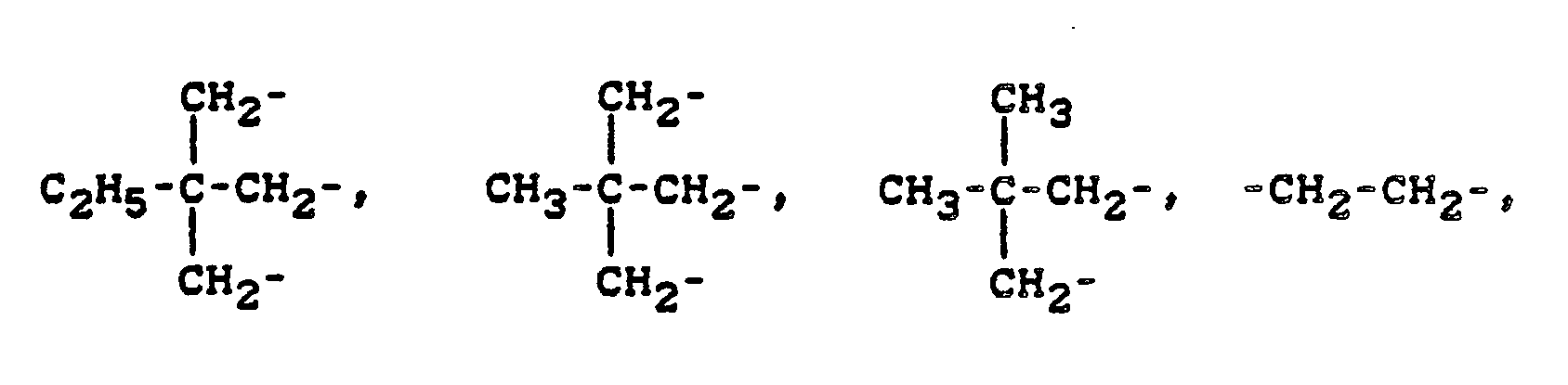


Ein aromatischer Rest (A) kann ein aromatischer Kohlenwasserstoffrest mit 6 bis 24, bevorzugt 6 bis 14, Kohlenstoffatomen sein. Beispielsweise seinen die folgenden aromatischen Reste genannt:


Ein araliphatischer Rest (A) kann ein Kohlenwasserstoffrest mit einem geradkettigen oder verzweigten aliphati schen und einem aromatischen Teil mit 7 bis 26 Kohlenstoffatomen bedeuten, wobei der aromatische Teil bevorzugt 6 bis 12 und der aliphatische Teil bevorzugt 1 bis 14 Kohlenstoffatome enthält. Beispielsweise seien die folgenden araliphatischen Reste genannt:


Ein cycloaliphatischer Rest (A) kann ein cyclischer Kohlenwasserstoffrest mit 6 bis 26 kohlenstoffatomen, bevorzugt 6 bis 14 Kohlenstoffatomen, sein. Beispiels weise seien die folgenden cycloaliphatischen Reste genannt:


Die Reste A können, bevorzugt im aliphatischen oder cycloaliphatischen Teil, 1 oder 2, bevorzugt 1, Sauerstoffatome enthalten, so daß beispielsweise aliphatische bzw. cycloaliphatische Ether vorliegen.The radicals A can, preferably in the aliphatic or cycloaliphatic part, contain 1 or 2, preferably 1, oxygen atoms, so that, for example, aliphatic or cycloaliphatic ethers are present.
Insbesondere bevorzugt seien die folgenden Reste A genannt: Ethylen, Propylen, 2,2-Bismethylen- butan-1-yl, 2,2-Bismethylen-propan-1-yl, 2,2-Bis-methylen-propan-1,3-diyl, 1,1'-Oxy-bis-[(2,2-methylen)-propan-1,3-diyl], Propan-1,2,3-triyl, 1,6-Hexamethylen, 1,4-Tetramethylen, 1,4-Phenylen, Xylylen, 1,4-Cyclohexylen, 1,4-Bismethy len-1,4-cyclohexan, 2,2-bis(1,4-phenylen)propan, 3(4), 8(9)-Bismethylen-tricyclo-[5.2.1.02,6]decan und dessen Isomere, 4(5),9-Bismethylen-3,8-dimethyltricyclo[5.2.1.02,6]decan.The following radicals A are particularly preferred: ethylene, propylene, 2,2-bismethylene-butan-1-yl, 2,2-bismethylene-propan-1-yl, 2,2-bis-methylene-propane-1,3 -diyl, 1,1'-oxy-bis - [(2,2-methylene) propane-1,3-diyl], propane-1,2,3-triyl, 1,6-hexamethylene, 1,4- Tetramethylene, 1,4-phenylene, xylylene, 1,4-cyclohexylene, 1,4-bismethylene 1.4-cyclohexane, 2,2-bis (1,4-phenylene) propane, 3 (4), 8 ( 9) -Bismethylene-tricyclo- [5.2.1.0 2,6 ] decane and its isomers, 4 (5), 9-bismethylene-3,8-dimethyltricyclo [5.2.1.0 2,6 ] decane.
Insbesondere bevorzugt sind die Reste 2,2-Bismethylen-butan-1-yl, Propan-1,2,3-triyl, 2,2-Bismethylenpropan-1,3-diyl und 3(4),8(9)-Bismethylen-tricyclo[5.2.1.02,6]decan.The radicals 2,2-bismethylene-butan-1-yl, propane-1,2,3-triyl, 2,2-bismethylene propane-1,3-diyl and 3 (4), 8 (9) bismethylene are particularly preferred tricyclo [5.2.1.0 2.6 ] decane.
Als Gruppen X werden beispielsweise genannt:


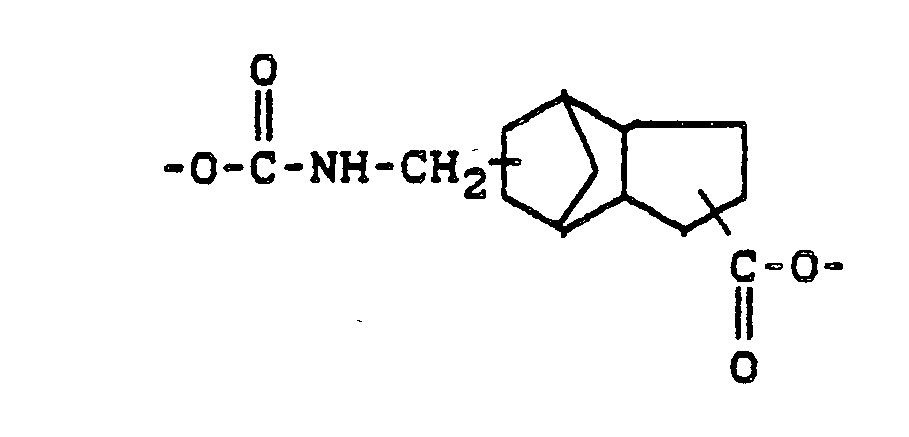
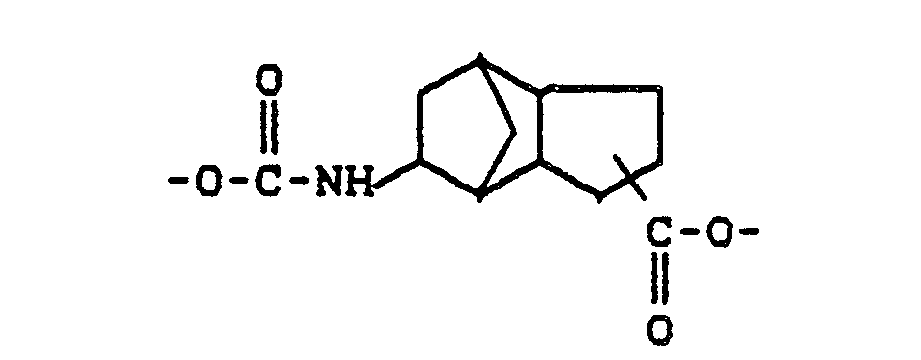
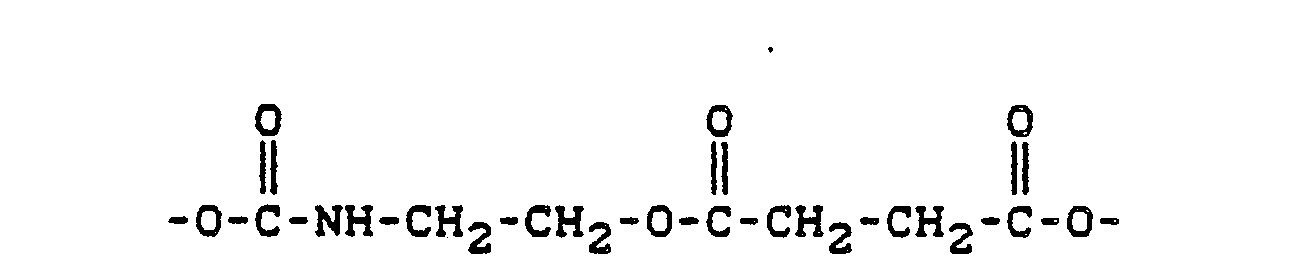

Ein zweiwertiger Kohlenwasserstoffrest (Z) kann ein geradkettiger oder verzweigter aliphatischer Kohlenwasserstoff mit 3 bis 15 Kohlenstoffatomen, bevorzugt 3 bis 10 Kohlenstoffatomen bedeuten. Der Rest Z kann gegebenenfalls 1 bis 3 Sauerstoffbrücken, bevorzugt 1 bis 2 Sauerstoffbrücken enthalten. Es ist auch möglich, daß der Rest Z durch 1 bis 4, bevorzugt 1 bis 2 (Meth)-acrylatreste substituiert ist. Beispielsweise seien die folgenden Reste genannt:A divalent hydrocarbon radical (Z) can mean a straight-chain or branched aliphatic hydrocarbon having 3 to 15 carbon atoms, preferably 3 to 10 carbon atoms. The radical Z can optionally contain 1 to 3 oxygen bridges, preferably 1 to 2 oxygen bridges. It is also possible for the Z radical to be substituted by 1 to 4, preferably 1 to 2 (meth) acrylate radicals. For example, the following residues are mentioned:


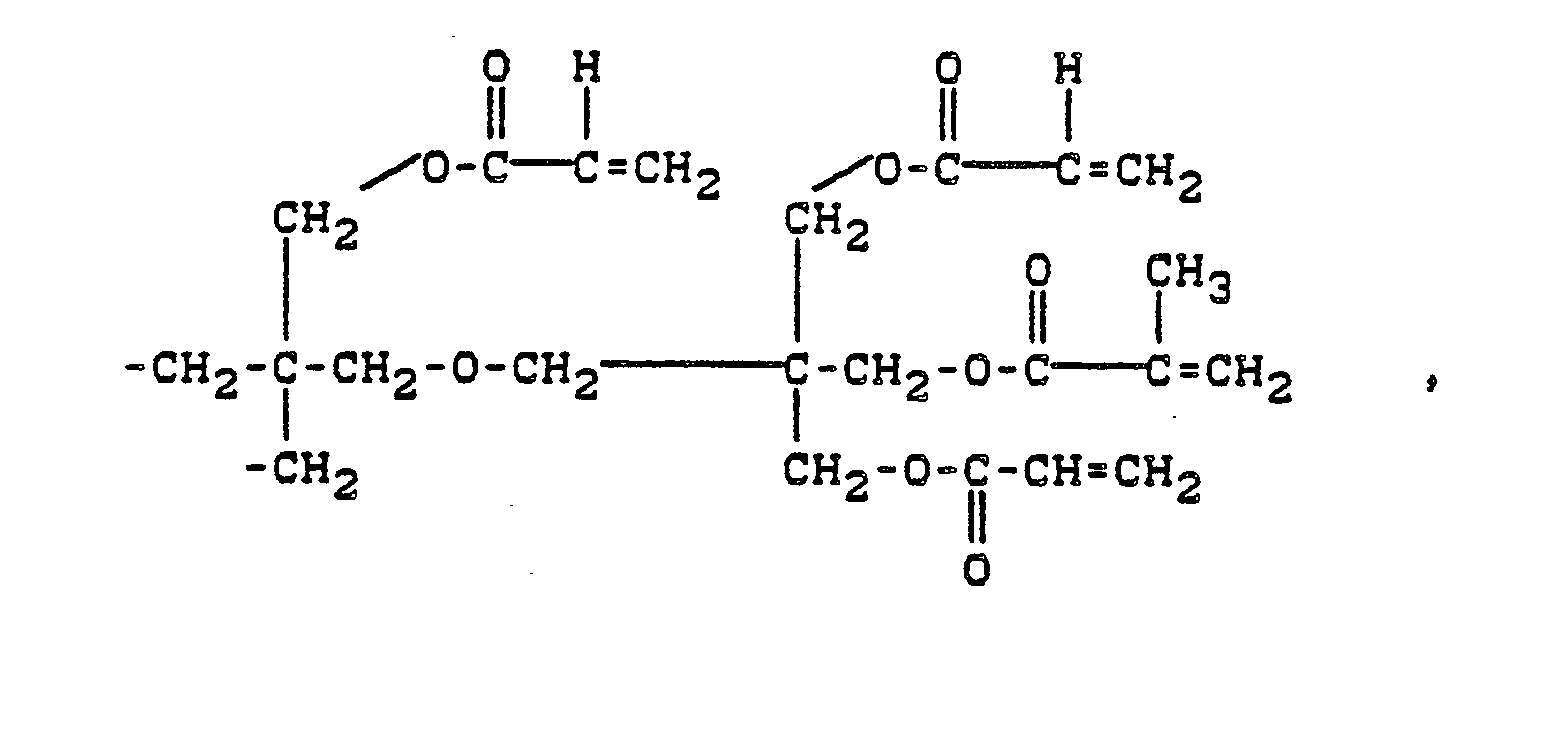


Bevorzugt werden Ester-Urethan-(Meth)-acrylsäurederivate der Formel (I), bei denen A ein geradkettiger oder verzweigter, gegebenenfalls 1 bis 3 Sauerstoffbrücken enthaltender, aliphatischer Rest mit 3 bis 12 Kohlenstoffatomen, ein aromatischer Rest mit 6 bis 14 Kohlenstoffatomen, ein araliphatischer Rest mit 7 bis 26 Kohlenstoffatomen oder ein cycloaliphatischer Rest mit 6 bis 14 Kohlenstoffatomen ist,
r für die Anzahl der von A ausgehenden Ketten steht und eine Zahl von 2 bis 6 bedeutet, R1 und R2 gleich sind und Wasserstoff oder verschieden sind und Wasserstoff und Methyl bedeuten, n für jede von A ausgehende Kette unabhängig eine Zahl von 0 bis 5 bedeutet, X für eine Gruppe
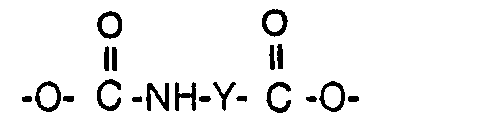
Y einen zweiwertigen aliphatischen Rest mit 2 bis 10 Kohlenstoffatomen bedeutet, steht,
Z ein zweiwertiger geradkettiger oder verzweigter aliphatischer Kohlenwasserstoff mit 3 bis 10 Kohlenstoffatomen, der gegebenenfalls 1 oder 2 Sauerstoffbrücken enthalten kann und gegebenenfalls durch 1 oder 2 (Meth)-acrylatreste substituiert sein kann, bedeutet, und
R3 für jede von A ausgehende Kette unabhängig Wasserstoff oder Methyl bedeutet.Ester-urethane (meth) acrylic acid derivatives of the formula (I) are preferred in which A is a straight-chain or branched, optionally containing 1 to 3 oxygen bridges, aliphatic radical having 3 to 12 carbon atoms, an aromatic radical having 6 to 14 carbon atoms araliphatic radical having 7 to 26 carbon atoms or a cycloaliphatic radical having 6 to 14 carbon atoms,
r represents the number of chains starting from A and represents a number from 2 to 6, R 1 and R 2 are identical and are hydrogen or different and represent hydrogen and methyl, n for each chain starting from A independently a number from 0 to 5 means X for a group
Y represents a divalent aliphatic radical having 2 to 10 carbon atoms,
Z is a divalent straight-chain or branched aliphatic hydrocarbon with 3 to 10 carbon atoms, which may optionally contain 1 or 2 oxygen bridges and may optionally be substituted by 1 or 2 (meth) acrylate radicals, and
R 3 is independently hydrogen or methyl for each chain starting from A.
Insbesondere bevorzugt werden Urethangruppen enthaltende (Meth)-acrylsäurederivate der Formel (I), bei denen
A für den 2,2-Bismethylen-butan-1-yl-Rest, Propan-1,2,3-triyl-Rest, 2,2-Bismethylenpropan-1,3-diyl-Rest oder 3(4), 8(9)-Bismethylen-tricyclo[5.2.1.02,6]decan-Rest steht,
r für die Anzahl der von A ausgehenden Ketten steht und die Zahl 3 oder 4 bedeutet,
R1 und R2 gleich sind und Wasserstoff oder verschieden sind und Wasserstoff und Methyl bedeuten,
n für jede von A ausgehende Kette unabhängig eine Zahl von 0 bis 5 bedeutet,
X die Gruppe

A for the 2,2-bismethylene-butan-1-yl residue, propane-1,2,3-triyl residue, 2,2-bismethylene propane-1,3-diyl residue or 3 (4), 8 ( 9) -bismethylene-tricyclo [5.2.1.0 2.6 ] decane radical,
r represents the number of chains starting from A and the number 3 or 4,
R 1 and R 2 are the same and are hydrogen or different and are hydrogen and methyl,
n independently represents a number from 0 to 5 for each chain starting from A,
X the group
Z einen zweiwertigen geradkettigen oder verzweigten aliphatischen Kohlenwasserstoffrest mit 3 bis 10 Kohlenstoffatomen, der gegebenenfalls 1 Sauerstoffbrücke enthalten und gegebenenfalls durch 1 (Meth)-acrylatrest substituiert sein kann, bedeutet, undZ is a divalent straight-chain or branched aliphatic hydrocarbon radical having 3 to 10 carbon atoms, which may optionally contain 1 oxygen bridge and may optionally be substituted by 1 (meth) acrylate radical, and
R3 für jede von A ausgehende Kette unabhängig Wasserstoff oder Methyl bedeutet.R 3 is independently hydrogen or methyl for each chain starting from A.
Beispielsweise seien die folgenden Ester-Urethan-(Meth)-acrylsäurederivate genannt:


Es wurde auch ein Verfahren zur Herstellung der erfindungsgemäßen Ester-Urethan(Meth)-acrylsäurederivate der Formel (I)

- A ein geradkettiger oder verzweigter, gegebenenfalls 1 bis 3 Sauerstoffbrücken enthaltender, aliphatischer Rest mit 2 bis 20 Kohlenstoffatomen, ein aromatischer Rest mit 6 bis 24 Kohlenstoffatomen, ein araliphatischer Rest mit 7 bis 26 Kohlenstoffatomen oder ein cycloaliphatischer Rest mit 6 bis 26 Kohlenstoffatomen ist,
- r für die Anzahl der von A ausgehenden Ketten steht und eine Zahl von 2 bis 6 bedeutet,
- R1 und R2 gleich sind und Wasserstoff oder verschieden sind und Wasserstoff und Methyl bedeuten, n für jede von A ausgehende Kette unabhängig eine Zahl von 0 bis 5 bedeutet,
- X für eine Gruppe

- Y einen zweiwertigen (cyclo)aliphatischen Rest mit 2 bis 15 C-Atomen, der gegebenenfalls Ester-, Ether-oder Urethangruppen enthält, bedeutet, steht,
- Z ein zweiwertiger geradkettiger oder verzweigten aliphatischen Kohlenwasserstoff mit 3 bis 15 Kohlenstoffatomen, der gegebenenfalls 1 bis 3 Sauerstoffbrücken enthalten kann und gegebenenfalls durch 1 bis 4 (Meth)-acrylatreste substituiert sein kann, bedeutet, und
- R3 für jede von A ausgehende Kette unabhängig Wasserstoff oder Methyl bedeutet,
dadurch gekennzeichnet, daß man den Trialkylsilylether eine Polyols der Formel (11)

- A, R1, R2, n und r die obengenannte Bedeutung haben und
- R4 bis R6 einen Alkylrest mit 1 bis 4 Kohlenstoffatomen bedeuten,
mit einem Isocyanatocarbonsäurechlorid der Formel (III)

- Y die obengenannte Bedeutung hat,
im Molverhältnis von etwa 1:1, gegebenenfalls in einem inerten Lösungsmittel, umsetzt und dann den entstandenen Isocyanatoester mit einem Hydroxyalkyl(meth)acrylsäureester der Formel (IV)

- R3 und Z die obengenannte Bedeutung haben,
im Molverhältnis von OH-Gruppen zu NCO-Gruppen von 0,98:1 bis 1,05:1 umsetzt,
gefunden.A process for the preparation of the ester-urethane (meth) acrylic acid derivatives of the formula (I) according to the invention has also been
- A is a straight-chain or branched, aliphatic radical with 2 to 20 carbon atoms, optionally containing 1 to 3 oxygen bridges, an aromatic radical with 6 to 24 carbon atoms, an araliphatic radical with 7 to 26 carbon atoms or a cycloaliphatic radical with 6 to 26 carbon atoms,
- r represents the number of chains starting from A and denotes a number from 2 to 6,
- R 1 and R 2 are the same and are hydrogen or different and are hydrogen and methyl, n is independently a number from 0 to 5 for each chain starting from A,
- X for a group
- Y represents a divalent (cyclo) aliphatic radical with 2 to 15 C atoms, which optionally contains ester, ether or urethane groups,
- Z is a divalent straight-chain or branched aliphatic hydrocarbon with 3 to 15 carbon atoms, which can optionally contain 1 to 3 oxygen bridges and can optionally be substituted by 1 to 4 (meth) acrylate radicals, and
- R 3 is independently hydrogen or methyl for each chain starting from A,
characterized in that the trialkylsilyl ether is a polyol of the formula (11)
- A, R 1 , R 2 , n and r have the meaning given above and
- R 4 to R 6 represent an alkyl radical having 1 to 4 carbon atoms,
with an isocyanatocarboxylic acid chloride of the formula (III)
- Y has the meaning given above,
in a molar ratio of about 1: 1, if appropriate in an inert solvent, and then reacting the resulting isocyanato ester with a hydroxyalkyl (meth) acrylic acid ester of the formula (IV)
- R 3 and Z have the meaning given above,
in a molar ratio of OH groups to NCO groups of 0.98: 1 to 1.05: 1,
found.
Die den Trialkylsilylethern der Formel II zugrundeliegenden Polyole sind an sich bekannt (DE-A 2 931 925) bzw. handelsüblich und können beispielsweise durch Oxyalkylierung der bekannten Polyole der Formel A(OH)r, z.B. 2,2-Bishydroxymethylbutan, 2,2-Bishhydroxymethylpropan-1,3-diol, 3(4),8(9)-Bishydroxymethyl-tricyclo[5.2.1.02,6]decan usw. hergestellt werden. Durch die Herstellung bedingt, können die Polyole auch als Produkt mit variablem Oxyalkylierungsgrad vorliegen.The polyols on which the trialkylsilyl ethers of the formula II are based are known per se (DE-A 2 931 925) or are commercially available and can be prepared, for example, by oxyalkylation of the known polyols of the formula A (OH) r , for example 2,2-bishydroxymethylbutane, 2,2- Bishhydroxymethylpropan-1,3-diol, 3 (4), 8 (9) -Bishydroxymethyl-tricyclo [5.2.1.0 2,6 ] decane, etc. Due to the preparation, the polyols can also be present as a product with a variable degree of oxyalkylation.
Die Silylether II sind in bekannter Weise, z.B. wie bei der Derivatisierung von Polyolen zu chromatographischen Zwecken, aus den entsprechenden Polyolen und Silylierungsreagenzien zugänglich. Zur Silylierung eignen sich z.B. Trialkylchlorsilane, Hexaalkyl-disilazane usw.The silyl ethers II are known, e.g. as in the derivatization of polyols for chromatographic purposes, accessible from the corresponding polyols and silylation reagents. For silylation e.g. Trialkylchlorosilanes, hexaalkyl disilazanes, etc.
Isocyanatocarbonsäurechloride der Formel III sind bekannt und können durch Umsetzung der Aminocarbonsäuren mit Phosgen hergestellt werden (W. Mormann, S. Hoffmann, W. Hoffmann, Chemische Berichte 120, 285-290 (1987); DE-A 2 120 090).Isocyanatocarboxylic acid chlorides of the formula III are known and can be prepared by reacting the aminocarboxylic acids with phosgene (W. Mormann, S. Hoffmann, W. Hoffmann, Chemical Reports 120, 285-290 (1987); DE-A 2 120 090).
(Meth)-acrylsäureester der Formel IV sind an sich bekannt und können beispielsweise durch partielle Veresterung der entsprechenden Polyole erhalten werden.(Meth) acrylic acid esters of the formula IV are known per se and can be obtained, for example, by partial esterification of the corresponding polyols.
Die Umsetzung des Trialkylsilylethers des Polyols II mit dem Isocyanatocarbonsäurechlorid III wird im allgemeinen ohne die Verwendung von Lösungsmitteln im Temperaturbereich von 80 bis 150°C durchgeführt. Lösungsmittel werden gegebenenfalls dann eingesetzt, wenn das Isocyanato carbonsäurechlorid ein Feststoff ist, der sich im Trialkylsilylether des Polyols nicht löst. Geeignet sind Lösungsmittel, die keinen aciden Wasserstoff enthalten, wie Toluol, Xylol, Dioxan, Acetonitril, Methylisobutylketon usw.The reaction of the trialkylsilyl ether of polyol II with the isocyanatocarboxylic acid chloride III is generally carried out in the temperature range from 80 to 150 ° C. without the use of solvents. Solvents are optionally used when the isocyanato carboxylic acid chloride is a solid which does not dissolve in the trialkylsilyl ether of the polyol. Solvents that do not contain acidic hydrogen are suitable, such as toluene, xylene, dioxane, acetonitrile, methyl isobutyl ketone, etc.
Die Reaktion wird unter Normaldruck oder reduziertem Druck durchgeführt.The reaction is carried out under normal pressure or reduced pressure.
Die Reaktanden werden in äquimolaren Mengen zur Reaktion gebracht; ein geringer Überschuß an III schadet nicht. Die Reaktion wird vorzugsweise zunächst bei Normaldruck bei 80 - 150 * C durchgeführt, wobei bereits ein Teil des entstehenden Trialkylchlorsilans abdestilliert, z.B. bei Verwendung von Trimethylsilylethern und Triethylsilylethern. Um die Reaktion zu vervollständigen, wird nach etwa 2 Stunden Reaktionszeit unter Vakuum das restliche Trialkylchlorsilan abdestilliert. Bei Silylethern mit Propyl- oder Butylgruppen wird von Anfang an Vakuum angelegt.The reactants are reacted in equimolar amounts; a small excess of III does no harm. The reaction is preferably first under atmospheric pressure at 80 - * C performed 150, where already a part of the resulting trialkylchlorosilane distilled off, for example when using trimethylsilyl ethers and triethylsilyl. In order to complete the reaction, the remaining trialkylchlorosilane is distilled off under vacuum after about 2 hours of reaction time. In the case of silyl ethers with propyl or butyl groups, a vacuum is applied from the start.
Der Umsatz ist nahezu quantitativ und kann durch gravimetrische Bestimmung des Destillats verfolgt werden.The turnover is almost quantitative and can be followed by gravimetric determination of the distillate.
Die nach der 1. Stufe erhaltenen Produkte stellen Isocyanato-(cyclo)alkylester der Polyole dar, wie durch spektroskopische Untersuchung gezeigt werden kann.The products obtained after the 1st stage are isocyanato (cyclo) alkyl esters of the polyols, as can be shown by spectroscopic examination.
Die Umsetzung zu den Monomeren erfolgt in einer 2. Stufe, die dadurch gekennzeichnet ist, daß man das in der 1. Stufe erhaltene Isocyanat mit Hydroxyalkyl(meth)acrylsäureestern IV umsetzt.The conversion to the monomers takes place in a second stage, which is characterized in that the isocyanate obtained in the first stage is reacted with hydroxyalkyl (meth) acrylic acid esters IV.
Dabei werden 0,98 bis 1,05 Mol IV, bezogen auf 1 Mol Isocyanatgruppen des in der 1. Stufe erhaltenen Produktes eingesetzt.0.98 to 1.05 mol of IV, based on 1 mol of isocyanate groups, of the product obtained in the 1st stage are used.
Für die 2. Stufe des erfindungsgemäßen Verfahrens werden im allgemeinen inerte Lösungsmittel verwendet. Beispielsweise seien Aceton, Chloroform, Tetrahydrofuran, Dioxan, Methylenchlorid, Toluol, Acetonitril genannt. Besonders bevorzugt sind Chloroform, Toluol, Acetonitril und Aceton.Inert solvents are generally used for the second stage of the process according to the invention. Examples include acetone, chloroform, tetrahydrofuran, dioxane, methylene chloride, toluene and acetonitrile. Chloroform, toluene, acetonitrile and acetone are particularly preferred.
Im allgemeinen wird auch die 2. Stufe des erfindungsgemäßen Verfahrens unter Ausschluß von Wasser durchgeführt. Besonders bevorzugt wird eine maximale Menge an Wasser unter 0,1 Gew.-%, bezogen auf die Gesamtmenge der Reaktanden.In general, the 2nd stage of the process according to the invention is carried out with the exclusion of water. A maximum amount of water below 0.1% by weight, based on the total amount of the reactants, is particularly preferred.
Katalysatoren für die 2. Stufe sind im allgemeinen Metallsalze höherer Fettsäuren. Bevorzugte Katalysatoren können beispielsweise Dibutylzinndilaurat, Dibutylzinndimethoxid und Zinn-(II)-octoat sein. Als Katalysatoren können aber auch Verbindungen mit tertiären Aminogruppen, wie Triethylamin, Pyridin, 2-Methylpyridin, N,N-Dimethylpiperazin und N,N-Dimethyl-benzylamin verwendet werden. Es ist auch möglich, Titanverbindungen wie Tetrabutyl-titanat einzusetzen.Catalysts for the second stage are generally metal salts of higher fatty acids. Preferred catalysts can be, for example, dibutyltin dilaurate, dibutyltin dimethoxide and tin (II) octoate. However, compounds with tertiary amino groups such as triethylamine, pyridine, 2-methylpyridine, N, N-dimethylpiperazine and N, N-dimethylbenzylamine can also be used as catalysts. It is also possible to use titanium compounds such as tetrabutyl titanate.
Im allgemeinen wird der Katalysator in einer Menge von 0,1 bis 2,5 Gew.-%, bevorzugt 0,1 bis 1,5 Gew.-%, bezo gen auf die Gesamtmenge der Reaktanden eingesetzt werden.In general, the catalyst will be used in an amount of 0.1 to 2.5% by weight, preferably 0.1 to 1.5% by weight, based on the total amount of the reactants.
In einer bevorzugten Ausführungsform wird die 2. Stufe des erfindungsgemäßen Verfahrens in Gegenwart eines Polymerisationsinhibitors durchgeführt. Polymerisationsinhibitoren sind an sich bekannt (Ullmanns Enzyklopädie der techn. Chemie, 4. Auflage, Verlag Chemie Weinheim, Band 8, Seiten 19-45). Beispielsweise seien 2,6-Di-tert.-butyl-4-methylphenol, Hydrochinon, Hydrochinonmonomethylether genannt.In a preferred embodiment, the second stage of the process according to the invention is carried out in the presence of a polymerization inhibitor. Polymerization inhibitors are known per se (Ullmanns Enzyklopadie der techn. Chemie, 4th edition, Verlag Chemie Weinheim, Volume 8, pages 19-45). For example, 2,6-di-tert-butyl-4-methylphenol, hydroquinone, hydroquinone monomethyl ether may be mentioned.
Es ist auch möglich, als Polymerisationsinhibitor Sauerstoff, z.B. Luftsauerstoff, zu verwenden, der in das Reaktionsgemisch eingeleitet wird.It is also possible to use oxygen, e.g. Atmospheric oxygen to be used, which is introduced into the reaction mixture.
Im allgemeinen wird der Polymerisationsinhibitor in einer Menge von 0,01 bis 1,0 Gew.-%, bevorzugt von 0,1 bis 0,2 Gew.-%, eingesetzt.The polymerization inhibitor is generally used in an amount of from 0.01 to 1.0% by weight, preferably from 0.1 to 0.2% by weight.
Die zweite Stufe des erfindungsgemäßen Verfahrens wird im allgemeinen im Temperaturbereich von 0 bis 100 C, vorzugsweise von 30 bis 70 C, durchgeführt.The second stage of the process according to the invention is generally carried out in the temperature range from 0 to 100 ° C., preferably from 30 to 70 ° C.
Das erfindungsgemäße Verfahren wird im allgemeinen bei Normaldruck durchgeführt. Es ist aber auch möglich, das erfindungsgemäße Verfahren bei Unter- oder Überdruck (beispielsweise im Druckbereich von 0,1 bis 10 bar) durchzuführen.The process according to the invention is generally carried out at normal pressure. However, it is also possible to carry out the process according to the invention at negative or positive pressure (for example in the pressure range from 0.1 to 10 bar).
Die 2. Stufe des erfindungsgemäßen Verfahrens kann beispielsweise wie folgt durchgeführt werden: Der (Meth)-acrylsäureester der Formel (IV) und gegebenenfalls der Polymerisationsinhibitor werden im inerten Lösungsmittel gelöst und unter Rühren zu dem gegebenenfalls gelösten Produkt aus der 1. Stufe zugetropft. Der Katalysator wird dabei einem der beiden Reaktanden zugesetzt.The second stage of the process according to the invention can be carried out, for example, as follows: the (meth) acrylic acid ester of the formula (IV) and, if appropriate, the polymerization inhibitor dissolved inert solvent and added dropwise with stirring to the optionally dissolved product from the 1st stage. The catalyst is added to one of the two reactants.
Bevorzugt werden 0,98 bis 1,05 Mol des Hydroxyalkyl(meth)acrylats IV, bezogen auf 1 Mol NCO-Gruppen im Produkt der 1. Stufe eingesetzt.0.98 to 1.05 mol of the hydroxyalkyl (meth) acrylate IV, based on 1 mol of NCO groups, are preferably used in the product of the 1st stage.
Die Reaktion wird im allgemeinen bis zum vollständigen Umsatz geführt. Nach beendeter Umsetzung wird das Reaktionsprodukt durch Entfernen des Lösungsmittels isoliert. Eine vorherige Filtration oder Reinigung mit Hilfe von Adsorbentien, z.B. Aktivkohle, Bleicherde, Kieselgel oder Aluminiumoxid ist möglich.The reaction is generally carried out until complete conversion. After the reaction has ended, the reaction product is isolated by removing the solvent. Prior filtration or purification using adsorbents, e.g. Activated carbon, bleaching earth, silica gel or aluminum oxide is possible.
Die nach dem erfindungsgemäßen Verfahren erhaltenen (Meth)-acrylsäurederivate stellen Monomergemische mit einer für das Verfahren typischen Molmassenvertielung dar.The (meth) acrylic acid derivatives obtained by the process according to the invention represent monomer mixtures with a molecular weight distribution typical of the process.
Es ist auch möglich, die erste und die zweite Stufe des obengenannten Verfahrens in ihrer Reihenfolge zu vertauschen. In diesem Fall müssen die entsprechenden Trialkylsilylether des Hydroxyalkyl-(meth)-acrylats mit dem Isocyanatocarbonsäurechlorid umgesetzt werden. Das dabei erhaltene Isocyanato-(meth)-acrylat wird dann in der 2. Stufe mit einer dem NCO-Gehalt entsprechenden Menge des Polyols umgesetzt.It is also possible to reverse the order of the first and second stages of the above method. In this case, the corresponding trialkylsilyl ethers of the hydroxyalkyl (meth) acrylate must be reacted with the isocyanatocarboxylic acid chloride. The isocyanato (meth) acrylate obtained is then reacted in the second stage with an amount of the polyol corresponding to the NCO content.
Die erste Variante des Verfahrens ist jedoch bevorzugt.However, the first variant of the method is preferred.
Für den erfindungsgemäßen Einsatz der neuen Ester-Urethan(meth)acrylate auf dem Dentalgebiet ist eine Auftrennung der erhaltenen Reaktionsgemische nicht erforderlich. Die Gemische selbst können in vorteilhafter Weise als Komponente von Dentalwerkstoffen, beispielsweise Zahnfüllungsmaterialien, verwendet werden.A separation of the reaction mixtures obtained is not necessary for the use according to the invention of the new ester-urethane (meth) acrylates in the dental field. The mixtures themselves can advantageously be used as a component of dental materials, for example tooth filling materials.
Die erfindungsgemäßen Ester-Urethan(meth)acrylate können als Monomere für Dentalwerkstoffen verwendet werden. Als Dentalwerkstoffe seien beispielsweise Füllungsmaterialien für Zähne, Beschichtungsmittel für Zähne und Komponenten für die Herstellung von Zahnersatz, bevorzugt Kunststoffzähne, genannt. Je nach Anwendungsgebiet können Dentalwerkstoffe weitere Additive enthalten.The ester urethane (meth) acrylates according to the invention can be used as monomers for dental materials. Dental materials include, for example, filling materials for teeth, coating compositions for teeth and components for the production of dentures, preferably plastic teeth. Depending on the area of application, dental materials can contain further additives.
Für die Anwendung als Monomere für polymerisierbare Zahlfüllmassen oder Beschichtungsmittel im Dentalbereich können die erfindungsgemäßen (Meth)-acrylsäurederivate mit an sich bekannten Monomeren gemischt werden, um beispielsweise die Viskosität dem Verwendungszweck anzupassen. Hierbei werden Viskositäten im Bereich von 60 bis 10.000 mPas bevorzugt. Dieses ist dadurch erreichbar, daß man den erfindungsgemäßen Monomeren gegebenenfalls ein Comonomer niedriger Viskosität als Reaktivverdünner bzw. Lösungsmittel mischt. Die erfindungsgemäßen Verbindungen werden in der Mischung mit Comonomeren mit einem Anteil von ca. 40 bis ca. 90 Gew.-%, bevorzugt von 50 bis 80 Gew.-%, eingesetzt. Es ist ebenfalls bevorzugt, Mischungen verschiedener erfindungsgemäßer (Meth)-acrylsäurederivate einzusetzen.For use as monomers for polymerizable numbering compounds or coating agents in the dental field, the (meth) acrylic acid derivatives according to the invention can be mixed with monomers known per se, for example in order to adapt the viscosity to the intended use. Viscosities in the range from 60 to 10,000 mPas are preferred. This can be achieved by optionally mixing a low viscosity comonomer as a reactive diluent or solvent in the monomers of the invention. The compounds according to the invention are used in a mixture with comonomers in a proportion of about 40 to about 90% by weight, preferably from 50 to 80% by weight. It is also preferred to use mixtures of various (meth) acrylic acid derivatives according to the invention.
Es ist auch möglich, Monomermischungen einzusetzen, die mehrere Comonomere enthalten, um die gewünschte Viskosität zu erreichen.It is also possible to use monomer mixtures which contain several comonomers in order to achieve the desired viscosity.
Beispielsweise seien die folgenden Comonomeren genannt: Glycerindi(meth)acrylat. Triethylenglykoldi-(meth)acrylat, Tetraethylenglykoldi(meth)acrylat, 1, 12-Dodecandioldi(meth)acrylate, 1,6-Hexandioldi(meth)-acrylat, Diethylenglykol dimethacrylat, 2,2-Bis-[p-(2 -hydroxy-3 -methacryioyioxy propoxy)-phenyl]-propan, 2,2-Bis-[p-(2'-methacryloyloxyethoxy)-phenyl]-propan, Trimethylol-propan-tri-(meth)-acrylat, Bis-(meth)-acryloyloxyethoxymethyl-tricyclo-[5,2,1 ,02.6]-decan (DE-A 29 31 925 und DE-A 29 31 926).The following comonomers may be mentioned, for example: glycerol di (meth) acrylate. Triethylene glycol di (meth) acrylate, tetraethylene glycol di (meth) acrylate, 1, 12-dodecanediol di (meth) acrylate, 1,6-hexanediol di (meth) acrylate, diethylene glycol dimethacrylate, 2,2-bis- [p- (2-hydroxy -3-methacryioyioxy propoxy) phenyl] propane, 2,2-bis- [p- (2'-methacryloyloxyethoxy) phenyl] propane, trimethylol propane tri- (meth) acrylate, bis (meth) -acryloyloxyethoxymethyl-tricyclo- [5,2,1, 02.6] -decane (DE-A 29 31 925 and DE-A 29 31 926).
Insbesondere bevorzugt werden Comonomere, die bei 13 mbar einen Siedepunkt über 100' C besitzen.Comonomers which have a boiling point above 100 ° C. at 13 mbar are particularly preferred.
Die erfindungsgemäßen polyfunktionellen Ester-Urethan(Meth)-acrylsäureester können gegebenenfalls in Mischung mit den genannten Comonomeren mit an sich bekannten Methoden zu vernetzten Polymerisaten aushärten (Am. Chem. Soc., Symp. Ser. 212, 359-371 (1983)). Für die sogenannte Redoxpolymerisation ist ein System aus einer peroxidischen Verbindung und einem Reduktionsmittel, beispielsweise auf Basis tertiärer aromatischer Amine, geeignet. Beispiele für Peroxide sind: Dibenzoylperoxid, Dilauroylperoxid und Di-4-chlorbenzoylperoxid.The polyfunctional ester-urethane (meth) acrylic acid esters according to the invention can optionally harden in a mixture with the comonomers mentioned using known methods to form crosslinked polymers (Am. Chem. Soc., Symp. Ser. 212, 359-371 (1983)). A system composed of a peroxidic compound and a reducing agent, for example based on tertiary aromatic amines, is suitable for the so-called redox polymerization. Examples of peroxides are: dibenzoyl peroxide, dilauroyl peroxide and di-4-chlorobenzoyl peroxide.
Als tertiäre aromatische Amine seien beispielsweise N,N-Dimethyl-p-toluidin, Bis-(2-hydroxyethyl)-p-toluidin, Bis-(2-hydroxyethyl)-3,5-dimethylanilin und N-Methyl-N-(2-Methylcarbamoyloxypropyl)-3,5-dimethylanilin genannt. Die Konzentration des Peroxids bzw. des Amins werden vorteilhaft so gewählt, daß sie 0,1 bis 5 Gew.-%, bevorzugt 0,5 bis 3 Gew.-%, bezogen auf die Monomermischung betragen. Die peroxid- bzw. aminhaitigen Monomermischungen werden bis zur Anwendung getrennt gelagert.Examples of tertiary aromatic amines are N, N-dimethyl-p-toluidine, bis- (2-hydroxyethyl) -p-toluidine, bis- (2-hydroxyethyl) -3,5-dimethylaniline and N-methyl-N- (2 -Methylcarbamoyloxypropyl) -3,5-dimethylaniline called. The concentration of the peroxide or of the amine is advantageously chosen so that it is 0.1 to 5% by weight, preferably 0.5 to 3% by weight, based on the monomer mixture. The peroxide- or amine-containing monomer mixtures are stored separately until use.
Die erfindungsgemäßen Monomeren können auch durch Bestrahlung mit UV-licht oder sichtbarem Licht (beispielsweise- im Wellenlängenbereich von 230 bis 650 nm) zur Polymerisation gebracht werden. Als Initiatoren für die photoinitierte Polymerisation eignen sich beispielsweise Benzil, Benzildimethylketal, Benzoinmonoalkylether, Benzophenon, p-Methoxybenzophenon, Fluorenon, Thioxanthon, Phenanthrenchinon und 2,3-Bornandion (Campherchinon), gegebenenfalls in Gegenwart von synergistisch wirkenden Aktivatoren, wie N,N-Dimethylaminoethylmethacrylat, Triethanolamin, 4-N,N-Dimethylaminobenzolsulfonsäu- rediallylamid. Die Durchführung der Photopolymerisation ist beispielsweise in der DE-A 3 135 115 beschrieben.The monomers according to the invention can also be brought to polymerization by irradiation with UV light or visible light (for example in the wavelength range from 230 to 650 nm). Suitable initiators for the photo-initiated polymerization are, for example, benzil, benzil dimethyl ketal, benzoin monoalkyl ether, benzophenone, p-methoxybenzophenone, fluorenone, thioxanthone, phenanthrenequinone and 2,3-bornanedione (camphorquinone), optionally in the presence of synergistic activators, such as N, N-dimethylaminoethyl , Triethanolamine, 4-N, N-dimethylaminobenzenesulfonic acid rediallylamide. The implementation of the photopolymerization is described for example in DE-A 3 135 115.
Neben den oben beschriebenen Initiatoren können den erfindungsgemäßen (Meth)-acrylsäure-Derivaten an sich für diesen Einsatzzweck bekannte Lichtschutzmittel und Stabilisatoren zugesetzt werden.In addition to the initiators described above, the light stabilizers and stabilizers known per se for this purpose can be added to the (meth) acrylic acid derivatives according to the invention.
Lichtschutzmittel sind beispielsweise in (Gächter, Müller, Taschenbuch der Kunststoff-Additive, 2. Ausgabe, Carl Hanser Verlag) beschrieben. Beispielsweise seien die folgenden Lichtschutzmittel genannt: Cyasorb UV9@, Tinuvin PO, Tinuvin 770@, Tinuvin 6220, Tinuvin 7650.Light stabilizers are described, for example, in (Gächter, Müller, Taschenbuch der Kunststoff-Additive, 2nd Edition, Carl Hanser Verlag). Examples include the following light stabilizers: Cyasorb UV9 @, Tinuvin PO, Tinuvin 770 @, Tinuvin 6220, Tinuvin 7650.
Stabilisatoren sind beispielsweise in (Ullmanns Encylconädie der technischen Chemie, 4. Auflage, Bd. 8) beschrieben. Beispielsweise seien die folgenden Stabilisatoren genannt: 2,6-Di-tert.-butylphenol, 2,6-Di-tert.-butyl-4-methylphenol, 2,6-Di-octadecyl-4-methyl-phenol, 1,1 -Methylen-bis(naphthol-2) u.a.Stabilizers are described for example in (Ullmanns Encylconädie der technical chemistry, 4th edition, Vol. 8). The following stabilizers may be mentioned, for example: 2,6-di-tert-butylphenol, 2,6-di-tert-butyl-4-methylphenol, 2,6-di-octadecyl-4-methylphenol, 1,1 -Methylene-bis (naphthol-2) and others
Die Lichtschutzmittel und die Stabilisatoren können jeweils in einer Menge von 0,01 bis 0,5 Gew.-Teilen, bezogen auf 100 Gew.-Teile der Monomermischung, eingesetzt werden.The light stabilizers and the stabilizers can each be used in an amount of 0.01 to 0.5 parts by weight, based on 100 parts by weight of the monomer mixture.
Die Monomermischungen können ohne Zusatz von Füllstoffen als Beschichtungsmittel (Zahnlacke) eingesetzte werden.The monomer mixtures can be used as coating agents (tooth varnishes) without the addition of fillers.
Bei der Verwendung als Zahnfüllmassen setzt man den erhaltenen Monomermischungen im allgemeinen Füllstoffe zu. Um einen hohen Füllgrad erreichen zu können, sind Monomermischungen, die eine Viskosität im Bereich von 60 bis 10.000 mPas besitzen, besonders vorteilhaft.When used as tooth filling compounds, fillers are generally added to the monomer mixtures obtained. In order to be able to achieve a high degree of filling, monomer mixtures which have a viscosity in the range from 60 to 10,000 mPas are particularly advantageous.
Vorzugsweise mischt man den erfindungsgemäßen (Meth)acrylsäurederivaten anorganische Füllstoffe bei.Beispielsweise seien Bergkristall, Kristoballit, Quarzglas, hochdisperse Kieselsäure, Aluminiumoxid und Glaskeramiken, beispielsweise Lanthan und Zirkon enthaltende Glaskeramiken (DE-A 23 47 591) genannt. Die anorganischen Füllstoffe werden zur Verbesserung des Verbunds zur Polymermatrix des Polymethacrylats, vorzugsweise mit einem Haftvermittler vorbehandelt. Die Haftvermittlung kann beispielsweise durch eine Behandlung mit Organosiliciumverbindungen erreicht werden (Progress in Organic Coatings 11, 297-308 (1983)). Bevorzugt wird 3-Methacryloyloxypropyl-trimethoxysilan eingesetzt. Die Füllstoffe für die erfindungsgemäßen Zahnfüllmassen weisen im allgemeinen einen mittleren Teilchendurchmesser von 0,01 bis 100 µrn, vorzugsweise von 0,03 bis 50 u.m, besonders bevorzugt von 0,03 bis 5 um auf. Es kann auch vorteilhaft sein, mehrere Füllstoffe nebeneinander einzusetzen, die einen voneinander verschiedenen Teilchendurchmesser und/oder einen unterschiedlichen Silangehalt besitzen.Inorganic fillers are preferably mixed in with the (meth) acrylic acid derivatives according to the invention. Examples include rock crystal, crystalloballite, quartz glass, highly disperse silica, aluminum oxide and glass ceramics, for example glass ceramics containing lanthanum and zirconium (DE-A 23 47 591). To improve the bond to the polymer matrix of the polymethacrylate, the inorganic fillers are preferably pretreated with an adhesion promoter. The adhesion can be achieved, for example, by treatment with organosilicon compounds (Progress in Organic Coatings 11, 297-308 (1983)). 3-Methacryloyloxypropyltrimethoxysilane is preferably used. The fillers for the dental filling materials according to the invention generally have an average particle diameter of 0.01 to 100 μm, preferably 0.03 to 50 μm, particularly preferably 0.03 to 5 μm. It can also be advantageous to use several fillers next to one another which have a different particle diameter and / or a different silane content.
Der Füllstoffanteil in der Zahnfüllmasse beträgt im allgemeinen 5 bis 85 Gew.-%, vorzugsweise 50 bis 80 Gew.-%.The proportion of filler in the tooth filling compound is generally 5 to 85% by weight, preferably 50 to 80% by weight.
Für die Herstellung der Zahnfüllmassen werden die komponenten unter Verwendung handelsüblicher Knetmaschinen vermischt.The components are mixed using standard kneading machines to produce the dental filling compounds.
Der Anteil der erfindungsgemäßen Ester-Urethan(meth)acrylate in den Zahnfüllmassen beträgt im allgemeinen 5 bis 40 Gew.-% bezogen auf die Füllmasse.The proportion of the ester-urethane (meth) acrylates according to the invention in the tooth filling materials is generally 5 to 40% by weight, based on the filling material.
Die erfindungsgemäßen Ester-Urethan-(Meth)-AcrylsäureDerivate können auch also Komponenten bei der Herstellung von Zahnersatz eingesetzt werden.The ester-urethane (meth) acrylic acid derivatives according to the invention can also be used as components in the manufacture of dentures.
Dabei werden die erfindungsgemäßen Monomeren mit die üblicherweise verwendeten, an sich bekannten Bestandteilen kombiniert. Vorzugsweise werden die Monomeren im Gemisch mit Alkylmethacrylaten, wie Methylmethacrylat eingesetzt. Es können auch zusätzlich an sich bekannte Perpolymerisate zugesetzt werden. Zur Einstellung der Zahnfabe können bekannte anorganische und organische Farbpigmente und Trübungsmittel zugesetzt werden. Auch die Anwendung von Stabilisatoren und Lichtschutzmitteln ist möglich.The monomers according to the invention are combined with the commonly used constituents known per se. The monomers are preferably used in a mixture with alkyl methacrylates, such as methyl methacrylate. Perpolymers known per se can also be added. Known inorganic and organic color pigments and opacifiers can be added to adjust the tooth color. Stabilizers and light stabilizers can also be used.
Die Kunststoffzähne werden durch radikalische Polymerisation der Dentalmassen unter Formgebung hergestellt.The plastic teeth are produced by radical polymerisation of the dental materials with shaping.
Die Verarbeitung ist sowohl durch Injektionsverfahren als auch durch Prägeverfahren möglich und erfolgt im allgemeinen nach den üblichen Herstellungsmethoden für Zähne auf Basis von Poly-(methylmethacrylat), z.B. durch thermische Polymerisation unter Verwendung von an sich bekannten Polymerisationsinitiatoren, beisielsweise auf Basis von Peroxiden und Azoverbindungen, wie Dibenzoylperoxid, Dilauroylperoxid, Cyclohexylpercarbonat, Azobisisobuttersäurenitril. Gut geeignet sind auch Mischungen von Polymerisationsinitiatoren mit unterschiedlichen Zerfallstemperaturen.Processing is possible both by injection methods and by embossing methods and is generally carried out according to the usual manufacturing methods for teeth based on poly (methyl methacrylate), e.g. by thermal polymerization using known polymerization initiators, for example based on peroxides and azo compounds such as dibenzoyl peroxide, dilauroyl peroxide, cyclohexyl percarbonate, azobisisobutyronitrile. Mixtures of polymerization initiators with different decomposition temperatures are also very suitable.
Die aus den erfindungsgemäßen Ester-Urethan-(Meth)acrylsäureestern hergestellten Dentalwerkstoffe zeichnen sich durch hohe Widerstandsfähigkeit gegenüber mechanischer Beanspruchung une eine hohe Abrasionsbeständigkeit aus. Die Abrasionsbeständigkeit wurde nach dem in der Literatur beschriebenen in vitro-Abriebtest ermittelt (J. Thiemann, W. Finger, B. Alker, M. Bock, IADR Paper No. 650 (1986)).The dental materials produced from the ester-urethane (meth) acrylic acid esters according to the invention are notable for high resistance to mechanical stress and high abrasion resistance. The abrasion resistance was determined according to the in vitro abrasion test described in the literature (J. Thiemann, W. Finger, B. Alker, M. Bock, IADR Paper No. 650 (1986)).
Tetrakis-(trimethylsilyloxymethyl)methanTetrakis (trimethylsilyloxymethyl) methane
Zu einer Suspension von 136 g (1 Mol) Pentaerythrit in 700 ml Toluol werden bei Raumtemperatur 163,2 g (1,5 Mol) Trimethylchlorsilan und 242,2 g (1,5 Mol) Hexamethyldisilazan langsam zugetropft. Man läßt bei Raumtemperatur mehrere Stunden rühren. Das Produktgemisch wird einer fraktionierten Destillation unterworfen:
- Kp (0,3 mm Hg): 96-98 C
- Ausbeute: 331 g = 78 %
- Analyse durch G.L.C.: mindestens 98%
- Kp (0.3 mm Hg): 96-98 C
- Yield: 331 g = 78%
- Analysis by GLC: at least 98%
116,7 g (0,275 Mol) Tetrakis-(trimethylsilyloxymethyl)methan und 192,8 g (1,099 Mol) Isocyanatocapronsäurechlorid werden bei 90 C und 250 mbar 7 Stunden gerührt. Dann wird noch 15 Stunden bei 110°C und 250 mbar nachgerührt.116.7 g (0.275 mol) of tetrakis (trimethylsilyloxymethyl) methane and 192.8 g (1.099 mol) of isocyanatocaproic acid chloride are stirred at 90 ° C. and 250 mbar for 7 hours. Then the mixture is stirred for a further 15 hours at 110 ° C. and 250 mbar.
Das bei der Reaktion gebildete Trimethylchlorsilan (isoliert werden 110 g) wird in eine gekühlte Vorlage destilliert und kann zur Herstellung des Silylethers (Beispiel 1) wiederverwendet werden.The trimethylchlorosilane formed in the reaction (110 g is isolated) is distilled into a cooled receiver and can be reused to produce the silyl ether (Example 1).
Das bei der Destillation als Rückstand verbleibende Produkt wird evakuiert, bis Gewichtskonstanz erreicht ist. Das Produkt ist eine gelbliche Flüssigkeit. Ausbeute: 191 g NCO-Gehalt: 23,4 %The product remaining as a residue in the distillation is evacuated until constant weight is reached. The product is a yellowish liquid. Yield: 191 g NCO content: 23.4%
IR (Film auf KBr) [cm-1]: keine Absorption > 3000 (NH); 2250 (NCO), 1720
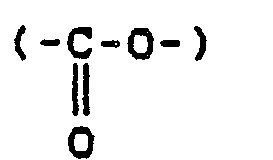



191 g des in Beispeil 2 erhaltenen Polyisocyanats werden in 500 ml Chloroform gelöst. Nach Zugabe von 0,26 g 2,6-Di-tert. -butyl-4-methyl-phenol und 0,3 g Zinn-II-octoat werden bei Raumtemperatur 241,4 g (1,06 Mol) Glycerindimethacrylat (Gemisch von 1,2- und 1,3-Diester) zugegeben.191 g of the polyisocyanate obtained in Example 2 are dissolved in 500 ml of chloroform. After adding 0.26 g of 2,6-di-tert. -butyl-4-methylphenol and 0.3 g of stannous octoate are added at room temperature to 241.4 g (1.06 mol) of glycerol dimethacrylate (mixture of 1,2- and 1,3-diesters).
Man erhöht die Temperatur auf 60° C und rührt bei dieser Temperatur bis zum vollständigen Umsatz der NCO-Gruppen. Danach wird das Lösungsmittel im Vakuum entfernt.The temperature is raised to 60 ° C. and the mixture is stirred at this temperature until the NCO groups have completely converted. The solvent is then removed in vacuo.
IR-Spektrum (Film auf KBr) [cm-1]:
- 3400 (N-H), 1720
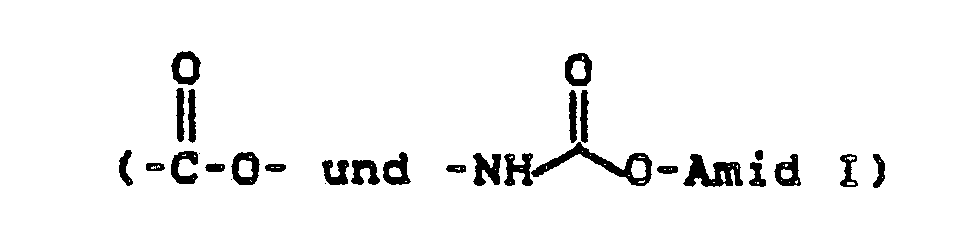
- 1600 (C = C), 1520 (Amid II)
- Ausbeute: quantitativ
- 3400 (NH), 1720
- 1600 (C = C), 1520 (amide II)
- Yield: quantitative
In einer Mischung aus 40 Gew.-Teilen Neopentylglykoldiacrylat und 60 Gew.-Teilen Monomer aus Beispiel 3 werden 0,5 Gew.-% N,N-Diallyi-p-dimethylaminobenzolsulfonsäureamid, 0,2 Gew.-% Campherchinon und 0,125 Gew.-% Benzildimethylketal gelöst.In a mixture of 40 parts by weight of neopentyl glycol diacrylate and 60 parts by weight of monomer from Example 3, 0.5% by weight of N, N-diallyi-p-dimethylaminobenzenesulfonamide, 0.2% by weight of camphorquinone and 0.125% by weight are mixed. -% benzil dimethyl ketal dissolved.
Beim Bestrahlen mit einer handelsüblichen Dentallampe (Translux, Fa. Kulzer) härtet die Flüssigkeit zu einem festen Kunststoff aus.

In einer Mischung aus 35 Gew.-Teilen Neopentylglykoldimethacrylat und 65 Gew.-Teilen des Monomers aus Beispiel 3 werden 0,5 Gew.- % N,N-Diallyl-p-dimethylaminobenzolsulfonsäureamid, 0,2 Gew.- % Campherchinon und 0,125 Gew.-% Benzildimethylketal gelöst.In a mixture of 35 parts by weight of neopentyl glycol dimethacrylate and 65 parts by weight of the monomer from Example 3, 0.5% by weight of N, N-diallyl-p-dimethylaminobenzenesulfonamide, 0.2% by weight of camphorquinone and 0.125% by weight .-% Benzildimethylketal dissolved.
Der nach der Bestrahlung mit einer handelsüblichen Dentallampe (60 Sek., sichtbares Licht) erhaltene Formkörper besitzt folgende Eigenschaften:

Claims (15)



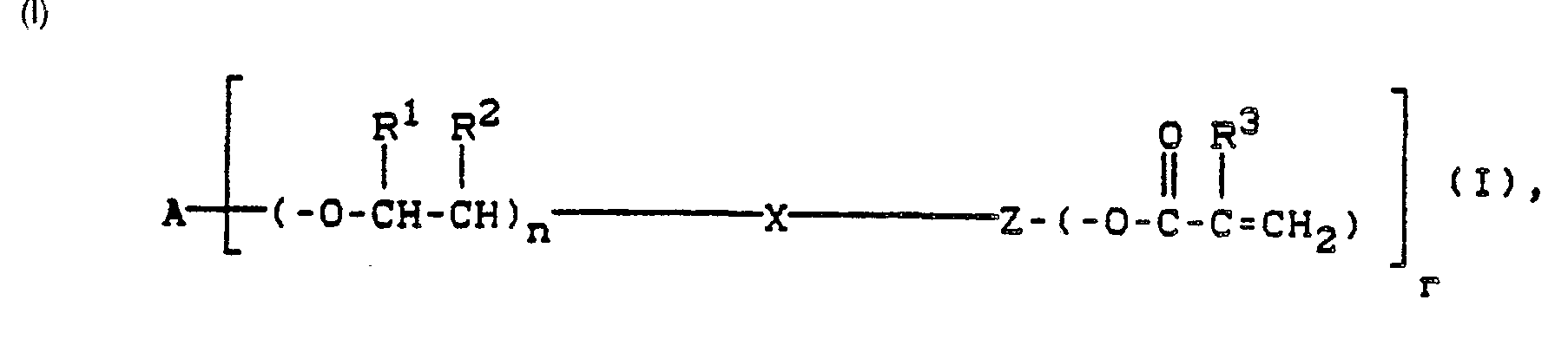

dadurch gekennzeichnet, daß man den Trialkylsilylether eine Polyols der Formel (11)

mit einem lsocyanatocarbonsäurechlorid der Formel (III)

im Molverhältnis von etwa 1:1, gegebenenfalls in einem inerten Lösungsmittel, umsetzt und dann den entstandenen Isocyanato-ester mit einem Hydroxyalkyl(meth)acrylsäureester der Formel (IV)

im Molverhältnis von OH-Gruppen zu NCO-Gruppen von 0,98:1 bis 1,05:1 umsetzt.4. Process for the preparation of polyfunctional ester-urethane (meth) acrylic acid derivatives of the formula
characterized in that the trialkylsilyl ether is a polyol of the formula (11)
with an isocyanatocarboxylic acid chloride of the formula (III)
in a molar ratio of about 1: 1, if appropriate in an inert solvent, and then reacting the resulting isocyanato ester with a hydroxyalkyl (meth) acrylic acid ester of the formula (IV)
in a molar ratio of OH groups to NCO groups of 0.98: 1 to 1.05: 1.

in der

in the


in Dentalwerkstoffen.8. Use of ester-urethane (meth) acrylic acid derivatives of the formula
in dental materials.

in der

in the


Priority Applications (1)
| Application Number | Priority Date | Filing Date | Title |
|---|---|---|---|
| AT88120877T ATE88178T1 (en) | 1987-12-23 | 1988-12-14 | ESTER URETHANE-(METH)ACRYLIC ACID DERIVATIVES. |
Applications Claiming Priority (2)
| Application Number | Priority Date | Filing Date | Title |
|---|---|---|---|
| DE3743782 | 1987-12-23 | ||
| DE19873743782 DE3743782A1 (en) | 1987-12-23 | 1987-12-23 | ESTER URETHANE (METH) ACRYLIC ACID DERIVATIVES |
Publications (3)
| Publication Number | Publication Date |
|---|---|
| EP0321841A2 true EP0321841A2 (en) | 1989-06-28 |
| EP0321841A3 EP0321841A3 (en) | 1990-12-05 |
| EP0321841B1 EP0321841B1 (en) | 1993-04-14 |
Family
ID=6343413
Family Applications (1)
| Application Number | Title | Priority Date | Filing Date |
|---|---|---|---|
| EP88120877A Expired - Lifetime EP0321841B1 (en) | 1987-12-23 | 1988-12-14 | Ester urethane (met)acrylic-acid derivatives |
Country Status (5)
| Country | Link |
|---|---|
| US (1) | US4904750A (en) |
| EP (1) | EP0321841B1 (en) |
| JP (1) | JPH021712A (en) |
| AT (1) | ATE88178T1 (en) |
| DE (2) | DE3743782A1 (en) |
Cited By (2)
| Publication number | Priority date | Publication date | Assignee | Title |
|---|---|---|---|---|
| EP0438628A3 (en) * | 1990-01-24 | 1992-01-15 | Heraeus Kulzer Gmbh | Polymerisable mixture and its preparation |
| EP0779290A1 (en) * | 1995-11-30 | 1997-06-18 | Bayer Ag | Urethane-(meth)acrylates with cyclic carbonate groups and their use in the preparation of dental materials or lithographic printing plates |
Families Citing this family (18)
| Publication number | Priority date | Publication date | Assignee | Title |
|---|---|---|---|---|
| DE3703130A1 (en) * | 1986-07-25 | 1988-01-28 | Bayer Ag | URETHANE GROUPS CONTAINING (METH) ACRYLIC ACID DERIVATIVES |
| DE59305310D1 (en) * | 1992-08-07 | 1997-03-13 | Bayer Ag | Chlorine-free multifunctional resins for paper finishing |
| CA2103398C (en) * | 1992-11-19 | 2003-10-14 | Andrew T. C. Liu | Self-lubricating abrasion resistant material and products |
| DE4422569A1 (en) | 1994-06-28 | 1996-01-04 | Bayer Ag | Bisulfite-blocked polyisocyanates as tanning agents |
| DE19608316C2 (en) * | 1996-02-22 | 2000-11-09 | Ivoclar Ag Schaan | Functionalized bicyclic (meth) acrylates, process for their preparation and their use #### |
| DE19624821A1 (en) * | 1996-06-21 | 1998-01-02 | Bayer Ag | Leather tanning process |
| DE19803979C2 (en) * | 1998-01-28 | 2001-06-28 | Ivoclar Ag Schaan | Compositions containing urethane di (meth) acrylate derivatives of 1,3-bis (1-isocyanato-1-methylethyl) benzene |
| DE10054934A1 (en) * | 2000-11-06 | 2002-05-08 | Bayer Ag | Isocyanates with amino groups |
| US20080103222A1 (en) * | 2002-04-26 | 2008-05-01 | Albemarle Corporation | New Class of Amine Coinitiators in Photoinitiated Polymerizations |
| CA2479942A1 (en) * | 2002-04-26 | 2003-11-06 | Albemarle Corporation | A new class of amine coinitiators in photoinitiated polymerizations |
| US20060293404A1 (en) * | 2003-04-24 | 2006-12-28 | Santobianco John G | New class of amine coinitiators in photoinitiated polymerizations |
| DE102004050284A1 (en) * | 2004-10-15 | 2006-04-27 | Lanxess Deutschland Gmbh | Isocyanate-based tannins |
| EP2415879A1 (en) | 2010-08-06 | 2012-02-08 | LANXESS Deutschland GmbH | Compositions comprising at least one compound containing carbamoylsulfonate groups and their use as tanning agents |
| EP2508627A1 (en) | 2011-04-04 | 2012-10-10 | LANXESS Deutschland GmbH | Solid, particular material on the basis of compounds containing carbamoylsulfonate groups |
| EP2508626A1 (en) | 2011-04-04 | 2012-10-10 | LANXESS Deutschland GmbH | Solid, particular tanning agent preparations |
| EP2540753A1 (en) | 2011-06-29 | 2013-01-02 | LANXESS Deutschland GmbH | Compound on the basis of compounds containing carbamoylsulfonate groups |
| EP2557181A1 (en) | 2011-08-12 | 2013-02-13 | LANXESS Deutschland GmbH | Method for hydrophobic finishing of substrates containing collagen fibre |
| EP2557224A1 (en) | 2011-08-12 | 2013-02-13 | LANXESS Deutschland GmbH | Method for colouring substrates containing collagen fibres |
Family Cites Families (6)
| Publication number | Priority date | Publication date | Assignee | Title |
|---|---|---|---|---|
| US3748133A (en) * | 1972-03-24 | 1973-07-24 | Eastman Kodak Co | Photopolymerizable compositions and elements and uses thereof |
| US4420306A (en) * | 1982-06-24 | 1983-12-13 | Blendax-Werke R. Schneider Gmbh & Co. | Tetraacrylic and tetramethacrylic esters and dental materials containing same |
| US4554336A (en) * | 1983-10-28 | 1985-11-19 | Sybron Corporation | Urethane modified orthodontic adhesive |
| US4820745A (en) * | 1985-05-07 | 1989-04-11 | Huels Troisdorf Aktiengesellschaft | Pressure-sensitive adhesives based on radiation-curable polyesters containing (meth)acrylic groups |
| DE3703080A1 (en) * | 1986-07-25 | 1988-01-28 | Bayer Ag | (METH) ACRYLIC ACID ESTER |
| DE3710279A1 (en) * | 1987-03-28 | 1988-10-06 | Hoechst Ag | POLYMERIZABLE COMPOUNDS AND THIS CONTAINING MIXTURE MIXING BY RADIATION |
-
1987
- 1987-12-23 DE DE19873743782 patent/DE3743782A1/en not_active Withdrawn
-
1988
- 1988-12-14 AT AT88120877T patent/ATE88178T1/en active
- 1988-12-14 EP EP88120877A patent/EP0321841B1/en not_active Expired - Lifetime
- 1988-12-14 DE DE8888120877T patent/DE3880286D1/en not_active Expired - Fee Related
- 1988-12-19 JP JP63318714A patent/JPH021712A/en active Pending
- 1988-12-20 US US07/287,424 patent/US4904750A/en not_active Expired - Fee Related
Cited By (3)
| Publication number | Priority date | Publication date | Assignee | Title |
|---|---|---|---|---|
| EP0438628A3 (en) * | 1990-01-24 | 1992-01-15 | Heraeus Kulzer Gmbh | Polymerisable mixture and its preparation |
| EP0779290A1 (en) * | 1995-11-30 | 1997-06-18 | Bayer Ag | Urethane-(meth)acrylates with cyclic carbonate groups and their use in the preparation of dental materials or lithographic printing plates |
| US5763622A (en) * | 1995-11-30 | 1998-06-09 | Bayer Ag | Urethane (meth) acrylates containing cyclic carbonate groups |
Also Published As
| Publication number | Publication date |
|---|---|
| DE3880286D1 (en) | 1993-05-19 |
| JPH021712A (en) | 1990-01-08 |
| DE3743782A1 (en) | 1989-07-13 |
| ATE88178T1 (en) | 1993-04-15 |
| US4904750A (en) | 1990-02-27 |
| EP0321841B1 (en) | 1993-04-14 |
| EP0321841A3 (en) | 1990-12-05 |
Similar Documents
| Publication | Publication Date | Title |
|---|---|---|
| EP0254185B1 (en) | (Meth)acrylic acid derivatives of tricyclo[5.2.1.02.6]decanes containing urethane groups | |
| EP0264551B1 (en) | Methacrylic-acid derivatives containing urethane groups | |
| EP0321841B1 (en) | Ester urethane (met)acrylic-acid derivatives | |
| EP0254950B1 (en) | (meth-)acrylic esters | |
| EP0206074B1 (en) | Methacrylic-acid esters and their use | |
| EP0201778B1 (en) | (meth)-acrylic-acid esters and their use | |
| EP0201031B1 (en) | (meth)acrylic esters and their use | |
| EP0209700B1 (en) | Tricyclodecane derivatives of methacrylic acid, and their use | |
| EP0779290A1 (en) | Urethane-(meth)acrylates with cyclic carbonate groups and their use in the preparation of dental materials or lithographic printing plates | |
| EP0635478A1 (en) | Acrylates and methacrylates based on cyclohexyldiphenols | |
| EP0804919A2 (en) | Use of a composition as dental material and dental material | |
| EP0261520A2 (en) | (Methyl)-acrylic-acid esters of siloxanes containing tricyclodecane groups | |
| EP0400383B1 (en) | Urea groups containing (meth)-acrylic acid derivativs from triisocyanates and their use | |
| EP2404916B1 (en) | Dental materials based on dimer acid derivatives with ring opening polymerisable groups | |
| EP1688125B1 (en) | Composition comprising polymerisable cyclopropylacrylates | |
| EP0266589B1 (en) | (meth)-acrylic acid derivatives from triisocyanates and their use | |
| EP0443370B1 (en) | Dental materials | |
| EP0273245B1 (en) | (meth)-acrylic acid derivatives from triisocyanates and their use |
Legal Events
| Date | Code | Title | Description |
|---|---|---|---|
| PUAI | Public reference made under article 153(3) epc to a published international application that has entered the european phase |
Free format text: ORIGINAL CODE: 0009012 |
|
| 17P | Request for examination filed |
Effective date: 19881214 |
|
| AK | Designated contracting states |
Kind code of ref document: A2 Designated state(s): AT BE CH DE ES FR GB IT LI NL SE |
|
| PUAL | Search report despatched |
Free format text: ORIGINAL CODE: 0009013 |
|
| AK | Designated contracting states |
Kind code of ref document: A3 Designated state(s): AT BE CH DE ES FR GB IT LI NL SE |
|
| 17Q | First examination report despatched |
Effective date: 19920814 |
|
| GRAA | (expected) grant |
Free format text: ORIGINAL CODE: 0009210 |
|
| AK | Designated contracting states |
Kind code of ref document: B1 Designated state(s): AT BE CH DE ES FR GB IT LI NL SE |
|
| REF | Corresponds to: |
Ref document number: 88178 Country of ref document: AT Date of ref document: 19930415 Kind code of ref document: T |
|
| ITF | It: translation for a ep patent filed | ||
| REF | Corresponds to: |
Ref document number: 3880286 Country of ref document: DE Date of ref document: 19930519 |
|
| GBT | Gb: translation of ep patent filed (gb section 77(6)(a)/1977) |
Effective date: 19930422 |
|
| ET | Fr: translation filed | ||
| PG25 | Lapsed in a contracting state [announced via postgrant information from national office to epo] |
Ref country code: GB Effective date: 19931214 Ref country code: AT Effective date: 19931214 |
|
| PG25 | Lapsed in a contracting state [announced via postgrant information from national office to epo] |
Ref country code: SE Effective date: 19931215 Ref country code: ES Free format text: LAPSE BECAUSE OF NON-PAYMENT OF DUE FEES Effective date: 19931215 |
|
| PG25 | Lapsed in a contracting state [announced via postgrant information from national office to epo] |
Ref country code: LI Effective date: 19931231 Ref country code: CH Effective date: 19931231 Ref country code: BE Effective date: 19931231 |
|
| PLBE | No opposition filed within time limit |
Free format text: ORIGINAL CODE: 0009261 |
|
| STAA | Information on the status of an ep patent application or granted ep patent |
Free format text: STATUS: NO OPPOSITION FILED WITHIN TIME LIMIT |
|
| 26N | No opposition filed | ||
| BERE | Be: lapsed |
Owner name: BAYER A.G. Effective date: 19931231 |
|
| PG25 | Lapsed in a contracting state [announced via postgrant information from national office to epo] |
Ref country code: NL Effective date: 19940701 |
|
| GBPC | Gb: european patent ceased through non-payment of renewal fee |
Effective date: 19931214 |
|
| NLV4 | Nl: lapsed or anulled due to non-payment of the annual fee | ||
| PG25 | Lapsed in a contracting state [announced via postgrant information from national office to epo] |
Ref country code: FR Effective date: 19940831 |
|
| REG | Reference to a national code |
Ref country code: CH Ref legal event code: PL |
|
| REG | Reference to a national code |
Ref country code: FR Ref legal event code: ST |
|
| PGFP | Annual fee paid to national office [announced via postgrant information from national office to epo] |
Ref country code: DE Payment date: 19941114 Year of fee payment: 7 |
|
| EUG | Se: european patent has lapsed |
Ref document number: 88120877.1 Effective date: 19940710 |
|
| PG25 | Lapsed in a contracting state [announced via postgrant information from national office to epo] |
Ref country code: DE Effective date: 19960903 |
|
| REG | Reference to a national code |
Ref country code: ES Ref legal event code: FD2A Effective date: 20010910 |
|
| PG25 | Lapsed in a contracting state [announced via postgrant information from national office to epo] |
Ref country code: IT Free format text: LAPSE BECAUSE OF NON-PAYMENT OF DUE FEES;WARNING: LAPSES OF ITALIAN PATENTS WITH EFFECTIVE DATE BEFORE 2007 MAY HAVE OCCURRED AT ANY TIME BEFORE 2007. THE CORRECT EFFECTIVE DATE MAY BE DIFFERENT FROM THE ONE RECORDED. Effective date: 20051214 |