EP0321858A2 - Installation de combustion - Google Patents
Installation de combustion Download PDFInfo
- Publication number
- EP0321858A2 EP0321858A2 EP88120967A EP88120967A EP0321858A2 EP 0321858 A2 EP0321858 A2 EP 0321858A2 EP 88120967 A EP88120967 A EP 88120967A EP 88120967 A EP88120967 A EP 88120967A EP 0321858 A2 EP0321858 A2 EP 0321858A2
- Authority
- EP
- European Patent Office
- Prior art keywords
- combustion
- combustion chamber
- floor
- chimney
- burning
- Prior art date
- Legal status (The legal status is an assumption and is not a legal conclusion. Google has not performed a legal analysis and makes no representation as to the accuracy of the status listed.)
- Withdrawn
Links
- 238000002485 combustion reaction Methods 0.000 title claims abstract description 143
- 239000000446 fuel Substances 0.000 claims description 34
- 239000007789 gas Substances 0.000 claims description 21
- 238000010438 heat treatment Methods 0.000 claims description 21
- 238000001704 evaporation Methods 0.000 claims description 13
- 230000008020 evaporation Effects 0.000 claims description 13
- UGFAIRIUMAVXCW-UHFFFAOYSA-N Carbon monoxide Chemical compound [O+]#[C-] UGFAIRIUMAVXCW-UHFFFAOYSA-N 0.000 claims description 10
- 238000010304 firing Methods 0.000 claims description 10
- 239000003546 flue gas Substances 0.000 claims description 10
- 239000000523 sample Substances 0.000 claims description 8
- 239000007788 liquid Substances 0.000 claims description 3
- 230000005855 radiation Effects 0.000 claims description 3
- 239000000567 combustion gas Substances 0.000 description 4
- 238000010586 diagram Methods 0.000 description 4
- 239000000203 mixture Substances 0.000 description 4
- 238000011144 upstream manufacturing Methods 0.000 description 3
- 229910000831 Steel Inorganic materials 0.000 description 2
- 239000000956 alloy Substances 0.000 description 2
- 229910045601 alloy Inorganic materials 0.000 description 2
- VNNRSPGTAMTISX-UHFFFAOYSA-N chromium nickel Chemical compound [Cr].[Ni] VNNRSPGTAMTISX-UHFFFAOYSA-N 0.000 description 2
- 238000004939 coking Methods 0.000 description 2
- 230000001105 regulatory effect Effects 0.000 description 2
- 239000004071 soot Substances 0.000 description 2
- 239000010959 steel Substances 0.000 description 2
- RYGMFSIKBFXOCR-UHFFFAOYSA-N Copper Chemical compound [Cu] RYGMFSIKBFXOCR-UHFFFAOYSA-N 0.000 description 1
- 230000001133 acceleration Effects 0.000 description 1
- QVGXLLKOCUKJST-UHFFFAOYSA-N atomic oxygen Chemical compound [O] QVGXLLKOCUKJST-UHFFFAOYSA-N 0.000 description 1
- 238000000889 atomisation Methods 0.000 description 1
- 230000015572 biosynthetic process Effects 0.000 description 1
- 239000000571 coke Substances 0.000 description 1
- 238000001816 cooling Methods 0.000 description 1
- 229910052802 copper Inorganic materials 0.000 description 1
- 239000010949 copper Substances 0.000 description 1
- 238000005538 encapsulation Methods 0.000 description 1
- 238000010285 flame spraying Methods 0.000 description 1
- 230000007257 malfunction Effects 0.000 description 1
- 238000000034 method Methods 0.000 description 1
- 239000001301 oxygen Substances 0.000 description 1
- 229910052760 oxygen Inorganic materials 0.000 description 1
- 238000007747 plating Methods 0.000 description 1
- 230000001960 triggered effect Effects 0.000 description 1
Images

Classifications
-
- F—MECHANICAL ENGINEERING; LIGHTING; HEATING; WEAPONS; BLASTING
- F23—COMBUSTION APPARATUS; COMBUSTION PROCESSES
- F23N—REGULATING OR CONTROLLING COMBUSTION
- F23N1/00—Regulating fuel supply
- F23N1/02—Regulating fuel supply conjointly with air supply
- F23N1/022—Regulating fuel supply conjointly with air supply using electronic means
-
- F—MECHANICAL ENGINEERING; LIGHTING; HEATING; WEAPONS; BLASTING
- F23—COMBUSTION APPARATUS; COMBUSTION PROCESSES
- F23N—REGULATING OR CONTROLLING COMBUSTION
- F23N1/00—Regulating fuel supply
- F23N1/002—Regulating fuel supply using electronic means
-
- F—MECHANICAL ENGINEERING; LIGHTING; HEATING; WEAPONS; BLASTING
- F23—COMBUSTION APPARATUS; COMBUSTION PROCESSES
- F23N—REGULATING OR CONTROLLING COMBUSTION
- F23N2221/00—Pretreatment or prehandling
- F23N2221/04—Preheating liquid fuel
-
- F—MECHANICAL ENGINEERING; LIGHTING; HEATING; WEAPONS; BLASTING
- F23—COMBUSTION APPARATUS; COMBUSTION PROCESSES
- F23N—REGULATING OR CONTROLLING COMBUSTION
- F23N2225/00—Measuring
- F23N2225/02—Measuring filling height in burners
-
- F—MECHANICAL ENGINEERING; LIGHTING; HEATING; WEAPONS; BLASTING
- F23—COMBUSTION APPARATUS; COMBUSTION PROCESSES
- F23N—REGULATING OR CONTROLLING COMBUSTION
- F23N2225/00—Measuring
- F23N2225/04—Measuring pressure
-
- F—MECHANICAL ENGINEERING; LIGHTING; HEATING; WEAPONS; BLASTING
- F23—COMBUSTION APPARATUS; COMBUSTION PROCESSES
- F23N—REGULATING OR CONTROLLING COMBUSTION
- F23N2225/00—Measuring
- F23N2225/08—Measuring temperature
-
- F—MECHANICAL ENGINEERING; LIGHTING; HEATING; WEAPONS; BLASTING
- F23—COMBUSTION APPARATUS; COMBUSTION PROCESSES
- F23N—REGULATING OR CONTROLLING COMBUSTION
- F23N2225/00—Measuring
- F23N2225/08—Measuring temperature
- F23N2225/14—Ambient temperature around burners
-
- F—MECHANICAL ENGINEERING; LIGHTING; HEATING; WEAPONS; BLASTING
- F23—COMBUSTION APPARATUS; COMBUSTION PROCESSES
- F23N—REGULATING OR CONTROLLING COMBUSTION
- F23N2227/00—Ignition or checking
- F23N2227/38—Electrical resistance ignition
-
- F—MECHANICAL ENGINEERING; LIGHTING; HEATING; WEAPONS; BLASTING
- F23—COMBUSTION APPARATUS; COMBUSTION PROCESSES
- F23N—REGULATING OR CONTROLLING COMBUSTION
- F23N2229/00—Flame sensors
-
- F—MECHANICAL ENGINEERING; LIGHTING; HEATING; WEAPONS; BLASTING
- F23—COMBUSTION APPARATUS; COMBUSTION PROCESSES
- F23N—REGULATING OR CONTROLLING COMBUSTION
- F23N2235/00—Valves, nozzles or pumps
- F23N2235/12—Fuel valves
- F23N2235/14—Fuel valves electromagnetically operated
-
- F—MECHANICAL ENGINEERING; LIGHTING; HEATING; WEAPONS; BLASTING
- F23—COMBUSTION APPARATUS; COMBUSTION PROCESSES
- F23N—REGULATING OR CONTROLLING COMBUSTION
- F23N5/00—Systems for controlling combustion
- F23N5/003—Systems for controlling combustion using detectors sensitive to combustion gas properties
- F23N5/006—Systems for controlling combustion using detectors sensitive to combustion gas properties the detector being sensitive to oxygen
Definitions
- the invention relates to a combustion device according to the preamble of patent claim 1.
- Such combustion devices for liquid fuels which are used in particular in a heating system with an evaporation burner for the combustion of heating oil, have a combustion chamber and a heat exchanger for dissipating heat to a suitable heat transfer medium. With these burners, the fuel supply can only be reduced gradually.
- a control device which is provided with three relays which are triggered depending on the thermostat control.
- the relays are connected to two solenoids that operate a special oil regulator.
- a control device and an oil regulator are provided which can be operated in two stages. In the first stage of the oil regulator, only a small flow opening is opened. In this position of the oil regulator, the burner is operated when starting up or after reaching the desired room temperature. A large flow opening is opened in the second stage of the oil regulator. The oil regulator can be used in this position.
- the known burners of this type can be throttled only poorly in terms of their performance. The minimum output that can be achieved is approx. 25% of the Rated capacity. A further reduction is not possible because the risk of sooting is too high and the temperature falls below the dew point. The emission protection regulations cannot be complied with if the output is reduced further.
- the invention has for its object to design a burner of the type mentioned in such a way that a further power reduction is possible.
- no soot and no drop below the dew point should occur in both full and partial load operation.
- the fuel is supplied via a metering device which is infinitely variable.
- the fuel quantity can be metered precisely in all operating areas. This is particularly advantageous in part-load operation, since soot-free combustion can only be achieved with a precisely set fuel-air mixture. Since the power reduction in the new combustion device is not achieved by switching the burner off or on, but by throttling the fuel supply, cooling below the dew point can be prevented.
- the metering device is designed as a solenoid valve which can be controlled by pulses, the pulse duration being infinitely variable. Since the solenoid valve has a relatively large opening cross section, no blockages can occur. This is particularly advantageous for fuels with a higher viscosity.
- a main blower for conveying the combustion air is provided, the output of which can be controlled in a manner adapted to the amount of fuel. In this way, an optimal fuel-air mixture can be set so that soot-free combustion takes place.
- a glow plug which is used in a known manner in diesel engines, is arranged above the combustion chamber of the combustion device. In this way, the ignition of the fuel-air mixture can be achieved in a simple and inexpensive manner.
- a flue gas measuring probe arranged in the exhaust pipe determines a size of the flue gas which is characteristic of the combustion. In this way, compliance with the emission protection regulations can be monitored and the combustion process can be regulated.
- a controllable underfloor heating can be provided, which ensures an optimal evaporation temperature in all operating areas.
- the soot or coke formation can be prevented by preheating the fuel.
- the firing tray can advantageously be constructed in multiple layers, a layer with high thermal conductivity being arranged outside the firing chamber. As a result, a better heat distribution of the heat supplied via the floor heating is achieved, which is advantageous in the ignition process.
- the inner layer which is preferably made of high-alloy chromium-nickel steel, meets the requirements for strength.
- An oil level overflow sensor is arranged on the combustion chamber, which prevents the combustion chamber from overflowing with fuel.
- a control unit that monitors and controls the combustion process is assigned to the new combustion device. All sensors and all actuators are connected to the control unit. The simultaneous control of the fuel metering, the combustion chamber temperature and the combustion air supply can result in a significant reduction in output.
- an exhaust gas bypass duct is provided as a bypass to the heat exchanger.
- a controllable throttle valve is arranged in the exhaust gas bypass duct, whereby a direct, controlled supply of the combustion air into the chimney is achieved. This prevents the chimney from falling below the dew point.
- the combustion device formed with an evaporation burner has an air supply space which surrounds the combustion chamber and into which the main fan conveys the combustion air. Excessive pressure in the combustion chamber is prevented by throttle openings that are provided in the combustion chamber wall. In order to become independent of fluctuations in the chimney draft, the arrangement of an additional throttle in the flow direction behind the main fan can be advantageous.
- an air guiding body which is arranged in the air supply space.
- the air guide body guides the combustion air to the combustion chamber wall in such a way that heating takes place in counterflow to the exhaust gas.
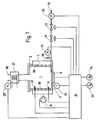
- the combustion chamber (1) is delimited by the combustion chamber wall (2) and the combustion floor (3).
- the combustion gases emerging from the combustion chamber (1) give off their heat to a suitable heat transfer medium in a heat exchanger (21) which is arranged above the combustion chamber (1).
- the combustion gases enter the chimney via the exhaust pipe (30).
- the combustion device shown here is used in a heating system for the combustion of heating oil and other liquid fuels.
- the invention is not restricted to a specific type of burner.
- the combustion device according to the invention can be designed, for example, with an evaporation burner or an atomization burner.
- the fuel is supplied via a fuel line (15) which connects a tank (not shown in the drawing) and the combustion chamber (1).
- the solenoid valve (14) is arranged in the fuel line (15) and can be controlled by pulses for metering the smallest amounts of fuel. The pulse duration can be regulated continuously. This metering device enables the burner device to be operated at a greatly reduced output. Due to the infinitely variable regulation of the solenoid valve (14), only the desired one arrives Amount of fuel in the combustion chamber (1). In this way, optimal combustion conditions can be set, which minimizes the risk of sooting or coking. Since the opening cross section of the solenoid valve (14) is relatively large, blockage does not occur even with fuels with increased viscosity.
- a safety solenoid valve (13) is connected upstream of the solenoid valve (14), which prevents further fuel supply, in particular in the event of malfunctions.
- the fuel leaves the fuel line (15) at the level of the firing tray (3).
- an oil level overflow sensor (12) is provided.
- the oil level overflow sensor (12) can be designed as an NTC resistor which is arranged in a riser pipe (38) which is connected to the fuel line (15). It is also possible that the NTC resistor is attached directly to the combustion chamber (1).
- the firing tray is first preheated.
- An adjustable floor heating (9) is provided below the firing floor (3).
- a floor temperature sensor (10) is assigned to the control loop of the floor heating (9).
- the floor heating (9) ensures that the fuel is sufficiently ignitable.
- the floor temperature should be around 360 ° C. In order to achieve good combustion over the entire load range, it may be necessary to switch on the floor heating.
- the firing tray (3) has a multilayer structure, a first layer with high thermal conductivity, for example copper, being provided outside the firing chamber (1). As a result, the heat supplied via the floor heating is distributed evenly.
- the required strength requirements are met by a second layer, which is provided inside the combustion chamber (1) and is made of high-alloy chromium-nickel steel.
- the firing tray (3) can be produced by plating or flame spraying the first layer onto the second layer.
- the combustion air is drawn in via the controllable main fan (16) into a cylindrical air supply space (4) which surrounds the combustion space (1).
- the combustion air flows into the combustion chamber (1) via throttle openings (36) which are provided in the combustion chamber wall (2).
- throttle openings (36) which are provided in the combustion chamber wall (2).
- solenoid valve (14) In the start-up phase, only a few drops of oil are supplied via the solenoid valve (14).
- the fuel-air mixture is ignited with a glow plug (11), which is arranged above the combustion floor (3) on the combustion chamber wall (2). Glow plugs of this type are used in a known manner in diesel engines. Compared to other ignition devices, the glow plug (11) is characterized by the simple structure and the low acquisition costs. Encapsulation of the filament ensures a long service life of the glow plug.
- a flame monitor (17) is installed at the level of the exhaust gas outlet from the combustion chamber. If the flame breaks off, the flame monitor (17) interrupts the fuel supply.
- the combustion exhaust gases flow from the combustion chamber (1) to the heat exchanger (21). With the release of heat to a suitable heat transfer medium, the combustion exhaust gases get into the exhaust pipe (30) and finally into the chimney, which is not shown in the drawing.
- a flue gas measuring probe (29) is arranged in the exhaust pipe (30) and can be used to determine a characteristic size of the flue gas.
- the flue gas measuring probe (29) can be a lambda probe, for example, which determines the oxygen concentration of the flue gas. It can be used to determine whether there is good and residue-free combustion of the fuel in the combustion chamber (1) he follows. The combustion process is monitored and controlled by the control unit (31).
- the control unit (31) is connected to all measuring and control elements of the combustion device.
- An outside temperature sensor (33), a room thermostat (34), the floor temperature sensor (10), the oil level overflow sensor (12), the flame monitor (17), the pressure monitor (35) and the flue gas measuring probe (29) are provided as measuring elements ) controls the actuators of the burner.
- a control of the solenoid valve (14), the floor heating (9) and the main fan (16) is provided in the combustion device according to the invention. Sooting or coking of the combustion device can be prevented. At the same time, compliance with the emission protection regulations is guaranteed.
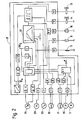
- FIG. 2 shows a schematic circuit diagram of the control unit (31).
- the measured values determined by the measuring elements (10, 12, 17, 29, 33, 34, 35) are digitized and fed to a microprocessor-controlled map control unit (37). If the measured value does not correspond to the target value, the actuators (9, 11, 13, 14, 16) are activated.
- the evaporation burner (39) like the burner described in FIG. 1, has a combustion chamber (1) and a heat exchanger (21).
- An exhaust gas bypass duct (22) is provided as a bypass to the heat exchanger (21), in which a controllable throttle valve (23) is arranged.
- the main exhaust gas flow (19) emerging from the combustion chamber (1) thus only partially reaches the heat exchanger (21).
- An exhaust gas bypass flow (20) is led directly into the exhaust pipe (30) via the exhaust gas bypass flow duct (22). Through the Direct supply of warm combustion gases can prevent the temperature from falling below the dew point in the flue pipe and in the chimney.
- a chimney temperature sensor (28) is arranged on the exhaust pipe (30) as a measuring element.
- a controllable additional fan (25) is provided above the heat exchanger (21) and can be activated if the draft is too low. It is controlled together with the main fan (16), which is arranged in the area of the combustion chamber (1).
- An adjustable chimney throttle (26) is attached to the exhaust pipe (30) in the exhaust gas direction behind the additional fan (25). This can compensate for fluctuations in differential pressure in the chimney.
- the arrangement of a further throttle, which is not shown in the drawing, in the flow direction of the combustion air behind the main fan (16) ensures pressure conditions in the combustion chamber (1) which are almost independent of the chimney draft.
- a chimney pressure sensor (27) is provided on the exhaust pipe (30) as a measuring element for the chimney draft. It is also possible to arrange the chimney pressure sensor (27) in the area of the main fan (16). The pressure conditions in the combustion chamber (1) are monitored with the combustion chamber pressure sensor (24), which is arranged upstream of the additional fan (25) in the exhaust gas direction.
- the floor temperature sensor (10) in the area of the combustion floor (3), the flame monitor (17) in the area where the combustion exhaust gas emerges from the combustion chamber (1) and the oil level overflow sensor (12) on the riser (38) of the fuel line (15) arranged.
- a glow plug (11) is attached to the combustion chamber wall (2) above the combustion floor (3) and projects into the combustion chamber (1).
- the evaporation burner (39) is combined with a control unit (31 '), which is based on the control unit (31) according to FIGS. 1 and 2.
- the control unit (31 ') is connected to all measuring and actuating elements of the combustion device according to FIG. 3.
- the measuring elements are the outside temperature sensor (33), the room thermostat (34), the floor temperature sensor (10), the flame monitor (17), the oil level overflow sensor (12), the pressure monitor (35), the combustion gas temperature sensor (18), the combustion chamber pressure sensor (24) , the chimney pressure sensor (27), the chimney temperature sensor (28) and the flue gas measuring probe (29) are provided.
- the control unit (31 ') controls the combustion process via the solenoid valve (14), the safety solenoid valve (13), the floor heating (9), the glow plug (11), the main blower (16), the auxiliary blower (25), the throttle valve (23 ) and the chimney throttle (26).
- a microprocessor-controlled map control unit is provided in the control unit (31 ').
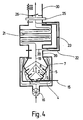
- the evaporation burner (39) according to FIG. 3 is shown enlarged.
- the outside of the combustion chamber (1) is surrounded by an air supply chamber (4).
- An air guide (5) is arranged in the air supply space (4) and surrounds the combustion chamber wall (2) like a pot. At its free, upward-facing edge, the air guiding body (5) slopes towards the combustion chamber wall (2).
- the combustion air is drawn in from the environment via the main fan (16) into the air supply space (4).
- the air guide (5) guides the combustion air to its free edge, which serves as a deflecting edge for the air flow.
- the combustion air is guided through the air baffle (5) after the deflection on the combustion chamber wall (2), whereby heating takes place in counterflow to the exhaust gas.
- the annular space between the combustion chamber wall (2) and air guide body (5) tapers to an annular gap (7). The resulting acceleration of the flow leads to an improvement in the heat transfer.
- the air distribution space (6) which serves to supply combustion air into the interior of the burner, is limited by the combustion chamber wall (2) and the air guide (5).
- the glow plug (11) is also possible to attach the glow plug (11) to the air guide (5), which then also serves as a heat sink.
- the air distribution space (6) has an expanding cross section.
- the combustion air flowing in via the annular gap (7) therefore experiences a delay in the air distribution space (6), which favors the supply to the combustion space.
- the combustion air enters the combustion chamber (1) via throttle openings (not shown in the drawing) which are provided in the combustion chamber wall (2). Preheating the combustion air further improves the combustion process, in particular in part-load operation, and relieves the floor heating (9).
- the outer shape of the combustion chamber wall (2) corresponds to the outer surface of three opening truncated cones, which are arranged one above the other and whose outer diameter increases in the direction of the main exhaust gas flow (19).
- This design of the combustion chamber (1) achieves good and residue-free combustion even with a small flame.
- the combustion chamber wall (2) is designed to converge in the area of the exit of the main exhaust gas flow (19) from the combustion chamber (1).
- Radiation converters (8) protrude into the combustion chamber (1) and are arranged almost vertically to the combustion chamber wall (2). The radiation converters (8) are correctively heated up and radiate their heat in the direction of the firing tray (3). Good evaporation of the fuel is thereby achieved.
Landscapes
- Engineering & Computer Science (AREA)
- Chemical & Material Sciences (AREA)
- Combustion & Propulsion (AREA)
- Mechanical Engineering (AREA)
- General Engineering & Computer Science (AREA)
- Control Of Combustion (AREA)
- Regulation And Control Of Combustion (AREA)
- Feeding And Controlling Fuel (AREA)
Applications Claiming Priority (2)
| Application Number | Priority Date | Filing Date | Title |
|---|---|---|---|
| DE19873743205 DE3743205A1 (de) | 1987-12-19 | 1987-12-19 | Brenneinrichtung |
| DE3743205 | 1987-12-19 |
Publications (2)
| Publication Number | Publication Date |
|---|---|
| EP0321858A2 true EP0321858A2 (fr) | 1989-06-28 |
| EP0321858A3 EP0321858A3 (fr) | 1989-11-29 |
Family
ID=6343046
Family Applications (1)
| Application Number | Title | Priority Date | Filing Date |
|---|---|---|---|
| EP88120967A Withdrawn EP0321858A3 (fr) | 1987-12-19 | 1988-12-15 | Installation de combustion |
Country Status (2)
| Country | Link |
|---|---|
| EP (1) | EP0321858A3 (fr) |
| DE (1) | DE3743205A1 (fr) |
Cited By (4)
| Publication number | Priority date | Publication date | Assignee | Title |
|---|---|---|---|---|
| DE19641920A1 (de) * | 1996-10-11 | 1998-04-16 | Gaggenau Werke | Verfahren und Vorrichtung zum Steuern der Flammengröße gasbetriebener Koch- oder Backgeräte |
| US7690916B2 (en) | 2002-04-16 | 2010-04-06 | Miele & Cie. Kg | Method and apparatus for operating a gas-powered cooking and frying device |
| EP2037176A3 (fr) * | 2007-09-12 | 2017-06-21 | Thermmix AG | Procédé de commande d'un brûleur à évaporation |
| IT202300027372A1 (it) * | 2023-12-20 | 2025-06-20 | Dumarey Automotive Italia S P A | Sistema di combustione per combustibili decarbonizzati |
Families Citing this family (4)
| Publication number | Priority date | Publication date | Assignee | Title |
|---|---|---|---|---|
| DE10001251B4 (de) * | 2000-01-14 | 2005-01-27 | Robert Bosch Gmbh | Verfahren zum Steuern oder Regeln eines Gasbrenners |
| DE102007060656B3 (de) | 2007-12-15 | 2009-03-19 | Spartherm Feuerungstechnik Gmbh | Feuerungsanlage, insbesondere Kamin- oder Kachelofen |
| EP3321582A1 (fr) * | 2016-11-14 | 2018-05-16 | Hubert Ziegler | Dispositif de régulation du tirage d'une cheminée et procédé de régulation constante du tirage d'une cheminée |
| DE202017001336U1 (de) | 2017-03-14 | 2017-05-10 | Spartherm Feuerungstechnik Gmbh | Feuerungsanlage |
Family Cites Families (10)
| Publication number | Priority date | Publication date | Assignee | Title |
|---|---|---|---|---|
| FR1497608A (fr) * | 1966-08-31 | 1967-10-13 | Procédé de réglage de débit d'un fluide et un dispositif pour la mise en oeuvre du procédé | |
| FR2353019A1 (fr) * | 1976-05-25 | 1977-12-23 | Erap | Procede d'alimentation en combustible de bruleurs a pulverisation et circuit d'alimentation en faisant application |
| DE2755621A1 (de) * | 1977-12-14 | 1979-06-21 | Schrag Heizungs Lueftungs Klim | Steuergeraet fuer thermostatgesteuerte oelverdampfungsbrenner |
| DE2913465B1 (de) * | 1979-04-04 | 1980-06-19 | Buderus Ag | Verfahren zur Regelung einer Zentralheizungsanlage |
| DE3106773A1 (de) * | 1981-02-24 | 1982-09-09 | Robert Bosch Gmbh, 7000 Stuttgart | Verfahren zum steuern der energiezufuhr in einem wassererhitzer, insbesondere einem heizkessel |
| JPS5895117A (ja) * | 1981-11-30 | 1983-06-06 | Kurabo Ind Ltd | 燃焼制御装置 |
| US4453055A (en) * | 1982-10-29 | 1984-06-05 | Challenger Caribbean Corporation | Louvered arc chute |
| DE3415042A1 (de) * | 1984-04-21 | 1985-10-31 | GoGas Goch GmbH & Co, 4600 Dortmund | Ansteuerung fuer ein gasregelventil |
| JPS6134340U (ja) * | 1984-07-31 | 1986-03-03 | 三國工業株式会社 | 液体燃料燃焼式流体加熱装置 |
| US4695246A (en) * | 1984-08-30 | 1987-09-22 | Lennox Industries, Inc. | Ignition control system for a gas appliance |
-
1987
- 1987-12-19 DE DE19873743205 patent/DE3743205A1/de active Granted
-
1988
- 1988-12-15 EP EP88120967A patent/EP0321858A3/fr not_active Withdrawn
Cited By (4)
| Publication number | Priority date | Publication date | Assignee | Title |
|---|---|---|---|---|
| DE19641920A1 (de) * | 1996-10-11 | 1998-04-16 | Gaggenau Werke | Verfahren und Vorrichtung zum Steuern der Flammengröße gasbetriebener Koch- oder Backgeräte |
| US7690916B2 (en) | 2002-04-16 | 2010-04-06 | Miele & Cie. Kg | Method and apparatus for operating a gas-powered cooking and frying device |
| EP2037176A3 (fr) * | 2007-09-12 | 2017-06-21 | Thermmix AG | Procédé de commande d'un brûleur à évaporation |
| IT202300027372A1 (it) * | 2023-12-20 | 2025-06-20 | Dumarey Automotive Italia S P A | Sistema di combustione per combustibili decarbonizzati |
Also Published As
| Publication number | Publication date |
|---|---|
| DE3743205A1 (de) | 1989-06-29 |
| DE3743205C2 (fr) | 1990-02-08 |
| EP0321858A3 (fr) | 1989-11-29 |
Similar Documents
| Publication | Publication Date | Title |
|---|---|---|
| EP1060346B1 (fr) | Procede et dispositif pour la combustion d'un combustible liquide | |
| EP0927321B1 (fr) | Bruleur de prevaporisation et de premelange pour combustibles liquides | |
| DE2700671C2 (de) | Blaubrennender Ölbrenner | |
| EP0274630A1 (fr) | Agencement pour un brûleur | |
| EP0599060A1 (fr) | Brûleur de dépollution ou de purification d'un moteur à combustion interne | |
| EP0478644A1 (fr) | Procede et dispositif pour la production de chaleur par combustion sans flamme d'un carburant dans un flux de gaz. | |
| DE3010078C2 (de) | Mit flüssigem Brennstoff betriebener Brenner für Heizvorrichtungen | |
| DE2163983C3 (de) | Nachverbrennungsanlage für die Abgase von Brennkraftmaschinen | |
| DE8816636U1 (de) | Verdampferbrenner | |
| DE69717880T2 (de) | Energieerzeuger zur Produktion eines heissen Fluidums | |
| DE19605216C2 (de) | Verfahren zum Betreiben eines Fahrzeugzusatzheizgerätes und Glüheinrichtung | |
| DE3743205C2 (fr) | ||
| WO1996021127A1 (fr) | Appareil de chauffage pour vehicule | |
| DE10347509B4 (de) | Heizgerät mit einer Zerstäuberdüse | |
| WO2020035393A1 (fr) | Système de chauffage | |
| DE19752335A1 (de) | Verfahren und Vorrichtung zum Verbrennen von Brennstoff | |
| EP1522788A2 (fr) | Brûleur à vaporisation | |
| DE3927416C2 (de) | Gaszentralheizungsbrenner | |
| DE3223108C2 (de) | Verdampfungsölbrenner | |
| DE1501803A1 (de) | Brenner | |
| EP0643264A1 (fr) | Procédé de commande la qualité d'une flamme d'un brûleur atmosphérique à gaz et brûleur à gaz pour la mise en oeuvre de ce procédé | |
| DE19807240A1 (de) | Einspritzsystem | |
| CH662640A5 (de) | Vergasungsbrenner fuer fluessigen brennstoff. | |
| DE10320920B4 (de) | Heizgerät mit einer Abgasabführung | |
| DE19807239C2 (de) | Einspritzventil |
Legal Events
| Date | Code | Title | Description |
|---|---|---|---|
| PUAI | Public reference made under article 153(3) epc to a published international application that has entered the european phase |
Free format text: ORIGINAL CODE: 0009012 |
|
| AK | Designated contracting states |
Kind code of ref document: A2 Designated state(s): AT BE CH DE ES FR GB IT LI LU NL |
|
| PUAL | Search report despatched |
Free format text: ORIGINAL CODE: 0009013 |
|
| AK | Designated contracting states |
Kind code of ref document: A3 Designated state(s): AT BE CH DE ES FR GB IT LI LU NL |
|
| 17P | Request for examination filed |
Effective date: 19900512 |
|
| 17Q | First examination report despatched |
Effective date: 19921223 |
|
| STAA | Information on the status of an ep patent application or granted ep patent |
Free format text: STATUS: THE APPLICATION IS DEEMED TO BE WITHDRAWN |
|
| 18D | Application deemed to be withdrawn |
Effective date: 19940924 |