EP0321904B1 - Method for optimizing the flow and temperature of a washing liquid - Google Patents
Method for optimizing the flow and temperature of a washing liquid Download PDFInfo
- Publication number
- EP0321904B1 EP0321904B1 EP88121228A EP88121228A EP0321904B1 EP 0321904 B1 EP0321904 B1 EP 0321904B1 EP 88121228 A EP88121228 A EP 88121228A EP 88121228 A EP88121228 A EP 88121228A EP 0321904 B1 EP0321904 B1 EP 0321904B1
- Authority
- EP
- European Patent Office
- Prior art keywords
- washing
- wash water
- temperature
- cloth
- wash
- Prior art date
- Legal status (The legal status is an assumption and is not a legal conclusion. Google has not performed a legal analysis and makes no representation as to the accuracy of the status listed.)
- Expired - Lifetime
Links
- 238000005406 washing Methods 0.000 title claims description 70
- 238000000034 method Methods 0.000 title claims description 18
- 239000007788 liquid Substances 0.000 title description 3
- XLYOFNOQVPJJNP-UHFFFAOYSA-N water Substances O XLYOFNOQVPJJNP-UHFFFAOYSA-N 0.000 claims description 80
- 239000004744 fabric Substances 0.000 claims description 36
- 230000000694 effects Effects 0.000 claims description 30
- 239000012535 impurity Substances 0.000 claims description 9
- 238000009988 textile finishing Methods 0.000 claims description 2
- 238000010438 heat treatment Methods 0.000 claims 1
- 238000005259 measurement Methods 0.000 description 9
- 238000011109 contamination Methods 0.000 description 6
- 230000008676 import Effects 0.000 description 5
- 239000000126 substance Substances 0.000 description 3
- 238000010586 diagram Methods 0.000 description 2
- 239000003513 alkali Substances 0.000 description 1
- 230000033228 biological regulation Effects 0.000 description 1
- 238000004061 bleaching Methods 0.000 description 1
- 238000007664 blowing Methods 0.000 description 1
- 238000009529 body temperature measurement Methods 0.000 description 1
- 239000007795 chemical reaction product Substances 0.000 description 1
- 230000007423 decrease Effects 0.000 description 1
- 238000005265 energy consumption Methods 0.000 description 1
- 239000004753 textile Substances 0.000 description 1
- 238000011282 treatment Methods 0.000 description 1
- 230000008016 vaporization Effects 0.000 description 1
- 238000009834 vaporization Methods 0.000 description 1
Images


Classifications
-
- D—TEXTILES; PAPER
- D06—TREATMENT OF TEXTILES OR THE LIKE; LAUNDERING; FLEXIBLE MATERIALS NOT OTHERWISE PROVIDED FOR
- D06B—TREATING TEXTILE MATERIALS USING LIQUIDS, GASES OR VAPOURS
- D06B23/00—Component parts, details, or accessories of apparatus or machines, specially adapted for the treating of textile materials, not restricted to a particular kind of apparatus, provided for in groups D06B1/00 - D06B21/00
- D06B23/24—Means for regulating the amount of treating material picked up by the textile material during its treatment
- D06B23/28—Means for regulating the amount of treating material picked up by the textile material during its treatment in response to a test conducted on the treating material
-
- D—TEXTILES; PAPER
- D06—TREATMENT OF TEXTILES OR THE LIKE; LAUNDERING; FLEXIBLE MATERIALS NOT OTHERWISE PROVIDED FOR
- D06B—TREATING TEXTILE MATERIALS USING LIQUIDS, GASES OR VAPOURS
- D06B3/00—Passing of textile materials through liquids, gases or vapours to effect treatment, e.g. washing, dyeing, bleaching, sizing, impregnating
- D06B3/10—Passing of textile materials through liquids, gases or vapours to effect treatment, e.g. washing, dyeing, bleaching, sizing, impregnating of fabrics
- D06B3/12—Passing of textile materials through liquids, gases or vapours to effect treatment, e.g. washing, dyeing, bleaching, sizing, impregnating of fabrics in zig-zag manner over series of guiding means
-
- D—TEXTILES; PAPER
- D06—TREATMENT OF TEXTILES OR THE LIKE; LAUNDERING; FLEXIBLE MATERIALS NOT OTHERWISE PROVIDED FOR
- D06B—TREATING TEXTILE MATERIALS USING LIQUIDS, GASES OR VAPOURS
- D06B3/00—Passing of textile materials through liquids, gases or vapours to effect treatment, e.g. washing, dyeing, bleaching, sizing, impregnating
- D06B3/10—Passing of textile materials through liquids, gases or vapours to effect treatment, e.g. washing, dyeing, bleaching, sizing, impregnating of fabrics
- D06B3/18—Passing of textile materials through liquids, gases or vapours to effect treatment, e.g. washing, dyeing, bleaching, sizing, impregnating of fabrics combined with squeezing, e.g. in padding machines
Definitions
- the invention relates to a method for adjusting the flow rate and temperature of wash water when washing out impurities, such as superfluous chemicals, from cloth webs in textile finishing processes using a wide-washing machine, in which a cloth web is passed through a number of wash basins connected in series and the warm wash water in counterflow Sink is led.
- a method is known from practice.
- the extent of the washout or the so-called wash effect can be controlled by means of contamination concentration sensors.
- a contamination concentration sensor is, for example, a pH meter or a conductivity sensor that measures the extent of the conductivity of the cloth contaminated with excess chemicals.
- a sensor When entering and dispensing the machine, such a sensor can be pressed onto the cloth.
- the water flow rate and the water temperature can be set for a certain value of the desired washing action.
- the thermal yield of the washing process is often not optimal.
- the desired washing effect can namely be achieved in various ways, the extreme routes being: a) a lot of water and low temperature and b) little water and a high temperature.
- too much wash water and too high temperatures are used, which leads to high energy costs.
- the temperature rises (too high) the energy losses (and consequently the energy costs) increase exponentially, e.g. because the vaporization is much stronger at high temperature.
- the invention aims to remedy the above-mentioned problems and to provide an improved method with which an optimally inexpensive adjustment of the flow rate and temperature of the washing water is achieved while maintaining the desired washing effect, which method can be used for all fabric qualities.
- Fig. 1 shows schematically a wide washing machine, in which the unnecessary chemicals, such as alkali and reaction products, derived from lye and bleaching treatments, are rinsed out of the cloth.
- a machine has, for example, three wash basins 5, each wash basin being divided into three wash compartments 1 connected in series in order to increase the washing effect.
- the wash water 2 is passed through the machine in a countercurrent process, the fresh rinse water flowing into the machine on the right-hand side and then flowing through all the compartments.
- the textile or cloth web 3 to be washed goes into the machine on the left-hand side and is guided on rolls through all compartments.
- the cloth run can be both vertical and horizontal.
- the cloth is pressed through the press plant 4. The pressed water is returned to the wash water flowing through it.
- the wash water is brought up to temperature and maintained per wash basin, for example by blowing in hot steam.
- a contamination concentration sensor such as a conductivity sensor, has been attached to the import and possibly to one of the sinks and to the outlet, which is pressed onto the cloth.
- washing water consumption and temperature are generally selected so that a good rinsing or washing effect is obtained under all circumstances. This almost always means too much wash water and too high temperatures, which leads to high energy costs.
- the invention now provides such a method for optimally coordinating the washing water flow rate and temperature, so that energy savings are made possible while maintaining the desired washing effect, for which purpose measures have been taken as shown in FIG.
- Flow meters W and S are arranged in the two main supply lines for measuring the washing water and steam consumption, and temperature sensors T1 to T6, such as a Pt-100 element, have been installed in the individual wash basins for the temperature measurements.
- a speedometer V for the speed of the cloth web has also been installed.
- the valves in the wash water supply lines K1 to K6 can be designed as flow-controlled pneumatic valves.
- the conductivity sensors G1 to G3 have been installed for the measurement of the contamination of the cloth during import, in one of the sinks and during export.
- the control unit 8 shown in FIG. 3 can be a mini computer.
- the measurement data of the temperature sensors T, the conductivity sensors G and the knives W, S, V are collected by a data logger 6, which forwards them once every ten seconds via an interface 7 of the control unit 8.
- the control signals in binary code originating from this control unit are converted via an interface 9 into control signals of 4 to 20 mA for the valves generally indicated by 10. Proportional control is used for the water flow rate and PID control for the temperature.
- the regulation takes place on the basis of the measurement of the concentration of the impurity in the cloth, for example by means of the conductivity, which corresponds to this concentration of the impurity in proportion.
- the value of the desired conductivity after n compartments, together with the conductivity measured at the time of import, gives the desired washing effect ⁇ p, this is the conductivity C "of the cloth on export divided by the conductivity C o on import: ⁇ p C n / C o .
- the optimally inexpensive combination of water flow rate and temperature is calculated, after which this is adjusted via the valves and adjusted in the event of deviations.
- FIG. 4 shows a schematic representation of a wide washing machine with a number of compartments, into which the fabric is inserted on the left and out on the right and the contamination of this fabric decreases from left to right. The contamination increases from right to left in the wash water flow.
- C o ... C l-3 , C 1-2 , C l-1 , C l is the impurity concentration of the cloth, and is K o ... K l-3 , R l-2 , K I - 1 , K, the concentration of the impurity in the wash water.
- the exchange factor M for a washing compartment is defined as the fraction of the liquid coming in with the cloth, which is replaced by washing water.
- the amount of steam required to heat the wash water and the cloth includes the theoretically required amount of steam to bring the wash water and the cloth up to temperature (linearly depending on the temperature) and the amount of steam required to compensate for the heat loss.
- FIG. 6 shows that an optimally inexpensive combination of water flow rate and temperature can be found for each desired washing action.
- the corresponding desired exchange factor M and the corresponding temperature T can be calculated starting from an initial value and then from incrementing values of the water flow rate in the flow area and the desired washing action.
- the corresponding costs are calculated and the combination with the minimum costs is selected. This combination of water flow rate and temperature is then adjusted, all as indicated in the flow chart of Figure 9.
Landscapes
- Engineering & Computer Science (AREA)
- Textile Engineering (AREA)
- Control Of Washing Machine And Dryer (AREA)
- Treatment Of Fiber Materials (AREA)
Description
Die Erfindung betrifft ein Verfahren zum Einstellen der Durchflußmenge und Temperatur von Waschwasser beim Auswaschen von Verunreinigungen, wie überflüssigen Chemikalien, aus Tuchbahnen bei Textilveredlungsverfahren unter Anwendung einer Breitwaschmaschine, in der eine Tuchbahn durch eine Anzahl in Reihe geschalteter Waschbecken und das warme Waschwasser im Gegenstrom durch diese Waschbecken geführt wird. Ein solches Verfahren ist aus der Praxis bekannt.The invention relates to a method for adjusting the flow rate and temperature of wash water when washing out impurities, such as superfluous chemicals, from cloth webs in textile finishing processes using a wide-washing machine, in which a cloth web is passed through a number of wash basins connected in series and the warm wash water in counterflow Sink is led. Such a method is known from practice.
Bei einem solchen Verfahren kann das Ausmass des Auswaschens oder die sogenannte Waschwirkung mittels Verunreinigungskonzentrationssensoren kontrolliert werden. Ein solcher Verunreinigungskonzentrationssensor ist beispielsweise ein pH-Messer oder ein Leitfähigkeitssensor, der das Ausmass derLeitfähigkeit des mit überflüssigen Chemikalien verunreinigten Tuches misst. Bei der Eingabe und der Ausgabe der Maschine kann ein solcher Sensor an das Tuch angepresst werden. Dabei kann bei einem Tuch einer bestimmten Qualität für einen bestimmten Wert der gewünschten Waschwirkung die Wasserdurchflußmenge und die Wassertemperatur eingestellt werden. Dies gilt dann aber nur für eine einzige Tuchqualität, und bei einer anderen Tuchqualitätwird eine andere Einstellung der Wasserdurchflußmenge und der Temperatur angewandt werden müssen, um die entsprechende Waschwirkung zu erzielen.In such a method, the extent of the washout or the so-called wash effect can be controlled by means of contamination concentration sensors. Such a contamination concentration sensor is, for example, a pH meter or a conductivity sensor that measures the extent of the conductivity of the cloth contaminated with excess chemicals. When entering and dispensing the machine, such a sensor can be pressed onto the cloth. With a cloth of a certain quality, the water flow rate and the water temperature can be set for a certain value of the desired washing action. However, this only applies to a single cloth quality, and with a different cloth quality, a different setting of the water flow rate and the temperature will have to be used in order to achieve the corresponding washing effect.
Im allgemeinen wird eine solche Einstellung mit Obermass von Wasser und hoher Temperatur ausgeführt, die derart weit bemessen sind, dass für alle Tuchqualitäten die gewünschte Waschwirkung erzielt wird. Die bei dieser Einstellung für das Waschverfahren erforderliche Energie wird dafür verwendet, das Spül- oder Waschwasser und das zu waschende Tuch auf Temperatur zu bringen, die erforderlichen Temperaturen beizubehalten, d.h. eintretende Energieverluste auszugleichen und die Maschinen anzutreiben.In general, such an adjustment is carried out with excess water and high temperature, which are dimensioned to such an extent that the desired washing effect is achieved for all fabric qualities. The energy required for this setting for the washing process is used to bring the rinsing or washing water and the cloth to be washed to temperature, to maintain the required temperatures, i.e. Compensate for energy losses that occur and drive the machines.
Die Praxis hat gezeigt, dass der thermische Ertrag des Waschverfahrens oft nicht optimal ist. Der gewünschte Wascheffekt kann nämlich auf verschiedenen Wegen erreicht werden, wobei als Extremwege gelten : a) viel Wasser und niedrige Temperatur und b) wenig Wasser und hohe Temperatur. Im allgemeinen wird mit zu viel Waschwasser und zu hohen Temperaturen gearbeitet, was zu zu hohen Energiekosten führt. Vor allem bei steigender (zu hoher) Temperatur nehmen die Energieverluste (und folglich die Energiekosten) exponential zu, u.a. weil die Verdampfung bei hoher Temperatur viel stärker ist.Practice has shown that the thermal yield of the washing process is often not optimal. The desired washing effect can namely be achieved in various ways, the extreme routes being: a) a lot of water and low temperature and b) little water and a high temperature. In general, too much wash water and too high temperatures are used, which leads to high energy costs. Especially when the temperature rises (too high), the energy losses (and consequently the energy costs) increase exponentially, e.g. because the vaporization is much stronger at high temperature.
Die Erfindung bezweckt die Behebung der obengenannten Probleme und die Schaffung eines verbesserten Verfahrens, mit dem auf schnelle Weise eine optimal preisgünstige Einstellung von Durchflußmenge und Temperatur des Waschwassers mit Erhalt des gewünschten Wascheffekts erreicht wird, welches Verfahren für alle Tuchqualitäten angewandt werden kann. Dies wird erfindungsgemäß bei einem Verfahren gemäß Anspruch 1 in der Weise erreicht, dass mittels einer Messung bei einer Wassertemperatur die Waschwasserdurchflußmenge und der Wascheffekt gemessen werden und daraus ein entsprechender erster Austauschfaktor errechnet wird, dass mittels einer weiteren Messung bei einer weiteren Temperatur erneut die Waschwasserdurchflußmenge und der Wascheffekt gemessen werden und daraus ein weiterer entsprechender zweiter Austauschfaktor errechnet wird, aus welchem ersten Austauschfaktor, zweiten Austauschfaktor und entsprechenden Temperaturen, der lineare Zusammenhang M = f(T) ermittelt wird, und dass, für anwachsende Werte von Waschwasserdurchflußmenge und erwünschtem Wascheffekt, die dementsprechenden erforderlichen Austauschfaktoren und über den genannten linearen Zusammenhang die erforderlichen Temperaturen bestimmt werden, wobei jeweils die Kosten des Waschwasser- und Dampfverbrauchs ermittelt werden und mittels des sich daraus ergebenden Minimumwertes dieser Kosten die entsprechende Waschwasserdurchflußmenge und die entsprechende Dampfzufuhr eingestellt werden.The invention aims to remedy the above-mentioned problems and to provide an improved method with which an optimally inexpensive adjustment of the flow rate and temperature of the washing water is achieved while maintaining the desired washing effect, which method can be used for all fabric qualities. This is achieved according to the invention in a method according to claim 1 in such a way that the washing water flow rate and the washing effect are measured by means of a measurement at a water temperature and a corresponding first exchange factor is calculated from this, that the washing water flow rate and the washing effect is measured and a further corresponding second exchange factor is calculated, from which first exchange factor, second exchange factor and corresponding temperatures, the linear relationship M = f (T) is determined, and that, for increasing values of wash water flow rate and desired washing effect, the Corresponding required exchange factors and the required temperatures are determined via the linear relationship mentioned, the costs of the wash water and steam consumption being determined in each case and resulting from this the minimum value of these costs, the corresponding wash water flow rate and the corresponding steam supply are set.
Bei einer solchen erfindungsgemässen Ausführung ist es möglich, eine Breitwaschmaschine in der Weise abzustimmen, dass ein wirtschaftliches System mit Erhalt der gewünschten Waschwirkung erhalten wird. Dadurch kann in der Praxis der durchschnittliche Energieverbrauch im Vergleich zu dem bekannten Verfahren um 40 bis 50% herabgesetzt werden. Die Erfindung wird an Hand einer Ausführungsform mit Bezugnahme auf die Zeichnungen näher erläutert werden, in welchen Zeichnungen :
- Figur 1 schematisch eine Darstellung einer Breitwaschmaschine mit drei in Waschkompartimente eingeteilten Waschbecken zeigt ;
Figur 2 das Prinzip der Mess- und Regelelementen zeigt, die bei dem erfindungsgemässen Verfahren angewandt werden ;Figur 3 ein vereinfachtes Schema der angewandten Regeleinheit zeigt;Figur 4 ein Schema zur Erläuterung der Bestimmung des auf ein Waschkompartiment anzuwendenden Austauschfaktors zeigt;- Figur 5 eine Graphik zeigt, als Beispiel des Zusammenhangs zwischen dem Phasenverhältnis und der Temperatur bei einer bestimmten Waschwirkung ;
- Figur6 eine Graphikzeigt, als Beispiel des Zusammenhangs zwischen den Betriebskosten und einer Kombination von Waschwasserdurchflußmenge und Temperatur bei einer bestimmten Waschwirkung ;
- Figur 7 eine Graphik zeigt, als Beispiel des Zusammenhangs zwischen Austauschfaktor und Temperatur;
- Figur 8 ein Ablaufdiagramm der Bestimmung des Zusammenhangs zwischen dem Austauschfaktor und der Temperatur zeigt; und
Figur 9 ein Ablaufdiagramm der kostenminimalen Einstellung von Waschwasserdurchflußmenge und temperatur zeigt.
- FIG. 1 schematically shows an illustration of a wide washing machine with three wash basins divided into washing compartments;
- FIG. 2 shows the principle of the measuring and control elements which are used in the method according to the invention;
- Figure 3 shows a simplified diagram of the control unit used;
- FIG. 4 shows a diagram to explain the determination of the exchange factor to be applied to a wash compartment;
- FIG. 5 shows a graph as an example of the relationship between the phase ratio and the temperature for a specific washing action;
- Figure 6 shows a graph as an example of the relationship between operating costs and a combination of wash water flow rate and temperature for a particular wash action;
- FIG. 7 shows a graph as an example of the relationship between the exchange factor and the temperature;
- FIG. 8 shows a flow chart of the determination of the relationship between the exchange factor and the temperature; and
- FIG. 9 shows a flowchart of the cost-minimal setting of wash water flow rate and temperature.
Fig. 1 zeigt schematisch eine Breitwaschmaschine, in der die überflüssigen Chemikalien, wie Alkali und Reaktionsprodukte, von Laugen- und Bleichbehandlungen stammend, aus dem Tuch herausgespült werden. Eine solche Maschine hat beispielsweise drei Waschbecken 5, wobei zur Steigerung der Waschwirkung jedes Waschbecken in drei in Reihe geschaltete Waschkompartimente 1 aufgegliedert ist. Das Waschwasser 2 wird im Gegenstromverfahren durch die Maschine hindurchgeführt, wobei auf der rechten Seite das frische Spülwasser in die Maschine hineinfliesst und danach durch alle Kompartimente hindurchfliesst. Die zu waschende Textil- oder Tuchbahn 3 geht auf der linken Seite in die Maschine hinein und wird auf Rollen durch alle Kompartimente hindurcheführt. Der Tuchlauf kann dabei sowohl senkrecht wie waagerecht sein. Nach jedem Waschbecken wird das Tuch durch das Pressewerk 4 gepresst. Das herausgepresste Wasser wird wieder in das durchfliessende Waschwasser zurück-geführt. Pro Waschbecken wird das Waschwasser auf Temperatur gebracht und erhalten, beispielsweise mittels des Einblasens von heissem Dampf. Zugleich ist bei der Einfuhr und eventuell bei einem der Waschbecken und bei derAusfuhrein Verunreinigungskonzentrationssensor, wie ein Leitfähigkeitssensor, angebracht worden, der an das Tuch gepresst wird.Fig. 1 shows schematically a wide washing machine, in which the unnecessary chemicals, such as alkali and reaction products, derived from lye and bleaching treatments, are rinsed out of the cloth. Such a machine has, for example, three wash basins 5, each wash basin being divided into three wash compartments 1 connected in series in order to increase the washing effect. The
In der Praxis werden im allgemeinen Waschwasserverbrauch und Temperatur (d.h. Dampfzufuhr) so gewählt, dass unter allen Umständen eine gute Spül- oder Waschwirkung erhalten wird. Das bedeutet fast immer zu viel Waschwasser und zu hohe Temperaturen, was zu hohen Energiekosten führt.In practice, washing water consumption and temperature (i.e. steam supply) are generally selected so that a good rinsing or washing effect is obtained under all circumstances. This almost always means too much wash water and too high temperatures, which leads to high energy costs.
Die Erfindung schafft nun ein derartiges Verfahren für die optimale Abstimmung von Waschwasserdurchflußmenge und Temperatur, so dass unter Erhalt der gewünschten Waschwirkung eine Energie-Einsparung ermöglicht wird, wozu Vorkehrungen angebracht worden sind, wie sie in Figur 2 dargestellt worden sind. Für die Messung des Waschwasser- und Dampfverbrauchs sind in den beiden Hauptzufuhrleitungen Durchflußmesser W und S angeordnet und für die Temperaturmessungen in den einzelnen Waschbecken Temperatursensoren T1 bis T6 installiert worden, wie beispielsweise ein Pt-100-Element. Ebenfalls ist ein Geschwindigkeitsmesser V für die Geschwindigkeit der Tuchbahn montiert worden. Die Ventile in den Waschwasserzufuhrleitungen K1 bis K6 können als strömungsgesteuerte pneumatische Ventile ausgeführt sein. Für die Messung der Verunreinigung des Tuches sind bei der Einfuhr, in einem der Waschbecken und bei Der Ausfuhr die Leitfähigkeitssensoren G1 bis G3 angebracht worden.The invention now provides such a method for optimally coordinating the washing water flow rate and temperature, so that energy savings are made possible while maintaining the desired washing effect, for which purpose measures have been taken as shown in FIG. Flow meters W and S are arranged in the two main supply lines for measuring the washing water and steam consumption, and temperature sensors T1 to T6, such as a Pt-100 element, have been installed in the individual wash basins for the temperature measurements. A speedometer V for the speed of the cloth web has also been installed. The valves in the wash water supply lines K1 to K6 can be designed as flow-controlled pneumatic valves. The conductivity sensors G1 to G3 have been installed for the measurement of the contamination of the cloth during import, in one of the sinks and during export.
Die in Figur 3 angegebene Regeleinheit 8 kann ein Minicomputer sein. Die Messdaten der Temperaturfühler T, der Leitfähigkeitssensoren G und der Messer W, S, V werden von einem Datalogger 6 gesammelt, der sie alle zehn Sekunden einmal über eine Schnittstelle 7 derRegeleinheit 8 weiterleitet. Die aus dieser Regeleinheit stammenden Steuersignale im Binärkode werden über eine Schnittstelle 9 in Steuersignale von 4 bis 20 mA für die mit 10 allgemein angedeuteten Ventile umgewandelt. Dabei wird für die Wasserdurchflußmenge eine proportionale Regelung und für die Temperatur eine PID-Regelung angewandt.The control unit 8 shown in FIG. 3 can be a mini computer. The measurement data of the temperature sensors T, the conductivity sensors G and the knives W, S, V are collected by a
Die Regelung erfolgt auf der Grundlage der Messung der Konzentration der Verunreinigung im Tuch, beispielsweise mittels der Leitfähigkeit, die dieser Konzentration der Verunreinigung proportional entspricht. Der Wert der gewünschten Leitfähigkeit nach n Kompartimenten ergibt mit der bei der Einguhr gemessenen Leitfähigkeit die gewünschte Waschwirkung <p, dies ist die Leitfähigkeit C" des Tuchs bei der Ausfuhr geteilt durch die Leitfähigkeit Co bei der Einfuhr: <p = Cn/Co. Für diese gewünschte Waschwirkung wird die optimal preisgünstige Kombination von Wasserdurchflußmenge und Temperatur berechnet, wonach diese über die Ventile eingestellt und im Falle von Abweichungen nachgestellt wird.The regulation takes place on the basis of the measurement of the concentration of the impurity in the cloth, for example by means of the conductivity, which corresponds to this concentration of the impurity in proportion. The value of the desired conductivity after n compartments, together with the conductivity measured at the time of import, gives the desired washing effect <p, this is the conductivity C "of the cloth on export divided by the conductivity C o on import: <p = C n / C o . For this desired washing effect, the optimally inexpensive combination of water flow rate and temperature is calculated, after which this is adjusted via the valves and adjusted in the event of deviations.
Im allgemeinen wird davon ausgegangen, dass jedes Waschkompartiment bei derselbe Wasserdurchflußmenge und bei derselben Temperatur dieselbe Waschwirkung hat. Da dies in der Praxis nicht immer zutrifft, zum Beispiel als Folge der Abmessungen der Kompartimente und des Pressens des Tuchs zwischen bestimmten Kompartimenten, wird mit der durchschnittlichen Waschwirkung pro Kompartiment gearbeitet. In Figur 4 ist eine schematische Darstellung einer Breitwaschmaschine mit einer Anzahl von i Komparimenten gezeigt, in die das Gewebe links eingeführt und rechts herausgeführt wird und die Verunreinigung dieses Gewebes von links nach rechts abnimmt. Dabei nimmt von rechts nach links in dem Waschwasserfluss die Verunreinigung zu. Dabei ist Co...Cl-3, C1-2, Cl-1, Cl die Verunreinigungskonzentration des Tuches, und ist Ko...Kl-3, Rl-2, KI-1, K, die Konzentration der Verunreinigung im Waschwasser. Der Austauschfaktor M für ein Waschkompartiment ist dabei als die Fraktion der mit dem Tuch hereinkommenden Flüssigkeit definiert, die durch Waschwasser ausgewechselt wird.
Bei vollständigem Austausch ist M = 1 und bei keinem Austausch ist M = 0. Der Austauschfaktor erweist sich als in dem Arbeitsbereich linear abhängig von der Temperatur:

Mittels derobengenannten Gleichungen (2) und (3) kann derZusammenhang zwischen derWaschwirkung ϕ = Cn/C0, der Waschwassertemperatur T und dem Phasenverhältnis F festgelegt werden, wie als Beispiel für eine bestimmte Waschwirkung in Figur 5 angegeben. Aus dieser Figur geht hervor, dass eine bestimmte gewünschte Waschwirkung mit einer grossen Anzahl Einstellungen von Wasserdurchflußmenge A und TemperaturT erreicht werden kann. Zur Bestimmung deroptimalen preisgünstigen Kombination müssen die Kosten von Dampf und Wasser bei diesen Einstellungen bekannt sein.Using the above-mentioned equations (2) and (3), the relationship between the washing action ϕ = C n / C 0 , the washing water temperature T and the phase ratio F can be determined, as given as an example for a specific washing action in FIG. This figure shows that a certain desired washing effect can be achieved with a large number of settings for water flow rate A and temperature T. To determine the optimal low cost combination, the cost of steam and water at these settings must be known.
Die Dampfmenge, die für die Heizung des Waschwassers und des Tuchs erforderlich ist, umfasst die theoretisch erforderliche Menge Dampf, um das Waschwasser und das Tuch auf Temperatur zu bringen (linear abhängig von der Temperatur), und die erforderliche Dampfmenge zum Ausgleich des Wärmeverlusts.The amount of steam required to heat the wash water and the cloth includes the theoretically required amount of steam to bring the wash water and the cloth up to temperature (linearly depending on the temperature) and the amount of steam required to compensate for the heat loss.
Wenn man die gesamte Kosten für Wasser und Dampf gegen die einzelnen Kombinationen von Wasserdurchflußmenge und Temperatur absetzt, die eine bestimmte gewünschte Waschwirkung bringen, entsteht der in Figur 6 dargestellte Zusammenhang. Aus dieser Figur geht hervor, dass sich für jede gewünschte Waschwirkung eine optimal kostengünstige Kombination von Wasserdurchflußmenge und Temperatur finden lässt.If the total costs for water and steam are set off against the individual combinations of water flow rate and temperature which bring about a certain desired washing effect, the relationship shown in FIG. 6 arises. This figure shows that an optimally inexpensive combination of water flow rate and temperature can be found for each desired washing action.
Mittels der früheren Daten kann für die Regeleinheit das folgende Regelmodell aufgesetzt werden :
- 1) Eingeben der Messwerte in die Regeleinheit ;
- 2) Mittelwertberechnung der Messwerte ;
- 3) Berechnen des Austauschfaktors M aus der gemessenen Waschwirkung <p = Cn/C0 und der Wasserdurchflußmenge ;
- 4) Berechnen des Zusammehangs zwischen dem Austauschfaktor M und der Temperatur T ;
- 5) Bestimmen der optimal kostengünstigen Kombination von Wasserdurchflußmenge und Temperatur bei einer gewünschten Waschwirkung ;
- 6) Anpassen der Einstellpunkte.
- 1) Enter the measured values in the control unit;
- 2) mean value calculation of the measured values;
- 3) Calculate the exchange factor M from the measured washing effect <p = C n / C 0 and the water flow rate;
- 4) calculating the relationship between the exchange factor M and the temperature T;
- 5) determining the optimally inexpensive combination of water flow rate and temperature for a desired washing effect;
- 6) Adjust the setting points.
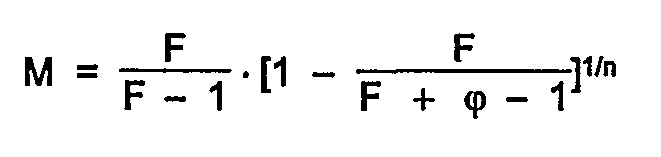
Indem die oben bereits genannte Formel (3) umgeschrieben wird, wird für den Durchschnittsaustauschfaktor M die nachfolgende Gleichung erhalten :
Aus der oben bereits gegebenen Gleichung (4) folgt für eine Waschmaschine mit einer Anzahl von n Kompartimenten, dass zu einer gewünschten Waschwirkung und einem gewahlten Wasserflusswert ein Wert von M gehört. Um bei einer bestimmten Breitwaschmaschine berechnen zu können, bei welcherwassertemperatur der gewünschte Wert M (für eine gewünschte Waschwirkung) erreicht werden wird, muss der Zusammenhang zwischen diesen beiden Grössen bekannt sein. Unter der Annahme, dass dieser Zusammenhang linear ist, muss zunächst der Richtungskoeffizient (RC) und der Achsenschnitt (B) der Geraden M = f(T) bestimmt werden.For a washing machine with a number of n compartments, it follows from equation (4) given above that a value of M belongs to a desired washing action and a selected water flow value. In order to be able to calculate the water temperature at which the desired value M (for a desired washing effect) will be achieved for a particular wide-washing machine, the relationship between these two variables must be known. Assuming that this relationship is linear, the directional coefficient (RC) and the axis section (B) of the straight line M = f (T) must first be determined.
Mit Bezugnahme auf Figur 7 wird dieser Zusammenhang folgendermassen bestimmt :
- - In einem ersten Messdurchgang wird bei einer bestimmten Temperatur aus den Durchschnittsmesswerten der Leitfähigkeit an der Einfuhr und an der Ausfuhr und aus der Wasserdurchflußmenge der entsprechende M-Wert ermittelt, der eine erste Schätzung des Richtungskoeffizienten RC der Funktion M = f(T) gibt.
- - In einem zweiten Messdurchgang wird bei einer folgenden Temperatur aus den Messwerten der Leitfähigkeit und aus der Durchflußmenge ein zweiter entsprechender M-Wert ermittelt. Aus diesem und dem vorletzten ermittelten M-Wert wird ein neuer Richtungskoeffizient RC errechnet. Auf diese Weise werden immer die jeweils letzten beiden M-Werte verwendet, um die Gerade M = f(T) zu bestimmen.
- - In a first measurement run at a certain temperature, the average measured values of the conductivity at the import and the export and from the water flow rate correspond to the M-value determined, which gives a first estimate of the directional coefficient RC of the function M = f (T).
- - In a second measurement run at a following temperature, a second corresponding M-value is determined from the measured values of the conductivity and from the flow rate. A new direction coefficient RC is calculated from this and the penultimate M-value. In this way, the last two M values are always used to determine the straight line M = f (T).
Bei diesen Berechnungen können sich die nachfolgenden Situationen ergeben, wie auch in dem Ablaufdiagramm von Figur 8 angegeben worden ist:
- 1) bei einer ersten Messung wird für den Achsenschnitt B ein Wert Null angenommen ;
- 2) wenn bei einer folgenden Messung die gemessenen Temperaturen T1 und T2 unterschiedlich sind, wird die Gerade folgendermassen bestimmt:

- 3) Wenn bei einer folgenden Messung die gemessenen Temperaturen T1 und T2 gleich sind oder wenn durch irgendeine Ursache ein negativer RC oder B entsteht, wird die Gerade folgendermassen bestimmt:

- 1) in a first measurement, a value of zero is assumed for the axis section B;
- 2) if the measured temperatures T 1 and T 2 are different in a subsequent measurement, the straight line is determined as follows:
- 3) If the measured temperatures T 1 and T 2 are the same in a subsequent measurement or if a negative RC or B arises due to any cause, the straight line is determined as follows:
Nachdem der obengenannte Zusammenhang zwischen Mund T bestimmt worden ist, können, ausgehend von einem Beginnwert und danach von inkrementierenden Werten von Wasserdurchflußmenge in dem Flussbereich und von der gewünschten Waschwirkung der entsprechende gewünschte Austauschfaktor M und die entsprechende Temperatur T errechnet werden. Für diese nachfolgenden Kombinationen von Wasserdurchflußmenge und Temperatur werden die entsprechenden Kosten errechnet und wird daraus diejenige Kombination mit den minimalen Kosten gewählt. Diese Kombination von Wasserdurchflußmenge und Temperatur wird dann eingestellt, dies alles wie in dem Ablaufdiagramm von Figur 9 angegeben worden ist.After the above-mentioned relationship between mouth T has been determined, the corresponding desired exchange factor M and the corresponding temperature T can be calculated starting from an initial value and then from incrementing values of the water flow rate in the flow area and the desired washing action. For these subsequent combinations of water flow rate and temperature, the corresponding costs are calculated and the combination with the minimum costs is selected. This combination of water flow rate and temperature is then adjusted, all as indicated in the flow chart of Figure 9.
In der beigefügten Tabelle I sind für eine Reihe von Tuchbahnen die erhaltenen Ergebnisse mittels des alten Verfahrens und mittels des neuen Verfahrens angegeben worden. Es ist klar, dass unter Beibehaltung der erforderlichen Waschwirkung eine erhebliche Energie-Einsparung erreicht wird.

Claims (3)


Applications Claiming Priority (2)
| Application Number | Priority Date | Filing Date | Title |
|---|---|---|---|
| NL8703074 | 1987-12-18 | ||
| NL8703074 | 1987-12-18 |
Publications (2)
| Publication Number | Publication Date |
|---|---|
| EP0321904A1 EP0321904A1 (en) | 1989-06-28 |
| EP0321904B1 true EP0321904B1 (en) | 1991-05-08 |
Family
ID=19851116
Family Applications (1)
| Application Number | Title | Priority Date | Filing Date |
|---|---|---|---|
| EP88121228A Expired - Lifetime EP0321904B1 (en) | 1987-12-18 | 1988-12-19 | Method for optimizing the flow and temperature of a washing liquid |
Country Status (5)
| Country | Link |
|---|---|
| US (1) | US4922566A (en) |
| EP (1) | EP0321904B1 (en) |
| JP (1) | JPH01306669A (en) |
| DE (1) | DE3862753D1 (en) |
| ES (1) | ES2022585B3 (en) |
Families Citing this family (8)
| Publication number | Priority date | Publication date | Assignee | Title |
|---|---|---|---|---|
| US5390385A (en) * | 1993-05-28 | 1995-02-21 | Knight Equipment International | Laundry management system for washing machines |
| DE10039904B4 (en) * | 2000-08-16 | 2005-12-15 | Senkingwerk Gmbh | Method for washing laundry in a tankless washing line and washing line for carrying out the method |
| EP1337840A1 (en) * | 2000-10-27 | 2003-08-27 | The Procter & Gamble Company | An improved consumer product kit, and a method of use therefor |
| DE10109749A1 (en) * | 2001-02-28 | 2002-09-05 | Pharmagg Systemtechnik Gmbh | Process for the wet treatment of laundry |
| JP4562484B2 (en) * | 2004-10-07 | 2010-10-13 | 株式会社日阪製作所 | Textile cleaning method and textile processing apparatus used therefor |
| JP4551794B2 (en) * | 2005-03-14 | 2010-09-29 | 株式会社日阪製作所 | How to wash textiles |
| JP4551818B2 (en) * | 2005-05-25 | 2010-09-29 | 株式会社日阪製作所 | How to wash textiles |
| CN110158254B (en) * | 2019-06-27 | 2021-07-09 | 卡是纺织科技(上海)有限公司 | Cloth dyeing process is with soaking device of scrubbing with hands |
Family Cites Families (6)
| Publication number | Priority date | Publication date | Assignee | Title |
|---|---|---|---|---|
| DE2515499C3 (en) * | 1975-04-09 | 1978-11-02 | Original Hanau Quarzlampen Gmbh, 6450 Hanau | Device for controlling the drawing up of at least one color component contained in a dye liquor on textile material or the like |
| DE2853236A1 (en) * | 1978-12-09 | 1980-06-19 | Heraeus Gmbh W C | DEVICE FOR CONTROLLING THE COLOR EXTRACTION SPEED |
| EP0087391A1 (en) * | 1982-02-23 | 1983-08-31 | Ciba-Geigy Ag | Method and device for applying a chemical product on a sheet-like material |
| JPS60110965A (en) * | 1983-11-21 | 1985-06-17 | 株式会社山東鉄工所 | Automatic control method and apparatus of contamination degree of washing solution in cloth washing solution tank |
| DE3511949A1 (en) * | 1985-04-02 | 1986-10-09 | Babcock Textilmaschinen GmbH, 2105 Seevetal | METHOD AND DEVICE FOR SAVING WATER IN WASHING MACHINES |
| JPS62243867A (en) * | 1986-04-14 | 1987-10-24 | カネボウ株式会社 | Method and apparatus for automatically adjusting marcerizingor bleaching liquid of cloth |
-
1988
- 1988-12-19 US US07/286,745 patent/US4922566A/en not_active Expired - Fee Related
- 1988-12-19 JP JP63318720A patent/JPH01306669A/en active Granted
- 1988-12-19 ES ES88121228T patent/ES2022585B3/en not_active Expired - Lifetime
- 1988-12-19 EP EP88121228A patent/EP0321904B1/en not_active Expired - Lifetime
- 1988-12-19 DE DE8888121228T patent/DE3862753D1/en not_active Expired - Fee Related
Also Published As
| Publication number | Publication date |
|---|---|
| EP0321904A1 (en) | 1989-06-28 |
| JPH01306669A (en) | 1989-12-11 |
| JPH0375661B2 (en) | 1991-12-02 |
| US4922566A (en) | 1990-05-08 |
| DE3862753D1 (en) | 1991-06-13 |
| ES2022585B3 (en) | 1991-12-01 |
Similar Documents
| Publication | Publication Date | Title |
|---|---|---|
| EP0290637B1 (en) | Process for operating a calander machine and controlling device for carrying out the process | |
| DE2823738C2 (en) | Method for leveling (smoothing) a paper web | |
| DE2926072C2 (en) | ||
| DE3324481A1 (en) | WASHING METHOD FOR A PROGRAM-CONTROLLED DRUM WASHING MACHINE | |
| EP1184504A2 (en) | Method for washing the laundry in a continuous washing machine without tank and washing machine implementing such method | |
| EP0321904A1 (en) | Method for optimizing the flow and temperature of a washing liquid | |
| EP1394312A1 (en) | Method for sizing textile webs or yarns | |
| EP0045838A1 (en) | Method of varying the hand-controlled programme-cycle of an automatic washing machine, and machine for carrying out the method | |
| DE1115706B (en) | Washing method and automatic washing machine to carry it out | |
| DE3206563C2 (en) | ||
| DE3728046C2 (en) | Method for compensating the deflection of the lip bar of a paper machine and a device used in the method | |
| DE541562C (en) | Method and device for mercerising cotton fibers | |
| DE2747990C3 (en) | Coffee machine for preparing coffee in cups | |
| DE69004293T2 (en) | Machine for processing silver halide containing film with little washing water. | |
| DE3221776C2 (en) | ||
| DE3040683A1 (en) | METHOD FOR HEATING WATER OF A HOUSEWATER CIRCUIT AND DEVICE OF A HOUSEWATER CIRCUIT AND DEVICE FOR IMPLEMENTING THE METHOD | |
| DE2700440B2 (en) | Method of washing laundry | |
| DE4233311A1 (en) | Fabric desizing control - compares concentration of sizing in washing fluid with amount of sizing applied to control washing action | |
| DE4142517A1 (en) | Program-controlled washing machine or dishwasher - registers speed of temperature rise in washing water to provide for heater control | |
| DE283533C (en) | ||
| DE4435846A1 (en) | Washing, spinning and rinsing textiles in machine | |
| DE598035C (en) | Method for finishing textile goods using a hydraulic calender and device for carrying out the method | |
| DE2309119A1 (en) | A PROCESS FOR THE INDEPENDENT CONTROL OF A PULP-FOCUSED BLEACHING PROCESS | |
| DE3811365A1 (en) | Method for reducing the quantity of rinsing water, especially in the case of washing machines | |
| DE1167303B (en) | Washing method and automatic washing machine to carry it out |
Legal Events
| Date | Code | Title | Description |
|---|---|---|---|
| PUAI | Public reference made under article 153(3) epc to a published international application that has entered the european phase |
Free format text: ORIGINAL CODE: 0009012 |
|
| AK | Designated contracting states |
Kind code of ref document: A1 Designated state(s): CH DE ES FR GB IT LI NL |
|
| 17P | Request for examination filed |
Effective date: 19890802 |
|
| 17Q | First examination report despatched |
Effective date: 19900323 |
|
| GRAA | (expected) grant |
Free format text: ORIGINAL CODE: 0009210 |
|
| AK | Designated contracting states |
Kind code of ref document: B1 Designated state(s): CH DE ES FR GB IT LI NL |
|
| ET | Fr: translation filed | ||
| GBT | Gb: translation of ep patent filed (gb section 77(6)(a)/1977) | ||
| REF | Corresponds to: |
Ref document number: 3862753 Country of ref document: DE Date of ref document: 19910613 |
|
| ITF | It: translation for a ep patent filed | ||
| PLBE | No opposition filed within time limit |
Free format text: ORIGINAL CODE: 0009261 |
|
| STAA | Information on the status of an ep patent application or granted ep patent |
Free format text: STATUS: NO OPPOSITION FILED WITHIN TIME LIMIT |
|
| 26N | No opposition filed | ||
| PGFP | Annual fee paid to national office [announced via postgrant information from national office to epo] |
Ref country code: CH Payment date: 19951127 Year of fee payment: 8 |
|
| PGFP | Annual fee paid to national office [announced via postgrant information from national office to epo] |
Ref country code: GB Payment date: 19951211 Year of fee payment: 8 |
|
| PGFP | Annual fee paid to national office [announced via postgrant information from national office to epo] |
Ref country code: ES Payment date: 19951213 Year of fee payment: 8 |
|
| PGFP | Annual fee paid to national office [announced via postgrant information from national office to epo] |
Ref country code: FR Payment date: 19951228 Year of fee payment: 8 |
|
| PGFP | Annual fee paid to national office [announced via postgrant information from national office to epo] |
Ref country code: NL Payment date: 19951230 Year of fee payment: 8 |
|
| PGFP | Annual fee paid to national office [announced via postgrant information from national office to epo] |
Ref country code: DE Payment date: 19961217 Year of fee payment: 9 |
|
| PG25 | Lapsed in a contracting state [announced via postgrant information from national office to epo] |
Ref country code: GB Effective date: 19961219 |
|
| PG25 | Lapsed in a contracting state [announced via postgrant information from national office to epo] |
Ref country code: LI Effective date: 19961231 Ref country code: CH Effective date: 19961231 |
|
| PG25 | Lapsed in a contracting state [announced via postgrant information from national office to epo] |
Ref country code: NL Effective date: 19970701 |
|
| GBPC | Gb: european patent ceased through non-payment of renewal fee |
Effective date: 19961219 |
|
| REG | Reference to a national code |
Ref country code: CH Ref legal event code: PL |
|
| PG25 | Lapsed in a contracting state [announced via postgrant information from national office to epo] |
Ref country code: FR Effective date: 19970829 |
|
| NLV4 | Nl: lapsed or anulled due to non-payment of the annual fee |
Effective date: 19970701 |
|
| REG | Reference to a national code |
Ref country code: FR Ref legal event code: ST |
|
| PG25 | Lapsed in a contracting state [announced via postgrant information from national office to epo] |
Ref country code: ES Free format text: LAPSE BECAUSE OF NON-PAYMENT OF DUE FEES Effective date: 19971220 |
|
| PG25 | Lapsed in a contracting state [announced via postgrant information from national office to epo] |
Ref country code: DE Free format text: LAPSE BECAUSE OF NON-PAYMENT OF DUE FEES Effective date: 19980901 |
|
| REG | Reference to a national code |
Ref country code: ES Ref legal event code: FD2A Effective date: 19980113 |
|
| PG25 | Lapsed in a contracting state [announced via postgrant information from national office to epo] |
Ref country code: IT Free format text: LAPSE BECAUSE OF NON-PAYMENT OF DUE FEES;WARNING: LAPSES OF ITALIAN PATENTS WITH EFFECTIVE DATE BEFORE 2007 MAY HAVE OCCURRED AT ANY TIME BEFORE 2007. THE CORRECT EFFECTIVE DATE MAY BE DIFFERENT FROM THE ONE RECORDED. Effective date: 20051219 |