EP0321933A2 - Device for controlling a Read-only memory, and electronic cash register having such a device - Google Patents
Device for controlling a Read-only memory, and electronic cash register having such a device Download PDFInfo
- Publication number
- EP0321933A2 EP0321933A2 EP88121330A EP88121330A EP0321933A2 EP 0321933 A2 EP0321933 A2 EP 0321933A2 EP 88121330 A EP88121330 A EP 88121330A EP 88121330 A EP88121330 A EP 88121330A EP 0321933 A2 EP0321933 A2 EP 0321933A2
- Authority
- EP
- European Patent Office
- Prior art keywords
- memory
- read
- clock
- data
- pulse
- Prior art date
- Legal status (The legal status is an assumption and is not a legal conclusion. Google has not performed a legal analysis and makes no representation as to the accuracy of the status listed.)
- Granted
Links
Images



Classifications
-
- G—PHYSICS
- G11—INFORMATION STORAGE
- G11C—STATIC STORES
- G11C16/00—Erasable programmable read-only memories
- G11C16/02—Erasable programmable read-only memories electrically programmable
- G11C16/06—Auxiliary circuits, e.g. for writing into memory
- G11C16/10—Programming or data input circuits
-
- G—PHYSICS
- G07—CHECKING-DEVICES
- G07G—REGISTERING THE RECEIPT OF CASH, VALUABLES, OR TOKENS
- G07G1/00—Cash registers
- G07G1/12—Cash registers electronically operated
-
- G—PHYSICS
- G11—INFORMATION STORAGE
- G11C—STATIC STORES
- G11C16/00—Erasable programmable read-only memories
- G11C16/02—Erasable programmable read-only memories electrically programmable
- G11C16/06—Auxiliary circuits, e.g. for writing into memory
- G11C16/22—Safety or protection circuits preventing unauthorised or accidental access to memory cells
- G11C16/225—Preventing erasure, programming or reading when power supply voltages are outside the required ranges
-
- G—PHYSICS
- G11—INFORMATION STORAGE
- G11C—STATIC STORES
- G11C16/00—Erasable programmable read-only memories
- G11C16/02—Erasable programmable read-only memories electrically programmable
- G11C16/06—Auxiliary circuits, e.g. for writing into memory
- G11C16/32—Timing circuits
-
- G—PHYSICS
- G11—INFORMATION STORAGE
- G11C—STATIC STORES
- G11C17/00—Read-only memories programmable only once; Semi-permanent stores, e.g. manually-replaceable information cards
- G11C17/14—Read-only memories programmable only once; Semi-permanent stores, e.g. manually-replaceable information cards in which contents are determined by selectively establishing, breaking or modifying connecting links by permanently altering the state of coupling elements, e.g. PROM
- G11C17/18—Auxiliary circuits, e.g. for writing into memory
-
- G—PHYSICS
- G11—INFORMATION STORAGE
- G11C—STATIC STORES
- G11C5/00—Details of stores covered by group G11C11/00
- G11C5/14—Power supply arrangements, e.g. power down, chip selection or deselection, layout of wirings or power grids, or multiple supply levels
- G11C5/143—Detection of memory cassette insertion or removal; Continuity checks of supply or ground lines; Detection of supply variations, interruptions or levels ; Switching between alternative supplies
Definitions
- the present invention relates to an apparatus for controlling operation needed for writing data into read-only memory after activation of power-supply source when using programmable read-only memory which requires data writing operation using signals having high precision in the time for example.
- activation of power-supply source designates supply of power including resumption of power supply after the power supply is momentarily interrupted.
- P-ROM sealed programmable read-only memory
- the control circuit When writing data into P-ROM mainly composed of silicon, the control circuit delivers address signal and data signal designated for storage to P-ROM by means of parallel bit while feeding a high voltage to the P-ROM.
- the control circuit executes data-writing operation by delivering data-writing instruction signal to the P-ROM, where this signal is durable for the predetermined period of time like 1 millisecond +/-5% for example. If the period of this data-writing instruction signal were shorter than the predetermined period of time, then, the amount of electric charge becomes too short to suffice the needs of the P-ROM. This results in the loss of charge generated for allowing data to be written into the P-ROM, and as a result, it inhibits the system from securely writing logic "1" and "0" into the P-ROM.
- control circuit needs to output data-writing instruction signal in an extremely accurate durable period of time. Accordingly, synchronous with clock pulses output from crystal oscillator for example, control circuit executes data-writing operation against the P-ROM by applying data-writing instruction signal having extremely accurate time durability.
- control circuit cannot count clock pulses at all, and thus, it outputs a data-writing instruction signal durable for several seconds to the P-ROM.
- any conventional electronic apparatus incorporating a P-ROM withholds to execute data writing operation for a specific period of time like 10 seconds after the power is ON, whereby the level of the oscillated clock pulses is fully stabilized. After this period of activating standby mode, the control circuit is allowed to execute data writing operation.
- any conventional electronic apparatus incorporating a P-ROM remains in the standby mode of some while, and thus, it cannot activate any operation other than the operation for writing data into the P-ROM. Consequently, any of those conventional electronic apparatuses mentioned above is still too inconvenience for practical use.
- the primary object of the invention is to overcome those technical problems mentioned above, by providing a novel apparatus which securely writes data into read-only memory in a very short period of time after activating power-supply source and properly controls the read-only memory having improved utility after activating power-supply source.
- an apparatus for controlling a read-only memory comprises
- the invention also provides a novel apparatus for controlling the above read-only memory comprising the following sequential steps.
- a certain period of time is spent before the level of the second clock pulse surpasses the identifying levl, where the spent time is longer than the period of time in which, after activating power supply, arithmetic processing means securely enters into normal arithmetic processing operations in response to the first clock pulse. While this condition is present, data-writing means is prevented from writing data into the read-only memory until the level of the second clock pulse surpasses the predetermined identifying level after allowing arithmetic processing means to securely enter into normal arithmetic processing operation.
- arithmetic processing means incorporates the first clock-pulse generating circuit, and executes arithmetic processing operations in response to the first clock pulse generated by the first clock-pulse generating circuit before delivering storable data to the read-only memory.
- Data delivered from arithmetic processing means is stored in a memory of read-only memory control means. Entry of data into this memory is executed in accordance with the first clock pulse.
- Read-only memory control means incorporates the second clock-pulse generating circuit. In accordance with the second clock pulse delivered from the second clock-pulse generating circuit, the storable data is written into the read-only memory.
- read-only memory control means also incorporates the clock-pulse level identifying circuit. ONly when this circuit identifies that the peak level of the second clock pulse surpasses the predetermined identifying level, data can be written into the read-only memory.
- a certain period of time is spent before the level of the second clock pulse surpasses the identifying level, where the spent time is longer than the period of time in which arithmetic processing means can securely enter into normal arithmetic processing operation in response to the first clock pulse.
- no data-writing operation is executed against the read-only memory during a period ranging from the moment at which arithmetic processing means enters into normal arithmetic operation to the moment at which the second clock pulse surpasses the identifying level.
- the system can securely prevent delivery of such a signal containing poor precision of time to the read-only memory caused by presence of low-level second clock pulse generated immediately after activating power-supply source, thus allowing the apparatus to securely write data into read-only memory.
- the apparatus embodied by the invention significantly shortenes the standby period in which no data-writing operation is executed. Since the embodiment of the invention allows the apparatus to securely execute all the needed processes other than the data-writing operation while this operation is inhibitted, compared to any of conventional arts, the apparatus according to the invention significantly promotes practical utility.
- the apparatus can securely execute all the needed processes other than the operation for writing data into read-only memory immediately after activating power-supply source, and yet, compared to any conventional system, the period prohibitting data writing operation is significantly reduced. Consequently, utility of the apparatus incorporating the apparatus according to the invention is greatly promoted.
- the read-only memory and means for controlling the read-only memory are integrally constituted into a single unit, which unit is removably mounted to said arithmetic processing, mean through a connector.
- This constitution allows the integrated unit of read-only memory and control means to optionally be disengaged from arithmetic processing means after writing data into the read-only memory before eventually reading data from the read-only memory using another electronic appratus.
- the pulse-level identifying means is comprised of a counter for counting pulses of said second clock-pulse having higher values than the predetermined threshold value, and means for reading the value counted by said counter at the predetermined time intervals, and wherein when the value counted by the counter increases, the level identifying means identifies that the peak level of the second clock-pulse is higher than the identifying level.
- read-only memory is subtantially composed of either an electrically eraseable programmable read-only memory or a read-only memory whose content is eraseable on exposure to ultraviolet rays. If the system introduces the ultraviolet-eraseable programmable read-only memory, it is possible for the system to inhibit rewriting of data in read-only memory by molding ultraviolet-incident window with beam-shielding plastic material. User of an electronic cash register incorporating ultraviolet-eraseable programmable read-only memory can write enter the sum of sale into this memory for presentation of sales report to the administration.
- an electronic apparatus incorporating read-only memory reflecting the preferred embodiments of the invention securely reduces standby duration immediately after activating power-supply source, and yet, the system related to the invention securely writes data into read-only memory based on signals containing an extremely accurate time basis. Consequently, the system related to the invention is ideally suited for application to an electronic cash register which stores data like the sum of sale for example in the read-only memory.
- FIG. 1 is the simplified block diagram of electronic cash register 1 incorporating a preferred embodiment of the P-ROM control apparatus according to the invention.
- Electronic cash register 1 is comprised of P-ROM 6 storing data related to the sales record of a commercial store like a supermarket for example, P-ROM control circuit 5, and arithmetic processing circuit 3, repectively.
- P-ROM 6 is substantially composed of silicon and provided with a plurality of cells each storing charge, while each cell also stores data to be written internally.
- data signals and address signals are respectively delivered to P-ROM 6 in the form of parallel bits.
- a data-writing instruction signal durable for the predetermined period of time like 1 millisecond +/-5% for example is delivered to P-ROM 6.
- each cell of P-ROM stores the predetermined volume of charge.
- P-ROM 6 retains the written data without using backup power supply like battery.
- durable period of the data-writing instruction signal must perfectly match the durable period specified for P-ROM in ultrahigh precision.
- the P-ROM control circuit 5 incorporates the second clock-pulse generating circuit 7 which comprises crystal oscillator for example. Second clock pulses generated by the second clock-pulse generating circuit 7 is delivered to clock circuit 18 which counts the number of the clock pulses. By referring to the number of clock pulses counted by clock circuit 18, arithmetic processing circuit 3 delivers high-precision-time-based data writing instruction signal to P-ROM 6.
- P-ROM control circuit 5 incorporates random access memory (RAM) 12 which is used as a buffer memory for delivering storable data and address data to P-ROM 6.
- RAM random access memory
- Power-supply circuit 2 electrically energizes arithmetic processing circuit 3, P-ROM control circuit 5, and data input/output control circuit 8 of the electronic cash register 1. While carrying on normal cash registration, cash data entered from keyboard 9 is delivered to arithmetic processing circuit 3 via data input/output control circuit 8, so that the entered cash data can be treated with a variety of subsequent processes before eventually being stored in RAM 12. The cash data registered in RAM 12 is then delivered from arithmetic processing circuit 3 to display panel 10 via data input/output circuit 8 before allowing the operator and client to visually confirm the displayed content. Arithmetic processing circuit 3 processes the cash data in accordance with programs stored in ROM 13.
- P-ROM control circuit 3 controls operation of printer 15 which is provided for printing cash data on receipts for delivery to clients, and opening or closing operation of drawer 14 for receipt or payment of cash.
- Arithmetic processing circuit 3 operates itself synchronous with the first clock pulse output from the first clock-pulse generating circuit 20. Likewise, time in the input and output of data to and from arithmetic processing circuit 3 is also set synchronous with the first clock-pulse.
- Sales data processed by arithmetic processing circuit 3 and stored in RAM 12 is then written into P-ROM 6 by following those steps mentioned below.
- RAM 12 stores sales data for the day together with serial numbers of sales corresponding to each data. For example, these serial numbers respectively have 2-byte data length, whereas each sales data is of 6-byte length.
- Arithmetic processing circuit 3 then delivers these data signals to data processor 16 of P-ROM control circuit 5 via interface 4 and connector 21, which then stores these 8 byte data signals in RAM 17 and then calculates addresses to be stored in P-ROM 6 by referring to those serial numbers each having 2-byte data length.
- data processor 16 generates the flag data which has 2-byte length for example, and designates whether each data has.securely been written into P-ROM 6 or not.
- P-ROM 6 and P-ROM control circuit 17 are integrally constituted into a single unit 19, which unit is removably mounted to the arithmetic circuit 3 through a connector 21.
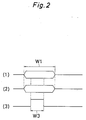
- FIG. 2(3) designates data-writing instruction signal generated by the data processor 16. While the data processor 16 retains address signal and data signal in the durable period W1, the data processor 16 generates data-writing instruction signal during a period W3 by referring to the value counted by clock circuit 18.
- the durable period W3 corresponds to 1 millisecond +/-5% for example.
- FIG. 3(1) is the waveforms of the first clock pulse output from the first clock-pulse generating circuit 20 immediately after activating power-supply source.
- the first clock-pulse reaches the threshold level value V2, and then it gradually reaches peak level V1.
- arithmetic processing circuit enters into fully operative condition in which it can correctly execute normal input and output operations. This allows arithmetic processing circuit 3 to transmit and receive to and from data processor 16 of P-ROM control circuit 5 synchronous with the first clock-pulse.
- arithmetic processing circuit 3 normally outputs 8-bit data signal to data processor 16 of P-ROM control circuit 5.
- FIG. 3(2) is the waveforms of the second clock-pulse output from the second clock-pulse generating circuit 7.
- the second clock-pulse rises itself at a speed slower than that of the first clock-pulse, and thus, it reaches the threshold level value V2, after a period W5, longer than period W4, is past, and then it gradually reaches peak level V1. Accordingly, after a period W5 is past from the activation of power-supply source, data processor 16 of P-ROM control circuit 5 enters into fully operative condition in which it can correctly write data into P-ROM 6.
- FIG. 4 is the flowchart designating operations of the arithmetic processing circuit 3. While step n1 is underway, if power supply source were activated or power is back from interruption, then, operation mode proceeds to step n2. While step n2 is underway, if the arithmetic processing circuit 3 should write data into P-ROM 6 next for example, then, arithmetic processing circuit 3 outputs 8-bit data signal for example. While step n3 is underway, P-ROM control circuit 5 identifies whether writing of data into P-ROM 6 has already been completed, or not. If it is already completed, P-ROM control circuit 5 outputs data writing-completed signal to the arithmetic processing circuit 3.
- step n4 is which the arithmetic processing circuit 3 ceases output of all the data signals.
- step n5 is activated, in accordance with programs stored in ROM 13, the arithmetic processing circuit 3 resumes the ensuing data processing operations.
- FIG. 5 is the flowchart designating operations of the P-ROM control circuit 5 for writing data into P-ROM 6 on receipt of data from the arithmetic processing circuit 3.
- step m1 if the power-supply source turns ON or the power is again back from interruption, while step m2 is underway, then operation mode proceeds to step m2. While step m2 is underway, if data signal from the arithmetic processing circuit 3 should be written into P-ROM 6, then, operation mode enters into step m3. However, if the arithmetic processing circuit 3 outputs signals for reading data from P-ROM 6, for example, then, operation mode proceeds to step m5 in which data processing operation is executed in accordance with the output signals.
- step m3 P-ROM control circuit 5 identifies whether clock circuit 18 can count the second clock pulses, or not. If the second clock pulse were at a specific peak level higher than the threshold value level V2 (i.e., the predetermined identifying level), clock circuit 18 can count the second clock-pulse. For example, after a certain period W5 is past from the moment of activating power-supply source, clock circuit 18 can count the second clock-pulse. Data processor 16 periodically reads the value counted by clock circuit 18, and as a result, it identifies that the peak value of the second clock-pulse surpasses the threshold value level V2 by detecting variation of the value counted by clock circuit 18.
- step m4 As soon as the peak level of the second clock pulse surpasses the threshold value level V2, operation mode proceeds to step m4 to allow the data processor 16 to write data into P-ROM 6. Simultaneously, data processor 16 of P-ROM control circuit 5 outputs data-writing instruction signal based on the accurate timing W3 by calculating the value of the second clock-pulse counted by clock circuit 18. When all the needed operations designated for step m4 are terminated, operation mode returns to step m2 to cause this apparatus to repeatedly execute the same data processing operations as was done before.
- electronic cash register reflecting the preferred embodiment of the invention can freely execute all the data processing operations except for the writing of data into P-ROM 6, and thus, this electronic cash register can securely execute data-writing operation in a certain period of time shorter than the compulsory standby period needed for any conventional apparatus.
- the second clock-pulse generating circuit 7 is provided independent of the first clock-pulse generating circuit 20, which delivers the first clock pulses to other circuits, compared to the case that the second clock pulses are generated by drawing out lead wires from the first clock generating circuit 20 to write the data into P-ROM 6, it is eliminates that the fear of lowering time-basis accuracy caused by lag of time basis generated by floating capacitance. Further additionallymore, discretely provided second clock-pulse generating circuit 7 significantly promotes resistance against noise, thus allowing the P-ROM control circuit 5 to stably write data into P-ROM 6.
- P-ROM 6 which is substantially composed of either a bipolar P-ROM, or an EP-ROM whose content is eraseable on exposure to ultraviolet rays, or an EEP -ROM (electrically eraseable programmable read-only memory), for example.
Landscapes
- Engineering & Computer Science (AREA)
- Computer Security & Cryptography (AREA)
- Physics & Mathematics (AREA)
- General Physics & Mathematics (AREA)
- Power Engineering (AREA)
- Read Only Memory (AREA)
- Static Random-Access Memory (AREA)
Abstract
Description
- The present invention relates to an apparatus for controlling operation needed for writing data into read-only memory after activation of power-supply source when using programmable read-only memory which requires data writing operation using signals having high precision in the time for example.
- The term "activation of power-supply source" stated in this description designates supply of power including resumption of power supply after the power supply is momentarily interrupted.
- Some countries in the world have enforced a system to have commercial stores compulsorily report the sum of sale to the administration in accordance with the system mentioned below. This system obliges commercial stores to write data of total sale into the sealed programmable read-only memory (hereinafter called P-ROM) of an electronic cash register. Sealed P-ROM storing data of total sale is eventually dismounted from the cash register under the presence of administrative officials in charge for implementing compulsory report of the total sale of each store.
- When using such an electronic cash register incorporating a P-ROM for storing data, normally, a specific control circuit controls the writing and reading of data into and from the P-ROM. Data written in the P-ROM is stably retained without requiring backup service of battery.
- When writing data into P-ROM mainly composed of silicon, the control circuit delivers address signal and data signal designated for storage to P-ROM by means of parallel bit while feeding a high voltage to the P-ROM. The control circuit executes data-writing operation by delivering data-writing instruction signal to the P-ROM, where this signal is durable for the predetermined period of time like 1 millisecond +/-5% for example. If the period of this data-writing instruction signal were shorter than the predetermined period of time, then, the amount of electric charge becomes too short to suffice the needs of the P-ROM. This results in the loss of charge generated for allowing data to be written into the P-ROM, and as a result, it inhibits the system from securely writing logic "1" and "0" into the P-ROM.
- Even if the period of the data-writing instruction signal were slightly shorter than the predetermined period of time, even though the term of warranty of the P-ROM were effective for 10 consecutive years in retaining the stored data, the written data may eventually be lost within several years. Conversely, if the period of the data-writing instruction signal were significantly longer than the predetermined period of time, it adversely affects those memory cells in the periphery of the memory cell to be written the data in the P-ROM. This eventually destroys all the data written in those ambient momory cells.
- As is clear from the above reason, the control circuit needs to output data-writing instruction signal in an extremely accurate durable period of time. Accordingly, synchronous with clock pulses output from crystal oscillator for example, control circuit executes data-writing operation against the P-ROM by applying data-writing instruction signal having extremely accurate time durability.
- Nevertheless, when operating any conventional electronic apparatus incorporating the P-ROM, since the level of oscillated clock pulse is too low immediately after the power is turned ON, control circuit cannot count clock pulses at all, and thus, it outputs a data-writing instruction signal durable for several seconds to the P-ROM.
- Normally, any conventional electronic apparatus incorporating a P-ROM withholds to execute data writing operation for a specific period of time like 10 seconds after the power is ON, whereby the level of the oscillated clock pulses is fully stabilized. After this period of activating standby mode, the control circuit is allowed to execute data writing operation.
- When writing data using any conventional system as mentioned above, although the period of time until fully stabilizing the oscillated clock pulses is variable according to the condition of using electronic apparatus and the environment in which it is used, allowable maximum period of time must be provided for the standby mode after the power is turned ON, taking those factors in account. As a result, actually even though the oscillated clock pulses are stabilized in a very short period of time, any conventional electronic apparatus incorporating a P-ROM cannot activate operation while the standby mode lasts for such a long period of time as mentioned above. Reflecting this, users anxiously look foward to an early access to a useful electronic apparatus incorporating such a useful P-ROM capable of quickly activating operations after activation of power-supply source.
- What was worse, after the power is ON, any conventional electronic apparatus incorporating a P-ROM remains in the standby mode of some while, and thus, it cannot activate any operation other than the operation for writing data into the P-ROM. Consequently, any of those conventional electronic apparatuses mentioned above is still too inconvenience for practical use.
- The primary object of the invention is to overcome those technical problems mentioned above, by providing a novel apparatus which securely writes data into read-only memory in a very short period of time after activating power-supply source and properly controls the read-only memory having improved utility after activating power-supply source.
- To securely achieve the above object, an apparatus for controlling a read-only memory according to the invention, comprises
- (a) a read-only memory for receiving and storing data internally;
- (b) means for processing arithemetrically, having a first clock-pulse generating circuit, and for executing arithmetic processing operations in response to a first clock pulse output from the first clock-pulse generating circuit and delivering the data to be stored into the read-only memory; and
- (c) means for controlling the read-only memory comprising;
(c1) a second clock-pulse generating circuit which generates a second clock-pulse for writing data into the read-only memory;
(c2) a memory which internally stores data delivered from the arithmetic means in response to the first clock-pulse;
(c3) a clock-pulse level identifying circuit which identifies level of the second clock-pulse in reference to the predetermined identifying level; and
(c4) data-writing means which writes data from the memory into the read-only memory in response to the second clock pulse when the clock-pulse level identifying circuit detects that the level of the second clock-pulse surpasses the predetermined identifying level; - In addition to those means for controlling the read-only memory mentioned above, the invention also provides a novel apparatus for controlling the above read-only memory comprising the following sequential steps.
- After activation of power supply, a certain period of time is spent before the level of the second clock pulse surpasses the identifying levl, where the spent time is longer than the period of time in which, after activating power supply, arithmetic processing means securely enters into normal arithmetic processing operations in response to the first clock pulse. While this condition is present, data-writing means is prevented from writing data into the read-only memory until the level of the second clock pulse surpasses the predetermined identifying level after allowing arithmetic processing means to securely enter into normal arithmetic processing operation.
- According to the invention, arithmetic processing means incorporates the first clock-pulse generating circuit, and executes arithmetic processing operations in response to the first clock pulse generated by the first clock-pulse generating circuit before delivering storable data to the read-only memory. Data delivered from arithmetic processing means is stored in a memory of read-only memory control means. Entry of data into this memory is executed in accordance with the first clock pulse. Read-only memory control means incorporates the second clock-pulse generating circuit. In accordance with the second clock pulse delivered from the second clock-pulse generating circuit, the storable data is written into the read-only memory.
- Furthermore, read-only memory control means also incorporates the clock-pulse level identifying circuit. ONly when this circuit identifies that the peak level of the second clock pulse surpasses the predetermined identifying level, data can be written into the read-only memory. As a result, after activating power supply source, a certain period of time is spent before the level of the second clock pulse surpasses the identifying level, where the spent time is longer than the period of time in which arithmetic processing means can securely enter into normal arithmetic processing operation in response to the first clock pulse. However, no data-writing operation is executed against the read-only memory during a period ranging from the moment at which arithmetic processing means enters into normal arithmetic operation to the moment at which the second clock pulse surpasses the identifying level.
- Consequently, the system can securely prevent delivery of such a signal containing poor precision of time to the read-only memory caused by presence of low-level second clock pulse generated immediately after activating power-supply source, thus allowing the apparatus to securely write data into read-only memory. Furthermore, compared to the standby period consumed by any of conventional apparatus mentioned earlier, the apparatus embodied by the invention significantly shortenes the standby period in which no data-writing operation is executed. Since the embodiment of the invention allows the apparatus to securely execute all the needed processes other than the data-writing operation while this operation is inhibitted, compared to any of conventional arts, the apparatus according to the invention significantly promotes practical utility.
- As mentioned above, according to the invention, the apparatus can securely execute all the needed processes other than the operation for writing data into read-only memory immediately after activating power-supply source, and yet, compared to any conventional system, the period prohibitting data writing operation is significantly reduced. Consequently, utility of the apparatus incorporating the apparatus according to the invention is greatly promoted.
- According to a preferred embodiment of the invention, the read-only memory and means for controlling the read-only memory are integrally constituted into a single unit, which unit is removably mounted to said arithmetic processing, mean through a connector. This constitution allows the integrated unit of read-only memory and control means to optionally be disengaged from arithmetic processing means after writing data into the read-only memory before eventually reading data from the read-only memory using another electronic appratus.
- According to another preferred embodiment of the invention, the pulse-level identifying means is comprised of a counter for counting pulses of said second clock-pulse having higher values than the predetermined threshold value, and means for reading the value counted by said counter at the predetermined time intervals, and wherein when the value counted by the counter increases, the level identifying means identifies that the peak level of the second clock-pulse is higher than the identifying level.
- According to a still another preferred embodiment of the invention, read-only memory is subtantially composed of either an electrically eraseable programmable read-only memory or a read-only memory whose content is eraseable on exposure to ultraviolet rays. If the system introduces the ultraviolet-eraseable programmable read-only memory, it is possible for the system to inhibit rewriting of data in read-only memory by molding ultraviolet-incident window with beam-shielding plastic material. User of an electronic cash register incorporating ultraviolet-eraseable programmable read-only memory can write enter the sum of sale into this memory for presentation of sales report to the administration.
- As is clear from the above description, an electronic apparatus incorporating read-only memory reflecting the preferred embodiments of the invention securely reduces standby duration immediately after activating power-supply source, and yet, the system related to the invention securely writes data into read-only memory based on signals containing an extremely accurate time basis. Consequently, the system related to the invention is ideally suited for application to an electronic cash register which stores data like the sum of sale for example in the read-only memory.
- The above and further objects as well as advantageous features of the invention will more fully be apparent from the detailed description and the accompanying drawings that follow.
- FIG. 1 is the simplified block diagram of
electronic cash register 1 incorporating a preferred embodiment of the read-only memory control system related to the invention; - FIG. 2 is the timing chart designating the operation for writing data into P-
ROM 6; - FIG. 3 (1) through (4) are respectively the timing charts designating operations of
electronic cash register 1 after activation of power-supply source; - FIG. 4 is the flowchart designating sequential operations of arithmetic processing circuit related to the invention; and
- FIG. 5 is the flowchart designating sequential operations of P-ROM control circuit related to the invention.
- Referring now more particularly to the accompanying drawings, preferred embodiments of the invention are described below. FIG. 1 is the simplified block diagram of
electronic cash register 1 incorporating a preferred embodiment of the P-ROM control apparatus according to the invention.Electronic cash register 1 is comprised of P-ROM 6 storing data related to the sales record of a commercial store like a supermarket for example, P-ROM control circuit 5, andarithmetic processing circuit 3, repectively. - P-
ROM 6 is substantially composed of silicon and provided with a plurality of cells each storing charge, while each cell also stores data to be written internally. When activating data-writing operation, data signals and address signals are respectively delivered to P-ROM 6 in the form of parallel bits. In this case, a data-writing instruction signal durable for the predetermined period of time like 1 millisecond +/-5% for example is delivered to P-ROM 6. Following the delivery of the data-writing instruction signal to P-ROM 6 for a specific duration and at a specific voltage level, each cell of P-ROM stores the predetermined volume of charge. - P-
ROM 6 retains the written data without using backup power supply like battery. However, in order to securely write data into each cell and preserve the data-retentive capability of P-ROM 6 itself, durable period of the data-writing instruction signal must perfectly match the durable period specified for P-ROM in ultrahigh precision. - To correctly deliver the data-writing instruction signal having extremely precise time basis to P-
ROM 6, the P-ROM control circuit 5 incorporates the second clock-pulse generating circuit 7 which comprises crystal oscillator for example. Second clock pulses generated by the second clock-pulse generating circuit 7 is delivered toclock circuit 18 which counts the number of the clock pulses. By referring to the number of clock pulses counted byclock circuit 18,arithmetic processing circuit 3 delivers high-precision-time-based data writing instruction signal to P-ROM 6. P-ROM control circuit 5 incorporates random access memory (RAM) 12 which is used as a buffer memory for delivering storable data and address data to P-ROM 6. - Power-
supply circuit 2 electrically energizesarithmetic processing circuit 3, P-ROM control circuit 5, and data input/output control circuit 8 of theelectronic cash register 1. While carrying on normal cash registration, cash data entered fromkeyboard 9 is delivered toarithmetic processing circuit 3 via data input/output control circuit 8, so that the entered cash data can be treated with a variety of subsequent processes before eventually being stored inRAM 12. The cash data registered inRAM 12 is then delivered fromarithmetic processing circuit 3 to displaypanel 10 via data input/output circuit 8 before allowing the operator and client to visually confirm the displayed content.Arithmetic processing circuit 3 processes the cash data in accordance with programs stored inROM 13. P-ROM control circuit 3 controls operation ofprinter 15 which is provided for printing cash data on receipts for delivery to clients, and opening or closing operation ofdrawer 14 for receipt or payment of cash.Arithmetic processing circuit 3 operates itself synchronous with the first clock pulse output from the first clock-pulse generating circuit 20. Likewise, time in the input and output of data to and fromarithmetic processing circuit 3 is also set synchronous with the first clock-pulse. - Sales data processed by
arithmetic processing circuit 3 and stored inRAM 12 is then written into P-ROM 6 by following those steps mentioned below. First,RAM 12 stores sales data for the day together with serial numbers of sales corresponding to each data. For example, these serial numbers respectively have 2-byte data length, whereas each sales data is of 6-byte length.Arithmetic processing circuit 3 then delivers these data signals todata processor 16 of P-ROM control circuit 5 viainterface 4 andconnector 21, which then stores these 8 byte data signals inRAM 17 and then calculates addresses to be stored in P-ROM 6 by referring to those serial numbers each having 2-byte data length. Anddata processor 16 generates the flag data which has 2-byte length for example, and designates whether each data has.securely been written into P-ROM 6 or not. To correctly store data of total sales amount for the day in P-ROM 6, a sum of 10 bytes of data are output from thisdata processor 16 to P-ROM 6. P-ROM 6 and P-ROM control circuit 17 are integrally constituted into asingle unit 19, which unit is removably mounted to thearithmetic circuit 3 through aconnector 21. - Based on the value counted by
clock circuit 18,data processor 16 outputs calculated address signals shown in FIG. 2(1), and storable data signal shown in FIG. 2(2) P-ROM 6 in the form of parallel 8-bits. Accordingly, the apparatus repeatedly executes thosesequential processes 10 consecutive times while renewing addresses before eventually storing 10-byte data signals in P-ROM 6. FIG. 2(3) designates data-writing instruction signal generated by thedata processor 16. While thedata processor 16 retains address signal and data signal in the durable period W1, thedata processor 16 generates data-writing instruction signal during a period W3 by referring to the value counted byclock circuit 18. The durable period W3 corresponds to 1 millisecond +/-5% for example. Immediately after activating power-supply source, the level of the second clock pulse generated from the second-pulse generating circuit 7 is too low, and as a result,clock circuit 18 cannot count the clock pulses needed for writing data into P-ROM 6. If this occurs,data processor 16 is prevented from generating data-wiring instruction signal by executing those processes described below. - FIG. 3(1) is the waveforms of the first clock pulse output from the first clock-
pulse generating circuit 20 immediately after activating power-supply source. After a period W4 is past from the moment of activating power-supply source, the first clock-pulse reaches the threshold level value V2, and then it gradually reaches peak level V1. Accordingly, after a period W4 is past from the activation of power-supply source, arithmetic processing circuit enters into fully operative condition in which it can correctly execute normal input and output operations. This allowsarithmetic processing circuit 3 to transmit and receive to and fromdata processor 16 of P-ROM control circuit 5 synchronous with the first clock-pulse. As a result, after a period W4 is past from the activation of power-supply source,arithmetic processing circuit 3 normally outputs 8-bit data signal todata processor 16 of P-ROM control circuit 5. - FIG. 3(2) is the waveforms of the second clock-pulse output from the second clock-
pulse generating circuit 7. The second clock-pulse rises itself at a speed slower than that of the first clock-pulse, and thus, it reaches the threshold level value V2, after a period W5, longer than period W4, is past, and then it gradually reaches peak level V1. Accordingly, after a period W5 is past from the activation of power-supply source,data processor 16 of P-ROM control circuit 5 enters into fully operative condition in which it can correctly write data into P-ROM 6. - FIG. 4 is the flowchart designating operations of the
arithmetic processing circuit 3. While step n1 is underway, if power supply source were activated or power is back from interruption, then, operation mode proceeds to step n2. While step n2 is underway, if thearithmetic processing circuit 3 should write data into P-ROM 6 next for example, then,arithmetic processing circuit 3 outputs 8-bit data signal for example. While step n3 is underway, P-ROM control circuit 5 identifies whether writing of data into P-ROM 6 has already been completed, or not. If it is already completed, P-ROM control circuit 5 outputs data writing-completed signal to thearithmetic processing circuit 3. This activates step n4 is which thearithmetic processing circuit 3 ceases output of all the data signals. Next, when step n5 is activated, in accordance with programs stored inROM 13, thearithmetic processing circuit 3 resumes the ensuing data processing operations. - FIG. 5 is the flowchart designating operations of the P-
ROM control circuit 5 for writing data into P-ROM 6 on receipt of data from thearithmetic processing circuit 3. In step m1, if the power-supply source turns ON or the power is again back from interruption, while step m2 is underway, then operation mode proceeds to step m2. While step m2 is underway, if data signal from thearithmetic processing circuit 3 should be written into P-ROM 6, then, operation mode enters into step m3. However, if thearithmetic processing circuit 3 outputs signals for reading data from P-ROM 6, for example, then, operation mode proceeds to step m5 in which data processing operation is executed in accordance with the output signals. - While step m3 is underway, P-
ROM control circuit 5 identifies whetherclock circuit 18 can count the second clock pulses, or not. If the second clock pulse were at a specific peak level higher than the threshold value level V2 (i.e., the predetermined identifying level),clock circuit 18 can count the second clock-pulse. For example, after a certain period W5 is past from the moment of activating power-supply source,clock circuit 18 can count the second clock-pulse.Data processor 16 periodically reads the value counted byclock circuit 18, and as a result, it identifies that the peak value of the second clock-pulse surpasses the threshold value level V2 by detecting variation of the value counted byclock circuit 18. - As soon as the peak level of the second clock pulse surpasses the threshold value level V2, operation mode proceeds to step m4 to allow the
data processor 16 to write data into P-ROM 6. Simultaneously,data processor 16 of P-ROM control circuit 5 outputs data-writing instruction signal based on the accurate timing W3 by calculating the value of the second clock-pulse counted byclock circuit 18. When all the needed operations designated for step m4 are terminated, operation mode returns to step m2 to cause this apparatus to repeatedly execute the same data processing operations as was done before. - As is clear from the above description, even in such a period immediately after activating power-supply source, electronic cash register reflecting the preferred embodiment of the invention can freely execute all the data processing operations except for the writing of data into P-
ROM 6, and thus, this electronic cash register can securely execute data-writing operation in a certain period of time shorter than the compulsory standby period needed for any conventional apparatus. Furthermore, since the second clock-pulse generating circuit 7 is provided independent of the first clock-pulse generating circuit 20, which delivers the first clock pulses to other circuits, compared to the case that the second clock pulses are generated by drawing out lead wires from the firstclock generating circuit 20 to write the data into P-ROM 6, it is eliminates that the fear of lowering time-basis accuracy caused by lag of time basis generated by floating capacitance. Furthermore, discretely provided second clock-pulse generating circuit 7 significantly promotes resistance against noise, thus allowing the P-ROM control circuit 5 to stably write data into P-ROM 6. - The invention allows those preferred embodiments to use P-
ROM 6 which is substantially composed of either a bipolar P-ROM, or an EP-ROM whose content is eraseable on exposure to ultraviolet rays, or an EEP -ROM (electrically eraseable programmable read-only memory), for example. - The invention may also be embodied in a variety of ways other than those preferred embodiments cited above without departing from the spirit, scope, or essential features of the invention. Therefore, those preferred embodiments cites above are merely illustrative examples. The scope of the invention is explicitly manifested in the following Claims, and thus, the content of the foregoing description does not bind the scope of the invention, but any modification or alteration falling under the spirit and scope of the invention shall fully be embraced in the scope of the invention itself.
Claims (8)
(c1) a second clock-pulse generating circuit which generates a second clock-pulse for writing data into the read-only memory (6);
(c2) a memory (17) which internally stores data delivered from the arithmetic means (3) in response to the first clock-pulse; (c3) a clock-pulse level identifying circuit (18) which identifies level of the second clock-pulse in reference to the predetermined identifying level; and
(c4) data-writing means which writes data from the memory (17) into the read-only memory (6) in response to the second clock pulse when the clock-pulse level identifying circuit detects that the level of the second clock-pulse surpasses the predetermined identifying level;
wherein after activation of power-supply source (2), a certain period of time is spent before peak level of the second clock-pulse surpasses the identifying level, where the spent time is longer than a period of time in which, after activation of power-supply source (2), said arithmetic processing means (3) securely enters into normal arithmetic processing operations in response to the first clock-pulse, and the data-writing means is prevented from writing data into the read-only memory (6) until peak level of the second clock-pulse surpasses the predetermined identifying level after allowing said arithmetic processing means (3) to securely enter into normal arithmetic processing operation.
a read-only memory in which data is written in accordance with data-writing instruction signal containing high time-basis precision;
a clock-pulse generating circuit;
means for identifying peak level of clock pulses output from the clock-pulse generating circuit, in reference to predetermined identifying level which is determined on the basis of the peak level of the clock-pulse, when operation of the clock-pulse generating circuit remains stable; and
data-writing means which, in response to signal output from said peak-level identifying means, delivers data-writing instruction signal containing high time-basis precision to the read-only memory in accordance with the clock-pulse only when peak level of the clock-pulse is higher than the predetermined identifying level.
Applications Claiming Priority (2)
| Application Number | Priority Date | Filing Date | Title |
|---|---|---|---|
| JP32486087A JPH0756757B2 (en) | 1987-12-21 | 1987-12-21 | Control device after turning on the memory |
| JP324860/87 | 1987-12-21 |
Publications (3)
| Publication Number | Publication Date |
|---|---|
| EP0321933A2 true EP0321933A2 (en) | 1989-06-28 |
| EP0321933A3 EP0321933A3 (en) | 1990-08-08 |
| EP0321933B1 EP0321933B1 (en) | 1994-02-16 |
Family
ID=18170457
Family Applications (1)
| Application Number | Title | Priority Date | Filing Date |
|---|---|---|---|
| EP19880121330 Expired - Lifetime EP0321933B1 (en) | 1987-12-21 | 1988-12-20 | Device for controlling a Read-only memory, and electronic cash register having such a device |
Country Status (4)
| Country | Link |
|---|---|
| EP (1) | EP0321933B1 (en) |
| JP (1) | JPH0756757B2 (en) |
| DE (1) | DE3887855T2 (en) |
| TR (1) | TR23969A (en) |
Families Citing this family (1)
| Publication number | Priority date | Publication date | Assignee | Title |
|---|---|---|---|---|
| DE102020129479B4 (en) | 2020-11-09 | 2023-11-09 | Polymath.Vision UG (haftungsbeschränkt) | Linear drive and method for linear displacement of an object |
Family Cites Families (3)
| Publication number | Priority date | Publication date | Assignee | Title |
|---|---|---|---|---|
| JPS5840643A (en) * | 1981-09-03 | 1983-03-09 | Toshiba Corp | Oscillation control system of one-chip micro-computer |
| US4534018A (en) * | 1983-04-29 | 1985-08-06 | Pitney Bowes Inc. | Non-volatile memory protection circuit with microprocessor interaction |
| US4665328A (en) * | 1984-07-27 | 1987-05-12 | National Semiconductor Corporation | Multiple clock power down method and structure |
-
1987
- 1987-12-21 JP JP32486087A patent/JPH0756757B2/en not_active Expired - Lifetime
-
1988
- 1988-12-20 DE DE19883887855 patent/DE3887855T2/en not_active Expired - Lifetime
- 1988-12-20 EP EP19880121330 patent/EP0321933B1/en not_active Expired - Lifetime
-
1989
- 1989-01-21 TR TR1789A patent/TR23969A/en unknown
Also Published As
| Publication number | Publication date |
|---|---|
| EP0321933A3 (en) | 1990-08-08 |
| JPH0756757B2 (en) | 1995-06-14 |
| JPH01165094A (en) | 1989-06-29 |
| DE3887855T2 (en) | 1994-09-01 |
| EP0321933B1 (en) | 1994-02-16 |
| DE3887855D1 (en) | 1994-03-24 |
| TR23969A (en) | 1991-01-11 |
Similar Documents
| Publication | Publication Date | Title |
|---|---|---|
| US5036460A (en) | Microprocessor having miswriting preventing function | |
| US20010002475A1 (en) | Memory device | |
| US4578774A (en) | System for limiting access to non-volatile memory in electronic postage meters | |
| EP0092976A2 (en) | Memory writing control apparatus | |
| KR0185954B1 (en) | Memory management method | |
| EP0173967B1 (en) | Microprogram load unit | |
| EP0370529A2 (en) | Microcomputer having EEPROM | |
| US6442349B1 (en) | Camera capable of storing photographing data and display device connectable thereto | |
| EP0197345A2 (en) | An electronic postage meter having power up and power down protection circuitry | |
| EP0321933A2 (en) | Device for controlling a Read-only memory, and electronic cash register having such a device | |
| EP0472285A2 (en) | External memory access control for a processing system | |
| JPS58169395A (en) | Rewritable read-only memory controlling system | |
| US5343436A (en) | Electronic apparatus having backup power source | |
| US6374313B1 (en) | FIFO and method of operating same which inhibits output transitions when the last cell is read or when the FIFO is erased | |
| US5231592A (en) | Counter | |
| EP0354590A3 (en) | Instruction buffer for a microcomputer | |
| JPH0822422A (en) | Memory device | |
| JPH0511930A (en) | Disk cache device | |
| JP2740685B2 (en) | Storage device backup circuit | |
| JP3130077B2 (en) | Information processing device | |
| JPH10240633A (en) | Memory system and memory card | |
| JPH06236695A (en) | Non-volatile memory device with exchange display function | |
| JPS60241116A (en) | portable terminal device | |
| JPH09311827A (en) | Data backup device | |
| JP3053270B2 (en) | Power supply backup method and device |
Legal Events
| Date | Code | Title | Description |
|---|---|---|---|
| PUAI | Public reference made under article 153(3) epc to a published international application that has entered the european phase |
Free format text: ORIGINAL CODE: 0009012 |
|
| 17P | Request for examination filed |
Effective date: 19881220 |
|
| AK | Designated contracting states |
Kind code of ref document: A2 Designated state(s): DE GB IT |
|
| PUAL | Search report despatched |
Free format text: ORIGINAL CODE: 0009013 |
|
| AK | Designated contracting states |
Kind code of ref document: A3 Designated state(s): DE GB IT |
|
| RHK1 | Main classification (correction) |
Ipc: G11C 17/00 |
|
| 17Q | First examination report despatched |
Effective date: 19920723 |
|
| GRAA | (expected) grant |
Free format text: ORIGINAL CODE: 0009210 |
|
| AK | Designated contracting states |
Kind code of ref document: B1 Designated state(s): DE GB IT |
|
| REF | Corresponds to: |
Ref document number: 3887855 Country of ref document: DE Date of ref document: 19940324 |
|
| ITF | It: translation for a ep patent filed | ||
| PLBE | No opposition filed within time limit |
Free format text: ORIGINAL CODE: 0009261 |
|
| STAA | Information on the status of an ep patent application or granted ep patent |
Free format text: STATUS: NO OPPOSITION FILED WITHIN TIME LIMIT |
|
| 26N | No opposition filed | ||
| REG | Reference to a national code |
Ref country code: GB Ref legal event code: IF02 |
|
| PGFP | Annual fee paid to national office [announced via postgrant information from national office to epo] |
Ref country code: GB Payment date: 20071219 Year of fee payment: 20 |
|
| PGFP | Annual fee paid to national office [announced via postgrant information from national office to epo] |
Ref country code: IT Payment date: 20071228 Year of fee payment: 20 Ref country code: DE Payment date: 20071213 Year of fee payment: 20 |
|
| REG | Reference to a national code |
Ref country code: GB Ref legal event code: PE20 Expiry date: 20081219 |
|
| PG25 | Lapsed in a contracting state [announced via postgrant information from national office to epo] |
Ref country code: GB Free format text: LAPSE BECAUSE OF EXPIRATION OF PROTECTION Effective date: 20081219 |