EP0322013A2 - A process for the preparation of solid dispersions of acid salts of tetravalent metals having lamellar structure in an inert inorganic matrix, and the products so obtained - Google Patents
A process for the preparation of solid dispersions of acid salts of tetravalent metals having lamellar structure in an inert inorganic matrix, and the products so obtained Download PDFInfo
- Publication number
- EP0322013A2 EP0322013A2 EP88202769A EP88202769A EP0322013A2 EP 0322013 A2 EP0322013 A2 EP 0322013A2 EP 88202769 A EP88202769 A EP 88202769A EP 88202769 A EP88202769 A EP 88202769A EP 0322013 A2 EP0322013 A2 EP 0322013A2
- Authority
- EP
- European Patent Office
- Prior art keywords
- dispersion
- phosphate
- acid
- process according
- acid salt
- Prior art date
- Legal status (The legal status is an assumption and is not a legal conclusion. Google has not performed a legal analysis and makes no representation as to the accuracy of the status listed.)
- Granted
Links
- 239000002253 acid Substances 0.000 title claims abstract description 36
- 150000003839 salts Chemical class 0.000 title claims abstract description 33
- 238000000034 method Methods 0.000 title claims abstract description 26
- 239000011159 matrix material Substances 0.000 title claims abstract description 23
- 230000008569 process Effects 0.000 title claims abstract description 22
- 229910052751 metal Inorganic materials 0.000 title claims abstract description 20
- 239000002184 metal Substances 0.000 title claims abstract description 20
- 239000007962 solid dispersion Substances 0.000 title claims abstract description 17
- 238000002360 preparation method Methods 0.000 title claims abstract description 9
- 150000002739 metals Chemical class 0.000 title claims abstract description 8
- VYPSYNLAJGMNEJ-UHFFFAOYSA-N Silicium dioxide Chemical compound O=[Si]=O VYPSYNLAJGMNEJ-UHFFFAOYSA-N 0.000 claims abstract description 53
- XLYOFNOQVPJJNP-UHFFFAOYSA-N water Substances O XLYOFNOQVPJJNP-UHFFFAOYSA-N 0.000 claims abstract description 29
- 239000000377 silicon dioxide Substances 0.000 claims abstract description 25
- 239000003054 catalyst Substances 0.000 claims abstract description 9
- 150000001412 amines Chemical class 0.000 claims abstract description 5
- 238000010438 heat treatment Methods 0.000 claims abstract description 4
- 150000007524 organic acids Chemical class 0.000 claims abstract description 4
- 229910052500 inorganic mineral Inorganic materials 0.000 claims abstract description 3
- 239000011707 mineral Substances 0.000 claims abstract description 3
- 229910019142 PO4 Inorganic materials 0.000 claims description 25
- 239000010452 phosphate Substances 0.000 claims description 25
- QTBSBXVTEAMEQO-UHFFFAOYSA-N Acetic acid Chemical compound CC(O)=O QTBSBXVTEAMEQO-UHFFFAOYSA-N 0.000 claims description 21
- QCWXUUIWCKQGHC-UHFFFAOYSA-N Zirconium Chemical group [Zr] QCWXUUIWCKQGHC-UHFFFAOYSA-N 0.000 claims description 16
- 229910052726 zirconium Inorganic materials 0.000 claims description 16
- 239000006185 dispersion Substances 0.000 claims description 12
- 239000007787 solid Substances 0.000 claims description 12
- 239000000725 suspension Substances 0.000 claims description 11
- 230000007062 hydrolysis Effects 0.000 claims description 8
- 238000006460 hydrolysis reaction Methods 0.000 claims description 8
- 238000006243 chemical reaction Methods 0.000 claims description 6
- 238000009830 intercalation Methods 0.000 claims description 5
- 230000002687 intercalation Effects 0.000 claims description 5
- QGZKDVFQNNGYKY-UHFFFAOYSA-N Ammonia Chemical compound N QGZKDVFQNNGYKY-UHFFFAOYSA-N 0.000 claims description 4
- 238000002441 X-ray diffraction Methods 0.000 claims description 4
- 238000005406 washing Methods 0.000 claims description 4
- BOTDANWDWHJENH-UHFFFAOYSA-N Tetraethyl orthosilicate Chemical compound CCO[Si](OCC)(OCC)OCC BOTDANWDWHJENH-UHFFFAOYSA-N 0.000 claims description 3
- 150000001768 cations Chemical class 0.000 claims description 3
- 229910010272 inorganic material Inorganic materials 0.000 claims description 3
- 238000005342 ion exchange Methods 0.000 claims description 3
- 150000005622 tetraalkylammonium hydroxides Chemical class 0.000 claims description 3
- LPSKDVINWQNWFE-UHFFFAOYSA-M tetrapropylazanium;hydroxide Chemical compound [OH-].CCC[N+](CCC)(CCC)CCC LPSKDVINWQNWFE-UHFFFAOYSA-M 0.000 claims description 3
- 229910021529 ammonia Inorganic materials 0.000 claims description 2
- 239000011147 inorganic material Substances 0.000 claims description 2
- 229920000136 polysorbate Polymers 0.000 claims 4
- 150000001767 cationic compounds Chemical class 0.000 claims 1
- 238000010981 drying operation Methods 0.000 claims 1
- 229910001411 inorganic cation Inorganic materials 0.000 claims 1
- 229920000053 polysorbate 80 Polymers 0.000 claims 1
- 239000000758 substrate Substances 0.000 claims 1
- 150000001875 compounds Chemical class 0.000 abstract description 6
- 238000001246 colloidal dispersion Methods 0.000 abstract description 3
- 230000032798 delamination Effects 0.000 abstract description 2
- 238000006555 catalytic reaction Methods 0.000 abstract 1
- 125000002091 cationic group Chemical group 0.000 abstract 1
- 150000007522 mineralic acids Chemical class 0.000 abstract 1
- 239000000243 solution Substances 0.000 description 24
- 238000003756 stirring Methods 0.000 description 10
- 239000000463 material Substances 0.000 description 9
- 229910000166 zirconium phosphate Inorganic materials 0.000 description 7
- 239000000047 product Substances 0.000 description 6
- LEHFSLREWWMLPU-UHFFFAOYSA-B zirconium(4+);tetraphosphate Chemical compound [Zr+4].[Zr+4].[Zr+4].[O-]P([O-])([O-])=O.[O-]P([O-])([O-])=O.[O-]P([O-])([O-])=O.[O-]P([O-])([O-])=O LEHFSLREWWMLPU-UHFFFAOYSA-B 0.000 description 6
- 101100283604 Caenorhabditis elegans pigk-1 gene Proteins 0.000 description 5
- 230000003197 catalytic effect Effects 0.000 description 5
- HPXRVTGHNJAIIH-UHFFFAOYSA-N cyclohexanol Chemical compound OC1CCCCC1 HPXRVTGHNJAIIH-UHFFFAOYSA-N 0.000 description 5
- 239000002243 precursor Substances 0.000 description 5
- HUCVOHYBFXVBRW-UHFFFAOYSA-M caesium hydroxide Chemical compound [OH-].[Cs+] HUCVOHYBFXVBRW-UHFFFAOYSA-M 0.000 description 4
- 239000000203 mixture Substances 0.000 description 4
- WGYKZJWCGVVSQN-UHFFFAOYSA-N propylamine Chemical compound CCCN WGYKZJWCGVVSQN-UHFFFAOYSA-N 0.000 description 4
- 238000001035 drying Methods 0.000 description 3
- MTJGVAJYTOXFJH-UHFFFAOYSA-N 3-aminonaphthalene-1,5-disulfonic acid Chemical compound C1=CC=C(S(O)(=O)=O)C2=CC(N)=CC(S(O)(=O)=O)=C21 MTJGVAJYTOXFJH-UHFFFAOYSA-N 0.000 description 2
- IJGRMHOSHXDMSA-UHFFFAOYSA-N Atomic nitrogen Chemical compound N#N IJGRMHOSHXDMSA-UHFFFAOYSA-N 0.000 description 2
- RYGMFSIKBFXOCR-UHFFFAOYSA-N Copper Chemical compound [Cu] RYGMFSIKBFXOCR-UHFFFAOYSA-N 0.000 description 2
- -1 Cu+2 ions Chemical class 0.000 description 2
- 241000761557 Lamina Species 0.000 description 2
- NBIIXXVUZAFLBC-UHFFFAOYSA-N Phosphoric acid Chemical compound OP(O)(O)=O NBIIXXVUZAFLBC-UHFFFAOYSA-N 0.000 description 2
- 239000007900 aqueous suspension Substances 0.000 description 2
- AIYUHDOJVYHVIT-UHFFFAOYSA-M caesium chloride Chemical compound [Cl-].[Cs+] AIYUHDOJVYHVIT-UHFFFAOYSA-M 0.000 description 2
- 238000001354 calcination Methods 0.000 description 2
- 229910052681 coesite Inorganic materials 0.000 description 2
- 239000008119 colloidal silica Substances 0.000 description 2
- 230000000052 comparative effect Effects 0.000 description 2
- 229910052906 cristobalite Inorganic materials 0.000 description 2
- 239000013078 crystal Substances 0.000 description 2
- 230000018044 dehydration Effects 0.000 description 2
- 238000006297 dehydration reaction Methods 0.000 description 2
- 238000010828 elution Methods 0.000 description 2
- 238000001704 evaporation Methods 0.000 description 2
- 230000008020 evaporation Effects 0.000 description 2
- 239000011521 glass Substances 0.000 description 2
- 239000008240 homogeneous mixture Substances 0.000 description 2
- 125000004435 hydrogen atom Chemical group [H]* 0.000 description 2
- 150000002500 ions Chemical class 0.000 description 2
- NBIIXXVUZAFLBC-UHFFFAOYSA-K phosphate Chemical compound [O-]P([O-])([O-])=O NBIIXXVUZAFLBC-UHFFFAOYSA-K 0.000 description 2
- 239000000843 powder Substances 0.000 description 2
- 229960001866 silicon dioxide Drugs 0.000 description 2
- 235000012239 silicon dioxide Nutrition 0.000 description 2
- 229910052682 stishovite Inorganic materials 0.000 description 2
- 229910052905 tridymite Inorganic materials 0.000 description 2
- SEBKJXOIXNKSPB-UHFFFAOYSA-N C1=CCCCC1.CC1=CCCC1 Chemical compound C1=CCCCC1.CC1=CCCC1 SEBKJXOIXNKSPB-UHFFFAOYSA-N 0.000 description 1
- RTAQQCXQSZGOHL-UHFFFAOYSA-N Titanium Chemical compound [Ti] RTAQQCXQSZGOHL-UHFFFAOYSA-N 0.000 description 1
- 150000003973 alkyl amines Chemical class 0.000 description 1
- 125000000217 alkyl group Chemical group 0.000 description 1
- 229910000147 aluminium phosphate Inorganic materials 0.000 description 1
- 229910021486 amorphous silicon dioxide Inorganic materials 0.000 description 1
- 238000004458 analytical method Methods 0.000 description 1
- 229910052799 carbon Inorganic materials 0.000 description 1
- 125000004432 carbon atom Chemical group C* 0.000 description 1
- 238000009833 condensation Methods 0.000 description 1
- 230000005494 condensation Effects 0.000 description 1
- 239000010949 copper Substances 0.000 description 1
- 229910052802 copper Inorganic materials 0.000 description 1
- OPQARKPSCNTWTJ-UHFFFAOYSA-L copper(ii) acetate Chemical compound [Cu+2].CC([O-])=O.CC([O-])=O OPQARKPSCNTWTJ-UHFFFAOYSA-L 0.000 description 1
- YWEUIGNSBFLMFL-UHFFFAOYSA-N diphosphonate Chemical compound O=P(=O)OP(=O)=O YWEUIGNSBFLMFL-UHFFFAOYSA-N 0.000 description 1
- 230000008034 disappearance Effects 0.000 description 1
- 239000012153 distilled water Substances 0.000 description 1
- 230000000694 effects Effects 0.000 description 1
- 239000000945 filler Substances 0.000 description 1
- 239000012467 final product Substances 0.000 description 1
- 239000011491 glass wool Substances 0.000 description 1
- 125000005843 halogen group Chemical group 0.000 description 1
- 238000010348 incorporation Methods 0.000 description 1
- 150000002484 inorganic compounds Chemical class 0.000 description 1
- 229910001410 inorganic ion Inorganic materials 0.000 description 1
- 239000011229 interlayer Substances 0.000 description 1
- 239000010410 layer Substances 0.000 description 1
- 238000004949 mass spectrometry Methods 0.000 description 1
- 238000009740 moulding (composite fabrication) Methods 0.000 description 1
- 229910052757 nitrogen Inorganic materials 0.000 description 1
- DLYUQMMRRRQYAE-UHFFFAOYSA-N phosphorus pentoxide Inorganic materials O1P(O2)(=O)OP3(=O)OP1(=O)OP2(=O)O3 DLYUQMMRRRQYAE-UHFFFAOYSA-N 0.000 description 1
- 238000001556 precipitation Methods 0.000 description 1
- 230000005855 radiation Effects 0.000 description 1
- 238000011084 recovery Methods 0.000 description 1
- 229910002027 silica gel Inorganic materials 0.000 description 1
- 239000000741 silica gel Substances 0.000 description 1
- 239000000126 substance Substances 0.000 description 1
- 239000010414 supernatant solution Substances 0.000 description 1
- 239000010936 titanium Substances 0.000 description 1
- 229910052719 titanium Inorganic materials 0.000 description 1
- 150000003754 zirconium Chemical class 0.000 description 1
Images

Classifications
-
- B—PERFORMING OPERATIONS; TRANSPORTING
- B01—PHYSICAL OR CHEMICAL PROCESSES OR APPARATUS IN GENERAL
- B01J—CHEMICAL OR PHYSICAL PROCESSES, e.g. CATALYSIS OR COLLOID CHEMISTRY; THEIR RELEVANT APPARATUS
- B01J37/00—Processes, in general, for preparing catalysts; Processes, in general, for activation of catalysts
- B01J37/02—Impregnation, coating or precipitation
- B01J37/03—Precipitation; Co-precipitation
-
- B—PERFORMING OPERATIONS; TRANSPORTING
- B01—PHYSICAL OR CHEMICAL PROCESSES OR APPARATUS IN GENERAL
- B01J—CHEMICAL OR PHYSICAL PROCESSES, e.g. CATALYSIS OR COLLOID CHEMISTRY; THEIR RELEVANT APPARATUS
- B01J27/00—Catalysts comprising the elements or compounds of halogens, sulfur, selenium, tellurium, phosphorus or nitrogen; Catalysts comprising carbon compounds
- B01J27/14—Phosphorus; Compounds thereof
- B01J27/16—Phosphorus; Compounds thereof containing oxygen, i.e. acids, anhydrides and their derivates with N, S, B or halogens without carriers or on carriers based on C, Si, Al or Zr; also salts of Si, Al and Zr
-
- B—PERFORMING OPERATIONS; TRANSPORTING
- B01—PHYSICAL OR CHEMICAL PROCESSES OR APPARATUS IN GENERAL
- B01J—CHEMICAL OR PHYSICAL PROCESSES, e.g. CATALYSIS OR COLLOID CHEMISTRY; THEIR RELEVANT APPARATUS
- B01J39/00—Cation exchange; Use of material as cation exchangers; Treatment of material for improving the cation exchange properties
- B01J39/02—Processes using inorganic exchangers
-
- C—CHEMISTRY; METALLURGY
- C07—ORGANIC CHEMISTRY
- C07C—ACYCLIC OR CARBOCYCLIC COMPOUNDS
- C07C1/00—Preparation of hydrocarbons from one or more compounds, none of them being a hydrocarbon
- C07C1/20—Preparation of hydrocarbons from one or more compounds, none of them being a hydrocarbon starting from organic compounds containing only oxygen atoms as heteroatoms
- C07C1/24—Preparation of hydrocarbons from one or more compounds, none of them being a hydrocarbon starting from organic compounds containing only oxygen atoms as heteroatoms by elimination of water
-
- C—CHEMISTRY; METALLURGY
- C07—ORGANIC CHEMISTRY
- C07C—ACYCLIC OR CARBOCYCLIC COMPOUNDS
- C07C2521/00—Catalysts comprising the elements, oxides or hydroxides of magnesium, boron, aluminium, carbon, silicon, titanium, zirconium or hafnium
- C07C2521/06—Silicon, titanium, zirconium or hafnium; Oxides or hydroxides thereof
- C07C2521/08—Silica
-
- C—CHEMISTRY; METALLURGY
- C07—ORGANIC CHEMISTRY
- C07C—ACYCLIC OR CARBOCYCLIC COMPOUNDS
- C07C2527/00—Catalysts comprising the elements or compounds of halogens, sulfur, selenium, tellurium, phosphorus or nitrogen; Catalysts comprising carbon compounds
- C07C2527/14—Phosphorus; Compounds thereof
- C07C2527/16—Phosphorus; Compounds thereof containing oxygen
- C07C2527/167—Phosphates or other compounds comprising the anion (PnO3n+1)(n+2)-
-
- C—CHEMISTRY; METALLURGY
- C07—ORGANIC CHEMISTRY
- C07C—ACYCLIC OR CARBOCYCLIC COMPOUNDS
- C07C2601/00—Systems containing only non-condensed rings
- C07C2601/12—Systems containing only non-condensed rings with a six-membered ring
- C07C2601/16—Systems containing only non-condensed rings with a six-membered ring the ring being unsaturated
Definitions
- This invention relates to a process for the preparation of a solid dispersion of acid salts of tetravalent metals having lamellar structure in an inorganic matrix, as well as to the products so obtained which have large surface areas and acid catalytic activity.
- the acid salts of tetravalent metals are members of a class of inorganic compounds among the most investigated during the last two decades because of their very good catalytic properties and of their ionic exchange capabilitiesities (A. Clearfield - Inorganic Ion Exchange Materials - C.R.C. Press Boca Raton, FL USA, 1982). It is well known (see the Italian Patent Application 48437A/82) that compounds of such class having lamellar structure can be delaminated by intercalation within their structure of an organic substance containing a proton acceptor group and of water till obtaining a stable colloidal water suspension of the intercalated acid salt.
- the solid inert inorganic matrix consists of silica, as it was found that silica does not interfere with the catalytic action of the laminas of said acid salts of tetravalent metals.
- inert inorganic matrix could also be a matrix different from silica, and those who are skilled in the art can select the matrix according to the activity to be obtained from the resultant catalyst.
- the object of the present invention consists in a process for the preparation of a solid dispersion of the acid salt of the tetravalent metal having a lamellar structure in an inert inorganic matrix, said process comprising the intercalation of the acid salt mentioned above with an amine, which is preferably selected among an alkylamine, preferably an n-alkylamine, a trialkanolamine, and an alkylalkanolamine, with a number of carbon atoms in the alkyl or the alkanol groups between 1 and 4, where the amine amount is in the range from 25 to 75% and is preferably of 50%, with respect to the number of gramatoms of acid protons present in the acid salt of the tetravalent metal chosen, said process being characterized in that such intercalated acid salt is dispersed with vigorous stirring into a medium selected between a colloidal suspension of an inorganic material which can be gelled, and a water solution of an oligos
- the colloidal suspension of the gelable inorganic material is in particular a colloidal suspension of silica, more particularly stabilized by ammonia addition, for instance the product commercially available as LUDOX from DuPont, and the water solution of the oligosilicate prepared by hydrolysis of a tetraalkylsilicate in a water solution of a tetraalkylammonium hydroxide is, in particular, the water solution of an oligosilicate having a silica content between 5 and 50 % by weight, said solution being obtained by hydrolysis of tetraethylsilicate in a water solution of tetrapropylammonium hydroxide (at a concentration between 10 and 30 %).
- the hydrolysis is carried out at a temperature between 2°C and 120°C, preferably between 5°C and 80°C, in a time between 0.2 and 24 hours.
- weight ratios between the acid salt and the final inert solid inorganic matrix can also be of 1/1 or greater, but preferably they are lower than 1/1 and, more particularly, they are more preferably less than 1/2, such ratios being especially preferably between 1/3 and 1/5.
- the weight ratios between the acid salt of the tetravalent metal and the material that supplies the inert solid inorganic matrix in the preparation will be of such values as to give the ratios mentioned above in the final product.
- the gelled dispersion of the acid salt, before the washing operation and the possible drying is eluted with a mineral or an organic acid, and in particular with acetic acid.
- the preferred acid salt of the tetravalent metal of the present invention is the acid zirconium phosphate, ⁇ -Zr(HPO4)2.H2O, as such compound becomes easily delaminated through intercalation of n-propylamine, and in addition it has a very good heat stability (the condensation of the POH groups of the interlayer regions starts at temperatures higher than 400°C, while the disruption of the surface POH groups occurs beyond 700°C) together with a high ionic exchange capacity (6.64 meg/g).
- acid salt will be essentially referred to in the following, but it is to be clearly understood that the disclosure can be applied also to any other acid salt of tetravalent metals that has a lamellar structure, and especially to those salts which in the Italian Patent Application 48437A/82 are already reported as capable of forming colloidal dispersions by suitable intercalation with amines, such as for instance acid zirconium ⁇ phosphate, acid titanium ⁇ -phosphate and zirconium ⁇ -phosphate-phosphite.
- Crystalline zirconium phosphate having a lamellar structure was prepared according to the following procedure: 85 g of ZrOC12.8H2O were dissolved into 1.2 1 of water. 80 ml of 40 by weight HF was first added to the solution, and then 715 ml of 85 by weight phosphoric acid was added. The clear solution, placed in a plastic vessel, was heated on a water bath to 80°C and pre-humidified air was bubbled through such solution.
- crystals were separated from the solution, washed with distilled water till pH 4-4.5 and stored in a desiccator over phosphorus pentoxide.
- the precursor of the inert solid inorganic matrix was prepared according to the following procedure: 54.5 g of tetraethylsilicate was added with stirring to 50 g of a water solution of tetrapropylammonium hydroxide at the concentration of 19 % by weight and previously heated to about 40°C, and the whole mixture was kept stirring till a clear solution is obtained.
- the solution was cooled to room temperature and demineralized water was added to make up for evaporation losses.
- the colloidal suspension obtained in a) was stirred and the solution prepared in b) was added to the same till a homogeneous mixture was obtained.
- Such mixture was heated up to 80°C and acetic acid was added to the same dropwise and with stirring till gelification of the system.
- the zirconium phosphate dispersed throughout the silica matrix was regenerated to the hydrogen form by elution with acetic acid and washing with demineralized water.
- the material was washed and dried, then it was heated up to 600°C in a stream of N2 and was left for one hour in such conditions, then it was calcined in the air at the same temperature for 5 hours.
- the solid so obtained was a dispersion of Zr alphaphosphate in silica at the concentration of 24 % by weight calculated with respect to the starting weight of ⁇ -Zr(HPO4)2.H2O, and it had a surface area of 458 m2/g (determined by the Sorpty 1750 Carlo Erba in N2).
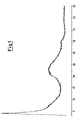
- the X-ray diffraction pattern of the calcined product is shown in Figure 1.
- the bright diffused halo centered at 2 ⁇ 22.5°, corresponds to the diffraction of the glass silica matrix.
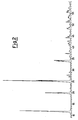
- Figure 2 represents by comparison the X-ray diffrac tion pattern of crystalline zr alpha-phosphate before delamination.
- Such mixture was heated up to 80°C and acetic acid was added with stirring to the same dropwise, till gelification of the system. After drying at 80°C, the zirconium phosphate dispersed throughout the silica matrix was regenerated to the hydrogen form by elution with acetic acid and washing with demineralized water. The material washed and dried was then heated up to 600°C in a stream of N2 and was kept for 1 hour in such conditions, then it was calcined in the air at the same temperature for 5 hours.
- the solid so obtained was a 30% dispersion of Zr alpha-phosphate in silica gel, the percentage being calculated with respect to the starting weight of ⁇ -Zr(HPO4)2. H2O, and it had a surface area of 190 m2/g (determined by means of the Sorpty 1750 Carlo Erba in N2).
- Figure 3 shows the X-ray diffraction pattern of the dispersion after calcination: the same considerations concerning Figure 1 hold true also for such diffraction pattern.
- the diffraction patterns reported in Figures 1-3 were obtained employing the CuK radiation; the abscissas represent angles 2 ⁇ , while the relative intensity was reported as the ordinates.
- the materials disclosed above can be employed as cation exchangers or as catalysts. Some examples will be given in the following for illustrating their use as catalysts, and in the salt conversion through ionic exchange.
- Tests were carried out in a small reactor consisting of a glass pipe of inside diameter 0.8 cm, provided with a water condenser and a trap at -80°C for the more volatile products. Heating up to the desired temperature was carried out with a tubular oven provided with a device for temperature control.
- the catalyst being a very fine powder, was first made into a tablet under pressure of 4 t/cm2, then crushed and screened to 35/60 mesh.
- the catalyst was previously treated at 350°C for 2 hours under a flow of dry nitrogen.
- the ion exchange capacity of the solid dispersion of zirconium alpha-phosphate in silica can be ascribed by 96% to the presence of acid protons of the HPO4 groups of zirconium alphaphosphate, and that such material, though dispersed throughout an inert inorganic matrix, is converted into a salt form by means of an ionic exchange reaction.
Landscapes
- Chemical & Material Sciences (AREA)
- Organic Chemistry (AREA)
- Chemical Kinetics & Catalysis (AREA)
- Engineering & Computer Science (AREA)
- Materials Engineering (AREA)
- Inorganic Chemistry (AREA)
- Colloid Chemistry (AREA)
- Catalysts (AREA)
- Compounds Of Alkaline-Earth Elements, Aluminum Or Rare-Earth Metals (AREA)
- Pharmaceuticals Containing Other Organic And Inorganic Compounds (AREA)
- Organic Low-Molecular-Weight Compounds And Preparation Thereof (AREA)
- Low-Molecular Organic Synthesis Reactions Using Catalysts (AREA)
- Silicon Compounds (AREA)
Abstract
Description
- This invention relates to a process for the preparation of a solid dispersion of acid salts of tetravalent metals having lamellar structure in an inorganic matrix, as well as to the products so obtained which have large surface areas and acid catalytic activity.
- The acid salts of tetravalent metals are members of a class of inorganic compounds among the most investigated during the last two decades because of their very good catalytic properties and of their ionic exchange capabilities (A. Clearfield - Inorganic Ion Exchange Materials - C.R.C. Press Boca Raton, FL USA, 1982). It is well known (see the Italian Patent Application 48437A/82) that compounds of such class having lamellar structure can be delaminated by intercalation within their structure of an organic substance containing a proton acceptor group and of water till obtaining a stable colloidal water suspension of the intercalated acid salt.
- It is also well known (see the European Pat. Appn. Pub. N. 202710) that the colloidal water suspension of one of the best known members of such class, i.e. alphazirconium phosphate, can give rise to powders of the mentioned compound which have surface areas between 9 and 20 m²/g.
- It is clearly evident that the value of the surface area (and then of the catalytically active sites) obtained according to the prior art mentioned previously is too low to be employed for interesting industrial applications.
- Now it has been surprisingly found that it is possible to increase in a remarkable way the surface area of acid salts having a lamellar structure, through the incorporation in a stable way of such compounds into a solid inert inorganic matrix that allows the laminas of the acid salts to be kept at distances larger than the normal distances, so increasing the value of the active surface area.
- The solid inert inorganic matrix, according to a preferred embodiment of the present invention, consists of silica, as it was found that silica does not interfere with the catalytic action of the laminas of said acid salts of tetravalent metals.
- Obviously the inert inorganic matrix could also be a matrix different from silica, and those who are skilled in the art can select the matrix according to the activity to be obtained from the resultant catalyst.
- The object of the present invention consists in a process for the preparation of a solid dispersion of the acid salt of the tetravalent metal having a lamellar structure in an inert inorganic matrix, said process comprising the intercalation of the acid salt mentioned above with an amine, which is preferably selected among an alkylamine, preferably an n-alkylamine, a trialkanolamine, and an alkylalkanolamine, with a number of carbon atoms in the alkyl or the alkanol groups between 1 and 4, where the amine amount is in the range from 25 to 75% and is preferably of 50%, with respect to the number of gramatoms of acid protons present in the acid salt of the tetravalent metal chosen, said process being characterized in that such intercalated acid salt is dispersed with vigorous stirring into a medium selected between a colloidal suspension of an inorganic material which can be gelled, and a water solution of an oligosilicate prepared by hydrolysis of a tetraalkylsilicate in a water solution of a tetraalkylammonium hydroxide. The dispersion of the acid salt is then gelled in a suitable time, washed and poss ibly dried, then heat treated at a temperature from 80°C to 650°C, preferably at least partially in the air.
- The colloidal suspension of the gelable inorganic material is in particular a colloidal suspension of silica, more particularly stabilized by ammonia addition, for instance the product commercially available as LUDOX from DuPont, and the water solution of the oligosilicate prepared by hydrolysis of a tetraalkylsilicate in a water solution of a tetraalkylammonium hydroxide is, in particular, the water solution of an oligosilicate having a silica content between 5 and 50 % by weight, said solution being obtained by hydrolysis of tetraethylsilicate in a water solution of tetrapropylammonium hydroxide (at a concentration between 10 and 30 %).
- As regards the other conditions for the preparation of the water solution of oligosilicate, such conditions are as follows: the hydrolysis is carried out at a temperature between 2°C and 120°C, preferably between 5°C and 80°C, in a time between 0.2 and 24 hours.
- As regards the weight ratios between the acid salt and the final inert solid inorganic matrix, they can also be of 1/1 or greater, but preferably they are lower than 1/1 and, more particularly, they are more preferably less than 1/2, such ratios being especially preferably between 1/3 and 1/5.
- The weight ratios between the acid salt of the tetravalent metal and the material that supplies the inert solid inorganic matrix in the preparation will be of such values as to give the ratios mentioned above in the final product. According to a preferred embodiment of the present invention, the gelled dispersion of the acid salt, before the washing operation and the possible drying, is eluted with a mineral or an organic acid, and in particular with acetic acid.
- The preferred acid salt of the tetravalent metal of the present invention is the acid zirconium phosphate, α-Zr(HPO₄)₂.H₂O, as such compound becomes easily delaminated through intercalation of n-propylamine, and in addition it has a very good heat stability (the condensation of the POH groups of the interlayer regions starts at temperatures higher than 400°C, while the disruption of the surfacePOH groups occurs beyond 700°C) together with a high ionic exchange capacity (6.64 meg/g). Accordingly, such acid salt will be essentially referred to in the following, but it is to be clearly understood that the disclosure can be applied also to any other acid salt of tetravalent metals that has a lamellar structure, and especially to those salts which in the Italian Patent Application 48437A/82 are already reported as capable of forming colloidal dispersions by suitable intercalation with amines, such as for instance acid zirconium γ phosphate, acid titanium α-phosphate and zirconium α-phosphate-phosphite.

- Some examples will be disclosed in the following with the aim of better illustrating the invention, but it is to be understood that the invention is not to be considered as limited to or by such examples.
- Crystalline zirconium phosphate having a lamellar structure was prepared according to the following procedure:
85 g of ZrOC1₂.8H₂O were dissolved into 1.2 1 of water. 80 ml of 40 by weight HF was first added to the solution, and then 715 ml of 85 by weight phosphoric acid was added. The clear solution, placed in a plastic vessel, was heated on a water bath to 80°C and pre-humidified air was bubbled through such solution. - Full precipitation occurred in about 4 days. The crystals were separated from the solution, washed with distilled water till pH 4-4.5 and stored in a desiccator over phosphorus pentoxide.
- 5 g of zirconium alpha-phosphate (α-Zr(HPO₄)₂.H₂O) prepared as disclosed above, whose crystals had average sizes of about 15 µm and surface area of 0.2 m²/g was suspended into 500 cc of water, and 250 cc of a water solution of 0.066 M n-propylamine was added. The addition was performed slowly and dropwise over about 4 hours and with vigorous stirring
- Keeping the mixture stirred for a further period of about 20 hours, a colloidal suspension of delaminated zirconium alpha-phosphate was obtained.
- The precursor of the inert solid inorganic matrix was prepared according to the following procedure:
54.5 g of tetraethylsilicate was added with stirring to 50 g of a water solution of tetrapropylammonium hydroxide at the concentration of 19 % by weight and previously heated to about 40°C, and the whole mixture was kept stirring till a clear solution is obtained. - The solution was cooled to room temperature and demineralized water was added to make up for evaporation losses.
- Thus a clear solution was obtained which was stable at room temperature.
- The colloidal suspension obtained in a) was stirred and the solution prepared in b) was added to the same till a homogeneous mixture was obtained. Such mixture was heated up to 80°C and acetic acid was added to the same dropwise and with stirring till gelification of the system. After drying at 80°C, the zirconium phosphate dispersed throughout the silica matrix was regenerated to the hydrogen form by elution with acetic acid and washing with demineralized water. The material was washed and dried, then it was heated up to 600°C in a stream of N₂ and was left for one hour in such conditions, then it was calcined in the air at the same temperature for 5 hours.
- The solid so obtained was a dispersion of Zr alphaphosphate in silica at the concentration of 24 % by weight calculated with respect to the starting weight of α-Zr(HPO₄)₂.H₂O, and it had a surface area of 458 m²/g (determined by the Sorpty 1750 Carlo Erba in N₂).
- The X-ray diffraction pattern of the calcined product is shown in Figure 1. The almost complete disappearance of the crystalline character of the crystalline Zr alphaphosphate and the residual presence of the characteristic diffraction lines only, though widened to 2 ϑ=20° and 2 ϑ≃34° (corresponding to planes of the crystalline lattice perpendicular to the surface of the lamina) is in agreement with the high dispersion of Zr phosphate throughout the silica matrix (almost at the level of an individual lamina). The bright diffused halo, centered at 2ϑ≃ 22.5°, corresponds to the diffraction of the glass silica matrix.
- Figure 2 represents by comparison the X-ray diffrac tion pattern of crystalline zr alpha-phosphate before delamination.
-
- a) The suspension of the delaminated Zr alpha-phosphate was prepared as disclosed in the paragraph a) of example 1.
- b) The precursor of the inert solid inorganic matrix was made up of the colloidal silica product known as Ludox AS (30 % SiO₂), available from the DuPont.
- c) 38.9 g of the water colloidal silica mentioned in the paragraph b) was added to the suspension obtained as disclosed in a) with stirring, and the suspension was kept stirring till a homogeneous mixture was obtained.
- Such mixture was heated up to 80°C and acetic acid was added with stirring to the same dropwise, till gelification of the system. After drying at 80°C, the zirconium phosphate dispersed throughout the silica matrix was regenerated to the hydrogen form by elution with acetic acid and washing with demineralized water. The material washed and dried was then heated up to 600°C in a stream of N₂ and was kept for 1 hour in such conditions, then it was calcined in the air at the same temperature for 5 hours.
- The solid so obtained was a 30% dispersion of Zr alpha-phosphate in silica gel, the percentage being calculated with respect to the starting weight of α-Zr(HPO₄)₂. H₂O, and it had a surface area of 190 m²/g (determined by means of the Sorpty 1750 Carlo Erba in N₂).
- Figure 3 shows the X-ray diffraction pattern of the dispersion after calcination: the same considerations concerning Figure 1 hold true also for such diffraction pattern. The diffraction patterns reported in Figures 1-3 were obtained employing the CuKradiation; the abscissas represent angles 2ϑ, while the relative intensity was reported as the ordinates.

- The materials disclosed above can be employed as cation exchangers or as catalysts. Some examples will be given in the following for illustrating their use as catalysts, and in the salt conversion through ionic exchange.
- Material consisting of non-delaminated crystalline Jr alpha-phosphate, prepared according to the disclosure given in paragraph a) of example 1.
- Material consisting of amorphous zirconium phosphate, prepared according to the procedure disclosed in the following publication: A. Clearfield, A. Oskarsson and C. Oskarsson, Ion Exch. Membr. 1, 9, 1972.
- Tests were carried out in a small reactor consisting of a glass pipe of inside diameter 0.8 cm, provided with a water condenser and a trap at -80°C for the more volatile products. Heating up to the desired temperature was carried out with a tubular oven provided with a device for temperature control. The catalyst, being a very fine powder, was first made into a tablet under pressure of 4 t/cm², then crushed and screened to 35/60 mesh.
- 0.7 g of the catalyst was loaded into the reactor having a porous wall, together with a minimum layer of glass wool and finally 9 cm was loaded of an inert filler in order to favour evaporation and pre-heating of cyclohexanol. This compound was fed to the reactor by a metering pump of the syringe type (the Perfusor available from the Brown-Melsungen). During the test, a constant flow of nitrogen of about 0.9 l/hr was also kept. Temperature was determined with a thermocouple arranged inside the catalytic bed.
- Before the reaction, the catalyst was previously treated at 350°C for 2 hours under a flow of dry nitrogen.
- The products obtained after 30 minutes of reaction, collected in the trap, were weighed (with recovery better than 96% of the material fed in), analyzed and quantitatively determined by the g.l.c. (with the method of the internal standard).
- Their nature was confirmed by mass spectrometry by comparison with surely authentic samples.
- Results of the catalytic tests, in terms of working temperature, conversion percentage of cyclohexanol and selectivity, are reported in the following.
Dehydration of cyclohexanol (1) Cat. T(°C) Conv. of cyclohexanol (%) Selectivity (%) cyclohexene methylcyclopentene Ex.1 345 100 90 6 Ex.2 347 100 82 12 Ex.3 349 67 88 - Ex.4 350 7 90 - Ex.1 235 84 96 0.6 Ex.2 234 70 95 0.5 Ex.3 236 2.5 95 - Ex.4 235 0 - - SiO₂ (2) 233 0 - - (1) WHSV = 9.1 (2) Amorphous SiO₂ obtained from the precursor (b) of the inorganic matrix of example 1. - 1 g of the solid dispersion of zirconium alpha-phosphate in silica, prepared according to the specifications given in example 1, was immersed into 50 ml of a 0.100 M solution of CsCl that was kept under vigorous stirring. A decrease in the pH of the solution was immediately recorded, the pH passing from the initial value of 5.75 to the value of 2.05. To reestablish the initial ptt value of 5.75 with the solid present in the suspension, 5.6 ml of a 0.100 M solution of CsOH was added. Accordingly, the ionic exchange capacity for the Cs⁺ cation of the solid dispersion of zirconium alpha-phosphate in silica can be deduced to be of 0.56 meq/g under such conditions.
- The same test was performed employing 1 g of silica prepared by gelification with acetic acid and next calcining at 600°C the precursor of the inert inorganic matrix prepared according to the specifications given in paragraph b) of example 1. In that case, the consumption of the 0.100 M CsOH solution turned out to be 0.2 ml. Accordingly, it can be deduced that the ion exchange capacity of the solid dispersion of zirconium alpha-phosphate in silica can be ascribed by 96% to the presence of acid protons of the HPO₄ groups of zirconium alphaphosphate, and that such material, though dispersed throughout an inert inorganic matrix, is converted into a salt form by means of an ionic exchange reaction.
- 1 g of the solid dispersion of zirconium alpha-phosphate in silica, prepared according to the specifications given in example 1, was immersed into 50 ml of a 0.100 M solution of copper acetate. The solution with the solid suspended was kept under constant stirring for two hours.
- The analysis of the supernatant solution for determining the copper content gave 4.75 mmoles of Cu⁺² ions against 5.00 mmoles present at the start. It can be deduced that 1 g of solid dispersion of zirconium alphaphosphate in silica shows under such conditions an ion exchange capacity for the Cu⁺² ion of 0.50 meq/g, and that zirconium phosphate dispersed throughout the silica was converted into the copper form.
Claims (17)
Priority Applications (1)
| Application Number | Priority Date | Filing Date | Title |
|---|---|---|---|
| AT88202769T ATE86886T1 (en) | 1987-12-22 | 1988-12-02 | PROCESSES FOR THE PREPARATION OF SOLID DISPERSIONS OF ACIDIC QUALITATIVE METAL SALTS WITH LAYERING STRUCTURE IN AN INERT INORGANIC MATRIX AND PRODUCTS SO MANUFACTURED. |
Applications Claiming Priority (2)
| Application Number | Priority Date | Filing Date | Title |
|---|---|---|---|
| IT23153/87A IT1223582B (en) | 1987-12-22 | 1987-12-22 | PROCEDURE FOR THE PREPARATION OF SOLID DISPERSIONS OF ACID SALTS OF TETRAVALENT METALS WITH LAMELLAR STRUCTURE IN AN INORGANIC INERT MATRIX AND PRODUCTS SO OBTAINED |
| IT2315387 | 1987-12-22 |
Publications (3)
| Publication Number | Publication Date |
|---|---|
| EP0322013A2 true EP0322013A2 (en) | 1989-06-28 |
| EP0322013A3 EP0322013A3 (en) | 1989-07-26 |
| EP0322013B1 EP0322013B1 (en) | 1993-03-17 |
Family
ID=11204341
Family Applications (1)
| Application Number | Title | Priority Date | Filing Date |
|---|---|---|---|
| EP88202769A Expired - Lifetime EP0322013B1 (en) | 1987-12-22 | 1988-12-02 | A process for the preparation of solid dispersions of acid salts of tetravalent metals having lamellar structure in an inert inorganic matrix, and the products so obtained |
Country Status (6)
| Country | Link |
|---|---|
| EP (1) | EP0322013B1 (en) |
| JP (1) | JPH01212206A (en) |
| AT (1) | ATE86886T1 (en) |
| DE (1) | DE3879433T2 (en) |
| ES (1) | ES2040328T3 (en) |
| IT (1) | IT1223582B (en) |
Cited By (4)
| Publication number | Priority date | Publication date | Assignee | Title |
|---|---|---|---|---|
| FR2648727A1 (en) * | 1989-06-21 | 1990-12-28 | Toa Gosei Chem Ind | MINERAL ION EXCHANGER IN GRAIN |
| EP0386845B1 (en) * | 1989-03-10 | 1993-08-04 | ENIRICERCHE S.p.A. | Solid catalyst functionalized with sulfonic groups, process for preparing it and its use |
| FR2849018A1 (en) * | 2002-12-20 | 2004-06-25 | Rhodia Elect & Catalysis | ZIRCONIUM PHOSPHATE WITH EXFOLIATED STRUCTURE, PRECURSOR OF THIS PHOSPHATE, METHOD OF PREPARATION AND USE IN COMPOSITIONS BASED ON MACROMOLECULAR MATERIALS |
| FR2871810A1 (en) * | 2004-06-22 | 2005-12-23 | Rhodia Chimie Sa | Use of zirconium phosphate and their sodium salts, comprising layers of exfoliated structure in aqueous medium, as a modifying agent of rheology in aqueous acid medium |
Family Cites Families (4)
| Publication number | Priority date | Publication date | Assignee | Title |
|---|---|---|---|---|
| FR2479986A1 (en) * | 1980-04-02 | 1981-10-09 | Commissariat Energie Atomique | PROCESS FOR THE PREPARATION OF ADSORBENT MATERIALS FOR THE ANALYSIS OR TREATMENT OF LIQUIDS AND THE MATERIALS THUS OBTAINED |
| US4444904A (en) * | 1983-05-26 | 1984-04-24 | Exxon Research & Engineering Co. | Process for synthesizing a multicomponent acidic catalyst composition containing zirconium by an organic solution method |
| IT1197667B (en) * | 1983-06-24 | 1988-12-06 | Enea | STATIONARY PHASES FOR CHROMATOGRAPHY AND PREPARATION PROCEDURE OF THE SAME |
| US4717513A (en) * | 1984-04-27 | 1988-01-05 | Shell Oil Company | Silica intercalated crystalline zirconium phosphate-type materials |
-
1987
- 1987-12-22 IT IT23153/87A patent/IT1223582B/en active
-
1988
- 1988-12-02 ES ES198888202769T patent/ES2040328T3/en not_active Expired - Lifetime
- 1988-12-02 EP EP88202769A patent/EP0322013B1/en not_active Expired - Lifetime
- 1988-12-02 DE DE8888202769T patent/DE3879433T2/en not_active Expired - Fee Related
- 1988-12-02 AT AT88202769T patent/ATE86886T1/en not_active IP Right Cessation
- 1988-12-22 JP JP63322230A patent/JPH01212206A/en active Pending
Cited By (5)
| Publication number | Priority date | Publication date | Assignee | Title |
|---|---|---|---|---|
| EP0386845B1 (en) * | 1989-03-10 | 1993-08-04 | ENIRICERCHE S.p.A. | Solid catalyst functionalized with sulfonic groups, process for preparing it and its use |
| FR2648727A1 (en) * | 1989-06-21 | 1990-12-28 | Toa Gosei Chem Ind | MINERAL ION EXCHANGER IN GRAIN |
| FR2849018A1 (en) * | 2002-12-20 | 2004-06-25 | Rhodia Elect & Catalysis | ZIRCONIUM PHOSPHATE WITH EXFOLIATED STRUCTURE, PRECURSOR OF THIS PHOSPHATE, METHOD OF PREPARATION AND USE IN COMPOSITIONS BASED ON MACROMOLECULAR MATERIALS |
| WO2004065297A1 (en) * | 2002-12-20 | 2004-08-05 | Rhodia Electronics And Catalysis | Exfoliate structured zirconium phosphate, precursors of said phosphate, method for the production and use thereof in macromolecular-material-based compositions |
| FR2871810A1 (en) * | 2004-06-22 | 2005-12-23 | Rhodia Chimie Sa | Use of zirconium phosphate and their sodium salts, comprising layers of exfoliated structure in aqueous medium, as a modifying agent of rheology in aqueous acid medium |
Also Published As
| Publication number | Publication date |
|---|---|
| IT1223582B (en) | 1990-09-29 |
| JPH01212206A (en) | 1989-08-25 |
| DE3879433D1 (en) | 1993-04-22 |
| ES2040328T3 (en) | 1993-10-16 |
| EP0322013B1 (en) | 1993-03-17 |
| EP0322013A3 (en) | 1989-07-26 |
| IT8723153A0 (en) | 1987-12-22 |
| ATE86886T1 (en) | 1993-04-15 |
| DE3879433T2 (en) | 1993-08-19 |
Similar Documents
| Publication | Publication Date | Title |
|---|---|---|
| US3879310A (en) | Surface stabilized active alumina | |
| US3957689A (en) | Process for preparing an attrition resistant zeolite hydrocarbon conversion catalyst | |
| EP3658503B1 (en) | Methods for producing hierarchical mesoporous zeolite beta | |
| US6958138B1 (en) | Supported metal catalyst, preparation and applications for directly making hydrogen peroxide | |
| US4166100A (en) | Method of preparing granulated activated alumina | |
| CN101176849B (en) | Catalyzer for preparing propylene from methanol or dimethyl ether in high selectivity and preparation method thereof | |
| US4582815A (en) | Extrusion of silica-rich solids | |
| US4085069A (en) | Hydrothermally stable catalysts containing ammonium faujasite zeolites | |
| CA1333172C (en) | Preparation of promoted silica catalysts | |
| DD212955A5 (en) | PROCESS FOR PREPARING AN OXALSAFE DIESTER | |
| CN114620698B (en) | Large-particle zirconium phosphate and preparation method thereof | |
| US3886094A (en) | Preparation of hydrocarbon conversion catalysts | |
| US2938874A (en) | Preparation of phosphate-containing alumina gels | |
| US4935574A (en) | Preparation of para-xylene by toluene methylation | |
| US3423328A (en) | Silver-barium catalyst | |
| US3392124A (en) | Physically stable alumino-silicate zeolite catalysts | |
| US3105053A (en) | Process for preparing alumina hydrosol and gel | |
| EP0322013B1 (en) | A process for the preparation of solid dispersions of acid salts of tetravalent metals having lamellar structure in an inert inorganic matrix, and the products so obtained | |
| US4652544A (en) | Solid acid catalyst of acid-treated hydrated niobium oxide and method for its preparation | |
| JPH0676207B2 (en) | Zeolite production method | |
| CA1249576A (en) | Coformed catalyst | |
| CN102442684A (en) | In-situ Y zeolite modifying method | |
| US20250387777A1 (en) | Direct lithium extraction compositions and methods | |
| CN112705186A (en) | 2, 5-dichlorotoluene isomerization catalyst, preparation method and application thereof | |
| US3112279A (en) | Process for the preparation of a transition alumina dehydration catalyst |
Legal Events
| Date | Code | Title | Description |
|---|---|---|---|
| PUAI | Public reference made under article 153(3) epc to a published international application that has entered the european phase |
Free format text: ORIGINAL CODE: 0009012 |
|
| PUAL | Search report despatched |
Free format text: ORIGINAL CODE: 0009013 |
|
| AK | Designated contracting states |
Kind code of ref document: A2 Designated state(s): AT BE CH DE ES FR GB GR LI LU NL SE |
|
| RHK1 | Main classification (correction) |
Ipc: B01J 39/12 |
|
| AK | Designated contracting states |
Kind code of ref document: A3 Designated state(s): AT BE CH DE ES FR GB GR LI LU NL SE |
|
| 17P | Request for examination filed |
Effective date: 19891229 |
|
| 17Q | First examination report despatched |
Effective date: 19901220 |
|
| GRAA | (expected) grant |
Free format text: ORIGINAL CODE: 0009210 |
|
| AK | Designated contracting states |
Kind code of ref document: B1 Designated state(s): AT BE CH DE ES FR GB GR LI LU NL SE |
|
| REF | Corresponds to: |
Ref document number: 86886 Country of ref document: AT Date of ref document: 19930415 Kind code of ref document: T |
|
| REF | Corresponds to: |
Ref document number: 3879433 Country of ref document: DE Date of ref document: 19930422 |
|
| ET | Fr: translation filed | ||
| REG | Reference to a national code |
Ref country code: GR Ref legal event code: FG4A Free format text: 3007523 |
|
| REG | Reference to a national code |
Ref country code: ES Ref legal event code: FG2A Ref document number: 2040328 Country of ref document: ES Kind code of ref document: T3 |
|
| PLBE | No opposition filed within time limit |
Free format text: ORIGINAL CODE: 0009261 |
|
| STAA | Information on the status of an ep patent application or granted ep patent |
Free format text: STATUS: NO OPPOSITION FILED WITHIN TIME LIMIT |
|
| EPTA | Lu: last paid annual fee | ||
| 26N | No opposition filed | ||
| EAL | Se: european patent in force in sweden |
Ref document number: 88202769.1 |
|
| PGFP | Annual fee paid to national office [announced via postgrant information from national office to epo] |
Ref country code: GB Payment date: 19971124 Year of fee payment: 10 |
|
| PGFP | Annual fee paid to national office [announced via postgrant information from national office to epo] |
Ref country code: DE Payment date: 19971205 Year of fee payment: 10 |
|
| PGFP | Annual fee paid to national office [announced via postgrant information from national office to epo] |
Ref country code: FR Payment date: 19971209 Year of fee payment: 10 |
|
| PGFP | Annual fee paid to national office [announced via postgrant information from national office to epo] |
Ref country code: LU Payment date: 19971212 Year of fee payment: 10 Ref country code: AT Payment date: 19971212 Year of fee payment: 10 |
|
| PGFP | Annual fee paid to national office [announced via postgrant information from national office to epo] |
Ref country code: SE Payment date: 19971218 Year of fee payment: 10 |
|
| PGFP | Annual fee paid to national office [announced via postgrant information from national office to epo] |
Ref country code: NL Payment date: 19971223 Year of fee payment: 10 Ref country code: GR Payment date: 19971223 Year of fee payment: 10 |
|
| PGFP | Annual fee paid to national office [announced via postgrant information from national office to epo] |
Ref country code: ES Payment date: 19971230 Year of fee payment: 10 |
|
| PGFP | Annual fee paid to national office [announced via postgrant information from national office to epo] |
Ref country code: CH Payment date: 19980106 Year of fee payment: 10 |
|
| PGFP | Annual fee paid to national office [announced via postgrant information from national office to epo] |
Ref country code: BE Payment date: 19980217 Year of fee payment: 10 |
|
| PG25 | Lapsed in a contracting state [announced via postgrant information from national office to epo] |
Ref country code: LU Free format text: LAPSE BECAUSE OF NON-PAYMENT OF DUE FEES Effective date: 19981202 Ref country code: GB Free format text: LAPSE BECAUSE OF NON-PAYMENT OF DUE FEES Effective date: 19981202 Ref country code: AT Free format text: LAPSE BECAUSE OF NON-PAYMENT OF DUE FEES Effective date: 19981202 |
|
| PG25 | Lapsed in a contracting state [announced via postgrant information from national office to epo] |
Ref country code: SE Free format text: LAPSE BECAUSE OF NON-PAYMENT OF DUE FEES Effective date: 19981203 |
|
| PG25 | Lapsed in a contracting state [announced via postgrant information from national office to epo] |
Ref country code: LI Free format text: LAPSE BECAUSE OF NON-PAYMENT OF DUE FEES Effective date: 19981231 Ref country code: GR Free format text: LAPSE BECAUSE OF NON-PAYMENT OF DUE FEES Effective date: 19981231 Ref country code: CH Free format text: LAPSE BECAUSE OF NON-PAYMENT OF DUE FEES Effective date: 19981231 Ref country code: BE Free format text: LAPSE BECAUSE OF NON-PAYMENT OF DUE FEES Effective date: 19981231 |
|
| BERE | Be: lapsed |
Owner name: ENIRICERCHE S.P.A. Effective date: 19981231 |
|
| PG25 | Lapsed in a contracting state [announced via postgrant information from national office to epo] |
Ref country code: NL Free format text: LAPSE BECAUSE OF NON-PAYMENT OF DUE FEES Effective date: 19990701 |
|
| GBPC | Gb: european patent ceased through non-payment of renewal fee |
Effective date: 19981202 |
|
| REG | Reference to a national code |
Ref country code: CH Ref legal event code: PL |
|
| PG25 | Lapsed in a contracting state [announced via postgrant information from national office to epo] |
Ref country code: FR Free format text: LAPSE BECAUSE OF NON-PAYMENT OF DUE FEES Effective date: 19990831 |
|
| NLV4 | Nl: lapsed or anulled due to non-payment of the annual fee |
Effective date: 19990701 |
|
| REG | Reference to a national code |
Ref country code: FR Ref legal event code: ST |
|
| PG25 | Lapsed in a contracting state [announced via postgrant information from national office to epo] |
Ref country code: DE Free format text: LAPSE BECAUSE OF NON-PAYMENT OF DUE FEES Effective date: 19991001 |
|
| PG25 | Lapsed in a contracting state [announced via postgrant information from national office to epo] |
Ref country code: ES Free format text: LAPSE BECAUSE OF NON-PAYMENT OF DUE FEES Effective date: 19991203 |
|
| REG | Reference to a national code |
Ref country code: ES Ref legal event code: FD2A Effective date: 20000114 |