EP0322025A2 - Transmitter circuit - Google Patents
Transmitter circuit Download PDFInfo
- Publication number
- EP0322025A2 EP0322025A2 EP88202851A EP88202851A EP0322025A2 EP 0322025 A2 EP0322025 A2 EP 0322025A2 EP 88202851 A EP88202851 A EP 88202851A EP 88202851 A EP88202851 A EP 88202851A EP 0322025 A2 EP0322025 A2 EP 0322025A2
- Authority
- EP
- European Patent Office
- Prior art keywords
- coupled
- terminal
- transmitter circuit
- output
- current source
- Prior art date
- Legal status (The legal status is an assumption and is not a legal conclusion. Google has not performed a legal analysis and makes no representation as to the accuracy of the status listed.)
- Granted
Links
Images
Classifications
-
- H—ELECTRICITY
- H04—ELECTRIC COMMUNICATION TECHNIQUE
- H04L—TRANSMISSION OF DIGITAL INFORMATION, e.g. TELEGRAPHIC COMMUNICATION
- H04L25/00—Baseband systems
- H04L25/02—Details ; arrangements for supplying electrical power along data transmission lines
Definitions
- the present invention relates to a transmitter circuit for a transmission system wherein a plurality of such transmitter circuits are coupled in parallel to a transmission line which is coupled to a receiver circuit, said transmitter circuit having an output which is electrically coupled to said line but is galvanically isolated therefrom and is able to supply at said output a current and to limit this current in function of the voltage on said output.
- the transmitter circuits and the receiver circuit form part of respective S-interface circuits located in subscriber stations and in a network station respectively, this network station being coupled to a digital exchange through a subscriber line.
- Each of these S-interface circuits further includes a receiver circuit and a transmitter circuit respectively, these receiver circuits being coupled in parallel to another transmission line to which the transmitter circuit of the network station has access.
- the S-interface circuits are for instance of the type disclosed in the article "ISDN Components for Public and Private Digital Loops" by P. Van Iseghem et al, Electrical Communication, Volume 61, November 1, 1987, pp 63-71.
- Each S-interface circuit is for instance able to transmit a 192 kbit/sec signal consisting of groups of frames of 42 bits, 36 of which are information bits part of two B channels of 16 bits each and of a D channel of 4 bits. Thus 12 bits per frame are left for signals which may be added by the interface.
- four of these bits form an echo channel for the retransmission of the D channel bits received from the subscriber station. This retransmission is required to ensure that only one transmitter circuit makes use of this channel. Indeed, the transmitter circuit of a subscriber station starts transmitting the address assigned to this station only when the D channel is free.
- this station When the bits of this address are received in the network station receiver they are retransmitted to the subscriber station receiver with a predetermined delay in the D echo channels, and the transmitter of this station only transmits a next bit after it has received the echo bits. As long as these bits are the same as the transmitted D channel bits the subscriber station transmitter continues transmitting. However, if in this station a difference is detected due to several subscriber station transmitter circuits having simultaneously transmitted their addresses this station ceases transmission.
- a pseudoternary code in which a binary one is represented by the absence of current and binary zero by a positive and a negative current alternately.
- An object of the present invention is to provide a transmitter circuit of this type, but which is able to fulfill these requirements in a simple way.
- this object is achieved due to the fact that said transmitter output is shunted by a variable impedance which is controlled by the output of a servo control circuit which is operated in function of the difference between a reference voltage and a feedback voltage which is itself function of the transmitter circuit output voltage.
- the servo control circuit becomes operative for instance as soon as the feedback voltage decreases below the reference voltage and this feedback voltage is limited to the reference voltage due to which the output voltage of the transmitter circuit is limited.
- said servo control circuit includes a comparator circuit circuit which is constituted by an operational amplifier whose first and second inputs are controlled by said reference voltage and by said feedback voltage respectively.
- variable impedance is coupled, in series with a constant current source, across two DC supply voltages and that the end of said impedance which is connected to said current source is coupled to said second input of said first operational amplifier.
- the transmitter circuit output voltage is limited to a voltage which is equal to the difference of one of the DC supply voltages and the reference voltage.
- the invention also relates to an electronic contact system which is for instance particularly adapted for being used in the above described transmitter circuit.
- This contact system is particularly characterized in that it incudes at least one electronic contact device including : a main transistor switch connected between first and second terminals and having a control third terminal; first and second auxiliary transistor switches connected between said third terminal and a fourth terminal and between said third terminal and a fifth terminal respectively; and control means to bring said first and second auxiliary transistor switches in opposite conditions wherein one is blocked and the other is conductive.
- the main transistor switch is made conductive or blocked in a simple way due to which such contact systems may be used in the above described transmitter circuit in a simple way to control the direction of current flow through the variable impedance.
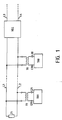
- the transmission system shown in Fig. 1 includes a plurality of transmitter circuits TR1/8 which are coupled in parallel to a transmission line L1, L2. More particularly, each of these transmitter circuits TR1 to TR8 has an output, with terminals L11, L21 to L18, L28, which is coupled to the line L1, L2 through a respective transformer T1/8. At its one end the transmission line L1, L2 is connected to a receiver circuit REC which is coupled to a digital exchange (not shown) through a subscriber line L3, L4, whilst at its other end it is terminated by an impedance Z1.
- Each of the transmitter circuits TR1/8 as well as the receiver circuit REC forms part of an S-interface circuit (not shown) which is able to perform the functions described above, e.g. to generate a current I, or -I, or no current between its output terminals L11 and L21/L18 and L28.
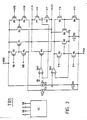
- the transmitter circuits TR1 to TR8 are indentical and therefore only one of them, i.e. TR1, and an associated control circuit CC which together with TR1 forms part of an S-interface is represented in detail in Fig. 2.
- the control circuit CC provides control signals X, XB, Y and YB which directly control the gates of the transistors P3 to P8 and N3 to N6.
- XB and YB are the inverse of X and Y respectively.
- the current source CS2 is in fact derived by current mirroring (not shown) from the accurate current source CS1. In this way a DC resistance which is not very accurate but sufficiently accurate is realised in a simple way.
- Their junction point A is connected to the non-inverting input of operational amplifier OA1 whose inverting input is connected to the junction point B of two parallel circuits which are both connected in series with resistor R2 between VDD and VSS.
- the first of these parallel circuits comprises the series connection of the source-to-drain paths of transistors P1 and P9 and the drain-to-source path of transistor N2.
- the second of these parallel circuits comprises the series connection of the source-to-drain paths of transistors P2 and P9 and the drain-to-source path of transistor N1.
- the gate of transistor P8 is controlled by the output signal of the operational amplifier OA2 whose inverting input is connected to the reference voltage VR and the non-inverting input C of which is connected to the like named junction point C of transistors P7 and P8 which together with the transistor P1/6 and N1/N6 constitute a switching circuit.
- the drain-to-source paths of the transistors P7 and P8 are connected between terminal L11 and C and between terminal L21 and C respectively and their gates are controlled by the control signals X and Y respectively.
- the gates of transistors P1, P2, N1, N2 are controlled by the transistors P3 to P6 and N3 to N6 and permit the flow of current from the end L11 to the end L21 of P9 or vice-versa. More particularly, the source-to-drain paths of transistors P3 and P4 as well as the source-to-drain paths of transistors P5 and P6 are connected in series with the constant current source CS2 between VDD and VSS, and the junction points of P3 and P4 and of P5 and P6 are connected to the gates of P1 and P2 respectively.
- the gates of P3, P4, P5 and P6 are controlled by the respective control signals YB, XB, XB and YB provided by the control circuit CC.
- the gates of transistors N1 and N2 are controlled by the transistors N3, N4 and N5, N6 respectively.
- the drain-to-source paths of transistors N3 and N4 as well as the drain-to-source paths of transistors N5 and N6 are connected in series between the output of operational amplifier OA1 and VSS, and the junction points of N3 and N4 and of N5 and N6 are connected to the gates of N1 and N2 respectively.
- the gates of N3, N4, N5 and N6 are controlled by the respective control signals Y, X, X and Y provided by the control circuit CC.
- the operational amplifier OA2 together with the transistors P7, P8 and P9 constitutes a servo control circuit of which the forward path includes transistor P9 and the feedback path includes transistor P7.
- the operational amplifier OA1 has an input A to which the fixed voltage VA is applied and a feedback path which is closed via N3, N1 or via N5, N2.
- This operational amplifier OA1 together with R2 constitutes a constant current source by which the constant current I1 provided by CS1 is converted to a constant current I in R2.
- This current I flows from VDD to VSS via transistor P1, terminal L11, primary winding of transformer T1, terminal L21, transistor N2 and resistance R2.
- the constant current I1 is converted in the current I by multiplication with the ratio R1/R2. Because the current I1 may thus be chosen relatively small, the power consumption of the whole transmitter circuit is limited. On the other hand it is easier to realise an accurate ratio of resistances than to make accurate resistances.
- n 2.
- the output of the amplifier OA2 is therefore positive due to which transistor P9 is blocked.
- the voltage V across the terminals L11, L21 is limited to a constant value as soon as the current supplied to the receiver circuit REC is at least equal to 2I′.
- the above described switching circuit P1/6, N1/6 in fact consists of four similar electronic contact devices P1/3/4, P2/5/6, N1/4/3 and N2/6/5.
- Each of these devices, for instance P1/3/4 includes : - a main transistor switch P1 which is connected with its source and drain elctrodes between first and second terminals and which has a control third terminal constituted by its gate; - first and second auxiliary transistor switches P3 and P4 which are connected with their source and drain electrodes between said third terminal and a fourth terminal and between said third terminal and a fifth terminal respectively; - control means (CC) to bring said first and second auxiliary transistor switches P3 and P4 in opposite conditions, wherein the one is blocked and the other is conductive.
- CC control means
Landscapes
- Engineering & Computer Science (AREA)
- Power Engineering (AREA)
- Computer Networks & Wireless Communication (AREA)
- Signal Processing (AREA)
- Amplifiers (AREA)
- Superconductors And Manufacturing Methods Therefor (AREA)
- Arrangements For Transmission Of Measured Signals (AREA)
- Networks Using Active Elements (AREA)
- Emergency Alarm Devices (AREA)
- Selective Calling Equipment (AREA)
- Alarm Systems (AREA)
- Cable Transmission Systems, Equalization Of Radio And Reduction Of Echo (AREA)
Abstract
Description
- The present invention relates to a transmitter circuit for a transmission system wherein a plurality of such transmitter circuits are coupled in parallel to a transmission line which is coupled to a receiver circuit, said transmitter circuit having an output which is electrically coupled to said line but is galvanically isolated therefrom and is able to supply at said output a current and to limit this current in function of the voltage on said output.
- Such a transmitter circuit is already known from the article "System 12. Configuration for ISDN Subscriber Equipment, Network Termination, Digital Telephones and Terminal Adapters" by T. Israel et al, Electrical Communication, Volume 59, Number 1/2, 1985, pp. 120-126.
- As described in this article the transmitter circuits and the receiver circuit form part of respective S-interface circuits located in subscriber stations and in a network station respectively, this network station being coupled to a digital exchange through a subscriber line. Each of these S-interface circuits further includes a receiver circuit and a transmitter circuit respectively, these receiver circuits being coupled in parallel to another transmission line to which the transmitter circuit of the network station has access. The S-interface circuits are for instance of the type disclosed in the article "ISDN Components for Public and Private Digital Loops" by P. Van Iseghem et al, Electrical Communication, Volume 61, November 1, 1987, pp 63-71.
- Each S-interface circuit is for instance able to transmit a 192 kbit/sec signal consisting of groups of frames of 42 bits, 36 of which are information bits part of two B channels of 16 bits each and of a D channel of 4 bits. Thus 12 bits per frame are left for signals which may be added by the interface. In the direction from the network station to the subscriber station four of these bits form an echo channel for the retransmission of the D channel bits received from the subscriber station. This retransmission is required to ensure that only one transmitter circuit makes use of this channel. Indeed, the transmitter circuit of a subscriber station starts transmitting the address assigned to this station only when the D channel is free. When the bits of this address are received in the network station receiver they are retransmitted to the subscriber station receiver with a predetermined delay in the D echo channels, and the transmitter of this station only transmits a next bit after it has received the echo bits. As long as these bits are the same as the transmitted D channel bits the subscriber station transmitter continues transmitting. However, if in this station a difference is detected due to several subscriber station transmitter circuits having simultaneously transmitted their addresses this station ceases transmission.
- To be noted that for transmission a pseudoternary code is used in which a binary one is represented by the absence of current and binary zero by a positive and a negative current alternately.
- In the above first mentioned article no details are given about the transmitter circuit, but it is mentioned therein that this circuit must act as voltage-limited current source and that the output current has to be limited so that the voltage across the transmission line never exceeds a predetermined value even when several stations are transmitting simultaneously.
- An object of the present invention is to provide a transmitter circuit of this type, but which is able to fulfill these requirements in a simple way.
- According to the invention this object is achieved due to the fact that said transmitter output is shunted by a variable impedance which is controlled by the output of a servo control circuit which is operated in function of the difference between a reference voltage and a feedback voltage which is itself function of the transmitter circuit output voltage.
- In this way the servo control circuit becomes operative for instance as soon as the feedback voltage decreases below the reference voltage and this feedback voltage is limited to the reference voltage due to which the output voltage of the transmitter circuit is limited.
- Another characteristic feature of the present transmitter circuit is that said servo control circuit includes a comparator circuit circuit which is constituted by an operational amplifier whose first and second inputs are controlled by said reference voltage and by said feedback voltage respectively.
- Still another characteristic feature of the present circuit is that said variable impedance is coupled, in series with a constant current source, across two DC supply voltages and that the end of said impedance which is connected to said current source is coupled to said second input of said first operational amplifier.
- In this way the transmitter circuit output voltage is limited to a voltage which is equal to the difference of one of the DC supply voltages and the reference voltage.
- The invention also relates to an electronic contact system which is for instance particularly adapted for being used in the above described transmitter circuit. This contact system is particularly characterized in that it incudes at least one electronic contact device including : a main transistor switch connected between first and second terminals and having a control third terminal; first and second auxiliary transistor switches connected between said third terminal and a fourth terminal and between said third terminal and a fifth terminal respectively; and control means to bring said first and second auxiliary transistor switches in opposite conditions wherein one is blocked and the other is conductive.
- Thus the main transistor switch is made conductive or blocked in a simple way due to which such contact systems may be used in the above described transmitter circuit in a simple way to control the direction of current flow through the variable impedance.
- The above mentioned and other objects and features of the invention will become more apparent and the invention itself will be best understood by referring to the following description of an embodiment taken in conjunction with the accompanying drawings wherein :
- Fig. 1 is a schematic diagram of a transmission system including a transmitter circuit according to the invention;
- Fig. 2 represents transmitter circuit TR1 of Fig. 1 in detail.
- The transmission system shown in Fig. 1 includes a plurality of transmitter circuits TR1/8 which are coupled in parallel to a transmission line L1, L2. More particularly, each of these transmitter circuits TR1 to TR8 has an output, with terminals L11, L21 to L18, L28, which is coupled to the line L1, L2 through a respective transformer T1/8. At its one end the transmission line L1, L2 is connected to a receiver circuit REC which is coupled to a digital exchange (not shown) through a subscriber line L3, L4, whilst at its other end it is terminated by an impedance Z1.
- Each of the transmitter circuits TR1/8 as well as the receiver circuit REC forms part of an S-interface circuit (not shown) which is able to perform the functions described above, e.g. to generate a current I, or -I, or no current between its output terminals L11 and L21/L18 and L28.
- The transmitter circuits TR1 to TR8 are indentical and therefore only one of them, i.e. TR1, and an associated control circuit CC which together with TR1 forms part of an S-interface is represented in detail in Fig. 2. The transmitter circuit TR1 operates with the supply voltages VDD=5 Volts and VSS=0 Volt and with a bandgap reference voltage VR=2.9 Volts and includes constant current sources CS1 and CS2 which provide a current equal to I1=300 and I2=80 micro-amperes respectively, operational amplifiers OA1 and OA2, PMOS field effect transistors P1 to P9, NMOS field effect transistors N1 to N6 and resistors R1 and R2. The control circuit CC provides control signals X, XB, Y and YB which directly control the gates of the transistors P3 to P8 and N3 to N6. Hereby XB and YB are the inverse of X and Y respectively.
- The current source CS2 is in fact derived by current mirroring (not shown) from the accurate current source CS1. In this way a DC resistance which is not very accurate but sufficiently accurate is realised in a simple way.
- The current source CS1 is connected in series with resistor R1 between the supply voltages VDD and VSS and develops a constant voltage VA=R1.I1 thereon. Their junction point A is connected to the non-inverting input of operational amplifier OA1 whose inverting input is connected to the junction point B of two parallel circuits which are both connected in series with resistor R2 between VDD and VSS. The first of these parallel circuits comprises the series connection of the source-to-drain paths of transistors P1 and P9 and the drain-to-source path of transistor N2. The second of these parallel circuits comprises the series connection of the source-to-drain paths of transistors P2 and P9 and the drain-to-source path of transistor N1. The gate of transistor P8 is controlled by the output signal of the operational amplifier OA2 whose inverting input is connected to the reference voltage VR and the non-inverting input C of which is connected to the like named junction point C of transistors P7 and P8 which together with the transistor P1/6 and N1/N6 constitute a switching circuit. The drain-to-source paths of the transistors P7 and P8 are connected between terminal L11 and C and between terminal L21 and C respectively and their gates are controlled by the control signals X and Y respectively.
- The gates of transistors P1, P2, N1, N2 are controlled by the transistors P3 to P6 and N3 to N6 and permit the flow of current from the end L11 to the end L21 of P9 or vice-versa. More particularly, the source-to-drain paths of transistors P3 and P4 as well as the source-to-drain paths of transistors P5 and P6 are connected in series with the constant current source CS2 between VDD and VSS, and the junction points of P3 and P4 and of P5 and P6 are connected to the gates of P1 and P2 respectively. The gates of P3, P4, P5 and P6 are controlled by the respective control signals YB, XB, XB and YB provided by the control circuit CC.
- Likewise, the gates of transistors N1 and N2 are controlled by the transistors N3, N4 and N5, N6 respectively. Indeed, the drain-to-source paths of transistors N3 and N4 as well as the drain-to-source paths of transistors N5 and N6 are connected in series between the output of operational amplifier OA1 and VSS, and the junction points of N3 and N4 and of N5 and N6 are connected to the gates of N1 and N2 respectively. The gates of N3, N4, N5 and N6 are controlled by the respective control signals Y, X, X and Y provided by the control circuit CC.
- As will become clear later, the operational amplifier OA2 together with the transistors P7, P8 and P9 constitutes a servo control circuit of which the forward path includes transistor P9 and the feedback path includes transistor P7. The operational amplifier OA1 has an input A to which the fixed voltage VA is applied and a feedback path which is closed via N3, N1 or via N5, N2. This operational amplifier OA1 together with R2 constitutes a constant current source by which the constant current I1 provided by CS1 is converted to a constant current I in R2.
- The above described transmitter circuit TR1 and the transmission system of which it forms part operate as follows.
- Under the control of the above described switching circuit P1/8, N1/6 which is itself controlled by the circuit CC providing the control signals X=YB=1, XB=Y=1 or X=Y=1, the transmitter circuit provides a current which flows from L11 to L12 and is equal to I, -I or zero respectively.
- In case X=YB=1 the transistors P4, P5, P8, N4 and N5 are conductive, whereas the transistors P3, P6, P7, N3 and N6 are blocked. As a consequence thereof :
- transistor P1 is conductive because its gate is connected to VSS via P4 and the DC resistance of the current source CS2 in series;
- transistor N2 is conductive since its gate is connected to the positive output of OA1 via N5;
- transistors P2 and N1 are both blocked because P5 and N4 interconnect the source and the gate of P2 and of N1 directly and via R2 respectively. - Because the feedback loop of the amplifier OA2 is closed through transistor P8 the voltage VC then applied to the non-inverting input of OA2 is substantially equal to
VC=VDD-V (1)
where V is the voltage across the terminals L11, L21. - Also the feedback path of the operational amplifier OA1 is closed via N5 and N2 so that the voltage on the junction point B is equal to VA and that a constant current I=I1


- In a similar way, when XB=Y=1 the transistors P4, P5, P8, N4 and N5 are blocked whereas the transistors P3, P6, P7, N3 and N6 are conductive due to which transistors P1, N2 are blocked and P2, N1 are conductive. Because the feedback path of OA2 is closed via transistor P7 the voltage VC on the non-inverting input of OA2 is again given by the relation (1). Also the feedback path of OA1 is closed via N3 and N1 so that VB=VA, due to which the current I flows from VDD to VSS through transistor P2, terminal L21, primary winding of transformer T1, terminal L11, transistor N1 and resistance R2. In other words, the current I now flows in the reverse direction (from L21 to L11) through the primary winding than when X=YB=1.
- Finally, in case X=Y=1 the transistors P1, P2, P7, P8, N1 and N2 ar blocked so that no current is supplied to the line.
- It should be noted that in the current source CS1, R1, OA1, E2 the constant current I1 is converted in the current I by multiplication with the ratio R1/R2. Because the current I1 may thus be chosen relatively small, the power consumption of the whole transmitter circuit is limited. On the other hand it is easier to realise an accurate ratio of resistances than to make accurate resistances.
- Because of the presence of the transformer T1 which for instance has a winding ratio equal to n the primary current I is transformed into a secondary current I′=nI. In a preferred embodiment n=2.
- As long as only this current I′ is supplied to the receiver circuit REC, i.e. as long as the difference between the number of transmitter circuits supplying a current I in one direction and the number of transmitter circuits supplying a current in the opposite direction is equal to 1, the voltage V′=Z′I′ is developped across the transmission line impedance Z′. The value of the current I′ has been so chosen that it gives rise in each of the transmitter circuits, such as TR1, supplying a current I to a voltage V=nV′ which is such that VC is larger than the reference voltage VR. The output of the amplifier OA2 is therefore positive due to which transistor P9 is blocked.
- In a preferred embodiment Z′=50 ohms and n=2 so that the line impedance seen at the terminals L11, L21 is equal to Z=200 ohms. With I=7.5 milli-Amperes one has V=1.5 Volts so that VC=VDD-V=3.5 Volts which is larger than VR=2.9 Volts.
- As soon as a current mI′, with m >= 2, is supplied to the receiver circuit REC, i.e. as soon as the difference between the number of transmitter circuits supplying a current I in one direction and the number of transmitter circuits supplying a current in the opposite direction is at least equal to 2, the voltage then developped across the transmission line impedance Z′ is equal to V′=mZ′I′ which is thus m times as large than when m=1. In each of the transmitter circuits, e.g. p, this gives rise to a voltage V which is also m times larger and such that VC is smaller than VR.
- In the above example and with m=2, one has V=3 Volts so that VC=VDD-V=2 Volts which is indeed smaller than VR=2.9 Volts.
- As a consequence, in each of the p transmitter circuits the output of amplifier OA2 is de-activated due to which the associated transistor P9 is rendered conductive. Thus its impedance which is called P9 is connected across the terminals L11, L21 and transformed into an impedance P′9= P9/N across the line, N being equal to the square of n. Hence p impedances P′9 are connected in parallel with the line impedance Z′ to provide a total line impedance Z2 across which a voltage V′ is developped. This total line impedance Z′2 and this voltage V′ are transformed in each of the p transmitter circuits into a line impedance Z2=Z′2.N and a voltage V=nV′ respectively.
- By the action of the servo control circuit in each of the p transmitter circuits the impedance P9 and therefore also the impedance Z2 is so regulated that the voltage V satisfies the relation
VR = VDD-V (2)
or V = VDD-VR (3) - In the above example one obtains V=2.1 Volts.
- Hence, by the action of each of the servo control circuits the voltage V across the terminals L11, L21 is limited to a constant value as soon as the current supplied to the receiver circuit REC is at least equal to 2I′.
- In connection with the above it may be noted that by the use of the switching means the same accurate current I is supplied to the transmission line in the one or other direction. In this way the problem of current inequality is avoided which may occur when another current source is used for each current direction.
- It may also be noted that the above described switching circuit P1/6, N1/6 in fact consists of four similar electronic contact devices P1/3/4, P2/5/6, N1/4/3 and N2/6/5. Each of these devices, for instance P1/3/4 includes :
- a main transistor switch P1 which is connected with its source and drain elctrodes between first and second terminals and which has a control third terminal constituted by its gate;
- first and second auxiliary transistor switches P3 and P4 which are connected with their source and drain electrodes between said third terminal and a fourth terminal and between said third terminal and a fifth terminal respectively;
- control means (CC) to bring said first and second auxiliary transistor switches P3 and P4 in opposite conditions, wherein the one is blocked and the other is conductive. - If, as shown for P1 and P3, the first and fourth terminals are interconnected, making P3 conductive has for effect - as described above - that the source and the gate of P1 are short-circuited due to which the operation of P1 is prevented, whilst making P4 conductive has for effect that the potential at the fifth terminal is applied to the gate of P1 due to which the latter may become conductive. The same operation applies for N1, N4 and N2, N6 although the sources of these transistors are connected via the small resistance R2.
- While the principles of the invention have been described above in connection with specific apparatus, it is to be clearly understood that this description is made only by way of example and not as a limitation on the scope of the invention.
Claims (17)
Priority Applications (1)
| Application Number | Priority Date | Filing Date | Title |
|---|---|---|---|
| AT88202851T ATE103747T1 (en) | 1987-12-23 | 1988-12-13 | TRANSMIT CIRCUIT. |
Applications Claiming Priority (2)
| Application Number | Priority Date | Filing Date | Title |
|---|---|---|---|
| BE8701480 | 1987-12-23 | ||
| BE8701480A BE1001413A6 (en) | 1987-12-23 | 1987-12-23 | Transmission chain and they used electronic contact system. |
Publications (3)
| Publication Number | Publication Date |
|---|---|
| EP0322025A2 true EP0322025A2 (en) | 1989-06-28 |
| EP0322025A3 EP0322025A3 (en) | 1990-04-25 |
| EP0322025B1 EP0322025B1 (en) | 1994-03-30 |
Family
ID=3883027
Family Applications (1)
| Application Number | Title | Priority Date | Filing Date |
|---|---|---|---|
| EP88202851A Expired - Lifetime EP0322025B1 (en) | 1987-12-23 | 1988-12-13 | Transmitter circuit |
Country Status (6)
| Country | Link |
|---|---|
| EP (1) | EP0322025B1 (en) |
| AT (1) | ATE103747T1 (en) |
| AU (1) | AU613434B2 (en) |
| BE (1) | BE1001413A6 (en) |
| DE (1) | DE3888810T2 (en) |
| ES (1) | ES2053716T3 (en) |
Cited By (2)
| Publication number | Priority date | Publication date | Assignee | Title |
|---|---|---|---|---|
| EP0325391A3 (en) * | 1988-01-22 | 1990-05-02 | Advanced Micro Devices, Inc. | Pseudo-ternary code transmitter |
| US20130287085A1 (en) * | 2011-09-23 | 2013-10-31 | Intel Corporation | Push-pull source-series terminated transmitter apparatus and method |
Family Cites Families (3)
| Publication number | Priority date | Publication date | Assignee | Title |
|---|---|---|---|---|
| GB1200486A (en) * | 1967-04-18 | 1970-07-29 | Int Computers Ltd | Data transmitting apparatus |
| DE2022553A1 (en) * | 1970-05-08 | 1971-11-25 | Siemens Ag | Arrangement for protection against interference in systems of communication and data technology |
| US4620310A (en) * | 1985-03-11 | 1986-10-28 | Metapath Inc. | Method and apparatus for generating bipolar pulses in a local area network |
-
1987
- 1987-12-23 BE BE8701480A patent/BE1001413A6/en not_active IP Right Cessation
-
1988
- 1988-12-05 AU AU26527/88A patent/AU613434B2/en not_active Ceased
- 1988-12-13 DE DE3888810T patent/DE3888810T2/en not_active Expired - Fee Related
- 1988-12-13 AT AT88202851T patent/ATE103747T1/en not_active IP Right Cessation
- 1988-12-13 EP EP88202851A patent/EP0322025B1/en not_active Expired - Lifetime
- 1988-12-13 ES ES88202851T patent/ES2053716T3/en not_active Expired - Lifetime
Cited By (4)
| Publication number | Priority date | Publication date | Assignee | Title |
|---|---|---|---|---|
| EP0325391A3 (en) * | 1988-01-22 | 1990-05-02 | Advanced Micro Devices, Inc. | Pseudo-ternary code transmitter |
| US20130287085A1 (en) * | 2011-09-23 | 2013-10-31 | Intel Corporation | Push-pull source-series terminated transmitter apparatus and method |
| US9210011B2 (en) * | 2011-09-23 | 2015-12-08 | Intel Corporation | Push-pull source-series terminated transmitter apparatus and method |
| TWI549438B (en) * | 2011-09-23 | 2016-09-11 | 英特爾公司 | Push-pull source-series terminated transmitter apparatus and method |
Also Published As
| Publication number | Publication date |
|---|---|
| EP0322025B1 (en) | 1994-03-30 |
| DE3888810T2 (en) | 1994-08-18 |
| BE1001413A6 (en) | 1989-10-24 |
| ATE103747T1 (en) | 1994-04-15 |
| DE3888810D1 (en) | 1994-05-05 |
| ES2053716T3 (en) | 1994-08-01 |
| EP0322025A3 (en) | 1990-04-25 |
| AU613434B2 (en) | 1991-08-01 |
| AU2652788A (en) | 1989-06-29 |
Similar Documents
| Publication | Publication Date | Title |
|---|---|---|
| US4173714A (en) | Communication circuit with combined power feed and data transmission over a phantom channel | |
| DE2633066B1 (en) | DEVICE FOR TRANSMISSION OF CONTACT SIGNALS VIA A TWO-WIRE CABLE IN DUPLEX OPERATION | |
| DE3783803T2 (en) | TRANSMITTER FOR S-BUS INTERFACE IN AN INTEGRATING DIGITAL NETWORK (ISDN). | |
| WO1980001008A1 (en) | Coupling circuit for transferring data signals at a high rate | |
| US2662122A (en) | Two-way transistor electrical transmission system | |
| EP0721254A2 (en) | CMOS-PECL level conversion circuit | |
| US2829203A (en) | Electronic telephone subscriber's line circuit for neutralizing the effects of longitudinal induction and longitudinal unbalance | |
| EP0322025B1 (en) | Transmitter circuit | |
| JPS63155931A (en) | Digital signal transmission circuit | |
| US3476879A (en) | Line relay for d.c. telegraph systems | |
| GB1134371A (en) | Circuit arrangement for simultaneous signalling in both transmission directions between two terminal stations in telecommunication systems | |
| GB1569899A (en) | Hybrid circuit arrangement | |
| US4361732A (en) | Trunk interface circuit with current compensation | |
| KR100408746B1 (en) | Circuit device for decoupling of DC voltage and AC voltage | |
| US3849607A (en) | Polarity reversal switching circuit | |
| US3363191A (en) | Data transmission amplifier | |
| US4012590A (en) | Circuit arrangement for two-wire full duplex data transmission | |
| US4899114A (en) | Voltage source amplifier for use in a pseudoternary code transmitter | |
| US3689710A (en) | Two-wire to four-wire conversion circuit for a data switching center | |
| US6181167B1 (en) | Full duplex CMOS communication | |
| CN217587897U (en) | Polarity conversion device and non-polarity communication system | |
| IE811646L (en) | Circuit arrangement | |
| US4110565A (en) | Duplex telephone signalling system | |
| US2473346A (en) | Teletypewriter exchange system | |
| JPH04213261A (en) | Method and apparatus for termination of telephone line |
Legal Events
| Date | Code | Title | Description |
|---|---|---|---|
| PUAI | Public reference made under article 153(3) epc to a published international application that has entered the european phase |
Free format text: ORIGINAL CODE: 0009012 |
|
| AK | Designated contracting states |
Kind code of ref document: A2 Designated state(s): AT BE CH DE ES FR GB IT LI NL SE |
|
| PUAL | Search report despatched |
Free format text: ORIGINAL CODE: 0009013 |
|
| AK | Designated contracting states |
Kind code of ref document: A3 Designated state(s): AT BE CH DE ES FR GB IT LI NL SE |
|
| RHK1 | Main classification (correction) |
Ipc: H04L 25/08 |
|
| 17P | Request for examination filed |
Effective date: 19901019 |
|
| 17Q | First examination report despatched |
Effective date: 19920907 |
|
| GRAA | (expected) grant |
Free format text: ORIGINAL CODE: 0009210 |
|
| AK | Designated contracting states |
Kind code of ref document: B1 Designated state(s): AT BE CH DE ES FR GB IT LI NL SE |
|
| REF | Corresponds to: |
Ref document number: 103747 Country of ref document: AT Date of ref document: 19940415 Kind code of ref document: T |
|
| REF | Corresponds to: |
Ref document number: 3888810 Country of ref document: DE Date of ref document: 19940505 |
|
| ITF | It: translation for a ep patent filed | ||
| ET | Fr: translation filed | ||
| REG | Reference to a national code |
Ref country code: ES Ref legal event code: FG2A Ref document number: 2053716 Country of ref document: ES Kind code of ref document: T3 |
|
| EAL | Se: european patent in force in sweden |
Ref document number: 88202851.7 |
|
| PLBE | No opposition filed within time limit |
Free format text: ORIGINAL CODE: 0009261 |
|
| STAA | Information on the status of an ep patent application or granted ep patent |
Free format text: STATUS: NO OPPOSITION FILED WITHIN TIME LIMIT |
|
| 26N | No opposition filed | ||
| PGFP | Annual fee paid to national office [announced via postgrant information from national office to epo] |
Ref country code: GB Payment date: 19981112 Year of fee payment: 11 |
|
| PGFP | Annual fee paid to national office [announced via postgrant information from national office to epo] |
Ref country code: FR Payment date: 19981113 Year of fee payment: 11 |
|
| PGFP | Annual fee paid to national office [announced via postgrant information from national office to epo] |
Ref country code: SE Payment date: 19981118 Year of fee payment: 11 Ref country code: DE Payment date: 19981118 Year of fee payment: 11 |
|
| PGFP | Annual fee paid to national office [announced via postgrant information from national office to epo] |
Ref country code: NL Payment date: 19981123 Year of fee payment: 11 Ref country code: AT Payment date: 19981123 Year of fee payment: 11 |
|
| PGFP | Annual fee paid to national office [announced via postgrant information from national office to epo] |
Ref country code: CH Payment date: 19981124 Year of fee payment: 11 |
|
| PGFP | Annual fee paid to national office [announced via postgrant information from national office to epo] |
Ref country code: BE Payment date: 19981209 Year of fee payment: 11 |
|
| PGFP | Annual fee paid to national office [announced via postgrant information from national office to epo] |
Ref country code: ES Payment date: 19981216 Year of fee payment: 11 |
|
| PG25 | Lapsed in a contracting state [announced via postgrant information from national office to epo] |
Ref country code: GB Free format text: LAPSE BECAUSE OF NON-PAYMENT OF DUE FEES Effective date: 19991213 Ref country code: AT Free format text: LAPSE BECAUSE OF NON-PAYMENT OF DUE FEES Effective date: 19991213 |
|
| PG25 | Lapsed in a contracting state [announced via postgrant information from national office to epo] |
Ref country code: SE Free format text: LAPSE BECAUSE OF NON-PAYMENT OF DUE FEES Effective date: 19991214 |
|
| PG25 | Lapsed in a contracting state [announced via postgrant information from national office to epo] |
Ref country code: LI Free format text: LAPSE BECAUSE OF NON-PAYMENT OF DUE FEES Effective date: 19991231 Ref country code: CH Free format text: LAPSE BECAUSE OF NON-PAYMENT OF DUE FEES Effective date: 19991231 Ref country code: BE Free format text: LAPSE BECAUSE OF NON-PAYMENT OF DUE FEES Effective date: 19991231 |
|
| BERE | Be: lapsed |
Owner name: ALCATEL BELL Effective date: 19991231 |
|
| PG25 | Lapsed in a contracting state [announced via postgrant information from national office to epo] |
Ref country code: NL Free format text: LAPSE BECAUSE OF NON-PAYMENT OF DUE FEES Effective date: 20000701 |
|
| GBPC | Gb: european patent ceased through non-payment of renewal fee |
Effective date: 19991213 |
|
| EUG | Se: european patent has lapsed |
Ref document number: 88202851.7 |
|
| PG25 | Lapsed in a contracting state [announced via postgrant information from national office to epo] |
Ref country code: FR Free format text: LAPSE BECAUSE OF NON-PAYMENT OF DUE FEES Effective date: 20000831 |
|
| NLV4 | Nl: lapsed or anulled due to non-payment of the annual fee |
Effective date: 20000701 |
|
| PG25 | Lapsed in a contracting state [announced via postgrant information from national office to epo] |
Ref country code: DE Free format text: LAPSE BECAUSE OF NON-PAYMENT OF DUE FEES Effective date: 20001003 |
|
| REG | Reference to a national code |
Ref country code: FR Ref legal event code: ST |
|
| PG25 | Lapsed in a contracting state [announced via postgrant information from national office to epo] |
Ref country code: ES Free format text: LAPSE BECAUSE OF NON-PAYMENT OF DUE FEES Effective date: 20001214 |
|
| REG | Reference to a national code |
Ref country code: ES Ref legal event code: FD2A Effective date: 20010113 |
|
| PG25 | Lapsed in a contracting state [announced via postgrant information from national office to epo] |
Ref country code: IT Free format text: LAPSE BECAUSE OF NON-PAYMENT OF DUE FEES;WARNING: LAPSES OF ITALIAN PATENTS WITH EFFECTIVE DATE BEFORE 2007 MAY HAVE OCCURRED AT ANY TIME BEFORE 2007. THE CORRECT EFFECTIVE DATE MAY BE DIFFERENT FROM THE ONE RECORDED. Effective date: 20051213 |