EP0322145A2 - Vorrichtung zum Steuern der Dicke eines thermoplastischen Bahnmaterials - Google Patents
Vorrichtung zum Steuern der Dicke eines thermoplastischen Bahnmaterials Download PDFInfo
- Publication number
- EP0322145A2 EP0322145A2 EP88311771A EP88311771A EP0322145A2 EP 0322145 A2 EP0322145 A2 EP 0322145A2 EP 88311771 A EP88311771 A EP 88311771A EP 88311771 A EP88311771 A EP 88311771A EP 0322145 A2 EP0322145 A2 EP 0322145A2
- Authority
- EP
- European Patent Office
- Prior art keywords
- plates
- heated
- cooling
- thickness
- zone
- Prior art date
- Legal status (The legal status is an assumption and is not a legal conclusion. Google has not performed a legal analysis and makes no representation as to the accuracy of the status listed.)
- Withdrawn
Links
- 239000000463 material Substances 0.000 title claims abstract description 127
- 238000001816 cooling Methods 0.000 claims abstract description 60
- 238000010438 heat treatment Methods 0.000 claims abstract description 31
- 238000000926 separation method Methods 0.000 claims description 6
- 238000000034 method Methods 0.000 description 13
- 229910000831 Steel Inorganic materials 0.000 description 5
- 239000011248 coating agent Substances 0.000 description 5
- 238000000576 coating method Methods 0.000 description 5
- 239000010959 steel Substances 0.000 description 5
- 239000012467 final product Substances 0.000 description 4
- 239000003365 glass fiber Substances 0.000 description 4
- 229920000271 Kevlar® Polymers 0.000 description 3
- 239000004761 kevlar Substances 0.000 description 3
- 238000004519 manufacturing process Methods 0.000 description 3
- 239000004810 polytetrafluoroethylene Substances 0.000 description 3
- 229920001343 polytetrafluoroethylene Polymers 0.000 description 3
- XLYOFNOQVPJJNP-UHFFFAOYSA-N water Substances O XLYOFNOQVPJJNP-UHFFFAOYSA-N 0.000 description 3
- 239000000110 cooling liquid Substances 0.000 description 2
- 238000011084 recovery Methods 0.000 description 2
- 229920001169 thermoplastic Polymers 0.000 description 2
- 239000004416 thermosoftening plastic Substances 0.000 description 2
- 239000011230 binding agent Substances 0.000 description 1
- 238000007796 conventional method Methods 0.000 description 1
- 239000012809 cooling fluid Substances 0.000 description 1
- 230000007423 decrease Effects 0.000 description 1
- 230000000694 effects Effects 0.000 description 1
- 238000009499 grossing Methods 0.000 description 1
- 238000005259 measurement Methods 0.000 description 1
- 239000000155 melt Substances 0.000 description 1
- 239000000203 mixture Substances 0.000 description 1
- 238000003825 pressing Methods 0.000 description 1
- 238000003860 storage Methods 0.000 description 1
- 238000011144 upstream manufacturing Methods 0.000 description 1
- 238000004804 winding Methods 0.000 description 1
Images

Classifications
-
- B—PERFORMING OPERATIONS; TRANSPORTING
- B29—WORKING OF PLASTICS; WORKING OF SUBSTANCES IN A PLASTIC STATE IN GENERAL
- B29C—SHAPING OR JOINING OF PLASTICS; SHAPING OF MATERIAL IN A PLASTIC STATE, NOT OTHERWISE PROVIDED FOR; AFTER-TREATMENT OF THE SHAPED PRODUCTS, e.g. REPAIRING
- B29C43/00—Compression moulding, i.e. applying external pressure to flow the moulding material; Apparatus therefor
- B29C43/22—Compression moulding, i.e. applying external pressure to flow the moulding material; Apparatus therefor of articles of indefinite length
- B29C43/228—Compression moulding, i.e. applying external pressure to flow the moulding material; Apparatus therefor of articles of indefinite length using endless belts feeding the material between non-rotating pressure members, e.g. vibrating pressure members
-
- B—PERFORMING OPERATIONS; TRANSPORTING
- B29—WORKING OF PLASTICS; WORKING OF SUBSTANCES IN A PLASTIC STATE IN GENERAL
- B29C—SHAPING OR JOINING OF PLASTICS; SHAPING OF MATERIAL IN A PLASTIC STATE, NOT OTHERWISE PROVIDED FOR; AFTER-TREATMENT OF THE SHAPED PRODUCTS, e.g. REPAIRING
- B29C43/00—Compression moulding, i.e. applying external pressure to flow the moulding material; Apparatus therefor
- B29C43/32—Component parts, details or accessories; Auxiliary operations
- B29C43/52—Heating or cooling
-
- B—PERFORMING OPERATIONS; TRANSPORTING
- B29—WORKING OF PLASTICS; WORKING OF SUBSTANCES IN A PLASTIC STATE IN GENERAL
- B29C—SHAPING OR JOINING OF PLASTICS; SHAPING OF MATERIAL IN A PLASTIC STATE, NOT OTHERWISE PROVIDED FOR; AFTER-TREATMENT OF THE SHAPED PRODUCTS, e.g. REPAIRING
- B29C43/00—Compression moulding, i.e. applying external pressure to flow the moulding material; Apparatus therefor
- B29C43/32—Component parts, details or accessories; Auxiliary operations
- B29C43/44—Compression means for making articles of indefinite length
- B29C43/48—Endless belts
- B29C2043/483—Endless belts cooperating with a second endless belt, i.e. double band presses
Definitions
- This invention relates to apparatus for the precision control of the gauge or thickness of a heat-softenable sheet material.
- Heat-softenable sheet material comprises material which when heated may be brought to a condition where it is soft and pliable and may also be compressed.
- the melt characteristics of the material are used to provide the control of thickness, so the material must have a thermoplastic component which allows the material to soften and become pliable on heating and which allows it to be compressed.
- Heat-softenable sheet materials most commonly comprise non-woven material produced according to conventional non-woven techniques wherein the fibres are formed into a batt and subsequently impregnated with a thermoplastic binder composition. Such heat-softenable sheet materials are described in greater detail in our co-pending European patent application 204,482.
- Heat softenable sheet materials of this kind generally have a somewhat uneven gauge when measurements of thickness are taken across a sample sheet.
- This precise thickness control is achieved by heating the heat-softenable material to a temperature above its softening point, then compressing it whilst it is in a heat-softened condition, and then cooling it to a temperature below its softening point before it recovers from the reduced thickness to which it has been compressed.
- the final thickness of the material is determined by the depth of the passage through the cooling zone. If the depth of the passage through the cooling zone is slightly greater than the gauge to which the heat-softened material has been compressed in the heated zone, the material will expand to take up any space between the second pair of plates while it is still soft; it will be set at this thickness as it is cooled to a temperature below its softening point before it leaves the cooling zone so that there is substantially no recovery.
- the cooling stage of the process is preferably carried out as soon as possible after the heating stage of the process.
- the extent to which the heat-softenable material may be compressed largely depends on its density and thermoplasticity. It is important to ensure that in both the heated and cooling zones of the process, the sample reaches the desired optimum temperature throughout its entire thickness. It is also important to ensure that the material has sufficient time in the heated zone to soften enough to ensure that the fibres can accommodate the position in which they are desired to be set in the final product.
- the heat-softenable material should preferably not be pressed before it is fully softened throughout its thickness, or else some parts of the material will be pressed to a greater extent than others.
- the material is preferably equally heated on both sides, for example by pairs of opposing heating plates, and may then be passed through a tapering section in which the material is compressed as the passage between the surfaces between which it passes decreases in depth; it then passes before it has a chance to recover into a cooling zone.
- the material is cooled on both sides to accelerate the cooling process and to ensure that the sample has been cooled below its softening point throughout its entire thickness.
- the material, on leaving the cooling zone is sufficiently cool that there will be substantially no recovery from its compressed state and the thickness of the material will correspond to the predetermined thickness as set in the cooling zone.
- European patent application 204,482 also describes and claims an apparatus for carrying out the process in which the sheet material is forwarded by engagement between a pair of endless belts and passed through a passage between a first pair of plates provided with heating means and a second pair of plates provided with cooling means, said first pair of plates being held rigidly with a separation at the parallel exit edges equal to or somewhat less than the thickness desired for the sheet material and said second pair of plates being held rigidly parallel with a separation equal to the desired thickness, whereby in operation said first of plates define a passage through a heated zone wherein the material passing through is softened and said second pair of plates define a passage through a cooling zone wherein the material passing through is set whilst precisely maintained at the desired thickness.
- Sheet material produced using the apparatus claimed in European patent application 204,482 has improved gauge uniformity but for some very demanding applications there is some variation in surface finish caused by surface variations of the endless belts.
- Said stationary confining means may take the form of a second stationary endless belt, stationary lengths of support belt material which may be held against platens or even by platens as such.
- the support belt material may be fed from a reel located upstream so that the support surface can readily be renewed after unacceptable wear.
- heat softenable material which has passed through an apparatus according to the invention has a high uniformity of gauge
- the slight sheer caused by the passage of the sheet material across the stationary side of the heating and cooling zones tends to even out surface variations so that the surface of the sheet material has an improved quality and surface uniformity.
- materials suitable for use to provide belts in a belt arrangement according to the invention include glass fibre/KEVLAR (RTM) belts or steel mesh belts. Each of these may be covered with a coating of PTFE to reduce wear of the actual belt itself; the PTFE coating also provides a so-called 'non-stick' coating which will reduce any tendency for the heat-softenable material being processed to stick to the belts.
- the strength and other properties of such belts enable very thin belts to be used, providing excellent thermal performance and also allowing the bulk of the apparatus, and hence the cost, to be reduced as smaller guiding and drive rollers may be used than in conventional pressing apparatus using heavy steel belts which require large rollers around which to pass.
- Advantage may be taken of their properties to use different materials for the single endless belt and for the stationary confining means.
- good results are obtained using an endless belt of glass fibre/KEVLAR (RTM) material and stationary confining means comprising close-weave steel mesh.
- RTM glass fibre/KEVLAR
- stationary confining means comprising close-weave steel mesh.
- using an driven endless belt of steel mesh and using glass fibre/KEVLAR as the stationary surface in the treatment zones can be arranged to provide a better grip on the sheet material. It is thus possible to provide for different levels of surface sheer of the sheet material being processed.
- the heated zone in apparatus preferably comprises opposing heating plates arranged so that both sides of the heat-softenable material may be equally heated. It may, however, be desired to heat the plates unequally so that the smoothing, compressing and densifying effect achieved by compressing the material in its heat-softened state applies more to one side than the other. This can be used to control the surface finish of the material.
- the material may be heated to bring it to a heat-softened condition from room temperature or alternatively, apparatus according to the invention may be so positioned that heat-softenable material passes immediately into the apparatus after leaving the final process stage of its production process.
- the material may well be at an elevated temperature (e.g. of the order of 140°C) and so require only a very small amount of heat to bring it to a suitable heat-softened state ready for compressing.
- the passage through the heated zone may further comprise a tapering section comprising two opposing surfaces at least one of which is inclined to the central longitudinal axis passing between the surfaces whereby the material is compressed as it passes therethrough. Preferably both surfaces are inclined to each other so that the material is compressed equally on each side.
- the tapering section may be provided by an insulating section between the heated and cooling zones which compresses the material which is maintained in a heat-softened condition whilst in the insulating section.
- the first pair of heated plates provide the tapering section.
- the heated plates are arranged to taper continuously between the entry to the passage between said heated plates and the exit therefrom.
- the heated zone may further comprise an additional pair of heated plates disposed in substantially parallel arrangement adjacent said first pair of heated plates. This additional pair of heated plates may be disposed after the first pair of heated plates and having parallel surfaces spaced at a distance apart equal to the intended thickness of the compressed, heat-softened the material.
- the passage of the compressed material in its heat-softened state through this additional pair of heated plates can add to the further control of the gauge of the final product.
- there may be a pre-heating section prior to the tapering section comprising parallel heating plates arranged to heat the heat-softenable material before it is passed between said first pair of heated plates.
- the softened material may exit from the heated zone at the desired thickness of the material.
- the material is maintained at this thickness whilst passing into the cooling section which is also set to the same gauge i.e. the desired thickness of the material.
- the softened material may exit from the heated zone at somewhat less than the desired thickness. This allows the material to recover slightly from its compressed state, which may release some internal pressure, but is not sufficient to allow any uneveness in the gauge in the final product, and, in many cases, the surface finish of the final product is improved.
- the cooling zone comprises a substantially parallel pair of cooling plates which are arranged to reduce the temperature of the material below its softening point.
- the driven belt of a belt arrangement bears against one of the cooling plates as it passes through the apparatus and the stationary confining means contacts the other cooling plate.
- the second pair of plates of the cooling zone are arranged to be substantially parallel and are rigidly located with a separation equal to the desired thickness of the material.
- the length of the cooling section must be sufficient to reduce the temperature of the heat-softenable material below its softening point throughout its entire thickness. When the temperature of the material is below its softening point, it does not recover to any significant extent from the thickness to which it has been set and is hence maintained at this preset gauge.
- the cooling zone may be arranged to cool the material to any desired temperature below its softening point.
- it may be cooled substantially by using water as the cooling fluid so that it may be wound onto a roll for storage or it may be cooled only slightly (e.g. to 150°C) to be at the same temperature as a material coming out of the final stage of its production process.
- the belt and the stationary confining means are arranged to bear against the heating and cooling plates of the heating and cooling sections respectively to make the heating and cooling processes as efficient as possible.
- a coating of a wear resistant material may be provided on these elements.
- temperatures in the present invention may be employed in the present invention.
- the operating temperatures are governed by the softening point of the material since it is desired to ensure that the entire body of heat-softenable material passing through the heated zone is heated to a temperature above its softening point and to ensure that the cooling zone is cooled to a temperature below the softening point of the sample. It is important to ensure that the heating and cooling processes heat and cool respectively the entire thickness of the material.
- temperatures in the range 180°C to 240°C are used, although they may be higher or lower as determined by the softening point of the materials desired to be gauged.
- the first pair of plates is heated by conventional heating methods to any particular desired temperature; preferably heat transfer oil is employed.
- the second pair of plates are cooled by conventional cooling methods, for example a cooling liquid e.g. water, to a predetermined temperature.
- a cooling liquid e.g. water
- the rate at which heat-softenable material may be processed by the invention may be varied as desired. The rate depends on the length of the heated and cooling zones; longer zones allow a faster throughput rate.
- the rate at which the material is processed in accordance with invention will also depend on the thickness of the material as the material must be heat-softened throughout its thickness. Material initially of a thickness greater than 10mm will not normally be gauged to such an accurate degree as material of a smaller thickness, in the range 0.5 to 5mm, for example.
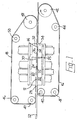
- Heated zone 12 comprises two adjustable opposing heating platens 20,22, each having a heating surface 24,26 respectively.
- the passage between the heating surfaces 24,26 is arranged to taper from inlet 28 of the heated zone to outlet 30 thereof.
- the separation between the heating surfaces at inlet 28 is 1.2mm and at outlet 30 is 0.6mm.
- the cooling zone comprises two adjustable opposing cooling platens 32,34, each having a cooling surface 36,38 respectively.
- the cooling surfaces 36,38 are arranged to be parallel and are spaced at a distance of 0.6mm apart.
- the endless belt 16, is a TYGAFLOR (RTM) belt, made of glass fibre and KELVAR (RTM) with a PTFE coating. (Available from Fothergill & Harvey plc, Littleborough, Lancashire, England.) Belt 16 passes around two guiding rollers 40,41 and a drive roller 42 and is arranged to bear against a tensioning roller 44.
- belt 16 (which is stationary in operation) is a similar TYGAFLOR (RTM) belt, passing around locating rollers 46, 47, 48 and tensioning roller 50.
- RTM TYGAFLOR
- the belt 18 is arranged so that the inside surface of the belt contacts heating surface 26 and cooling surface 38.
- Belts 16,18 because of their thickness, have a low heat capacity so that heat from heated zone 12 is quickly transferred to a sheet of material inserted between the belts 16,18 and rapidly removed from the sheet of material in the cooling zone.
- Band 118 is held stationary during operation of the press, but as it becomes worn, it can be replenished by winding replacement material off reel 61.
- the upper face of the treatment zones is provided by platens 62, 63 of smooth-surface steel.
- a sheet of impregnated non-woven shoe lining material 52 to be compressed to a thickness of 0.6mm is fed through the heated zone 12 and the cooling zone 14 of the illustrative apparatus at a rate of 2 metres per minute.
- Heating platens 20,22 measuring 0.4m in length, 1.8m in width and 0.075m in thickness were used and were heated to a temperature of 220°C using heat transfer oil.
- Cooling platens 34,32 measuring 0.2 in length, 1.8m in width and 0.075m in thickness were used and were kept at a temperature of 15°C using water as the cooling liquid. Whilst in the heated zone heat was transferred from the heating platens 20,22 to the sheet 52 of material to bring the sheet to a heat-softened condition throughout its thickness.
Landscapes
- Engineering & Computer Science (AREA)
- Mechanical Engineering (AREA)
- Shaping Of Tube Ends By Bending Or Straightening (AREA)
- Processing And Handling Of Plastics And Other Materials For Molding In General (AREA)
Applications Claiming Priority (2)
| Application Number | Priority Date | Filing Date | Title |
|---|---|---|---|
| GB8729922 | 1987-12-22 | ||
| GB878729922A GB8729922D0 (en) | 1987-12-22 | 1987-12-22 | Apparatus for controlling thickness of heat-softenable sheet material |
Publications (2)
| Publication Number | Publication Date |
|---|---|
| EP0322145A2 true EP0322145A2 (de) | 1989-06-28 |
| EP0322145A3 EP0322145A3 (de) | 1990-10-17 |
Family
ID=10628895
Family Applications (1)
| Application Number | Title | Priority Date | Filing Date |
|---|---|---|---|
| EP19880311771 Withdrawn EP0322145A3 (de) | 1987-12-22 | 1988-12-13 | Vorrichtung zum Steuern der Dicke eines thermoplastischen Bahnmaterials |
Country Status (2)
| Country | Link |
|---|---|
| EP (1) | EP0322145A3 (de) |
| GB (1) | GB8729922D0 (de) |
Cited By (3)
| Publication number | Priority date | Publication date | Assignee | Title |
|---|---|---|---|---|
| EP1366880A3 (de) * | 2002-05-02 | 2007-10-03 | Ballard Power Systems Inc. | Bandvorschubvorrichtung für ein kontinuierliches Netz aus expandiertem Graphit |
| CN113699814A (zh) * | 2020-05-22 | 2021-11-26 | 精工爱普生株式会社 | 纤维结构体制造装置、纤维结构体制造方法及纤维结构体 |
| CN119159896A (zh) * | 2024-11-04 | 2024-12-20 | 宿迁恒达纺织有限公司 | 一种涤纶复合面料加工用加热装置 |
Family Cites Families (5)
| Publication number | Priority date | Publication date | Assignee | Title |
|---|---|---|---|---|
| GB693647A (en) * | 1950-02-24 | 1953-07-01 | Reinold Hagen | Improved process of and apparatus for pressing sheets of thermoplastic materials |
| SE333238B (sv) * | 1966-12-12 | 1971-03-08 | Defibrator Ab | Saett och anordning foer att efterbehandla plattor av vegetabiliskt material |
| US3938261A (en) * | 1972-12-06 | 1976-02-17 | Anderson James K | Apparatus for improving printing surface of printing material |
| JPS57110421A (en) * | 1980-12-29 | 1982-07-09 | Sakushin Kogyo Kk | Apparatus for molding long synthetic resin plate or sheet |
| GB8513345D0 (en) * | 1985-05-28 | 1985-07-03 | Busm Co Ltd | Gauge control of heat-softenable material |
-
1987
- 1987-12-22 GB GB878729922A patent/GB8729922D0/en active Pending
-
1988
- 1988-12-13 EP EP19880311771 patent/EP0322145A3/de not_active Withdrawn
Cited By (3)
| Publication number | Priority date | Publication date | Assignee | Title |
|---|---|---|---|---|
| EP1366880A3 (de) * | 2002-05-02 | 2007-10-03 | Ballard Power Systems Inc. | Bandvorschubvorrichtung für ein kontinuierliches Netz aus expandiertem Graphit |
| CN113699814A (zh) * | 2020-05-22 | 2021-11-26 | 精工爱普生株式会社 | 纤维结构体制造装置、纤维结构体制造方法及纤维结构体 |
| CN119159896A (zh) * | 2024-11-04 | 2024-12-20 | 宿迁恒达纺织有限公司 | 一种涤纶复合面料加工用加热装置 |
Also Published As
| Publication number | Publication date |
|---|---|
| EP0322145A3 (de) | 1990-10-17 |
| GB8729922D0 (en) | 1988-02-03 |
Similar Documents
| Publication | Publication Date | Title |
|---|---|---|
| US4792426A (en) | Precision control of the thickness of heat-softenable material | |
| US7005024B2 (en) | Process and device for the manufacture of a composite material | |
| US1361970A (en) | Composite-plate-curing machine | |
| US3996032A (en) | Insulated heater tray for making glass fibers and method for using same | |
| JPH0152119B2 (de) | ||
| KR102033709B1 (ko) | 벨트프레스식 플라스틱시트 제조장치 | |
| NO164234B (no) | Fremgangsmaate for separering av nitrogen fra naturgass. | |
| US4699676A (en) | Process of and device for heating parts of a double band press | |
| EP0322145A2 (de) | Vorrichtung zum Steuern der Dicke eines thermoplastischen Bahnmaterials | |
| US3583030A (en) | Apparatus for the continuous forming of fibrous products by continuously compressing and curing binder containing fibrous material | |
| KR100416117B1 (ko) | 적층금속판의제조방법및제조장치 | |
| US2344601A (en) | Treatment of fibrous glass | |
| US7393480B2 (en) | Method and apparatus for the manufacture of chip boards and fiber boards | |
| EP0038559B1 (de) | Verfahren zur Herstellung einer verschleissfesten Folie und Vorrichtung zu deren Herstellung | |
| US4933127A (en) | Process for improving the slip properties of a ski sole made of powdered high density polyethylene of very high molecular weight | |
| US4609423A (en) | Apparatus for making a web of plastic material | |
| JP2019107659A (ja) | 加熱ロールプレス装置および加熱ロールプレス方法 | |
| US5258085A (en) | Process for producing a layered material in sheet or membrane form from thermoplastic foam | |
| JPH0442168B2 (de) | ||
| US4810315A (en) | Method for making a web of plastic material | |
| US2993523A (en) | Process and apparatus for continuous production of flat laminates | |
| US3050109A (en) | Process and machine for the continuous production of corrugated laminates of plasticmaterials | |
| JP2003094198A (ja) | 連続シートプレス装置における厚さ制御装置、同制御装置を備えたプレス装置、及び同プレス装置を用いた連続シートの製造方法 | |
| US4923647A (en) | Process for the vulcanization of laminar rubber products | |
| JPH05245866A (ja) | 繊維強化熱可塑性樹脂シートの連続強化成形方法及び装置 |
Legal Events
| Date | Code | Title | Description |
|---|---|---|---|
| PUAI | Public reference made under article 153(3) epc to a published international application that has entered the european phase |
Free format text: ORIGINAL CODE: 0009012 |
|
| AK | Designated contracting states |
Kind code of ref document: A2 Designated state(s): DE FR GB IT NL |
|
| RAP1 | Party data changed (applicant data changed or rights of an application transferred) |
Owner name: EMHART MATERIALS UK LIMITED Owner name: EMHART INDUSTRIES, INC. |
|
| RAP1 | Party data changed (applicant data changed or rights of an application transferred) |
Owner name: EMHART MATERIALS UK LIMITED Owner name: TEXON FOOTWEAR INC. |
|
| PUAL | Search report despatched |
Free format text: ORIGINAL CODE: 0009013 |
|
| AK | Designated contracting states |
Kind code of ref document: A3 Designated state(s): DE FR GB IT NL |
|
| STAA | Information on the status of an ep patent application or granted ep patent |
Free format text: STATUS: THE APPLICATION IS DEEMED TO BE WITHDRAWN |
|
| 18D | Application deemed to be withdrawn |
Effective date: 19910418 |