EP0322531B1 - Chemin des gaz d'un dispositif silencieux pour compresseur rotatif - Google Patents
Chemin des gaz d'un dispositif silencieux pour compresseur rotatif Download PDFInfo
- Publication number
- EP0322531B1 EP0322531B1 EP88117513A EP88117513A EP0322531B1 EP 0322531 B1 EP0322531 B1 EP 0322531B1 EP 88117513 A EP88117513 A EP 88117513A EP 88117513 A EP88117513 A EP 88117513A EP 0322531 B1 EP0322531 B1 EP 0322531B1
- Authority
- EP
- European Patent Office
- Prior art keywords
- discharge
- muffler
- gas
- bearing
- cylinder block
- Prior art date
- Legal status (The legal status is an assumption and is not a legal conclusion. Google has not performed a legal analysis and makes no representation as to the accuracy of the status listed.)
- Expired - Lifetime
Links
- 230000006835 compression Effects 0.000 claims description 25
- 238000007906 compression Methods 0.000 claims description 25
- 238000001816 cooling Methods 0.000 claims description 9
- 239000012530 fluid Substances 0.000 claims description 8
- 238000007599 discharging Methods 0.000 claims description 5
- 239000007789 gas Substances 0.000 description 84
- 239000003921 oil Substances 0.000 description 18
- 230000010349 pulsation Effects 0.000 description 7
- 239000003507 refrigerant Substances 0.000 description 6
- 238000004804 winding Methods 0.000 description 5
- 238000003466 welding Methods 0.000 description 3
- 238000005219 brazing Methods 0.000 description 2
- 238000005461 lubrication Methods 0.000 description 2
- 238000005476 soldering Methods 0.000 description 2
- 230000003247 decreasing effect Effects 0.000 description 1
- 230000001747 exhibiting effect Effects 0.000 description 1
- 238000001914 filtration Methods 0.000 description 1
- 230000001050 lubricating effect Effects 0.000 description 1
- 239000010687 lubricating oil Substances 0.000 description 1
- 238000004519 manufacturing process Methods 0.000 description 1
- 230000001681 protective effect Effects 0.000 description 1
Images


Classifications
-
- F—MECHANICAL ENGINEERING; LIGHTING; HEATING; WEAPONS; BLASTING
- F04—POSITIVE - DISPLACEMENT MACHINES FOR LIQUIDS; PUMPS FOR LIQUIDS OR ELASTIC FLUIDS
- F04B—POSITIVE-DISPLACEMENT MACHINES FOR LIQUIDS; PUMPS
- F04B39/00—Component parts, details, or accessories, of pumps or pumping systems specially adapted for elastic fluids, not otherwise provided for in, or of interest apart from, groups F04B25/00 - F04B37/00
-
- F—MECHANICAL ENGINEERING; LIGHTING; HEATING; WEAPONS; BLASTING
- F04—POSITIVE - DISPLACEMENT MACHINES FOR LIQUIDS; PUMPS FOR LIQUIDS OR ELASTIC FLUIDS
- F04C—ROTARY-PISTON, OR OSCILLATING-PISTON, POSITIVE-DISPLACEMENT MACHINES FOR LIQUIDS; ROTARY-PISTON, OR OSCILLATING-PISTON, POSITIVE-DISPLACEMENT PUMPS
- F04C29/00—Component parts, details or accessories of pumps or pumping installations, not provided for in groups F04C18/00 - F04C28/00
- F04C29/12—Arrangements for admission or discharge of the working fluid, e.g. constructional features of the inlet or outlet
-
- F—MECHANICAL ENGINEERING; LIGHTING; HEATING; WEAPONS; BLASTING
- F04—POSITIVE - DISPLACEMENT MACHINES FOR LIQUIDS; PUMPS FOR LIQUIDS OR ELASTIC FLUIDS
- F04C—ROTARY-PISTON, OR OSCILLATING-PISTON, POSITIVE-DISPLACEMENT MACHINES FOR LIQUIDS; ROTARY-PISTON, OR OSCILLATING-PISTON, POSITIVE-DISPLACEMENT PUMPS
- F04C23/00—Combinations of two or more pumps, each being of rotary-piston or oscillating-piston type, specially adapted for elastic fluids; Pumping installations specially adapted for elastic fluids; Multi-stage pumps specially adapted for elastic fluids
- F04C23/008—Hermetic pumps
-
- F—MECHANICAL ENGINEERING; LIGHTING; HEATING; WEAPONS; BLASTING
- F04—POSITIVE - DISPLACEMENT MACHINES FOR LIQUIDS; PUMPS FOR LIQUIDS OR ELASTIC FLUIDS
- F04C—ROTARY-PISTON, OR OSCILLATING-PISTON, POSITIVE-DISPLACEMENT MACHINES FOR LIQUIDS; ROTARY-PISTON, OR OSCILLATING-PISTON, POSITIVE-DISPLACEMENT PUMPS
- F04C29/00—Component parts, details or accessories of pumps or pumping installations, not provided for in groups F04C18/00 - F04C28/00
- F04C29/06—Silencing
-
- F—MECHANICAL ENGINEERING; LIGHTING; HEATING; WEAPONS; BLASTING
- F04—POSITIVE - DISPLACEMENT MACHINES FOR LIQUIDS; PUMPS FOR LIQUIDS OR ELASTIC FLUIDS
- F04C—ROTARY-PISTON, OR OSCILLATING-PISTON, POSITIVE-DISPLACEMENT MACHINES FOR LIQUIDS; ROTARY-PISTON, OR OSCILLATING-PISTON, POSITIVE-DISPLACEMENT PUMPS
- F04C29/00—Component parts, details or accessories of pumps or pumping installations, not provided for in groups F04C18/00 - F04C28/00
- F04C29/06—Silencing
- F04C29/065—Noise dampening volumes, e.g. muffler chambers
-
- F—MECHANICAL ENGINEERING; LIGHTING; HEATING; WEAPONS; BLASTING
- F04—POSITIVE - DISPLACEMENT MACHINES FOR LIQUIDS; PUMPS FOR LIQUIDS OR ELASTIC FLUIDS
- F04C—ROTARY-PISTON, OR OSCILLATING-PISTON, POSITIVE-DISPLACEMENT MACHINES FOR LIQUIDS; ROTARY-PISTON, OR OSCILLATING-PISTON, POSITIVE-DISPLACEMENT PUMPS
- F04C29/00—Component parts, details or accessories of pumps or pumping installations, not provided for in groups F04C18/00 - F04C28/00
- F04C29/06—Silencing
- F04C29/068—Silencing the silencing means being arranged inside the pump housing
Definitions
- the invention pertains to a rotary compressor as per the preamble of claim 1 and claim 9.
- a compressor of this kind is disclosed by JP-A- 62-214292.
- prior art hermetic rotary compressors comprise a housing which is hermetically sealed. Located in the housing are an electric motor and a compressor mechanism. The electric motor is connected to a crankshaft which has an eccentric portion thereon. The eccentric portion of the crankshaft is located within a compression chamber bore of the compressor cylinder block. A roller located within the compression chamber is mounted on the eccentric portion of the crankshaft and is driven thereby. The roller cooperates with a sliding vane to compress refrigerant within the bore of the cylinder block.
- Rotary hermetic compressors of the type herein disclosed generally have a pressurized or high side sealed housing. Compressed gas from within the compression chamber is discharged through a gas routing system into the compressor housing. This discharge gas exhibits undesirable properties with respect to achieving quiet and efficient operation of the compressor. Specifically, noise pulsations are ordinarily caused by the discharge gas due to opening and closing of valving in response to the cyclical compression and suction created in the compression chamber within the cylinder block. Under certain operating conditions, and particularly for higher capacity compressors, these noise pulsations become objectionable to the consumer.
- Another problem associated with rotary hermetic compressors, wherein pressurized gas is discharged into the sealed housing is a hot operating environment which tends to decrease the efficiency of the electric motor. High operating temperatures also result in undesirable high temperatures for the lubricating oil, the housing, and the discharge gas.
- Prior art gas routing systems for rotary compressors have generally addressed the problem of excessive noise pulsations by providing a single discharge port in either of the main or outboard bearings through which compressed gas is removed from the compression chamber into a muffler or a series of mufflers.
- a single discharge port in either of the main or outboard bearings through which compressed gas is removed from the compression chamber into a muffler or a series of mufflers.
- the compressed gas is discharged through a bearing into a muffler cavity, it is rerouted through passageways extending through both bearings and the cylinder block and then through an auxiliary muffler system or directly into the housing.
- Another prior art gas routing system provides for multiple discharge ports in the sidewall of the cylindrical compression chamber providing communication between the compression chamber and a discharge chamber defined within the cylinder block. From the discharge chamber, discharge gas passes through a single port extending through a bearing into a muffler before being discharged into the interior of the compressor housing. By providing a plurality of discharge ports in the sidewall of the compression chamber, cooler gas is discharged into the discharge chamber defined within the cylinder block. The gas is then discharged through a single smaller opening in one of the bearings.
- a disadvantage of the prior art solutions wherein compressed gas is discharged through a single opening in one of the main or outboard bearings is that a single opening in a rotary compressor cannot be made large enough to sufficiently reduce the level of noise pulsations. Furthermore, the temperature of gas discharged through a limited size opening is hotter than can otherwise be achieved though larger openings, thus increasing operating temperatures of the compressor and reducing compressor efficiency.
- the prior art rotary compressor design utilizing a plurality of discharge ports in the sidewall of the cylinder provides a baffling chamber in the cylinder block.
- the discharge gas is ultimately discharged through one port in one of the bearings into a single muffler, thereby maintaining objectionable sound pulsations.
- a further problem with a rotary compressor having a discharge chamber defined within the cylinder block is that compressor size may be increased by the need for space surrounding the compression chamber.
- heat generated in the compression chamber and dissipated into the cylinder block maintains the discharge gas within the discharge chamber at higher temperatures, thereby decreasing its ability to cool compressor components when discharged within the housing.
- the present invention overcomes the disadvantages of the above-described prior art hermetic rotary compressors by providing an improved discharge gas routing system for discharging gas from within the compression chamber of the cylinder block to the interior of the sealed compressor housing.
- the State of the Art upon which the invention is based provides a rotary compressor comprising a cylinder block defining a cylinder, and a main bearing and an outboard bearing located on respective ends of the cylinder block enclosing the cylinder at each of its opposite ends.
- compressed gas from within the cylinder is discharged through first and second discharge ports extending through the main and outboard bearings, respectively. Accordingly, flow of the compressed gas discharged from within the cylinder is divided between the first and second discharge ports.
- said State of the Art provides, in one form thereof, a gas routing system for a rotary compressor wherein compressed gas from within the compression chamber in the cylinder block is discharged through respective ports in the main and outboard bearings into mufflers mounted on the outside of the main and outboard bearings.
- the discharge gas is expanded upon entering each of the mufflers, whereby cooling of the gas occurs.
- the expanded gas of one of the mufflers flows through a passageway extending through the main and outboard bearings and the cylinder block and is combined with the expanded discharge gas in the other muffler prior to being discharged into the interior of a hermetically sealed housing.
- An advantage of said prior art structure was that compressed gas from within the compression chamber can be discharged axially outwardly through both the main and outboard bearings, thereby increasing the effective size of the discharge port previously provided in only one of the main or outboard bearings. This results in noise pulsations of a lesser magnitude and discharge gas at lower temperatures.
- Another advantage of said gas routing system was that flow of the combined discharge gas exhibiting a cooler temperature may be directed at the stator windings of the electric motor in order to provide better cooling and more efficient operation thereof. Also, the cooler discharge gas directed for cooling the stator windings contributes to an overall cooler temperature within the sealed compressor housing.
- the paramount advantages of the gas routing system in accordance with the present invention are reduced sound levels achieved through the axial discharge of compressed gas through both of the bearings, and improved efficiency due to lower operating temperatures within the compressor housing, including lower oil temperatures, lower stator winding temperatures, etc.
- Yet another advantage of the structure of the present invention in one form thereof, is that the passageways provided between the compression chamber and the mufflers, between the two mufflers, and between one of the mufflers and the interior of the compressor housing are comprised of substantially aligned holes through the main and outboard bearings and the cylinder block, whereby the mufflers do not require tubing connections, thus contributing to ease and lower costs of manufacturing. Furthermore, the plurality of holes extending through the main and outboard bearings and the cylinder block reduce the mass of the cylinder and bearings and require no additional tubing.
- the rotary compressor of the present invention in one form thereof, provides a cylinder block defining a cylinder, and a main bearing and an outboard bearing located on respective ends of the cylinder block to close the cylinder at each of its opposite ends.
- An eccentric roller is rotationally mounted in the cylinder, whereby rotation of the roller in the cylinder results in compressed gas within the cylinder.
- a rotatable crankshaft is operably supported by the main and outboard bearings and is drivingly connected to the roller for rotation thereof.
- Means for discharging the compressed gas from within the cylinder is provided, comprising a first discharge port in communication with and extending from the cylinder through the main bearing and a second discharge port in communication with and extending from the cylinder through the outboard bearing. Accordingly, flow of the compressed gas discharge from within the cylinder is divided between the first and second discharge ports.
- first and second discharge muffler mounted respectively on the main and outboard bearings, being in fluid communication with the first and second discharge posts respectively, whereby compressed gas is discharged through the main bearing is expanded upon entry into the first muffler and compressed gas discharged through the outboard bearing is expanded upon entry into the second muffler.
- gas passage means communicating between the first and second mufflers for allowing expanded gas in one of the first and second mufflers to flow from the one muffler to the other muffler and gas discharge outlet means providing fluid communication between the other muffler and the inside of the housing.
- the discharge outlet means extends through the main and outboard bearings and the cylinder block.
- the rotary hermetic compressor of the instant invention further provides, in one form thereof, a vertically disposed hermetically sealed cylindrical casing.
- An electric motor unit is mounted within the casing and includes a rotatable rotor and a stator.
- the hermetic compressor also includes an oil sump located in a lower portion of the housing and a cylinder block having a compression chamber defined therein.
- An upper bearing is mounted to the upper end of the cylinder and defines an upper end wall of the chamber.
- the upper bearing has an upper discharge port extending therethrough.
- a lower bearing is mounted to the lower end of the cylinder block and defines a lower end wall of the compression chamber.
- the lower bearing has a lower discharge port extending therethrough.
- a crankshaft is drivingly connected to the rotor and operably supported by the upper and lower bearings.
- Piston means for compressing gas within the chamber is drivingly connected to the crankshaft.
- An upper muffler is mounted to the top of the upper bearing, whereby the upper discharge port provides gaseous communication between the chamber and the upper muffler.
- a lower muffler is mounted to the bottom of the lower bearing and is in fluid contact with oil in the oil sump. The lower discharge port provides gaseous communication between the chamber and the lower muffler, whereby compressed gas from within the chamber is discharged and expanded into the upper and lower mufflers.
- the compressor of this form provides gas passage means communicating between the upper and lower mufflers for discharging gas from the upper muffler and delivering it to the lower muffler.
- the lower muffler then communicates with the inside of the housing by means of discharge gas outlet means for directly delivering discharge gas from the lower muffler through the bearings and the cylinder block to the inside of the the housing in an upward direction toward the motor for cooling thereof.
- a compressor having a housing generally designated at 10.
- the housing has a top portion 12, a lower portion 14 and a central portion 16.
- the three housing portions are hermetically secured together as by welding or brazing.
- a flange 18 is welded to the bottom of housing 10 for mounting the compressor.
- a motor Located inside the hermetically sealed housing is a motor generally designated at 20 having a stator 22 and a rotor 24.
- the stator is provided with windings 26.
- the stator is secured to the housing 10 by an interference fit such as by shrink fitting.
- the rotor 24 has a central aperture 28 provided therein into which is secured a crankshaft 30 by an interference fit.
- a terminal cluster 32 is provided on the top portion 12 of the compressor for connecting the compressor to a source of electric power.
- a post 34 is welded to top portion 12 for mounting a protective cover (not shown) for terminal cluster 32.
- a refrigerant discharge tube 36 extends through top portion 12 of the housing and has an end 38 thereof extending into the interior of the compressor as shown.
- the tube is sealingly connected to housing 10 at 40 as by soldering.
- a suction tube 42 extends into the interior of compressor housing 10 and is sealed thereto as by soldering, brazing, or welding.
- the outer end 44 of suction tube 42 is connected to accumulator 46 which has support plates 48 disposed therein for supporting a filtering mesh 50.
- a bracket 52 secures accumulator 46 to the outside wall of housing 10.
- crankshaft 30 is provided with an eccentric portion 54 which revolves around the crankshaft axis as crankshaft 30 is rotatably driven by rotor 24.
- Counterweights 56 and 58 are provided to balance eccentric 54 and are secured to respective end rings 60 and 62 of rotor 24 by riveting.
- Crankshaft 30 is journalled in a main bearing 64 having a cylindrical journal portion 66 and a generally flat planar mounting portion 68. Planar portion 68 is secured to housing 10 at three points 70 such as by welding of flanges 72 to the housing, as best illustrated in Fig. 2.
- a second bearing or journal 74 is also shown disposed in the lower part of housing 10.
- Outboard bearing 74 is provided with a journal portion 76 having aperture 78 therein and a generally planar portion 80.
- Crankshaft 30 has a lower portion 82 journalled in journal portion 76 of outboard bearing 74 as illustrated in Fig. 1.
- a compressor cylinder block 84 Located intermediate main bearing 64 and outboard bearing 74 is a compressor cylinder block 84. Cylinder block 84 defines a cylinder therein, referred to herein as compression chamber 85. Compressor cylinder block 84, outboard bearing 74, and main bearing 64 are secured together by means of twelve bolts 86, two of which are indicated in Fig. 1. By referring to Fig. 2, it can be seen that six threaded holes 88 are provided in cylinder block 84 for securing bearings 64, 74 and cylinder block 84 together. Of the twelve bolts 86, six of them secure outboard bearing 74 to cylinder block 84 and are threaded into holes 88. The remaining six bolts secure main bearing 64 to cylinder block 84 and are also threaded into holes 88. An upper discharge muffler plate 90 is secured to main bearing 64 and a lower discharge muffler plate 92 is secured to outboard bearing 74 by bolts 86, as indicated in Fig. 1.
- cylinder block 84 has a vane slot 94 provided in the cylindrical side wall 96 thereof into which is received a sliding vane 98.
- Roller 100 is provided which surrounds eccentric portion 54 of crankshaft 30 and revolves around the axis of crankshaft 30 and is driven by eccentric 54. Tip 102 of sliding vane 98 is in continuous engagement with roller 100 as vane 98 is urged against the roller by spring 104 received in spring pocket 106. Referring to Fig. 2, during operation, as roller 100 rolls around compression chamber 85, refrigerant will enter chamber 85 through suction tube 42.
- roller 100 the compression volume enclosed by roller 100, cylinder wall 96, and sliding vane 98 will decrease in size as roller 100 revolves clockwise around compression chamber 85. Refrigerant contained in that volume will therefore be compressed and after compression will exit through a relief 110 in sidewall 96.
- the aforementioned compressor mechanism is presented by way of illustration only, it being contemplated that other piston means for compressing gas within chamber 85 may be used without departing from the spirit and scope of the present invention.
- the rotary compressor disclosed herein provides a lubrication system for lubricating components of the compressor, including eccentric 54 and roller 100.
- a lubrication system for lubricating components of the compressor, including eccentric 54 and roller 100.
- Such a system is disclosed in U. S. Patent No. 4,640,669, assigned to the same assignee as the present invention, the disclosure of which is hereby incorporated by reference.
- FIGs 1 and 3 components of an exemplary lubrication system are shown, including aperture 112 in crankshaft 30 into which oil is drawn from oil in oil sump 114.
- Aperture 112 delivers oil to opening 116 in crankshaft 30 to lubricate roller 100.
- Oil also flows into annular chamber 118 and radially outwardly therefrom through passageway 120, as described more fully in U. S. Patent No. 4,640,669.
- a conventional oil paddle 122 is axially mounted to end portion 82 of crankshaft 30 for contact with oil in oil sump 114.
- the discharge gas routing system of the present invention provides means for discharging compressed gas from within chamber 85 and comprises a first discharge port 130 in communication with chamber 85 and extending through main bearing 64.
- a first discharge valve 132 and valve retainer 134 are mounted on outer surface 136 by means of a rivet 138.
- a second discharge port 140 extends through outboard bearing 74.
- a second discharge valve 142 and valve retainer 144 are mounted on outer surface 146 by means of a rivet 148.
- the gas is then discharged into first and second discharge mufflers comprising muffler chambers 150 and 152 defined by discharge muffler plates 90 and 92 and the outer surfaces 136 and 146 of bearings 64 and 74, respectively.
- a collar 154 is provided in muffler plate 90 to sealingly engage over journal portion 66 as by a slip-fit.
- a collar 156 is provided in muffler plate 92 to sealingly engage over journal portion 76.
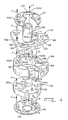
- Figure 4 illustrates the routing of discharge gas during operation of the compressor. More specifically, compressor refrigerant gas is discharged through relief 110 in cylinder block 84 and flows axially outwardly in opposite directions as illustrated by directional lines A and B. With respect to the vertical orientation of the compression mechanism in Figure 4, the discharge gas indicated by line A flows through discharge port 130 in upper main bearing 64. Upon passing by discharge valve 132 and valve retainer 134, the discharge gas is expanded into upper muffler chamber 150 defined by muffler plate 90 and the top surface 136 of main bearing 64. The expansion of the discharge gas upon entry into muffler chamber 150 provides cooling of the discharge gas.
- Discharge gas discharged axially downwardly as indicated by directional arrow B flows through discharge port 140 in lower outboard bearing 74 and passes through discharge valve 142 and valve retainer 144 before entering lower muffler chamber 152 defined by muffler plate 92 and outer surface 146 of outboard bearing 74. As the discharge gas is expanded into discharge space 152, a certain amount of cooling of the gas is achieved.
- the present invention in one form thereof, provides for the discharge gas in upper muffler chamber 150 to be routed into a gas passageway 160, as indicated by directional arrow C.
- Gas passageway 160 comprises holes 160a in main bearing 64, 160b in cylinder block 84, and 160c in outboard bearing 74. Holes 160a, 160b, and 160c are axially aligned to provide passageway 160, through which laminar flow of discharge gas is achieved, as indicated by directional arrow D.
- Gas passageway 160 provides communication between muffler chambers 150 and 152 located at opposite ends of the compressor mechanism.
- the discharge gas in muffler chamber 150 indicated by directional arrow C enters hole 160a in main bearing 64, proceeds through hole 160b in cylinder block 84, and finally passes through 160c in outboard bearing 74 before entering discharge space 152. Also, the routing of gas through the upper muffler and then through passageway 60 prior to entering the lower muffler provides several additional stages of baffling to reduce sound.
- Discharge passageway 162 in accord with one form of the present invention, comprises holes 162a in outboard bearing 74, 162b in cylinder block 84, 162c in main bearing 64, and 162d in muffler plate 90.
- a second discharge passageway 164 may also be provided in similar fashion, comprising holes 164a, 164b, 164c, and 164d.
- the combined discharge gas in chamber 152 is discharged through passageways 162 and 164 as indicated by directional arrows F and G, respectively.
- the discharge gas exiting passageways 162 and 164 is directed upwardly toward electric motor unit 20. In this way, the cooler discharge gases achieved by the gas routing system of the present invention provide more effective cooling of the stator windings 26.
- discharge port 130 in the main bearing is preferably sized smaller than discharge port 140 in the outboard bearing in order to provide the necessary flow rate for gas to travel the longer distance through constricting passageway 160 before entering muffler chamber 152.
- discharge port 130 is .181 inches in diameter while discharge port 140 is .312 inches in diameter.
- passageways 160, 162, and 164 are all approximately .343 inches in diameter.
Landscapes
- Engineering & Computer Science (AREA)
- Mechanical Engineering (AREA)
- General Engineering & Computer Science (AREA)
- Applications Or Details Of Rotary Compressors (AREA)
Claims (12)
- Compresseur rotatif, comprenant un bloc de cylindre (84) définissant un cylindre; un pilier principal (64) et un palier extérieur (74) placés sur les extrémités respectives du bloc de cylindre et fermant ce bloc de cylindre à chacune de ses extrémités opposées; des moyens de piston (100) montés excentriquement an rotation dans le cylindre; un vilebrequin rotatif (30) supporté en fonctionnement par le pilier principal et le palier extérieur et relié par une liaison d'entraînement aux moyens de piston, la rotation des moyens de piston dans le cylindre produisant du gaz comprimé dans ce cylindre ; des moyens destinés à décharger le gaz comprimé de l'intérieur du cylindre, ces moyens comprenant un premier orifice de décharge (130) en communication avec le cylindre et sortant de celui-ci par le palier principal, et un second orifice de décharge (140) en communication avec le cylindre et sortant de celui-ci par le palier extérieur; un premier silencieux de décharge (150) et un second silencieux de décharge (152) montés respectivement sur le pilier principal et sur le pilier extérieur, le premier silencieux de décharge et le second silencieux de décharge étant respectivement en communication avec le premier orifice de décharge et le second orifice de décharge, de façon que le gaz comprimé déchargé par le palier principal soit dilaté lorsqu'il entre dans le premier silencieux, et que la gaz comprimé déchargé par le palier extérieur soit dilaté lorsqu'il entre dans le second silencieux ; des moyens de passage de gaz (160) assurant la communication entre le premier silencieux et le second silencieux pour permettre au gaz dilaté se trouvant dans l'un ou l'autre du premier silencieux (150) et du second silencieux (152), de s'écouler de l'un des silencieux (150) vers l'autre silencieux (152) ; et des moyens de sortie de décharge de gaz (162, 164) assurant la communication de fluide entre l'autre silencieux et l'intérieur du carter ; compresseur rotatif caractérisé en ce que les moyens de sortie de décharge passent à travers le palier principal, le palier extérieur et le bloc de cylindre.
- Compresseur rotatif selon la revendication 1, caractérisé en ce qu'il comprend an outre une première soupape de décharge (132) montée sur le palier principal (64) et une seconde soupape de décharge (142) montée sur le palier extérieur (74), la première soupape de décharge et la seconde soupape de décharge étant respectivement en communication avec le premier orifice de décharge et le second orifice de décharge.
- Compresseur rotatif selon la revendication 1, caractérisé en ce que le premier orifice de décharge et le second orifice de décharge (130, 140) sont alignés axialement, de façon que la décharge du gaz comprimé par le premier orifice de décharge et par le second orifice de décharge se produisent simultanément.
- Compresseur rotatif selon la revendication 1, caractérisé en ce que les moyens de passage de gaz comprennent un passage (160) défini par des trous essentiellement alignés (160a à 160c) traversant le palier principal (64), le palier extérieur (74) et le bloc de cylindre (84).
- Compresseur rotatif selon la revendication 1, caractérisé en ce que l'orifice de décharge (130) est associé en fonctionnement à l'un (150) du premier silencieux et du second silencieux (150, 152) présente une plus petite section transversale que l'autre orifice de décharge (140).
- Compresseur rotatif selon la revendication 1, caractérisé en ce que les moyens de sortie de décharge (162, 164) comprennent un certain nombre de passages de décharge définis chacun par des trous essentiellement alignés (162a à 162c, 164a à 164c) traversant le palier principal (64) le palier extérieur (74) et le bloc de cylindre (84).
- Compresseur rotatif selon la revendication 1, caractérisé en ce que le premier silencieux de décharge (150) comprend une première plaque de silencieux (90) montée sur l'extrémité axialement extérieure du palier principal (64) pour former une première chambre de silencieux entre les deux, en ce que le second silencieux de décharge (152) comprend une seconde plaque de silencieux (92) montée sur l'extrémité axialement extérieure du palier extérieur (74) pour former une seconde chambre de silencieux entre les deux ; et en ce que les moyens de sortie de décharge de gaz (162, 164) passent & travers la plaque de silencieux (90) associée à l'un des silencieux (150).
- Compresseur rotatif selon la revendication 7, caractérisé en ce que la plaque de silencieux (90) à travers laquelle passe la sortie de décharge de gaz (162, 164) comprend une partie de rebord fixée au voisinage de la surface axialement extérieure du palier (64) associé à celle-ci, cette partie de rebord étant percée d'une ouverture (162d, 164d) à travers laquelle passe la sortie de décharge de gaz.
- Compresseur rotatif scellé hermétiquement, comprenant un carter cylindrique verticale (10) scellée hermétiquement ; un bloc de moteur électrique (20) monté à l'intérieur du carter et comprenant un rotor rotatif (24) et un stator (22) ; un carter d'huile (114) placé dans la partie inférieure du carter ; un bloc de cylindre (84) comportant une chambre de compression (85) formée à l'intérieur de celui-ci; un palier supérieur (64) monté sur l'extrémité supérieure du bloc de cylindre et définissant une paroi d'extrémité supérieure de la chambre, ce palier supérieur comportant un orifice de décharge supérieur (130) passant à travers celui-ci ; un palier inférieur (74) monté sur l'extrémité inférieure du bloc de cylindre et définissant une paroi d'extrémité inférieure de la chambre de compression, ce palier inférieur comportant un orifice de décharge inférieur (140) passant à travers celui-ci ; un vilebrequin (30) relié par une liaison d'entraînement au rotor et supporté en fonctionnement par le palier supérieur et le palier Inférieur ; des moyens de piston (98, 100) reliés par une liaison d'entraînement au vilebrequin pour comprimer le gaz à l'intérieur de la chambre ; un silencieux supérieur (150) monté sur le haut du palier supérieur, l'orifice de décharge supérieur assurant la communication de gaz entre la chambre et le silencieux supérieur ; un silencieux inférieur (152) monté sur le bas du palier inférieur et se trouvant en contact de fluide avec l'huile contenue dans le carter d'huile, l'orifice de décharge inférieur assurant la communication de fluide entre la chambre et le silencieux inférieur ; des moyens de passage (160) assurant la communication entre le silencieux supérieur et le silencieux inférieur ; et des moyens de sortie de gaz de décharge (162, 164) assurant la communication entre le silencieux inférieur et l'intérieur du carter par le palier supérieur, le palier inférieur et le bloc de cylindre; compresseur rotatif caractérisé en ce que les moyens de sortie transportent le gaz de décharge provenant du silencieux supérieur et fournissent ce gaz au silencieux inférieur ; et en ce que les moyens de sortie de gaz de décharge fournissent directement le gaz provenant du silencieux inférieur par les paliers et le bloc de cylindre, à l'intérieur du carter, dans un mouvement ascendant dirigé vers le moteur pour refroidir celui-ci.
- Compresseur rotatif selon la revendication 9, caractérisé en ce que les moyens de piston (90, 100) comprennent un galet d'excentrique (100) ; et en ce que l'orifice de décharge supérieur et l'orifice de décharge inférieur (130, 140) sont alignés axialement pour produire la décharge simultanée du gaz comprimé par le premier orifice de décharge et le second orifice de décharge.
- Compresseur rotatif selon la revendication 9, caractérisé en ce que le silencieux supérieur (150) comprend une plaque de silencieux (90) fixée à la surface supérieure du palier supérieur (64) pour former une chambre de silencieux entre les deux ; et en ce que les moyens de sortie de gaz de décharge (162, 164) comprennent un certain nombre de passages espacés périphériquement et définis par des trous essentiellement alignés (162a à 162d, 164a à 164d) traversant le palier supérieur (64), le palier inférieur (74), le bloc de cylindre (84) et la plaque de silencieux.
- Compresseur rotatif selon la revendication 11, caractérisé an ce que la plaque de silencieux (90) comprend une partie de rebord fixée au voisinage de la surface supérieure du palier supérieur (64), l'ouverture (162d, 164d) étant formée dans la partie de rebord dans une disposition essentiellement alignée avec les trous (162a à 162c, 164a à 164c) traversant le palier supérieur, le palier inférieur et le bloc de cylindre (84).
Applications Claiming Priority (2)
| Application Number | Priority Date | Filing Date | Title |
|---|---|---|---|
| US13836587A | 1987-12-24 | 1987-12-24 | |
| US138365 | 1987-12-24 |
Publications (3)
| Publication Number | Publication Date |
|---|---|
| EP0322531A2 EP0322531A2 (fr) | 1989-07-05 |
| EP0322531A3 EP0322531A3 (en) | 1990-03-07 |
| EP0322531B1 true EP0322531B1 (fr) | 1991-12-27 |
Family
ID=22481695
Family Applications (1)
| Application Number | Title | Priority Date | Filing Date |
|---|---|---|---|
| EP88117513A Expired - Lifetime EP0322531B1 (fr) | 1987-12-24 | 1988-10-21 | Chemin des gaz d'un dispositif silencieux pour compresseur rotatif |
Country Status (6)
| Country | Link |
|---|---|
| EP (1) | EP0322531B1 (fr) |
| JP (1) | JPH01170789A (fr) |
| KR (1) | KR910008213B1 (fr) |
| BR (1) | BR8806342A (fr) |
| CA (1) | CA1330976C (fr) |
| DE (1) | DE3867220D1 (fr) |
Families Citing this family (8)
| Publication number | Priority date | Publication date | Assignee | Title |
|---|---|---|---|---|
| JP3408309B2 (ja) * | 1994-02-10 | 2003-05-19 | 株式会社東芝 | 密閉形コンプレッサならびにこのコンプレッサを用いた冷凍装置 |
| KR100531288B1 (ko) * | 2003-05-13 | 2005-11-28 | 엘지전자 주식회사 | 로터리 압축기 |
| CN100455813C (zh) * | 2004-11-30 | 2009-01-28 | 乐金电子(天津)电器有限公司 | 旋转式压缩机的消声器防漏装置 |
| EP1967738B1 (fr) * | 2005-12-28 | 2016-03-30 | Daikin Industries, Ltd. | Compresseur |
| CN104214100B (zh) * | 2013-06-05 | 2018-08-07 | 珠海格力节能环保制冷技术研究中心有限公司 | 压缩机及具有其的空调器 |
| CN111271279B (zh) * | 2018-12-04 | 2022-06-28 | 上海海立电器有限公司 | 压缩机及其装配方法 |
| CN111271278B (zh) * | 2018-12-04 | 2022-06-21 | 上海海立电器有限公司 | 压缩机及其装配方法 |
| CN119491821A (zh) * | 2023-08-18 | 2025-02-21 | 安徽威灵汽车部件有限公司 | 电动转子式压缩机、空调系统和车辆 |
Family Cites Families (4)
| Publication number | Priority date | Publication date | Assignee | Title |
|---|---|---|---|---|
| JPS6137835Y2 (fr) * | 1981-05-11 | 1986-11-01 | ||
| US4640669A (en) * | 1984-11-13 | 1987-02-03 | Tecumseh Products Company | Rotary compressor lubrication arrangement |
| US4730996A (en) * | 1985-07-29 | 1988-03-15 | Kabushiki Kaisha Toshiba | Rotary compressor with two discharge valves having different frequencies |
| JPS62147086A (ja) * | 1985-12-19 | 1987-07-01 | Matsushita Electric Ind Co Ltd | 密閉型電動圧縮機 |
-
1988
- 1988-10-14 CA CA000580216A patent/CA1330976C/fr not_active Expired - Fee Related
- 1988-10-21 EP EP88117513A patent/EP0322531B1/fr not_active Expired - Lifetime
- 1988-10-21 DE DE8888117513T patent/DE3867220D1/de not_active Expired - Fee Related
- 1988-10-26 JP JP63268349A patent/JPH01170789A/ja active Pending
- 1988-11-01 KR KR1019880014318A patent/KR910008213B1/ko not_active Expired
- 1988-12-02 BR BR888806342A patent/BR8806342A/pt not_active IP Right Cessation
Also Published As
| Publication number | Publication date |
|---|---|
| JPH01170789A (ja) | 1989-07-05 |
| DE3867220D1 (de) | 1992-02-06 |
| CA1330976C (fr) | 1994-07-26 |
| BR8806342A (pt) | 1989-08-15 |
| KR910008213B1 (ko) | 1991-10-11 |
| EP0322531A3 (en) | 1990-03-07 |
| KR890010419A (ko) | 1989-08-08 |
| EP0322531A2 (fr) | 1989-07-05 |
Similar Documents
| Publication | Publication Date | Title |
|---|---|---|
| US4881879A (en) | Rotary compressor gas routing for muffler system | |
| US4971529A (en) | Twin rotary compressor with suction accumulator | |
| US5022146A (en) | Twin rotary compressor with suction accumulator | |
| US6155805A (en) | Hermetic compressor having acoustic insulator | |
| US4889475A (en) | Twin rotary compressor with suction accumulator | |
| KR100753647B1 (ko) | 스크롤 압축기 배출머플러 | |
| US5055010A (en) | Suction baffle for refrigeration compressor | |
| EP0464868B1 (fr) | Soupape et compresseur | |
| EP0325833B1 (fr) | Compresseur vertical à commande à coulisse | |
| EP1358408B1 (fr) | Compresseur horizontal a volute | |
| US4623304A (en) | Hermetically sealed rotary compressor | |
| US3239132A (en) | Compressor | |
| US3184157A (en) | Refrigerating apparatus | |
| EP0183332B1 (fr) | Joint d'étanchéité pour tube d'aspiration d'un compresseur rotatif | |
| US4457671A (en) | Hermetic type rotary compressor with silencer means | |
| CA1330976C (fr) | Compresseur rotatif muni d'un systeme d'insonorisation | |
| US7063523B2 (en) | Compressor discharge assembly | |
| CA1309070C (fr) | Compresseur | |
| JP3736063B2 (ja) | ローリングピストン型ロータリ圧縮機 | |
| US3189255A (en) | Motor-compressor for small refrigerating machines | |
| JP2005146986A (ja) | アキュームレータ内蔵及び熱交換器一体型コンプレッサ | |
| US4639198A (en) | Suction tube seal for a rotary compressor | |
| JPH02264189A (ja) | 横置形回転式圧縮機 | |
| JPH08247067A (ja) | ロータリコンプレッサ | |
| JP2026001798A (ja) | アキュムレーター、圧縮機、および冷凍サイクル装置 |
Legal Events
| Date | Code | Title | Description |
|---|---|---|---|
| PUAI | Public reference made under article 153(3) epc to a published international application that has entered the european phase |
Free format text: ORIGINAL CODE: 0009012 |
|
| AK | Designated contracting states |
Kind code of ref document: A2 Designated state(s): DE FR GB IT |
|
| PUAL | Search report despatched |
Free format text: ORIGINAL CODE: 0009013 |
|
| AK | Designated contracting states |
Kind code of ref document: A3 Designated state(s): DE FR GB IT |
|
| 17P | Request for examination filed |
Effective date: 19900316 |
|
| 17Q | First examination report despatched |
Effective date: 19900921 |
|
| GRAA | (expected) grant |
Free format text: ORIGINAL CODE: 0009210 |
|
| AK | Designated contracting states |
Kind code of ref document: B1 Designated state(s): DE FR GB IT |
|
| ET | Fr: translation filed | ||
| REF | Corresponds to: |
Ref document number: 3867220 Country of ref document: DE Date of ref document: 19920206 |
|
| ITF | It: translation for a ep patent filed | ||
| PGFP | Annual fee paid to national office [announced via postgrant information from national office to epo] |
Ref country code: GB Payment date: 19920910 Year of fee payment: 5 |
|
| PGFP | Annual fee paid to national office [announced via postgrant information from national office to epo] |
Ref country code: DE Payment date: 19920928 Year of fee payment: 5 |
|
| PLBE | No opposition filed within time limit |
Free format text: ORIGINAL CODE: 0009261 |
|
| STAA | Information on the status of an ep patent application or granted ep patent |
Free format text: STATUS: NO OPPOSITION FILED WITHIN TIME LIMIT |
|
| 26N | No opposition filed | ||
| PG25 | Lapsed in a contracting state [announced via postgrant information from national office to epo] |
Ref country code: GB Effective date: 19931021 |
|
| GBPC | Gb: european patent ceased through non-payment of renewal fee |
Effective date: 19931021 |
|
| PG25 | Lapsed in a contracting state [announced via postgrant information from national office to epo] |
Ref country code: DE Effective date: 19940701 |
|
| PGFP | Annual fee paid to national office [announced via postgrant information from national office to epo] |
Ref country code: FR Payment date: 20030915 Year of fee payment: 16 |
|
| PG25 | Lapsed in a contracting state [announced via postgrant information from national office to epo] |
Ref country code: FR Free format text: LAPSE BECAUSE OF NON-PAYMENT OF DUE FEES Effective date: 20050630 |
|
| REG | Reference to a national code |
Ref country code: FR Ref legal event code: ST |
|
| PG25 | Lapsed in a contracting state [announced via postgrant information from national office to epo] |
Ref country code: IT Free format text: LAPSE BECAUSE OF NON-PAYMENT OF DUE FEES;WARNING: LAPSES OF ITALIAN PATENTS WITH EFFECTIVE DATE BEFORE 2007 MAY HAVE OCCURRED AT ANY TIME BEFORE 2007. THE CORRECT EFFECTIVE DATE MAY BE DIFFERENT FROM THE ONE RECORDED. Effective date: 20051021 |