EP0323050A2 - Photosensitive compound - Google Patents
Photosensitive compound Download PDFInfo
- Publication number
- EP0323050A2 EP0323050A2 EP88311462A EP88311462A EP0323050A2 EP 0323050 A2 EP0323050 A2 EP 0323050A2 EP 88311462 A EP88311462 A EP 88311462A EP 88311462 A EP88311462 A EP 88311462A EP 0323050 A2 EP0323050 A2 EP 0323050A2
- Authority
- EP
- European Patent Office
- Prior art keywords
- compound
- formula
- group
- defined above
- yield
- Prior art date
- Legal status (The legal status is an assumption and is not a legal conclusion. Google has not performed a legal analysis and makes no representation as to the accuracy of the status listed.)
- Granted
Links
- 0 C1[C@]2[C@]1CCC*2 Chemical compound C1[C@]2[C@]1CCC*2 0.000 description 24
- GOTPPAFMSNHKFA-UHFFFAOYSA-N CC(C(C(C)=O)=N)O Chemical compound CC(C(C(C)=O)=N)O GOTPPAFMSNHKFA-UHFFFAOYSA-N 0.000 description 1
- BSKOLJVTLRLTHE-UHFFFAOYSA-N CCC1C(C)CCC1 Chemical compound CCC1C(C)CCC1 BSKOLJVTLRLTHE-UHFFFAOYSA-N 0.000 description 1
- JRSXBQNQVCFNOR-UHFFFAOYSA-N CNN(N(C)O)N(C)O Chemical compound CNN(N(C)O)N(C)O JRSXBQNQVCFNOR-UHFFFAOYSA-N 0.000 description 1
Images


Classifications
-
- G—PHYSICS
- G03—PHOTOGRAPHY; CINEMATOGRAPHY; ANALOGOUS TECHNIQUES USING WAVES OTHER THAN OPTICAL WAVES; ELECTROGRAPHY; HOLOGRAPHY
- G03C—PHOTOSENSITIVE MATERIALS FOR PHOTOGRAPHIC PURPOSES; PHOTOGRAPHIC PROCESSES, e.g. CINE, X-RAY, COLOUR, STEREO-PHOTOGRAPHIC PROCESSES; AUXILIARY PROCESSES IN PHOTOGRAPHY
- G03C1/00—Photosensitive materials
- G03C1/72—Photosensitive compositions not covered by the groups G03C1/005 - G03C1/705
-
- C—CHEMISTRY; METALLURGY
- C07—ORGANIC CHEMISTRY
- C07C—ACYCLIC OR CARBOCYCLIC COMPOUNDS
- C07C309/00—Sulfonic acids; Halides, esters, or anhydrides thereof
- C07C309/01—Sulfonic acids
- C07C309/28—Sulfonic acids having sulfo groups bound to carbon atoms of six-membered aromatic rings of a carbon skeleton
- C07C309/45—Sulfonic acids having sulfo groups bound to carbon atoms of six-membered aromatic rings of a carbon skeleton containing nitrogen atoms, not being part of nitro or nitroso groups, bound to the carbon skeleton
- C07C309/52—Sulfonic acids having sulfo groups bound to carbon atoms of six-membered aromatic rings of a carbon skeleton containing nitrogen atoms, not being part of nitro or nitroso groups, bound to the carbon skeleton the carbon skeleton being further substituted by doubly-bound oxygen atoms
-
- C—CHEMISTRY; METALLURGY
- C07—ORGANIC CHEMISTRY
- C07C—ACYCLIC OR CARBOCYCLIC COMPOUNDS
- C07C309/00—Sulfonic acids; Halides, esters, or anhydrides thereof
- C07C309/63—Esters of sulfonic acids
- C07C309/72—Esters of sulfonic acids having sulfur atoms of esterified sulfo groups bound to carbon atoms of six-membered aromatic rings of a carbon skeleton
- C07C309/76—Esters of sulfonic acids having sulfur atoms of esterified sulfo groups bound to carbon atoms of six-membered aromatic rings of a carbon skeleton containing nitrogen atoms, not being part of nitro or nitroso groups, bound to the carbon skeleton
-
- C—CHEMISTRY; METALLURGY
- C07—ORGANIC CHEMISTRY
- C07C—ACYCLIC OR CARBOCYCLIC COMPOUNDS
- C07C309/00—Sulfonic acids; Halides, esters, or anhydrides thereof
- C07C309/78—Halides of sulfonic acids
- C07C309/86—Halides of sulfonic acids having halosulfonyl groups bound to carbon atoms of six-membered aromatic rings of a carbon skeleton
- C07C309/88—Halides of sulfonic acids having halosulfonyl groups bound to carbon atoms of six-membered aromatic rings of a carbon skeleton containing nitrogen atoms, not being part of nitro or nitroso groups, bound to the carbon skeleton
-
- C—CHEMISTRY; METALLURGY
- C07—ORGANIC CHEMISTRY
- C07C—ACYCLIC OR CARBOCYCLIC COMPOUNDS
- C07C311/00—Amides of sulfonic acids, i.e. compounds having singly-bound oxygen atoms of sulfo groups replaced by nitrogen atoms, not being part of nitro or nitroso groups
- C07C311/15—Sulfonamides having sulfur atoms of sulfonamide groups bound to carbon atoms of six-membered aromatic rings
- C07C311/16—Sulfonamides having sulfur atoms of sulfonamide groups bound to carbon atoms of six-membered aromatic rings having the nitrogen atom of at least one of the sulfonamide groups bound to hydrogen atoms or to an acyclic carbon atom
-
- G—PHYSICS
- G03—PHOTOGRAPHY; CINEMATOGRAPHY; ANALOGOUS TECHNIQUES USING WAVES OTHER THAN OPTICAL WAVES; ELECTROGRAPHY; HOLOGRAPHY
- G03F—PHOTOMECHANICAL PRODUCTION OF TEXTURED OR PATTERNED SURFACES, e.g. FOR PRINTING, FOR PROCESSING OF SEMICONDUCTOR DEVICES; MATERIALS THEREFOR; ORIGINALS THEREFOR; APPARATUS SPECIALLY ADAPTED THEREFOR
- G03F7/00—Photomechanical, e.g. photolithographic, production of textured or patterned surfaces, e.g. printing surfaces; Materials therefor, e.g. comprising photoresists; Apparatus specially adapted therefor
- G03F7/004—Photosensitive materials
- G03F7/0045—Photosensitive materials with organic non-macromolecular light-sensitive compounds not otherwise provided for, e.g. dissolution inhibitors
-
- G—PHYSICS
- G03—PHOTOGRAPHY; CINEMATOGRAPHY; ANALOGOUS TECHNIQUES USING WAVES OTHER THAN OPTICAL WAVES; ELECTROGRAPHY; HOLOGRAPHY
- G03F—PHOTOMECHANICAL PRODUCTION OF TEXTURED OR PATTERNED SURFACES, e.g. FOR PRINTING, FOR PROCESSING OF SEMICONDUCTOR DEVICES; MATERIALS THEREFOR; ORIGINALS THEREFOR; APPARATUS SPECIALLY ADAPTED THEREFOR
- G03F7/00—Photomechanical, e.g. photolithographic, production of textured or patterned surfaces, e.g. printing surfaces; Materials therefor, e.g. comprising photoresists; Apparatus specially adapted therefor
- G03F7/004—Photosensitive materials
- G03F7/04—Chromates
Definitions
- This invention relates to a photosensitive compound useful as a photosensitive agent for lithography, e.g. for producing semiconductor devices.
- the main polymer (resin) per se used in the resist has a large light absorption against the exposed light, or a photosensitive material in the resist has no good light reactivity.
- photosensitive materials such as naphthoquinone diazides heretofore used in known resists generally have a large absorption against a light near 248.4 nm and are hardly improved in transmittance after exposure to light.
- changes in light transmittance before and after exposure to light of KrF excimer laser (248.4 nm) is only about 3% at 248.4 nm as shown in Fig. 3 wherein the full line is before exposure and the dotted line is after exposure. This means that the reactivity is poor.
- U.S. Patent No. 4,622,283 to Gray discloses a lithographic resist composition for use with deep UV light of less than 300 nm wavelength containing as a photosensitive solubilizing agent a compound of the formula: wherein R 1 and R 2 can each individually be alkyl, aryl, alkoxyalkyl, aralkyl or haloalkyl radicals or R 1 and R 2 taken together can be an alkylene radical.
- this composition is insufficient in preventing non-light exposed portion from erosion of an alkaline developing solution to cause erosion of retaining portions of resist film (hereinafter referred to as "film erosion") in large amounts, which results in causing deterioration in contrast of the resist pattern.
- U.S. Patent No. 4,339,522 to Balanso et al disclose a lithographic resist composition comprising a phenolic-aldehyde resin and a deep ultraviolet sensitizer of the formula: wherein R 1 is alkyl or aryl; and R 2 is H, alkyl or aryl, or together R, and R 2 are cycloalkyl. But this U.S.
- Patent is quite silent on the reactivity against KrF excimer laser, resistance to alkaline developing solution and improvement in the contrast.
- the present invention provides a photosensitive compound represented by the formula:
- the photosensitive compounds of the formula (I) can be produced by various ways.
- the photosensitive compound of the present invention is represented by the formula:
- the base which can form a quaternary salt with -SO 2 Cl or -S0 2 Br there can be used pyridine, piperazine, piperidine, N-methylpyrrolidine, morpholine, diethylamine, triethylamine, etc.
- salts of organic base of -SO 3 H and the quaternary salt there can be used salts of -SO 3 H and a base such pyridine, piperzine, piperidine, N-methylpyrrolidine, morpholine, diethylamine, triethylamine, or the like.
- the photosensitive compound of the formula (I) concretely includes the following compounds: wherein X 1 , Y 1 and m are as defined above; and R 13 is an alkyl group, a cycloalkyl group, a hydroxyalkyl group or an alkoxyalkyl group, wherein X 1 , Y 1 , R 13 and m are as defined above, wherein X 1 , Y 1 , X 2 , Y 2 , m and n are as defined above, wherein X 1 , Y 1 , X 2 , Y 2 , m and n are as defined above, wherein X 1 , Y 1 , X 2 , Y 2 , m and n are as defined above, wherein X 1 , Y 1 , X 2 , Y 2 , m and n are as defined above, and wherein X 3 , Y 3 , R 9 and p are as defined above.
- the compounds of the formula (I) can be produced by various ways.
- the production of the compound of the formula (II), wherein X 1 is a hydrogen atom, a halogen atom, a lower alkyl group or a lower alkoxy group (hereinafter defined as Z 1 ) and Y 1 is -S0 2 CI, that is, a compound of the formula: wherein Z 1 , R 13 and m are as defined above, can be producee by reacting a compound of the formula: with a diazotizing agent in the presence of a base such as an organic base to form a compound of the formula: which is then reacted with chlorosulfonic acid.
- the diazotization can be carried out under the following conditions.
- diazotizing agent there can be used p-toluenesulfonylazide, benzenesulfonylazide, 2-azide-3-ethylbenzothiazolium fluoroborate, etc.
- an alcohol such as ethanol, isopropanol, etc.
- an ether such as ethyl ether, isopropyl ether, tetrahydrofuran, etc.
- a halogenated hydrocarbon such as dichloromethane, chloroform, carbon tetrachloride, 1,2-dichloroethane, etc.
- a hydrocarbon such as n-hexane, cyclohexane, toluene, etc.
- an organic base such as piperidine, triethylamine, N-methylpyrrolidine, N-methylmorpholine, pyridine, diethylamine, etc.; an alcoholate such as NaOCH 3 , NaOC 2 Hs, KOC(CH 3 ) 3 , KOC 2 H 5 , etc.; and Na, NaH, KH, etc.
- the diazotizing agent is used in an amount of preferably 0.5 to 3 moles, more preferably 0.8 to 1.5 moles per mole of the compound (11-1).
- the base is used in an amount of preferably 0.5 to 5 moles, more preferably 0.8 to 1.5 moles per mole of the compound (11-1).
- the reaction is carried out preferably at a temperature of -10° to 30 C, more preferably -5° to 10°C, for preferably 15 minutes to 5 hours, more preferably 1 to 2 hours.
- the chlorosulfonation can be carried out in a solvent or in the absence of a solvent under the following conditions.
- a chlorinated hydrocarbon such as carbon tetrachloride, tetrachloroethane, chloroform, 1,2-dichloroethane, dichloromethane, etc., carbon disulfide, so as to suppress side reactions.
- Chlorosulfonic acid is used in an amount of preferably 1 to 10 moles, more preferably 2.5 to 4.5 moles, per mole of the compound (11-4).
- the reaction is carried out preferably at a temperature of -20 to 20° C, more preferably -10° to 5° C, for preferably 15 minutes to 5 hours, more preferably 1 to 2 hours.
- the compound of the formula (II') can also be producee by reacting a compound of the formula: wherein Z 1 , R 13 and m are as defined above, with a sulfonating agent, followed by neutralization to yield a compound of the formula: wherein M is an alkali metal atom, an ammonium group or a residue of an organic base; Z 1 , R 13 and m are as defined above, reacting the compound of the formula (II-2) with a diazotizing agent in the presence of a base to yield a compound of the formula: wherein M, Z 1 , R 13 and m are as defined above, followed by reaction with a chlorinating agent.
- the sulfonation can be carried out under the following conditions.
- chlorosulfonic acid there can be used chlorosulfonic acid, sulfuric acid, fuming sulfuric-acid, anhydrous sulfuric acid (sulfur trioxide), a complex of dioxane and anhydrous sulfuric acid, a complex of pyridine and anhydrous sulfuric acid, etc.
- a solvent in the case of using sulfuric acid, there can be used glacial acetic acid, acetic anhydride, ethyl acetate, ethyl ether, acetonitrile, carbon tetrachloride, etc.; and in the case of using other sulfonating agents, there can be used carbon disulfide, 1,2-dichloroethane, tetrachloroethane, chloroform, carbon tetrachloride, dichloromethane, nitromethane, nitrobenzene, etc.
- the sulfonating agent is used in an amount of preferably 1 to 10 moles, more preferably 1 to 3 moles, per mole of the compound (11-1).
- the reaction can be carried out preferably at -10 to 30° C, more preferably -5 to 5° C, preferably in the presence of a Ta powder as a catalyst in the case of using chlorosulfonic acid, or preferably at 0 to 100° C, more preferably at 0 to 10° C during the dropwise addition of a sulfonating agent such as sulfonic acid, fuming sulfuric acid, anhydrous sulfuric acid or a complex, and finally raised to 50 to 100 °C.
- a sulfonating agent such as sulfonic acid, fuming sulfuric acid, anhydrous sulfuric acid or a complex
- the neutralization is carried out by using a neutralizing agent (for inserting M), for example, a potassium salt such as KCI, K 2 CO 3 , KOH, KOR (R is an alkyl group), KHCO 3 , etc.; a sodium salt such as NaCI, Na 2 CO 3 , NaOH, NaOR (R is an alkyl group), NaHC0 3 , etc.; an ammonium salt such as NH 4 CI, (NH 4 )- 2 C0 3 , NH 4 HCO 3 , NH 3 , etc.; an organic base such as (C 2 Hs)3N, (C 2 Hs)2NH, etc.
- a neutralizing agent for inserting M
- a potassium salt such as KCI, K 2 CO 3 , KOH, KOR (R is an alkyl group), KHCO 3 , etc.
- a sodium salt such as NaCI, Na 2 CO 3 , NaOH, NaOR (R is an alkyl group), NaHC0 3 , etc.
- the diazotization can be carried out under the following conditions.
- diazotizing agent there can be used p-toluenesulfonylazide, benzenesulfonylazide, 2-azido-3-ethylbenzothiazolium fluoroborate, etc.
- an alcohol such as ethanol, isopropanol, etc.
- an ether such as ethyl ether, isopropyl ether, tetrahydrofuran, etc.
- a halogenated hydrocarbon such as dichloromethane, chloroform, carbon tetrachloride, etc.
- a hydrocarbon such as n-hexane, cyclohexane, etc.
- an amide such as N,N-dimethylformamide (DMF), formamide, hexamethylphosphoramide (HMPA), etc.
- an organic base such as triethylamine, piperidine, etc.
- an alcoholate such as NaOCH 3 , NaOC 2 H 5 , etc.
- the diazotizing agent is used in an amount of preferably 0.5 to 3 moles, more preferably 0.8 to 1.5 moles, per mole of the compound (11-2).
- the base is used in an amount.of preferably 0.5 to 5 moles, more preferably 0.8 to 1.5 moles, per mole of the compound (II-2).
- the reaction can be carried out at preferably -10 to 30 C, more preferably -5 to 10°C, for preferably 15 minutes to 5 hours, more preferably 1 to 2 hours.
- the chlorination can be carried out under the following conditions.
- chlorinating agent there can be used thionyl chloride, phosgene (dimer), phosphorus pentachloride, phosphoryl chloride, chlorine, chlorosulfonic acid, etc.
- the solvent there can be used DMF, formamide, chloroform, dichloromethane, carbon tetrachloride, 1,2-dichloroethane, etc.
- the chlorinating agent is used in an amount of preferably 1 to 10 moles, more preferably 1 to 3 moles, per mole of the compound (11-3).
- the reaction can be carried out preferably at 0 to 100 C, more preferably 0 to 25 °C.
- aliphatic amine examples include monomethylamine, monoethylamine, monopropylamine, monobutylamine, monopentylamine, dimethylamine, diethylamine, dipropylamine, monoethanolamine, diethanolamine, etc.
- organic base examples include piperidine, piperazine, pyrrolidine, morpholine, etc.
- the compound of the formula (11-1) can be prepared by reacting an ester of the formula: wherein Z 1 and m are as defined above; and R is an alkyl groyp, with a ketone of the formula: wherein R' 3 is as defined above, in the presence of a condensing agent and preferably in a solvent.
- condensing agent there can be used Na, NaOR" (R" is an alkyl group), NaNH 2 , KOR", KNH 2 , (C 6 H 5 ) 3 CNa, etc.
- an ether such as isopropyl ether, tetrahydrofuran, etc.; the ester per se, the ketone per se, a hydrocarbon, etc.
- the compound of the formula (II-1) can be produced by reacting a ketone of the formula: wherein Z 1 and m are as defined above, with an ester of the formula: wherein R 13 and R' are as defined above, in the presence of a condensing agent, preferably in a solvent.
- the diazotization and the chlorosulfonation can be carried out in the same manner as described in the case of the compound of the formula (II').
- the compound of the formula (III') can also be produced by reacting a compound of the formula: wherein Z 1 , R 13 and m are as defined above, with a sulfonating agent, followed by neutralization to yield a compound of the formula: wherein Z 1 , R 13 , M and m are as defined above, reacting the compound of the formula (III-2) with a diazotizing agent in the present of a base to yield a compound of the formula: wherein M, Z 1 , R 13 and m are as defined above, followed by reaction with a chlorinating agent.
- Z 1 , -SO 3 M, -S0 2 CI, -S0 3 H, -SO 3 R 5 and can be attached to any position of the naphthalene ring, that is, when the alkylene group is attached to the 1-position, Z 1 , -SO 3 M, -S0 2 CI, -SO 3 H, -SO 3 R 5 and can be attached to any positions of 2- to 8-positions, or when the alkylene group is attached to the 2- position, Z 1 , -SO 3 M, -SO 2 Cl, -S0 3 H, -SO 3 R 5 and can be attached to any positions of 1-position and 3- to 8-positions.
- the compound of the formula (III-1) can be prepared in the same manner as described in the case of the compound of the formula (11-1).
- the diazotization and the chlorosulfonation can be carried out in the same manner as described in the case of the compound of the formula (II'). In the chlorosulfonation, one of may be retained without attaching -S0 2 CI.
- the compound of the formula (IV ) can also be produced by reacting a compound of the formula: wherein Z 1 , Z 2 , m and n are as defined above, with a sulfonating agent, followed by neutralization to yield a compound of the formula: wherein Z 1 , Z 2 , M, m and n are as defined above, reacting the compound of the formula(IV-2) with a diazotiting agent in the presence of an organic base to yield a compound of the formula: wherein Z 1 , 2 2 , M, m and n are as defined above, followed by reaction with a chlorinating agent.
- the compound of the formula (IV-1) can be prepared in the same manner as described in the case of the compound of the formual (II-1). More concretely, a compound of the formula: can be prepared by reacting compounds of the formula: wherein Z 1 , Z 2 , m and n are as defined above; and Q is chlorine, bromine or iodine with 2,4-pentanedione in the presence of a condensing agent and a solvent at 10° C or lower.
- the solvent there can be used cyclohexane, n-hexane, toluene, isopropyl ether, etc.
- the compound of the formula (IV-1) can also be prepared by reacting a ketone of the formula: wherein Z 2 and m are as defined above, with an ester of the formula: wherein R is an alkyl group; and Z 1 and m are as defined above, in the presence of Na, NaH, or a metal alkoxide to carry out a condensation reaction.
- the compound of the formula (V') can also be produced by reacting a compound of the formula: wherein Z 1 , Z 2 , m and n are as defined above, with a sulfonating agent, followed by neutralization to yield a compound of the formula: wherein Z 1 , Z 2 , M, m, and n are as defined above, reacting the compound of the formula (V-2) with a diazotizing agent in the presence of an organic base to yield a compound of the formula: wherein Z 1 , Z 2 , M, m and n are as defined above, followed by reaction with a chlorinating agent.
- Z 1 , -SO 3 M, -S0 2 CI, -SO 3 H, -SO 3 R 5 can be attached to any positions of the naphthalene ring, that is, when the alkylene group is attached to the 1-position, Z 1 , -S0 3 M, -S0 2 CI, -SO 3 H, -SO 3 R 5 , and can be attached to any positons of 2- to 8-positions, or when the alkylene group is attached to the 2- position, Z 1 and the like substituents can be attached to any positions of 1-position and 3- to 8-positions.
- the compound of the formula (V-1) can be prepared in the same manner as described in the case of the compound of the formula (IV-1).
- the diazotization and the chlorosulfonation can be carried out in the same manner as described in the case of the compound of the formula (II').
- the compound of the formula (VI') can also be produced by reacting a compound of the formula: wherein Z 1 , Z 2 , m and n are as defined above, with a sulfonating agent, followed by neutralization to yield a compound of the formula: wherein Z 1 , Z 2 , M, m and n are as defined above, reacting the compound of the formula (VI-2) with a diazotizing agent in the presence of a base to yield a compound of the formula: wherein M, Z 1 , Z 2 , m and n are as defined above, followed by reaction with a chlorinating agent.
- the hydrolysis, the alcoholysis, and the reaction with ammonia, an aliphatic amine or an organic base, of the compound of the formula (VI') can be carried out in the same manner as described in the case of the compound of the formula (II') to yield the following compounds: wherein Z 1 , Z 2 , R 3 , R 4 , R 5 , R 6 , R 7 , R 8 , m and n are as defined above.
- Z 1 , Z 2 , -SO 3 M, -S0 2 CI, -SO 3 H, -SO 3 R 5 , -SO 3 R 8 and can be attached to any positions of the naphthalene ring, that is, when the alkylene group is attached to the 1-position, Z 1 and the like substituents can be attached to any positions of 2- to 8-positions, or when the alkylene group is attached to the 2-position, Z 1 and the like substituents can be attached to any positions of 1-position and 3- to 8-positions.
- the compound of the formula (VI-1) can be prepared in the same manner as described in the case of the compound of the formula (IV-1).
- the diazotization and the chlorosulfonatoin can be carried out in the same manner as described in the case of the compound of the formula (II').
- the compound of the formula (VII') can also be produced by reacting a compound of the formula: wherein Z 1 , R 9 and p are as defined above, with a sulfonating agent, followed by neutralization to yield a compound of the formula: wherein Z 1 , R 9 , M, and p are as defined above, reacting the compound of the formula (VII-2) with a diazotizing agent in the presence of an organic base to yield a compound of the formula: wherein M, Z 1 , R 9 and p are as defined above, followed by reaction with a chlorinating agent.
- the compound of the formula (VII-1) can be prepared in the same manner as described in the case of the compound of the formula (11-1). More concretely, a compound of the formula: wherein Z 1 , R 9 and p are as defined above, is reacted with malonic acid in the presence of acetic anhydride and sulfuric acid to form a compound of the formula:
- the photosensitive compound of the formula (I) has a great reactivity against a light of 248.4 nm, that is, has a large change in light transmittance before and after exposure to the light (about 50% or more) and shows a transmittance of 65% or more after exposure to the light.
- a photosensitive composition comprising a compound of the formula (I) having a functional group such as -S0 2 CI, -SOsH or the like reactive with a resin as at least one of X 1 , X 2 , X 3 , Y 1 , Y 2 and Y 3 , and a resin having OH groups
- a crosslinking reaction proceeds, which results in producing an effect for decreasing a solubility of the resin in a developing solution.
- the group of the formula: in the compound of the formula (I) is changed to a group of the formula: by deep UV light such as KrF excimer laser light, or the like.
- the group of the formula (VIII) changes as follows:
- the photosensitive composition containing the photosensitive compound of the formula (I) becomes alkali-soluble in only light-exposed portions to form a so-called positive-type resist.
- a positive-type resist material is a combination of a photosensitive substance, a resin and a solvent.
- a resin an alkali-soluble novolac resin is mainly used. Therefore, it is desirable that alkali solubility of non-light exposed portions of novolac resin is suppressed.
- the photosensitive compound of the formula (I) has one or two methylene chains such as -(CH 2 ) m - in the molecule, the molecule as a whole is stabilized, which results in improving thermal stability of the compound of the formula (I). This also makes it possible to produce the compound of the formula (I) in indistrially large amounts and to store the compound of the formula (I) stably for a long period of time.
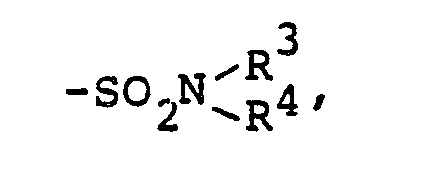
- the position of functional group such as -S0 2 CI, ' -SO 3 N, -SO 3 R 5 , or the like can be any one of o-, m- and p-position of a benzene ring with regard to the methylene group, or can be any one of 2- to 8-positions when the methylene group is attached to the 1- position of a naphthalene ring or any one of 1-position and 3-to 8-positions when the methylene group is attached to the 2-position of the naphthalene ring. In any cases, the effect as a photosensitizer is not influenced considerably.
- the effect is not so influenced when m, n and p are in the range of 1 to 20.
- m, n and p are in the range of 1 to 20.
- the methylene group chain becomes longer, there is a tendency to attain the same effect with a smaller amount and the solubility of the photosensitive compound of the formula (I) per se in a developing solution is lowered. From this point of view, the longer the methylene group chain becomes, the better the results become.
- the photosensitive compound of the formula (I) can be used not only in the production of semiconductor devices but also as a photosensitive reagent in the production of photoengraved plates, printing materials and the like applying the light reaction.
- the resultant residue (6.5 g) was purified by column chromatography on silica gel (Wako Gel C-200, manufactured by Wako Pure Chemical Industries, Ltd.) with n-hexane/ethyl acetate (5:1) as eluent to give the title compound as a pale yellow viscous oil, which solidified rapidly to afford pale yellow solid; yield: 4.2 g; mp 58.0-59.5C.
- Example 31 Using 4-diazo-1,7-bis(4-methyl-3-sulfophenyl)-3,5-heptanedione (1.0 g, 2 mmol) obtained in Example 31, the reaction was carried out in the same procedure as described in Example 21 to give the title compound as a pale yellow viscous oil; yield: 950 mg.
- a photosensitive composition having the following composition was prepared:
- the photosensitive composition was spin coated on a semiconductor substrate (Si substrate) in 1.0 ⁇ m thickness and prebaked at 90 C using a hot plate for 2 minutes. Then, a dissolving rate in an alkali developing solution [a 2.38% aqueous solution of tetramethylammonium hydroxide (TMAH)] was measured. The dissolving rate was 400 nm/min, which value was 1/10 of that of poly(p-vinylphenol)(4000 nm/min.). This means that the photosensitive compound mentioned above has a function of lowering the dissolving rate in the alkali developing solution.
- TMAH tetramethylammonium hydroxide
- a pattern was formed using the photosensitive composition as shown in Fig. 1.
- a layer 2 of the photosensitive composition was formed by spin coating on a substrate 1 such as a semiconductor in 1.0 ⁇ m thickness [Fig. 1 (a)].
- the substrate 1 may have thereon an oxidizing film, an insulating film, and an electroconductive film.
- the layer 2 was selectively exposed to KrF excimer laser 4 via a mask 5 [Fig. 1 (b)].
- the layer 2 was dipped in a 2.38% TMAH aqueous solution for 1 minutes to form a pattern 2a by dissolving and removing the exposed portions [Fig. 1(c)].
- the resulting pattern 2a had a film erosion of about 40%, an aspect ratio of 70 degree and resolution of 0.4 ⁇ m lines and spaces.
- Photosensitive compositions comprising a photosensitive compound of the formula (I) as listed in Table 1, poly(p-vinylphenol) as a polymer and diethylene glycol dimethyl ether as a solvent, in amounts as listed in Table 1 were prepared.
- Each photosensitive composition was subjected to the same dissolving test and pattern formation as in Example 45.
- Run Nos. 1 and 2 to 11 influences of substituents are shown in Run Nos. 1 and 2 to 11, wherein Run No. 2 is the best; in Run Nos. 18 and 19 to 22, wherein Run No. 19 is the best; and in Run Nos. 23 and 24 to 26, wherein Run No. 24 is the best.
Landscapes
- Chemical & Material Sciences (AREA)
- Organic Chemistry (AREA)
- Physics & Mathematics (AREA)
- General Physics & Mathematics (AREA)
- Spectroscopy & Molecular Physics (AREA)
- Engineering & Computer Science (AREA)
- Materials Engineering (AREA)
- Organic Low-Molecular-Weight Compounds And Preparation Thereof (AREA)
Abstract


Description
- This invention relates to a photosensitive compound useful as a photosensitive agent for lithography, e.g. for producing semiconductor devices.
- With recent higher density and larger scale integration of semiconductor devices, wavelengths used in exposing devices for minute processing, particularly for lithography become shorter and shorter. Now, KrF excimer laser light (248.4 nm) is studied. But, there have been no photosensitive materials suitable for such a wavelength.
- For example, even when MP 2400 (mfd. by Shipley Corp.), which is known among photoresists to have high sensitivity to KrF excimer laser light and good light transmittance, is used, pattern formation after development is very bad and cannot be used practically [K. Ogawa et al., J. Electrochem. Soc., 135, p2347 (1988)]..
- This seems to be derived from the fact that MP 2400 resist has a large surface absorption for the exposed light.
- This can be interpreted that the main polymer (resin) per se used in the resist has a large light absorption against the exposed light, or a photosensitive material in the resist has no good light reactivity.
- That is, photosensitive materials such as naphthoquinone diazides heretofore used in known resists generally have a large absorption against a light near 248.4 nm and are hardly improved in transmittance after exposure to light. For example, in the case of MP 2400 with a film thickness of 1 u.m, changes in light transmittance before and after exposure to light of KrF excimer laser (248.4 nm) is only about 3% at 248.4 nm as shown in Fig. 3 wherein the full line is before exposure and the dotted line is after exposure. This means that the reactivity is poor.
- On the other hand, U.S. Patent No. 4,622,283 to Gray discloses a lithographic resist composition for use with deep UV light of less than 300 nm wavelength containing as a photosensitive solubilizing agent a compound of the formula:

- Further, U.S. Patent No. 4,339,522 to Balanso et al disclose a lithographic resist composition comprising a phenolic-aldehyde resin and a deep ultraviolet sensitizer of the formula:

- Patent is quite silent on the reactivity against KrF excimer laser, resistance to alkaline developing solution and improvement in the contrast.
- It is an object of the present invention to provide photosensitive compounds having good reactivity against deep ultraviolet light near 248.4 nm so as to overcome defects of known lithographic resist compositions.
- It is another object of the present invention to provide process for producing the photosensitive compounds.
- The present invention provides a photosensitive compound represented by the formula:

- wherein R1 is

- X1 and Y1 are independently a hydrogen atom, a halogen atom, a lower alkyl group having 1 to 5 carbon atoms, a lower alkoxy group having 1 to 5 carbon atoms, -S02CI, -S02Br,

- -SO3H or -SO3R5; R3 and R4 are independently a hydrogen atom or a lower alkyl group having 1 to 5 carbon atoms, which may have one or more substituents, or R3, R4 and N taken together may form a heterocyclic ring such as a piperazine ring, a piperidine ring, a pyrrolidine ring, a morpholine ring, or the like; R5 is a lower alkyl group having 1 to 5 carbon atoms; the -SO2Cl or -SO2Br group may include a quaternary salt thereof; the -SO3H group may include an ammonium salt thereof, an organic base salt thereof and a quaternary salt thereof; m is an integer of 1 to 20; R2 is an alkyl group, a cycloalkyl group, a hydroxyalkyl group, an alkoxyalkyl group,


- X2 and Y2 are independently a hydrogen atom, a halogen atom, a lower alkyl group having 1 to 5 carbon atoms, a lower alkoxy group having 1 to 5 carbon atoms, -S02CI, -S02Br,

- -S03H or -SO3R8; R6 and R7 are independently a hydrogen atom or a lower alkyl group having 1 to 5 carbon atoms which may have one or more substituents, or R6, R7 and N taken together may form a heterocyclic ring such as a piperazine ring, a piperidine ring, a pyrrolidine ring, a morpholine ring, or the like; R8 is a lower alkyl group having 1 to 5 carbon atoms; the -S02CI or -S02Br group may include a quaternary salt thereof; the -SO3H group may include an ammonium salt thereof, an organic base salt thereof and a quaternary salt thereof; n is an integer of 1 to 20; or R1 and R2 taken together may form a group of the formula:

- wherein R9 is an alkyl group, an aralkyl group, a hydroxyalkyl group or an alkoxyalkyl group; X3 and Y3 are independently a hydrogen atom, a halogen atom, a lower alkyl group having 1 to 5 carbon atoms, a lower alkoxy group having 1 to 5 carbon atoms, -S02CI, -SO2Br,

- -SO3H or -SO3R5; R3, R4 and R5 are as defined above; the -S02CI or -S02Br group may include a quaternary salt thereof; the -SO3H group may include an ammonium salt thereof, an organic base thereof and a quaternary salt thereof; and p is an integer of 1 to 20.
- The photosensitive compounds of the formula (I) can be produced by various ways.
-
- Figs. 1 (a) to (c) are cross-sectional views explaining one example of a pattern forming process using a photosensitive compound of the present invention.
- Fig. 2 is a graph showing ultraviolet spectrophotometric characteristics of a photosensitive composition including a photosensitive compound of the present invention at near 248.4 nm.
- Fig. 3 is a graph showing ultraviolet spectrophotometric characteristics of MP 2400 at near 248.4 nm.
- The photosensitive compound of the present invention is represented by the formula:

- wherein R' is

- X' and Y1 are independently a hydrogen atom, a halogen atom, such as Cl, Br, I or F, a lower alkyl group having 1 to 5 carbon atoms, a lower alkoxy group having 1 to 5 carbon atoms, -S02CI, -SO2Br,

- -SO3H, or -SO3R5; R3 and R4 are independently a hydrogen atom or a lower alkyl group having 1 to 5 carbon atoms, which may have one or more substituents, or R3, R4 and N taken together may form a heterocyclic ring such as a piperazine ring, a piperidine ring, a pyrrolidine ring, a morpholine ring, or the like; R5 is a lower alkyl group having 1 to 5 carbon atoms; the -S02CI or -S02Br group may include a quaternary salt thereof; the -SO3H group may include an ammonium salt thereof, an organic base salt thereof and a quaternary salt thereof; m is an integer of 1 to 20; R2 is an alkyl group, a cycloalkyl group, a hydroxyalkyl group, an alkoxyalkyl group,

- X2 and Y2 are independently a hydrogen atom, a halogen atom such as Cl, Br, I or F, a lower alkyl group having 1 to 5 carbon atoms, a lower alkoxy group having 1 to 5 carbon atoms, -S02CI, -SO2Br,

- -SO3H or -SO3R8; R6 and R7 are independently a hydrogen atom or a lower alkyl group having 1 to 5 carbon atoms which may have one or more substituents, or R6, R7 and N taken together may form a heterocyclic ring such as a piperazine ring, a piperidine ring, a pyrrolidine ring, a morpholine ring, or the like; R8 is a lower alkyl group having 1 to 5 carbon atoms; the -SO2Cl or -S02Br group may include a quaternary salt thereof, the -SO3H group may include an ammonium salt thereof, an organic base salt thereof and a quaternary salt thereof; n is an integer of 1 to 20; or R1 and R2 teken together may form a group of the formula:

- wherein R9 is an alkyl group, an aralkyl group, a hydroxyalkyl group or an alkoxyalkyl group; X3 and Y3 are independently a hydrogen atom, a halogen atom such as Cl, Br, I or F, a lower alkyl group having 1 to 5 carbon atoms, a lower alkoxy group having 1 to 5 carbon atoms, -S02CI, -S02Br,

- -SO3H or -SO3R5; R3, R4 and R5 are as defined above; the -S02CI or -S02Br group may include a quaternary salt thereof; the -SO3H group may include an ammonium salt thereof, an organic base salt thereof and a quaternary salt thereof; and p is an integer of 1 to 20.
- As the base which can form a quaternary salt with -SO2Cl or -S02Br, there can be used pyridine, piperazine, piperidine, N-methylpyrrolidine, morpholine, diethylamine, triethylamine, etc.
- As the salt of organic base of -SO3H and the quaternary salt, there can be used salts of -SO3H and a base such pyridine, piperzine, piperidine, N-methylpyrrolidine, morpholine, diethylamine, triethylamine, or the like.
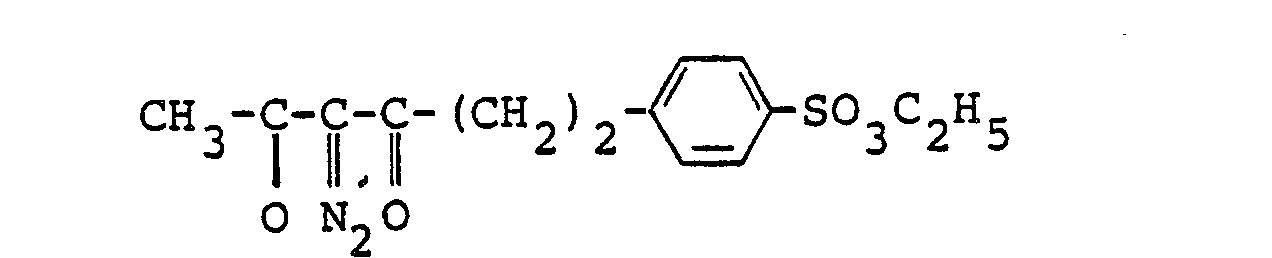
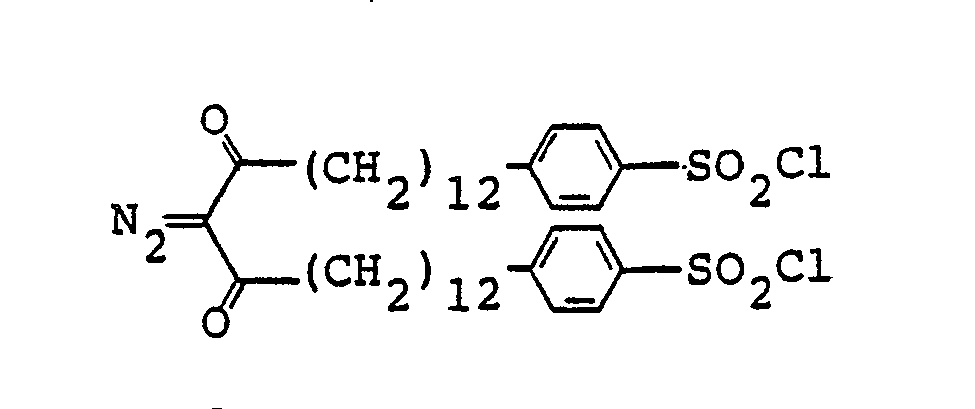
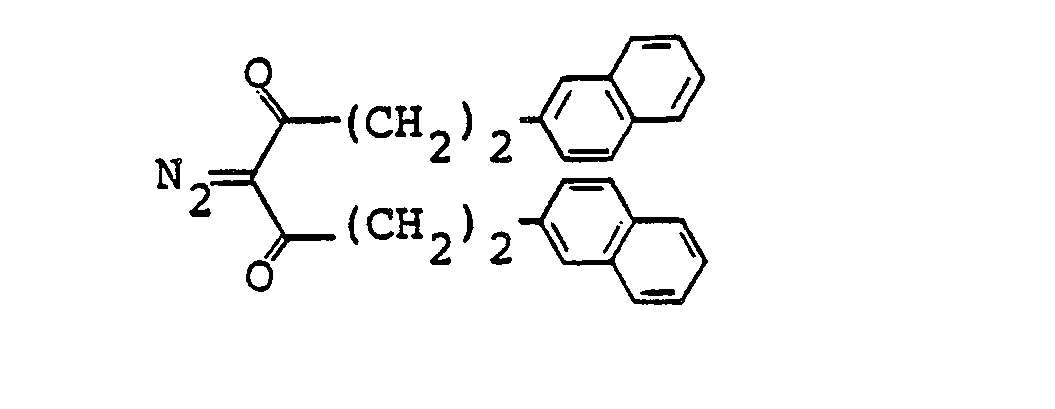
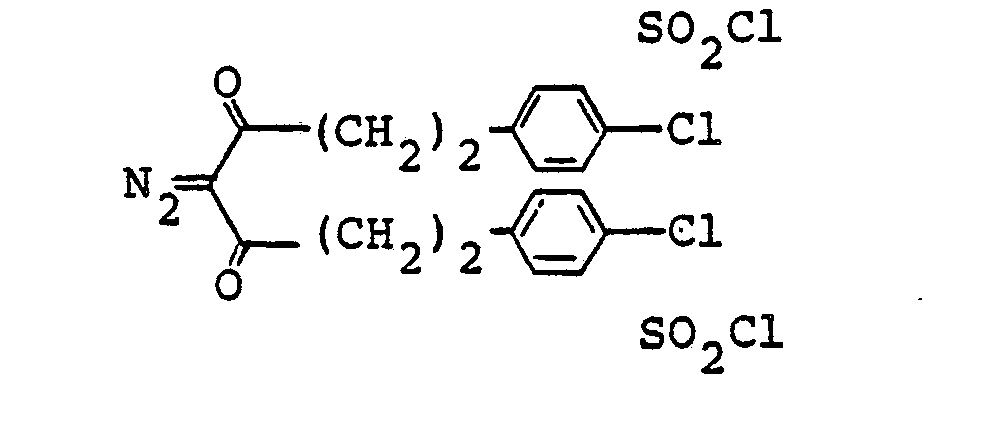
- The photosensitive compound of the formula (I) concretely includes the following compounds:


- Preferable examples of the compounds of the formula (I) are as follows.










- The compounds of the formula (I) can be produced by various ways.
- For example, the production of the compound of the formula (II), wherein X1 is a hydrogen atom, a halogen atom, a lower alkyl group or a lower alkoxy group (hereinafter defined as Z1) and Y1 is -S02CI, that is, a compound of the formula:


- In the above reactions, the diazotization can be carried out under the following conditions.
- As the diazotizing agent, there can be used p-toluenesulfonylazide, benzenesulfonylazide, 2-azide-3-ethylbenzothiazolium fluoroborate, etc.
- As the solvent, there can be used an alcohol such as ethanol, isopropanol, etc.; an ether such as ethyl ether, isopropyl ether, tetrahydrofuran, etc.; a halogenated hydrocarbon such as dichloromethane, chloroform, carbon tetrachloride, 1,2-dichloroethane, etc.; a hydrocarbon such as n-hexane, cyclohexane, toluene, etc.
- As the base, there can be used an organic base such as piperidine, triethylamine, N-methylpyrrolidine, N-methylmorpholine, pyridine, diethylamine, etc.; an alcoholate such as NaOCH3 , NaOC2Hs, KOC(CH3)3, KOC2H5, etc.; and Na, NaH, KH, etc.
- The diazotizing agent is used in an amount of preferably 0.5 to 3 moles, more preferably 0.8 to 1.5 moles per mole of the compound (11-1). The base is used in an amount of preferably 0.5 to 5 moles, more preferably 0.8 to 1.5 moles per mole of the compound (11-1).
- The reaction is carried out preferably at a temperature of -10° to 30 C, more preferably -5° to 10°C, for preferably 15 minutes to 5 hours, more preferably 1 to 2 hours.
- The chlorosulfonation can be carried out in a solvent or in the absence of a solvent under the following conditions.
- As the solvent, there can be used a chlorinated hydrocarbon such as carbon tetrachloride, tetrachloroethane, chloroform, 1,2-dichloroethane, dichloromethane, etc., carbon disulfide, so as to suppress side reactions.
- Chlorosulfonic acid is used in an amount of preferably 1 to 10 moles, more preferably 2.5 to 4.5 moles, per mole of the compound (11-4).
- The reaction is carried out preferably at a temperature of -20 to 20° C, more preferably -10° to 5° C, for preferably 15 minutes to 5 hours, more preferably 1 to 2 hours.
- The compound of the formula (II') can also be producee by reacting a compound of the formula:


- In the above reactions, the sulfonation can be carried out under the following conditions.
- As the sulfonating agent, there can be used chlorosulfonic acid, sulfuric acid, fuming sulfuric-acid, anhydrous sulfuric acid (sulfur trioxide), a complex of dioxane and anhydrous sulfuric acid, a complex of pyridine and anhydrous sulfuric acid, etc.
- As a solvent, in the case of using sulfuric acid, there can be used glacial acetic acid, acetic anhydride, ethyl acetate, ethyl ether, acetonitrile, carbon tetrachloride, etc.; and in the case of using other sulfonating agents, there can be used carbon disulfide, 1,2-dichloroethane, tetrachloroethane, chloroform, carbon tetrachloride, dichloromethane, nitromethane, nitrobenzene, etc.
- The sulfonating agent is used in an amount of preferably 1 to 10 moles, more preferably 1 to 3 moles, per mole of the compound (11-1).
- The reaction can be carried out preferably at -10 to 30° C, more preferably -5 to 5° C, preferably in the presence of a Ta powder as a catalyst in the case of using chlorosulfonic acid, or preferably at 0 to 100° C, more preferably at 0 to 10° C during the dropwise addition of a sulfonating agent such as sulfonic acid, fuming sulfuric acid, anhydrous sulfuric acid or a complex, and finally raised to 50 to 100 °C. After the dropwise addition of sulfonating agent, the reaction is preferably carried out for 1 to 3 hours.
- The neutralization is carried out by using a neutralizing agent (for inserting M), for example, a potassium salt such as KCI, K2CO3, KOH, KOR (R is an alkyl group), KHCO3, etc.; a sodium salt such as NaCI, Na2CO3, NaOH, NaOR (R is an alkyl group), NaHC03, etc.; an ammonium salt such as NH4CI, (NH4)-2C03, NH4HCO3, NH3, etc.; an organic base such as (C2Hs)3N, (C2Hs)2NH, etc.
- The diazotization can be carried out under the following conditions.
- As the diazotizing agent, there can be used p-toluenesulfonylazide, benzenesulfonylazide, 2-azido-3-ethylbenzothiazolium fluoroborate, etc.
- As the solvent, there can be used an alcohol such as ethanol, isopropanol, etc.; an ether such as ethyl ether, isopropyl ether, tetrahydrofuran, etc.; a halogenated hydrocarbon such as dichloromethane, chloroform, carbon tetrachloride, etc.; a hydrocarbon such as n-hexane, cyclohexane, etc.; an amide such as N,N-dimethylformamide (DMF), formamide, hexamethylphosphoramide (HMPA), etc.
- As the base, there can be used an organic base such as triethylamine, piperidine, etc.; an alcoholate such as NaOCH3, NaOC2H5, etc.
- The diazotizing agent is used in an amount of preferably 0.5 to 3 moles, more preferably 0.8 to 1.5 moles, per mole of the compound (11-2). The base is used in an amount.of preferably 0.5 to 5 moles, more preferably 0.8 to 1.5 moles, per mole of the compound (II-2).
- The reaction can be carried out at preferably -10 to 30 C, more preferably -5 to 10°C, for preferably 15 minutes to 5 hours, more preferably 1 to 2 hours.
- The chlorination can be carried out under the following conditions.
- As the chlorinating agent, there can be used thionyl chloride, phosgene (dimer), phosphorus pentachloride, phosphoryl chloride, chlorine, chlorosulfonic acid, etc.
- As the solvent, there can be used DMF, formamide, chloroform, dichloromethane, carbon tetrachloride, 1,2-dichloroethane, etc.
- The chlorinating agent is used in an amount of preferably 1 to 10 moles, more preferably 1 to 3 moles, per mole of the compound (11-3).
- The reaction can be carried out preferably at 0 to 100 C, more preferably 0 to 25 °C.
- When the compound of the formula:


- When the compound of the formula (II') is subjected to alcoholysis in place of hydrolysis, there can be obtained a compound of the formula:

- When the compound of the formula (II') is reacted with ammonia, an aliphatic amine, or an organic base, there can be obtained a compound of the formula:

- Examples of the aliphatic amine are monomethylamine, monoethylamine, monopropylamine, monobutylamine, monopentylamine, dimethylamine, diethylamine, dipropylamine, monoethanolamine, diethanolamine, etc.
- Examples of the organic base are piperidine, piperazine, pyrrolidine, morpholine, etc.
- The compound of the formula (11-1) can be prepared by reacting an ester of the formula:


- As the condensing agent, there can be used Na, NaOR" (R" is an alkyl group), NaNH2, KOR", KNH2, (C6H5)3CNa, etc.
- As the solvent, there can be used an ether such as isopropyl ether, tetrahydrofuran, etc.; the ester per se, the ketone per se, a hydrocarbon, etc.
- Alternatively, the compound of the formula (II-1) can be produced by reacting a ketone of the formula:


- As the condensing agent and the solvent, those mentioned above can also be used.
- The compound of the formula (III), wherein X1 is a hydrogen atom, a halogen atom, a lower alkyl group or a lower alkoxy group (= Z1) and Y1 is -SO2Cl, that is, the compound of the formula:
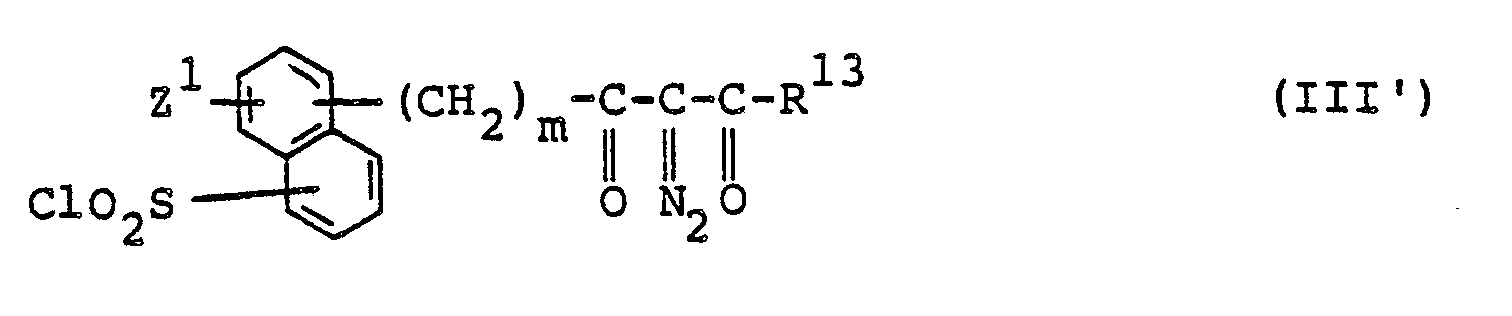


- The diazotization and the chlorosulfonation can be carried out in the same manner as described in the case of the compound of the formula (II').
- The compound of the formula (III') can also be produced by reacting a compound of the formula:


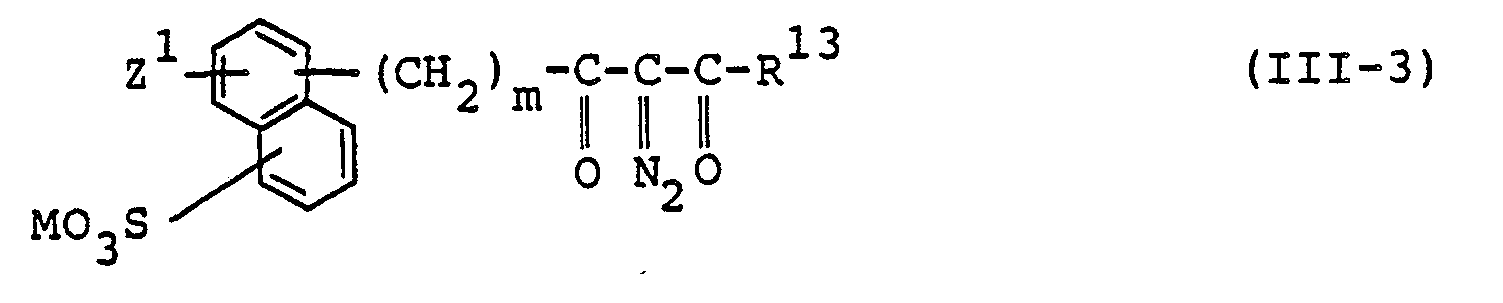
- The sulfonation, neutralization, diazotization and chlorination can be carried out in the same manner as described in the case of the compound of the formula (II').
- The hydrolysis, the alcoholysis, and the reaction with ammonia, an aliphatic amine or an organic base of the compound of the formula (III'), can be carried out in the same manner as described in the case of the compound of the formula (II') to yield the following compounds:


- In the formulae (III'), and (III-1) to (III-7), Z1, -SO3M, -S02CI, -S03H, -SO3R5 and


- The compound of the formula (III-1) can be prepared in the same manner as described in the case of the compound of the formula (11-1).
- The compound of the formula (IV), wherein X1 is a hydrogen atom, a halogen atom, a lower alkyl group or a lower alkoxy group (= Z1), X2 is a hydrogen atom, a halogen atom, a lower alkyl group or a lower alkoxy group (= Z2), Y1 is -S02CI and Y2 is -S02CI, 2 that is, a compound of the formula:


- The diazotization and the chlorosulfonation can be carried out in the same manner as described in the case of the compound of the formula (II'). In the chlorosulfonation, one of

- The compound of the formula (IV ) can also be produced by reacting a compound of the formula:


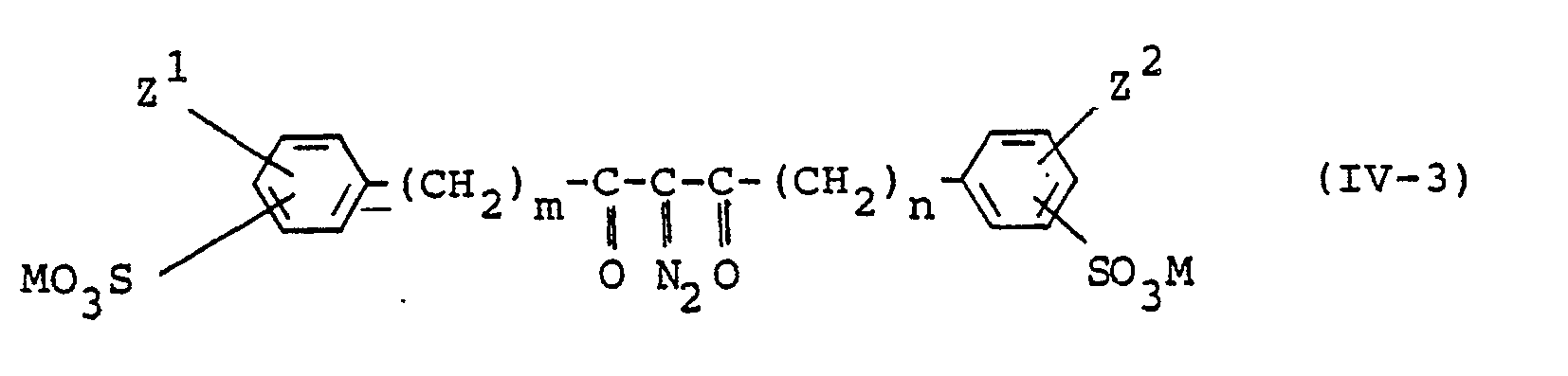
- The sulfonation, neutralization, diazotization and chlorination can be carried out in the same manner as described in the case of the compound of the formula (II'). In the above-mentioned reactions, one of

- The hydrolysis, the alcoholysis, and the reaction with ammonia, an aliphatic amine or an organic base, of the compound of the formula (IV') can be carried out in the same manner as described in the case of the compound of the formula (II') to yield the following compounds:


- The compound of the formula (IV-1) can be prepared in the same manner as described in the case of the compound of the formual (II-1). More concretely, a compound of the formula:


- The compound of the formula (IV-1) can also be prepared by reacting a ketone of the formula:
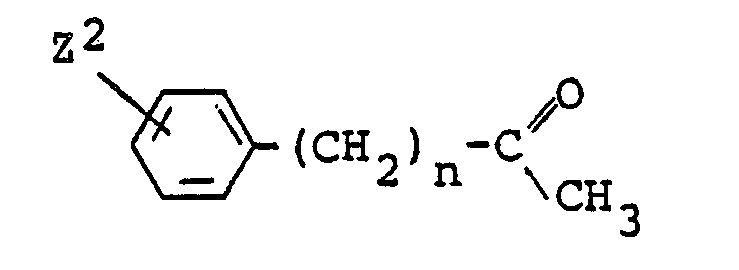

- The compound of the forlula (V), wherein X1 is a hydrogen atom, a halogen atom, a lower alkyl group or a lower alkoxy group (= ZI); X2 is a hydrogen atom, a halogen atom, a lower alkyl group or a lower alkoxy group (= Z2 ; Y1 is -SO2Cl; and Y2 is -S02CI, that is, the compound of the formula:


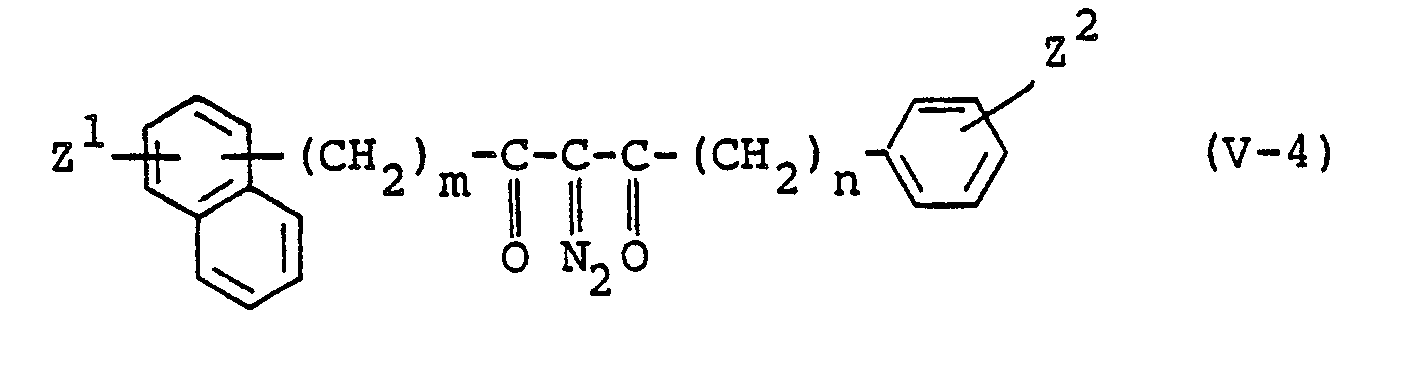
- The diazotization and the chlorosulnation can be carried out in the same manner as described in the case of the compound of the formula (II').
- The compound of the formula (V') can also be produced by reacting a compound of the formula:

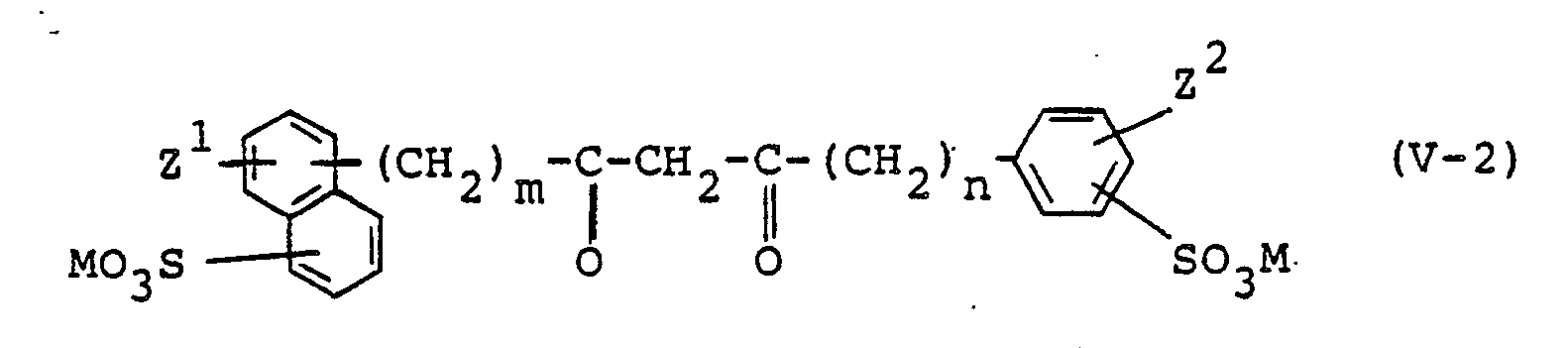

- The sulfonation, neutralization, diazotization and chlorination can be carried out in the same manner as described in the case of the compound of the formula (II').
- The hydrolysis, the alcoholysis, and the reaction with ammonia, an aliphatic amine or an organic base, of the compound of the formual (V') can be carried out in the same manner as described in the case of the compound of the formula (II') to yield the following compounds:


- In the formulae (V') and (V-1) to (V-7) Z1, -SO3M, -S02CI, -SO3H, -SO3R5, and


- The compound of the formula (V-1) can be prepared in the same manner as described in the case of the compound of the formula (IV-1).
- The compound of the formula (VI), wherein X1 is a hydrogen atom, a halogen atom, a lower alkyl group or a lower alkoxy group (= Z1); X2 is a hydrogen atom, a halogen atom, a lower alkyl group or a lower alkoxy group (= Z2); Y1 is -S02CI; and Y2 is -SO2Cl, that is, the compound of the formula:


- The diazotization and the chlorosulfonation can be carried out in the same manner as described in the case of the compound of the formula (II').
- The compound of the formula (VI') can also be produced by reacting a compound of the formula:


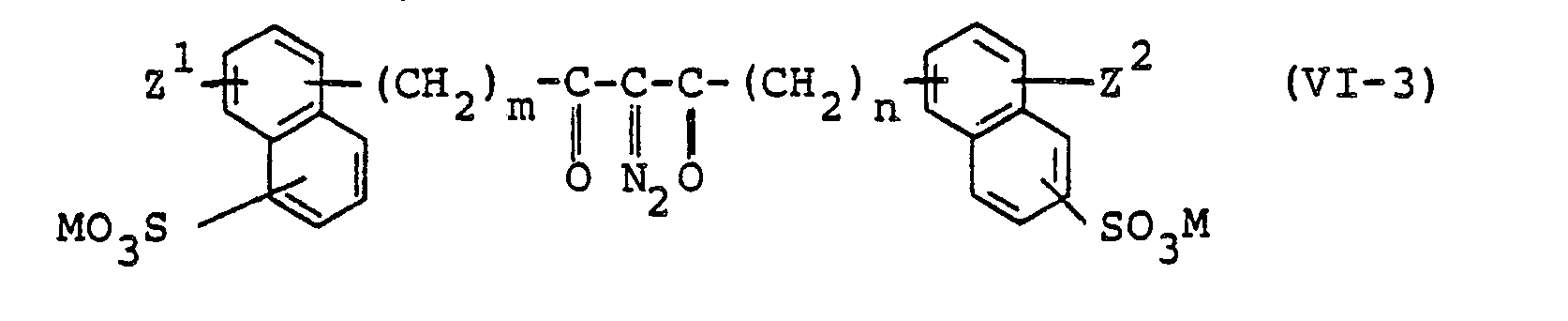
- The sulfonation, neutralization, diazotization and chlorination can be carried out in the same manner as described in the case of the compound of the formula (II').
- The hydrolysis, the alcoholysis, and the reaction with ammonia, an aliphatic amine or an organic base, of the compound of the formula (VI') can be carried out in the same manner as described in the case of the compound of the formula (II') to yield the following compounds:



- In the formulae (VI') and (VI-1) to (VI-7), Z1, Z2, -SO3M, -S02CI, -SO3H, -SO3R5, -SO3R8,


- The compound of the formula (VI-1) can be prepared in the same manner as described in the case of the compound of the formula (IV-1).
- The compound of the formula (VII), wherein X3 is a hydrogen atom, a halogen atom, a lower alkyl group or a lower alkoxy group (= Z1) and Y3 is -S02CI, that is, the compound of the formula:


- The diazotization and the chlorosulfonatoin can be carried out in the same manner as described in the case of the compound of the formula (II').
- The compound of the formula (VII') can also be produced by reacting a compound of the formula:


- The sulfonation, neutralization, diazotization and chlorination can be carried out in the same manner as described in the case of the compound of the formula (II').
- The hydrolysis, the alcoholysis, and the reaction with ammonia, an aliphatic amine or an organic base, of the compound of the formula (VII') can be carried out in the same manner as described in the case of the compound of the formula (II') to yield the following compounds:


- The compound of the formula (VII-1) can be prepared in the same manner as described in the case of the compound of the formula (11-1). More concretely, a compound of the formula:


- The photosensitive compound of the formula (I) has a great reactivity against a light of 248.4 nm, that is, has a large change in light transmittance before and after exposure to the light (about 50% or more) and shows a transmittance of 65% or more after exposure to the light. Further, in a photosensitive composition comprising a compound of the formula (I) having a functional group such as -S02CI, -SOsH or the like reactive with a resin as at least one of X1, X2, X3, Y1, Y2 and Y3, and a resin having OH groups, when heated after coating of the photosensitive composition, a crosslinking reaction proceeds, which results in producing an effect for decreasing a solubility of the resin in a developing solution. Thus, by using such a photosensitive composition as a resist or the like material, there can be obtained a resin pattern having a good (non-eroded) shape.
- That is, the group of the formula:


- Generally speaking, a positive-type resist material is a combination of a photosensitive substance, a resin and a solvent. As the resin, an alkali-soluble novolac resin is mainly used. Therefore, it is desirable that alkali solubility of non-light exposed portions of novolac resin is suppressed.
- In the compound of the formula [I] having one or more functional groups reactive with the resin as at least one of X1, X2, X3, Y1, Y2 and Y3, since there are one or more functional groups such as -S02CI, -S02Br or -SO3H, at terminal groups, crosslinking proceeds with heating by forming, for example, ester bonds such as

- Further, since the photosensitive compound of the formula (I) has one or two methylene chains such as -(CH2)m - in the molecule, the molecule as a whole is stabilized, which results in improving thermal stability of the compound of the formula (I). This also makes it possible to produce the compound of the formula (I) in indistrially large amounts and to store the compound of the formula (I) stably for a long period of time.
- In the compound of the formula (I), the position of functional group such as -S02CI, '
- The photosensitive compound of the formula (I) can be used not only in the production of semiconductor devices but also as a photosensitive reagent in the production of photoengraved plates, printing materials and the like applying the light reaction.
- The present invention is illustrated by way of the following Examples, in which all percents are by weight unless otherwise specified.
- Sodium azide (22.5 g, 0.35 mol) was dissolved in Hz0(65 ml) and diluted with 90% aqueous ethanol (130 ml). To this mixture, a solution of p-toluenesulfonyl chloride (60 g, 0.32 mol) in ethanol (300 ml) was added dropwise at 10-25°C and stirring was continued fo 2.5 hours at room temperature. The reaction mixture was evaporated under reduced pressure, the resultant residue was washed with H2O for several times, dried over anhydrous MgS04 and filtered with suction to give the title compound as a colorless oil; yield: 50.7 g. HNMR δppm (CDCl3): 2.43 (3H, s, CH3), 7.24 (2H, d, J = 8Hz, Ar3-H, 5-H), 7.67 (2H, d, J=8Hz, Ar 2-H, 6-H). IR (Neat) νcm-1: 2120.
- (Compound [II];; R13=-CH3, X' =-SO2Cl, Y1 = H, m = 1)
- Sodium (28 g) was added in small portions to a solution of ethyl phenyl acetate (600 g, 3.66 moles) and acetone (70.7 g, 1.22 moles) under nitrogen, was dissolved at 30-40 °C with stirring for 1 h and then the mixture was reacted at 70-80 °C for 4.5 h. The reaction mixture was taken up in H2O (1.2 ℓ ), neutralized with dilute hydrochloric acid and extracted with chloroform. The organic layer was washed with H20, dried over anhydrous MgSO4 and then evaporated. The residue was distilled under reduced pressure to give the title compound as a colorless oil; yield: 53.2 g; bp 142-146° C/15 mmHg. (Lit. bp 133-136°C/10 mmHg; K.G. Hampton, T.M. Harris, C.R. Hauser, Org. Synth., 51, 128 (1971)).
- To a solution of 1-phenyl-2,4-pentadione (36.2 g, 0.21 mol) obtained in above (1) and piperidine (17.5 g, 0.21 mol) in dichloromethane (500 ml), p-toluenesulfonyl azide (44.5 g, 0.23 mol) obtained in Example 1 was added dropwise at 0-5° C, and stirring was continued for 1 h at the same temperature. The reaction mixture was washed with dilute aqueous potassium hydroxide and H20, dried over anhydrous MgS04 and evaporated in vacuo. The resultant residue (50 g) was chromatographed on silica gel (Wako Gel C-200, manufactured by Wako Pure Chemical Industries, LTd.) with n-hexane/ethyl acetate (10:1) as eluent to give the title compound as a orange-red viscous oil; yield: 33.0 g. 'HNMR δppm(CDCl3): 2.36 (3H, S, CH3), 4.00 (2H, s, -CH2-), 7.23 (5H, s, ArH). IR (Neat) νcm-1 : 2140, 1660.
- (Compound [II]; R13 = -CH3, X1=-SO2Cl, Y1=H, m=1)
- To a solution of 3-diazo-1-phenyl-2,4-pentanedione (16.5 g, 0.082 mol) obtained in above (2) in chloroform (50 ml), chlorosulfonic acid (38 g) was added dropwise at -15~-10°C. The mixture was stirred for 2 h at -15~-10°C and for 3 h at 10-15°C, then poured into cold H20 (1.5t ), and extracted with chloroform. The organic extract was washed with H20, dried over anhydrous MgSO4, and then evaporated under reduced pressure. The resultant residue (20 g) was chromatographed on silica gel (Wako Gel C-200, manufactured by Wako Pure Chemical Industries, Ltd.) with n-hexane/ethyl acetate (5:1) as eluent to give the title compound as a yellow prisms after recrystallization from ethyl ether; yield: 4.0 g; mp 84.0-86.5° C (dec). 1HNMR δppm (CDCl3): 2.45 (3H, s, CH3), 4.30 (2H, s, -CH2-), 7.54 (2H, d, J=8Hz, Ar2-H, 6-H), 8.00 (2H, d, J=8Hz, Ar3-H, 5-H). IR (KBr) νcm-1: 2125, 1660. UV (CH3CN) λmax nm (loge): 244.2 (4.40). Anal. calcd. for C" H9ClN2O4S: C%, 43.94; H%, 3.02; N%, 9.32. Found: C%, 44.02; H%, 3.14; N%, 9.30.
- Synthesis of 6-(4-chlorosulfonylphenyl)-3-diazo-2,4-hexanedione
- (Compound [II]; R13=-CH3, X'=-S02CI, Y1=H, m=2)
- Sodium (23 g) was added in small portions to a solution of 4-phenyl-2-butanone (148 g, 1 mol) and ethyl acetate (264 g) at 20-60° C with stirring under nitrogen and then the reaction mixture was refluxed for 2 h with stirring. After cooling, the mixture was taken up in H2O (1ℓ), neutralized with hydrochloric acid, the organic layer was separated, washed with H20, dried over anhydrous Na2SO4 and then evaporated. The resultant residue (171 g) was distilled under reduced pressure to give the title compound as a colorless oil; yield: 73.4 g; bp 128-133 C/3-4 mmHg (Lit. bp 133-136° C/5 mmHg; C.R. Hauser, T.M. Harris, J.Am. Chem. Soc., 80, 6360 (1958)).
- Using 6-phenyl-2,4-hexanedione (29.0 g, 0.15 mol) obtained in above (1), the reaction was carried out in the same manner as described in Example 2, (2) to give the title compound as a orange-red amorphous solid; yield: 27.0 g; mp 30.0-32.0° C 1HNMR δppm (CDCl3): 2.47 (3H, s, CH3), 3.10 (4H, s, -CH2-CH2-), 7.28 (5H, s, ArH). IR (Neat) νcm-1: 2100, 1650 UV (CH3CN) λmax nm (log ∈): 229.3 (4.27)
- (Compound [II]; R13=-CH3, X1=-SO2Cl, Y1=H, m=2)
- Using 3-diazo-6-phenyl-2,4-hexanedione (10.8 g, 0.05 mol) obtained in above (2), the reaction was carried out in the same manner as described in Example 2, (3) to give the title compound as a pale yellow amorphous solid; yield: 3.0 g; mp 58.0-59.5°C. 1HNMR δppm (CDCl3): 2.40 (3H, s, CH3), 3.20 (4H, s, -CH2-CH2-CO-), 7.32 (2H, dd, J=8Hz, Ar2-H, 6-H), 7.97 (2H, dd, J = 8Hz, Ar3-H, 5-H). IR (Neat) νcm-1: 2130, 1660 UV (CH3CN) λmax nm (log ∈): 244.2 (4.36) Anal. calcd. for C12 H11ClN2O4S: C%, 45.65; H%, 3.51; N%, 8.87. Found: C%, 45.69; H%, 3.79; N%, 8.68.
- Synthesis of 4-(4-diazo-3,5-dioxohexyl)benzenesulfonic acid
- (Compound [II]; R13=-CH3, X1=-SO3H, Y1=H, m=2)
- 6-(4-Chlorosulfonylphenyl)-3-diazo-2,4-hexanedione (2.0 g; 6.4 mmol) obtained in Example 3, (3) was stirred in a solution of acetonitrile (15 ml) and H20 (45 ml) for 2 h at 30-35°C. The reaction mixture was washed with dichloromethane (40 ml x 2) and then the aqueous layer was evaporated to dryness under reduced pressure to give the title compound as a slightly yellow viscous oil; yield: 1.4 g. 1HNMR δppm (CDCl3-DMSO-d6): 2.37 (3H, s, CH3), 2.88 (2H, t, J=7Hz, -CH2-CO-), 3.07 (2H, t, J=7Hz, -CH2-CH2 CO-), 7.21 (2H, d, J = 8.5Hz, Ar3-H, 5-H), 7.58 (2H, d, J=8.5Hz, Ar2-H, 6-H), 10.53 (1 H, bs, -SO3H). IR (Neat) νcm-1: 3370, 2120, 1630. UV (CH3CN) λmax nm (log e): 226.4 (4.46). Anal. calcd. for C12H12N2O5S: C%, 48.64; H%, 4.08; N%, 9.45. Found: C%, 48.75; H%, 4.11; N%, 9.29.
- Synthesis of ammonium 4-(4-diazo-3,5-dioxohexyl) benzenesulfonate
- (Compound [II], R13=-CH3, X1=-SON⊕H4, Y1=H, m=2)

- To a solution of 4-(4-diazo-3,5-dioxohexyl) benzenesulfonic acid (890 g, 30 mmol) obtained in Example 4 in acetonitrile (5 ml), 28% aqueous ammonia (3 ml) was added dropwise at 5-10°C, and stirring was continued for 2 h at the same temperature. Then the mixture was evaporated under reduced pressure, and the residue was crystallized on treatment with acetonitrile to give the title compound as a white amorphous solid; yield: 750 mg; mp 81 °C (dec.). 'HNMR δppm (CDCl3-DMSO-d6): 2.40 (3H, s, -CO-CH3), 2.93 (1H, t, J=8Hz, -CH2-CO-), 3.06 (2H, t, 8Hz, -CH2CH2-CO-), 3.34 (4H, bs, -N⊕H4), 7.20 (2H, d, J=8Hz, Ar3-H, 5-H), 7.70 (2H, d, J=8Hz, Ar2-H, 6-H). IR (KBr) νcm-1: 3430, 2120, 1640. UV (H20)xmax nm (log e): 225.0 (4.36).
- (Compound [II]; R13=-CH3, X1=-SON⊕H(C2H5)3, Y1=H, m=2)
- To a solution of 4-(4-diazo-3,5-dioxohexyl)benzenesulfonic acid (890 mg, 30 mmol) obtained in Example 4 in acetonitrile (5 ml), triethylamine (3 ml) was added dropwise at 5-10 C, and stirring was continued for 2 h at the same temperature. Then the mixture was evaporated under reduced pressure, the residue was washed thrice with ethyl ether and evaporated to dryness under reduced pressure to give the title compound as a slightly yellow viscous oil; yield: 700 mg. 1HNMR δppm (CDCl3): 1.36 (9H, t, J=7Hz, N-CH2CH3 x 3), 2.42 (3H, s, -CO-CH3), 2.96-3.06 (4H, m, -CH2CH2-), 3.16 (6H, q, J=7Hz, N-CH2CH3 x 3), 7.24 (2H, d, J=8Hz, Ar3-H, 5-H), 7.81 (2H, d, J=8Hz, Ar2-H, 6-H). IR (Neat ) νcm-1: 3430, 2120, 1650. UV (CH3CN) λmax nm (log ∈): 226.4 (4.37). Anal. calcd. for C18H27N3O5S: C%, 54.39; H% 6.85; N%, 10.57 Found: C%, 54.11; H%, 7.14; N%, 10.36.
- (Compound [II]; R13=-CH3, X1=-SO3CH3, Y1=H, m=2)
- 6-(4-Chlorosulfonylphenyl)-3-diazo-2,4-hexanedione (2.0 g, 6.4 mmol) obtained in Example 3, (3) was stirred in triethylamine (1.5 ml), methanol (2.5 ml) and chloroform (8 ml) for 6 h at 10-15°C, then the mixture was poured into H2O and extracted thrice with chloroform. The organic extract was washed with H20, dried over anhydrous MgS04 and evaporated under reduced pressure. The residue was chromatographed on silica gel (Wako Gel C-200, manufactured by Wako Pure Chemical Industries, Ltd.) with chloroform as eluent to give the title compound as a pale yellow viscous oil; yield: 730 mg. 1HNMR δppm (CDCI3): 2.42 (3H, s, CH3), 3.03-3.18 (4H, m, -CH2CH2-), 3.76 (3H, s, S03CH3), 7.43 (2H, d, J=8.5Hz, Ar3-H, 5-H), 7.83 (2H, d, J=8.5Hz, Ar2-H, 6-H). IR (Neat) νcm-1: 2100, 1650. UV (CH3CN) λmax nm (log ∈): 227.8 (4.48). Anal. calcd. for C13H14N2O5S: C%, 50.32; H%, 4.55; N%, 9.03. Found: C%, 50.25, H%, 4.61; N%, 8.97.
- (Compound [II], R13=-CH3, X1 =-S03C2Hs, Y1=H, m=2)
- 6-(4-Chlorosulfonylphenyl)-3-diazo-2,4-hexanedione (2.0 g, 6.4 mmol) obtained in Example 3, (3) was stirred in triethylamine (1.5 mi) and ethanol (5 ml) for 16 h at room temperature, then the mixture was poured into H20 and extracted thrice with chloroform. The organic extract was washed with H20, dried over anhydrous MgSO4 and evaporated under reduced pressure. The residue was chromatographed on silica gel (Wako Gel C-200) with chloroform as eluent to give the title compound as a pale yellow viscous oil; yield: 550 mg. 1HNMR δppm (CDCl3): 1.31 (3H, t, J=7Hz, -S02CH2CH3), 2.42 (3H, s, -COCH3), 3.04-3.17 (4H, m, ArCH2CH2CO-(, 4.11 (2H, q, J=7Hz, -SO3CH2CH3), 7.42 (2H, d, J=8.5 Hz, Ar3-H, 5-H), 7.82 (2H, d, J=8.5 Hz, Ar2 = H, 6-H). IR (Neat) νcm-1: 2120, 1645. UV (CH3CN) λmax nm (log ∈): 229.0 (4.46). Anal. calcd. for C14H16N2O5S: C%, 51.84; H%, 4.97; N%, 8.64. Found: C%, 51.77; H%, 4.85; N%, 8.73.
- (Compound [II]; R13=-CH3, X1=-SO2NH2, Y1=H, m =2)
- To a solution of 6-(4-chlorosulfonylphenyl)-3-diazo-2,4-hexanedione (1.0 g, 3.2 mmol) obtained in Example 3, (3) in acetonitrile (5 ml), 28% aqueous ammonia (2 g) was added dropwise at 5-10°C, and stirring was continued for 6 h at room temperature. Then the mixture was evaporated under reduced pressure and the residue was chromatographed on silica gel (Wako Gel C-200; manufactured by Wako Pure Chemical Industries, Ltd.) with n-hexane/ethyl acetate (from 5:1 to 2:1) as eluent to give the title compound as a white amorphous solid; yield: 800 mg; mp 109.5-111.5° C. 'HNMR δppm (CDCl3-DMSO-d6): 2.41 (3H, s, COCH3), 3.02-3.13 (4H, m, -CH2CH2-), 6.42 (2H, bs, -NH2), 7.35 (2H, d, J = 8Hz, phenyl-C2, C6), 7.83 (2H, d, J =8Hz, phenyl-C3, Cs). IR (KBr) νcm-1: 2120, 1625. UV (CH3CN) λmax nm (log ∈): 228.8 (4.47) Anal. calcd. for C12H13N3O4S: C%, 48.80; H%, 4.44; N%, 14.23. Found C%, 48.69; H%, 4.39; N%, 14.41
- (Compound [II]; R13=-CH3, X1 =-S02N(C2Hs)2 Y1 =H, m =2)
- Using 6-(4-chlorosulfonylphenyl)-3-diazo-2,4-hexanedione (1.0 g, 3.2 mmol) obtained in Example 3, (3) and diethylamine (0.6 g), the reaction was carried out in the same manner as described in Example 9 to give the title compound as a slightly yellow viscous oil; yield; 770 mg. 'HNMR δppm (CDCl3): 1.13 (6H, t, J=7Hz, N-CH2CH3x 2), 2.42 (3H, s, -COCH3), 3.00-3.15 (4H, m, -CH2CH2CO-), 3.23 (4H, q, J=7Hz, N-CH2CH3x 2), 7.35 (2H, d, J=8.5Hz, Ar3-H, 5-H), 7.72 (2H, d, J=8.5 Hz, Ar2-H, 6-H). IR (Neat νcm-1: 2110, 1640. UV (CH3CN) λmax nm (log ∈): 232.5 (4.28) Anal. calcd. for C16H21N3O4S: C%, 54.69; H%, 6.02; N%, 11.96 Found: C%, 54.60; H%, 5.86: N%, 12.11
- (Compound [II]; R13 =-CH3,

- Using 6-(4-chlorosulfonylphenyl)-3-diazo-2,4-hexanedione (1.0 g, 3.2 mmol) obtained in Example 3, (3) and morpholine (0.83 g), the reaction was carried out in the same manner as described in Example 9 to give the title compound as a slightly yellow viscous oil; yield: 800 mg. 1HNMR δppm (CDCI3): 2.42 (3H, s, -COCH3), 2.99 (4H, t, J = 5Hz, morpholine 2-H, 2-H, 6-H, 6-H), 3.04-3.16 (4H, m, -CH2CH2CO-), 3.74 (4H, t, J=5Hz, morpholine 3-H, 3-H, 5-H, 5-H), 7.43 (2H, d, J=8Hz, Ar3-H, 5-H), 7.67 (2H, d, J= 8Hz, Ar2-H, 6-H). IR (Neat) vcm-1: 2130, 1645. UV (CHsCN) λmax nm (log e): 230.9 (4.47). Anal. calcd. for C16H19N4O5S: C%, 52.59; H%, 5.24; N%, 11.50. Found: C%, 52.42; H%, 5.30; N%, 11.66.
- (Compound [II]; R13=-CH3,
-

- Y1=H, m=2)
- Using 6-(4-chlorosulfonylphenyl)-3-diazo-2,4-hexanedione (1.0 g, 3.2 mmol) obtained in Example 3, (3) and piperidine (0.65 g), the reaction was carried out in the same manner as described in Example 9 to give the title compound as a slightly yellow viscous oil; yield: 730 mg. 1HNMR δPPM (CDCl3): 1.37-1.51 (2H, m, piperidine 4-H, 4-H), 1.60-1.74 (4H, m, piperidine 3-H, 3-H, 5-H, 5-H), 2.42 (3H, s, -COCH3), 2.96-3.18 (8H, m, -CH2CH2CO- and piperidine 2-H, 2-H, 6-H, 6-H), 7.38 (2H, d, J = 8Hz, Ar3-H, 5-H), 7.67 (2H, d, J=BHz, Ar2=H, 6-H). IR (Neat) νcm-1: 2130, 1640. UV (CH3CN) λmax nm (log e): 231.2 (4.46) Anal. calcd. for C17H21N3O4S: C%, 56.18; H%, 5.82; N%, 11.56. Found: C%, 56.01; H%, 6.10; N%, 11.49.
- (Compound [II]; R13=-CH3, X1=-SO2Cl, Y1=H, m=5)
- To a suspension of lithium aluminum hydride (67.2 g) in dry tetrahydrofuran (2.5 ℓ), a solution of 4-phenylbutyric acid (225 g, 1.37 mmoles) in dry tetrahydrofuran was added dropwise at 15-25°C under nitrogen. The resultant mixture was stirred for 1 h at room temperature, then poured into ice-cold H20 (3 ℓ) and sulfuric acid (200 g) and extracted thrice with ethyl acetate. The organic extract was dried over anhydrous Na2SO4, evaporated, and then the residue was distilled under reduced pressure to give the title compound as a colorless oil; yield: 191 g; bp 113-115°C/0.5 mmHg (Lit. bp 92-93°C/0.3 mmHg; B.H. Baker, W.B. Martin, J. Org. Chem., 25, 1496 (1960)).
- Thionyl chloride (300 g) was added dropwise in 4-phenylbutanol (189 g, 1.26 mols) obtained in above (1) at room temperature and stirring was continued for 4 h under reflux. The reaction mixture was evaporated and the resultant residue was distilled under reduced pressure to give the title compound as a colorless oil; yield: 149 g; bp 122-123°C/17 mmHg (Lit. bp 90-91°C/2 mmHg; A.Iliceto, A. Fava, A. Simeone, Gazz. chim, ital., 90, 600 (1960)).
- To a suspension of sodium hydride (60% in oil, 10.7 g) in dry cyclohexane (140 ml), a solution of 2,4-pentanedione (26.7 g, 0.267 mol) in dry cyclohexane was added dropwise at room temperature with stirring under nitrogen, and the resultant mixture was stirred for 2 h at the same temperature. To this suspension, N,N,N',N'-tetramethylethylenediamine (34.1 g) was added dropwise, followed by the dropwise addition of n-butyllithium (1.6 M in n-hexane solution, 185 ml) at 0°C or lower and the resultant mixture was stirred for 2 h at room temperature. Then to this suspension, 1-chloro-4-phenylbutane (52.3 g, 0.31 mol) obtained in above (2) was added dropwise at 0-5 °C and stirring was continued for 3 h at room temperature. The reaction mixture was poured into ice-cold H20 (1ℓ), neutralized with dilute hydrochloric acid and extracted twice with ethyl acetate. The organic extract was washed with H20, dried over anhydrous MgSO4 and solvent was removed. The residue was chromatographed on silica gel (Wako Gel C-200) with benzene/n-hexane (4:1) as eluent to give the title compound as a pale yellow oil which was an ca 1:6 mixture of Keto/Enol as seen by the methylene singlet at δ3.55 ppm and the methine singlet at 55.47 ppm in the 1HNMR spectrum; yield; 8.5 g. 'HNMR δppm (CDCl3): 1.34-1.71 (6H, m, -CH2CH2CH2-CH2CO-), 2.04 (3H, s, -COCH3), 2.26 (2H, t, J=8Hz, -CH2COCH2CO-), 2.61 (2H, t, J=8Hz, Ar-CH2-), 3.55(2H, s, -COCH2CO-), 5.47 (1H, s, - C =CH-CO-), 7.16 -7.30 (5H, m, ArH), 15.49 (1 H, bs, -OH). IR (Neat) νcm-1: 1725, 1600.
- Using 9-phenyl-2,4-hexanedione (7.8 g, 0.034 mol) obtained in above (3) and triethylamine (3.4 g, 0.034 mol), the reaction was carried out in the same manner as described in Example 2, (2) and the crude product was purified by column chromatography on silica gel (Wako Gel C-200) eluting with n-hexane/dichloromethane (2:1 → 1:1 → 1:4) to afford the title compound as a yellow viscous oil; yield;5.2 g. 'HNMR δppm (CDCl3): 1.35-1.74 (6H, m, -CH2CH2CH2-CH2CO-), 2.43 (3H, s, -COCH3), 2.61 (2H, t, J=8Hz, Ar-CH2-), 2.70 (2H, t, J=8Hz, -CH2CO-), 7.15-7.30 (5H, m, ArH). IR (Neat) νcm-1: 2100, 1650.
- (Compound [II]; R13=-CH3, X' =-SO2Cl, Y' = H, m=5)
- Using 3-diazo-9-phenyl-2,4-nonanedione (3.6 g, mmol) obtained in above (4), the reaction was carried out in the same manner as described in Example 2, (3) to give the title compound as a slightly yellow viscous oil; yield: 1.4 g. 1HNMR δppm (CDCl3): 1.37-1.75 (6H, m, -CH2CH2CH2-CH2CO-), 2.43 (3H, s, -COCH3), 2.74 (4H, m, -CH2-CO- and Ar-CH2), 7.41 (2H, d, J=8Hz, Ar2-H, 6-H), 7.95 (2H, d, J=8Hz, Ar3-H, 5-H). IR (Neat) νcm-1 2100, 1645 UV (CH3CN) λmax nm (log e): 242.2 (4.27). Anal. Calcd. for C15H17ClN2O4C%, 50.49; H%, 4.80; N%, 7.85. Found: C%; 50.63; H%, 4.69; N%, 7.77.
- (Compound [II]; R13=-CH3, X1=-SO3C2H5, Y1=H, m=5)
- Using 9-(4-chlorosulfonylphenyl)-3-diazo-2,4-nonanedione (1.1 g, 3.1 mmol) obtained in Examle 13, (5), the reaction was carried out in the same manner as described in Example 8 and the crude oil was chromatographed on silica gel (Wako Gel C-200) with chloroform as eluent to give the title compound as a pale yellow viscous oil; yield: 850 mg. 1HNMR δppm (CDCl3): 1.23-1.34 (5H, m, -CH2CH2CH2CO- and -SO3CH2CH3), 1.59-1.64 (4H, m, ArCH2CH2 and -CH2CH2CO-), 2.36 (3H, s, -COCH3), 2.60-2.69 (4H, m, Ar-CH2-and -CH2CO-), 4.04 (2H, q, J=7Hz, -SO3CH2CH3), 7.27 (2H, d, J=8Hz, Ar2-H, 6-H), 7.73 (2H, d, J=8Hz, Ar3-H, 5-H). IR (Neat) νcm-1: 2100, 1640. Anal. calcd, for C17H22N2O5S: C%, 55.72; H%, 6.05; N%, 7.64. Found: C%, 55.61; H%, 6.21; N%, 7.88.
- (Compound [II]; R13=CH3CH3CH2-, X1=-SO2Cl, Y1=H, m=2)
- Sodium (7.3 g) was added in small portions to a solution of 4-phenyl-2-butanone (46.8 g, 0.31 mol) and ethyl butyrate (110 g, 0.95 mol) in toluene (120 ml) at 20-60°C under nitrogen, and stirring was continued for 9 h under reflux. After standing overnight, the reaction mixture was taken up in H20 (300 ml), neutralized with hydrochloric acid and extracted with ethyl acetate. The organic layer was washed with H2O, dried over anhydrous MgS04 and then evaporated. The residual reddish orange oil (84 g) was distilled under reduced pressure to afford the title compound as a pale yellow oil which was an ca 3:7 mixture of Keto/Enol as seen by the methylene singlet at δ3.52 ppm and the methine singlet as δ5.45 ppm in the 1HNMR spectrum; yield: 15.4 g; bp. 166-168°C/2 mmHg. 1HNMR δppm (CDCl3): 0.93 (3H, t, J=7Hz, -CH3), 1.53-1.67 (2H, m, -CH2CH3), 2.23 (2H, t, J=7Hz, -CH2CH2CH3), 2.60 (2H, t, J=7Hz, Ar-CH2CH2-), 2.94 (2H, t, J=7Hz, Ar-CH2-), 3.52 (2H, s, -COCH2CO-), 5.45 (1 H, s, - C = CHCO-), 7.16-7.28 (5H, m, ArH), 15.46 (1 H, bs, OH). IR (Neat) vcm-1: 1600.
- Using 1-phenyl-3,5-octanedione (7.6 g, 35 mmol) obtained in above (1), the reaction was carried out in the same manner as described in Example 3, (2), and the crude oil (12 g) was purified by column chromatography om silica gel (Wako Gel C-200) with n-hexane/ dichloromethane (5:1 → 3:1 - 1:1) as eluent to give the title compound as a yellow oil; yield: 5.3 g. 1HNMR δppm (CDCl3): 0.97 (3H, t, J=7Hz, CH3), 1.63-1.77 (2H, m, -CH2CH3), 2.68 (2H, t, J= 7Hz, -CH2CH2CH3), 2.94-3.11 (4H, m, A4-CH2CH2-), 7.19-7.33 (5H, m, ArH). IR (Neat) vcm-1: 2140, 1650.
- (Compound [II]; R13=CH3CH2CH2-, X1=-SO2Cl, Y1=H, m=2)
- Using 4-diazo-1-phenyl-3,5-octanedione (5.2 g, 21.3 mmol) obtained in above (2), the reaction was carried out in the same manner as described in Example 3, (3), and the crude oil (3 g) was chromatographed on silica gel (Wako Gel C-200, manufactured by Wako Pure Chemical Industries, Ltd.) with n-hexane/ethyl acetate (from 5:1 to 3:1) as eluent to give the title compound as a pale yellow viscous oil; yield: 900 mg. 1HNMR δppm (CDCl3): 0.98 (3H, t, J=7Hz, -CH3), 1.63-1.77 (2H, m, -CH2CH3), 2.63 (2H, t, J=7Hz, -CH2CH2CH3), 3.09 (2H, t, J = 7Hz, Ar-CH2CH2-), 3.22 (2H, t, J=7Hz, Ar-CH2-), 7.49 (2H, d, J=9Hz, Ar2-H, 6-H), 7.95 (2H, d, J = 9Hz, Ar3-H, 5-H). IR (Neat) νcm-1: 2140, 1650. Anal. calcd. for C14H15ClN2O4S: C%, 49.05; H%, 4.41; N%, 8.17. Found: C%, 48.89; H%, 4.66; N%, 8.34.
- (Compound [II]; R13=-CH3, X1=-SO2Cl, Y1 = H, m=2)
- To a suspensoin of 6-phenyl-2,4-hexanedione (15.2 g, 80 mmol) obtained in Example 3, (1) and tantalum powder (100 mg) in carbon tetrachloride (40 ml), chlorosulfonic acid (9.4 g, 80 mmol) was added dropwise at -5-0°C, and stirring was continued for 30 min at the same temperature. After reaction, supernatant solvent was decanted, the residue was treated with cold H20 (150 ml) and filtered to removed inorganic materials. Then to the filtrate, dilute aqueous potassium hydroxide was added, evaporated to dryness under reduced pressure and the residue was recrystallized from ethanol to give the title compound as a white prisms; yield: 16.0 g; mp 153°C (dec.). 'HNMR δPPM (CDCl3-DMSO-d6): 2.01 (3H, s, CH3), 2.54 (2H, t, J=7Hz, -CH2CH2CO-), 2.85 (2H, t, J=7Hz, Ar-CH2-), 7.16 (2H, d, J=8Hz, Ar2-H, 6-H), 7.62 (2H, d, J=8Hz, Ar3-H, 5-H). IR (KBr) νcm-1: 1690.
- To a solution of potassium 4-(3,5-dioxohexyl)benzenesulfonate (15.4 g, 50 mmol) obtained in above (1) and triethylamine (5.7 g, 56 mmol) in N,N-dimethylformamide (100 ml) and dichloromethane (20 ml), p-toluenesulfonylazide (10.6 g, 54 mmol) obtained in Example 1 was added dropwise at 0-5 °C, and stirring was continued for 4 h at the same temperature. Then the reaction mixture was taken up in dichloromethane (400 ml), the resultant precipitate was filtered, washed thrice with dichloromethane and dried in vacuo to give the title compound as a pale yellow solid; yield: 12.5 g; mp 75 °C (dec.). 'HNMR δppm (CDCl3-DMSO-d6): 2.38 (3H, s, CH3), 2.89 (2H, t, J=7Hz, -CH2CH2CO-), 3.06 (2H, t, J=7Hz, Ar-CH2-), 7.18 (2H, d, J = 8Hz, Ar2-H, 6-H), 7.63 (2H, d, J = 8Hz, Ar3-H, 5-H). IR (KBr) νcm-1: 2120, 1640.
- (Compound [II]; R13=-CH3, X1=-SO2Cl, Y1 =H, m=2)
- To a solution of potassium 4-(4-diazo-3,5-dioxohexyl)benzenesulfonate (11.7 g, 35 mmol) obtained in above (2) in N, N-dimethylformamide (40 ml), thionyl chloride (6.3 g, 53 mmol) was added dropwise at 10-15°C, and stirring was continued for 2 h at room temperature. The reaction mixture was poured into cold H2O (400 ml), extracted with chloroform, the organic layer was washed with H20, dried over anhydrous MgS04 and evaporated in vacuo. The resultant residue (6.5 g) was purified by column chromatography on silica gel (Wako Gel C-200, manufactured by Wako Pure Chemical Industries, Ltd.) with n-hexane/ethyl acetate (5:1) as eluent to give the title compound as a pale yellow viscous oil, which solidified rapidly to afford pale yellow solid; yield: 4.2 g; mp 58.0-59.5C.
- 1HNMR, IR and UV spectra of this product were identical with those of the product as described in Example 3,(3).
- (Compound [IV]; Y1=Y2=H, X1=X2=-SO2Cl, m=n=2)
- To a suspension of sodium hydride (60% in oil, 17 g) in dry cyclohexane (200 ml), a solution of 2,4-pentanedione (37 g, 0.37 mol) in dry cyclohexane was added dropwise at room temperature with stirring under nitrogen, and the resultant mixture was stirred for 40 min at the same temperature. To this suspension, N,N,N',N'-tetramethylethylenediamine (91.8 g) was added dropwise, followed by the dropwise addition of n-butyllithium (1.6 M in n-hexane solution, 337 g) at 0°C or lower and the resultant mixture was stirred for 24 h at room temperature. Then to this suspension, benzyl chloride (93.7 g) was added dropwise at 0-5°C, stirring was continued for 2 h at room temperature and standed for overnight. The reaction mixture was poured into dilute hydrochloric acid, the organic layer was separated, washed thrice with H20, dried over MgSO4 and evaporated. The residue (79 g) was distilled under reduced pressure to give the title compound as a pale yellow oil; yield: 23.5 g; bp 185-190 C/0.4 mmHg.
- To a solution of 1,7-diphenyl-3,5-heptanedione (16.6 g, 60 mmol) obtained in above (1) and piperidine (5.1 g, 60 mmol) in dichloromethane (120 ml), p-toluenesulfonylazide (12.4 g, 63 mmol) obtained in Example 1 was added dropwise at 0-5 C, and stirring was continued for 2 h at the same temperature. The reaction mixture was washed with dilute aqueous potassium hydroxide and H20, dried over anhydrous MgS04 and evaporated in vacuo. The resultant residue (19 g) was chromatographed on silica gel (Wako Gel C-200, manufactured by Wako Pure Chemical Industries, Ltd.) with dichloromethane as eluent to give the title compound as a slightly yellow crystals; yield: 8.0 g; mp 62.5-64.0 C. 1HNMR δppm (CDCl3): 2.93-3.08 (8H, m, -CH2-x4), 720 (10H, s, ArH x 2). IR (KBr) νcm-1: 2120, 1650. UV (CHaCN) λmax nm (log ∈): 231.0 (4.28).
- (Compound [IV]; Y1=Y2=H, X1=X2=-SO2Cl, m=n=2)
- A solution of 4-diazo-1,7-diphenyl-3,5-heptanedione (7.5 g, 24 mmol) obtained in above (2) in chloroform was added dropwise into chlorosulfonic acid (22.4 g) at 0-5°C, and stirring was continued for 1 h at the same temperature. The reaction mixture was poured into cold H20 (0.5 1), extracted with chloroform, the organic extract was washed with H20 for several times, dried over anhydrous MgSO4 and evaporated in vacuo. The resultant residue (5 g) was chromatographed on silica gel (Wako Gel C-200, manufactured by Wako Pure Chemical Industries, Ltd.) with n-hexane/ethyl acetate (from 3:1 to 1:1) as eluent to give the title compound as yellow crystals; yield: 3.0 g; mp 121-122.5°C. 'HNMR δppm (CDCl3): 3.11 (8H, s, -CH2-x4), 7.40 (4H, d, J=8Hz, (Ar2-H, 6-H)x2), 7.53 (4H, d, J=8Hz, (Ar3-H, 5-H)x2). IR (KBr) νcm-1: 2130, 1640. UV (CH3CN) λmax nm (log e): 245.6 (4.54). Anal. calcd. for C19H15Cl2N2O6S2: C%,45.34; H%, 3.20; N%, 5.57. Found: C%, 45.25; H%, 3.36; N%, 5.56.
- (Compound [IV], Y1 =Y2=H, X1 =X2 =-SO3C2H5, m = n=2)
- To a solution of 1,7-bis(4-chlorosulfonylphenyl)-4-diazo-3,5-heptanedione (700 mg, 1.4 mmol) obtained in Example 17, (3), in ethanol (15 ml) and dichloromethane (10 ml), triethylamine (420 mg) was added dropwise at 5-10°C, and stirring was continued for 8 h at room temperature. The reaction mixture was concentrated under reduced pressure, diluted with dichloromethane (40 ml), washed thrice with H20, dried over anhydrous MgS04 and evaporated under reduced pressure. The resultant residue (820 mg) was chromatographed on silica gel (Wako Gel C-200) with n-hexane/ethyl acetate (from 5:1 to 3:1) as eluent to give the title compound as a slightly yellow viscous oil; yield: 450 mg. 1HNMR δppm (CDCl3): 1.31 (6H, t, J=7Hz, SO3CH2CH3 x2), 3.08 (8H, bs, Ar-CH2CH2CO- x 2), 4.12 (4H, q, J = 7Hz, SO2CH2CH3 x 2), 7.41 (4H, d, J=8Hz, (Ar2-H, 6-H) x 2), 7.83 (4H, d, J=8Hz, (Ar 3-H, 5-H) x 2). IR (Neat) νcm-1: 2130, 1650. UV (CH3CN) λmax nm (log ∈): 229.0 (4.62). Anal. calcd. for C23H26N3O8S2: C%, 52.86; H%, 5.01; N%, 5.36. Found: C%, 52.65; H%, 5.21; N%, 5.31.
- (Compound [IV]; Y' =Y2=H, X1 =X2=-S02N(C2Hs)2, m=n=2)
- To a solution of 1,7-bis(4-chlorosulfonylphenyl)-4-diazo-3,5-heptanedione (700 mg, 1.4 mmol) obtained in Example 17, (3) in acetonitrile (15 ml), N,N-diethylamine (1 g) was added dropwise at 5-10°C, and stirring was continued for 10 h at room temperature. The reaction mixture was concentrated under reduced pressure, diluted with methylenechloride (40 ml), washed thrice with H20, dried over anhydrous MgSO4 and evaporated under reduced pressure. The resultant residue (800 mg) was chromatographed on silica gel (Wako Gel C-200) with n-hexane/ethyl acetate (from 5:1 to 3:1) as eluent to give the title compound as a slightly yellow viscous oil; yield: 370 mg. 'HNMR δppm (CDCl3): 1.13 (12H, t, J=7Hz, N-CH2CH3 x 4), 3.05 (8H, bs, -CH2CH2CO- x 2), 3.23 (8H, q, J=7Hz, N-CH2CH3 x 4), 7.34 (4H, d, J=8Hz, (Ar2-H, 6-H) x 2), 7.73 (4H, d, J=8Hz, (Ar3-H, 5-H) x 2). IR (Neat) νcm-1: 2120, 1650. UV (CH3CN) λmax nm (log e): 234.4 (4.58). Anal. calcd. for C27H36N4O6S2: C%, 56.23; H%, 6.29; N%, 9.71. Found: C%, 56.40; H%, 6.42; N%, 9.60.
- (Compound [IV]; Y1=Y2=H,X1=X2=-SO3H,m=n = 2)
- 1,7-Bis(4-chlorosulfonylphenyl)-4-diazo-3;5-heptanedione (2.0 g, 4.0 mmol) obtained in Example 17, (3) was stirred in a solution of acetonitrile (70 ml) and H20 (50 ml) for 25 h at 30-35°C. The reaction mixture was washed with dichloromethane (30 ml x 3) and then the aqueous layer was evaporated to dryness under reduced pressure to give the title compound as a pale yellow viscous oil; yield: 1.6 g. 1HNMR δppm (DMSO-d6-CDCl3): 2.85 (4H, t, J=7Hz, -CH2CH2CO- x 2), 3.08 (4H, t, J=7Hz, ArCH2CH2CO- x 2), 5.32 (2H, bs, SO3H x 2), 7.21 (4H, d, J=BHz,(Ar3-H, 5-H) x 2), 7.54 (4H, d, J=8Hz. (Ar2-H, 6-H) x 2). IR (Neat) νcm-1: 2110, 1635. Anal. calcd. for C19H18N2O8S2: C%, 48.92; H%, 3.89; N%, 6.01. Found: C%, 49.20; H%, 4.15; N%, 5.79.
- (Compound [IV];Y1=Y2=H,X1=X2=-SO3N⊕H4, m=n=2)
- To a solution of 4-diazo-1,7-bis(4-sulfophenyl)-3,5-heptanedione (700 mg, 1.5 mmol) obtained in Example 20 in acetonitrile (20 ml), 28% aqueous ammonia (400 mg) was added dropwise at 0-5 °C, and stirring was continued for 3 h at the same temperature. Then the mixture was evaporated under reduced pressure, the residue was washed with acetonitrile for several times and evaporated to dryness under reduced pressure to give the title compound as a slightly yellow viscous oil; yield: 650 mg. 1HNMR δppm (CDCl3-DMSO-d6): 2.84 (4H, t, J=7Hz, -CH2CO- x 2), 3.08 (4H, t, J=7Hz, Ar-CH2 x 2), 4.04 (8H, bs, ⊕NH4 x 2), 7.18 (4H, d, J = 8Hz, (Ar2-H, 6-H) x 2), 7.52 (4H, d, J = 8Hz, (Ar3-H, 5-H) x 2).
- (Compound [IV]; Y' = Y2 = H, X1 = X2 = SO 9 N⊕H(C2 H5)3, m = n = 2)
- To a solutoin of 4-diazo-1,7-bis(4-sulfophenyl)-3,5-heptanedione (700 mg, 1.5 mmol) obtained in Example 20 in acetonitrile (20 ml), triethylamine (600 mg) was added dropwise at 0-5°C, and stirring was continued for 3 h at the same temperature. Then the mixture was evaporated under reduced pressure, the resultant residue was washed with acetonitrile for several times and evaporated to dryness under reduced presence to give the title compound as a pale yellow viscous oil; yield: 900 mg. 1HNMR sppm (CDCl3-DMSO-d6): 1.16 (18H, t, J=7Hz, N-CH2CH3 x 6), 2.84 (4H, t, J=7Hz, -CH2CO- x 2), 3.04-3.12 (16H, m, N-CH2CH3 x 6 and Ar-CH2 x 2), 3.49 (2H, bs, -⊕NH x 2), 7.18(4H, d, J=8Hz, (Ar2-H, 6-H) x 2), 7.51 (4H, d, J=8Hz, (Ar3-H, 5-H) x 2). IR (Neat) νcm-1: 2110, 1650.
- (Compound [IV]; Y1=Y2=H, X1=X2=-SO2Cl, m=n=3)
- Using 2,4-pentandione (93.8 g, 0.94 mol) and β-phenethyl bromide (405 g), the reaction was carried out in the same manner as described in Example 17, (1), and the crude product (350 g) was purified by column chromatography on silica gel (Wako Gel C-200, manufactured by Wako Pure Chemical Industries, Ltd.) with benzene as eluent to give the title compound as a pale yellow oil which was an ca 1:5 mixture of Keto/Enol as seen by the methylene singlet at δ3.43 ppm and the methine singlet at δ5.42 ppm in the 1HNMR spectrum; yield: 66.9 g. 1HNMR δppm (CDCl3): 1.85-1.97 (4H, m, -CH2CH2-CO-x 2), 2.27 (4H, t, J=8Hz, -CH2CH2-CO x 2), 2.62 (4H, t, J=8Hz, Ar-CH2CH2- x 2) 3.43 (2H, s, -COCH2CO-), 5.42 (1H, s, - C =CH-CO-), 7.10-7.33 (10H, m, Ar-H x 2), 15.53 (1 H, bs, -OH). IR (Neat) νcm-1: 1725, 1700, 1610
- To a solution of 1,9-diphenyl-4,6-nonanedione (60 g, 0.195 mol) obtained in above (1) and triethylamine (19.8 g, 0.195 mol) in dichloromethane (270 ml), p-toluenesulfonylazide (40.1 g, 0.203 mol) obtained in Example 1 was added dropwise at 0-5 C, and stirring was continued for 2 h at the same temperature. The reaction mixture was washed with dilute aqueous potassium hydroxide and H20, dried over anhydrous MgS04 and evaporated under reduced pressure. The residual solid (68 g) was recrystallized from ethanol to afford the title compound as a slightly yellow leaflets; yield: 42.0 g; mp 54.5-56.5°C. 'HNMR δppm (CDCl3): 1.93-2.04 (4H, m, -CH2CH2-CO-X 2), 2.65-2.75 (8H, m, Ar-CH2CH2CH2CO- x 2), 7.14-7.31 (10H, m, Ar-H x 2). IR (KBr) νcm-1: 2080, 1640.
- (Compound [IV]; Y1=Y2=H, X1 = X2 =-SO2Cl. m = n =3)
- Using 5-diazo-1,9-diphenyi-4,6-nonanedione (21.5 g, 64.3 mmol) obtained in above (2), the reaction was carried out in the same manner as described in Example 17, (3), and the residue (10 g) was chromatographed on silica gel (Wako Gel C-200) with n-hexane/dichloromethane (from 1:1 to 1:4) to give the title compound as pale yellow viscous oil; yield; 6.8 g. 1HNMR δppm (CDCl3): 1.98-2.13 (4H, m, -CH2CH2-CO-x 2), 2.76-2.89 (8H, m, ArCH2CH2CH2-CO- x 2), 7.49 (4H, d, J=8Hz, (Ar2-H, 6-H) x 2), 7.97 (4H, d, J = 8Hz, (Ar3-H, 5-H) x 2). IR (Neat) νcm-1: 2110, 1650. UV (CH3CN) λmax nm (log e): 244.2 (4.52). Anal. calcd. for C21H20Cl2N2O5S2: C%, 47.46; H%, 3.79; N%, 5.27. Found: C%, 47.39; H%, 3.96; N%, 5.33.
- (Compound [IVJ; Y1=Y2=H,X1=X2=-SO3CH3, m=n=3)
- Using 1,9-bis(4-chlorosulfonylphenyl)-5-diazo-4,6-nonanedione (800 mg, 1.5 mmol) obtained in Example 23, (3), and methanol (16 ml), the reaction was carried out in the same manner as described in Example 18. The resultant residue (700 mg) was chromatographed on silica gel (Wako Gel C-200) with n-hexane/ethyl acetate (from 5:1 to 3:1) to give the title compound as a slightly yellow viscous oil; yield: 350 mg. 1HNMR δppm (CDCl3): 2.02 (4H, q, J=8Hz, -CH2CH2-CO- x 2), 2.77 (8H, t, J=8Hz, Ar-CH2CH2CH2-COX2), 3.75 (6H, s, SO3CH3 x 2), 7.39 (4H, d, J=8Hz, (Ar2-H, 6-H) x 2), 7.83 (4H, d, J=8Hz. (Ar3-H, 5-H) x 2). IR (Neat) νcm-1: 2110, 1645. UV (CH3CN) λmax nm (log e): 228.3 (4.59). Anal. calcd. for C23H26N2O8S2 C%, 52.86; H%, 5.01; N%, 5.36. Found: C%, 52.73; H%, 5.19; N%, 5.22.
- (Compound [IV]; Y1 = Y2=H, X1 = X2=-SO3H, m = n = 3)
- Using 1,9-bis(4-chlorosulfonylphenyl)-5-diazo-4,6-nonanedione (3.0 g, 5.64 mmol) obtained in Example 23, (3), the reaction was carried out in the same procedure as described in Example 20 to affort the title compound as a pale yellow viscous oil; yield: 2.0 g. 1HNMR δPPM (DMSO-d6) : 1.78-1.89 (4H, m, -CH2CH2CH2CO- x 2), 2.61 (4H, t, J=7.5Hz, -CH2CO- x 2), 2.76 (4H, t, J=7.5 Hz, Ar-CH2CH2-x 2), 4.10 (2H, bs, SO3H x 2), 7.18 (4H, d, J=7.5 Hz, (Ar3-H, 5-H) x 2), 7.54 (4H, d, J = 7.5Hz, (Ar2-H, 6-H) x 2). IR (Neat) νcm-1: 2150, 1640. Anal. calcd. for C21H22N2O8S2 : C%, 51.00; H%, 4.48; N%, 5.66. Found: C%, 50.91; H%, 4.63; N%, 5.79.
- (Compound [IV]; Y' = Y2 = H, X1 = X2 =-SON⊕H(C2 H5)3, m = n = 3)
- Using 5-diazo-1,9-bis(4-sulfophenyl)-4,6-nonanedione (1.75 g, 3.54 mmol) obtained in Example 25, the reaction was carried out in the same manner as described in Example 22 to afford the title compound as a slightly yellow viscous oil; yield: 2.23 g. 1HNMR δppm (DMSO-d6): 1.17 (18H, t, J=7.5Hz, N-CH2CH3 x 6), 1.76-1.88 (4H, m, -CH2CH2CO-x 2), 2.60 (4H, t, J=7.7Hz, -CH2CO- x 2), 2.74 (4H, t, J=7Hz, Ar-CH2CH2 x 2), 3.08 (12H, q, J=7.5Hz, N-CH2CH2 x 6), 3.37 (2H, bs, NH x 2), 7.15 (4H, d, J = 8Hz, (Ar2-H, 6-H) 2), 7.52 (4H, d, J = 8Hz, (Ar3-H, 5-H) x 2). IR (Neat) νcm-1: 2700, 2150, 1700, 1640. Anal. calcd. for C33H52N4O8S2: C%, 56.87; H%, 7.52; N%, 8.04. Found: C%, 56.61; H%, 7.83 ; N%, 8.29.
- (Compound [IV]; Y1=Y2=-CH3, X1=X2=-SO2Cl, m=n=2)
- Using 2,4-pentandione (195.2 g, 1.95 moles) and 4-methylbenzylchloride (635.4 g), the reaction was carried out in the same manner as described in Example 17, (1), and the residue (568 g) was recrystallized from ethanol to afford the title compound as a white needles which was an ca 1:9 mixture of Keto/Enol as seen by the methylene singlet at 53.50 ppm and the methine singlet at 55.43 ppm in the 1HNMR spectrum; yield: 155 g; mp 74.8-75.7C. 'HNMR δppm (CDCl3): 2.31 (6H, s, Ar-CH3 x 2), 2.55 (4H, t, J=8Hz, -CH2CH2-CO- x 2), 2.88 (4H, t, J = 8Hz, ArCH2CH2-CO- x 2), 3.50 (2H, s, -COCH2CO-), 5.43(1H, s, - C =CH-CO-), 7.04-7.11 (8H, m, ArH x 2), 15.43 (1 H, bs, -OH). I IR (KBr) νcm-1: 1620.
- Using 1,7-bis(4-methylphenyl)-3,5-heptanedione (112.8 g, 0.366 mol) obtained in above (1), the reaction was carried out in the same manner as described in Example 17, (2), and the residue (129 g) was recrystallized from ethanol to afford the title compound as a slightly yellow prisms; yield: 103 g; mp 45.6-46.8C. 'HNMR δppm (CDCl3): 2.31 (6H, s, Ar-CH3x 2), 2.88-3.05 (8H, m, Ar-CH2CH2CO- x 2), 7.10 (8H, s, ArH x 2). IR (KBr) νcm-1: 2100, 1660.
- (Compound [IV]; Y1=Y2=-CH3, X1=X2=-SO2Cl, m=n=2)
- Using 1,7-bis(4-methylphenyl)-4-diazo-3,5-heptanedione (90 g, 0.269 mol) obtained in above (2), the reaction was carried out in the same manner as described in Example 17, (3), and the residue was chromatographed on silica gel (Wako Gel C-200) with n-hexane/ethyl acetate (1:1) as eluent to give the title compound as a pale yellow viscous oil; yield: 30 g. 'HNMR δppm (CDCl3): 2.74 (6H, s, Ar-CH3 x 2), 3.04-3.08 (8H, m, Ar-CH2CH2-CO- x 2), 7.34 (2H, d, J = 8Hz, Ar5-H x 2), 7.49 (2H, dd, J = 2Hz and J = 8Hz, Ar6-H x 2), 7.90 (2H, d, J=2Hz, Ar2-H x 2). IR (Neat) νcm-1: 2110, 1650. UV (CH3CN) λmax nm (log e): 233.1 (4.44). Anal. calcd, for C21 H20Cl2N2O6S2: C%, 47.46; H%, 3.79; N%, 5.27. Found: C%, 47.54; H%, 3,99; N%, 5.21.
- (Compound [IV]; Y1 =Y2=-CH3, X1 =X2=-SO3CH3, m=n=2)
- Using 1,7-bis(3-chlorosulfonyl-4-methylphenyl)-4-diazo-3,5-heptanedione (3.1 g, 5.8 mmol) obtained in Example 27, (3) and methanol (25 ml), the reaction was carried out in the same manner as described in Example 18, and the residue (2.9 g) was chromatographed on silica gel (Wako Gel C-200, manufactured by Wako Pure Chemical Industries, Ltd.) with n-hexane/ethyl acetate (5:1 - 3:1 → 2:1) as eluent to give the title compound as a slightly yellow viscous oil; yield: 1.9 g. 'HNMR δppm (CDCl3): 2.60 (6H, s, Ar-CH3 x 2), 3.01-3.05 (8H, m, Ar-CH2CH2-CO- x 2), 3.74 (6H, s, SO3CH3 x 2), 7.28 (2H, d, J = 8Hz, Ar5-H x 2), 7.40 (2H, dd, J = 8Hz and J = 2Hz, Ar6-H x 2), 7.82 (2H, d, J = 2Hz, Ar2-H x 2). IR (Neat) νcm-1: 2120, 1640. UV (CHsCN) λmax nm (log s): 225.4 (4.46). Anal. calcd. for C23H26N2O8S2: C%, 52.86, H%, 5.01; N%, 5.36. Found: C%, 52.74, H%, 5.24, N%, 5.26.
- (Compound [IV]; Y1=Y2=-CH3, X1=X2=-SO3C2H5, m=n=2)
- Using 1,7-bis(3-chlorosulfonyl-4-methylphenyl)-4-diazo-3,5-heptanedione (700 mg, 1.3 mmol) obtained in Example 27, (3) and ethanol (20 ml), the reaction was carried out in the same manner as described in Example 18, and the residue (700 mg) was chromatographed on silica gel (Wako Gel C-200) with n-hexane/ethyl acetate (from 5:1 to 3:1) as eluent to give the title compound as a slightly yellow viscous oil; yield: 450 mg. 1HNMR δppm (CDCl3): 1.32 (6H, t, J=7Hz, SO3CH2CH3 x 2), 2.61 (6H, s, Ar-CH3 x 2), 3.01-3.08 (8H, m, ArCH2CH2-CO- x 2), 4.10 (4H, q, J=7Hz, SO3CH2CH2 x 2), 4.27 (2H, d, J=8Hz, Ar5-H x 2), 7.39 (2H, dd, J=2Hz and J = 8Hz, Ar6-H x 2), 7.82 (2H, d, J=2Hz, Ar2-H x 2). IR (Neat) νcm-1: 2110, 1645. UV (CH3CN) λmax nm (log e): 225.4 (4.49). Anal. calcd. for C25H30N2O8S2: C%, 54,53; H%, 5.49; N%, 5.09. Found: C%, 54.46; H%, 5.56; N%, 5.14
- (Compound [IV]; Y' =Y2=-CH3, X' =X2=-SO2N(C2H5)2, m=n=2)
- Using 1,7-bis(3-chlorosulfonyl-4-methylphenyl)-4-diazo-3,5-heptanedione (700 mg, 1.3 mmol) obtained in Example 27, (3) and N,N-diethylamine (1 g), the reaction was carried out in the same manner as described in Example 19,,and the resultant oil (800 mg) was chromatographed on silica gel (Wako Gel C-200) with n-hexane/ethyl acetate (from 5:1 to 2:1) as eluent to give the title compound as a pale yellow viscous oil; yield: 380 mg. 1HNMR δppm (CDCl3): 1.21 (12H, t, J=7Hz, N-CH2CH3 x 4), 2.55 (6H, s, Ar-CH3 x 2), 2.96-3.08 (8H, m, -CH2CH2CO- x 2), 3.30 (8H, q J=7Hz, N-CH2CH3 x 4), 7.20 (2H, d, J=8Hz Ar5-H x 2), 7.28 (2H, d, J=BHz, Ar6-H x 2), 7.76 (2H, s, Ar2-H x 2). IR (Neat) νcm-1: 2120, 1650. UV (CH3CN) λmax nm (log e): 227.2 (4.49). Anal. cacd. for C29H40N4O6S2: C%, 57.59; H%, 6.67; N%, 9.26. Found: C%, 57.71; H%, 6.42; N%, 9.50.
- To a solution of 1,7-bis(3-chlorosulfonyl-4-methylphenyl)-4-diazo-3,5-heptanedione (1.4 g, 2.6 mmol) obtained in Example 27, (3) in tetrahydrofuran (40 ml), H20 (40 ml) was added, and stirring was continued for 48 h at room temperature. The reaction mixture was washed with dichloromethane for several times and evaporated to dryness under reduced pressure to afford the title compound as a pale yellow viscous oil; yield: 1.2 g. 1HNMR δppm (CDCl3-DMSO-d6): 2.48 (6H, s, CH3 x 2), 2.80 (4H, t, J=7Hz, -CH2CO- x 2), 3.04 (4H, t, J=7Hz, A4-CH2- x 2), 4.98 (2H, bs, -SO3H x 2), 7.02-7.14 (4H, m, (Ar5-H, 6-H) x 2), 7.60 (2H, s, Ar2-H x 2). IR (Neat) νcm-1: 2110, 1630. Anal. calcd. for C21 H22N2O8S2: C%, 51.00; H%, 4.48; N%, 5.66. Found: C%, 50.82; H%, 4.73; N%, 5.93.
- (Compound [IV], Y1=Y2=-CH3, X1=X2=-SON⊕H4, m=n=2)
- Using 4-diazo-1,7-bis(4-methyl-3-sulfophenyl)-3,5-heptanedione (1.0 g, 2 mmol) obtained in Example 31, the reaction was carried out in the same procedure as described in Example 21 to give the title compound as a pale yellow viscous oil; yield: 950 mg. 1HNMR δppm (CDCl3-DMSO-d6): 2.60 (6H, s, CH3 x 2), 2.83 (4H, t, J=7Hz, -CH2CO- x 2), 3.06 (4H, t, J =7Hz, Ar-CH2- x 2), 4.74 (8H, bs, ⊕NH4 x 2), 7.07 (4H, s, (Ar5-H, 6-H) x 2), 7.06 (2H, s, Ar2-H x 2). IR (Neat) νcm-1: 3300, 2090, 1620. Anal. calcd. for C21 H28N4O8S2: C%, 47.72; H%, 5.34; N%, 10.60. Found: C%, 47.50; H%, 5.51; N%, 10.91.
- (Compound [VI]; Y1=Y2=H, X1= X2=-SO2Cl, m = n = 2)
- Using 2,4-pentanedione (59.6 g, 0.595 mol) and 1-chloromethylnaphthalene (245 g), the reaction was carried out in the same manner as described in Example 17, (1), and the residual oil (200 g) was chromatographed on silica gel (Wako Gel C-200) with n-hexane/benzene (1:4) as eluent to give the title compound as a yellow oil which was an ca 1:6 mixture of Keto/Enol as seen by the methylene singlet at δ3.33 ppm and the methine singlet at δ5.27 ppm in the 1HNMR spectrum; yield: 71 g. 'HNMR δppm (CDCl3): 2.56 (4H, t, J=8Hz, -CH2CH2-CO-x 2), 3.24 (4H, t, J=8Hz, -CH2CH2CO- x 2), 3.33 (2H, s, -COCH2CO-), 5.27 (1 H, s,, - C = CH-CO-), 7.17-7.91 (14H, m, ArH x 2), 15.43 (1H, bs, -OH). IR (Neat) νcm-1: 1720, 1600.
- Using 1,7-di(1-naphthyl)-3,5-heptanedione (30 g, 79 mmol) obtained in above (1), the reaction was carried out in the same manner as described in Example 17, (2), and the residue (35 g) was chromatographed on silica gel (Wako Gel C-200) with n-hexane/dichloromethane (from 4:1 to 2:1) as eluent to give the title compound as a pale yellow viscous oil; yield: 22.7 g. 1HNMR δppm (CDCl3): 3.14 (4H, t, J=8Hz, -CH2CH2-CO x 2), 3.42 (4H, t, J=8Hz, -CH2CH2-CO- x 2), 7.34-8.03 (4H, m, ArH x 2). IR (Neat) νcm-1: 2120, 1650.
- (Compound [VI]; Y1=Y2=H, X1 = X2 = -SO2Cl, m = n = 2)
- Using 4-diazo-1,7-di(1-naphthyl)-3,5-heptanedione (11.0 g, 27 mmol) obtained in above (2), the reaction was carried out in the same manner as described in Example 17, (3), and the residual oil (5 g) was purified by column chromatography on silica gel (Wako Gel C-200, manufactured by Wako Pure Chemical Industries, Ltd.) with n-hexane/dichloromethane (1:1 - 1:4 → 1:9) as eluent to give the title compound as a slightly yellow viscous oil; yield: 2.6 g. 1HNMR δppm (CDCl3): 3.22 (4H, t, -CH2CH2CO- x 2), 3.55 (4H, t, -CH2CH2CO- x 2), 7.52 (2H, d, J=8Hz, Ar2-H x 2), 7.71-7.88 (4H, m, (Ar6-H, 7-H) x 2), 8.20 (2H, d, J =8Hz, Ar8-H x 2), 8.29 (2H, d, J-8Hz, Ar3-H x 2), 8.85 (2H, d, J =8Hz, Ar5-H x 2). IR (Neat) νcm-1: 2100, 1645. UV (CH3CN) λmax nm (loge): 239.4 (4.81). Anal. calcd. for C27H20Cl2N2O6S2: C%, 53.74; H%, 3.34; N%, 4.64. Found: C%, 53.59; H%, 3.51; N%, 4.52.
- (Compound [VI], Y1 = Y2 = H, X1 = X2 =-SO2Cl, m = n = 2)
- To a suspension of 1,7-di-(1-naphthyl)-3,5-heptanedione (16 g, 40 mmol) obtained in Example 33, (1), and tantalum powder (100 mg) in carbon tetrachloride (35 ml), chlorosulfonic acid (9.4 g, 80 mmol) was added dropwise at -5-0°C, and stirring was continued for 30 min at the same temperature. After reaction, supernatant solvent was decanted, the residue was treated with cold H2O (80 ml) and filtered to removed inorganic materials. The filtrate was neutralized with dilute aqueous potassion hydroxide and then the precipitate was filtered off. The resultant filtrate was evaporated to dryness under reduced pressure to give the title compound as a pale yellow solid; yield: 17.9 g. 1HNMR δppm (DMSO-d6): 2.68-2.75 (4H, m, -CH2CH2CO- x 2), 3.23-3.40 (4H, m, -CH2CH2CO-x 2), 7.30-8.15 (10H, m, (Ar2-H, 3-H, 6-H, 7-H, 8-H) x 2), 8.77 (2H, d, J = 8Hz, Ar5-H x 2). IR (KBr) νcm-1 1720, 1700, 1600.
- To a solution of 1,7-bis(potassium 4-sulfonatol-naphthyl)-3,5-heptanedione (8.9 g, 14.3 mmol) obtained in above (1) and triethylamine (1.6 g, 15.9 mmol) in N,N-dimethylformamide (50 ml) and dichloromethane (10 ml), p-toluenesulfonylazide (3.1 g, 15.5 mmol) obtained in Example 1 was added dropwise at 0-5 °C, and stirring was continued for 4 h at the same temperature. Then the reaction mixture was taken up in dichloromethane (200 ml), the resultant precipitate was filtered, washed thrice with dichloromethane and dried in vacuo to give the title compound as a slightly yellow solid: yield: 6.9 g. 1HNMR δppm (DMSO-ds): 3.17-3.24 (4H, m, -CH2CH2CO- x 2), 3.33-3.52 (4H, m, -CH2CH2CO-x 2), 7.31-8.04 (10H, m, (Ar2-H, 3-H, 6-H, 7-H, 8-H) x 2), 8.92 (2H, d, J = 8Hz, Ar5-H x 2). IR (KBr) vcm-1: 2100, 1655.
- (Compound [VI]; Y1=Y2=H, X1=X2=-SO2Cl, m = n = 2)
- To a solution of 4-diazo-1,7-bis(potassium 4-sulfonato-1-naphthyl)-3,5-heptanedione (6.0 g, 9.3 mmol) obtained in above (2) in N,N-dimethylformamide (20 ml), thionylchloride (3.4 g, 28 mmol) was added dropwise at 10-15 C, and stirring was continued for 2 h at 10-15°C. The reaction mixture was poured into cold H20 (200 ml), extracted with chloroform, the organic extract was washed thrice with H20, dried over anhydrous MgS04 and evaporated in vacuo. The resultant residue (1.7 g) was chromatographed on silica gel (Wako Gel C-200) with n-hexane/dichloromethane (1:1 → 1:4 → 1:9) as eluent to give the title compound as a slightly yellow viscous oil; yield: 800 mg. 'HNMR, IR and UV spectra of this product were identical with those of the product as described in Example 33, (3).
- (Compound [VI]; Y1=Y2=H, X1=X2=-SO3CH3, m=n=2)
- Using 1,7-bis(4-chlorosulfonyl-1-naphthyl)4-diazo-3,5-heptanedione (4.0 g, 6.6 mmol) obtained in Example 33 and methanol (30 ml), the reaction was carried out in the same manner as described in Example 18, and the resultant residue (3.7 g) was chromatographed on silica gel (Wako Gel C-200, manufactured by Wako Pure Chemical Industries, Ltd.) with n-hexane/ethyl acetate (from 5:1 to 2:1) as eluent to give the title compound as a white amorphous solid; yield: 1.9 g. 'HNMR δppm (CDCl3): 3.20 (4H, t, -CH2CO- x 2), 3.51 (4H, t, Ar-CH2- x 2), 3.72 (6H, s, -SO3CH3 x 2), 7.49 (2H. d, J = 8Hz, Ar2-H x 2), 7.64-7.74(4H, m, (Ar6-H, 7-H) x 2), 8.15 (2H, dd, J = 8Hz and J=2Hz, Ar8-H x 2), 8.21 (2H, d, J = 8Hz, Ar3-H x 2), 8.65 (2H, dd, J = 8Hz and J = 2Hz, Ar5-H x 2). IR (KBr) νcm-1: 2120, 1640. UV (CH3CN) λmax nm (loge): 228.8 nm (5.01).
- (Compound [IV]; Y1=Y2=H, X=X2 =-SO2Cl, m = n = 5)
- Using 2,4-pentanedione (26.7 g, 0.267 mol) and 1-chloro-4-phenylbutane (110 g, 0.65 mol) obtained in Example 13, (2), the reaction was carried out in the same manner as described in Example 17, (1), and the residue was chromatographed on silica gel (Wako Gel C-200) with benzene/n-hexane (from 4:1 to 10:1) as eluent to afford the title compound as a pale yellow oil which was an ca 1:4 mixture of Keto/Enol as seen by the methylene singlet at 53.52 ppm and the methine singlet at δ5.44 ppm in the 1HNMR spectrum; yield: 2.5g. 'HNMR δppm (CDCl3): 1.26-1.42 (4H, m, -CH2CH2CH2CO-x 2), 1.56-1.69 (8H, m, -CH2-CH2CH2CH2CO-x 2), 2.26 (4H, t, J = 8Hz, -CH2CH2CO- CH2 x 2), 2.61 (4H, t, J=8Hz, Ar-CH2- x 2), 3.52 (2H, s, -COCH2CO-), 5.44 (1H, s, -C = CH-CO-), 7.15-7.30 (10H, m, Ar-H x 2), 15.52 (1H, bs, -OH). IR (Neat) νcm-1: 1700, 1600.
- Using 1,13-diphenyl-6,8-tridecanedione (2.0 g, 5.5 mmol) obtained in above (1), the reaction was carried out in the same manner as described in Example 17, (2), and the residue (2.8 g) was chromatographed on silica gel (Wako Gel C-200) with n-hexane/ethyl acetate (4:1) as eluent to give the title compound as a pale yellow viscous oil; yield: 1.9 g. 1HNMR Sppm (CDCl3): 1.34-1.43 (4H, m, -CH2CH2CH2CO-x 2), 1.58-1.73 (8H, m, CH2CH2CH2CH2CO- x 2), 2.57-2.64 (4H, m, -CH2CH2CO- x 2), 2.67-2.74 (4H, m, Ar-CH2- x 2), 7.14-7.30 (10H, m, Ar-H x 2). IR (Neat) νcm-1: 2100, 1650.
- (Compound [IV]; Y1=Y2=H, X1 = X2 = -SO2Cl, m = n = 5)
- Using 7-diazo-1,13-diphenyl-6,8-tridecanedione (1.6 g, 4.0 mmol) obtained in above (2), the reaction was carried out in the same manner as described in Example 17, (3), and the residue (0.8 g) was chromatographed on silica gel (Wako Gel C-200) with n-hexane/ethyi acetate (from 2:1 to 1:1) as eluent to give the title compound as a slightly yellow viscous oil; yield: 300 mg. 'HNMR δppm (CDCl3): 1.19-1.35 (4H, m, -CH2CH2CH2CO-x 2), 1.51-1.94 (12H, m, -CH2- x 6), 2.70-2.77 (4H, m, Ar-CH2- x 2), 7.41 (4H, d, J=8.5Hz, (Ar2-H, 6-H) x 2), 7.95 (4H, d, J=8.5 Hz, (Ar3-H, 5-H) x 2). IR (Neat) νcm-1: 2160, 1650, 1370. Anal. calcd for C25H28Cl2N2O6S2: C%, 51.11; H%, 4.80; N%, 4.77. Found: C%, 50.83; H%, 5.06; N%, 4.58.
- Compound [VI]; Y1=Y2-H, X1=X2=-SO2Cl, m=n=2)
- To a solution of 2-naphthoic acid (121 g, 0.7 mol) in chloroform (1.5 ℓ) and N,N-dimethylform amide (100 ml), thionyl chloride (167 g) was added dropwise under reflux and stirring was continued for 1 h under reflux. The reaction mixture was concentrated in vacuo and the resultant residue was added dropwise to a solution of triethylamine (106 g) and ethanol (150 ml) at 10°C or lower. The mixture was stirred for 1 h at room temperature, poured into H20 (1 t), extracted with chloroform, the organic extract was washed with H20, dried over anhydrous MgSO4 and evaporated under reduced pressure. The residue was distilled under reduced pressure to give the title compound as a colorless oil which solidified in the refrigerator; yield: 112 g; bp 145-147°C/2 mm Hg; mp 35.0-36.5°C. (Lit. bp 146-147 C/1-2 mmHg, mp 35.5-36.2°C; C.C. Price. P.H. Michel, J.Am. Chem. Soc., 74, 3652 (1952).).
- To a suspension of lithium aluminum hydride (19 g) in ethyl ether (500 ml), a solution of ethyl 2-naphthoate (111 g, 0.55 mol) obtained in above (1) in ethyl ether was added dropwise at 10°C or lower under nitrogen, and stirring was continued for 1 h at room temperature. To this reaction mixture, ethyl acetate (200 ml) was added dropwise to destroy excess LiAIH4.. The resultant mixture was poured into hydrochloric acid (200 ml) and H20 (300 ml), the organic layer was separated, washed with H20, dried over anhydrous MgS04 and evaporated under reduced pressure. The residual brown solid was recrystallized from ligroin to give the title compound as a white needles; yield: 74.0 g; mp 80.5-81.5C (Lit. mp 80.5-81 C; C.R. Hauser, D.N. VanEenam, P.L. Bayless, J. Org. Chem., 23, 354 (1958).).
- To a solution of 2-hydroxymethylnaphthalene (53.7 g, 0.34 mol) obtained in above (2) in dichloromethane (300 ml), thionyl chloride (60.7 g) was added dropwise at 30±5°C, and stirring was continued for 1 h under reflux. After cooling, the reaction mixture was washed twice with H20, dried over anhydrous MgS04 and evaporated in vacuo. The resultant oil (54 g) was distilled under reduced pressure to give the title compound as a pale yellow viscous oil which solidified in the refrigerator; yield: 44.2 g; bp 129-133°C/2 mmHg, mp 46.8-48.0°C (Lit. bp 125-132°C/2 mmHg, mp 47-48° C; C.R. Hauser, D.N. VanEenam. P.L. Bayless, J. Org. Chem., 23, 354 (1958).).
- Using 2,4-pentanedione (10.0 g, 0.1 mol) and 2-chloromethylnaphthalene (35.3 g, 0.2 mol) obtained in above (3), the reaction was carried out in the same manner as described in Example 17, (1) and crude product (32 g) was chromatographed on silica gel (Wako Gel C-200, manufactured by Wako Pure Chemical Industries, Ltd.) with benzene as eluent to give the title compound as a pale yellow amorphous solid which was an ca 3:2 mixture of Keto/Enol as seen by the methylene singlet at δ3.53 ppm and the methine singlet at δ5.45 ppm in the 1HNMR spectrum; yield: 15.4 g; mp 123.0-125.0°C. 'HNMR δppm (CDCl3): 2.65 (4H, t, J=8Hz, -CH2CO-x 2), 3.06 (4H, t, J=8Hx, -CH2CH2CO- x 2), 3.53 (2H, s, -COCH2CO-), 5.45 (1H, s, - C = CH-CO-), 7.29 (2H, d, J = 6.5Hz, Ar4-H x 2), 7.31-7.40 (4H, m, (Ar5-H, 7-H) x 2), 7.60 (2H, bs, Arl-H x 2), 7.73-7.81 (6H, m, (Ar3-H, 6-H, 8-H) x 2), 15.46 (1 H, bs, OH). IR (KBr) νcm-1: 1600.
- Using 1,7-di-(2-naphthyl)-3,5-heptanedione (6.85 g, 18 mmol) obtained in above (4), the reaction was carried out in the same procedure as described in Example 17, (2), and crude oil (9.8 g) was purified by column chromatography on silica gel (Wako Gel C-200) with n-hexane/dichloromethane (1:1) as eluent to give the title compound as a yellow viscous oil; yield: 6.8 g. 'HNMR ppm (CDCl3): 3.12 (8H, bs, -CH2CH2CO- x 2), 7.33 (2H, d, J=8Hz, Ar4-H x 2), 7.41-7.62 (4H, m, (Ar5-H, 7-H) x 2), 7.64 (2H, bs, Ar1-H x 2), 7.75-7.81 (6H, m, (Ar3-H, 6-H, 8-H) x 2). IR (Neat) νcm-1: 2100, 1650.
- (Compound [VI]; Y1=Y2=H, X1=X2=-SO2Cl, m = n = 2)
- Using 4-diazo-1,7-di-(2-naphthyl)-3,5-heptanedione (6.4 g, 15.7 mmol) obtained in above (5), the reaction was carried out in the same manner as described in Example 17, (3) and crude oil (1.1 g) was chromatographed on silica gel (Wako Gel C-200) with n-hexane/dichloromethane (1:2) as eluent to give the title compound as a slightly yellow viscous oil which was an ca 1:1 mixture of 6-isomeri8-isomer by the singlet at δ8.54 ppm and δ8.71 ppm in the 1HNMR spectrum; yield: 250 mg. 'HNMR δppm (CDCl3): 3.19-3.31 (8H, m, -CH2CH2-x 2), 7.52-8.36 (8H, m, ArH x 2), 8.54 (1H, bs, Ar5-H: 6-isomer), 8.71 (1 H, d, J=9.0Hz, Ar7-H: 8-isomer). IR (Neat) νcm-1: 2110, 1650. Anal. calcd. for C27H20Cl2N2O6S2: C%, 53.73; H%, 3.34; N%, 4.64. Found: C%, 53.49; H%, 3.45; N%, 4.81.
- (Compound [IV]; Y1=Y2=-CH3, X1=X2=-SO2Cl, m=n=2)
- To a suspension of 1,7-bis(4-methylphenyl)-3,5-heptanedione (41.6 g, 0.135 mol) obtained in Example 27, (1) and tantalum powder (300 mg) in carbon tetrachloride (100 ml), chlrosulfonic acid (31.5 g, 0.27 mol) was added dropwise at -5-0 C, and stirring was continued for 1 h at room temperature. After reaction, supernatant solvent was decanted, the residue was treated with cold H20 (250 ml) and filtered to remove any inorganic materials. The filtrate.was neutralized with dilute aqueous sodium hydroxide and then the precipitate was filtered off. The resultant filtrate was evaporated to dryness under reduced pressure and the residue was recrystallized from ethanol to give the title compound as a white prisms; yield: 40.0 g. 1HNMR δppm (CDCl3-DMSO-d6): 2.41 (4H, 5, J=7Hz, -CH2CH2CO- x 2), 2.59 (6H, s, Ar-CH3 x 2), 2.82 (4H, t, J = 7Hz, ArCH2CH2 x 2), 7.05 (4H, bs, (Ar5-H, 6-H) x 2), 7.75 (2H, s, Ar2-H x 2).
- To a solution of 1,7-bis(sodium 4-methyl-3-sulfonatophenyl)-3,5-heptanedione (35.9 g, 70 mmol) obtained in above (1) and triethylamine (7.9 g, 78 mmol) in N,N-dimethylformamide (200 ml) and dichloromethane (40 ml), p-toluenesulfonylazide (15.0 g, 76 mmol) obtained in Example 1 was added dropwise at 0-5°C, and stirring was continued for 4 h at the same temperature. Then the reaction mixture was taken up in dichloromethane (800 ml), the resultant precipitate was filtered, washed with dichloromethane and dried in vacuo to afford the title compound as a pale yellow solid; yield: 21.5 g 1HNMR δppm (CDCl3-DMSO-d6): 2.59 (6H, s, Ar-CH3 x 2), 2.86 (4H, t, J=7Hz, -CH2CH2CO-x 2), 3.02 (4H, t, J = 7Hz, Ar-CH2- x 2), 7.08 (4H, bs, (Ar5-H, 6-H) x 2), 7.77 (2H, s, Ar6-H x 2). IR (KBr) νcm-1: 2150, 1640.
- (compound [IV]; Y1 = Y2=-CH3, X1=X2=-SO2Cl, m = n = 2)
- To a solution of 4-diazo-1,7-bis(sodium 4-methyl-3-sulfonatophenyl)-3,5-heptanedione (20.6 g, 40 mmol) obtained in above (2) in N,N-dimethylformamide (60 ml), thionyl chloride (14.3 g, 120 mmol) was added dropwise at 10-15°C, and stirring was continued for 2 h at room temperature. The reaction mixture was poured into cold H20 (1 t), extracted with chloroform, the organic extract was washed thrice with H20, dried over anhydrous MgS04 and evaporated under reduced pressure. The resultant residue (7 g) was chromatographed on silica gel (Wako Gel C-200, manufactured by Wako Pure Chemical Industries, Ltd.) with n-hexane/ ethyl acetate (1:1) as eluent to give the title compound as a pale yellow viscous oil; yield: 4.8 g.
- 1HNMR, IR and UV spectra of this product were identical with those of the product as described in Example 27, (3).
- (Compound [II]; R13=-CH3, X1=-SO2Cl, Y1=H, m=g)
- Thionyl chloride (360 g) was added dropwise to methyl hydrogen sebacate (432.6 g, 2 moles) at 60 °C with vigorous stirring and stirring was continued for 2 h under reflux. The reaction mixture was evaporated and the residue was distilled under reduced pressure to give the title compound as a colorless oil; yield: 400 g; bp 145-150°C/4 mmHg. (Lit. bp 166-168°C/14 mmHg; T.D. Heyes, J.C. Roberts, J. Chem. Soc., 1952, 4935).
- To a solution of 9-carbomethoxynonanoyl chloride (213.6 g, 0.91 mol) obtained in above (1) in benzene (900 ml), aluminum chloride (153 g) was added in small portions at 5°C or lower with vigorous stirring. The mixture was allowed to warm to reflux, stirring was continued for 1 h under reflux and poured into cold H2O (1 ℓ). The organic layer was separated, washed thrice with H2O (500 ml), dried over anhydrous MgSO4 and evaporated under reduced pressure. The residual dark orange oil (200 g) was chromatographed on silica gel (Wako Gel C-200, mfd. by Wako Pure Chemical Industries, Ltd.) with n-hexane/ethyl acetate (4:1) as eluent to give the title compound as a colorless viscous oil, which solidified in the refrigerator; yield: 73.8 g, mp 37.0-38.0°C. 'HNMR δppm (CDCl3): 1.26-1.40 (8H, m, -CH2- x 4), 1.59-1.76 (4H, m, -COCH2CH2- and -CH2CH2COOCH3), 2, 2.30 (2H, t, J = 7.3Hz, -CH2COOCH3), 2.96 (2H, t, J = 7.3Hz, Ar-COCH2-), 3.67 (3H, s, -COOCH3), 7.42-7.58 (3H, m, Ar3-H, 4-H, 5-H), 7.96 (2H, d, J = 7.3Hz, Ar2-H, 6-H). IR (KBr) νcm-1: 2900, 2850, 1740, 1680.
- To a solution of methyl 9-benzoylnonanoate (18.3 g, 66 mmol) obtained in above (2) in diethyleneglycol (100 ml), 80% hydrazine hydrate (11.6 g) and potassium hydroxide (14.9 g) were added and stirring was continued for 2 h under reflux. The reaction mixture was concentrated, poured into H2O (200 ml), acidified with dilute hydrochloric acid and extracted with ethyl acetate. The organic extract was washed with H20, dried over anhydrous MgS04 and evaporated under reduced pressure. The residue was recrystallized from ligroin to give the title compound as a white leaflets; yield: 14.5 g; mp 44.5-46.5°C. (Lit. mp 46.4-46.6- C; R.Goto, A.Ishizawa, M.Yamamura, Nippon Kagaku Zasshi, 88(6), 678 (1967).). 'HNMR δppm (CDCl3): 1.24-1.31 (10H, m, -CH2 x 10), 1.58-1.63 (4H, m, ArCH2CH2 and -CH2CH2COOH), 2.34 (2H, t, J=7.3Hz, -CH2COOH), 2.60 (2H, t, J=7.7Hz, Ar-CH2-), 7.14-7.19 (3H, m, Ar2-H, 4-H, 6-H), 7.25-7.34 (2H, m, Ar3-H, 5-H). IR (KBr) νcm-1: 1670.
- To a solution of 10-phenyldecanoic acid (13.7 g, 55 mmol) obtained in above (3) in dichloromethane (100 ml), thionyl chloride (13.1 g) was added dropwise at 40°C, and stirring was continued for 1 h under reflux. The reaction mixture was concentrated, the resultant residue was added dropwise to a solution of triethylamine (11.2 g) and methanol (20 ml) at 20°C or lower, and stirring was continued for 2 h at 20±5°C. The mixture was taken up in H20 (100 ml), extracted with dichloromethane, the organic layer was washed thrice with H20 (100 ml), dried over anhydrous MgSO4 and evaporated under reduced pressure. The residue (15.4 g) was purified by column chromatography on silica gel (Wako Gel C-200) with dichloromethane as eluent to give the title compound as a pale yellow oil; yield: 10.1 g. 1HNMR δppm (CDCl3): 1.24-1.32 (10H, m, -CH2 x 5), 1.56-1.61 (4H, m, ArCH2CH2- and -CH2CH2COO-), 2.29 (2H, t, J=7.3Hz, -CH2COO-), 2.59 (2H, t, J=7.3Hz, Ar-CH2-), 7.16-7.18 (3H, m, Ar2-H, 4-H, 6-H), 7.24-7.30 (2H, m, Ar3-H, 5-H). IR (Neat) νcm-1: 1720.
- Using methyl 10-phenyldecanoate (9.2 g, 35 mmol) obtained in above (4) and acetone (2.4 g, 42 mmol), the reaction was carried out in the same manner as described in Example 2, (1), and the crude oil (10.8 g) was chromatographed on silica gel (Wako Gel C-200) with n-hexane/ethyl acetate (10:1) as eluent to give the title compound as a yellow oil which was an ca 3:7 mixture of Keto/Enol as seen by the methylene singlet at 53.56 ppm and the methine singlet at δ5.48 ppm in the 1HNMR spectrum; yield: 1.2 g. 1HNMR δPPM (CDCl3): 1.29 (10H, bs, -CH2- x 5), 1.59 (4H, bs, Ar-CH2CH2 and -CH2CH2COCH2-), 2.05 (3H, s, -COCH3), 2.26 (2H, t, J=6.5Hz, -CH2COCH2COCH3), 2.60 (2H, t, J=7.2Hz, Ar-CH2-), 3.56 (2H, s, -COCH2CO-), 5.48 (1H, s, - C =CHCO-), 7.14-7.19 (3H, m, Ar2-H, 4-H, 6-H), 7.25-7.30 (2H, m, Ar3-H, 5-H), 15.51 (1 H, s, OH). I IR (Neat) νcm-1: 1600.
- Using 13-phenyl-2,4-tridecanedione (1.1 g, 4 mmol) obtained in above (5), the reaction was carried out in the same manner as described in Example 2, (2) and the crude oil (1.4 g) was purified by column chromatography on silica gel (Wako Gel C-200) with dichloromethane as eluent to give the title compound as a yellow viscous oil which solidified when kept overnignt in the refrigerator; yield: 1.0 g; mp 29.0-31.0°C. 1HNMR δppm (CDCl3): 1.29 (10H, bs, -CH2- x 5), 1.59-1.64 (4H, m, Ar-CH2CH2- and -CH2CH2CO-), 2.44 (3H, s, -COCH3), 2.59 (2H, t, J=7.7Hz, -CH2CO-), 2.69 (2H, t, J=7.5Hz, Ar-CH2-), 7.16-7.18 (3H, m, Ar2-H, 4-H, 6-H), 7.24-7.30 (2H, m, Ar3-H, 5-H). IR (Neat) νcm-1 2090, 1640.
- (Compound [II]; R13=-CH3, X1 =-SO2Cl, Y' =H, m=9)
- Using 3-diazo-13-phenyi-2,4-tridecanedione (0.88 g, 2.8 mmol) obtained in above (6), the reaction was carried out in the same manner as described in Example 2, (3) and the crude product (300 mg) was purified by column chromatography on silica gel (Wako Gel C-200, manufactured by Wako Pure Chemical Industries, Ltd.) with dichloromethane as eluent to afford the title compound as a pale yellow viscous oil which solidified when kept overnight in the refrigerator; yield: 150 mg; mp 48.5-50.0°C. 1HNMR δPPM (CDCl3): 1.30 (10H, bs, -CH2- x 5), 1.59-1.64 (4H, m, Ar-CH2CH2- and -CH2CH2CO-), 2.45 (3H, s, -COCH3), 2.68-2.75 (4H, m, ArCH2 and -CH2CO-), 7.41 (2H, d, J=6.6Hz, Ar2-H, 6-H), 7.94 (2H, d, J = 6.6Hz, Ar3-H, 5-H). IR (Neat) νcm-1: 2090, 1630. UV (CH3CN) λmax nm (loge): 241.3 (4.41) Anal. calcd. for C19H25ClN2O4S: C%, 55.26; H%, 6.10; N%, 6.78. Found: C%, 55.38; H%, 6.17; N%, 6.69.
- (Compound [II]; R13=-CH3, X1=-SO2Cl, Y1=H, m=12)
- To a suspention of magnesium (turnings, 17.1 g) in ethyl ether (300 ml), a solution of β-phenethyl bromide (140 g, 0.7 mol) in ethyl ether was added dropwise under mild reflux with vigorous stirring under nitrogen, and stirring was continued for 1 h under reflux. After cooling, the mixture (Grignard reagent) was added dropwise to a solution of 9-carbomethoxynonanoyl chloride (150.1 g, 0.64 mol) in ethyl ether (500 ml) at -50~-30°C. The mixture was allowed to warm to room temperature, stirred for 2 h at the same temperature and poured into H20 (500 ml). The organic layer was separated, washed with H20, dried over anhydrous MgSO4 and evaporated in vacuo. The residue (203 g) was chromatographed on silica gel (Wako Gel C-200, manufactured by Wako Pure Chemical Industries, Ltd.) with n-hexane/ethyl acetate (4:1) as eluent to afford the title compound as a colorless oil; yield: 99.7 g. 'HNMR δppm (CDCl3): 1.23-1.30 (8H, m, -CH2- x 4), 1.51-1.70 (4H, m, -CH2COCH2CH2 and -CH2CH2COO- ), 1.81-2.01 (2H, m, Ar-CH2CH2-), 2.30 (2H, t, J=7.3Hz, -CH2COOCH3), 2.36-2.43 (4H, m, -CH2COCH2-), 2.53-2.72 (2H, m, Ar-CH2-), 3.66 (3H, s, -COOCH3), 7.13-7.31(5H, m, ArH). IR (Neat) vcm-1: 2950, 2800, 1730, 1710.
- To a solution of methyl 10-oxo-13-phenyltridecanoate (56.8 g, 0.178 mol) obtained in above (1) in diethylene glycol (600 ml), 80% hydrazine hydrate (50 ml) and potassium hydroxide (70 g) were added and stirring was continued for 2 h under reflux. The reaction mixture was concentrated, poured into H2O (740 ml), acidified with dilute hydrochloric acid and extracted with chloform. The organic extract was washed with H2O, dried over anhydrous MgS04 and evaporated in vacuo. The residue was recrystallized from ligroin to afford the title compound as a white leaflets; yield: 44.4 g; mp 51.5-52.5°C. (Lit. mp 52.2-52.5 C; A. Ishizawa, M.Yamamura, R. Goto, Nippon Kagaku Zasshi, 89(8), 815 (1968).). 'HNMR δPPM (DMSO-d6): 1.24-1.33 (16H, m, -CH2 x 8), 1.47-1.58 (4H, m, ArCH2CH2- and -CH2CH2COOH), 2.18 (2H, t, J=7.3Hz, -CH2COOH), 2.48-2.58 (2H, m, ArCH2-), 7.11-7.28 (5H, m, ArH), 11.89 (1H.bs.-COOH). IR (KBr) νcm-1: 2900, 2850, 1680.
- 13-Phenyltridecanoic acid (22.4 g, 77 mmol) was reacted for 1 h in methanol (60 ml) and sulfuric acid (2.2 g) under reflux. The reaction mixture was concentrated, poured into H2O (100 ml) and extracted with dichloromethane. The organic layer was washed with H20, dried over anhydrous MgSO4 and evaporated under reduced pressure. The residue (33 g) was chromatographed on silica gel (Wako Gel C-200) with dichloromethane as eluent to give the title compound as a white solid; yield: 17.6 g; mp 30.5-31.5 C. 'HNMR δppm (CDCl3): 1.25-1.29 (16H, m, -CH2 x 8), 1.56-1.63 (4H, m, -CH2CH2COOH3 and Ar-CH2CH2-), 2.30 (2H, t, J=7.5 Hz, -CH2COOCH3), 2.60 (2H, t, J=7.8Hz, Ar-CH2-), 3.66 (3H, s, -COOCH3), 7.16-7.18 (3H, m, Ar3-H, 4-H, 5-H), 7.24-7.29 (2H, m, Ar2-H, 6-H). IR (KBr) νcm-1: 2900, 2850, 1730.
- Using methyl 13-phenyltridecanoate (15.9 g, 55 mmol) obtained in above (3) and acetone (3.8 g, 66 mmol), the reaction was carried out in the same procedure as described in Example 2, (1) and the crude oil was purified by column chromatography on silica gel (Wako Gel C-200) with n-hexane/ethyl acetate (10:1) as eluent to give the title compound as a yellow oil which was an ca 3:7 mixture of Keto/Enol as seen by the methylene singlet at δ3.55 ppm and the methine singlet at δ5.47 ppm in the 1HNMR spectrum; yield: 1.8 g. 'HNMR δppm (CDCl3): 1.29 (16H, bs, -CH2- x 8), 1.56-1.63 (4H, m, -CH2CH2CO- and Ar-CH2CH2-), 2.05 (3H, s, -COCH3), 2.26 (2H, t, J=6.5Hz, -CH2COCH2COCH3), 2.60 (2H, t, J=7.2Hz, Ar-CH2-), 3.55 (2H, s, -COCH2CO-), 5.47 (1 H, s, - C = CHCO-), 7.14-7.19 (3H, m, Ar2-H, 4-H, 6-H), 7.25-7.30 (2H, m, Ar3-H, 5-H), 15.51 (1 H, s, OH). IR (Neat) νcm-1: 1605 cm-1 (C=O).
- Using 16-phenyl-2,4-hexadecanedione (1.5 g, 4.5 mmol) obtained in above (4), the reaction was carried out in the same procedure as described in Example 2, (2) and the crude oil was chromatographed on silica gel (Wako Gel C-200) with dichloromethane as eluent to give the title compound as a yellow viscous oil; yield: 1.3 g. 1HNMR δPPM (CDCl3): 1.29 (16H, bs, -CH2- x 8), 1.59-1.63 (4H, m, ArCH2CH2- and -CH2CH2CO-), 2.44 (3H, s, -COCH3), 2.59 (2H, t, J = 7.5Hz, -CH2CO-), 2.70 (2H, t, J = 7.5Hz, ArCH2-), 7.16-7.18 (3H, m, Ar2-H, 4-H, 6-H), 7.24-7.30 (2H, m, Ar3-H, 5-H). IR (Neat) νcm-1: 2090, 1640.
- (Compound [II]; R13=-CH3, X1=-SO2Cl, Y' = H, m = 12)
- Using 3-diazo-16-phenyl-2,4-hexadecanedione (1.1 g, 3 mmol) obtained in above (5), the reaction was carried out in the same procedure as described in Example 2,(3) and the crude oil (300 mg) was chromatographed on silica gel (Wako Gel C-200, manufactured by Wako Pure Chemical Industries, Ltd.) with dichloromethane as eluent to afford the title compound as a pale yellow viscous oil; yield: 140 mg. 1HNMR δppm (CDCl3): 1.30 (16H, bs, -CH2 x 8), 1.59-1.63 (4H, m, Ar-CH2CH2- and -CH2CH2CO-), 2.45 (3H, s, -COCH3), 2.68-2.75 (4H, m, Ar-CH2- and -CH2CO-), 7.41 (2H, d, J=6.6Hz, Ar2-H, 6-H), 7.95 (2H, d, J=6.6Hz, Ar3-H, 5-H). IR (Neat) νcm-1: 2090, 1635.
- (Compound [II]; R13 = Cyclohexyl, X1 =-SO2Cl, Y1 = H, m = 2)
- To a solution of ethanol (45 ml) and triethylamine (78 g) in toluene (120 ml), cyclohexane carbonyl chloride (75 g, 0.51 mol) was added dropwise at 15°C or lower, and stirring was continued for 3 h at room temperature. The reaction mixture was poured into cold H20 (350 ml), acidified with dilute hydrochloric acid and extracted with ethyl acetate. The organic extract was washed thrice with H2O (150 ml), dried over anhydrous Na2SO4 and the solvent was removed in vacuo. The residue (93 g) was distilled under reduced pressure to give the title compound as a colorless oil; yield: 64 g; bp 101-102 C/35 mmHg (Lit: bp 194°C/~760 torr: G.A. Olah, T. Keumi, D. Meider, Synthesis, 1978, 929.). 1HNMR δppm (CDCl3): 1.13-1.92 (13H, m, cyclohexyl 2-H, 2'-H, 3-H, 3'-H, 4-H, 4'-H, 5-H, 5'-H, 6-H, 6'-H and -COOCH2CH3), 2.22-2.35 (1 H, m, cyclohexyl 1-H), 4.11 (2H, g, J=7Hz, -COOCH2 CH3). IR (Neat) νcm-1: 1725
- Using ethyl cyclohexane carboxylate (63 g, 0.4 mol) and 4-phenyl-2-butanone (20 g, 0.13 mol), the reaction was carried out in the same manner as described in Example 2, (1) and crude dark orange oil (23 g) was chromatographed on silica gel (Wako Gel C-200) eluting with n-hexane/ethyl acetate (100:1 → 100:2 - 100:3) to afford the title compound as a yellow oil which was an ca 3:17 mixture of Keto/Enol by the methylene singlet at 53.55 ppm and the methine singlet at δ5.45 ppm in the 1HNMR spectrum; yield: 2.5 g. 1HNMR δppm (CDCl3): 1.05-1.89 (10H, m, cyclohexyl 2-H, 2'-H; 3-H, 3'-H, 4-H, 4'-H, 5-H, 5'-H, 6-H, 6'-H), 2.20-2.37 (1H, m, cyclohexyl 1-H), 2.65 (2H, t, J=7Hz, -CH2CH2CO-), 2.90 (2H, t, J=7Hz, Ar-CH2-), 3.55 (2H, s, -COCH2CO-), 5.45 (1 H, s, - C = CHCH-), 7.15-7.27 (5H, m, ArH), 15.58 (1 H, bs, OH).
- IR (Neat) νcm-1: 1710.
- Using 1-cyclohexyl-5-phenyl-1,3-pentanedione (2.4 g, 9.3 mmol) obtained in above (2), the reaction was carried out in the same manner as described in Example 2, (2) and the crude yellow oil g) was purified by column chromatography on silica gel (Wako Gel C-200) with n-hexane/ethyl acetate (from 100:1 to 100:2) as eluent to give the title compound as a pale yellow viscous oil; yield: 1.9 g). 1HNMR δppm (CDCl3): 1.18-1.53 (6H, m, cyclohexyl 3-H, 3'-H, 4-H, 4'-H, 5-H, 5'-H), 1.68-1.82 (4H, m, cyclohexyl 2-H, 2'-H, 6-H, 6'-H). 2.83-3.00 (3H, m, cyclohexyl 1-H and -CH2CH2CO-), 3.05-3.11 (2H, m, ArCH2-), 7.17-7.31 (5H, m, ArH). IR (Neat) νcm-1: 2080, 1630.
- (Compound [II]; R13 = cyclohexyl, X1 =-SO2Cl, Y1 =H, m=2)
- Using 1-cyclohexyl-2-diazo-5-phenyl-1,3-pentanedione (1.7 g, 6 mmol) obtained in above (3), the reaction was carried out in the same manner as described in Example 2, (3) and the crude oil (400 mg) was chromatographed on silica gel (Wako Gel C-200, manufactured by Wako Pure Chemical Industries, Ltd.) eluting with n-hexane/ethyl acetate (3:1) to afford the title compound as a pale yellow viscous oil; yield: 200 mg. 1HMMR δppm (CDCl3): 1.18-1.64 (6H, m, cyclohexyl 3-H, 3 -H, 4-H, 4 -H, 5-H, 5'-H), 1.67-1.90 (4H, m, cyclohexyl 2-H, 2'-H. 6-H, 6'-H). 2.65-2.78 (1H, m, cyclohexyl 1-H), 3.09 (2H, t, J=7Hz, -CH2CH2CO-), 3.20 (2H, t, J = 7Hz, ArCH2-), 7.49 (2H, d, J = 8Hz, Ar2-H, 6-H), 7.95 (2H, d, J = 8Hz, Ar3-H, 5-H). IR (Neat) νcm-1: 2100, 1640.
- (Compound [VII]; R9 =-CH3, X3 = -S02CI, Y3 = H, p = 2)
- To a solution of malonic acid (56.7 g, 0.55 mol) and acetic anhydride (73 ml), sulfuric acid (2 ml) was added dropwise at 5-10 °C and stirring was continued for 20 min at the same temperature. To this mixture, 4-phenyl-2-butanone (105 g, 0.7 mol) was added dropwise at 15-20°C and stirring was continued for 15 h at the same temperature. The reaction mixture was taken up into H20, extracted with chloroform, then the organic extract was washed with H20, dried over anhydrous MgSO4 and evaporated. The resultant solid was recrystallized from aqueous acetone to give the title compound as a white amorphous solid; yield: 68.0 g; mp. 63.0-65.0 °C. 'HNMR δppm (CDCl3): 1.74 (3H, s, CH3), 2,03-2.44 (2H, m, Ar-CH2CH2-), 2.60-3.02 (2H, m, Ar-CH2CH2-), 3.58 (2H, s, -COCH2CO-), 7.16 (5H, s, Ar-H). IR (KBr) νcm-1: 1750.
- To a solution of 2-methyl-2-(2-phenylethyl)-1,3-dioxane-4,6-dione (67 g, 0.29 mol) obtained in above (1) and triethylamine (32 g) in ethanol (150 ml), p-toluenesulfonylazide (61 g, 0.3 mol) obtained in Example 1 was added dropwise at -15~-10°C, and stirring was continued for 45 min at the same temperature. The reaction mixture was extracted with dichloromethane, the organic layer was washed with H20, dried over anhydrous MgSO4 and evaporated under reduced pressure. The resultant residue was chromatographed on silica gel (Wako Gel C-200) with n-hexane/ethyl acetate (10:1 - 5:1 - 3:1) as eluent to give the title compound as a yellow crystals; yield: 44.0 g; mp. 50.5-51.0 C. 1HNMR δppm (CDCl3): 1.74 (3H, s, CH3), 2.04-2.47 (2H, m, Ar-CH2CH2-), 2.60-3.02 (2H, m, Ar-CH2CH2 ), 7.16 (5H, s, Ar-H). IR (KBr) νcm-1: 2180, 1695.
- Compound [VII]; R9 = -CH3, X3=-SO2Cl, Y3=H, p=2)
- To a solution of 5-diazo-2-methyl-2-(2-phenylethyl)-1,3-dioxane-4,6-dione (8.0 g, 31 mmol) obtained in above (2) in chloroform (35 ml), chlorosulfonic acid (21.5 g) was added dropwise at -20--10C. The mixture was stirred for 45 min at the same temperature, poured into cold H20 and extracted with chloroform. The organic extract was washed with H2O, dried over anhydrous MgS04 and evaporated. The residue was chromatographed on silica gel (Wako Gel C-200, manufactured by Wako Pure Chemical Industries, Ltd.) with n-hexane/ethyl acetate (10:1 - 4:1 - 1:1) as eluent to give the title compound as a white amorphous solid; yield: 1.6 g; mp 153.5-156.5C. 'HNMR δppm (CDCl3): 1.82 (3H, s, CH3), 2.13-2.56 (2H, m, Ar-CH2CH2-), 2.73-3.19 (2H, m, ArCH2CH2 ), 7.44 (2H, d, J = 9Hz, Ar2-H, 6-H), 7.97 (2H, d, J = 9Hz, Ar3-H, 5-H). IR (KBr) νcm-1: 2170, 1710. Anal. calcd. for C13H11ClN2O6S: C%, 43.52; H%, 3.09; N%, 7.81. Found: C%, 43.66; H%, 3.01; N%, 7.69.
- (Compound [IV], Y1=Y2=-Cl, X1=X2= - SO2Cl, m=2, n=2)
- Using 2,4-pentanedione (20.0 g, 0.2 mol) and 4-chlorobenzyl chloride (74.7 g), the reaction was carried out in the same manner as described in Example 17, (1), and the residual orange red semisolid (69 g) was recrystallized from methanol to give the title compound as s white prisms which was an ca 3:17 mixture of Keto/Enol as seen by the methylene singlet at δ3.51 ppm and the methine singlet at δ5.37 ppm in the 'HNMR spectrun; yield: 24.7 g; mp 74.6-76.1 C. 1HNMR δppm (CDCl3): 2.55 (4H, t, J=7.3Hz, Ar-CH2CH2CO- x 2). 2.88 (4H, t, J=7.3Hz, Ar-CH2 x 2), 3.51 (2H, s, -COCH2CO-), 5.37 (1H, s, - C =CH-CO-), 7.07-7.11 (4H, m, (Ar2-H, 6-H) x 2), 7.23-7.26 (4H, m, (Ar3-H, 5-H) x 2), 15.35 (1 H, s, -OH). IR (KBr) νcm-1: 3300, 1640, 1600
- Using 1,7-bis(4-chlorophenyl)-3,5-heptanedione (12.0 g, 34.4 mmol) obtained in above (1), the reaction was carried out in the same manner as described in Example 17, (2), and the residue (15 g) was purified by column chromatography on silica gel (Wako Gel C-200) with dichloromethane as eluent to give the title compound as a pale yellow crystals; yield: 11.2 g; mp 83 °C (dec.). 1HNMR δppm (CDCl3); 2.93-3.01 (8H, m, Ar-CH2CH2CO-x 2), 7.12-7.16 (4H, m, (Ar2-H, 6-H) x 2), 7.24-7.27 (4H, m, (Ar3-H, 5-H) x 2). IR (KBr) νcm-1: 2100, 1650. UV (CH3CN) λmax nm (log ε): 225.0 (4.50)
- (Compound [IV], Y1=Y2=-Cl, X1=X2=-SO2Cl, m=2, n=2)
- Using 1,7-bis(4-chlorophenyl)-4-diazo-3,5-heptanedione (3.98 g, 10.6 mmol) obtained in above (2), the reaction was carried out in the same manner as described in Example 17, (3), and the residue (1.3 g) was chromatographed on silica gel (Wako Gel C-200, manufactured by Wako Pure Chemical Industries, Ltd.) with dichloromethane as eluent to give the title compound as a pale yellow viscous oil; yield; 1.1 g. 'HNMR δppm (CDCl3): 3.08 (8H, s, -CH2- x 4), 7.55 (4H, s, (Ar5-H, 6-H) x 2), 7.99 (2H, s, Ar2-H x 2). IR (Neat) νcm-1: 2110, 1655. UV (CH3CN) λmax nm (log e): 227.0 (4.53), 287.0 (3.75). Anal. calcd. for C19H14Cl4N2O6S2: C%, 39.88; H%, 2.47; N%, 4.90. Found: C%, 40.09; H%, 2.31; N%, 4.82.
- (Compound [IV], Y1 =Y 2-CH30, X1 =X2=-SO2Cl, m=2, n=2)
- Using 2,4-pentanedione (37.3 g, 0.37 mol) and 4-methoxybenzylchloride (133 g), the reaction was carried out in the same manner as described in Example 17, (1), and the solid residue was purified by recrystalization from ethanol to give the title compound as pale yellow microneedles which were not shown any methylene singlet at δ3.0-4.0 ppm in the 1HNMR spectrum; yield: 95.1 g; mp 73.5-76.25°C. 'HNMR δppm (CDCl3): 2.64 (4H, t, J=8Hz, Ar-CH2CH2CO- x 2), 2.86 (4H, t, J=8Hz, Ar-CH2- x 2), 3.78 (6H, s, CH3CO- x 2), 5.41 (1H, s, - C =CH-CO-), 6.82 (4H, d, J=9Hz, (Ar2-H, 6-H) x 2), 7.09 (4H, d, J=9Hz, (Ar3-H, 5-H) x 2), 15.43 (1 H, bs, -OH). IR (KBr) νcm-1: 1600.
- Using 1,7-bis(4-methoxyphenyl)-3,5-heptanedione (4.5 g, 13.2 mmol) obtained in above (1), the reaction was carried out in the same procedure as described in Example 17, (2), and the dark brown oily residue (5.6 g) was purified by silica gel column chromatograpy (Wako Gel C-200) with dichloromethane as eluent to afford the title compound as a yellow viscous oil; yield: 2.4 g. 1HNMR δppm (CDCl3): 2.87-3.03 (8H, m, -CH2- x 4), 3.78 (6H, s, CH20- x 2), 6.82 (4H, d, J=8.6Hz, (Ar3-H, 5-H) x 2), 7.13 (4H, d, J = 8.6Hz, (Ar2-H, 6-H) x 2). IR (Neat) νcm-1: 2900, 2100, 1650.
- (Compound [IV], Y1=Y2=-CH3O, X1 =X2=-SO2Cl, m=2, n=2)
- Using 1,7-bis(4-methoxyphenyl)-4-diazo-3,5-heptanedione (2.2 g, 6 mmol) obtained in above (2), the reaction was carried out in the same manner as described in Example 17, (3), and the residue (1.8 g) was purified by column chromatography on silica gel (Wako Gel C-200, manufactured by Wako Pure Chemical Industries, Ltd.) with n-hexane/ethyl acetate (1:1) as eluent to give the title compound as a pale yellow amorphous solid; yield: 1.7 g; mp 51.0-52.0 C. 1HNMR δppm (CDCl3): 2.99-3.05 (8H, m, -CH2- x 4), 4.03 (6H, s, CH30- x 2), 7.06 (2H, d, J = 8.8Hz, Ar5-H x 2), 7.57 (2H, dd. J=8.8Hz and 2.2Hz, Ar
6 -H x 2), 7.79 (2H, d, J=2.2Hz, Ar2-H x 2). IR (KBr) νcm-1: 2100, 1650. UV (CH3CN) λmax nm (log ∈): 228.0 (4.54), 306.0 (3.88). Anal. calcd. for C21H20Cl2N2O8S2: C%, 44.77; H%, 3.58; N%, 4.97. Found: C%, 44.80; H%, 3.51; N%, 5.07. - A photosensitive composition having the following composition was prepared:

- The photosensitive composition was spin coated on a semiconductor substrate (Si substrate) in 1.0 µm thickness and prebaked at 90 C using a hot plate for 2 minutes. Then, a dissolving rate in an alkali developing solution [a 2.38% aqueous solution of tetramethylammonium hydroxide (TMAH)] was measured. The dissolving rate was 400 nm/min, which value was 1/10 of that of poly(p-vinylphenol)(4000 nm/min.). This means that the photosensitive compound mentioned above has a function of lowering the dissolving rate in the alkali developing solution.
- A pattern was formed using the photosensitive composition as shown in Fig. 1. A
layer 2 of the photosensitive composition was formed by spin coating on asubstrate 1 such as a semiconductor in 1.0 µm thickness [Fig. 1 (a)]. Thesubstrate 1 may have thereon an oxidizing film, an insulating film, and an electroconductive film. Thelayer 2 was selectively exposed to KrF excimer laser 4 via a mask 5 [Fig. 1 (b)]. Finally, thelayer 2 was dipped in a 2.38% TMAH aqueous solution for 1 minutes to form apattern 2a by dissolving and removing the exposed portions [Fig. 1(c)]. The resultingpattern 2a had a film erosion of about 40%, an aspect ratio of 70 degree and resolution of 0.4 µm lines and spaces. - Photosensitive compositions comprising a photosensitive compound of the formula (I) as listed in Table 1, poly(p-vinylphenol) as a polymer and diethylene glycol dimethyl ether as a solvent, in amounts as listed in Table 1 were prepared.
- Each photosensitive composition was subjected to the same dissolving test and pattern formation as in Example 45.
- The dissolving rate, the film erosion, the aspect ratio and the resolution were measured in the same manner as in Example 45 and listed in Table 1.,


- As is clear from Table 1, influences of the methylene chain length are shown in Run Nos. 2, 13, 15 and 17, Run Nos. 1, 12, 14 and 16, Run Nos. 18, 23, 27 and 29, and Run Nos. 19, 24, 28 and 30, wherein longer methylene chains provide good results with smaller using amounts, that is, the sensitivity as the photosensitive compound is increased.
- Further, influences of substituents are shown in Run Nos. 1 and 2 to 11, wherein Run No. 2 is the best; in Run Nos. 18 and 19 to 22, wherein Run No. 19 is the best; and in Run Nos. 23 and 24 to 26, wherein Run No. 24 is the best.
Claims (15)


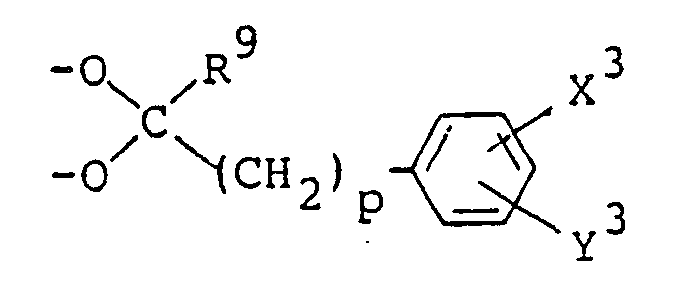


reacting a compound of the formula:
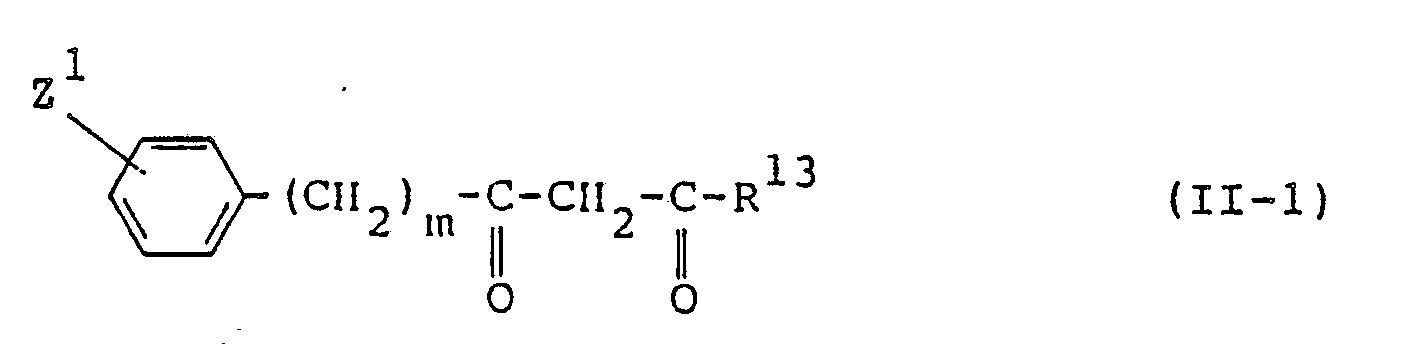


reacting a compound of the formula:

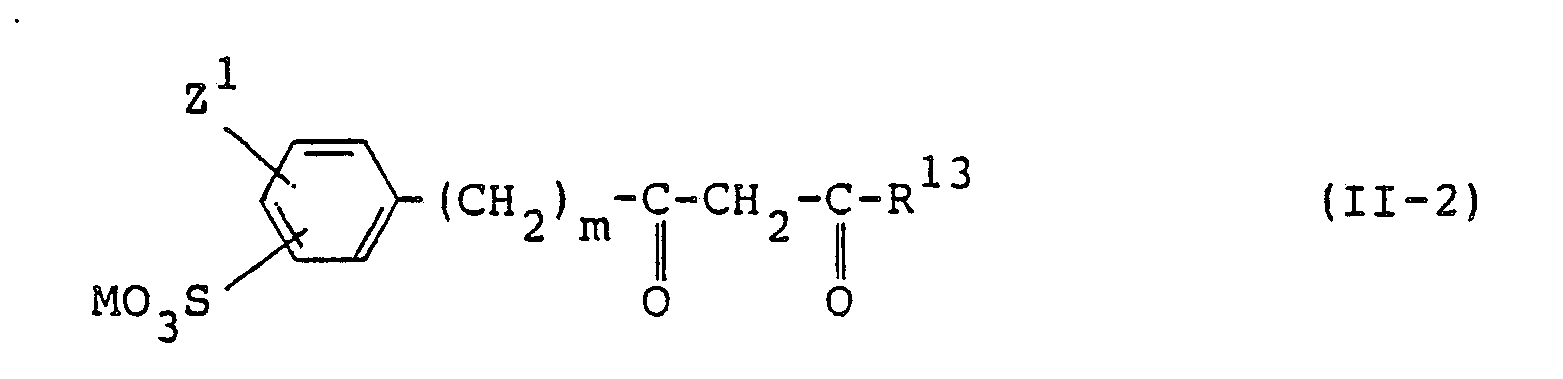
reacting the compound of the formula (II-2) with a diazotizing agent in the presence of an organic base to yield a compound of the formula:


reacting a compound of the formula:



reacting a compound of the formula:


reacting the compound of the formula (III-2) with a diazotizing agent in the presence of a base to yield a compound of the formula:


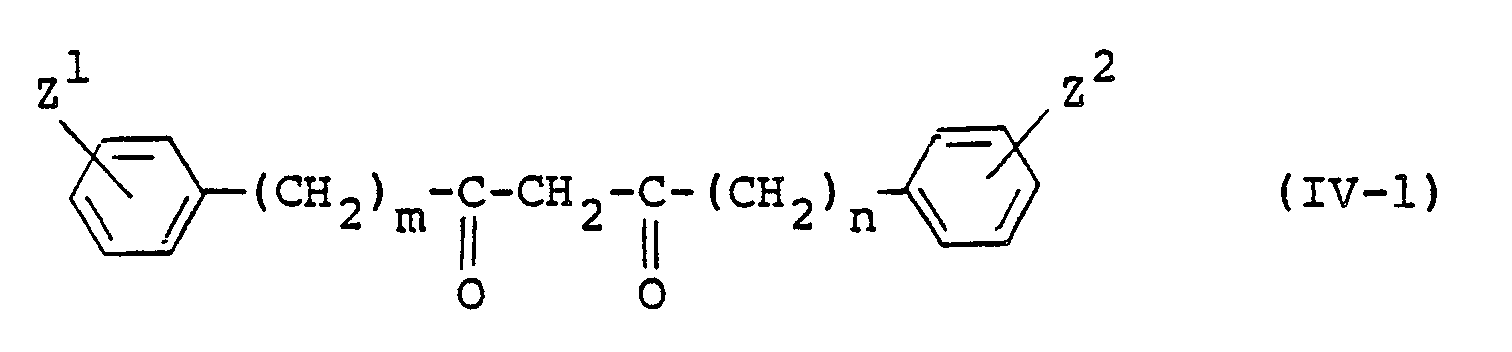


reacting the compound of the formula (V-2) with a diazotizing agent in the presence of an organic base to yield a compound of the formula:


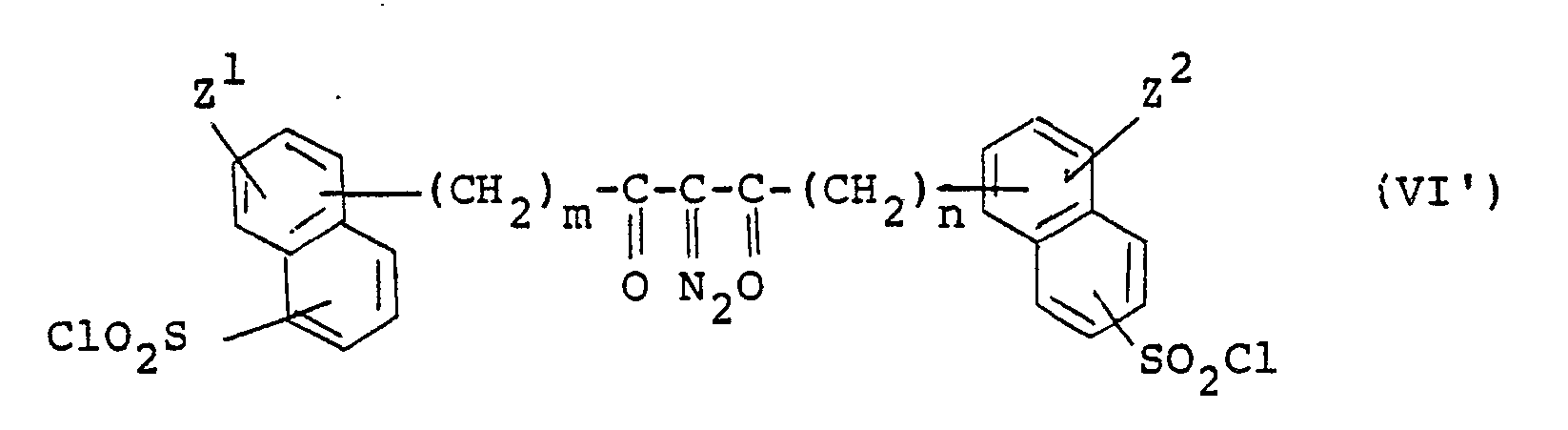


reacting the compound of the formula (VI-2) with a diazotizing agent in the presence of a base to yield a compound of the formula:


reacting a compound of the formula:
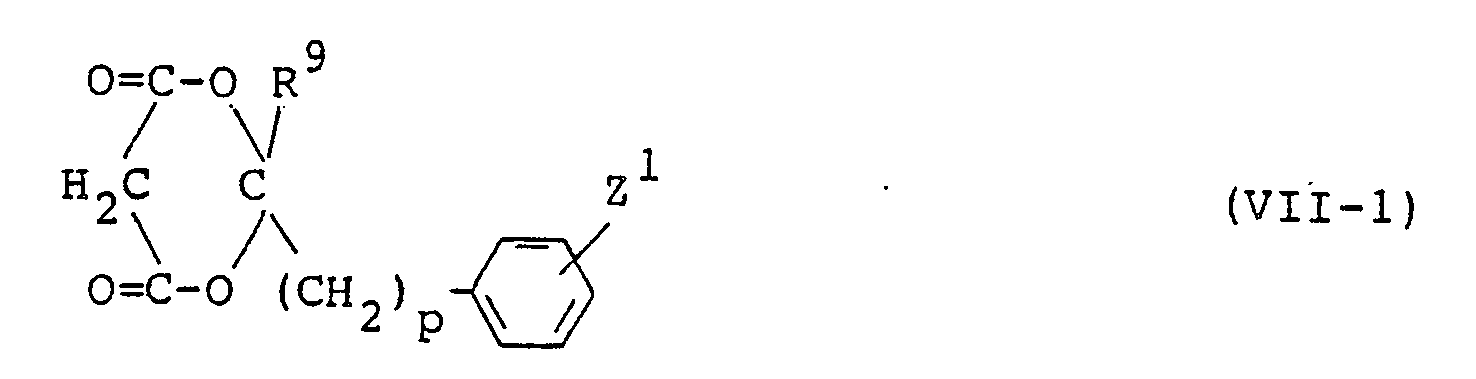


reacting a compound of the formula:


reacting the compound of the formula (VII-2) with a diazotizing.agent in the presence of an organic base to yield a compound of the formula:

Applications Claiming Priority (6)
| Application Number | Priority Date | Filing Date | Title |
|---|---|---|---|
| JP306878/87 | 1987-12-04 | ||
| JP30687887 | 1987-12-04 | ||
| JP309336/87 | 1987-12-07 | ||
| JP30933687 | 1987-12-07 | ||
| JP62310737A JPH0768238B2 (en) | 1987-12-08 | 1987-12-08 | Novel Meldrum's acid derivative |
| JP310737/87 | 1987-12-08 |
Publications (3)
| Publication Number | Publication Date |
|---|---|
| EP0323050A2 true EP0323050A2 (en) | 1989-07-05 |
| EP0323050A3 EP0323050A3 (en) | 1990-12-19 |
| EP0323050B1 EP0323050B1 (en) | 1994-11-02 |
Family
ID=27338874
Family Applications (1)
| Application Number | Title | Priority Date | Filing Date |
|---|---|---|---|
| EP88311462A Expired - Lifetime EP0323050B1 (en) | 1987-12-04 | 1988-12-02 | Photosensitive compound |
Country Status (3)
| Country | Link |
|---|---|
| EP (1) | EP0323050B1 (en) |
| KR (1) | KR910005030B1 (en) |
| DE (1) | DE3852017T2 (en) |
Cited By (2)
| Publication number | Priority date | Publication date | Assignee | Title |
|---|---|---|---|---|
| EP0416564A3 (en) * | 1989-09-05 | 1992-03-11 | Kao Corporation | Novel aroyl ketone derivative, uv ray absorber comprising the same, and cosmetic composition containing the same |
| US5191121A (en) * | 1989-09-05 | 1993-03-02 | Kao Corporation | Aroyl ketone derivative, UV ray absorber comprising the same, and cosmetic composition containing the same |
-
1988
- 1988-12-02 DE DE3852017T patent/DE3852017T2/en not_active Expired - Fee Related
- 1988-12-02 EP EP88311462A patent/EP0323050B1/en not_active Expired - Lifetime
- 1988-12-03 KR KR1019880016136A patent/KR910005030B1/en not_active Expired
Non-Patent Citations (2)
| Title |
|---|
| CHEMISCHE BERICHTE. vol. 99, no. 10, 1966, WEINHEIM DE pages 3128 - 3147; Manfred Regitz: "Synthese von Diacyl-diazomethanen durch Diazogruppen}bertragung" * |
| IEEE TRANSACTIONS ON ELECTRON DEVICES. vol. ED-28, no. 11, November 1981, NEW YORK US pages 1300 - 1305; GRANT B.D. et al.: "Deep UV Photoresist 1. Meldrum's Diazo sensitiser" * |
Cited By (2)
| Publication number | Priority date | Publication date | Assignee | Title |
|---|---|---|---|---|
| EP0416564A3 (en) * | 1989-09-05 | 1992-03-11 | Kao Corporation | Novel aroyl ketone derivative, uv ray absorber comprising the same, and cosmetic composition containing the same |
| US5191121A (en) * | 1989-09-05 | 1993-03-02 | Kao Corporation | Aroyl ketone derivative, UV ray absorber comprising the same, and cosmetic composition containing the same |
Also Published As
| Publication number | Publication date |
|---|---|
| DE3852017T2 (en) | 1995-06-01 |
| KR890010620A (en) | 1989-08-09 |
| EP0323050B1 (en) | 1994-11-02 |
| KR910005030B1 (en) | 1991-07-22 |
| DE3852017D1 (en) | 1994-12-08 |
| EP0323050A3 (en) | 1990-12-19 |
Similar Documents
| Publication | Publication Date | Title |
|---|---|---|
| US4736055A (en) | Oxime sulfonates containing reactive groups | |
| US5047556A (en) | Photoinitiators having a combined structure | |
| Krutak et al. | Chemistry of ethenesulfonyl fluoride. Fluorosulfonylethylation of organic compounds | |
| JP4489954B2 (en) | Novel unsaturated oxime derivatives and their use as potential acids | |
| NL1014545C2 (en) | Oxim derivatives and their use as latent acids. | |
| US5716756A (en) | Sulfonic acid esters, radiation-sensitive mixtures prepared therewith and their use | |
| EP0675410A1 (en) | Resist composition for deep ultraviolet light | |
| FR2794252A1 (en) | RESERVE COMPOSITION, PHOTOSENSITIVE COMPOUNDS CONTAINED THEREIN AND USES THEREOF | |
| AU726458B2 (en) | Alkysulfonyloximes for high-resolution I-line photoresists of high sensitivity | |
| JP2500533B2 (en) | Novel diazodisulfone compound | |
| JPH07333834A (en) | Chemically amplified positive resist material | |
| Houlihan et al. | Design, synthesis, characterization, and use of all-organic, nonionic photogenerators of acid | |
| US4207107A (en) | Novel ortho-quinone diazide photoresist sensitizers | |
| US6770420B2 (en) | Alkylsulfonyloximes for high-resolution i-line photoresists of high sensitivity | |
| JP3386041B2 (en) | Photoacid generator, photoresist composition containing the same, and method of forming a pattern using the composition | |
| US5250669A (en) | Photosensitive compound | |
| EP0323050B1 (en) | Photosensitive compound | |
| KR100293041B1 (en) | Polymers with N, N-disubstituted sulfonamide pendant groups and uses thereof | |
| US5612169A (en) | N,N-disubstituted sulfonamides and radiation-sensitive mixture prepared therewith | |
| JP2577980B2 (en) | Photosensitive material and pattern forming method using the same | |
| EP0246885A2 (en) | A contrast-enhancing agent for photolithography | |
| JPH01263648A (en) | Radiation sensitive composition | |
| FI57183B (en) | LJUSKAENSLIG POLYMER LAEMPLIG ATT ANVAENDAS FOER FRAMSTAELLNING AV TRYCKPLATTOR | |
| KR100230135B1 (en) | Sulfonium salt for polymer polymerization and preparation method thereof | |
| JP3106708B2 (en) | Novel benzopyran derivative, resist material using the same, and pattern forming method using the resist material |
Legal Events
| Date | Code | Title | Description |
|---|---|---|---|
| PUAI | Public reference made under article 153(3) epc to a published international application that has entered the european phase |
Free format text: ORIGINAL CODE: 0009012 |
|
| AK | Designated contracting states |
Kind code of ref document: A2 Designated state(s): DE FR GB |
|
| PUAL | Search report despatched |
Free format text: ORIGINAL CODE: 0009013 |
|
| AK | Designated contracting states |
Kind code of ref document: A3 Designated state(s): DE FR GB |
|
| 17P | Request for examination filed |
Effective date: 19910510 |
|
| 17Q | First examination report despatched |
Effective date: 19930223 |
|
| RAP1 | Party data changed (applicant data changed or rights of an application transferred) |
Owner name: MATSUSHITA ELECTRIC INDUSTRIAL CO., LTD. Owner name: WAKO PURE CHEMICAL INDUSTRIES LTD |
|
| GRAA | (expected) grant |
Free format text: ORIGINAL CODE: 0009210 |
|
| AK | Designated contracting states |
Kind code of ref document: B1 Designated state(s): DE FR GB |
|
| REF | Corresponds to: |
Ref document number: 3852017 Country of ref document: DE Date of ref document: 19941208 |
|
| ET | Fr: translation filed | ||
| PLBE | No opposition filed within time limit |
Free format text: ORIGINAL CODE: 0009261 |
|
| STAA | Information on the status of an ep patent application or granted ep patent |
Free format text: STATUS: NO OPPOSITION FILED WITHIN TIME LIMIT |
|
| 26N | No opposition filed | ||
| PGFP | Annual fee paid to national office [announced via postgrant information from national office to epo] |
Ref country code: GB Payment date: 19971022 Year of fee payment: 10 |
|
| PGFP | Annual fee paid to national office [announced via postgrant information from national office to epo] |
Ref country code: DE Payment date: 19971124 Year of fee payment: 10 |
|
| PGFP | Annual fee paid to national office [announced via postgrant information from national office to epo] |
Ref country code: FR Payment date: 19971224 Year of fee payment: 10 |
|
| PG25 | Lapsed in a contracting state [announced via postgrant information from national office to epo] |
Ref country code: GB Free format text: LAPSE BECAUSE OF NON-PAYMENT OF DUE FEES Effective date: 19981202 |
|
| GBPC | Gb: european patent ceased through non-payment of renewal fee |
Effective date: 19981202 |
|
| PG25 | Lapsed in a contracting state [announced via postgrant information from national office to epo] |
Ref country code: FR Free format text: LAPSE BECAUSE OF NON-PAYMENT OF DUE FEES Effective date: 19990831 |
|
| REG | Reference to a national code |
Ref country code: FR Ref legal event code: ST |
|
| PG25 | Lapsed in a contracting state [announced via postgrant information from national office to epo] |
Ref country code: DE Free format text: LAPSE BECAUSE OF NON-PAYMENT OF DUE FEES Effective date: 19991001 |