EP0323062B1 - Process for manufacturing organic silazane polymers - Google Patents
Process for manufacturing organic silazane polymers Download PDFInfo
- Publication number
- EP0323062B1 EP0323062B1 EP88311692A EP88311692A EP0323062B1 EP 0323062 B1 EP0323062 B1 EP 0323062B1 EP 88311692 A EP88311692 A EP 88311692A EP 88311692 A EP88311692 A EP 88311692A EP 0323062 B1 EP0323062 B1 EP 0323062B1
- Authority
- EP
- European Patent Office
- Prior art keywords
- polymer
- compound
- organic silazane
- ceramic
- silazane polymer
- Prior art date
- Legal status (The legal status is an assumption and is not a legal conclusion. Google has not performed a legal analysis and makes no representation as to the accuracy of the status listed.)
- Expired
Links
- 229920000642 polymer Polymers 0.000 title claims description 104
- 238000000034 method Methods 0.000 title claims description 74
- 238000004519 manufacturing process Methods 0.000 title claims description 28
- 239000000919 ceramic Substances 0.000 claims description 66
- 150000001875 compounds Chemical class 0.000 claims description 52
- QGZKDVFQNNGYKY-UHFFFAOYSA-N Ammonia Chemical compound N QGZKDVFQNNGYKY-UHFFFAOYSA-N 0.000 claims description 40
- KWYUFKZDYYNOTN-UHFFFAOYSA-M Potassium hydroxide Chemical group [OH-].[K+] KWYUFKZDYYNOTN-UHFFFAOYSA-M 0.000 claims description 39
- 239000000835 fiber Substances 0.000 claims description 37
- 239000000203 mixture Substances 0.000 claims description 34
- 238000002844 melting Methods 0.000 claims description 20
- 230000008018 melting Effects 0.000 claims description 20
- 229910021529 ammonia Inorganic materials 0.000 claims description 17
- LIKFHECYJZWXFJ-UHFFFAOYSA-N dimethyldichlorosilane Chemical compound C[Si](C)(Cl)Cl LIKFHECYJZWXFJ-UHFFFAOYSA-N 0.000 claims description 15
- 238000005245 sintering Methods 0.000 claims description 14
- YLJJAVFOBDSYAN-UHFFFAOYSA-N dichloro-ethenyl-methylsilane Chemical compound C[Si](Cl)(Cl)C=C YLJJAVFOBDSYAN-UHFFFAOYSA-N 0.000 claims description 13
- 229910052581 Si3N4 Inorganic materials 0.000 claims description 10
- 239000003054 catalyst Substances 0.000 claims description 10
- HEMHJVSKTPXQMS-UHFFFAOYSA-M Sodium hydroxide Chemical compound [OH-].[Na+] HEMHJVSKTPXQMS-UHFFFAOYSA-M 0.000 claims description 9
- 238000000465 moulding Methods 0.000 claims description 9
- HBMJWWWQQXIZIP-UHFFFAOYSA-N silicon carbide Chemical compound [Si+]#[C-] HBMJWWWQQXIZIP-UHFFFAOYSA-N 0.000 claims description 8
- 229910010271 silicon carbide Inorganic materials 0.000 claims description 8
- 239000000460 chlorine Substances 0.000 claims description 7
- 229910052801 chlorine Inorganic materials 0.000 claims description 7
- 125000002496 methyl group Chemical group [H]C([H])([H])* 0.000 claims description 7
- WKBOTKDWSSQWDR-UHFFFAOYSA-N Bromine atom Chemical group [Br] WKBOTKDWSSQWDR-UHFFFAOYSA-N 0.000 claims description 6
- 239000003513 alkali Substances 0.000 claims description 6
- 125000001309 chloro group Chemical group Cl* 0.000 claims description 6
- 125000001495 ethyl group Chemical group [H]C([H])([H])C([H])([H])* 0.000 claims description 6
- 125000004435 hydrogen atom Chemical group [H]* 0.000 claims description 6
- 229910000069 nitrogen hydride Inorganic materials 0.000 claims description 6
- 125000001997 phenyl group Chemical group [H]C1=C([H])C([H])=C(*)C([H])=C1[H] 0.000 claims description 6
- 239000003504 photosensitizing agent Substances 0.000 claims description 6
- 125000000391 vinyl group Chemical group [H]C([*])=C([H])[H] 0.000 claims description 6
- KTQYJQFGNYHXMB-UHFFFAOYSA-N dichloro(methyl)silicon Chemical compound C[Si](Cl)Cl KTQYJQFGNYHXMB-UHFFFAOYSA-N 0.000 claims description 5
- 239000005048 methyldichlorosilane Substances 0.000 claims description 5
- 238000002156 mixing Methods 0.000 claims description 4
- 239000003795 chemical substances by application Substances 0.000 claims description 3
- 239000011261 inert gas Substances 0.000 claims description 3
- 150000002484 inorganic compounds Chemical class 0.000 claims description 3
- 229910010272 inorganic material Inorganic materials 0.000 claims description 3
- 229910052582 BN Inorganic materials 0.000 claims description 2
- PZNSFCLAULLKQX-UHFFFAOYSA-N Boron nitride Chemical compound N#B PZNSFCLAULLKQX-UHFFFAOYSA-N 0.000 claims description 2
- PNEYBMLMFCGWSK-UHFFFAOYSA-N aluminium oxide Inorganic materials [O-2].[O-2].[O-2].[Al+3].[Al+3] PNEYBMLMFCGWSK-UHFFFAOYSA-N 0.000 claims description 2
- 230000000379 polymerizing effect Effects 0.000 claims description 2
- HQVNEWCFYHHQES-UHFFFAOYSA-N silicon nitride Chemical compound N12[Si]34N5[Si]62N3[Si]51N64 HQVNEWCFYHHQES-UHFFFAOYSA-N 0.000 claims description 2
- IJGRMHOSHXDMSA-UHFFFAOYSA-N Atomic nitrogen Chemical compound N#N IJGRMHOSHXDMSA-UHFFFAOYSA-N 0.000 claims 1
- 229910001873 dinitrogen Inorganic materials 0.000 claims 1
- 239000001257 hydrogen Substances 0.000 claims 1
- 229910052739 hydrogen Inorganic materials 0.000 claims 1
- 229920002554 vinyl polymer Polymers 0.000 claims 1
- VLKZOEOYAKHREP-UHFFFAOYSA-N n-Hexane Chemical compound CCCCCC VLKZOEOYAKHREP-UHFFFAOYSA-N 0.000 description 55
- 238000006116 polymerization reaction Methods 0.000 description 40
- UHOVQNZJYSORNB-UHFFFAOYSA-N Benzene Chemical compound C1=CC=CC=C1 UHOVQNZJYSORNB-UHFFFAOYSA-N 0.000 description 27
- 238000006243 chemical reaction Methods 0.000 description 20
- 239000000047 product Substances 0.000 description 17
- 239000000126 substance Substances 0.000 description 16
- 238000005915 ammonolysis reaction Methods 0.000 description 14
- 239000007789 gas Substances 0.000 description 13
- 239000000463 material Substances 0.000 description 13
- 238000009987 spinning Methods 0.000 description 13
- 238000002360 preparation method Methods 0.000 description 12
- 239000007787 solid Substances 0.000 description 11
- 238000010894 electron beam technology Methods 0.000 description 9
- 239000002243 precursor Substances 0.000 description 9
- 241001663845 Thelesperma Species 0.000 description 8
- 235000001975 Thelesperma gracile Nutrition 0.000 description 8
- 239000007788 liquid Substances 0.000 description 7
- 239000003960 organic solvent Substances 0.000 description 7
- YXFVVABEGXRONW-UHFFFAOYSA-N Toluene Chemical compound CC1=CC=CC=C1 YXFVVABEGXRONW-UHFFFAOYSA-N 0.000 description 6
- 229910010293 ceramic material Inorganic materials 0.000 description 6
- 230000000994 depressogenic effect Effects 0.000 description 6
- 239000002904 solvent Substances 0.000 description 6
- 239000005046 Chlorosilane Substances 0.000 description 5
- KOPOQZFJUQMUML-UHFFFAOYSA-N chlorosilane Chemical class Cl[SiH3] KOPOQZFJUQMUML-UHFFFAOYSA-N 0.000 description 5
- 239000000843 powder Substances 0.000 description 5
- JROMGTZTUZNJJY-UHFFFAOYSA-N 1,3,5-tris(ethenyl)-2,4,6-trimethyl-1,3,5,2,4,6-triazatrisilinane Chemical compound C(=C)N1[SiH](N([SiH](N([SiH]1C)C=C)C)C=C)C JROMGTZTUZNJJY-UHFFFAOYSA-N 0.000 description 4
- NLXLAEXVIDQMFP-UHFFFAOYSA-N Ammonia chloride Chemical compound [NH4+].[Cl-] NLXLAEXVIDQMFP-UHFFFAOYSA-N 0.000 description 4
- BAVYZALUXZFZLV-UHFFFAOYSA-N Methylamine Chemical compound NC BAVYZALUXZFZLV-UHFFFAOYSA-N 0.000 description 4
- 230000000052 comparative effect Effects 0.000 description 4
- 238000004821 distillation Methods 0.000 description 4
- 238000010438 heat treatment Methods 0.000 description 4
- 238000002074 melt spinning Methods 0.000 description 4
- WGGNJZRNHUJNEM-UHFFFAOYSA-N 2,2,4,4,6,6-hexamethyl-1,3,5,2,4,6-triazatrisilinane Chemical compound C[Si]1(C)N[Si](C)(C)N[Si](C)(C)N1 WGGNJZRNHUJNEM-UHFFFAOYSA-N 0.000 description 3
- RTZKZFJDLAIYFH-UHFFFAOYSA-N Diethyl ether Chemical compound CCOCC RTZKZFJDLAIYFH-UHFFFAOYSA-N 0.000 description 3
- 238000010521 absorption reaction Methods 0.000 description 3
- FXMNVBZEWMANSQ-UHFFFAOYSA-N chloro(silyl)silane Chemical class [SiH3][SiH2]Cl FXMNVBZEWMANSQ-UHFFFAOYSA-N 0.000 description 3
- 125000004122 cyclic group Chemical group 0.000 description 3
- IICCLYANAQEHCI-UHFFFAOYSA-N 4,5,6,7-tetrachloro-3',6'-dihydroxy-2',4',5',7'-tetraiodospiro[2-benzofuran-3,9'-xanthene]-1-one Chemical compound O1C(=O)C(C(=C(Cl)C(Cl)=C2Cl)Cl)=C2C21C1=CC(I)=C(O)C(I)=C1OC1=C(I)C(O)=C(I)C=C21 IICCLYANAQEHCI-UHFFFAOYSA-N 0.000 description 2
- KWOLFJPFCHCOCG-UHFFFAOYSA-N Acetophenone Chemical compound CC(=O)C1=CC=CC=C1 KWOLFJPFCHCOCG-UHFFFAOYSA-N 0.000 description 2
- GUUVPOWQJOLRAS-UHFFFAOYSA-N Diphenyl disulfide Chemical compound C=1C=CC=CC=1SSC1=CC=CC=C1 GUUVPOWQJOLRAS-UHFFFAOYSA-N 0.000 description 2
- OFBQJSOFQDEBGM-UHFFFAOYSA-N Pentane Chemical compound CCCCC OFBQJSOFQDEBGM-UHFFFAOYSA-N 0.000 description 2
- WYURNTSHIVDZCO-UHFFFAOYSA-N Tetrahydrofuran Chemical compound C1CCOC1 WYURNTSHIVDZCO-UHFFFAOYSA-N 0.000 description 2
- 229910000102 alkali metal hydride Inorganic materials 0.000 description 2
- 150000008046 alkali metal hydrides Chemical class 0.000 description 2
- 229910052784 alkaline earth metal Inorganic materials 0.000 description 2
- 150000001342 alkaline earth metals Chemical class 0.000 description 2
- 150000001412 amines Chemical class 0.000 description 2
- 235000019270 ammonium chloride Nutrition 0.000 description 2
- 238000004458 analytical method Methods 0.000 description 2
- 239000012298 atmosphere Substances 0.000 description 2
- 239000011230 binding agent Substances 0.000 description 2
- 239000006227 byproduct Substances 0.000 description 2
- 239000012700 ceramic precursor Substances 0.000 description 2
- 238000009833 condensation Methods 0.000 description 2
- 230000005494 condensation Effects 0.000 description 2
- 238000006356 dehydrogenation reaction Methods 0.000 description 2
- AFZSMODLJJCVPP-UHFFFAOYSA-N dibenzothiazol-2-yl disulfide Chemical compound C1=CC=C2SC(SSC=3SC4=CC=CC=C4N=3)=NC2=C1 AFZSMODLJJCVPP-UHFFFAOYSA-N 0.000 description 2
- 230000001747 exhibiting effect Effects 0.000 description 2
- 239000000706 filtrate Substances 0.000 description 2
- 238000001914 filtration Methods 0.000 description 2
- 238000002329 infrared spectrum Methods 0.000 description 2
- 239000013067 intermediate product Substances 0.000 description 2
- 230000001678 irradiating effect Effects 0.000 description 2
- 229910001507 metal halide Inorganic materials 0.000 description 2
- 150000005309 metal halides Chemical class 0.000 description 2
- 229910003465 moissanite Inorganic materials 0.000 description 2
- 150000002894 organic compounds Chemical class 0.000 description 2
- 230000000704 physical effect Effects 0.000 description 2
- 239000002685 polymerization catalyst Substances 0.000 description 2
- 238000000197 pyrolysis Methods 0.000 description 2
- 239000011541 reaction mixture Substances 0.000 description 2
- 229930187593 rose bengal Natural products 0.000 description 2
- 229940081623 rose bengal Drugs 0.000 description 2
- STRXNPAVPKGJQR-UHFFFAOYSA-N rose bengal A Natural products O1C(=O)C(C(=CC=C2Cl)Cl)=C2C21C1=CC(I)=C(O)C(I)=C1OC1=C(I)C(O)=C(I)C=C21 STRXNPAVPKGJQR-UHFFFAOYSA-N 0.000 description 2
- ORGHESHFQPYLAO-UHFFFAOYSA-N vinyl radical Chemical compound C=[CH] ORGHESHFQPYLAO-UHFFFAOYSA-N 0.000 description 2
- 229940069744 2,2'-dithiobisbenzothiazole Drugs 0.000 description 1
- FIADVASZMLCQIF-UHFFFAOYSA-N 2,2,4,4,6,6,8,8-octamethyl-1,3,5,7,2,4,6,8-tetrazatetrasilocane Chemical compound C[Si]1(C)N[Si](C)(C)N[Si](C)(C)N[Si](C)(C)N1 FIADVASZMLCQIF-UHFFFAOYSA-N 0.000 description 1
- ZAMOUSCENKQFHK-UHFFFAOYSA-N Chlorine atom Chemical compound [Cl] ZAMOUSCENKQFHK-UHFFFAOYSA-N 0.000 description 1
- CTQNGGLPUBDAKN-UHFFFAOYSA-N O-Xylene Chemical compound CC1=CC=CC=C1C CTQNGGLPUBDAKN-UHFFFAOYSA-N 0.000 description 1
- UCKMPCXJQFINFW-UHFFFAOYSA-N Sulphide Chemical compound [S-2] UCKMPCXJQFINFW-UHFFFAOYSA-N 0.000 description 1
- 244000283375 Thelesperma megapotamicum Species 0.000 description 1
- 235000000382 Thelesperma megapotamicum Nutrition 0.000 description 1
- 238000005299 abrasion Methods 0.000 description 1
- 239000000853 adhesive Substances 0.000 description 1
- 230000001070 adhesive effect Effects 0.000 description 1
- 239000012300 argon atmosphere Substances 0.000 description 1
- 238000005452 bending Methods 0.000 description 1
- ZWOASCVFHSYHOB-UHFFFAOYSA-N benzene-1,3-dithiol Chemical compound SC1=CC=CC(S)=C1 ZWOASCVFHSYHOB-UHFFFAOYSA-N 0.000 description 1
- RWCCWEUUXYIKHB-UHFFFAOYSA-N benzophenone Chemical compound C=1C=CC=CC=1C(=O)C1=CC=CC=C1 RWCCWEUUXYIKHB-UHFFFAOYSA-N 0.000 description 1
- 239000012965 benzophenone Substances 0.000 description 1
- 238000009835 boiling Methods 0.000 description 1
- 239000007795 chemical reaction product Substances 0.000 description 1
- 238000005229 chemical vapour deposition Methods 0.000 description 1
- 230000006835 compression Effects 0.000 description 1
- 238000007906 compression Methods 0.000 description 1
- 238000001816 cooling Methods 0.000 description 1
- 238000004132 cross linking Methods 0.000 description 1
- 229960004132 diethyl ether Drugs 0.000 description 1
- -1 e.g. Substances 0.000 description 1
- 230000008030 elimination Effects 0.000 description 1
- 238000003379 elimination reaction Methods 0.000 description 1
- 239000002657 fibrous material Substances 0.000 description 1
- 238000004817 gas chromatography Methods 0.000 description 1
- 238000009776 industrial production Methods 0.000 description 1
- 239000000155 melt Substances 0.000 description 1
- QSHDDOUJBYECFT-UHFFFAOYSA-N mercury Chemical compound [Hg] QSHDDOUJBYECFT-UHFFFAOYSA-N 0.000 description 1
- 229910052753 mercury Inorganic materials 0.000 description 1
- 239000005055 methyl trichlorosilane Substances 0.000 description 1
- JLUFWMXJHAVVNN-UHFFFAOYSA-N methyltrichlorosilane Chemical compound C[Si](Cl)(Cl)Cl JLUFWMXJHAVVNN-UHFFFAOYSA-N 0.000 description 1
- 239000003921 oil Substances 0.000 description 1
- 229920000620 organic polymer Polymers 0.000 description 1
- 230000003647 oxidation Effects 0.000 description 1
- 238000007254 oxidation reaction Methods 0.000 description 1
- 239000002861 polymer material Substances 0.000 description 1
- 229920001709 polysilazane Polymers 0.000 description 1
- 230000035484 reaction time Effects 0.000 description 1
- 238000009877 rendering Methods 0.000 description 1
- 230000000717 retained effect Effects 0.000 description 1
- 238000007493 shaping process Methods 0.000 description 1
- 230000035939 shock Effects 0.000 description 1
- 239000012686 silicon precursor Substances 0.000 description 1
- 229920005573 silicon-containing polymer Polymers 0.000 description 1
- 238000001228 spectrum Methods 0.000 description 1
- 239000007858 starting material Substances 0.000 description 1
- 239000010409 thin film Substances 0.000 description 1
- ZDHXKXAHOVTTAH-UHFFFAOYSA-N trichlorosilane Chemical compound Cl[SiH](Cl)Cl ZDHXKXAHOVTTAH-UHFFFAOYSA-N 0.000 description 1
- 239000005052 trichlorosilane Substances 0.000 description 1
- 239000013638 trimer Substances 0.000 description 1
- 239000003039 volatile agent Substances 0.000 description 1
- 239000008096 xylene Substances 0.000 description 1
Classifications
-
- C—CHEMISTRY; METALLURGY
- C08—ORGANIC MACROMOLECULAR COMPOUNDS; THEIR PREPARATION OR CHEMICAL WORKING-UP; COMPOSITIONS BASED THEREON
- C08G—MACROMOLECULAR COMPOUNDS OBTAINED OTHERWISE THAN BY REACTIONS ONLY INVOLVING UNSATURATED CARBON-TO-CARBON BONDS
- C08G77/00—Macromolecular compounds obtained by reactions forming a linkage containing silicon with or without sulfur, nitrogen, oxygen or carbon in the main chain of the macromolecule
- C08G77/60—Macromolecular compounds obtained by reactions forming a linkage containing silicon with or without sulfur, nitrogen, oxygen or carbon in the main chain of the macromolecule in which all the silicon atoms are connected by linkages other than oxygen atoms
- C08G77/62—Nitrogen atoms
-
- C—CHEMISTRY; METALLURGY
- C04—CEMENTS; CONCRETE; ARTIFICIAL STONE; CERAMICS; REFRACTORIES
- C04B—LIME, MAGNESIA; SLAG; CEMENTS; COMPOSITIONS THEREOF, e.g. MORTARS, CONCRETE OR LIKE BUILDING MATERIALS; ARTIFICIAL STONE; CERAMICS; REFRACTORIES; TREATMENT OF NATURAL STONE
- C04B35/00—Shaped ceramic products characterised by their composition; Ceramics compositions; Processing powders of inorganic compounds preparatory to the manufacturing of ceramic products
- C04B35/515—Shaped ceramic products characterised by their composition; Ceramics compositions; Processing powders of inorganic compounds preparatory to the manufacturing of ceramic products based on non-oxide ceramics
- C04B35/56—Shaped ceramic products characterised by their composition; Ceramics compositions; Processing powders of inorganic compounds preparatory to the manufacturing of ceramic products based on non-oxide ceramics based on carbides or oxycarbides
- C04B35/565—Shaped ceramic products characterised by their composition; Ceramics compositions; Processing powders of inorganic compounds preparatory to the manufacturing of ceramic products based on non-oxide ceramics based on carbides or oxycarbides based on silicon carbide
- C04B35/571—Shaped ceramic products characterised by their composition; Ceramics compositions; Processing powders of inorganic compounds preparatory to the manufacturing of ceramic products based on non-oxide ceramics based on carbides or oxycarbides based on silicon carbide obtained from Si-containing polymer precursors or organosilicon monomers
-
- C—CHEMISTRY; METALLURGY
- C04—CEMENTS; CONCRETE; ARTIFICIAL STONE; CERAMICS; REFRACTORIES
- C04B—LIME, MAGNESIA; SLAG; CEMENTS; COMPOSITIONS THEREOF, e.g. MORTARS, CONCRETE OR LIKE BUILDING MATERIALS; ARTIFICIAL STONE; CERAMICS; REFRACTORIES; TREATMENT OF NATURAL STONE
- C04B35/00—Shaped ceramic products characterised by their composition; Ceramics compositions; Processing powders of inorganic compounds preparatory to the manufacturing of ceramic products
- C04B35/515—Shaped ceramic products characterised by their composition; Ceramics compositions; Processing powders of inorganic compounds preparatory to the manufacturing of ceramic products based on non-oxide ceramics
- C04B35/58—Shaped ceramic products characterised by their composition; Ceramics compositions; Processing powders of inorganic compounds preparatory to the manufacturing of ceramic products based on non-oxide ceramics based on borides, nitrides, i.e. nitrides, oxynitrides, carbonitrides or oxycarbonitrides or silicides
- C04B35/584—Shaped ceramic products characterised by their composition; Ceramics compositions; Processing powders of inorganic compounds preparatory to the manufacturing of ceramic products based on non-oxide ceramics based on borides, nitrides, i.e. nitrides, oxynitrides, carbonitrides or oxycarbonitrides or silicides based on silicon nitride
- C04B35/589—Shaped ceramic products characterised by their composition; Ceramics compositions; Processing powders of inorganic compounds preparatory to the manufacturing of ceramic products based on non-oxide ceramics based on borides, nitrides, i.e. nitrides, oxynitrides, carbonitrides or oxycarbonitrides or silicides based on silicon nitride obtained from Si-containing polymer precursors or organosilicon monomers
Definitions
- This invention relates to a process for manufacturing organic silazane polymers which are suitably used as precursors for ceramic materials, and also to a process for manufacturing ceramics from the organic silazane polymers.
- Ceramics are materials which have excellent properties, such as heat resistance, abrasion resistance, and high-temperature strength, i.e., physical strength at high temperatures.
- Methods used to manufacture shaped ceramic articles from such materials include molding a fine powder of the ceramic material into a desired form, such as by compression, followed by sintering, or a "precursor" method in which an organic polymer, serving as a preceramic material, is first melted or dissolved in a solvent, fabrication into a desired form, and sintered to render the polymer inorganic.
- the main advantage of the precursor method is that ceramic products having complex shapes can be formed, e.g., products in forms, such as fibers and sheets, which cannot be obtained with the fine powder sintering method.
- SiC and S1 3 N 4 Materials generally used as such ceramics include SiC and S1 3 N 4 . These have attracted considerable attention because of their good high temperature properties. For example, SiC has a high heat resistance and a high-temperature strength and Si 3 N 4 has a high thermal shock resistance and a high fracture toughness. Accordingly, various proposals have been made for processes of producing SiC-Si 3 N 4 ceramics and also for processes of producing organic silicon precursors using the precursor method. These processes and their disadvantages are described in paragraphs (1) to (7) below. Incidentally, infusibilization herein defined is to render an organic substance unable or difficult to melt at temperatures higher than its melting point without turning it inorganic. Sintering herein defined is to turn an organic substance inorganic by heating it at high temperatures.
- silazane polymers are not appropriate for industrial use as preceramic materials.
- these polymers were found to exhibit poor moldability and processability as precursors for ceramic fibers, and poor ceramic yield as well.
- Ceramic products e.g., ceramic fibers obtained from the known preceramic polysilazane materials were found to have relatively poor physical properties such as strength, modulus of elasticity and the like.
- the present inventors have investigated processes for manufacturing SiC-Si 3 N 4 type ceramics utilizing the precursor technique and to obtain ceramic precursors having excellent productivity and workability for the manufacture of the ceramic products.
- the inventors have proposed methods of manufacturing organic silazane polymers and ceramics therefrom, as disclosed in JP-A 62-290730, 63-117037, 63-193930, and 63-210133.
- the inventors have further studied the conversion of the polymers obtained by means of the procedures described in paragraphs (6) and (7) above with a view to improving the conversion methods.
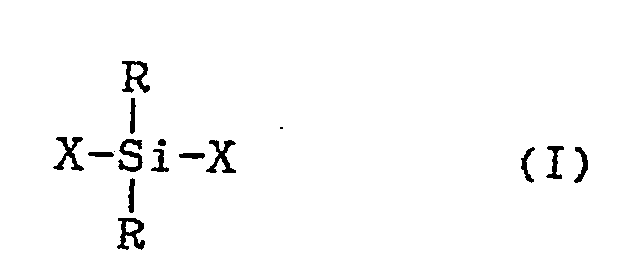
- organic silazane polymers exhibiting excellent heat stability, workability (moldability), and infusibility, can be obtained by reacting a mixture comprising 20 to 90 mol.% of at least one organosilicic compound having the formula (I): in which R may be the same or different and is a methyl group, an ethyl group or a phenyl group, and X represents a chlorine and/or a bromine atom; and 80 to 10 mol.% of at least one of the organosilicic compound having the formula (II): in which R represents a methyl group, an ethyl group or a phenyl group, and R i represents a hydrogen atom or a vinyl group, and X represents a chlorine or a bromine atom; with ammonia to obtain a silazane compound, and polymerizing the thus obtained silazane compound in the presence of an alkali catalyst to eventually obtain on organic silazane polymer, having a
- the inventors have also found that the thus obtained organic silazane polymers have high ceramic yield.
- the present invention also provides a method of manufacturing a ceramic which comprises melting, molding, and rendering infusible the organic silazane polymer, and then baking the same.
- the present invention it is possible to produce in an easy and economical way, a high quality organic silazane polymer exhibiting excellent moldability, workability, and infusibility and having high ceramic yield (usually, for example, 70-80%).
- Another important advantage of the present invention is that the use of an alkali metal hydride or an alkaline earth metal hydride as the polymerization catalyst can be avoided. Thus, these catalysts are expensive and difficult to handle.
- economical and easy-to-handle polymerization catalysts such as, potassium hydroxide and sodium hydroxide. It is thus possible to manufacture the improved organic silazane polymer in a manner far more economical and industrially advantageous as compared to prior processes.
- the present invention it is possible to produce an organic silazane polymer having excellent workability and infusibility, as well as far better ceramic yield than the polymers obtained through the procedure described under (6) above. Further, the method of manufacturing ceramics according to the present invention uses the above-described organic silazane polymers as ceramic precursors so that it enables easy fabrication of ceramic products of various desired shapes which are endowed with excellent properties.
- the compound of formula (I) is dimethyldichlorosilane.
- the compounds represented by the general formula (II) are preferably organosilicic compounds containing a vinyl group as Ri , that is, those represented by the formula (Ila).
- An example thereof is methylvinyldichlorosilane,
- the proportion of the compounds (I) to that of compounds (II) in the mixture should be between 20 mol.% to 80 mol.% and 90 mol.% to 10 mol.%, respectively. More preferably, the proportion falls in the range between 30 mol.% to 70 mol.% and 80 mol.% to 20 mol.%, respectively.
- Mixtures having the compositions in these ranges give organic silazane polymers which possess excellent heat stability, workability, and infusibility. Also, when these organic silazane polymers are baked, the ceramics obtained are greatly improved as compared to the ceramics obtained using conventional precursor methods. For example, the inventive ceramics exhibit improved ceramic yield, tensile strength, and elastic modulus.
- the proportion of the compounds (II) exceeds the upper limit, the resultant organic silazane polymers tend to have poor heat stability and workability. Also, if the proportion of the compounds (II) is smaller than the lower limit, organic silazane polymers are obtained having poor infusibility and low ceramic yield after baking.
- the mixing ratio (in terms of mol.% : mol.%) should be between 5 : 95 and 95 : 5, respectively, or more preferably between 20 : 80 and 80 : 20, respectively.
- the above defined mixture of the organosilicic compounds is reacted with ammonia to produce silazane compounds.
- Any manner will do for conducting the reaction between the mixture and the ammonia, but a preferred manner consists of reacting the mixture with gaseous NH 3 in an organic solvent, and then removing the by-product ammonium chloride, and finally removing the organic solvent by distillation (stripping).
- the organic solvent used can be, for example, pentane, hexane, benzene, toluene, xylene or diethylether.
- the amount of the ammonia used can be as many moles as the chlorine in the chlorosilane used, but preferably is 1.2 to 1.5 times as many moles as the same.
- the silazane compounds are polymerized in the presence of an alkali catalyst, preferably KOH or NaOH.
- the amount of the alkali catalyst added can be in normal cases 0.1 to 5.0 weight %, or preferably 0.1 to 2.0 weight %, based on the weight of the silazane compound.
- the polymerization process is usually conducted in the absence of a solvent, but it is also possible to conduct it in a solvent. In the latter case, any ordinary organic solvent will do so long as it has a boiling point suited to the polymerization temperature.
- the polymerization temperature is normally in the range of 0 - 350 ° C, or preferably, 20 - 300 ° C depending on the desired polymerization degree as well as on the kind of organosilicic compound selected. Further, according to the method of the invention, there is no prescribed after-treatment procedure. However, it is possible to dissolve the polymers after the polymerization in an organic solvent, remove insoluble matter by means of filtration, and then remove the solvent by distillation under atmospheric pressure or reduced pressure. As a result, it is possible to obtain organic silazane polymers having melting points of 60 - 200 ° C, and molecular weights of 800 - 3000, as determined by the benzene cryoscoping depressant method.
- An important advantage of the present invention is that the polymerization is allowed to continue until it ceases of its own accord. This is evidenced by the cessation of the evolution of gas from the polymerization mixture. Thus, there is no need to attempt to stop the polymerization at a midpoint of the reaction.
- the degrees of polymerization and the melting points of the silazane polymers can be also suitably controlled by changing the mixing ratios of the above organosilicic compounds.
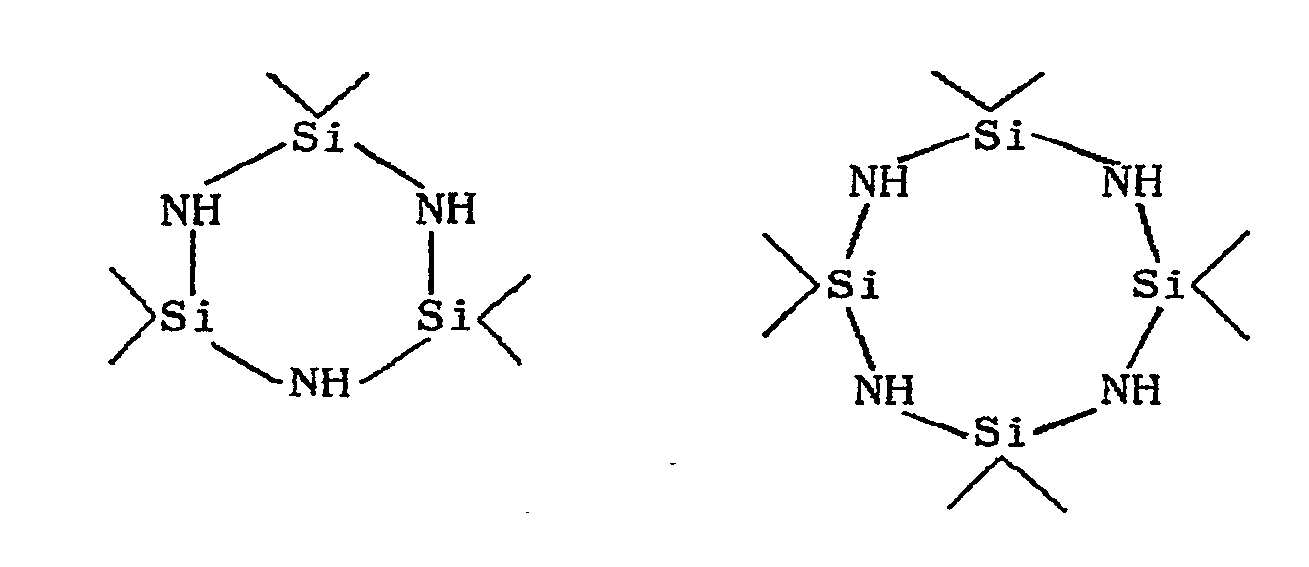
- silazane compounds produced from the reaction between the above-described mixtures and the ammonia comprise, for example, a silazane trimer and a silazane tetramer having skeleton units as represented by the formulae below, respectively.
- a silazane trimer and a silazane tetramer having skeleton units as represented by the formulae below, respectively.
- the structure of the silazane compounds there is no requirement as to the structure of the silazane compounds.
- the organic silazane polymers thus obtained have high moldability and processability and, accordingly, can be shaped, as preceramic materials, into suitable forms of shaped articles, such as fibers or sheets.
- the polymers may be used as binders or adhesives.
- the organic silazane polymers are melted, molded, infusibilized and finally sintered.
- the polymers preferably have melting points of from 60 to 200 °C and molecular weights of from 800 to 3000 so that it becomes easier to melt and mold the polymers.
- the manner of melting, shaping and sintering of the organic silazane polymers is not critical, but the polymers are molded in desired shapes and sintered to obtain ceramic products of desired forms using conventional procedures.
- the organic silazane polymer is first heated to form a melt and then spun by melt spinning.
- the spinning temperature is determined depending on the melting point of the polymer, and is favorably in the range of from 100 to 300 ° C.
- the thread-like material obtained by the spinning is infusibilized by heating in air, irradiation with electron beams in a vacuum or in inert gases such as N 2 gas or optically infusibilized by irradiation with ultraviolet beams in an inert atmosphere, such as N 2 or Ar gas.
- the heating in air is preferably effected at a temperature between 50 and 150 ° C.
- the electron beam irradiation is preferably conducted at an exposure dose of from 10 to 1000 Mrad.
- the ultraviolet irradiation may be carried out by using a commercially available ultraviolet lamp having a wave length of 250 to 400 nm.
- the light quantity of the ultraviolet is preferably adjusted by selecting the intensity of the light source, the irradiating distance and the irradiating time depending on the ease of infusibilization of the particular organic silazane polymer used.
- the organic silazane polymers are optically infusibilized by ultraviolet irradiation, it is preferred that the organic silazane polymers obtained using compound (II) having a vinyl radical as R 1 are used.
- the organic silazane polymers having a small amount of vinyl radical can be easily optically infusibilized by ultraviolet irradiation if a photosensitizer, vulcanizer, etc. is added to the organic silazane polymer.
- the blending amount of photosensitizer or vulcanizer is preferably from about 0.0001 to 5 wt.% of the polymer since addition of a larger amount may affect the properties of the resultant polymer.
- the photosensitizer and the vulcanizer are those known to the art. Examples of the photosensitizer include benzophenone, acetophenone, and rosebengal; examples of the vulcanizer include diphenyl disulfide, 1,3-benzendithiol, 2,2 ' -dithiobisbenzothiazole, and 2-mercaptethyl sulfide.
- the thus infusibilized thread-like material is sintered at high temperatures in a tension-free or tensioned condition, thereby obtaining ceramic fibers composed mainly of SiC and Si 3 N 4 and having good strength and modulus of elasticity.
- the sintering is preferably effected in a vacuum or an atmosphere of one or more gases, such as an inert gas including Ar, etc., N 2 , H 2 , NH 3 and the like, at a temperature of from 700 to 2,000 ° C, preferably from 700 to 1,500 ° C.
- the sintering under tension is more preferable, since the ceramic fibers obtained are of high quality having a tensile strength of from 180 to 230 kg/mm 2 and a modulus of elasticity of from 15 to 20 tons/mm 2 .
- organic silazane polymer When the organic silazane polymer is added as a binding agent to a powder of inorganic compounds selected from the group consisting of alumina, silicon carbide, silicon nitride and boron nitride, a ceramic molding product of high quality can be easily obtained.
- the inventive organic silazane polymers which are thermally stable and have desired degrees of polymerization with good moldability and processability, can be conveniently produced industrially according to the process of the invention. Further, the polymers are excellent in infusibility and high in ceramic yield, and provide organic silazane polymers highly suitable for use as preceramic materials.
- ceramics of high quality composed mainly of SiC and Si 3 N 4 can be obtained at a high ceramic yield.
- Ceramic products in desired forms such as ceramic fibers, ceramic sheets and ceramic molding products having high strength and high modulus of elasticity can be obtained easily by the process of the invention.
- a dried 1-liter four-necked flask equipped with a stirrer, a thermometer, an inlet tube for NHs , and a low temperature condenser was charged with 850 ml of hexane, and then with 29.0 g of dimethyldichlorosilane and 31.7 g of methylvinyldichlorosilane, and next the mixture was cooled to -20 ° C. Excessive gaseous ammonia was passed into this solution at a rate of 20 liter/hr for 2.5 hours (total amount of addition of ammonia: 2.23 mol). The reaction mixture was warmed to room temperature, and meanwhile, in order to allow the unreacted NH 3 to escape, the condenser was replaced by an air-cooled condenser.
- a dried 1-liter flask equipped in the same way as the flask used in case (1) was charged with 850 ml of hexane, and then with 46.4 g of dimethyldichlorosilane and 12.7 g of methylvinyldichlorosilane, and next the mixture was cooled to -20 ° C. Gaseous ammonia was passed in this solution at a rate of 20 liter/hr for 2.5 hours. This was followed by the same procedure as was carried out in case (1), and 32 g of a transparent liquid (silazane compound) was obtained.
- a dried 2-liter four-necked flask equipped in the same way as the flask in case (1) was charged with 1500 ml of dehydrated hexane, and then with 31.0 g of dimethyldichlorosilane and 79.0 g of methylvinyldichlorosilane. This was followed by the same procedure as in case (1), and 63 g of a transparent liquid (silazane compound) was obtained.
- a dried 2-liter flask equipped in the same way as in case (1) was charged with 1500 ml of hexane, 36.8 g of methyldichlorosilane, 56.8 g of dimethyldichlorosilane and then 5.6 g of methylvinyldichlorosilane, and then gaseous ammonia was passed into the mixture to react therewith. This was followed by the same procedure as in the case (1), and 49.6 g of silazane compounds was obtained.
- a dried 100 ml three-necked flask was equipped with a stirrer, thermometer, a water-cooled condenser, and a gas inlet tube for N 2 , and was charged with 30 g of the product obtained in the ammonolysis step (1) and also 0.3 g of KOH as the catalyst. Then, the mixture was gradually heated. When the temperature reached 115°C, the reacting mixture turned yellow, and at 140 ° C, evolution of gases was observed. Analysis showed that these gases were NH s and CH 4 . Then, the reaction temperature was raised to 225 ° C, and then the mixture was cooled to room temperature. The product was gluey.
- the temperature was gradually raised to 280 ° C, and this temperature was maintained for 5 minutes before it was allowed to drop to room temperature.
- the product was a vitreous solid of brown color, soluble in organic solvents, such as benzene, hexane, and toluene.
- this product was dissolved in hexane, and then the solution was filtrated, and the filtrate was stripped of the solvent and low-vapor-pressure volatiles at 200 ° C, 400 Pa (3 mmHg), whereby 23.1 g of a pale yellow solid wa obtained.
- This substance had a melting point of 112.8 ° C, and a molecular weight of 1511 (benzene cryoscoping depressant method).
- IR infrared
- the ceramic yield was 73 %, and the resulting fibrous substance had a fiber diameter of 8 ⁇ , tensile strength of 220 kg/mm 2 and a modulus of elasticity of 18 t/mm 2 .
- the fiber composition was analyzed by elementary analysis, it was confirmed to be fibers mainly composed of SiC-Si 3 N 4 comprising 56.7 % of Si, 21.1 % of C, 18.7 % of N and 3.5 % of O.
- the resultant fibers were sintered under a slight tension for 1 hour at a temperature of 1150 ° C to which the temperature was raised at a rate of 100 ° C/hr.
- the ceramic yield was 72 % and the fiber was found to have a fiber diameter of 8 1 1, a tensile strength of 185 kg/mm2 and a modulus of elasticity of 17 t/mm2 .
- the powder-pressed mold was heated in an argon atmosphere, the temperature being raised from the room temperature to 1,000 ° C over 2 hours, and from 1,000 ° C to 1,950 ° C over 1 hour, and being maintained at 1,950 ° C over 30 minutes and then allowed to drop to thereby obtain an SiC mold having a density of 2.8 g/cm 3 and a bending strength of 25 kg/mm 2 .
- a 1-liter four-necked flask equipped with a stirrer, a thermometer, an inlet tube for NH 3 , and a low temperature condenser was charged with 1500 ml of dehydrated hexane, and then with 90 g of dimethyldichlorosilane. Gaseous ammonia was passed into this solution at a rate of 20 liter/hr for 3.5 hours to cause ammonolysis. Then, the same procedure was followed as that described in ammonolysis step (1) of the Example. As a result, 44 g of transparent liquid was obtained. This was a mixture mainly made up of hexamethylcyclotrisilazane and octamethylcyclotetrasilazane.
- a 1-liter four-necked flask equipped in the same way as the flask of the foregoing step (1) was charged with 1500 ml of dehydrated hexane, and then with 98.7 g of methylvinyldichlorosilane.
- the mixture was allowed to react with ammonia in the same manner as in step (1) above, and 47.0 g of a transparent liquid was obtained.
- This was a mixture mainly made up of trimethyltrivinylcyclotrisilazane and tetram- ethyltetravinyltetracyclosilazane.
- Hexamethylcyclotrisilazane was isolated by distillation from the silazane compound obtained in the ammonolysis step (1) of the Comparative Example. After pouring 20 g of the thus obtained hexamethylcyclotrisilazane into a 100-ml three-necked flask, 0.2 g of KOH was added thereto, and then the mixture was heated gradually in an N 2 stream and the reaction was allowed to proceed at 280 ° C. When the mixture was cooled, a yellow massive solid was obtained. This reaction product was dissolved in 50 ml of hexane, and filtrated.
- Trimethyltrivinylcyclotrisilazane was isolated by distillation from the silazane compound obtained in the ammonolysis step (2) of the Comparative Example. After pouring 20 g of the thus obtained trimethyltrivinylcyclotrisilazane into a 100-ml three-necked flask, 0.2 g of KOH was added thereto, and then the mixture was heated gradually in an N 2 stream and the reaction was allowed to proceed at 190 ° C. When the mixture was cooled to room temperature, a greasy substance was obtained. As the mixture was further heated in the flask such that a reaction was allowed to proceed at 200 °C for 5 minutes, the mixture gelatinized rapidly.
- the solid substance obtained after cooling the product was scarcely soluble in organic solvents (benzene, hexane, THF, CCI 4 , etc.), and the melting point was higher than 300 ° C.
Landscapes
- Chemical & Material Sciences (AREA)
- Engineering & Computer Science (AREA)
- Ceramic Engineering (AREA)
- Organic Chemistry (AREA)
- Materials Engineering (AREA)
- Structural Engineering (AREA)
- Manufacturing & Machinery (AREA)
- Health & Medical Sciences (AREA)
- Chemical Kinetics & Catalysis (AREA)
- Medicinal Chemistry (AREA)
- Polymers & Plastics (AREA)
- Ceramic Products (AREA)
- Silicon Polymers (AREA)
- Inorganic Fibers (AREA)
Description
- This invention relates to a process for manufacturing organic silazane polymers which are suitably used as precursors for ceramic materials, and also to a process for manufacturing ceramics from the organic silazane polymers.
- Great interest has been currently shown in ceramics as materials which have excellent properties, such as heat resistance, abrasion resistance, and high-temperature strength, i.e., physical strength at high temperatures. However, because of the hardness and poor chip resistance, such ceramics are very difficult to machine and shape. Methods used to manufacture shaped ceramic articles from such materials include molding a fine powder of the ceramic material into a desired form, such as by compression, followed by sintering, or a "precursor" method in which an organic polymer, serving as a preceramic material, is first melted or dissolved in a solvent, fabrication into a desired form, and sintered to render the polymer inorganic. The main advantage of the precursor method is that ceramic products having complex shapes can be formed, e.g., products in forms, such as fibers and sheets, which cannot be obtained with the fine powder sintering method.
- Materials generally used as such ceramics include SiC and S13N4 . These have attracted considerable attention because of their good high temperature properties. For example, SiC has a high heat resistance and a high-temperature strength and Si3N4 has a high thermal shock resistance and a high fracture toughness. Accordingly, various proposals have been made for processes of producing SiC-Si3N4 ceramics and also for processes of producing organic silicon precursors using the precursor method. These processes and their disadvantages are described in paragraphs (1) to (7) below. Incidentally, infusibilization herein defined is to render an organic substance unable or difficult to melt at temperatures higher than its melting point without turning it inorganic. Sintering herein defined is to turn an organic substance inorganic by heating it at high temperatures.
- (1) United States Patent No.3,853,567 discloses a process of obtaining SiC-Si3N4 ceramics wherein chlorosilanes and amines are reacted and subsequently heated at high temperatures to obtain carbosilazanes. These are then spun, infusibilized, and sintered at high temperatures of from 800 to 2000°C. However, the high temperatures required of from 520 to 650 °C to obtain the carbosilazanes renders this process very difficult to adopt industrially. In addition, this process is disadvantageous in that the yield of inorganic ceramic materials from the carbosilazanes, is low, e.g., about 55 %. In the Examples of this U.S. Patent specification only methyltrichlorosilane and dimethyldichlorosilane are exemplified as the chlorosilanes, and methylamine as the amines.
- (2) United States Patent No. 4,097,294 teaches the conversion of various silicon-containing polymers into ceramic materials by pyrolysis. However, it discloses only one example of a silazane polymer and the ceramic yield is as low as 12 % at best. Although this United States patent specification indicates that ceramic materials may be formed into fibers or thin films, this is merely a suggested possibility. In fact, little mention is made of the moldability and processability of polymers, which is considered to be among the most important aspects of the precursor method.
- (3) Numerous methods for the production of silazane polymers have been disclosed. For example, by the reaction between chlorodisilanes and disilazanes shown in United States Patent No. 4,404,153; by the reaction between chlorosilanes and disilazanes shown in United States Patent No. 4,312,970; by the reaction between chlorodisilanes and ammonia disclosed in United States Patent No. 4,395,460; and by the reaction between trichlorosilane and disilazanes disclosed in United States Patent No. 4,540,803, respectively. Moreover, United States Patent No.4,535,007 discloses the production of silazane polymers wherein metal halides are added to chlorosilanes and disilazanes, and United States Patent No. 4,482,689 discloses another method wherein metal halides are added to chlorodisilanes and disilazanes. It is stated in each of these references that the respective silazane polymers may be converted to ceramic materials by pyrolysis. However, the ceramic yields for these silazane polymers are only 50 to 60 wt%. Also, as in the patent specification referred to in (2) above, none of these references describes in detail the moldability and processability of the polymers, which are most important aspects in the precursor method. In particular, most of the references do not provide any examples for making ceramic fibers, and those showing examples of ceramic fibers do not refer to the strength of the ceramic fibers. Only United States Patent No. 4,482,689 contains a description of the strength of the fiber; however, according to the disclosure, the ceramic fibers have a low tensile strength such as 53 kg/mm2 or 63 kg/mm2.
- (4) United States Patent No. 4,482,669 describes a process for preparing silazane polymers which comprises reacting ammonia with an organosilicic compound of the formula,

- (5) United States Patent No. 4,595,775 describes a process for preparing a silazane polymer which comprises producing a cyclic silazane from a reaction between a compound of the formula:
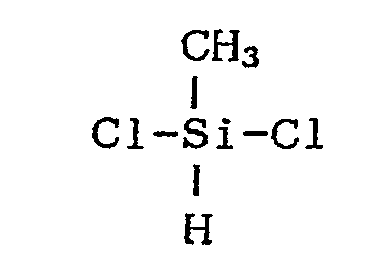
- (6) K. A. Andrianov and others reported in J. Organomet. Chem. 3, 129-137 ('65), that it is possible to obtain a polymer by the following procedure: react dimethyldichlorosilane and ammonia to produce a silazane compound, and polymerize the silazane compound in the presence of KOH as the catalyst. These reactions are shown below.
Baking the polymer to turn it into ceramic is not mentioned; however, the present inventors consider that this polymer when molded into various shapes will be poor in infusibility, wherefore this polymer, having no radicals that are capable of crosslinking, must receive a considerable amount of highly energized irradiation of electron beam, y -ray, etc. to become infusible. Also, another inconvenience with this polymer is that its ceramic yield after baking is as small as 35-40 %.
- (7) A. A. Zhdanov and others reported in Polym. Sci, USSR 23 (6) 1429-1438 ('81) that a silazane polymer is obtained by reacting trimethyltrivinylcyclotrisilazane with KOH (1 %) at 200°C. A disadvantage of this polymer lies in that it undergoes prompt polymerization when heated to temperatures above 200°C to produce a polymer which is insoluble and infusible, and therefore not moldable. Also, this report does not mention conversion of the polymer to a ceramic.
- Polymer Science USSR, vol. 26, No. 8, 1984, 1989-97 discloses the preparation of low molecular weight oligocyclosilazanes.
- As is apparent from the foregoing description, hitherto proposed silazane polymers are not appropriate for industrial use as preceramic materials. In addition, these polymers were found to exhibit poor moldability and processability as precursors for ceramic fibers, and poor ceramic yield as well. Ceramic products, e.g., ceramic fibers obtained from the known preceramic polysilazane materials were found to have relatively poor physical properties such as strength, modulus of elasticity and the like.
- It is therefore an object of the present invention to provide a process for manufacturing preceramic materials which is adapted for industrial production and which enables one to produce preceramic materials having good moldability and processability in high ceramic yield.
- It is another object of the invention to provide a process for manufacturing ceramics of high quality from the preceramic polymer materials.
- The present inventors have investigated processes for manufacturing SiC-Si3N4 type ceramics utilizing the precursor technique and to obtain ceramic precursors having excellent productivity and workability for the manufacture of the ceramic products. As a result, the inventors have proposed methods of manufacturing organic silazane polymers and ceramics therefrom, as disclosed in JP-A 62-290730, 63-117037, 63-193930, and 63-210133. The inventors have further studied the conversion of the polymers obtained by means of the procedures described in paragraphs (6) and (7) above with a view to improving the conversion methods. As a result, the inventors have found that organic silazane polymers exhibiting excellent heat stability, workability (moldability), and infusibility, can be obtained by reacting a mixture comprising 20 to 90 mol.% of at least one organosilicic compound having the formula (I):

and 80 to 10 mol.% of at least one of the organosilicic compound having the formula (II):
- The inventors have also found that the thus obtained organic silazane polymers have high ceramic yield.
- The present invention also provides a method of manufacturing a ceramic which comprises melting, molding, and rendering infusible the organic silazane polymer, and then baking the same.
- Particularly, according to the present invention, it is possible to produce in an easy and economical way, a high quality organic silazane polymer exhibiting excellent moldability, workability, and infusibility and having high ceramic yield (usually, for example, 70-80%). Another important advantage of the present invention is that the use of an alkali metal hydride or an alkaline earth metal hydride as the polymerization catalyst can be avoided. Thus, these catalysts are expensive and difficult to handle. In contrast with the method according to the present invention, one can use economical and easy-to-handle polymerization catalysts such as, potassium hydroxide and sodium hydroxide. It is thus possible to manufacture the improved organic silazane polymer in a manner far more economical and industrially advantageous as compared to prior processes. Furthermore, according to the present invention, it is possible to produce an organic silazane polymer having excellent workability and infusibility, as well as far better ceramic yield than the polymers obtained through the procedure described under (6) above. Further, the method of manufacturing ceramics according to the present invention uses the above-described organic silazane polymers as ceramic precursors so that it enables easy fabrication of ceramic products of various desired shapes which are endowed with excellent properties.
- In the method of manufacturing the organic silazane of the invention, the following compounds are used as the starting materials:
- at least one of the organosilicic compounds of the following general formula (I):

- and at least one of the organosilicic compounds of the following general formula (II):

- Preferably, the compound of formula (I) is dimethyldichlorosilane.
- The compounds represented by the general formula (II) are preferably organosilicic compounds containing a vinyl group as Ri , that is, those represented by the formula (Ila). An example thereof is methylvinyldichlorosilane,

- Also preferred as compounds represented by the formula (II) are those wherein R1 is a hydrogen atom as shown by formula (Ilb),

- The proportion of the compounds (I) to that of compounds (II) in the mixture should be between 20 mol.% to 80 mol.% and 90 mol.% to 10 mol.%, respectively. More preferably, the proportion falls in the range between 30 mol.% to 70 mol.% and 80 mol.% to 20 mol.%, respectively. Mixtures having the compositions in these ranges give organic silazane polymers which possess excellent heat stability, workability, and infusibility. Also, when these organic silazane polymers are baked, the ceramics obtained are greatly improved as compared to the ceramics obtained using conventional precursor methods. For example, the inventive ceramics exhibit improved ceramic yield, tensile strength, and elastic modulus. If, for example, the proportion of the compounds (II) exceeds the upper limit, the resultant organic silazane polymers tend to have poor heat stability and workability. Also, if the proportion of the compounds (II) is smaller than the lower limit, organic silazane polymers are obtained having poor infusibility and low ceramic yield after baking.
- If, in the mixture, the compound represented by the formula (11) is composed of both the organic compounds having a vinyl group (Ila) and organic compounds having a hydrogen atom lib), the mixing ratio (in terms of mol.% : mol.%) should be between 5 : 95 and 95 : 5, respectively, or more preferably between 20 : 80 and 80 : 20, respectively.
- According to the present invention, the above defined mixture of the organosilicic compounds is reacted with ammonia to produce silazane compounds. Any manner will do for conducting the reaction between the mixture and the ammonia, but a preferred manner consists of reacting the mixture with gaseous NH3 in an organic solvent, and then removing the by-product ammonium chloride, and finally removing the organic solvent by distillation (stripping). The organic solvent used can be, for example, pentane, hexane, benzene, toluene, xylene or diethylether. The amount of the ammonia used can be as many moles as the chlorine in the chlorosilane used, but preferably is 1.2 to 1.5 times as many moles as the same.
- Next, according to the present invention, the silazane compounds are polymerized in the presence of an alkali catalyst, preferably KOH or NaOH. The amount of the alkali catalyst added can be in normal cases 0.1 to 5.0 weight %, or preferably 0.1 to 2.0 weight %, based on the weight of the silazane compound. The polymerization process is usually conducted in the absence of a solvent, but it is also possible to conduct it in a solvent. In the latter case, any ordinary organic solvent will do so long as it has a boiling point suited to the polymerization temperature. The polymerization temperature is normally in the range of 0 - 350°C, or preferably, 20 - 300 °C depending on the desired polymerization degree as well as on the kind of organosilicic compound selected. Further, according to the method of the invention, there is no prescribed after-treatment procedure. However, it is possible to dissolve the polymers after the polymerization in an organic solvent, remove insoluble matter by means of filtration, and then remove the solvent by distillation under atmospheric pressure or reduced pressure. As a result, it is possible to obtain organic silazane polymers having melting points of 60 - 200 °C, and molecular weights of 800 - 3000, as determined by the benzene cryoscoping depressant method.
- An important advantage of the present invention is that the polymerization is allowed to continue until it ceases of its own accord. This is evidenced by the cessation of the evolution of gas from the polymerization mixture. Thus, there is no need to attempt to stop the polymerization at a midpoint of the reaction. The degrees of polymerization and the melting points of the silazane polymers can be also suitably controlled by changing the mixing ratios of the above organosilicic compounds.
- The silazane compounds produced from the reaction between the above-described mixtures and the ammonia comprise, for example, a silazane trimer and a silazane tetramer having skeleton units as represented by the formulae below, respectively. However, as far as the objects of the present invention are concerned, there is no requirement as to the structure of the silazane compounds.
- Also, it is thought that, as the silazane compounds undergo polymerization in the presence of an alkali catalyst, an intermediate product having a structure depicted below is produced accompanied by the elimination of NH3 and CH4 , and then the intermediate product grows into organic silazane polymers having greater molecular weights.

- The organic silazane polymers thus obtained have high moldability and processability and, accordingly, can be shaped, as preceramic materials, into suitable forms of shaped articles, such as fibers or sheets. In addition, the polymers may be used as binders or adhesives.
- In the process of manufacturing ceramics according to the invention, the organic silazane polymers are melted, molded, infusibilized and finally sintered. For this purpose, the polymers preferably have melting points of from 60 to 200 °C and molecular weights of from 800 to 3000 so that it becomes easier to melt and mold the polymers.
- The manner of melting, shaping and sintering of the organic silazane polymers is not critical, but the polymers are molded in desired shapes and sintered to obtain ceramic products of desired forms using conventional procedures.
- For instance, when a ceramic fiber is desired, the organic silazane polymer is first heated to form a melt and then spun by melt spinning. The spinning temperature is determined depending on the melting point of the polymer, and is favorably in the range of from 100 to 300 °C.
- Next, the thread-like material obtained by the spinning is infusibilized by heating in air, irradiation with electron beams in a vacuum or in inert gases such as N2 gas or optically infusibilized by irradiation with ultraviolet beams in an inert atmosphere, such as N2 or Ar gas. In this infusibilization step, the heating in air is preferably effected at a temperature between 50 and 150 °C. The electron beam irradiation is preferably conducted at an exposure dose of from 10 to 1000 Mrad. The ultraviolet irradiation may be carried out by using a commercially available ultraviolet lamp having a wave length of 250 to 400 nm. The light quantity of the ultraviolet is preferably adjusted by selecting the intensity of the light source, the irradiating distance and the irradiating time depending on the ease of infusibilization of the particular organic silazane polymer used. In the case where the organic silazane polymers are optically infusibilized by ultraviolet irradiation, it is preferred that the organic silazane polymers obtained using compound (II) having a vinyl radical as R1 are used. However, the organic silazane polymers having a small amount of vinyl radical can be easily optically infusibilized by ultraviolet irradiation if a photosensitizer, vulcanizer, etc. is added to the organic silazane polymer. The blending amount of photosensitizer or vulcanizer is preferably from about 0.0001 to 5 wt.% of the polymer since addition of a larger amount may affect the properties of the resultant polymer. The photosensitizer and the vulcanizer are those known to the art. Examples of the photosensitizer include benzophenone, acetophenone, and rosebengal; examples of the vulcanizer include diphenyl disulfide, 1,3-benzendithiol, 2,2'-dithiobisbenzothiazole, and 2-mercaptethyl sulfide.
- The thus infusibilized thread-like material is sintered at high temperatures in a tension-free or tensioned condition, thereby obtaining ceramic fibers composed mainly of SiC and Si3N4 and having good strength and modulus of elasticity. In this step, the sintering is preferably effected in a vacuum or an atmosphere of one or more gases, such as an inert gas including Ar, etc., N2 , H2 , NH3 and the like, at a temperature of from 700 to 2,000°C, preferably from 700 to 1,500°C. The sintering under tension is more preferable, since the the ceramic fibers obtained are of high quality having a tensile strength of from 180 to 230 kg/mm2 and a modulus of elasticity of from 15 to 20 tons/mm2 .
- When the organic silazane polymer is added as a binding agent to a powder of inorganic compounds selected from the group consisting of alumina, silicon carbide, silicon nitride and boron nitride, a ceramic molding product of high quality can be easily obtained.
- As has been described above, the inventive organic silazane polymers, which are thermally stable and have desired degrees of polymerization with good moldability and processability, can be conveniently produced industrially according to the process of the invention. Further, the polymers are excellent in infusibility and high in ceramic yield, and provide organic silazane polymers highly suitable for use as preceramic materials.
- On the other hand, according to the process of manufacturing ceramics of the present invention, ceramics of high quality composed mainly of SiC and Si3N4 can be obtained at a high ceramic yield. Ceramic products in desired forms such as ceramic fibers, ceramic sheets and ceramic molding products having high strength and high modulus of elasticity can be obtained easily by the process of the invention.
- The present invention is more particularly described by way of examples, but these examples should not be construed as limiting the present invention.
- A dried 1-liter four-necked flask equipped with a stirrer, a thermometer, an inlet tube for NHs , and a low temperature condenser was charged with 850 ml of hexane, and then with 29.0 g of dimethyldichlorosilane and 31.7 g of methylvinyldichlorosilane, and next the mixture was cooled to -20 °C. Excessive gaseous ammonia was passed into this solution at a rate of 20 liter/hr for 2.5 hours (total amount of addition of ammonia: 2.23 mol). The reaction mixture was warmed to room temperature, and meanwhile, in order to allow the unreacted NH3 to escape, the condenser was replaced by an air-cooled condenser.
- Next, a by-product ammonium chloride was removed from the reaction mixture by filtration in a dry box. Then, the cake on the filter was washed with 500 ml of hexane, and the filtrate was stripped of the hexane under a reduced pressure (60 °C/1 mmHg). The residual (silazane compounds) was a transparent liquid and weighed 34 g. According to the results of gas chromatography and mass spectrography, this liquid was recognized as a mixture of cyclic silazanes represented as below:


- A dried 1-liter flask equipped in the same way as the flask used in case (1) was charged with 850 ml of hexane, and then with 46.4 g of dimethyldichlorosilane and 12.7 g of methylvinyldichlorosilane, and next the mixture was cooled to -20 °C. Gaseous ammonia was passed in this solution at a rate of 20 liter/hr for 2.5 hours. This was followed by the same procedure as was carried out in case (1), and 32 g of a transparent liquid (silazane compound) was obtained.
- A dried 2-liter four-necked flask equipped in the same way as the flask in case (1) was charged with 1500 ml of dehydrated hexane, and then with 31.0 g of dimethyldichlorosilane and 79.0 g of methylvinyldichlorosilane. This was followed by the same procedure as in case (1), and 63 g of a transparent liquid (silazane compound) was obtained.
- A dried 1-liter four-necked flask equipped in the same way as in case (1) was charged with 850 ml of dehydrated hexane, 10.4 g of methyldichlorosilane, 23.2 g of dimethyldichlorosilane and then 25.4 g of methylvinyldichlorosilane, and then gaseous ammonia was passed into the mixture to react therewith. This was followed by the same procedure as in case (1), and 33 g of a transparent liquid (silazane compound) was obtained.
- A dried 2-liter flask equipped in the same way as in case (1) was charged with 1500 ml of hexane, 36.8 g of methyldichlorosilane, 56.8 g of dimethyldichlorosilane and then 5.6 g of methylvinyldichlorosilane, and then gaseous ammonia was passed into the mixture to react therewith. This was followed by the same procedure as in the case (1), and 49.6 g of silazane compounds was obtained.
- A dried 100 ml three-necked flask was equipped with a stirrer, thermometer, a water-cooled condenser, and a gas inlet tube for N2 , and was charged with 30 g of the product obtained in the ammonolysis step (1) and also 0.3 g of KOH as the catalyst. Then, the mixture was gradually heated. When the temperature reached 115°C, the reacting mixture turned yellow, and at 140°C, evolution of gases was observed. Analysis showed that these gases were NHs and CH4. Then, the reaction temperature was raised to 225°C, and then the mixture was cooled to room temperature. The product was gluey. Again, the temperature was gradually raised to 280°C, and this temperature was maintained for 5 minutes before it was allowed to drop to room temperature. The product was a vitreous solid of brown color, soluble in organic solvents, such as benzene, hexane, and toluene. Next, this product was dissolved in hexane, and then the solution was filtrated, and the filtrate was stripped of the solvent and low-vapor-pressure volatiles at 200°C, 400 Pa (3 mmHg), whereby 23.1 g of a pale yellow solid wa obtained. This substance had a melting point of 112.8 °C, and a molecular weight of 1511 (benzene cryoscoping depressant method). Further, the infrared (IR) spectra showed absorption peaks of N-H at 3,400 cm-1, C-H at 2,980 cm-1, CH2= CH at 1420 cm-1, and Si-CHs at 1,260 cm-1.
- Thirty grams of the silazane compound obtained in the ammonolysis step (2) were heated at 300 °C for 5 minutes and thereby caused to undergo polymerization in the same manner as in polymerization step (1) in the presence of 0.3 g of KOH. The same procedure as in polymerization step (1) was followed, and 25.5g of pale yellow solid was obtained. This substance had a melting point of 162 °C, and a molecular weight of 1440 (benzene cryoscoping depressant method).
- Fifty grams of the silazane compound obtained in the ammonolysis step (3) was heated at 195 °C and thereby caused to undergo polymerization in the same manner as in polymerization step (1) in the presence of 0.5 g of KOH. The same procedure as in polymerization step (1) was followed, and 40 g of vitreous solid was obtained. This substance had a melting point of 111 °C, and a molecular weight of 1470 (benzene cryoscoping depressant method). The IR spectra showed similar absorption peaks as in the case of the polymer obtained in polymerization step (1).
- Thirty grams of the silazane compound obtained in the ammonolysis step (4) were caused to undergo polymerization in the same manner as in polymerization step (1) in the presence of 0.3 g of KOH. Shortly after addition of the KOH, gas evolution occurred and as the temperature got to 60 °C the gas evolution became vigorous; then the evolution ceased at 80 °C. The temperature was raised further to 275 °C, and then it was lowered to room temperature whereupon a brown solid was obtained. The same after-treatment was conducted as in the other cases and, as a result, 22.8 g of a pale yellow substance was obtained. This substance had a melting point of 166.4 °C, and a molecular weight of 2230 (benzene cryoscoping depressant method).
- Forty-five grams of the silazane compound obtained in the ammonolysis step (5) were heated at 260 °C and thereby caused to undergo polymerization in the presence of 0.45 g of KOH. The same procedure as in the polymerization step (1) was followed, and 34.7 g of a pale yellow solid was obtained. This substance had a melting point of 182 °C, and a molecular weight of 2490.
- Twenty grams of the silazane polymer obtained in the polymerization step (1) were melt-spun at 170 °C by the use of a mono-hole melt spinning apparatus. The spinning was carried out very satisfactorily even after 4 hours of spinning and was performed at a take-up speed of 420 m/min. Then, the resultant green thread was subjected to an infusibilization treatment by electron beams at 400 Mrad. Then, the thread was sintered under a slight tension in an N2 gas stream for 30 minutes at a temperature of 1100°C, to which the temperature was raised at a rate of 100 °C/hr. The ceramic yield was 73 %, and the resulting fibrous substance had a fiber diameter of 8 µ, tensile strength of 220 kg/mm2 and a modulus of elasticity of 18 t/mm2 . When the fiber composition was analyzed by elementary analysis, it was confirmed to be fibers mainly composed of SiC-Si3N4 comprising 56.7 % of Si, 21.1 % of C, 18.7 % of N and 3.5 % of O.
- Ten grams of the silazane polymer obtained in the polymerization step (2) were melt-spun at 260 °C by the use of the same spinning apparatus as used in the fiber preparation step (1). The spinning was carried out very satisfactorily. The resultant green thread was slightly tensed and was infusibilized by heating to 80-150 °C (10°C /hr) in air. Then the thread was sintered in an N2 gas stream for 30 minutes at a temperature of 1250 °C to which the temperature was raised at a rate of 100 °C/hr. The ceramic yield was 76 %, and the resulting fibrous substance had a fiber diameter of 10µ, tensile strength of 200 kg/mm2 and a modulus of elasticity of 16 t/mm2 . Further, the substance was confirmed to be fibers mainly composed of SiC-Si3N4 comprising 49.5 % of Si, 22.5 % of C, 17.5 % of N and 10.5 % of O.
- Twenty grams of the silazane polymer obtained in the polymerization step (3) were melt-spun in a dry box at 180°C and the spinning was performed at a take-up speed of 450 m/min by the use of the same spinning apparatus as used in fiber preparation step (1). The spinning was carried out very satisfactorily throughout. Then, the resultant green thread was subjected to an infusibilization treatment by electron beams at 500 Mrad. The resultant green thread was tensed and was sintered in an N2 gas stream for 30 minutes at a temperature of 1200 °C, to which the temperature was raised at a rate of 100 °C/hr. The ceramic yield was 81 %, and the resulting fibrous substance had a fiber diameter of 6 µ, tensile strength of 210 kg/mm2 and a modulus of elasticity of 18 t/mm2 .
- Ten grams of the silazane polymer obtained in the polymerization step (4) were mixed with 0.1 % of rosebengal as a photosensitizer and 0.5 % of 2-mercaptethylsulfide as a curing agent, and then the mixture was dissolved in 50 ml of hexane. Then, the hexane was distilled off under a reduced pressure. The thus prepared polymer was melt-spun at 270 °C by the use of the same spinning apparatus as used in fiber preparation step (1). The resultant green thread was subjected to an infusibilization treatment in an N2 gas stream for 5 hours using a ultraviolet beam irradiation device (mercury lamp H-400P for photochemical use, manufactured by Toshiba Co. Ltd.) placed 15 cm from the thread, and the thread was subjected to photoirradiation from a 15 cm distance. Then, the resultant fibers were sintered under a slight tension for 1 hour at a temperature of 1150 °C to which the temperature was raised at a rate of 100°C/hr. The ceramic yield was 72 % and the fiber was found to have a fiber diameter of 811, a tensile strength of 185 kg/mm2 and a modulus of elasticity of 17 t/mm2 .
- Ten grams of the silazane polymer obtained in the polymerization step (5) were incorporated with 0.2 % of 2,2'-dithiobisbenzothiazole as a curing agent, and then the mixture was dissolved in 50 ml of hexane. Next, the hexane was distilled off under a reduced pressure. The thus obtained polymer was melt-spun by the use of the same spinning apparatus as used in fiber preparation step (1). The resultant green thread was infusibilized using an ultraviolet beam irradiation device in the same manner as described under fiber preparation step (4); then, the resultant fibers were sintered at 1200°C. The ceramic yield was 79 % and the tensile strength was 205 kg/mm2 and the modulus of elasticity was 18 tIMM2.
- Ten grams of fine SiC powder and two grams of hexane were dispersed and kneaded in 3.0 g of the silazane polymer obtained in the polymerization step (5), and then the hexane was distilled off. The powder was press-molded under a molding pressure of 98100 kPa (1,000 kg/cm2), thereby obtaining a powder-pressed mold having a diameter of 25 mm and a thickness of 3 mm. Then, the powder-pressed mold was heated in an argon atmosphere, the temperature being raised from the room temperature to 1,000 °C over 2 hours, and from 1,000°C to 1,950°C over 1 hour, and being maintained at 1,950 °C over 30 minutes and then allowed to drop to thereby obtain an SiC mold having a density of 2.8 g/cm3 and a bending strength of 25 kg/mm2 .
- A 1-liter four-necked flask equipped with a stirrer, a thermometer, an inlet tube for NH3 , and a low temperature condenser was charged with 1500 ml of dehydrated hexane, and then with 90 g of dimethyldichlorosilane. Gaseous ammonia was passed into this solution at a rate of 20 liter/hr for 3.5 hours to cause ammonolysis. Then, the same procedure was followed as that described in ammonolysis step (1) of the Example. As a result, 44 g of transparent liquid was obtained. This was a mixture mainly made up of hexamethylcyclotrisilazane and octamethylcyclotetrasilazane.
- A 1-liter four-necked flask equipped in the same way as the flask of the foregoing step (1) was charged with 1500 ml of dehydrated hexane, and then with 98.7 g of methylvinyldichlorosilane. The mixture was allowed to react with ammonia in the same manner as in step (1) above, and 47.0 g of a transparent liquid was obtained. This was a mixture mainly made up of trimethyltrivinylcyclotrisilazane and tetram- ethyltetravinyltetracyclosilazane.
- Hexamethylcyclotrisilazane was isolated by distillation from the silazane compound obtained in the ammonolysis step (1) of the Comparative Example. After pouring 20 g of the thus obtained hexamethylcyclotrisilazane into a 100-ml three-necked flask, 0.2 g of KOH was added thereto, and then the mixture was heated gradually in an N2 stream and the reaction was allowed to proceed at 280 °C. When the mixture was cooled, a yellow massive solid was obtained. This reaction product was dissolved in 50 ml of hexane, and filtrated. Then, the hexane and low vapor pressure components were distilled off at 200 °C under 133 Pa (1 torr), leaving 15 g of pale yellow solid. This substance had a melting point of 161 °C, and a molecular weight of 1320 (benzene cryoscoping depressant method). Further, the IR spectra showed absorption of N-H at 3,400 cm-1, C-H at 2,980 cm-1, and Si-CH3 at 1,260 cm-1.
- Trimethyltrivinylcyclotrisilazane was isolated by distillation from the silazane compound obtained in the ammonolysis step (2) of the Comparative Example. After pouring 20 g of the thus obtained trimethyltrivinylcyclotrisilazane into a 100-ml three-necked flask, 0.2 g of KOH was added thereto, and then the mixture was heated gradually in an N2 stream and the reaction was allowed to proceed at 190°C. When the mixture was cooled to room temperature, a greasy substance was obtained. As the mixture was further heated in the flask such that a reaction was allowed to proceed at 200 °C for 5 minutes, the mixture gelatinized rapidly. The solid substance obtained after cooling the product was scarcely soluble in organic solvents (benzene, hexane, THF, CCI4, etc.), and the melting point was higher than 300 °C. An attempt was made to control the reaction temperature so as to obtain a polymerization degree at which melt-spinning was possible, but due to the uncontrollable rapid reaction that took place when the temperature was in the vicinity of 200 °C, the endeavor was thwarted.
- Ten grams of the organic silazane polymer obtained in polymerization step (1) of the Comparative Example were charged into a mono-hole spinning apparatus, and was melt-spun at 250 °C. Spinning was carried out satisfactorily, and performed at a take-up speed of 400 m/min. The resultant green thread was subjected to irradiation with electron beams at 100 Mrad, 500 Mrad, and 2 Grad by using an electron beam apparatus; then the fibrous material obtained was sintered in an N2 stream at 1100 °C, the temperature having been increased to this value at a rate of 100 °C/hr. The threads that had received 100 Mrad or 500 Mrad of electron beams were melted down and did not have a fibrous appearance when taken out of the sintering furnace. The threads that had been exposed to 2 Grad of electron beams retained the fibrous form although some portions were slightly melted; these had a tension strength of 120 - 180 kg/mm2 and a modulus of elasticity of 14 - 16 t/mm2, but the ceramic yield based on the spun green thread was only 38 %.
- Attempts were made to infusibilize some green threads by oxidation in the air, and others by irradiation with ultraviolet rays; in both cases the infusibilization was a failure for the threads were all melted down during sintering.
Claims (16)

Applications Claiming Priority (2)
| Application Number | Priority Date | Filing Date | Title |
|---|---|---|---|
| JP62313264A JPH01153730A (en) | 1987-12-11 | 1987-12-11 | Organic silazane polymer and production of ceramic using said polymer |
| JP313264/87 | 1987-12-11 |
Publications (2)
| Publication Number | Publication Date |
|---|---|
| EP0323062A1 EP0323062A1 (en) | 1989-07-05 |
| EP0323062B1 true EP0323062B1 (en) | 1990-11-28 |
Family
ID=18039115
Family Applications (1)
| Application Number | Title | Priority Date | Filing Date |
|---|---|---|---|
| EP88311692A Expired EP0323062B1 (en) | 1987-12-11 | 1988-12-09 | Process for manufacturing organic silazane polymers |
Country Status (4)
| Country | Link |
|---|---|
| US (1) | US4954596A (en) |
| EP (1) | EP0323062B1 (en) |
| JP (1) | JPH01153730A (en) |
| DE (1) | DE3861189D1 (en) |
Families Citing this family (10)
| Publication number | Priority date | Publication date | Assignee | Title |
|---|---|---|---|---|
| US5176941A (en) * | 1987-11-07 | 1993-01-05 | Hoechst Aktiengesellschaft | Process of producing a ceramic/fiber composite using a molten polysilazone |
| EP0361181B1 (en) * | 1988-09-09 | 1995-03-22 | Shin-Etsu Chemical Co., Ltd. | Infusibilization of organic silazane polymers and preparation of hollow ceramic fibers |
| US5208192A (en) * | 1990-01-12 | 1993-05-04 | Ethyl Corporation | Preceramic polysilazane compositions |
| DE4114218A1 (en) * | 1991-05-01 | 1992-11-05 | Bayer Ag | ORGANIC SILAZANE POLYMERS, METHOD FOR THE PRODUCTION THEREOF AND A METHOD FOR THE PRODUCTION OF CERAMIC MATERIALS THEREOF |
| JP3050959B2 (en) * | 1991-09-04 | 2000-06-12 | 日本原子力研究所 | Ultra-high-strength heat-resistant silicon carbide fiber and method for producing the same |
| US6329487B1 (en) * | 1999-11-12 | 2001-12-11 | Kion Corporation | Silazane and/or polysilazane compounds and methods of making |
| DE10297497T5 (en) * | 2001-12-04 | 2004-11-18 | Fleetguard, Inc., Nashville | Melt-spun ceramic fiber filter and method |
| US9991182B2 (en) | 2013-07-19 | 2018-06-05 | Az Electronic Materials (Luxembourg) S.A.R.L. | Encapsulation material for light emitting diodes |
| CN108395253B (en) * | 2018-02-13 | 2021-09-21 | 东华大学 | Preparation method of silicon-boron-nitrogen-carbon-beryllium ceramic fiber |
| CN108676167B (en) * | 2018-04-03 | 2020-06-16 | 中国科学院化学研究所 | A kind of preparation device and method of polysilazane |
Family Cites Families (13)
| Publication number | Priority date | Publication date | Assignee | Title |
|---|---|---|---|---|
| DE2218960A1 (en) * | 1972-04-19 | 1973-11-08 | Bayer Ag | MOLDED BODIES FROM MOGENIC MIXTURES OF SILICON CARBIDE AND SILICON NITRIDE AND PROCESS FOR THEIR PRODUCTION |
| US4097294A (en) * | 1976-08-23 | 1978-06-27 | The United States Of America As Represented By The Secretary Of The Navy | Preparation of ceramics |
| US4404153A (en) * | 1981-01-15 | 1983-09-13 | Dow Corning Corporation | Process for the preparation of poly(disilyl)silazane polymers and the polymers therefrom |
| US4312970A (en) * | 1981-02-20 | 1982-01-26 | Dow Corning Corporation | Silazane polymers from {R'3 Si}2 NH and organochlorosilanes |
| US4395460A (en) * | 1981-09-21 | 1983-07-26 | Dow Corning Corporation | Preparation of polysilazane polymers and the polymers therefrom |
| US4540803A (en) * | 1983-11-28 | 1985-09-10 | Dow Corning Corporation | Hydrosilazane polymers from [R3 Si]2 NH and HSiCl3 |
| US4482669A (en) * | 1984-01-19 | 1984-11-13 | Massachusetts Institute Of Technology | Preceramic organosilazane polymers |
| US4482689A (en) * | 1984-03-12 | 1984-11-13 | Dow Corning Corporation | Process for the preparation of polymetallo(disily)silazane polymers and the polymers therefrom |
| US4595775A (en) * | 1984-04-06 | 1986-06-17 | Petrarch Systems, Inc. | N-methylhydridosilazanes, polymers thereof, methods of making same and silicon nitrides produced therefrom |
| US4535007A (en) * | 1984-07-02 | 1985-08-13 | Dow Corning Corporation | Silicon nitride-containing ceramics |
| JPS62290730A (en) * | 1986-06-10 | 1987-12-17 | Shin Etsu Chem Co Ltd | Production of organosilazane polymer and production of ceramics using said polymer |
| DE3625690A1 (en) * | 1986-07-30 | 1988-02-04 | Wacker Chemie Gmbh | METHOD FOR PRODUCING SIC-CONTAINING CERAMIC FIBER |
| US4720532A (en) * | 1986-08-22 | 1988-01-19 | Massachusetts Institute Of Technology | Organopolysilazane precursors to silicon nitride-rich mixed SiC/Si3 N4 |
-
1987
- 1987-12-11 JP JP62313264A patent/JPH01153730A/en active Granted
-
1988
- 1988-12-09 DE DE8888311692T patent/DE3861189D1/en not_active Expired - Fee Related
- 1988-12-09 EP EP88311692A patent/EP0323062B1/en not_active Expired
- 1988-12-12 US US07/283,316 patent/US4954596A/en not_active Expired - Lifetime
Also Published As
| Publication number | Publication date |
|---|---|
| DE3861189D1 (en) | 1991-01-10 |
| JPH0426612B2 (en) | 1992-05-07 |
| JPH01153730A (en) | 1989-06-15 |
| EP0323062A1 (en) | 1989-07-05 |
| US4954596A (en) | 1990-09-04 |
Similar Documents
| Publication | Publication Date | Title |
|---|---|---|
| US4869854A (en) | Process for manufacturing organic silazane polymers and ceramics therefrom | |
| US4870035A (en) | Process for manufacturing organic silazane polymers and process for manufacturing ceramics from the polymers | |
| US4847345A (en) | Process for manufacturing organic silazane polymers and ceramics therefrom | |
| US4767876A (en) | Method for converting organosilicon polymers containing SIH repeat units and organopolysilazane precursors to new and useful preceramic polymers and silicon nitride enriched ceramic materials | |
| EP0295062B1 (en) | Polysilacyclobutasilazanes | |
| US4954596A (en) | Process for manufacturing organic silazane polymers and ceramics therefrom | |
| US4948763A (en) | Preparation of hollow ceramic fibers | |
| JP2511074B2 (en) | Pre-ceramic polymer, ceramic material and methods for producing the same | |
| EP0417526B1 (en) | Methods for preparing polytitanocarbosilazane polymers and ceramics therefrom | |
| US5145813A (en) | Process for manufacturing organic silazane polymers and ceramics therefrom | |
| EP0434428B1 (en) | A method for manufacturing a hafnium-containing silazane polymer and a method for manufacturing a ceramic from said polymer | |
| EP0361181B1 (en) | Infusibilization of organic silazane polymers and preparation of hollow ceramic fibers | |
| US5200371A (en) | Method for preparing organic silazane polymers and method for preparing ceramics from the polymers | |
| EP0466055B1 (en) | Method for preparing organic silazane polymers and method for preparing ceramics from the polymers | |
| JPH0798865B2 (en) | Ceramics manufacturing method | |
| JPH0234565A (en) | Method for making organic silazane polymer infusible | |
| JP2518119B2 (en) | Ceramics manufacturing method | |
| US5008348A (en) | Infusibilization of organic silazane polymers | |
| JPS63243328A (en) | Ceramics manufacturing method | |
| JPH07119283B2 (en) | Method for infusibilizing organic silazane polymer | |
| JPH02169627A (en) | Method for controlling catalytic | |
| JPH0798866B2 (en) | Ceramics manufacturing method | |
| JPH02120279A (en) | Ceramics manufacturing method | |
| JPH04153226A (en) | Method for producing boron-containing silazane polymer and method for producing ceramics | |
| JPH0577691B2 (en) |
Legal Events
| Date | Code | Title | Description |
|---|---|---|---|
| PUAI | Public reference made under article 153(3) epc to a published international application that has entered the european phase |
Free format text: ORIGINAL CODE: 0009012 |
|
| AK | Designated contracting states |
Kind code of ref document: A1 Designated state(s): DE FR |
|
| 17P | Request for examination filed |
Effective date: 19890829 |
|
| 17Q | First examination report despatched |
Effective date: 19891031 |
|
| GRAA | (expected) grant |
Free format text: ORIGINAL CODE: 0009210 |
|
| AK | Designated contracting states |
Kind code of ref document: B1 Designated state(s): DE FR |
|
| ET | Fr: translation filed | ||
| REF | Corresponds to: |
Ref document number: 3861189 Country of ref document: DE Date of ref document: 19910110 |
|
| PLBE | No opposition filed within time limit |
Free format text: ORIGINAL CODE: 0009261 |
|
| STAA | Information on the status of an ep patent application or granted ep patent |
Free format text: STATUS: NO OPPOSITION FILED WITHIN TIME LIMIT |
|
| 26N | No opposition filed | ||
| PGFP | Annual fee paid to national office [announced via postgrant information from national office to epo] |
Ref country code: FR Payment date: 19981209 Year of fee payment: 11 |
|
| PGFP | Annual fee paid to national office [announced via postgrant information from national office to epo] |
Ref country code: DE Payment date: 19981221 Year of fee payment: 11 |
|
| PG25 | Lapsed in a contracting state [announced via postgrant information from national office to epo] |
Ref country code: FR Free format text: LAPSE BECAUSE OF NON-PAYMENT OF DUE FEES Effective date: 20000831 |
|
| PG25 | Lapsed in a contracting state [announced via postgrant information from national office to epo] |
Ref country code: DE Free format text: LAPSE BECAUSE OF NON-PAYMENT OF DUE FEES Effective date: 20001003 |
|
| REG | Reference to a national code |
Ref country code: FR Ref legal event code: ST |