EP0323178A2 - Verfahren zur Herstellung von supraleitenden Materialien bei hoher Temperatur - Google Patents
Verfahren zur Herstellung von supraleitenden Materialien bei hoher Temperatur Download PDFInfo
- Publication number
- EP0323178A2 EP0323178A2 EP88312277A EP88312277A EP0323178A2 EP 0323178 A2 EP0323178 A2 EP 0323178A2 EP 88312277 A EP88312277 A EP 88312277A EP 88312277 A EP88312277 A EP 88312277A EP 0323178 A2 EP0323178 A2 EP 0323178A2
- Authority
- EP
- European Patent Office
- Prior art keywords
- oxygen
- alkali
- earth element
- substituted
- metal oxide
- Prior art date
- Legal status (The legal status is an assumption and is not a legal conclusion. Google has not performed a legal analysis and makes no representation as to the accuracy of the status listed.)
- Withdrawn
Links
Images




Classifications
-
- C—CHEMISTRY; METALLURGY
- C01—INORGANIC CHEMISTRY
- C01G—COMPOUNDS CONTAINING METALS NOT COVERED BY SUBCLASSES C01D OR C01F
- C01G21/00—Compounds of lead
- C01G21/006—Compounds containing lead, with or without oxygen or hydrogen, and containing two or more other elements
-
- B—PERFORMING OPERATIONS; TRANSPORTING
- B01—PHYSICAL OR CHEMICAL PROCESSES OR APPARATUS IN GENERAL
- B01J—CHEMICAL OR PHYSICAL PROCESSES, e.g. CATALYSIS OR COLLOID CHEMISTRY; THEIR RELEVANT APPARATUS
- B01J35/00—Catalysts, in general, characterised by their form or physical properties
- B01J35/70—Catalysts, in general, characterised by their form or physical properties characterised by their crystalline properties, e.g. semi-crystalline
-
- C—CHEMISTRY; METALLURGY
- C01—INORGANIC CHEMISTRY
- C01G—COMPOUNDS CONTAINING METALS NOT COVERED BY SUBCLASSES C01D OR C01F
- C01G15/00—Compounds of gallium, indium or thallium
- C01G15/006—Compounds containing gallium, indium or thallium, with or without oxygen or hydrogen, and containing two or more other elements
-
- C—CHEMISTRY; METALLURGY
- C01—INORGANIC CHEMISTRY
- C01G—COMPOUNDS CONTAINING METALS NOT COVERED BY SUBCLASSES C01D OR C01F
- C01G29/00—Compounds of bismuth
- C01G29/006—Compounds containing bismuth, with or without oxygen or hydrogen, and containing two or more other elements
-
- C—CHEMISTRY; METALLURGY
- C01—INORGANIC CHEMISTRY
- C01G—COMPOUNDS CONTAINING METALS NOT COVERED BY SUBCLASSES C01D OR C01F
- C01G3/00—Compounds of copper
- C01G3/006—Compounds containing copper, with or without oxygen or hydrogen, and containing two or more other elements
-
- C—CHEMISTRY; METALLURGY
- C01—INORGANIC CHEMISTRY
- C01G—COMPOUNDS CONTAINING METALS NOT COVERED BY SUBCLASSES C01D OR C01F
- C01G30/00—Compounds of antimony
- C01G30/002—Compounds containing antimony, with or without oxygen or hydrogen, and containing two or more other elements
-
- C—CHEMISTRY; METALLURGY
- C01—INORGANIC CHEMISTRY
- C01G—COMPOUNDS CONTAINING METALS NOT COVERED BY SUBCLASSES C01D OR C01F
- C01G33/00—Compounds of niobium
- C01G33/006—Compounds containing niobium, with or without oxygen or hydrogen, and containing two or more other elements
-
- C—CHEMISTRY; METALLURGY
- C04—CEMENTS; CONCRETE; ARTIFICIAL STONE; CERAMICS; REFRACTORIES
- C04B—LIME, MAGNESIA; SLAG; CEMENTS; COMPOSITIONS THEREOF, e.g. MORTARS, CONCRETE OR LIKE BUILDING MATERIALS; ARTIFICIAL STONE; CERAMICS; REFRACTORIES; TREATMENT OF NATURAL STONE
- C04B35/00—Shaped ceramic products characterised by their composition; Ceramics compositions; Processing powders of inorganic compounds preparatory to the manufacturing of ceramic products
- C04B35/01—Shaped ceramic products characterised by their composition; Ceramics compositions; Processing powders of inorganic compounds preparatory to the manufacturing of ceramic products based on oxide ceramics
- C04B35/45—Shaped ceramic products characterised by their composition; Ceramics compositions; Processing powders of inorganic compounds preparatory to the manufacturing of ceramic products based on oxide ceramics based on copper oxide or solid solutions thereof with other oxides
- C04B35/4504—Shaped ceramic products characterised by their composition; Ceramics compositions; Processing powders of inorganic compounds preparatory to the manufacturing of ceramic products based on oxide ceramics based on copper oxide or solid solutions thereof with other oxides containing rare earth oxides
-
- C—CHEMISTRY; METALLURGY
- C04—CEMENTS; CONCRETE; ARTIFICIAL STONE; CERAMICS; REFRACTORIES
- C04B—LIME, MAGNESIA; SLAG; CEMENTS; COMPOSITIONS THEREOF, e.g. MORTARS, CONCRETE OR LIKE BUILDING MATERIALS; ARTIFICIAL STONE; CERAMICS; REFRACTORIES; TREATMENT OF NATURAL STONE
- C04B35/00—Shaped ceramic products characterised by their composition; Ceramics compositions; Processing powders of inorganic compounds preparatory to the manufacturing of ceramic products
- C04B35/01—Shaped ceramic products characterised by their composition; Ceramics compositions; Processing powders of inorganic compounds preparatory to the manufacturing of ceramic products based on oxide ceramics
- C04B35/45—Shaped ceramic products characterised by their composition; Ceramics compositions; Processing powders of inorganic compounds preparatory to the manufacturing of ceramic products based on oxide ceramics based on copper oxide or solid solutions thereof with other oxides
- C04B35/4512—Shaped ceramic products characterised by their composition; Ceramics compositions; Processing powders of inorganic compounds preparatory to the manufacturing of ceramic products based on oxide ceramics based on copper oxide or solid solutions thereof with other oxides containing thallium oxide
-
- C—CHEMISTRY; METALLURGY
- C04—CEMENTS; CONCRETE; ARTIFICIAL STONE; CERAMICS; REFRACTORIES
- C04B—LIME, MAGNESIA; SLAG; CEMENTS; COMPOSITIONS THEREOF, e.g. MORTARS, CONCRETE OR LIKE BUILDING MATERIALS; ARTIFICIAL STONE; CERAMICS; REFRACTORIES; TREATMENT OF NATURAL STONE
- C04B35/00—Shaped ceramic products characterised by their composition; Ceramics compositions; Processing powders of inorganic compounds preparatory to the manufacturing of ceramic products
- C04B35/01—Shaped ceramic products characterised by their composition; Ceramics compositions; Processing powders of inorganic compounds preparatory to the manufacturing of ceramic products based on oxide ceramics
- C04B35/45—Shaped ceramic products characterised by their composition; Ceramics compositions; Processing powders of inorganic compounds preparatory to the manufacturing of ceramic products based on oxide ceramics based on copper oxide or solid solutions thereof with other oxides
- C04B35/4521—Shaped ceramic products characterised by their composition; Ceramics compositions; Processing powders of inorganic compounds preparatory to the manufacturing of ceramic products based on oxide ceramics based on copper oxide or solid solutions thereof with other oxides containing bismuth oxide
-
- H—ELECTRICITY
- H01—ELECTRIC ELEMENTS
- H01M—PROCESSES OR MEANS, e.g. BATTERIES, FOR THE DIRECT CONVERSION OF CHEMICAL ENERGY INTO ELECTRICAL ENERGY
- H01M4/00—Electrodes
- H01M4/86—Inert electrodes with catalytic activity, e.g. for fuel cells
- H01M4/90—Selection of catalytic material
- H01M4/9016—Oxides, hydroxides or oxygenated metallic salts
-
- H—ELECTRICITY
- H01—ELECTRIC ELEMENTS
- H01M—PROCESSES OR MEANS, e.g. BATTERIES, FOR THE DIRECT CONVERSION OF CHEMICAL ENERGY INTO ELECTRICAL ENERGY
- H01M8/00—Fuel cells; Manufacture thereof
- H01M8/10—Fuel cells with solid electrolytes
- H01M8/12—Fuel cells with solid electrolytes operating at high temperature, e.g. with stabilised ZrO2 electrolyte
- H01M8/124—Fuel cells with solid electrolytes operating at high temperature, e.g. with stabilised ZrO2 electrolyte characterised by the process of manufacturing or by the material of the electrolyte
-
- B—PERFORMING OPERATIONS; TRANSPORTING
- B01—PHYSICAL OR CHEMICAL PROCESSES OR APPARATUS IN GENERAL
- B01J—CHEMICAL OR PHYSICAL PROCESSES, e.g. CATALYSIS OR COLLOID CHEMISTRY; THEIR RELEVANT APPARATUS
- B01J2235/00—Indexing scheme associated with group B01J35/00, related to the analysis techniques used to determine the catalysts form or properties
- B01J2235/15—X-ray diffraction
-
- C—CHEMISTRY; METALLURGY
- C01—INORGANIC CHEMISTRY
- C01P—INDEXING SCHEME RELATING TO STRUCTURAL AND PHYSICAL ASPECTS OF SOLID INORGANIC COMPOUNDS
- C01P2002/00—Crystal-structural characteristics
- C01P2002/20—Two-dimensional structures
-
- C—CHEMISTRY; METALLURGY
- C01—INORGANIC CHEMISTRY
- C01P—INDEXING SCHEME RELATING TO STRUCTURAL AND PHYSICAL ASPECTS OF SOLID INORGANIC COMPOUNDS
- C01P2002/00—Crystal-structural characteristics
- C01P2002/50—Solid solutions
- C01P2002/52—Solid solutions containing elements as dopants
- C01P2002/54—Solid solutions containing elements as dopants one element only
-
- C—CHEMISTRY; METALLURGY
- C01—INORGANIC CHEMISTRY
- C01P—INDEXING SCHEME RELATING TO STRUCTURAL AND PHYSICAL ASPECTS OF SOLID INORGANIC COMPOUNDS
- C01P2002/00—Crystal-structural characteristics
- C01P2002/70—Crystal-structural characteristics defined by measured X-ray, neutron or electron diffraction data
- C01P2002/77—Crystal-structural characteristics defined by measured X-ray, neutron or electron diffraction data by unit-cell parameters, atom positions or structure diagrams
-
- C—CHEMISTRY; METALLURGY
- C01—INORGANIC CHEMISTRY
- C01P—INDEXING SCHEME RELATING TO STRUCTURAL AND PHYSICAL ASPECTS OF SOLID INORGANIC COMPOUNDS
- C01P2002/00—Crystal-structural characteristics
- C01P2002/80—Crystal-structural characteristics defined by measured data other than those specified in group C01P2002/70
- C01P2002/88—Crystal-structural characteristics defined by measured data other than those specified in group C01P2002/70 by thermal analysis data, e.g. TGA, DTA, DSC
-
- C—CHEMISTRY; METALLURGY
- C01—INORGANIC CHEMISTRY
- C01P—INDEXING SCHEME RELATING TO STRUCTURAL AND PHYSICAL ASPECTS OF SOLID INORGANIC COMPOUNDS
- C01P2004/00—Particle morphology
- C01P2004/20—Particle morphology extending in two dimensions, e.g. plate-like
-
- C—CHEMISTRY; METALLURGY
- C01—INORGANIC CHEMISTRY
- C01P—INDEXING SCHEME RELATING TO STRUCTURAL AND PHYSICAL ASPECTS OF SOLID INORGANIC COMPOUNDS
- C01P2006/00—Physical properties of inorganic compounds
- C01P2006/32—Thermal properties
- C01P2006/33—Phase transition temperatures
- C01P2006/36—Solid to solid transition temperatures
-
- Y—GENERAL TAGGING OF NEW TECHNOLOGICAL DEVELOPMENTS; GENERAL TAGGING OF CROSS-SECTIONAL TECHNOLOGIES SPANNING OVER SEVERAL SECTIONS OF THE IPC; TECHNICAL SUBJECTS COVERED BY FORMER USPC CROSS-REFERENCE ART COLLECTIONS [XRACs] AND DIGESTS
- Y02—TECHNOLOGIES OR APPLICATIONS FOR MITIGATION OR ADAPTATION AGAINST CLIMATE CHANGE
- Y02E—REDUCTION OF GREENHOUSE GAS [GHG] EMISSIONS, RELATED TO ENERGY GENERATION, TRANSMISSION OR DISTRIBUTION
- Y02E60/00—Enabling technologies; Technologies with a potential or indirect contribution to GHG emissions mitigation
- Y02E60/30—Hydrogen technology
- Y02E60/50—Fuel cells
-
- Y—GENERAL TAGGING OF NEW TECHNOLOGICAL DEVELOPMENTS; GENERAL TAGGING OF CROSS-SECTIONAL TECHNOLOGIES SPANNING OVER SEVERAL SECTIONS OF THE IPC; TECHNICAL SUBJECTS COVERED BY FORMER USPC CROSS-REFERENCE ART COLLECTIONS [XRACs] AND DIGESTS
- Y02—TECHNOLOGIES OR APPLICATIONS FOR MITIGATION OR ADAPTATION AGAINST CLIMATE CHANGE
- Y02P—CLIMATE CHANGE MITIGATION TECHNOLOGIES IN THE PRODUCTION OR PROCESSING OF GOODS
- Y02P70/00—Climate change mitigation technologies in the production process for final industrial or consumer products
- Y02P70/50—Manufacturing or production processes characterised by the final manufactured product
Definitions
- the invention relates to methods for preparing binary, ternary or higher metal oxide materials having high or enhanced oxygen-ion mobility or diffusion, or, for a given density and material dimensions, having a high or enhanced rate of oxygen exchange or diffusion with an ambient oxygen containing atmosphere; to methods for preparing novel binary, ternary, or higher metal oxide materials exhibiting superconductivity; and to novel materials having high or enhanced oxygen-ion mobility and/or exhibiting superconductivity.
- Binary, ternary and higher metal oxide materials containing as one or more cations an alkali earth element or element and which exhibit superconductivity or which may be prepared to exhibit superconductivity at elevated temperatures are exemplified by YBa2Cu3O 7- ⁇ , Bi 2+x (Ca,Sr) n+1 Cu n O 2n+4+ ⁇ , Tl 1+n (Ca,Ba) n+1 Cu n O 2n+3+ ⁇ and Tl 2+n (Ca,Sr) n+1 Cu n O 2n+4+ ⁇ .
- the material YBa2Cu3O 7- ⁇ conveniently referred to as YBCO, or those materials RBa2Cu3O 7- ⁇ , conveniently referred to as RBCO, where the element Y in YBCO is replaced either wholly or in part by an element of the rare-earth lanthanides, can be prepared in a form which is superconducting at elevated temperatures in the region of 90 to 100 K.
- TCBCO homologous series of compounds approximated in composition by the formula Tl 1+n (Ca,Ba) n+1 Cu n O 2n+2+ ⁇ and Tl 2+n (Ca,Sr) n+1 Cu n O 2n+4+ ⁇ where n may equal 1, 2, 3, 4, ..., conveniently referred to as TCBCO similarly form a series of superconducting compounds. These materials are loosely referred to as "high-temperature superconductors". In their superconducting state these materials will exhibit zero electrical resistance and perfect diamagnetism. The latter property means that the material will totally expell a magnetic field, a phenomenon known as the Meissner effect.
- the above materials may be prepared by solid state reaction of precursor materials, for example, such as Y2O3, BaCO3 and CuO for YBCO, such as Bi2O3, CaCO3, SrCO3 and CuO for BCSCO, and such as Tl2O3, CaO, BaO and CuO for TCBCO, followed by oxygen loading or unloading as appropriate to achieve the optimum oxygen stoichiometry for superconductivity, as described in "Chemistry of High Temperature Superconductors" - Eds.
- precursor materials for example, such as Y2O3, BaCO3 and CuO for YBCO, such as Bi2O3, CaCO3, SrCO3 and CuO for BCSCO, and such as Tl2O3, CaO, BaO and CuO for TCBCO
- Higher densities may be achieved by, for example, spray drying or freeze drying powders as described for example in Johnson et al, Advanced Ceramic Materials 2 , 337 (1987), spray pyrolysis as described for example in Kodas et al, Applied Physics Letters 52 , 1622 (1988), precipitation or sol gel methods as described for example in Barboux et al J. Applied Physics 63 , 2725 (1988), in order to achieve very fine particles of dimension 20 to 100 mm. After die-pressing these will sinter to high density. Alternatively, to achieve higher densities one may hot press, extrude, or rapidly solidify the ceramic material from the melt after solid state reaction or grow single crystals.
- the volume thermal expansion coefficient roughly halves and the a-, b- and c-directions all contract on further cooling. It is these large, strongly anisotropic, thermal expansion anomalies which are the cause of cracking, particularly in dense samples where the interior is unable to load up with oxygen sufficiently rapidly resulting in marked expansion or contraction differentials occurring over the sample cross-section.
- the alkali-earth atoms are typically introduced in the precursor materials as carbonates which tend to be slow reacting.
- the low rate of oxygen mobility in these known high temperature superconducting materials substantially inhibits their preparation to relatively high densities and/or in relatively rapid preparation times.
- Binary, ternary or higher metal oxide materials containing as cations one or more alkali earth elements, such as those referred to previously, and having high oxygen-ion mobility may also be used as electrodes, electrolytes and sensors for electrochemical applications.
- the oxygen-ions will move through such an electrolyte material under an applied electrical field allowing the construction of oxygen pumps for catalysis and other oxidising or reduction processes involving the supply or extraction of atomic oxygen.
- the oxygen-ions will also move through such an electrolyte material under a concentration gradient allowing the construction of batteries, fuel cells and oxygen monitors.
- the present invention provides methods for preparing metal oxide materials, and new metal oxide materials, of the type referred to and useful as superconductors or electrodes, electrolytes, sensors, catalysts or the like, having high or enhanced oxygen mobility.
- the methods of the invention enable the preparation of high temperature superconducting materials to high densities and/or in reduced preparation of times.
- the methods of the invention can be utilised to prepare electrodes, electrolytes, sensors, catalysts and the like having high oxygen mobility.
- the invention may be said to comprise in one aspect a method of enhancing oxygen-ion mobility in a binary, ternary, or higher metal oxide containing as one or more cations any alkali-earth element or elements, comprising preparing said material such that said alkali-earth element(s) is partially or fully substituted by any of the alkali metals Li, Na, K, Rb or Cs.
- the invention may be said to comprise a method of preparing a binary, ternary, or higher metal oxide material containing as one or more cations any alkali-earth element or elements and exhibiting superconductivity comprising preparing said material such that said alkali-earth element(s) is partially or fully substituted by any of the alkali metals Li, Na, K, Rb or Cs.
- the invention may be said to comprise a method of preparing a binary, ternary, or higher metal oxide material containing as one or more cations any alkali earth element or elements and exhibiting superconductivity comprising preparing said material such that said alkali earth element is partially or fully substituted by any of the alkali metals Li, Na, K, Rb, or Cs, and modifying the oxygen stoichiometry of said material to enhance the superconductivity thereof.
- the invention may be said to comprise a method of preparing a binary, ternary or higher metal oxide material containing as one ore more cations any alkali-earth element(s) and exhibiting superconductivity, comprising preparing said materials such that said alkali earth element(s) is substituted by any of the alkali metals Li, Na, K, Rb or Cs to an extent sufficient to achieve a rate of oxygen diffusion or rate of oxygen exchange with an oxygen containing atmosphere sufficient to enable oxygen exchange or oxygen diffusion into said material to achieve the oxygen stoichiometry in said material requisite for superconductivity at an elevated temperature in a minimum or reduced time, and carrying out said oxygen exchange or oxygen diffusion into said material to achieve said oxygen stoichiometry in a minimum or reduced time.
- the invention may be said to comprise a method of preparing an electrode, electrolyte, sensor or catalyst comprising preparing said binary, ternary, or higher electrode, electrolyte, sensor or catalyst from metal oxide material containing as one or more cations any alkali earth element or elements having high oxygen-ion mobility, including preparing said material such that said alkali earth element is partially or fully substituted by any of the alkali metals Li, Na, K, Rb, or Ca.
- the alkali metal which is substituted into these materials is K or Na.
- alkali earth containing materials which may alkali metal substituted in the preparation of materials in accordance with the invention suitable for use as electrodes, electrolytes, sensors, catalysts or the like may be selected from: Bi2AO 4+ ⁇ ... (7) wherein: Bi is replaceable either wholly or in part by Tl, Pb or Sb; AR 1-x R′ x O 3- ⁇ ... (8) wherein: R′ is any other element R as defined in formula (1); A12Al14O33; or ... (9) RA2Ni3O 7- ⁇ ; ... (10) wherein: in formulae (7), (8), (9) and (10): A is any alkali earth element or combination thereof.
- Preferred examples of materials which may be alkali metal substituted to form electrodes, electrolytes, sensors, catalysts and the like are Bi2Sr 1-x Ca x O 4+ ⁇ ; SrCe 1-x Yb x O 3- ⁇ ; Ca12Al14O33 ; or YBa2Ni3O 7- ⁇ .
- a preferred alkali substituted mateial formed as a superconductor or as an electrode, electrolyte, sensor, catalyst or the like in accordance with the invention is: YBa 2-x X x Cu3O 7- ⁇ wherein O ⁇ x ⁇ 1 and X is Na or K.
- the alkali metal substituted, metal oxide materials of the invention may be prepared by solid state reaction, liquid flux reaction, or vapour phase deposition reaction techniques as are known for preparation of the known unsubstituted RBCO, TCBCO and BCSCO materials, for example.
- the preparation of unsubstituted alkali earth containing binary, ternary and higher metal oxide materials by these techniques is described in "Chemistry of High-Temperature Superconductors" - Eds. D L Nelson, M S Whittingham and T F George, American Chemical Society Symposium Series 351 (1987)) and in Buckley et al, Physica C 156 , 629 (1988).
- the alkali metals substituted into the subject materials are suitably introduced in preparation in the form of their oxides, but the preparation of the materials of the invention by the above techniques is complicated by the high temperatures and the long reaction and sintering times which are typically required. The volatility of the alkali oxides at such temperatures is sufficient for substantial loss of the alkali over the long reaction and processing times.
- Out-diffusion and evaporation of the alkali metals from the metal oxide or its precursor during preparation under elevated temperatures may be prevented or controlled by controlling the ambient atmosphere including controlling the oxygen partial pressure and the alkali oxide partial pressure; by controlling the ambient temperatures; by enclosing the metal oxide or its precursor(s) in a sealed container; by providing excess precursor alkali to allow for loss; or by controlling the chemical potential of the alkali atoms in the metal oxide by electrochemical means.
- Preparation of the materials of the invention/in accordance with the method of the invention may be carried out more rapidly if in preparation of the materials by solid state reaction of precursor materials any or all of the cations in the end material are introduced as precursors in the nitrate or hydroxide forms for rapid reaction of bulk material in the nitrate or hydroxide melt.
- the precursor materials employed may be Y2O3, Ba(NO3)2, KNO3 and CuO.
- the precursor materials employed may be Bi2O3, Ca(NO3)2, Sr(NO3)2, CuO, and NaNO3 or KNO3.
- the alkali metals may alternatively be introduced as KOH or NOH for example.
- Both the temperature and duration of the preparation reaction may be lowered by using nitrate or hydroxide precursors to introduce the cations. Melting of the nitrate and/or hydroxide precursors allows intimate atomic mixing prior to decomposition and efflux of oxides of nitrogen.
- the materials may be sintered or (re-)ground to small particles and pressed to shape and sintered as desired to form the end material for use, as is known in the art for the preparation of unsubstituted materials, and/or annealed to relieve stresses and increase strength and toughness as is similarly known in the art for the unsubstituted materials.
- the precursor materials may be stoichiometrically mixed as nitrates in aqueous or other suitable solution and sprayed as a mist which is passed through an oven, furnace, microwave heating zone or the like for rapid reaction of the discrete droplets.
- the droplets may then be collected by way of a cyclone, filter, electrostatic precipitator, or the like.
- the alkali metal substituted, metal oxide materials of the invention may alternatively be prepared by firstly preparing the alkali earth element containing parent materials by known techniques such as those referred to and then substituting the alkali metals by electrochemical insertion, ion insertion, or diffusion from a bulk source.
- the substituted materials may also be grown from a flux onto a substrate through which alkali-ions are pumped by electrochemical means.
- the alkali substituted materials after preparation may as necessary be loaded or unloaded with oxygen to achieve the optimum stoichiometry for superconductivity, optimised oxygen mobility, or other material properties.
- RBCO materials for example this generally requires oxygen loading into the materials and with known techniques this is generally carried out by slow cooling the materials from the reaction temperatures, which are typically in the range 930 - 970°C, over 4 to 15 hours.
- Alkali substituted RBCO materials formed in accordance with the invention will typically only require a matter of minutes or even seconds for oxygen loading to occur, for materials of comparable density.
- Oxygen loading or unloading may be carried out by heating to comparable temperatures as used in oxygen loading/unloading of the unsubstituted materials as described in the prior references, followed by cooling over a time sufficient to achieve the required oxygen stoichiometry, which will typically be in the range of seconds to up to ten minutes (depending on sample density and dimensions). Most suitably, oxygen loading or unloading is carried out during cooling from the reaction temperatures immediately after the preparation reaction, where the materials are prepared by solid state reaction for example. Alternatively and/or additionally oxygen loading may be carried out during sintering or annealling in an oxygen containing atmosphere at an appropriate pressure or partial pressure of oxygen.
- the reacted particles may be rapidly oxygen loaded or unloaded by a short anneal in an oxygen containing atmosphere while still airborne, or after collection.
- the materials may be used as prepared without necessarily requiring oxygen loading or unloading for forming electrodes, electrolytes, sensors, catalysts and the like utilising the high oxygen mobility property of the materials.
- the alkali metals incorporated into the atomic structure of materials formed in accordance with the invention may be any of the alkali metals Li, Na K, Rb or Cs. Na and K are preferred. Na may for a given degree of substitution give higher oxygen loading rates, and has other advantages including lower volatility of the alkali at typical temperatures of preparation, greater resistance to atmospheric and moisture corrosion, and better sintering for a given temperature and duration of sinter, offering higher densification.
- Materials formed with the method of the invention may be prepared in the form of thin films, thick films, filiaments, tapes, bulk ceramics or single crystals, for example.
- substitution with alkali metals in RBCO, BCSCO and TCBCO and their substitutional derivatives or other metal oxide materials of the type described results in enhanced oxygen mobility or diffusion in the material.
- the materials may be loaded or unloaded with oxygen more rapidly as described and/or higher density versions of the materials may be prepared relative to the unsubstituted materials for similar if not reduced temperatures and durations of sintering.
- the superconducting orthorhombic structure is more readily achieved for RBCO prepared with the method of the invention and less oxygen may be required in the material for orthorhombic structure and superconducting behaviour, and the orthorhombic to tetragonal transition in RBCO where anisotropic thermal expansion is largest is displaced to a higher temperature where oxygen mobility is greater. Higher densities may be achieved.
- Materials formed in accordance with the invention may have included in their atomic structure oxygen, hydrogen, fluorine or alkali-ions by electrochemical means.
- An oxygen-ion, proton, fluorine-ion or alkali-ion solid state electrolyte may be used for pumping the require ionic species into the materials.
- RBCO may be used as an electrode material or may embed an electrode which is separated from a counter electrode by the solid-state electrolyte. The application of a voltage between the two electrodes will insert the required ions in the RBCO or RBCO-derived material. This will be carried out at elevated temperature and ideally, though not exclusively, the substituted material would be annealed after insertion.
- Preferred examples, without loss of generality, of alkali-substituted high-T c superconductors formed in accordance with the invention are YBa 2-x K x Cu3O 7- ⁇ where 0.0 ⁇ x ⁇ 1, and YBa 2-x Na x Cu3O 7- ⁇ where 0 ⁇ x ⁇ 0.5.
- unsubstituted YBCO is typically prepared using BaCO3 together with Y2O3 and CuO reacted at 930 to 950°C for 6 to 15 hours, reground, die-pressed then sintered at a similar temperature and duration incorporating a slow-cooling step or low temperature anneal. These samples were then annealed for up to one hour in air at various temperatures then either air-quenched onto cold zirconia substrates or quenched in situ into liquid nitrogen. The structure was determined by X-ray diffraction and changes in oxygen stoichiometry by weight change.
- FIG 1 shows the boundaries between tetragonal (T) and the two orthorhombic phases O ii and O i for air-quenched and liquid-nitrogen-quenched samples.
- O i is the phase which exhibits 90 K superconductivity.
- the difference between air quenching and liquid-nitrogen quenching arises because of the enhanced oxygen mobility.
- the five to ten second cool-down in the air-quenched samples is sufficiently long to allow significant ingress of oxygen in the potassium substituted samples, but not in the unsubstituted sample.
- Samples of composition YBa 2-x K x Cu3O 7- ⁇ and YBa 2-x Na x Cu3O 7- ⁇ were prepared by thorough mixing and prereacting as a powder bed in an alumina crucible at 700°C in order to ensure homogenous mixing in the nitrate melt before decomposition and efflux of oxides of nitrogen. The residue was transferred to a dry box for milling in an atmosphere of dry nitrogen. 10 and 13 mm diameter pellets were pressed in a die then reacted for 15 minutes to 930°C in a gold crucible with a close fitting lid in order to minimise egress of volatile alkali oxides.
- the pellets were reground and milled in an atmosphere of dry nitrogen, die-pressed as pellets and sintered for 15 minutes in the gold crucible.
- the short reaction and sintering times were to ensure minimal loss of alkali consistent with production of XRD phase-pure material.
- one would demonstrate successful atomic substitution by showing a progressive displacement of the structural lattice parameters with increased alkali content. In the present case lattice parameters do not appear to shift. One sees only a progressive relative change in some x-ray reflection intensities. Conditions were arranged to ensure more or less the same density (and hence porosity) for all samples prepared for comparison (85-87% of theoretical density).
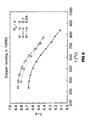
- Fig. 8 shows the equilibrium oxygen loading curves obtained from the total mass changes occurring at each temperature.
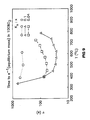
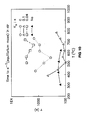
- Figs 9-11 show the time elapsed for relaxation to 1/e of the total mass change in 100% O2, 21% O2 and 1% O2 for each substitution level, as plotted in Figs 4 and 5 and many others like them.
- the actual relaxation time may be 1/5 of the relaxation time shown in the figure, or less, it is noted that substitution has increased the loading rate by a factor of more than 100.
- the curves show distinct minima occurring at around 500 to 550°C where the rate is fastest. At 21% O2 the enhancement in loading rate is not as great while at 1% O2 there is little difference in loading rate whatever the substitution level.
- allowance must be made for the fact that the oxygen partial pressure is not the same and the density of the Na-substituted material is rather higher (90% of theoretical density). Both of these effects, and particularly the latter will slow the oxygen loading rate. It may be concluded that sodium substitution probably has a larger effect in enhancing oxygen loading rate than does potassium substitution.
- a sample composition YBa 1.9 Na 0.1 Cu3O 7- ⁇ was prepared as described in example 2. After the first 15 minute reaction the material was reground and die-pressed as a bar with dimensions 3 mm x 3 mm and 45 mm and sintered for 30 minutes in a sealed gold tube. XRD measurements indicated essentially phase-pure material.
- the sintered bar was trimmed precisely in length to resonate mechanically at 40 kHz in the longitudinal mode, then, using sauericon ceramic cement, the bar was glued to a 40 kHz composite oscillator, comprising quartz drive and gauge crystals and a fused quartz spacer red.
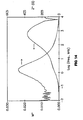
- the Youngs modulus and mechanical damping were measured as a function of temperature in various atmospheres with different partial pressures. It has been shown (can Tallon, Schuitema and Tapp, Applied Physics Letters 52 , 507 (1988)) that the mechanical damping at 40 kHz is dominated by a peak at 544°C (marked A in Fig. 12) which arises from the hopping of oxygen atoms within the basal plane from the chain sites to the vacant sites.
- a diffusion coefficient of 2.9 x 10 ⁇ 11 cm2 sec ⁇ 1 may be deduced.
- the mechanical damping of the Na-substituted sample, shown in Fig. 12 has an additional peak (marked B) occurring at 493°C indicating the presence of sites in the lattice where the hopping rate is faster.
- Fig. 12 also shows the mechanical damping curve for the unsubstituted material which shows the absence of the subsidiary peak.
- the increase in hopping rate arises from the softer interaction potential between an oxygen and the monovalent alkali atom compared to the potential between an oxygen atom and the divalent barium atom.
- the softer interaction potential will also arise from the outward relaxation of oxygen-ions away from the alkali atom.
- Higher loading rates may be achieved for x>0.1 for Na-substitution and for oxygen partial pressures exceeding 1 atmosphere.
- Sodium has the additional advantages that it is less volatile at the temperature of preparation; for a given temperature and duration samples sinter to a higher density when Na-substituted and they are less subject to atmospheric attack than are the K-substituted materials.
- the compounds Bi2SrO4 and Bi2Sr 0.5 Ca 0.5 O4 were prepared by solid state reaction of stoichiometric proportions of Bi2O3, SrCO3 and CaCo3 at 770°C for 12 hours.
- the compounds Bi2CaO4, prepared at 650°C is known (P Conflant et al, C R Acad. Sc. Paris 279 , 457 (1974)) however Bi2SrO4 and Bi2Sr 0.5 Ca 0.5 O4 as prepared above are new materials with a layered structure and a platy, mica-like morphology.
- Bi2SrO4 adopts the same structure as Bi2Sr 0.5 Ca 0.5 O4, namely a platy hexagonal structure with a 2.76 x superstructure in the basal plane as revealed by electron diffraction.
- Lattice parameters for these materials are summarised in Table 1.
- the compound Bi2Sr 0.9 Na 0.1 O 4- ⁇ was prepared by reaction of Bi2O3, (Sr(NO3)2 and NaNO3 at 770°C for 2 hours in a gold crucible.
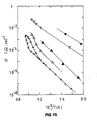
- Impedance spectroscopy or Bi2SrO4 and Bi2Sr 0.9 Na 0.1 O4 exposes three relaxation peaks, a well-broadened low frequency peak shown in Fig. 13 for the alkali substituted material.
- This relaxation has an equivalent capacitance of about 100 nF which does not change with temperature. This together with the broadening suggests that this relaxation arises from grain boundaries.
- the mid- and high-frequency relaxations shown in Fig. 14 have equivalent capacitances of 50 to 500 pF which are strongly temperature dependent and these are attributable to two oxygen hopping processes.
- Fig. 15 shows, as a function of inverse temperature, conductivity calculated from the equivalent resistance for these relaxations (measured from Cole-Cole plots or from the position and magnitude of the peaks).
- Open triangles refer to Bi2SrO4, filled triangles refer to Bi2Sr 0.9 Na 0.1 O4.
- Upward-pointing triangles refer to the mid-frequency relaxation
- downward-pointing triangles refer to the high-frequency relaxation.
- the circles refer to conductance measurements at 1592 Hz using a Wayne-Kerr bridge.
- the sodium-substitution is seen to increase the equivalent conductivity of the mid-frequency relaxation by 10 times while the conductivity for the high-frequency relaxation is enhanced by 30 times. It is concluded that the hopping rate for both relaxations is enhanced by the alkali-substitution.
- the compound Ca12Al14O33 is known to be of cubic structure having a high oxygen-ion conductivity with a high transference number, i.e. the dominant current carrier at high temperature is the oxygen-ion rather than electrons (Lacerda et al, Nature 332 , 525 (1988)).
- This material is typically prepared by reacting CaCO3 and Al2O3 at temperatures in the range 1250 to 1350°C for periods of 6 to 15 hours. Although this material is a candidate for alkali substitution both reaction temperature and duration need to be reduced to allow incorporation of the alkali.
- Ca(NO3)2 in the precursor resulted in this boundary being lowered to 1100°C or lower. At 1050°C roughly 80% of the product was the required Ca12Al14O33. By including NaNO3 in the precursor material the boundary was lowered still further.
- Ca11NaAl14O 33- ⁇ was prepared by stoichiometric reaction of Ca(NO3)2, NaNO3 and Al2O3 at 1000°C in a gold lined alumina crucible, capped to reduce efflux of Na2O vapour.
- Cole-Cole plots of impedance data showed a single large semicircle arising from grain boundary capacitance which concealed the bulk oxygen-ion relaxation. This prevented straightforward demonstration of enhanced oxygen-ion mobility but the successful rapid low temperature preparation underscores the utility of the preparation technique.
Landscapes
- Chemical & Material Sciences (AREA)
- Organic Chemistry (AREA)
- Engineering & Computer Science (AREA)
- Materials Engineering (AREA)
- Inorganic Chemistry (AREA)
- Ceramic Engineering (AREA)
- Manufacturing & Machinery (AREA)
- Chemical Kinetics & Catalysis (AREA)
- Structural Engineering (AREA)
- Electrochemistry (AREA)
- General Chemical & Material Sciences (AREA)
- Life Sciences & Earth Sciences (AREA)
- Sustainable Development (AREA)
- Sustainable Energy (AREA)
- Compositions Of Oxide Ceramics (AREA)
- Inorganic Compounds Of Heavy Metals (AREA)
- Superconductors And Manufacturing Methods Therefor (AREA)
- Oxygen, Ozone, And Oxides In General (AREA)
Applications Claiming Priority (2)
| Application Number | Priority Date | Filing Date | Title |
|---|---|---|---|
| NZ222691A NZ222691A (en) | 1987-12-29 | 1987-12-29 | Production of high temperature metal oxide superconductors |
| NZ222691 | 1987-12-29 |
Publications (2)
| Publication Number | Publication Date |
|---|---|
| EP0323178A2 true EP0323178A2 (de) | 1989-07-05 |
| EP0323178A3 EP0323178A3 (de) | 1990-03-28 |
Family
ID=19922294
Family Applications (1)
| Application Number | Title | Priority Date | Filing Date |
|---|---|---|---|
| EP88312277A Withdrawn EP0323178A3 (de) | 1987-12-29 | 1988-12-23 | Verfahren zur Herstellung von supraleitenden Materialien bei hoher Temperatur |
Country Status (3)
| Country | Link |
|---|---|
| EP (1) | EP0323178A3 (de) |
| JP (1) | JPH02120209A (de) |
| NZ (1) | NZ222691A (de) |
Cited By (1)
| Publication number | Priority date | Publication date | Assignee | Title |
|---|---|---|---|---|
| EP1114676A3 (de) * | 1999-12-17 | 2002-02-06 | Enichem S.p.A. | Dampfspaltungskatalysator und dessen Herstellungsverfahren |
Families Citing this family (1)
| Publication number | Priority date | Publication date | Assignee | Title |
|---|---|---|---|---|
| JP3168229B2 (ja) * | 1992-10-06 | 2001-05-21 | 日本発条株式会社 | ボールジョイント装置 |
Family Cites Families (4)
| Publication number | Priority date | Publication date | Assignee | Title |
|---|---|---|---|---|
| JP2656531B2 (ja) * | 1987-04-08 | 1997-09-24 | 株式会社日立製作所 | 酸化物超電導体 |
| JPS6461346A (en) * | 1987-09-01 | 1989-03-08 | Seiko Epson Corp | Superconducting material |
| JPH01100053A (ja) * | 1987-10-12 | 1989-04-18 | Nippon Telegr & Teleph Corp <Ntt> | 超伝導材料 |
| JPH01102975A (ja) * | 1987-10-16 | 1989-04-20 | Sumitomo Cement Co Ltd | 超電導セラミックスの製法 |
-
1987
- 1987-12-29 NZ NZ222691A patent/NZ222691A/en unknown
-
1988
- 1988-12-23 EP EP88312277A patent/EP0323178A3/de not_active Withdrawn
- 1988-12-29 JP JP63335706A patent/JPH02120209A/ja active Pending
Non-Patent Citations (5)
| Title |
|---|
| ADVANCED CERAMIC MATERIALS, vol. 2, no. 3B, July 1987, pages 457-470, ACerS; I.-W. CHEN et al.: "Superconductivity and the tailoring of lattice parameters of the compound YBa2Cu3Ox" * |
| JAPANESE JOURNAL OF APPLIED PHYSICS, vol. 22, 1983, Supplement 22-2, (Proceedings of the 4th Meeting on Ferroelectric Materials and Their Applications, Kyoto 1983), pages 57-60; M. SUZUKI et al.: "Effect of substitution in Perovskite-type oxide superconductor" * |
| PHYSICA, vol. 148B, no. 1-3, December 987, pages 336-338, Elsevier Science Publishers B.V. (North-Holland Physics Publishing Division), Amsterdam, NL; Y. SAITO et al.: "High-Tc superconducting properties in (Y1-xTlx)Ba2Cu3O7-y, Y(ba1-xKx)2Cu3O7-y and YBa2(Cu1-xMgx)3O7-y" * |
| SOLID STATE IONICS, vol. 24, no. 4, September 1987, pages 305-314, Elsevier Science Publishers B.V. (North-Holland Physics Publishing Division), Amsterdam, NL; R. METSELAAR et al.: "Electrical transport properties of calcium and barium aluminates" * |
| SOLID STATE IONICS, vol. 27, no. 3, July 1988, pages 199-205, Amsterdam, NL; D.J. VISCHJAGER et al.: "Oxygen diffusion in YBa2Cu3O7-x; an impedance spectroscopy study" * |
Cited By (2)
| Publication number | Priority date | Publication date | Assignee | Title |
|---|---|---|---|---|
| EP1114676A3 (de) * | 1999-12-17 | 2002-02-06 | Enichem S.p.A. | Dampfspaltungskatalysator und dessen Herstellungsverfahren |
| US6696614B2 (en) * | 1999-12-17 | 2004-02-24 | Enichem S.P.A. | Catalyst for steam cracking reactions and related preparation process |
Also Published As
| Publication number | Publication date |
|---|---|
| NZ222691A (en) | 1991-05-28 |
| EP0323178A3 (de) | 1990-03-28 |
| JPH02120209A (ja) | 1990-05-08 |
Similar Documents
| Publication | Publication Date | Title |
|---|---|---|
| US5204316A (en) | Preparation of tape of silver covered bi-pb-ca;sr-cu-o oriented polycrystal superconductor | |
| US5024992A (en) | Preparation of highly oxidized RBa2 Cu4 O8 superconductors | |
| Liang et al. | Phase diagram of SrO CaO CuO ternary system | |
| US6686319B1 (en) | Metal oxide materials | |
| EP0411943B1 (de) | Supraleitende 247-Metalloxidzusammensetzungen | |
| EP0398503B1 (de) | Oxid von seltenen Erden, Barium und Kupfer als supraleitende Materialien | |
| EP0351844B1 (de) | Verfahren zur Herstellung von oxidischen Supraleitern des Typs Wismut | |
| EP0323178A2 (de) | Verfahren zur Herstellung von supraleitenden Materialien bei hoher Temperatur | |
| US5348935A (en) | Highly oxidized superconductors | |
| EP0354537B1 (de) | Verfahren zur Herstellung eines Pulvers aus supraleitfähigem Oxid auf der Basis von Wismut, das Blei enthält, und Verfahren zur Herstellung eines Sinterkörpers daraus | |
| Kanno et al. | Phase relation and superconductivity in the oxygen nonstoichiometric system, Ba2YCu3Ox | |
| EP0476504B1 (de) | Oxidische Supraleiter und Verfahren zu ihrer Herstellung | |
| JPH0196055A (ja) | 超伝導磁器組成物 | |
| US5556830A (en) | Tl-doped HgBaCaCu superconductors | |
| JP2840349B2 (ja) | 高Tc超伝導体とその製造方法 | |
| US5618776A (en) | Yttrium or rare-earth substituted metal oxide materials | |
| JP2677882B2 (ja) | ビスマス系酸化物超電導体の製造方法 | |
| Jose et al. | REBa2ZrO5. 5 (RE= La, Ce, Eu, and Yb): Synthesis, characterization, and their potential use as substrates for YBa2Cu3O7–δ superconductors | |
| JPH01100001A (ja) | パラメータ調節によって得られた超伝導材料 | |
| EP0316042A1 (de) | Verfahren zum Herstellen eines superleitenden Körpers | |
| Poisl et al. | Solid‐State Sintering of YBa2Cu3Ox in Different Oxygen Partial Pressures | |
| JP2698689B2 (ja) | 酸化物超伝導材料およびその製造方法 | |
| Hill et al. | Processing effects on microstructure and superconducting properties of sintered YBa2Cu3O6+ x | |
| NZ233388A (en) | Method of preparing a metal oxide material capable of displaying superconductivity above 77k | |
| Zhu | Influence of Oxygen Partial Pressure and Temperature on the Formation and Stability of 110K Phase in the BiPbSrCaCuO Superconducting System |
Legal Events
| Date | Code | Title | Description |
|---|---|---|---|
| PUAI | Public reference made under article 153(3) epc to a published international application that has entered the european phase |
Free format text: ORIGINAL CODE: 0009012 |
|
| AK | Designated contracting states |
Kind code of ref document: A2 Designated state(s): DE FR GB IT NL SE |
|
| PUAL | Search report despatched |
Free format text: ORIGINAL CODE: 0009013 |
|
| RHK1 | Main classification (correction) |
Ipc: C01B 13/14 |
|
| AK | Designated contracting states |
Kind code of ref document: A3 Designated state(s): DE FR GB IT NL SE |
|
| 17P | Request for examination filed |
Effective date: 19900815 |
|
| 17Q | First examination report despatched |
Effective date: 19910716 |
|
| STAA | Information on the status of an ep patent application or granted ep patent |
Free format text: STATUS: THE APPLICATION IS DEEMED TO BE WITHDRAWN |
|
| 18D | Application deemed to be withdrawn |
Effective date: 19920310 |