EP0323536B1 - Arylcyclobuten/Dienophil-Copolymere - Google Patents
Arylcyclobuten/Dienophil-CopolymereInfo
- Publication number
- EP0323536B1 EP0323536B1 EP88100097A EP88100097A EP0323536B1 EP 0323536 B1 EP0323536 B1 EP 0323536B1 EP 88100097 A EP88100097 A EP 88100097A EP 88100097 A EP88100097 A EP 88100097A EP 0323536 B1 EP0323536 B1 EP 0323536B1
- Authority
- EP
- European Patent Office
- Prior art keywords
- moieties
- dienophilic
- copolymer composition
- monomer
- arylcyclobutane
- Prior art date
- Legal status (The legal status is an assumption and is not a legal conclusion. Google has not performed a legal analysis and makes no representation as to the accuracy of the status listed.)
- Expired - Lifetime
Links
- 229920001577 copolymer Polymers 0.000 title claims description 34
- 239000000203 mixture Substances 0.000 claims description 40
- 239000000178 monomer Substances 0.000 claims description 40
- 150000001875 compounds Chemical class 0.000 claims description 17
- XQUPVDVFXZDTLT-UHFFFAOYSA-N 1-[4-[[4-(2,5-dioxopyrrol-1-yl)phenyl]methyl]phenyl]pyrrole-2,5-dione Chemical compound O=C1C=CC(=O)N1C(C=C1)=CC=C1CC1=CC=C(N2C(C=CC2=O)=O)C=C1 XQUPVDVFXZDTLT-UHFFFAOYSA-N 0.000 claims description 11
- 229920003192 poly(bis maleimide) Polymers 0.000 claims description 10
- 125000005439 maleimidyl group Chemical group C1(C=CC(N1*)=O)=O 0.000 claims description 4
- 125000003342 alkenyl group Chemical group 0.000 claims description 2
- USIUVYZYUHIAEV-UHFFFAOYSA-N diphenyl ether Natural products C=1C=CC=CC=1OC1=CC=CC=C1 USIUVYZYUHIAEV-UHFFFAOYSA-N 0.000 claims description 2
- 125000002915 carbonyl group Chemical group [*:2]C([*:1])=O 0.000 claims 1
- YMWUJEATGCHHMB-UHFFFAOYSA-N Dichloromethane Chemical compound ClCCl YMWUJEATGCHHMB-UHFFFAOYSA-N 0.000 description 12
- 229920000642 polymer Polymers 0.000 description 10
- 238000006116 polymerization reaction Methods 0.000 description 9
- 125000003118 aryl group Chemical group 0.000 description 7
- IJGRMHOSHXDMSA-UHFFFAOYSA-N Atomic nitrogen Chemical compound N#N IJGRMHOSHXDMSA-UHFFFAOYSA-N 0.000 description 6
- PPBRXRYQALVLMV-UHFFFAOYSA-N Styrene Chemical compound C=CC1=CC=CC=C1 PPBRXRYQALVLMV-UHFFFAOYSA-N 0.000 description 6
- UMIVXZPTRXBADB-UHFFFAOYSA-N benzocyclobutene Chemical group C1=CC=C2CCC2=C1 UMIVXZPTRXBADB-UHFFFAOYSA-N 0.000 description 6
- 230000009477 glass transition Effects 0.000 description 6
- DTGDMPJDZKDHEP-UHFFFAOYSA-N 4-ethenylbicyclo[4.2.0]octa-1(6),2,4-triene Chemical compound C=CC1=CC=C2CCC2=C1 DTGDMPJDZKDHEP-UHFFFAOYSA-N 0.000 description 5
- 239000002131 composite material Substances 0.000 description 4
- 238000000034 method Methods 0.000 description 4
- 229910000831 Steel Inorganic materials 0.000 description 3
- 125000001995 cyclobutyl group Chemical group [H]C1([H])C([H])([H])C([H])(*)C1([H])[H] 0.000 description 3
- 238000010438 heat treatment Methods 0.000 description 3
- 239000000463 material Substances 0.000 description 3
- 229910052757 nitrogen Inorganic materials 0.000 description 3
- 229920005989 resin Polymers 0.000 description 3
- 239000011347 resin Substances 0.000 description 3
- 239000010959 steel Substances 0.000 description 3
- OZAIFHULBGXAKX-UHFFFAOYSA-N 2-(2-cyanopropan-2-yldiazenyl)-2-methylpropanenitrile Chemical compound N#CC(C)(C)N=NC(C)(C)C#N OZAIFHULBGXAKX-UHFFFAOYSA-N 0.000 description 2
- OKTJSMMVPCPJKN-UHFFFAOYSA-N Carbon Chemical group [C] OKTJSMMVPCPJKN-UHFFFAOYSA-N 0.000 description 2
- PEEHTFAAVSWFBL-UHFFFAOYSA-N Maleimide Chemical compound O=C1NC(=O)C=C1 PEEHTFAAVSWFBL-UHFFFAOYSA-N 0.000 description 2
- 239000000853 adhesive Substances 0.000 description 2
- 230000001070 adhesive effect Effects 0.000 description 2
- QVGXLLKOCUKJST-UHFFFAOYSA-N atomic oxygen Chemical compound [O] QVGXLLKOCUKJST-UHFFFAOYSA-N 0.000 description 2
- 239000007795 chemical reaction product Substances 0.000 description 2
- 239000003795 chemical substances by application Substances 0.000 description 2
- 238000000576 coating method Methods 0.000 description 2
- 125000001047 cyclobutenyl group Chemical group C1(=CCC1)* 0.000 description 2
- 238000004090 dissolution Methods 0.000 description 2
- 125000006575 electron-withdrawing group Chemical group 0.000 description 2
- 239000011888 foil Substances 0.000 description 2
- 229920001519 homopolymer Polymers 0.000 description 2
- 125000005647 linker group Chemical group 0.000 description 2
- 239000006082 mold release agent Substances 0.000 description 2
- 229910052760 oxygen Inorganic materials 0.000 description 2
- 239000001301 oxygen Substances 0.000 description 2
- 239000000843 powder Substances 0.000 description 2
- 238000002360 preparation method Methods 0.000 description 2
- 239000002904 solvent Substances 0.000 description 2
- 229920001169 thermoplastic Polymers 0.000 description 2
- 229920001187 thermosetting polymer Polymers 0.000 description 2
- 239000004416 thermosoftening plastic Substances 0.000 description 2
- QWVDOOFNEDJIKP-POHAHGRESA-N (z)-4-amino-2-(7-bicyclo[4.2.0]octa-1,3,5,7-tetraenyl)-4-oxobut-2-enoic acid Chemical compound C1=CC=C2C(C(/C(O)=O)=C/C(=O)N)=CC2=C1 QWVDOOFNEDJIKP-POHAHGRESA-N 0.000 description 1
- 150000003923 2,5-pyrrolediones Chemical class 0.000 description 1
- HLBLWEWZXPIGSM-UHFFFAOYSA-N 4-Aminophenyl ether Chemical compound C1=CC(N)=CC=C1OC1=CC=C(N)C=C1 HLBLWEWZXPIGSM-UHFFFAOYSA-N 0.000 description 1
- 0 B/C(/CNNC1(CCC(CC2)C2CC1)C1CCCC1)=C/[Cn]C Chemical compound B/C(/CNNC1(CCC(CC2)C2CC1)C1CCCC1)=C/[Cn]C 0.000 description 1
- PMBGGCZCMMETSV-UHFFFAOYSA-N IC1=CC=CC2=CC=C12 Chemical compound IC1=CC=CC2=CC=C12 PMBGGCZCMMETSV-UHFFFAOYSA-N 0.000 description 1
- OAICVXFJPJFONN-UHFFFAOYSA-N Phosphorus Chemical compound [P] OAICVXFJPJFONN-UHFFFAOYSA-N 0.000 description 1
- BQCADISMDOOEFD-UHFFFAOYSA-N Silver Chemical compound [Ag] BQCADISMDOOEFD-UHFFFAOYSA-N 0.000 description 1
- NINIDFKCEFEMDL-UHFFFAOYSA-N Sulfur Chemical compound [S] NINIDFKCEFEMDL-UHFFFAOYSA-N 0.000 description 1
- 229920006362 Teflon® Polymers 0.000 description 1
- 125000002947 alkylene group Chemical group 0.000 description 1
- 229910052782 aluminium Inorganic materials 0.000 description 1
- XAGFODPZIPBFFR-UHFFFAOYSA-N aluminium Chemical compound [Al] XAGFODPZIPBFFR-UHFFFAOYSA-N 0.000 description 1
- 229910052799 carbon Inorganic materials 0.000 description 1
- 150000001728 carbonyl compounds Chemical class 0.000 description 1
- 239000003054 catalyst Substances 0.000 description 1
- -1 coatings Substances 0.000 description 1
- 229920006037 cross link polymer Polymers 0.000 description 1
- 150000001993 dienes Chemical class 0.000 description 1
- 238000000113 differential scanning calorimetry Methods 0.000 description 1
- 239000000835 fiber Substances 0.000 description 1
- 239000012765 fibrous filler Substances 0.000 description 1
- 239000000945 filler Substances 0.000 description 1
- 239000003063 flame retardant Substances 0.000 description 1
- 239000003517 fume Substances 0.000 description 1
- 239000007789 gas Substances 0.000 description 1
- 239000011521 glass Substances 0.000 description 1
- 239000003365 glass fiber Substances 0.000 description 1
- PCHJSUWPFVWCPO-UHFFFAOYSA-N gold Chemical compound [Au] PCHJSUWPFVWCPO-UHFFFAOYSA-N 0.000 description 1
- 239000010439 graphite Substances 0.000 description 1
- 229910002804 graphite Inorganic materials 0.000 description 1
- 229910052736 halogen Inorganic materials 0.000 description 1
- 150000002367 halogens Chemical class 0.000 description 1
- 125000005842 heteroatom Chemical group 0.000 description 1
- BHEPBYXIRTUNPN-UHFFFAOYSA-N hydridophosphorus(.) (triplet) Chemical compound [PH] BHEPBYXIRTUNPN-UHFFFAOYSA-N 0.000 description 1
- 150000002430 hydrocarbons Chemical group 0.000 description 1
- 239000003999 initiator Substances 0.000 description 1
- FSQQTNAZHBEJLS-UPHRSURJSA-N maleamic acid Chemical class NC(=O)\C=C/C(O)=O FSQQTNAZHBEJLS-UPHRSURJSA-N 0.000 description 1
- 229910052751 metal Inorganic materials 0.000 description 1
- 239000002184 metal Substances 0.000 description 1
- 239000002480 mineral oil Substances 0.000 description 1
- 235000010446 mineral oil Nutrition 0.000 description 1
- 238000000465 moulding Methods 0.000 description 1
- 230000001590 oxidative effect Effects 0.000 description 1
- 229910052698 phosphorus Inorganic materials 0.000 description 1
- 239000011574 phosphorus Substances 0.000 description 1
- 230000000704 physical effect Effects 0.000 description 1
- 239000002243 precursor Substances 0.000 description 1
- 239000010453 quartz Substances 0.000 description 1
- 238000011084 recovery Methods 0.000 description 1
- 230000003014 reinforcing effect Effects 0.000 description 1
- VYPSYNLAJGMNEJ-UHFFFAOYSA-N silicon dioxide Inorganic materials O=[Si]=O VYPSYNLAJGMNEJ-UHFFFAOYSA-N 0.000 description 1
- 229910052709 silver Inorganic materials 0.000 description 1
- 239000004332 silver Substances 0.000 description 1
- 229910052717 sulfur Inorganic materials 0.000 description 1
- 239000011593 sulfur Substances 0.000 description 1
- 238000009864 tensile test Methods 0.000 description 1
- 229930195735 unsaturated hydrocarbon Natural products 0.000 description 1
- 238000005303 weighing Methods 0.000 description 1
Classifications
-
- C—CHEMISTRY; METALLURGY
- C08—ORGANIC MACROMOLECULAR COMPOUNDS; THEIR PREPARATION OR CHEMICAL WORKING-UP; COMPOSITIONS BASED THEREON
- C08G—MACROMOLECULAR COMPOUNDS OBTAINED OTHERWISE THAN BY REACTIONS ONLY INVOLVING UNSATURATED CARBON-TO-CARBON BONDS
- C08G61/00—Macromolecular compounds obtained by reactions forming a carbon-to-carbon link in the main chain of the macromolecule
-
- C—CHEMISTRY; METALLURGY
- C08—ORGANIC MACROMOLECULAR COMPOUNDS; THEIR PREPARATION OR CHEMICAL WORKING-UP; COMPOSITIONS BASED THEREON
- C08F—MACROMOLECULAR COMPOUNDS OBTAINED BY REACTIONS ONLY INVOLVING CARBON-TO-CARBON UNSATURATED BONDS
- C08F212/00—Copolymers of compounds having one or more unsaturated aliphatic radicals, each having only one carbon-to-carbon double bond, and at least one being terminated by an aromatic carbocyclic ring
- C08F212/02—Monomers containing only one unsaturated aliphatic radical
- C08F212/32—Monomers containing only one unsaturated aliphatic radical containing two or more rings
Definitions
- This invention relates to arylcyclobutane copolymer compositions.
- Arylcyclobutane resins are a family of monomers, oligomers, prepolymers and polymers.
- Poly(arylcyclobutane) polymers are disclosed in U S -A-4,540,763. The polymers are prepared by heating a resin having two or more arylcyclobutane moieties to temperatures sufficient to open the cyclobutane rings. The opened cyclobutane rings react with each other to form a crosslinked polymer.
- the poly(arylcyclobutane) polymers exhibit excellent thermal and oxidative stability. They can be used as coatings, adhesives, composites and the like. However, U S-A-4,540,763 discloses that the polymers can only be prepared from arylcyclobutane-containing monomers.
- poly(arylcyclobutenes)monomers which are useful in the preparation of polymeric compositions used in films and in composites are disclosed.
- the poly(arylcyclobutene) is characterized by comprising aryl moieties with one or more cyclobutene rings fused to each aryl moiety, wherein the aryl moieties are directly bonded to one another or are connected by a bridging member, wherein the bridging member is (1) a polyvalent inorganic radical or (2) a polyvalent organic radical which (a) contains one or more heteroatoms comprising oxygen, sulfur, nitrogen, or phosphorus or (b) one or more aromatic radicals.
- the poly(arylcyclobutenes) are sometimes named poly(arylcyclobutanes) in the relevant literature.
- WO-A-86/01809 describes a polymeric composition which comprises the reaction product prepared by exposing one or more poly(arylcyclobutenes) having two or more aryl moieties with one or more cyclobutene rings fused to each aryl moiety, wherein the aryl moieties are directly bonded to one another or are connected by a bridging member wherein the bridging member is (1) a polyvalent inorganic radical or (2) a polyvalent organic radical, to temperatures at which the poly(arylcyclobutenes) undergo polymerization.
- This invention is a copolymer composition
- a copolymer composition comprising, in a polymerised form, a compound containing at least two polymerizable arylcyclobutene moieties, and a monomer containing at least two copolymerizable dienophilic moieties, said composition being characterized in that the compound containing at least two polymerizable arylcyclobutene moieties is: poly(styrene-co-4-vinylbenzocyclobutene) of the formula: wherein n and m are integers of at least 1.
- the mixture of the dienophilic monomer and said arylcyclobutane compound provides a reactive monomer system which is useful in preparing copolymer compositions.
- the copolymer compositions can exhibit improved properties such as adhesion, thermal stability, solvent resistance, dielectric constant, etc. compared to homopolymer compositions prepared from either monomer.
- the copolymer compositions of this invention can be thermoplastic or thermoset polymeric compositions and can be used in conventional thermoplastic and thermoset applications. Examples of such uses include adhesives, coatings, composites and the like.
- the arylcyclobutane compound of this invention is a reaction product of styrene and 4-vinylbenzocyclobutane.
- styrene is contacted with 4-vinylbenzocyclobutane in the presence of a suitable free-radical initiator, such as azobisisobutyronitrile.
- a suitable free-radical initiator such as azobisisobutyronitrile.
- the styrene and 4-vinylbenzocyclobutane compounds are added in any amount sufficient to provide two polymerizable benzocyclobutane moieties.
- This compound can be called poly(styrene-co-4-vinylbenzocyclobutane), and corresponds to the formula wherein n and m are integers of at least 1.
- the dienophilic moieties are moieties which react with conjugated dienes to form a six-member ring. Such moieties are discussed in Morrison and Boyd, Organic Chemistry , 3rd Ed., 1979. Suitable moieties are alkenyl moieties and preferably are unsaturated hydrocarbon moieties having an electron-withdrawing group on an adjacent carbon. Suitable electron-withdrawing groups are oxygen, nitrogen, halogens, phosphorous and the like. Especially preferred dienophilic moieties are a,b-unsaturated carbonyl compounds, and the most preferred moieties are maleimide moieties.
- the more preferred monomers are monomers which contain polymerizable dienophilic moieties which polymerize at about (i.e., within 50°C) of the temperature at which the arylcyclobutane-containing monomers polymerize.
- the most preferred monomers contain maleimide moieties.
- the maleimide-containing monomers polymerize at about 200°C.
- Such monomers can be represented by the formula: wherein X is a polyvalent organic or inorganic moiety.
- Preferred X groups are: and wherein n is at least 1.
- dienophilic moieties are alkylene moieties, especially acetylenic moieties.
- the amounts of the arylcyclobutane-containing compound and the dienophilic monomer which are employed in preparing the copolymers of this invention can vary.
- the arylcyclobutane compound is employed at less than 100 percent by weight of the monomers mixture, and the dienophilic monomer is employed at less than 100 percent of the monomer mixture.
- the ratio of the amount of dienophilic monomer to the amount of arylcyclobutane compound is greater than one.
- the copolymer composition of this invention can be comprised of other monomeric or polymeric compositions which can independently polymerize to provide an interpenetrating network or can copolymerize with the monomers.
- Suitable optional monomeric or polymeric compositions include mono-arylcyclobutane monomers (i.e., monomers which contain only one arylcyclobutane moiety) and other poly(arylcyclobutane) monomers (i.e., monomers which contain at least two arylcyclobutane moieties).
- Preferred mono-arylcyclobutanes are A,B-monomers which have a polymerizable benzocyclobutane moiety and a reactive maleimide moiety.
- Such monomers can correspond to the formula wherein R' is a direct bond, or a polyvalent organic or inorganic moiety, and can be the same or different as R.
- Such A,B-monomers can be prepared by dehydrating benzocyclobutenyl maleamic acid. The maleamic acid derivatives and methods for preparing them are disclosed in U S-A-4,638,078.
- the copolymer composition can also contain optional components which are determined by the particular use of the copolymer.
- optional components include fibrous fillers such as glass, quartz and graphite fibers; organic and inorganic powder fillers; catalysts; curing agents; fire retardants; and the like.
- the copolymer composition can contain an amount of an electro-conductive metal such as silver or gold powder and can be used as a die-attach material.
- the copolymer composition can contain an amount of reinforcing glass fibers and can be used as a composite.
- the copolymer composition is prepared by combining the arylcyclobutane compound and the dienophilic monomer to form a mixture and treating the monomer mixture at sufficient polymerization conditions.
- the monomer mixture can thermally polymerize, so the application of heat is a preferred polymerization process.
- suitable polymerization temperatures are temperatures at which the cyclobutane rings open to provide a diene-type structure. Preferably such temperatures range from about 180°C to 270°C.
- Preparing the copolymers of this invention can improve the physical properties of homopolymers prepared from the monomers. For example, adhesion/thermal stability, solvent resistance, dielectric constant, elongation at break (toughness), and the like can be improved. Also, surprisingly, the hot wet strength of the maleimide polymers can be increased.
- the yellow solution was poured into a cake pan which has been covered with a Teflon® sheet, and the dichloromethane was allowed to evaporate in a fume hood overnight.
- the resultant homogeneous, bright yellow polymer sheet was cut into small pieces with scissors and these pieces were then ground using a Wiley laboratory mill.
- the ground polymer was then dried in a vacuum oven overnight 13.15 Pa (0.1 mm Hg, 100°C). This dried powder weighed 19.7 g, or 69 percent recovery.
- Differential scanning calorimetry shows a glass transition at 86°C, and one major polymerization exotherm which peaks at 259.8°C.
- a piece of heavy gauge alluminum foil was coated with a suitable mold release agent and placed on a flat steel plate with the coated surface facing up. On top of this was placed a steel plate in which was cut a hole in the shape of a standard tensile test bar. The assembly was then sprayed with a mold release agent. The benzocyclobutane/bismaleimide mixture was then placed in the mold shape, and the copolymer was pressed down into the mold with a spatula. More copolymer was placed on top of this, and the copolymer was then covered with another piece of release-agent-treated aluminum foil and another steel plate.
- the apparatus was then entered into a hydraulic press which has been heated to 210°C, and the platens were closed until they just touch both plates.
- the mold was then allowed to sit for 10 minutes while the copolymer melted; the mold was then pressurized to 15 tons ram force.
- the mold was then heated to 255°C over 10 minutes.
- the mold was maintained between 250°C to 255°C for another 10 minutes.
- the pressure was released and the molding apparatus was transferred from the hot press directly to a cold press, where the mold was allowed to cool for 10 minutes.
- the copolymer part was then removed and was brown-orange in appearance, weighing 6.7 g.
- the copolymer containing 9.6 millimoles benzocyclobutane and 9.6 millimoles bismaleimide, exhibits a glass transition of 86°C prior to polymerization.
- the copolymer sample completely disintegrates in methylene chloride, whereas the copolymer obtained by thermally copolymerizing the bismaleimide and the polystyrene-co--4-vinylbenzocyclobutane swells but does not dissolve or disintegrate.
- a mixture of 7.5 percent vinylbenzocyclobutanecontaining polystyrene-co-4-vinylbenzocyclobutane with 1 mole of bismaleimide per mole benzocyclobutane gave a copolymer which exhibits a glass transition prior to curing of 108°C to 111°C.
- the curing of this material by heating to 300°C gave a copolymer with a glass transition temperature from roughly 114°C to 121°C.
- Another sample of a mixture containing 5 percent benzocyclobutane and 3.85 millimoles bismaleimide was prepared and crosslinked by heating to 320°C.
- the uncured material exhibits a glass transition temperature of 89°C, while after curing, the glass transition temperature moves to 110°C.
- All of the samples of polystyrene-co-4-vinylbenzocyclobutane admixed with bismaleimide exhibit a polymerization exotherm beginning at 190°C to 200°C and peaking near 250°C to 260°C.
Landscapes
- Chemical & Material Sciences (AREA)
- Health & Medical Sciences (AREA)
- Chemical Kinetics & Catalysis (AREA)
- Medicinal Chemistry (AREA)
- Polymers & Plastics (AREA)
- Organic Chemistry (AREA)
- Addition Polymer Or Copolymer, Post-Treatments, Or Chemical Modifications (AREA)
Claims (7)
- Copolymerzusammensetzung, enthaltend in polymerisierter Form eine Verbindung, die mindestens zwei polymerisierbare Arylcyclobutengruppen enthält, und ein mindestens zwei copolymerisierbare, dienophile Gruppen enthaltendes Monomer, wobei die Zusammensetzung
dadurch gekennzeichnet ist,
daß die mindestens zwei polymerisierbare Arylcyclobutengruppen enthaltende Verbindung Poly(styrol-co-4-vinylbenzocyclobuten) der Formel ist: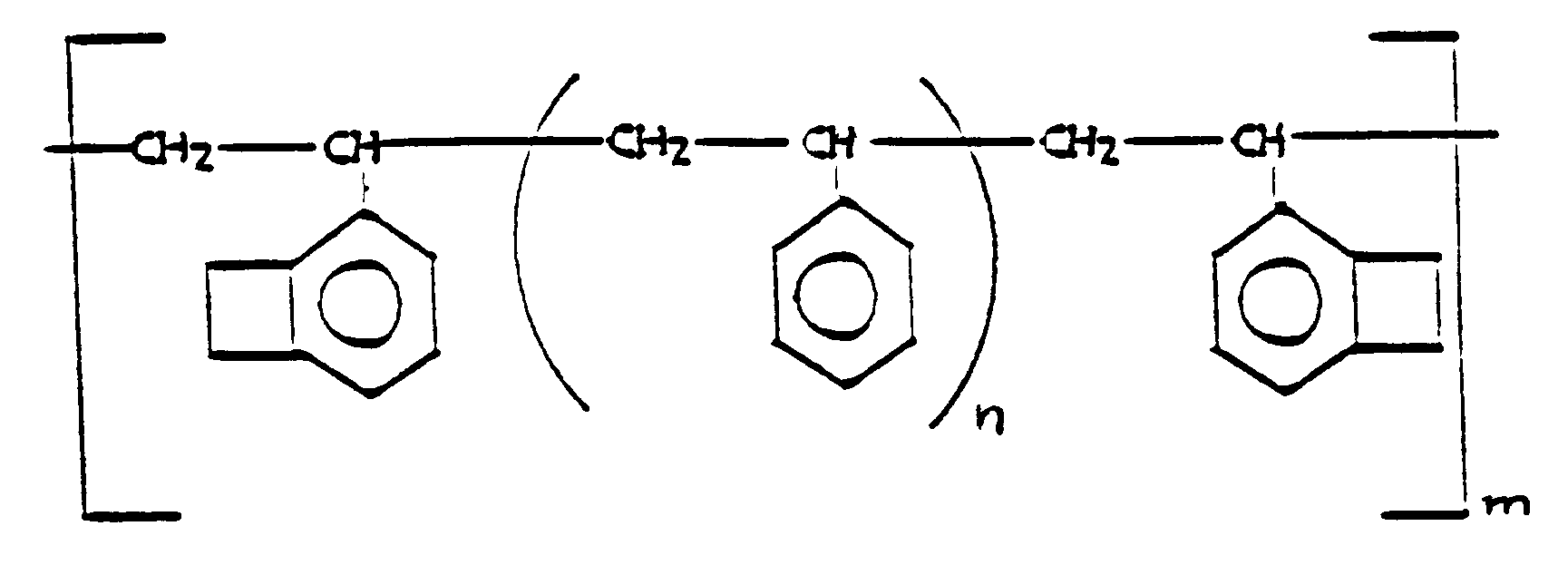
- Copolymerzusammensetzung nach Anspruch 1,
dadurch gekennzeichnet,
daß die dienophilen Gruppen Alkenylgruppen sind. - Copolymerzusammensetzung nach Anspruch 1,
dadurch gekennzeichnet,
daß die dienophilen Gruppen α,β-ungesättigte Carbonylgruppen sind. - Copolymerzusammensetzung nach Anspruch 1,
dadurch gekennzeichnet,
daß die dienophilen Gruppen Maleinimidgruppen sind. - Copolymerzusammensetzung nach Anspruch 1,
dadurch gekennzeichnet,
daß das mindestens zwei polymerisierbare, dienophile Gruppen enthaltende Monomer 4,4'-Diphenyletherbismaleinimid ist. - Copolymerzusammensetzung nach Anspruch 1,
dadurch gekennzeichnet,
daß sie weiterhin ein Monoarylcyclobutenmonomer enthält. - Copolymerzusammensetzung nach Anspruch 6,
dadurch gekennzeichnet,
daß das Monoarylcyclobutenmonomer der Formel entspricht:
Priority Applications (3)
| Application Number | Priority Date | Filing Date | Title |
|---|---|---|---|
| US06/890,671 US4730030A (en) | 1986-07-25 | 1986-07-25 | Arylcyclobutane/dienophile copolymer |
| EP88100097A EP0323536B1 (de) | 1988-01-07 | 1988-01-07 | Arylcyclobuten/Dienophil-Copolymere |
| DE19883886723 DE3886723T2 (de) | 1988-01-07 | 1988-01-07 | Arylcyclobuten/Dienophil-Copolymere. |
Applications Claiming Priority (1)
| Application Number | Priority Date | Filing Date | Title |
|---|---|---|---|
| EP88100097A EP0323536B1 (de) | 1988-01-07 | 1988-01-07 | Arylcyclobuten/Dienophil-Copolymere |
Publications (2)
| Publication Number | Publication Date |
|---|---|
| EP0323536A1 EP0323536A1 (de) | 1989-07-12 |
| EP0323536B1 true EP0323536B1 (de) | 1993-12-29 |
Family
ID=8198627
Family Applications (1)
| Application Number | Title | Priority Date | Filing Date |
|---|---|---|---|
| EP88100097A Expired - Lifetime EP0323536B1 (de) | 1986-07-25 | 1988-01-07 | Arylcyclobuten/Dienophil-Copolymere |
Country Status (2)
| Country | Link |
|---|---|
| EP (1) | EP0323536B1 (de) |
| DE (1) | DE3886723T2 (de) |
Families Citing this family (2)
| Publication number | Priority date | Publication date | Assignee | Title |
|---|---|---|---|---|
| EP0515170A3 (en) * | 1991-05-22 | 1993-04-07 | The Dow Chemical Company | Biscyclobutarene/polymaleimide copolymers |
| WO2016026123A1 (en) * | 2014-08-21 | 2016-02-25 | Dow Global Technologies Llc | Compositions comprising oxygen substituted benzocyclobutenes and dienophiles, and electronic devices containing same |
Citations (1)
| Publication number | Priority date | Publication date | Assignee | Title |
|---|---|---|---|---|
| US4711964A (en) * | 1986-05-08 | 1987-12-08 | University Of Dayton | Bisdiene from bis-benzocyclobutene compound |
Family Cites Families (3)
| Publication number | Priority date | Publication date | Assignee | Title |
|---|---|---|---|---|
| CA1260481A (en) * | 1984-08-27 | 1989-09-26 | Robert A. Kirchhoff | Poly(arylcyclobutenes) |
| US4540763A (en) * | 1984-09-14 | 1985-09-10 | The Dow Chemical Company | Polymers derived from poly(arylcyclobutenes) |
| DE3507879A1 (de) * | 1985-03-06 | 1986-09-11 | Hüls AG, 4370 Marl | Polyimide und verfahren zu ihrer herstellung |
-
1988
- 1988-01-07 DE DE19883886723 patent/DE3886723T2/de not_active Expired - Fee Related
- 1988-01-07 EP EP88100097A patent/EP0323536B1/de not_active Expired - Lifetime
Patent Citations (1)
| Publication number | Priority date | Publication date | Assignee | Title |
|---|---|---|---|---|
| US4711964A (en) * | 1986-05-08 | 1987-12-08 | University Of Dayton | Bisdiene from bis-benzocyclobutene compound |
Also Published As
| Publication number | Publication date |
|---|---|
| DE3886723T2 (de) | 1994-05-11 |
| EP0323536A1 (de) | 1989-07-12 |
| DE3886723D1 (de) | 1994-02-10 |
Similar Documents
| Publication | Publication Date | Title |
|---|---|---|
| US4730030A (en) | Arylcyclobutane/dienophile copolymer | |
| CA1138476A (en) | Curable mixtures based on maleimides and propenyl-substituted phenols, and the use thereof | |
| US4783514A (en) | Polymeric monoarylcyclobutane compositions | |
| US5462994A (en) | Preparation of conjugated diene-monoalkenyl arene block copolymers having a low polydispersity index | |
| FI93463C (fi) | Lineaarinen kopolymeeri, joka koostuu neljästä vuorottelevasta segmentistä, sekä menetelmä tämän lineaarisen kopolymeerin valmistamiseksi | |
| CA1323136C (en) | Ethylenically-unsaturated ethers of alkenyl phenols as reactive diluents for bismaleimides | |
| US4835232A (en) | Heat-curable molding compositions | |
| NO905111L (no) | Polymerer med deler avledet fra maleimider med forbedret varmemotstandsevne. | |
| CA1277090C (en) | Heat-curable mixtures containing substituted bicyclo[2.2.1]-hept-5-ene-2,3-dicarboximides and polymaleimides | |
| EP0323536B1 (de) | Arylcyclobuten/Dienophil-Copolymere | |
| WO1991002013A1 (en) | Biscitraconimide copolymers with olefinically unsaturated materials | |
| AU602042B2 (en) | Arylcyclobutene/dienophile copolymers | |
| KR940000411B1 (ko) | 이미드화 혼성중합체 및 그 이용 | |
| US5422410A (en) | Method for increasing the molecular weight of thermoplastic polymers of monoalkenyl arenes | |
| EP0407661B1 (de) | Homopolymere oder Copolymere des Biscitraconimid und Verfahren zur Härtung von Biscitraconimiden mit anionischem Katalysator | |
| Liang et al. | Toughening bismaleimide resins by N-allyl aromatic amine | |
| KR920000190B1 (ko) | 아릴사이클로부탄/친디엔체 공중합체 | |
| EP0464940B1 (de) | Modifizierte Bisimid-Zusammensetzung | |
| Iijima et al. | Modification of two‐component bismaleimide resin by blending (meth) allyl compounds as third components | |
| US3225121A (en) | Thermoplastic copolymer of vinyl monomer and aldehyde monomer | |
| JPH01182318A (ja) | アリールシクロブタン/ジエノフィル コポリマー | |
| US4315089A (en) | Polymers containing aromatic aldehyde groups | |
| Oishi et al. | Polymerization and Copolymerization of endo-N-Cyclohexyl-bicyclo [2, 2, 1] hept-2-ene-5, 6-dicarboximide | |
| Kakuchi et al. | Synthesis of some tailor-made poly (benzo-19-crown-6) s via cyclopolymerization of divinyl ether with hydrogen iodide/iodine initiator | |
| JPH0234617A (ja) | 含フツ素系熱硬化性樹脂組成物 |
Legal Events
| Date | Code | Title | Description |
|---|---|---|---|
| PUAI | Public reference made under article 153(3) epc to a published international application that has entered the european phase |
Free format text: ORIGINAL CODE: 0009012 |
|
| AK | Designated contracting states |
Kind code of ref document: A1 Designated state(s): BE CH DE FR GB IT LI NL |
|
| 17P | Request for examination filed |
Effective date: 19900105 |
|
| 17Q | First examination report despatched |
Effective date: 19920507 |
|
| GRAA | (expected) grant |
Free format text: ORIGINAL CODE: 0009210 |
|
| AK | Designated contracting states |
Kind code of ref document: B1 Designated state(s): BE CH DE FR GB IT LI NL |
|
| REF | Corresponds to: |
Ref document number: 3886723 Country of ref document: DE Date of ref document: 19940210 |
|
| ET | Fr: translation filed | ||
| ITF | It: translation for a ep patent filed | ||
| PLBE | No opposition filed within time limit |
Free format text: ORIGINAL CODE: 0009261 |
|
| STAA | Information on the status of an ep patent application or granted ep patent |
Free format text: STATUS: NO OPPOSITION FILED WITHIN TIME LIMIT |
|
| 26N | No opposition filed | ||
| PGFP | Annual fee paid to national office [announced via postgrant information from national office to epo] |
Ref country code: FR Payment date: 19961122 Year of fee payment: 10 |
|
| PGFP | Annual fee paid to national office [announced via postgrant information from national office to epo] |
Ref country code: DE Payment date: 19961209 Year of fee payment: 10 |
|
| PGFP | Annual fee paid to national office [announced via postgrant information from national office to epo] |
Ref country code: BE Payment date: 19961211 Year of fee payment: 10 |
|
| PGFP | Annual fee paid to national office [announced via postgrant information from national office to epo] |
Ref country code: GB Payment date: 19970102 Year of fee payment: 10 |
|
| PGFP | Annual fee paid to national office [announced via postgrant information from national office to epo] |
Ref country code: CH Payment date: 19970121 Year of fee payment: 10 |
|
| PGFP | Annual fee paid to national office [announced via postgrant information from national office to epo] |
Ref country code: NL Payment date: 19970131 Year of fee payment: 10 |
|
| PG25 | Lapsed in a contracting state [announced via postgrant information from national office to epo] |
Ref country code: GB Free format text: LAPSE BECAUSE OF NON-PAYMENT OF DUE FEES Effective date: 19980107 |
|
| PG25 | Lapsed in a contracting state [announced via postgrant information from national office to epo] |
Ref country code: LI Free format text: LAPSE BECAUSE OF NON-PAYMENT OF DUE FEES Effective date: 19980131 Ref country code: FR Free format text: THE PATENT HAS BEEN ANNULLED BY A DECISION OF A NATIONAL AUTHORITY Effective date: 19980131 Ref country code: CH Free format text: LAPSE BECAUSE OF NON-PAYMENT OF DUE FEES Effective date: 19980131 Ref country code: BE Free format text: LAPSE BECAUSE OF NON-PAYMENT OF DUE FEES Effective date: 19980131 |
|
| BERE | Be: lapsed |
Owner name: THE DOW CHEMICAL CY Effective date: 19980131 |
|
| PG25 | Lapsed in a contracting state [announced via postgrant information from national office to epo] |
Ref country code: NL Free format text: LAPSE BECAUSE OF NON-PAYMENT OF DUE FEES Effective date: 19980801 |
|
| GBPC | Gb: european patent ceased through non-payment of renewal fee |
Effective date: 19980107 |
|
| REG | Reference to a national code |
Ref country code: CH Ref legal event code: PL |
|
| NLV4 | Nl: lapsed or anulled due to non-payment of the annual fee |
Effective date: 19980801 |
|
| PG25 | Lapsed in a contracting state [announced via postgrant information from national office to epo] |
Ref country code: DE Free format text: LAPSE BECAUSE OF NON-PAYMENT OF DUE FEES Effective date: 19981001 |
|
| REG | Reference to a national code |
Ref country code: FR Ref legal event code: ST |
|
| PG25 | Lapsed in a contracting state [announced via postgrant information from national office to epo] |
Ref country code: IT Free format text: LAPSE BECAUSE OF NON-PAYMENT OF DUE FEES;WARNING: LAPSES OF ITALIAN PATENTS WITH EFFECTIVE DATE BEFORE 2007 MAY HAVE OCCURRED AT ANY TIME BEFORE 2007. THE CORRECT EFFECTIVE DATE MAY BE DIFFERENT FROM THE ONE RECORDED. Effective date: 20050107 |