EP0323914A2 - Vorrichtung zum Einkapseln von elektrischen Drähten - Google Patents
Vorrichtung zum Einkapseln von elektrischen Drähten Download PDFInfo
- Publication number
- EP0323914A2 EP0323914A2 EP89300115A EP89300115A EP0323914A2 EP 0323914 A2 EP0323914 A2 EP 0323914A2 EP 89300115 A EP89300115 A EP 89300115A EP 89300115 A EP89300115 A EP 89300115A EP 0323914 A2 EP0323914 A2 EP 0323914A2
- Authority
- EP
- European Patent Office
- Prior art keywords
- wires
- arrangement
- sealant
- polyester
- heat
- Prior art date
- Legal status (The legal status is an assumption and is not a legal conclusion. Google has not performed a legal analysis and makes no representation as to the accuracy of the status listed.)
- Withdrawn
Links
- 239000000565 sealant Substances 0.000 claims abstract description 40
- 229920000728 polyester Polymers 0.000 claims abstract description 31
- 229920000642 polymer Polymers 0.000 claims abstract description 19
- 239000000203 mixture Substances 0.000 claims abstract description 16
- 229920001169 thermoplastic Polymers 0.000 claims abstract description 7
- 239000004416 thermosoftening plastic Substances 0.000 claims abstract description 7
- 125000002843 carboxylic acid group Chemical group 0.000 claims abstract description 6
- 239000004800 polyvinyl chloride Substances 0.000 claims abstract description 4
- 229920000915 polyvinyl chloride Polymers 0.000 claims abstract description 3
- 238000007789 sealing Methods 0.000 claims abstract description 3
- 239000002253 acid Substances 0.000 claims description 6
- 125000001033 ether group Chemical group 0.000 claims description 5
- NIXOWILDQLNWCW-UHFFFAOYSA-N 2-Propenoic acid Natural products OC(=O)C=C NIXOWILDQLNWCW-UHFFFAOYSA-N 0.000 claims description 4
- 238000010292 electrical insulation Methods 0.000 claims description 4
- 229920006242 ethylene acrylic acid copolymer Polymers 0.000 claims description 4
- SMZOUWXMTYCWNB-UHFFFAOYSA-N 2-(2-methoxy-5-methylphenyl)ethanamine Chemical compound COC1=CC=C(C)C=C1CCN SMZOUWXMTYCWNB-UHFFFAOYSA-N 0.000 claims description 3
- 229920001577 copolymer Polymers 0.000 claims description 3
- 230000004927 fusion Effects 0.000 claims description 3
- 238000009413 insulation Methods 0.000 abstract description 19
- 239000004014 plasticizer Substances 0.000 description 13
- 239000000463 material Substances 0.000 description 9
- 230000000903 blocking effect Effects 0.000 description 8
- KKEYFWRCBNTPAC-UHFFFAOYSA-N terephthalic acid group Chemical group C(C1=CC=C(C(=O)O)C=C1)(=O)O KKEYFWRCBNTPAC-UHFFFAOYSA-N 0.000 description 8
- WERYXYBDKMZEQL-UHFFFAOYSA-N butane-1,4-diol Chemical compound OCCCCO WERYXYBDKMZEQL-UHFFFAOYSA-N 0.000 description 7
- QQVIHTHCMHWDBS-UHFFFAOYSA-N isophthalic acid Chemical compound OC(=O)C1=CC=CC(C(O)=O)=C1 QQVIHTHCMHWDBS-UHFFFAOYSA-N 0.000 description 7
- 239000004952 Polyamide Substances 0.000 description 6
- 229920002647 polyamide Polymers 0.000 description 6
- 230000032683 aging Effects 0.000 description 5
- 239000003431 cross linking reagent Substances 0.000 description 4
- 230000009467 reduction Effects 0.000 description 4
- MQIUGAXCHLFZKX-UHFFFAOYSA-N Di-n-octyl phthalate Natural products CCCCCCCCOC(=O)C1=CC=CC=C1C(=O)OCCCCCCCC MQIUGAXCHLFZKX-UHFFFAOYSA-N 0.000 description 3
- LYCAIKOWRPUZTN-UHFFFAOYSA-N Ethylene glycol Chemical compound OCCO LYCAIKOWRPUZTN-UHFFFAOYSA-N 0.000 description 3
- BJQHLKABXJIVAM-UHFFFAOYSA-N bis(2-ethylhexyl) phthalate Chemical compound CCCCC(CC)COC(=O)C1=CC=CC=C1C(=O)OCC(CC)CCCC BJQHLKABXJIVAM-UHFFFAOYSA-N 0.000 description 3
- 238000004132 cross linking Methods 0.000 description 3
- VLKZOEOYAKHREP-UHFFFAOYSA-N n-Hexane Chemical compound CCCCCC VLKZOEOYAKHREP-UHFFFAOYSA-N 0.000 description 3
- -1 polyethylene Polymers 0.000 description 3
- 230000005855 radiation Effects 0.000 description 3
- CXMXRPHRNRROMY-UHFFFAOYSA-N sebacic acid Chemical group OC(=O)CCCCCCCCC(O)=O CXMXRPHRNRROMY-UHFFFAOYSA-N 0.000 description 3
- 229920001897 terpolymer Polymers 0.000 description 3
- JNXDCMUUZNIWPQ-UHFFFAOYSA-N trioctyl benzene-1,2,4-tricarboxylate Chemical compound CCCCCCCCOC(=O)C1=CC=C(C(=O)OCCCCCCCC)C(C(=O)OCCCCCCCC)=C1 JNXDCMUUZNIWPQ-UHFFFAOYSA-N 0.000 description 3
- 125000000391 vinyl group Chemical group [H]C([*])=C([H])[H] 0.000 description 3
- KOMNUTZXSVSERR-UHFFFAOYSA-N 1,3,5-tris(prop-2-enyl)-1,3,5-triazinane-2,4,6-trione Chemical compound C=CCN1C(=O)N(CC=C)C(=O)N(CC=C)C1=O KOMNUTZXSVSERR-UHFFFAOYSA-N 0.000 description 2
- BJELTSYBAHKXRW-UHFFFAOYSA-N 2,4,6-triallyloxy-1,3,5-triazine Chemical compound C=CCOC1=NC(OCC=C)=NC(OCC=C)=N1 BJELTSYBAHKXRW-UHFFFAOYSA-N 0.000 description 2
- 239000005977 Ethylene Substances 0.000 description 2
- 239000004831 Hot glue Substances 0.000 description 2
- 239000003963 antioxidant agent Substances 0.000 description 2
- 230000003078 antioxidant effect Effects 0.000 description 2
- 239000006229 carbon black Substances 0.000 description 2
- 238000005538 encapsulation Methods 0.000 description 2
- 229920006226 ethylene-acrylic acid Polymers 0.000 description 2
- 238000010438 heat treatment Methods 0.000 description 2
- XXMIOPMDWAUFGU-UHFFFAOYSA-N hexane-1,6-diol Chemical group OCCCCCCO XXMIOPMDWAUFGU-UHFFFAOYSA-N 0.000 description 2
- 239000003999 initiator Substances 0.000 description 2
- CDOSHBSSFJOMGT-UHFFFAOYSA-N linalool Chemical compound CC(C)=CCCC(C)(O)C=C CDOSHBSSFJOMGT-UHFFFAOYSA-N 0.000 description 2
- 238000004519 manufacturing process Methods 0.000 description 2
- 238000002844 melting Methods 0.000 description 2
- 230000008018 melting Effects 0.000 description 2
- 150000002978 peroxides Chemical class 0.000 description 2
- 150000003254 radicals Chemical class 0.000 description 2
- 238000011084 recovery Methods 0.000 description 2
- 230000000717 retained effect Effects 0.000 description 2
- 229920002554 vinyl polymer Polymers 0.000 description 2
- VXNZUUAINFGPBY-UHFFFAOYSA-N 1-Butene Chemical compound CCC=C VXNZUUAINFGPBY-UHFFFAOYSA-N 0.000 description 1
- KWKAKUADMBZCLK-UHFFFAOYSA-N 1-octene Chemical compound CCCCCCC=C KWKAKUADMBZCLK-UHFFFAOYSA-N 0.000 description 1
- DMWVYCCGCQPJEA-UHFFFAOYSA-N 2,5-bis(tert-butylperoxy)-2,5-dimethylhexane Chemical compound CC(C)(C)OOC(C)(C)CCC(C)(C)OOC(C)(C)C DMWVYCCGCQPJEA-UHFFFAOYSA-N 0.000 description 1
- XMNIXWIUMCBBBL-UHFFFAOYSA-N 2-(2-phenylpropan-2-ylperoxy)propan-2-ylbenzene Chemical compound C=1C=CC=CC=1C(C)(C)OOC(C)(C)C1=CC=CC=C1 XMNIXWIUMCBBBL-UHFFFAOYSA-N 0.000 description 1
- JIGUQPWFLRLWPJ-UHFFFAOYSA-N Ethyl acrylate Chemical compound CCOC(=O)C=C JIGUQPWFLRLWPJ-UHFFFAOYSA-N 0.000 description 1
- CERQOIWHTDAKMF-UHFFFAOYSA-N Methacrylic acid Chemical compound CC(=C)C(O)=O CERQOIWHTDAKMF-UHFFFAOYSA-N 0.000 description 1
- 239000004698 Polyethylene Substances 0.000 description 1
- XTXRWKRVRITETP-UHFFFAOYSA-N Vinyl acetate Chemical compound CC(=O)OC=C XTXRWKRVRITETP-UHFFFAOYSA-N 0.000 description 1
- 230000002378 acidificating effect Effects 0.000 description 1
- 150000007513 acids Chemical class 0.000 description 1
- 230000009471 action Effects 0.000 description 1
- WNLRTRBMVRJNCN-UHFFFAOYSA-N adipic acid Chemical compound OC(=O)CCCCC(O)=O WNLRTRBMVRJNCN-UHFFFAOYSA-N 0.000 description 1
- 235000011037 adipic acid Nutrition 0.000 description 1
- 238000004458 analytical method Methods 0.000 description 1
- 230000008901 benefit Effects 0.000 description 1
- 230000005540 biological transmission Effects 0.000 description 1
- IAQRGUVFOMOMEM-UHFFFAOYSA-N butene Natural products CC=CC IAQRGUVFOMOMEM-UHFFFAOYSA-N 0.000 description 1
- 230000008859 change Effects 0.000 description 1
- 238000010382 chemical cross-linking Methods 0.000 description 1
- 239000003795 chemical substances by application Substances 0.000 description 1
- 230000000052 comparative effect Effects 0.000 description 1
- 238000010924 continuous production Methods 0.000 description 1
- 238000001816 cooling Methods 0.000 description 1
- 230000006866 deterioration Effects 0.000 description 1
- 238000000113 differential scanning calorimetry Methods 0.000 description 1
- 238000010894 electron beam technology Methods 0.000 description 1
- SEBVBMQGOVGVAR-UHFFFAOYSA-N ethene;ethenyl acetate;prop-2-enoic acid Chemical compound C=C.OC(=O)C=C.CC(=O)OC=C SEBVBMQGOVGVAR-UHFFFAOYSA-N 0.000 description 1
- QHZOMAXECYYXGP-UHFFFAOYSA-N ethene;prop-2-enoic acid Chemical compound C=C.OC(=O)C=C QHZOMAXECYYXGP-UHFFFAOYSA-N 0.000 description 1
- CYKDLUMZOVATFT-UHFFFAOYSA-N ethenyl acetate;prop-2-enoic acid Chemical compound OC(=O)C=C.CC(=O)OC=C CYKDLUMZOVATFT-UHFFFAOYSA-N 0.000 description 1
- 229920001038 ethylene copolymer Polymers 0.000 description 1
- 230000001747 exhibiting effect Effects 0.000 description 1
- 239000004744 fabric Substances 0.000 description 1
- 239000012530 fluid Substances 0.000 description 1
- 238000007654 immersion Methods 0.000 description 1
- 238000010348 incorporation Methods 0.000 description 1
- 238000009434 installation Methods 0.000 description 1
- 239000004702 low-density polyethylene Substances 0.000 description 1
- 229940099514 low-density polyethylene Drugs 0.000 description 1
- 239000011159 matrix material Substances 0.000 description 1
- 239000000155 melt Substances 0.000 description 1
- 230000005012 migration Effects 0.000 description 1
- 238000013508 migration Methods 0.000 description 1
- PNJWIWWMYCMZRO-UHFFFAOYSA-N pent‐4‐en‐2‐one Natural products CC(=O)CC=C PNJWIWWMYCMZRO-UHFFFAOYSA-N 0.000 description 1
- 229920003023 plastic Polymers 0.000 description 1
- 239000004033 plastic Substances 0.000 description 1
- 229920000573 polyethylene Polymers 0.000 description 1
- 229920000098 polyolefin Polymers 0.000 description 1
- 230000001737 promoting effect Effects 0.000 description 1
- 229940095050 propylene Drugs 0.000 description 1
- QQONPFPTGQHPMA-UHFFFAOYSA-N propylene Natural products CC=C QQONPFPTGQHPMA-UHFFFAOYSA-N 0.000 description 1
- 125000004805 propylene group Chemical group [H]C([H])([H])C([H])([*:1])C([H])([H])[*:2] 0.000 description 1
- 239000000523 sample Substances 0.000 description 1
- 238000007493 shaping process Methods 0.000 description 1
- 239000000126 substance Substances 0.000 description 1
- 230000000930 thermomechanical effect Effects 0.000 description 1
- 230000001052 transient effect Effects 0.000 description 1
- 229920001567 vinyl ester resin Polymers 0.000 description 1
- XLYOFNOQVPJJNP-UHFFFAOYSA-N water Substances O XLYOFNOQVPJJNP-UHFFFAOYSA-N 0.000 description 1
- 239000002759 woven fabric Substances 0.000 description 1
Images
Classifications
-
- H—ELECTRICITY
- H01—ELECTRIC ELEMENTS
- H01R—ELECTRICALLY-CONDUCTIVE CONNECTIONS; STRUCTURAL ASSOCIATIONS OF A PLURALITY OF MUTUALLY-INSULATED ELECTRICAL CONNECTING ELEMENTS; COUPLING DEVICES; CURRENT COLLECTORS
- H01R4/00—Electrically-conductive connections between two or more conductive members in direct contact, i.e. touching one another; Means for effecting or maintaining such contact; Electrically-conductive connections having two or more spaced connecting locations for conductors and using contact members penetrating insulation
- H01R4/70—Insulation of connections
- H01R4/72—Insulation of connections using a heat shrinking insulating sleeve
-
- B—PERFORMING OPERATIONS; TRANSPORTING
- B29—WORKING OF PLASTICS; WORKING OF SUBSTANCES IN A PLASTIC STATE IN GENERAL
- B29C—SHAPING OR JOINING OF PLASTICS; SHAPING OF MATERIAL IN A PLASTIC STATE, NOT OTHERWISE PROVIDED FOR; AFTER-TREATMENT OF THE SHAPED PRODUCTS, e.g. REPAIRING
- B29C61/00—Shaping by liberation of internal stresses; Making preforms having internal stresses; Apparatus therefor
- B29C61/06—Making preforms having internal stresses, e.g. plastic memory
- B29C61/0608—Making preforms having internal stresses, e.g. plastic memory characterised by the configuration or structure of the preforms
- B29C61/0616—Making preforms having internal stresses, e.g. plastic memory characterised by the configuration or structure of the preforms layered or partially layered preforms, e.g. preforms with layers of adhesive or sealing compositions
-
- B—PERFORMING OPERATIONS; TRANSPORTING
- B29—WORKING OF PLASTICS; WORKING OF SUBSTANCES IN A PLASTIC STATE IN GENERAL
- B29K—INDEXING SCHEME ASSOCIATED WITH SUBCLASSES B29B, B29C OR B29D, RELATING TO MOULDING MATERIALS OR TO MATERIALS FOR MOULDS, REINFORCEMENTS, FILLERS OR PREFORMED PARTS, e.g. INSERTS
- B29K2023/00—Use of polyalkenes or derivatives thereof as moulding material
-
- B—PERFORMING OPERATIONS; TRANSPORTING
- B29—WORKING OF PLASTICS; WORKING OF SUBSTANCES IN A PLASTIC STATE IN GENERAL
- B29K—INDEXING SCHEME ASSOCIATED WITH SUBCLASSES B29B, B29C OR B29D, RELATING TO MOULDING MATERIALS OR TO MATERIALS FOR MOULDS, REINFORCEMENTS, FILLERS OR PREFORMED PARTS, e.g. INSERTS
- B29K2067/00—Use of polyesters or derivatives thereof, as moulding material
Definitions
- This invention relates to the encapsulation of electrical wires, for example the encapsulation of wires in an electrical harness.
- an arrangement for encapsulating one or more electrical wires which comprises a dimensionally heat-recoverable article for enclosing at least part of the wires which is formed from an olefinic homo- or copolymer, and a quantity of fusible sealant for sealing the wire, the sealant comprising a blend of a thermoplastic polyester and an olefinic polymer having free carboxylic acid groups.
- the arrangement according to the invention has the advantage that it enables the brittleness or toughness of the encapsulated wires to be significantly reduced or even prevented.
- the brittleness of the wire insulation in such instances is caused by migration of plasticiser from the pvc insulation into the encapsulating sealant. Because a relatively large volume of sealant may be used (compared with the volume of the insulation) and because the insulation/sealant interface has a relatively large area (compared with the volume of the insulation) a significant and rapid reduction in plasticiser level of the wire insulation may be observed with known sealants both in the regions of the wire that are encapsulated and in the adjacent regions. Depending on the type of sealant employed, the plasticiser level in the wire insulation may be reduced by up to 40% after one week ageing at 85°C.
- the polyester that is used in the sealant is preferably one having one or more of the following acid groups: and one or more of the following ether groups: -O-CH2CH2-O-, -O-(CH2)4-O-, -O-(CH2)6-O- -O-CH2CH2OCH2CH2-O-, -(OCH2CH2) n -O- in which n is an integer of up to 150, preferably from 50 to 100 and especially from 70 to 90.
- the polyester will have at least two such acid and/or ether groups.
- the polyester may have both isophthalic and terephthalic acid groups and both 1,4-butanediol and 1,6-hexanediol groups.
- Another preferred polyester has isophthalic acid, terephthalic acid and decane-1,10-dioic acid groups together with 1,4-butane diol ether groups.
- the polyester preferably has a relatively low crystallinity in order to reduce the brittleness of the sealant since a brittle sealant insert may cause a problem for certain forms of arrangement.
- the crystallinity of the sealant may be judged by the latent heat of fusion of the sealant which may itself conveniently be determined by differential scanning calorimetry.
- a latent heat value of not more than 40Jg ⁇ 1, and especially not more than 35Jg ⁇ 1 is preferred.
- a polyester having a latent heat of fusion of not more than 30 Jg ⁇ 1 especially not more than 26 Jg ⁇ 1 is preferred.
- the olefinic polymer that is used in the sealant has free carboxylic acid groups that are preferably, although not necessarily, derived from acrylic acid or methacrylic acid.
- the preferred olefinic polymers are ethylene acrylic acid and ethylene methacrylic copolymers, especially ethylene acrylic acid copolymer, the copolymer preferably not having any additional comonomers.
- the olefinic polymer preferably has an acidic comonomer content of up to 20% by weight, preferably up to 12% and especially up to 9% by weight, but normally not less than 3% by weight.
- thermoplastic polyester is usually present in the blend in an amount of 20 to 90% by weight, preferably from 30 to 80% by weight and especially at least 40% by weight e.g. from 50 to 60% by weight, the remainder being the olefinic polymer.
- the sealant preferably has a melting or softening point of at least 80°C, preferably at least 90°C and especially at least 100°C in order to retain its strength when subjected to elevated temperatures that may be experienced in an automobile engine, but preferably not higher than 140°C and especially not more than 120°C in order to reduce the risk of damage to the wire insulation during installation.
- the melting temperature range i.e. the difference between the T100 and To points of a thermomechanical analysis plot is not more than 20°C, preferably not more than 15°C (measured at a temperature rise of 10°C with a 6.35mm flat profile probe loaded with a 50 g weight).
- the heat-shrinkable article used in the present invention is preferably in the form of a sleeve and may be made from a polymeric material exhibiting the property of elastic or plastic memory as described, for example, in U.S. Patents 2,027,962; 3,086,242 and 3,597,372. As is made clear in, for example, U.S.
- the original dimensionally heat-stable form may be a transient form in a continuous process in which, for example, an extruded tube is expanded, whilst hot, to a dimensionally heat-unstable form but, in other applications, a preformed dimensionally heat stable article is deformed to a dimensionally heat unstable form in a separate stage.
- the polymeric material may be cross-linked at any stage in the production of the article that will enhance the desired dimensional recoverability.
- One manner of producing a heat-recoverable article comprises shaping the polymeric material into the desired heat-stable form, subsequently cross-linking the polymeric material, heating the article to a temperature above the crystalline point or, for amorphous materials the softening point, as the case may be, of the polymer, deforming the article and cooling the article whilst in the deformed state so that the deformed state of the article is heat-unstable, application of heat will cause the article to assume its original heat-stable shape.
- the sleeve may be formed from a fabric, preferably a woven fabric, that employs heatshrinkable fibres and preferably also a polymer matrix, for example as described in European Patent Specification No. 116,393, the disclosure of which is incorporated herein by reference.
- polymeric materials may be used to form heat-recoverable articles, those materials based on olefin polymers are preferred for use as heat-shrinkable tubing and the like, especially in automotive applications, in view of their mechanical properties, relative chemical inertness and cost.
- olefin polymers include polyethylene (low medium or even high density) and ethylene copolymers for example with propylene, butene, hexane, octene, vinyl acetate or other vinyl esters or ethyl acrylate.
- the polymeric composition may be cross-linked either by the incorporation of a chemical crosslinking agent or by exposure to high energy radiation.
- suitable crosslinking agents are free radical initiators such as peroxides for example, dicumyl peroxide, 2,5-bis-( t -butyl peroxy)- 2,5-dimethylhexane, 2,5-bis( t -butyl-peroxy)-2,5-dimethylhexyne-3, ⁇ , ⁇ -bis-( t -butyl-peroxy)-di-iso propylbenzene.
- Other examples of appropriate cross-linking agents are disclosed in C.S. Sheppard & V.R. Kamath Polymer Engineering & Science 19 No.
- chemically cross-linked composition there will be about 0.5 to 5 weight per cent of peroxide based on the weight of the polymeric composition.
- the cross-linking agent may be employed alone or in association with a co-curing agent such as a polyfunctional vinyl or allyl compound, e.g. triallyl cyanurate, triallyl isocyanurate or pentaerythritol tetramethacrylate.
- Radiation cross-linking may be effected by exposure to high energy irradiation such as an electron beam or gamma rays. Radiation dosages in the range 2 to 80 Mrads, preferably 2 to 50 Mrads, e.g. 2 to 20 Mrads and particularly 4 to 15 Mrads are in general appropriate.
- a prorad such as a poly-functional vinyl or allyl compound
- a prorad such as a poly-functional vinyl or allyl compound
- triallyl cyanurate, triallyl isocyanurate or pentaerythritol tetramethacrylate are incorporated into the composition prior to irradiation.
- the heat-shrinkable article may be employed in any conventional form, for example in the form of a tube or short sleeve, a moulded part having one, two or more outlets, e.g. in the form of a cap, or in a tape form.
- the sealant may be bonded to the heat-shrinkable article, for example it may be coated on the article or it may be formed separately and then inserted into the article, optionally before partially recovering the article onto it.
- the sealant may be installed on the wires separately and the heat-shrinkable article may then be located on the installed sealant.
- the invention provides an arrangement which comprises a plurality of electrical wires that have electrical insulation based on polyvinyl chloride, at least part of the wires being enclosed by an article that has been recovered onto the wires by heat, the article containing a quantity of sealant for encapsulating the wires which comprises a blend of a thermoplastic polyester and an olefinic polymer having free carboxylic acid groups.
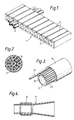
- figure 1 shows a blocking array 1 that may be used to form a moisture block in an automotive harness or cable.
- the array has a number of channels 2 that extend through the array, and a number of slits 3, each slit communicating with one channel.
- the slits enable one or two wires to be pressed into each channel 2 from the side of the array. Once all the wires have been inserted into the slits a heat-shrinkable sleeve that had previously been positioned over the wires, is moved over the array and is heated to cause it to shrink. The heating also causes the sealant forming the blocking array to soften to melt, and the recovery of the heat-shrinkable sleeve causes the profile 1 to change from a generally flat configuration to a substantially cylindrical one as shown in figure 2.
- the volume of the sealant 5 from which the array was formed may be considerably greater than the volume of the electrical insulation of the wires 4, with the result that if a sealant such as a polyamide were used with pvc insulated wires a considerable proportion of the plasticiser in the pvc could migrate into the sealant with the resulting embrittlement of the wire insulation, whereas by use of a polyester-ethylene/acrylic copolymer blend, substantially no plasticiser is taken up by the sealant.
- the volume of sealant is at least as great as the volume of electrical insulation of the wires i.e. that part of the wires that is encapsulated in the sealant, but the volume of sealant may be considerably greater, e.g. at least 5 times and sometimes as much as ten or more times the volume of insulation in the wires.
- FIG. 3 An alternative form of moisture block is shown in figure 3 in which a generally tubular block of sealant 21 has a number of grooves 22 along its periphery for receiving one or more wires 23 of the harness. A heat-recoverable sleeve 24 may then be recovered on the block which melts under the action of the heat used to recover the block and forms a seal. If desired the block may contain an aperture 25 to enable additional wires to be sealed.
- FIG 4. Another form of article is shown in figure 4.
- This device comprises a short length of heat-shrinkable tubing 31 that has been partially recovered over a cylindrical insert 32 of the sealant.
- the device can be positioned over a standard 2- or 3-pole connector so that the right hand end of the device as shown extends over the connector outlet and the wires extend through the sealant and the left hand end as shown of the device. Recovery of the device about the wires and connector will form a seal at the end of the connector.
- a cable blocking profile of the type shown in figure 1 was installed on ten 18 AWG plasticised pvc wires followed by a conventional low density polyethylene heat-shrinkable sleeve. The arrangement was installed on the wires as described in European application No. 249,510.
- the blocking profile was formed from the following composition. Component Parts by Weight ethylene acrylic acid copolymer (m.p. 85-95°C) 42.5 polyester 1 (m.p. 140-150°C) 27.5 polyester 2 (m.p. 100-110°C) 30 carbon black 1 antioxidant 0.25
- Polyester 1 was a polyester formed from ethylene glycol and equal quantities (by mole) of terephthalic acid and hexane-1,6-dioic acid.
- Polyester 2 was a polyester formed from butane-1,4-diol with a mixture of acids (35% isophthalic acid, 35% terephthalic acid and 30% decane-1,10-dioic acid by mole).
- Example 1 was repeated with the exception that the sealant used for the blocking profile comprised a polyamide hot-melt adhesive.
- the results are shown in Table II. TABLE II Conditions Ultimate Elongation Retained Elongation Wire 1 control 195% (100%) Wire 1 aged in polyamide 43% 22% Wire 2 control 76% (100%) Wire 2 aged in polyamide 40% 63% Wire 3 control 106% (100%) Wire 3 aged in polyamide 25% 24%
- the ratio of plasticiser to polymer in the wires was determined both before and after heat ageing.
- the original ratio of polymer to plasticiser was 75:25, and the ratio after ageing was 83:17 by weight, indicating a 32% reduction in the plasticiser level of the wire insulation.
- a heat-shrinkable sleeve that was lined with an ethylene vinyl acetate acrylic acid terpolymer sealant was employed to form the cable block, those wires that were in contact with the terpolymer suffered an even greater plasticiser loss.
- the polymer/plasticiser ratio in the heat aged wires rose to 86:14. indicating a 44% reduction in the plasticiser level of the wire insulation.
- Plaques were formed from a number of blends of an ethylene acrylic acid copolymer and one or more polyesters at different component levels, and were tested for plasticiser uptake by immersing them in two commonly used plasticisers; dioctyl phthalate (DIOP) and tri-octyl trimellitate (TOT) at room temperature for various periods of time.
- DIOP dioctyl phthalate
- TOT tri-octyl trimellitate
- Polyester 3 is a polyester whose acid groups comprise 70% terephthalic acid groups and 30% isophthalic acid groups by mole, and whose ether groups are derived from 45% 1,4-butanediol and 55% 1,6-hexanediol by mole. Each blend contained 1% carbon black and 0.25% antioxidant (based on the total weight of the EAA and polyester).
Landscapes
- Sealing Material Composition (AREA)
- Insulated Conductors (AREA)
- Compositions Of Macromolecular Compounds (AREA)
Applications Claiming Priority (2)
| Application Number | Priority Date | Filing Date | Title |
|---|---|---|---|
| GB8800421 | 1988-01-08 | ||
| GB888800421A GB8800421D0 (en) | 1988-01-08 | 1988-01-08 | Arrangement for encapsulating electrical wires |
Publications (2)
| Publication Number | Publication Date |
|---|---|
| EP0323914A2 true EP0323914A2 (de) | 1989-07-12 |
| EP0323914A3 EP0323914A3 (de) | 1991-12-18 |
Family
ID=10629692
Family Applications (1)
| Application Number | Title | Priority Date | Filing Date |
|---|---|---|---|
| EP19890300115 Withdrawn EP0323914A3 (de) | 1988-01-08 | 1989-01-06 | Vorrichtung zum Einkapseln von elektrischen Drähten |
Country Status (3)
| Country | Link |
|---|---|
| EP (1) | EP0323914A3 (de) |
| JP (1) | JPH01236268A (de) |
| GB (1) | GB8800421D0 (de) |
Cited By (5)
| Publication number | Priority date | Publication date | Assignee | Title |
|---|---|---|---|---|
| EP0439284A1 (de) * | 1990-01-18 | 1991-07-31 | BRITISH TELECOMMUNICATIONS public limited company | Kabelverschlussvorrichtung |
| EP0626742A3 (de) * | 1993-04-20 | 1995-05-10 | Rxs Schrumpftech Garnituren | Wärmeschrumpfbare Kabelmuffe. |
| EP0938159A1 (de) * | 1998-02-18 | 1999-08-25 | Sumitomo Wiring Systems, Ltd. | Eine wasserdichte Konstruction für Kabelende und Verfahren zur Herstellung einer wasserdichten Konstruction |
| US9080091B2 (en) | 2011-03-17 | 2015-07-14 | Toyobo Co., Ltd. | Polyester resin composition for electrical/electronic part-sealing material, sealed product, and production method thereof |
| US9139729B2 (en) | 2011-02-23 | 2015-09-22 | Toyobo Co., Ltd. | Resin composition for sealing electrical electronic components, method of producing electrical electronic component, and sealed electrical electronic component |
Families Citing this family (1)
| Publication number | Priority date | Publication date | Assignee | Title |
|---|---|---|---|---|
| DE69525415T2 (de) * | 1994-11-04 | 2002-06-20 | Sumitomo Electric Industries, Ltd. | Schrumpfbarer Schlauch, aus Verbundmaterial, und Verfahren zur Abdichtung unter Verwendung dieses Schlauches |
Family Cites Families (8)
| Publication number | Priority date | Publication date | Assignee | Title |
|---|---|---|---|---|
| US4407888A (en) * | 1979-12-07 | 1983-10-04 | Raychem Limited | Dimensionally recoverable article with adhesive portion |
| US4264761A (en) * | 1980-03-07 | 1981-04-28 | E. I. Du Pont De Nemours And Company | Copolyester barrier coat |
| US4624720A (en) * | 1983-01-06 | 1986-11-25 | Raychem Ltd | Dimensionally heat-recoverable article |
| EP0116673B1 (de) * | 1983-02-18 | 1989-08-09 | Toyo Boseki Kabushiki Kaisha | Blockcopolymermischung vom Polyester-Typ |
| US4501928A (en) * | 1983-05-09 | 1985-02-26 | Dainichi-Nippon Cables, Ltd. | Shielding tape and electric cables using same |
| GB8614369D0 (en) * | 1986-06-12 | 1986-07-16 | Raychem Ltd | Blocking arrangement |
| EP0262929B1 (de) * | 1986-10-01 | 1995-01-18 | Mitsui Petrochemical Industries, Ltd. | Amorphe Polyester-Zusammensetzungen und ihre Verwendungen |
| BR8807456A (pt) * | 1987-04-13 | 1990-05-22 | Raychem Corp | Material de barreira para interface selante de gel-capa de cabo |
-
1988
- 1988-01-08 GB GB888800421A patent/GB8800421D0/en active Pending
-
1989
- 1989-01-06 EP EP19890300115 patent/EP0323914A3/de not_active Withdrawn
- 1989-01-09 JP JP1004571A patent/JPH01236268A/ja active Pending
Cited By (6)
| Publication number | Priority date | Publication date | Assignee | Title |
|---|---|---|---|---|
| EP0439284A1 (de) * | 1990-01-18 | 1991-07-31 | BRITISH TELECOMMUNICATIONS public limited company | Kabelverschlussvorrichtung |
| EP0626742A3 (de) * | 1993-04-20 | 1995-05-10 | Rxs Schrumpftech Garnituren | Wärmeschrumpfbare Kabelmuffe. |
| EP0938159A1 (de) * | 1998-02-18 | 1999-08-25 | Sumitomo Wiring Systems, Ltd. | Eine wasserdichte Konstruction für Kabelende und Verfahren zur Herstellung einer wasserdichten Konstruction |
| US6107573A (en) * | 1998-02-18 | 2000-08-22 | Sumitomo Wiring Systems, Ltd. | Watertight construction for ends of wires and method for forming the watertight construction |
| US9139729B2 (en) | 2011-02-23 | 2015-09-22 | Toyobo Co., Ltd. | Resin composition for sealing electrical electronic components, method of producing electrical electronic component, and sealed electrical electronic component |
| US9080091B2 (en) | 2011-03-17 | 2015-07-14 | Toyobo Co., Ltd. | Polyester resin composition for electrical/electronic part-sealing material, sealed product, and production method thereof |
Also Published As
| Publication number | Publication date |
|---|---|
| JPH01236268A (ja) | 1989-09-21 |
| EP0323914A3 (de) | 1991-12-18 |
| GB8800421D0 (en) | 1988-02-10 |
Similar Documents
| Publication | Publication Date | Title |
|---|---|---|
| US4576993A (en) | Low density polyethylene polymeric compositions | |
| US4972042A (en) | Blocking arrangement for suppressing fluid transmission in cables | |
| EP0032001B1 (de) | Elastischer Gegenstand mit adhäsiver Schicht und Verfahren zu seiner Herstellung | |
| US4963698A (en) | Cable sealing | |
| CA1311815C (en) | Electrical terminal | |
| US4935467A (en) | Polymeric blends | |
| EP0108491A1 (de) | Elektrisches Kabel mit flammenhemmender Beschichtung | |
| JPS6234055B2 (de) | ||
| US5143761A (en) | Thermoplastic fluoropolymer adhesive composition | |
| RU95122572A (ru) | Полимерное соединение и электрический привод или кабель | |
| JPH07116651B2 (ja) | 寸法的熱回復性物品 | |
| EP0323914A2 (de) | Vorrichtung zum Einkapseln von elektrischen Drähten | |
| EP0302495B1 (de) | Gewendelte Schnur | |
| US6303866B1 (en) | Self-adjusting cables and method for making same | |
| SK5202002A3 (en) | Extrusible thermoplastic material and optical fibre micromodule made from same | |
| CA1329113C (en) | Wrap-around heat-recoverable sealing article | |
| WO2015077739A1 (en) | Heat shrinkable tube | |
| EP0880302A2 (de) | Heizkabel un Herstellungsverfahren | |
| JPS59167247A (ja) | 回復性布およびその用途 | |
| US4877467A (en) | Electrically insulated wire | |
| CA1134538A (en) | Polymeric compositions | |
| EP1289064B1 (de) | Elektrischer Vebinder mit ionomerem Isolationsmaterial | |
| JP3835055B2 (ja) | リサイカブル電力ケーブル | |
| GB2170646A (en) | Flame retardant cable | |
| EP0411055B1 (de) | Verbundener gegenstand |
Legal Events
| Date | Code | Title | Description |
|---|---|---|---|
| PUAI | Public reference made under article 153(3) epc to a published international application that has entered the european phase |
Free format text: ORIGINAL CODE: 0009012 |
|
| 17P | Request for examination filed |
Effective date: 19890114 |
|
| AK | Designated contracting states |
Kind code of ref document: A2 Designated state(s): AT BE CH DE ES FR GB IT LI NL SE |
|
| PUAL | Search report despatched |
Free format text: ORIGINAL CODE: 0009013 |
|
| AK | Designated contracting states |
Kind code of ref document: A3 Designated state(s): AT BE CH DE ES FR GB IT LI NL SE |
|
| STAA | Information on the status of an ep patent application or granted ep patent |
Free format text: STATUS: THE APPLICATION IS DEEMED TO BE WITHDRAWN |
|
| 18D | Application deemed to be withdrawn |
Effective date: 19920619 |