EP0324400A2 - Procédé et dispositif pour la fabrication de produits de broyage - Google Patents
Procédé et dispositif pour la fabrication de produits de broyage Download PDFInfo
- Publication number
- EP0324400A2 EP0324400A2 EP89100238A EP89100238A EP0324400A2 EP 0324400 A2 EP0324400 A2 EP 0324400A2 EP 89100238 A EP89100238 A EP 89100238A EP 89100238 A EP89100238 A EP 89100238A EP 0324400 A2 EP0324400 A2 EP 0324400A2
- Authority
- EP
- European Patent Office
- Prior art keywords
- oxygen
- grinding
- atmosphere
- product
- free atmosphere
- Prior art date
- Legal status (The legal status is an assumption and is not a legal conclusion. Google has not performed a legal analysis and makes no representation as to the accuracy of the status listed.)
- Granted
Links
- 238000000034 method Methods 0.000 title claims description 34
- 239000001301 oxygen Substances 0.000 claims abstract description 32
- 229910052760 oxygen Inorganic materials 0.000 claims abstract description 32
- 235000013339 cereals Nutrition 0.000 claims abstract description 25
- 230000003647 oxidation Effects 0.000 claims abstract description 18
- 238000007254 oxidation reaction Methods 0.000 claims abstract description 18
- 238000003860 storage Methods 0.000 claims abstract description 18
- 238000003801 milling Methods 0.000 claims abstract description 15
- 238000004519 manufacturing process Methods 0.000 claims abstract description 13
- 241000282414 Homo sapiens Species 0.000 claims abstract description 9
- 235000012820 baking ingredients and mixes Nutrition 0.000 claims abstract description 5
- 238000012432 intermediate storage Methods 0.000 claims abstract description 3
- 238000000227 grinding Methods 0.000 claims description 53
- 239000007789 gas Substances 0.000 claims description 30
- QVGXLLKOCUKJST-UHFFFAOYSA-N atomic oxygen Chemical compound [O] QVGXLLKOCUKJST-UHFFFAOYSA-N 0.000 claims description 20
- 230000001681 protective effect Effects 0.000 claims description 19
- 239000000463 material Substances 0.000 claims description 17
- 238000004806 packaging method and process Methods 0.000 claims description 17
- 239000004575 stone Substances 0.000 claims description 15
- CURLTUGMZLYLDI-UHFFFAOYSA-N Carbon dioxide Chemical compound O=C=O CURLTUGMZLYLDI-UHFFFAOYSA-N 0.000 claims description 11
- IJGRMHOSHXDMSA-UHFFFAOYSA-N Atomic nitrogen Chemical compound N#N IJGRMHOSHXDMSA-UHFFFAOYSA-N 0.000 claims description 9
- 238000012545 processing Methods 0.000 claims description 9
- 239000000654 additive Substances 0.000 claims description 8
- 235000013305 food Nutrition 0.000 claims description 8
- 239000004464 cereal grain Substances 0.000 claims description 6
- 239000002994 raw material Substances 0.000 claims description 6
- 235000008429 bread Nutrition 0.000 claims description 5
- 239000001569 carbon dioxide Substances 0.000 claims description 5
- 229910002092 carbon dioxide Inorganic materials 0.000 claims description 5
- 230000029087 digestion Effects 0.000 claims description 5
- 239000004615 ingredient Substances 0.000 claims description 5
- 102000004169 proteins and genes Human genes 0.000 claims description 5
- 108090000623 proteins and genes Proteins 0.000 claims description 5
- 238000012216 screening Methods 0.000 claims description 5
- 241001465754 Metazoa Species 0.000 claims description 4
- 229920002472 Starch Polymers 0.000 claims description 4
- 235000015927 pasta Nutrition 0.000 claims description 4
- 235000019698 starch Nutrition 0.000 claims description 4
- 239000008107 starch Substances 0.000 claims description 4
- 238000009837 dry grinding Methods 0.000 claims description 3
- 230000007717 exclusion Effects 0.000 claims description 3
- 238000007710 freezing Methods 0.000 claims description 3
- 230000008014 freezing Effects 0.000 claims description 3
- 229910052757 nitrogen Inorganic materials 0.000 claims description 3
- 238000002360 preparation method Methods 0.000 claims description 3
- 238000007873 sieving Methods 0.000 claims description 3
- 238000012546 transfer Methods 0.000 claims description 3
- XLYOFNOQVPJJNP-UHFFFAOYSA-N water Substances O XLYOFNOQVPJJNP-UHFFFAOYSA-N 0.000 claims description 3
- 238000007664 blowing Methods 0.000 claims description 2
- 239000002826 coolant Substances 0.000 claims description 2
- 235000013399 edible fruits Nutrition 0.000 claims description 2
- 231100000252 nontoxic Toxicity 0.000 claims description 2
- 230000003000 nontoxic effect Effects 0.000 claims description 2
- 239000002341 toxic gas Substances 0.000 claims description 2
- 238000001816 cooling Methods 0.000 claims 1
- 235000013311 vegetables Nutrition 0.000 claims 1
- 239000011782 vitamin Substances 0.000 abstract description 2
- 235000013343 vitamin Nutrition 0.000 abstract description 2
- 229940088594 vitamin Drugs 0.000 abstract description 2
- 229930003231 vitamin Natural products 0.000 abstract description 2
- 239000000470 constituent Substances 0.000 abstract 2
- 235000016709 nutrition Nutrition 0.000 abstract 1
- 239000000047 product Substances 0.000 description 34
- 235000013312 flour Nutrition 0.000 description 13
- 239000000203 mixture Substances 0.000 description 7
- 239000003570 air Substances 0.000 description 5
- 238000002156 mixing Methods 0.000 description 5
- 239000000126 substance Substances 0.000 description 5
- 239000007795 chemical reaction product Substances 0.000 description 4
- 229910001873 dinitrogen Inorganic materials 0.000 description 3
- 235000019197 fats Nutrition 0.000 description 3
- 238000011049 filling Methods 0.000 description 3
- 238000010586 diagram Methods 0.000 description 2
- 230000002349 favourable effect Effects 0.000 description 2
- 230000035784 germination Effects 0.000 description 2
- 239000011261 inert gas Substances 0.000 description 2
- 239000005022 packaging material Substances 0.000 description 2
- 235000018102 proteins Nutrition 0.000 description 2
- 235000019871 vegetable fat Nutrition 0.000 description 2
- 235000020985 whole grains Nutrition 0.000 description 2
- 241000282412 Homo Species 0.000 description 1
- 240000004808 Saccharomyces cerevisiae Species 0.000 description 1
- 238000009825 accumulation Methods 0.000 description 1
- 239000012080 ambient air Substances 0.000 description 1
- 238000013459 approach Methods 0.000 description 1
- 230000009286 beneficial effect Effects 0.000 description 1
- 230000031018 biological processes and functions Effects 0.000 description 1
- 230000015556 catabolic process Effects 0.000 description 1
- 238000006243 chemical reaction Methods 0.000 description 1
- 230000002860 competitive effect Effects 0.000 description 1
- 238000010276 construction Methods 0.000 description 1
- 230000006735 deficit Effects 0.000 description 1
- 238000006731 degradation reaction Methods 0.000 description 1
- 235000005911 diet Nutrition 0.000 description 1
- 230000037213 diet Effects 0.000 description 1
- 238000006073 displacement reaction Methods 0.000 description 1
- 230000000694 effects Effects 0.000 description 1
- 238000005516 engineering process Methods 0.000 description 1
- 239000000945 filler Substances 0.000 description 1
- 239000004519 grease Substances 0.000 description 1
- 239000002927 high level radioactive waste Substances 0.000 description 1
- 238000012994 industrial processing Methods 0.000 description 1
- 238000009776 industrial production Methods 0.000 description 1
- 229910052500 inorganic mineral Inorganic materials 0.000 description 1
- 239000013067 intermediate product Substances 0.000 description 1
- 230000007774 longterm Effects 0.000 description 1
- 238000012423 maintenance Methods 0.000 description 1
- 239000011707 mineral Substances 0.000 description 1
- 235000015097 nutrients Nutrition 0.000 description 1
- 150000002927 oxygen compounds Chemical class 0.000 description 1
- 235000014594 pastries Nutrition 0.000 description 1
- 230000001105 regulatory effect Effects 0.000 description 1
- 230000000717 retained effect Effects 0.000 description 1
- 150000003839 salts Chemical class 0.000 description 1
- 239000007787 solid Substances 0.000 description 1
- 210000000352 storage cell Anatomy 0.000 description 1
- 238000003786 synthesis reaction Methods 0.000 description 1
- 230000009466 transformation Effects 0.000 description 1
- 235000021122 unsaturated fatty acids Nutrition 0.000 description 1
- 150000004670 unsaturated fatty acids Chemical class 0.000 description 1
- 235000011845 white flour Nutrition 0.000 description 1
Images


Classifications
-
- B—PERFORMING OPERATIONS; TRANSPORTING
- B02—CRUSHING, PULVERISING, OR DISINTEGRATING; PREPARATORY TREATMENT OF GRAIN FOR MILLING
- B02C—CRUSHING, PULVERISING, OR DISINTEGRATING IN GENERAL; MILLING GRAIN
- B02C23/00—Auxiliary methods or auxiliary devices or accessories specially adapted for crushing or disintegrating not provided for in preceding groups or not specially adapted to apparatus covered by a single preceding group
- B02C23/18—Adding fluid, other than for crushing or disintegrating by fluid energy
-
- B—PERFORMING OPERATIONS; TRANSPORTING
- B02—CRUSHING, PULVERISING, OR DISINTEGRATING; PREPARATORY TREATMENT OF GRAIN FOR MILLING
- B02B—PREPARING GRAIN FOR MILLING; REFINING GRANULAR FRUIT TO COMMERCIAL PRODUCTS BY WORKING THE SURFACE
- B02B1/00—Preparing grain for milling or like processes
- B02B1/08—Conditioning grain with respect to temperature or water content
-
- B—PERFORMING OPERATIONS; TRANSPORTING
- B02—CRUSHING, PULVERISING, OR DISINTEGRATING; PREPARATORY TREATMENT OF GRAIN FOR MILLING
- B02C—CRUSHING, PULVERISING, OR DISINTEGRATING IN GENERAL; MILLING GRAIN
- B02C11/00—Other auxiliary devices or accessories specially adapted for grain mills
- B02C11/08—Cooling, heating, ventilating, conditioning with respect to temperature or water content
Definitions
- the invention relates to a process for the production of mill products for human consumption or for animal feed from starch, protein and fat-containing plant fruits, such as cereal grains and other seeds, in a dry processing of the raw material.
- Cereal grains and seeds are naturally designed so that they can be germinated if stored dry and undamaged over one or more vegetation periods. These are complex, in the end probably hardly completely understandable biological processes due to the ingredients as well as the specific structure of the whole grain. To put it simply, the rich content of most grains serves as a stored nutrient for germ growth.
- the protein is the lifeblood.
- the vegetable fat as a higher form of an energy concentration is often concentrated in the germination area and serves a rapid growth especially in the first germination phase even under less favorable conditions at the time of the initial phase of growth. All parts, along with the outermost cellulose-like grain layer, are used for the construction of the new plant. Humans have also taken advantage of this balanced composition of essential ingredients.
- the grain of grain serves as human and animal food. At the correct ambient temperature and product humidity, grains and other seeds can be stored for longer periods. Whole quality is maintained at least over a 1-year storage period, provided that the grain remains germinable and whole.
- a maximum of white flours is worked out in the mill, e.g. for bread and pastries, pasta, etc.
- the most nutritionally physiologically valuable parts of the grain especially the part of the germ and partly the outer layers of grain, are kept away from these ground products, human consumption and e.g. fed to animals.
- the germ is the most valuable part of the grain and at the same time also contains the largest proportion of vegetable fat, in the form of the highly unsaturated fatty acids that are beneficial to health. In parallel with the generally recognized level of knowledge For a long time, no importance was attached to this issue.
- the grain is ground integrally in the bakery, as in the early days of using grinding stones, next to the dough trough and passed directly into the dough trough. In this way, the vital substances in the grain can be retained with a high percentage.
- the invention has now set itself the task of creating a new method and corresponding devices that allow the commercial / industrial production of high-quality to high-quality ground products, with both the plant investments and the operating costs should be within a reasonable range, so that for End-user purchase prices arise that are closer to the prices of normal products and not of special diet products.
- healthcare costs may already occupy a large proportion of the national economy, which is incomparably higher than the economic advantage of previous milling.
- the inferiority or wholesomeness of the daily food at least have a significant influence on the economic expenditure through the medical costs. Bringing this back into a more favorable ratio is also part of the task according to the invention.
- the solution according to the invention is characterized in that, in order to avoid oxidation, the product to be processed is placed under an oxygen-poor or oxygen-free atmosphere during or after the dry digestion at a product temperature above freezing but below 70 ° C., preferably 50 ° C.
- the new invention can be implemented in the traditional flat or stone mill as well as in the modern passage milling with mill roller mills.
- disintegration is intended to mean the transformation of the originally whole grain into a fragmented, as it were, pre-chewed form.
- mill-based work techniques such as peeling, pre-peeling, grinding, sieving and sifting, mixing, conveying, etc., i.e. wherever an oxidation is being prepared or is actually taking place.
- the processing of the mill products conventionally takes place with a moisture which is only slightly higher than the storage moisture. In the case of multiple grinding with roller mills, it is e.g. B. in the range of about 15%.
- work is carried out dry with a product moisture below this storage moisture of approximately 15%.
- the processing moisture can range from e.g. B. 8 to 10% water content.
- the cereal flakes are dried immediately after being crushed to a moisture content of less than 15%, preferably to a residual water content of 8-10%, and further treated in a corresponding dry atmosphere.
- the invention allows a whole series of particularly advantageous configurations.
- the product is preferably divided into portions after dry grinding and preferably after intermediate storage and brought into airtight packaging, in the interior of which a vacuum or a reaction-neutral protective gas atmosphere is produced.
- the oxygen-poor or oxygen-free atmosphere is produced by blowing in atmospheric nitrogen, carbon dioxide or another non-toxic gas.
- atmospheric nitrogen, carbon dioxide or another non-toxic gas can also be used or these can be used one after the other.
- nitrogen gas and carbon dioxide can also be used or these can be used one after the other. For example, for easier displacement of the air and the relatively heavy carbon dioxide, which is only then replaced by a nitrogen gas for ongoing production.
- the cold released by the expansion can be used to lower the temperature of the grinding tools and / or the atmosphere in the grinding chamber.
- the unlocking or very particularly preferably takes place.
- dry grinding of the food in several stages such that each grinding stage is preferably carried out under an oxygen-poor or oxygen-free atmosphere.
- a screening process can be carried out in each case between two grinding stages, the screening or screening also being carried out under an oxygen-poor or oxygen-free atmosphere.
- milling roller mills with corrugated and smooth rollers are preferably used.
- the digestion of the raw material with one, two or three grinding steps can preferably be designed as stone mills.
- the material is preferably placed beforehand in an intermediate bunker, which also has a protective gas atmosphere. The goods are then brought directly into the packaging. In this case, only the entry of atmospheric oxygen has to be avoided for the packaging.
- the gas contained in the flour or semolina-shaped material is sufficient in many cases as protection.
- the raw material can also be peeled or scrubbed or peeled or tanned under a low-oxygen or oxygen-free atmosphere and, if it is not processed immediately, stored or packaged in a low-oxygen or oxygen-free atmosphere. This allows e.g. carry out the actual grinding at another time or at a different location.
- an economically optimal embodiment of the new method according to the invention lies in the fact that a baking mix is produced according to a predetermined recipe. This can be produced directly in portions in a mixing drum under an oxygen-poor or oxygen-free atmosphere and then packaged in vacuum or with a reaction-neutral protective gas atmosphere or initially stored temporarily with a reaction-neutral protective gas atmosphere.
- the invention further relates to a device for applying the method.
- This is characterized by the fact that they have unlocking elements and housings that completely enclose them without uncontrolled air passage openings product and outlet openings that can be closed off from the free atmosphere and means for supplying a reaction-neutral protective gas atmosphere.
- the product path between individual or all plant elements such as grinding unit, plan sifter, silo etc. is made lockable against free, uncontrolled gas passage by means of locks and / or slides.
- a feed line for part of the protective gas atmosphere in the area of the ground material intake of the grinding rollers or grinding bodies and / or a supply line for part of the protective gas atmosphere in the area of the ground material collecting space of the grinding rollers or grinding bodies is preferably provided.
- the condition also relates to the application of the method, with the goods being directly used for further processing, in particular disintegration, e.g. the dough preparation for bread, pasta, is fed.
- disintegration e.g. the dough preparation for bread, pasta
- the invention further relates to a product produced by the process according to the invention as an oxidation-free ground, starch, protein and fat-containing foodstuff, which is stored in an airtight packaging or a container, the packaging or the container having an oxygen-free or oxygen-free atmosphere is available.
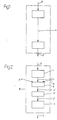
- the device shown in Figure 1 consists of a mill 1 with a possible short grinding path, for example a stone mill and a packaging machine 2 connected to it, which, as is indicated by the dash-dotted border, designated 10, while avoiding the access of atmospheric oxygen to it Product is operated.
- the cereal grains 3 to be comminuted in the mill 1 are thus in an oxygen-poor or almost oxygen-free atmosphere, which is generated by an inert gas atmosphere from inert gases such as nitrogen, carbonic acid or Mixture of these or can be formed by a vacuum, ground and the flour 4 obtained therefrom is then fed to the packaging machine 2, in which the end product 5 is portioned accordingly, immediately packed airtight, so that no oxygen can reach the ground material during processing and therefore no oxidation occurs.
- the storable end product 5 thus contains all the vitamins and minerals contained in the grains 3 without being damaged by oxidation, and can be processed further at any time.
- the mill 1 is a mixing machine 6 in which the flour 4 ground from the cereal grains 3 can be admixed with one or more additives 7, 7 ', etc. and this is connected to a portioning machine 8.
- the baking mixes or other mixtures 4 'produced in the mixing machine 6 are thus divided in the portioning machine 8 and the individual portions are then packed airtight in a packaging machine 2. Since, in turn, all operations are carried out with the exclusion of an oxygen atmosphere, as is indicated by the dash-dotted border 10, an end product 5 is produced from the cereal grains 3 and the additives 7, 7 'and has no oxidation damage.
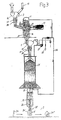
- Fig. 3 a simply designed whole small mill system is shown.
- the still undamaged grains are fed via a feed line 11 and via a feed funnel 12 and a product lock 13 into the interior of the mill 1 designed as a stone mill.
- the stone mill has two upright grinding stones rotating about a horizontal axis 14, one of which is the fixed stone 15 and the second of the rotor stone 16.
- the rotor stone 16 is driven by an electric motor 17.
- Flour 4 is directly via an additional funnel 18 and a lock 19 and a discharge pipe 20 in an air or. gas-tight container 21 fed.
- the container 21 is almost filled with flour in the picture 4.
- the flour 4 is conveyed through a removal device 22 directly to a bag filling device 23, with a compacting screw 23 'being arranged in the bag filling device 23.
- the packaging machine is only symbolically represented by an empty sack 24, a sack 24 'on the filler neck and a finished and hermetically sealed sack 24'.
- the gas e.g. as nitrogen gas or carbon dioxide
- a gas source 25 directly into the pressure side of a gas line system 26.
- Both the mill 1 and the container 21 each have their own gas circulation system, which is maintained via a pressure fan 27.
- both for the mill 1 and for the container 21 each have their own gas system or. the specifically required gas resp. the permissible oxygen concentration can be regulated.
- each working section can be closed completely gas-tight, e.g. by installing sliders 28.
- the flour 4 additionally shows the mixture of e.g. produce baking mixes, which can also be packed in airtight sacks 24 ⁇ .
- the flour 4 is removed from the container 21 via a material lock 30 and placed in a gas-tight mixer. All additives such as yeast, salt, etc. are resp. From the corresponding storage cells 31. 32 removed and, like the flour itself, added to the batch mixer in precisely dosed quantities.
- the corresponding control of all system elements is coordinated via a computer 33, as is only indicated schematically.
- the finished, dry baking mixture is drained off in an intermediate container 34 and can be lifted into a sack conveyor 35 by means of an inclined conveyor 35 in a likewise gas-tight filling funnel 36, from which the individual sacks or containers for the Transport or storage can be filled.
- FIG. 5 now shows schematically an example of the implementation of the new invention with milling roller mills 40 and plan sifter 41.
- the conveying and lifting system of the intermediate grinding products is done here with gas-tight screw conveyors 42.
- the great advantage of this system is that it allows the individual grinding fractions to be mechanically broken down in a targeted manner, so that the baking properties, flavorings and milling aspects can be optimized in every respect.
- the individual workspaces can be placed under a specific gas atmosphere, or the appropriate atmosphere is maintained. This makes it possible to choose between the maximum target values for the ingredients with regard to human health and the economically still viable effort for maintaining the special atmosphere, the best syntheses that can still be achieved in practice.
Landscapes
- Engineering & Computer Science (AREA)
- Food Science & Technology (AREA)
- Cereal-Derived Products (AREA)
- Bakery Products And Manufacturing Methods Therefor (AREA)
- Disintegrating Or Milling (AREA)
- Crushing And Grinding (AREA)
- Storage Of Fruits Or Vegetables (AREA)
- Coloring Foods And Improving Nutritive Qualities (AREA)
Priority Applications (1)
| Application Number | Priority Date | Filing Date | Title |
|---|---|---|---|
| AT89100238T ATE99190T1 (de) | 1988-01-14 | 1989-01-07 | Verfahren und einrichtung zur herstellung von muehlenprodukten. |
Applications Claiming Priority (2)
| Application Number | Priority Date | Filing Date | Title |
|---|---|---|---|
| CH134/88 | 1988-01-14 | ||
| CH134/88A CH677455A5 (fr) | 1988-01-14 | 1988-01-14 |
Publications (3)
| Publication Number | Publication Date |
|---|---|
| EP0324400A2 true EP0324400A2 (fr) | 1989-07-19 |
| EP0324400A3 EP0324400A3 (en) | 1990-05-30 |
| EP0324400B1 EP0324400B1 (fr) | 1993-12-29 |
Family
ID=4180022
Family Applications (1)
| Application Number | Title | Priority Date | Filing Date |
|---|---|---|---|
| EP89100238A Revoked EP0324400B1 (fr) | 1988-01-14 | 1989-01-07 | Procédé et dispositif pour la fabrication de produits de broyage |
Country Status (5)
| Country | Link |
|---|---|
| EP (1) | EP0324400B1 (fr) |
| AT (1) | ATE99190T1 (fr) |
| CH (1) | CH677455A5 (fr) |
| DE (1) | DE58906507D1 (fr) |
| ES (1) | ES2049762T3 (fr) |
Cited By (2)
| Publication number | Priority date | Publication date | Assignee | Title |
|---|---|---|---|---|
| EP3333244A1 (fr) * | 2016-12-06 | 2018-06-13 | Commissariat à l'Energie Atomique et aux Energies Alternatives | Systeme d'alimentation en poudre a partir de granules, procede et installation de gazeification de charge de matiere carbonee dans un reacteur a flux entraîne (rfe) utilisant un tel systeme |
| US20240399384A1 (en) * | 2023-06-01 | 2024-12-05 | Nanchang University | Device that effectively produces macha powder |
Family Cites Families (10)
| Publication number | Priority date | Publication date | Assignee | Title |
|---|---|---|---|---|
| US2381421A (en) * | 1942-03-12 | 1945-08-07 | Claude R Wickard | Method of treating cereal grains |
| GB822935A (en) * | 1955-12-13 | 1959-11-04 | Harald Adriaan Bok | Improvements in or relating to apparatus for gelatinizing of granular or like materials |
| DE2002958A1 (de) * | 1970-01-23 | 1971-07-29 | Alfred Taubert | Verfahren zur Erhaltung des natuerlichen Kakaoaromas bei der Herstellung von Kakaoerzeugnissen |
| US4069349A (en) * | 1970-06-22 | 1978-01-17 | The Continental Group, Inc. | Process for vacuum packaging of roasted, ground coffee |
| FR2298960A1 (fr) * | 1975-01-28 | 1976-08-27 | Scholz Walter | Procede pour la conservation de fourrages |
| JPS5479872A (en) * | 1977-12-08 | 1979-06-26 | Kelsey Hayes Co | Powder classifier |
| EP0018607B1 (fr) * | 1979-04-26 | 1982-04-07 | Bühler AG | Procédé et dispositif de prébroyage d'amandes de cacao |
| DE2938635A1 (de) * | 1979-09-25 | 1981-04-09 | Ing.(grad.) Heinz 4390 Gladbeck Hölter | Verfahren zur trennung von getreidekornschalen vom kornkern |
| CH662477A5 (de) * | 1983-03-22 | 1987-10-15 | Buehler Ag Geb | Verfahren zum behandeln von schalenfruechten. |
| DE3545828A1 (de) * | 1985-12-23 | 1987-07-02 | Jackering Altenburger Masch | Verfahren und einrichtung zum betrieb einer mahlanlage |
-
1988
- 1988-01-14 CH CH134/88A patent/CH677455A5/de not_active IP Right Cessation
-
1989
- 1989-01-07 ES ES89100238T patent/ES2049762T3/es not_active Expired - Lifetime
- 1989-01-07 EP EP89100238A patent/EP0324400B1/fr not_active Revoked
- 1989-01-07 DE DE89100238T patent/DE58906507D1/de not_active Revoked
- 1989-01-07 AT AT89100238T patent/ATE99190T1/de not_active IP Right Cessation
Cited By (3)
| Publication number | Priority date | Publication date | Assignee | Title |
|---|---|---|---|---|
| EP3333244A1 (fr) * | 2016-12-06 | 2018-06-13 | Commissariat à l'Energie Atomique et aux Energies Alternatives | Systeme d'alimentation en poudre a partir de granules, procede et installation de gazeification de charge de matiere carbonee dans un reacteur a flux entraîne (rfe) utilisant un tel systeme |
| US20240399384A1 (en) * | 2023-06-01 | 2024-12-05 | Nanchang University | Device that effectively produces macha powder |
| US12465921B2 (en) * | 2023-06-01 | 2025-11-11 | Nanchang University | Device for producing macha powder |
Also Published As
| Publication number | Publication date |
|---|---|
| EP0324400B1 (fr) | 1993-12-29 |
| EP0324400A3 (en) | 1990-05-30 |
| ES2049762T3 (es) | 1994-05-01 |
| DE58906507D1 (de) | 1994-02-10 |
| ATE99190T1 (de) | 1994-01-15 |
| CH677455A5 (fr) | 1991-05-31 |
Similar Documents
| Publication | Publication Date | Title |
|---|---|---|
| EP0335925B1 (fr) | Procede de fabrication de produits cerealiers moulus et moulin a cereales | |
| DE69310749T2 (de) | Verfahren zur herstellung von vitaminangereichtem getreide | |
| CH677309A5 (fr) | ||
| EP0016442A1 (fr) | Procédé et installation de préparation de chapelure ainsi qu'une chapelure | |
| EP1372409A2 (fr) | Procede et installation pour le traitement de gruau d'extraction, obtenu a partir de graines de tournesol et destine a l'alimentation animale | |
| DE3926334A1 (de) | Verfahren zur herstellung von fruchtmehl | |
| EP0231825A2 (fr) | Procédé et installation de préparation de nourriture pour animaux ou de produits alimentaires | |
| EP0324400A2 (fr) | Procédé et dispositif pour la fabrication de produits de broyage | |
| DE4243879C1 (de) | Verfahren zur Herstellung eines Nahrungsmittels aus Biertreber | |
| DE3406370C2 (fr) | ||
| DE2928250A1 (de) | Verfahren und anlage zur herstellung von mehl, insbesondere weizenmehl zum brotbacken | |
| EP3009191A1 (fr) | Utilisation de fibres nutritives obtenues lors d'un procede de preparation de broyage de cereales | |
| DE1945543C3 (de) | Verfahren zur Herstellung eines mit Eiweiß angereicherten, gebäckartigen oder pulverförmigen Lebensmittels | |
| DE4322421A1 (de) | Keks mit Weizenmehl, Fett, Vollmilch, Salz und einem Backtriebmittel | |
| EP0486961B1 (fr) | Procédé de préparation d'un concentré contenant des oligoéléments approprié pour l'homme et les animaux | |
| DE3826998A1 (de) | Verfahren zur herstellung einer kartoffelmasse in scheibenform | |
| DE860595C (de) | Verfahren und Vorrichtung zur Herstellung von Nahrungsmitteln | |
| EP0701402B1 (fr) | Melange pret a utiliser pour patisserie, son procede de production et son utilisation | |
| DE2339245A1 (de) | Verfahren zur herstellung von getreideprodukten | |
| EP1184453A1 (fr) | Préparation diététique et cosmétique | |
| AT218840B (de) | Verfahren zur Verarbeitung von Kakaomassen | |
| DE102004013464A1 (de) | Verfahren und Vorrichtung zum Herstellen von Futterpellets | |
| EP4197346A1 (fr) | Procédé de fabrication d'un aliment végétalien | |
| DE701216C (de) | Verfahren zur Herstellung eines lecithinhaltigen Futtermittels, insbesondere fuer Gefluegel | |
| DE4334322A1 (de) | Verfahren und Vorrichtung zur Herstellung von Getreide-Schrot |
Legal Events
| Date | Code | Title | Description |
|---|---|---|---|
| PUAI | Public reference made under article 153(3) epc to a published international application that has entered the european phase |
Free format text: ORIGINAL CODE: 0009012 |
|
| AK | Designated contracting states |
Kind code of ref document: A2 Designated state(s): AT BE CH DE ES FR GB GR IT LI LU NL SE |
|
| PUAL | Search report despatched |
Free format text: ORIGINAL CODE: 0009013 |
|
| AK | Designated contracting states |
Kind code of ref document: A3 Designated state(s): AT BE CH DE ES FR GB GR IT LI LU NL SE |
|
| 17P | Request for examination filed |
Effective date: 19901123 |
|
| 17Q | First examination report despatched |
Effective date: 19911021 |
|
| GRAA | (expected) grant |
Free format text: ORIGINAL CODE: 0009210 |
|
| AK | Designated contracting states |
Kind code of ref document: B1 Designated state(s): AT BE CH DE ES FR GB GR IT LI LU NL SE |
|
| REF | Corresponds to: |
Ref document number: 99190 Country of ref document: AT Date of ref document: 19940115 Kind code of ref document: T |
|
| PGFP | Annual fee paid to national office [announced via postgrant information from national office to epo] |
Ref country code: FR Payment date: 19931231 Year of fee payment: 6 |
|
| ET | Fr: translation filed | ||
| ITTA | It: last paid annual fee | ||
| PGFP | Annual fee paid to national office [announced via postgrant information from national office to epo] |
Ref country code: SE Payment date: 19940131 Year of fee payment: 6 Ref country code: NL Payment date: 19940131 Year of fee payment: 6 |
|
| REF | Corresponds to: |
Ref document number: 58906507 Country of ref document: DE Date of ref document: 19940210 |
|
| GBT | Gb: translation of ep patent filed (gb section 77(6)(a)/1977) |
Effective date: 19940114 |
|
| PGFP | Annual fee paid to national office [announced via postgrant information from national office to epo] |
Ref country code: BE Payment date: 19940225 Year of fee payment: 6 |
|
| ITF | It: translation for a ep patent filed | ||
| PGFP | Annual fee paid to national office [announced via postgrant information from national office to epo] |
Ref country code: GB Payment date: 19940329 Year of fee payment: 6 |
|
| PG25 | Lapsed in a contracting state [announced via postgrant information from national office to epo] |
Ref country code: GR Free format text: LAPSE BECAUSE OF FAILURE TO SUBMIT A TRANSLATION OF THE DESCRIPTION OR TO PAY THE FEE WITHIN THE PRESCRIBED TIME-LIMIT Effective date: 19940401 |
|
| REG | Reference to a national code |
Ref country code: ES Ref legal event code: FG2A Ref document number: 2049762 Country of ref document: ES Kind code of ref document: T3 |
|
| PGFP | Annual fee paid to national office [announced via postgrant information from national office to epo] |
Ref country code: ES Payment date: 19940629 Year of fee payment: 6 |
|
| PGFP | Annual fee paid to national office [announced via postgrant information from national office to epo] |
Ref country code: LU Payment date: 19940731 Year of fee payment: 6 |
|
| EPTA | Lu: last paid annual fee | ||
| PLBI | Opposition filed |
Free format text: ORIGINAL CODE: 0009260 |
|
| 26 | Opposition filed |
Opponent name: LINDE AKTIENGESELLSCHAFT Effective date: 19940929 Opponent name: SEITENBACHER GMBH & CO. NATURKOST Effective date: 19940928 |
|
| PG25 | Lapsed in a contracting state [announced via postgrant information from national office to epo] |
Ref country code: LU Free format text: LAPSE BECAUSE OF NON-PAYMENT OF DUE FEES Effective date: 19950107 Ref country code: GB Effective date: 19950107 Ref country code: AT Effective date: 19950107 |
|
| PG25 | Lapsed in a contracting state [announced via postgrant information from national office to epo] |
Ref country code: SE Effective date: 19950108 |
|
| PG25 | Lapsed in a contracting state [announced via postgrant information from national office to epo] |
Ref country code: ES Free format text: LAPSE BECAUSE OF NON-PAYMENT OF DUE FEES Effective date: 19950109 |
|
| PGFP | Annual fee paid to national office [announced via postgrant information from national office to epo] |
Ref country code: AT Payment date: 19950110 Year of fee payment: 6 |
|
| NLR1 | Nl: opposition has been filed with the epo |
Opponent name: LINDE AKTIENGESELLSCHAFT Opponent name: SEITENBACHER GMBH & CO. NATURKOST |
|
| EAL | Se: european patent in force in sweden |
Ref document number: 89100238.8 |
|
| PG25 | Lapsed in a contracting state [announced via postgrant information from national office to epo] |
Ref country code: BE Effective date: 19950131 |
|
| PGFP | Annual fee paid to national office [announced via postgrant information from national office to epo] |
Ref country code: CH Payment date: 19950719 Year of fee payment: 7 |
|
| BERE | Be: lapsed |
Owner name: SCHNITZER JOHANN GEORG Effective date: 19950131 |
|
| PG25 | Lapsed in a contracting state [announced via postgrant information from national office to epo] |
Ref country code: NL Effective date: 19950801 |
|
| PGFP | Annual fee paid to national office [announced via postgrant information from national office to epo] |
Ref country code: DE Payment date: 19950819 Year of fee payment: 7 |
|
| GBPC | Gb: european patent ceased through non-payment of renewal fee |
Effective date: 19950107 |
|
| PG25 | Lapsed in a contracting state [announced via postgrant information from national office to epo] |
Ref country code: FR Effective date: 19950929 |
|
| NLV4 | Nl: lapsed or anulled due to non-payment of the annual fee |
Effective date: 19950801 |
|
| EUG | Se: european patent has lapsed |
Ref document number: 89100238.8 |
|
| REG | Reference to a national code |
Ref country code: FR Ref legal event code: ST |
|
| RDAG | Patent revoked |
Free format text: ORIGINAL CODE: 0009271 |
|
| STAA | Information on the status of an ep patent application or granted ep patent |
Free format text: STATUS: PATENT REVOKED |
|
| REG | Reference to a national code |
Ref country code: CH Ref legal event code: PL |
|
| 27W | Patent revoked |
Effective date: 19960420 |