EP0324422B1 - Regelsystem für Kameras mit Tageslichtblitzgerät - Google Patents
Regelsystem für Kameras mit Tageslichtblitzgerät Download PDFInfo
- Publication number
- EP0324422B1 EP0324422B1 EP89100311A EP89100311A EP0324422B1 EP 0324422 B1 EP0324422 B1 EP 0324422B1 EP 89100311 A EP89100311 A EP 89100311A EP 89100311 A EP89100311 A EP 89100311A EP 0324422 B1 EP0324422 B1 EP 0324422B1
- Authority
- EP
- European Patent Office
- Prior art keywords
- flash
- level
- camera
- fill
- ambient light
- Prior art date
- Legal status (The legal status is an assumption and is not a legal conclusion. Google has not performed a legal analysis and makes no representation as to the accuracy of the status listed.)
- Expired - Lifetime
Links
- 238000005286 illumination Methods 0.000 claims description 10
- 230000004044 response Effects 0.000 claims description 5
- 238000010586 diagram Methods 0.000 description 3
- 230000015572 biosynthetic process Effects 0.000 description 1
- 230000000881 depressing effect Effects 0.000 description 1
- 230000000994 depressogenic effect Effects 0.000 description 1
- 238000010304 firing Methods 0.000 description 1
- 238000012986 modification Methods 0.000 description 1
- 230000004048 modification Effects 0.000 description 1
- 230000000153 supplemental effect Effects 0.000 description 1
Images

Classifications
-
- G—PHYSICS
- G03—PHOTOGRAPHY; CINEMATOGRAPHY; ANALOGOUS TECHNIQUES USING WAVES OTHER THAN OPTICAL WAVES; ELECTROGRAPHY; HOLOGRAPHY
- G03B—APPARATUS OR ARRANGEMENTS FOR TAKING PHOTOGRAPHS OR FOR PROJECTING OR VIEWING THEM; APPARATUS OR ARRANGEMENTS EMPLOYING ANALOGOUS TECHNIQUES USING WAVES OTHER THAN OPTICAL WAVES; ACCESSORIES THEREFOR
- G03B7/00—Control of exposure by setting shutters, diaphragms or filters, separately or conjointly
- G03B7/16—Control of exposure by setting shutters, diaphragms or filters, separately or conjointly in accordance with both the intensity of the flash source and the distance of the flash source from the object, e.g. in accordance with the "guide number" of the flash bulb and the focusing of the camera
Definitions
- the invention relates generally to the field of photography, and specifically to an artificial illumination control system for a camera. More particularly, the invention relates to an artificial illumination control system for controlling the energization of a source of artificial illumination in a normal (or full) flash mode of operation, where ambient light levels are too low for a proper daylight exposure, and in a fill (or fill-in) flash mode of operation, where ambient light levels are relatively high but certain portions of the subject to be photographed have significantly less light falling on them than surrounding portions of the subject.
- a source of artificial illumination such as an electronic flash device, sometimes referred to as a "strobe" unit.
- Situations where a source of artificial illumination are used in relatively high ambient light levels are commonly referred to as a "fill” or “fill-in” mode of flash operation.
- Document US-A-4,331,400 discloses an electric strobe flash apparatus for automatic fill-in and full flash. Supplemental illumination for objects within the maximum range of the flash is provided. A full flash mode is applied under the condition of low ambient light, and a fill-in flash mode is used under conditions of bright ambient light. Here the electronic flash measures the ambient light level and selects the appropriate flash mode. There exist no possibility to determine the maximum distance for effective fill flash mode and to inhibit the fill flash mode when the camera-to-object distance is greater than the maximum distance.
- Still other cameras inhibit, i.e. render inoperative, an electronic flash unit or shift the control mode of the camera from flash photography to daylight photography whenever the subject to be photographed is located beyond an adequately operable distance for the flash output. See U.S. Patent No. 4,501,481 granted February 26, 1985.
- an improved artificial illumination control system where, when the level of ambient light intensity warrents a fill flash mode, but the camera-to-subject distance exceeds a predetermined distance beyond which the flash output may be ineffectual for a fill flash exposure, the fill flash mode is prevented and the control system reverts to a no flash mode.
- an improved artificial illumination control system for controlling the energization of an electronic flash device during a photographic exposure interval in a camera, wherein (a) light level detecting means provides a measure of the brightness level of ambient light intensity, (b) flash triggering means for energizing said electronic flash device operating in a fill flash mode to enable a fill flash exposure, and (c) camera-to-subject distance detecting means providing a measure of the camera-to-subject distance, wherein said control system is characterized by: comparator means for determining whether the measure of the level of the ambient light intensity provided by said light level detecting means is equal to or greater than a related light level for fill flash mode or is smaller than that level, and for determining whether the camera-to-subject distance provided by said camera-to-subject distance detecting means is less than or equal to a maximum distance for fill flash exposure or is greater than that distance; and control means, acting in response to said comparator means for operating said flash triggering means in its fill flash mode if both said measure
- the invention is disclosed as being embodied preferably in a conventional 35mm camera having a built-in electronic flash unit. Because such a camera is well known, this description is directed in particular to photographic elements forming part of or cooperating directly with the disclosed embodiment. It is to be understood, however, that other elements not specifically shown or described may take various forms known to persons of ordinary skill in the art.
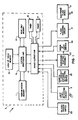
- Fig. 1 depicts a flash control system 1 for controlling the energization of a conventional electronic flash device 3 during a photographic exposure interval in a 35mm camera.
- the control system 1 has three flash related modes of operation, full (or normal) flash, no flash, and fill (or fill-in) flash, one of which is automatically selected, each time the exposure interval is commenced, in accordance with a measure of the level of ambient light intensity provided by a conventional light level detecting circuit 5.
- the control system 1 includes, in addition to the electronic flash device 3 and the light level detecting circuit 5, a conventional microcomputer 7 having a microprocessor or central processing unit (CPU) 9, a volatile random access memory (RAM) 11, a non-volatile read-only memory (ROM) 13, a look-up table memory 15, an input/output (I/O) chip 17, a flash timer 19, and an exposure interval timer 21. Moreover, a normally open release trigger switch 23 is shown which is closed in response to manually depressing a shutter release button, not shown, on the body of the camera.
- an automatic focus device which is operated to focus an objective lens, not shown, and to provide a measure of the camera-to-subject distance.
- a conventional diaphragm shutter assembly 27 is shown which is opened to commence the exposure interval and closed to terminate the exposure interval in response to its receipt of respective control signals from the microcomputer 7.
- a normally open "crack of light” switch 29 is shown which is closed each time the diaphragm shutter assembly 27 is initially opened.
- a conventional flash triggering circuit 31 for energizing the electronic flash device 3 is shown which is operated by the microcomputer 7 in a full flash mode to enable a full flash exposure and is operated in a fill flash mode to enable a fill flash exposure.
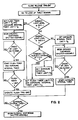
- FIG. 2 is a flow chart for the microcomputer 7, depicting the various steps of operation of the flash control system 1.
- the microcomputer 7 interrogates its look-up table memory 15 to determine whether the measure of the level of ambient light intensity provided by the light level detecting circuit 5 either is less than or equal to 64 foot-lamberts, which is too low for a proper daylight exposure, is greater than 64 foot-lamberts but less than 500 foot-lamberts, or is equal to or greater than 500 foot-lamberts, which is bright enough that shadowed areas of the subject to be photographed may result.
- a further interrogation of the look-up table memory 15 is made to determine whether the measure of camera-to-subject distance provided by the camera-to-subject distance detecting device 25 is less than or equal to 11.5 feet or is greater than 11.5 feet. This distance is the maximum camera-to-subject distance suitable for a fill flash exposure in the example at hand. Following the appropriate determination, one of the three flash related modes, full flash, no flash, or fill flash is automatically selected.
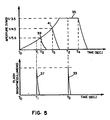
- either a full flash exposure or a no flash exposure will automatically be selected in accordance with only the level of ambient light intensity, and either a fill flash exposure or a no flash exposure will automatically be selected in accordance with both the level of ambient light intensity and the camera-to-subject distance. This is illustrated in schematic fashion in FIG. 4.
- the three exposure interval curves 35, 39, and 41 assume a film speed of ASA 100. With other film speeds, the curves of course would be somewhat different as to aperture and/or as to the closing times T4, T3, and T5. Also, the flash output spikes 33 and 37 for full flash and fill flash might be somewhat different as to the times T2 and T1.
- the exposure interval curves 35, 39, and 41 are limited to three in number. However, it will be appreciated that this number can be increased. Also, the control system can be made more sophisticated simply by increasing the number of light level zones in the look-up table memory 15.
Landscapes
- Physics & Mathematics (AREA)
- General Physics & Mathematics (AREA)
- Exposure Control For Cameras (AREA)
- Stroboscope Apparatuses (AREA)
Claims (4)
- Kunstlichtsteuerungssystem (1) zum Steuern der Einschaltung eines elektronischen Blitzgeräts (3) für die Dauer einer fotografischen Belichtung in einer Kamera, mit einer Helligkeits-Detektoreinrichtung (5), die einen Meßwert für das Helligkeitsniveau des Umgebungslichts liefert, einer Blitzauslösereinrichtung (31), die das elektronische Biltzgerät für den Betrieb in einem Aufhellblitzmodus so aktiviert, daß eine Belichtung mit einem Aufhellblitz erfolgt, und einer Abstands-Detektoreinrichtung (25), die einen Meßwert für den Abstand zwischen Kamera und Aufnahmegegenstand liefert, dadurch gekennzeichnet, daß
eine Komparatoreinrichtung (9, 15) vorgesehen ist, die feststellt, ob der von der Helligkeits-Detektoreinrichtung (5) gelieferte Meßwert auf oder über oder unter dem damit in Beziehung stehenden Helligkeitsniveau für den Aufhellblitzmodus liegt, und ermittelt, ob der von der Abstands-Detektoreinrichtung (25) gelieferte Meßwert für den Abstand zwischen Kamera und Aufnahmegegenstand ebenso groß ist wie ein maximaler Abstand für eine Aufhellbelichtung oder kleiner oder größer ist als dieser Abstand,
eine Steuereinrichtung (9, 17) nach Maßgabe der Komparatoreinrichtung (9, 15) die Blitzauslösereinrichtung (31) für den Betrieb im Aufhellblitzmodus betätigt, wenn der Meßwert für das Helligkeitsniveau des Umgebungslichts auf oder über dem damit in Beziehung stehenden Helligkeitsniveau für den Aufhellblitzmodus liegt und der Meßwert für den Abstand zwischen Kamera und Aufnahmegegenstand kleiner ist als der maximale Abstand oder diesem entspricht, und die Steuereinrichtung verhindert, daß die Blitzauslösereinrichtung (31) im Aufhellblitzmodus arbeitet, wenn der Meßwert für das Helligkeitsniveau des Umgebungslichts auf oder über dem damit in Beziehung stehenden Helligkeitsniveau für den Aufhellblitzmodus liegt und dabei der Meßwert für den Abstand zwischen Kamera und Aufnahmegegenstand den maximalen Abstand übersteigt, und
die Steuereinrichtung (9, 17) so angeordnet ist, daß sie für eine Aufnahme bei Tageslicht immer dann automatisch einen Betriebsmodus ohne Blitzauslösung auswählt, wenn das Helligkeitsniveau des Umgebungslichts höher ist als das damit in Beziehung stehende Helligkeitsniveau für den Vollblitzmodus und niedriger als das damit in Beziehung stehende Helligkeitsniveau für den Aufhellblitzmodus, ganz gleich, welcher Abstand zwischen Kamera und Aufnahmegegenstand ermittelt wurde, und wenn das Helligkeitsniveau des Umgebungslichts dem damit in Beziehung stehenden Helligkeitsniveau für den Vollblitzmodus entspricht oder dieses übersteigt und dabei der Abstand zwischen Kamera und Aufnahmegegenstand größer ist als der maximale Abstand, bis zu dem die Blitzauslösereinrichtung für den Aufhellblitzmodus betätigbar ist. - Steuerungssystem (1) nach Anspruch 1, dadurch gekennzeichnet, daß das Helligkeitsniveau für den Aufhellblitzmodus einer Umgebungshelligkeit entspricht, bei der mindestens bestimmte Bereiche des Aufnahmegegenstands im wesentlichen im Schatten liegen, und daß der maximale Abstand einem Abstand zwischen Kamera und Aufnahmegegenstand entspricht, der so gering ist, daß mit dem Aufhellblitz Schattenbereiche des Aufnahmegegenstandes bei einer Aufhellblitzbelichtung aufhellbar sind.
- Steuerungssystem (1) nach Anspruch 1 oder 2, dadurch gekennzeichnet, daß das Helligkeitsniveau für den Aufhellblitzmodus einer Umgebungshelligkeit entspricht, wie sie bei hellem Sonnenschein vorhanden ist, und daß die Umgebungshelligkeit bei 500 f.-lambert (1 713 cd/m²) und der maximale Abstand, bei dem der Aufhellblitzmodus wirksam ist, unter oder bei 11,5 ft (3,5 m) liegt.
- Steuerungssystem (1) nach Anspruch 3, dadurch gekennzeichnet, daß ein Vollblitzmodus für eine Vollblitzbelichtung wahlbar ist und daß die Steuerungseinrichtung (9, 17) ohne Berücksichtigung des Abstands zwischen Kamera und Aufnahmegegenstand den Vollblitzmodus automatisch dann wählt, wenn das Helligkeitsniveau des Umgebungslichts unter dem damit in Beziehung stehenden Helligkeitsniveau für den Vollblitzmodus liegt, wobei dieser auf eine Umgebungshelligkeit eingestellt ist, die so gering ist, daß eine Vollblitzbelichtung angezeigt erscheint.
Applications Claiming Priority (2)
| Application Number | Priority Date | Filing Date | Title |
|---|---|---|---|
| US143418 | 1988-01-13 | ||
| US07/143,418 US4801964A (en) | 1988-01-13 | 1988-01-13 | Fill flash control system for cameras |
Publications (3)
| Publication Number | Publication Date |
|---|---|
| EP0324422A2 EP0324422A2 (de) | 1989-07-19 |
| EP0324422A3 EP0324422A3 (en) | 1989-08-09 |
| EP0324422B1 true EP0324422B1 (de) | 1993-11-10 |
Family
ID=22503979
Family Applications (1)
| Application Number | Title | Priority Date | Filing Date |
|---|---|---|---|
| EP89100311A Expired - Lifetime EP0324422B1 (de) | 1988-01-13 | 1989-01-10 | Regelsystem für Kameras mit Tageslichtblitzgerät |
Country Status (5)
| Country | Link |
|---|---|
| US (1) | US4801964A (de) |
| EP (1) | EP0324422B1 (de) |
| JP (1) | JPH01207729A (de) |
| DE (1) | DE68910537T2 (de) |
| HK (1) | HK50894A (de) |
Families Citing this family (18)
| Publication number | Priority date | Publication date | Assignee | Title |
|---|---|---|---|---|
| JP2505640Y2 (ja) * | 1987-08-24 | 1996-07-31 | 株式会社リコー | カメラシステム |
| US5697002A (en) * | 1988-03-16 | 1997-12-09 | Nikon Corporation | Control device for preventing red-eye effect on camera |
| US4941009A (en) * | 1988-07-07 | 1990-07-10 | Konica Corporation | Method for slow synchro-flash photography |
| US5130739A (en) * | 1990-08-23 | 1992-07-14 | Eastman Kodak Company | Automatic optimization of photographic exposure parameters through determination and utilization of extra system speed |
| US5121155A (en) * | 1990-08-23 | 1992-06-09 | Eastman Kodak Company | Technique for determining whether to use fill flash illumination to capture an image of a current scene |
| US5049916A (en) * | 1990-08-23 | 1991-09-17 | Eastman Kodak Company | Automatic optimization of photographic exposure parameters through determination and utilization of extra system speed |
| US5124740A (en) * | 1990-08-23 | 1992-06-23 | Eastman Kodak Company | Depth number based technique for selecting lens aperture size and flash parameters for a full flash exposure |
| US5099268A (en) * | 1990-08-23 | 1992-03-24 | Eastman Kodak Company | Technique for selecting lens aperture size for a fill flash exposure |
| US5124741A (en) * | 1990-08-23 | 1992-06-23 | Eastman Kodak Company | Technique for prioritized selection of shelter speed and lens aperture settings |
| JPH04270327A (ja) * | 1991-02-26 | 1992-09-25 | Fuji Photo Optical Co Ltd | カメラの露出補正装置 |
| US6029015A (en) * | 1994-10-20 | 2000-02-22 | Fuji Photo Optical Co., Ltd. | Camera with built-in electronic flash |
| US6108496A (en) * | 1998-04-24 | 2000-08-22 | Asahi Kogaku Kogyo Kabushiki Kaisha | Exposure control system for camera |
| JP2000047297A (ja) * | 1998-07-28 | 2000-02-18 | Minolta Co Ltd | デジタルスチルカメラ |
| US7978260B2 (en) * | 2003-09-15 | 2011-07-12 | Senshin Capital, Llc | Electronic camera and method with fill flash function |
| TWI244575B (en) * | 2004-10-18 | 2005-12-01 | Avermedia Tech Inc | Document camera with light compensation functionality |
| JP2007264196A (ja) * | 2006-03-28 | 2007-10-11 | Fujifilm Corp | ストロボ制御装置及び方法 |
| US10701277B2 (en) * | 2017-05-31 | 2020-06-30 | Fotonation Limited | Automatic exposure module for an image acquisition system |
| CN109375358B (zh) * | 2018-11-28 | 2020-07-24 | 南京理工大学 | 一种基于最优照明模式设计下的差分相衬定量相位显微成像方法 |
Citations (2)
| Publication number | Priority date | Publication date | Assignee | Title |
|---|---|---|---|---|
| US4331400A (en) * | 1980-08-11 | 1982-05-25 | Eastman Kodak Company | Electronic strobe flash apparatus for automatic fill-in and full-flash |
| US4501481A (en) * | 1981-12-04 | 1985-02-26 | Canon Kabushiki Kaisha | Flash photographing system |
Family Cites Families (13)
| Publication number | Priority date | Publication date | Assignee | Title |
|---|---|---|---|---|
| US31034A (en) * | 1861-01-01 | Wrench | ||
| US4174161A (en) * | 1969-11-06 | 1979-11-13 | Canon Kabushiki Kaisha | Exposure control system |
| US4063257A (en) * | 1969-11-06 | 1977-12-13 | Canon Kabushiki Kaisha | Exposure control system |
| JPS557569B2 (de) * | 1972-02-16 | 1980-02-26 | ||
| JPS5529408B2 (de) * | 1972-03-15 | 1980-08-04 | ||
| JPS5454029A (en) * | 1977-10-06 | 1979-04-27 | Canon Inc | Light varying strobo camera of program type |
| US4159870A (en) * | 1978-02-21 | 1979-07-03 | Eastman Kodak Company | Exposure control apparatus including general purpose lag compensation |
| USRE31034E (en) | 1978-04-21 | 1982-09-21 | Polaroid Corporation | Range synchronized flash photographic apparatus and method for achieving optimum flash exposure |
| US4188103A (en) * | 1978-04-21 | 1980-02-12 | Polaroid Corporation | Range synchronized flash photographic apparatus and method for achieving optimum flash exposure |
| US4354751A (en) * | 1980-03-18 | 1982-10-19 | Minolta Camera Kabushiki Kaisha | Exposure system for a camera |
| US4373792A (en) * | 1980-04-25 | 1983-02-15 | Nippon Kogaku K.K. | Flashlight photographing device |
| US4375322A (en) * | 1981-05-11 | 1983-03-01 | Polaroid Corporation | Full range variable proportional fill flash system |
| US4444478A (en) * | 1982-11-16 | 1984-04-24 | Polaroid Corporation | Hybrid camera arrangement |
-
1988
- 1988-01-13 US US07/143,418 patent/US4801964A/en not_active Expired - Lifetime
-
1989
- 1989-01-10 EP EP89100311A patent/EP0324422B1/de not_active Expired - Lifetime
- 1989-01-10 DE DE68910537T patent/DE68910537T2/de not_active Expired - Fee Related
- 1989-01-13 JP JP897583A patent/JPH01207729A/ja active Pending
-
1994
- 1994-05-19 HK HK50894A patent/HK50894A/xx unknown
Patent Citations (2)
| Publication number | Priority date | Publication date | Assignee | Title |
|---|---|---|---|---|
| US4331400A (en) * | 1980-08-11 | 1982-05-25 | Eastman Kodak Company | Electronic strobe flash apparatus for automatic fill-in and full-flash |
| US4501481A (en) * | 1981-12-04 | 1985-02-26 | Canon Kabushiki Kaisha | Flash photographing system |
Also Published As
| Publication number | Publication date |
|---|---|
| JPH01207729A (ja) | 1989-08-21 |
| EP0324422A3 (en) | 1989-08-09 |
| EP0324422A2 (de) | 1989-07-19 |
| DE68910537T2 (de) | 1994-05-26 |
| US4801964A (en) | 1989-01-31 |
| HK50894A (en) | 1994-05-27 |
| DE68910537D1 (de) | 1993-12-16 |
Similar Documents
| Publication | Publication Date | Title |
|---|---|---|
| EP0324422B1 (de) | Regelsystem für Kameras mit Tageslichtblitzgerät | |
| US4933702A (en) | Camera with night photography apparatus | |
| US4772910A (en) | Full/fill flash control system for cameras | |
| US4812872A (en) | Smart flash control system for cameras | |
| US4429969A (en) | Exposure control device of camera for flash exposure | |
| EP0326815B1 (de) | Kontrollsystem für eine Elektronenblitzanordnung | |
| US4317622A (en) | Exposure control apparatus for flash photography | |
| JPH08328069A (ja) | ストロボ内蔵カメラ | |
| US4464039A (en) | Charge completion detecting device for flash photography system | |
| US5231446A (en) | Red-eye preventing device | |
| JP2794575B2 (ja) | 赤目防止制御装置 | |
| JPH0324654B2 (de) | ||
| JP2569444B2 (ja) | 赤目防止制御装置 | |
| US6343189B1 (en) | Controller for controlling a built-in flash of a camera | |
| US5124739A (en) | Real time pseudofocus exposure control system | |
| US6347189B1 (en) | Flash controller of a camera | |
| US4445763A (en) | Hybrid camera arrangement | |
| US6597866B2 (en) | Camera for taking a picture in a good focus condition | |
| JP2839002B2 (ja) | カメラ | |
| JP2882347B2 (ja) | カメラ | |
| JPH0712980Y2 (ja) | 赤目防止制御装置 | |
| JP2855574B2 (ja) | 赤目緩和機能付カメラ | |
| JP2756343B2 (ja) | カメラ及びカメラに適用される制御装置 | |
| JPH08166621A (ja) | カメラ | |
| JP3122446B2 (ja) | ストロボ制御装置 |
Legal Events
| Date | Code | Title | Description |
|---|---|---|---|
| PUAI | Public reference made under article 153(3) epc to a published international application that has entered the european phase |
Free format text: ORIGINAL CODE: 0009012 |
|
| PUAL | Search report despatched |
Free format text: ORIGINAL CODE: 0009013 |
|
| AK | Designated contracting states |
Kind code of ref document: A2 Designated state(s): DE FR GB |
|
| RHK1 | Main classification (correction) |
Ipc: G03B 7/16 |
|
| AK | Designated contracting states |
Kind code of ref document: A3 Designated state(s): DE FR GB |
|
| 17P | Request for examination filed |
Effective date: 19900110 |
|
| 17Q | First examination report despatched |
Effective date: 19920423 |
|
| GRAA | (expected) grant |
Free format text: ORIGINAL CODE: 0009210 |
|
| AK | Designated contracting states |
Kind code of ref document: B1 Designated state(s): DE FR GB |
|
| REF | Corresponds to: |
Ref document number: 68910537 Country of ref document: DE Date of ref document: 19931216 |
|
| ET | Fr: translation filed | ||
| PLBE | No opposition filed within time limit |
Free format text: ORIGINAL CODE: 0009261 |
|
| STAA | Information on the status of an ep patent application or granted ep patent |
Free format text: STATUS: NO OPPOSITION FILED WITHIN TIME LIMIT |
|
| 26N | No opposition filed | ||
| PGFP | Annual fee paid to national office [announced via postgrant information from national office to epo] |
Ref country code: GB Payment date: 19941221 Year of fee payment: 7 |
|
| PGFP | Annual fee paid to national office [announced via postgrant information from national office to epo] |
Ref country code: FR Payment date: 19950117 Year of fee payment: 7 |
|
| PGFP | Annual fee paid to national office [announced via postgrant information from national office to epo] |
Ref country code: DE Payment date: 19950203 Year of fee payment: 7 |
|
| PG25 | Lapsed in a contracting state [announced via postgrant information from national office to epo] |
Ref country code: GB Effective date: 19960110 |
|
| GBPC | Gb: european patent ceased through non-payment of renewal fee |
Effective date: 19960110 |
|
| PG25 | Lapsed in a contracting state [announced via postgrant information from national office to epo] |
Ref country code: FR Effective date: 19960930 |
|
| PG25 | Lapsed in a contracting state [announced via postgrant information from national office to epo] |
Ref country code: DE Effective date: 19961001 |
|
| REG | Reference to a national code |
Ref country code: FR Ref legal event code: ST |