EP0324862A1 - Wiederaufbereitungsanlage für kernbrennstoff - Google Patents
Wiederaufbereitungsanlage für kernbrennstoff Download PDFInfo
- Publication number
- EP0324862A1 EP0324862A1 EP88906085A EP88906085A EP0324862A1 EP 0324862 A1 EP0324862 A1 EP 0324862A1 EP 88906085 A EP88906085 A EP 88906085A EP 88906085 A EP88906085 A EP 88906085A EP 0324862 A1 EP0324862 A1 EP 0324862A1
- Authority
- EP
- European Patent Office
- Prior art keywords
- nitric acid
- acid solution
- nuclear fuel
- metal ions
- waste liquor
- Prior art date
- Legal status (The legal status is an assumption and is not a legal conclusion. Google has not performed a legal analysis and makes no representation as to the accuracy of the status listed.)
- Granted
Links
Images



Classifications
-
- G—PHYSICS
- G21—NUCLEAR PHYSICS; NUCLEAR ENGINEERING
- G21C—NUCLEAR REACTORS
- G21C19/00—Arrangements for treating, for handling, or for facilitating the handling of, fuel or other materials which are used within the reactor, e.g. within its pressure vessel
- G21C19/42—Reprocessing of irradiated fuel
- G21C19/44—Reprocessing of irradiated fuel of irradiated solid fuel
- G21C19/46—Aqueous processes, e.g. by using organic extraction means, including the regeneration of these means
-
- Y—GENERAL TAGGING OF NEW TECHNOLOGICAL DEVELOPMENTS; GENERAL TAGGING OF CROSS-SECTIONAL TECHNOLOGIES SPANNING OVER SEVERAL SECTIONS OF THE IPC; TECHNICAL SUBJECTS COVERED BY FORMER USPC CROSS-REFERENCE ART COLLECTIONS [XRACs] AND DIGESTS
- Y02—TECHNOLOGIES OR APPLICATIONS FOR MITIGATION OR ADAPTATION AGAINST CLIMATE CHANGE
- Y02E—REDUCTION OF GREENHOUSE GAS [GHG] EMISSIONS, RELATED TO ENERGY GENERATION, TRANSMISSION OR DISTRIBUTION
- Y02E30/00—Energy generation of nuclear origin
- Y02E30/30—Nuclear fission reactors
-
- Y—GENERAL TAGGING OF NEW TECHNOLOGICAL DEVELOPMENTS; GENERAL TAGGING OF CROSS-SECTIONAL TECHNOLOGIES SPANNING OVER SEVERAL SECTIONS OF THE IPC; TECHNICAL SUBJECTS COVERED BY FORMER USPC CROSS-REFERENCE ART COLLECTIONS [XRACs] AND DIGESTS
- Y02—TECHNOLOGIES OR APPLICATIONS FOR MITIGATION OR ADAPTATION AGAINST CLIMATE CHANGE
- Y02W—CLIMATE CHANGE MITIGATION TECHNOLOGIES RELATED TO WASTEWATER TREATMENT OR WASTE MANAGEMENT
- Y02W30/00—Technologies for solid waste management
- Y02W30/50—Reuse, recycling or recovery technologies
-
- Y—GENERAL TAGGING OF NEW TECHNOLOGICAL DEVELOPMENTS; GENERAL TAGGING OF CROSS-SECTIONAL TECHNOLOGIES SPANNING OVER SEVERAL SECTIONS OF THE IPC; TECHNICAL SUBJECTS COVERED BY FORMER USPC CROSS-REFERENCE ART COLLECTIONS [XRACs] AND DIGESTS
- Y10—TECHNICAL SUBJECTS COVERED BY FORMER USPC
- Y10S—TECHNICAL SUBJECTS COVERED BY FORMER USPC CROSS-REFERENCE ART COLLECTIONS [XRACs] AND DIGESTS
- Y10S422/00—Chemical apparatus and process disinfecting, deodorizing, preserving, or sterilizing
- Y10S422/903—Radioactive material apparatus
Definitions
- This invention relates to a nuclear fuel reprocessing plant and its processing method effective for restricting corrosion of apparatuses in a nuclear fuel reprocessing process.
- Reprocessing of a used nuclear fuel is made to recover and purify uranium and plutonium that can be used once again as a nuclear fuel and to remove and discard other radioactive substances. It is a wet process referred to as a "Purex process" that has been most commonly employed as the reprocessing method at present.
- This method comprises primarily a dissolving step of dissolving the used nuclear fuel in nitric acid, a co-decontamination step of separating uranium and plutonium from other radioactive substances by solvent extraction from this nitric acid solution, a distribution step of separating uranium and plutonium thus extracted, and a purification step of purifying uranium and plutonium, respectively.
- stainless steel has a protective oxide film on the surface in a system consisting of nitric acid alone and is under the passive state but if any chemical seed having high oxidation force such as Cr (VI) ion is contained therein, the oxidation force of the nitric acid solution is remarkably enhanced. Accordingly, when the surface potential of the stainless steel becomes remarkably high and reaches a certain specific potential beyond the passive state potential, the metal dissolves as a high valency ion and there occurs a phenomenon that promotes vigorously corrosion, that is, so-called "over-passive state corrosion".
- the nuclear fission products might exist in the nitric acid solution at all of these steps, though the concentration might change, and the Ru ion of the platinum group and the Ce ion of the rare earth element that can operate as the chemical seed having high oxidation force are contained.
- Cr and Fe ions as the corrosion products from the stainless steel itself might exist in nitric acid.
- these ions are likely to assume a high oxidation state at positions where the nitric acid concentration is high or the temperature of the nitric acid solution is high and they can exist as Ru(VIII), Ce (IV), Cr(VI) and Fe (III). Accordingly, it can be said that ordinary stainless steel is highly likely to cause the over-passive state corrosion.
- Japanese Patent Laid-Open No. 46380/1985 discloses a method which blows a NOx gas into a nitric acid solution as a method of preventing corrosion by the nitric acid solution in a nitric acid production plant, a nitric acid oxidation apparatus, a reprocessing plant of radioisotopes, and the like.
- the method of blowing the NOx gas cannot easily control the reducing reaction and involves the possibility that the metal ions as the radioactive nuclei are precipitated as the metals. If such ions are precipitated as the metals or if a precious metal such as platinum is precipitated, corrosion of the materials of the apparatuses might be accelerated remarkably by galvanic corrosion so that processing apparatuses for such ions are necessary.
- U.S. Patent No. 3,891,741 proposes a method which causes the precipitation on the cathode surface by electrolytic reduction to recover nuclear fission products such as Ru but since this method is the method of precipitating the metals, it is not free from possible galvanic corrosion.
- the present invention restricts the corrosion promotion action of nuclear fission products or corrosion generating substances that exist unavoidably in the nitric acid solution in a nuclear fuel reprocessing plant, and adjusts the surface potential of stainless steel always to a potential in a passive state region.
- the present invention is based on the concept that the surface potential of stainless steel is raised remarkably and corrosion is promoted when Ru or Ce as the nuclear fission product or Cr or Fe of the corrosion product of the stainless steel itself is under the high oxidizing state in the nitric acid solution, in conjunction with the corrosion of the stainless steel in a reprocessing environment having used nuclear fuels dissolved by the nitric acid solution.
- the present invention effects electrolytic reduction to electrically reduce the ionic valence of metal ions such as Ru(VIII), Ce(IV), Cr(VI) or Fe(III) ion contained in the nitric acid solution while keeping them in the state of the metal ions and while preventing these radioactive oxidizing metal ions as the metals and thus to reduce these ions to ions having lower ionic valence and at the same time, the present invention generates NOx by electrolytic reduction to provide a reducing atmosphere and to prevent the Ru(III or II), Ce(III), Cr(III) or Fe(II) having the lower ionic valence from having a high oxidation number and eventually, the rise of the surface potential of the stainless steel. In this manner, the present invention finds out that corrosiveness of the nitric acid solution can be reduced drastically.
- metal ions such as Ru(VIII), Ce(IV), Cr(VI) or Fe(III)
- the present invention provides a nuclear fuel reprocessing plant which comprises a cathode electrode disposed in the nitric acid solution containing oxidizing metal ions consisting of the nuclear fuel dissolved in the nitric acid solution; an anode electrode disposed in the nitric acid solution consisting substantially of the nitric acid solution described above; a membrane for separating the nitric acid solution containing the oxidizing metal ions from the nitric acid solution consisting substantially of the nitric acid solution while connecting them electrically; and electrolytic reduction means for applying a constant potential or a constant current between the cathode electrode and the anode electrode for reducing the valence of the metal ions while keeping them under the state of the metal ions, in such a manner as not to permit the precipitation of the metal ions as the metals.
- the present invention is suitable for processing the used nuclear fuel by vacuum boiling of the nitric acid solution containing oxidizing metal ions consisting of the nuclear fuel dissolved in the nitric
- the nuclear fuel reprocessing plant in accordance with the present invention comprises a fuel dissolution tank for dissolving a used nuclear fuel in a nitric acid solution; a waste liquor evaporating tank for concentrating a waste liquor after uranium and plutonium are separated from the nitric acid solution dissolving therein the nuclear fuel; an acid recovery evaporating tank for removing further the waste liquor from the nitric acid solution separated from the waste liquor evaporating tank; an acid recovery rectifier for purifying the nitric acid solution to obtain nitric acid to be used again for the main process; and a waste liquor storage tank for storing therein a radioactive waste liquor of a high or medium level; and the apparatus of the invention provides electrolytic reduction means for reducing the valence of the oxidizing metal ions consisting of the nuclear fuel dissolved in the nitric acid solution while keeping them in the ionic state to at least one of the constituents described above. Furthermore, the present invention provides vacuum boiling means for a ni
- the present invention can prevent over-passive state corrosion of the stainless steel due to the oxidizing metal ions in the reprocessing nitric acid solution, the present invention can prevent the troubles of the fuel dissolution tank, the waste liquor evaporating tank, the waste liquor concentration tank, the waste liquor storage tank, the nitric acid recovery evaporating tank and the nitric acid recovery rectifier, that are likely to be placed under the particularly severe corrosive environment, due to corrosion, can therefore stabilize the operation of the nuclear fuel reprocessing plant and can improve its reliability.
- the gist of the present invention resides also in a processing method of a nuclear fuel reprocessing plant for processing a used nuclear fuel by a nitric acid solution, which method is characterized in that the valence of oxidizing metal ions consisting of the nuclear fuel dissolved in the nitric acid solution is reduced while keeping them under the ionic state and without permitting their precipitation as the metals to such an extent as to generate a NOx gas.
- the present invention is also characterized in that the oxidizing metal ions consisting of the nuclear fuel dissolved in the nitric acid solution are electrolytically reduced at a potential lower than an oxidation-reduction potential of the metal ions without permitting the precipitation of these metal ions as the metals.
- the present invention relates also to a corrosion-proofing method of equipment by a nitric acid solution characterized in that the oxidizing metal ions are electrolytically reduced to such an extent as not to permit their precipitation as the metals in the same way as described above.
- the present invention can be applied to corrosion proofing of a nitric acid production plant by ammonia oxidation, a nitric acid oxidation apparatus of organic compounds, an apparatus for recovering metals from scraps of semiconductor materials, and a surface cleaning apparatus of stainless steel.
- the present invention is effective for processing which employs vacuum boiling of the nitric acid solution.
- the present invention adjusts an external power source so that a cathode electrode potential can be kept within the range of the reduction potential of the ions in the nitric acid solution or the current necessary for reducing the ions can be supplied, and these ions are reduced on the surface of the cathode electrode and their ionic valence is reduced.
- This reaction can be expressed by the following formulas (1) to (5): Ru(VIII) + 5e ⁇ Ru(III) (1) Ru(VIII) + 6e ⁇ Ru(II) (2) Ce(IV) + e ⁇ Ce(III) (3) Cr(VI) + 3e ⁇ Cr(III) (4) Fe(III) + e ⁇ Fe(II) (5) Accordingly, when the electrolysis is carried out, the potential of the working electrode is set to be lower than the oxidation-reduction potential of the reaction expressed by the formulas (1) to (5) .
- the electrolytic apparatus for the electrolytic reduction of the nitric acid solution consists of a cathode electrode, an anode electrode, a reference electrode and a potential controller.
- the cathode electrode or the anode electrode is preferably an inert electrode and examples of the inert electrode include precious metal electrodes such as Pt, Au and Pt-coating Ti electrodes and a carbon electrode.
- Examples of the reference electrode include an Ag/AgCl electrode, a Hg/Hg2Cl2 electrode, or the like.
- a potentiostat is an example of the potential controller.
- the following two methods may be employed as the definite method of electrolytic reduction of the nitric acid solution.
- the first method measures the concentration of the Ru(VIII), Ce(IV), Cr(VI) and Fe(III) ions in the nitric acid solution and supplies the current necessary for reducing them to Ru(III or II), Ce(III) and Cr(III).
- quantitative analysis including the valence of the chemical seeds such as Ru(VIII) and Ce(IV) is difficult in many cases. Therefore, the second method measures the surface potential of the stainless steel as the object of corrosion and conducts electrolytic reduction.
- the invention determines in advance the passive state regions of the stainless steel in pure nitric acid having various concentrations and at various temperatures through the measurement of polarization curves or the like, monitors the surface potential of the stainless steel in the nitric acid solution, starts electrolytic reduction when the nitric acid solution exceeds the passive state potential when it is assumed to be pure nitric acid, and stops electrolytic reduction when the nitric acid solution returns to the passive state region.
- the present invention is effective for a dissolution tank, a waste liquor evaporating tank, a waste liquor concentration tank and a waste liquor storage tank that handle large quantities of a high temperature nitric acid solution containing nuclear fission products, or a nitric acid recovery evaporating tank and a nitric acid recovery rectifier in which nuclear fission products are most likely to exist unavoidably and which handle a nitric acid solution having a medium to high concentration and at a medium to high temperature.
- the present invention places the cathode electrode and the reference electrode into the nitric acid solution inside the main body of the apparatus handling nitric acid or inside a side chamber bypassed from the main body, places the anode electrode in the side chamber equipped with a membrane through a bypass from the main body in such a manner as to communicate electrically with the nitric acid solution inside the main body and conducts electrolytic reduction of the nitric acid solution inside the main body by use of the external potential controller.
- the cathode electrode and the reference electrode into the nitric acid solution inside the main body of the apparatus handling nitric acid or inside a side chamber bypassed from the main body, places the anode electrode in the side chamber equipped with a membrane through a bypass from the main body in such a manner as to communicate electrically with the nitric acid solution inside the main body and conducts electrolytic reduction of the nitric acid solution inside the main body by use of the external potential controller.
- the surface potential of the stainless steel in the nitric acid solution is monitored by putting into the nitric acid solution a monitor electrode made of the same stainless material as that of the apparatus or using it as the apparatus main body minitor electrode so that when the surface potential exceeds the passive state potential under that environment, the external potential controller is operated to start electrolytic reduction of the nitric acid solution and when the surface potential of the minitor electrode returns to the passive state potential, the electrolytic reduction is terminated. In this manner, the electrolytic reduction can be made economically.
- Fig. 1 shows the outline of the construction of the electrolytic reduction apparatus for practising the present invention.
- a nitric acid solution 12 containing oxidizing metal ions is supplied to a cathode electrolytic cell 5 from a nuclear fuel reprocessing equipment 8 through a liquid supply port 10.
- the cathode electrolytic cell 5 is separated from an anode electrolytic cell 6 by a membrane 7, and a cathode electrode 2 and a reference electrode 4 are disposed in the cathode cell 5.
- a non-consumable anode electrode 3 is disposed in the anode electrolytic cell 6.
- Electrolysis of a nitric acid solution 12 to be processed is carried out by adjusting the current value with the anode electrode 3 by the potential controller 1 so that the electrode potential of the cathode electrode 2 relative to the reference electrode 4 reaches a set value.
- the set value of the reference potential is selected to such a value that the oxidizing metal ions do not substantially precipitate on the cathode electrode 2.
- Valence of the metal ions is reduced while they are kept under the ionic state and corrosion of various apparatuses by the nitric acid solution is prevented.
- the treated liquor after electrolytic reduction is returned again to the reprocessing equipment 8 through a discharge port 11. Thus processing can be made continuously while circulating the treating solution.
- the materials of the cathode electrode 2 and anode electrode 3 must be non-consumable, corrosion-resistant and highly electrically conductive.
- the electrodes are metal electrodes such as a Pt electrode, a Pt-coating Ti electrode, an Au electrode and Pd electrode, and carbon electrode besides the metal electrodes.
- Ag/AgCl electrode or Hg/Hg2Cl2 electrode can be used for the reference electrode 4, a ceramic electrode is more preferred to glass electrode from the aspect of resistance to radioactivity.
- the anode cell 6 is filled with pure nitric acid 13 and the membrane 7 is such that the inflow of the metal ions into the anode cell 6 can be prevented.
- a potential monitor electrode 9 is disposed in the reprocessing equipment 8 so as to monitor its surface potential.
- the potential controller 1 When the surface potential exceeds the set value, the potential controller 1 operates and electrolysis is carried out. In this manner, corrosion-proofing can be made efficiently for the reprocessing equipment 8. It is most optimal to use the same material as that of the reprocessing equipment for the monitor electrode 9. Moreover, the reprocessing equipment 9 itself may be used as the cathode cell.
- corrosion of the reprocessing equipment can be prevented without using any additives from outside. Furthermore, since the oxidizing metal ions of the used nuclear fuel by nitric acid are not precipitated as the metals, there can be obtained a great effect that corrosion-proofing can be made without any maintenance. It is difficult to handle the oxidizing metal ions because they have radioactivity. Hence, the present invention provides the great effect in that corrosion-proofing can be made without permitting the precipitation of these ions as the metals.
- Corrosion tests were carried out for 100 hours for austenite stainless steels having chemical compositions shown in Table 1 in various nitric acid solutions simulating a used nuclear fuel reprocessing process.
- the corrosion rate was measured in pure nitric acid having a concentration of from 2 to 14 mol/l and at a temperature from 40°C to a boiling point.
- at least one of Ru(VIII), Ce(IV) and Cr(VI) was added in a concentration range of 0 to 0.5 mol/l to pure nitric acid under the respective condition and the corrosion rate was measured.
- the corrosion rate was measured while each the nitric acid solution containing these oxidizing metal ions was subjected to electrolytic reduction.
- the corrosion rate As to the corrosion rate, the change with time at every 25 hours was measured and the absolute value of the corrosion rate under the condition corresponding to each of the case of the nitric acid solution to which the oxidizing metal ions were added and to the case where the nitric acid solution containing the oxidizing metal ions was electrolytically reduced, by use of the value of the corrosion rate at the passage of 100 hours after each testpiece was dipped into pure nitric acid, as the reference. The result is shown in Fig. 2.
- Fig. 2 shows the corrosion rates of each testpiece shown in Table 1 in pure nitric acid of 9 mol/l at boiling temperature (110°C), in a nitric acid solution prepared by adding 0.001 mol/l of Ru(VIII), Ce(IV) and Cr(VI), respectively, to this pure nitric acid and in a nitric acid solution obtained by electrolytically reducing this nitric acid solution containing Ru(VIII), etc.
- the potential of the cathode electrode in this nitric acid solution was controlled from 0.55 V to 0.23 V (with reference to the Ag/AgCl electrode).
- the potential of the cathode electrode was set to 0.30 V (with reference to the Ag/AgCl electrode).
- the range (B) does that in the nitric acid solution to which Ru(VIII) and the like was added in the amounts described above and the range (C) does that in the case where the nitric acid solution containing Ru(VIII) and the like was electrolytically reduced while the cathode electrode potential was set to 0.30 V (with reference to Ag/AgCl electrode).
- Electrolytic reduction in this embodiment was carried out while the metal ions was kept under the ionic state and did not precipitate as the respective metals.
- the corrosion rate (the range (B)) by nitric acid containing the oxidizing metal ions such as Ru(VIII) is by about 100 times greater than the corrosion rate (the range (A)) in pure nitric acid and it can thus be understook that the presence of the oxidizing metal ions greatly increases the corrosion rate.
- the corrosion rate (C) in the nitric acid solution which is electrolytically reduced in accordance with the present invention drops drastically down to about 1/100 times and the invention provides a great corrosion-proofing effect.
- any metals do not precipitate on the cathode electrode due to the reduction of the oxidizing metal ions and since reduction is effected by the generation of NOx, the reducing effect becomes further greater. It is therefore believed that the corrosion quantity can be reduced as described above.
- the electrolytic reduction apparatus must be controlled to a potential at which the oxidizing metal ions do not precipitate, but this potential is set to a suitable value because it varies with the kinds of metals, the concentration of nitric acid, its temperature, and so forth.
- electrolytic reduction was carried out by use of the electrolytic reduction apparatus shown in Fig. 1 in the same way as in Embodiment 1 while the reprocessing equipment 8 was boiled at a reduced pressure and the potential was being controlled by monitoring through a potential monitor, in order to prevent the oxidizing metal ions from precipitating on the cathode electrode 2.
- an evacuation apparatus was disposed inside the space of the reprocessing equipment 8 at its portion where the nitric acid solution did not exist, and a heater was further disposed to heat the nitric acid solution.
- Fig. 3 is a system block diagram of the nuclear fuel reprocessing plant in accordance with the present invention and Fig. 4 is a structural view consisting of various apparatuses. The used nuclear fuel is processed through the steps shown in the block diagram.
- the used nuclear fuel was put into a reservoir (not shown) stored for a considerable period of time and processed after radioactivity in the fuel had attenuated.
- the fuel was cut into small pieces, only the oxide fuel was dissolved in the dissolution tank at the dissolving step and the coating pipe was removed as the solid waste. Dissolution was carried out in boiling nitric acid. The fuel solution was then sent to the co-decontamination step, where uranium and plutonium were separated from the solution.
- This separation was effected by extraction with an organic solvent and uranium and plutonium shifted into the organic phase while the nuclear fission products remained in the aqueous phase.
- This aqueous phase was sent to a high radioactive waste liquor processing step.
- the high radioactive waste liquor after the separation of uranium and plutonium was sent to a waste liquor evaporating tank 15 for concentration.
- the waste liquor was further removed from the nitric acid solution separated from the evaporating tank 15 and sent to the evaporating tank 16 for recovering nitric acid.
- This nitric acid solution was sent to the acid recovery rectifier 17 for purifying nitric acid to be used again, and nitric acid thus recovered was used again.
- the residue after recovery of the nitric acid solution was stored in a waste liquor tank for storing radioactive waste liquors of medium and high levels.
- Reference numeral 18 represents a high level waste liquor storage tank.
- Each of the fuel dissolution tank 14, waste liquor evaporating tank 15, acid recovery evaporating tank 16, acid recovery rectifier 17 and waste liquor 18 contained the oxidizing metal ions of the nuclear fission products and corrosion was promoted therein. Accordingly, constant voltage or current control means or monitor means and the electrolytic reduction apparatus for electrolytically reducing these metal ions to ions of lower were provided to each of these apparatuses.
- the apparatus shown in Fig. 1 was used as the electrolytic reduction apparatus. Since each of these apparatuses was a container made of austenite system stainless steel for storing the nitric acid solution, the cathode electrode for reducing the metal ions was disposed in the nitric acid solution.
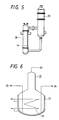
- Fig. 5 shows the structure of the acid recovery evaporating tank 16.
- a large number of heat transfer pipes 19 for heating nitric acid are disposed in the tank 16 and a gas-water separator 20 is disposed therein, too.
- Fig. 6 shows the structure of the waste liquor evaporating tank 15. There are disposed a heating coil 21 using the inflowing heating medium, an external heating jacket 22, a nitric acid solution inlet 23, its outlet 24 and a gas outlet 25.
- Fig. 7 shows the structure of the waste liquor tank 18, and a cooling pipe 26 for cooling by use of a refrigerant, a nitric acid solution inlet 27 and its outlet 28 are disposed in the tank.
- Fig. 8 shows the structure of the acid recovery rectifier 17, and a rack 29, a heating unit 30, a nitric acid solution inlet 31, a gas outlet 32, a concentrated liquor outlet 33, a reflux outlet 34, a heating medium inlet 35 and a heating medium outlet 36 are disposed therein.
- the electrolytic reduction apparatus is disposed for each of these apparatuses.
- the nitric acid solution is communicated between the electrolytic reduction apparatus and each of these apparatuses through the pipe.
- evacuation means are provided to the waste liquor evaporating tank 15 and the acid recovery rectifier 17 as shown in Fig. 4 and the solution can be boiled in vacuo and the reprocessing plant with less corrosion can be accomplished.
- the present invention makes it possible to prevent corrosion of the nuclear fuel reprocessing equipment without allowing the precipitation of the oxidizing metal ions. Therefore, corrosion-proofing of the reprocessing equipment can be made without the need of specific processing of the waste as the radioactive substances. Since the stop of operation due to corrosion can be prevented in advance, the operation factor of the reprocessing plant can be improved.
Landscapes
- Physics & Mathematics (AREA)
- Engineering & Computer Science (AREA)
- Plasma & Fusion (AREA)
- General Engineering & Computer Science (AREA)
- High Energy & Nuclear Physics (AREA)
- Preventing Corrosion Or Incrustation Of Metals (AREA)
- Separation Using Semi-Permeable Membranes (AREA)
Applications Claiming Priority (3)
| Application Number | Priority Date | Filing Date | Title |
|---|---|---|---|
| JP187560/87 | 1987-07-29 | ||
| JP18756087A JPS6432197A (en) | 1987-07-29 | 1987-07-29 | Plant for retreatment of nuclear fuel |
| PCT/JP1988/000694 WO1989001224A1 (fr) | 1987-07-29 | 1988-07-13 | Installation de retraitement de combustible nucleaire |
Publications (3)
| Publication Number | Publication Date |
|---|---|
| EP0324862A1 true EP0324862A1 (de) | 1989-07-26 |
| EP0324862A4 EP0324862A4 (de) | 1990-05-14 |
| EP0324862B1 EP0324862B1 (de) | 1994-11-09 |
Family
ID=16208219
Family Applications (1)
| Application Number | Title | Priority Date | Filing Date |
|---|---|---|---|
| EP19880906085 Expired - Lifetime EP0324862B1 (de) | 1987-07-29 | 1988-07-13 | Wiederaufbereitungsanlage für kernbrennstoff |
Country Status (5)
| Country | Link |
|---|---|
| US (1) | US5190623A (de) |
| EP (1) | EP0324862B1 (de) |
| JP (1) | JPS6432197A (de) |
| DE (1) | DE3852095T2 (de) |
| WO (1) | WO1989001224A1 (de) |
Cited By (3)
| Publication number | Priority date | Publication date | Assignee | Title |
|---|---|---|---|---|
| FR2773176A1 (fr) * | 1997-12-29 | 1999-07-02 | Commissariat Energie Atomique | Procede et dispositif pour l'oxydation d'un ou de plusieurs actinides stabilises sous forme reduite par un ou plusieurs agents anti-nitreux, en solution nitrique concentree |
| GB2343899A (en) * | 1998-11-19 | 2000-05-24 | Toshiba Kk | Electrolytic treatment of nuclear waste |
| FR2964493A1 (fr) * | 2010-09-07 | 2012-03-09 | Soletanche Freyssinet | Procede de traitement d'une solution radioactive |
Families Citing this family (9)
| Publication number | Priority date | Publication date | Assignee | Title |
|---|---|---|---|---|
| JPH06180392A (ja) * | 1992-12-15 | 1994-06-28 | Power Reactor & Nuclear Fuel Dev Corp | 高レベル放射性廃液からルテニウムを分離回収する方法 |
| US5435942A (en) * | 1994-02-28 | 1995-07-25 | United States Department Of Energy | Process for treating alkaline wastes for vitrification |
| FR2738165B1 (fr) * | 1995-09-06 | 1997-11-28 | Cogema | Procede et dispositif de dissolution d'un melange d'oxydes d'uranium et de plutonium |
| JP3549865B2 (ja) * | 2001-11-28 | 2004-08-04 | 核燃料サイクル開発機構 | 使用済核燃料中の希少元素fpの分離回収方法およびこれを利用した原子力発電−燃料電池発電共生システム |
| JP5132476B2 (ja) * | 2008-08-12 | 2013-01-30 | 株式会社東芝 | 使用済核燃料の再処理方法および遠心抽出装置 |
| US9896738B2 (en) | 2015-05-28 | 2018-02-20 | Savannah River Nuclear Solutions, Llc | Process for dissolving aluminum for recovering nuclear fuel |
| US9799415B2 (en) | 2015-05-28 | 2017-10-24 | Savannah River Nuclear Solutions, Llc | Method for controlling aluminum dissolution |
| JP7362439B2 (ja) * | 2019-11-14 | 2023-10-17 | 株式会社東芝 | 電解抽出装置および電解抽出方法 |
| CN112201375B (zh) * | 2020-10-21 | 2022-02-11 | 中国核动力研究设计院 | 核反应堆探测器组件拆除用主轴平移卷绕机构和使用方法 |
Family Cites Families (19)
| Publication number | Priority date | Publication date | Assignee | Title |
|---|---|---|---|---|
| FR1373712A (fr) * | 1963-07-22 | 1964-10-02 | Commissariat Energie Atomique | Appareil de dissolution de matériaux nucléaires |
| GB1096592A (en) * | 1965-01-22 | 1967-12-29 | Atomic Energy Authority Uk | Electrolytic reduction for solutions containing nuclear fuel material |
| US3616275A (en) * | 1969-04-14 | 1971-10-26 | Allied Chem | Process for concentrating a metal of variable valence in aqueous solution |
| US3770612A (en) * | 1970-08-24 | 1973-11-06 | Allied Chem | Apparatus for electrolytic oxidation or reduction, concentration, and separation of elements in solution |
| DE2146262C3 (de) * | 1971-09-16 | 1981-05-21 | Deutsche Gesellschaft für Wiederaufarbeitung von Kernbrennstoffen mbH, 3000 Hannover | Vorrichtung zur Reduktion von Salzlösungen von Verbindungen kernphysikalisch spaltbarer Elemente |
| JPS5326168B2 (de) * | 1973-04-04 | 1978-07-31 | ||
| US3948735A (en) * | 1973-06-01 | 1976-04-06 | The United States Of America As Represented By The United States Energy Research And Development Administration | Concentration and purification of plutonium or thorium |
| DE2449588C2 (de) * | 1974-10-18 | 1985-03-28 | Kernforschungszentrum Karlsruhe Gmbh, 7500 Karlsruhe | Verfahren zur Zersetzung einer wäßrigen, radioaktiven Abfallösung mit gelösten, anorganischen und organischen Inhaltsstoffen |
| US4111831A (en) * | 1976-06-03 | 1978-09-05 | Exxon Nuclear Company, Inc. | Inhibiting corrosion of stainless steel by ruthenium-containing nitric acid solution |
| DE2711368A1 (de) * | 1977-03-16 | 1978-09-21 | Hoechst Ag | Verfahren zum zurueckhalten von fluechtigen radioaktiven substanzen, die bei der aufarbeitung von kernbrennstoffen anfallen |
| DE2901067C2 (de) * | 1979-01-12 | 1983-10-27 | Reaktor-Brennelement Union Gmbh, 6450 Hanau | Verfahren zur Aufarbeitung von radioaktiven Filtraten und Einrichtung zur Durchführung dieses Verfahrens |
| US4277454A (en) * | 1979-09-18 | 1981-07-07 | J. R. Simplot Company | Methods for the control of excessive corrosion in phosphoric acid circuits |
| DE3261996D1 (en) * | 1981-03-13 | 1985-03-07 | Atomic Energy Authority Uk | A method of dissolving nuclear material from a nuclear fuel cartridge, and apparatus therefor |
| US4686019A (en) * | 1982-03-11 | 1987-08-11 | Exxon Research And Engineering Company | Dissolution of PuO2 or NpO2 using electrolytically regenerated reagents |
| DE3345199A1 (de) * | 1983-12-14 | 1985-06-27 | Kernforschungszentrum Karlsruhe Gmbh, 7500 Karlsruhe | Verfahren zur reduktiven plutonium-rueckextraktion aus einer organischen wiederaufarbeitungsloesung in eine waessrige, salpetersaure loesung unter anwendung eines elektrolysestromes |
| FR2562914A1 (fr) * | 1984-04-16 | 1985-10-18 | Solvay | Procede pour inhiber la corrosion d'une masse metallique au contact d'un bain acide contenant un oxydant |
| JPS61122599A (ja) * | 1984-11-20 | 1986-06-10 | 住友化学工業株式会社 | 使用済核燃料の溶解方法 |
| WO1986007184A1 (fr) * | 1985-05-28 | 1986-12-04 | Jozef Hanulik | Moyen pour la decontamination de materiaux contamines metalliques ou renfermant du ciment, son procede de fabrication et son utilisation |
| JPH05165300A (ja) * | 1991-12-13 | 1993-07-02 | Citizen Watch Co Ltd | カラー画像記録方法 |
-
1987
- 1987-07-29 JP JP18756087A patent/JPS6432197A/ja active Granted
-
1988
- 1988-07-13 WO PCT/JP1988/000694 patent/WO1989001224A1/ja not_active Ceased
- 1988-07-13 DE DE3852095T patent/DE3852095T2/de not_active Expired - Fee Related
- 1988-07-13 US US07/335,661 patent/US5190623A/en not_active Expired - Fee Related
- 1988-07-13 EP EP19880906085 patent/EP0324862B1/de not_active Expired - Lifetime
Cited By (5)
| Publication number | Priority date | Publication date | Assignee | Title |
|---|---|---|---|---|
| FR2773176A1 (fr) * | 1997-12-29 | 1999-07-02 | Commissariat Energie Atomique | Procede et dispositif pour l'oxydation d'un ou de plusieurs actinides stabilises sous forme reduite par un ou plusieurs agents anti-nitreux, en solution nitrique concentree |
| WO1999034369A1 (fr) * | 1997-12-29 | 1999-07-08 | Commissariat A L'energie Atomique | Procede et dispositif pour l'oxydation d'un ou de plusieurs actinides stabilises sous forme reduite par un ou plusieurs agents anti-nitreux, en solution nitrique concentree |
| GB2343899A (en) * | 1998-11-19 | 2000-05-24 | Toshiba Kk | Electrolytic treatment of nuclear waste |
| GB2343899B (en) * | 1998-11-19 | 2001-05-16 | Toshiba Kk | Electrolytic treatment method of zirconium and apparatus therefor |
| FR2964493A1 (fr) * | 2010-09-07 | 2012-03-09 | Soletanche Freyssinet | Procede de traitement d'une solution radioactive |
Also Published As
| Publication number | Publication date |
|---|---|
| JPS6432197A (en) | 1989-02-02 |
| US5190623A (en) | 1993-03-02 |
| EP0324862B1 (de) | 1994-11-09 |
| WO1989001224A1 (fr) | 1989-02-09 |
| DE3852095D1 (de) | 1994-12-15 |
| EP0324862A4 (de) | 1990-05-14 |
| JPH0553238B2 (de) | 1993-08-09 |
| DE3852095T2 (de) | 1995-03-16 |
Similar Documents
| Publication | Publication Date | Title |
|---|---|---|
| US3891741A (en) | Recovery of fission products from acidic waste solutions thereof | |
| US4537666A (en) | Decontamination using electrolysis | |
| KR100566725B1 (ko) | 화학 오염 제거 방법 | |
| US3890244A (en) | Recovery of technetium from nuclear fuel wastes | |
| US4056482A (en) | Method for preparing aqueous, radioactive waste solutions from nuclear plants for solidification | |
| US5190623A (en) | Nuclear fuel reprocessing plant | |
| CN109478437B (zh) | 一种对核能发电工厂中的金属表面进行去污的方法 | |
| JPH0129439B2 (de) | ||
| JPS6331279B2 (de) | ||
| EP0032416B2 (de) | Verfahren zum Entfernen von Ablagerungen | |
| US5439562A (en) | Electrochemical decontamination of radioactive metals by alkaline processing | |
| JP2002323596A (ja) | 加圧水型原子炉及び付随する高温水環境での腐食、浸食及び応力腐食割れを低減する貴金属触媒 | |
| US4149702A (en) | Method and apparatus for recycling heat treating salts | |
| EP0859671B1 (de) | Verfahren zur dekontaminierung von komponenten eines kernkraftwerkes | |
| US6428679B1 (en) | Electrolytic method for the recovery and recycling of silver from a nitric acid solution | |
| WO1997017146A9 (en) | Method for decontamination of nuclear plant components | |
| US5633423A (en) | Consumable anode, electrodissolution process applied to the decontamination of slightly radioactive liquid effluents and apparatus for performing the process | |
| JP2652035B2 (ja) | 高腐食性液体中の防食方法 | |
| US3857763A (en) | Recovery of electrolytic deposits of rhodium | |
| Steele | Corrosion control in nuclear fuel reprocessing | |
| EP0348991B1 (de) | Verfahren zur Verdampfungsbehandlung einer Ruthenium enthaltenden Salpetersäurelösung | |
| US3024172A (en) | Electrolytic separation process and apparatus | |
| Slansky et al. | Review of Research and Development at the Idaho Chemical Processing Plant on the Electrolytic Dissolution of Nuclear Fuel | |
| JPS62172298A (ja) | 使用済原子燃料の再処理方法 | |
| GB2570700A (en) | Continuous processing of spent nuclear fuel |
Legal Events
| Date | Code | Title | Description |
|---|---|---|---|
| PUAI | Public reference made under article 153(3) epc to a published international application that has entered the european phase |
Free format text: ORIGINAL CODE: 0009012 |
|
| 17P | Request for examination filed |
Effective date: 19890419 |
|
| AK | Designated contracting states |
Kind code of ref document: A1 Designated state(s): DE FR GB |
|
| A4 | Supplementary search report drawn up and despatched |
Effective date: 19900514 |
|
| 17Q | First examination report despatched |
Effective date: 19930122 |
|
| GRAA | (expected) grant |
Free format text: ORIGINAL CODE: 0009210 |
|
| AK | Designated contracting states |
Kind code of ref document: B1 Designated state(s): DE FR GB |
|
| REF | Corresponds to: |
Ref document number: 3852095 Country of ref document: DE Date of ref document: 19941215 |
|
| ET | Fr: translation filed | ||
| PLBE | No opposition filed within time limit |
Free format text: ORIGINAL CODE: 0009261 |
|
| STAA | Information on the status of an ep patent application or granted ep patent |
Free format text: STATUS: NO OPPOSITION FILED WITHIN TIME LIMIT |
|
| 26N | No opposition filed | ||
| PGFP | Annual fee paid to national office [announced via postgrant information from national office to epo] |
Ref country code: GB Payment date: 19960703 Year of fee payment: 9 |
|
| PGFP | Annual fee paid to national office [announced via postgrant information from national office to epo] |
Ref country code: FR Payment date: 19960716 Year of fee payment: 9 |
|
| PGFP | Annual fee paid to national office [announced via postgrant information from national office to epo] |
Ref country code: DE Payment date: 19960926 Year of fee payment: 9 |
|
| PG25 | Lapsed in a contracting state [announced via postgrant information from national office to epo] |
Ref country code: GB Free format text: LAPSE BECAUSE OF NON-PAYMENT OF DUE FEES Effective date: 19970713 |
|
| GBPC | Gb: european patent ceased through non-payment of renewal fee |
Effective date: 19970713 |
|
| PG25 | Lapsed in a contracting state [announced via postgrant information from national office to epo] |
Ref country code: FR Free format text: LAPSE BECAUSE OF NON-PAYMENT OF DUE FEES Effective date: 19980331 |
|
| PG25 | Lapsed in a contracting state [announced via postgrant information from national office to epo] |
Ref country code: DE Free format text: LAPSE BECAUSE OF NON-PAYMENT OF DUE FEES Effective date: 19980401 |
|
| REG | Reference to a national code |
Ref country code: FR Ref legal event code: ST |