EP0325165A2 - Procédé de dépôt électrolytique sur une face d'un tissu - Google Patents
Procédé de dépôt électrolytique sur une face d'un tissu Download PDFInfo
- Publication number
- EP0325165A2 EP0325165A2 EP89100489A EP89100489A EP0325165A2 EP 0325165 A2 EP0325165 A2 EP 0325165A2 EP 89100489 A EP89100489 A EP 89100489A EP 89100489 A EP89100489 A EP 89100489A EP 0325165 A2 EP0325165 A2 EP 0325165A2
- Authority
- EP
- European Patent Office
- Prior art keywords
- fabric
- sheet
- fabric sheet
- backing
- fibers
- Prior art date
- Legal status (The legal status is an assumption and is not a legal conclusion. Google has not performed a legal analysis and makes no representation as to the accuracy of the status listed.)
- Withdrawn
Links
- 238000000034 method Methods 0.000 title claims abstract description 33
- 238000007747 plating Methods 0.000 title claims abstract description 14
- 239000002759 woven fabric Substances 0.000 title claims abstract description 8
- 239000004744 fabric Substances 0.000 claims abstract description 75
- 239000008151 electrolyte solution Substances 0.000 claims abstract description 19
- 239000002131 composite material Substances 0.000 claims abstract description 9
- 150000001455 metallic ions Chemical class 0.000 claims abstract description 9
- 239000000835 fiber Substances 0.000 claims description 35
- 239000000243 solution Substances 0.000 claims description 16
- 230000002093 peripheral effect Effects 0.000 claims description 12
- OKTJSMMVPCPJKN-UHFFFAOYSA-N Carbon Chemical compound [C] OKTJSMMVPCPJKN-UHFFFAOYSA-N 0.000 claims description 8
- 229910002804 graphite Inorganic materials 0.000 claims description 8
- 239000010439 graphite Substances 0.000 claims description 8
- 239000011248 coating agent Substances 0.000 claims description 7
- 238000000576 coating method Methods 0.000 claims description 7
- 239000004020 conductor Substances 0.000 claims description 6
- 230000008021 deposition Effects 0.000 claims description 3
- 239000004568 cement Substances 0.000 claims description 2
- 230000005684 electric field Effects 0.000 claims description 2
- 238000009736 wetting Methods 0.000 claims 3
- 229910021645 metal ion Inorganic materials 0.000 abstract description 3
- 239000000463 material Substances 0.000 abstract description 2
- 238000002791 soaking Methods 0.000 abstract description 2
- 239000002184 metal Substances 0.000 description 18
- 229910052751 metal Inorganic materials 0.000 description 18
- RYGMFSIKBFXOCR-UHFFFAOYSA-N Copper Chemical compound [Cu] RYGMFSIKBFXOCR-UHFFFAOYSA-N 0.000 description 5
- 229910052802 copper Inorganic materials 0.000 description 5
- 239000010949 copper Substances 0.000 description 5
- JPVYNHNXODAKFH-UHFFFAOYSA-N Cu2+ Chemical compound [Cu+2] JPVYNHNXODAKFH-UHFFFAOYSA-N 0.000 description 3
- 229910001431 copper ion Inorganic materials 0.000 description 3
- 238000010420 art technique Methods 0.000 description 2
- 238000000151 deposition Methods 0.000 description 2
- 239000003792 electrolyte Substances 0.000 description 2
- 229920004934 Dacron® Polymers 0.000 description 1
- 239000004593 Epoxy Substances 0.000 description 1
- QAOWNCQODCNURD-UHFFFAOYSA-L Sulfate Chemical compound [O-]S([O-])(=O)=O QAOWNCQODCNURD-UHFFFAOYSA-L 0.000 description 1
- 235000006650 Syzygium cordatum Nutrition 0.000 description 1
- 235000006651 Syzygium guineense Nutrition 0.000 description 1
- 240000005334 Syzygium guineense Species 0.000 description 1
- 239000000853 adhesive Substances 0.000 description 1
- 230000001070 adhesive effect Effects 0.000 description 1
- 238000005452 bending Methods 0.000 description 1
- 239000000872 buffer Substances 0.000 description 1
- JZCCFEFSEZPSOG-UHFFFAOYSA-L copper(II) sulfate pentahydrate Chemical compound O.O.O.O.O.[Cu+2].[O-]S([O-])(=O)=O JZCCFEFSEZPSOG-UHFFFAOYSA-L 0.000 description 1
- 230000032798 delamination Effects 0.000 description 1
- 239000003822 epoxy resin Substances 0.000 description 1
- 230000002349 favourable effect Effects 0.000 description 1
- 239000002657 fibrous material Substances 0.000 description 1
- 238000001465 metallisation Methods 0.000 description 1
- 239000003973 paint Substances 0.000 description 1
- 229920000647 polyepoxide Polymers 0.000 description 1
- 239000012260 resinous material Substances 0.000 description 1
- 238000005096 rolling process Methods 0.000 description 1
Images
Classifications
-
- C—CHEMISTRY; METALLURGY
- C25—ELECTROLYTIC OR ELECTROPHORETIC PROCESSES; APPARATUS THEREFOR
- C25D—PROCESSES FOR THE ELECTROLYTIC OR ELECTROPHORETIC PRODUCTION OF COATINGS; ELECTROFORMING; APPARATUS THEREFOR
- C25D5/00—Electroplating characterised by the process; Pretreatment or after-treatment of workpieces
- C25D5/02—Electroplating of selected surface areas
- C25D5/028—Electroplating of selected surface areas one side electroplating, e.g. substrate conveyed in a bath with inhibited background plating
-
- C—CHEMISTRY; METALLURGY
- C25—ELECTROLYTIC OR ELECTROPHORETIC PROCESSES; APPARATUS THEREFOR
- C25D—PROCESSES FOR THE ELECTROLYTIC OR ELECTROPHORETIC PRODUCTION OF COATINGS; ELECTROFORMING; APPARATUS THEREFOR
- C25D5/00—Electroplating characterised by the process; Pretreatment or after-treatment of workpieces
- C25D5/02—Electroplating of selected surface areas
- C25D5/022—Electroplating of selected surface areas using masking means
-
- C—CHEMISTRY; METALLURGY
- C25—ELECTROLYTIC OR ELECTROPHORETIC PROCESSES; APPARATUS THEREFOR
- C25D—PROCESSES FOR THE ELECTROLYTIC OR ELECTROPHORETIC PRODUCTION OF COATINGS; ELECTROFORMING; APPARATUS THEREFOR
- C25D5/00—Electroplating characterised by the process; Pretreatment or after-treatment of workpieces
- C25D5/54—Electroplating of non-metallic surfaces
Definitions
- the invention relates to methods and apparatus for plating fabric. More specifically, the invention relates to methods and apparatus for plating one side of woven fabric sheets.
- Modern composite aircraft typically utilize woven sheets of graphite fiber material or tape which are impregnated with a resinous material such as epoxy. These sheets are then bonded together so as to form a lightweight laminate having considerable structural strength.
- the uppermost layer of the laminate may be provided with a quantity of metal to prevent electrical discharges from traveling through deeper layers of the laminate and to dissipate the discharge throughout the surface of the aircraft skin.
- metal As is also known from U.S. Patent Application No. 000,926, titled "Metallic Conduction Method and System for Joined Sections of Composite Structures," different quantities of metal per unit area may be advantageously deposited in the uppermost layer of different areas of the aircraft to both maximize lightning protection and minimize the weight of the aircraft. For example, 200 grams per square meter of metal deposited in the outermost layer of an aircraft structure subject to a Zone One lightning strike is sufficient to prevent delamination of the aircraft skin. Furthermore, deposition of 100 grams per square meter of metal in an outermost layer of the aircraft subject to a Zone Two lightning strike is sufficient to protect that portion of the aircraft.
- each fiber of the outermost layer is coated with metal prior to being woven into a continuous sheet.
- This technique is particularly disadvantageous in that the coaxial metal sheath around each fiber has a substantially different modulus of elasticity than the fiber itself. Thus, when the aircraft is subject to bending moments, the metal sheath tends to shear away from the fiber. In addition, unnecessary excess weight is introduced into the fabric weave.
- a fabric sheet is then pressed against the rolling cathode, and the metal layer is transferred to the outside of the fabric sheet in a fashion similar to paint being deposited on a wall with a roller.
- This technique results in the entire side of the fabric being coated with metal, including the interstices between each fiber.
- a metallized fabric of this type would have a metallized layer which is much thicker than necessary for lightning protection.
- a metal content of approximately 100 grams per square meter is desired. This corresponds to a continuous copper sheet having a thickness of less than 25 M.
- the plating technique disclosed in Tainton would not be capable of consistently providing such a thin coating.
- interstices in the weave would be filled in, which would disadvantageously interfere with the flex characteristic of the underlying composite material.
- the present invention attempts to provide a method for plating one side of individual fibers in a fabric sheet with a conductive material.
- the present invention attempts to achieve the above object with an apparatus which can conveniently control the thickness of the metal deposition.
- the present invention attempts to achieve the foregoing objects and others by applying a removable backing to one side of a fabric sheet.
- the fabric sheet is then wetted on the other side with an electrolytic solution containing metallic ions to be deposited on the fabric sheet. Air bubbles trapped in the interstices of the fabric weave by the removable backing prevent the solution from soaking through the weave and limit the wetted surface to a lower peripheral surface of each fiber in the weave.
- electrodes apply an electrical field across the sheet which bonds the metallic ions to the lower peripheral surfaces of the fibers.
- the backing sheet is then removed.
- the result is a fabric sheet having a thin, metallic coating on only one side of the individual fibers in the weave.
- the interstices are not filled on. The sheet is thus low in weight and retains flexibility characteristics substantially similar to those of an unplated sheet.
- one of the electrodes is a conductive roller having a lower portion immersed in an electrolytic solution bath and an upper portion in contact with the lower peripheral surfaces of the fibers.
- a second electrode comprising a conductive brush, is positioned in contact with the fabric sheet. An electric potential is impressed between the electrodes to bond the metal ions to the fiber surfaces. The quantity of metal deposited is controlled by the ionic concentration of the solution, the voltage impressed across the electrodes, and the current flow between the electrodes.
- the fabric and backing sheets are preferably immersed in the electrolytic solution prior to introduction between the electrodes.
- the fabric and backing sheets are oriented so that air bubbles are trapped in the interstices within the weave.
- the fabric and backing sheets are also drawn under a weave opening roller in the solution, which opens up the weave to fully wet the lower peripheral surfaces of the fibers.
- the conductive roller which comprises the first electrode may also be covered with fabric to absorb the electrolytic solution from the bath to ensure a good conductive path from the roller to the fabric sheet.
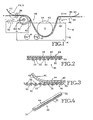
- a plating apparatus for use with the method of the present invention is generally indicated at reference numeral 10 in Figure 1.
- the apparatus includes a bath 12 of electrolytic solution 14.
- the solution contains copper and sulfate ions 16, 17 and various buffers. Other electrolytes having different metallic ions may be used as desired.
- the bath 12 is the source of copper ions 16 which are to be deposited onto one side of a woven, graphite fabric sheet 20, shown in Figures 1-3.
- the fabric sheet 20 consists of a plurality of individual fibers 22 which are interwoven as shown in Figures 2 and 3.
- the method of the invention preferably plates only a lower surface 30 (see Figure 4) of each fiber 22 with a thin coating of copper 32.
- the coating may be as thin as 25 M or less.
- the coated side of the fabric will then be positioned on the outside of an uppermost layer of a composite laminate to distribute electrical discharges along the outside of an aircraft's skin.
- the plating technique of the present invention preferably does not fill in interstices 34 between the individual fibers 22, as does the technique disclosed in U.S. Patent No. 2,042,030, issued to Tainton. Such "filling in” of the interstices would result in a fabric sheet having flex characteristics substantially different from those of an unplated sheet. Also, unnecessary weight would be introduced into the sheet.
- an adhesive backing sheet 40 is temporarily adhered to an upper side 44 of the fabric sheet which is not to be plated.
- the backing sheet may be ordinary paper adhered to the fabric sheet with a thin layer of rubber cement 45.
- the underside 46 of the fabric sheet 20 is positioned above the solution 14 so that upon introduction of the fabric and backing sheets into the solution, air bubbles are trapped in the interstices 34 of the fabric weave. In this way, only the lower peripheral surfaces 30 of the individual fibers 22 are wetted by the solution 14 containing the copper ions 16.
- the fabric 20 and backing 40 sheets are introduced into the bath 12 over an idler roller 50, which, in conjunction with an anode roller 52 (described in more detail below), causes tension in the fabric sheet as it is guided around the periphery of an expansion roller 54.
- the expansion roller is substantially immersed in electrolytic solution 14 and serves only to open the weave of the fabric sheet 20 so that the lower peripheral surfaces 30 of each individual fiber 22 are thoroughly wetted with the solution.
- Drive rollers 56 draw the sheets to the left, as shown in Figure 1, and provide the described tension in the sheet.
- the backing sheet 40 and lower peripheral surface 30 of the fibers 22 in the fabric sheet 20 are thoroughly wetted with solution.
- the fabric and backing sheets are then guided through the anode roller 52 and a conductive cathode brush 62 as shown.
- the anode roller has a portion in contact with the solution 14 and a portion in contact with the underside 46 of the fabric sheet 20.
- the anode roller is preferably made from a conductive material (such as graphite) which will not be consumed during the plating process.
- the anode roller 52 may be provided with a peripheral sheet of fabric 60, such as Dacron® felt, to ensure that the lower peripheral surfaces 30 of each fiber 22 are thoroughly wetted.
- the cathode brush 62 is positioned so as to be in contact with the wetted fabric sheet 40.
- a voltage is impressed between the anode roller 52 and cathode brush 62 by a battery 63 or other voltage source to positively charge the former and negatively charge the latter.
- the copper ions 16 present on the lower peripheral surfaces 30 of the individual fibers 22 are bonded thereto.
- the backing sheet 40 may then be removed, as shown in Figures 1 and 3.
- the resulting plated fabric sheet may then be utilized in the outermost layer of a composite laminate, as discussed above.
- the quantity of metal deposited onto the fabric sheet 20 is a function of the electrolytic solution 14 concentration, the voltage impressed by battery 63, and the effective surface area of the anode roller 52.
- the voltage applied by battery 63 is variable between 8 to 12 volts, resulting in current flow of between 20 to 70 amperes, depending on the solution concentration.
- a suitable electrolytic solution using copper sulfate pentahydrate as the electrolyte is available from Selectron Corp. (Vanguard Pacific), Waterberry, Connecticut, which provides an amp hour rating for the solution.
- the anode roller 52 and cathode brush 62 shown in Figure 1 have a length of approximately 24 inches, resulting in an effective anode contact area of 1 1 ⁇ 2 inches by 24 inches.
- the rating of the solution divided by the applied voltage multiplied by the current flow from anode to cathode, multiplied by the time of current application, will give the amount of copper deposited.
Landscapes
- Chemical & Material Sciences (AREA)
- Engineering & Computer Science (AREA)
- Chemical Kinetics & Catalysis (AREA)
- Electrochemistry (AREA)
- Materials Engineering (AREA)
- Metallurgy (AREA)
- Organic Chemistry (AREA)
- Electroplating Methods And Accessories (AREA)
- Chemical Or Physical Treatment Of Fibers (AREA)
- Chemically Coating (AREA)
Applications Claiming Priority (2)
| Application Number | Priority Date | Filing Date | Title |
|---|---|---|---|
| US07/146,418 US4892626A (en) | 1988-01-21 | 1988-01-21 | Method for plating one side of a woven fabric sheet |
| US146418 | 1988-01-21 |
Publications (2)
| Publication Number | Publication Date |
|---|---|
| EP0325165A2 true EP0325165A2 (fr) | 1989-07-26 |
| EP0325165A3 EP0325165A3 (fr) | 1990-07-04 |
Family
ID=22517269
Family Applications (1)
| Application Number | Title | Priority Date | Filing Date |
|---|---|---|---|
| EP89100489A Withdrawn EP0325165A3 (fr) | 1988-01-21 | 1989-01-12 | Procédé de dépôt électrolytique sur une face d'un tissu |
Country Status (3)
| Country | Link |
|---|---|
| US (1) | US4892626A (fr) |
| EP (1) | EP0325165A3 (fr) |
| JP (1) | JPH0284542A (fr) |
Families Citing this family (20)
| Publication number | Priority date | Publication date | Assignee | Title |
|---|---|---|---|---|
| US5089325A (en) * | 1988-01-21 | 1992-02-18 | The Boeing Company | Partially coated fabric sheet |
| US6048581A (en) | 1996-09-24 | 2000-04-11 | Mcdonnell Douglas Corporation | Elastic ground plane and method |
| US5777479A (en) * | 1996-10-29 | 1998-07-07 | Mcdonnell Douglas Corporation | Lighting test method and apparatus |
| US5804310A (en) * | 1996-12-18 | 1998-09-08 | Rasmussen; Glen L. | Patterned fibers |
| US6027074A (en) | 1997-02-27 | 2000-02-22 | Mcdonnell Douglas | Reinforced elastomer panel |
| US6092764A (en) * | 1997-07-21 | 2000-07-25 | Mcdonnell Douglas Corporation | Interface seal for an aircraft |
| US6089505A (en) | 1997-07-22 | 2000-07-18 | Mcdonnell Douglas Corporation | Mission adaptive inlet |
| US5853882A (en) * | 1997-08-26 | 1998-12-29 | Mcdonnell Douglas Corporation | Compositive prepreg ply having tailored electrical properties and method of fabrication thereof |
| US6209824B1 (en) * | 1997-09-17 | 2001-04-03 | The Boeing Company | Control surface for an aircraft |
| DE69916360T3 (de) | 1998-05-21 | 2008-06-05 | Mcdonnell Douglas Corp. | Flügelprofil |
| US6079667A (en) * | 1998-06-09 | 2000-06-27 | Mcdonnell Douglas Corporation | Auxiliary inlet for a jet engine |
| US6076766A (en) * | 1998-07-01 | 2000-06-20 | Mcdonnell Douglas Corp. | Folding wing for an aircraft |
| KR20010002179A (ko) * | 1999-06-11 | 2001-01-05 | 안정오 | 미세금속입자 함유 합성수지재와 섬유제법 |
| LU90640B1 (en) * | 2000-09-18 | 2002-05-23 | Circuit Foil Luxembourg Trading Sarl | Method for electroplating a strip of foam |
| JP2002180372A (ja) * | 2000-12-15 | 2002-06-26 | Toho Tenax Co Ltd | 金属酸化物被覆炭素繊維、及びその製造方法 |
| US6682619B2 (en) * | 2001-07-17 | 2004-01-27 | Sikorsky Aircraft Corporation | Composite pre-preg ply having tailored dielectrical properties and method of fabrication thereof |
| US20040166408A1 (en) * | 2003-02-20 | 2004-08-26 | The Boeing Company | Structurally integrated wire and associated fabrication method |
| US7281318B2 (en) * | 2004-05-19 | 2007-10-16 | The Boeing Company | Method of manufacturing a composite structural member having an integrated electrical circuit |
| US7018217B2 (en) * | 2004-05-19 | 2006-03-28 | The Boeing Company | Structurally integrable electrode and associated assembly and fabrication method |
| US8395093B1 (en) | 2010-04-06 | 2013-03-12 | Cornerstone Research Group, Inc. | Conductive elastomeric heater with expandable core |
Family Cites Families (17)
| Publication number | Priority date | Publication date | Assignee | Title |
|---|---|---|---|---|
| US2042030A (en) * | 1936-05-26 | Laminated article | ||
| US653887A (en) * | 1899-05-01 | 1900-07-17 | Metal Fabric Company | Metal-coated fibrous material. |
| US1243041A (en) * | 1916-07-08 | 1917-10-16 | Walter Gordon Clark | Covering material for aircraft and method of making said material. |
| US1819130A (en) * | 1926-04-19 | 1931-08-18 | Ernst Gideon Bek | Electroplating and electroplating apparatus |
| US1750831A (en) * | 1927-03-05 | 1930-03-18 | Cairns Dev Company | Art of making metal fabrics |
| US2538317A (en) * | 1945-12-28 | 1951-01-16 | Reynolds Metals Co | Treatment of aluminum sheets |
| US2783193A (en) * | 1952-09-17 | 1957-02-26 | Motorola Inc | Electroplating method |
| DE1640496A1 (de) * | 1966-12-22 | 1970-10-22 | Ibm Deutschland | Verfahren zur Herstellung von flexiblen elektrischen Bandleitern und flexiblen elektrischen Schaltungen auf galvanoplastischem Wege |
| GB1208959A (en) * | 1968-04-17 | 1970-10-14 | Rolls Royce | Electroplating electrically conductive fibres |
| GB1272777A (en) * | 1968-09-23 | 1972-05-03 | Int Research & Dev Co Ltd | Electro-plating of electrically-conducting fibres |
| JPS4926174B1 (fr) * | 1970-07-11 | 1974-07-06 | ||
| JPS5512112B2 (fr) * | 1973-02-23 | 1980-03-29 | ||
| FR2438692A1 (fr) * | 1978-10-12 | 1980-05-09 | Sumitomo Electric Industries | Procede de galvanoplastie pour la production continue de metal poreux sous forme de ruban |
| US4349859A (en) * | 1980-09-24 | 1982-09-14 | Mcdonnell Douglas Corporation | Shielded structural or containment member |
| US4429341A (en) * | 1981-05-06 | 1984-01-31 | The Boeing Company | Lightning protection for external surface composite material of an aircraft |
| DE3278383D1 (en) * | 1982-09-30 | 1988-05-26 | Boeing Co | Integral lightning protection system for composite aircraft skins |
| DE3301669A1 (de) * | 1983-01-20 | 1984-07-26 | Bayer Ag, 5090 Leverkusen | Blitzschutzverbundmaterial |
-
1988
- 1988-01-21 US US07/146,418 patent/US4892626A/en not_active Expired - Fee Related
-
1989
- 1989-01-12 EP EP89100489A patent/EP0325165A3/fr not_active Withdrawn
- 1989-01-20 JP JP1011768A patent/JPH0284542A/ja active Pending
Also Published As
| Publication number | Publication date |
|---|---|
| EP0325165A3 (fr) | 1990-07-04 |
| JPH0284542A (ja) | 1990-03-26 |
| US4892626A (en) | 1990-01-09 |
Similar Documents
| Publication | Publication Date | Title |
|---|---|---|
| US4892626A (en) | Method for plating one side of a woven fabric sheet | |
| US5089325A (en) | Partially coated fabric sheet | |
| US4522889A (en) | Lightning protection composite material | |
| US2540602A (en) | Method and apparatus for the surface treatment of metals | |
| US4468293A (en) | Electrochemical treatment of copper for improving its bond strength | |
| US4713149A (en) | Method and apparatus for electroplating objects | |
| US4515671A (en) | Electrochemical treatment of copper for improving its bond strength | |
| EP3232747A1 (fr) | Feuille de cuivre, feuille de cuivre pour circuit haute fréquence, feuille de cuivre fixée à un support, feuille de cuivre fixée à un support pour circuit haute fréquence, stratifié, procédé de fabrication de carte de circuit imprimé et procédé de fabrication d'un dispositif électronique | |
| EP0643432A1 (fr) | Feuille poreuse métallique et méthode pour la fabrication | |
| JPS63241193A (ja) | 表面処理を施した銅箔の製造方法 | |
| US4176035A (en) | Installation for the production of a copper foil intended to be applied to a dielectric substrate | |
| US4349859A (en) | Shielded structural or containment member | |
| CN119332314A (zh) | 一种一体式载体铜箔生产设备及生产方法 | |
| US4113576A (en) | Method of making a thin-copper foil-carrier composite | |
| EP1570113B1 (fr) | Procede de production de metaux etires revetus et utilisation de ces metaux en tant que derivateurs de courant dans des composants electrochimiques | |
| US3691026A (en) | Process for a continuous selective electroplating of strip | |
| EP0149763A2 (fr) | Procédé et appareillage pour le revêtement électrolytique des fibres de carbone | |
| US3377202A (en) | Process for producing sintered nickel electrode plates | |
| US2927889A (en) | Apparatus for making magnetic tape | |
| JPS57198293A (en) | Surface treated steel plate with superior coatability | |
| KR100748791B1 (ko) | 수직 도금 장치 및 도금 방법 | |
| US4587166A (en) | Plated magnetic recording material and process for making same | |
| US4582573A (en) | Method for treating a single side of a metallic sheet | |
| JPH0321673B2 (fr) | ||
| CA2353965A1 (fr) | Procede pour produire une feuille metallique autoportante |
Legal Events
| Date | Code | Title | Description |
|---|---|---|---|
| PUAI | Public reference made under article 153(3) epc to a published international application that has entered the european phase |
Free format text: ORIGINAL CODE: 0009012 |
|
| AK | Designated contracting states |
Kind code of ref document: A2 Designated state(s): DE ES FR GB IT NL SE |
|
| PUAL | Search report despatched |
Free format text: ORIGINAL CODE: 0009013 |
|
| AK | Designated contracting states |
Kind code of ref document: A3 Designated state(s): DE ES FR GB IT NL SE |
|
| STAA | Information on the status of an ep patent application or granted ep patent |
Free format text: STATUS: THE APPLICATION IS DEEMED TO BE WITHDRAWN |
|
| 18D | Application deemed to be withdrawn |
Effective date: 19910105 |