EP0325218B1 - Cellule non-aqueux de metal actif, ameliorée - Google Patents
Cellule non-aqueux de metal actif, ameliorée Download PDFInfo
- Publication number
- EP0325218B1 EP0325218B1 EP89100769A EP89100769A EP0325218B1 EP 0325218 B1 EP0325218 B1 EP 0325218B1 EP 89100769 A EP89100769 A EP 89100769A EP 89100769 A EP89100769 A EP 89100769A EP 0325218 B1 EP0325218 B1 EP 0325218B1
- Authority
- EP
- European Patent Office
- Prior art keywords
- lithium
- active metal
- metal cell
- electrolyte
- cells
- Prior art date
- Legal status (The legal status is an assumption and is not a legal conclusion. Google has not performed a legal analysis and makes no representation as to the accuracy of the status listed.)
- Revoked
Links
- 229910052751 metal Inorganic materials 0.000 title claims description 15
- 239000002184 metal Substances 0.000 title claims description 15
- CURLTUGMZLYLDI-UHFFFAOYSA-N Carbon dioxide Chemical compound O=C=O CURLTUGMZLYLDI-UHFFFAOYSA-N 0.000 claims description 64
- 229910052744 lithium Inorganic materials 0.000 claims description 48
- WHXSMMKQMYFTQS-UHFFFAOYSA-N Lithium Chemical compound [Li] WHXSMMKQMYFTQS-UHFFFAOYSA-N 0.000 claims description 45
- TZIHFWKZFHZASV-UHFFFAOYSA-N methyl formate Chemical group COC=O TZIHFWKZFHZASV-UHFFFAOYSA-N 0.000 claims description 34
- 239000000243 solution Substances 0.000 claims description 33
- 229910002092 carbon dioxide Inorganic materials 0.000 claims description 32
- 239000001569 carbon dioxide Substances 0.000 claims description 30
- 239000008151 electrolyte solution Substances 0.000 claims description 18
- 229910001540 lithium hexafluoroarsenate(V) Inorganic materials 0.000 claims description 15
- 229910001496 lithium tetrafluoroborate Inorganic materials 0.000 claims description 15
- 239000003792 electrolyte Substances 0.000 claims description 12
- 150000003839 salts Chemical class 0.000 claims description 6
- 239000002904 solvent Substances 0.000 claims description 4
- 229910052783 alkali metal Inorganic materials 0.000 claims description 3
- 150000001340 alkali metals Chemical class 0.000 claims description 3
- 229910003002 lithium salt Inorganic materials 0.000 claims description 2
- 159000000002 lithium salts Chemical class 0.000 claims description 2
- 229920006395 saturated elastomer Polymers 0.000 claims description 2
- 150000002895 organic esters Chemical class 0.000 claims 2
- 230000001351 cycling effect Effects 0.000 description 17
- 229940021013 electrolyte solution Drugs 0.000 description 16
- 230000000694 effects Effects 0.000 description 5
- 150000002148 esters Chemical class 0.000 description 5
- 230000006872 improvement Effects 0.000 description 5
- 239000000654 additive Substances 0.000 description 3
- 230000000996 additive effect Effects 0.000 description 3
- 230000008901 benefit Effects 0.000 description 3
- 239000003960 organic solvent Substances 0.000 description 3
- 238000002161 passivation Methods 0.000 description 3
- 230000010287 polarization Effects 0.000 description 3
- RTZKZFJDLAIYFH-UHFFFAOYSA-N Diethyl ether Chemical compound CCOCC RTZKZFJDLAIYFH-UHFFFAOYSA-N 0.000 description 2
- RAHZWNYVWXNFOC-UHFFFAOYSA-N Sulphur dioxide Chemical compound O=S=O RAHZWNYVWXNFOC-UHFFFAOYSA-N 0.000 description 2
- 230000009286 beneficial effect Effects 0.000 description 2
- 239000006182 cathode active material Substances 0.000 description 2
- 239000010406 cathode material Substances 0.000 description 2
- -1 hexafluoroarsenate Chemical compound 0.000 description 2
- 239000007800 oxidant agent Substances 0.000 description 2
- 238000007747 plating Methods 0.000 description 2
- 230000001681 protective effect Effects 0.000 description 2
- 238000007086 side reaction Methods 0.000 description 2
- FYSNRJHAOHDILO-UHFFFAOYSA-N thionyl chloride Chemical compound ClS(Cl)=O FYSNRJHAOHDILO-UHFFFAOYSA-N 0.000 description 2
- JWUJQDFVADABEY-UHFFFAOYSA-N 2-methyltetrahydrofuran Chemical compound CC1CCCO1 JWUJQDFVADABEY-UHFFFAOYSA-N 0.000 description 1
- OKTJSMMVPCPJKN-UHFFFAOYSA-N Carbon Chemical compound [C] OKTJSMMVPCPJKN-UHFFFAOYSA-N 0.000 description 1
- 239000002000 Electrolyte additive Substances 0.000 description 1
- 230000004913 activation Effects 0.000 description 1
- 239000003125 aqueous solvent Substances 0.000 description 1
- 229910052799 carbon Inorganic materials 0.000 description 1
- 230000008859 change Effects 0.000 description 1
- 239000007795 chemical reaction product Substances 0.000 description 1
- 239000006184 cosolvent Substances 0.000 description 1
- 230000001627 detrimental effect Effects 0.000 description 1
- 238000004090 dissolution Methods 0.000 description 1
- 238000003487 electrochemical reaction Methods 0.000 description 1
- 230000002708 enhancing effect Effects 0.000 description 1
- 239000003759 ester based solvent Substances 0.000 description 1
- JBTWLSYIZRCDFO-UHFFFAOYSA-N ethyl methyl carbonate Chemical compound CCOC(=O)OC JBTWLSYIZRCDFO-UHFFFAOYSA-N 0.000 description 1
- 230000001747 exhibiting effect Effects 0.000 description 1
- 238000001125 extrusion Methods 0.000 description 1
- 238000004519 manufacturing process Methods 0.000 description 1
- 230000007246 mechanism Effects 0.000 description 1
- 238000000034 method Methods 0.000 description 1
- 239000011255 nonaqueous electrolyte Substances 0.000 description 1
- 230000001590 oxidative effect Effects 0.000 description 1
- 230000003071 parasitic effect Effects 0.000 description 1
- 239000002243 precursor Substances 0.000 description 1
- 230000009257 reactivity Effects 0.000 description 1
- 239000007787 solid Substances 0.000 description 1
- 239000000126 substance Substances 0.000 description 1
- YBBRCQOCSYXUOC-UHFFFAOYSA-N sulfuryl dichloride Chemical compound ClS(Cl)(=O)=O YBBRCQOCSYXUOC-UHFFFAOYSA-N 0.000 description 1
- 229910000314 transition metal oxide Inorganic materials 0.000 description 1
Images


Classifications
-
- H—ELECTRICITY
- H01—ELECTRIC ELEMENTS
- H01M—PROCESSES OR MEANS, e.g. BATTERIES, FOR THE DIRECT CONVERSION OF CHEMICAL ENERGY INTO ELECTRICAL ENERGY
- H01M10/00—Secondary cells; Manufacture thereof
- H01M10/05—Accumulators with non-aqueous electrolyte
-
- H—ELECTRICITY
- H01—ELECTRIC ELEMENTS
- H01M—PROCESSES OR MEANS, e.g. BATTERIES, FOR THE DIRECT CONVERSION OF CHEMICAL ENERGY INTO ELECTRICAL ENERGY
- H01M4/00—Electrodes
- H01M4/02—Electrodes composed of, or comprising, active material
- H01M4/13—Electrodes for accumulators with non-aqueous electrolyte, e.g. for lithium-accumulators; Processes of manufacture thereof
-
- H—ELECTRICITY
- H01—ELECTRIC ELEMENTS
- H01M—PROCESSES OR MEANS, e.g. BATTERIES, FOR THE DIRECT CONVERSION OF CHEMICAL ENERGY INTO ELECTRICAL ENERGY
- H01M4/00—Electrodes
- H01M4/02—Electrodes composed of, or comprising, active material
- H01M4/36—Selection of substances as active materials, active masses, active liquids
- H01M4/38—Selection of substances as active materials, active masses, active liquids of elements or alloys
-
- H—ELECTRICITY
- H01—ELECTRIC ELEMENTS
- H01M—PROCESSES OR MEANS, e.g. BATTERIES, FOR THE DIRECT CONVERSION OF CHEMICAL ENERGY INTO ELECTRICAL ENERGY
- H01M4/00—Electrodes
- H01M4/02—Electrodes composed of, or comprising, active material
- H01M2004/026—Electrodes composed of, or comprising, active material characterised by the polarity
- H01M2004/027—Negative electrodes
-
- H—ELECTRICITY
- H01—ELECTRIC ELEMENTS
- H01M—PROCESSES OR MEANS, e.g. BATTERIES, FOR THE DIRECT CONVERSION OF CHEMICAL ENERGY INTO ELECTRICAL ENERGY
- H01M2300/00—Electrolytes
- H01M2300/0017—Non-aqueous electrolytes
- H01M2300/0025—Organic electrolyte
-
- Y—GENERAL TAGGING OF NEW TECHNOLOGICAL DEVELOPMENTS; GENERAL TAGGING OF CROSS-SECTIONAL TECHNOLOGIES SPANNING OVER SEVERAL SECTIONS OF THE IPC; TECHNICAL SUBJECTS COVERED BY FORMER USPC CROSS-REFERENCE ART COLLECTIONS [XRACs] AND DIGESTS
- Y02—TECHNOLOGIES OR APPLICATIONS FOR MITIGATION OR ADAPTATION AGAINST CLIMATE CHANGE
- Y02E—REDUCTION OF GREENHOUSE GAS [GHG] EMISSIONS, RELATED TO ENERGY GENERATION, TRANSMISSION OR DISTRIBUTION
- Y02E60/00—Enabling technologies; Technologies with a potential or indirect contribution to GHG emissions mitigation
- Y02E60/10—Energy storage using batteries
Definitions
- the present invention relates to non-aqueous electrochemical cells and, more particularly, to improvements with respect to the recharging of secondary active metal cells including those utilizing anodes of lithium metal.
- the invention allows such cells to achieve suitable high recharging efficiencies without sacrifice of high cell capacity.
- non-aqueous active metal cells have enabled those skilled in the art to achieve much higher energy densities or energy to weight ratios than was heretofore known.
- the potential uses for such cells has created a great deal of interest, resulting in significant efforts to improve the safety and versatility of these cells.
- Pletcher refers on page 271 to different types of ambient-temperature lithium cells which have in common the dissolution of lithium as the negative electrode.
- One type of electrolyte is an aprotic organic solvent containing a lithium salt.
- the organic solvent could include methyl formate, while popular electrolytes are inter alia hexafluoroarsenate.
- a non-aqueous electrolyte battery wherein a protective film is formed on a lithium anode before the anode is incorporated in the battery.
- Lithium is formed into a ribbon-like shape in dry air by extrusion molding, sealed and stored in Ar, punched into disks in dry air, pressed and integrated with an anode current collector net, then left in a CO2 atmosphere before adding electrolyte in the battery fabrication.
- Such cells typically consist of a light, strongly reducing anode, normally an alkali metal such as lithium, an aprotic, non-aqueous solvent into which has been dissolved an appropriate quantity of a salt of the anode metal to form a conductive solution, and an oxidizing agent as the cathode material.
- the electrolyte solvent or co-solvent also acts as the active cathode material which is subsequently reduced at a porous carbon electrode.
- dual-function solvents include thionyl chloride, sulfuryl chloride, and sulfur dioxide.
- the main object of the present invention is to improve the efficiency of secondary cells while a further object is to improve the efficiency of primary cells.
- the present invention concerns significant improvements in secondary active metal, non-aqueous cells having organic-based electrolyte solutions, particularly solutions which employ ester solvents. It enables the two goals mentioned above to be reached.
- carbon dioxide has highly beneficial effects in enhancing desirable properties of such secondary cells.
- the carbon dioxide can be used in two ways, namely, to pretreat the lithium anode prior to exposure to the electroyte solution and as an electrolyte solution additive.
- the use of carbon dioxide as an electrolyte solution additive has been found to produce the greatest effect.
- the anode is lithium and the active cathode material is a transition metal oxide such as V2O5.
- the preferred electrolyte ester solvent is methyl formate (HCOOCH3).
- the electrolyte salt normally used is LiAsF6 and an amount of LiBF4 may also be present.
- Ester-based solutions can offer conductivities almost an order of magnitude greater than prior art solutions, thus allowing cells to operate efficiently over the entire temperature range from -40°C to +75°C.
- the CO2-doped electrolyte solutions of the present invention are used principally with respect to secondary or rechargeable cells. However, it has also been discovered that CO2 reduces anode polarization and appears to reduce passivation effects in methyl formate solutions, thus offering benefits for primary cell applications as well.
- the two most important factors concerning electrolyte solutions for secondary or rechargeable cells of the class described are (1) maintaining sufficiently high conductivities to allow cells to operate over a broad temperature range at moderate to high rates of discharge and (2) providing for efficient cycling of the lithium anode such that a sufficient number of recharging cycles are possible.
- FIGURE 1 illustrates the dramatic increase in specific conductivity that can be realized with ester-based electrolyte solutions, exemplified by the methyl formate solution, over current state-of-the-art solutions such as the 1.5M LiAsF6/2-methyl THF solution.
- This superiority of the ester-based solutions holds throughout the full military specification temperature range of -40°C to +75°C.
- the methyl formate solutions are better by almost an order of magnitude over most of this range.
- LiBF4 is normally used in methyl formate solutions to improve solution stability at elevated temperatures and is generally added at one fifth of the LiAsF6 concentration.
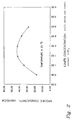
- FIGURES 2 and 3 show that the specific conductivity of the methyl formate solutions reach a maximum at a LiAsF6 concentration between 1.5 and 2M and that the added LiBF4 has very little effect on the specific conductivity.
- the data given in TABLE I further show that methyl formate solutions offer excellent conductivities over a wide range of solute concentrations. In fact, the value of 17.3 mMHO/cm yielded by a 0.5M LiAsF6 solution is even sufficient for most cell applications.
- the second key factor for any electrolyte solution considered for use in a rechargeable lithium cell is to provide for efficient cycling of the lithium anode.
- lithium cycling efficiencies of greater than 90% and preferably greater than 95% are required.
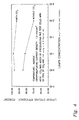
- Lithium cycling efficiency tests were conducted by stripping and plating lithium on a working lithium electrode at 1.0 mA/cm2. The charge passed during each half-cycle represented approximately a 20 percent depth of discharge, based on the starting capacity of the working lithium electrode. The tests were continued until the working lithium electrode was completely consumed.
- the measured lithium cycling efficiency for a 2M LiAsF6 + 0.4M LiBF4/MF solution was increased from 70% to 81% while no change in efficiency was observed for a 0.5M LiAsF6 + 0.1M LiBF4/MF solution.
- the highest lithium cycling efficiency obtained using this approach was 87 percent for a 1.0M LiAsF6 + 0.2M LiBF4/MF solution.
- CO2 acts as a precursor to form an ionically conductive, protective film on the surface to the lithium metal which prevents freshly deposited lithium from undergoing parasitic side reactions with the electrolyte solution. It is further proposed that CO2 could also be altering the morphology of the plated lithium, making it less dendritic in nature. In any event, however, the beneficial effects of CO2 appear unique to ester solutions, including methyl formate, and are not present in other typical lithium cell electroyte solutions investigated.
- This invention therefore, describes an improved ester-based solution that offers greatly enhanced lithium cycling efficiencies for use in long cycle life rechargeable cells. These improvements are achieved using CO2 as an electroyte additive and to pretreat the lithium anodes.
- the present invention brings to secondary lithium cells, it should be noted that the invention is also applicable to primary cells. This is because it has been discovered that CO2 reduces anode polarization in methyl formate solutions and appears to reduce passivation effects.
Landscapes
- Chemical & Material Sciences (AREA)
- Chemical Kinetics & Catalysis (AREA)
- Electrochemistry (AREA)
- General Chemical & Material Sciences (AREA)
- Engineering & Computer Science (AREA)
- Materials Engineering (AREA)
- Manufacturing & Machinery (AREA)
- Secondary Cells (AREA)
Claims (9)
- Elément de métal actif non aqueux comprenant une anode de métal alcalin, un ester organique comme solvant, et comme électrolyte, un sel du métal de l'anode soluble dans ce solvant, caractérisé en ce que la solution d'électrolyte est saturée de dioxyde de carbone.
- Elément de métal actif selon la revendication 1, caractérisé en ce que le métal alcalin est le lithium.
- Element de métal actif selon les revendications 1 ou 2, caractérisé en ce que l'ester organique est le formiate de méthyle.
- Elément de métal actif selon les revendications 2 ou 3, caractérisé en ce que le sel utilisé comme électrolyte est LiASF₆.
- Elément de métal actif selon les revendications 2, 3 ou 4, caractérisé en ce que la solution contient aussi LiBF₄.
- Elément de métal actif selon l'une des revendications précédentes, caractérisé en ce que cette anode est prétraitée par CO₂.
- Elément de métal actif selon l'une des revendications 4 à 6, caractérisé en ce que ce sel utilisé comme électrolyte est constitué d'une combinaison de LiASF₆ et LiBF₄.
- Elément de métal actif selon la revendication 7, caractérisé en ce que la composition du sel utilisé comme électrolyte satisfait à la relation:

dans laquelle: la valeur de X est comprise entre 0,25 et 4,0 et M est la molarité. - Elément de métal actif selon l'une des revendications précédentes, caractérisé en ce que cette solution d'électrolyte est une solution de formiate de méthyle contenant un sel de lithium et CO₂.
Applications Claiming Priority (2)
| Application Number | Priority Date | Filing Date | Title |
|---|---|---|---|
| US07/146,533 US4853304A (en) | 1988-01-21 | 1988-01-21 | Electrolyte for secondary non-aqueous cells |
| US146533 | 1993-11-02 |
Publications (2)
| Publication Number | Publication Date |
|---|---|
| EP0325218A1 EP0325218A1 (fr) | 1989-07-26 |
| EP0325218B1 true EP0325218B1 (fr) | 1993-08-25 |
Family
ID=22517818
Family Applications (1)
| Application Number | Title | Priority Date | Filing Date |
|---|---|---|---|
| EP89100769A Revoked EP0325218B1 (fr) | 1988-01-21 | 1989-01-18 | Cellule non-aqueux de metal actif, ameliorée |
Country Status (3)
| Country | Link |
|---|---|
| US (1) | US4853304A (fr) |
| EP (1) | EP0325218B1 (fr) |
| DE (1) | DE68908570T2 (fr) |
Families Citing this family (23)
| Publication number | Priority date | Publication date | Assignee | Title |
|---|---|---|---|---|
| US4960657A (en) * | 1988-03-01 | 1990-10-02 | Bridgestone Corporation | Lithium cells |
| US5147739A (en) * | 1990-08-01 | 1992-09-15 | Honeywell Inc. | High energy electrochemical cell having composite solid-state anode |
| US5284721A (en) * | 1990-08-01 | 1994-02-08 | Alliant Techsystems Inc. | High energy electrochemical cell employing solid-state anode |
| DE69215556T2 (de) * | 1991-03-15 | 1997-07-03 | Honda Motor Co Ltd | Kathodenmaterialien für eine Lithiumbatterie und Verfahren zu ihrer Herstellung |
| US5171648A (en) * | 1991-08-13 | 1992-12-15 | Alliant Techsystems Inc. | Snap-action current interruption diaphragm system for over-pressurized electrochemical cells |
| US5240790A (en) * | 1993-03-10 | 1993-08-31 | Alliant Techsystems Inc. | Lithium-based polymer electrolyte electrochemical cell |
| JP3425493B2 (ja) * | 1994-07-28 | 2003-07-14 | 日立マクセル株式会社 | 非水二次電池およびその製造方法 |
| US5753389A (en) * | 1995-03-17 | 1998-05-19 | Wilson Greatbatch Ltd. | Organic carbonate additives for nonaqueous electrolyte in alkali metal electrochemical cells |
| US5569558A (en) * | 1995-06-05 | 1996-10-29 | Wilson Greatbatch Ltd. | Reduced voltage delay additive for nonaqueous electrolyte in alkali metal electrochemical cell |
| US6663760B2 (en) * | 1996-12-06 | 2003-12-16 | Seiko Epson Corporation | Method of fabricating two-terminal nonlinear element using non-aqueous electrolyte |
| US6492064B1 (en) | 1998-06-04 | 2002-12-10 | California Institute Of Technology | Organic solvents, electrolytes, and lithium ion cells with good low temperature performance |
| US6759170B2 (en) | 1998-10-22 | 2004-07-06 | Wilson Greatbatch Technologies, Inc. | Organic carbonate additives for nonaqueous electrolyte rechargeable electrochemical cells |
| US6593029B2 (en) * | 2001-03-15 | 2003-07-15 | Wilson Greatbatch Ltd. | Manufacturing process for improved discharge of lithium-containing electrochemical cells |
| US6605385B2 (en) | 2001-03-22 | 2003-08-12 | Wilson Greatbatch Ltd. | Electrochemical cell having an electrode with a carbonate additive in the electrode active mixture |
| US6780542B2 (en) * | 2001-09-13 | 2004-08-24 | Wilson Greatbatch Ltd. | Lithium oxyhalide cell with improved safety and voltage delay characteristics |
| KR100765053B1 (ko) | 2003-06-09 | 2007-10-09 | 산요덴키가부시키가이샤 | 리튬 이차 전지 및 그의 제조 방법 |
| JP4610213B2 (ja) * | 2003-06-19 | 2011-01-12 | 三洋電機株式会社 | リチウム二次電池及びその製造方法 |
| JP2008226537A (ja) * | 2007-03-09 | 2008-09-25 | Sanyo Electric Co Ltd | 非水電解質二次電池及びその製造方法 |
| ES2663420T3 (es) * | 2011-12-01 | 2018-04-12 | Nanoscale Components, Inc. | Método para litificación de ánodos |
| US10128491B2 (en) | 2011-12-01 | 2018-11-13 | Nanoscale Components, Inc. | Method for alkaliating electrodes |
| EP3497738A4 (fr) * | 2016-08-12 | 2020-05-06 | Viking Power Systems Pte. Ltd. | Additif contenant des électrolytes pour des batteries d'anodes métalliques rechargeables à énergie élevée |
| CN110998916A (zh) | 2017-07-10 | 2020-04-10 | 那诺思卡乐康母庞特公司 | 用于在阳极上形成sei层的方法 |
| CN108808177B (zh) * | 2018-06-14 | 2020-11-13 | 北京理工大学 | 一种离子液体-超临界二氧化碳混合电解质、制备及电池 |
Family Cites Families (5)
| Publication number | Priority date | Publication date | Assignee | Title |
|---|---|---|---|---|
| US3544385A (en) * | 1968-11-04 | 1970-12-01 | Union Carbide Corp | Non-aqueous battery with methylene chloride in the electrolyte |
| GB1376423A (en) * | 1972-05-19 | 1974-12-04 | Mallory & Co Inc P R | Organic electrolyte cells with storage life |
| US3976509A (en) * | 1975-04-04 | 1976-08-24 | Lockheed Missiles & Space Company, Inc. | Electrolyte compositions |
| IL54408A (en) * | 1978-03-31 | 1981-09-13 | Yeda Res & Dev | Photosynthetic process for converting carbon dioxide to organic compounds |
| US4228227A (en) * | 1979-08-13 | 1980-10-14 | Honeywell Inc. | Rechargeable electrochemical cell |
-
1988
- 1988-01-21 US US07/146,533 patent/US4853304A/en not_active Expired - Fee Related
-
1989
- 1989-01-18 EP EP89100769A patent/EP0325218B1/fr not_active Revoked
- 1989-01-18 DE DE89100769T patent/DE68908570T2/de not_active Revoked
Non-Patent Citations (1)
| Title |
|---|
| Industrial Electrochemistry, D. Pletcher (Chapman and Hall) 1982, p.271 * |
Also Published As
| Publication number | Publication date |
|---|---|
| EP0325218A1 (fr) | 1989-07-26 |
| US4853304A (en) | 1989-08-01 |
| DE68908570D1 (de) | 1993-09-30 |
| DE68908570T2 (de) | 1994-02-03 |
Similar Documents
| Publication | Publication Date | Title |
|---|---|---|
| US4853304A (en) | Electrolyte for secondary non-aqueous cells | |
| Owen | Rechargeable lithium batteries | |
| US4668593A (en) | Solvated electron lithium electrode for high energy density battery | |
| EP1722430B1 (fr) | Batterie secondaire avec matière active d'électrode comprenant un composé radicalaire | |
| EP0357001B1 (fr) | Batterie secondaire à électrolyte organique | |
| EP3561915A1 (fr) | Anode métallique au lithium, son procédé de fabrication, et batterie secondaire au lithium comprenant la même anode | |
| US6228532B1 (en) | Lithium secondary cell | |
| US5589291A (en) | Stabilized rechargeable cell in MSE | |
| Tobishima et al. | Influence of electrolyte additives on safety and cycle life of rechargeable lithium cells | |
| EP0575191B1 (fr) | Solvant électrolytique non-aqueux et batterie contenant cet électrolyte | |
| US5496663A (en) | Lithium ion battery with lithium vanadium pentoxide positive electrode | |
| EP1815546B1 (fr) | Electrolyte pour accumulateurs lithium-soufre et accumulateurs lithium-soufre dans lesquels l'electrolyte est utilise | |
| CN109659613B (zh) | 一种锂电池低温电解液 | |
| US3844837A (en) | Nonaqueous battery | |
| CN114784381A (zh) | 一种电解液及其制备方法、锂离子电池 | |
| EP0548449B1 (fr) | Accumulateurs à électrolyte non-aqueux | |
| CN111276740A (zh) | 一种锂空气电池用或锂铜电池用电解液 | |
| Kaner et al. | Reversible electrochemical reduction of polyacetylene,(CH) x | |
| US20040191629A1 (en) | Positive electrode, non-aqueous electrolyte secondary battery, and method of manufacturing the same | |
| JP2000348721A (ja) | リチウム二次電池 | |
| US4888258A (en) | Lithium-lithium nitride anode | |
| US4499161A (en) | Electrochemical cell using dimethoxymethane and/or trimethoxymethane as solvent for electrolyte | |
| EP4618222A1 (fr) | Batterie secondaire et appareil électrique | |
| CA1302491C (fr) | Anode au lithium et au nitrure de lithium | |
| KR102514199B1 (ko) | 이차전지용 전해액 첨가제, 이를 포함하는 리튬 이차전지용 비수 전해액, 및 이를 포함하는 리튬 이차전지 |
Legal Events
| Date | Code | Title | Description |
|---|---|---|---|
| PUAI | Public reference made under article 153(3) epc to a published international application that has entered the european phase |
Free format text: ORIGINAL CODE: 0009012 |
|
| AK | Designated contracting states |
Kind code of ref document: A1 Designated state(s): CH DE FR GB IT LI NL |
|
| 17P | Request for examination filed |
Effective date: 19900116 |
|
| 17Q | First examination report despatched |
Effective date: 19920203 |
|
| RAP1 | Party data changed (applicant data changed or rights of an application transferred) |
Owner name: ALLIANT TECHSYSTEMS INC. |
|
| GRAA | (expected) grant |
Free format text: ORIGINAL CODE: 0009210 |
|
| ITF | It: translation for a ep patent filed | ||
| AK | Designated contracting states |
Kind code of ref document: B1 Designated state(s): CH DE FR GB IT LI NL |
|
| REF | Corresponds to: |
Ref document number: 68908570 Country of ref document: DE Date of ref document: 19930930 |
|
| ET | Fr: translation filed | ||
| PLBI | Opposition filed |
Free format text: ORIGINAL CODE: 0009260 |
|
| 26 | Opposition filed |
Opponent name: SOCIETE FRANCAISE SAFT Effective date: 19940520 |
|
| NLR1 | Nl: opposition has been filed with the epo |
Opponent name: SOCIETE FRANCAISE SAFT. |
|
| PGFP | Annual fee paid to national office [announced via postgrant information from national office to epo] |
Ref country code: FR Payment date: 19961212 Year of fee payment: 9 |
|
| PGFP | Annual fee paid to national office [announced via postgrant information from national office to epo] |
Ref country code: GB Payment date: 19961218 Year of fee payment: 9 |
|
| PGFP | Annual fee paid to national office [announced via postgrant information from national office to epo] |
Ref country code: DE Payment date: 19961219 Year of fee payment: 9 |
|
| PGFP | Annual fee paid to national office [announced via postgrant information from national office to epo] |
Ref country code: NL Payment date: 19961231 Year of fee payment: 9 |
|
| PGFP | Annual fee paid to national office [announced via postgrant information from national office to epo] |
Ref country code: CH Payment date: 19970108 Year of fee payment: 9 |
|
| RDAH | Patent revoked |
Free format text: ORIGINAL CODE: EPIDOS REVO |
|
| RDAG | Patent revoked |
Free format text: ORIGINAL CODE: 0009271 |
|
| STAA | Information on the status of an ep patent application or granted ep patent |
Free format text: STATUS: PATENT REVOKED |
|
| REG | Reference to a national code |
Ref country code: CH Ref legal event code: PL |
|
| 27W | Patent revoked |
Effective date: 19970424 |
|
| GBPR | Gb: patent revoked under art. 102 of the ep convention designating the uk as contracting state |
Free format text: 970424 |
|
| NLR2 | Nl: decision of opposition |