EP0325417A2 - Dokumentenbildverarbeitungsgerät - Google Patents
Dokumentenbildverarbeitungsgerät Download PDFInfo
- Publication number
- EP0325417A2 EP0325417A2 EP89300428A EP89300428A EP0325417A2 EP 0325417 A2 EP0325417 A2 EP 0325417A2 EP 89300428 A EP89300428 A EP 89300428A EP 89300428 A EP89300428 A EP 89300428A EP 0325417 A2 EP0325417 A2 EP 0325417A2
- Authority
- EP
- European Patent Office
- Prior art keywords
- sub
- blocks
- tree
- position indicating
- extracting
- Prior art date
- Legal status (The legal status is an assumption and is not a legal conclusion. Google has not performed a legal analysis and makes no representation as to the accuracy of the status listed.)
- Granted
Links
Images




Classifications
-
- G—PHYSICS
- G06—COMPUTING OR CALCULATING; COUNTING
- G06T—IMAGE DATA PROCESSING OR GENERATION, IN GENERAL
- G06T11/00—Two-dimensional [2D] image generation
- G06T11/60—Creating or editing images; Combining images with text
-
- G—PHYSICS
- G06—COMPUTING OR CALCULATING; COUNTING
- G06V—IMAGE OR VIDEO RECOGNITION OR UNDERSTANDING
- G06V30/00—Character recognition; Recognising digital ink; Document-oriented image-based pattern recognition
- G06V30/40—Document-oriented image-based pattern recognition
- G06V30/41—Analysis of document content
- G06V30/416—Extracting the logical structure, e.g. chapters, sections or page numbers; Identifying elements of the document, e.g. authors
Definitions
- This invention relates to a document image processing apparatus, and more particularly to such apparatus that can properly read a document image which includes a number of articles and columns.
- Conventional document image processing apparatus cannot automatically read a document which includes a large number of articles and columns. Such apparatus can only read from the top to the bottom of a document having a single article in a single column.
- the input document image must be divided into sub-blocks represented by lines of text or paragraphs. Further, the relationship of the connections between the respective sub-blocks must be designated by a human operator.
- each document to be read must be defined individually in terms of its own layout form.
- a document including a large number of articles and columns must be read by procedures associated with cumbersome and time-consuming human intervention.
- An object of the present invention is to provide a document image processing apparatus capable of automatically processing input document images without the need for additional human intervention.
- a document image processing apparatus characterised in that it comprises structure analyzing means for analytically dividing the image of a document into sub-blocks; geometric structure forming means for forming a representation form corresponding to the physical positional relationship between said sub-blocks; and structure understanding means for transforming said representation form into a modified document image having a predetermined relationship between said sub-blocks.
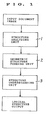
- input document images are fed into a structure analyzing unit 1.
- the input document images are analytically divided into sub-blocks having analogous physical properties (such as character size and pitch, spacing, font type, and underlining).
- the sub-blocks are classified into two items such as "head” and "body” in accordance with their physical properties.
- the term "head” (H) is given to a sub-block that extends over plural columns, or includes characters processed by centering.
- body” (B) is given to a sub-block other than a "head” (H) sub-block, as shown in Figure 2a.
- the numerals attached to H or B of the sub-blocks in Figure 2a indicate the proper reading order.
- the respective nodes of the tree have single or plural numerals in sequence.
- This group of numerals is defined as a list.
- the numerals of the lists represent the positional relationship of the sub-blocks in Figure 2a. The order of the numerals coincides with the proper human reading order.
- the uppermost node of the tree of Figure 2b has a list including numerals such as 0, 1 and 2. These correspond to the sub-blocks 0H, 1H and 2B respectivly positioned in the same column at the upper portion of Figure 2a. Further, in Figure 2a, the sub-blocks 3H and 13H are positioned under the sub-block 2B. Three columns are present under the sub-block 3H. Each column includes sub-blocks such as 4H, 5B and 6B, and 7B and 8H, and 9H, 10B, 11H and 12B.
- the left node at the intermediate portion of the tree has a list including the numeral 3, which represents 3 of the sub-block 3H in Figure 2a.
- the right node has a list including the numerals 13, 14, 15 and 16 which respectively represent sub-blocks 13H, 14B, 15H and 16B in Figure 2a.
- three nodes which are situated under the node having the list that includes 3 have the lists including numerals 4, 5 and 6, 7 and 8, and 9, 10, 11 and 12 which respectively represent sub-blocks 4H, 5B and 6B, of the sub-blocks 7B and 8H, sub-blocks 9H, 10B, 11H and 12B in Figure 2a.
- a logical structure is produced on the basis of the above-described geometric structure.
- the logical structure corresponds to a modified document image having a predetermined relationship between the sub-blocks.
- the structure analyzing unit 1 of Figure 1 comprises a run length coding unit 23, a column information extracting unit 24, a line information extracting unit 25, a sub-block information extracting unit 26, and an item adding unit 27.
- the geometric structure forming unit 2 of Figure 1 comprises an adjacent information-in-identical column extracting unit 28, and a tree structure forming unit 29.
- the structure understanding unit 3 of Figure 1 comprises a transformation unit 30, a multiple texts processing unit 31, and an item-adding unit 32.
- input document images 21 are optically read by an imge scanner 22.
- Output signals produced from the image scanner 22 are fed into the run length coding unit 23.
- run length code signals are formed on the basis of the thus input document image signals.
- the run length code signals are processed in prescribed manners by means of the column information extracting unit 24, the line information extracting unit 25, and the sub-block information extracting unit 26.
- the input document images are divided into sub-block information corresponding to the respective sub-blocks of the input document images in terms of physical properties.
- the thus obtained sub-block information is designated corresponding to items of the input document images by means of the item adding unit 27.
- output signals produced from the item adding unit 27 are fed into the adjacent information-in-identical column extracting unit 28.
- the unit 28 sub-blocks adjacent to each other in the same column are extracted as adjacent information.
- the adjacent information produced from the unit 28 is fed into the tree structure forming unit 29.
- trees of geometric structure having nodes including the thus received adjacent information are formed.
- output signals produced from the unit 29 are fed into the transformation unit 30.
- the trees of geometric structure are transformed into trees of logical structure by use of various rules of extracting priority order information.
- output signals produced from the unit 30 are fed into the multiple texts processing unit 31.
- the unit 31 a large number of texts are processed in accordance with the prescribed manner.
- output signals produced from the unit 31 are fed into the item-adding unit 32.
- the unit 32 corresponding items are respectively added to the thus obtained sub-blocks.
- logical structure outputs 33 are produced from the unit 2.
- the sub-blocks can be classified into bibliographic items such as title, subtitle, abstract, etc, and main text items, such as paragraphs.
- the priority relationship of the sub-blocks is represented logically by use of a tree.
- the respective nodes of the tree have lists including the numerals of sub-blocks having the same priority.
- the order of the numerals in the respective lists coincides with the priority order of proper reading.
- the size of the tree corresponds to the number of different priority relationships present among the sub-blocks of the document image.
- Figure 4a shows a geometric structure.
- T represents a title
- N represents an author's name
- S represents a subtitle
- A represents an abstract
- P represents a text paragraph.
- the numerals of the respective sub-blocks indicate the logical order of the document from top to bottom, i.e., in proper human reading order.
- the geometric structure of Figure 4a is transformed into a logical structure in the form of a tree, as shown in Figure 4b.
- the uppermost node of the tree of Figure 4b has a list including the numerals 0 and 1. These represent the title and author's name which are on the same level in terms of priority.
- the order of the numerals 0 and 1 correspond to the proper reading order.
- the node situated immediately under the uppermost node has a list including the numeral 2.
- the next three nodes have lists each including one of the numerals 3, 13 and 15. These correspond to the sub-blocks 3S, 13S and 15S which are the subtitles on the same level.
- the three nodes under the number 3 each has a list including the numerals 4, 8 and 9, and 11 respectively. These correspond to the sub-blocks 4S, 8S, 9S and 11S, each of which is a subtitle and is dominated by the subtitle 3S.
- the corresponding numerals 8 and 9 appear at the same node.
- the paragraphs 5, 6 and 7 are dominated by the subtitle 4S.
- the numerals 5, 6 and 7 are situated togeter under the number 4.
- the paragraph 10 is dominated by the subtitle 9S.
- the numeral 10 is situated under the node having the list including the numerals 8 and 9.
- the paragraph 12 is dominated by the subtitle 11, so that the numeral 12 is situated under the node having the list including the numeral 11.
- the paragraph 16p is dominated by the subtitle 15S, so that the numeral 16 is situated under the node having the list including the numeral 15.
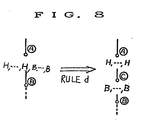
- a logical structure can be obtained by transforming a geometric structure in accordance with the following four rules a through d.
- S represents a sub-block
- H represents a head sub-block
- B represents a body sub-block.
- a geometric structure is represented by the tree.
- the tree is obtained corresponding to sub-blocks a and b.
- the tree of the geometric structure is transformed into a logical structure represented by the tree. The transformation is performed as follows.
- the terminal node (A) of the tree has a list including B,S...S corresponding to the content of the sub-block.
- the terminal node (B) of the tree has a list including S...S corresponding to the content of the sub-block b.
- B which is present at the head of the row in the list of the terminal node (A) of the tree, is moved to the end of the row in the list of the terminal node (B) of the tree.
- a geometric structure is represented by the tree.
- the tree is obtained corresponding to sub-blocks a and b.
- the tree of the geometric structure is transformed into a logical structure represented by the tree. The transformation is performed as follows.
- the terminal node (A) of the tree has a list including S...S corresponding to the content of the sub-block.
- the terminal node (B) of the tree has a list including S...S, H corresponding to the content of the sub-block b.
- S which is present at the head of the row in the list of the terminal node (A) of the tree, is moved to the portion immediately after H in the list of the terminal node (B) of the tree.
- a geometric structure represented by the tree is transformed into a logical structure represented by the tree of Figure 6b.
- a node (A) of the tree has a list including S...S, B and an H-B sequence (a combination of sequential Hs and Bs).
- a node (D) is newly produced so as to have a list that only includes the H-B sequence extracted from the list of the node (A) of the tree.
- the thus produced node (D) is added to a parent node of the tree as a brother node. If the node (A) has a descendant node group (C), the node group (C) is moved together with the node (D). Futher, if a parent node does not exist, a NULL parent node is produced, and the above-described process is performed.
- a geometric structure represented by the tree is transformed into a logical structure represented by the tree.
- a node (A) of the tree has a list including an H-B sequence.
- a node (C) is newly produced so as to have a list that only includes the sequential Bs extracted from the list of the node (A) of the tree.
- the thus produced node (C) is added under node (A) of the tree as a child node.
- Figure 9 shows an example of the transformation from the geometric structure of Figure 2b into the logical structure of Figure 4b by use of a combination of the above-described four rules a through d.
- the sub-block can include a larger amount of information.
- H the head sub-block, which is a root node, can represent a title or an author's name.
- the head sub-blocks within the nodes other than the root node can represent a subtitle.
- B the body sub-block within a terminal node can represent a paragraph.
- the body sub-blocks within the nodes other than the terminal node can represent an abstract or the like.
- a document including a large number of texts can also be represented by increasing the number of trees.
- the reading order of these trees is determined on the basis of the principle that the reading is not moved back to top of the preceeding left column.
- Figures 10a and 10b plural trees are used to represent a document including plural texts.
- Figure 10a shows a document including plural sub-blocks.
- Figure 10b shows geometric structures represented by three trees a , b and c.
- the tree a, tree b and tree c are arranged in alphabetical order.
- the tree a having a root node which is a "head” can independently represent one text region.
- the tree b without the root node of a "head” only a "body” is present
- the tree b is added to the tree a, which is the next tree previous to the tree b.
- the tree a represents one text region
- the tree c represents another text region as shown in Figure 10b.
- the logical structures are produced by processes performed in the structure understanding unit 3.
- plural trees with respect to the sub-blocks are determined corresponding to the respective text regions.
- the respective sub-blocks have been previously designated by such items as a title, a subtitle, a paragraph and the like.
- all the sub-blocks of the respective text regions are not required to be extracted, but only the titles or the titles with subtitles are required.
- Frames that surround the sub-blocks of the same text region are displayed with the same color, but different colors from those of other text regions. Moreover, the entire area of the sub-blocks of the same text region may also be displayed with the same color. As a result, the relationship betwen the respective sub-blocks can be clearly represented.
- several sub-blocks such as subtitle sub-blocks and their paragraph sub-blocks are compiled, and represented by use of the same color.
- the sub-blocks may also be distinguished from each other by differences in brightness, by distinctions between solid- and dotted-lines, or by blinking or flashing characters on background.
- all of the sub-blocks of the respective texts may be surrounded with frames.
- the corresponding text numbers may be added to the left shoulders of the respective frames.
- image sub-blocks such as graphs and photographs
- these sub-blocks may also be discriminated in the above-described manner.
- image sub-blocks may also be displayed using images in original form.
- the respective sub-blocks are displayed in the complete form.
- the respective sub-blocks may also be represented by the use of constituent components, such as characters per se, frames that surround the characters, or the center lines representing the character rows.
- the respective sub-blocks may also be represented by use of the base lines, the character patterns per se or the frames that surround the character patterns.
- the above-described multi-color discrimination technique may also be practiced.
- the meaning and connection relationship between the sub-blocks can be determined by use of physical properties (features) of the document alone without investigating the context of the sub-blocks.
- a document image processing apparatus capable of automatically extracting specified text regions from a document including a large number of text regions without the need for additional human intervention. Futher, the apparatus can also extract only the title from the respective text regions.
Landscapes
- Engineering & Computer Science (AREA)
- Computer Vision & Pattern Recognition (AREA)
- Physics & Mathematics (AREA)
- General Physics & Mathematics (AREA)
- Theoretical Computer Science (AREA)
- Artificial Intelligence (AREA)
- Multimedia (AREA)
- Processing Or Creating Images (AREA)
- Character Input (AREA)
- Image Processing (AREA)
Applications Claiming Priority (2)
| Application Number | Priority Date | Filing Date | Title |
|---|---|---|---|
| JP7518/88 | 1988-01-19 | ||
| JP63007518A JPH01183784A (ja) | 1988-01-19 | 1988-01-19 | 文書画像処理装置 |
Publications (3)
| Publication Number | Publication Date |
|---|---|
| EP0325417A2 true EP0325417A2 (de) | 1989-07-26 |
| EP0325417A3 EP0325417A3 (de) | 1992-03-25 |
| EP0325417B1 EP0325417B1 (de) | 1995-10-25 |
Family
ID=11667993
Family Applications (1)
| Application Number | Title | Priority Date | Filing Date |
|---|---|---|---|
| EP89300428A Expired - Lifetime EP0325417B1 (de) | 1988-01-19 | 1989-01-18 | Dokumentenbildverarbeitungsgerät |
Country Status (3)
| Country | Link |
|---|---|
| EP (1) | EP0325417B1 (de) |
| JP (1) | JPH01183784A (de) |
| DE (1) | DE68924606T2 (de) |
Cited By (17)
| Publication number | Priority date | Publication date | Assignee | Title |
|---|---|---|---|---|
| EP0376420A3 (de) * | 1988-12-30 | 1991-04-24 | Softview, Inc. | Verfahren und Anordnung zur Generierung allgemeiner Formulare |
| US5148520A (en) * | 1988-12-30 | 1992-09-15 | Chipsoft Ca, Corp. | Determining the locations of the contents of bordered areas of a generic form |
| US5208906A (en) * | 1988-12-30 | 1993-05-04 | Chipsoft Ca, Corp. | Method and apparatus for representing bordered areas of a generic form with records |
| EP0461817A3 (en) * | 1990-06-15 | 1993-11-18 | American Telephone & Telegraph | Image segmenting apparatus and methods |
| EP0652538A3 (de) * | 1993-11-08 | 1995-12-06 | Canon Kk | Bildverarbeitungsvorrichtung und -verfahren. |
| EP0694881A3 (de) * | 1994-07-25 | 1996-07-17 | Canon Kk | Effizientes Verfahren zum Interpretieren graphischer Programmiersprache |
| US5548700A (en) * | 1989-12-29 | 1996-08-20 | Xerox Corporation | Editing text in an image |
| US5680479A (en) * | 1992-04-24 | 1997-10-21 | Canon Kabushiki Kaisha | Method and apparatus for character recognition |
| US5734761A (en) * | 1994-06-30 | 1998-03-31 | Xerox Corporation | Editing scanned document images using simple interpretations |
| AU694512B2 (en) * | 1994-07-25 | 1998-07-23 | Canon Kabushiki Kaisha | Efficient methods for the interpretation of a graphical programming language |
| US5825944A (en) * | 1994-12-21 | 1998-10-20 | Canon Kabushiki Kaisha | Block selection review and editing system |
| US5893127A (en) * | 1996-11-18 | 1999-04-06 | Canon Information Systems, Inc. | Generator for document with HTML tagged table having data elements which preserve layout relationships of information in bitmap image of original document |
| US5987171A (en) * | 1994-11-10 | 1999-11-16 | Canon Kabushiki Kaisha | Page analysis system |
| US6005680A (en) * | 1995-04-04 | 1999-12-21 | Canon Information Systems, Inc. | Method for capturing a document image, a scanner using the method and a document image management system using the scanner |
| US6389162B2 (en) | 1996-02-15 | 2002-05-14 | Canon Kabushiki Kaisha | Image processing apparatus and method and medium |
| US6512848B2 (en) | 1996-11-18 | 2003-01-28 | Canon Kabushiki Kaisha | Page analysis system |
| WO2007070010A1 (en) * | 2005-12-16 | 2007-06-21 | Agency For Science, Technology And Research | Improvements in electronic document analysis |
Families Citing this family (4)
| Publication number | Priority date | Publication date | Assignee | Title |
|---|---|---|---|---|
| JP2701350B2 (ja) * | 1988-08-25 | 1998-01-21 | 日本電気株式会社 | 文書読取装置 |
| US5369716A (en) * | 1989-08-31 | 1994-11-29 | Kabushiki Kaisha Toshiba | Document reader and reading processing method therefor |
| JP3302147B2 (ja) * | 1993-05-12 | 2002-07-15 | 株式会社リコー | 文書画像処理方法 |
| CN103186510B (zh) * | 2011-12-30 | 2016-08-03 | 北大方正集团有限公司 | 一种转换文档格式的方法和装置 |
-
1988
- 1988-01-19 JP JP63007518A patent/JPH01183784A/ja active Pending
-
1989
- 1989-01-18 EP EP89300428A patent/EP0325417B1/de not_active Expired - Lifetime
- 1989-01-18 DE DE68924606T patent/DE68924606T2/de not_active Expired - Fee Related
Non-Patent Citations (3)
| Title |
|---|
| 8TH INTERNATIONAL CONFERENCE ON PATTERN RECOGNITION 27 October 1986, NEW YORK, US pages 769 - 772; Y. MAEDA ET AL.: 'Character segmentation in Japanese hand-written document images' & 2.1 * * |
| 9TH INTERNATIONAL CONFERENCE ON PATTERN RECOGNITION 14 November 1988, NEW YORK, US pages 739 - 743; G. CIARDIELLO ET AL.: 'An experimental system for office document handling and text recognition' * |
| PROCEEDINGS OF THE 1987 IEEE INTERNATIONAL CONFERENCE ON SYSTEMS, MAN AND CYBERNETICS vol. 2, 20 October 1987, NEW YORK, US pages 759 - 763; O. IWAKI ET AL.: 'A segmentation method based on office document hierarchical structure' * |
Cited By (24)
| Publication number | Priority date | Publication date | Assignee | Title |
|---|---|---|---|---|
| US5144693A (en) * | 1988-12-30 | 1992-09-01 | Chipsoft Ca Corp. | Method and apparatus for generic form generation |
| US5148520A (en) * | 1988-12-30 | 1992-09-15 | Chipsoft Ca, Corp. | Determining the locations of the contents of bordered areas of a generic form |
| US5208906A (en) * | 1988-12-30 | 1993-05-04 | Chipsoft Ca, Corp. | Method and apparatus for representing bordered areas of a generic form with records |
| EP0376420A3 (de) * | 1988-12-30 | 1991-04-24 | Softview, Inc. | Verfahren und Anordnung zur Generierung allgemeiner Formulare |
| US5548700A (en) * | 1989-12-29 | 1996-08-20 | Xerox Corporation | Editing text in an image |
| EP0461817A3 (en) * | 1990-06-15 | 1993-11-18 | American Telephone & Telegraph | Image segmenting apparatus and methods |
| US5680479A (en) * | 1992-04-24 | 1997-10-21 | Canon Kabushiki Kaisha | Method and apparatus for character recognition |
| US5680478A (en) * | 1992-04-24 | 1997-10-21 | Canon Kabushiki Kaisha | Method and apparatus for character recognition |
| US6115497A (en) * | 1992-04-24 | 2000-09-05 | Canon Kabushiki Kaisha | Method and apparatus for character recognition |
| US6072941A (en) * | 1993-11-08 | 2000-06-06 | Canon Kabushiki Kaisha | Image processing apparatus and method which classifies images according to attributes |
| EP0652538A3 (de) * | 1993-11-08 | 1995-12-06 | Canon Kk | Bildverarbeitungsvorrichtung und -verfahren. |
| US5734761A (en) * | 1994-06-30 | 1998-03-31 | Xerox Corporation | Editing scanned document images using simple interpretations |
| EP0694881A3 (de) * | 1994-07-25 | 1996-07-17 | Canon Kk | Effizientes Verfahren zum Interpretieren graphischer Programmiersprache |
| US6011919A (en) * | 1994-07-25 | 2000-01-04 | Canon Information Systems Research Australia Pty Ltd. | Method of providing efficiency to a graphical programming language with alternative form determination and cost of execution estimation |
| AU694512B2 (en) * | 1994-07-25 | 1998-07-23 | Canon Kabushiki Kaisha | Efficient methods for the interpretation of a graphical programming language |
| US5987171A (en) * | 1994-11-10 | 1999-11-16 | Canon Kabushiki Kaisha | Page analysis system |
| US6014458A (en) * | 1994-11-10 | 2000-01-11 | Canon Kabushiki Kaisha | System for designating document direction |
| US5825944A (en) * | 1994-12-21 | 1998-10-20 | Canon Kabushiki Kaisha | Block selection review and editing system |
| US6005680A (en) * | 1995-04-04 | 1999-12-21 | Canon Information Systems, Inc. | Method for capturing a document image, a scanner using the method and a document image management system using the scanner |
| US6449065B1 (en) | 1995-04-04 | 2002-09-10 | Canon Kabushiki Kaisha | Method for capturing a document image, a scanner using the method and a document image management system using the scanner |
| US6389162B2 (en) | 1996-02-15 | 2002-05-14 | Canon Kabushiki Kaisha | Image processing apparatus and method and medium |
| US5893127A (en) * | 1996-11-18 | 1999-04-06 | Canon Information Systems, Inc. | Generator for document with HTML tagged table having data elements which preserve layout relationships of information in bitmap image of original document |
| US6512848B2 (en) | 1996-11-18 | 2003-01-28 | Canon Kabushiki Kaisha | Page analysis system |
| WO2007070010A1 (en) * | 2005-12-16 | 2007-06-21 | Agency For Science, Technology And Research | Improvements in electronic document analysis |
Also Published As
| Publication number | Publication date |
|---|---|
| EP0325417A3 (de) | 1992-03-25 |
| DE68924606T2 (de) | 1996-04-11 |
| JPH01183784A (ja) | 1989-07-21 |
| EP0325417B1 (de) | 1995-10-25 |
| DE68924606D1 (de) | 1995-11-30 |
Similar Documents
| Publication | Publication Date | Title |
|---|---|---|
| US5185813A (en) | Document image processing apparatus | |
| EP0325417B1 (de) | Dokumentenbildverarbeitungsgerät | |
| EP0753833B1 (de) | Vorrichtung und Verfahren für die Extraktion von Artikeln eines Dokuments | |
| US6212299B1 (en) | Method and apparatus for recognizing a character | |
| US5754712A (en) | Image processing apparatus | |
| EP1739574B1 (de) | Verfahren zur Identifizierung von Wörtern in einem elektronischen Dokument | |
| US5179650A (en) | Method and apparatus for editing documents | |
| JPH09171557A (ja) | イメージ処理方法及び装置 | |
| US4677585A (en) | Method for obtaining common mode information and common field attribute information for a plurality of card images | |
| CN1099800C (zh) | 图像处理方法和设备 | |
| JP5446877B2 (ja) | 目次構造特定装置 | |
| EP0196898A2 (de) | Maschinenübersetzungssystem | |
| US11194953B1 (en) | Graphical user interface systems for generating hierarchical data extraction training dataset | |
| US6567545B1 (en) | Format recognition method, apparatus and storage medium | |
| JP3922396B2 (ja) | レイアウト装置および表示装置 | |
| US6094484A (en) | Isomorphic pattern recognition | |
| JP3319203B2 (ja) | 文書ファイリング方法及び装置 | |
| Faure | Preattentive reading and selective attention for document image analysis | |
| JP3013442B2 (ja) | 図面自動入力装置 | |
| JPH0388086A (ja) | 文書読取装置 | |
| JP2001307020A (ja) | 文字認識装置 | |
| JPH0697470B2 (ja) | 文字列抽出装置 | |
| JPH0743718B2 (ja) | マルチメディア文書構造化方式 | |
| JPH10222612A (ja) | 文書認識装置 | |
| JPH0452783A (ja) | 図面読取装置 |
Legal Events
| Date | Code | Title | Description |
|---|---|---|---|
| PUAI | Public reference made under article 153(3) epc to a published international application that has entered the european phase |
Free format text: ORIGINAL CODE: 0009012 |
|
| 17P | Request for examination filed |
Effective date: 19890130 |
|
| AK | Designated contracting states |
Kind code of ref document: A2 Designated state(s): DE FR GB |
|
| PUAL | Search report despatched |
Free format text: ORIGINAL CODE: 0009013 |
|
| AK | Designated contracting states |
Kind code of ref document: A3 Designated state(s): DE FR GB |
|
| 17Q | First examination report despatched |
Effective date: 19940203 |
|
| GRAA | (expected) grant |
Free format text: ORIGINAL CODE: 0009210 |
|
| AK | Designated contracting states |
Kind code of ref document: B1 Designated state(s): DE FR GB |
|
| ET | Fr: translation filed | ||
| REF | Corresponds to: |
Ref document number: 68924606 Country of ref document: DE Date of ref document: 19951130 |
|
| PLBE | No opposition filed within time limit |
Free format text: ORIGINAL CODE: 0009261 |
|
| STAA | Information on the status of an ep patent application or granted ep patent |
Free format text: STATUS: NO OPPOSITION FILED WITHIN TIME LIMIT |
|
| 26N | No opposition filed | ||
| REG | Reference to a national code |
Ref country code: GB Ref legal event code: 746 Effective date: 19981002 |
|
| REG | Reference to a national code |
Ref country code: FR Ref legal event code: D6 |
|
| REG | Reference to a national code |
Ref country code: GB Ref legal event code: IF02 |
|
| PGFP | Annual fee paid to national office [announced via postgrant information from national office to epo] |
Ref country code: FR Payment date: 20030110 Year of fee payment: 15 |
|
| PGFP | Annual fee paid to national office [announced via postgrant information from national office to epo] |
Ref country code: GB Payment date: 20030115 Year of fee payment: 15 |
|
| PGFP | Annual fee paid to national office [announced via postgrant information from national office to epo] |
Ref country code: DE Payment date: 20030130 Year of fee payment: 15 |
|
| PG25 | Lapsed in a contracting state [announced via postgrant information from national office to epo] |
Ref country code: GB Free format text: LAPSE BECAUSE OF NON-PAYMENT OF DUE FEES Effective date: 20040118 |
|
| PG25 | Lapsed in a contracting state [announced via postgrant information from national office to epo] |
Ref country code: DE Free format text: LAPSE BECAUSE OF NON-PAYMENT OF DUE FEES Effective date: 20040803 |
|
| GBPC | Gb: european patent ceased through non-payment of renewal fee |
Effective date: 20040118 |
|
| PG25 | Lapsed in a contracting state [announced via postgrant information from national office to epo] |
Ref country code: FR Free format text: LAPSE BECAUSE OF NON-PAYMENT OF DUE FEES Effective date: 20040930 |
|
| REG | Reference to a national code |
Ref country code: FR Ref legal event code: ST |