EP0326208A2 - Compositions détergentes granulaires contenues dans une poche contenoue des agents renforçants hygroscopiques - Google Patents
Compositions détergentes granulaires contenues dans une poche contenoue des agents renforçants hygroscopiques Download PDFInfo
- Publication number
- EP0326208A2 EP0326208A2 EP89200099A EP89200099A EP0326208A2 EP 0326208 A2 EP0326208 A2 EP 0326208A2 EP 89200099 A EP89200099 A EP 89200099A EP 89200099 A EP89200099 A EP 89200099A EP 0326208 A2 EP0326208 A2 EP 0326208A2
- Authority
- EP
- European Patent Office
- Prior art keywords
- weight
- porous
- water
- pouched
- group
- Prior art date
- Legal status (The legal status is an assumption and is not a legal conclusion. Google has not performed a legal analysis and makes no representation as to the accuracy of the status listed.)
- Withdrawn
Links
Images
Classifications
-
- C—CHEMISTRY; METALLURGY
- C11—ANIMAL OR VEGETABLE OILS, FATS, FATTY SUBSTANCES OR WAXES; FATTY ACIDS THEREFROM; DETERGENTS; CANDLES
- C11D—DETERGENT COMPOSITIONS; USE OF SINGLE SUBSTANCES AS DETERGENTS; SOAP OR SOAP-MAKING; RESIN SOAPS; RECOVERY OF GLYCEROL
- C11D17/00—Detergent materials or soaps characterised by their shape or physical properties
- C11D17/04—Detergent materials or soaps characterised by their shape or physical properties combined with or containing other objects
- C11D17/041—Compositions releasably affixed on a substrate or incorporated into a dispensing means
- C11D17/046—Insoluble free body dispenser
-
- C—CHEMISTRY; METALLURGY
- C11—ANIMAL OR VEGETABLE OILS, FATS, FATTY SUBSTANCES OR WAXES; FATTY ACIDS THEREFROM; DETERGENTS; CANDLES
- C11D—DETERGENT COMPOSITIONS; USE OF SINGLE SUBSTANCES AS DETERGENTS; SOAP OR SOAP-MAKING; RESIN SOAPS; RECOVERY OF GLYCEROL
- C11D3/00—Other compounding ingredients of detergent compositions covered in group C11D1/00
- C11D3/02—Inorganic compounds ; Elemental compounds
- C11D3/12—Water-insoluble compounds
- C11D3/124—Silicon containing, e.g. silica, silex, quartz or glass beads
- C11D3/1246—Silicates, e.g. diatomaceous earth
- C11D3/128—Aluminium silicates, e.g. zeolites
-
- C—CHEMISTRY; METALLURGY
- C11—ANIMAL OR VEGETABLE OILS, FATS, FATTY SUBSTANCES OR WAXES; FATTY ACIDS THEREFROM; DETERGENTS; CANDLES
- C11D—DETERGENT COMPOSITIONS; USE OF SINGLE SUBSTANCES AS DETERGENTS; SOAP OR SOAP-MAKING; RESIN SOAPS; RECOVERY OF GLYCEROL
- C11D3/00—Other compounding ingredients of detergent compositions covered in group C11D1/00
- C11D3/16—Organic compounds
- C11D3/20—Organic compounds containing oxygen
- C11D3/2075—Carboxylic acids-salts thereof
Definitions
- the present invention relates to pouched granular detergent compositions containing a detergent surfactant, preferably an aluminosilicate ion exchange material, water-soluble neutral or alkaline hygroscopic builder salt, preferably comprising ether carboxylate builders as defined herein.
- a detergent surfactant preferably an aluminosilicate ion exchange material, water-soluble neutral or alkaline hygroscopic builder salt, preferably comprising ether carboxylate builders as defined herein.
- the compositions herein can contain no or only low levels of phosphate materials and preferably less than about 4% by weight of alkali metal silicate materials.
- Granular detergent compositions have, in the past, often contained high concentrations of phosphate builder materials, particularly sodium tripolyphosphate.
- phosphate builder materials particularly sodium tripolyphosphate.
- sodium tripolyphosphate When a crutcher mix containing sodium tripolyphosphate is spray-dried, it is believed that enough mixed-phosphate hydrolysis products are formed to inhibit phosphate crystal growth.
- the hydrolysis products are concentrated in the liquid phase which finally dries to an amorphous glassy phosphate material.
- This glassy material effectively "cements" the finely crystalline granule walls together, producing granules which exhibit very desirable physical properties, i.e., crisp, durable and free-flowing granules.
- the glassy phosphate material readily disintegrates in the laundering solution so that no insoluble residue is left on the fabrics.
- Alkali metal silicates are usually included in granular detergents at low levels for corrosion inhibition and processing reasons. When phosphate builders are removed from detergents, the level of silicate is often increased severalfold since it also dries to a tough glassy film capable of strengthening granule walls and enhancing free-flowing characteristics. Silicates having a lower SiO2 to alkali metal oxide ratio (e.g. 1.6-2.0) are usually selected because they are more water-soluble than the higher ratio silicates. However, exposure of the silicate to carbon dioxide during drying and storage can shift its ratio to a higher value and reduce its solubility, resulting in detergent granules which do not completely disintegrate in the laundering solution, and an unacceptably high level of insoluble material being deposited on fabrics.
- Silicates having a lower SiO2 to alkali metal oxide ratio e.g. 1.6-2.0
- the insolubles problem can be particularly severe when the detergent composition also contains water-insoluble aluminosilicate material since higher levels of silicates (e.g., above about 3%) enhance the deposition of the aluminosilicates onto fabrics. This solubility problem is compounded further in a pouched detergent form product.
- An annoying problem with air/water-permeable pouched granular detergent is dusting when the pouch is removed from its package for use in the washing machine.
- hygroscopic builders particulatly at higher levels, can improve granular detergent solubility. However, they have been avoided in granular form due to granular stickiness and caking upon storage. Detergent stickiness and caking are usually associated with decreased solubility and undesirable flow properties.
- Another object of the present invention is to provide a porous pouched laundry detergent dispenser with reduced dusting.
- the present invention encompasses a porous, pouched hygroscopic granular detergent composition and a method of dispensing said hygroscopic granular detergent into the wash water of a washing machine.
- the present invention encompasses a porous, pouched hygroscopic granular detergent composition
- a porous, pouched hygroscopic granular detergent composition comprising:
- the pouched granular detergent compositions of the present invention contain, as essential components, detergent surfactant and water-soluble neutral or alkaline hygroscopic builder salt selected from ether polycarboxylate builders, hygroscopic organic salts of citrate, formate, malate, succinate, acetate, tartrate, and suitable hygroscopic polyacrylate salts and mixtures thereof.
- hygroscopic builder salt selected from ether polycarboxylate builders, hygroscopic organic salts of citrate, formate, malate, succinate, acetate, tartrate, and suitable hygroscopic polyacrylate salts and mixtures thereof.
- compositions preferably contain (1 ) from 0% to less than about 5%, more preferably less than about 4%, most preferably less than about 3%, by weight of alkali metal silicate materials; and (2) from 0% to less than about 10%, more preferably less than about 5%, by weight of phosphate materials. Most preferably, the compositions are substantially free of phosphate materials, at least less than 0.5%. A level of silicate of up to about 10, preferably up to about 8 can be included if solubility is not an issue.
- compositions herein are prepared by drying an aqueous slurry comprising the above components.
- the slurry generally contains from about 25% to about 50% water, whereas the dried granules can contain up to about 15% water, normally initially from about 3% to about 12%. Higher water levels in the slurry give poorer granules.
- the drying operation can be accomplished by any convenient means, for example, by using spray-drying towers, both countercurrent and co-current, fluid beds, flash-drying towers, both countercurrent and co-current, fluid beds, flash-drying equipment, or industrial microwave or oven drying equipment.
- the drying is in a countercurrent spray drying tower.
- the granular detergents herein exhibit at least initial free-flowing characteristics which are essential for fast line pouching.
- ether polycarboxylate builders are readily water-soluble and the granules quickly disintegrate in the laundering solution. Little or no insoluble residue is left on the fabrics. Moreover, the ether polycarboxylate builder is an effective builder.
- the granular detergents are uniquely suited for pouched detergent articles and a method of making same.
- the granular detergents of this invention are free flowing when made and they are filled into the pouches while free flowing, however, they can become sticky and nonfree flowing or lumpy under stress storage conditions which makes them unsuitable for granular detergents in boxes.
- Surprisingly notwithstanding increased caking, there is a benefit in reduced dusting with surprisingly about equal solubility of the detergent from the pouch.
- the combination allows for the use of a detergent which forms lumps which are otherwise unacceptable for box use. Yet in the present invention, this sticky, lumpy detergent provides a reduced dusting benefit while maintaining good solubility from a pouch.
- the granular detergents of the present invention can contain a total of from about 5% to about 75%, preferably from about 10% to about 60%, and more preferably from about 20% to about 50%, by weight of a water-soluble neutral or alkaline salt.
- the neutral or alkaline salt has a pH in solution of seven or greater, and can be either organic or inorganic in nature.
- the salt assists in providing the desired density and bulk to the detergent granules herein. While some of the salts are inert, many of them also function as detergency builder materials in the laundering solution.
- neutral water-soluble salts include the alkali metal, ammonium or substituted ammonium chorides, fluorides and sulfates.
- the alkali metal, and especially sodium, salts of the above are preferred.
- Sodium sulfate is typically used in detergent granules and is a particularly preferred salt herein and is used at a level of about 1:1 of the hygroscopic builder salt.
- water-soluble salts include the compounds commonly known as detergent builder materials.
- Builders are generally selected from the various water-soluble, alkali metal, ammonium or substituted ammonium phosphates, polyphosphates, phosphonates, polyphosphonates, carbonates, silicates, borates, and polyhydroxysulfonates.
- the alkali metal, especially sodium, salts of the above are preferred.
- the present compositions should preferably contain less than about 5%, preferably less than about 4%, more preferably less than about 3% by weight of silicate materials for optimum solubility and less than about 10%, preferably less than about 5%, by weight of phosphate materials.
- the compositions are substantially free of phosphates.
- inorganic phosphate builders are sodium and potassium tripolyphosphate, pyrophosphate, polymeric metaphosphate having a degree of polymerization of from about 6 to 21, and orthophosphate.
- polyphosphonate builders are the sodium and potassium salts of ethylene diphosphonic acid, the sodium and potassium salts of ethane 1-hydroxy-1 ,1-diphosphonic acid and the sodium and potassium salts of ethane, 1,1,2-triphosphonic acid.
- Other phosphorus builder compounds are disclosed in U.S. Pat. Nos. 3,159,581; 3,213,030; 3,422,021; 3,422,137; 3,400,176 and 3,400,148, incorporated herein by reference.
- nonphosphorus, inorganic builders are sodium and potassium carbonate, bicarbonate, sesquicarbonate, tetraborate decahydrate, and silicate having a molar ratio of SiO2 to alkali metal oxide of from about 0.5 to about 4.0, preferably from about 1.0 to about 2.4.
- the water-soluble neutral or alkaline hygroscopic builder salts comprise from about 1% to about 55%, preferably from about 3% to about 30%, most preferably from about 5% to about 25%, by weight of the granular detergent composition.
- the hygroscopic builder salt is selected from the group consisting of: organic salts of citrate, formate, malate, succinate, acetate, tartrate, and ether polycarboxylate builder having the formula: wherein each R is selected from the group consisting of H, and OH with no more than one OH group being attached to any one carbon atom; R1 is either a group having the formula wherein each X is selected from the group consisting of H and cations which make the ether polycarboxylate builder water soluble and n is from 0 to 4.
- the preferred hygroscopic builder salts are ether polycarboxylate detergency builders of the general structural formula: wherein each R is H or OH, so long as only one OH group is attached to a carbon atom, and R1 can be either wherein each X is H or a salt-forming cation and n is from 0 to 4.
- These ether polycarboxylate builder acids or salts thereof are hereinafter designated as "EPB". "EPB" is used to designate both the acid and salt forms of these materials.
- One preferred composition contains at least 26% by weight of the ether polycarboxylate builder. Another contains from about 5% to about 35% organic salt of citrate. Yet another contains from about 3% to about 25% ether polycarboxylate and from about 1% to about 15% organic salt of citrate, more preferably from about 5% to about 15% ether polycarboxylate with citrate with a ratio of 2:1 to 1:2.
- EPBs provide synergistic cleaning performance when combined with the aluminosilicate derergency builder, especially hydrated Zeolite A with a particle size of less than about 5 microns.
- the benefit is greatest for lower levels of EPBs up to a 1:1 ratio of EPB to aluminosilicate.
- the EPB component can be employed in the compositions herein in their free acid form, i.e., wherein X in the structural formulas is H.
- these materials can be partially or fully neutralized to a tartrate monosuccinate salt.
- Preferred salt-forming cations useful in forming the neutralized materials are those which yield substantially water-soluble salts of tartrate monosuccinic acid. Examples of such preferred salt-forming cations include alkali metal (e.g., sodium, potassium, lithium), C1-C4 alkyl substituted ammonium and C1-C4 alkanolammonium. The most preferred salt-forming cations are sodium, potassium, monoethanolammonium and triethanolammonium.
- the detergent compositions herein contain from about 5% to about 45% by weight of an organic surfactant selected from the group consisting of anionic, nonionic, zwitterionic, ampholytic and cationic surfactants, and mixtures thereof.
- the surfactant preferably represents from about 5% to about 45%, and more preferably from about 8% to about 35%, most preferably from about 20 to about 30% by weight of the detergent composition.
- Surfactants useful herein are listed in U.S. Pat. No. 3,664,961, Norris, issued May 23, 1972, and in U.S. Pat. No. 3,919,678, Laughlin et al., issued Dec. 30, 1975, both incorporated herein by reference.
- cationic surfactants also include those described in U.S. Pat. No. 4,222,905, Cockrell, issued Sept. 16, 1980, and in U.S. Pat. No. 4,239,659, Murphy, issued Dec. 16, 1980, both incorporated herein by reference.
- cationic surfactants are generally less compatible with the aluminosilicate materials herein, and thus are preferably used at low levels, if at all, in the present compositions.
- the following are representative examples of surfactants useful in the present compositions.
- Water-soluble salts of the higher fatty acids are useful anionic surfactants in the compositions herein.
- Soaps can be made by direct saponification of fats and oils or by the neutralization of free fatty acids.
- Particularly useful are the sodium and potassium salts of the mixtures of fatty acids derived from coconut oil and tallow, i.e., sodium or potassium tallow and coconut soap.
- Useful anionic surfactants also include the water-soluble salts, preferably the alkali metal, ammonium and alkylolammonium salts, of organic sulfuric reaction products having in their molecular structure an alkyl group containing from about 10 to about 20 carbon atoms and a sulfonic acid or sulfuric acid ester group.
- alkyl is the alkyl portion of acyl groups.
- this group of synthetic surfactants are the sodium and potassium alkyl sulfates, especially those obtained by sulfating the higher alcohols (C8-C18 carbon atoms) such as those produced by reducing the glycerides of tallow or coconut oil; and the sodium and potassium alkyl benzene sulfonates in which the alkyl group contains from about 9 to about 15 carbon atoms, in straight or branched chain configuration, e.g., those of the type described in U.S. Pat. Nos. 2,220,099 and 2,477,383.
- Especially valuable are linear straight chain alkyl benzene sulfonates in which the average number of carbon atoms in the alkyl group is from about 11 to 13, abbreviated as C11-C13 LAS.
- anionic surfactants herein are the sodium alkyl glyceryl ether sulfonates, especially those ethers of higher alcohols derived from tallow and coconut oil; sodium coconut oil fatty acid monoglyceride sulfonates and sulfates; sodium or potassium salts of alkyl phenol ethylene oxide ether sulfates containing from about 1 to about 10 units of ethylene oxide per molecule and wherein the alkyl groups contain from about 8 to about 12 carbon atoms; and sodium or potassium salts of alkyl ethylene oxide ether sulfates containing from about 1 to about 10 units of ethylene oxide per molecule and wherein the alkyl group contains from about 10 to about 20 carbon atoms.
- Other useful anionic surfactants herein include the water-soluble salts of esters of alpha-sulfonated fatty acids containing from about 6 to 20 carbon atoms in the fatty acid group and from about 1 to 10 carbon atoms in the ester group; water-soluble salts of 2-acyloxy-alkane-1-sulfonic acids containing from about 2 to 9 carbon atoms in the acyl group and from about 9 to about 23 carbon atoms in the alkane moiety; alkyl ether sulfates containing from about 10 to 20 carbon atoms in the alkyl group and from about 1 to 30 moles of ethylene oxide; water-soluble salts of olefin sulfonates containing from about 12 to 24 carbon atoms; and beta-alkyloxy alkane sulfonates containing from about 1 to 3 carbon atoms in the alkyl group and from about 8 to about 20 carbon atoms in the alkane moiety.
- Nonionic surfactants are also useful in the compositions of the invention.
- Such nonionic materials include compounds produced by the condensation of alkylene oxide groups (hydrophilic in nature) with an organic hydrophobic compound, which may be aliphatic or alkyl aromatic in nature.
- the length of the polyoxyalkylene group which is condensed with any particular hydrophobic group can be readily adjusted to yield a water-soluble compound having the desired degree of balance between hydrophilic and hydrophobic elements.
- Suitable nonionic surfactants include the polyethylene oxide condensates of alkyl phenols, e.g., the condensation products of alkyl phenols having an alkyl group containing from about 6 to 15 carbon atoms, in either a straight chain or branched chain configuration, with from about 3 to 12 moles of ethylene oxide per mole of alkyl phenol.
- Preferred nonionics are the water-soluble condensation products of aliphatic alcohols containing from 8 to 22 carbon atoms, in either straight chain or branched configuration, with from 3 to 12 moles of ethylene oxide per mole of alcohol.
- Particularly preferred are the condensation products of alcohols having an alkyl group containing from about 9 to 15 carbon atoms with from about 3 to 8 moles of ethylene oxide per mole of alcohol.
- Semi-polar nonionic surfactants include water-soluble amine oxides containing one alkyl moiety of from about 10 to 18 carbon atoms and 2 moieties selected from the group consisting of alkyl groups and hydroxyalkyl groups containing from 1 to about 3 carbon atoms; water-soluble phosphine oxides containing one alkyl moiety of about 10 to 18 carbon atoms and 2 moieties selected from the group consisting of alkyl groups and hydroxyalkyl groups containing from about 1 to 3 carbon atoms; and water-soluble sulfoxides containing one alkyl moiety of from about 10 to 18 carbon atoms and a moiety selected from the group consisting of alkyl and hydroxyalkyl moieties of from about 1 to 3 carbon atoms.
- Ampholytic surfactants include derivatives of aliphatic or aliphatic derivatives of heterocyclic secondary and tertiary amines in which the aliphatic moiety can be either straight or branched chain and wherein one of the aliphatic substituents contains from about 8 to 18 carbon atoms and at least one aliphatic substituent contains an anionic water-solubilizing group.
- Zwitterionic surfactants include derivatives of aliphatic quaternary ammonium phosphonium, and sulfonium compounds in which one of the aliphatic substituents contains from about 8 to 18 carbon atoms.
- Particularly preferred surfactants herein include linear alkylbenzene sulfonates containing from about 11 to 14 carbon atoms in the alkyl group; tallowalkyl sulfates; coconutalkyl glyceryl ether sulfonates; alkyl ether sulfates wherein the alkyl moiety contains from about 14 to 18 carbon atoms and wherein the average degree of ethoxylation is from about 1 to 4; olefin or paraffin sulfonates containing from about 14 to 16 carbon atoms; alkyldimethylamine oxides wherein the alkyl group contains from about 11 to 16 carbon atoms; alkyldimethylammonio propane sulfonates and alkyldimethylammonio hydroxy propane sulfonates wherein the alkyl group contains from about 14 to 18 carbon atoms; soaps of higher fatty acids containing from about 12 to 18 carbon atoms; condensation products of C9-C15 alcohols with
- Specific preferred surfactants for use herein include: sodium linear C11-C13 alkylbenzene sulfonate; triethanolammonium C11-C13 alkylbenzene sulfonate; sodium tallow alkyl sulfate; sodium coconut alkyl glyceryl ether sulfonate; the sodium salt of a sulfated condensation product of a tallow alcohol with about 4 moles of ethylene oxide; the condensation product of a coconut fatty alcohol with about 6 moles of ethylene oxide; the condensation product of tallow fatty alcohol with about 11 moles of ethylene oxide; the condensation of a fatty alcohol containing from about 14 to about 15 carbon atoms with about 7 moles of ethylene oxide; the condensation product of a C12-C13 fatty alcohol with about 3 moles of ethylene oxide; 3-(N,N-dimethyl-N-coconutalkylammonio)-2-hydroxypropane-1-sulfonate; 3-(N
- the detergent compositions herein can also contain from 0% to about 30%, preferably from about 5% to about 25%, and more preferably from about 5% to about 20%, by weight of crystalline aluminosilicate ion exchange material of the formula Na z [(A102) z (SiO2) y ] ⁇ xH2O wherein z and y are at least about 6, the molar ratio of z to y is from about 1.0 to about 0.5 and x is from about 10 to about 264.
- Amorphous hydrated aluminosilicate materials useful herein have the empirical formula M z (zA10 2 ySiO2) wherein M is sodium, potassium, ammonium or substituted ammonium, z is from about 0.5 to about 2 and y is 1, said material having a magnesium ion exchange capacity of at least about 50 milligram equivalents of CaCO3 hardness per gram of anhydrous aluminosilicate. Hydrated sodium Zeolite A with a particle size of from about 1 to 10 microns is preferred.
- the aluminosilicate ion exchange builder materials herein are in hydrated form and contain from about 10% to about 28% of water by weight if crystalline, and potentially even higher amounts of water if amorphous. Highly preferred crystalline aluminosilicate ion exchange materials contain from about 18% to about 22% water in their crystal matrix.
- the crystalline aluminosilicate ion exchange materials are further characterized by a particle size diameter of from about 0.1 micron to about 10 microns. Amorphous materials are often smaller, e.g., down to less than about 0.01 micron.
- Preferred ion exchange materials have a particle size diameter of from about 0.2 micron to about 4 microns.
- particle size diameter herein represents the average particle size diameter by weight of a given ion exchange material as determined by conventional analytical techniques such as, for example, microscopic determination utilizing a scanning electron microscope.
- the crystalline aluminosilicate ion exchange materials herein are usually further characterized by their calcium ion exchange capacity, which is at least about 200 mg equivalent of CaCO3 water hardness/g of aluminosilicate, calculated on an anhydrous basis, and which generally is in the range of from about 300 mg eq./g to about 352 mg eq./g.
- the aluminosilicate ion exchange materials herein are still further characterized by their calcium ion exchange rate which is at least about 2 grains Ca++/gallon/minute/gram/gallon of aluminosilicate (anhydrous basis), and generally lies within the range of from about 2 grains/gallon/minute/gram/gallon to about 6 grains/gallon/minute/gram/gallon, based on calcium ion hardness.
- Optimum aluminosilicate for builder purposes exhibit a calcium ion exchange rate of at least about 4 grains/gallon/minute/gram/gallon.
- the amorphous aluminosilicate ion exchange materials usually have a Mg++ exchange of at least about 50 mg eq. CaCO3/g (12 mg Mg++/g) and a Mg++ exchange rate of at least about 1 grain/gallon/minute/gram/gallon. Amorphous materials do not exhibit an observable diffraction pattern when examined by Cu radiation (1.54 Angstrom Units).
- Aluminosilicate ion exchange materials useful in the practice of this invention are commercially available.
- the aluminosilicates useful in this invention can be crystalline or amorphous in structure and can be naturally occurring aluminosilicates or synthetically derived.
- a method for producing aluminosilicate ion exchange materials is discussed in U.S. Pat. No. 3,985,669, Krummel et al., issued Oct. 12, 1976, incorporated herein by reference.
- Preferred synthetic crystalline aluminosilicate ion exchange materials useful herein are available under the designations Zeolite A, Zeolite B, and Zeolite X.
- the crystalline aluminosilicate ion exchange material has the formula Na12[(A102)12(SiO2)12] ⁇ xH2O wherein x is from about 20 to about 30, especially about 27 and has a particle size generally less than about 5 microns.
- a preferred disposable dispenser is designed to be removably attached to the central agitating post of a washing machine for dispensing a laundry active, e.g., a detergent or bleach, into the wash water of the machine.
- a laundry active e.g., a detergent or bleach
- a preferred disposable dispenser for the dispensing of a laundry active during the wash period of an automatic clothes washing machine having an upright central agitating post.
- the dispenser comprises a sealed water-permeable, water-insoluble pouch or container, adaptable to being fastened onto the central agitating post and having disposed therein a laundry additive.
- the laundry active dissolves out of said water-permeable container by force of the agitating post and wash water.
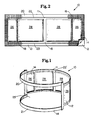
- a preferred embodiment of a laundry active dispenser 10 is shown having two equal laminated rectangular sheets, 12 and 14.
- the sheets are made of a flexible laminar water-permeable, water-insoluble material permanently sealed together at their peripheral edges 11 in this particular instance, by means of a continuous heat seal 16. It is not intended , however, to limit the present embodiment to such flexible laminar materials, or to the provision of a heat sealing means.
- the two laminar sheets are also joined together by means of heat seals 16 and 18 to divide the dispenser 10 into four rectangular container pouches 26 and 28′.
- the preferred dispenser is made by first embossing one of the substrate sheets, e.g., 14, to form deeper pochets for the pouches to contain the laundry active ingredients.
- the ingredients are placed in the indentations created by the embossing.
- a sheet of polyethylene film (not shown) can be precut to match the seal areas 16 and 18 which are around and between the pouch pockets 26 and 28. This sheet is placed in position to line up with the embossed sheet.
- the second sheet 12 is then put in place and heat is applied to the embossed sheet. The heat melts the polyethylene film and seals the laundry actives inside the pouched pockets.
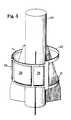
- top and bottom peripheral edges 20 and 21 have slits 22 and 23 so as when opened, circular loops 22′ and 23′ are formed which are large enough to be loosely fitted (fastened) about the central agitating post 24 of an automatic clothes washing machine (see Fig. 3)
- An advantage of having two circular loops 22′ and 23′ is that the dispenser 10 is held more closely to the agitator.
- the container pouches 26 and 28 can be designed so that the dispenser is perforated (not shown) so it could be torn in half or used in larger or smaller loads. Each half would have a circular loop for fastening to the agitator post.
- At least one of the two sheets 12 and 14 that forms the container pouches 26 and 27 of the dispenser 10 is water-permeable. It will be noted that the slits 22 and 23 do not extend across the entire length of the sheets' peripheral edges 11.
- the object to be kept in mind, in accordance with the invention, is to provide a means to fasten the dispenser to the central post 24 to allow the laundry active to dispense from its container pouches in response to the movement of the central agitating post.
- the seals do not rupture. Accordingly, the nature of materials used for making the dispenser 10 should be so selected.
- the operation of the preferred laundry active dispenser is simply begun by looping the dispenser onto the central agitating post 24, preferably before the operation of the machine has been initiated, in the manner shown in Fig. 3.
- the dispenser is activated by the wash period of the automatic washer.
- the used dispenser can be lifted off the central agitating post and discarded or placed in the dryer with the washed fabrics.
- any number of materials other than a flexible laminar nonwoven substance can be used for the container to enclose the laundry active, for example, porous metal foils, porous plastic bags, and the like.
- the material used must be compatible with the nature of the laundry active which it is to contain, so that the chemical or physical identity of the container itself or the laundry active is not altered.
- porous foil sheeting paper sheeting
- porous plastic boxes nonwoven or woven cloth sheeting
- any number of methods or means that are compatible with the dispenser design and provides for a means to fasten the dispenser to allow exit of the active from the water-permeable, water-insoluble container into the wash water through agitation force can be used. See U.S. Pat. No. 4,026,131, supra , for suitable fastening means designs.
- the present invention can be combined with dispenser devices which are activated in the spin period or the rinse period of the washing machine operation or the drying operation.
- dispenser devices which are activated in the spin period or the rinse period of the washing machine operation or the drying operation.
- a laundry active dispenser 10 shown in Figs. 1, 2 and 3.
- This laundry active dispenser has been constructed so it can be packed flat and when used easily slipped over the top of the washing machine central post agitator, where it remains throughout the wash cycle.
- Dispenser 10 is 4-1/2 inches (11.4 cm) tall.
- the circumferences of loops 22′ and 23′ are about 21 inches (5.3 cm), which is large enough to easily fit over virtually every washing machine central post agitator. It is also large enough to slip half way or more down on the central post agitator so that when the consumer wants to use the machine to wash a small load, which requires low water fills, the dispenser and its contained laundry additives will be submerged and can dissolve.
- This example is constructed of materials that are strong enough to survive the reciprocal agitation and centrifugal spin forces of the washer cycle. It is then put in the dryer along with the wet laundry to dispense water-insoluble through the wash and rinse fabric softening and antistatic agents that have been designed to survive the wash and be activated by the heat of the dryer.
- the substrate used in this example is a spun-bonded polyester nonwoven supplied by DuPont under the trade name Reemay® 2420.
- This dispenser 10 also has multiple pouches (pockets). Each one can be used to hold one or more laundry actives, for example, laundry detergent, bleach, enzymes, optical brighteners, builders and other chemicals used to clean and condition laundry in the washer.
- laundry actives for example, laundry detergent, bleach, enzymes, optical brighteners, builders and other chemicals used to clean and condition laundry in the washer.
- compositions of the present invention can be included in the compositions of the present invention. These include flow aids, color speckles, bleaching agents and bleach activators, suds boosters or suds suppressors, antitarnish and anticorrosion agents, soil suspending agents, soil release agents, dyes, fillers, optical brighteners, germicides, pH adjusting agents, nonbuilder alkalinity sources, hydrotropes, enzymes, enzyme-stabilizing agents, chelating agents and perfumes.
- compositions of this invention need not be packaged in containers with good or excellent moisture barrier properties by virtue of unit doses contained in pouches.
- Materials like sodium perborate tetrahydrate and monohydrate can be admixed with the granular detergent compositions of this invention.
- Other materials include enzymes, solid hydrogen peroxide sources, hydrogen peroxide activators, and silicone suds suppressors.
- the above formulas are prepared by making a crutcher mix of the base granule ingredients with a water level of about 40% and spray drying. It highly desirable to insure good inital flowability by adding a flow aid, 0.1-1 parts, to the spray dried granules. Some preferred flow aids are anhydrous and particulate colloidal silica, e.g., Cab-O-Sil (Cabot Corp.) and Sipernatt, available commercially.
- the spray dried base granules are packaged in water-permeable, water-insoluble unit dose pouches. It is also desirable to admix any optionals to the base granules prior to pouching.
- the pouched base detergent granule compositions of the present invention are initially free flowing, but become lumpy or sticky upon storage under stress conditions, e.g., 80°F (27°C)/60-80% relative humidity.
- stress conditions e.g. 80°F (27°C)/60-80% relative humidity.
- One test is to store the pouches in a closed cardboard box for a period of several weeks. The pouches are then examined for caking and stickiness after the first, second and fourth weeks. Tile pouches are also tested for dust grades.
- the pouched compositions of the present invention provide very good detergent solubility with improved dusting after stress storage, notwithstanding the development of lumpiness.
Landscapes
- Chemical & Material Sciences (AREA)
- Life Sciences & Earth Sciences (AREA)
- Engineering & Computer Science (AREA)
- Chemical Kinetics & Catalysis (AREA)
- Oil, Petroleum & Natural Gas (AREA)
- Wood Science & Technology (AREA)
- Organic Chemistry (AREA)
- Health & Medical Sciences (AREA)
- Emergency Medicine (AREA)
- Inorganic Chemistry (AREA)
- Detergent Compositions (AREA)
Applications Claiming Priority (2)
| Application Number | Priority Date | Filing Date | Title |
|---|---|---|---|
| US14872788A | 1988-01-26 | 1988-01-26 | |
| US148727 | 1998-09-04 |
Publications (2)
| Publication Number | Publication Date |
|---|---|
| EP0326208A2 true EP0326208A2 (fr) | 1989-08-02 |
| EP0326208A3 EP0326208A3 (fr) | 1990-11-28 |
Family
ID=22527082
Family Applications (1)
| Application Number | Title | Priority Date | Filing Date |
|---|---|---|---|
| EP19890200099 Withdrawn EP0326208A3 (fr) | 1988-01-26 | 1989-01-18 | Compositions détergentes granulaires contenues dans une poche contenoue des agents renforçants hygroscopiques |
Country Status (4)
| Country | Link |
|---|---|
| EP (1) | EP0326208A3 (fr) |
| JP (1) | JPH0214299A (fr) |
| CA (1) | CA1323821C (fr) |
| IE (1) | IE890242L (fr) |
Cited By (7)
| Publication number | Priority date | Publication date | Assignee | Title |
|---|---|---|---|---|
| WO1991015566A1 (fr) * | 1990-04-03 | 1991-10-17 | The Procter & Gamble Company | Procede concernant le nettoyage des tissus |
| WO1991019779A1 (fr) * | 1990-06-18 | 1991-12-26 | The Procter & Gamble Company | Procede de production d'un adjuvant detersif agglomere a oxodisuccinate-2,2' et a zeolite a |
| EP0456315A3 (en) * | 1990-05-08 | 1992-02-05 | The Procter & Gamble Company | Low ph granular laundry detergent compositions containing aluminosilicate citric acid and carbonate builders |
| US5583098A (en) * | 1993-11-24 | 1996-12-10 | Lever Brothers Company, Division Of Conopco, Inc. | Detergent compositions |
| EP0763594A1 (fr) * | 1995-09-18 | 1997-03-19 | The Procter & Gamble Company | Procédé pour la fabrication de détergents granulairs |
| US5723428A (en) * | 1993-11-24 | 1998-03-03 | Lever Brothers Company | Detergent compositions and process for preparing them |
| WO2007135366A1 (fr) * | 2006-05-18 | 2007-11-29 | Reckitt Benckiser N.V. | Produit détergent, procédé pour le préparer et utilisation |
Families Citing this family (2)
| Publication number | Priority date | Publication date | Assignee | Title |
|---|---|---|---|---|
| JPH04277599A (ja) * | 1991-03-05 | 1992-10-02 | Unilever Nv | 洗剤組成物 |
| JP2958506B2 (ja) * | 1994-06-15 | 1999-10-06 | 花王株式会社 | 微粒子固体ビルダーの製造方法 |
Family Cites Families (6)
| Publication number | Priority date | Publication date | Assignee | Title |
|---|---|---|---|---|
| US3801511A (en) * | 1972-04-17 | 1974-04-02 | Procter & Gamble | Spray-dried detergent composition |
| US4032465A (en) * | 1975-02-03 | 1977-06-28 | Lever Brothers Company | Production of detergent compositions |
| US4303556A (en) * | 1977-11-02 | 1981-12-01 | The Procter & Gamble Company | Spray-dried detergent compositions |
| US4654159A (en) * | 1985-06-24 | 1987-03-31 | The Procter & Gamble Company | Ether hydroxypolycarboxylate detergency builders |
| GB8617058D0 (en) * | 1986-07-12 | 1986-08-20 | Procter & Gamble Ltd | Laundry products |
| GB8620733D0 (en) * | 1986-08-27 | 1986-10-08 | Procter & Gamble | Detergency builders & built detergents |
-
1989
- 1989-01-18 EP EP19890200099 patent/EP0326208A3/fr not_active Withdrawn
- 1989-01-25 CA CA000589153A patent/CA1323821C/fr not_active Expired - Fee Related
- 1989-01-26 JP JP1741189A patent/JPH0214299A/ja active Pending
- 1989-01-26 IE IE24289A patent/IE890242L/xx unknown
Cited By (7)
| Publication number | Priority date | Publication date | Assignee | Title |
|---|---|---|---|---|
| WO1991015566A1 (fr) * | 1990-04-03 | 1991-10-17 | The Procter & Gamble Company | Procede concernant le nettoyage des tissus |
| EP0456315A3 (en) * | 1990-05-08 | 1992-02-05 | The Procter & Gamble Company | Low ph granular laundry detergent compositions containing aluminosilicate citric acid and carbonate builders |
| WO1991019779A1 (fr) * | 1990-06-18 | 1991-12-26 | The Procter & Gamble Company | Procede de production d'un adjuvant detersif agglomere a oxodisuccinate-2,2' et a zeolite a |
| US5583098A (en) * | 1993-11-24 | 1996-12-10 | Lever Brothers Company, Division Of Conopco, Inc. | Detergent compositions |
| US5723428A (en) * | 1993-11-24 | 1998-03-03 | Lever Brothers Company | Detergent compositions and process for preparing them |
| EP0763594A1 (fr) * | 1995-09-18 | 1997-03-19 | The Procter & Gamble Company | Procédé pour la fabrication de détergents granulairs |
| WO2007135366A1 (fr) * | 2006-05-18 | 2007-11-29 | Reckitt Benckiser N.V. | Produit détergent, procédé pour le préparer et utilisation |
Also Published As
| Publication number | Publication date |
|---|---|
| EP0326208A3 (fr) | 1990-11-28 |
| JPH0214299A (ja) | 1990-01-18 |
| IE890242L (en) | 1989-07-26 |
| CA1323821C (fr) | 1993-11-02 |
Similar Documents
| Publication | Publication Date | Title |
|---|---|---|
| US5990068A (en) | Powder detergent composition having improved solubility | |
| US4253842A (en) | Detergent compositions and washing methods including and utilizing separate tablets of components | |
| US4099912A (en) | Detergent compositions and washing methods including and utilizing separate tablets of components | |
| EP0293139B1 (fr) | Compositions de lavage | |
| JP3402367B2 (ja) | 洗剤組成物 | |
| JP2594996B2 (ja) | 過酸漂白剤と汚れ放出剤を含有する洗濯組成物 | |
| EP0070067B2 (fr) | Produit de blanchiment pour le linge avec libération contrôlée de produit de blanchiment | |
| US5198198A (en) | Article comprising a water soluble bag containing a multiple use amount of a pelletized functional material and methods of its use | |
| US4925586A (en) | Pouched granular detergent compositions containing hygroscopic builders | |
| JPS6130072B2 (fr) | ||
| US4365853A (en) | Article for storing and dispensing detergent compositions utilizing separate tablets of components | |
| JPH08507098A (ja) | 高活性酵素粒状物 | |
| US4605506A (en) | Fabric softening built detergent composition | |
| CA2156173A1 (fr) | Peroxyacides | |
| US5300250A (en) | Granular laundry compositions having improved solubility | |
| JP2005048353A (ja) | 固体柔軟剤組成物 | |
| EP0326208A2 (fr) | Compositions détergentes granulaires contenues dans une poche contenoue des agents renforçants hygroscopiques | |
| JPH06500141A (ja) | 洗剤組成物 | |
| US5180515A (en) | Granular detergent compositions having low levels of potassium salt to provide improved solubility | |
| EP0123423B1 (fr) | Compositions détergentes, détergents liguides et méthodes pour leur préparation | |
| US5378388A (en) | Granular detergent compositions containing selected builders in optimum ratios | |
| JPH0234700A (ja) | 液体洗剤組成物 | |
| AU653408B2 (en) | Zeolite based spray-dried detergent compositions and process for preparing same | |
| CA2248994C (fr) | Composition detergente tensioactive non-ionique fluide agglomeree et son procede de fabrication | |
| GB2149418A (en) | Detergent bleaching composition |
Legal Events
| Date | Code | Title | Description |
|---|---|---|---|
| PUAI | Public reference made under article 153(3) epc to a published international application that has entered the european phase |
Free format text: ORIGINAL CODE: 0009012 |
|
| AK | Designated contracting states |
Kind code of ref document: A2 Designated state(s): AT BE CH DE FR GB GR IT LI LU NL SE |
|
| PUAL | Search report despatched |
Free format text: ORIGINAL CODE: 0009013 |
|
| RHK1 | Main classification (correction) |
Ipc: C11D 17/04 |
|
| AK | Designated contracting states |
Kind code of ref document: A3 Designated state(s): AT BE CH DE FR GB GR IT LI LU NL SE |
|
| 17P | Request for examination filed |
Effective date: 19910518 |
|
| 17Q | First examination report despatched |
Effective date: 19930606 |
|
| STAA | Information on the status of an ep patent application or granted ep patent |
Free format text: STATUS: THE APPLICATION HAS BEEN WITHDRAWN |
|
| 18W | Application withdrawn |
Withdrawal date: 19931021 |