EP0326293A1 - Methode zur Ausbildung von Verbindungen - Google Patents
Methode zur Ausbildung von Verbindungen Download PDFInfo
- Publication number
- EP0326293A1 EP0326293A1 EP89300548A EP89300548A EP0326293A1 EP 0326293 A1 EP0326293 A1 EP 0326293A1 EP 89300548 A EP89300548 A EP 89300548A EP 89300548 A EP89300548 A EP 89300548A EP 0326293 A1 EP0326293 A1 EP 0326293A1
- Authority
- EP
- European Patent Office
- Prior art keywords
- layer
- metal
- dielectric
- dielectric layer
- contact
- Prior art date
- Legal status (The legal status is an assumption and is not a legal conclusion. Google has not performed a legal analysis and makes no representation as to the accuracy of the status listed.)
- Withdrawn
Links
Images


Classifications
-
- H—ELECTRICITY
- H10—SEMICONDUCTOR DEVICES; ELECTRIC SOLID-STATE DEVICES NOT OTHERWISE PROVIDED FOR
- H10W—GENERIC PACKAGES, INTERCONNECTIONS, CONNECTORS OR OTHER CONSTRUCTIONAL DETAILS OF DEVICES COVERED BY CLASS H10
- H10W20/00—Interconnections in chips, wafers or substrates
- H10W20/01—Manufacture or treatment
- H10W20/071—Manufacture or treatment of dielectric parts thereof
-
- H—ELECTRICITY
- H10—SEMICONDUCTOR DEVICES; ELECTRIC SOLID-STATE DEVICES NOT OTHERWISE PROVIDED FOR
- H10W—GENERIC PACKAGES, INTERCONNECTIONS, CONNECTORS OR OTHER CONSTRUCTIONAL DETAILS OF DEVICES COVERED BY CLASS H10
- H10W20/00—Interconnections in chips, wafers or substrates
- H10W20/01—Manufacture or treatment
- H10W20/071—Manufacture or treatment of dielectric parts thereof
- H10W20/081—Manufacture or treatment of dielectric parts thereof by forming openings in the dielectric parts
-
- H—ELECTRICITY
- H10—SEMICONDUCTOR DEVICES; ELECTRIC SOLID-STATE DEVICES NOT OTHERWISE PROVIDED FOR
- H10W—GENERIC PACKAGES, INTERCONNECTIONS, CONNECTORS OR OTHER CONSTRUCTIONAL DETAILS OF DEVICES COVERED BY CLASS H10
- H10W20/00—Interconnections in chips, wafers or substrates
- H10W20/01—Manufacture or treatment
- H10W20/071—Manufacture or treatment of dielectric parts thereof
- H10W20/081—Manufacture or treatment of dielectric parts thereof by forming openings in the dielectric parts
- H10W20/084—Manufacture or treatment of dielectric parts thereof by forming openings in the dielectric parts for dual-damascene structures
Definitions
- the present invention relates to semiconductors, and, more particularly, to contacts for semiconductor devices.
- a multi-level metal contact structure comprising two layers of metal contact areas formed by planarizing the first metal contact areas, using a planarizing dielectric material between the contact areas.
- a first dielectric layer which serves as an etch stop, is formed over the planarized surface.
- a second dielectric layer is formed over the etch stop layer.
- the second metal layer is formed by first etching contact holes down through the two dielectric layers, employing a two-step etch pro cess that is first selective to the second dielectric layer and then is selective to the first dielectric layer, thereby stopping at the top surface of the first metal layer.
- the preferred process of the invention avoids gouging problems experienced with prior art approaches, with consequent shorting of upper metal layers to buried structures and permits closer placement of contact structures than permitted by prior art processes.
- FIG. 1 depicts the effects of misalignment of an attempt to form a contact hole 10 in an inter-level dielectric layer 12 to an underlying patterned first metal interconnect 14. Offset of the contact hole 10 to one side of the metal interconnect 14 is seen to result in etching through any material adjacent the metal interconnect, such as an oxide or glass layer 16 down to a buried structure 18, such as polysilicon, for example. The resultant gouge 19 is depicted by dashed lines. Deposition of a second metal contact 20a would fill the contact hole 10, shorting the buried structure 18 to the metal interconnect 14 and contact 20a.
- FIG. 2 shows a top plan view of the offset.
- One common approach in the prior art is to form a "landing pad" structure, as shown in FIG. 3.
- such a structure uses up extra area and prohibits using tight spacing d between adjacent interconnects 14 and 14′.
- Semiconductor wafers having a plurality of devices formed thereon are processed to the point of a first level interconnect.
- the nature of the devices and the processing to the first level interconnect are immaterial and hence do not form a part of this invention.
- the process of the invention is suitable for any semi-conductor device requiring more than one level of interconnect.
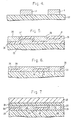
- FIG. 4 depicts the resulting wafer following formation and patterning of the first level interconnect 14.
- the details of the device itself are omitted, it being assumed that the first level interconnect 14 is formed on an inter-level dielectric layer 22.
- the composition and thickness of the inter-level dielectric layer 22 are conventional and hence again do not form a part of the invention.
- the inter-level dielectric layer 22 typically comprises silicon dioxide. Other oxides or other dielectric materials may be used for silicon or other semiconductor devices.
- the dimensions and composition of the first level interconnect 14 and second level interconnect 20, as well as any additional level interconnects 20′ are conventional and well-known to those skilled in this art.
- a first oxide layer 24, is blanket deposited over the entire surface, covering both the first level interconnect 14 and any exposed portions of the inter-level dielectric layer 22.
- the first oxide layer 24 is formed to a thickness ranging from about 6,000 to 8,000 ⁇ .
- the thickness of the first oxide layer 24 is a trade-off between a desire for a thicker layer, and hence increased capacitance between the first level interconnect 14 and the second level interconnect 20, and the desire for a relatively thin layer for reduced process times to etch contact holes and to fill the contact holes with the second level interconnect metal.
- the first oxide layer 24 is formed by PECVD (plasma-enhanced chemical vapor deposition), employing well-known process parameters for the deposition.
- PECVD plasma-enhanced chemical vapor deposition
- the process temperature should be maintained below about 400°C. Any low temperature glass may be employed for this oxide layer 24.
- the metal portions 14 are physically and electrically isolated from each other.
- the coated wafer is planarized back to the metal interconnect surface, denoted 14a, as shown in FIG. 6, employing any of the procedures well-known in the art.
- PECVD oxide layer 24 While it may be advantageous to employ both a PECVD oxide layer 24 and a spin-on glass layer 26, it is not essential to the practice of the invention. Although planarization is facilitated by the combination, it will be appreciated that for openings less than about 0.5 ⁇ m, PECVD is not feasible due to the formation of voids. In such cases, spin-on glass would be used alone.
- the nitride which is conveniently deposited by PECVD, is formed to a thickness of about 400 to 800 ⁇ .
- Other non-conducting materials which would also comprise an etch-stop may be used in place of silicon nitride.
- An inter-level oxide layer 30 is deposited; this layer serves as a patterning layer for the subsequent etching.
- the oxide layer 30 is deposited to a thickness of about 6,000 to 8,000 ⁇ , as with the deposition of layer 24.
- the resulting structure is shown in FIG. 7.
- the oxide layer 30 is then masked with a resist layer (not shown) and etched to form contact holes 10 to the underlying first level interconnect 14.
- the etching is done in two steps. In the first step, the oxide layer 30 is etched, stopping on the underlying nitride layer 28, as depicted in FIG. 8. The nitride layer 28 is then etched, stopping on the underlying oxide 24 and/or metal 14, depending on the placement of the contact holes 10 being etched, as shown in FIG. 9.
- Fluorocarbon plasma etching is advantageously employed in the two-step etching process, since adjustment in chemistry permits selective etching of oxide and then nitride, as is well-known.
- the selectivity of oxide in layer 30 to nitride in layer 28 should be at least about 5:1, in order to allow for a 25% process non-uniformity.
- the selectivity of the nitride in layer 28 to the oxide in layer 24 need only be at least about 3:1, since the nitride layer is much thinner than the oxide layer and thus the percent non-uniformity is smaller.
- the resist layer is then stripped.
- the second level metal layer 20 is then deposited and patterned, as is conventional.
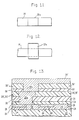
- the resulting two layer metal interconnect fabricated in accordance with the process of the invention is depicted in FIG. 10.
- the advantages provided by the invention include permitting the contact 20a and the first level metal 14 can be of the same size or the contact can be larger than the metal. Thus, as seen in FIGS. 11 and 12, there is no over-etch problem even if the contact 20a is mis-aligned with the metal 14. Also, it will be appreciated that the resulting metal area to form the contact is less than the prior art "dogbone”, or "framed”, contact.
- the etch stop layer 28 prevents the oxide etch (through the oxide 30 between the interconnect levels) from penetrating and forming a gouge 19, as in FIG. 1. This is demonstrated in FIG. 8. Having stopped on the nitride layer 28, the switch to a nitride etch does not etch the underlying oxide layers 24, 26 and prevents the gouge 19 from forming.
- any conducting material may be employed for the first metal layer 14 and the second metal layer 20. While aluminum is conventionally employed in silicon semiconductor devices, other conducting materials, such as tungsten, molybdenum, and others well-known in the art may alternatively be used.
Landscapes
- Internal Circuitry In Semiconductor Integrated Circuit Devices (AREA)
Applications Claiming Priority (2)
| Application Number | Priority Date | Filing Date | Title |
|---|---|---|---|
| US14880388A | 1988-01-27 | 1988-01-27 | |
| US148803 | 1993-11-05 |
Publications (1)
| Publication Number | Publication Date |
|---|---|
| EP0326293A1 true EP0326293A1 (de) | 1989-08-02 |
Family
ID=22527462
Family Applications (1)
| Application Number | Title | Priority Date | Filing Date |
|---|---|---|---|
| EP89300548A Withdrawn EP0326293A1 (de) | 1988-01-27 | 1989-01-20 | Methode zur Ausbildung von Verbindungen |
Country Status (2)
| Country | Link |
|---|---|
| EP (1) | EP0326293A1 (de) |
| JP (1) | JPH0214552A (de) |
Cited By (18)
| Publication number | Priority date | Publication date | Assignee | Title |
|---|---|---|---|---|
| EP0436387A3 (en) * | 1990-01-03 | 1991-10-16 | Hewlett-Packard Company | Single chamber via etch through a dual-layer dielectric |
| US5286674A (en) * | 1992-03-02 | 1994-02-15 | Motorola, Inc. | Method for forming a via structure and semiconductor device having the same |
| EP0568385A3 (en) * | 1992-04-30 | 1994-06-01 | Sgs Thomson Microelectronics | Method for forming contact vias in integrated circuits |
| US5371047A (en) * | 1992-10-30 | 1994-12-06 | International Business Machines Corporation | Chip interconnection having a breathable etch stop layer |
| US5620919A (en) * | 1990-01-12 | 1997-04-15 | Paradigm Technology, Inc. | Methods for fabricating integrated circuits including openings to transistor regions |
| US5656861A (en) * | 1990-01-12 | 1997-08-12 | Paradigm Technology, Inc. | Self-aligning contact and interconnect structure |
| US5702981A (en) * | 1995-09-29 | 1997-12-30 | Maniar; Papu D. | Method for forming a via in a semiconductor device |
| FR2760129A1 (fr) * | 1997-02-21 | 1998-08-28 | United Microelectronics Corp | Procede de formation d'une structure d'interconnexion dans un dispositif a semiconducteurs |
| NL1005911C2 (nl) * | 1997-04-25 | 1998-10-27 | United Microelectronics Corp | Zelf-uitgerichte, niet-gelande doorgangsmetallisatie. |
| WO1999016118A1 (en) * | 1997-09-25 | 1999-04-01 | Advanced Micro Devices, Inc. | Process for fabricating semiconductor device including antireflective etch stop layer |
| GB2330001A (en) * | 1997-10-06 | 1999-04-07 | United Microelectronics Corp | Multilevel interconnect with air dielectric |
| WO1999049508A1 (en) * | 1998-03-27 | 1999-09-30 | Advanced Micro Devices, Inc. | Process for fabricating an integrated circuit with a self-aligned contact |
| DE10046012A1 (de) * | 2000-09-18 | 2002-04-04 | Infineon Technologies Ag | Verfahren zur Bildung eines Kontaktlochs in einer Halbleiterschaltungsanordnung |
| US6441418B1 (en) | 1999-11-01 | 2002-08-27 | Advanced Micro Devices, Inc. | Spacer narrowed, dual width contact for charge gain reduction |
| US6444530B1 (en) | 1999-05-25 | 2002-09-03 | Advanced Micro Devices, Inc. | Process for fabricating an integrated circuit with a self-aligned contact |
| US6551923B1 (en) | 1999-11-01 | 2003-04-22 | Advanced Micro Devices, Inc. | Dual width contact for charge gain reduction |
| DE102007037845A1 (de) * | 2007-03-09 | 2008-09-18 | Mitsubishi Electric Corp. | Magnetorestive Sensorvorrichtung |
| CN104078444B (zh) * | 2013-03-29 | 2017-05-24 | 索尼半导体解决方案公司 | 堆叠结构和制造堆叠结构的方法 |
Families Citing this family (1)
| Publication number | Priority date | Publication date | Assignee | Title |
|---|---|---|---|---|
| JP2000294631A (ja) * | 1999-04-05 | 2000-10-20 | Mitsubishi Electric Corp | 半導体装置及びその製造方法 |
Citations (2)
| Publication number | Priority date | Publication date | Assignee | Title |
|---|---|---|---|---|
| EP0154419A2 (de) * | 1984-02-10 | 1985-09-11 | Fujitsu Limited | Verfahren zum Herstellen einer Verbindungsstruktur von einer Halbleiteranordnung |
| EP0241729A2 (de) * | 1986-03-27 | 1987-10-21 | General Electric Company | Unberandete Kontaktlochverbindung mit dielektrischer Ätzsperre |
-
1989
- 1989-01-20 EP EP89300548A patent/EP0326293A1/de not_active Withdrawn
- 1989-01-23 JP JP1013866A patent/JPH0214552A/ja active Pending
Patent Citations (2)
| Publication number | Priority date | Publication date | Assignee | Title |
|---|---|---|---|---|
| EP0154419A2 (de) * | 1984-02-10 | 1985-09-11 | Fujitsu Limited | Verfahren zum Herstellen einer Verbindungsstruktur von einer Halbleiteranordnung |
| EP0241729A2 (de) * | 1986-03-27 | 1987-10-21 | General Electric Company | Unberandete Kontaktlochverbindung mit dielektrischer Ätzsperre |
Non-Patent Citations (3)
| Title |
|---|
| FOURTH INTERNATIONAL IEEE VLSI MULTILEVEL INTERCONNECTION CONFERENCE, Santa Clara, 15th-16th June 1987, pages 376-384, IEEE, New York, US; R.M. BREWER et al.: "Process window calculations for an SOG etch back process" * |
| IBM TECHNICAL DISCLOSURE BULLETIN, vol. 27, no. 7A, December 1984, pages 3990-3993, New York, US; C. ALCORN et al.: "Self-aligned silicon nitride-polyimide double step via hole" * |
| S.J. MOSS et al.: "The chemistry of the semiconductor industry", 1987, pages 374-378 Blackie & Son, Ltd, Glasgow, London, GB * |
Cited By (23)
| Publication number | Priority date | Publication date | Assignee | Title |
|---|---|---|---|---|
| EP0436387A3 (en) * | 1990-01-03 | 1991-10-16 | Hewlett-Packard Company | Single chamber via etch through a dual-layer dielectric |
| US5620919A (en) * | 1990-01-12 | 1997-04-15 | Paradigm Technology, Inc. | Methods for fabricating integrated circuits including openings to transistor regions |
| US5656861A (en) * | 1990-01-12 | 1997-08-12 | Paradigm Technology, Inc. | Self-aligning contact and interconnect structure |
| US5286674A (en) * | 1992-03-02 | 1994-02-15 | Motorola, Inc. | Method for forming a via structure and semiconductor device having the same |
| EP0568385A3 (en) * | 1992-04-30 | 1994-06-01 | Sgs Thomson Microelectronics | Method for forming contact vias in integrated circuits |
| US5371047A (en) * | 1992-10-30 | 1994-12-06 | International Business Machines Corporation | Chip interconnection having a breathable etch stop layer |
| US6040619A (en) * | 1995-06-07 | 2000-03-21 | Advanced Micro Devices | Semiconductor device including antireflective etch stop layer |
| US5702981A (en) * | 1995-09-29 | 1997-12-30 | Maniar; Papu D. | Method for forming a via in a semiconductor device |
| FR2760129A1 (fr) * | 1997-02-21 | 1998-08-28 | United Microelectronics Corp | Procede de formation d'une structure d'interconnexion dans un dispositif a semiconducteurs |
| NL1005911C2 (nl) * | 1997-04-25 | 1998-10-27 | United Microelectronics Corp | Zelf-uitgerichte, niet-gelande doorgangsmetallisatie. |
| WO1999016118A1 (en) * | 1997-09-25 | 1999-04-01 | Advanced Micro Devices, Inc. | Process for fabricating semiconductor device including antireflective etch stop layer |
| GB2330001A (en) * | 1997-10-06 | 1999-04-07 | United Microelectronics Corp | Multilevel interconnect with air dielectric |
| GB2330001B (en) * | 1997-10-06 | 1999-09-01 | United Microelectronics Corp | Method of forming an integrated circuit device |
| WO1999049508A1 (en) * | 1998-03-27 | 1999-09-30 | Advanced Micro Devices, Inc. | Process for fabricating an integrated circuit with a self-aligned contact |
| US6444530B1 (en) | 1999-05-25 | 2002-09-03 | Advanced Micro Devices, Inc. | Process for fabricating an integrated circuit with a self-aligned contact |
| US6441418B1 (en) | 1999-11-01 | 2002-08-27 | Advanced Micro Devices, Inc. | Spacer narrowed, dual width contact for charge gain reduction |
| US6551923B1 (en) | 1999-11-01 | 2003-04-22 | Advanced Micro Devices, Inc. | Dual width contact for charge gain reduction |
| DE10046012A1 (de) * | 2000-09-18 | 2002-04-04 | Infineon Technologies Ag | Verfahren zur Bildung eines Kontaktlochs in einer Halbleiterschaltungsanordnung |
| DE10046012B4 (de) * | 2000-09-18 | 2005-09-22 | Infineon Technologies Ag | Verfahren zur Bildung eines Kontaktlochs in einer Halbleiterschaltungsanordnung |
| DE102007037845A1 (de) * | 2007-03-09 | 2008-09-18 | Mitsubishi Electric Corp. | Magnetorestive Sensorvorrichtung |
| DE102007037845B4 (de) * | 2007-03-09 | 2009-04-09 | Mitsubishi Electric Corp. | Magnetorestive Sensorvorrichtung |
| US7675286B2 (en) | 2007-03-09 | 2010-03-09 | Mitsubishi Electric Corporation | Magnetoresistive sensor device |
| CN104078444B (zh) * | 2013-03-29 | 2017-05-24 | 索尼半导体解决方案公司 | 堆叠结构和制造堆叠结构的方法 |
Also Published As
| Publication number | Publication date |
|---|---|
| JPH0214552A (ja) | 1990-01-18 |
Similar Documents
| Publication | Publication Date | Title |
|---|---|---|
| US6509623B2 (en) | Microelectronic air-gap structures and methods of forming the same | |
| US6103629A (en) | Self-aligned interconnect using high selectivity metal pillars and a via exclusion mask | |
| US5937324A (en) | Method for forming a line-on-line multi-level metal interconnect structure for use in integrated circuits | |
| US6251790B1 (en) | Method for fabricating contacts in a semiconductor device | |
| EP0534631B1 (de) | Verfahren zur Herstellung von Sacklöchern und hergestellte Struktur | |
| EP1119027B1 (de) | Ein Kondensator für die Integration in einer Kupfer-Damaszen-Struktur und Herstellungsmethode | |
| US6030896A (en) | Self-aligned copper interconnect architecture with enhanced copper diffusion barrier | |
| US5332924A (en) | Semiconductor device and production method thereof | |
| JPH0214552A (ja) | 半導体装置内の下方レベルの金属に接触するように少なくとも1つの付加的なレベルの金属相互接続を形成するための方法 | |
| US4933297A (en) | Method for etching windows having different depths | |
| US5600170A (en) | Interconnection structure of semiconductor device | |
| US6998338B2 (en) | Method of producing an integrated circuit configuration | |
| US5922515A (en) | Approaches to integrate the deep contact module | |
| US6274482B1 (en) | Semiconductor processing methods of forming a contact opening | |
| US5869393A (en) | Method for fabricating multi-level interconnection | |
| US6248636B1 (en) | Method for forming contact holes of semiconductor memory device | |
| US20050151260A1 (en) | Interconnection structure for a semiconductor device and a method of forming the same | |
| US5847457A (en) | Structure and method of forming vias | |
| JPH104092A (ja) | 半導体装置の製造方法 | |
| JPH09129730A (ja) | 半導体装置の製造方法 | |
| KR20010054870A (ko) | 반도체소자의 자기정렬 콘택 구조체를 형성하는 방법 | |
| US6284645B1 (en) | Controlling improvement of critical dimension of dual damasceue process using spin-on-glass process | |
| KR100798270B1 (ko) | 반도체 소자 및 그 제조 방법 | |
| US6207545B1 (en) | Method for forming a T-shaped plug having increased contact area | |
| KR100506050B1 (ko) | 반도체소자의 콘택 형성방법 |
Legal Events
| Date | Code | Title | Description |
|---|---|---|---|
| PUAI | Public reference made under article 153(3) epc to a published international application that has entered the european phase |
Free format text: ORIGINAL CODE: 0009012 |
|
| AK | Designated contracting states |
Kind code of ref document: A1 Designated state(s): AT BE CH DE ES FR GB GR IT LI LU NL SE |
|
| 17P | Request for examination filed |
Effective date: 19891019 |
|
| 17Q | First examination report despatched |
Effective date: 19910503 |
|
| STAA | Information on the status of an ep patent application or granted ep patent |
Free format text: STATUS: THE APPLICATION IS DEEMED TO BE WITHDRAWN |
|
| 18D | Application deemed to be withdrawn |
Effective date: 19911112 |