EP0326421A2 - Elektroanalytisches Verfahren - Google Patents
Elektroanalytisches Verfahren Download PDFInfo
- Publication number
- EP0326421A2 EP0326421A2 EP89300834A EP89300834A EP0326421A2 EP 0326421 A2 EP0326421 A2 EP 0326421A2 EP 89300834 A EP89300834 A EP 89300834A EP 89300834 A EP89300834 A EP 89300834A EP 0326421 A2 EP0326421 A2 EP 0326421A2
- Authority
- EP
- European Patent Office
- Prior art keywords
- working electrode
- electrode
- sample
- substance
- electrolyte
- Prior art date
- Legal status (The legal status is an assumption and is not a legal conclusion. Google has not performed a legal analysis and makes no representation as to the accuracy of the status listed.)
- Granted
Links
Images
Classifications
-
- G—PHYSICS
- G01—MEASURING; TESTING
- G01N—INVESTIGATING OR ANALYSING MATERIALS BY DETERMINING THEIR CHEMICAL OR PHYSICAL PROPERTIES
- G01N27/00—Investigating or analysing materials by the use of electric, electrochemical, or magnetic means
- G01N27/26—Investigating or analysing materials by the use of electric, electrochemical, or magnetic means by investigating electrochemical variables; by using electrolysis or electrophoresis
- G01N27/28—Electrolytic cell components
- G01N27/30—Electrodes, e.g. test electrodes; Half-cells
- G01N27/327—Biochemical electrodes, e.g. electrical or mechanical details for in vitro measurements
- G01N27/3271—Amperometric enzyme electrodes for analytes in body fluids, e.g. glucose in blood
Definitions
- This invention relates to an electroanalytical method of subjecting a substance to be determined to a determination based on change in the electrical voltage, electrical current or electrical quantity in the process of electrolysis of the substance.
- Electrochemically analytical method has recently been broadened in its utilization fields such as the so-called biosensor, liquid-chromatographic detector, etc.
- Conventional methods for detecting specimens according to electroanalytical method include a method of immersing an electrode as a detecting part such as ion selective electrode, biological electrode, etc. in a sample solution, a method of forcibly flowing a sample solution inside a working electrode as in the case of chromatographical detector or flow injection detector, and a method of directly feeding a sample into an electrolyte as in the case of Karl Fischer method for moisture determination.
- the present inventors have noted that among the period of the analytical time in the electroanalysis, the time required for washing the detector is considerably long and when the measurement is carried out while the electrolyte flows as it is, the background or noise level due to the uncontrolled flow rate becomes so relatively high that the detection limit value increases.
- the present invention provides: an electroanalytical method which comprises providing an electrolytic cell containing a working electrode chamber and a counter electrode chamber adjacent thereto by the medium of a separator electrolyzing a sample to be determined, by directly feeding it to a working electrode contained in said working electrode chamber and consisting of an electroconductive porous body impregnated with an electrolyte in a non-flowing state, and measuring at least one of the electric voltage, electric current and electrical quantity in said detecting electrode, to determine said substance to be determined in said sample.
- the present inventors have found that when an electrode consisting of an electroconductive porous body is impregnated with an electrolyte to such an extent that it does not flow out of the body and a sample is directly fed to the electrode to carry out electrolysis, then it is possible to effect the analysis rapidly and with a high accuracy.
- the resulting electrical change in quantity i.e. change in the electric voltage, electric current or electrical quantity is related to the quantity of the substance electrolyzed; hence it is possible to determine the substance to be determined, by measuring the electrical quantity changed at the time of the electrolysis.
- an ion-exchange membrane may be used as the separator.
- a mere porous membrane may also be used, but in order to reduce the background level, it is preferred to use a highly electroconductive ion-exchange membrane.
- an aggregate of carbonaceous or graphitic carbon fibers or a porous carbon on the surface of which an element heavier than carbon is present in 1.5% or more in terms of the proportion of numbers of the surface elements as measured according to ESCA (photoelectric spectrophotometry).
- ESCA photoelectric spectrophotometry
- the element made coexistent with carbon is introduced onto the surface of the detecting electrode in the form of a carbide or some other compound of silicon or other elements including those of group V, group VI and group VII of the Periodio Table, whereby the dispersibility of the sample solution is improved and at the same time, in the electrolytic reaction, an electron transfer reaction between the working electrode and the substance to be electrolyzed is rapidly carried out.
- Materials for the working electrode and materials for current-collecting gauze are important to be chemically stable; for example, nickel gauze, sintered porous nickel, etc. may be used in an alkaline electrolyte and materials of noble metals such as platinum may be used in various kinds of electrolytes, but these materials are often inferior in the dispersibility and seizability of the sample solution to the above carbon fibers or porous carbon.
- the shape of the working electrode is preferred to be a shape larger than a disk having a thickness of 1.5 mm or more and a diameter of 10 mm, whereby a sufficient volume for diffusing the sample solution is secured so that the sample solution is able to diffuse rapidly. If the thickness is less than 1.5 mm or the diameter is less than 10 mm, the electrode volume is insufficient so that the dropped sample is impossible to diffuse rapidly and uniformly and hence the time required for the analysis is in vain prolonged and the response curve is disturbed to make the analysis troublesome.
- a lead wire is usually taken out of a current-collecting metal gauze, and in the case of analysis wherein only a relatively low current flows, it is possible to extend the detecting electrode as it is, to the outer part of the cell to collect current, or it is also possible to make arranged carbon fibers a current-collecting cloth or a lead filament.
- electrolyte used in the present invention various pH buffer solutions are enumerated, and materials obtained by dissolving or dispersing therein, e.g. iodide compounds represented by KI, metal complexes of iron, cobalt, molybdenum, etc., complex ligands of halogen ions, aminocarboxylic acids, enzymes, etc. may also be used.
- iodide compounds represented by KI metal complexes of iron, cobalt, molybdenum, etc.
- complex ligands of halogen ions aminocarboxylic acids, enzymes, etc.
- a redox mediator and/or an auxiliary which can convert the substance to be determined into an active substance to the electrode reaction such as enzymes, coexistent in the electrolyte by dispersing or fixing it.
- the redox mediators are halogen ion/halogen system, hydroquinones/quinones system, (e.g. naphthoquinonesulfonic acid), polyvalent metal ions, etc.
- Enzymes include those which react with the substance to be determined to generate hydrogen peroxide as in the case of glucose, and besides those which form an active substance to the working electrode by the medium of redox mediators.
- an inert gas such as nitrogen
- an inert gas-flowing-in port provided in the sample-feeding tube
- Renewal of the electrolyte may be carried out through the electrolyte-flowing-in tube and the electrolyte-flowing-out tube each connected to the working electrode chamber.
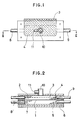
- Fig. 1 shows a view illustrating an embodiment of a detector (electrolytic cell) used in the present invention
- Fig. 2 shows a cross-sectional view of Fig. 1 in the direction along a II-II line indicated by arrow marks.
- the electrolytic cell is composed of a separator 1 and a working electrode chamber 4 and an counter electrode chamber 7 respectively provided on both the sides of separator 1, placing the separator between these chambers; a working electrode 2 consisting of an electroconductive porous body is filled in a working electrode chamber 4 and also a current-collecting metal wire gauze 3 is contained therein; and a sample-feeding tube 10 provided with an inert gas-flowing-in port 11 is connected to the chamber.
- a counter electrode chamber 7 are contained a counter electrode 5 consisting of an electroconductive porous body and a current-collecting plate 6 consisting of a carbon plate.
- numerals 8 and 9 show an electrolyte-flowing-in tube and an electrolyte-flowing-out tube each connected to the working electrode chamber and the counter electrode chamber.
- a smaple containing a substance to be determined is fed onto the detecting electrode 2 impregnated with an electrolyte through the sample-feeding tube 10 by means of a quantitative pipette or the like; electrolyzed; and determined by measuring at least one of the electric voltage, electric current and electrical quantity in the working electrode 2.
- the present invention is applied to various coulometric, amperometric and voltammetric analyses for substances in water, food, blood, chemical products, etc.
- An electrolytic cell as a detector was formed using a polystyrenesulfonic acid membrane as the separator 1, a material obtained by feeding oxygen onto the surface of a polyacrylonitrile fiber based carbon felt obtained by baking at 1,400°C and having a proportion of numbers of the surface elements, 0/C of 1.7% measured according to ESCA as the working electrode 2 and the counter electrode 5 and a platinum gauze as the current-collecting metal gauze 3, respectively.
- a once analytical time according to the method of the present invention was about 1/30 -1/40 that of orthotolidine method.
- Example 2 Using the same detector and electrolytes as those in Example 1, the respective CCl4 solutions of a glycerol oleate just after opening of a sealed vessel thereof and those after opening of the vessel and exposed to direct sunlight for 3 hours were fed onto the detector 2 by means of a quantitative pipette to detect lipid hydroperoxid peroxides in the glycerol oleate.
- the peak value of the reduction current in the working electrode 2 obtained by adding the glycerol oleate just after the opening was about 15 ⁇ A and almost unchanged from that of the background level, whereas the peak value of the glycerol oleate after allowed to stand for 3 hours amounted to 250 ⁇ A. This tendency accorded with the results of the measurement method of peroxides in food analysis.
- Example 2 was repeated except that a polyolefin microporous membrane was used as the separator and the O/C value on the surface of the detecting electrode according to ESCA was made about 1%, to detect the lipid peroxide.
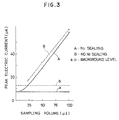
- Oxygen dissolved in water was detected using the detector of Example 1; using a phosphoric acid-sodium phosphate aqueous solution (pH: 5.5) of 0.2M-ethylenediaminetetracarbonatoiron (II) as the working electrolyte and a phosphoric acid-sodium phosphate aqueous solution of KI-I2 as the counter electrode solution, making the potential of the working electrode -0.65V vs. the counter electrode; and further introducing nitrogen gas through an inert gas-introducing port.
- the sample volumes at four stages were 10 ⁇ l, 25 ⁇ l, 50 ⁇ l and 100 ⁇ l, respectively, and the peak current values at the respective stages were measured.
- An electrolytic cell was formed using a sulfonic acid cationic ion-exchange membrane using a polyolefin as its substrate; nitrogen as a sealing inert gas; a carbon felt electrode having a proportion of numbers of the surface electments 0/C of 5% and that having a proportion of numbers of the surface elements Cl/C of 3%, as the working electrode 2 and as the counter electrode 5, respectively; and a graphite plate as the current-collecting plate 6 of the counter electrode 5.
- the determination results have a high repetition accuracy and also a high reliability.
- Example 2 A quantitative analysis was carried out under the same conditions as in Example 1 except that sealing nitrogen gas feed was stopped. As a result, the analytical value was abnormally large, there was no reproducibility and determination was impossible.
- Example 2 A quantitative analysis was carried out under the same conditions as in Example 1 except that electrolysis was carried out while passing the electrolyte as it was. As a result, the background current rose up to a value close to two figures and was unstabilized so that the analytical accuracy lowered notably. This is considered due to the fact that cross mixing of the electrolytes through the separator increased.
- Example 4 The determination in Example 4 was carried out according to a constant-current method of seeking the endpoint from change in the potential. As a result, the determination could be carried out with an accuracy almost same with that in the case of controlled potential coulometry.
- An electrolytic cell was constructed using a polystyrenesulfonic acid cation-exchange membrane as the separator 1, a carbonaceous carbon felt having the same properties as those of the felt used in Example 4 as the working electrode 2, a stainless mesh as the current-collecting metal gauze 3 for the working electrode 2 and a graphite plate as the current-collecting plate 6 for the counter electrode 5, respectively, and as a substance for exchanging the substance to be determined with the electroactive substance, immobilized enzyme (glucose oxidase) glass beads were dispersed in the working electrode 2.
- electrolyte for the working electrode 2
- an electrolyte having KI added to a buffer solution having a pH of 5.8 was used and on the other hand, as the solution for the counter electrode, as 0.5M-KI aqueous solution of a pH of 4 was used, and these solutions were sometimes exchanged with a fresh solution, respectively.
- Glucose was detected using the above-mentioned electrolytic cell, making the potential of the working electrode -0.65V vs. the counter electrode and pouring an aqueous solution of 0.1% by weight glucose (25 ⁇ l) as a sample in the working electrode.
- the background current was about 10 ⁇ A, but the observed value was smaller by about 25% that the theoretical electrical quantity. This was due to glucose isomer; thus by adding mutarotase (Aldose-1-epimerase) capable of converting ⁇ -D-glucose into ⁇ -glucose to function, determination just as in the theoretical electrical quantity became possible.
- mutarotase Aldose-1-epimerase
- the measurement time is shortened and also operation is simplified as compared with other conventional spectrophotometric enzymic method.
- the concentration of L-ascorbic acid of reduced type in various foods were measured according to controlled potential coulometry using ferricyan ion as oxidation mediator.
- the construction of the detector was made as follows working electrode: a carbon felt of 38 mm ⁇ in diameter and 3 mm thick which was made from polyacrylonitrile fibers was impregnated with a buffer solution of phosphoric acid-sodium phosphate (pH 4) containing saturated potassium ferricyanate at room temperature, counter electrode: same as the detector, separator: cation-exchange membrane (Naphion 117 trademark of Du Pont Co.)
- Juice sample was used as it was or diluted with distilled water and dropwise fed onto the working electrode by means of a 10 ⁇ l quantitative pipette.
- the squeezed juice was filtered through a 0.45 ⁇ m filter and then similarly fed onto the working electrode by means of a 10 ⁇ l quantitative pipette.
- Analytical results according to the present method and comparative methods are shown in Table 3.
- Table 3 Sample Present method Indophenol method Liquid chromatography (HPLC) Lemon soft drink 182mgl ⁇ 1 191mgl ⁇ 1 Grape fruit juice 257mgl ⁇ 1 249mgl ⁇ 1 Orange 2.0 2.2 Tomato 1.9 1.8
- the respective serum samples of human being, horse and bovin were measured using commercially available abbreviated analysis kits (free cholesterol "Free-Cholesterol C-test, Wako” and total cholesterol “Cholesterol C-test, Wako”).
- free cholesterol it is possible to easily prepare a standard solution, and with standard solutions of 1 ⁇ 10 ⁇ 3M and 1 ⁇ 10 ⁇ 4M, the differences between the measured values in the case of the present method and the calculated values according to weight method were 3% or less.
- a carbon felt working electrode of 38 mm in diameter an 3 mm thick was impregnated with ascorbic acid oxidase and KI, and a current under which iodine formed by air oxidation was electrolytically reduced was measured followed by feeding a sample containing vitamin C (L-ascorbic acid of reduced type) to the working electrode and measuting lowering of the reduction current caused by the oxygen consumption reaction to thereby determine vitamin C.
- vitamin C L-ascorbic acid of reduced type
- the enzyme was immobilized according to two method. According to one of them, a polyacrylamide derivative to be dispersed in the working electrode was diazotized with nitrous acid and ascorbic acid oxidase was immobilized by subjecting the resulting material to coupling reaction with the derivative. According to the other method, the carbon felt electrode was nitrated, followed by aminating the resulting material through reduction and carrying out diazo-coupling as described above to effect immobilizing.
- the present invention it is possible to detect and determine a substance to be determined in a short time and with stability and also to simplify the flow line of the whole of the equipment. Further, it is possible to very easily carry out the determination of enzyme activity for clinical inspections.
- the preferred embodiments of the present invention can provide an electronanalytical method which can solve the above-mentioned problems of the prior art and has high accuracy and superior operability than the prior art methods.
Landscapes
- Health & Medical Sciences (AREA)
- Chemical & Material Sciences (AREA)
- Life Sciences & Earth Sciences (AREA)
- Analytical Chemistry (AREA)
- General Health & Medical Sciences (AREA)
- Chemical Kinetics & Catalysis (AREA)
- Electrochemistry (AREA)
- Physics & Mathematics (AREA)
- Hematology (AREA)
- Biochemistry (AREA)
- Molecular Biology (AREA)
- General Physics & Mathematics (AREA)
- Immunology (AREA)
- Pathology (AREA)
- Measuring Or Testing Involving Enzymes Or Micro-Organisms (AREA)
- Investigating Or Analysing Biological Materials (AREA)
- Investigating Or Analyzing Materials By The Use Of Electric Means (AREA)
- Investigating Or Analyzing Non-Biological Materials By The Use Of Chemical Means (AREA)
Applications Claiming Priority (2)
| Application Number | Priority Date | Filing Date | Title |
|---|---|---|---|
| JP63018696A JP2633280B2 (ja) | 1988-01-29 | 1988-01-29 | 電気分析方法 |
| JP18696/88 | 1988-01-29 |
Publications (3)
| Publication Number | Publication Date |
|---|---|
| EP0326421A2 true EP0326421A2 (de) | 1989-08-02 |
| EP0326421A3 EP0326421A3 (en) | 1990-07-04 |
| EP0326421B1 EP0326421B1 (de) | 1994-10-05 |
Family
ID=11978791
Family Applications (1)
| Application Number | Title | Priority Date | Filing Date |
|---|---|---|---|
| EP89300834A Expired - Lifetime EP0326421B1 (de) | 1988-01-29 | 1989-01-27 | Elektroanalytisches Verfahren |
Country Status (4)
| Country | Link |
|---|---|
| US (1) | US5059290A (de) |
| EP (1) | EP0326421B1 (de) |
| JP (1) | JP2633280B2 (de) |
| DE (1) | DE68918602T2 (de) |
Cited By (5)
| Publication number | Priority date | Publication date | Assignee | Title |
|---|---|---|---|---|
| US5480808A (en) * | 1994-01-31 | 1996-01-02 | The Unversity Of Dayton | Voltammetric method for measuring peroxide concentration in hydrocarbon fuels |
| WO1996001422A1 (en) * | 1994-07-05 | 1996-01-18 | Unilever Plc | Improvements in or relating to electrochemical measurements |
| US5496521A (en) * | 1991-02-15 | 1996-03-05 | Avl Medical Instruments Ag | Analyzing device including an ion-permeable channel connecting a sample chamber with a reaction space |
| EP1672362A1 (de) * | 2004-12-14 | 2006-06-21 | Mocon, Inc. | Coulometrischer Wasserdampfsensor |
| US7624622B1 (en) | 2006-05-26 | 2009-12-01 | Mocon, Inc. | Method of measuring the transmission rate of a permeant through a container and determining shelf life of a packaged product within the container |
Families Citing this family (9)
| Publication number | Priority date | Publication date | Assignee | Title |
|---|---|---|---|---|
| JPH0769304B2 (ja) * | 1989-12-26 | 1995-07-26 | 三井造船株式会社 | 電気分析用検出器 |
| JP2526298B2 (ja) * | 1990-04-16 | 1996-08-21 | 三井造船株式会社 | 電量分析用セル |
| US5262034A (en) * | 1992-10-23 | 1993-11-16 | International Fuel Cells Corporation | Electrochemical sensor for monitoring electrochemical potentials of fuel cell components |
| EP0600607A3 (en) * | 1992-10-28 | 1996-07-03 | Nakano Vinegar Co Ltd | Coulometric analysis method and a device therefor. |
| GB9226840D0 (en) * | 1992-12-23 | 1993-02-17 | Unilever Plc | Improvements in or relating to electrochemical reactions |
| AU6157898A (en) | 1997-02-06 | 1998-08-26 | E. Heller & Company | Small volume (in vitro) analyte sensor |
| US6338790B1 (en) | 1998-10-08 | 2002-01-15 | Therasense, Inc. | Small volume in vitro analyte sensor with diffusible or non-leachable redox mediator |
| US7590260B2 (en) * | 2003-09-25 | 2009-09-15 | Siemens Aktiengesellschaft | Method and apparatus for video coding by validation matrix |
| JP5710345B2 (ja) * | 2011-03-31 | 2015-04-30 | ペルメレック電極株式会社 | 酸化性物質の総濃度測定方法、酸化性物質の総濃度測定用濃度計およびそれを用いた硫酸電解装置 |
Family Cites Families (15)
| Publication number | Priority date | Publication date | Assignee | Title |
|---|---|---|---|---|
| US3291705A (en) * | 1961-05-05 | 1966-12-13 | Paul A Hersch | Method and apparatus for analyzing gas |
| US3315271A (en) * | 1964-04-16 | 1967-04-18 | Beckman Instruments Inc | Cell for dissolved oxidant analysis |
| US3296113A (en) * | 1963-10-15 | 1967-01-03 | Union Carbide Corp | Gas-stream monitor |
| US3846270A (en) * | 1969-05-16 | 1974-11-05 | Hitachi Ltd | Detector cell for coulometric analysis |
| JPS5114040B1 (de) * | 1969-05-16 | 1976-05-06 | ||
| AT316901B (de) * | 1971-02-01 | 1974-08-12 | Heinzgert Ammer | Verfahren zur Bestimmung des pH-Wertes in wässerigen Lösungen, Rohwasser oder aufbereitetem und entsalztem Wasser |
| JPS5221396B1 (de) * | 1971-03-19 | 1977-06-10 | ||
| US3926764A (en) * | 1971-05-19 | 1975-12-16 | Radiometer As | Electrode for potentiometric measurements |
| JPS4854987A (de) * | 1971-11-06 | 1973-08-02 | ||
| JPS49123098A (de) * | 1973-03-28 | 1974-11-25 | ||
| US4214968A (en) * | 1978-04-05 | 1980-07-29 | Eastman Kodak Company | Ion-selective electrode |
| JPS6053842A (ja) * | 1983-09-05 | 1985-03-27 | Hitachi Ltd | 流通式電解セル |
| US4533456A (en) * | 1984-04-05 | 1985-08-06 | Critikon | Oxygen sensor for rapid blood gas analysis |
| JPH0623730B2 (ja) * | 1984-11-22 | 1994-03-30 | 三井造船株式会社 | 電量分析法 |
| WO1987003624A1 (en) * | 1985-12-12 | 1987-06-18 | Gordon George Wallace | An electrochemical sampling device |
-
1988
- 1988-01-29 JP JP63018696A patent/JP2633280B2/ja not_active Expired - Lifetime
-
1989
- 1989-01-25 US US07/301,792 patent/US5059290A/en not_active Expired - Lifetime
- 1989-01-27 DE DE68918602T patent/DE68918602T2/de not_active Expired - Fee Related
- 1989-01-27 EP EP89300834A patent/EP0326421B1/de not_active Expired - Lifetime
Cited By (8)
| Publication number | Priority date | Publication date | Assignee | Title |
|---|---|---|---|---|
| US5496521A (en) * | 1991-02-15 | 1996-03-05 | Avl Medical Instruments Ag | Analyzing device including an ion-permeable channel connecting a sample chamber with a reaction space |
| US5480808A (en) * | 1994-01-31 | 1996-01-02 | The Unversity Of Dayton | Voltammetric method for measuring peroxide concentration in hydrocarbon fuels |
| WO1996001422A1 (en) * | 1994-07-05 | 1996-01-18 | Unilever Plc | Improvements in or relating to electrochemical measurements |
| US5597463A (en) * | 1994-07-05 | 1997-01-28 | Van Den Bergh Foods Co., Division Of Conopco, Inc. | Device for electrochemical measurements |
| EP1672362A1 (de) * | 2004-12-14 | 2006-06-21 | Mocon, Inc. | Coulometrischer Wasserdampfsensor |
| EP1798547A1 (de) * | 2004-12-14 | 2007-06-20 | Mocon, Inc. | Coulometrischer Wasserdampfsensor |
| US7569128B2 (en) | 2004-12-14 | 2009-08-04 | Mocon, Inc. | Coulometric water vapor sensor |
| US7624622B1 (en) | 2006-05-26 | 2009-12-01 | Mocon, Inc. | Method of measuring the transmission rate of a permeant through a container and determining shelf life of a packaged product within the container |
Also Published As
| Publication number | Publication date |
|---|---|
| EP0326421B1 (de) | 1994-10-05 |
| EP0326421A3 (en) | 1990-07-04 |
| DE68918602T2 (de) | 1995-03-23 |
| JP2633280B2 (ja) | 1997-07-23 |
| US5059290A (en) | 1991-10-22 |
| DE68918602D1 (de) | 1994-11-10 |
| JPH01195358A (ja) | 1989-08-07 |
Similar Documents
| Publication | Publication Date | Title |
|---|---|---|
| US5842983A (en) | Biosensor | |
| Durliat et al. | Spectrophotometric and electrochemical determinations of L (+)-lactate in blood by use of lactate dehydrogenase from yeast. | |
| Blaedel et al. | Reagentless enzyme electrodes for ethanol, lactate, and malate | |
| US4356074A (en) | Substrate specific galactose oxidase enzyme electrodes | |
| Shankaran et al. | Characterization and application of an electrode modified by mechanically immobilized copper hexacyanoferrate | |
| CA1239663A (en) | Electrochemical system with rotating electrode/sparger assembly | |
| US5059290A (en) | Electroanalytical method | |
| CN105572199A (zh) | 工作电极生物反应物及电极式测试条 | |
| US20240264111A1 (en) | Electrochemical reaction device and method for electrochemically analyzing glucose | |
| EP0289345A1 (de) | Ampérometrische Methode zur Titration von NADH (1,4 dihydronicotinamid-adenine-dinucleotide) in Lösung | |
| Schick et al. | Amperometric nonenzymatic determination of serum glucose by means of a nickel-catalyst electrode. | |
| Naik et al. | Surfactant induced iron (II) phthalocyanine modified carbon paste electrode for simultaneous detection of ascorbic acid, dopamine and uric acid | |
| Durliat et al. | Investigation of electron transfer between platinum and large biological molecules by thin-layer spectroelectrochemistry | |
| US5378332A (en) | Amperometric flow injection analysis biosensor for glucose based on graphite paste modified with tetracyanoquinodimethane | |
| Hu et al. | Development of a hypoxanthine biosensor based on immobilized xanthine oxidase chemically modified electrode | |
| Milardović et al. | Rapid determination of oxalate by an amperometric oxalate oxidase‐based electrode | |
| Laurinavicius et al. | Bioelectrochemical conversion of urea on carbon black electrode and application | |
| Durliat et al. | Amperometric enzyme electrode for determination of glucose based on thin-layer spectroelectrochemistry of glucose oxidase | |
| Salimi et al. | Disposable amperometric sensor for neurotransmitters based on screen-printed electrodes modified with a thin iridium oxide film | |
| Berisha et al. | A new biosensor for glucose based on screen printed carbon electrodes modified with tin (IV)-oxide | |
| US20240252072A1 (en) | Treatment device using reaction system containing oxidoreductase and co-enzyme, and method for controlling same | |
| Shaidarova et al. | Electrocatalytic determination of oxalate ions on chemically modified electrodes | |
| Lobo et al. | Flow‐injection analysis of ethanol with an alcohol dehydrogenase‐modified carbon past electrode | |
| Shankaran et al. | Evaluation of a mechanically immobilized nickel hexacyanoferrate electrode as an amperometric sensor for thiosulfate determination | |
| Backofen et al. | Determination of cyanide in microsamples by means of capillary flow injection analysis with amperometric detection |
Legal Events
| Date | Code | Title | Description |
|---|---|---|---|
| PUAI | Public reference made under article 153(3) epc to a published international application that has entered the european phase |
Free format text: ORIGINAL CODE: 0009012 |
|
| AK | Designated contracting states |
Kind code of ref document: A2 Designated state(s): CH DE FR GB LI |
|
| PUAL | Search report despatched |
Free format text: ORIGINAL CODE: 0009013 |
|
| AK | Designated contracting states |
Kind code of ref document: A3 Designated state(s): CH DE FR GB LI |
|
| 17P | Request for examination filed |
Effective date: 19901116 |
|
| 17Q | First examination report despatched |
Effective date: 19920527 |
|
| GRAA | (expected) grant |
Free format text: ORIGINAL CODE: 0009210 |
|
| AK | Designated contracting states |
Kind code of ref document: B1 Designated state(s): CH DE FR GB LI |
|
| REF | Corresponds to: |
Ref document number: 68918602 Country of ref document: DE Date of ref document: 19941110 |
|
| ET | Fr: translation filed | ||
| PLBE | No opposition filed within time limit |
Free format text: ORIGINAL CODE: 0009261 |
|
| STAA | Information on the status of an ep patent application or granted ep patent |
Free format text: STATUS: NO OPPOSITION FILED WITHIN TIME LIMIT |
|
| 26N | No opposition filed | ||
| PGFP | Annual fee paid to national office [announced via postgrant information from national office to epo] |
Ref country code: FR Payment date: 19961218 Year of fee payment: 9 |
|
| PGFP | Annual fee paid to national office [announced via postgrant information from national office to epo] |
Ref country code: GB Payment date: 19970114 Year of fee payment: 9 |
|
| PGFP | Annual fee paid to national office [announced via postgrant information from national office to epo] |
Ref country code: CH Payment date: 19970115 Year of fee payment: 9 |
|
| PGFP | Annual fee paid to national office [announced via postgrant information from national office to epo] |
Ref country code: DE Payment date: 19970220 Year of fee payment: 9 |
|
| PG25 | Lapsed in a contracting state [announced via postgrant information from national office to epo] |
Ref country code: GB Free format text: LAPSE BECAUSE OF NON-PAYMENT OF DUE FEES Effective date: 19980127 |
|
| PG25 | Lapsed in a contracting state [announced via postgrant information from national office to epo] |
Ref country code: LI Free format text: LAPSE BECAUSE OF NON-PAYMENT OF DUE FEES Effective date: 19980131 Ref country code: FR Free format text: THE PATENT HAS BEEN ANNULLED BY A DECISION OF A NATIONAL AUTHORITY Effective date: 19980131 Ref country code: CH Free format text: LAPSE BECAUSE OF NON-PAYMENT OF DUE FEES Effective date: 19980131 |
|
| REG | Reference to a national code |
Ref country code: CH Ref legal event code: PL |
|
| GBPC | Gb: european patent ceased through non-payment of renewal fee |
Effective date: 19980127 |
|
| PG25 | Lapsed in a contracting state [announced via postgrant information from national office to epo] |
Ref country code: DE Free format text: LAPSE BECAUSE OF NON-PAYMENT OF DUE FEES Effective date: 19981001 |
|
| REG | Reference to a national code |
Ref country code: FR Ref legal event code: ST |