EP0326484A2 - Elektrochemischer Generator mit elektronisch leitendem Polymer der Polypyrrolgruppe als Kathode und Behandlungsverfahren zur Verbesserung der Kapazität pro Masseneinheit dieser Kathode - Google Patents
Elektrochemischer Generator mit elektronisch leitendem Polymer der Polypyrrolgruppe als Kathode und Behandlungsverfahren zur Verbesserung der Kapazität pro Masseneinheit dieser Kathode Download PDFInfo
- Publication number
- EP0326484A2 EP0326484A2 EP89400201A EP89400201A EP0326484A2 EP 0326484 A2 EP0326484 A2 EP 0326484A2 EP 89400201 A EP89400201 A EP 89400201A EP 89400201 A EP89400201 A EP 89400201A EP 0326484 A2 EP0326484 A2 EP 0326484A2
- Authority
- EP
- European Patent Office
- Prior art keywords
- cathode
- electrochemical generator
- alkali metal
- potential
- sulfite
- Prior art date
- Legal status (The legal status is an assumption and is not a legal conclusion. Google has not performed a legal analysis and makes no representation as to the accuracy of the status listed.)
- Withdrawn
Links
Images


Classifications
-
- H—ELECTRICITY
- H01—ELECTRIC ELEMENTS
- H01M—PROCESSES OR MEANS, e.g. BATTERIES, FOR THE DIRECT CONVERSION OF CHEMICAL ENERGY INTO ELECTRICAL ENERGY
- H01M10/00—Secondary cells; Manufacture thereof
- H01M10/05—Accumulators with non-aqueous electrolyte
-
- H—ELECTRICITY
- H01—ELECTRIC ELEMENTS
- H01M—PROCESSES OR MEANS, e.g. BATTERIES, FOR THE DIRECT CONVERSION OF CHEMICAL ENERGY INTO ELECTRICAL ENERGY
- H01M4/00—Electrodes
- H01M4/02—Electrodes composed of, or comprising, active material
- H01M4/36—Selection of substances as active materials, active masses, active liquids
- H01M4/60—Selection of substances as active materials, active masses, active liquids of organic compounds
-
- Y—GENERAL TAGGING OF NEW TECHNOLOGICAL DEVELOPMENTS; GENERAL TAGGING OF CROSS-SECTIONAL TECHNOLOGIES SPANNING OVER SEVERAL SECTIONS OF THE IPC; TECHNICAL SUBJECTS COVERED BY FORMER USPC CROSS-REFERENCE ART COLLECTIONS [XRACs] AND DIGESTS
- Y02—TECHNOLOGIES OR APPLICATIONS FOR MITIGATION OR ADAPTATION AGAINST CLIMATE CHANGE
- Y02E—REDUCTION OF GREENHOUSE GAS [GHG] EMISSIONS, RELATED TO ENERGY GENERATION, TRANSMISSION OR DISTRIBUTION
- Y02E60/00—Enabling technologies; Technologies with a potential or indirect contribution to GHG emissions mitigation
- Y02E60/10—Energy storage using batteries
-
- Y—GENERAL TAGGING OF NEW TECHNOLOGICAL DEVELOPMENTS; GENERAL TAGGING OF CROSS-SECTIONAL TECHNOLOGIES SPANNING OVER SEVERAL SECTIONS OF THE IPC; TECHNICAL SUBJECTS COVERED BY FORMER USPC CROSS-REFERENCE ART COLLECTIONS [XRACs] AND DIGESTS
- Y02—TECHNOLOGIES OR APPLICATIONS FOR MITIGATION OR ADAPTATION AGAINST CLIMATE CHANGE
- Y02P—CLIMATE CHANGE MITIGATION TECHNOLOGIES IN THE PRODUCTION OR PROCESSING OF GOODS
- Y02P70/00—Climate change mitigation technologies in the production process for final industrial or consumer products
- Y02P70/50—Manufacturing or production processes characterised by the final manufactured product
Definitions
- the subject of the invention is an electrochemical generator using an electronic conductive polymer belonging to the polypyrrole group as a cathode.
- Electrochemical cells using electronic conductive polymers as the active electrode material have been described in numerous publications.
- European patents EP-A-143 966 and 49 970 describe batteries in which various polymers can be used, for example polyacetylene, as active material of positive or negative electrode with electrolytes based on alkali metal salts in solution in an organic solvent which can belong to different groups such as carbonates, nitriles, organosulfur compounds, organophosphorus compounds and esters.
- Electrochemical generators of the same type are also known in which the cathode is a pyrolytic graphite compound or a fluorographite as described in American patents US-A-3,844,837 and US-A-3,985,577.
- this graphite cathode with a lithium anode using as electrolyte a solution of lithium salt in an organic solvent, which is lithium hexafluoroarsenate in dimethyl sulfite, in the case of US patent 3,985,577.
- the energy performance of cathodes of conductive polymer depends on the electrolyte used, in particular on the solvent.
- a solvent formed from molecules of small dimensions a mass energy is obtained which is greater than that provided when a solvent whose molecules have a larger size is used.
- the polypyrrole increases the mass capacity of the cathode by about 20%.
- ethylene carbonate instead of propylene carbonate, an increase in the energy performance of the polypyrrole is obtained on the order of 20 to 30%.
- the mass energy that can be extracted from cathodes made of conductive polymer such as polypyrroles remains limited to values between 80 and 140 Ah / kg of electrode in the best cases. This is due to the fact that the redox reaction of the cathode is accompanied by a phenomenon of insertion and disinsertion of the negative anion originating from the electrolyte (for example ClO4 ⁇ ) surrounded by its procession of molecules solvent. Given the molecular weight of these anions, the total number of ions that can fit into the polymer is limited. It appeared that one could insert for example into the polypyrrole at most two ClO4 ⁇ ions for three pyrrole patterns, and this introduces a limitation of the mass capacity of the electrode.
- the electrolyte for example ClO4 ⁇
- this redox mechanism of conductive polymers is characterized by a quasi-linear increase in the doping rate as a function of the potential of the electrode during charging.
- the discharge curves of these electrodes (potential as a function of time) have a roughly linear decreasing part with a fairly weak discharge voltage level, which limits the mass capacity of the electrode, as it appears in the document J. of the Electrochem. Soc., 133, n ° 6 (June 1986), p. 1073-1079.
- EP-A-0 143 966 has also described electrochemical cells comprising a conjugated polymer anode which has been coated, in a reduced state, by contact with a monomer comprising a reactive oxirane group and which can be associated with various cathodes and various electrolytes including dimethyl sulfite and propylene carbonate.
- the present invention specifically relates to an electrochemical generator using as cathode an electronic conductive polymer belonging to the group of polypyrrole, which makes it possible to obtain energy performances clearly superior to those which are obtained with the electrochemical generators described above.
- this electrochemical generator comprises a cathode, an anode and an electrolyte constituted by a solution of an alkali metal salt in an organic solvent comprising a dialkyl sulfite or an ethylene sulfite, and it is characterized in that that the cathode comprises an electronic conductive organic polymer chosen from polymers and copolymers of pyrrole and substituted pyrrole derivatives, the cathode containing in reduced form the alkali metal salt of the electrolyte and having, during the discharge of the current generator constant, a plateau of discharge potential.
- dialkyl sulfites used are preferably dialkyl sulfites in which the alkyl radicals have from 1 to 4 carbon atoms, such as dimethyl sulfite and diethyl sulfite.
- Ethylene sulfite has the formula:
- glycol sulfite It can also be called glycol sulfite.
- the organic solvent of the electrolyte it is not necessary for the organic solvent of the electrolyte to consist solely of dialkyl sulfite. Indeed, it is also possible to obtain higher performance by using as solvent a mixture of dialkyl sulfite and another organic solvent comprising at least 10% by volume of dialkyl sulfite.
- This other solvent can be one of the solvents usually used in electrochemical cells. Examples of such solvents that may be mentioned include ethylene carbonate, propylene carbonate, acetonitrile, dioxolane, 2-methyltetrahydrofuran, gamma-butyrolactone, sulfolane, dimethyl sulfoxide and more generally ethers and esters known to be stable in the presence of alkali metals.
- this other solvent is ethylene carbonate or propylene carbonate.
- the conductive polymers used in the generator of the invention are polymers belonging to the polypyrrole group which are the seat of electrochemical reactions of the oxidation-reduction type.
- the polymer used supplies an electron from the ⁇ electron system to the external system, leaving a positively charged defect in the polymer network which is compensated by the fixation on this network of a negative anion from the electrolyte.
- the polymer goes from the semi-insulating state to the conductive state.
- the conductive polymer of the cathode supplies electrons to the network outside the generator while it is charged with anions from the electrolyte.
- the polymer receives electrons from the anode through the external circuit and returns the anions through the internal circuit to the generator.
- the polymers used in the invention are polymers or copolymers of pyrrole or of substituted pyrrole derivatives; in the latter case, they are polymers or copolymers obtained from pyrrole comprising various substituents, for example alkyl, alkoxy radicals, etc., as described in European patent EP-A-105,768.
- polypyrrole or an alkylated derivative of polypyrrole such as poly (N-methylpyrrole) is used.
- the cathode can also comprise an additive capable of improving the properties of the conductive polymer, in particular its mechanical properties.
- a composite material may be used as the cathode in which the mechanical strength of the conductive polymer is improved by combining it with another substance having better mechanical properties, such as for example polytetrafluoroethylene.
- the conductivity of the conductive polymer can also be improved by adding carbon black to it.
- the additive such as polytetrafluoroethylene or carbon black can be mixed with the conductive polymer powder, then put into the form of an electrode by compression of the powder mixture.
- the additive can also be introduced during the manufacture of the conductive polymer to form a copolymer.
- the conductive polymers used in the invention can be prepared by conventional methods, for example by polymerization of the base monomer, either chemically or electrochemically.
- the anode can be made of different materials, for example in metals or alloys, or in electronic conductive polymers.
- an anode comprising an alkali metal such as lithium is used.
- This alkali metal can constitute the entire anode or it can be combined with another metal in the form of an alloy, for example an aluminum-lithium alloy.
- It can also be combined with an electronic conductive polymer in the form of doping ions, for example using an electronic conductive polymer doped with lithium ions.
- the electrolytes used in the invention are alkali metal salts. These salts can correspond to the formula MA in which M is the alkali metal and A represents an anion.
- this anion can be chosen from ClO4 ⁇ , AsF6 ⁇ , BF4 ⁇ , CF3SO3 ⁇ , PF6 ⁇ , Br ⁇ , F ⁇ , Cl ⁇ and MCOO-COO ⁇ .
- a lithium salt such as lithium perchlorate is used.
- the electrochemical generator of the invention having improved energy performance compared to that obtained with the generators of the prior art, it is necessary to first of all submit a cathode made of an electronically conductive organic polymer chosen from polymers and copolymers of pyrrole and substituted pyrrole derivatives in at least one treatment cycle giving improved doping of the conductive polymer to form the cathode of the invention, before using the generator.
- the subject of the invention is also a method of manufacturing the electrochemical generator according to the invention, which consists in subjecting a cathode made of an electronic conductive organic polymer chosen from polymers and copolymers of pyrrole and substituted derivatives of pyrrole, doped with anions in an electrochemical generator comprising an anode and an electrolyte constituted by a solution of an alkali metal salt in an organic solvent comprising a dialkyl sulfite or an ethylene sulfite, first of all at least one discharge carried out at a potential V2 lower than the reduction potential of the cathode and at least equal to 1.5V until the electric current is canceled, then subjecting the cathode thus discharged to at least one charge and discharge cycle between a higher potential V1 greater at V2 and the lower potential V2 so as to obtain voltage plates during the charging and during the discharging at constant current.
- a cathode made of an electronic conductive organic polymer chosen from polymers and copolymers of pyrrol
- the electrolyte of the electrochemical generator can be changed and replaced by fresh electrolyte for the actual use of the electrochemical generator.
- V1 and V2 depend in particular on the anode used.
- the potential V1 is equal to or higher than the higher potential of use V′1 of the electrochemical generator.
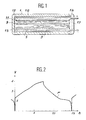
- a generator is shown electrochemical according to the invention.
- This generator comprises a sealed housing 1 composed of two parts 1a and 1b made for example of polyethylene. Inside this housing, a first current collector 3 made of stainless steel was successively arranged, a cathode 5 constituted by polypyrrole, a separating material 9 made of mineral fibers, an anode 11 constituted for example by a lithium-aluminum alloy and a second current collector 13 made of stainless steel.
- the housing 1 is filled with electrolyte constituted in this case by a lithium salt (LiClO4) dissolved in dimethyl sulfite with a LiClO4 concentration of 1 mol / l.
- LiClO4 lithium salt
- Such a generator structure makes it possible to obtain, with the treatment of the invention, improved energy performance compared to that which is obtained when lithium perchlorate in solution in propylene carbonate is used as the electrolyte.
- This treatment consists first of all in discharging the cathode doped with ClO4 ⁇ anions at a potential V2 and 1.5 volts for a period sufficient for the current to become zero, then in performing at least one charge cycle and using a potential V1 higher than the highest potential usually used with a generator of this type, for example a potential V1 of 4V.
- the potential between the cathode and the anode is then recorded by charging and discharging at constant current.
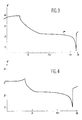
- Figures 2 and 3 show the charge-discharge curves obtained with this generator after 1 and 3 charge-discharge cycles which are all carried out with a constant current of 0.2 mA and a polypyrrole electrode of 10 mg.
- FIG. 2 represents the charge and discharge curve obtained during the first cycle, ie the voltage variations (in V) at the terminals of the generator as a function of time (in h).
- V the voltage variations
- in h the time
- FIG. 3 represents the charge and discharge curve corresponding to the third cycle. It can be seen that the discharge plate P is longer and that a plate also forms during charging. This corresponds to a high mass capacity which is 260 Ah / kg in this case.
- the initial electrolyte can be replaced by fresh electrolyte of the same composition and the charge and discharge levels are immediately restored by having removed any degradation products of the electrolyte. which would have formed during the first charge-discharge cycles at high voltage. This confirms that the first charge-discharge cycles have an effect on the electrode and not on the electrolyte.
- This figure 5 illustrates in vertical section a cell electrochemical with three electrodes enabling cyclic voltammetry measurements to be made.
- the cell comprises a cell body 18 comprising a central recess which determines a chamber 20 for an electrolyte solution.
- a compartment 22 is arranged at the upper part of the cell to fill and empty the chamber 20.
- Another compartment 24 intended for a reference electrode is also arranged at the upper part of the cell.
- the cell body 18 has threaded holes for two current supply screws 26; an electrode 28 and a counter electrode 30 are arranged on either side of the chamber 20.
- the electrode 28 consists of the polypyrrole part whose properties we want to study.
- the cell body 18 comprises two flanges 18a and 18b which can be connected together by screw-nut systems such as 32, 34.
- a stainless steel disc 36 is interposed between the flange 18a and the electrode 28 and a plastic grid 38 is interposed between the electrode 28 and a seal. 40 in plastic.
- a seal 42 made of plastic is interposed between the flange 18b and the cell body to make the seal.
- the compartment 24 of the reference electrode consists of a pyrex envelope which delimits two volumes, namely an upper volume 44 and a lower volume 45 separated by a wall 46.
- An asbestos wire 47 sealed in the pyrex connects electrically these two volumes.
- the volume 45 is in communication with the chamber 20 by a longitudinal channel 48.
- the reference electrode 50 produced for example in silver is bonded to the frustoconical plug 51.
- a 3 mg polypyrrole electrode 28 is used and measurements of cyclic voltammetry on this electrode using as an electrolyte a 1 mol / l solution of lithium perchlorate in dimethyl sulfite and an aluminum counter-electrode, which corresponds to a half-battery operation.
- FIG. 6 represents the discharge curve (voltage as a function of time) obtained with a constant discharge current of 0.2 mA. It is noted that in this case, a discharge plate is obtained at around ⁇ 1 V relative to the silver electrode. The total charge obtained with this constant current of 0.2 mA is 400 Ah / kg of polypyrrole, ie 3 to 4 times the charge collected under the best conditions with an electrochemical generator using ethylene carbonate.
- FIG. 7 shows the discharge curve obtained using a constant discharge current of 0.4 mA.
- the mass capacity of the electrode tends to decrease since it is no more than 250 Ah / kg, which however remains much higher than the results obtained with the generators of the prior art.
- FIG. 8 shows the discharge curve obtained when the discharge current is brought to 1 mA. Under these conditions, the mass capacity further decreases since it is no more than 150 Ah / kg. However, it remains much higher than what is obtained with the generators of the prior art.
- the properties of a polypyrrole electrode were tested after several charge-discharge cycles.
- the device of FIG. 5 is also used with a sample of polypyrrole of 4.3 mg and an electrolyte constituted by a solution of dimethyl sulfite containing 1 mol / l of lithium perchlorate.
- a mass capacity of the electrode is obtained of 310 Ah / kg in the seventh cycle, of 210 Ah / kg in the twentieth cycle, and of 145 Ah / kg in the fortieth cycle. It can therefore be seen that the polypyrrole electrode can undergo charge-discharge cycles repeatedly without excessive damage.
- cyclic voltammetry measurements were carried out on a polypyrrole pellet using as an electrolyte a 2 mol / l solution of lithium perchlorate in dimethyl sulfite.
- the voltage of the electrode is imposed relative to the reference electrode, and the current flowing through the cell is measured, the voltage varying according to a linear law as a function of time with a scanning speed equal to 0 , 1 mV / s.
- FIG. 9 represents the cyclic voltammetry curve obtained under these conditions after three cycles. This curve is characteristic of the cyclic voltammetry curves obtained with the polypyrrole electrodes, but this time it has two oxidation peaks O1 and O2 and a single reduction peak R.
- Elemental analysis of the polypyrrole electrode in reduced form used in this third series of experiments for FIG. 9 has shown that it contains 0.3 mol of ClO4Li per pyrrole cycle.
- the conventional doping mechanism accepted for conductive polymers is an anionic doping mechanism.
- the charge reaction is written: PPy + ClO4 ⁇ ⁇ PPy+, ClO4 ⁇ + 1e ⁇ .
- PPy0 PPy+ClO4 ⁇ , which corresponds to the first oxidation peak
- PPy0ClO4Li becomes PPy+ClO4 ⁇ by expulsion of Li, which corresponds to the second oxidation peak.
- the electrode is first of all subjected to a discharge at a potential V2 lower than the reduction potential of the electrode until the current is canceled. to accumulate the alkali metal in the electrode, then this electrode is brought to a potential greater than or equal to the usual potential of 400 mV relative to Ag / Ag+ to obtain the first peak corresponding to the oxidation of the polymer, then the second peak due to expulsion alkali metal.
- the maximum potential can be reduced to +200 mV or 0 mV compared to Ag / Ag+ to obtain a stable operation characterized by a potential plateau under constant current charge and a plateau under discharge at constant current, without degradation of the electrolyte or of the electrode, while retaining a very interesting stored power.
- FIG. 12 shows the charge and discharge curves obtained with the electrochemical generator of FIG. 1, using a constant charge and discharge current of 0 , 2 mA, between potential terminals fixed at 1V and 3.5V.
- the charge and discharge curves are not different from those obtained in FIG. 11 when an electrolyte based on propylene carbonate and on perchlorate is used. lithium.
- the cyclic voltammetry curve has been shown obtained under the same conditions as that of FIG. 9, but using 10 mg of polypyrrole and an electrolyte constituted by ethylene sulfite containing 2 mol / l of LiClO4 instead of the dimethyl sulfite containing 2mol / l of LiClO4. Note that this curve includes, like that of FIG. 9, two oxidation peaks O′1 and O′2 and a single reduction peak R ′.
Landscapes
- Chemical & Material Sciences (AREA)
- Chemical Kinetics & Catalysis (AREA)
- Electrochemistry (AREA)
- General Chemical & Material Sciences (AREA)
- Engineering & Computer Science (AREA)
- Manufacturing & Machinery (AREA)
- Secondary Cells (AREA)
- Battery Electrode And Active Subsutance (AREA)
Applications Claiming Priority (2)
| Application Number | Priority Date | Filing Date | Title |
|---|---|---|---|
| FR8800783A FR2626412A1 (fr) | 1988-01-25 | 1988-01-25 | Generateur electrochimique utilisant un polymere conducteur electronique appartenant au groupe du polypyrrole comme cathode et procede de traitement pour ameliorer la capacite massique de cette cathode |
| FR8800783 | 1988-01-25 |
Publications (2)
| Publication Number | Publication Date |
|---|---|
| EP0326484A2 true EP0326484A2 (de) | 1989-08-02 |
| EP0326484A3 EP0326484A3 (de) | 1991-07-17 |
Family
ID=9362588
Family Applications (1)
| Application Number | Title | Priority Date | Filing Date |
|---|---|---|---|
| EP19890400201 Withdrawn EP0326484A3 (de) | 1988-01-25 | 1989-01-25 | Elektrochemischer Generator mit elektronisch leitendem Polymer der Polypyrrolgruppe als Kathode und Behandlungsverfahren zur Verbesserung der Kapazität pro Masseneinheit dieser Kathode |
Country Status (2)
| Country | Link |
|---|---|
| EP (1) | EP0326484A3 (de) |
| FR (1) | FR2626412A1 (de) |
Cited By (2)
| Publication number | Priority date | Publication date | Assignee | Title |
|---|---|---|---|---|
| FR2682816A1 (fr) * | 1991-10-21 | 1993-04-23 | Alsthom Cge Alcatel | Generateur electronique primaire ou secondaire. |
| WO1994023463A1 (en) * | 1993-03-30 | 1994-10-13 | Valence Technology, Inc. | Positive electrode for rechargeable lithium batteries |
Families Citing this family (1)
| Publication number | Priority date | Publication date | Assignee | Title |
|---|---|---|---|---|
| CN101801438B (zh) * | 2007-07-20 | 2013-08-07 | 梅丁格有限公司 | 可手动操作的便携式输注设备 |
Family Cites Families (9)
| Publication number | Priority date | Publication date | Assignee | Title |
|---|---|---|---|---|
| ZA8420B (en) * | 1983-01-24 | 1985-02-27 | Lubrizol Enterprises Inc | Electronically conducting polypyrrole and co-polymers of pyrrole,compositions containing them,methods for making them,and electro-chemical cells using them |
| JPS59143280A (ja) * | 1983-02-04 | 1984-08-16 | Hitachi Ltd | ポリマを用いた2次電池 |
| DE3328635A1 (de) * | 1983-08-09 | 1985-02-21 | Basf Ag, 6700 Ludwigshafen | Elektrochemisches element oder batterie |
| US4528254A (en) * | 1983-11-30 | 1985-07-09 | Allied Corporation | Conjugated polymer battery containing organosulfur solvent |
| US4472487A (en) * | 1983-11-30 | 1984-09-18 | Allied Corporation | Battery having polymeric anode coated with reaction product of oxirane compound |
| JPS61128477A (ja) * | 1984-11-27 | 1986-06-16 | Toyota Motor Corp | 導電性高分子材料製負極の製造方法 |
| JPS61128478A (ja) * | 1984-11-27 | 1986-06-16 | Toyota Motor Corp | 導電性高分子材料製負極の製造方法 |
| DE3507422A1 (de) * | 1985-03-02 | 1986-09-04 | Basf Ag, 6700 Ludwigshafen | Elektrochemisches speicherelement oder sekundaere batterie |
| JPS6293863A (ja) * | 1985-10-21 | 1987-04-30 | Showa Denko Kk | 非水系二次電池 |
-
1988
- 1988-01-25 FR FR8800783A patent/FR2626412A1/fr not_active Withdrawn
-
1989
- 1989-01-25 EP EP19890400201 patent/EP0326484A3/de not_active Withdrawn
Cited By (2)
| Publication number | Priority date | Publication date | Assignee | Title |
|---|---|---|---|---|
| FR2682816A1 (fr) * | 1991-10-21 | 1993-04-23 | Alsthom Cge Alcatel | Generateur electronique primaire ou secondaire. |
| WO1994023463A1 (en) * | 1993-03-30 | 1994-10-13 | Valence Technology, Inc. | Positive electrode for rechargeable lithium batteries |
Also Published As
| Publication number | Publication date |
|---|---|
| FR2626412A1 (fr) | 1989-07-28 |
| EP0326484A3 (de) | 1991-07-17 |
Similar Documents
| Publication | Publication Date | Title |
|---|---|---|
| EP0105768B1 (de) | Elektrochemische Generatoren mit organischen Polymeren als aktives Elektrodenmaterial | |
| EP1466379B1 (de) | Hochstabilitätspolymerelektrolyt, dessen verwendung in elektrochemischen systemen | |
| CA1222543A (fr) | Anodes denses d'alliages de lithium pour batteries tout solide | |
| EP2989648B1 (de) | Elektrochemische vorrichtung als superkondensatoren auf elektrolytbasis mit mindestens einem alkalischen leitsalz ausser lithium | |
| WO2012071668A1 (fr) | Batterie lithium-air | |
| EP3780244B1 (de) | Alkalische sekundäre elektrochemische generatoren mit einer zinkanode | |
| EP1573834A2 (de) | Überzogene elektrode mit hergestellter folie aus wässrigen wasserlöslicher bindemittelzusammensetzung enthaltenden lösung, herstellungsverfahren dafür und ihre verwendung | |
| EP0660432A1 (de) | Kohlenstoffanode für einen wiederaufladbaren electrochemischen Lithiumgenerator und Herstellungsverfahren | |
| FR2564248A1 (fr) | Procede de production d'une cathode composite pour element de batterie electrochimique | |
| WO2007085077A1 (fr) | Particules d’oxyde metallique enrobees a faible taux de dissolution, procedes de preparation et utilisation dans les systemes electrochimiques | |
| EP3607601B1 (de) | Lithium-salz-gemisch und verwendungen davon als batterieelektrolyt | |
| FR2510820A1 (fr) | Procede pour ameliorer la duree d'utilisation des piles non aqueuses | |
| CA2967918A1 (fr) | Batterie lithium organique | |
| FR3118679A1 (fr) | Liquide ionique à base de bis(fluorosulfonyl)imide | |
| EP0614240A1 (de) | Aufladbarer lithiumenthaltender elektrochemischen Stromgenerator | |
| WO2019145662A2 (fr) | Melange de sels de lithium et de potassium, et son utilisation dans une batterie | |
| EP3049471B1 (de) | Polymerzusammensetzungen zur leitung von lithiumionen an elektrochemischen lithiumgenerator | |
| EP0326484A2 (de) | Elektrochemischer Generator mit elektronisch leitendem Polymer der Polypyrrolgruppe als Kathode und Behandlungsverfahren zur Verbesserung der Kapazität pro Masseneinheit dieser Kathode | |
| EP3959768A1 (de) | Verfahren zur herstellung einer li-ionen-batteriezelle | |
| EP3629413A1 (de) | Gelelektrolyt, verfahren für die herstellung und verwendung des gelelektrolyten | |
| FR2760568A1 (fr) | Generateurs a electrolyte polymere possedant un sel de potassium permettant de stabiliser les performances et la vie utile de la batterie | |
| CA2960489A1 (fr) | Composition d'electrolyte et son utilisation dans des batteries lithium-ion | |
| EP1042839B1 (de) | Additive zur verbesserung der reversibilität einer kohlenstoffelektrode in einem aufladbaren elektrochemischen lithiumionstromgenerators | |
| CA2232107C (fr) | Generateurs a electrolyte polymere possedant un sel de potassium permettant de stabiliser les performances et la vie utile de la batterie | |
| FR3063836A1 (fr) | Composition d'electrolyte et son utilisation dans des batteries lithium-ion |
Legal Events
| Date | Code | Title | Description |
|---|---|---|---|
| PUAI | Public reference made under article 153(3) epc to a published international application that has entered the european phase |
Free format text: ORIGINAL CODE: 0009012 |
|
| AK | Designated contracting states |
Kind code of ref document: A2 Designated state(s): BE DE FR |
|
| PUAL | Search report despatched |
Free format text: ORIGINAL CODE: 0009013 |
|
| AK | Designated contracting states |
Kind code of ref document: A3 Designated state(s): BE DE FR |
|
| STAA | Information on the status of an ep patent application or granted ep patent |
Free format text: STATUS: THE APPLICATION IS DEEMED TO BE WITHDRAWN |
|
| 18D | Application deemed to be withdrawn |
Effective date: 19920118 |