EP0326734A2 - Appareil pour ancrer un combiné à un boîtier téléphonique - Google Patents
Appareil pour ancrer un combiné à un boîtier téléphonique Download PDFInfo
- Publication number
- EP0326734A2 EP0326734A2 EP88302771A EP88302771A EP0326734A2 EP 0326734 A2 EP0326734 A2 EP 0326734A2 EP 88302771 A EP88302771 A EP 88302771A EP 88302771 A EP88302771 A EP 88302771A EP 0326734 A2 EP0326734 A2 EP 0326734A2
- Authority
- EP
- European Patent Office
- Prior art keywords
- handset
- telephone
- cord armor
- telephone cord
- end portion
- Prior art date
- Legal status (The legal status is an assumption and is not a legal conclusion. Google has not performed a legal analysis and makes no representation as to the accuracy of the status listed.)
- Withdrawn
Links
Images




Classifications
-
- H—ELECTRICITY
- H04—ELECTRIC COMMUNICATION TECHNIQUE
- H04M—TELEPHONIC COMMUNICATION
- H04M1/00—Substation equipment, e.g. for use by subscribers
- H04M1/02—Constructional features of telephone sets
- H04M1/15—Protecting or guiding telephone cords
Definitions
- the present invention is directed to a system for anchoring a telephone handset to a telephone housing such as the housing for a public or "pay" telephone.
- Systems for anchoring handsets to such telephone housings are known. See U.S. patent 4,518,830 (Drexler et al).
- a 3/32 inch diameter 7 X 19 stranded cable having a tensile strength of 800 pounds or more is used to mechanically connect the handset to the housing.
- the stranded cable is flexible and, together with the signal wires, is sheathed in flexible telephone cord armor ("tca”) between the handset and the housing. An end portion of the tca extends within the handset through a grommet and the depending legs of the handset transmitter cup.
- the stranded cable extends through the yoke of the handset past the junction of the yoke and handset receiver portion.
- the end of the stranded cable is provided with an end plug or stop.
- the stranded cable is anchored at the yoke-receiver junction by a wedge-shaped anchor member. See Figures 9-11 of the patent.
- the bottom surface of the anchor member is flat and contacts a relatively flat interior surface of the handset.
- the top surface of the anchor member is also flat as are the side surfaces of the anchor member.
- the top surface of the anchor member is disposed at an acute angle with respect to its bottom surface, the two surfaces converging towards the yoke-receiver junction.
- the stranded cable extends through a slot formed in the bottom surface of the anchor member.
- the cable end stop is received in a bore in the rear surface of the anchor member.
- the bore and slot intersect at a shoulder which serves as a stop surface for the cable end stop. Because the top and side surfaces of the anchor member are flat, the surfaces intersect along relatively sharp edges.
- the interior surface of the handset which faces the top surface of the anchor member is not flat but, instead, comprises a compound surface at the yokereceiver junction.
- the compound surface is defined by two radii of curvature, one along the longitudinal axis of the handset and the other substantially perpendicular thereto along the width of the handset. The relatively sharp edges of the anchor member make "point" contact with the interior compound surface of the handset.
- the stranded cable end stop contacts the anchor member shoulder, forcing the relatively sharp edges of the anchor member into "point" contact against the interior compound surface of the handset.
- the anchor member edges tend to shear or slice through the interior surface of the handset thereby rupturing the handset wall at the yoke-receiver junction.
- the handset end of the tca is crimped so as to fit between the transmitter cup legs.
- the legs and an interior surface of the transmitter end of the handset retain the tca in position. If the spacing between the transmitter cup legs exceeds the outer diameter of the tca, they will not anchor the tca against longitudinal displacement.
- the handset end of the tca is forced against the grommet. If the handset is pulled with sufficient force, the tca may be forced through and pulled out of the grommet.
- the handset end of the tca may be pushed through the transmitter end of the handset into an acoustic foam block at the junction of the handset transmitter and yoke portions.
- One problem solved by the present invention is that of anchoring the stranded cable at the yoke-receiver junction of the handset without danger of rupture of the junction wall when forces up to the 800 pound tensile strength of the stranded cable are applied.
- Another problem solved by the present invention is that of anchoring the handset end of the tca against longitudinal and rotational displacement in the transmitter end of the handset.
- the invention includes the discovery that rupture of the handset wall at the yoke-receiver junction is due to "point" contact between the relatively sharp edges of the conventional wedge-shaped anchor member and the compound interior surface of the handset at the yoke-receiver junction.
- the invention also includes recognition of the inability of the transmitter cup legs to reliably anchor the handset end of the tca in position against longitudinal and rotational displacement at the transmitter end of the handset.
- the anchor member is shaped so as to have a top compound surface matching the shape of the compound interior surface of the handset at the yoke-receiver junction such that full surface contact is maintained between the anchor member and the handset interior compound surface at the yoke-receiver junction.
- Such contact distributes the forces produced when the handset is pulled away from the telephone housing so that the forces cannot concentrate at a "point” or even along a "line” thereby preventing rupture of the handset wall at the junction.
- the handset end of the tca is positively anchored against longitudinal and rotational displacement by a retainer member mounted on the tca and sandwiched between the grommet and transmitter cup legs.
- FIG. 1 a telephone housing 10 of the public or "pay" type and a handset 12.
- the housing 10 and handset 12 are conventional structures.
- the telephone signal wires 14 and a stranded cable 16 are sheathed in tca 18 between the housing 10 and handset 12.
- the tca 18 extends through a grommet 20 secured to the transmitter end 22 of the handset.
- the tca 18 protects the signal wires 14 and cable 16 from vandalism.
- the system for anchoring the cable 16 and tca 18 in handset 12 is best shown in Figure 2.
- the handset 12 includes a receiver end or portion 24 and a yoke 26 connecting the transmitter and receiver ends 22, 24.
- the handset 12 is a conventional one-piece structure provided with screw caps 28, 30 at the transmitter and receiver ends respectively.
- the tca extends through grommet 20 below the transmitter cup 32 through the transmitter cup legs 34.
- a ferrule 36 is secured in conventional manner to the end of the tca.
- the ferrule is provided with an opening allowing for passage of the cable 16 and signal wires 14.
- the cable 16 is anchored in the handset 12 by means of a cable anchor member 38 which is inserted in the handset at the yoke-receiver junction.
- the junction is generally indicated by 40 in Figure 2.
- the top surface 42 of the anchor member 38 includes a generally concavo-convex surface which "matches" the convex-concave interior surface 44 of the handset at the yoke-receiver junction 40 as shown in Figures 3-8.
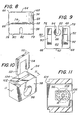
- the cable anchor member 38 and yoke-receiver junction 40 are best shown in Figures 3-8.
- the bottom surface 46 of the cable anchor member is substantially flat, and it contacts a substantially flat interior surface 48 of the handset at the yoke-receiver junction 40.
- the top compound surface 42 and flat bottom surface 46 of the cable anchor member contact the handset interior surfaces 44, 48 at the yoke-receiver junction so as to maintain full surface contact between the cable anchor member and the interior surfaces 44, 48 of the handset.
- the side surfaces 50, 52 of the cable anchor member are substantially flat.
- the side surfaces converge towards the transmitter end 22 of the handset with a slight taper such as 3° so as to provide pilot surfaces facilitating placement of the cable anchor member 38 in the yoke-receiver junction 40.
- the top compound surface 42 includes a lower, relatively flat surface portion 54 which leads into a concavo-convex surface portion 56 having a 1/2 inch radius of curvature along the direction of the longitudinal axis L of the handset and a 1 1/8 inch radius of curvature along a direction transverse and substantially perpendicular to the longitudinal axis of the handset.
- the cable anchor member is provided with a substantially flat front surface 58 and a substantially flat rear surface 60. The distance between the front and rear surfaces 58, 60 is 1 1/4 inch. The width of the front surface is 1.060 inch. The width of the rear surface 60 is 1.125 inch.
- the concavo-convex portion 56 leads into an upper, substantially flat surface portion 62 along an arcuate rounded edge 64.
- Edge 64 is defined by an arc running transverse to the longitudinal axis of the anchor member with a radius of curvature of 1 1/8 inch. The edge is rounded with a radius of curvature of 3/32 inch.
- the surfaces 54, 56 and 62 intersect the side surfaces 50, 52 along rounded edges 66, 68 each having a radius of curvature of 3/32 inch.
- the front surface 58 intersects the side surfaces 50, 52 along straight, rounded edges 70, 72 each having a radius of curvature of 3/32 inch.
- the front surface 58 intersects the lower surface portion 54 along a straight, rounded edge 74 having a radius of curvature of 1/16 inch.
- the side surfaces 50, 52 intersect bottom surface 46 along straight, rounded edges 76, 78 each having a radius of curvature of 3/32 inch.
- the bottom surface 46 intersects the front surface 58 along a straight, rounded edge 80 having a radius of curvature of 1/16 inch.
- a slot 82 is formed in the bottom surface 46 parallel to the longitudinal axis of the anchor member to accommodate the cable 16.
- a circular bore or passage 84 is formed in the rear surface 60.
- the passage 84 intersects the slot 82 so as to define a shoulder 86 which serves as a stop surface for an end stop or plug 88 secured to the end of cable 16.
- Cavities 90, 92 may be formed between passage 84 and the side surfaces 50, 52 so as to make the anchor member lightweight.
- the cable anchor member 38 is formed of a hard, polymeric plastic material such as ABS. By rounding the intersecting edges of the cable anchor member surfaces, and by forming the top compound surfaces of the anchor member as described, "point" or “line” contact between the anchor member and the interior surfaces of the handset at the yoke-receiver junction are avoided. Accordingly, when the handset is pulled away from the telephone housing 10, end stop 88 seats in passage 84 against shoulder 86, and all forces are distributed over an area of full surface contact between the cable anchor member and the interior surface of the handset. As a result, rupture of the handset wall at the yoke-receiver junction will not occur even at forces which are commensurate with the 800 pound tensile strength of cable 16.
- the tca 18 is anchored in the transmitter end 22 of handset 12 by a retainer member 94.
- the tca retainer member 94 is best shown in Figures 10 and 11.
- the retainer member 94 is a block of hard, polymeric plastic material having a through-bore or passage 96 extending from a front face 98 to a rear face 100 ( Figure 2).
- the retainer member is also provided with a slot 102 extending from a top face 104 to a bottom face 106 and intersecting the passage 96.
- the diameter of the passage 96 is slightly greater than the outer diameter of ferrule 36 so that the tca 18 and ferrule 36 can freely slide through the passage.
- An end portion 108 of the tca 18 proximate ferrule 36 is swaged.
- a metallic, generally U-shaped clip 110 is inserted in slot 102 such that the clip legs 112, 114 at least partially protrude within the passage 96.
- the spacing between the clip legs 112, 114 is less than the outer diameter of the tca so that the legs fit over the swaged end portion 108 of the tca thereby preventing any appreciable longitudinal or rotational displacement of the tca within passage 96.
- the tca 18 is locked in the retainer member 94.
- the retainer member 94 itself is anchored in position against longitudinal and rotational displacement by the grommet 20, the bottom surface 116 of the transmitter cup 32, the transmitter cup legs 34 and the bottom interior surface 118 of the transmitter end 22 of the handset.
- transmitter cup 32 and the bottom interior surface 118 of the transmitter end 22 of the handset prevent rotational displacement of the retainer member 94 hence rotational displacement of the tca 18 about its longitudinal axis.
- the transmitter cup legs 34 provide a stop surface which is contacted by the rear face 100 of the retainer member 94 thereby preventing longitudinal displacement of the retainer member hence longitudinal displacement of the tca.
- the grommet 20 provides a stop surface which is contacted by the front face 98 of the retainer member 94 thereby preventing longitudinal displacement of the retainer member hence longitud inal displacement of the tca. Accordingly, the tca 18 can neither be pushed through the transmitter end 22 to the yoke 26 of the handset nor pulled from the transmitter end 22 through the grommet 20.
- the tca 18 is anchored in the telephone housing 10 by means of a combined cable-tca retainer member 120.
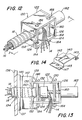
- the cable-tca retainer member 120 is best shown in Figures 12 and 13.
- Retainer member 120 is a five sided, hollow rigid metallic block having side walls 122, 124, slotted top and bottom walls 126, 128 and a rear wall 130.
- a ferrule 132 is secured to the telephone housing end of the tca 18 and is provided with a passage through which the signal wires 14 and the cable 16 extend.
- the telephone housing end of the tca 18 is inserted through a circular opening 134 in a wall 136 of the telephone housing 10.
- the telephone housing end portion of the tca 18 is swaged as at 138.
- Swaged portion 138 of the tca is located in a slot 140 formed in a keeper plate 142 which is screw fastened to a conventional mounting block 137 secured to wall 136 inside the telephone housing.
- the keeper plate 142 has an ear 143 which is captured in a portion of the mounting block and a flange 145 provided with a screw hole 147.
- the swaged portion 138 of the tca also extends through a slot 144 in the bottom wall 128 of the retainer member 120.
- the keeper plate 142 and bottom wall 128 of the retainer member provide stop surfaces which contact shoulders 146, 148 and 150, 152 at the swaged portion 138 of the tca thereby preventing longitudinal displacement of the tca.
- the keeper slot 140 and the bottom wall slot 144 of the retainer member have identical widths which permit insertion of the swaged portion 138 of the tca with only slight clearance such that the keeper plate 142 and bottom wall 128 prevent rotational displacement of the tca about its longitudinal axis.
- the end portion of the tca including ferrule 132 is prevented from sliding out of the bottom wall slot 144 by a cotter pin 154 which extends through aligned openings 156, 158 in side walls 122, 124.
- the telephone housing end of the cable 16 extends through a slot 160 in the top wall 126 of the retainer member 120.
- the top wall 126 provides a stop surface for an end stop or plug 162 secured to the cable 16.
- the cable 16 is retained in slot 160 by a cotter pin 164 which extends through aligned openings 166, 168 in side walls 122, 124.
- the retainer member 120 serves to anchor both the tca 18 and cable 16 within the telephone housing 10.
- the tca retainer member 94′ is best shown in Figures 16 and 17.
- the retainer member 94′ is a regid, generally L-shaped metal clip having a slot 200 extending from an upper leg 202 to a lower leg 204.
- the portion of slot 200 in leg 202 is generally elongated and has a width slightly greater than the width of the swaged end portion 108 of the tca 18.
- the portion of slot 200 in leg 204 is in the shape of a partial circle having a diameter which is greater than the width of the portion of slot 200 in leg 202.
- the diameter of the portion of the slot in leg 204 is slightly greater than the outer diameter of the ferrule 36 so that the ferrule end of the tca 18 may be inserted through the portion of the leg 204 as shown in solid lines in Figure 17.
- the tca 18 can then be displaced upwardly through the portion of slot 200 in leg 202, as shown in Figure 17, along the swaged end portion 108 thereof.
- the edges of the slot 200 in leg 202 will then prevent longitudinal and rotational displacement of the tca.
- the tca retainer member 94′ is captured by inserting the clip leg 202 in the gap between the transmitter cup legs 34 and 206.
- the thickness of leg 202 is chosen to ensure that the leg is captured by frictional engagement with the transmitter legs 34, 206.
- the transmitter cup 32 and retainer clip 94′ may be rotated 180° so as to capture leg 202 between transmitter legs 34, 206 and against the grommet 20.
- the system of the present invention has been described in terms of a cable anchor member 38, tca retainer member 94 (or 94′) and combined cable-tca retainer member 120, and it is preferred that all such elements be used in combination, the elements may also be used independently of each other.
- the cable anchor member 38 anchors the cable 16 at the yoke-receiver junction of the handset 12 while the tca retainer member 94 (or 94′) anchors the tca at the transmitter end 22 of the handset 12.
- the cable 16 is sheathed in the tca 18 between the telephone housing 10 and the handset 12, the cable and tca are not mechanically connected, and they are separately anchored in the handset.
- the combined cable-tca retainer member 120 serves to anchor both the tca 18 and cable 16 at the telephone housing 10, the tca and cable are separately anchored by the top and bottom walls 126, 128 of retainer member 120.
- the anchoring action may be further imnproved by welding the cable anchor member 38 to the interior surfaces of the handset at the yoke-receiver junction.
- the cable anchor member 38 may be ultrasonically welded to the interior surfaces of the handset at the yoke-received junction so as to provide a unified body of increased strength.
- the anchor member 38 prevents rupture of the handset wall at the yoke-receiver junction despite the application of forces up to the 800 pound tensile strength of the cable 16 itself.
- the cable anchor member 38 has been described in connection with a concavo-convex surface having particular radii of curvature, it should be understood that the shape of the surfaces of the cable anchor member are generally chosen to match the shape of the interior surface of the handset at the yoke-receiver junction to ensure optimal surface contact between the anchor member and handset.
- leg 204 can be dispensed with whereby the leg 202 would be generally U-shaped around the slot 200, similar in shape to clip 110 in Figure 10.
- Such a retainer clip, designated 94 ⁇ is shown in Figures 19 and 20.
- the transmitter cup 32 and retainer clip 94 ⁇ may be rotated 180° so as to place the clip 94 ⁇ against the grommet 20 in the manner previously explained in connection with retainer clip 94′ and Figure 21.
Landscapes
- Engineering & Computer Science (AREA)
- Signal Processing (AREA)
- Telephone Set Structure (AREA)
Applications Claiming Priority (2)
| Application Number | Priority Date | Filing Date | Title |
|---|---|---|---|
| US07/154,422 US4845774A (en) | 1986-10-06 | 1988-02-05 | Apparatus for anchoring a telephone handset to a telephone housing |
| US154422 | 1998-08-13 |
Publications (2)
| Publication Number | Publication Date |
|---|---|
| EP0326734A2 true EP0326734A2 (fr) | 1989-08-09 |
| EP0326734A3 EP0326734A3 (fr) | 1990-05-23 |
Family
ID=22551304
Family Applications (1)
| Application Number | Title | Priority Date | Filing Date |
|---|---|---|---|
| EP88302771A Withdrawn EP0326734A3 (fr) | 1988-02-05 | 1988-03-29 | Appareil pour ancrer un combiné à un boítier téléphonique |
Country Status (4)
| Country | Link |
|---|---|
| US (1) | US4845774A (fr) |
| EP (1) | EP0326734A3 (fr) |
| JP (1) | JPH01272250A (fr) |
| CA (1) | CA1286813C (fr) |
Cited By (1)
| Publication number | Priority date | Publication date | Assignee | Title |
|---|---|---|---|---|
| EP0473381A3 (en) * | 1990-08-23 | 1992-06-03 | Wintel Service Corporation | Apparatus and method for securing an armoured cord and restraint cable assembly to a telephone handset and housing |
Families Citing this family (9)
| Publication number | Priority date | Publication date | Assignee | Title |
|---|---|---|---|---|
| US5007079A (en) * | 1989-09-15 | 1991-04-09 | International Teleservice Corporation | Coin fraud prevention unit and modular configurations for pay telephone stations |
| US5018185A (en) * | 1990-03-21 | 1991-05-21 | Robert Riddle | Tamperproof pay telephone |
| US5086465A (en) * | 1991-01-04 | 1992-02-04 | Quadrum Telecommunications, Inc. | Armored telephone cord retention bracket |
| US5394467A (en) * | 1993-03-26 | 1995-02-28 | Claircom Communications Group, L.P. | Multi-purpose telephone strain relief |
| US5577119A (en) * | 1995-05-08 | 1996-11-19 | I.D. Tel Corp. | Tension resisting bracket for telephone handsets |
| AU730468B2 (en) * | 1996-06-03 | 2001-03-08 | Alcatel Australia Limited | Attachment arrangement for armoured handset cord |
| USD533901S1 (en) * | 2005-04-04 | 2006-12-19 | Chattahoochee Pencil Company, Inc. | Marker implement |
| USD609519S1 (en) * | 2008-02-19 | 2010-02-09 | Ortega Juan J | Rug |
| US20130098122A1 (en) * | 2011-10-19 | 2013-04-25 | Checkpoint Systems, Inc. | Cable lock with integral connected metal sheath |
Family Cites Families (28)
| Publication number | Priority date | Publication date | Assignee | Title |
|---|---|---|---|---|
| GB974487A (fr) * | ||||
| US896700A (en) * | 1906-01-22 | 1908-08-25 | Western Electric Co | Electrical conducting-cord. |
| DE608909C (de) * | 1932-08-09 | 1935-02-04 | Henschel & Sohn A G | Anordnung fuer die Zufuehrung einer zusaetzlichen Arbeitsmittelmenge bei Roehrenschnellverdampfern |
| US2200794A (en) * | 1937-05-08 | 1940-05-14 | Bell Telephone Labor Inc | Electrical connector |
| US2220393A (en) * | 1938-02-04 | 1940-11-05 | Ericsson Telefon Ab L M | Self-carrying cable |
| US2367298A (en) * | 1942-04-13 | 1945-01-16 | Int Standard Electric Corp | Cord connector for telephone instruments |
| FR901602A (fr) * | 1944-01-28 | 1945-08-01 | Pforzheim Metallschlauch | Conducteur électrique à plusieurs fils logés dans une gaine souple |
| US2795641A (en) * | 1953-12-03 | 1957-06-11 | Rowell Ross Fredrick | Cord supporting coil |
| US3235674A (en) * | 1962-06-29 | 1966-02-15 | Ericsson Telefon Ab L M | Arrangement in hand microtelephones |
| DE1183549B (de) * | 1963-04-27 | 1964-12-17 | Telefonbau & Normalzeit Gmbh | Fernsprechhandapparat |
| US3284751A (en) * | 1963-10-11 | 1966-11-08 | Eltra Corp | Resistor ignition lead |
| US3291898A (en) * | 1964-01-21 | 1966-12-13 | Aluminum Co Of America | High voltage expanded electrical conductors |
| DE1899444U (de) * | 1964-05-30 | 1964-08-27 | Telefonbau & Normalzeit Gmbh | Fernsprechhandapparat. |
| US3290429A (en) * | 1964-08-04 | 1966-12-06 | Bell Telephone Labor Inc | Armored electric line |
| US3384393A (en) * | 1965-04-19 | 1968-05-21 | Myers Electric Products Inc | Conduit connector for junction boxes |
| SE319830B (fr) * | 1965-05-21 | 1970-01-26 | Electrolux Ab | |
| US3377422A (en) * | 1966-01-26 | 1968-04-09 | Amp Inc | Splice assembly to connect cable ends together |
| US3643205A (en) * | 1969-10-13 | 1972-02-15 | Bunker Ramo | Telephone handset connector |
| AT294936B (de) * | 1969-11-07 | 1971-12-10 | Akg Akustische Kino Geraete | Kopfhörer mit einem Mikrophon |
| US3699498A (en) * | 1970-04-30 | 1972-10-17 | Bell Telephone Labor Inc | Devices for making electrical connections |
| US3929164A (en) * | 1971-02-25 | 1975-12-30 | Harold J Richter | Fluid transfer umbilical assembly for use in zero gravity environment |
| US3674915A (en) * | 1971-06-01 | 1972-07-04 | Phillips Petroleum Co | Electrical cable having an ethylene-1-olefin copolymer as the dielectric material |
| US4087659A (en) * | 1977-01-21 | 1978-05-02 | Boenecke Charles A | Tamperproof handset for railroad applications |
| US4079190A (en) * | 1977-02-03 | 1978-03-14 | International Standard Electric Corporation | Submarine coaxial cable |
| FR2414243A1 (fr) * | 1978-01-10 | 1979-08-03 | Cables De Lyon Geoffroy Delore | Cable electrique a element porteur longitudinal |
| US4130740A (en) * | 1978-02-09 | 1978-12-19 | Northern Telecom Limited | Telephone handset with rotatably locking receiver |
| US4518830A (en) * | 1982-06-25 | 1985-05-21 | At&T Bell Laboratories | Armored telephone cord with a longitudinal strength member |
| US4837815A (en) * | 1986-06-26 | 1989-06-06 | Nynex Corporation | Armored cord handset |
-
1988
- 1988-02-05 US US07/154,422 patent/US4845774A/en not_active Ceased
- 1988-03-29 EP EP88302771A patent/EP0326734A3/fr not_active Withdrawn
- 1988-03-31 CA CA000563576A patent/CA1286813C/fr not_active Expired - Lifetime
- 1988-04-05 JP JP63082383A patent/JPH01272250A/ja active Granted
Cited By (1)
| Publication number | Priority date | Publication date | Assignee | Title |
|---|---|---|---|---|
| EP0473381A3 (en) * | 1990-08-23 | 1992-06-03 | Wintel Service Corporation | Apparatus and method for securing an armoured cord and restraint cable assembly to a telephone handset and housing |
Also Published As
| Publication number | Publication date |
|---|---|
| JPH01272250A (ja) | 1989-10-31 |
| EP0326734A3 (fr) | 1990-05-23 |
| CA1286813C (fr) | 1991-07-23 |
| US4845774A (en) | 1989-07-04 |
| JPH0440906B2 (fr) | 1992-07-06 |
Similar Documents
| Publication | Publication Date | Title |
|---|---|---|
| EP0326734A2 (fr) | Appareil pour ancrer un combiné à un boîtier téléphonique | |
| US6042433A (en) | Electrical contact | |
| US5848456A (en) | Locking device for a connector | |
| JP2724697B2 (ja) | 電気コネクタ用のフローティングパネル取付構造 | |
| JP3442715B2 (ja) | リテーナ付き圧接コネクタ | |
| US5562475A (en) | Modular telephone plug | |
| EP0950374A3 (fr) | Dispositif de raccordement à rotule, et écarteur chirurgical | |
| US4304454A (en) | Insulation piercing connector | |
| EP0851535A3 (fr) | Parties d'un connecteur | |
| EP0999612A3 (fr) | Connecteur électrique monté en surface et sa borne métallique | |
| EP0905819A3 (fr) | Connecteur avec verrouillage | |
| EP0372766A1 (fr) | Connecteur avec dispositif de verrouillage amovible, et dispositif de verrouillage à cet effet | |
| USRE33647E (en) | Apparatus for anchoring a telephone handset to a telephone housing | |
| EP0828321A3 (fr) | Connecteur pour système d'airbag | |
| US6846206B2 (en) | Electrical plug connector | |
| US4957453A (en) | Electrical socket | |
| EP1204171A3 (fr) | Connecteur électrique | |
| JPH11122748A (ja) | 配線用ボックス | |
| KR910000844B1 (ko) | 외장코드 송수화기 | |
| EP0223586A2 (fr) | Connecteurs électriques avec cavités de contact polyvalentes | |
| EP0589793B1 (fr) | Système de fixation pour élément tubulaire souple | |
| EP0088489A1 (fr) | Attachement de serrure pour câbles | |
| US5315648A (en) | Retainer member for anchoring a telephone handset to a telephone housing | |
| EP1094552A2 (fr) | Connecteur pour la connexion d'un conducteur à un elément de construction | |
| EP1049207A2 (fr) | Connecteur pour câbles à mécanisme d'engagement pour un élèment de borne électrique |
Legal Events
| Date | Code | Title | Description |
|---|---|---|---|
| PUAI | Public reference made under article 153(3) epc to a published international application that has entered the european phase |
Free format text: ORIGINAL CODE: 0009012 |
|
| AK | Designated contracting states |
Kind code of ref document: A2 Designated state(s): AT BE CH DE ES FR GB GR IT LI LU NL SE |
|
| PUAL | Search report despatched |
Free format text: ORIGINAL CODE: 0009013 |
|
| AK | Designated contracting states |
Kind code of ref document: A3 Designated state(s): AT BE CH DE ES FR GB GR IT LI LU NL SE |
|
| 17P | Request for examination filed |
Effective date: 19901115 |
|
| 17Q | First examination report despatched |
Effective date: 19921028 |
|
| STAA | Information on the status of an ep patent application or granted ep patent |
Free format text: STATUS: THE APPLICATION IS DEEMED TO BE WITHDRAWN |
|
| 18D | Application deemed to be withdrawn |
Effective date: 19940111 |