EP0326826B1 - Mittel mit zerstörender Wirkung auf maligne Tumore, Verfahren zu dessen Herstellung und Präparation zur Anwendung in der Therapie von Krebskranken - Google Patents
Mittel mit zerstörender Wirkung auf maligne Tumore, Verfahren zu dessen Herstellung und Präparation zur Anwendung in der Therapie von Krebskranken Download PDFInfo
- Publication number
- EP0326826B1 EP0326826B1 EP89100493A EP89100493A EP0326826B1 EP 0326826 B1 EP0326826 B1 EP 0326826B1 EP 89100493 A EP89100493 A EP 89100493A EP 89100493 A EP89100493 A EP 89100493A EP 0326826 B1 EP0326826 B1 EP 0326826B1
- Authority
- EP
- European Patent Office
- Prior art keywords
- alpha
- ketoglutaric acid
- hydroxymethylfurfural
- solution
- acid
- Prior art date
- Legal status (The legal status is an assumption and is not a legal conclusion. Google has not performed a legal analysis and makes no representation as to the accuracy of the status listed.)
- Expired - Lifetime
Links
- 201000011510 cancer Diseases 0.000 title claims description 18
- 238000000034 method Methods 0.000 title claims description 10
- 238000004519 manufacturing process Methods 0.000 title claims description 6
- 230000001066 destructive effect Effects 0.000 title claims description 5
- 239000003814 drug Substances 0.000 title abstract 3
- 206010028980 Neoplasm Diseases 0.000 title description 17
- 238000002360 preparation method Methods 0.000 title description 9
- 238000002560 therapeutic procedure Methods 0.000 title description 5
- 229940079593 drug Drugs 0.000 title 1
- KPGXRSRHYNQIFN-UHFFFAOYSA-N 2-oxoglutaric acid Chemical compound OC(=O)CCC(=O)C(O)=O KPGXRSRHYNQIFN-UHFFFAOYSA-N 0.000 claims abstract description 63
- HWXBTNAVRSUOJR-UHFFFAOYSA-N alpha-hydroxyglutaric acid Natural products OC(=O)C(O)CCC(O)=O HWXBTNAVRSUOJR-UHFFFAOYSA-N 0.000 claims abstract description 31
- 229940009533 alpha-ketoglutaric acid Drugs 0.000 claims abstract description 31
- NOEGNKMFWQHSLB-UHFFFAOYSA-N 5-hydroxymethylfurfural Chemical compound OCC1=CC=C(C=O)O1 NOEGNKMFWQHSLB-UHFFFAOYSA-N 0.000 claims abstract description 20
- RJGBSYZFOCAGQY-UHFFFAOYSA-N hydroxymethylfurfural Natural products COC1=CC=C(C=O)O1 RJGBSYZFOCAGQY-UHFFFAOYSA-N 0.000 claims abstract description 20
- 150000001875 compounds Chemical class 0.000 claims abstract description 16
- XPCTZQVDEJYUGT-UHFFFAOYSA-N 3-hydroxy-2-methyl-4-pyrone Chemical compound CC=1OC=CC(=O)C=1O XPCTZQVDEJYUGT-UHFFFAOYSA-N 0.000 claims abstract description 8
- SBJKKFFYIZUCET-JLAZNSOCSA-N Dehydro-L-ascorbic acid Chemical compound OC[C@H](O)[C@H]1OC(=O)C(=O)C1=O SBJKKFFYIZUCET-JLAZNSOCSA-N 0.000 claims abstract description 4
- SBJKKFFYIZUCET-UHFFFAOYSA-N Dehydroascorbic acid Natural products OCC(O)C1OC(=O)C(=O)C1=O SBJKKFFYIZUCET-UHFFFAOYSA-N 0.000 claims abstract description 4
- HYMLWHLQFGRFIY-UHFFFAOYSA-N Maltol Natural products CC1OC=CC(=O)C1=O HYMLWHLQFGRFIY-UHFFFAOYSA-N 0.000 claims abstract description 4
- 235000020960 dehydroascorbic acid Nutrition 0.000 claims abstract description 4
- 239000011615 dehydroascorbic acid Substances 0.000 claims abstract description 4
- 229940043353 maltol Drugs 0.000 claims abstract description 4
- MWOOGOJBHIARFG-UHFFFAOYSA-N vanillin Chemical compound COC1=CC(C=O)=CC=C1O MWOOGOJBHIARFG-UHFFFAOYSA-N 0.000 claims abstract description 4
- FGQOOHJZONJGDT-UHFFFAOYSA-N vanillin Natural products COC1=CC(O)=CC(C=O)=C1 FGQOOHJZONJGDT-UHFFFAOYSA-N 0.000 claims abstract description 4
- 235000012141 vanillin Nutrition 0.000 claims abstract description 4
- 239000003795 chemical substances by application Substances 0.000 claims description 28
- QGZKDVFQNNGYKY-UHFFFAOYSA-N Ammonia Chemical compound N QGZKDVFQNNGYKY-UHFFFAOYSA-N 0.000 claims description 12
- 230000015572 biosynthetic process Effects 0.000 claims description 11
- XLYOFNOQVPJJNP-UHFFFAOYSA-N water Substances O XLYOFNOQVPJJNP-UHFFFAOYSA-N 0.000 claims description 10
- 239000003792 electrolyte Substances 0.000 claims description 8
- WQZGKKKJIJFFOK-GASJEMHNSA-N Glucose Natural products OC[C@H]1OC(O)[C@H](O)[C@@H](O)[C@@H]1O WQZGKKKJIJFFOK-GASJEMHNSA-N 0.000 claims description 7
- 150000001412 amines Chemical class 0.000 claims description 7
- 239000008103 glucose Substances 0.000 claims description 7
- 229910021529 ammonia Inorganic materials 0.000 claims description 6
- 150000003839 salts Chemical class 0.000 claims description 6
- 239000013543 active substance Substances 0.000 claims description 4
- 238000001990 intravenous administration Methods 0.000 claims description 4
- 238000002156 mixing Methods 0.000 claims description 4
- 239000007787 solid Substances 0.000 claims description 4
- 229930091371 Fructose Natural products 0.000 claims description 3
- 239000005715 Fructose Substances 0.000 claims description 3
- RFSUNEUAIZKAJO-ARQDHWQXSA-N Fructose Chemical compound OC[C@H]1O[C@](O)(CO)[C@@H](O)[C@@H]1O RFSUNEUAIZKAJO-ARQDHWQXSA-N 0.000 claims description 3
- FYYHWMGAXLPEAU-UHFFFAOYSA-N Magnesium Chemical compound [Mg] FYYHWMGAXLPEAU-UHFFFAOYSA-N 0.000 claims description 3
- ZLMJMSJWJFRBEC-UHFFFAOYSA-N Potassium Chemical compound [K] ZLMJMSJWJFRBEC-UHFFFAOYSA-N 0.000 claims description 3
- WQZGKKKJIJFFOK-VFUOTHLCSA-N beta-D-glucose Chemical compound OC[C@H]1O[C@@H](O)[C@H](O)[C@@H](O)[C@@H]1O WQZGKKKJIJFFOK-VFUOTHLCSA-N 0.000 claims description 3
- 239000011777 magnesium Substances 0.000 claims description 3
- 229910052749 magnesium Inorganic materials 0.000 claims description 3
- NBIIXXVUZAFLBC-UHFFFAOYSA-K phosphate Chemical compound [O-]P([O-])([O-])=O NBIIXXVUZAFLBC-UHFFFAOYSA-K 0.000 claims description 3
- 239000011591 potassium Substances 0.000 claims description 3
- 229910052700 potassium Inorganic materials 0.000 claims description 3
- 239000011734 sodium Substances 0.000 claims description 3
- OYPRJOBELJOOCE-UHFFFAOYSA-N Calcium Chemical compound [Ca] OYPRJOBELJOOCE-UHFFFAOYSA-N 0.000 claims description 2
- VEXZGXHMUGYJMC-UHFFFAOYSA-M Chloride anion Chemical compound [Cl-] VEXZGXHMUGYJMC-UHFFFAOYSA-M 0.000 claims description 2
- DGAQECJNVWCQMB-PUAWFVPOSA-M Ilexoside XXIX Chemical compound C[C@@H]1CC[C@@]2(CC[C@@]3(C(=CC[C@H]4[C@]3(CC[C@@H]5[C@@]4(CC[C@@H](C5(C)C)OS(=O)(=O)[O-])C)C)[C@@H]2[C@]1(C)O)C)C(=O)O[C@H]6[C@@H]([C@H]([C@@H]([C@H](O6)CO)O)O)O.[Na+] DGAQECJNVWCQMB-PUAWFVPOSA-M 0.000 claims description 2
- PTFCDOFLOPIGGS-UHFFFAOYSA-N Zinc dication Chemical compound [Zn+2] PTFCDOFLOPIGGS-UHFFFAOYSA-N 0.000 claims description 2
- 239000000654 additive Substances 0.000 claims description 2
- 150000001450 anions Chemical class 0.000 claims description 2
- 239000011575 calcium Substances 0.000 claims description 2
- 229910052791 calcium Inorganic materials 0.000 claims description 2
- 239000007788 liquid Substances 0.000 claims description 2
- 229940085991 phosphate ion Drugs 0.000 claims description 2
- 229910052708 sodium Inorganic materials 0.000 claims description 2
- 230000000699 topical effect Effects 0.000 claims description 2
- 239000004480 active ingredient Substances 0.000 abstract description 7
- 239000003978 infusion fluid Substances 0.000 abstract description 5
- 239000002552 dosage form Substances 0.000 abstract description 3
- 238000011275 oncology therapy Methods 0.000 abstract description 2
- 229940059082 douche Drugs 0.000 abstract 1
- 239000002674 ointment Substances 0.000 abstract 1
- 239000000243 solution Substances 0.000 description 28
- 238000001802 infusion Methods 0.000 description 16
- 230000002354 daily effect Effects 0.000 description 11
- 239000000203 mixture Substances 0.000 description 10
- HEMHJVSKTPXQMS-UHFFFAOYSA-M Sodium hydroxide Chemical compound [OH-].[Na+] HEMHJVSKTPXQMS-UHFFFAOYSA-M 0.000 description 9
- 208000037265 diseases, disorders, signs and symptoms Diseases 0.000 description 9
- 239000000126 substance Substances 0.000 description 9
- 201000010099 disease Diseases 0.000 description 7
- 206010027476 Metastases Diseases 0.000 description 6
- 230000036765 blood level Effects 0.000 description 6
- 201000009030 Carcinoma Diseases 0.000 description 5
- 230000035622 drinking Effects 0.000 description 5
- 239000008187 granular material Substances 0.000 description 5
- XLOMVQKBTHCTTD-UHFFFAOYSA-N Zinc monoxide Chemical compound [Zn]=O XLOMVQKBTHCTTD-UHFFFAOYSA-N 0.000 description 4
- 239000002253 acid Substances 0.000 description 4
- 230000006872 improvement Effects 0.000 description 4
- 210000001165 lymph node Anatomy 0.000 description 4
- 241000792859 Enema Species 0.000 description 3
- 206010027458 Metastases to lung Diseases 0.000 description 3
- 230000009471 action Effects 0.000 description 3
- 230000000694 effects Effects 0.000 description 3
- 239000007920 enema Substances 0.000 description 3
- 210000001035 gastrointestinal tract Anatomy 0.000 description 3
- 210000002784 stomach Anatomy 0.000 description 3
- 239000000725 suspension Substances 0.000 description 3
- 210000001519 tissue Anatomy 0.000 description 3
- 206010006187 Breast cancer Diseases 0.000 description 2
- 208000026310 Breast neoplasm Diseases 0.000 description 2
- 206010011224 Cough Diseases 0.000 description 2
- IAZDPXIOMUYVGZ-UHFFFAOYSA-N Dimethylsulphoxide Chemical compound CS(C)=O IAZDPXIOMUYVGZ-UHFFFAOYSA-N 0.000 description 2
- 239000004606 Fillers/Extenders Substances 0.000 description 2
- 208000017604 Hodgkin disease Diseases 0.000 description 2
- 229910019142 PO4 Inorganic materials 0.000 description 2
- 229930006000 Sucrose Natural products 0.000 description 2
- CZMRCDWAGMRECN-UGDNZRGBSA-N Sucrose Chemical compound O[C@H]1[C@H](O)[C@@H](CO)O[C@@]1(CO)O[C@@H]1[C@H](O)[C@@H](O)[C@H](O)[C@@H](CO)O1 CZMRCDWAGMRECN-UGDNZRGBSA-N 0.000 description 2
- 230000002378 acidificating effect Effects 0.000 description 2
- QVGXLLKOCUKJST-UHFFFAOYSA-N atomic oxygen Chemical compound [O] QVGXLLKOCUKJST-UHFFFAOYSA-N 0.000 description 2
- 230000008901 benefit Effects 0.000 description 2
- 210000004369 blood Anatomy 0.000 description 2
- 239000008280 blood Substances 0.000 description 2
- 239000002775 capsule Substances 0.000 description 2
- 150000001768 cations Chemical class 0.000 description 2
- 210000004027 cell Anatomy 0.000 description 2
- 238000006243 chemical reaction Methods 0.000 description 2
- 210000001072 colon Anatomy 0.000 description 2
- 239000000470 constituent Substances 0.000 description 2
- 239000003085 diluting agent Substances 0.000 description 2
- 239000012153 distilled water Substances 0.000 description 2
- VYFYYTLLBUKUHU-UHFFFAOYSA-N dopamine Chemical compound NCCC1=CC=C(O)C(O)=C1 VYFYYTLLBUKUHU-UHFFFAOYSA-N 0.000 description 2
- 229940095399 enema Drugs 0.000 description 2
- 239000002702 enteric coating Substances 0.000 description 2
- 238000009505 enteric coating Methods 0.000 description 2
- 238000009472 formulation Methods 0.000 description 2
- 210000001156 gastric mucosa Anatomy 0.000 description 2
- 210000004072 lung Anatomy 0.000 description 2
- 229940091250 magnesium supplement Drugs 0.000 description 2
- 230000036210 malignancy Effects 0.000 description 2
- 230000003211 malignant effect Effects 0.000 description 2
- 229920000609 methyl cellulose Polymers 0.000 description 2
- 239000001923 methylcellulose Substances 0.000 description 2
- 235000010981 methylcellulose Nutrition 0.000 description 2
- 150000002772 monosaccharides Chemical class 0.000 description 2
- 230000036651 mood Effects 0.000 description 2
- 239000001301 oxygen Substances 0.000 description 2
- 229910052760 oxygen Inorganic materials 0.000 description 2
- 235000011837 pasties Nutrition 0.000 description 2
- 239000010452 phosphate Substances 0.000 description 2
- 238000010837 poor prognosis Methods 0.000 description 2
- QZAYGJVTTNCVMB-UHFFFAOYSA-N serotonin Chemical compound C1=C(O)C=C2C(CCN)=CNC2=C1 QZAYGJVTTNCVMB-UHFFFAOYSA-N 0.000 description 2
- 210000002966 serum Anatomy 0.000 description 2
- 239000007909 solid dosage form Substances 0.000 description 2
- 230000000087 stabilizing effect Effects 0.000 description 2
- 239000005720 sucrose Substances 0.000 description 2
- 230000008961 swelling Effects 0.000 description 2
- 239000011787 zinc oxide Substances 0.000 description 2
- SFLSHLFXELFNJZ-QMMMGPOBSA-N (-)-norepinephrine Chemical compound NC[C@H](O)C1=CC=C(O)C(O)=C1 SFLSHLFXELFNJZ-QMMMGPOBSA-N 0.000 description 1
- UCTWMZQNUQWSLP-VIFPVBQESA-N (R)-adrenaline Chemical compound CNC[C@H](O)C1=CC=C(O)C(O)=C1 UCTWMZQNUQWSLP-VIFPVBQESA-N 0.000 description 1
- 229930182837 (R)-adrenaline Natural products 0.000 description 1
- 206010005003 Bladder cancer Diseases 0.000 description 1
- 206010006417 Bronchial carcinoma Diseases 0.000 description 1
- 206010009944 Colon cancer Diseases 0.000 description 1
- 102000004190 Enzymes Human genes 0.000 description 1
- 108090000790 Enzymes Proteins 0.000 description 1
- 208000010747 Hodgkins lymphoma Diseases 0.000 description 1
- CKLJMWTZIZZHCS-REOHCLBHSA-N L-aspartic acid Chemical compound OC(=O)[C@@H](N)CC(O)=O CKLJMWTZIZZHCS-REOHCLBHSA-N 0.000 description 1
- 208000008771 Lymphadenopathy Diseases 0.000 description 1
- 239000002202 Polyethylene glycol Substances 0.000 description 1
- 206010060862 Prostate cancer Diseases 0.000 description 1
- 208000000236 Prostatic Neoplasms Diseases 0.000 description 1
- 206010054184 Small intestine carcinoma Diseases 0.000 description 1
- 208000007107 Stomach Ulcer Diseases 0.000 description 1
- 208000007097 Urinary Bladder Neoplasms Diseases 0.000 description 1
- HCHKCACWOHOZIP-UHFFFAOYSA-N Zinc Chemical class [Zn] HCHKCACWOHOZIP-UHFFFAOYSA-N 0.000 description 1
- SMEGJBVQLJJKKX-HOTMZDKISA-N [(2R,3S,4S,5R,6R)-5-acetyloxy-3,4,6-trihydroxyoxan-2-yl]methyl acetate Chemical compound CC(=O)OC[C@@H]1[C@H]([C@@H]([C@H]([C@@H](O1)O)OC(=O)C)O)O SMEGJBVQLJJKKX-HOTMZDKISA-N 0.000 description 1
- 238000010521 absorption reaction Methods 0.000 description 1
- 238000009825 accumulation Methods 0.000 description 1
- 229940081735 acetylcellulose Drugs 0.000 description 1
- AWUCVROLDVIAJX-UHFFFAOYSA-N alpha-glycerophosphate Natural products OCC(O)COP(O)(O)=O AWUCVROLDVIAJX-UHFFFAOYSA-N 0.000 description 1
- 239000003708 ampul Substances 0.000 description 1
- 230000036528 appetite Effects 0.000 description 1
- 235000019789 appetite Nutrition 0.000 description 1
- 239000007864 aqueous solution Substances 0.000 description 1
- 229940009098 aspartate Drugs 0.000 description 1
- 230000000035 biogenic effect Effects 0.000 description 1
- 201000001531 bladder carcinoma Diseases 0.000 description 1
- 210000000481 breast Anatomy 0.000 description 1
- 201000008275 breast carcinoma Diseases 0.000 description 1
- 210000000621 bronchi Anatomy 0.000 description 1
- 208000003362 bronchogenic carcinoma Diseases 0.000 description 1
- 229920002301 cellulose acetate Polymers 0.000 description 1
- 238000002591 computed tomography Methods 0.000 description 1
- 230000006378 damage Effects 0.000 description 1
- 238000006114 decarboxylation reaction Methods 0.000 description 1
- 230000000994 depressogenic effect Effects 0.000 description 1
- 150000002016 disaccharides Chemical class 0.000 description 1
- 239000007884 disintegrant Substances 0.000 description 1
- 208000035475 disorder Diseases 0.000 description 1
- 229960003638 dopamine Drugs 0.000 description 1
- 238000001035 drying Methods 0.000 description 1
- 230000008030 elimination Effects 0.000 description 1
- 238000003379 elimination reaction Methods 0.000 description 1
- 229940079360 enema for constipation Drugs 0.000 description 1
- 229960005139 epinephrine Drugs 0.000 description 1
- 230000003203 everyday effect Effects 0.000 description 1
- 230000029142 excretion Effects 0.000 description 1
- 230000002349 favourable effect Effects 0.000 description 1
- 230000002496 gastric effect Effects 0.000 description 1
- 201000005917 gastric ulcer Diseases 0.000 description 1
- 210000004013 groin Anatomy 0.000 description 1
- XLYOFNOQVPJJNP-ZSJDYOACSA-N heavy water Substances [2H]O[2H] XLYOFNOQVPJJNP-ZSJDYOACSA-N 0.000 description 1
- 239000008240 homogeneous mixture Substances 0.000 description 1
- 239000011261 inert gas Substances 0.000 description 1
- 210000000936 intestine Anatomy 0.000 description 1
- 150000002500 ions Chemical class 0.000 description 1
- 230000007794 irritation Effects 0.000 description 1
- 239000000314 lubricant Substances 0.000 description 1
- LVBRFZFUCKKGDJ-HJWRJIQTSA-J magnesium;dipotassium;(2s)-2-aminobutanedioate;hydron Chemical compound [Mg+2].[K+].[K+].OC(=O)[C@@H](N)CC([O-])=O.OC(=O)[C@@H](N)CC([O-])=O.[O-]C(=O)[C@@H](N)CC(O)=O.[O-]C(=O)[C@@H](N)CC(O)=O LVBRFZFUCKKGDJ-HJWRJIQTSA-J 0.000 description 1
- 239000000463 material Substances 0.000 description 1
- 239000002207 metabolite Substances 0.000 description 1
- 230000009401 metastasis Effects 0.000 description 1
- 210000000214 mouth Anatomy 0.000 description 1
- 210000003097 mucus Anatomy 0.000 description 1
- SFLSHLFXELFNJZ-UHFFFAOYSA-N norepinephrine Natural products NCC(O)C1=CC=C(O)C(O)=C1 SFLSHLFXELFNJZ-UHFFFAOYSA-N 0.000 description 1
- 229960002748 norepinephrine Drugs 0.000 description 1
- 239000006186 oral dosage form Substances 0.000 description 1
- 210000000056 organ Anatomy 0.000 description 1
- 210000004798 organs belonging to the digestive system Anatomy 0.000 description 1
- 230000003647 oxidation Effects 0.000 description 1
- 238000007254 oxidation reaction Methods 0.000 description 1
- 125000004043 oxo group Chemical group O=* 0.000 description 1
- 238000010979 pH adjustment Methods 0.000 description 1
- 238000011499 palliative surgery Methods 0.000 description 1
- 230000007170 pathology Effects 0.000 description 1
- 125000002467 phosphate group Chemical group [H]OP(=O)(O[H])O[*] 0.000 description 1
- 230000004962 physiological condition Effects 0.000 description 1
- 229920001223 polyethylene glycol Polymers 0.000 description 1
- 229940111263 potassium magnesium aspartate Drugs 0.000 description 1
- 239000002243 precursor Substances 0.000 description 1
- 210000002307 prostate Anatomy 0.000 description 1
- 238000002601 radiography Methods 0.000 description 1
- 230000000306 recurrent effect Effects 0.000 description 1
- 230000009467 reduction Effects 0.000 description 1
- 230000029219 regulation of pH Effects 0.000 description 1
- 238000002271 resection Methods 0.000 description 1
- 230000029058 respiratory gaseous exchange Effects 0.000 description 1
- 201000000306 sarcoidosis Diseases 0.000 description 1
- 210000003491 skin Anatomy 0.000 description 1
- 208000017520 skin disease Diseases 0.000 description 1
- 210000000813 small intestine Anatomy 0.000 description 1
- AWUCVROLDVIAJX-GSVOUGTGSA-N sn-glycerol 3-phosphate Chemical compound OC[C@@H](O)COP(O)(O)=O AWUCVROLDVIAJX-GSVOUGTGSA-N 0.000 description 1
- 238000003756 stirring Methods 0.000 description 1
- 208000024891 symptom Diseases 0.000 description 1
- 239000003826 tablet Substances 0.000 description 1
- 239000002562 thickening agent Substances 0.000 description 1
- 230000004102 tricarboxylic acid cycle Effects 0.000 description 1
- 210000003932 urinary bladder Anatomy 0.000 description 1
- 208000010570 urinary bladder carcinoma Diseases 0.000 description 1
- 230000004580 weight loss Effects 0.000 description 1
- 239000011701 zinc Chemical class 0.000 description 1
- 229910052725 zinc Chemical class 0.000 description 1
Classifications
-
- A—HUMAN NECESSITIES
- A61—MEDICAL OR VETERINARY SCIENCE; HYGIENE
- A61K—PREPARATIONS FOR MEDICAL, DENTAL OR TOILETRY PURPOSES
- A61K31/00—Medicinal preparations containing organic active ingredients
- A61K31/70—Carbohydrates; Sugars; Derivatives thereof
- A61K31/7004—Monosaccharides having only carbon, hydrogen and oxygen atoms
-
- A—HUMAN NECESSITIES
- A61—MEDICAL OR VETERINARY SCIENCE; HYGIENE
- A61K—PREPARATIONS FOR MEDICAL, DENTAL OR TOILETRY PURPOSES
- A61K31/00—Medicinal preparations containing organic active ingredients
- A61K31/185—Acids; Anhydrides, halides or salts thereof, e.g. sulfur acids, imidic, hydrazonic or hydroximic acids
- A61K31/19—Carboxylic acids, e.g. valproic acid
-
- A—HUMAN NECESSITIES
- A61—MEDICAL OR VETERINARY SCIENCE; HYGIENE
- A61K—PREPARATIONS FOR MEDICAL, DENTAL OR TOILETRY PURPOSES
- A61K31/00—Medicinal preparations containing organic active ingredients
- A61K31/33—Heterocyclic compounds
- A61K31/335—Heterocyclic compounds having oxygen as the only ring hetero atom, e.g. fungichromin
- A61K31/34—Heterocyclic compounds having oxygen as the only ring hetero atom, e.g. fungichromin having five-membered rings with one oxygen as the only ring hetero atom, e.g. isosorbide
-
- A—HUMAN NECESSITIES
- A61—MEDICAL OR VETERINARY SCIENCE; HYGIENE
- A61K—PREPARATIONS FOR MEDICAL, DENTAL OR TOILETRY PURPOSES
- A61K33/00—Medicinal preparations containing inorganic active ingredients
-
- A—HUMAN NECESSITIES
- A61—MEDICAL OR VETERINARY SCIENCE; HYGIENE
- A61K—PREPARATIONS FOR MEDICAL, DENTAL OR TOILETRY PURPOSES
- A61K33/00—Medicinal preparations containing inorganic active ingredients
- A61K33/24—Heavy metals; Compounds thereof
- A61K33/30—Zinc; Compounds thereof
-
- A—HUMAN NECESSITIES
- A61—MEDICAL OR VETERINARY SCIENCE; HYGIENE
- A61K—PREPARATIONS FOR MEDICAL, DENTAL OR TOILETRY PURPOSES
- A61K33/00—Medicinal preparations containing inorganic active ingredients
- A61K33/42—Phosphorus; Compounds thereof
-
- A—HUMAN NECESSITIES
- A61—MEDICAL OR VETERINARY SCIENCE; HYGIENE
- A61P—SPECIFIC THERAPEUTIC ACTIVITY OF CHEMICAL COMPOUNDS OR MEDICINAL PREPARATIONS
- A61P35/00—Antineoplastic agents
Definitions
- the invention relates to an agent with a destructive effect on malignant tumors, a method for its production and a preparation for use in the therapy of cancer.
- the present invention is based on the finding that the increased blood level of alpha-ketoglutaric acid is due to a disorder of the citric acid cycle in the cells of the tumor could be attributed and this substance, which is harmful to the tumor due to its strongly acidic pH value, is excreted from the tumor tissue, for which purpose the ammonia or amines present to an increased extent are used in such tumors.
- the present invention accordingly relates to an agent having a destructive effect on malignant tumors, which is characterized in that it contains, as active ingredients, alpha-ketoglutaric acid and one or more compounds from the group 5-hydroxymethylfurfural, dehydroascorbic acid, maltol and vanillin which are capable of azomethine formation.
- the agent according to the present invention can be both an intravenous agent, preferably an infusion, and another route, such as an oral or rectal agent, or in the case of diseases of externally opened body cavities, a rinse.
- the use as an infusion is very cheap because it is the most reliable way of achieving a uniform and high blood level on both active substances, which ensures that the destructive effect on the tumor according to the invention is fully developed.
- Forms to be administered orally such as capsules, tablets, but also suspensions or solutions, and forms to be administered rectally are particularly suitable for the aftertreatment of patients who have already been successfully treated with the agent according to the invention and have already been discharged into home care.
- the application area of these dosage forms is by no means exhausted. Rather, they are also recommended where they allow direct access to the focus of the disease, as is the case, for example, with malignant diseases of the digestive tract, including the colon.
- rinses which can offer advantages for the oral cavity, for example, or to ointment-like preparations, pasty applications or tinctures for the treatment of malignant skin diseases.
- alpha-ketoglutaric acid is a strong acid, it is necessary to blunt this acid to avoid incompatibility symptoms by adding alkalis to such an extent that the pH of the agent is within a physiologically acceptable range.
- the requirements depend on the dosage form for which the product is intended. As a rule, it is advisable to set a pH of 4-6. An exception is the oral dosage form, in which the pH value can be significantly lower.
- alpha-ketoglutaric acid in the composition according to the invention in an excess by weight compared to the compound capable of azomethine formation.
- the weight ratio between alpha-ketoglutaric acid and the compound capable of forming azomethine should expediently be in the range from 2: 1 to 12: 1, a weight ratio of 3: 1 to 8: 1 being preferred and that of 6: 1 being particularly preferred.
- a monosaccharide in particular glucose or fructose
- the acidic metabolites of the same support the effect of alpha-ketoglutaric acid on the malignant tumor and, moreover, also have a stabilizing effect on the agent.
- Agents that are not used for intravenous administration can also contain disaccharides instead of monosaccharides, which also have a stabilizing effect and, in addition, also improve the taste of agents to be administered orally.
- the ions which are expediently supplied to the agent according to the invention are the sodium, potassium, calcium, magnesium and zinc ions, and the anions are the chloride ion and the phosphate ion, the latter being chosen by the choice of primary or secondary phosphate offers a favorable possibility of pH regulation.
- phosphate can also be incorporated into the agent in the form of glycerophosphate.
- 5-Hydroxymethylfurfural is particularly preferred as the compound capable of azomethine formation.
- the following composition for example, has proven very useful for the formulation of the agent according to the invention as an infusion solution: being with a composition particularly good results were achievable.
- both solid forms such as capsules or tablets and suspensions, which are formed, for example, by slurrying granules, and finally also solutions can be used, although in the latter two cases the compound capable of producing azomethine should not have an intense or even unpleasant taste .
- 5-hydroxymethylfurfural has proven particularly useful.
- the oral form offers the possibility of directly accessing foci of the disease in the digestive tract, it being advantageous to modify the formulation of the agent depending on the place of action.
- suspensions or solutions for treatment of carcinoma in the stomach are very suitable, the use of the agent according to the invention in the form of tablets which are provided with an enteric coating has proven particularly useful for the treatment of small bowel carcinoma.
- Carcinomas of the colon can be treated in addition to infusions with a form of the agent according to the invention, which is administered in the form of an enema.
- a thickening agent such as methyl cellulose, acetyl cellulose
- the agent according to the invention which contains the active ingredients in solution or add polyethylene glycol to avoid irritation in the intestine, which could lead to the expulsion of the agent.
- externally accessible carcinomas or metastases can be treated locally, for example by ointment-like preparations or pasty applications.
- B. dimethyl sulfoxide are incorporated, which favor the passage of the active ingredients through the skin.
- the preparation of the agent according to the invention is achieved by converting the two active ingredients into a homogeneous mixture which is customary in galenicals and which, in the case of the preparation of a solution, can be prepared simultaneously with an absorption in a diluent, preferably water.
- a diluent preferably water.
- the pH is adjusted to the desired value by adding alkalis, but not ammonia or amines.
- the procedure is preferably such that the alpha-ketocarboxylic acid and the other constituents are first dissolved in water and the pH is preferably adjusted to the range from 4-6 before adding the compound capable of azomethine formation.
- the active ingredients and the other additives are mixed in the usual way, if appropriate also granulated together.
- the desired pH range can expediently be set by using a corresponding part or the entire amount of the alpha-ketoglutaric acid in the form of one of its mono salts.
- the mono-Na salt is particularly suitable for this purpose, and the use of mono salts of potassium, magnesium or zinc is also very expedient, it also being possible to use mixtures of different mono salts to adapt the amount of the individual cations to the physiological conditions can.
- the agent according to the invention When the agent according to the invention is used in the therapy of patients with malignant tumors on various organs such as lungs, bronchi, breast, bladder, stomach, skin and the like, daily administration of the agent according to the invention over a period of a few weeks, for example about 1- 2 months, a stage has already been reached in which the previously clearly visible tumor was no longer detectable in the X-ray image and any existing metastases had also been successfully combated. This manifest treatment success also went hand in hand with a decisive improvement in the general condition of the patients. Noticeably rapid treatment successes were registered where the cancer was still at an early stage.
- the daily dose in the actual treatment phase is usually about 3-30 g of alpha-ketoglutaric acid and 1-5 g of compound which is capable of producing azomethine, preferably 5-hydroxymethylfurfural, the amount of the daily dose within this range depending on the severity of the case, however also depends on the general condition of the patient.
- the daily dose can be reduced in the Usually be kept a little lower. It is then usually about 3-9 g of alpha-ketoglutaric acid and 0.5-1.5 g of compound which is capable of azomethine formation.
- a liter of a solution is prepared by first dissolving the alpha-ketoglutaric acid in distilled water at a temperature of about 50 ° C, which has previously been made low in oxygen by gassing. NaOH and KOH, the electrolytes and the glucose are then introduced into the resulting solution in succession, a pH value of more than 4 being set at the same time. The 5-hydroxymethylfurfural is finally added to the clear solution thus obtained with stirring.
- the pH of the solution is 4.90, the solution has a calculated osmolality of 490 mosmol / kg H2O. It is filled into bottles of 1/2 liter for use as an infusion solution.
- the pH of the solution is 4.1, the calculated osmolality about 530 mosmol / kg H2O.
- the solution is filled into infusion bottles of 1/2 liter.
- the pH of the solution is 4.68. It is filled into infusion bottles with a volume of 1/2 liter.
- 1.2 g of alpha-ketoglutaric acid are mixed in the form of the mono-Na salt with 0.2 g of 5-hydroxymethylfurfural, 3.6 g of sucrose and 0.002 g of zinc oxide and dissolved by adding water to a volume of 20 ml .
- This solution is used to make a drinking ampoule.
- the preparations according to Examples 5 and 6 are intended for oral administration, in particular for the treatment of cases with carcinoma of the upper digestive organs such as the stomach.
- Example 6 The same substances as in Example 6, but with the difference that conventional lubricants and disintegrants are used instead of sucrose, are processed into tablets and then provided with an enteric coating. They can be used to treat tumors of the small intestine.
- a male patient at 78 years of age who had recurrent bladder carcinoma with lung metastases was infused with 1/2 liter of the solution according to Example 2 over 30 days. After that, neither the bladder tumor nor the lung metastases were detectable by radiography.
- a patient in whom a pronounced precancerosis was found in a gastroscopic examination after a gastric ulcer and whom extensive gastric resection was recommended, received a portion of the drinking granules according to Example 5, which was slurried in water, 3 times a day for 4 days administered a roll cure.
- the follow-up examination carried out on the 4th day in which samples of the gastric mucosa were again taken, no malignancy could be found in the cytologically examined tissue.
- the patient then continued the treatment with the same daily dose on the drinking granules according to Example 5 for 6 weeks. In the subsequent second follow-up examination, no malignancy could be found in the samples of the gastric mucosa taken and cytologically tested.
Landscapes
- Health & Medical Sciences (AREA)
- Life Sciences & Earth Sciences (AREA)
- General Health & Medical Sciences (AREA)
- Medicinal Chemistry (AREA)
- Pharmacology & Pharmacy (AREA)
- Animal Behavior & Ethology (AREA)
- Chemical & Material Sciences (AREA)
- Public Health (AREA)
- Veterinary Medicine (AREA)
- Epidemiology (AREA)
- Inorganic Chemistry (AREA)
- Molecular Biology (AREA)
- General Chemical & Material Sciences (AREA)
- Nuclear Medicine, Radiotherapy & Molecular Imaging (AREA)
- Organic Chemistry (AREA)
- Chemical Kinetics & Catalysis (AREA)
- Pharmaceuticals Containing Other Organic And Inorganic Compounds (AREA)
- Acyclic And Carbocyclic Compounds In Medicinal Compositions (AREA)
- Medicines That Contain Protein Lipid Enzymes And Other Medicines (AREA)
Description
- Die Erfindung betrifft ein Mittel mit zerstörender Wirkung auf maligne Tumore, ein Verfahren zu dessen Herstellung und eine Präparation zur Anwendung in der Therapie von Krebserkrankungen.
- Es ist bekannt, daß bei Patienten mit malignen Tumoren eine hochsignifikante Vermehrung von alpha-Ketoglutarsäure im Blut feststellbar ist. Hierbei werden Blutspiegel von 0,30 mg % genannt, während der normale Blutspiegel mit 0,18 mg % angegeben wird. Dieser erhöhte Blutspiegel konnte durch Verabreichung von Kalium-Magnesium-Aspartat, allerdings nur für die Dauer der Verabreichung, normalisiert werden, wobei auch eine Besserung des Allgemeinzustandes des Patienten erzielt werden konnte (L. Kronberger und E. Fink, "Nachbehandlung operierter Karzinompatienten mit Aspartat", Wissenschaftliche Gesellschaft der Ärzte in der Steiermark, Vorträge vom 11.12.1970, Auszug aus den Sitzungsberichten).
- Andererseits wurde von K. Schelstraete et al, The British J. of Radiology, Vol 55, Nr. 659 (1982), Seiten 797 bis 804 festgestellt, daß maligne Tumore eine durch Positron Emission Computer Tomographie bestimmbare vermehrte Aufnahme von ¹³NH₃ zeigen, die nach erfolgreicher Behandlung solcher Tumoren zurückgeht. Diese erhöhte ¹³NH₃-Aufnahme ist beträchtlich und beträgt bei manchen malignen Tumoren vier bis fünfmal so viel wie bei normalen Geweben.
Es ist auch bekannt, daß in einer Reihe von malignen Tumoren ein Gehalt an biogenen Aminen, wie z.B. Dopamin, 5-Hydroxytryptamin, Epinephrin und Norepinephrin nachweisbar sind, die aus Precursor-Substanzen durch Decarboxylierung entstehen. (R. Narotzky und W. Bondareff, The J. of Cell biology, 63, 1974, 64-70; L.V. Bader, A.W.J. Lykke und H. Hinterberger, Pathology 9, 1977, 353-358).
Der vorliegenden Erfindung liegt die Erkenntnis zugrunde, daß der erhöhte Blutspiegel an der alpha-Ketoglutarsäure auf eine Störung des Zitronensäurecyclus in den Zellen des Tumors zurückzuführen sein könnte und diese wegen ihres stark sauren pH-Wertes für den Tumor schädliche Substanz aus dem Tumorgewebe ausgeschieden wird, wozu der in solchen Tumoren in erhöhtem Ausmaß vorhandene Ammoniak bzw. die vorhandenen Amine dienen. - Überraschenderweise konnte darauf aufbauend gefunden werden, daß bei Verabreichung von größeren Mengen an alpha-Ketoglutarsäure an Patienten mit malignen Tumoren zwecks Erzielung eines Serumspiegels an dieser Substanz, der dann über jenem liegt, der bei solchen Patienten gefunden wird, bei gleichzeitiger Verabreichung einer wasserlöslichen, physiologisch verträglichen Substanz, die in enzymunabhängiger Reaktion Ammoniak und Amine unter Azomethinbildung zu binden vermag, diese offenbar dem Selbstschutz des Tumors dienende Ausscheidungsreaktion zum Erliegen kommt und eine Anreicherung an alpha-Ketoglutarsäure im Tumor die Folge ist, was zu einer bis zur völligen Eliminierung des Tumors führenden Schädigung desselben führt. Als Substanzen, die die Forderung nach einer Bindung von Ammoniak und Aminen in idealer Weise erfüllen, haben sich 5-Hydroxymethylfurfural, Dehydroascorbinsäure, Maltol und Vanillin erwiesen.
- Gegenstand der vorliegenden Erfindung ist demnach ein Mittel mit zerstörender Wirkung auf maligne Tumore, das dadurch gekennzeichnet ist, daß es als Wirkstoffe alpha-Ketoglutarsäure und eine oder mehrere zur Azomethinbildung befähigte Verbindungen aus der Gruppe 5-Hydroxymethylfurfural, Dehydroascorbinsäure, Maltol und Vanillin enthält.
Das Mittel gemäß vorliegender Erfindung kann sowohl ein intravenös zu verabreichendes Mittel, vorzugsweise eine Infusion, als auch ein auf anderem Wege, wie z.B. ein oral oder rectal zu verabreichendes Mittel, oder in Fällen von Erkrankungen von nach außen geöffneten Körperhöhlen auch eine Spülung sein. Die Anwendung als Infusion ist deshalb sehr günstig, weil hiermit am verläßlichsten ein gleichmäßiger und hoher Blutspiegel an beiden Wirkstoffen erzielt wird, der gewährleistet, daß die erfindungsgemäße zerstörende Wirkung auf den Tumor voll entfaltet wird. - Oral zu verabreichende Formen wie Kapseln, Tabletten, aber auch Suspensionen oder Lösungen, sowie rectal zu verabreichende Formen bieten sich vor allem für die Nachbehandlung von bereits erfolgreich mit dem erfindungsgemäßen Mittel behandelten Patienten an, die bereits in häusliche Pflege entlassen wurden. Damit ist aber der Anwendungsbereich dieser Darreichungsformen keinesfalls erschöpft. Sie sind vielmehr auch dort zu empfehlen, wo sie einen direkten Zugang zum Krankheitsherd ermöglichen, wie dies z.B. bei malignen Erkrankungen des Verdauungstraktes, einschließlich des Colons, der Fall ist. Das gleiche gilt für Spülungen, die beispielsweise für die Mundhöhle Vorteile bieten können oder für salbenartige Zubereitungen, pastöse Auftragungen oder Tinkturen zur Behandlung von malignen Erkrankungen der Haut.
Da alpha-Ketoglutarsäure eine starke Säure ist, ist es erforderlich, diese Säure zur Vermeidung von Unverträglichkeitserscheinungen durch Zugabe von Alkalien so weit abzustumpfen, daß der pH-Wert des Mittels in einen physiologisch verträglichen Bereich zu liegen kommt. Die Anforderungen richten sich dabei nach der Darreichungsform, für die das Mittel bestimmt ist. In der Regel ist es zweckmäßig, einen pH-Wert von 4-6 einzustellen.
Eine Ausnahme bildet die orale Darreichungsform, bei der der pH-Wert deutlich niedriger liegen kann. - Für diese Einstellung des pH-Wertes sind jedoch alle jene Substanzen, nämlich Ammoniak und Amine, auszuschließen, die mit der Oxogruppe der zur Azomethinbildung befähigten Verbindungen reagieren würden, da damit die erfindungsgemäß zu entfaltende Wirkung dieser Verbindungen verloren gehen würde.
Im Falle einer festen Darreichungsform hat es sich als zweckmäßig erwiesen, die Abstumpfung der Ketoglutarsäure dadurch zu erreichen, daß man sie gleich ganz oder teilweise in Form eines ihrer Monosalze mit physiologisch verträglichen Kationen einsetzt. - Es hat sich als vorteilhaft erwiesen, im erfindungsgemäßen Mittel die alpha-Ketoglutarsäure gegenüber der zur Azomethinbildung befähigten Verbindung in einem gewichtsmäßigen Überschuß einzusetzen.
- Zweckmäßig soll das Gewichtsverhältnis zwischen alpha-Ketoglutarsäure und der zur Azomethinbildung befähigten Verbindung im Bereich von 2 : 1 bis 12 : 1 liegen, wobei ein Gewichtsverhältnis von 3 : 1 bis 8 : 1 bevorzugt und ein solches von 6 : 1 besonders bevorzugt ist.
- Es hat sich ferner als günstig erwiesen, dem erfindungsgemäßen Mittel ein Monosaccharid, insbesondere Glucose oder Fructose, zuzusetzen, da die sauren Metabolite desselben die Wirkung der alpha-Ketoglutarsäure auf den malignen Tumor unterstützen und überdies auch eine stabilisierende Wirkung auf das Mittel ausgeübt wird. Mittel, die nicht der intravenösen Verabreichung dienen, können anstelle von Monosacchariden auch Disaccharide enthalten, die ebenfalls stablisierend wirken, bei oral zu verabreichenden Mitteln darüberhinaus auch geschmacksverbessernd sind. Schließlich ist die Einverleibung der üblichen, für den Organismus nötigen Elektrolyte zweckmäßig, wobei deren Art und Zusammensetzung vorteilhafterweise so gewählt wird, daß gleichzeitig die erwünschte Einstellung des pH-Wertes erzielt wird. Als Ionen, die dem erfindungsgemäßen Mittel zweckmäßig zugeführt werden, sind als Kationen das Natrium-, Kalium-, Calcium-, Magnesium- und Zinkion, als Anionen das Chloridion und das Phosphation zu nennen, wobei letzteres durch die Wahl von primärem oder sekundärem Phosphat eine günstige Möglichkeit der pH-Regulierung bietet. Natürlich kann Phosphat auch in Form von Glycerophosphat in das Mittel eingebracht werden.
- Als zur Azomethinbildung befähigte Verbindung ist 5-Hydroxymethylfurfural besonders bevorzugt.
Für die Formulierung des erfindungsgemäßen Mittels als Infusions- lösung hat sich beispielsweise folgende Zusammensetzung sehr bewährt: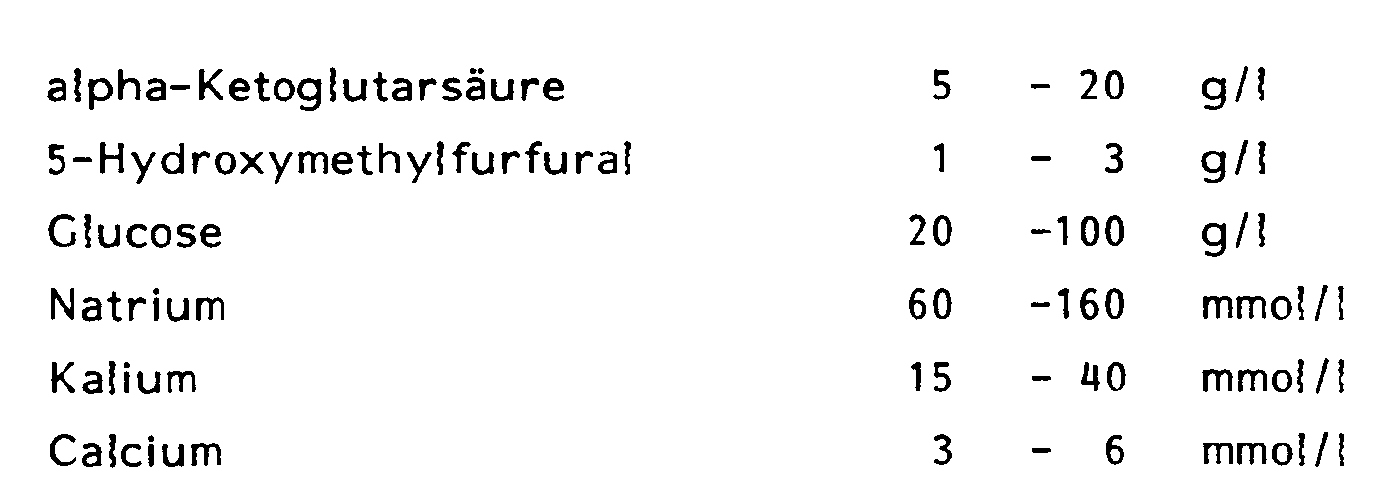

wobei mit einer Zusammensetzung
besonders gute Ergebnisse erzielbar waren. - Für die orale Verabreichung können sowohl feste Formen wie Kapseln oder Tabletten als auch Suspensionen, die beispielsweise durch Aufschlämmung von Granulaten entstehen, und schließlich auch Lösungen eingesetzt werden, wobei in den beiden letztgenannten Fällen die zur Azomethinbildung befähigte Verbindung keinen intensiven oder gar unangenehmen Geschmack besitzen sollte. Auch hier hat sich 5-Hydroxymethylfurfural besonders bewährt. Wie schon erwähnt, bietet die orale Form die Möglichkeit, direkt an Krankheitsherde im Verdauungstrakt heranzukommen, wobei es vorteilhaft ist, die Formulierung des Mittels je nach Einwirkungsort zu modifizieren. Während bei einem Karzinom im Magen Suspensionen oder Lösungen zur Behandlung sehr geeignet sind, hat sich für die Behandlung von Dünndarmcarcinom die Anwendung des erfindungsgemäßen Mittels in Form von Tabletten, die mit einem magensaftresistenten Überzug versehen sind, besonders bewährt. Karzinome des Colons können außer mit Infusionen auch mit einer Form des erfindungsgemäßen Mittels behandelt werden, das in Form eines Klistiers verabreicht wird. In diesem Fall ist es zweckmäßig, dem erfindungsgemäßen Mittel, das die Wirkstoffe gelöst enthält, ein Verdickungsmittel, wie z.B. Methylcellulose, Acetylcellulose oder Polyethylenglycol zuzusetzen, um Reizungen im Darm, die zum Ausstoß des Mittels führen könnten, möglichst zu vermeiden. Schließlich können von außen zugängliche Karzinome oder Metastasen lokal, etwa durch salbenartige Zubereitungen oder pastöse Auftragungen behandelt werden, wobei zweckmäßig Zusätze wie z. B. Dimethylsulfoxyd einverleibt werden, die den Durchgang der Wirkstoffe durch die Haut begünstigen.
- Die Herstellung des erfindungsgemäßen Mittels gelingt, indem man die beiden Wirkstoffe auf in der Galenik übliche Weise in eine homogene Mischung überführt, die im Falle der Herstellung einer Lösung gleichzeitig mit einer Aufnahme in einem Verdünnungsmittel, vorzugsweise Wasser, hergestellt werden kann. Vor, während oder nach erfolgter Mischung und Aufnahme in einem Verdünnungsmittel oder Mischung mit einem Streckmittel, wird der pH-Wert durch Zuführung von Alkalien, nicht aber von Ammoniak oder Aminen, auf den gewünschten Wert eingestellt. Wird das erfindungsgemäße Mittel in Form einer wäßrigen Lösung, etwa als Infusionslösung, zubereitet, geht man vorzugsweise so vor, daß zuerst die alpha-Ketocarbonsäure und die anderen Bestandteile in Wasser gelöst werden und der pH-Wert bevorzugt auf den Bereich von 4-6 eingestellt wird, bevor jene Verbindung zugefügt wird, die zur Azomethinbildung befähigt ist. Im Falle der Herstellung einer festen Darreichungsform werden die Wirkstoffe und die übrigen Zusätze in üblicher Weise gemischt, gegebenenfalls auch gemeinsam granuliert. Die Einstellung des gewünschten pH-Bereiches kann in diesem Fall zweckmäßigerweise durch Einsatz eines entsprechenden Teiles oder der gesamten Menge der alpha-Ketoglutarsäure in Form eines ihrer Monosalze vorgenommen werden. Dazu bietet sich das Mono-Na-Salz besonders an, sehr zweckmäßig ist auch der Einsatz von Monosalzen des Kaliums, Magnesiums oder des Zinks, wobei auch Mischungen von verschiedenen Monosalzen verwendet werden können, um die Menge an den einzelnen Kationen den physiologischen Bedingungen anpassen zu können. Auch im Falle der festen Zubereitungen ist es bevorzugt, zunächst das Monosalz der alpha-Ketoglutarsäure oder dessen Mischung mit der freien Säure mit den übrigen Bestandteilen wie Elektrolyte, Streckmittel und gegebenenfalls auch Zucker zu mischen, bevor jene Verbindung zugesetzt wird, die zur Azomethinbildung befähigt ist. Es hat sich als günstig erwiesen, die Herstellung des erfindungsgemäßen Mittels, besonders dann, wenn es sich um eine Lösung handelt, unter Inertgasatmosphäre vorzunehmen, was helfen soll, oxydationsempfindliche Stoffe, wie z.B. 5-Hydroxymethylfurfural vor einer Aktivitätsverminderung zu schützen.
- Bei der Anwendung des erfindungsgemäßen Mittels in der Therapie von Patienten mit malignen Tumoren an verschiedenen Organen wie Lunge, Bronchien, Brust, Blase, Magen, Haut und dergleichen konnte bei einer täglichen Verabreichung des erfindungsgemäßen Mittels über einen Zeitraum von einigen Wochen, beispielsweise etwa 1-2 Monate, bereits ein Stadium erzielt werden, in dem der zuvor deutlich sichtbare Tumor im Röntgenbild nicht mehr nachweisbar war und auch eventuell vorhandene Metastasen erfolgreich bekämpft waren. Hand in Hand mit diesem manifesten Behandlungserfolg ging auch eine entscheidende Besserung des Allgemeinzustandes der Patienten. Auffallend rasche Behandlungserfolge wurden dort registriert, wo sich das Krebsgeschehen noch in einem frühen Stadium befand.
- Ein besonderer Vorzug des erfindungsgemäßen Mittels liegt außerdem darin, daß schädliche oder auch nur unangenehme Nebenwirkungen nicht beobachtet werden konnten. Die Tagesdosis in der eigentlichen Behandlungsphase beträgt in der Regel etwa 3-30 g alpha-Ketoglutarsäure und 1-5 g Verbindung, die zur Azomethinbildung befähigt ist, vorzugsweise 5-Hydroxymethylfurfural, wobei sich die Höhe der Taggesdosis innerhalb dieses Bereiches nach Schwere des Falles, jedoch auch nach dem Allgemeinzustand des Patienten richtet. In Fällen, in denen der Krankheitsherd nicht durch Erzeugung eines Blutspiegels an den erfindungsgemäß gewählten Wirkstoffen sondern durch direkte Einwirkung der Wirkstoffe auf den Krankheitsherd bekämpft werden soll, wie dies z.B. bei Erkrankungen im Gastrointestinaltrakt durch orale oder rectale Gabe möglich ist, kann die Tagesdosis in der Regel etwas niedriger gehalten werden. Sie beträgt dann meistens etwa 3-9 g alpha-Ketoglutarsäure und 0,5-1,5 g Verbindung, die zur Azomethinbildung befähigt ist.
- Etwa die gleiche Dosis ist auch angezeigt, wenn im Zuge einer nicht stationär durchgeführten Infusionsbehandlung einzelne Tage, an denen eine Infusion nicht möglich ist, durch orale Gaben überbrückt werden sollen. Es ist günstig, nach Erreichen eines Behandlungserfolges eine Nachbehandlung des Patienten unter Verabreichung des erfindungsgemäßen Mittels in geringerer Tagesdosis, vorzugsweise in für die orale oder rectale Verabreichung geeigneter Form, anzuschließen, um den erreichten Erfolg zu stabilisieren. In diesem Fall ist es empfehlenswert, mit der oben genannten Dosierung für die lokale Anwendung zu beginnen. In den meisten Fällen kann dann die Dosis weiter reduziert werden, beispielsweise sogar bis zu einer Tagesdosis von 2,25 g alpha-Ketoglutarsäure und 0,375 g der Verbindung, die zur Azomethinbildung befähigt ist.
- In den nachfolgenden Beispielen werden detaillierte Beispiele für behandlungsgerechte Formen des erfindungsgemäßen Mittels und deren Anwendung in der Krebstherapie gegeben, ohne die vorliegende Erfindung darauf beschränken zu wollen.
- 6 g alpha-Ketoglutarsäure werden gemeinsam mit 50 g Glucose bei Raumtemperatur in 900 ml Wasser, das durch Begasen sauerstoffarm gemacht wurde, gelöst, worauf durch Zugabe von 2 g festem Natriumhydroxyd der pH-Wert der Lösung auf einen Wert über 4 gebracht wird. Nach Eintragen von 2 g 5-Hydroxymethylfurfural wird die resultierende Lösung auf 1 l aufgefüllt. Sie ist zum Einsatz als Infusionslösung zur Behandlung von Patienten mit malignen Tumoren geeignet.
- Aus folgenden Substanzen

wird ein Liter einer Lösung bereitet, indem man zunächst die alpha-Ketoglutarsäure in destilliertem Wasser bei einer Temperatur von etwa 50° C löst, das vorher durch Begasen sauerstoffarm gemacht wurde. In die resultierende Lösung werden dann nacheinander NaOH und KOH, die Elektrolyte sowie die Glucose eingetragen, wobei gleichzeitig ein pH-Wert von über 4 eingestellt wird. Der so erhaltenen klaren Lösung wird schließlich unter Rühren das 5-Hydroxymethylfurfural hinzugefügt. Man erhält so eine klare, leicht gelbliche Lösung, die pro Liter 6 g alpha-Ketoglutarsäure, 2 g 5-Hydroxymethylfurfural, 50 g Glucose sowie Elektrolyte in folgenden molaren Konzentrationen enthält:

- Der pH-Wert der Lösung beträgt 4,90, die Lösung hat eine berechnete Osmolalität von 490 mosmol/kg H₂O. Sie wird zur Anwendung als Infusionslösung in Flaschen von 1/2 Liter Inhalt abgefüllt.
- wie in Beispiel 2 beschrieben wird aus

- 1 Liter einer Lösung bereitet, die neben 16 g alpha-Ketoglutarsäure, 2 g 5-Hydroxymethylfurfural und 20 g Glucose Elektrolyte in folgender molarer Konzentration enthält:

- Der pH-Wert der Lösung beträgt 4,1, die berechnete Osmolalität etwa 530 mosmol/kg H₂O. Die Lösung wird in Infusionsflaschen von 1/2 Liter Inhalt abgefüllt.
- Wie in Beispiel 2 beschreiben wird aus

- 1 Liter einer Lösung bereitet, die die beiden Wirkstoffe im Verhältnis 6 : 1 enthält. Weiters sind Elektrolyte in folgender molarer Konzentration zugegen:
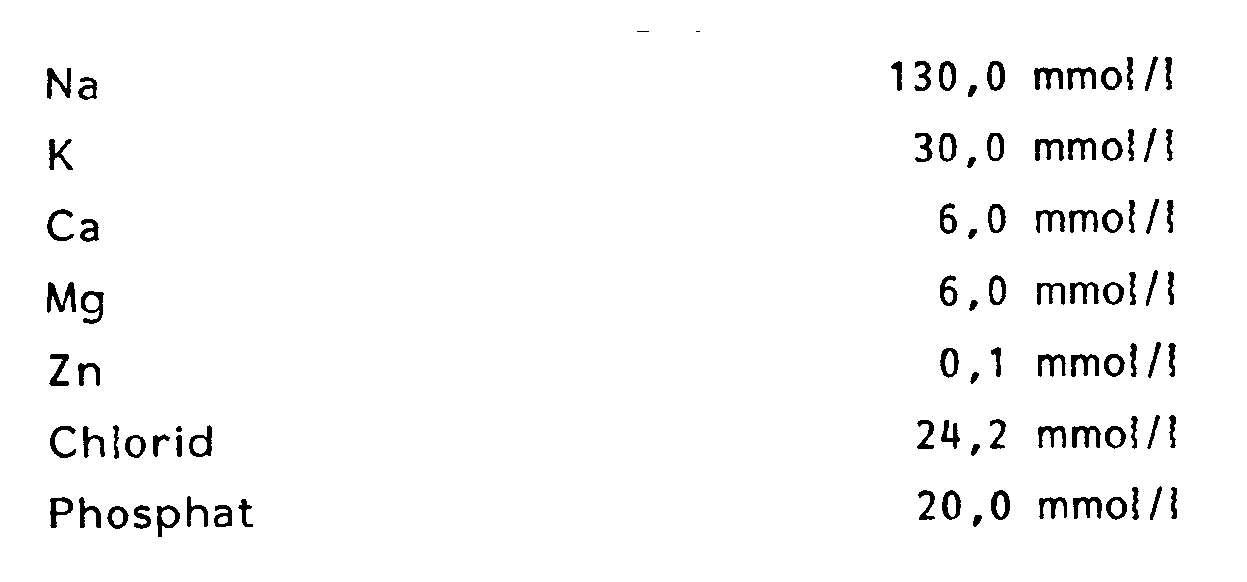
- Der pH-Wert der Lösung beträgt 4,68. Sie wird in Infusionsflaschen von 1/2 Liter Inhalt abgefüllt.
- 345,12 g alpha-Ketoglutarsäure-mono-Na-Salz, 0,8 g Zinkoxyd und 1204 g Staubzucker werden in einem Planetenmischer trocken gemischt und durch ein Sieb der Maschenweite 0,7 mm gesiebt. Das so erhaltene Material wird in den Mischer zurückgegeben und bei laufendem Mischwerk mit 100 g destilliertem Wasser versetzt und bis zur Agglomeratbildung gemischt. Nach Trocknung bei 50° C wird das Produkt durch ein Sieb der Maschenweite 1,25 mm granuliert und in einem Planetenmischer mit 50,0 g 5-Hydroxymethylfurfural gemischt. Der pH-Wert beträgt etwa 3. Man erhält 1600 g einer Masse, die als Trinkgranulat eingesetzt werden kann. Sie wird in Portionsbeutel zu je 4 g abgefüllt. Dieser Portionsbeutel enthält 0,75 g alpha-Ketoglutarsäure und 0,125 g 5-Hydroxymethylfurfural.
- 1,2 g alpha-Ketoglutarsäure werden in Form des Mono-Na-Salzes mit 0,2 g 5-Hydroxymethylfurfural, 3,6 g Saccharose und 0,002 g Zinkoxyd gemischt und durch Zusatz von Wasser bis zu einem Volumen von 20 ml in Lösung gebracht. Diese Lösung dient zur Herstellung einer Trinkampulle.
Die Präparate gemäß den Beispielen 5 und 6 sind zur oralen Verabreichung, insbesondere zur Behandlung von Fällen mit Karcinom der oberen Verdauungsorgane wie des Magens vorgesehen. - Die gleichen Stoffe wie in Beispiel 6, jedoch mit dem Unterschied, daß anstelle der Saccharose übliche Gleit- und Sprengmittel eingesetzt werden, werden zu Tabletten verarbeitet und anschließend mit einem magensaftresistenten Überzug versehen. Sie können zur Behandlung von Tumoren des Dünndarms dienen.
- 15 g Methylzellulose, die in Form eines flüssigen Schleimes vorliegt, werden mit 6 g alpha-Ketoglutarsäure, 1,2 g NaOH, 0,726 g 85 %iger KOH, 16 g NaH₂PO₄.2H₂O und 6 g Na₂HPO₄.12H₂O und schließlich mit 1 g 5-Hydroxymethylfurfural gemischt.
Die resultierende Lösung einer Viskosität von 20-50 cp und einem pH-Wert von etwa 6 wird auf 1 l aufgefüllt. Sie kann in Portionen von 1/4 Liter als Klistier verabreicht werden und dient bevorzugt zur Behandlung von Kolonkarczinomen, wobei die Tagesdosis 2 Klistiere beträgt. - Ein 33jähriger männlicher Patient mit einem hühnereigroßen, inoperablen Bronchialkarzinom mit infauster Prognose erhielt über 30 Tage täglich 1/2 Liter der Lösung gemäß Beispiel 2 infundiert, entsprechend einer Tagedosis an alpha-Ketoglutarsäure von 3 g und einer solchen an 5-Hydroxymethylfurfural von 1 g. Nach Ablauf der 30 Tage war der Tumor röntgenologisch nicht mehr sichtbar. Der vorher stimmungsmäßig depressiv eingestellte Patient wurde wieder positiv gestimmt und entwickelte einen lebhaften Appetit.
- Ein männlicher Patient mit 78 Jahren, der an einem rezidivierenden Blasenkarzinom mit Lungenmetastasen erkrankt war, erhielt über 30 Tage je 1/2 Liter der Lösung gemäß Beispiel 2 infundiert. Danach waren weder der Blasentumor noch die Lungenmetastasen röntgenologisch nachweisbar.
- Einer 70 Jahre alten Patientin wurde ein ulzerierendes Mammakarzinom mit mutiplen lokalen Metastasen chirurgisch entfernt. Da sich unmittelbar nach der Operation wieder Metastasen ausbildeten, wurde ihr täglich 1/2 Liter der Lösung gemäß Beispiel 2 infundiert. Diese Infusionsbehandlung mußte nach 7 Tagen wegen Venenunverträglichkeit abgebrochen werden. Da sich kurze Zeit nach Abheilung des Operationsfeldes im verheilten Operationsgebiet eine Metastase in Form eines harten Knotens bildete, wurde die Infusionsbehandlung unter Beachtung größter Sorgfalt bei der Verabreichung wieder aufgenommen.
Nach 7 Infusionen von je 1/2 Liter der Lösung gemäß Beispiel 2 war der harte Knoten verflüssigt, nach weiteren 7 Infusionen war das Gebiet des ursprünglichen harten Knotens unauffällig. Die Infusionsbehandlung wurde sicherheitshalber 6 Tage fortgesetzt. - Ein 87 Jahre alter Patient, der an einem primären Prostatakarzinom mit Lungenmetastasen litt, die häufig Bluthusten und Atembeschwerden verursachten, erhielt täglich über 16 Tage 1/2 Liter der Lösung gemäß Beispiel 2. Bei der dann vorgenommenen Zwischenuntersuchung hatte die Prostata wieder die normale Konsistenz und die Rundherde in der Lunge waren am Röntgenschirm nicht mehr sichtbar. Der Patient hatte keinen Hustenreiz mehr und konnte nach seiner Angabe wieder leicht atmen.
- Bei einem Patienten mit Morbus Hodgkin (Lymphogranulomatose) im Stadium IV mit infauster Prognose wurde nach 15 Infusionen von je 1/2 Liter der Lösung nach Beispiel 2 folgender Zwischenbefund erhoben:
von den angeschwollenen Lymphknoten an Hals, Achselhöhlen und Leisten waren die Achsellymphknoten abgeschwollen, die übrigen Lymphknoten waren noch geschwollen, der Arzt stellte jedoch eine Besserung des Gesamtzustandes des Patienten fest. - Ein Patient, bei dem bei einer Nachuntersuchung nach einem Magengeschwür über eine Gastroskopie eine ausgeprägte Präcancerose festgestellt wurde und dem eine weitgreifende Magenteilresektion empfohlen wurde, erhielt über 4 Tage 3 x täglich eine Portion des Trinkgranulates gemäß Beispiel 5, das in Wasser aufgeschlämmt wurde, in Form einer Rollkur verabreicht. Bei der am 4. Tag vorgenommenen Nachuntersuchung, bei der nocheinmal Proben der Magenschleimhaut entnommen wurden, konnte keine Malignität im zytologisch untersuchten Gewebe mehr festgestellt werden. Der Patient setzte daraufhin die Behandlung mit der gleichen Tagesdosis an dem Trinkgranulat gemäß Beispiel 5 noch 6 Wochen hindurch fort. Bei der anschließenden zweiten Nachuntersuchung konnte bei den entnommenen und zytologisch geprüften Proben der Magenschleimhaut ebenfalls keine Malignität mehr festgestellt werden.
- Eine 79jährige Patientin mit einem Mammakarzinom, das palliativ operiert wurde, zeigte nach erfolgter Operation eine Lymphknotenschwellung, die die Absiedlung von Fernmetastasen anzeigte. Bei schlechtem Allgemeinzustand und Gewichtsverlust wurde mit einer Infusionstherapie unter Verwendung der Lösung gemäß Beispiel 2 bei einer Tagesdosis von 1 g 5-Hydroxymethylfurfural und 3 g alpha-Ketoglutarsäure begonnen.
Nach der 6. Infusion war eine deutliche Besserung zu verzeichnen. Nach der Verabfolgung von insgesamt 14 Infusionen wurde dann auf eine orale Weiterbehandlung umgestellt, bei der die Patientin täglich 3 Portionen des Trinkgranulates gemäß Beispiel 5, das sind also 2,25 g alpha-Ketoglutarsäure und 0,375 g 5-Hydroxymethylfurfural pro Tag, erhielt.
Diese orale Therapie wurde 6 Monate fortgesetzt. Bei einer darauffolgenden Kontrolluntersuchung war die Lymphknotenschwellung nicht mehr tastbar und auch im Röntgenbild nicht mehr nachweisbar. Die Patientin hatte eine Gewichtszunahme zu verzeichnen und zeigte ein wesentlich gebessertes Allgemeinbefinden. - Prinzipiell können auch alle anderen bösartigen Tumorerkrankungen, die mit einer Erhöhung der alpha-Ketoglutarsäure im Serum verbunden sind, auf gleiche Weise behandelt werden.
Claims (10)
Applications Claiming Priority (2)
| Application Number | Priority Date | Filing Date | Title |
|---|---|---|---|
| AT218/88A AT393221B (de) | 1988-02-03 | 1988-02-03 | Mittel mit zerstoerender wirkung auf maligne tumore, verfahren zu dessen herstellung und praeparation zur anwendung in der therapie von krebskranken |
| AT218/88 | 1988-02-03 |
Publications (2)
| Publication Number | Publication Date |
|---|---|
| EP0326826A1 EP0326826A1 (de) | 1989-08-09 |
| EP0326826B1 true EP0326826B1 (de) | 1992-03-25 |
Family
ID=3484658
Family Applications (1)
| Application Number | Title | Priority Date | Filing Date |
|---|---|---|---|
| EP89100493A Expired - Lifetime EP0326826B1 (de) | 1988-02-03 | 1989-01-12 | Mittel mit zerstörender Wirkung auf maligne Tumore, Verfahren zu dessen Herstellung und Präparation zur Anwendung in der Therapie von Krebskranken |
Country Status (7)
| Country | Link |
|---|---|
| US (1) | US5006551A (de) |
| EP (1) | EP0326826B1 (de) |
| JP (1) | JPH01226810A (de) |
| AT (2) | AT393221B (de) |
| DE (1) | DE58901002D1 (de) |
| DK (1) | DK47089A (de) |
| ES (1) | ES2033021T3 (de) |
Cited By (1)
| Publication number | Priority date | Publication date | Assignee | Title |
|---|---|---|---|---|
| DE102013106530A1 (de) * | 2013-06-21 | 2014-12-24 | Christoph Pallua | Krebsmedikament |
Families Citing this family (20)
| Publication number | Priority date | Publication date | Assignee | Title |
|---|---|---|---|---|
| JPH03165602A (ja) * | 1989-11-24 | 1991-07-17 | Murata Mfg Co Ltd | 誘電体共振器 |
| HU207800B (en) * | 1990-05-10 | 1993-06-28 | Andras Sikter | Process for producing composition for improving condition and for treating different illnesses |
| PT668769E (pt) * | 1992-11-06 | 2000-10-31 | Greystone Medical Group Inc | Composicoes sinteticas relacionadas com extracto de casca de carvalho e processo para a sua utilizacao |
| US5629327A (en) * | 1993-03-01 | 1997-05-13 | Childrens Hospital Medical Center Corp. | Methods and compositions for inhibition of angiogenesis |
| GB9306741D0 (en) * | 1993-03-31 | 1993-05-26 | Biocure Ltd | Compounds |
| US6209259B1 (en) * | 1997-07-11 | 2001-04-03 | Encap, Llc | Seeding treatments |
| EP1137427A1 (de) * | 1998-12-07 | 2001-10-04 | Ecosmart Technologies Inc. | Krebsbehandlung zusammensetzung und verfahren mittels natürlicher pflanzlicher äetherischer öle mit signaltransduktion modulatoren |
| WO2001089520A2 (en) * | 2000-05-19 | 2001-11-29 | Progenics Pharmaceuticals, Inc. | Dehydroascorbic acid formulations and uses thereof |
| AT411730B (de) * | 2002-05-17 | 2004-05-25 | Groke Karl Dr | Mittel zur raucher-entwöhnung oder zur alkohol-entwöhnung |
| SE0201880D0 (sv) * | 2002-06-19 | 2002-06-19 | Milenca Gardovic | Komposition för att behandla hudåkommor och för att förbättra hårtillväxt |
| AT412447B (de) * | 2002-11-27 | 2005-03-25 | C Y L Handelsges M B H | Mittel mit zerstörender wirkung auf maligne tumore sowie verfahren zu seiner herstellung |
| US20050124684A1 (en) * | 2003-08-29 | 2005-06-09 | Ying Du | 5-(hydroxymethyl) furfural and derivatives as inhibitors of TNFalpha and IL-1beta production |
| AU2005316295B2 (en) * | 2004-12-17 | 2012-03-22 | Alan B. Cash | Method for extending lifespan and delaying the onset of age-related disease |
| PL372183A1 (pl) * | 2005-01-11 | 2006-07-24 | Sgp & Sons Ab | Preparat przeciwnowotworowy oraz zastosowanie preparatu przeciwnowotworowego |
| US20110105617A1 (en) * | 2005-01-11 | 2011-05-05 | Sgp & Sons Ab | Method for treatment of neoplastic diseases with alpha-keto glutarate and/or salts thereof |
| AT503385B1 (de) * | 2006-03-20 | 2008-05-15 | C Y L Pharmazeutika Gmbh | Mittel zur behandlung von oxidativem stress |
| DE102007007629A1 (de) | 2007-02-16 | 2008-08-21 | Evonik Degussa Gmbh | Verfahren zur Herstellung von 5-Hydroxymethyl-furfural über 5-Acyloxymethyl-furfural als Zwischenprodukt |
| EP2255623A1 (de) * | 2009-05-26 | 2010-12-01 | Volker Wagner-Solbach | Pflanzennährstoffe |
| WO2014070769A1 (en) | 2012-10-29 | 2014-05-08 | The University Of North Carolina At Chapel Hill | Methods and compositions for treating mucosal tissue disorders |
| ES2950096T3 (es) | 2016-09-22 | 2023-10-05 | Alan B Cash | Método para aliviar los síntomas del síndrome premenstrual |
Family Cites Families (9)
| Publication number | Priority date | Publication date | Assignee | Title |
|---|---|---|---|---|
| GB1125675A (en) * | 1966-02-10 | 1968-08-28 | Kyowa Hakko Kogyo Kk | Stable ascorbic acid composition and process for preparing the same |
| JPS52108027A (en) * | 1976-03-09 | 1977-09-10 | Rikagaku Kenkyusho | Anticarcinogen |
| JPS5412312A (en) * | 1977-06-30 | 1979-01-30 | Otsuka Chem Co Ltd | Preparation of ketazine |
| JPS5470428A (en) * | 1977-11-11 | 1979-06-06 | Rikagaku Kenkyusho | Carcinostatic agent |
| JPS54126731A (en) * | 1978-03-20 | 1979-10-02 | Rikagaku Kenkyusho | Carcinostatic agent |
| JPS579712A (en) * | 1980-06-20 | 1982-01-19 | Fukumi Morishige | Instilling (dripping) liquid for intravenous injection |
| EP0054635B1 (de) * | 1980-12-23 | 1985-02-13 | Dr. Franz Köhler Chemie GmbH | Protektive Lösung für Herz und Niere und Verfahren zu deren Herstellung |
| US4565598A (en) * | 1982-01-04 | 1986-01-21 | The Commonwealth Of Australia | Method and apparatus for controlling diameter in Czochralski crystal growth by measuring crystal weight and crystal-melt interface temperature |
| ATE78166T1 (de) * | 1985-10-22 | 1992-08-15 | Silvetti Anthony N | Monosaccharide enthaltende zusammensetzung zum heilen von wunden. |
-
1988
- 1988-02-03 AT AT218/88A patent/AT393221B/de not_active IP Right Cessation
-
1989
- 1989-01-12 ES ES89100493T patent/ES2033021T3/es not_active Expired - Lifetime
- 1989-01-12 AT AT89100493T patent/ATE74006T1/de not_active IP Right Cessation
- 1989-01-12 DE DE8989100493T patent/DE58901002D1/de not_active Expired - Fee Related
- 1989-01-12 EP EP89100493A patent/EP0326826B1/de not_active Expired - Lifetime
- 1989-01-24 US US07/301,035 patent/US5006551A/en not_active Expired - Lifetime
- 1989-02-02 DK DK047089A patent/DK47089A/da not_active Application Discontinuation
- 1989-02-02 JP JP1022747A patent/JPH01226810A/ja active Pending
Cited By (1)
| Publication number | Priority date | Publication date | Assignee | Title |
|---|---|---|---|---|
| DE102013106530A1 (de) * | 2013-06-21 | 2014-12-24 | Christoph Pallua | Krebsmedikament |
Also Published As
| Publication number | Publication date |
|---|---|
| US5006551A (en) | 1991-04-09 |
| ATA21888A (de) | 1991-02-15 |
| JPH01226810A (ja) | 1989-09-11 |
| DK47089A (da) | 1989-09-15 |
| AT393221B (de) | 1991-09-10 |
| DE58901002D1 (de) | 1992-04-30 |
| EP0326826A1 (de) | 1989-08-09 |
| ES2033021T3 (es) | 1996-07-16 |
| DK47089D0 (da) | 1989-02-02 |
| ATE74006T1 (de) | 1992-04-15 |
Similar Documents
| Publication | Publication Date | Title |
|---|---|---|
| AT393221B (de) | Mittel mit zerstoerender wirkung auf maligne tumore, verfahren zu dessen herstellung und praeparation zur anwendung in der therapie von krebskranken | |
| DE69530412T2 (de) | Zusammensetzung aus cisplatin in kombination mit 2,2'-dithio-bis(ethansulfonat)(dimesna) | |
| DE60103453T2 (de) | Verwendung von albuminstabilisiertem Paclitaxel zur Herstellung eines Arzneimittels zum Behandeln von festen Tumoren und das so erhaltene Arzneimittel | |
| DE69507029T2 (de) | Pharmazeutische zusammensetzungen enthaltend einen opiat antagonist und calcium salze, ihre verwendung zur behandlung von endorphin-vermittelten krankheiten | |
| DE69529213T2 (de) | Verwendung von magnesium enthaltenden verbindungen zur behandlung oder prophylaxe von krebs- und autoimmunkrankheiten | |
| DE69627170T2 (de) | Nichtwässrige abführmittel für den kolon | |
| EP0350973A1 (de) | Mittel und Erzeugnis für die Diagnose und Therapie von Tumoren sowie zur Behandlung von Schwächen der zelligen und humoralen Immunabwehr | |
| DE3115086A1 (de) | "dextromethorphan enthaltende pharamzeutische zusammensetzung und die verwendung von dextromethorphan zur schmerzbekaempfung" | |
| DE3424781C2 (de) | Verwendung von L-Carnosin zur Tumorbehandlung | |
| DE69917796T2 (de) | Decursin-enthaltende pharmazeutische zusammensetzungen | |
| DE69511448T2 (de) | Verwendung von Phosphorsäurediester-Verbindungen zur Unterdrückung von Krebsmetastasen in der Leber | |
| DE3402878A1 (de) | Arzneimittel und die verwendung schwerloeslicher calcium- und/oder magnesiumverbindungen als arzneimittel | |
| EP1565176B1 (de) | Mittel mit zerstörender wirkung auf maligne tumore sowie verfahren zu seiner herstellung | |
| DE3152319T1 (de) | ||
| EP1633394B1 (de) | Pharmazeutische kombinationspräparate zur krebstherapie enthaltend glutaminase und antineoplastische anthracycline oder platinverbindungen | |
| DE19528524A1 (de) | Calciumhaltiges Mittel zur intestinalen Phosphatbindung und Verfahren zu seiner Herstellung | |
| DE1951822A1 (de) | Pharmazeutisches Praeparat zur Behandlung von Krebs | |
| EP1524273A1 (de) | Verfahren zur Herstellung von trans- oder cis-Diammoniumdichlorodihydroxoplatin (IV)-Salzen und -Derivaten und ihre Verwendung zur Herstellung von pharmazeutischen Wirkstoffen | |
| EP1675599A1 (de) | Pharmazeutische zusammensetzung umfassend oxoplatin, dessen salze und derivate | |
| CN107737108B (zh) | 一种治疗心肌梗死后心室重塑的口服药物组合物 | |
| EP0673913B1 (de) | Calcium-Alkalicitratverbindungen und deren Verwendung als Arzneimittel | |
| DE3334751C2 (de) | ||
| DE60107135T2 (de) | Stuhl-Marker | |
| DE2827478A1 (de) | Arzneimittel, insbesondere zur heilung von und vorbeugung gegen geschwulstkrankheiten | |
| DE69916330T2 (de) | Phenylessigsäure enthaltende zusammensetzungen zur behandlung und vorbeugung der atherosklerose und der restenose |
Legal Events
| Date | Code | Title | Description |
|---|---|---|---|
| PUAI | Public reference made under article 153(3) epc to a published international application that has entered the european phase |
Free format text: ORIGINAL CODE: 0009012 |
|
| AK | Designated contracting states |
Kind code of ref document: A1 Designated state(s): AT BE CH DE ES FR GB GR IT LI LU NL SE |
|
| RAP1 | Party data changed (applicant data changed or rights of an application transferred) |
Owner name: LEOPOLD PHARMA GESELLSCHAFT M.B.H. |
|
| 17P | Request for examination filed |
Effective date: 19900130 |
|
| 17Q | First examination report despatched |
Effective date: 19910503 |
|
| GRAA | (expected) grant |
Free format text: ORIGINAL CODE: 0009210 |
|
| AK | Designated contracting states |
Kind code of ref document: B1 Designated state(s): AT BE CH DE ES FR GB GR IT LI LU NL SE |
|
| PG25 | Lapsed in a contracting state [announced via postgrant information from national office to epo] |
Ref country code: SE Effective date: 19920325 Ref country code: GR Free format text: LAPSE BECAUSE OF FAILURE TO SUBMIT A TRANSLATION OF THE DESCRIPTION OR TO PAY THE FEE WITHIN THE PRESCRIBED TIME-LIMIT Effective date: 19920325 |
|
| REF | Corresponds to: |
Ref document number: 74006 Country of ref document: AT Date of ref document: 19920415 Kind code of ref document: T |
|
| ITF | It: translation for a ep patent filed | ||
| REF | Corresponds to: |
Ref document number: 58901002 Country of ref document: DE Date of ref document: 19920430 |
|
| GBT | Gb: translation of ep patent filed (gb section 77(6)(a)/1977) | ||
| ET | Fr: translation filed | ||
| PLBE | No opposition filed within time limit |
Free format text: ORIGINAL CODE: 0009261 |
|
| STAA | Information on the status of an ep patent application or granted ep patent |
Free format text: STATUS: NO OPPOSITION FILED WITHIN TIME LIMIT |
|
| PG25 | Lapsed in a contracting state [announced via postgrant information from national office to epo] |
Ref country code: LU Free format text: LAPSE BECAUSE OF NON-PAYMENT OF DUE FEES Effective date: 19930131 Ref country code: LI Effective date: 19930131 Ref country code: CH Effective date: 19930131 |
|
| REG | Reference to a national code |
Ref country code: ES Ref legal event code: FG2A Ref document number: 2033021 Country of ref document: ES Kind code of ref document: T3 |
|
| 26N | No opposition filed | ||
| REG | Reference to a national code |
Ref country code: CH Ref legal event code: PL |
|
| PGFP | Annual fee paid to national office [announced via postgrant information from national office to epo] |
Ref country code: GB Payment date: 19981229 Year of fee payment: 11 |
|
| PGFP | Annual fee paid to national office [announced via postgrant information from national office to epo] |
Ref country code: FR Payment date: 19990118 Year of fee payment: 11 |
|
| PGFP | Annual fee paid to national office [announced via postgrant information from national office to epo] |
Ref country code: ES Payment date: 19990121 Year of fee payment: 11 Ref country code: BE Payment date: 19990121 Year of fee payment: 11 Ref country code: AT Payment date: 19990121 Year of fee payment: 11 |
|
| PGFP | Annual fee paid to national office [announced via postgrant information from national office to epo] |
Ref country code: NL Payment date: 19990128 Year of fee payment: 11 |
|
| PGFP | Annual fee paid to national office [announced via postgrant information from national office to epo] |
Ref country code: DE Payment date: 19990319 Year of fee payment: 11 |
|
| PG25 | Lapsed in a contracting state [announced via postgrant information from national office to epo] |
Ref country code: GB Free format text: LAPSE BECAUSE OF NON-PAYMENT OF DUE FEES Effective date: 20000112 Ref country code: AT Free format text: LAPSE BECAUSE OF NON-PAYMENT OF DUE FEES Effective date: 20000112 |
|
| PG25 | Lapsed in a contracting state [announced via postgrant information from national office to epo] |
Ref country code: ES Free format text: LAPSE BECAUSE OF NON-PAYMENT OF DUE FEES Effective date: 20000113 |
|
| PG25 | Lapsed in a contracting state [announced via postgrant information from national office to epo] |
Ref country code: BE Free format text: LAPSE BECAUSE OF NON-PAYMENT OF DUE FEES Effective date: 20000131 |
|
| BERE | Be: lapsed |
Owner name: LEOPOLD PHARMA G.M.B.H. Effective date: 20000131 |
|
| PG25 | Lapsed in a contracting state [announced via postgrant information from national office to epo] |
Ref country code: NL Free format text: LAPSE BECAUSE OF NON-PAYMENT OF DUE FEES Effective date: 20000801 |
|
| GBPC | Gb: european patent ceased through non-payment of renewal fee |
Effective date: 20000112 |
|
| PG25 | Lapsed in a contracting state [announced via postgrant information from national office to epo] |
Ref country code: FR Free format text: LAPSE BECAUSE OF NON-PAYMENT OF DUE FEES Effective date: 20000929 |
|
| NLV4 | Nl: lapsed or anulled due to non-payment of the annual fee |
Effective date: 20000801 |
|
| PG25 | Lapsed in a contracting state [announced via postgrant information from national office to epo] |
Ref country code: DE Free format text: LAPSE BECAUSE OF NON-PAYMENT OF DUE FEES Effective date: 20001101 |
|
| REG | Reference to a national code |
Ref country code: FR Ref legal event code: ST |
|
| REG | Reference to a national code |
Ref country code: ES Ref legal event code: FD2A Effective date: 20010910 |
|
| PG25 | Lapsed in a contracting state [announced via postgrant information from national office to epo] |
Ref country code: IT Free format text: LAPSE BECAUSE OF NON-PAYMENT OF DUE FEES;WARNING: LAPSES OF ITALIAN PATENTS WITH EFFECTIVE DATE BEFORE 2007 MAY HAVE OCCURRED AT ANY TIME BEFORE 2007. THE CORRECT EFFECTIVE DATE MAY BE DIFFERENT FROM THE ONE RECORDED. Effective date: 20050112 |