EP0327092A2 - Phosphonate, Verfahren zu deren Herstellung und deren Verwendung als Flammschutzmittel in Kunststoffen - Google Patents
Phosphonate, Verfahren zu deren Herstellung und deren Verwendung als Flammschutzmittel in Kunststoffen Download PDFInfo
- Publication number
- EP0327092A2 EP0327092A2 EP89101824A EP89101824A EP0327092A2 EP 0327092 A2 EP0327092 A2 EP 0327092A2 EP 89101824 A EP89101824 A EP 89101824A EP 89101824 A EP89101824 A EP 89101824A EP 0327092 A2 EP0327092 A2 EP 0327092A2
- Authority
- EP
- European Patent Office
- Prior art keywords
- compounds according
- compounds
- alcoholate
- general formula
- phosphonates
- Prior art date
- Legal status (The legal status is an assumption and is not a legal conclusion. Google has not performed a legal analysis and makes no representation as to the accuracy of the status listed.)
- Granted
Links
Classifications
-
- C—CHEMISTRY; METALLURGY
- C08—ORGANIC MACROMOLECULAR COMPOUNDS; THEIR PREPARATION OR CHEMICAL WORKING-UP; COMPOSITIONS BASED THEREON
- C08K—Use of inorganic or non-macromolecular organic substances as compounding ingredients
- C08K5/00—Use of organic ingredients
- C08K5/49—Phosphorus-containing compounds
- C08K5/51—Phosphorus bound to oxygen
- C08K5/53—Phosphorus bound to oxygen bound to oxygen and to carbon only
- C08K5/5317—Phosphonic compounds, e.g. R—P(:O)(OR')2
- C08K5/5333—Esters of phosphonic acids
-
- C—CHEMISTRY; METALLURGY
- C07—ORGANIC CHEMISTRY
- C07F—ACYCLIC, CARBOCYCLIC OR HETEROCYCLIC COMPOUNDS CONTAINING ELEMENTS OTHER THAN CARBON, HYDROGEN, HALOGEN, OXYGEN, NITROGEN, SULFUR, SELENIUM OR TELLURIUM
- C07F9/00—Compounds containing elements of Groups 5 or 15 of the Periodic Table
- C07F9/02—Phosphorus compounds
- C07F9/28—Phosphorus compounds with one or more P—C bonds
- C07F9/38—Phosphonic acids [RP(=O)(OH)2]; Thiophosphonic acids ; [RP(=X1)(X2H)2(X1, X2 are each independently O, S or Se)]
- C07F9/40—Esters thereof
- C07F9/4071—Esters thereof the ester moiety containing a substituent or a structure which is considered as characteristic
- C07F9/4075—Esters with hydroxyalkyl compounds
-
- C—CHEMISTRY; METALLURGY
- C07—ORGANIC CHEMISTRY
- C07H—SUGARS; DERIVATIVES THEREOF; NUCLEOSIDES; NUCLEOTIDES; NUCLEIC ACIDS
- C07H11/00—Compounds containing saccharide radicals esterified by inorganic acids; Metal salts thereof
- C07H11/04—Phosphates; Phosphites; Polyphosphates
Definitions
- the invention relates to novel phosphonates and their production and their use as flame retardants in plastics.
- Antimony trioxide is still widely used as a flame retardant for plastics in conjunction with halogen-containing, especially bromine-containing, organics.
- antimony trioxide which has carcinogenic activity in dust form
- the further processing of plastic parts such as sawing, drilling, milling must still appear to be problematic, since the absorption of dust-like particles cannot be ruled out in such operations can.
- cyclic phosphonic acid esters are prepared by reacting phosphonic acid, phosphoric acid or carboxylic acid esters with a bicyclic phosphite.
- European patent application 0 237 135 discloses a phosphonate body as a flame retardant which, however, because of its crystalline character, can only be incorporated into polymers using a hot rolling process.
- the invention has for its object to provide new compounds that can be used as flame retardants and a method for producing the compounds.
- the compounds prepared according to the invention in accordance with the formulas shown below have proven to be extraordinarily effective despite their relatively low phosphorus content, although in the general opinion a good flame retardant effect in phosphorus-containing compounds can be attributed to a very high phosphorus content.
- a 2 or 3
- b 2a
- x integer from 1-6, preferably 1 or 2 in the case of R a
- x 0 or integers from 1-10 in the case of R b
- the aromatic carboxylate residue is a benzoate, saliycylate or cresotinate residue
- the aliphatic carboxylate residue is an acetate, propionate, capronate, caprylate or caprinate residue
- R1 is also a monoalcoholate of di- or polyhydroxy compounds such as sorbitol, bisphenol A, sugar , Trimethylolpropane, pentaerythritol, polysaccharide or polyalkanolamine.
- R4 is a carboxylate of a dicarboxylic acid, such as succinate, oxalate, maleinate, fumarate, adipate, phthalate, terephthalate.
- R4 is a dialcoholate
- di- or polyhydroxy compounds such as bisphenol A, sorbitol, sugar, polyalkylene glycols, polysaccharides, polyvinyl alcohols, polyalkanolamines, hydroquinone, resorcinol, trimethylolpropane or pentaerythritol are preferred.
- the above-mentioned phosphonates are suitable as flame retardants due to their high thermal stability.
- the invention also relates to a process for the preparation of the phosphonates.
- a given dialkylalkane phosphonate is reacted with reactants containing hydroxyl groups, such as oxyethylated carboxylic acids, mono- or polyfunctional alcohols (oxyalkylated or non-oxyalkylated), phenols (oxyalkylated or non-oxyalkylated), glycols and polyglycols, with the formation of a new phosphonate and cleavage of the underlying phosphonate Alcohols according to the following reaction equations 1 and 2:
- dialkylalkanephosphonates required as starting compounds are prepared in a known manner from trialkylphosphites by rearrangement reactions according to Michaelis-Arbusov (Lit. Houben-Weyl - Methods of Organic Chemistry, Volume XII / 1 p. 433 ff (1963)).
- the compounds used according to the invention are prepared by heating ester oxalkylates, alcohols and their oxalkylates, phenols and their oxalkylates, and also glycols and polyglycols with phosphonic acid esters to the reflux temperature of the phosphonate.
- Alkalines such as sodium or potassium hydroxide, sodium or potassium methylate, and acids, such as concentrated sulfuric acid and p-toluenesulfonic acid, have proven successful as catalysts, with amounts of 0.05-1.0 percent, measured on the total amount of the reactants.
- the new phosphonates produced by the above process can be used as flame retardants in plastics, preferably in polyurethane, PVC, polyester or epoxy resins.
- the new phosphonates produced according to the invention are characterized by surprisingly high thermal stability, which contradicts the view represented, for example, in US Pat. No. 3,789,091 that phosphorus compounds with CH bonds on ⁇ -carbon atoms from 200 ° C. for decomposition with dealkylation tend. Most of the compounds according to the invention (exception are phosphonates from polyhydroxy compounds) are thermally stable up to about 250 ° C.
- the reaction product is water-clear, yellow and of low viscosity. Excess DMMP can be distilled off as required.
- 129 g of fatty alcohol propoxylate (C 12, 14, 1 PO; average molecular weight 258), (0.5 mol), 124.4 g of DMMP (1 mol) and 0.3 g of sodium methylate are weighed into a three-necked flask. Under a nitrogen blanket, the reaction mixture is heated as described in Example 1 and kept under reflux. After a reaction time of 12 h, the theoretical amount of methanol (20.1 ml) is distilled off from the reaction mixture. The excess DMMP is removed in vacuo.
- Flame retardants according to claim were incorporated into rigid polyurethane foams with the following formulation: 33.95% polyfunctional polyether polyol (OH number 395) 11.32% Monofluorotrichloromethane 0.50% N-ethylmorpholine 10.00% Reaction product from bisphenol A.2.4 EO and dimethyl methane phosphonate from Example 2 The homogeneous mixture of these components will be 25.00% a raw, liquid 4,4-diphenylmethane diisocyanate added and stirred briefly
- the resulting foam is stored for 14 days in a standard climate (20 ° C, 65% relative humidity - DIN 50 014) and tested in accordance with DIN 4 102 test method B 2. All samples pass the test.
- Flame retardant according to Example 2 is incorporated into the following recipe for the production of a flexible polyurethane foam: 58.20% trifunctional polyether polyol, MW 3500 (OH number 47.3) 0.24% Dibutyltin dilaurate 0.12% Diazabicyclooctane 0.44% Oxethylated silicone oil (e.g. L 520 from Union Carbide) 2.10% water 10.00% Flame retardant according to example 2 The mixture is mixed for as long as possible. Then be 28.90% Toluene diisocyanate (technical mixture of isomers) added and stirred rapidly.
- Toluene diisocyanate technical mixture of isomers
- the resulting flexible polyurethane foam is stored for 14 days in a standard climate (DIN 50 014). Its fire behavior is tested according to DIN 4 102 - test method B2. All samples pass the test.
- Flame retardant according to Example 2 is incorporated into a commercially available copolyester for use as a hot melt adhesive.
- the copolyester is polycondensed from: 25 mol% Terephthalic acid 25 mol% Isophthalic acid 25 mol% Ethylene glycol 25 mol% Butanediol 1.4
- a plate without and a plate with flame retardant are hung up vertically and flame-treated with a Bunsen burner for 15 seconds.
- the plate without flame retardant ignites after 5 seconds and continues to burn after the Bunsen burner has been removed until it is completely burned, with burning material dripping off.
- the plate with the incorporated flame retardant does not ignite. During the flame treatment, the plate becomes soft and deforms, but no burning drops fall down.
- Example 2 Flame retardant according to Example 2 is incorporated into a PVC paste of the following composition: DUT 1 2nd 3rd Emulsion PVC VESTOLIT E 7012 100 100 100 PVC plasticizer VESTINOL N 60 50 40 PVC plasticizer SANTICIZER 160 20th 10th 5 Stabilizer NUOSTAB G 1014 2nd 2nd 2nd Flame retardant according to example 2 - 20th 25th
- the PVC pastes are spread with a squeegee (0.3 mm) on glass plates and at 180 ° C for 3 min. long gelled.
- the resulting foils are rolled up, hung up vertically and flame-treated with the Bunsen burner for 15 seconds.
- Test item 1 ignites quickly and continues to burn independently when the Bunsen burner is removed, producing black smoke.
- Test object 2 goes out immediately after removing the Bunsen burner, initially producing little white smoke
- DUT 3 goes out immediately after removing the Bunsen burner. The smoke development is stronger than for test object 2.
Landscapes
- Chemical & Material Sciences (AREA)
- Organic Chemistry (AREA)
- Health & Medical Sciences (AREA)
- Biochemistry (AREA)
- Molecular Biology (AREA)
- General Health & Medical Sciences (AREA)
- Life Sciences & Earth Sciences (AREA)
- Medicinal Chemistry (AREA)
- Engineering & Computer Science (AREA)
- Biotechnology (AREA)
- Polymers & Plastics (AREA)
- Genetics & Genomics (AREA)
- Chemical Kinetics & Catalysis (AREA)
- Compositions Of Macromolecular Compounds (AREA)
- Fireproofing Substances (AREA)
Abstract
Description
- Die Erfindung betrifft neuartige Phosphonate sowie deren Herstellung und deren Verwendung als Flammschutzmittel in Kunststoffen.
- Als Flammschutzmittel für Kunststoffe wird nachwievor im großen Umfange Antimontrioxid in Verbindung mit halogenhaltigen, insbesondere bromhaltigen Organica verwendet.
- Die im Zusammenhang mit der Darstellung und Verarbeitung von Antimontrioxid bekannt gewordenen Gesundheitsrisiken haben eine weltweite Suche nach Ersatzstoffen eingeleitet. Obwohl Antimontrioxid, das in Staubform cancerogene Aktivität aufweist, durch Verwendung pastöser Formulierung für den Kunststoffhersteller problemlos zu handhaben ist, muß die Weiterverarbeitung von Kunststoffteilen wie Sägen, Bohren, Fräsen, weiterhin als problematisch erscheinen, da die Aufnahme staubförmiger Partikel bei solchen Arbeitsgängen nicht ausgeschlossen werden kann.
- Die Suche nach Ersatzstoffen für Antimontrioxid wurde nicht zuletzt aufgrund der beschriebenen gesundheitlichen Probleme ab 1979 intensiviert, als Sb₂O₃ erstmals in die Liste der Gesundheitsschädlichen Arbeitsstoffe (MAK-Liste) in die Kategorie III B eingestuft wurde. Es werden seither eine Reihe von Ersatzstoffen für die Kombination Antimontrioxid - halogenhaltige Organica angeboten, doch sind deren Wirkung bei mengengleicher Anwendung ungenügend, oder aber die Wirksubstanz ist unverhältnismäßig teuer in der Herstellung.
- Im dem wirtschaftlich wichtigen Bereich der Elektro- und Elektronikindustrie werden Forderungen nach halogenfreien Flammschutzmitteln in zunehmendem Maße gestellt. Kunststoffe werden als ideale Nichtleiter in großem Stil als elektrisches Isoliermaterial verwendet. Der Forderung nach halogenfreien Flammschutzmitteln liegt die Gefahr zugrunde, daß Schäden in Elektronikbauteilen und deren Folgen, verursacht durch korrosive Brandgase, den eigentlichen Brandschaden bei weitem übersteigen können.
- In der US-PS 37 89 091 und US-PS 38 49 368 werden cyclische Phosphonsäureester durch Umsetzung von Phosphonsäure-, Phosphorsäure-, oder Carbonsäureester mit einem bicyclischen Phosphit hergestellt.
- In der Europäischen Patentanmeldung 0 237 135 ist ein Phosphonatkörper als Flammschutzmittel offenbart, der allerdings in Polymere wegen seines kristallinen Charakters nur mit Hilfe eines heißen Einwalzverfahrens eingearbeitet werden kann.
- Aus der US-PS 23 52 549 ist eine Umesterung zwischen zwei unterschiedlichen Dialkylalkanphosphonaten bekannt.
- Der Erfindung liegt die Aufgabe zugrunde, neue Verbindungen zu schaffen, die als Flammschutzmittel verwendbar sind sowie ein Verfahren zur Herstellung der Verbindungen.
- Überraschenderweise haben sich die erfindungsgemäß hergestellten Verbindungen gemäß der nachstehend aufgezeigten Formeln trotz ihres relativ niedrigen Phosphorgehaltes als außerordentlich wirksam erwiesen, obwohl nach allgemeiner Auffassung ein guter Flammschutzeffekt bei phosphorhaltigen Verbindungen einem sehr hohen Phosphorgehalt zuzuschreiben ist.
- Als flammhemmende Verbindungen sind solche der allgemeinen Formel:
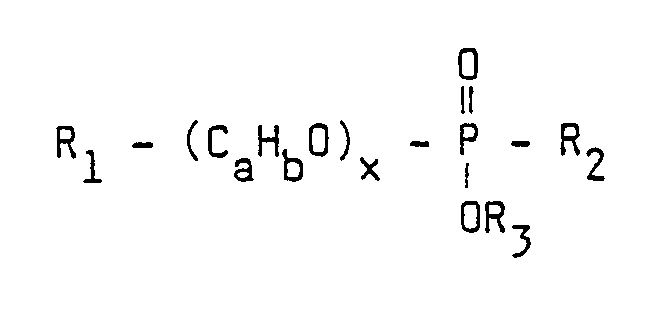
R₁ = Ra =- O -
ein aromatischer Carboxylatrest, ein aliphatischer Carboxylatrest, oder
R₁ = Rb - O -
ein Phenolat, ein substituiertes Phenolat oder ein teilweise oder vollständig hydriertes Phenolat, ein Alkoholat eines gesättigten Alkoholes, ein Alkoholat eines ungesättigten Alkoholes, ein Monoalkoholat eines Polyalkylenglykoles mit 2-10 Monomereinheiten oder ein Monoalkoholat einer Di- oder Polyhydroxyverbindung bedeuten und
R₂, R₃ einen Alkylrest (CnH2n+1) mit n = 1, 2, 3, 4, repräsentieren und R₂ mit R₃ identisch sein kann. - Ferner ist: a = 2 oder 3, b = 2a, x = ganze Zahl von 1-6, vorzugsweise 1 oder 2 im Falle von Ra,
x = 0 oder ganze Zahlen von 1-10 im Falle von Rb - Bevorzugt sind dabei solche Phosphonate, bei denen:
der aromatische Carboxylatrest ein Benzoat-, Saliycylat- oder Kresotinatrest ist,
der aliphatische Carboxylatrest ein Acetat-, Propionat-, Capronat-, Caprylat- oder Caprinatrest ist,
das Alkoholat eines gesättigten Alkoholes der allgemeinen Formel CnH2n+1 - O - mit n = 3-22, vorzugsweise n = 4-12 ist,
das Alkoholat eines ungesättigten Alkoholes der allgemeinen Formel CnH2n-1 - O - mit n = 4-22, vorzugsweise n = 6-18 ist und bei denen R₁ auch ein Monoalkoholat von Di- oder Polyhydroxyverbindungen wie Sorbit, Bisphenol A, Zucker, Trimethylolpropan, Pentaerythrit, Polysaccharid oder Polyalkanolamin sein kann. - Ebenso wirksam haben sich Verbindungen der allgemeinen Formel:

R₄ = - O -- Rc - - O -
- O -
ein Carboxylat einer Dicarbonsäure
oder
R₄ = - O - Rd - O -
ein Dialkoholat einer Di- oder Polyhydroxyverbindung ist und
R₂, R₃ die gleiche Bedeutung wie in Anspruch 1 haben und
a = 2 oder 3, b = 2a
x = eine ganze Zahl von 1-6, vorzugsweise 1 oder 2 im Falle von Rc,
x = 0 oder eine ganze Zahl von 1-10 im Falle von Rd bedeutet. - Bevorzugt sind hierfür solche Verbindungen bei denen R₄ ein Carboxylat einer Dicarbonsäure, wie Succinat, Oxalat, Maleinat, Fumarat, Adipinat, Phthalat, Terephthalat ist.
- Ist R₄ ein Dialkoholat, so sind solche von Di- oder Polyhydroxyverbindungen wie beispielsweise Bisphenol A, Sorbit, Zucker, Polyalkylenglykole, Polysaccharide, Polyvinylalkohole, Polyalkanolamine, Hydrochinon, Resorcin, Trimethylolpropan oder Pentaerythrit bevorzugt.
- Die vorstehend genannten Phosphonate sind aufgrund ihrer hohen thermischen Stabilität als Flammschutzmittel geeignet.
- Gegenstand der Erfindung ist auch ein Verfahren zu Herstellung der Phosphonate. Hierbei wird ein vorgegebenes Dialkylalkanphosphonat mit hydroxylgruppenhaltigen Reaktionspartnern wie oxethylierten Carbonsäuren, mono- oder polyfunktionellen Alkoholen (oxalkyliert oder nicht oxalkyliert), Phenolen (oxalkyliert oder nicht oxalkyliert), Glykolen und Polyglykolen zur Reaktion gebracht, unter Bildung eines neues Phosphonates und Abspaltung des dem Ausgangsphosphonat zugrundeliegenden Alkoholes gemäß folgenden Reaktionsgleichungen 1 und 2:

- Die als Ausgangsverbindungen notwendigen Dialkylalkanphosphonate werden auf bekannte Weise durch Umlagerungsreaktionen nach Michaelis-Arbusov aus Trialkylphosphiten hergestellt (Lit. Houben-Weyl - Methoden der organischen Chemie, Band XII/1 S. 433 ff (1963)).
- Die erfindungsgemäß eingesetzten Verbindungen werden durch Erhitzen von Esteroxalkylaten, Alkoholen und deren Oxalkylaten, Phenolen und deren Oxalkylaten, sowie Glykolen und Polyglykolen mit Phosphonsäureestern auf Rückflußtemperatur des Phosphonates hergestellt.
- Höhere Reaktionstemperaturen, wie sie gegen Ende der Reaktion auftreten können, müssen vermieden werden, da dann eine Zersetzung der Ausgangsphosphonate nicht auszuschließen ist.
- Als Katalysatoren haben sich Alkalien, wie Natrium- oder Kaliumhydroxid, Natrium- oder Kaliummethylat und Säuren, wie konzentrierte Schwefelsäure und p-Toluolsulfonsäure bewährt, bei Einsatzmengen von 0,05 - 1,0 Prozent, gemessen an der Gesamtmenge der Reaktionspartner.
- Die nach dem vorstehenden Verfahren hergestellten neuen Phosphonate sind als Flammschutzmittel in Kunststoffen, vorzugsweise in Polyurethan, PVC, Polyester oder Epoxydharzen verwendbar.
- Die erfindungsgemäß hergestellten neuen Phosphonate zeichnen sich durch überraschend hohe thermische Stabilität aus, was der beispielsweise in der US-PS 37 89 091 vertretenen Ansicht widerspricht, daß Phosphorverbindungen mit C-H-Bindungen an β-ständigen C-Atomen ab 200 °C zur Zersetzung unter Desalkylierung neigen. Die meisten der erfindungsgemäßen Verbindungen (Ausnahme sind Phosphonate aus Polyhydroxyverbindungen) sind bis etwa 250 °C thermisch stabil.
- In einen Dreihalskolben mit Rückflußkühler, KPG-Rührer und Stickstoffeinleitungsrohr werden 114,15 g (0,5 mol), Bisphenol A, 155,13 g (1,25 mol) Dimethylmethanphosphonat und 0,3 g Natriummethylat eingewogen. Der Rückflußkühler wird mit 70 °C warmem Wasser gespeist, auf seinem Kopf befindet sich eine mit Leitungswasser gekühlte Destillationsbrücke. Diese Apparatur ermöglicht das Abdestillieren von entstehendem Methanol und verhindert das Überdestillieren von Dimethylmethanphosphonat. Kurz nachdem unter einem Stickstoff-Polster die Siedetemperatur des DMMP erreicht ist (180 °C) setzt die Umesterungsreaktion ein, was an einer stetigen, gleichmäßigen Kondensation von Methanol in die Vorlage zu erkennen ist. Nach etwa 4 h ist die theoretische Menge von 40 ml Methanol (1 mol) überdestilliert. Unter Vakuum wird überschüssiges DMMP abgezogen.
- Man erhält ein viskoses, schwach gelbes, klares Produkt.
- In der unter Beispiel 1 beschriebenen Apparatur werden 417,4 g Bisphenol A.2,4 EO (1,25 mol), 387,8 g DMMP (3,125 mol) und 0,8 g Natriummethylat auf 180 °C erhitzt. Nachdem 100,7 ml Methanol (2,5 mol) in die Vorlage überdestilliert sind, wird die Reaktion abgebrochen.
- Man erhält ein schwach gelbes, klares, niedrigviskoses Produkt, von dem nach Bedarf überschüssiger Methanphosphonsäuredimethylester abdestilliert werden kann.
- In einen Dreihalskolben werden 97,4 g Maleinsäureoxethylat (2,2 EO) (0,5 mol), 155,1 g DMMP (1,25 mol) und 0,3 g Natriummethylat eingewogen. In der unter Beispiel 1 beschriebenen Weise wird die Reaktionsmischung 4 h unter Rückfluß gekocht, wobei die Reaktionstemperatur 190 °C nicht überschreitet. Dabei entstehen 40 ml Methanol (1,0 mol).
- Das Reaktionsprodukt ist wasserklar, gelb und niedrigviskos. Überschüssiges DMMP kann nach Bedarf abdestilliert werden.
- In einen Dreihalskolben werden 150 g Polyethylenglykol 300 (0,5 mol) 155,1 g DMMP (1,25 mol) und 0,3 g Natriummethylat, wie in Beispiel 1 beschrieben, 3 h unter Rückfluß gehalten. Nachdem 40 ml Methanol in die Vorlage überdestilliert sind, wird abgekühlt.
- Es entsteht ein niedrigviskoses, wasserklares, nahezu farbloses, klar wasserlösliches Produkt. Überschüssiges DMMP kann nach Bedarf abdestilliert werden.
- In einemDreihalskolben werden 91,1 g Sorbit (0,5 mol), 155,1 g DMMP (1,25 mol) und 0,3 g Natriummethylat, wie in Beispiel 1 beschrieben, unter Rückfluß gehalten. Innerhalb von 3 h färbt sich die Reaktionsmischung hellbraun und die erwartete Menge von 40 ml Methanol (1 mol) ist in die Vorlage überdestilliert.
- Man erhält ein hellbraunes, klares, wasserlösliches Produkt. Überschüssiges DMMP kann nach Bedarf abdestilliert werden.
- In einen Dreihalskolben werden 129 g Fettalkoholpropoxylat (C12, 14, 1 PO; mittleres Molekulargewicht 258), (0,5 mol), 124,4 g DMMP (1 mol) und 0,3 g Natriummethylat eingewogen. Unter einem Stickstoffpolster wird die Reaktionsmischung, wie in Beispiel 1 beschrieben, erhitzt und unter Rückfluß gehalten. Nach einer Reaktionszeit von 12 h ist die theoretische Menge an Methanol (20,1 ml) aus dem Reaktionsgemisch abdestilliert. Der Überschuß an DMMP wird im Vakuum abgezogen.
- Man erhält ein wasserklares, schwach gelbes Produkt.
- Flammschutzmittel gemäß Patentanspruch wurden in Polyurethan-Hartschäume folgender Rezeptur eingearbeitet:
33,95 % polyfunktionelles Polyetherpolyol (OH-Zahl 395) 11,32 % Monofluortrichlormethan 0,50 % N-Ethylmorpholin 10,00 % Umsetzungsprodukt aus Bisphenol A.2,4 EO und Dimethylmethanphosphonat aus Beispiel 2 Der homogenen Mischung dieser Komponenten werden 25,00 % eines rohen, flüssigen 4,4-Diphenylmethandiisocyanates zugesetzt und kurz gerührt - Der entstehende Schaum wird 14 Tage bei Normklima gelagert (20 °C, 65 % rel. Luftfeuchtigkeit - DIN 50 014) und nach DIN 4 102 Prüfverfahren B 2 geprüft. Sämtliche Proben bestehen des Test.
- Flammschutzmittel nach Beispiel 2 wird in folgende Rezeptur zur Herstellung eines Polyurethanweichschaumes eingearbeitet:
58,20 % trifunktionelles Polyetherpolyol, MG 3500 (OH-Zahl 47,3) 0,24 % Dibutylzinndilaurat 0,12 % Diazabicyclooctan 0,44 % Oxethyliertes Siliconöl (z.B. L 520 von Union Carbide) 2,10 % Wasser 10,00 % Flammschutzmittel nach Beispiel 2 Der Ansatz wird möglichst lange vermischt. Anschließend werden 28,90 % Toluylendiisocyanat (technisches Isomerengemisch) zugesetzt und rasch verrührt. - Der entstehende Polyurethan-Weichschaum wird 14 Tage bei Normklima (DIN 50 014) gelagert. Sein Brandverhalten wird nach DIN 4 102 - Prüfverfahren B2 - getestet. Sämtliche Proben bestehen den Test.
- Flammschutzmittel nach Beispiel 2 wird in einen handelsüblichen Copolyester für die Verwendung als Schmelzkleber eingearbeitet.
- Der Copolyester ist polykondensiert aus:
25 mol % Terephthalsäure 25 mol % Isophthalsäure 25 mol % Ethylenglykol 25 mol % Butandiol 1,4 - 100 Teile des Copolyesters in Pulverform werden mit 10 Teilen Flammschutzmittel nach Beispiel 2 gemischt, wobei zur Erzielung einer homogenen Mischung zunächst nur ca. 20 Teile Polyesterpulver zu 10 Teilen Flammschutzmittel gegeben werden und das restliche Polyesterpulver unter dauerndem Rühren nach und nach zugesetzt wird. Die erhaltene Masse wird in einer Metallform geschmolzen und durch Abkühlen zu einer Platte verarbeitet.
- Eine Platte ohne und eine Platte mit Flammschutzmittel werden senkrecht aufgehängt und 15 sec. mit einem Bunsenbrenner kantenbeflammt.
- Die Platte ohne Flammschutzmittel entzündet sich nach 5 sec. und brennt nach Entfernen des Bunsenbrenners weiter bis sie vollständig verbrannt ist, wobei brennendes Material abtropft. Die Platte mit eingearbeitetem Flammschutzmittel entzündet sich nicht. Während der Beflammung wird die Platte zwar weich und verformt sich, es fallen jedoch keine brennenden Tropfen herunter.
- Flammschutzmittel nach Beispiel 2 wird in eine PVC-Paste folgender Zusammensetzung eingearbeitet:
Prüfling 1 2 3 Emulsions PVC VESTOLIT E 7012 100 100 100 PVC-Weichmacher VESTINOL N 60 50 40 PVC-Weichmacher SANTICIZER 160 20 10 5 Stabilisator NUOSTAB G 1014 2 2 2 Flammschutzmittel nach Beispiel 2 - 20 25 - Die PVC-Pasten werden mit einer Rakel (0,3 mm) auf Glasplatten aufgestrichen und bei 180 °C 3 min. lang geliert. Die entstandenen Folien werden zusammengerollt, senkrecht aufgehängt und 15 sec. mit dem Bunsenbrenner kantenbeflammt.
- Prüfling 1 entzündet sich rasch und brennt dem Entfernen des Bunsenbrenners unter Entwicklung schwarzen Rauches selbständig weiter.
- Prüfling 2 verlischt sofort nach dem Entfernen des Bunsenbrenners, wobei zunächst wenig weißer Rauch entsteht
- Prüfling 3 verlischt sofort nach dem Entfernen des Bunsenbrenners. Die Rauchentwicklung ist stärker als bei Prüfling 2.
- 2,4 Gewichtsteile eines Bisphenol A-Epichlorhydrin-Harzes mit einem durchschnittlichen Molgewicht von 600 werden mit
0,3 Gewichtsteilen Flammschutzmittel nach Beispiel 2 verrührt. Zu dieser Mischung werden
0,6 Gewichtsteile eines Härters, bestehend aus 90 % Isophorondiamin und 10 % Benzylalkohol, gegeben und homogenisiert. Die erhaltene Masse wird mit Hilfe von Siliconkautschukformen zu 3 mm starken quadratischen Platten von 100 mm Kantenlänge gegossen. Nach einer Aushärtungszeit von 48 Stunden werden die Platten nach DIN 51 960 klimatisiert. Anschließend werden die Platten nach DIN 51 960 getestet.PROBEN 1 2 3 Flammschutzmittel nach Beispiel 2 in % 0 10 15 Längste Brennstrecke in mm 35 (wird gelöscht, da nicht selbstverlöschend!) 4 4 Brandflecktiefe in mm 3 1 0,5 - Bei den Proben 2 und 3 erlischt die Flamme selbständig, sobald der Alkohol und der Zellstoff verbrannt sind.
Claims (12)

R₁ = Ra -

ein aromatischer Carboxylatrest, ein aliphatischer Carboxylatrest,
oder
R₁ = Rb - O -
ein Phenolat, ein substituiertes Phenolat oder ein teilweise oder vollständig hydriertes Phenolat, ein Alkoholat eines gesättigten Alkoholes, ein Alkoholat eines ungesättigten Alkoholes, ein Monoalkoholat eines Polyalkylenglykols mit 2-10 Monomereinheiten oder ein Monoalkoholat einer Di- oder Polyhydroxyverbindung bedeuten,
und
R₂, R₃ einen Alkylrest (CnH2n+1) mit n = 1, 2, 3, 4 repräsentieren und R₂ mit R₃ identisch sein kann.
Ferner ist: a = 2 oder 3, b = 2a, x = ganze Zahl von 1-6, vorzugsweise 1 oder 2 im Falle von Ra,
x = 0 oder ganze Zahlen von 1-10 im Falle von Rb
dadurch gekennzeichnet
daß der aromatische Carboxylatrest ein Benzoat, ein Salicylat oder ein Kresotinat ist.
dadurch gekennzeichnet
daß der aliphatische Carboxylatrest ein Acetat, ein Propionat, ein Capronat, ein Caprylat oder ein Caprinat ist.
dadurch gekennzeichnet
daß das Alkoholat eines gesättigten Alkoholes ein solches der allgemeinen Formel CnH2n+1 - O - mit n = 3-22, vorzugsweise n = 4-12, ist.
dadurch gekennzeichnet
daß das Alkoholat eines ungesättigten Alkoholes ein solches der allgemeinen Formel CnH2n-1 - O - mit n = 4-22, vorzugsweise n = 6-18, ist.
dadurch gekennzeichnet
daß das Monoalkoholat einer Di- oder Polyhydroxyverbindung sich von Sorbit, Bisphenol A, einem Zucker, Trimethylolpropan, Pentaerythrit, einem Polysaccharid oder einem Polyalkanolamin ableitet.

R₄ = - O -


ein Carboxylat einer Dicarbonsäure
oder:
R₄ = - O - Rd - O -
ein Dialkoholat einer Di- oder Polyhydroxyverbindung ist
und:
R₂, R₃ die gleiche Bedeutung wie in Anspruch 1 haben
und:
a = 2 oder 3, b = 2a
x = eine ganze Zahl von 1-6, vorzugsweise 1 oder 2 im Falle von Rc,
x = 0 oder eine ganze Zahl von 1-10 im Falle von Rd bedeutet.
dadurch gekennzeichnet
daß das Carboxylat einer Dicarbonsäure ein Succinat, Oxalat, Maleinat, Fumarat, Adipinat, Phthalat, Terephthalat ist.
dadurch gekennzeichnet
daß sich das Dialkoholat von einer Di- oder Polyhydroxyverbindung wie Bisphenol A, Sorbit, Zucker, Polyalkylenglykol, Polysaccharid, Polyvinylalkohol, Polyalkanolamin, Hydrochinon, Resorcin, Trimethylolpropan oder Pentaerythrit herleitet.
dadurch gekennzeichnet,
daß Dialkylalkanphosphonate mit Hydroxylverbindungen nach folgenden Gleichungen umgeestert werden:

dadurch gekennzeichnet, daß Dialkylalkanphosphonate mit Hydroxylverbindungen nach folgenden Reaktionsgleichungen umgeestert werden:

Applications Claiming Priority (2)
| Application Number | Priority Date | Filing Date | Title |
|---|---|---|---|
| DE3803030A DE3803030C2 (de) | 1988-02-02 | 1988-02-02 | Verwendung von Phosphonaten als Flammschutzmittel in Kunststoffen |
| DE3803030 | 1988-02-02 |
Publications (3)
| Publication Number | Publication Date |
|---|---|
| EP0327092A2 true EP0327092A2 (de) | 1989-08-09 |
| EP0327092A3 EP0327092A3 (de) | 1991-03-13 |
| EP0327092B1 EP0327092B1 (de) | 1996-01-31 |
Family
ID=6346447
Family Applications (1)
| Application Number | Title | Priority Date | Filing Date |
|---|---|---|---|
| EP89101824A Revoked EP0327092B1 (de) | 1988-02-02 | 1989-02-02 | Phosphonate, Verfahren zu deren Herstellung und deren Verwendung als Flammschutzmittel in Kunststoffen |
Country Status (2)
| Country | Link |
|---|---|
| EP (1) | EP0327092B1 (de) |
| DE (2) | DE3803030C2 (de) |
Cited By (6)
| Publication number | Priority date | Publication date | Assignee | Title |
|---|---|---|---|---|
| EP0417410A3 (en) * | 1989-07-07 | 1991-11-06 | Cassella Aktiengesellschaft | Alkenyl-phosphonic- and phosphinic acid esters, process for their preparation, there use and prepared hydrogels using them |
| US5262456A (en) * | 1989-08-11 | 1993-11-16 | Siemens Aktiengesellschaft | Fire retardant casting resin molding compounds based on epoxy resins and acidic esters of hydroxy-functional phosphors |
| EP0632046A1 (de) * | 1993-05-27 | 1995-01-04 | DR. TH. BÖHME KG CHEM. FABRIK GMBH & CO. | Alkanphoshonsäureoxalkylate, Verfahren zu ihrer Herstellung und ihre Verwendung als Flammschutzmittel |
| US5614573A (en) * | 1995-03-27 | 1997-03-25 | Nicca Chemical Co., Ltd. | Flame retardants and flame retardant finishing method for polyester-based synthetic fiber materials |
| EP0845474A1 (de) * | 1996-11-13 | 1998-06-03 | ALBRIGHT & WILSON UK LIMITED | Alkylenverbrückte Alkyl-Phosphonate |
| US20210395477A1 (en) * | 2018-09-28 | 2021-12-23 | Sekisui Chemical Co., Ltd. | Foamed polyolefin-based-resin sheet |
Families Citing this family (6)
| Publication number | Priority date | Publication date | Assignee | Title |
|---|---|---|---|---|
| DE4131951A1 (de) * | 1991-09-25 | 1993-04-08 | Boehme Chem Fab Kg | Wasserloesliche bzw. dispergierbare mittel zur stabilisierung thermooxidativ labiler verbindungen |
| DE19832094A1 (de) * | 1998-07-16 | 2000-01-27 | Consortium Elektrochem Ind | Flammhemmende Dispersionszusammensetzung |
| DE10014597C2 (de) * | 2000-03-27 | 2002-06-27 | Clariant Gmbh | Halogenfreier, pentangetriebener flammwidriger Polyurethanhartschaum und ein Verfahren zu seiner Herstellung |
| DE10014596C2 (de) * | 2000-03-27 | 2002-06-27 | Clariant Gmbh | Halogenfreier, wassergetriebener flammwidriger Polyurethanhartschaum und ein Verfahren zu seiner Herstellung |
| DE10014593C2 (de) * | 2000-03-27 | 2002-06-27 | Clariant Gmbh | Halogenfreier, flammwidriger Polyurethanhartschaum und ein Verfahren zu seiner Herstellung |
| WO2025257178A1 (en) * | 2024-06-10 | 2025-12-18 | Syensqo Specialty Polymers Usa, Llc | Fire-resistant high-flow thermoplastic composition |
Family Cites Families (13)
| Publication number | Priority date | Publication date | Assignee | Title |
|---|---|---|---|---|
| GB1250963A (de) * | 1969-11-21 | 1971-10-27 | ||
| US3887654A (en) * | 1971-07-05 | 1975-06-03 | Ciba Geigy Corp | Phosphorus containing reaction products |
| US4001367A (en) * | 1974-03-29 | 1977-01-04 | M & T Chemicals Inc. | Method for permanently and uniformly incorporating an additive into an undrawn fiber |
| SE7500950L (de) * | 1974-02-20 | 1975-08-21 | Ciba Geigy Ag | |
| US3978166A (en) * | 1975-04-07 | 1976-08-31 | Borg-Warner Corporation | Cyclic phosphonates |
| GB1536778A (en) * | 1975-11-21 | 1978-12-20 | Upjohn Co | Bis(hydroxyalkyl)dialkylaminomethanephosphonates |
| DE2853936A1 (de) * | 1978-12-14 | 1980-07-03 | Bayer Ag | Phosphonsaeureester |
| NL7901769A (nl) * | 1979-03-06 | 1980-09-09 | Gen Electric | Vlamvertragende, polyfenyleenether bevattende samen- stellingen. |
| DE3065574D1 (en) * | 1979-03-24 | 1983-12-22 | Bayer Ag | Surface-active phosphonic acid esters, and polymer dispersions and emulsions containing them |
| DE2911697A1 (de) * | 1979-03-24 | 1980-10-02 | Bayer Ag | Oberflaechenaktive phosphonsaeureester |
| DE2918672A1 (de) * | 1979-05-09 | 1980-11-20 | Hoechst Ag | Verfahren zum aufhellen und faerben von synthesefasern |
| DE2945945A1 (de) * | 1979-11-14 | 1981-05-27 | Hoechst Ag, 6000 Frankfurt | Alkanphosphonsaeurehalbestersalze, ihre herstellung und ihre anwendung als praeparationsmittel fuer textile fasern |
| DE3780058T2 (de) * | 1986-04-07 | 1993-02-25 | Kalk Chemische Fabrik Gmbh | Reaktive, feuerhemmende zusammensetzung zum flammfestmachen von polyurethansteifschaum-materialien und verfahren zur herstellung derselben. |
-
1988
- 1988-02-02 DE DE3803030A patent/DE3803030C2/de not_active Expired - Lifetime
-
1989
- 1989-02-02 EP EP89101824A patent/EP0327092B1/de not_active Revoked
- 1989-02-02 DE DE58909584T patent/DE58909584D1/de not_active Expired - Lifetime
Cited By (7)
| Publication number | Priority date | Publication date | Assignee | Title |
|---|---|---|---|---|
| EP0417410A3 (en) * | 1989-07-07 | 1991-11-06 | Cassella Aktiengesellschaft | Alkenyl-phosphonic- and phosphinic acid esters, process for their preparation, there use and prepared hydrogels using them |
| US5262456A (en) * | 1989-08-11 | 1993-11-16 | Siemens Aktiengesellschaft | Fire retardant casting resin molding compounds based on epoxy resins and acidic esters of hydroxy-functional phosphors |
| EP0632046A1 (de) * | 1993-05-27 | 1995-01-04 | DR. TH. BÖHME KG CHEM. FABRIK GMBH & CO. | Alkanphoshonsäureoxalkylate, Verfahren zu ihrer Herstellung und ihre Verwendung als Flammschutzmittel |
| US5614573A (en) * | 1995-03-27 | 1997-03-25 | Nicca Chemical Co., Ltd. | Flame retardants and flame retardant finishing method for polyester-based synthetic fiber materials |
| EP0845474A1 (de) * | 1996-11-13 | 1998-06-03 | ALBRIGHT & WILSON UK LIMITED | Alkylenverbrückte Alkyl-Phosphonate |
| US20210395477A1 (en) * | 2018-09-28 | 2021-12-23 | Sekisui Chemical Co., Ltd. | Foamed polyolefin-based-resin sheet |
| US12060470B2 (en) * | 2018-09-28 | 2024-08-13 | Sekisui Chemical Co., Ltd. | Foamed polyolefin-based-resin sheet |
Also Published As
| Publication number | Publication date |
|---|---|
| EP0327092A3 (de) | 1991-03-13 |
| DE58909584D1 (de) | 1996-03-14 |
| DE3803030A1 (de) | 1989-08-10 |
| DE3803030C2 (de) | 1995-04-06 |
| EP0327092B1 (de) | 1996-01-31 |
Similar Documents
| Publication | Publication Date | Title |
|---|---|---|
| EP0327092B1 (de) | Phosphonate, Verfahren zu deren Herstellung und deren Verwendung als Flammschutzmittel in Kunststoffen | |
| EP0256355A2 (de) | Polyurethan-Prepolymere auf Basis oleochemischer Polyole, ihre Herstellung und Verwendung | |
| DE2457493A1 (de) | Flammhemmende oligomere phosphorverbindungen | |
| DE2252258A1 (de) | Schwerentflammbare thermoplastische polyester | |
| DE2252210A1 (de) | Schwerentflammbare thermoplastische polyester | |
| DE19540861A1 (de) | Verfahren zur Herstellung von Mischungen von oligomeren Phosphorsäureestern und deren Verwendung als Flammschutzmittel für Polyurethanschäume | |
| EP0658580A1 (de) | Flammwidrige Polyurethane | |
| DE2036587C3 (de) | ||
| EP0192601B1 (de) | Flammschutzmittel für Polyurethane | |
| EP3050891B1 (de) | Hydroxylgruppen-haltige poly(alkylenphosphate) | |
| EP0254683A2 (de) | Flammhemmende Zusammensetzungen | |
| EP3388479A1 (de) | Poly(alkylenphosphate) mit verringerter hygroskopie | |
| DE4221678C2 (de) | Hydroxyalkan-phosphonate von Polyolen | |
| DE1570207A1 (de) | Modifizierungsmittel fuer Polymerisate | |
| DE2237584A1 (de) | Polymere pentaerythrit-phosphite, verfahren zu ihrer herstellung und ihre verwendung fuer die polyurethanherstellung | |
| DE2452357A1 (de) | Copolykondensate von beta-halogenalkylphosphaten und dialkylphosphonaten | |
| DE3111565A1 (de) | Phosphorderivate von 1,3-diaethanolharnstoff und deren verwendung zur stabilisierung von polyurethanharzen | |
| EP0453821A2 (de) | Verwendung von spirocyclischen Borsäureestern als Flammhemmer in Kunststoffen | |
| DE1246242B (de) | Verfahren zur Herstellung von flammwidrigen Polyestern | |
| DE2432271A1 (de) | Phosphorhaltige sulfamid-derivate sowie verfahren zu deren herstellung | |
| DE1965831C3 (de) | Hydroxylchlor-Verbindungen als Flam mschutzmittel | |
| DE1568301B2 (de) | Verfahren zur Herstellung von Hydroxylgruppen und Phosphor enthaltenden Polyäthern | |
| DE1289313B (de) | Flammsichermachen von zellhaltigen Polyurethanschaumstoffen | |
| EP0135831A2 (de) | Verwendung von Polyhydroxyalkyl-polycarbonamiden zur Herstellung flammgeschützter Polyurethan-Hartschaum- und Integralschaumstoffe | |
| DE1259097B (de) | Verfahren zur Herstellung von Phosphoratome und Urethangruppen enthaltenden, gegebenenfalls verschaeumten Kunststoffen |
Legal Events
| Date | Code | Title | Description |
|---|---|---|---|
| PUAI | Public reference made under article 153(3) epc to a published international application that has entered the european phase |
Free format text: ORIGINAL CODE: 0009012 |
|
| AK | Designated contracting states |
Kind code of ref document: A2 Designated state(s): DE FR GB IT NL |
|
| PUAL | Search report despatched |
Free format text: ORIGINAL CODE: 0009013 |
|
| AK | Designated contracting states |
Kind code of ref document: A3 Designated state(s): DE FR GB IT NL |
|
| 17P | Request for examination filed |
Effective date: 19910821 |
|
| 17Q | First examination report despatched |
Effective date: 19931123 |
|
| GRAA | (expected) grant |
Free format text: ORIGINAL CODE: 0009210 |
|
| AK | Designated contracting states |
Kind code of ref document: B1 Designated state(s): DE FR GB IT NL |
|
| ITF | It: translation for a ep patent filed | ||
| GBT | Gb: translation of ep patent filed (gb section 77(6)(a)/1977) |
Effective date: 19960208 |
|
| REF | Corresponds to: |
Ref document number: 58909584 Country of ref document: DE Date of ref document: 19960314 |
|
| ET | Fr: translation filed | ||
| PLBQ | Unpublished change to opponent data |
Free format text: ORIGINAL CODE: EPIDOS OPPO |
|
| PLBI | Opposition filed |
Free format text: ORIGINAL CODE: 0009260 |
|
| PGFP | Annual fee paid to national office [announced via postgrant information from national office to epo] |
Ref country code: FR Payment date: 19961127 Year of fee payment: 9 |
|
| PLBF | Reply of patent proprietor to notice(s) of opposition |
Free format text: ORIGINAL CODE: EPIDOS OBSO |
|
| 26 | Opposition filed |
Opponent name: AKZO NOBEL N.V. Effective date: 19961031 |
|
| PGFP | Annual fee paid to national office [announced via postgrant information from national office to epo] |
Ref country code: GB Payment date: 19970124 Year of fee payment: 9 |
|
| PGFP | Annual fee paid to national office [announced via postgrant information from national office to epo] |
Ref country code: NL Payment date: 19970228 Year of fee payment: 9 |
|
| NLR1 | Nl: opposition has been filed with the epo |
Opponent name: AKZO NOBEL N.V. |
|
| PLBF | Reply of patent proprietor to notice(s) of opposition |
Free format text: ORIGINAL CODE: EPIDOS OBSO |
|
| PGFP | Annual fee paid to national office [announced via postgrant information from national office to epo] |
Ref country code: DE Payment date: 19970430 Year of fee payment: 9 |
|
| PG25 | Lapsed in a contracting state [announced via postgrant information from national office to epo] |
Ref country code: DE Effective date: 19970620 |
|
| RDAH | Patent revoked |
Free format text: ORIGINAL CODE: EPIDOS REVO |
|
| RDAG | Patent revoked |
Free format text: ORIGINAL CODE: 0009271 |
|
| STAA | Information on the status of an ep patent application or granted ep patent |
Free format text: STATUS: PATENT REVOKED |
|
| 27W | Patent revoked |
Effective date: 19970904 |
|
| GBPR | Gb: patent revoked under art. 102 of the ep convention designating the uk as contracting state |
Free format text: 970904 |
|
| NLR2 | Nl: decision of opposition |