EP0327155A2 - Pyrazines, pyrimidines and pyridazines, useful in the treatment of senile dementia - Google Patents
Pyrazines, pyrimidines and pyridazines, useful in the treatment of senile dementia Download PDFInfo
- Publication number
- EP0327155A2 EP0327155A2 EP89200147A EP89200147A EP0327155A2 EP 0327155 A2 EP0327155 A2 EP 0327155A2 EP 89200147 A EP89200147 A EP 89200147A EP 89200147 A EP89200147 A EP 89200147A EP 0327155 A2 EP0327155 A2 EP 0327155A2
- Authority
- EP
- European Patent Office
- Prior art keywords
- azabicyclo
- pyrazine
- ch2n
- heptane
- octane
- Prior art date
- Legal status (The legal status is an assumption and is not a legal conclusion. Google has not performed a legal analysis and makes no representation as to the accuracy of the status listed.)
- Withdrawn
Links
- 0 CCC1(C)NC(C)(C)CCC(C)(*)*C(*)**1 Chemical compound CCC1(C)NC(C)(C)CCC(C)(*)*C(*)**1 0.000 description 1
Classifications
-
- C—CHEMISTRY; METALLURGY
- C07—ORGANIC CHEMISTRY
- C07D—HETEROCYCLIC COMPOUNDS
- C07D239/00—Heterocyclic compounds containing 1,3-diazine or hydrogenated 1,3-diazine rings
- C07D239/02—Heterocyclic compounds containing 1,3-diazine or hydrogenated 1,3-diazine rings not condensed with other rings
- C07D239/24—Heterocyclic compounds containing 1,3-diazine or hydrogenated 1,3-diazine rings not condensed with other rings having three or more double bonds between ring members or between ring members and non-ring members
- C07D239/28—Heterocyclic compounds containing 1,3-diazine or hydrogenated 1,3-diazine rings not condensed with other rings having three or more double bonds between ring members or between ring members and non-ring members with hetero atoms or with carbon atoms having three bonds to hetero atoms with at the most one bond to halogen, directly attached to ring carbon atoms
-
- C—CHEMISTRY; METALLURGY
- C07—ORGANIC CHEMISTRY
- C07D—HETEROCYCLIC COMPOUNDS
- C07D451/00—Heterocyclic compounds containing 8-azabicyclo [3.2.1] octane, 9-azabicyclo [3.3.1] nonane, or 3-oxa-9-azatricyclo [3.3.1.0<2,4>] nonane ring systems, e.g. tropane or granatane alkaloids, scopolamine; Cyclic acetals thereof
- C07D451/02—Heterocyclic compounds containing 8-azabicyclo [3.2.1] octane, 9-azabicyclo [3.3.1] nonane, or 3-oxa-9-azatricyclo [3.3.1.0<2,4>] nonane ring systems, e.g. tropane or granatane alkaloids, scopolamine; Cyclic acetals thereof containing not further condensed 8-azabicyclo [3.2.1] octane or 3-oxa-9-azatricyclo [3.3.1.0<2,4>] nonane ring systems, e.g. tropane; Cyclic acetals thereof
-
- A—HUMAN NECESSITIES
- A61—MEDICAL OR VETERINARY SCIENCE; HYGIENE
- A61P—SPECIFIC THERAPEUTIC ACTIVITY OF CHEMICAL COMPOUNDS OR MEDICINAL PREPARATIONS
- A61P25/00—Drugs for disorders of the nervous system
-
- A—HUMAN NECESSITIES
- A61—MEDICAL OR VETERINARY SCIENCE; HYGIENE
- A61P—SPECIFIC THERAPEUTIC ACTIVITY OF CHEMICAL COMPOUNDS OR MEDICINAL PREPARATIONS
- A61P25/00—Drugs for disorders of the nervous system
- A61P25/02—Drugs for disorders of the nervous system for peripheral neuropathies
-
- C—CHEMISTRY; METALLURGY
- C07—ORGANIC CHEMISTRY
- C07D—HETEROCYCLIC COMPOUNDS
- C07D401/00—Heterocyclic compounds containing two or more hetero rings, having nitrogen atoms as the only ring hetero atoms, at least one ring being a six-membered ring with only one nitrogen atom
- C07D401/02—Heterocyclic compounds containing two or more hetero rings, having nitrogen atoms as the only ring hetero atoms, at least one ring being a six-membered ring with only one nitrogen atom containing two hetero rings
- C07D401/04—Heterocyclic compounds containing two or more hetero rings, having nitrogen atoms as the only ring hetero atoms, at least one ring being a six-membered ring with only one nitrogen atom containing two hetero rings directly linked by a ring-member-to-ring-member bond
-
- C—CHEMISTRY; METALLURGY
- C07—ORGANIC CHEMISTRY
- C07D—HETEROCYCLIC COMPOUNDS
- C07D403/00—Heterocyclic compounds containing two or more hetero rings, having nitrogen atoms as the only ring hetero atoms, not provided for by group C07D401/00
- C07D403/02—Heterocyclic compounds containing two or more hetero rings, having nitrogen atoms as the only ring hetero atoms, not provided for by group C07D401/00 containing two hetero rings
- C07D403/04—Heterocyclic compounds containing two or more hetero rings, having nitrogen atoms as the only ring hetero atoms, not provided for by group C07D401/00 containing two hetero rings directly linked by a ring-member-to-ring-member bond
-
- C—CHEMISTRY; METALLURGY
- C07—ORGANIC CHEMISTRY
- C07D—HETEROCYCLIC COMPOUNDS
- C07D403/00—Heterocyclic compounds containing two or more hetero rings, having nitrogen atoms as the only ring hetero atoms, not provided for by group C07D401/00
- C07D403/02—Heterocyclic compounds containing two or more hetero rings, having nitrogen atoms as the only ring hetero atoms, not provided for by group C07D401/00 containing two hetero rings
- C07D403/12—Heterocyclic compounds containing two or more hetero rings, having nitrogen atoms as the only ring hetero atoms, not provided for by group C07D401/00 containing two hetero rings linked by a chain containing hetero atoms as chain links
-
- C—CHEMISTRY; METALLURGY
- C07—ORGANIC CHEMISTRY
- C07D—HETEROCYCLIC COMPOUNDS
- C07D453/00—Heterocyclic compounds containing quinuclidine or iso-quinuclidine ring systems, e.g. quinine alkaloids
- C07D453/02—Heterocyclic compounds containing quinuclidine or iso-quinuclidine ring systems, e.g. quinine alkaloids containing not further condensed quinuclidine ring systems
-
- C—CHEMISTRY; METALLURGY
- C07—ORGANIC CHEMISTRY
- C07D—HETEROCYCLIC COMPOUNDS
- C07D453/00—Heterocyclic compounds containing quinuclidine or iso-quinuclidine ring systems, e.g. quinine alkaloids
- C07D453/06—Heterocyclic compounds containing quinuclidine or iso-quinuclidine ring systems, e.g. quinine alkaloids containing isoquinuclidine ring systems
-
- C—CHEMISTRY; METALLURGY
- C07—ORGANIC CHEMISTRY
- C07D—HETEROCYCLIC COMPOUNDS
- C07D471/00—Heterocyclic compounds containing nitrogen atoms as the only ring hetero atoms in the condensed system, at least one ring being a six-membered ring with one nitrogen atom, not provided for by groups C07D451/00 - C07D463/00
- C07D471/02—Heterocyclic compounds containing nitrogen atoms as the only ring hetero atoms in the condensed system, at least one ring being a six-membered ring with one nitrogen atom, not provided for by groups C07D451/00 - C07D463/00 in which the condensed system contains two hetero rings
- C07D471/08—Bridged systems
-
- C—CHEMISTRY; METALLURGY
- C07—ORGANIC CHEMISTRY
- C07D—HETEROCYCLIC COMPOUNDS
- C07D487/00—Heterocyclic compounds containing nitrogen atoms as the only ring hetero atoms in the condensed system, not provided for by groups C07D451/00 - C07D477/00
- C07D487/02—Heterocyclic compounds containing nitrogen atoms as the only ring hetero atoms in the condensed system, not provided for by groups C07D451/00 - C07D477/00 in which the condensed system contains two hetero rings
- C07D487/04—Ortho-condensed systems
Definitions
- the present invention relates to a class of substituted pyrazine, pyridazine and pyrimidine compounds which stimulate central muscarinic acetylcholine receptors and therefore are useful in the treatment of neurological and mental illnesses whose clinical manifestations are due to cholinergic deficiency.
- diseases include presenile and senile dementia (also known as Alzheimer's disease and senile dementia of the Alzheimer type respectively), Huntington's chorea, tardive dyskinesia, hyperkinesia, mania and Tourette Syndrome.
- Alzheimer's disease the most common dementing illness, is a slowly progressive neurological disorder characterised by marked deficits in cognitive functions including memory, attention, language and visual perception capabilities.
- the compounds of the present invention are pyrazines, pyridazines or pyrimidines, or salts or prodrugs thereof, substituted on one of the ring carbon atoms thereof with a non-aromatic azacyclic or azabicyclic ring system; and independently substituted on each of the other ring carbon atoms with a substituent of low lipophilicity or a hydrocarbon substituent.
- the present invention provides a compound of formula I: or a salt or prodrug thereof; wherein one of X, Y and Z represents nitrogen and the remainder represent carbon atoms; R1 represents a non-aromatic azacyclic or azabicyclic ring system; and R2, R11 and R12 independently represent hydrogen, halogen, -CF3, -OR6, -NR6R7, -NHOR6, -NHNH2, -CN, COR8, or a substituted or unsubstituted, saturated or unsaturated hydrocarbon group; wherein R6 is hydrogen, C1 ⁇ 6 alkyl, C2 ⁇ 6 alkenyl or C2 ⁇ 6 alkynyl, R7 is hydrogen, C1 ⁇ 6 alkyl or -COCH3, and R8 represents -OR6 or -NR6R7.
- novel compounds of this invention may be represented by structural formulae IA, IB or IC: or salts or prodrugs thereof; wherein R1, R2, R11 and R12 are as defined above.
- the ring is a pyrazine of formula IA, i.e. having the nitrogen atoms at the 1,4 positions.
- the azacyclic or azabicyclic ring system is a non-aromatic ring system containing one nitrogen atom as the sole heteroatom.
- the ring system contains from 4 to 10 ring atoms, preferably from 5 to 8 ring atoms.
- the ring system contains a tertiary amino nitrogen atom in a caged structure.
- the bicyclic systems may be fused, spiro or bridged.
- the nitrogen atom is at a bridgehead in a bicyclic system.
- Suitable ring systems for the group R1 include the following: wherein the broken line represents an optical chemical bond; the substituents R3 and R4 may be present at any position, including the point of attachment to the ring of structure I, and independently represent hydrogen, C1 ⁇ 4 alkyl, halogen, C1 ⁇ 4 alkoxy, hydroxy, carboxy or C1 ⁇ 4 alkoxycarbonyl; or R3 and R4 together represent carbonyl; and R5 represents hydrogen or C1 ⁇ 4 alkyl.
- R3 is hydrogen or methyl
- R4 is hydrogen, C1 ⁇ 4 alkoxy, C1 ⁇ 4 alkyl, C1 ⁇ 4 alkoxycarbonyl, halogen or hydroxy, preferably methoxy, methyl, fluoro, chloro, hydroxy or methoxycarbonyl.
- R3 and R4 is hydrogen.
- the group R5 represents hydrogen or methyl.
- the azacyclic or azabicyclic ring system is pyrrolidine, piperidine, tetrahydropyridine, azanorbornane, quinuclidine, isoquinuclidine, azabicyclo[2.2.2]octene or 1-azabicyclo[3.2.1]octane, any of which may in particular be either unsubstituted or substituted with methyl, hydroxy, fluoro, chloro or methoxycarbonyl.
- R2, R11 and/or R12 in formula IA, IB or IC are hydrocarbon substituents, they may be C1 ⁇ 15 alkyl, C2 ⁇ 15 alkenyl, C2 ⁇ 15 alkynyl, aryl or aralkyl.
- the alkyl, alkenyl or alkynyl groups may be straight, branched or cyclic groups.
- the alkyl group comprises from 1 to 6 carbon atoms.
- the hydrocarbon group(s) may carry one or more substituents.
- Suitable substituent groups include halogen, -OR6, -CF3, -NR6R7, -NO2, optionally substituted aryl, keto, -SR6, -SOR6, -SO2R6, -CO2R6 and -CONR6R7; wherein R6 and R7 are as defined with respect to formula I above.
- Substituents most suitable for the aryl group include chloro, bromo, methoxy, C1 ⁇ 6 alkyl, methoxycarbonyl, trifluoromethyl, nitro and -NR6R7.
- the groups R2, R11 and R12 independently represent hydrogen, halogen, -CF3, -OR6, -NHR6, -NHNH2, -CN, -COR8, phenyl(C1 ⁇ 3)alkyl, C3 ⁇ 6 cycloalkyl, adamantyl, C2 ⁇ 6 alkenyl, C2 ⁇ 6 alkynyl, C1 ⁇ 6 alkyl, or C1 ⁇ 6 alkyl substituted with -OR6, -NHR6, -SR6, -CO2R6, -CON(R6)2 or halogen.
- Particular values of the groups R2, R11 and/or R12 are hydrogen, hydroxy, chloro, methyl, ethyl, isopropyl, cyclopropyl, benzyl, adamantyl, amino, dimethylamino, methoxy, ethoxy, isopropoxy, n-butoxy, allyloxy, propargyloxy, methoxycarbonyl and ethoxycarbonyl.
- a preferred value is dimethylamino.
- One group of prodrugs of compounds of this invention have a substituent on the pyrazine, pyridazine or pyrimidine ring which is hydrolysable in vivo to an amino group.
- Groups which are hydrolysable in vivo to an amino group on the compounds of this invention may be readily ascertained by administering the compound to a human or animal and detecting, by conventional analytical techniques, the presence of the corresponding compound having an amino substituent in the urine of a human or animal.
- groups include, for example, amido and urethane substituents, in particular a group of formula -NH.Q, wherein Q represents CHO, COR or CO2R, and R represents an optionally substituted hydrocarbon group.
- the hydrocarbon group R includes groups having up to 20 carbon atoms, suitably up to 10 carbon atoms, conveniently up to 6 carbon atoms.
- Suitable groups R include C1 ⁇ 9 alkyl, C2 ⁇ 6 alkenyl, C2 ⁇ 6 alkynyl, C3 ⁇ 7 cycloalkyl, C3 ⁇ 7 cycloalkyl(C1 ⁇ 6)alkyl, aryl, and aryl(C1 ⁇ 6)alkyl.
- the alkyl group R may be straight or branched chain and may contain, for example, up to 12 carbon atoms, suitably from 1 to 6 carbon atoms.
- the group may be substituted methyl, ethyl, n- or iso-propyl, n-, sec-, iso- or tert-butyl, n- or iso-heptyl, or n- or iso-octyl.
- Suitable cycloalkyl groups include cyclopentyl and cyclohexyl.
- the aryl group R includes phenyl and naphthyl optionally substituted with up to five, preferably up to three, substituent groups.
- R1, R2, R11 and R12 are as defined above; in particular wherein R1 represents pyrrolidine, quinuclidine, tetrahydropyridine, piperidine, dehydrotropane, pyrrolizidine, azanorbornane, isoquinuclidine or azabicyclo[2.2.2]octene, any of which groups R1 may be optionally substituted with C1 ⁇ 3 alkyl, hydroxy, halogen or C1 ⁇ 3 alkoxycarbonyl; and R2, R11 and R12 independently represent hydrogen, halogen, -OR6, C1 ⁇ 6 alkyl, phenyl(C1 ⁇ 3)alkyl, C3 ⁇ 6 cycloalkyl, amino or dimethylamino.
- R1 represents 1-azanorbornane or quinuclidine.
- Specific compounds within the scope of the present invention include the following, and salts and prodrugs thereof: 3-(2-pyrazinyl)-1-azabicyclo[2.2.2]octan-3-ol; 3-(2-pyrazinyl)-1-azabicyclo[2.2.2]octane; 3-[2-(6-methylpyrazin)yl-1-azabicyclo[2.2.2]octan-3-ol; 3-[2-(6-methylpyrazin)yl]-1-azabicyclo[2.2.2]octane; 3-[2-(6-methoxypyrazin)yl]-1-azabicyclo[2.2.2]octane; 3-[2-(6-hydroxypyrazin)yl]-1-azabicyclo[2.2.2]-octane; 3-(2-pyrazinyl)-1-azabicyclo[2.2.1]heptan-3-ol; 3-(2-pyrazinyl)-1-azabicyclo[2.2.1]heptane; 6-
- Most of the compounds of this invention have at least one asymmetric centre and often more than one; and can therefore exist both as enantiomers and as diastereoisomers.
- those compounds possessing an unsymmetrical azabicyclic ring system may exist as exo and endo diastereoisomers. It is to be understood that the invention covers all such isomers and mixtures thereof.
- salts of the novel compounds are non-toxic pharmaceutically acceptable salts.
- Other salts may, however, be useful for the preparation of the compounds of the invention or their non-toxic pharmaceutically acceptable salts.
- Acid addition salts may be formed by mixing a solution of the compound with a solution of a pharmaceutically acceptable non-toxic acid such as hydrochloric acid, fumaric acid, maleic acid, succinic acid, acetic acid, citric acid, tartaric acid, carbonic acid or phosphoric acid.
- a pharmaceutically acceptable non-toxic acid such as hydrochloric acid, fumaric acid, maleic acid, succinic acid, acetic acid, citric acid, tartaric acid, carbonic acid or phosphoric acid.
- the novel compound carries a carboxylic acid group the invention also contemplates salts thereof, preferably non-toxic pharmaceutically acceptable salts thereof, such as the sodium, potassium and calcium salts thereof.
- Salts of amine groups may also comprise the quaternary ammonium salts in which the amino nitrogen atom carries an alkyl, alkenyl, alkynyl or aralkyl group.
- Such quaternary ammonium derivatives penetrate poorly into the central nervous system and are therefore useful as peripherally selective muscarinic agents, useful for example as antispasmodic agents, agents to reduce gastric acid secretion, agents to block the muscarinic actions of acetylcholinesterase inhibitors in the treatment of myasthenia gravis and as agents to co-administer with muscarinic agonists in Alzheimer's disease.
- the method of treatment of this invention includes a method of treating Alzheimer's disease, senile dementia of the Alzheimer type, Huntington's chorea, tardive dyskinesia, hyperkinesia, mania or Tourette syndrome by the administration to a patient in need of such treatment of an effective amount of one or more of the novel compounds.
- This invention therefore also provides a pharmaceutical composition
- a pharmaceutical composition comprising a compound of the invention and a pharmaceutically acceptable carrier.
- a peripherally acting cholinergic antagonist or anti-muscarinic agent.
- the compounds of the invention may advantageously be administered together with a peripheral cholinergic antagonist such as N-methylscopolamine, N-methylatropine, propantheline, methantheline or glycopyrrolate.
- the compounds of the invention can be administered orally, parenterally or rectally at a daily dose of about 0.01 to 10 mg/kg of body weight, preferably about 0.1 to 1 mg/kg, and may be administered on a regimen of 1-4 times a day.
- a cholinergic antagonist When a cholinergic antagonist is administered, it is incorporated at its conventional dose.
- the pharmaceutical formulations of this invention preferably are in unit dosage forms such as tablets, pills, capsules, powders, granules, sterile parenteral solutions or suspensions, or suppositories for oral, parenteral or rectal administration.
- a pharmaceutical carrier e.g. conventional tabletting ingredients such as corn starch, lactose, sucrose, sorbitol, talc, stearic acid, magnesium stearate, dicalcium phosphate or gums, and other pharmaceutical diluents, e.g.
- a solid preformulation composition containing a homogeneous mixture of a compound of the present invention, or a non-toxic pharmaceutically acceptable salt thereof.
- preformulation compositions as homogeneous, it is meant that the active ingredient is dispersed evenly throughout the composition so that the composition may be readily subdivided into equally effective unit dosage forms such as tablets, pills or capsules.
- This solid preformulation composition is then subdivided into unit dosage forms of the type described above containing from 0.1 to about 500 mg of the active ingredient of the present invention.
- the tablets or pills of the novel composition can be coated or otherwise compounded to provide a dosage form affording the advantage of prolonged action.
- the tablet or pill can comprise an inner dosage and an outer dosage component, the latter being in the form of an envelope over the former.
- the two components can be separated by an enteric layer which serves to resist disintegration in the stomach and permits the inner component to pass intact into the duodenum or to be delayed in release.
- enteric layers or coatings such materials including a number of polymeric acids or mixtures of polymeric acids with such materials as shellac, cetyl alcohol and cellulose acetate.
- liquid forms in which the novel compositions of the present invention may be incorporated for administration orally or by injection include aqueous solutions, suitably flavoured syrups and flavoured emulsions with edible oils such as cottonseed oil, sesame oil, coconut oil and peanut oil, as well as elixirs and similar pharmaceutical vehicles.
- Suitable dispersing or suspending agents for aqueous suspension include synthetic and natural gums such as tragacanth, acacia, alginate, dextran, sodium carboxymethylcellulose, methylcellulose, polyvinyl-pyrrolidone and gelatin.
- the compounds of this invention may be prepared by a process which comprises the dehydroxylation or decarboxylation of a compound of formula III or a salt thereof: wherein V represents a pyrazine, pyridazine or pyrimidine ring, independently substituted on each of the remaining ring carbon atoms with a substituent of low lipophilicity or a hydrocarbon substituent; A represents the residue of an azacyclic or azabicyclic ring; and B represents hydroxy or carboxy.
- the group B in compound III When the group B in compound III is hydroxy, it may be removed by chlorination and elimination, followed by hydrogenation.
- chlorination and elimination may be effected by treatment with phosphorus oxychloride in the presence of triethylamine, or with thionyl chloride followed, where necessary, by DBN.
- the chloride or the unsaturated product may then be hydrogenated under conventional conditions, such as over 10% palladium/carbon in methanol.
- the compound III may be dehydroxylated by the use of thionyl chloride followed by treatment with tributyltin hydride in a solvent such as tetrahydrofuran in the presence of a radical initiator such as azabisisobutyronitrile.
- the compound of formula III where B is hydroxy may be prepared by reaction of a ketone compound of formula IV with a metal derivative of a pyrazine, pyridazine or pyrimidine of formula V: wherein A and V are as defined above; and M represents a metal atom, for example lithium.
- the lithium derivative for instance may be prepared by reacting the corresponding iodo-substituted pyrazine, pyridazine or pyrimidine with t-butyl lithium.
- group B in compound III is carboxy it may be removed by standard decarboxylation techniques such as heating in aqueous solution made to pH1 with hydrochloric acid.
- the compounds of formula III where B represents carboxy may be prepared by reaction of a compound of formula VI with a compound of formula VII: wherein R1 and V are as defined above, Hal represents halogen, and W represents cyano, a carboxylic acid group or a derivative thereof which activates the adjacent position; and subsequently converting the group W to carboxy, preferably by hydrolysis.
- W represents an alkyl ester group such as methoxycarbonyl.
- the halogen group is iodide.
- the reaction between compounds VI and VII may be carried out in the presence of a strong base such as lithium diisopropylamide in a solvent such as tetrahydrofuran.
- azacyclic or azabicyclic moiety may be introduced into the molecules concerned by methods known from the art, in particular by methods analogous to those described in EP-A-0239309.
- one substituent can be converted to another.
- an amino group may be converted to chloro, or hydrazo, -NHNH2, via the intermediacy of diazonium, -N2.
- a chloro substituent may be converted to methoxy by reaction with a nucleophile such as methoxide; alkoxycarbonyl groups may be converted, via carboxy, to an amino substituent, -NH2; and methoxy may be converted to hydroxy by treatment with concentrated hydrobromic acid.
- any sensitive groups in the compounds may be necessary and/or desirable to protect any sensitive groups in the compounds.
- the reactants employed include amino, carboxy, keto, hydroxy or thiol groups, these may be protected in conventional manner.
- suitable protecting groups for hydroxy groups include silyl groups such as trimethylsilyl or t-butyldimethylsilyl, and etherifying groups such as tetrahydropyranyl; and for amino groups include benzyloxycarbonyl and t-butoxycarbonyl.
- Keto groups may be protected in the form of a ketal.
- Carboxy groups are preferably protected in a reduced form such as in the form of their corresponding protected alcohols, which may be subsequently oxidised to give the desired carboxy group.
- Thiol groups may be protected by disulphide formation, either with the thiol itself or with another thiol to form a mixed disulphide. The protecting groups may be removed at any convenient stage in the synthesis of the desired compound according to conventional techniques.
- Each of the compounds of the Examples demonstrates an affinity for the muscarinic receptor, having an IC50 (concentration required to displace 50% of specific [3H]-N-methylscopolamine binding from rat cortical membrane preparations) significantly lower than 100 ⁇ M.
- IC50 concentration required to displace 50% of specific [3H]-N-methylscopolamine binding from rat cortical membrane preparations
- Penetrability into the central nervous system of compounds of this invention was assessed by a measurable displacement of radioligand binding using standard "ex-vivo" binding techniques (Ref: J. Neurosurg ., 1985, 63 , 589-592).
- aqueous was extracted with dichloromethane (3 x 75ml), the combined extracts dried (Na2SO4) and the residue remaining, after removal of solvents, chromotographed through alumina, using ethyl acetate as eluant, to give a mixture of 3-chloro-3-[2-(6-methylpyrazin)yl]-1-azabicyclo[2.2.2]octane and 3-[2-(6-methylpyrazin)yl]-1-azabicyclo[2.2.2]oct-2-ene (0.26g) which was taken through to the final product without separation.
- 2,6-Diiodopyrazine (6.06g, 18.2mmol) was added to a solution of sodium (0.42g, 18.2mmol) in methanol (45ml) and heated under reflux for 3.5h. Water (150ml) was added and extracted with ether (3 x 150ml).
- C12H17N3O.2HCl.O.2H2O requires C,48.71; H,6.56; N,14.21%); m/e 219(M+ for free base); ⁇ (360MHz,D2O)1.72-2.40(5H,m,2 x CH2 and CH); 3.30-3.75(6H,m,3 x CH2-N); 4.04(3H,s,OMe); 4.01-4.08(1H,m,CH); 8.13(1H,s,pyrazine-H); 8.16(1H,s,pyrazine-H).
- Tributyltinhydride (0.24ml, 0.88mmol) was added to a stirred solution of 6-chloro-6-(2-pyrazinyl)-1-azabicyclo[3.2.1]octane (0.14g, 0.63mmol) in THF (75ml).
- Azoisobutyronitrile (AIBN) (0.1g) was added and the mixture heated rapidly to reflux. After 1.5h and 7.75h further portions of AIBN (50mg) were added followed by a second portion of tributyltinhydride (0.24ml, 0.88mmol) and refluxed for a further 4h.
- the reaction mixture was allowed to cool overnight, dichloromethane (50ml) added and the basic products extracted into 2N hydrochloric acid (3 x 25ml).
- the combined acid washings were basified with potassium carbonate and extracted with dichloromethane (4 x 75ml).
- the combined extracts were dried (Na2SO4) and evaporated, and the residue purified by alumina chromatography using dichloromethane/methanol (95:5) as eluant to give the title-pyrazine as a yellow solid (0.05g).
- the dihydrochloride salt was prepared, m.p. 268-271°C (dec.); (Found C,49.13; H,6.49; N,15.57.
- n -Butyllithium (12ml of a 1.6M solution in hexane 19.2mmol), at -110°C, was added dropwise to a solution of 5-bromopyrimidine (2.0g, 12.5mmol) in THF (60ml) and ether (60ml), at -110°C (ethanol/liquid nitrogen bath).
- the resultant yellow solution was stirred at -110°C for 1.25h and a solution of quinuclidinone (1.72g, 13.75mmol) in THF (20ml) also at -110°C, added dropwise.
- the reaction mixture was stirred at -110°C for 0.1h then warmed to room temperature and stirred for 16h.
- n -Butyllithium (12.2ml of a 1.6ml solution in hexane, 19.6mmol), cooled to -100°C, was added dropwise to a solution of 2-methyl-5-bromo-1,3- pyrimidine (Kosolapoff et al , J. Org. Chem , (1960) 1898; 2.04g, 11.8mmol) in THF (61ml) and ether (61ml), at -105°C (ethanol/liquid nitrogen bath). The yellow solution was stirred at -105°C for 1h before adding a solution of quinuclidinone (1.62g, 12.9mmol), in THF (21mL), that had been precooled to -100°C.
- Lithium diisopropylamide (3.7ml of a 1.5M solution in THF, 5.58mmol) was added dropwise to a solution of 3-carbomethoxy-5,5-dimethoxy-1-azabicyclo[2.2.1]heptane (1g, 4.7mmol) in THF (40ml), at -78°C, and stirred for 2 h.
- a solution of 2-iodopyrazine (1.15g, 5.58mmol) in THF (5ml) was added, at -78°C, stirred for 1h, and then warmed to room temperature and stirred for 16 h.
- a solution of lithium diisopropylamide in anhydrous THF was prepared by addition of n -butyllithium (7.9 ml of a 1.6M solution in hexane, 12.64 mmol) to a solution of diisopropylamine (1.4 g, 13.9 mmol) in THF (200 ml), at -78°C.
- the solution was stirred for 0.5 h before adding dropwise to a stirred solution of 1-methyl-3-carbomethoxypyrrolidine (1.5 g, 10.5 mmol) in THF (200 ml), at -78°C.
- the dihydrochloride salt was prepared, m.p. 154.4 - 154.7°C (isopropylalcohol/ether; (Found: C, 47.69; H, 6.32; N, 15.21. C11H15N3O.
- 2-Hydroxy-3-methylpyrazine was prepared from glyoxal and alanine amide hydrochloride by the procedure of Karmas and Spoerri, J. Am. Chem. Soc. , 1952, 74 , 1580
- the aqueous was further extracted with dichloromethane (4 x 100ml), dried (Na2SO4), evaporated, and the residue chromatographed through alumina using ethyl acetate as eluant to give two separated components.
- the less polar component identified as 3-[2-(3-methylpyrazin)yl]-3-chloro-1-azabicyclo[2.2.2]octane was obtained as a crystalline solid (0.45g), m.p.
- the more polar component, identified as the second title- compound (0.26g) was further purified as the sesquioxalate salt, m.p. 176-178°C (isopropyl alcohol); (Found: C, 53.33; H, 5.38; N, 12.42.
- the title- compound was prepared from 1-azabicyclo[2.2.1]heptan-3-one (1.6g, 14.4mmol) and 2-iodo-6-dimethylaminopyrazine (3.5g, 14.1mmol) by the procedure described for Example 1.
- the crude product was chromatographed through alumina using dichloromethane/methanol (96:4) as eluant to give the title- alcohol (1.55g), m.p. 149-150°C (ethyl acetate); (Found: C, 61.26; H, 7.72; N, 23.83.
- 2,6-Diiodopyrazine (12g, 36.14mmol) was added to a solution of sodium (0.83g, 36.10mmol) in ethanol (75ml). The solution was refluxed for 1h, the solvent removed under vacuum, water (40ml) added and extracted into dichloromethane (4 x 200ml). The solvent was removed under vacuum and the residue chromatographed through silica-gel using dichloromethane as eluant to give 2-iodo-6-ethoxypyrazine (6.5g), m.p.
- the title- alcohol was prepared from 1-azabicyclo [2.2.1]heptan-3-one (2.0g, 18.0mmol) and 2-iodo-6-ethoxypyrazine (4.50g, 18.0mmol) by the procedure described for Example 1.
- the crude product was chromatographed through alumina using dichloromethane/methanol (96:4) as eluant to give the title- alcohol (2.3g).
- the hydrochloride salt was prepared, m.p. 235-237°C (isopropyl alcohol); (Found: C, 52.78; H, 6.72; N, 14.91.
- the preceding chloride (1.7g, 6.71mmol) was hydrogenated over 10% Pd/C (0.5g) as described for Example 8.
- the crude product was chromatographed through alumina using dichloromethane/methanol (99.5:0.5) as eluant to give the title- endo -pyrazine as the more polar of two components (0.5g).
- the sesquioxalate salt was prepared, m.p.
- Example 32 part b The less polar product isolated from the chromatography of Example 32 part b was identified as the title- exo -pyrazine (0.10g).
- the hydrochloride salt was prepared, m.p. 252-253°C (isopropyl alcohol); (Found: C, 56.14; H, 7.07; N, 16.35.
- the title- alcohol was prepared from 2-iodo-6-methoxypyrazine (4g, 17.0mmol) and 1-azabicyclo[3.2.1.]octan-6-one (2.2g, 17.6mmol) using the procedure described for Example 1.
- the crude product was purified by chromatography through alumina, using dichloromethane/methanol (93:7) as eluant.
- the product (1g) was obtained as a low melting solid, m.p.
- Example 34 part 3 The less polar product isolated from the chromatography of Example 34 part 3 was identified as the title exo -pyrazine (40mg).
- the hydrochloride salt was prepared, m.p. 193-196°C (isopropyl alcohol/ether), (Found: C, 53.07; H, 6.72; N, 15.40. C12H17N3O.
- 2,6-Diiodopyrazine (8.72g, 26.3mmol) was added to a solution of sodium (0.61g, 26.5mmol) in isopropyl alcohol (75ml). The solution was refluxed for 1H, the solvent removed under vacuum, water (50ml) added, and extracted into dichloromethane (4 x 200ml).
- the title- alcohol was prepared from 1-azabicyclo [2.2.1]heptan-3-one (1.92g, 17.3mmol) and 2-iodo-6- isopropoxypyrazine (4.56g, 17.3mmol) using the procedure described for Example 1.
- the crude product was purified by chromatography through alumina eluting with dichloromethane/methanol (97:3).
- Example 36 part 4 The less polar product isolated from the chromatography of Example 36 part 4 was identified as the title exo -pyrazine (0.10g).
- the hydrochloride salt was prepared, m.p. 208-209°C (isopropylalcohol/ethyl acetate); (Found: C, 56.39;H, 7.27; N, 14.83. C13H19N3O.
- a solution of lithium diisopropylamide in anhydrous THF was prepared by addition of n -butyllithium (6.66ml of a 1.6M solution in hexane, 10.7mmol) to a stirred solution of diisopropylamine (1.08g, 10.7mmol) in THF (30ml), at -35°C. The solution was stirred for 0.5h and then added dropwise to a solution of 3-carbomethoxy-1-azabicyclo[2.2.2]octane (1.5g, 8.88mmol) in THF (50ml), at -78°C.
- 2-Iodo-3,6-dimethylpyrazine was prepared from 2-chloro-3,6-dimethylpyrazine (Aldrich) by the procedure of Hirschberg et al, J. Org. Chem, (1961) 26 , 1907.
- the title- compound was prepared from 1-azabicyclo[2.2.1]heptan-3-one (2.2g, 19.82mmol) and 2-iodo-3,6-dimethylpyrazine (4.64g, 19.82mmol) using the procedure described in Example 1. Chromatography through alumina using dichloromethane/methanol (96:4) gave the pure product (1.86g), m.p. 184-186°C (ethyl acetate); (Found: C, 65.43; H, 7.83; N, 18.81.
- the preceding chloride (0.6g, 2.53mmol) was hydrogenated over 10% Pd on C (0.32g) as described for previous examples.
- the crude product was chromatographed on alumina using dichloromethane/methanol (99.5:0.5) as eluant to give the title- endo -pyrazine as the more polar of two separated components (0.4g).
- the hydrogen oxalate salt was prepared, m.p. 199-200°C (isopropyl alcohol), (Found: C, 57.26; H, 6.49; N, 14.21. C12H17N3.
- Example 40 part 2 The less polar product isolated from the chromatography of Example 40 part 2 was identified as the title exo -pyrazine (50mg).
- the hydrogen oxalate salt was prepared, m.p. 183-185°C (isopropylalcohol), (Found: C, 56.87; H, 6.57; N, 14.06. C12H17N3.
- Tributyltin hydride (0.4ml, 1.37mmol) was added to a stirred solution of the preceding chloride (0.26g, 0.98mmol), in anhydrous THF (10ml), followed by a catalytic amount of AIBN. The mixture was refluxed for 1.5h before cooling to room temperature and adding a second portion of tributyltin hydride (0.4ml, 1.37mmol) and AIBN. Refluxing for 2h was followed by cooling to room temperature and adding dichloromethane (50ml) and 2N hydrochloric acid (10ml) and stirring for 0.1h.
- the aqueous was washed with dichloromethane (20ml) and the combined dichloromethane washed with 2N hydrochloric acid (2 x 25ml).
- the combined aqueous was basified with potassium carbonate and extracted with dichloromethane (5 x 50ml).
- the combined extracts were dried (Na2SO4) and the residue remaining, after removal of solvent, chromatographed through alumina using dichloromethane/methanol (98:2) as eluant to give the title -product.
- the dihydrochloride salt was prepared, m.p. 147-149°C (isopropyl alcohol/ether), (Found: C, 50.85; H, 6.25; N, 13.56. C13H17N3O.
- the title - compound was prepared from 1-azabicyclo[2.2.1]heptan-3-one (2.0g, 18.0mmol) and 2-iodo-3-ethylpyrazine (4.2g, 18.0mmol) using the procedure described for Example 1.
- the crude product was purified by chromatography through alumina using dichloromethane/methanol (96:4) as eluant.
- the product (0.75g) was obtained as a crystalline solid, m.p.
- the preceding chloride (0.45g, 1.68mmol) was hydrogenated in the usual way to give, after chromatography through alumina with dichloromethane/methanol (99.5:0.5) as eluant, the title- endo-pyrazine (0.39g).
- the dihydrogenoxalate salt was prepared, m.p. 105-107°C (isopropyl alcohol/ethyl acetate); (Found: C, 50.20; H, 5.72; N, 11.18.
- the preceding chloride (0.37g, 1.7mmol) was hydrogenated using the general procedure to give, after chromatography through alumina using dichloromethane/methanol (99:1) as eluant, the title- product .
- the dihydrochloride salt was prepared, m.p. 166-168°C (isopropylalcohol/ether); (Found: C, 47.26; H, 6.77; N, 15.05.
- a solution of lithium diisopropylamide in THF (20ml) was prepared by addition of n -butyllithium (14.5ml of a 1.6M solution in hexane, 23.2mmol) to a solution of diisopropylamine (2.35g, 23.5mmol) in THF (20ml), at -50°C.
- the solution was stirred for 0.5h and then added, at -78°C to a solution of exo -3-carbomethoxy-1-azabicyclo[2.2.1]heptane (3g, 19.35mmol, prepared as described in EP 0239309) in THF (50ml), at -78°C.
- a solution of lithium diisopropylamine was prepared by addition of n -butyllithium (1.5ml of a 1.6M solution in hexane, 2.4mmol) to a solution of diisopropylamine (0.33ml, 2.4mmol) in THF (20ml), at -40°C. The solution was stirred for 0.5h before adding a solution of a mixture of the preceding esters (0.54g, 2.0mmol) in THF (10ml), at -60°C, and stirring for 0.5h. A solution of 2,6-dichloropyrazine (0.36g, 2.4mmol) in THF (10ml) was added to the reaction mixture and allowed to warm to room temperature overnight.
- the title- compound was prepared from 1-azabicyclo[2.2.1]heptan-3-one (3g, 27.0mmol) and 2-iodo-3,5-dimethylpyrazine (6.3g, 27.0mmol) using the procedure described for Example 1.
- the crude product was purified by chromatography through alumina using dichloromethane/methanol (98.2) as eluant.
- Example 51 part 5 The less polar product obtained from the chromatography of Example 51 part 5 was identified as the title - exo-pyrazine (0.1g).
- the aqueous was extracted with dichloromethane (3 x 50ml), the combined extracts dried (Na2SO4), and evaporated, and the residue purified by chromatography through alumina eluting with dichloromethane/methanol (99:1).
- the more polar product (0.11g), the endo -diastereoisomer, was obtained as a crystalline solid.
- the hydrochloride salt was prepared, m.p. 213-215°C (isopropyl alcohol/ether); (Found: C, 58.48; H, 6.11; N, 15.74.
- the title- compound was prepared from 1-azabicyclo[2.2.1]heptan-3-one (2.1g, 18.9mmol) and 2-iodo-3,5,6-trimethylpyrazine (4.7g, 18.9mmol) using the procedure described for Example 1.
- the crude product was purified by alumina chromatography eluting with dichloromethane/methanol (97:3).
- the chloride was prepared from the preceding alcohol (1.6g, 6.87mmol) using the procedure described for Example 8.
- the crude product was purified by chromatography through silica-gel eluting with dichloromethane/methanol (90:10).
- Example 55 part 5 The less polar product obtained from the chromatography of Example 55 part 5 was identified as the title- exo-diastereoisomer (36mg).
- the title-hydroxypyrazine was prepared from glycine amide hydrochloride and 2,3-butanedione as described by Karmas and Spoerri, J. Am. Chem. Soc ., 1952, 74, 1580, m.p. 197-198°C (Lit. 201-202°C).
- the title- alcohol was prepared from 1-azabicyclo[2.2.1]heptan-3-one (3g, 27.0mmol) and 2-iodo-5,6-dimethylpyrazine (6.32g, 27.0mmol) using the general halogen/metal exchange procedure. Chromatography through alumina eluting with dichloromethane/methanol (97:3) gave the pure product (2.67g), m.p.
- the more polar product (0.34g) was identified as the endo -isomer.
- Tablets containing 1.0, 2.0, 25.0, 26.0, 50.0 and 100.0 mg, respectively, of the following compounds are prepared as illustrated below: 3-(2-pyrazinyl)-1-azabicyclo[2.2.1]heptane, isomers A and B; 3-[2-(6-methoxypyrazin)yl]-1-azabicyclo[2.2.1]heptane, isomers A and B.
- All of the active compound, lactose, and a portion of the corn starch are mixed and granulated to a 10% corn starch paste.
- the resulting granulation is sieved, dried and blended with the remainder of the corn starch and the magnesium stearate.
- the resulting granulation is then compressed into tablets containing 1.0mg, 2.0mg, 25.0mg, 26.0mg, 50.0mg and 100.0mg of active ingredient per tablet.
Landscapes
- Chemical & Material Sciences (AREA)
- Organic Chemistry (AREA)
- Health & Medical Sciences (AREA)
- Nuclear Medicine, Radiotherapy & Molecular Imaging (AREA)
- Pharmacology & Pharmacy (AREA)
- Neurosurgery (AREA)
- Biomedical Technology (AREA)
- Chemical Kinetics & Catalysis (AREA)
- General Chemical & Material Sciences (AREA)
- Medicinal Chemistry (AREA)
- Bioinformatics & Cheminformatics (AREA)
- Engineering & Computer Science (AREA)
- Neurology (AREA)
- Life Sciences & Earth Sciences (AREA)
- Animal Behavior & Ethology (AREA)
- General Health & Medical Sciences (AREA)
- Public Health (AREA)
- Veterinary Medicine (AREA)
- Pharmaceuticals Containing Other Organic And Inorganic Compounds (AREA)
- Nitrogen Condensed Heterocyclic Rings (AREA)
- Plural Heterocyclic Compounds (AREA)
Abstract
Description
- The present invention relates to a class of substituted pyrazine, pyridazine and pyrimidine compounds which stimulate central muscarinic acetylcholine receptors and therefore are useful in the treatment of neurological and mental illnesses whose clinical manifestations are due to cholinergic deficiency. Such diseases include presenile and senile dementia (also known as Alzheimer's disease and senile dementia of the Alzheimer type respectively), Huntington's chorea, tardive dyskinesia, hyperkinesia, mania and Tourette Syndrome. Alzheimer's disease, the most common dementing illness, is a slowly progressive neurological disorder characterised by marked deficits in cognitive functions including memory, attention, language and visual perception capabilities.
- Published European Patent Application No. 239309 discloses a class of oxadiazole compounds having a substituent of low lipophilicity, which are useful in the treatment of neurodegenerative disorders. It has now been found that a class of pyrazines, pyridazines and pyrimidines having a broader range of substituents also stimulate cholinergic transmission. There is no disclosure of pyrazine, pyridazine or pyrimidine structures in EP-A-0239309.
- It is believed that the enhancement of cholinergic transmission demonstrated by the compounds of this invention is achieved either directly by stimulating postsynaptic receptors, or indirectly by potentiating acetylcholine release.
- The compounds of the present invention are pyrazines, pyridazines or pyrimidines, or salts or prodrugs thereof, substituted on one of the ring carbon atoms thereof with a non-aromatic azacyclic or azabicyclic ring system; and independently substituted on each of the other ring carbon atoms with a substituent of low lipophilicity or a hydrocarbon substituent.
- Accordingly the present invention provides a compound of formula I:

one of X, Y and Z represents nitrogen and the remainder represent carbon atoms;
R¹ represents a non-aromatic azacyclic or azabicyclic ring system; and
R², R¹¹ and R¹² independently represent hydrogen, halogen, -CF₃, -OR⁶, -NR⁶R⁷, -NHOR⁶, -NHNH₂, -CN, COR⁸, or a substituted or unsubstituted, saturated or unsaturated hydrocarbon group; wherein R⁶ is hydrogen, C₁₋₆ alkyl, C₂₋₆ alkenyl or C₂₋₆ alkynyl, R⁷ is hydrogen, C₁₋₆ alkyl or -COCH₃, and R⁸ represents -OR⁶ or -NR⁶R⁷. - The novel compounds of this invention may be represented by structural formulae IA, IB or IC:
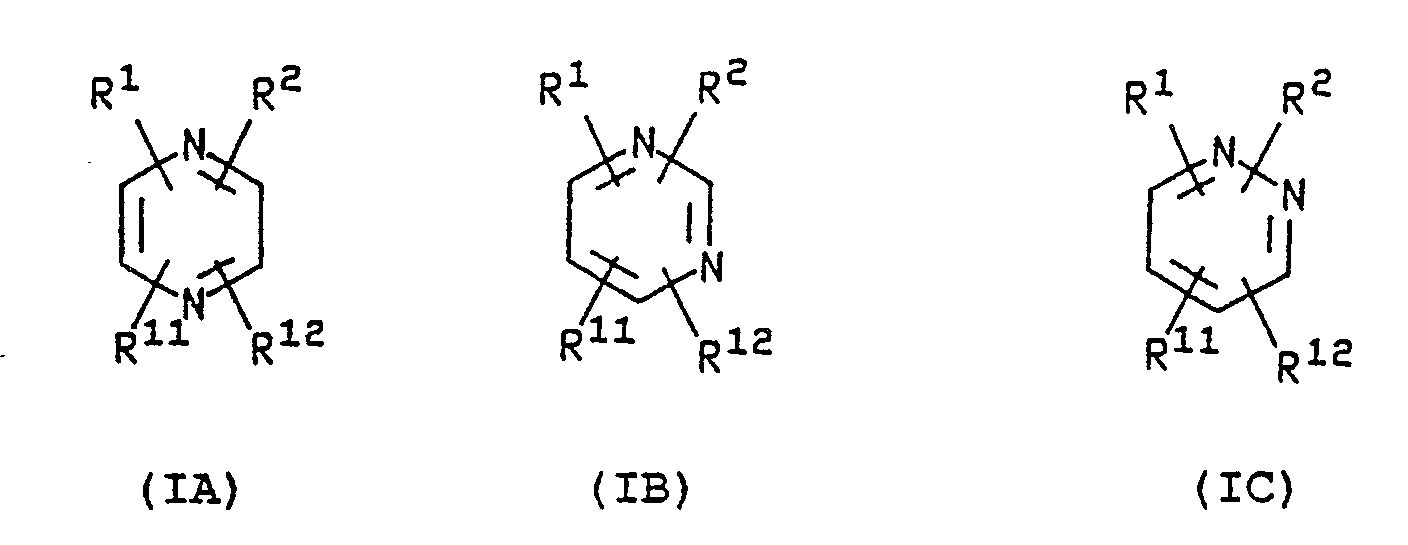
- Preferably the ring is a pyrazine of formula IA, i.e. having the nitrogen atoms at the 1,4 positions.
- The azacyclic or azabicyclic ring system is a non-aromatic ring system containing one nitrogen atom as the sole heteroatom. Suitably the ring system contains from 4 to 10 ring atoms, preferably from 5 to 8 ring atoms. Preferably, the ring system contains a tertiary amino nitrogen atom in a caged structure. The bicyclic systems may be fused, spiro or bridged. Preferably, the nitrogen atom is at a bridgehead in a bicyclic system. Examples of suitable ring systems for the group R¹ include the following:

the substituents R³ and R⁴ may be present at any position, including the point of attachment to the ring of structure I, and independently represent hydrogen, C₁₋₄ alkyl, halogen, C₁₋₄ alkoxy, hydroxy, carboxy or C₁₋₄ alkoxycarbonyl; or R³ and R⁴ together represent carbonyl; and
R⁵ represents hydrogen or C₁₋₄ alkyl. - It will be appreciated that the nitrogen atom in the azacyclic or azabicyclic ring will carry a lone pair of electrons.
- Suitably the group R³ is hydrogen or methyl; and R⁴ is hydrogen, C₁₋₄ alkoxy, C₁₋₄ alkyl, C₁₋₄ alkoxycarbonyl, halogen or hydroxy, preferably methoxy, methyl, fluoro, chloro, hydroxy or methoxycarbonyl. Preferably one or both of R³ and R⁴ is hydrogen.
- Preferably the group R⁵ represents hydrogen or methyl.
- Suitably the azacyclic or azabicyclic ring system is pyrrolidine, piperidine, tetrahydropyridine, azanorbornane, quinuclidine, isoquinuclidine, azabicyclo[2.2.2]octene or 1-azabicyclo[3.2.1]octane, any of which may in particular be either unsubstituted or substituted with methyl, hydroxy, fluoro, chloro or methoxycarbonyl.
- When the groups R², R¹¹ and/or R¹² in formula IA, IB or IC are hydrocarbon substituents, they may be C₁₋₁₅ alkyl, C₂₋₁₅ alkenyl, C₂₋₁₅ alkynyl, aryl or aralkyl. The alkyl, alkenyl or alkynyl groups may be straight, branched or cyclic groups. Suitably the alkyl group comprises from 1 to 6 carbon atoms. The hydrocarbon group(s) may carry one or more substituents. Suitable substituent groups include halogen, -OR⁶, -CF₃, -NR⁶R⁷, -NO₂, optionally substituted aryl, keto, -SR⁶, -SOR⁶, -SO₂R⁶, -CO₂R⁶ and -CONR⁶R⁷; wherein R⁶ and R⁷ are as defined with respect to formula I above.
- Substituents most suitable for the aryl group include chloro, bromo, methoxy, C₁₋₆ alkyl, methoxycarbonyl, trifluoromethyl, nitro and -NR⁶R⁷.
- Preferably the groups R², R¹¹ and R¹² independently represent hydrogen, halogen, -CF₃, -OR⁶, -NHR⁶, -NHNH₂, -CN, -COR⁸, phenyl(C₁₋₃)alkyl, C₃₋₆ cycloalkyl, adamantyl, C₂₋₆ alkenyl, C₂₋₆ alkynyl, C₁₋₆ alkyl, or C₁₋₆ alkyl substituted with -OR⁶, -NHR⁶, -SR⁶, -CO₂R⁶, -CON(R⁶)₂ or halogen. Particular values of the groups R², R¹¹ and/or R¹² are hydrogen, hydroxy, chloro, methyl, ethyl, isopropyl, cyclopropyl, benzyl, adamantyl, amino, dimethylamino, methoxy, ethoxy, isopropoxy, n-butoxy, allyloxy, propargyloxy, methoxycarbonyl and ethoxycarbonyl. A preferred value is dimethylamino.
- One group of prodrugs of compounds of this invention have a substituent on the pyrazine, pyridazine or pyrimidine ring which is hydrolysable in vivo to an amino group.
- Groups which are hydrolysable in vivo to an amino group on the compounds of this invention may be readily ascertained by administering the compound to a human or animal and detecting, by conventional analytical techniques, the presence of the corresponding compound having an amino substituent in the urine of a human or animal. Examples of such groups include, for example, amido and urethane substituents, in particular a group of formula -NH.Q, wherein Q represents CHO, COR or CO₂R, and R represents an optionally substituted hydrocarbon group.
- In this context, the hydrocarbon group R includes groups having up to 20 carbon atoms, suitably up to 10 carbon atoms, conveniently up to 6 carbon atoms. Suitable groups R include C₁₋₉ alkyl, C₂₋₆ alkenyl, C₂₋₆ alkynyl, C₃₋₇ cycloalkyl, C₃₋₇ cycloalkyl(C₁₋₆)alkyl, aryl, and aryl(C₁₋₆)alkyl. The alkyl group R may be straight or branched chain and may contain, for example, up to 12 carbon atoms, suitably from 1 to 6 carbon atoms. In particular the group may be substituted methyl, ethyl, n- or iso-propyl, n-, sec-, iso- or tert-butyl, n- or iso-heptyl, or n- or iso-octyl. Suitable cycloalkyl groups include cyclopentyl and cyclohexyl. The aryl group R includes phenyl and naphthyl optionally substituted with up to five, preferably up to three, substituent groups.
- One sub-class of compounds within the scope of the present invention is represented by formula IIA, IIB or IIC:

- Specific compounds within the scope of the present invention include the following, and salts and prodrugs thereof:
3-(2-pyrazinyl)-1-azabicyclo[2.2.2]octan-3-ol;
3-(2-pyrazinyl)-1-azabicyclo[2.2.2]octane;
3-[2-(6-methylpyrazin)yl-1-azabicyclo[2.2.2]octan-3-ol;
3-[2-(6-methylpyrazin)yl]-1-azabicyclo[2.2.2]octane;
3-[2-(6-methoxypyrazin)yl]-1-azabicyclo[2.2.2]octane;
3-[2-(6-hydroxypyrazin)yl]-1-azabicyclo[2.2.2]-octane;
3-(2-pyrazinyl)-1-azabicyclo[2.2.1]heptan-3-ol;
3-(2-pyrazinyl)-1-azabicyclo[2.2.1]heptane;
6-(2-pyrazinyl)-1-azabicyclo[3.2.1]octan-6-ol;
6-(2-pyrazinyl)-1-azabicyclo[3.2.1]octane;
3-(5-pyrimidinyl)-1-azabicyclo[2.2.2]octan-3-ol;
3-(5-pyrimidinyl)-1-azabicyclo[2.2.2]octane;
3-[5-(2-methylpyrimidin)yl]-1-azabicyclo[2.2.2]octane;
3-(2-pyrazinyl)-1-azabicyclo[2.2.1]heptan-5-ol;
3-fluoro-3-(2-pyrazinyl)-1-azabicyclo[2.2.1]heptane;
1-methyl-3-(2-pyrazinyl)pyrrolidine;
3-[2-(6-methoxypyrazin)yl]-1-azabicyclo[2.2.1]heptane;
3-[2-(3-methylpyrazin)yl]-1-azabicyclo[2.2.2]octan-3-ol;
3-[2-(3-methylpyrazin)yl]-3-chloro-1-azabicyclo[2.2.2]octane;
3-[2-(3-methylpyrazin)yl]-1-azabicyclo[2.2.2]oct-2-ene;
3-[2-(3-methylpyrazin)yl]-1-azabicyclo[2.2.2]octane;
3-[2-(6-methylpyrazin)yl]-1-azabicyclo[2.2.1]heptan-3-ol;
3-[2-(6-methylpyrazin)yl]-3-chloro-1-azabicyclo[2.2.1]heptane;
3-[2-(6-methylpyrazin)yl]-1-azabicyclo[2.2.1]heptane;
3-[2-(6-dimethylaminopyrazin)yl]-1-azabicyclo[2.2.1]heptan-3-ol;
3-[2-(6-dimethylaminopyrazin)yl]-1-azabicyclo[2.2.1]heptane;
3-[2-(6-ethoxypyrazin)yl]-1-azabicyclo[2.2.1]heptan-3-ol;
3-[2-(6-ethoxypyrazin)yl]-1-azabicyclo[2.2.1]heptane;
6-[2-(6-methoxypyrazin)yl]-1-azabicyclo[3.2.1]octane;
3-[2-(3,6-dimethylpyrazin)yl]-1-azabicyclo[2.2.1]heptan-3-ol;
3-[2-(3,6-dimethylpyrazin)yl]-1-azabicyclo[2.2.1]heptane;
3-[2-(3,5-dimethylpyrazin)yl]-1-azabicyclo[2.2.1]heptane;
3-[5-(2,3-dimethylpyrazin)yl]-1-azabicyclo[2.2.1]heptane;
3-[2-(3-ethylpyrazin)yl]-1-azabicyclo[2.2.2]octane;
3-[2-(3-ethylpyrazin)yl]-1-azabicyclo[2.2.1]heptane;
3-[2-(6-isopropoxypyrazin)yl]-1-azabicyclo[2.2.1]heptane;
3-[2-(6-propargyloxypyrazin)yl]-1-azabicyclo[2.2.1]heptane;
3-[2-(6-chloropyrazin)yl]-3-methoxycarbonyl-1-azabicyclo[2.2.2]octane;
3-[2-(6-chloropyrazin)yl]-1-azabicyclo[2.2.2]octane;
3-[2-(5-methylpyrazin)yl]-1-azabicyclo[2.2.2]octane;
3-[2-(6-allyloxypyrazin)yl]-1-azabicyclo[2.2.2]octane;
3-[2-(3-methylpyrazin)yl]-1,2,5,6-tetrahydropyridine;
3-[2-(6-methylpyrazin)yl]-1,2,5,6-tetrahydropyridine;
6-[2-(6-methylpyrazin)yl]-2-azabicyclo[2.2.2]octane;
6-[2-(3-methylpyrazin)yl]-2-azabicyclo[2.2.2]octane;
3-[2-(6-allyloxypyrazin)yl]-1-azabicyclo[2.2.1]heptane;
3-[2-(3-methylpyrazin)yl]-1-azabicyclo[2.2.1]heptane;
3-[2-(6-chloropyrazin)yl]-1-azabicyclo[2.2.1]heptane;
6-[2-(6-chloropyrazin)yl]-2-azabicyclo[2.2.2]octane;
6-[2-(6-methoxypyrazin)yl]-2-azabicyclo[2.2.2]octane;
3-[2-(6-n-butoxypyrazin)yl]-1-azabicyclo[2.2.2]octane;
3-[2-(3,5,6-trimethylpyrazin)yl]-1-azabicyclo[2.2.1]heptane;
6-(2-pyrazinyl)-2-azabicyclo[2.2.2]octane; and
3-[4-(2-chloropyrimidin)yl]-1-azabicyclo[2.2.1]heptane. - Most of the compounds of this invention have at least one asymmetric centre and often more than one; and can therefore exist both as enantiomers and as diastereoisomers. In particular, those compounds possessing an unsymmetrical azabicyclic ring system may exist as exo and endo diastereoisomers. It is to be understood that the invention covers all such isomers and mixtures thereof.
- Also included within the scope of the present invention are salts of the novel compounds. It will be appreciated that salts of the compounds for use in medicine will be non-toxic pharmaceutically acceptable salts. Other salts may, however, be useful for the preparation of the compounds of the invention or their non-toxic pharmaceutically acceptable salts. Acid addition salts, for example, may be formed by mixing a solution of the compound with a solution of a pharmaceutically acceptable non-toxic acid such as hydrochloric acid, fumaric acid, maleic acid, succinic acid, acetic acid, citric acid, tartaric acid, carbonic acid or phosphoric acid. Where the novel compound carries a carboxylic acid group the invention also contemplates salts thereof, preferably non-toxic pharmaceutically acceptable salts thereof, such as the sodium, potassium and calcium salts thereof.
- Salts of amine groups may also comprise the quaternary ammonium salts in which the amino nitrogen atom carries an alkyl, alkenyl, alkynyl or aralkyl group. Such quaternary ammonium derivatives penetrate poorly into the central nervous system and are therefore useful as peripherally selective muscarinic agents, useful for example as antispasmodic agents, agents to reduce gastric acid secretion, agents to block the muscarinic actions of acetylcholinesterase inhibitors in the treatment of myasthenia gravis and as agents to co-administer with muscarinic agonists in Alzheimer's disease.
- The method of treatment of this invention includes a method of treating Alzheimer's disease, senile dementia of the Alzheimer type, Huntington's chorea, tardive dyskinesia, hyperkinesia, mania or Tourette syndrome by the administration to a patient in need of such treatment of an effective amount of one or more of the novel compounds.
- This invention therefore also provides a pharmaceutical composition comprising a compound of the invention and a pharmaceutically acceptable carrier.
- It may, where appropriate, be advantageous, in order to reduce unwanted peripherally mediated side-effects, to incorporate into the composition a peripherally acting cholinergic antagonist (or anti-muscarinic agent). Thus the compounds of the invention may advantageously be administered together with a peripheral cholinergic antagonist such as N-methylscopolamine, N-methylatropine, propantheline, methantheline or glycopyrrolate.
- The compounds of the invention can be administered orally, parenterally or rectally at a daily dose of about 0.01 to 10 mg/kg of body weight, preferably about 0.1 to 1 mg/kg, and may be administered on a regimen of 1-4 times a day. When a cholinergic antagonist is administered, it is incorporated at its conventional dose.
- The pharmaceutical formulations of this invention preferably are in unit dosage forms such as tablets, pills, capsules, powders, granules, sterile parenteral solutions or suspensions, or suppositories for oral, parenteral or rectal administration. For preparing solid compositions such as tablets, the principal active ingredient is mixed with a pharmaceutical carrier, e.g. conventional tabletting ingredients such as corn starch, lactose, sucrose, sorbitol, talc, stearic acid, magnesium stearate, dicalcium phosphate or gums, and other pharmaceutical diluents, e.g. water, to form a solid preformulation composition containing a homogeneous mixture of a compound of the present invention, or a non-toxic pharmaceutically acceptable salt thereof. When referring to these preformulation compositions as homogeneous, it is meant that the active ingredient is dispersed evenly throughout the composition so that the composition may be readily subdivided into equally effective unit dosage forms such as tablets, pills or capsules. This solid preformulation composition is then subdivided into unit dosage forms of the type described above containing from 0.1 to about 500 mg of the active ingredient of the present invention. The tablets or pills of the novel composition can be coated or otherwise compounded to provide a dosage form affording the advantage of prolonged action. For example, the tablet or pill can comprise an inner dosage and an outer dosage component, the latter being in the form of an envelope over the former. The two components can be separated by an enteric layer which serves to resist disintegration in the stomach and permits the inner component to pass intact into the duodenum or to be delayed in release. A variety of materials can be used for such enteric layers or coatings, such materials including a number of polymeric acids or mixtures of polymeric acids with such materials as shellac, cetyl alcohol and cellulose acetate.
- The liquid forms in which the novel compositions of the present invention may be incorporated for administration orally or by injection include aqueous solutions, suitably flavoured syrups and flavoured emulsions with edible oils such as cottonseed oil, sesame oil, coconut oil and peanut oil, as well as elixirs and similar pharmaceutical vehicles. Suitable dispersing or suspending agents for aqueous suspension include synthetic and natural gums such as tragacanth, acacia, alginate, dextran, sodium carboxymethylcellulose, methylcellulose, polyvinyl-pyrrolidone and gelatin.
- The compounds of this invention may be prepared by a process which comprises the dehydroxylation or decarboxylation of a compound of formula III or a salt thereof:

- When the group B in compound III is hydroxy, it may be removed by chlorination and elimination, followed by hydrogenation. For example, chlorination and elimination may be effected by treatment with phosphorus oxychloride in the presence of triethylamine, or with thionyl chloride followed, where necessary, by DBN. The chloride or the unsaturated product may then be hydrogenated under conventional conditions, such as over 10% palladium/carbon in methanol. Alternatively, the compound III may be dehydroxylated by the use of thionyl chloride followed by treatment with tributyltin hydride in a solvent such as tetrahydrofuran in the presence of a radical initiator such as azabisisobutyronitrile.
- The compound of formula III where B is hydroxy may be prepared by reaction of a ketone compound of formula IV with a metal derivative of a pyrazine, pyridazine or pyrimidine of formula V:

- When the group B in compound III is carboxy it may be removed by standard decarboxylation techniques such as heating in aqueous solution made to pH1 with hydrochloric acid.
- The compounds of formula III where B represents carboxy may be prepared by reaction of a compound of formula VI with a compound of formula VII:

- Preferably W represents an alkyl ester group such as methoxycarbonyl. Preferably the halogen group is iodide. The reaction between compounds VI and VII may be carried out in the presence of a strong base such as lithium diisopropylamide in a solvent such as tetrahydrofuran.
- The azacyclic or azabicyclic moiety may be introduced into the molecules concerned by methods known from the art, in particular by methods analogous to those described in EP-A-0239309.
- After any of the above described processes is complete, one substituent can be converted to another. For example an amino group may be converted to chloro, or hydrazo, -NHNH₂, via the intermediacy of diazonium, -N₂. Similarly, a chloro substituent may be converted to methoxy by reaction with a nucleophile such as methoxide; alkoxycarbonyl groups may be converted, via carboxy, to an amino substituent, -NH₂; and methoxy may be converted to hydroxy by treatment with concentrated hydrobromic acid.
- In any of the above reactions it may be necessary and/or desirable to protect any sensitive groups in the compounds. For example, if the reactants employed include amino, carboxy, keto, hydroxy or thiol groups, these may be protected in conventional manner. Thus, suitable protecting groups for hydroxy groups include silyl groups such as trimethylsilyl or t-butyldimethylsilyl, and etherifying groups such as tetrahydropyranyl; and for amino groups include benzyloxycarbonyl and t-butoxycarbonyl. Keto groups may be protected in the form of a ketal. Carboxy groups are preferably protected in a reduced form such as in the form of their corresponding protected alcohols, which may be subsequently oxidised to give the desired carboxy group. Thiol groups may be protected by disulphide formation, either with the thiol itself or with another thiol to form a mixed disulphide. The protecting groups may be removed at any convenient stage in the synthesis of the desired compound according to conventional techniques.
- The following Examples illustrate the preparation of compounds according to the invention. Each of the compounds of the Examples demonstrates an affinity for the muscarinic receptor, having an IC₅₀ (concentration required to displace 50% of specific [³H]-N-methylscopolamine binding from rat cortical membrane preparations) significantly lower than 100 µM. Penetrability into the central nervous system of compounds of this invention was assessed by a measurable displacement of radioligand binding using standard "ex-vivo" binding techniques (Ref: J. Neurosurg., 1985, 63, 589-592).
- In the Examples, all temperatures are in °C; THF is tetrahydrofuran; and ether is diethyl ether.
- t-Butyllithium (11.43ml of a 1.4M solution in hexane, 16mmol) was added dropwise to a rapidly stirred solution of 2-iodopyrazine (Hirschberg et al, J. Org. Chem., (1961), 26, 1907; 1.65g, 8.0mmol) in ether (60ml), at -35°C. After 0.25h a solution of quinuclidinone (1g, 8.0mmol) in ether (20ml) was added dropwise and the reaction mixture warmed to room temperature and stirred for 2h. Quenching with water (25ml) was followed by extracting with dichloromethane (4 x 75ml) and drying (Na₂SO₄). The residue remaining after evaporation of the solvents under reduced pressure was purified by chromatography on alumina (Grade II-III), using dichloromethane/methanol (93:7) as eluant, to give 3-(2-pyrazinyl)-1-azabicyclo[2.2.2]octan-3-ol as a red solid (0.5g). The product was further purified by recrystallisation from ethyl acetate, m.p. 187-190°C (dec); (Found C, 64.24; H, 7.34; N, 20.68. C₁₁H₁₅N₃O requires C, 64.39; H, 7.32 N, 20.49%); δ (360MHz, CDCl₃) 1.20-1.40 (1H, m, CH of CH₂); 1.50-1.70 (2H, m, CH₂); 2.10-2.25 (1H, m, CH of CH₂); 2.34 (1H, b rs, CH); 2.70-2.80 (2H, m, CH₂-N); 2.88-3.00 (3H, m, CH₂-N and CH of CH₂-N); 3.85 (1H, dd, J = 1.5 and16Hz, CH of CH₂-N); 4.85 (1H, br s, OH); 8.54 (1H, d, J = 2Hz, pyrazine-H); 8.65 (1H, d, J = 2Hz, pyrazine-H); 8.89 (1H, d, J = 2Hz, pyrazine-H).
- Thionyl chloride (0.24g, 1.55mmol) was added dropwise to a rapidly stirred solution of 3-(2-pyrazinyl)-1-azabicyclo[2.2.2]octan-3-ol (0.21g, 1.02mmol) in dichloromethane (10ml) at -5°C. The reaction mixture was warmed to room temperature and then refluxed for 3h. Water (5ml) was added to the solution, basified to pH > 10 with potassium carbonate and extracted with dichloromethane (3 x 50ml). The combined extracts were dried (Na₂SO₄), the solvent removed under vacuum and the residue chromatographed through alumina (Grade II-III) using dichloromethane/methanol (98 : 2) as eluent to give 3-(2-pyrazinyl)-1-azabicyclo[2.2.2]-oct-2-ene as a pale yellow solid (0.14g), δ (360MHz, CDCl₃) 1.54-1.61 (2H, m, CH₂); 1.77-1.95 (2H, m, CH₂); 2.63-2.71 (2H, m, CH₂-N); 3.02-3.09 (2H, m, CH₂-N); 3.53-3.56 (1H, m, CH-bridgehead); 7.30 (1H, d, J = 1.5Hz, vinyl-H); 8.41 (1H, d, J = 2Hz, pyrazine-H); 8.52 (1H, dd, J = 1 and 2Hz, pyrazine-H), 8.78 (1H, d, J = 1Hz, pyrazine-H).
- A solution of 3-(2-pyrazinyl)-1-azabicyclo[2.2.2]-oct-2-ene (75mg, 0.4mmol), in ethanol (20ml), was hydrogenated over 10% Pd/C (75mg) in a Parr apparatus. After 1.5h the catalyst was removed by filtration through hyflo and the solvent removed under reduced pressure. Chromatography of the residue through alumina eluting with dichloromethane/ methanol (95 : 5) gave 3-(2-pyrazinyl)-1-azabicyclo[2.2.2]octane (55mg) as a pale yellow oil. The hydrochloride salt was prepared, m.p. 203-205°C (isopropyl alcohol/ether); (Found C, 55.23; H, 7.15; N, 17.86 C₁₁H₁₅N₃. HCl. 0.75 H₂O requires C, 55.23; H, 7.32; N, 17.57%); m/e 189 (M⁺ for free base); δ (360MHz, D₂O) 1.70-1.85 (2H, m, CH₂); 2.10-2.30 (2H, m, CH₂); 2.40-2.48 (1H, m, CH-bridgehead); 3.28-4.04 (7H, m, 3 x CH₂ and CH); 8.52 (1H, m, pyrazine-H); 8.63 (2H, m, pyrazine-H).
- t-Butyllithium (11.43ml of a 1.4M solution in hexane, 16mmol) was added dropwise to a rapidly stirred solution of 2-methyl-6-iodopyrazine (Spoerri et al; J. Am. Chem. Soc., (1952), 74, 1580; 1.76g, 8mmol) in ether (50ml) at -35°C. After 0.25h a solution of quinuclidinone (1g, 8.0mmol) in ether (20ml) was added dropwise and the reaction mixture warmed to room temperature and stirred for 2.5h. Water (15ml) was added and the mixture extracted with dichloromethane (4 x 75ml). The combined extracts were dried (Na₂SO₄) and the residue remaining after evaporation of the solvent was chromatographed on alumina using dichloromethane/methanol (90 : 10) as eluant to give 3-[2-(6-methylpyrazin)yl]-1-azabicyclo[2.2.2]octan-3-ol (0.45g) as an orange oil which crystallised on standing, m.p. 182-184°C (ethylacetate/ether); (Found C, 64.63; H, 7.72; N, 18.13. C₁₂H₁₇N₃O. 0.25H₂O requires C, 64.40; H, 7.88; N, 18.77%); m/e 219 (M⁺ for free base); δ (360MHz, D₂O) 1.28-1.40 (1H, m, CH of CH₂); 1.56-1.72 (2H, m, CH₂); 2.12-2.22 (1H, m, CH of CH₂); 2.37 (1H, br s, CH-bridgehead); 2.60 (3H, s, Me); 2.76-2.80 (2H, m, CH₂); 2.88-3.06 (3H, m, CH₂ and CH of CH₂); 3.90 (1H, d, J = 14.5Hz, CH of CH₂); 8.40 (1H, s, pyrazine-H); 8.64 (1H, s, pyrazine-H).
- Thionyl chloride (0.38ml) was added dropwise to a rapidly stirred solution of 3-[2-(6-methylpyrazin)yl]-1-azabicyclo[2.2.2]octan-3-ol (0.35g, 1.6mmol) in dichloromethane (15ml) at 0°C. The reaction mixture was warmed to room temperature and stirred for 2h. Water (5ml) was added and then basified to pH > 10 with potassium carbonate. The aqueous was extracted with dichloromethane (3 x 75ml), the combined extracts dried (Na₂SO₄) and the residue remaining, after removal of solvents, chromotographed through alumina, using ethyl acetate as eluant, to give a mixture of 3-chloro-3-[2-(6-methylpyrazin)yl]-1-azabicyclo[2.2.2]octane and 3-[2-(6-methylpyrazin)yl]-1-azabicyclo[2.2.2]oct-2-ene (0.26g) which was taken through to the final product without separation.
- A solution of the above mixture (0.28g) in ethanol (25ml) was hydrogenated over 10% Pd/C (0.2g) in a Parr apparatus. After 1.5h the catalyst was removed by filtration through hyflo and the solvent removed under reduced pressure. The crude product was purified by chromatography through alumina using dichloromethane/methanol (93:7) as eluant to give the title-pyrazine as a yellow oil (0.22g). The hydrogen oxalate salt was prepared , m.p. 184.5 - 186°C (isopropyl alcohol); (Found C, 57.49, H, 6.45; N, 14.63. C₁₂H₁₇N₃.C₂H₂O₄ requires C, 57.32; H, 6.52; N, 14.32%); m/e 203 (M⁺ for free base); δ(360MHz,D₂O) 1.78 - 1.85 (2H,m,CH₂); 2.10 - 2.20 (2H,m,CH₂); 2.42 - 2.44 (1H,m,CH); 2.57(3H,s,Me); 3.30 - 3.89 (6H,m,3 x CH₂-N); 4.01 - 4.05 (1H,m,CH-pyrazine); 8.38 (1H,s,pyrazine-H); 8.42 (1H,s,pyrazine-H).
- 2.6-Dichloropyrazine (20g, 134mmol) was added to a saturated solution of sodium iodide in water (12ml) and butan-2-one (800ml). A mixture of hydroiodic acid (18ml) and water (24ml) was added and the dark red solution refluxed for 4.5 days. The residue remaining after removal of the solvent was taken up into water (75ml), sodium metabisulphite (0.4g) added, and the solution basified with sodium hydroxide. The aqueous was extracted with dichloro methane (3 x 150ml), the combined extracts dried (Na₂SO₄) and the solvent removed in vacuo. The solid obtained after cooling overnight was filtered off, washed with petroleum ether, and dried under vacuum to give 2,6-diiodopyrazine (7.15g) which was used directly in the next stage.
- 2,6-Diiodopyrazine (6.06g, 18.2mmol) was added to a solution of sodium (0.42g, 18.2mmol) in methanol (45ml) and heated under reflux for 3.5h. Water (150ml) was added and extracted with ether (3 x 150ml). The combined extracts were dried (Na₂SO₄) and the residue remaining after removal of the solvent was chromatographed through silica gel eluting with ether/petroleum ether (50:50) to give 2-methoxy-6-iodopyrazine (4.17g); δ(360MHz, CDCl₃) 3.95(3H,s,OMe); 8.18(1H,s,pyrazine-H); 8.45(1H,s,pyrazine-H).
- t-Butyllithium (20ml of a 1.7M solution in pentane, 35.3mmol) was added dropwise to a rapidly stirred solution of 2-methoxy-6-iodopyrazine (4.17g, 17.6mmol) in ether (80ml), at -40°C. After 0.25h a solution of quinuclidinone (2.21g, 17.6mmol) in ether (60ml) was added dropwise and the reaction mixture warmed to room temperature and stirred for 2 h. Water (35ml) was added and extracted with ethylacetate (4 x 100ml). The combined extracts were dried (Na₂SO₄), the solvent removed under vacuum and, the residue chromatographed through alumina, eluting with dichloromethane/methanol (93:7) to give 3-[2-(6-methoxypyrazin)yl]-1-azabicyclo[2.2.2]octan-3-ol (1.65g); δ(360MHz, CDCl₃) 1.37-1.51 (3H,m,-CH₂ and CH of CH₂); 1.70-1.901H, brs, OH); 1.94-1.96-(1H,m,CH); 2.20-2.32(1H,m,CH of CH₂); 2.80-3.10(5H,m,2 x CH₂ and CH of CH₂); 3.74(1H,dd,J = 2 and 14.6Hz, CH of CH₂); 3.99(3H,s,Me); 8.15(1H,s,pyrazine-H); 8.39(1H,s,pyrazine-H).
- Thionyl chloride (2.83g, 23,8mmol) was added dropwise to a rapidly stirred solution of 3-2-(6-methoxypyrazin)yl]-1-azabicyclo[2.2.2]octan-3-ol (1.87g, 7.9mmol) in dichloromethane (80ml), at 0°C. The solution was warmed to room temperature and stirred for 19h. The solvent and excess thionyl chloride were removed under vacuum, the residue taken up into water (30ml) and basified with potassium carbonate. The aqueous was extracted with dichloromethane (4 x 75ml), the combined extracts dried (Na₂SO₄) and the solvent removed under vacuum. Chromatography of the residue through alumina, eluting with ethyl acetate gave a mixture of 3-chloro-3-[2-(6-methoxypyrazin)yl]-1-azabicyclo[2.2.2]octane and 3-[2-(6-methoxypyrazin)yl]-1-azabicyclo[2.2.2]oct-2-ene (1.1g).
- A solution of the above mixture (1.1g) in methanol (25ml) was hydrogenated over 10% Pd/C (0.11g) in a Parr apparatus. After 5h the catalyst was removed by filtration through hyflo and the solvent removed under reduced pressure. The dihydrochloride salt was prepared, m.p. 161-163°C (isopropylalcohol/ether); (Found C,48.48; H,6.60; N,14.03. C₁₂H₁₇N₃O.2HCl.O.2H₂O requires C,48.71; H,6.56; N,14.21%); m/e 219(M⁺ for free base); δ(360MHz,D₂O)1.72-2.40(5H,m,2 x CH₂ and CH); 3.30-3.75(6H,m,3 x CH₂-N); 4.04(3H,s,OMe); 4.01-4.08(1H,m,CH); 8.13(1H,s,pyrazine-H); 8.16(1H,s,pyrazine-H).
- A solution of 3-[2-(6-methoxy-pyrazin)yl]-1-azabicyclo[2.2.2]octane in concentrated hydrobromic acid (10ml) was refluxed for 20h. The acid was removed under vacuum and the residue triturated with ether. The solid obtained was recrystallized from methanol/ether m.p. 255-258°C (dec.); (Found C,36.15; H,4.74; N,11.20. C₁₁H₁₅N₃O. 2HBr requires C,35.99; H,4.67; N,11.45%). m/e 205 (M⁺ for free base). δ(360MHz, D₂O) 1.79-2.45(5H,m,2 x CH₂ and CH); 3.32-3.78(6H,m,3 x CH₂-N); 7.72 (1H, s, pyrazine-H) 8.08 (1H, s, pyrazine-H).
- t-Butyllithium (10.6ml of a 1.7M solution in pentane, 18mmol) was added dropwise to a rapidly stirred solution of 2-iodopyrazine (1.86g, 9.0mmol) in ether (50ml), at -45°C. After 0.25h a solution of 1-azabicyclo[2.2.1]heptan-3-one (1g, 9.0mmol) in ether (20ml) was added dropwise and the reaction mixture warmed to room temperature and stirred for 16h. Water (25ml) was added and the solution stirred for 0.25h before adding dichloromethane (150ml) and extracting. The aqueous was extracted twice more with dichloromethane (2 x 150ml), the extracts combined, dried (Na₂SO₄.MgSO₄) and the solvent removed under vacuum. The residue was purified by chromatography through alumina, eluting with dichloromethane/methanol (93:7). Recrystallisation from ethyl acetate gave 3-(2-pyrazinyl)-1-azabicyclo[2.2.1]heptan-3-ol (0.51g) as a pale yellow solid, m.p. 180-183°C; (Found C, 62.10; H,6.79; N,21.48. C₁₀H₁₃N₃O.O.15H₂O requires C,61.95; H,6.87; N,21.68%; δ(360MHz, CDCl₃) 1.40-1.59(1H,m,CH of CH₂); 2.33-2.36(1H,m,CH of CH₂); 2.47(1H,dd,J = 4 and 10Hz, CH of CH₂-N); 2.59(1H,dd, J = 4 and 10Hz, CH of CH₂-N); 2.74(1H,d, J = 4Hz, CH-bridgehead); 2.76-2.81(1H,m,CH of CH₂-N); 2.93-3.03(2H,m,2 x CH of 2 x CH₂-N); 3.39(1H,dd, J = 1.5 and 15Hz, CH of CH₂-N); 4.10-4.30(1H,m,OH); 8.49-8.50(2H,m,pyrazine-H); 8.87(1H,m,pyrazine-H).
- Thionyl chloride (1.5g, 12.6mmol) was added to a rapidly stirred solution of 3-(2-pyrazinyl)-1-aza bicyclo[2.2.1]heptan-3-ol (0.5g, 2.6mmol) in dichloromethane (30ml) at room temperature. The solution was stirred for 1h, heated at 60°C for 0.5h, and then cooled to room temperature, before adding water (20ml) and basifying with potassium carbonate. Extraction into dichloromethane (3 x 75mls), drying (Na₂SO₄) and chromatography of the residue remaining after removal of solvent through alumina, using ethyl acetate as eluant, gave 3-chloro-3-(2-pyrazinyl)-1-azabicyclo[2.2.1]heptane as a pale yellow oil (0.18g); m/e 209 (M⁺ of free base); δ(360MHz,CDCl₃) 0.84-0.92(1H,m,CH of CH₂); 1.58-1.67(1H,m,CH of CH₂); 2.42-2.48(1H,m,CH of CH₂-N); 2.69-2.72(1H,m,CH of CH₂-N); 2.78-2.86(1H,m,CH of CH₂-N); 3.22_3.24(1H,d, J = 4.5Hz, CH-bridgehead); 3.42-3.49(2H,m,2 x CH of CH₂-N); 4.13(1H,dd, J = 3 and 14Hz, CH of CH₂); 8.48(2H,s,pyrazine-H); 8.91(1H,s,pyrazine-H).
- A solution of 3-chloro-3-(2-pyrazinyl)-1-azabicyclo[2.2.1]heptane (0.18g, 0.85mmol) in methanol (30ml) was hydrogenated over 10% Pd/C (0.18g) in a Parr apparatus. After 1h the suspension was filtered through hyflo and the solvent removed under vacuum to give the title pyrazine as a cyrstalline solid (0.18g). The dihydrochloride salt was prepared, m.p. 183-186°C (isopropyl alcohol/ether); (Found C,47.47; H,6.22,N,16.57. C₁₀H₁₃N₃.2HCl.0.3H₂O requires C,47.36; H,6.16; N,16.51%); δ(360MHz, CDCl₃, freebase); 1.64-1.92(2H,m,CH₂); 3.17-3.19(1H,m,CH-bridgehead); 3.30-3.37(2H,m,2 x CH of CH₂-N); 3.48-3.59(2H,m,2 x CH of CH₂-N); 3.82-3.84(2H,m,2 x CH of CH₂); 3.96-4.00(1H,m,CH); 8.53-8.56(2H,m,pyrazine-H).
- t-Butyllithium (15.5ml of a 1.7M solution in pentane, 26.3mmol) was added dropwise to a rapidly stirred solution of 2-iodopyrazine (2.96g), 14.3mmol) in ether (70ml), at -50°C. The brown suspension was stirred at -50°C for 0.25h and a solution of 1-azabicyclo[3.2.1]octan-6-one (1.5g, 11.0mmol) in ether (30ml) then added dropwise. The reaction mixture was warmed to room temperature and stirred for 6.25h before adding water (10ml) and extracting with ethyl acetate (3 x 100ml). The crude product was chromatographed through alumina using dichloromethane/methanol (90:10) as eluant to give the title-pyrazine alcohol as a pale yellow solid (0.48g), m.p. 208-210°C (ethanol); (Found C,64.04; H,7.38; N,20.25. C₁₁H₁₅N₃O requires C,64.36; H,7.36; N,20.47%); m/e 205 (M⁺); δ(360MHz, D₂O) 1.57-2.34(4H,m,2 x CH₂); 2.50-2.54 (1H, m, CH-bridgehead); 2.90-3.21(5H,m,2 x CH₂-N and 0.5 x CH₂-N); 3.72(1H,d,J = 14Hz, 0.5 x CH₂-N); 8.52(1H,d,J = 2Hz,pyrazine-H); 8.56(1H,dd,J = 1.2 and 2Hz, pyrazine-H); 8.91(1H,d,J = 1.2Hz,pyrazine-H).
-
- Thionyl chloride (0.34g, 2.92mmol) was added dropwise to a rapidly stirred solution of 6-(2-pyrazinyl)-1-azabicyclo[3.2.1]heptan-6-ol (0.2g, 0.97mmol) in dichloromethane (15ml), at 0°C. The solution was stirred for 16h at room temperature, the solvents removed under vacuum and the residue taken up into water (10ml) and basified with potassium carbonate. The residue obtained after extraction, into dichloromethane (3 x 50ml), drying (Na₂SO₄) and evaporation, was chromatographed through alumina, using ethyl acetate as eluant, to give 6-chloro-6-(2-pyrazinyl)-1-azabicyclo[3.2.1]octane as a yellow solid (0.10g); δ(60MHz, CHCl₃)1.20-1.80(4H,m,2 x CH₂); 2.70-3.70(6H,m,2 x CH₂-N); 0.5 x CH₂-N, and CH); 4.50(1H,dd,J = 3 and 14Hz, 0.5 x CH₂); 8.50(2H,s,pyrazine-H); 8.82(1H,s,pyrazine-H).
- Tributyltinhydride (0.24ml, 0.88mmol) was added to a stirred solution of 6-chloro-6-(2-pyrazinyl)-1-azabicyclo[3.2.1]octane (0.14g, 0.63mmol) in THF (75ml). Azoisobutyronitrile (AIBN) (0.1g) was added and the mixture heated rapidly to reflux. After 1.5h and 7.75h further portions of AIBN (50mg) were added followed by a second portion of tributyltinhydride (0.24ml, 0.88mmol) and refluxed for a further 4h. The reaction mixture was allowed to cool overnight, dichloromethane (50ml) added and the basic products extracted into 2N hydrochloric acid (3 x 25ml). The combined acid washings were basified with potassium carbonate and extracted with dichloromethane (4 x 75ml).
The combined extracts were dried (Na₂SO₄) and evaporated, and the residue purified by alumina chromatography using dichloromethane/methanol (95:5) as eluant to give the title-pyrazine as a yellow solid (0.05g). The dihydrochloride salt was prepared, m.p. 268-271°C (dec.); (Found C,49.13; H,6.49; N,15.57. C₁₁H₁₅N₃.2HCl.0.35H₂O requires C,49.20; H,6.60; N,15.65%); m/e 189(M⁺ for free base); δ (CDCl₃) 1.38-1.84(4H,m,2 x CH₂); 3.16-4.26(8H,m,3 x CH₂ and 2 x CH); 8.54(1H,d,J = 2Hz, pyrazine-H); 8.62(1H,dd,J = 1.5 and 2Hz, pyrazine-H); 8.70(1H,d,J = 1.5Hz, pyrazine-H). - n-Butyllithium (12ml of a 1.6M solution in hexane 19.2mmol), at -110°C, was added dropwise to a solution of 5-bromopyrimidine (2.0g, 12.5mmol) in THF (60ml) and ether (60ml), at -110°C (ethanol/liquid nitrogen bath). The resultant yellow solution was stirred at -110°C for 1.25h and a solution of quinuclidinone (1.72g, 13.75mmol) in THF (20ml) also at -110°C, added dropwise. The reaction mixture was stirred at -110°C for 0.1h then warmed to room temperature and stirred for 16h. 2N-Hydrochloric acid (25ml) was added and stirred for 0.25h. The orgainc phase was washed with water (15ml) and the combined aqueous extracts basified with potassium carbonate and extracted with dichloromethane (4 x 75ml).
Chromatatography of the residue obtained upon removal of the solvents through alumina using dichloromethane/methanol (90:10) as eluant, gave 3-(5-pyrimidinyl)-1-azabicyclo[2.2.2]octan-3-ol as a yellow solid, m.p. 126-127°C(ethyl acetate/ether); (Found C,61,42; H,7.47; N,19.60. C₁₁H₁₅N₃O. O.5H₂O requires C,61.66; H,7.53; N,19.61%); m/e 205(M⁺); δ (360MHz,D₂O) 1.30-1.44(1H,m,0.5 x CH₂); 1.65-1.74(2H,m,CH₂); 2.10-2.20(1H,m,0.5 x CH₂); 2.30-2.32(1H,m,CH-bridgehead); 2.68-2.96(4H,m,2 x CH₂); 3.09(1H,dd,J = 1.5 and 14.7Hz, 0.5 x CH₂); 3.49(1H,dd,J = 1.5 and 14.7Hz,0.5 x CH₂); 8.96(2H,s,pyrimidine-H); 9.08(1H,s,pyrimidine-H). - Thionyl chloride (0.35ml. 4.8mmol) was added to a rapidly stirred solution of 3-(5-pyrimidinyl)-1- azabicyclo[2.2.2] octan-3-ol (0.5g, 2.4mmol) in dichloromethane (15ml), at 0°C. The solution was warmed to room temperature and sitrred for 1h before adding a second portion of thionyl chloride (0.2ml) and refluxing for 0.25h. The mixture was cooled to 10°C, water (10ml) added and basified to pH > 10 with potassium carbonate. Extraction into dichloromethane (3 x 50ml), drying (Na₂SO₄) and evaporation of solvents under reduced pressure gave 3-(5-pyrimidinyl)-1-azabicyclo[2.2.2]oct-2-ene (0.16g) as a yellow oil which crystallised on standing at 0°C, m/e 188 (M+H)⁺; δ(360MHz,D₂O) 1.86-1.98 (2H, m,CH₂); 2.15-2.26(2H,m,CH₂); 3.18-3.30 (2H,m,0.5 x CH₂ and CH); 3.62-3.72(3H,m,CH₂ and 0.5 x CH₂); 7.23(1H,s,vinyl-H); 9.00(2H,s,pyrimidine-H); 9.15(1H,s,pyrimidine H). A solution of 3-(5-pyrmidinyl)-1-azabicyclo[2.2.2]oct-2-ene (0.31g, 1.66mmol) in ethanol (40ml) was hydrogenated over 10% Pd/C (0.12g) in a Parr apparatus. After 4h the suspension was filtered through hyflo, the solvent removed under vacuum and, the residue chromatographed on alumina using dichloromethane/methanol (95:5) as eluant, to give 3-(5-pyrimidinyl)-1-azabicyclo[2.2.2]octane (0.17g) as a yellow oil. The hydrochloride salt was made, m.p. 267-270°C (dec.); (Found C,56.00; H,6.88, N,17.74. C₁₁H₁₅N₃.HCl.0.75H₂O requires C,55.69; H,6.58; N,17.71%) m/e 189 (M⁺ for free base); δ(360MHz,D₂O) 1.89-1.94(2H,m,CH₂); 2.13-2.24 (2H,m,CH₂); 2.38-2.46 (1H, m, CH-bridgehead); 3.34-3.90(7H,m,3 x CH₂-N and CH); 8.85(2H,s,pyrimidine-H); 9.09 (1H,s,pyrimidine-H).
- n-Butyllithium (12.2ml of a 1.6ml solution in hexane, 19.6mmol), cooled to -100°C, was added dropwise to a solution of 2-methyl-5-bromo-1,3- pyrimidine (Kosolapoff et al, J. Org. Chem, (1960) 1898; 2.04g, 11.8mmol) in THF (61ml) and ether (61ml), at -105°C (ethanol/liquid nitrogen bath). The yellow solution was stirred at -105°C for 1h before adding a solution of quinuclidinone (1.62g, 12.9mmol), in THF (21mL), that had been precooled to -100°C. The reaction mixture was allowed to warm to room temperature over a period of 2.25h. Workup with water (30ml) and extraction into dichloromethane (3 x 100ml) gave a crude product which was chromatographed through alumina, eluting with dichloromethane/methanol (93:7) to give the title-alcohol (0.57g) as a pale yellow solid, m.p. 167°C (ethyl acetate); (Found C,65.72; H,7.72; N,19.80. C₁₂H₁₇N₃O requires C,65.72,H,7.81; N,19.16%); 1.29-1.42 (1H, m, 0.5 x CH₂); 1.60-1.74(2H,m,CH₂); 2.26-3.32(1H,m,CH-bridgehead); 2.70(3H,s,Me); 2.70-3.00(4H,m,2 x CH₂); 3.06 (1H,d,J = 15Hz, 0.5 x CH₂-N); 3.47(1H,d,J = 15Hz, 0.5 x CH₂-N); 8.83(2H,s,pyrimidine-H).
- Thionyl chloride (1.2g) was added to a stirred solution of 3-[5-(2-methylpyrimidin)yl]-1-azabicyclo[2.2.2]octan-3-ol (0.57g, 2.6mmol) in dichloromethane (20ml), at 0°C. The solution was warmed to room temperature and then refluxed for 16h. Basic aqueous workup followed by extraction into dichloromethane gave a crude product which was chromatographed through alumina using dichloromethane/methanol, as eluant, to give 3-[5-(2-methylpyrimidin)yl]-1- azabicyclo[2.2.2]oct-2-ene (0.1g) as a brown oil. A solution of 3-[5-(2-methylpyrimidin)yl]-1-azabicyclo[2.2.2]oct-2-ene (0.1g, 0.5mmol) in ethanol (15ml) was hydrogenated over 10% of Pd/C (0.1g) in a Parr shaker. After 16h the catalyst was removed by filtration through hyflo and the solvent removed under vacuum to give 3-[5-(2-methylpyrimidin)yl]-1-azabicyclo-]2.2.2]octane(0.1g) as a yellow oil.. The dihydrochloride salt was prepared, m.p. 255.5-257.5°C; (Found C,51.58; H,6.91; N,15.47. C₁₂H₁₇N₃.2HCl requires C, 52.18; H,6.93; N,15.21%); m/e 203 (M⁺ for free base); δ(360MHz,D₂O) 1.84-1.94 (2H, m, CH₂); 2.06-2.27 (2H, m, CH₂); 2.32-2.44 (1H, m, CH-brdigehead); 2.78(3H,s,Me); 3.32-3.92(7H,m, 3 x CH₂-N and CH); 8.90 (2H, s, pyrimidine-H).
- Sodium methoxide (1g, 18.5 mmol) was added portionwise to a rapidly stirred solution of 3-(2-pyrazinyl)-1-azabicyclo[2.2.1]heptane(Isomer B) (0.3g, 1.7 mmol), in methanol (20ml) and heated at 65°C for 24 h. The solvents were removed under vacuum, the residue taken up into dichloromethane (1.5 ml) and chromatographed through alumina using dichloromethane/methanol (98.5:1.5) as eluant to give the title pyrazine (0.2 g) as a single isomer. The compound was further purified as the hydrochloride salt, m.p. 172-175°C (isopropyl alcohol/ether); (Found C, 52.00; H, 6.36; N, 18.01. C₁₀H₁₃N₃.1.5 HCl requires C, 52.23; H, 6.31; N, 18.28%) δ (360 MHz, D₂O) 1.99 - 2.06 (1H, m, CH of CH₂); 2.19 - 2.29 (1H, m, CH of CH₂); 3.17 - 3.20 (2H, m, 2 x CH); 3.35 - 3.42 (1H, m, CH of CH₂); 3.48 - 3.57 (1H, m, CH of CH₂); 3.62 - 3.71 (3H, m, CH and CH₂); 3.91 - 3.97 (1H, m, CH); 8.52 (1H, d, J = 2Hz, pyrazine-H); 8.64 (2H, s, 2 x pyrazine H).
- This was prepared from glycine and dimethylfumarate by the procedure reported by Joucla et al, J. Chem. Soc. Chem. Commun., (1985), 1566.
- A solution of trans-3,4-dicarbomethoxypyrrolidine (4.1g, 22mmol) in xylene (30ml) was added to a rapidly stirred suspension of potassium carbonate (7g) in xylene (150ml) at 120°C. After 0.25h, a solution of methylbromoacetate (3.45g, 22,5mmol) in xylene (30ml) was added dropwise and the mixture stirred rapidly at 140°C for 2 h. The solution was decanted from the inorganic residue which was taken up into water (100ml) and extracted with dichloromethane (3 x 150ml). The combined organics were dried (Na₂SO₄) and the solvent removed under vacuum to give the title triester as a yellow liquid (6g); m/e 259 (M⁺ for free base). (Found: M⁺ = 259.1048; C₁₁H₁₇NO₆ requires M⁺ = 259.1056); δ(360 MHz, CDCl₃) 2.96 - 3.11 (4H, m, 2 x CH₂N); 3.34 (2H, AB q, J = 16.5 Hz, CH₂CO₂Me); 3.46 - 3.52 (2H, m, 2 x CH); 3.74 (9H, s, 3 x CO₂Me).
- A solution of 1-carbomethoxymethyl-trans-3,4-dicarbomethoxypyrrolidine (5 g, 19.31 mmol) in toluene (75 ml) was added dropwise over a 1 h period to a rapidly stirred solution of potassium-t-butoxide (9g, 80mmol) in toluene (250ml) at 130°C. The mixture was refluxed for 4 h, cooled to room temperature and concentrated hydrochloric acid (75ml) added dropwise and stirred for 0.25 h. The organic phase was extracted with further portions of acid (3 x 50ml) and the combined aqueous heated at 110°C for 16 h. The solvent was then removed under vacuum, the residue dried and taken up into methanol (saturated with hydrogen chloride) (150ml). The mixture was stirred at room temperature for 24 h and the solvent removed under vacuum. The residue was dissolved in water (50ml), basified to pH > 10 with potassium carbonate and extracted with dichloromethane (5 x 150ml). The combined extractes were dried (Na₂SO₄) and the residue remaining after removal of solvents was chromatographed through silica-gel using dichloromethane/methanol (93:7) as eluant, to give the title ester as a yellow liquid (0.5g). An analytical sample was prepared as the hydrogen oxalate salt, mp 134.5-136.5°C (isopropylalcohol); (Found: C, 47.04; H, 6.20, N, 4.50. C₁₀H₁₇NO₄.(CO₂H)₂ requires C, 47.21; H, 6.27; N, 4.59%); δ (360MHz, CDCl₃) 2.44 (1H, dd, J = 3 and 9.8Hz, CH of CH₂-N); 2.63 (1H, dd, J = 3 and 12.7Hz, CH of CH₂-N); 2.77 (1H, d, J = 12.7Hz, CH of CH₂-N); 2.80-3.10 (5H, m, 2 of CH and 1.5 of CH₂); 3.11 (3H, s, OMe); 3.24 (3H, s, OMe); 3.71 (3H, s, CO₂Me).
- Lithium diisopropylamide (3.7ml of a 1.5M solution in THF, 5.58mmol) was added dropwise to a solution of 3-carbomethoxy-5,5-dimethoxy-1-azabicyclo[2.2.1]heptane (1g, 4.7mmol) in THF (40ml), at -78°C, and stirred for 2 h. A solution of 2-iodopyrazine (1.15g, 5.58mmol) in THF (5ml) was added, at -78°C, stirred for 1h, and then warmed to room temperature and stirred for 16 h. Water (25ml) and dichloromethane (70ml) were added and the aqueous extracted with dichloromethane (3 x 100ml). The combined extracts were dried (Na₂SO₄), evaporated, and the crude product chromatographed through silica-gel using dichloromethane/methanol (92:8) as eluant to give the title compound as a yellow liquid (0.1g); (Found: M⁺ = 293.1378; C₁₄H₁₉N₃O₄ requires M⁺ = 293.1376); m/e 293 (M⁺); δ (360MHz, CDCl₃) 2.34 (1H, d, J = 16Hz, CH of CH₂N); 2.82 (1H, s, CH-bridgehead); 3.05 (1H, dd, J = 4.3 and 14.6Hz, CH of CH₂-N); 3.18 (3H, s, OMe); 3.20 (1H, dd, J = 3.3 and 8.5Hz, CH of CH₂-N); 3.28 (1H, d, J = 12.7Hz, CH of CH₂-N); 3.34 (3H, s, OMe); 3.59 (3H, s, CO₂Me); 3.67 (1H, d, J = 10.8Hz, CH of CH₂-N); 3.91 (1H, dd, J = 3 and 12.7Hz, CH of CH₂-N); 8.45 (1H, d, J = 3.7Hz, pyrazine-H); 8.51 (1H, dd, J = 2.5 and 3.7Hz, pyrazine-H); 8.58 (1H, d, J = 2.5Hz, pyrazine-H).
- Sodium hydroxide (2.5ml of a 6N solution) was added to a solution of the preceding ester (0.1g, 0.34mmol) in methanol (1ml) and heated at 70°C for 24 h. The solution was cooled to room temperature and concentrated hydrochloric acid added until the solution was pH1 (≃ 1ml) and stirred at room temperature for 16 h. The reaction mixture was basified to pH 10 with potassium carbonate and extracted with dichloromethane (3 x 50 ml). The combined extracts were dried (Na₂SO₄), evaporated, and the residue (60mg) taken up into methanol (1ml) and sodium methoxide (50mg, 0.9mmol) added. The solution was heated at 65°C for 18 h, the solvent removed under vacuum and the residue chromatographed through alumina using dichloromethane/methanol (98:2) as eluant to give exo-3-(2-pyrazinyl)-5,5-dimethoxy-1-azabicyclo[2.2.1]heptane (45mg); (Found: (M+H) = 236.1394; C₁₂H₁₇N₃O₂ requires (M+H)⁺ = 236.1399); m/e 236 (M+H)⁺; (360MHz, CDCl₃) 2.46 (1H, d, J = 15Hz, 0.5 of CH₂N); 2.86 (1H, s, CH-bridgehead); 2.90 - 3.20 (5H, m, 2.5 of CH₂N); 3.24 (3H, s, OMe); 3.32 (3H, s, OMe); 3.40 - 3.50 (1H, m, CH-pyrazine); 8.40 (1H, d, J = 1.5 Hz, pyrazine-H); 8.46 - 8.52 (2h, m, 2 of pyrazine-H).
- A solution of exo-3-(2-pyrazinyl)-5,5-dimethoxy-1-azabicyclo[2.2.1]heptane (50mg, 0.2 mmol) in perchloric acid (3 ml of a 70% solution in water) was heated at 65°C for 2 h. Dichloromethane (30 ml) was added to the reaction mixture followed by water (5 ml) and basified with sodium carbonate. The aqueous was extracted into dichloromethane (4 x 50 ml), dried (Na₂SO₄) and evaporated, to give the ketone (35 mg) m/e 189 (M⁺); δ(360 MHz, CDCl₃) 2.95 (1H, dd, J = 4.2 and 17.8 Hz, CH of CH₂-N); 3.08 (1H, d, J = 11.3 Hz, CH of CH₂-N); 3.10 (1H, s, CH-bridgehead); 3.10 - 3.53 (5H, m, 2 of CH₂-N and CH-pyrazine); 8.45 - 8.54 (3H, m, 3 of pyrazine-H).
- Sodium borohydride (25 mg, 0.6 mmol) was added to a stirred solution of the preceding ketone (35 mg, 0.18 mmol) in ethanol (3 ml), at 10°C. After 0.5 h the solution was warmed to room temperature and stirred for a further 0.5 h. Excess borohydride was destroyed with 2N hydrochloric acid and the solvents then removed under vacuum. The residue was taken up into water (5 ml), basified with potassium carbonate and extracted into dichloromethane (3 x 25 ml). The combined extracts were dried (Na₂SO₄) and the solvent removed under vacuum to give exo-3-(2-pyrazinyl-1-azabicyclo[2.2.1]heptan-5-ol as a crystalline solid (20 mg), m.p. 198 - 201°C (isopropylalcohol); (Found: C, 62.61; H, 6.87; N, 21.79. C₁₀H₁₃N₃O requires C, 62.81; H, 6.85; N, 21.97%); m/e 191 (M⁺); δ(360 MHz, CDCl₃) 1.90 (1H, br s, OH); 2.18 (1H, m, CH of CH₂-N); 2.60 (1h, d, J = 10.2 Hz, CH of CH₂-N); 2.79 (1H, d, J = 4.3 Hz, CH-bridgehead); 3.04 (1H, dd, J = 3.5 and 10 Hz, CH of CH₂-N); 3.13 - 3.26 (3H, m, 1.5 of CH₂-N); 3.79 - 3.82 (1H, m, CH-pyrazine); 4.49 - 4.53 (1H, m, CH-OH); 8.39 (1H, s, pyrazine-H); 8.49 (2H, s, 2 of pyrazine-H).
- Diethylaminosulphur trifluoride (0.42 g, 2.62 mmol) was added to a stirred solution of 3-(2-pyrazinyl)-1-azabicyclo[2.2.1]heptane-3-ol (0.5 g, 2.62 mmol) in dichloromethane (30 ml), at -65°C. After 24 h, water (20 ml) was added, basified with potassium carbonate, and extracted into dichloromethane (3 x 50 ml). The combined extracts were dried (Na₂SO₄), evaporated, and the residue chromatographed through silica-gel, eluting with dichloromethane-methanol (90:10) to give 3-fluoro-3-(2-pyrazinyl)-1-azabicyclo[2.2.1]heptane (75 mg). The compound was further purified as the hydrogen chloride salt, m.p. 245°C (dec. ) (isopropylalcohol); (Found: C, 52.33; H, 5.79; N, 17.97. C₁₀H₁₂N₃F.HCl requires C, 52,29; H, 5.66; N, 18.30%) m/e 193 (M⁺ for free base); δ(360 MHz, CDCl₃) 1.06 - 1.13 (1H, m, CH of CH₂-N); 1.44 - 1.55 (1H, m, CH of CH₂-N); 2.58 (1H, dd, J = 3.1 and 9.7 Hz, CH of CH₂-N); 2.65 - 2.72 (1H, m, CH of CH₂-N); 2.83 - 2.91 (2H, m, CH-bridgehead and CH of CH₂-N); 3.09 - 3.24 (2H, m, 2 of CH of CH₂-N); 3.59 (1H, ddd, J = 3.1, 13.6 and 20.8 Hz, CH of CH₂-N); 8.50 - 8.53 (2H, m, 2 of pyrazine-H); 8.91 (1H, d, J = 1.2 Hz, pyrazine-H).
- A solution of sarcosine (30 g, 0.34 mol), methylacrylate (29 g, 0.34 mol) and paraformaldehyde (20.2 g, 0.67 mol) in toluene (3 l) was refluxed in a Dean-Stark trap apparatus for 0.5 h. The reaction mixture was cooled to room temperature and stirred for 16 h. Filtration through cotton wool and concentration under vacuum gave the title ester as a pale yellow liquid (21 g) m/e 143 (M⁺); δ(250 MHz, CDCl₃) 2.05 - 2.16 (2H, m, CH₂); 2.36 (3H, s, N-Me); 2.48 - 2.84 (4H, m, 2 of CH₂-N); 2.98 - 3.10 (1H, m, CH-CO₂Me); 3.70 (3H, s, CO₂Me).
-
- A solution of lithium diisopropylamide in anhydrous THF was prepared by addition of n-butyllithium (7.9 ml of a 1.6M solution in hexane, 12.64 mmol) to a solution of diisopropylamine (1.4 g, 13.9 mmol) in THF (200 ml), at -78°C. The solution was stirred for 0.5 h before adding dropwise to a stirred solution of 1-methyl-3-carbomethoxypyrrolidine (1.5 g, 10.5 mmol) in THF (200 ml), at -78°C. After 1 h, a solution of 2-iodopyrazine (2.73 g, 13.3 mmol) in THF (10 ml) was added dropwise, at -78°C, stirred for 0.25 h, warmed to room temperature, and stirred for a further 16 h. Water (25 ml) and dichloromethane (150 ml) were added, stirred for 0.25 h before separating the aqueous and extracting into dichloromethane (3 x 100 ml). The combined extracts were dried (Na₂SO₄), concentrated under vacuum, and the residue purified by silica-gel chromatography using dichloromethane/methanol (92:8) as eluant. The title pyrazine was obtained as an orange oil (0.36 g) m/e 222 (M⁺); δ(360 MHz, CDCl₃) 2.38 (3H, s, N-Me); 2.43 - 2.51 (1H, m, CH of CH₂); 2.66 - 2.92 (3H, m, CH of CH₂ and CH₂-N); 3.15 (1H, d, J = 9.7 Hz, CH of CH₂-N) 3.33 (1H, d, J = 9.7 Hz, CH of CH₂-N); 3.72 (3H, s, CO₂Me); 8.44 (1H, d, J = 1.5 Hz, pyrazine-H); 8.49 (1H, d, J = 2 Hz, pyrazine-H) 8.64 (1H, dd, J = 1.5 and 2Hz, pyrazine-H).
- Sodium hydroxide (4 ml of a 2N solution) was added to a solution of the preceding ester (0.35 g, 1.5 mmol) in methanol (3 ml) and stirred at room temperature for 0.5 h. Concentrated hydrochloric acid (5 ml) was added to the reaction mixture and stirred at room temperature for 16 h. The methanol was removed under vacuum, the aqueous basified to pH 10 with potassium carbonate and extracted with dichloromethane (4 x 100 ml). The residue remaining after drying (Na₂SO₄) and removal of solvents under vacuum was chromatographed on alumina (Grade II/III) using dichloromethane/methanol (98:2) as eluant to give the title -pyrazine (0.21 g). The hydrogen oxalate salt was prepared by addition of an ethereal solution of oxalic acid to a solution of the amine in ether, m.p. 142.5 - 143°C (isopropylacohol); (Found: C, 52.06; H, 5.99; N, 16.50. C₉H₁₃N₃.(CO₂H)₂ requires C, 52.17; H, 5.97; N, 16.59%); m/e 163 (M⁺ for free base); δ(360 MHz, D₂O) 2.16 - 2.77 (2H, m, CH₂); 3.03 and 3.06 (3H, s, N-me); 3.27 - 3.58 (2H, m, CH₂-N); 3.82 - 4.13 (3H, m, CH₂-N and CH-pyrazine); 8.50 - 8.64 (3H, m, 3 of pyrazine-H).
- A solution of 6-(2-pyrazinyl)-1-azabicyclo[3.2.1]octane(Isomer A, Example 10) (0.7 g, 3.7 mmol) and sodium methoxide (1 g, 18.5 mmol) in methanol (8 ml) was heated at 120°C, with stirring, for 17 h. The solvent was removed under vacuum and the residue chromatographed through alumina (Grade II/III) using dichloromethane/methanol (95:5) as eluant to give 6-(2-pyrazinyl)-1-azabicyclo[3.2.1]octane(Isomer B) (0.69 g) as a white crystalline solid. The hydrogen oxalate salt was prepared, m.p. 157.5 - 158.5°C (isopropylalcohol/ether), (Found: C, 55.50; H, 6.14; N, 14.72. C₁₁H₁₅N₃. (CO₂H)₂.0.15H₂O requires C, 55.37; H, 6.18; N, 14.90%); m/e 190 (M+H⁺)⁺; δ(360 MHz, D₂O) 1.79 - 1.88 (1H, m, CH of CH₂); 1.95 - 2.00 (2H, m, CH₂) 2.11 - 2.24 (1H, m, CH of CH₂); 2.75 - 2.78 (1H, m, CH-bridgehead); 3.31 (1H, d, J = 10.8 Hz, CH of CH₂-N); 3.34 - 3.43 (2H, m, 2 of CH of CH₂-N); 3.72 - 3.76 (1H, m, CH of CH₂-N); 3.84 - 4.02 (3H, m, 3 of CH of CH₂-N); 8.49 (1H, d, J = 2.6 Hz, pyrazine-H); 8.60 - 8.62 (2H, m, 2 of pyrazine-H).
- t-Butyllithium (24 ml of a 1.7M solution in pentane, 40.8 mmol) was added dropwise to a rapidly stirred solution of 2-iodo-6-methoxypyrazine (4.7 g, 19.9 mmol) in ether (125 ml), at -50°C. The reaction mixture was stirred for 0.25 h and a solution of 1-azabicyclo[2.2.1]heptan-3-one (2.86 g, 25.8 mmol) in ether (20 ml) (predried over MgSO₄), then added and warmed to room temperature. Aqueous workup and extraction into dichloromethane gave the crude product which was chromatographed on alumina using dichloromethane/methanol (96:4) as eluant to give the title alcohol (2.91 g) as a yellow oil; (Found: M⁺ = 221.1166; C₁₁H₁₅N₃O₂ requires M⁺ = 221.1164); m/e 221 (M⁺); δ(250 MHz CDCl₃) 1.46 - 1.62 (1H, m, CH of CH₂); 2.26 - 2.40 (1H, m, CH of CH₂); 2.50 (1H, dd, J = 3.5 and 12 Hz, CH of CH₂-N); 2.60 (1H, dd, J = 4.5 and 14 Hz, CH of CH₂-N); 2.72 (1H, d, J = 4.5 Hz, CH-bridgehead); 2.74 - 3.06 (2H, m, CH₂-N); 3.07 - 3.14 (1H, m, CH of CH₂-N); 3.42 (1h, dd, J = 1.5 and 14 Hz, CH of CH₂-N); 3.96 (3H, s, OMe); 8.13 (1H, s, pyrazine-H); 8.37 (1H, s, pyrazine-H).
- This was prepared from 3-[2-(6-methoxypyrazin)yl]-3-hydroxy-1-azabicyclo[2.2.1]heptane (2.91 g, 13.2 mmol) using thionyl chloride (100 ml) as described in the procedure for Example 8. The product was purified by chromatography on alumina (Grade (II/III) using ethyl acetate as eluant to give the title chloride (0.38 g); δ(360 MHz, CDCl₃) 0.93 - 1.06 (1H, m, CH of CH₂); 1.54 - 1.68 (1H, m, CH of CH₂); 2.32 - 2.52 (1H, m, CH of CH₂-N); 2.66 (1H, dd, J = 3 and 10.5 Hz, CH of CH₂-N); 2.76 - 2.88 (1H, m, CH of CH₂-N); 3.18 (1H, d, J = 4.5 Hz, CH-bridgehead); 3.35 - 3.50 (2H, m, 2 of CH of CH₂-N); 3.97 (3H, s, OMe); 4.02 (1H, dd, J = 3 and 14 Hz, CH of CH₂-N); 8.13 (1H, s, pyrazine-H); 8.42 (1H, s, pyrazine-H).
- A solution of 3-[2-(6-methoxypyrazin)yl]-3-chloro-1-azabicyclo[2.2.1]heptane (0.38 g, 1.6 mmol) in methanol (30 ml) was hydrogenated over 10% Pd/C (0.15 g) in a Parr apparatus. After 1 h the catalyst was removed by filtration through hyflo filter aid and the solvent removed under vacuum. The residue was chromatographed on alumina using dichloromethane/methanol (99:1) as eluant to give 3-[2-(6-methoxypyrazin)yl]-1-azabicyclo[2.2.1]heptane (Isomer A) (0.16 g). The dihydrochloride salt was prepared, m.p. 154.4 - 154.7°C (isopropylalcohol/ether; (Found: C, 47.69; H, 6.32; N, 15.21. C₁₁H₁₅N₃O. 2HCl requires C, 47.69; H, 6.32; N, 15.11%); m/e 205 (M⁺ for free base); δ(360 MHz, D₂O) 1.74 - 1.98 (2H, m, CH₂); 3.29 - 3.30 (1H, m, CH-bridgehead); 3.30 - 3.56 (4H, m, 2 of CH₂-N); 3.71 - 3.92 (2H, m, CH₂); 4.04 (3H, s, OMe); 4.02 - 4.07 (1H, m, CH-pyrazine); 8.15 (1H, s, pyrazine H); 8.40 (1H, s, pyrazine H).
- A solution of 3-[2-(6-methoxypyrazin)yl]-1-azabicyclo[2.2.1]heptane (Isomer A, Example 19) (0.83 g, 4 mmol) and sodium methoxide (5.6 g , 0.10 mole) in methanol (7 ml) was heated at 120°C for 24 h, with stirring. The solvent was removed under vacuum, the residue taken up into dichloromethane/methanol (90:10) (50 ml) and filtered through a pad of celite. The solvent was removed under vacuum and the crude product chromatographed through alumina, using dichloromethane/methanol (99:1) as eluant to give the title pyrazine (0.26 g). The hydrochloride salt was prepared, m.p. 205.5 - 206.5°C (isopropylalcohol/ether); (Found: C, 50.80; H, 6.29 N, 15.99. C₁₁H₁₅N₃O.1.5HCl requires C, 50.82; H, 6.35; N, 16.17%); m/e 205 (M⁺ for free base); δ(360 MHz, D₂O) 1.96 - 2.00 (1H, m, CH of CH₂); 2.16 - 2.25 (1H, m, CH of CH₂); 3.05 (1H, d, J = 4.2 Hz, CHbridgehead); 3.19 (1H, d, J = 10.1 Hz, CH of CH₂-N); 3.33 - 3.38 (1H, m, CH of CH₂-N); 3.48 - 3.55 (2H, m, 2 of CH of CH₂); 3.60 - 3.67 (1H, m, CH of CH₂-N); 3.84 (1H, d, J = 10 Hz, CH of CH₂-N); 3.90 - 4.00 (1H, m, CH-pyrazine); 4.00 (3H, s, OMe); 8.11 (1H, s, pyrazine-H); 8.12 (1H, s, pyrazine-H).
- 2-Hydroxy-3-methylpyrazine was prepared from glyoxal and alanine amide hydrochloride by the procedure of Karmas and Spoerri, J. Am. Chem. Soc., 1952, 74, 1580
- This was prepared from 2-hydroxy-3-methyl pyrazine according to the procedure of Hirschberg and Spoerri, J. Org. Chem., 1961, 1907. The compound was obtained as a low melting solid, m.p. 39-40°C (lit. m.p. 40-41°C).
- t-Butyllithium (28.2ml of a 1.7M solution in pentane, 48mmol) was added dropwise to a rapidly stirred solution of 2-iodo-3-methylpyrazine (5.3g, 24.1mmol) in ether (150ml), at -40°C. After 0.25h a solution of quinuclidinone (3g, 24.0mmol) in ether (25ml) was added dropwise and the dark red reaction mixture warmed to room temperature and stirred for 2h. The residue remaining after aqueous workup and extraction into dichloromethane was chromatographed through alumina using dichloromethane/methanol (93:7) as eluant to give the title-alcohol (1.45g) as a crystalline solid, m.p. 182°C (dec.); m/e 219 (M⁺); (Found: M⁺ = 219.1367.C₁₂H₁₇N₃O requires M⁺ = 219.1372); δ (360MHz, CDCl₃) 1.26-1.50 (3H, m, CH₂ and CH of CH₂); 2.14-2.21 (1H, m, CH of CH₂); 2.55 (1H, br s, bridgehead-H); 2.55-2.92 (5H, m, CH₂ and CH of CH₂); 2.75 (3H, s, Me); 3.79 (1H, dd, J = 1.8 and 14Hz, CH of CH₂); 8.28-8.30 (2H, m, pyrazine-H).
- Thionyl chloride (1.6g, 13.4mmol) was added drop wise to a rapidly stirred solution of 3-[2-(3-methylpyrazin)yl]-1-azabicyclo[2.2.2]octan-3-ol (1.45g, 6.62mmol) in dichloromethane (40ml) at -5°C. The reaction mixture was warmed to room temperature, stirred for 1h and then refluxed for 0.5h. The solution was cooled to room temperature, water (20ml) added and basified with potassium carbonate and the aqueous separated. The aqueous was further extracted with dichloromethane (4 x 100ml), dried (Na₂SO₄), evaporated, and the residue chromatographed through alumina using ethyl acetate as eluant to give two separated components. The less polar component, identified as 3-[2-(3-methylpyrazin)yl]-3-chloro-1-azabicyclo[2.2.2]octane was obtained as a crystalline solid (0.45g), m.p. 92-95°C; m/e 237 (M⁺); (Found: M⁺ = 237.1028.C₁₂H₁₆N₃Cl requires M⁺ = 237.1033); δ (360MHz, CDCl₃) 1.24-1.72 (3H, m, CH₂ and CH of CH₂); 2.33-40 (1H, m, CH of CH₂); 2.60-2.68 (2H, m, CH₂); 2.78 (3H, s, Me); 2.95-3.13 (3H, m, CH₂ and CH-bridgehead); 3.71 (1H, d, J = 15Hz, CH of CH₂); 3.97 (1H, br d, J = 15Hz, CH of CH₂); 8.33-8.34 (1H, m, pyrazine-H); 8.39 (1H, d, J = 1.4Hz, pyrazine-H).
- The more polar component, identified as the second title-compound (0.26g) was further purified as the sesquioxalate salt, m.p. 176-178°C (isopropyl alcohol); (Found: C, 53.33; H, 5.38; N, 12.42. C₁₂H₁₅N₃.1.5 (CO₂H)₂ requires C, 53.57; H, 5.36; N, 12.50%); δ (360MHz, D₂O) 1.96-2.02 (2H, m, CH₂); 2.17-2.21 (2H, m, CH₂); 2.66 (3H, s, Me); 3.27-3.34 (2H, m, CH₂); 3.59 (1H, br s, CH-bridgehead); 3.67-3.74 (2H, m, CH₂); 7.10 (1H, d, J = 1.27Hz, vinyl-H); 8.51-8.61 (2H, m, pyrazine-H).
- A solution of 3-[2-(3-methylpyrazin)yl-3-chloro-1-azabicyclo[2.2.2]octane (0.45g, 1.68mmol), in ethanol (30ml) was hydrogenated over 10% Pd/C (200mg) in a Parr apparatus, for 0.5h. The catalyst was removed by filtration through hyflo-filter aid and the solvent removed under vacuum to give 3-[2-(3-methylpyrazin)yl]-1-azabicyclo[2.2.2]octane (0.45g). The compound was purified as the dihydrochloride salt, m.p. 206-210°C (dec.). (Found: C, 48.02 H, 7.24; N, 14.03. C₁₂H₁₇N₃.2HCl. 1.3H₂O requires C, 48.10 H, 7.21; N, 14.03%); m/e 203 (M⁺); δ (360MHz, D₂O) 1.71-1.77 (2H, m, CH₂); 2.09-2.18 (2H, m, CH₂); 2.38-2.40 (1H, m, CH-bridgehead); 2.71 (3H, s, Me); 3.28-3.37 (1H, m, CH of CH₂); 3.43 (1H, d, J = 8.2Hz, CH of CH₂); 3.45 (1H, d, J = 8.2Hz, CH of CH₂); 3.54-3.63 (2H, m, CH₂); 3.95-4.00 (1H, m, CH of CH₂); 4.15 (1H, dd, J = 6.2 and 12.8Hz, CH-pyrazine); 8.45 (1H, d, J = 3Hz, pyrazine-H); 8.75-8.78 (1H, m, pyrazine-H).
- t-Butyllithium (21ml of a 1.7M solution in pentane; 36mmol) was added dropwise to a rapidly stirred solution of 2-iodo-6-methylpyrazine (3.96g, 18mmol; Lutz et al., J. Org. Chem., 1964, 415) in ether (75ml), at -35°C. AFter 0.25h a solution of 1- azabicyclo[2.2.1]heptan-3-one (2g, 18mmol) in ether (10ml) was added dropwise and the dark red reaction mixture allowed to warm to room temperature and stir for 16h. The residue obtained by aqueous workup and extraction into dichloromethane was chromatographed through alumina using dichloromethane/methanol (90:10) as eluant to give exo-3-[2-(6-methylpyrazin)yl]-1-azabicyclo[2.2.1]heptan-3-ol (2.00g) as an oil; m/e 205 (M⁺); (Found: M⁺ = 205.1242. C₁₁H₁₅N₃O requires M⁺ = 205.1215); δ (360MHz, CDCl₃) 1.49-1.58 (1H, m, CH of CH₂); 2.32-2.43 (1H, m, CH of CH₂); 2.50 (1H, dd, J = 3.7 and 10.3Hz, CH of CH₂); 2.56 (3H, s, Me); 2.62 (1H, dd, J = 3.7 and 12.9Hz, CH of CH₂); 2.69 (1H, d, J = 3.8Hz, CH-bridgehead); 2.78-2.84 (1H, m, CH of CH₂); 2.93-3.06 (2H, m, CH₂); 3.38 (1H, d, J = 12.9Hz, CH of CH₂); 8.38 (1H, s, pyrazine-H); 8.62 (1H, s, pyrazine-H).
- Thionyl chloride (5g, 42mmol) was added dropwise to a rapidly stirred solution of the preceding alcohol (2g, 10mmol) in dichloromethane (50ml) at 0°C. The solution was warmed to 60°C and stirred for 0.5h, before cooling to room temperature, adding water (20ml), and basifying with potassium carbonate. The aqueous was extracted with dichloromethane (4 x 70ml), dried (Na₂SO₄) and evaporated. Chromatography of the residue through alumina using dichloromethane as eluant gave the title chloride (0.37g) as a yellow oil; m/e 223 (M⁺) (Found: M⁺ = 223.0875.C₁₁H₁₄N₃Cl requires M⁺ = 223.0876); δ (360MHz, CDCl₃) 0.86-0.93 (1H, m, CH of CH₂); 1.56-1.65 (1H, m, CH of CH₂); 2.38-2.50 (1H, m, CH of CH₂); 2.56 (3H, s, Me); 2.67 (1H, dd, J = 3.3 and 9.7Hz, CH of CH₂); 2.71-2.83 (1H, m, CH of CH₂); 3.22 (1H, d, J = 4.5Hz, CH-bridgehead); 3.39-3.46 (2H, m, CH₂); 4.12 (1H, dd, J = 2.9 and 13.8Hz, CH of CH₂); 8.34 (1H, s, pyrazine-H); 8.68 (1H, s, pyrazine-H).
- A solution of endo-3-[2-(6-methylpyrazin)yl]-3-chloro-1-azabicyclo[2.2.1]heptane (0.37g, 1.7mmol) in methanol (50ml) was hydrogenated over 10% Pd/C (0.15g) in a Parr apparatus for 1h. The catalyst was removed by filtration, the solvent removed under vacuum, and the residue chromatographed through alumina using dichloromethane/methanol (97:3) as eluant to give the title compound (0.11g). The dihydrochloride salt was prepared, m.p. 200-202°C (isopropylalcohol); (Found: C, 49.55; H, 6.38; N, 15.63.C₁₁H₁₅N₃.2.1HCl requires C, 49.70; H, 6.48; N, 15.81%); δ (360MHz, D₂O) 1.58-1.66 (1H, m, CH of CH₂); 1.91-2.00 (1H, m, CH of CH₂); 2.64 (3H, s, Me); 3.36-3.52 (4H, m, CH₂, CH of CH₂ and CH-bridgehead); 3.58 (1H, d, J = 8.3Hz, CH of CH₂); 3.78-3.92 (2H, m, CH₂); 4.11-4.15 (1H, m, CH-pyrazine); 8.48 (1H, s, pyrazine-H); 8.49 (1H, s, pyrazine-H).
- Sodium methoxide (0.5g, 13mmol) was added to a solution of endo-3-[2-(6-methylpyrazin)yl]-1-azabicyclo[2.2.1]heptane (0.17g, 0.76mmol) in methanol (3ml) and stirred at 65°C for 18h. The residue remaining after removal of solvent was chromatographed through alumina using dichloromethane/methanol (99.5:0.5) as eluant to give the title-pyrazine (0.09g). The sesquioxalate salt was prepared, m.p. 144-147°C (isopropylalcohol); (Found: C, 51.79; H, 5.60; N, 12.88.C₁₁H₁₅N₃. 1.5 (CO₂H)₂ requires C, 51.85; H, 5.59; N,12.96%); δ (360MHz, D₂O) 1.97-2.05 (1H, m, CH of CH₂); 2.19-2.28 (1H, m, CH of CH₂); 2.57 (3H, s, Me); 3.17-3.19 (2H, m, CH of CH₂ and CH-bridgehead); 3.34-3.41 (1H, m, CH of CH₂); 3.47-3.55 (1H, m, CH of CH₂); 3.58-3.70 (3H, m, CH₂ and CH of CH₂); 3.92-3.98 (1H, m, CH-pyrazine); 8.40 (1H, s, pyrazine-H); 8.42 (1H, s, pyrazine-H).
- A solution of 2,6-diiodopyrazine (6g, 18.1mmol) in methanol (50ml) and dimethylamine (40% aqueous solution, 200ml) was heated at reflux for 1h. The methanol was removed under vacuum, the aqueous saturated with potassium carbonate and extracted with dichloromethane (3 x 100ml). The combined extracts were dried (Na₂SO₄), evaporated, and the residue purified by chromatography through silica-gel eluting with dichloromethane. The product (4g) was obtained as a low melting solid, m.p. 46-48°C, m/e 249 (M⁺); δ (360MHz, CDCl₃) 3.10 (6H, s, 2 x Me); 7.87 (1H, s, pyrazine-H); 8.01 (1H, s pyrazine-H).
- The title-compound was prepared from 1-azabicyclo[2.2.1]heptan-3-one (1.6g, 14.4mmol) and 2-iodo-6-dimethylaminopyrazine (3.5g, 14.1mmol) by the procedure described for Example 1. The crude product was chromatographed through alumina using dichloromethane/methanol (96:4) as eluant to give the title-alcohol (1.55g), m.p. 149-150°C (ethyl acetate); (Found: C, 61.26; H, 7.72; N, 23.83. C₁₂H₁₈N₄O requires C, 61.52; H, 7.74; N, 23.91%); m/e 234 (M⁺); δ (360MHz, CDCl₃) 1.46-1.56 (1H, m, CH of CH₂); 2.10 (1H, br, s, OH); 2.32-2.38 (1H, m, CH of CH₂); 2.48 (1H, dd, J = 3.6 and 10Hz, CH of CH₂N); 2.58 (1H, dd, J = 3.6 and 13Hz, CH of CH₂N); 2.65 (1H, d, J = 3.6Hz, CH-bridgehead); 2.76-2.83 (1H, m, CH of CH₂N); 2.94-3.01 (1H, m, CH of CH₂N); 3.09 (1H, d, J = 10Hz, CH of CH₂N); 3.16 (6H, s, 2 x NMe); 3.35 (1H, dd, J = 2 and 13Hz, CH of CH₂N); 7.95 (1H, s, pyrazine-H); 8.00 (1H, s, pyrazine-H).
- Thionyl chloride (0.9g, 7.6mmol) was added dropwise to a solution of exo-3-[2-(6-dimethylaminopyrazin)yl]-1-azabicyclo[2.2.1]heptan-3-ol (1.25g, 5.34mmol) in dichloromethane (30ml), at 0°C. The solution was warmed to room temperature, stirred for 1h then warmed to 60°C for 0.5h. Water (5ml) was added, basified with potassium carbonate and extracted with ethyl acetate (4 x 75ml). The residue remaining after removal of solvent under vacuum was chromatographed through alumina using ethyl acetate as eluant to give the title-chloride (0.37g), m.p. 90-92°C; m/e 252 (M⁺); δ (360MHz, CDCl₃) 1.01-1.08 (1H, m, CH of CH₂); 1.53-1.62 (1H, m, CH of CH₂); 2.40-2.46 (1H, m, CH of CH₂N); 2.65 (1H, dd, J = 2.7 and 9.7Hz, CH of CH₂N); 2.76-2.83 (1H, m, CH of CH₂N); 3.13 (6H, s, 2 x NMe); 3.15 (1H, d, J = 4.5Hz, CH-bridgehead); 3.37-3.42 (2H, m, CH₂N); 4.09 (1H, dd, J = 2.8 and 13.7Hz, CH of CH₂N); 7.89 (1H, s, pyrazine-H); 8.10 (1H, s, pyrazine-H).
- A solution of the preceding chloride (0.47g, 1.86mmol) in ethanol (25ml) was hydrogenated over 10% Pd/C (200mg) in a Parr apparatus for 1h. The solvent removed under vacuum and the residue chromatographed through alumina using dichloromethane/methanol as eluant to give the title-compound (0.12g). The dihydrochloride salt was prepared, m.p. 215-217°C (isopropyl alcohol/ether), (Found: C, 46.74; H, 6.95; N, 17.75. C₁₂H₁₈N₄. 2.5HCl requires C, 46.58; H, 6.67; N, 18.10%); m/e 218 (M⁺); δ (360MHz, D₂O) 1.74-1.81 (1H, m, CH of CH₂); 1.91-1.99 (1H, m, CH of CH₂); 3.22 (6H, s, 2 x NMe); 3.29-3.32 (1H, m, CH-bridgehead); 3.37-3.43 (4H, m, 2 of CH₂N); 3.69-3.76 (1H, m, CH of CH₂N); 3.90-3.96 (1H, m, CH of CH₂); 4.02-4.07 (1H, m, CH-pyrazine); 7.77 (1H, s, pyrazine-H); 7.99 (1H, s, pyrazine-H).
- A solution of endo-3-[2-(6-dimethylaminopyrazin)yl]-1-azabicyclo[2.2.1]heptane (0.28g, 1.28mmol) and sodium methoxide (0.4g, 74.0mmol) in methanol (4 ml) was refluxed for 18h. The solvent was removed under vacuum, the residue taken up into dichloromethane and chromatographed through alumina eluting with dichloromethane/methanol (98:2) to give the exo-diastereoisomer (60mg). The dihydrochloride salt was prepared, m.p. 217-220°C (isopropylalcohol/ether); (Found: C, 47.08; H, 6.75; N, 18.08. C₁₂H₁₈N₄. 2.4HCl requires C, 47.13; H, 6.72; N, 18.32%); m/e 218 (M⁺); δ (360MHz, D₂O) 1.96-2.01 (1H, m. CH of CH₂); 2.16-2.26 (1H, m, CH catalyst was removed by filtration through hyflo, the of CH₂); 3.11 (1H, d, J = 4.3Hz, CH-bridgehead); 3.19 (6H, s, 2 x NMe); 3.20 (1H, d, J = 7.3Hz, CH of CH₂N); 3.32-3.40 (1H, m, CH of CH₂N); 3.47-3.65 (3H, m, CH₂N and CH of CH₂N); 3.76 (1H, d, J = 8.0Hz, CH of CH₂N); 3.96-4.02 (1H, m, CH-pyrazine); 7.75 (1H, s, pyrazine-H); 7.97 (1H, s, pyrazine-H).
- 2,6-Diiodopyrazine (12g, 36.14mmol) was added to a solution of sodium (0.83g, 36.10mmol) in ethanol (75ml). The solution was refluxed for 1h, the solvent removed under vacuum, water (40ml) added and extracted into dichloromethane (4 x 200ml). The solvent was removed under vacuum and the residue chromatographed through silica-gel using dichloromethane as eluant to give 2-iodo-6-ethoxypyrazine (6.5g), m.p. 36-37°C; δ (60MHz, CDCl₃) 1.30 (3H, t, J = 7Hz, Me); 4.35 (2H, q, J = 7Hz, CH₂Me); 8.07 (1H, s, pyrazine-H); 8.35 (1H, s, pyrazine-H).
- The title-alcohol was prepared from 1-azabicyclo [2.2.1]heptan-3-one (2.0g, 18.0mmol) and 2-iodo-6-ethoxypyrazine (4.50g, 18.0mmol) by the procedure described for Example 1. The crude product was chromatographed through alumina using dichloromethane/methanol (96:4) as eluant to give the title-alcohol (2.3g). The hydrochloride salt was prepared, m.p. 235-237°C (isopropyl alcohol); (Found: C, 52.78; H, 6.72; N, 14.91. C₁₂H₁₇N₃O₂.HCl.0.15H₂O requires C, 52.52; H, 6.72; N, 15.31%); m/e 235 (M⁺) δ (360MHz, D₂O) 1.46 (3H, t, J = 7.1Hz, Me); 2.09-2.19) (1H, m, CH of CH₂); 2.56-2.64 (1H, m, CH of CH₂); 3.28 (1H, br s, CH-bridgehead); 3.28-3.31 (1H, m, CH of CH₂N); 3.35 (1H, dd, J = 2.5 and 9.4Hz, CH of CH₂N); 3.42-3.50 (1H, m, CH of CH₂N); 3.59-3.67 (1H, m, CH of CH₂N); 3.91 (1H, d, J = 9.4Hz, CH of CH₂N); 4.30 (1H, dd, J = 2.5 and 12.4Hz, CH of CH₂N); 4.47 (2H, q, J = 7.1Hz, CH₂Me); 8.17 (1H, s, pyrazine-H); 8.44 (1H, s, pyrazine-H)..
- The title-chloride was prepared from exo-3-[2-(6-ethoxypyrazin)yl]-1-azabicyclo[2.2.1]heptan-3-ol (2.30g, 9.8mmol) using the procedure described for Example 8. The crude product was chromatographed through alumina using ethyl acetate as solvent. The product (1.7g) was obtained as an orange oil, m/e 254 (M+1)⁺; δ (360MHz, CDCl₃) 0.96-1.04 (1H, m, CH of CH₂); 1.44 (3H, t, J = 7.1Hz, Me); 1.57-1.66 (1H, m, CH of CH₂); 2.38-2.46 (1H, m, CH of CH₂N); 2.66 (1H, dd, J = 3.2 and 10.3Hz, CH of CH₂); 2.78-2.86 (1H, m, CH of CH₂); 3.19 (1H, d, J = 4.5Hz, CH-bridgehead); 3.37-3.41 (1H, m, CH of CH₂N); 3.44 (1H, dd, J = 2.1 and 13.7Hz, CH of CH₂N); 3.98 (1H, dd, J = 2.8 and 13.7Hz, CH of CH₂N); 4.40 (2H, q, J = 7.1Hz, CH₂Me); 8.10 (1H, s, pyrazine-H); 8.41 (1H, s, pyrazine-H).
- The preceding chloride (1.7g, 6.71mmol) was hydrogenated over 10% Pd/C (0.5g) as described for Example 8. The crude product was chromatographed through alumina using dichloromethane/methanol (99.5:0.5) as eluant to give the title-endo-pyrazine as the more polar of two components (0.5g). The sesquioxalate salt was prepared, m.p. 136-137°C (isopropyl alcohol), (Found: C, 50.79; H, 5.68; N, 11.86; C₁₂H₁₇N₃O.1.5 (CO₂H)₂ requires C, 50.85; H, 5.69; N, 11.86%); m/e 219 (M⁺); δ (360MHz, D₂O) 1.41 (3H, t, J = 6.84Hz, Me); 1.72-1.82 (1H, m, CH of CH₂); 1.86-1.98 (1H, m, CH of CH₂); 3.27-3.29 (1H, m, CH-bridgehead); 3.36-3.55 (4H, m, 2 of CH₂N); 3.69-3.77 (1H, m, CH of CH₂N); 3.83-3.88 (1H, m, CH of CH₂N); 4.00-4.08 (1H, m, CH-pyrazine); 4.47 (2H, q, J = 6.84Hz, CH₂Me); 8.09 (1H, s, pyrazine-H); 8.12 (1H, s, pyrazine-H).
- The less polar product isolated from the chromatography of Example 32 part b was identified as the title-exo-pyrazine (0.10g). The hydrochloride salt was prepared, m.p. 252-253°C (isopropyl alcohol); (Found: C, 56.14; H, 7.07; N, 16.35. C₁₂H₁₇N₃O.HCl requires C, 56.36; H, 7.09; N, 16.43%); m/e 219 (M⁺); δ (360MHz, D₂O) 1.42 (3H, t, J = 7.2Hz, Me); 1.97-2.04 (1H, m, CH of CH₂); 2.17-2.27 (1H, m, CH of CH₂); 3.11 (1H, d, J = 4.3Hz, CH-bridgehead); 3.21 (1H, d, J = 9Hz, CH of CH₂N); 3.34-3.42 (1H, m, CH of CH₂N); 3.50-3.58 (2H, m, CH₂N); 3.62-3.69 (1H, m, CH of CH₂N); 3.83 (1H, d, J = 9Hz, CH of CH₂N); 3.88-3.94 (1H, m, CH-pyrazine); 4.46 (2H, q, J = 7.2Hz, CH₂Me); 8.09 (1H, s, pyrazine-H); 8.12 (1H, s, pyrazine-H).
- The title-alcohol was prepared from 2-iodo-6-methoxypyrazine (4g, 17.0mmol) and 1-azabicyclo[3.2.1.]octan-6-one (2.2g, 17.6mmol) using the procedure described for Example 1. The crude product was purified by chromatography through alumina, using dichloromethane/methanol (93:7) as eluant. The product (1g) was obtained as a low melting solid, m.p. 43-45°C, δ (360MHz, CDCl₃) 1.44-1.51 (1H, m, CH of CH₂); 1.74-1.83 (1H, m, CH of CH₂); 1.89 (1H, br s, OH); 2.06-2.16 (1H, m, CH of CH₂); 2.11 (1H, d, J = 3.6Hz, CH-bridgehead); 2.32-2.43 (1H, m, CH of CH₂); 2.89 (1H, dd, J = 3.1 and 12.0Hz, CH of CH₂N); 2.96-3.08 (2H, m, CH₂N); 3.10 (1H, dd, J = 3.1 and 13.7Hz, CH of CH₂N); 3.34-3.38 (1H, m, CH of CH₂N); 3.61 (1H, d, J = 13.7Hz, CH of CH₂N); 3.97 (3H, s, OMe); 8.14 (1H, s, pyrazine-H; 8.36 (1H, s, pyrazine-H).
- The title-chloride was prepared from the preceding alcohol (1.0g, 4.3mmol) using the procedure described for Example 8. Chromatography through alumina using ethyl acetate as solvent gave the desired product (0.64g), as a pale yellow oil, δ (360MHz, CDCl₃) 1.07-1.16 (2H, m, CH₂); 1.62-1.82 (2H, m, CH₂); 2.80-2.90 (3H, m, CH₂N and CH-bridgehead); 3.07 (1H, dd, J = 2.3 and 11.5Hz, CH of CH₂N); 3.59-3.62 (1H, m, CH of CH₂N); 3.73 (1H, d, J = 14.6Hz, CH of CH₂N); 4.02 (3H, s, OMe); 4.44 (1H, dd, J = 2.3 and 14.6Hz, CH of CH₂N); 8.15 (1H, s, pyrazine-H; 8.41 (1H, s, pyrazine-H).
-
- A solution of the above chloride (0.64g, 2.52mmol) in ethanol (30ml) was hydrogenated over 10% Pd/C (0.4g) for 1h. The product remaining after removal of catalyst and evaporation of solvent was chromatographed through alumina using dichloromethane/methanol (96:4) as eluant to give the title-endo-pyrazine as the more polar of two separated components (0.26g). The dihydrochloride salt was prepared, m.p. 169-170°C (isopropyl alcohol/ether), (Found: C, 48.40; H, 6.36; N, 14.11. C₁₂H₁₇N₃O. 2HCl.0.2H₂O requires C, 48.72; H, 6.61; N, 14.20%); m/e 219 (M⁺); δ (360MHz, D₂O) 1.46-1.57 (1H, m, CH of CH₂); 1.60-1.83 (2H, m, CH₂); 1.96-2.10 (1H, m, CH of CH₂); 3.06-3.12 (1H, m, CH-bridgehead); 3.36-3.50 (3H, m, CH₂N and CH of CH₂N); 3.62-3.66 (1H, m, CH of CH₂N); 3.94 (1H, dd, J = 11.8 and 12.0Hz, CH of CH₂N); 4.06 (3H, s, OMe); 4.12-4.19 (1H, m, CH of CH₂N); 4.27 (1H, ddd, J = 1.8, 7.0 and 12.0Hz, CH-pyrazine); 8.17 (1H, s, pyrazine-H); 8.21 (1H, s, pyrazine-H).
- The less polar product isolated from the chromatography of Example 34 part 3 was identified as the title exo-pyrazine (40mg). The hydrochloride salt was prepared, m.p. 193-196°C (isopropyl alcohol/ether), (Found: C, 53.07; H, 6.72; N, 15.40. C₁₂H₁₇N₃O. 1.4HCl requires C, 53.32; H, 6.86; N, 15.54%); m/e 219 (M⁺); δ (360MHz, D₂O) 1.76-1.88 (1H, m, CH of CH₂); 1.90-2.02 (2H, m, CH of CH₂); 2.07-2.24 (1H, m, CH of CH₂); 2.73 (1H, br s, CH-bridgehead); 3.32 (1H, d, J = 10.9Hz, CH of CH₂N); 3.38.3.42 (2H, m, 2 x CH of CH₂N); 3.76 (1H, dd, J = 6.0 and 8.0Hz, CH of CH₂N); 3.82-3.94 (3H, m, 2 x CH of CH₂N and CH-pyrazine); 4.00 (3H, s, OMe); 8.11 (1H, s, pyrazine-H); 8.13 (1H, s, pyrazine-H).
- 2,6-Diiodopyrazine (8.72g, 26.3mmol) was added to a solution of sodium (0.61g, 26.5mmol) in isopropyl alcohol (75ml). The solution was refluxed for 1H, the solvent removed under vacuum, water (50ml) added, and extracted into dichloromethane (4 x 200ml). The residue remaining after removal of solvent under vacuum was chromatographed through silica-gel eluting with dichloromethane to give the title-pyrazine (4.56g), δ (60MHz, CDCl₃) 1.32 (6H, d, J = 7Hz, 2 x Me); 5.23 (1H, m, CH(Me)₂); 8.00 (1H, s, pyrazine-H); 8.30 (1H, s, pyrazine-H).
- The title-alcohol was prepared from 1-azabicyclo [2.2.1]heptan-3-one (1.92g, 17.3mmol) and 2-iodo-6- isopropoxypyrazine (4.56g, 17.3mmol) using the procedure described for Example 1. The crude product was purified by chromatography through alumina eluting with dichloromethane/methanol (97:3). The product (2.0g) was obtained as a viscous oil, (Found: M⁺ = 249.1470. C₁₃H₁₉N₃O₂ requires M⁺ = 249.14772); 1.38 (3H, d, J = 5.4Hz, Me); 1.39 (3H, d, J = 5.4Hz, Me); 1.50-1.58 (1H, m, CH of CH₂); 1.88 (1H, br s, OH); 2.29-2.40 (1H, m, CH of CH₂); 2.51 (1H, dd, J = 3.7 and 10.0Hz, CH of CH₂N); 2.61 (1H, dd. J = 3.7 and 12.8Hz, CH of CH₂N); 2.72 (1H, d, J = 3.7Hz, CH-bridgehead); 2.76-2.86 (1H, m, CH of CH₂N); 2.96-3.06 (1H, m, CH of CH₂N); 3.11 (1H, d, J = 10.0Hz, CH of CH₂N); 3.41 (1H, dd, J = 1.9 and 12.8Hz, CH of CH₂N); 5.26 (1H, m, CH(Me)₂); 8.07 (1H, s, pyrazine-H); 8.32 (1H, s, pyrazine-H).
- The title-chloride was prepaerd from the preceding alcohol (1.0g, 4.0mmol) using the procedure described for Example 8. The product (0.6g) was obtained as a yellow oil after chromatography through alumina using ethyl acetate as eluant, m/e 267 (M⁺); δ (360MHz, CDCl₃) 0.98-1.06 (1H, m, CH of CH₂); 1.37 (3H, d, J = 5.2Hz, Me); 1.38 (3H, d, J = 5.2Hz, Me); 1.57-1.67 (1H, m, CH of CH₂; 2.37-2.45 (1H, m, CH of CH₂N); 2.66 (1H, dd, J = 3.2 and 10.3Hz, CH of CH₂N); 2.78-2.86 (1H, m, CH of CH₂N); 3.19 (1H, d, J = 4.5Hz, CH-bridgehead); 3.39 (1H, m, CH of CH₂N); 3.45 (1H, dd, J = 2.1 and 13.7Hz, CH of CH₂N); 3.96 (1H, dd, J = 2.8 and 13.7Hz, CH of CH₂N); 5.26 (1H, m, CH(Me)₂); 8.06 (1H, s, pyrazine-H); 8.38 (1H, s, pyrazine-H).
- endo-3-[2-(6-Isopropoxypyrazin)yl]-3-chloro-1-azabicyclo[2.2.1]heptane (0.5g, 1.9mmol) was hydrogenated over 10% Pd/C (0.2g) as described for Example 8. The crude product was chromatographed through alumina using dichloromethane/methanol (99.5:0.5) as eluant to give the title-endo-pyrazine as the more polar of two separated components (0.35g). The hydrochloride salt was prepared, m.p. 132-135°C (isopropylalcohol/ethyl acetate); (Found: C, 54.04; H, 7.44; N, 14.46. C₁₃H₁₉N₃O.1.5HCl requires C, 54.23; H, 7.18; N, 14.59%); δ (360MHz, D₂O) 1.37-1.42 (6H, m, 2 x Me); 1.74-1.82 (1H, m, CH of CH₂); 1.90-2.09 (1H, m, CH of CH₂); 3.29-3.31 (1H, m, CH-bridgehead); 3.37-3.44 (2H, m, CH₂N); 3.48-3.57 (2H, m, CH₂N); 3.71-3.87 (2H, m, CH₂N); 4.03-4.07 (1H, m, CH-pyrazine); 5.32-5.42 (1H, m, CH(Me)₂); 8.05 (1H, s, pyrazine-H); 8.12 (1H, s, pyrazine-H).
- The less polar product isolated from the chromatography of Example 36 part 4 was identified as the title exo-pyrazine (0.10g). The hydrochloride salt was prepared, m.p. 208-209°C (isopropylalcohol/ethyl acetate); (Found: C, 56.39;H, 7.27; N, 14.83. C₁₃H₁₉N₃O. 1.2HCl requires C, 56.36; H, 7.35; N, 15.16%; δ (360MHz, D₂O) 1.38 (3H, d, J = 6.1Hz, Me); 1.39 (3H, d, J = 6.1Hz, Me); 1.96-2.06 (1H m, CH of CH₂); 2.17-2.28 (1H, m, CH of CH₂); 3.11 (1H, d, J = 4.2Hz, CH-bridgehead); 3.21 (1H, d, J = 9.1Hz, CH of CH₂N); 3.32-3.44 (1H, m, CH of CH₂N); 3.48-3.60 (2H, m, CH₂N); 3.63-3.69 (1H, m, CH of CH₂N); 3.80 (1H, d, J = 9.1Hz, CH of CH₂N); 3.86-3.92 (1H, m, CH-pyrazine); 5.31-5.38 (1H, m, CH(Me)₂); 8.04 (1H, s, pyrazine-H); 8.12 (1H, s, pyrazine-H).
- A solution of lithium diisopropylamide in anhydrous THF was prepared by addition of n-butyllithium (6.66ml of a 1.6M solution in hexane, 10.7mmol) to a stirred solution of diisopropylamine (1.08g, 10.7mmol) in THF (30ml), at -35°C. The solution was stirred for 0.5h and then added dropwise to a solution of 3-carbomethoxy-1-azabicyclo[2.2.2]octane (1.5g, 8.88mmol) in THF (50ml), at -78°C. The solution was stirred for 2h before adding a solution of 2,6-dichloropyrazine (1.59g, 10.7mmol) in THF (15ml), at -78°C. Stirring for 16h at room temperature was followed by aqueous workup and extraction into dichloromethane. The crude product was chromatographed through silica-gel eluting with dichloromethane/methanol (92:8) to give the title-ester (1.51g) as a yellow oil; (Found: M⁺ = 281.0920; C₁₃H₁₆N₃O₂Cl requires M⁺ = 281.09310); δ (360MHz, CDCl₃) 1.41-1.55 (2H, m, CH₂); 1.64-1.72 (2H, m, CH₂); 2.66-2.71 (1H, m, CH of CH₂N); 2.73-2.95 (4H, m, CH₂N, CH of CH₂N and CH-bridgehead); 3.64 (1H, dd, J = 2.2 and 14.4Hz, CH of CH₂N); 3.67 (3H, s, CO₂Me); 3.98 (1H, dd, J = 2.2 and 14.4Hz, CH of CH₂N); 8.47 (1H, s, pyrazine-H); 8.57 (1H, s, pyrazine-H).
- 2-Iodo-3,6-dimethylpyrazine was prepared from 2-chloro-3,6-dimethylpyrazine (Aldrich) by the procedure of Hirschberg et al, J. Org. Chem, (1961) 26, 1907.
- The title-compound was prepared from 1-azabicyclo[2.2.1]heptan-3-one (2.2g, 19.82mmol) and 2-iodo-3,6-dimethylpyrazine (4.64g, 19.82mmol) using the procedure described in Example 1. Chromatography through alumina using dichloromethane/methanol (96:4) gave the pure product (1.86g), m.p. 184-186°C (ethyl acetate); (Found: C, 65.43; H, 7.83; N, 18.81. C₁₂H₁₇N₃O requires C, 65.73; H,7.81; N, 19.16%); δ (360MHz, CDCl₃) 1.50-1.59 (1H, m, CH of CH₂); 2.04 (1H, br s, OH); 2.14-2.24 (1H, m, CH of CH₂); 3.36 (1H, dd, J = 3.5 and 9.7Hz, CH of CH₂N); 2.43 (3H, s, Me); 2.49 (1H, d, J = 9.7Hz, CH of CH₂N); 2.56-2.61 (1H, m, CH of CH₂N; 2.58 (3H, s, Me); 2.65-2.71 (1H, m, CH of CH₂N); 2.80-2.89 (1H, m, CH of CH₂N); 3.27 (1H, dd, J = 1.9 and 12.6Hz, CH of CH₂N); 3.42 (1H, d, J = 4.2Hz, CH-bridgehead); 8.17 (1H, s, pyrazine-H).
- The title-chloride was prepared from exo-3-[2-(3,6-dimethylpyrazin)yl]-1-azabicyclo[2.2.1]heptan-3-ol (1g, 4.57mmol) using the procedure described for Example 8. The product (0.6g) was obtained as a yellow oil after chromatography through alumina using ethyl acetate as eluant, m/e 237 (M⁺); (Found: M⁺ = 237.1038. C₁₂H₁₆N₃Cl requires M⁺ = 237.10328; δ (360MHz, CDCl₃) 0.87-0.95 (1H, m, CH of CH₂); 1.62-1.71 (1H, m, CH of CH₂); 2.30-2.37 (1H, m, CH of CH₂N); 2.50 (3H, s, Me); 2.67 (1H, dd, J = 2.7 and 9.9Hz, CH of CH₂N); 2.76 (3H, s, Me); 2.73-2.83 (1H, m, CH of CH₂N); 3.40 (1H, d, J = 9.9Hz, CH of CH₂N); 3.47 (1H, d, J = 4.7Hz, CH-bridgehead); 3.48 (1H, d, J = 12Hz, CH of CH₂N); 4.36-4.46 (1H, m, CH of CH₂N); 8.26 (1H, s, pyrazine-H).
- The preceding chloride (0.6g, 2.53mmol) was hydrogenated over 10% Pd on C (0.32g) as described for previous examples. The crude product was chromatographed on alumina using dichloromethane/methanol (99.5:0.5) as eluant to give the title-endo-pyrazine as the more polar of two separated components (0.4g). The hydrogen oxalate salt was prepared, m.p. 199-200°C (isopropyl alcohol), (Found: C, 57.26; H, 6.49; N, 14.21. C₁₂H₁₇N₃. (CO₂H)₂ requires C, 57.33; H, 6.53; N, 14.33%); m/e 203 (M⁺); δ (360MHz, D₂O) 1.42-1.54 (1H, m, CH of CH₂); 1.78-1.90 (1H, m, CH of CH₂); 2.53 (3H, s, Me); 2.56 (3H, s, Me); 3.36-3.63 (6H, m, 2 of CH₂N, CH of CH₂N and CH-bridgehead); 4.10-4.22 (2H, m, CH of CH₂N and CH-pyrazine); 8.23 (1H, s, pyrazine-H).
- The less polar product isolated from the chromatography of Example 40 part 2 was identified as the title exo-pyrazine (50mg). The hydrogen oxalate salt was prepared, m.p. 183-185°C (isopropylalcohol), (Found: C, 56.87; H, 6.57; N, 14.06. C₁₂H₁₇N₃. (CO₂H)₂.0.1H₂O requires C, 56.98; H, 6.56; N, 14.24%); m/e 203 (M⁺); δ (360MHz, D₂O) 1.98-2.08 (1H, m, CH of CH₂); 2.18-2.28 (1H, m, CH of CH₂); 2.50 (3H, s, Me); 2.54 (3H, s, Me); 3.07 (1H, d, J = 4.3Hz, CH-bridgehead); 3.11 (1H, d, J = 9.1Hz, CH of CH₂N); 3.34-3.42 (1H, m, CH of CH₂N); 3.46-3.60 (3H, m, CH₂N and CH of CH₂N); 3.67 (1H, dd, J = 5.5 and 8.2Hz, CH of CH₂N); 4.15-4.20 (1H, m, CH-pyrazine); 8.21 (1H, s, pyrazine-H).
- This was prepared from 2,6-diiodopyrazine (5.5g, 16.6mmol) and allyl alcohol by the procedure described for Example 31 part 1. Chromatography through silica gel using dichloromethane as eluant gave the pure product (2g), δ (250MHz, CDCl₃) 4.83-4.86 (2H, m, CH₂O); 5.29-5.35 (1H, m, cis-vinyl-H); 5.39-5.48 (1H, m, trans-vinyl-H); 5.98-6.13 (1H, m, vinyl-H); 8.16 (1H, s, pyrazine-H); 8.40 (1H, s, pyrazine-H).
- The title-alcohol was prepared from 1-azabicyclo[2.2.1]heptan-3-one (0.85g, 7.66mmol) and 2-iodo-6- allyloxypyrazine (2g, 7.63mmol) by the procedure described for Example 1. The crude product was chromatographed through alumina using dichloromethane/methanol (96:4) as eluant to give the desired alcohol (0.81g) as a pale yellow oil (Found: M⁺ = 247.1320.C₁₃H₁₇N₃O₂ requires M⁺ = 247.1321); δ (360MHz, CDCl₃) 1.49-1.57 (1H, m, CH of CH₂); 2.30-2.36 (1H, m, CH of CH₂); 2.47 (1H, dd, J = 3.6 and 10Hz, CH of CH₂N); 2.57 (1H, dd, J = 3.6 and 13Hz, CH of CH₂N); 2.72 (1H, d, J = 3.9Hz, CH-bridgehead); 2.72-2.80 (1H, m, CH of CH₂N); 2.92-3.00 (1H, m, CH of CH₂N); 3.09 (1H, d, J = 10Hz, CH of CH₂N); 3.39 (1H, dd, J = 1.8 and 13Hz, CH of CH₂N); 4.83-4.86 (2H, m, CH₂O); 5.28-5.31 (1H, m, cis-vinyl-H); 5.38-5.44 (1H, m, trans-vinyl-H); 6.00-6.10 (1H, m, vinyl-H); 8.15 (1H, s, pyrazine-H); 8.38 (1H, s, pyrazine-H).
- The title-chloride was prepared from exo-3-[2-(6-allyloxypyrazin)yl]-1-azabicyclo[2.2.1]heptan-3-ol (0.81g, 3.28mmol) by the procedure described for Example 8. The crude product was chromatographed through alumina using ethyl acetate as eluant to give the desired chloride (0.26g) as a yellow oil, (Found: M⁺ = 265.0975. C₁₃H₁₆N₃OCl requires M⁺ = 265.0982); δ (360MHz, CDCl₃) 0.94-1.02 (1H, m, CH of CH₂); 1.57-1.66 (1H, m, CH of CH₂); 2.37-2.45 (1H, m, CH of CH₂N); 2.67 (1H, dd, J = 2.5 and 9.7Hz, CH of CH₂N); 2.76-2.86 (1H, m, CH of CH₂N); 3.19 (1H, d, J = 4.5, CH-bridgehead); 3.38- 3.41 (1H, m, CH of CH₂N); 3.45 (1H, dd, J = 2.1 and 13.7Hz, CH of CH₂N); 3.97 (1H, dd, J = 2.5 and 13.7Hz, CH of CH₂N); 4.86-4.88 (2H, m, CH₂-O); 5.28-5.32 (1H, m, cis-vinyl-H); 5.39-5.45 (1H, m, trans-vinyl-H); 6.01-6.11 (1H, m, vinyl-H); 8.15 (1H, s, pyrazine-H); 8.43 (1H, s, pyrazine-H).
- Tributyltin hydride (0.4ml, 1.37mmol) was added to a stirred solution of the preceding chloride (0.26g, 0.98mmol), in anhydrous THF (10ml), followed by a catalytic amount of AIBN. The mixture was refluxed for 1.5h before cooling to room temperature and adding a second portion of tributyltin hydride (0.4ml, 1.37mmol) and AIBN. Refluxing for 2h was followed by cooling to room temperature and adding dichloromethane (50ml) and 2N hydrochloric acid (10ml) and stirring for 0.1h. The aqueous was washed with dichloromethane (20ml) and the combined dichloromethane washed with 2N hydrochloric acid (2 x 25ml). The combined aqueous was basified with potassium carbonate and extracted with dichloromethane (5 x 50ml). The combined extracts were dried (Na₂SO₄) and the residue remaining, after removal of solvent, chromatographed through alumina using dichloromethane/methanol (98:2) as eluant to give the title-product. The dihydrochloride salt was prepared, m.p. 147-149°C (isopropyl alcohol/ether), (Found: C, 50.85; H, 6.25; N, 13.56. C₁₃H₁₇N₃O. 2HCl. 0.1H₂O requires C, 51.02; H, 6.32; N, 13.73%); m/e 231 (M⁺); δ (360MHz, D₂O) 1.68-1.78 (1H, m, CH of CH₂); 1.85-1.97 (1H, m, CH of CH₂); 3.28-3.30 (1H, m, CH-bridgehead); 3.36-3.56 (4H, m, 2 x CH₂N); 3.70-3.77 (1H, m, CH of CH₂N); 3.82-3.87 (1H, m, CH of CH₂N); 4.0-4.07 (1H, m, CH-pyrazine): 4.97-5.02 (2H, m, CH₂O); 5.30-5.43 (2H, m, CH₂ of vinyl); 6.07-6.18 (1H, m, CH-vinyl); 8.17 (2H, s, pyrazine-H's).
- Sodium metal (50mg, 2.2mmol) was added to allyl alcohol (3ml) at room temperature and once dissolved, a solution of endo-3-[2-(6-allyloxypyrazin)yl]-1-azabicyclo[2.2.1]heptane (0.15g, 0.64mmol) in allyl alcohol (1ml) was added, with stirring, and the mixture refluxed for 2h. The solution was cooled to 60°C and the solvent removed by distillation under vacuum. The residue was taken up into dichlormethane and chromatographed through alumina using dichloromethane/methanol (99.5:0.5) as eluant to give the title-pyrazine (0.10g) as a clear oil. The hydrochloride salt was prepared, m.p. 186-189°C (isopropyl alcohol/ether); (Found: C, 57.64; H, 6.76; N, 15.41 C₁₃H₁₇N₃O.1HCl.0.2H₂O requires C, 57.54; H, 6.83; N, 15.48%); m/e 231 (M⁺); δ (360MHz, D₂O) 1.96-2.40 (1H, m, CH of CH₂); 2.16-2.26 (1H, m, CH of CH₂); 3.10 (1H, d, J = 4Hz, CH-bridgehead); 3.19 (1H, d, J = 9.2Hz, CH of CH₂N); 3.33-3.44 (1H, m, CH of CH₂N); 3.50-3.60 (2H, m, 2 z CH of CH₂N); 3.61-3.68 (1H, m, CH of CH₂N); 3.80 (1H, d, J = 9.2Hz, CH of CH₂N); 3.87-3.94 (1H, m, CH-pyrazine); 4.94-4.97 (2H, m, CH₂-O); 5.32-5.45 (2H, m, vinyl-CH₂); 6.09-6.17 (1H, m, vinyl-CH); 8.14 (1H,s, pyrazine-H); 8.15 (1H, s, pyrazine-H).
- The title -compound was prepared from α-amino-butyramide hydrobromide and glyoxal as described by Karmas and Spoerri, J. Am. Chem. Soc., 1952, 74, 1580, m.p. 95-97°C (Lit. 96-97°C).
- This was prepared from 2-hydroxy-3-ethyl-pyrazine by the procedure of Hirschberg and Spoerri, J. Org. Chem., 1961, 1907.
- The title -compound was prepared from 1-azabicyclo[2.2.1]heptan-3-one (2.0g, 18.0mmol) and 2-iodo-3-ethylpyrazine (4.2g, 18.0mmol) using the procedure described for Example 1. The crude product was purified by chromatography through alumina using dichloromethane/methanol (96:4) as eluant. The product (0.75g) was obtained as a crystalline solid, m.p. 165-167°C, m/e 219 (M⁺), δ (360MHz, CDCl₃) 1.30 (3H, t, J = 7.4Hz, Me); 1.50-1.61 (1H, m, CH of CH₂); 2.15-2.25 (1H, m, CH of CH₂); 2.38 (1H, dd, J = 3.4 and 10Hz, CH of CH₂N); 2.49 (1H, d, J = 10Hz, CH of CH₂N); 2.63 (1H, dd, J = 3.4 and 12.6Hz, CH of CH₂N); 2.62-2.72 (1H, m, CH of CH₂N); 2.80-3.00 (3H, m, CH of CH₂N and CH₂); 3.22 (1H, d, J = 12.6Hz, CH of CH₂N); 3.38 (1H, d, J = 4.2Hz, CH-bridgehead); 8.18 (1H, d, J = 2.5Hz, pyrazine-H); 8.38 (1H, d, J = 2.5Hz, pyrazine-H).
- This was prepared from the preceding alcohol (0.7g, 3.2mmol) by the procedure described for Example 8. The product (0.24g) was obtained as a low melting solid after chromatography through alumina using ethyl acetate as eluant, m.p. 63-65°C, (Found: M⁺ = 237.1035; C₁₂H₁₆N₃Cl requires M⁺ = 237.1033; 0.90 (1H, br s, CH of CH₂); 1.38 (3H, t, J = 7.3Hz, Me); 1.62-1.72 (1H, m, CH of CH₂); 2.31-2.38 (1H, m, CH of CH₂N); 2.66 (1H,dd, J = 2.5 and 9.6Hz, CH of CH₂N); 2.73-2.81 (1H, m, CH of CH₂N); 3.05-3.16 (2H, m, CH₂); 3.40-3.45 (2H, m, CH of CH₂N and CH-bridgehead); 3.51 (1H, d, J = 13.8Hz, CH of CH₂N); 4.30 (1H, br s, CH of CH₂N); 8.30 (1H, d, J = 2.4Hz, pyrazine-H); 8.46 (1H, d, J = 2.4Hz, pyrazine-H).
- The preceding chloride (0.45g, 1.68mmol) was hydrogenated in the usual way to give, after chromatography through alumina with dichloromethane/methanol (99.5:0.5) as eluant, the title-endo-pyrazine (0.39g). The dihydrogenoxalate salt was prepared, m.p. 105-107°C (isopropyl alcohol/ethyl acetate); (Found: C, 50.20; H, 5.72; N, 11.18. C₁₂H₁₇N₃, 2(CO₂H)₂ requires C, 50.13; H, 5.52; N, 10.96%); m/e 203 (M⁺); δ (360MHz, D₂O) 1.29 (3H, t, J = 10.9Hz, Me); 1.45-1.58 (1H, m, CH of CH₂); 1.80-1.97 (1H, m, CH of CH₂); 2.86-3.12 (2H, m, CH₂Me); 3.33-3.65 (5H, m, 2 of CH₂N and CH-bridgehead); 3.71 (1H, d, J = 16.5Hz, CH of CH₂N); 4.00-4.08 (1H, m, CH of CH₂N); 4.26-4.37 (1H, m, CH-pyrazine); 8.45 (1H, d, J = 4.0Hz, pyrazine-H); 8.63 (1H, d, J = 4.0Hz, pyrazine-H). The less polar component (0.05g) was identified as the exo-diastereoisomer.
- This was prepared from 1-azabicyclo[2.2.1]heptan-3-one (2.48g, 22.0mmol) and 2-iodo-3-methyl-pyrazine (3.78g, 17.2mmol) using the procedure described for Example 1. Chromatography through alumina eluting with dichloromethane/methanol (98:2) gave the pure product (1.61g); (Found: M⁺ = 205.1206. C₁₁H₁₅N₃O requires M⁺ = 205.12151); δ (360MHz, CDCl₃) 1.51-1.59 (1H, m, CH of CH₂); 2.15-2.24 (1H, m, CH of CH₂); 2.37 (1H, dd, J = 3.4 and 10Hz, CH of CH₂N); 2.48 (1H, d, J = 10Hz, CH of CH₂N); 2.61 (1H, dd, J = 3.4 and 12.6Hz, CH of CH₂N); 2.64 (3H, s, Me); 2.64-2.87 (2H, m, CH₂N); 3.21 (1H, dd, J = 1.8 and 12.6Hz, CH of CH₂N); 3.39 (1H, d, J = 4.2Hz, CH-bridgehead); 8.19 (1H, d, J = 2.5Hz, pyrazine-H); 8.30 (1H, d, J = 2.5Hz, pyrazine-H).
- This was prepared from the preceding alcohol (1.5g, 7.3mmol) using the procedure described for Example 8. The product (0.37g) was isolated as a yellow oil; (Found M⁺ = 223.0868.C₁₁H₁₄N₃Cl requires M⁺ = 223. 08763); δ (360MHz, CDCl₃) 0.85-0.98 (1H, m, CH of CH₂); 1.62-.178 (1H, m, CH of CH₂); 2.28-2.40 (1H, m, CH of CH₂N); 2.67 (1H, dd, J = 2.7 and 9.8Hz, CH of CH₂N); 2.60-2.81 (1H, m, CH of CH₂N); 2.82 (3H, s, Me); 3.40 (1H, d, J = 9.8Hz, CH of CH₂N); 3.48 (1H, d, J = 4.8Hz, CH-bridgehead); 3.50 (1H, d, J = 14.7Hz, CH of CH₂N); 4.25-4.36 (1H, m, CH of CH₂N); 8.32 (1H, d, J = 2.4Hz, pyrazine-H); 8.40 (1H, d, J = 2.4Hz, pyrazine-H).
-
- The preceding chloride (0.37g, 1.7mmol) was hydrogenated using the general procedure to give, after chromatography through alumina using dichloromethane/methanol (99:1) as eluant, the title-product. The dihydrochloride salt was prepared, m.p. 166-168°C (isopropylalcohol/ether); (Found: C, 47.26; H, 6.77; N, 15.05. C₁₁H₁₅N₃.2HCl.H₂O requires C, 47.15; H, 6.84; N, 15.00%); m/e 189 (M⁺); δ (360MHz, D₂O) 1.43-1.52 (1H, m, CH of CH₂); 1.82-1.96 (1H, m, CH of CH₂); 2.71 (3H, s, Me); 3.40-3.50 (4H, m, CH of CH₂N, CH₂N and CH-bridgehead); 3.61 (1H, d, J = 8.3Hz, CH of CH₂N); 3.68-3.74 (1H, m, CH of CH₂N); 4.02-4.08 (1H, m, CH of CH₂N); 4.26-4.32 (1H, m, CH-pyrazine); 8.45 (1H, d, J = 3Hz, pyrazine-H); 8.72 (1H, d, J = 3Hz, pyrazine-H).
- A solution of 3-[2-(6-chloropyrazin)yl]-3-carbomethoxy-1-azabicyclo[2.2.2]octane (1.0g, 3.6mmol) in concentrated (35%) hydrochloric acid (40ml) was heated at 125°C for 4h. The solution was cooled to 10°C, dichloromethane (100ml) added, and the aqueous basified to pH 10 with potassium carbonate, with stirring. The aqueous was separated and extracted with several portions of dichloromethane (4 x 50ml). The residue remaining, after drying (Na₂SO₄) and removal of solvent, was chromatographed through alumina, eluting with dichloromethane/methanol (96:4) to give the title-chloropyrazine (0.25g). The hydrochloride salt was prepared, m.p. 149-151°C (isopropyl alcohol/ether); (Found: C, 48.00; H, 5.79; N, 15.08. C₁₁H₁₄N₃Cl.1.4HCl requires C, 48.09; H, 5.65; N, 15.29%); m/e 223 (M⁺); δ (360MHz, D₂O) 1.73-1.90 (2H, m, CH₂); 2.08-2.28 (2H, m, CH₂); 2.44-2.47 (1H, m, bridgehead-H); 3.29-3.38 (1H, m, CH of CH₂N); 3.42-3.56 (3H, m, CH₂N and CH of CH₂N); 3.62-3.69 (1H, m, CH of CH₂N); 3.77-3.82 (1H, m, CH of CH₂N); 4.01 (1H, dd, J = 6.3 and 12.7Hz, CH-pyrazine); 8.58 (1H, s, pyrazine-H); 8.59 (1H, s, pyrazine-H).
- Sodium methoxide (0.25g, 6.25mmol) was added to a solution of endo-3-[2-(3-methylpyrazin)yl]-1-azabicyclo[2.2.1]heptane (0.15g, 0.8mmol) and the solution refluxed for 16h. The solvent was removed under vacuum, the residue taken up into dichloromethane, and chromatographed through alumina eluting with dichloromethane/methanol (99:1) to give the less polar exo-diastereoisomer (70mg). The hydrochloride salt was prepared, m.p. 214-216°C (ethyl acetate/isopropyl alcohol/ether); (Found: C, 55.16; H, 7.00; N, 17.54. C₁₁H₁₅N₃.1.4HCl requires C, 54.98; H, 6.88; N, 17.49%) m/e 189 (M⁺); δ (360MHz, D₂O) 2.02-2.12 (1H, m, CH of CH₂N); 2.20-2.30 (1H, m, CH of CH₂N); 2.61 (3H, s, Me); 3.13-3.17 (2H, m, CH of CH₂N and CH- bridgehead); 3.36-3.44 (1H, m, CH of CH₂N); 3.49-3.66 (3H, m, CH₂N and CH of CH₂N); 3.74 (1H, dd, J = 5.4 and 8.1Hz, CH of CH₂N); 4.06-4.11 (1H, m, CH-pyrazine); 8.36 (1H, d, J = 2.8Hz, pyrazine-H); 8.47 (1H, d, J = 2.8Hz, pyrazine-H).
- A solution of lithium diisopropylamide in THF (20ml) was prepared by addition of n-butyllithium (14.5ml of a 1.6M solution in hexane, 23.2mmol) to a solution of diisopropylamine (2.35g, 23.5mmol) in THF (20ml), at -50°C. The solution was stirred for 0.5h and then added, at -78°C to a solution of exo-3-carbomethoxy-1-azabicyclo[2.2.1]heptane (3g, 19.35mmol, prepared as described in EP 0239309) in THF (50ml), at -78°C. The solution was stirred for 2h before adding a solution of 2,6-dichloropyrazine (3.5g, 23.5mmol) in THF (10ml). The reaction mixture was warmed to room temperature and stirred for 16h. Water (40ml) and dichloromethane (150ml) were added and stirred for 0.1h before separating the aqueous and further extracting with dichloromethane (3 x 100ml). The combined extracts were dried (Na₂SO₄), evaporated, and the residue chromatographed through silica-gel, eluting with dichloromethane/methanol (92:8) to give the title pyrazine (1.8g); (Found: M⁺ = 267.0763. C₁₂H₁₄N₃O₂Cl requires M⁺ = 267.07745); δ (360MHz, CDCl₃) 1.28-1.37 (1H, m, CH of CH₂); 1.69-1.78 (1H, m, CH of CH₂); 2.52-2.59 (2H, m, CH₂N); 2.65-2.72 (1H, m, CH of CH₂N); 2.89-2.97 (1H, m, CH of CH₂N); 3.19 (1H, dd, J = 2.2 and 12.8Hz, CH of CH₂N); 3.50 (1H, d, J = 4.2Hz, CH-bridgehead): 3.67 (3H, s, CO₂Me); 3.70 (1H, dd, J = 2.67 and 12.8Hz, CH of CH₂N); 8.47 (1H, s, pyrazine-H); 8.49 (1H, s, pyrazine-H).
- A solution of the preceding ester (1.8g, 6.73mmol) in concentrated hydrochloric acid (30ml) was refluxed for 4h. The solution was cooled to 10°C, dichloromethane (100ml) added and the aqueous basified to pH 10 with potassium carbonate. The aqueous was separated and further extracted with dichloromethane (5 x 100ml). The combined extracts were dried (Na₂SO₄), the solvent removed under vacuum and the residue chromatographed through alumina eluting with dichloromethane/methanol (98.2) to give the title-product (0.6g). The hydrogen oxalate salt was prepared, m.p. 159-161°C (isopropyl alcohol); (Found: C, 48.07; H, 4.74; N, 13.92. C₁₀H₁₂N₃Cl. (CO₂H)₂ requires C, 48.09; H, 4.71; N, 14.02%); m/e 209 (M⁺); δ (360MHz, CDCl₃, free base) 1.18-1.25 (1H, m, CH of CH₂); 1.38-1.47 (1H, m, CH of CH₂); 2.59-2.62 (1H, m, CH of CH₂N); 2.62-2.79 (2H, m, CH of CH₂N); 2.85-3.10 (3H, m, CH-bridgehead, and CH₂N); 3.16-3.23 (1H, m, CH of CH₂N); 3.44-3.49 (1H, m, CH-pyrazine); 8.38 (1H, s, pyrazine-H); 8.42 (1H, s, pyrazine-H). The less polar isomer from the chromatography was identified as the exo-diastereoisomer (50mg); (Found: M⁺ = 209.0700 C₁₀H₁₂N₃Cl requires M⁺ = 209.07198).
- Di-t-butyldicarbonate (21.8g, 0.10mmol) in dry dichloromethane (50ml) was added dropwise to a stirred, cooled (0°C) solution of 6-carbomethoxy-2-azabicyclo[2.2.2]octane (18.2g, 0.09mmol, mixture of endo and exo isomers, prepared as described in Example 21a, EP 0239309) in dry dichloromethane (100ml). The resulting solution was stirred at room temperature for 4h, water (100ml) added and the mixture stirred for 0.25h. The organic layer was separated and washed with 0.5M hydrochloric acid (100ml), water (100ml) saturated sodium hydrogen carbonate solution (100ml), water (100ml) then dried (Na₂SO₄) and evaporated. The residue was purified by column chromatography on silica by elution with ethyl acetate/petroleum ether (60-80), (2.5:97.5) to give Isomer A as a colourless oil which crystallised on standing (12.0g), m.p. 44-45°C, Rf = 0.35 in ethyl acetate/petroleum ether (60-80) (50:50) on silica; (Found: C, 62.59; H, 8.55; N, 5.10. C₁₄H₂₃NO₄ requires C, 62.43; H, 8.61; N, 5.20%); m/e 269 (M⁺); δ (360MHz, CDCl₃) 1.47 (9H, s, 3 of Me); 1.55-2.20 (7H, m, 3 of CH₂ and CH-bridgehead); 2.86-3.00 (1H, m, CH-CO₂Me); 3.30 (2H, br s, CH₂N); 3.69 and 3.72 (total 3H, each br s, CO₂Me, rotamers); 4.21 and 4.38 (total 1H, each br s, CHN-bridgehead, rotamers). Mixed fractions were collected (1:1 mixture, 4.80g), followed by Isomer B as a colourless oil (6.80g), Rf = 0.32 in ethyl acetate/ petroleum ether (60-80) (50:50) on silica; m/e 269 (M⁺); δ (360MHz, CDCl₃) 1.42 and 1.43 (total 9H, each s, 3 of Me, rotamers); 1.52-2.20 (7H, m, 3 of CH₂ and CH-bridgehead); 2.63-2.73 (1H, m, CH-CO₂Me); 3.19-3.25 (1H, m, CH of CH₂N); 3.36-3.42 (1H, m, CH of CH₂N); 3.66 and 3.69 (total 3H, each s, CO₂Me, rotamers); 4.27-4.30 and 4.36-4.38 (each total 1H, each m, CH-N-bridgehead, rotamers).
- A solution of lithium diisopropylamine was prepared by addition of n-butyllithium (1.5ml of a 1.6M solution in hexane, 2.4mmol) to a solution of diisopropylamine (0.33ml, 2.4mmol) in THF (20ml), at -40°C. The solution was stirred for 0.5h before adding a solution of a mixture of the preceding esters (0.54g, 2.0mmol) in THF (10ml), at -60°C, and stirring for 0.5h. A solution of 2,6-dichloropyrazine (0.36g, 2.4mmol) in THF (10ml) was added to the reaction mixture and allowed to warm to room temperature overnight. Water (10ml) and dichloromethane (100ml) were added and stirred for 0.1h. The aqueous was separated and extracted with further portions of dichloromethane (3 x 50ml). The combined extracts were dried (Na₂SO₄) and evaporated and the residue chromatographed through silica-gel eluting with ethyl acetate/petroleum ether (60-80) (50:50) to give 2-isomers. The less polar isomer (250mg) was obtained as a low melting solid, (Found: M⁺ = 381.1447. C₁₈H₂₄N₃O₄Cl requires M⁺ = 381.14553); δ (360MHz, CDCl₃) 1.33 and 1.39 (total 9H, each s, 3 of Me, rotamers); 1.60-2.20 (7H, m, 3 of CH₂ and CH-bridgehead); 3.10-3.30 (2H, m, CH₂N); 3.68 and 3.70 (total 3H, each s, CO₂Me, rotamers); 4.74-4.77 and 4.90-4.93 (total 1H, each m, CH-N-bridgehead, rotamers); 8.45 and 8.46 (total 1H, each s, pyrazine-H, rotamers); 8.77 and 8.84 (total 1H, each s, pyrazine-H, rotamers). The more polar isomer (350mg) was obtained as a low melting solid; (Found: M⁺ = 381.1475. C₁₈H₂₄N₃O₄Cl requires M⁺ = 381.14553); δ (360MHz, CDCl₃) 1.46 and 1.50 (total 9H, each s, 3 of Me, rotamers); 1.52-2.30 (6H, m, 3 of CH₂); 2.97-3.03 (1H, m, CH-bridgehead); 3.26-3.44 (2H, m, CH₂N); 3.60 and 3.64 (total 3H, each s, CO₂Me, rotamers); 4.91-4.93 and 5.07-5.09 (total 1H, each m, CHN-bridgehead, rotamers); 8.47 and 8.48 (total 1H, each s, pyrazine-H, rotamers); 8.60 and 8.64 (total 1H, each s, pyrazine-H, rotamers).
-
- A solution of the preceding ester (0.5g, 1.3mmol, less polar isomer) in concentrated hydrochloric acid (20ml) was refluxed for 4h. The solution was cooled to room temperature, basified with potassium carbonate and extracted into dichloromethane (5 x 70ml). The combined extracts were dried (Na₂SO₄), evaporated, and the residue chromatographed through alumina, eluting with dichloromethane/methanol (96:4) to give the title-pyrazine, Isomer A, (0.12g); (Found: M⁺ = 223.0873. C₁₁H₁₄N₃Cl requires M⁺ = 223.08763); δ (360MHz, CDCl₃) 1.62-1.73 (1H, m, CH of CH₂); 1.78-2.08 (7H, m, 2 of CH₂, CH of CH₂, CH-bridgehead and NH); 2.89 (1H, br s, CH-bridgehead); 3.00 (1H, d, J = 10.7Hz, CH of CH₂N); 3.12-3.18 (2H, m, CH of CH₂N and CH-pyrazine); 8.43 (1H, s, pyrazine-H); 8.44 (1H, s, pyrazine-H).
- Using the procedure described for Isomer A, the more polar ester (Example 49, part 2) was treated with hydrochloric acid to give 6-[2-(6-Chloropyrazin)yl]-2-azabicyclo[2.2.2]octane, Isomer B. (Found: M⁺ = 223.0872 C₁₁H₁₄N₃Cl requires M⁺ = 223.0876); δ (360HMz, D₂O) 1.71-1.94 (4H, m, 2 of CH₂); 2.20-2.28 (3H, m, CH-bridgehead and CH₂); 3.36 (2H, brs, CH₂N); 3.68-3.73 (1H, m, CH-pyrazine); 3.80-3.82 (1H, m, CH-bridgehead); 8.56 (2H, s, pyrazine-H).
-
- Sodium methoxide (0.25g, 6.25mmol) was added to a solution of the preceding chloride (0.12g, 0.54mmol, Isomer A) in methanol (15ml) and refluxed for 16h. The solvent was removed under vacuum, the residue taken up into water (3ml) and extracted with dichloromethane (5 x 20ml). The combined extracts were dried (Na₂SO₄), evaporated and the residue chromatographed through alumina eluting with dichloromethane/methanol (97.5:2.5) to give the title-isoquinuclidine (56mg, Isomer A). The hydrochloride salt was prepared, m.p. 170-172°C (isopropyl alcohol/ether); (Found: C, 51.73; H, 6.86; N, 14.79. C₁₂H₁₇N₃O.1.65HCl requires C, 51.58; H, 6.73; N, 15.04%); m/e 219 (M⁺); δ (360MHz, D₂O) 1.80-2.14 (5H, m, 2 of CH₂ and CH of CH₂); 2.14-2.18 (1H, m, CH-bridgehead); 2.24-2.33 (1H, m, CH of CH₂); 3.30-3.34 (1H, br d, J = 12Hz, CH of CH₂N); 3.45 (1H, dd, J = 6.2 and 12.0Hz, CH-pyrazine); 3.55 (1H, br d, J = 12Hz, CH of CH₂N); 3.74 (1H, br s, CHN-bridgehead); 4.02 (3H, s, OMe); 8.10 (1H, s, pyrazine-H); 8.17 (1H, s, pyrazine-H).
- Using the procedure described for Isomer A, 6-[2-(6-chloropyrazin)yl]-2-azabicyclo[2.2.2]octane (Isomer B) was treated with sodium methoxide to give 6-[2-(6-methoxypyrazin)yl]-2-azabicyclo[2.2.2]octane, Isomer B.
-
- The title-compound was prepared from alanine amide hydrochloride and pyruvic aldehyde as described by Karmas and Spoerri, J. Am. Chem. Soc., 1952, 74, 1580, m.p. = 149.5-151°C (Lit. 146-147°C).
- This was prepared from 2-hydroxy-3,5-dimethylpyrazine by the procedure of Hirschberg and Spoerri, J. Org. Chem., 1961, 1907.
- The title-compound was prepared from 1-azabicyclo[2.2.1]heptan-3-one (3g, 27.0mmol) and 2-iodo-3,5-dimethylpyrazine (6.3g, 27.0mmol) using the procedure described for Example 1. The crude product was purified by chromatography through alumina using dichloromethane/methanol (98.2) as eluant. The product (3.1g) was obtained as a crystalline solid, m.p. 172-175°C; (Found: M⁺ = 219.1372. C₁₂H₁₇N₃O requires M⁺ = 219.1385); δ (250MHz, CDCl₃) 1.45-1.56 (1H, m, CH of CH₂); 2.10-2.24 (1H, m, CH of CH₂); 2.31 (1H, dd, J = 3.4 and 9.4Hz, CH or CH₂N); 2.40 (1H, d, J = 9.4Hz, CH of CH₂N); 2.47 (3H, s, Me); 2.50-2.69 (3H, m, 2 of CH of CH₂N and OH); 2.57 (3H, s, Me); 2.69-2.84 (1H, m, CH of CH₂N); 3.07 (1H, dd, J = 1.5 and 12.5Hz, CH of CH₂N); 3.35 (1H, d, J = 4.1Hz, CH-bridgehead); 8.02 (1H, s, pyrazine-H).
- The title-chlorides were prepared from the preceding alcohol (3.1g, 14.0mmol) using the procedure described for Example 8. The crude product was purified by chromatography through alumina eluting with ethyl acetate. The product was obtained as a mixture of diastereoisomers (1.93g). A sample of the less polar isomer was obtained as a single diastereoisomer; (Found: M⁺ = 237.1021. C₁₂H₁₆N₃Cl requires M⁺ = 237.1033); δ (360MHz, CDCl₃) 0.88-1.00 (1H, m, CH of CH₂); 1.62-1.72 (1H, m, CH of CH₂); 2.28-2.36 (1H, m, CH of CH₂N); 2.53 (3H, s, Me); 2.67 (1H, dd, J = 2.4 and 9.8Hz, CH of CH₂N); 2.74-2.82 (1H, m, CH of CH₂N); 2.77 (3H, s, Me); 3.40 (1H, d, J = 9.8Hz, CH of CH₂N); 3.46 (1H, d, J = 4.10Hz, CH-bridgehead); 3.51 (1H, d, J = 13.8Hz, CH of CH₂N); 4.22-4.34 (1H, m, CH of CH₂N); 8.19 (1H, s, pyrazine-H).
- A mixture of the preceding chlorides (1.83g, 7.7mmol) was hydrogenated in the usual way. Chromatography of the crude product through alumina, eluting with dichloromethane/methanol (99:1) gave the title-endo-pyrazine (1.2g). The dihydrochloride salt was prepared, m.p. 217-220°C (isopropyl alcohol); (Found: C, 48.83; H, 6.99; N, 14.11. C₁₂H₁₇N₃. 2HCl.H₂O requires C, 48.99; H, 7.19; N, 14.28%); δ (360MHz, D₂O) 1.46-1.52 (1H, m, CH of CH₂); 1.86-1.96 (1H, m, CH of CH₂); 2.68 (3H, s, Me); 2.75 (3H, s, Me); 3.38-3.51 (4H, m, 3 of CH of CH₂N, and CH-bridgehead); 3.61 (1H, d, J = 9.2Hz, CH of CH₂N); 3.73 (1H, dd, J = 11.2 and 11.4Hz, CH of CH₂N); 4.00-4.05 (1H, m, CH of CH₂N); 4.28-4.34 (1H, m, CH-pyrazine); 8.82 (1H, s, pyrazine-H).
- The less polar product obtained from the chromatography of Example 51 part 5 was identified as the title -exo-pyrazine (0.1g). The dihydrochloride salt was prepared, m.p. 205°C (dec) (isopropyl alcohol/ether); (Found: C, 49.23; H, 6.73; N, 14.27 C₁₂H₁₇N₃ 2.1.HCl 0.7 H₂O requires C, 49.28; H, 7.07; N, 14.37%); m/e 203 (M⁺); δ (360MHz, D₂O) 2.02-2.10 (1H, m, CH of CH₂); 2.20-2.29 (1H, m, CH of CH₂); 2.63 (3H, s, Me); 2.70 (3H, s, Me); 3.12 (1H, d, J = 4.4Hz, CH-bridgehead); 3.18 (1H, d, J = 9.4Hz, CH of CH₂N); 3.35-3.45 (1H, m, CH of CH₂N); 3.50-3.60 (2H, m, 2 of CH of CH₂N); 3.61-3.67 (1H, m, CH of CH₂N); 3.77 (1H, dd, J = 5.6 and 8.3Hz, CH of CH₂N); 4.06-4.11 (1H, m, CH-pyrazine); 8.67 (1H, s, pyrazine-H).
-
- Sodium hydride (150mg of an 80% dispersion in oil, 5.2mmol) was added to a solution of propargyl alcohol (0.3g, 5.4mmol) in anhydrous toluene (20ml) and heated at 70°C for 0.1h. A solution of endo-3-[2-(6-chloropyrazin]-1-azabicyclo[2.2.1]heptane (0.3g, 1.43mmol, Example 48) in toluene (1ml) was added to the reaction mixture and heated at 130°C for 36h. The solvent was removed under vacuum, the residue taken up into dichloromethane (70ml) and washed with water (20ml). The aqueous was extracted with dichloromethane (3 x 50ml), the combined extracts dried (Na₂SO₄), and evaporated, and the residue purified by chromatography through alumina eluting with dichloromethane/methanol (99:1). The more polar product (0.11g), the endo-diastereoisomer, was obtained as a crystalline solid. The hydrochloride salt was prepared, m.p. 213-215°C (isopropyl alcohol/ether); (Found: C, 58.48; H, 6.11; N, 15.74. C₁₃H₁₅N₃O.HCl requires C, 58.76; H, 6.08; N, 15.81%); m/e 229 (M⁺); δ (360MHz, D₂O) 1.78-1.98 (2H, m, CH₂); 2.95 (1H, t, J = 2.4Hz, alkyne-H); 3.30 (1H, br s, CH-bridgehead); 3.39 (1H, d, J = 9.1Hz, CH of CH₂N); 3.50-3.58 (3H, m, 3 of CH of CH₂N); 3.75 (1H, dd, J = 11.3 and 11.8Hz, CH of CH₂N); 3.89-3.95 (1H, m, CH of CH₂N); 4.04-4.10 (1H, m, CH-pyrazine); 5.04 (1H, dd, J = 2.4 and 15.8Hz, CH of CH₂O); 5.17 (1H, dd, J = 2.4 and 15.8Hz, CH of CH₂O); 8.18 (1H, s, pyrazine-H); 8.21 (1H, s, pyrazine-H). The less polar component was identified as the exo-diastereoisomer (20mg); m/e 229 (M⁺).
- Sodium (0.13g, 5.7mmol) was added to n-butanol (5ml) and heated at 80°C for 0.5h. A solution of 3-[2-(6-chloropyrazin)yl]-1-azabicyclo[2.2.2]octane (0.25g, 1.17mmol, Example 46), in butanol (5ml) was added and the reaction mixture heated at reflux for 16h. The solvent was removed under vacuum, the residue taken up into dichloromethane (50ml) and washed with water (20ml). Drying (Na₂SO₄) and evaporation were followed by chromatography through alumina eluting with dichloromethane/methanol (98:2) to give the title -butyloxypyrazine (80mg). The hydrochloride salt was prepared, m.p. 148-149°C; (Found: C, 57.21; H, 7.61; N, 13.11. C₁₅H₂₃N₃O. 1.5HCl requires C, 57.01; H, 7.76; N, 13.30%); m/e 261 (M⁺); δ (360MHz, D₂O) 0.95 (3H, t, J = 7.4Hz, Me); 1.41-1.52 (2H, m, CH₂); 1.75-1.82 (3H, m, CH₂ and CH of CH₂); 1.88-2.02 (1H, m, CH of CH₂); 2.10-2.24 (2H, m, CH₂); 2.34-2.37 (1H, m, CH-bridgehead); 3.33-3.72 (6H, m, 3 of CH₂N); 3.99 (1H, dd, J = 5 and 12.1Hz, CH-pyrazine); 4.42-4.47 (2H, m, CH₂O); 8.08 (1H, s, pyrazine-H); 8.12 (1H, s, pyrazine-H).
-
- The title-hydroxypyrazine was prepared from alanine amide hydrochloride and 2,3-butanedione as described by Karmas and Spoerri, J. Am. Chem. Soc., 1952, 74, 1580, δ (60MHz, CDCl₃) 2.25 (6H, s, 2 of Me); 2.40 (3H, s, Me).
- This was prepared from the chloride using the iodination procedure described by Hirschberg and Spoerri, J. Org. Chem., 1961, 1907, m.p. 59.0-63.0°C; δ (360MHz, CDCl₃) 2.44 (3H, s, Me); 2.47 (3H, s, Me); 2.69 (3H, s, Me).
- The title-compound was prepared from 1-azabicyclo[2.2.1]heptan-3-one (2.1g, 18.9mmol) and 2-iodo-3,5,6-trimethylpyrazine (4.7g, 18.9mmol) using the procedure described for Example 1. The crude product was purified by alumina chromatography eluting with dichloromethane/methanol (97:3). The product (1.64g) was obtained as a crystalline solid, m.p. 200-204°C; (Found: M⁺ = 233.1523. C₁₃H₁₉N₃O requires M⁺ = 233.15281); δ (360MHz, CDCl₃) 1.48-1.57 (1H, m, CH of CH₂); 2.14-2.24 (1H, m, CH of CH₂); 2.34 (1H, dd, J = 3.5 and 9.8Hz, CH of CH₂N); 2.40 (3H, s, Me); 2.45 (3H, s, Me); 2.45-2.50 (1H, m, CH of CH₂N); 2.55 (3H, s, Me); 2.57 (1H, dd, J = 3.6 and 12.6Hz, CH of CH₂N); 2.62-2.72 (1H, m, CH of CH₂N); 2.80-2.88 (1H, m, CH of CH₂N); 3.26 (1H, dd, J = 1.9 and 12.6Hz, CH of CH₂N); 3.42 (1H, d, J = 4.1Hz, CH-bridgehead).
- The chloride was prepared from the preceding alcohol (1.6g, 6.87mmol) using the procedure described for Example 8. The crude product was purified by chromatography through silica-gel eluting with dichloromethane/methanol (90:10). The less polar product (0.78g), identified as the title-chloride, was obtained as a pale red oil, (Found: M⁺ = 251.1176. C₁₃H₁₈N₃Cl requires M⁺ = 251.11893); δ (250MHz, CDCl₃) 1.62-1.86 (2H, m, CH₂); 2.36-2.46 (1H, m, CH of CH₂N); 2.48 (3H, s, Me); 2.50 (3H, s, Me); 2.50-2.58 (1H, m, CH of CH₂N); 2.62 (3H, s, Me); 2.76-2.84 (1H, m, CH of CH₂N); 2.96-3.04 (1H, m, CH of CH₂N); 3.10 (1H, dd, J = 3.5 and 13.2Hz, CH of CH₂N); 3.84 (1H, dd, J = 2 and 13.2Hz, CH of CH₂N); 3.92 (1H, d, J = 4.2Hz, CH-bridgehead).
- The more polar product was identified as the elimination product (0.1g); (Found: M⁺ = 215.1404. C₁₃H₁₇N₃ requires M⁺ = 215.14225); δ (250MHz, D₂O, hydrochloride salt) 1.80-1.94 (1H, m, CH of CH₂); 2.42-2.58 (1H, m, CH of CH₂); 2.63 (9H, s, 3 of Me); 3.28 (1H, d, J = 8Hz, CH of CH₂N); 3.26-3.38 (1H, m, CH of CH₂N); 3.50-3.55 (1H, m, CH of CH₂N); 3.88-3.98 (1H, m, CH of CH₂N); 4.27 (1H, d, J = 4Hz, CH-bridgehead); 7.17 (1H, s, vinyl-H).
- The preceding chloride (0.7g, 3.0mmol) was hydrogenated in the usual way. The crude product was chromatographed through silica-gel eluting with dichloromethane/methanol/concn. ammonia (89:10:1) to give the endo-diastereoisomer (0.57g). The hydrochloride salt was prepared, m.p. 222°C (dec) (isopropyl alcohol/ether); (Found: M⁺ = 217.1585. C₁₃H₁₉N₃ requires M⁺ = 217.15790); δ (360MHz, D₂O) 1.44-1.54 (1H, m, CH of CH₂); 1.83-1.94 (1H, m, CH of CH₂); 2.67 (3H, s, Me); 2.68 (3H, s, Me); 2.70 (3H, s, Me); 3.34-3.39 (1H, m, CH-bridgehead); 3.41 (1H, dd, J = 2 and 9.1Hz, CH of CH₂N); 3.46-3.54 (2H, m, 2 of CH of CH₂N); 3.59 (1H, d, J = 9.1Hz, CH of CH₂N); 3.65-3.72 (1H, m, CH of CH₂N); 4.05-4.12 (1H, m, CH of CH₂N); 4.22-4.30 (1H, m, CH-pyrazine).
- The less polar product obtained from the chromatography of Example 55 part 5 was identified as the title-exo-diastereoisomer (36mg). The dihydrochloride salt was prepared, m.p. 180°C (dec) (isopropyl alcohol/ether); (Found: C, 51.85; H, 7.45; N, 13.74.C₁₃H₁₇N₃.2HCl.0.6H₂O requires C, 51.87; H, 7.43; N, 13.93%); δ (360MHz, D₂O) 2.01-2.10 (1H, m, CH of CH₂); 2.20-2.28 (1H, m, CH of CH₂); 2.65 (6H, s, 2 of Me); 2.70 (3H, s, Me); 3.08 (1H, d, J = 4.3Hz, CH-bridgehead); 3.16 (1H, d, J = 9.3Hz, CH of CH₂N); 3.34-3.42 (1H, m, CH of CH₂N); 3.48-3.67 (3H, m, 3 of CH of CH₂N); 3.74-3.78 (1H, m, CH of CH₂N); 4.14-4.20 (1H, m, CH-pyrazine).
- The title-hydroxypyrazine was prepared from glycine amide hydrochloride and 2,3-butanedione as described by Karmas and Spoerri, J. Am. Chem. Soc., 1952, 74, 1580, m.p. 197-198°C (Lit. 201-202°C).
- The preceding hydroxypyrazine was converted to the chloride using the procedure of Karmas et al and this then converted to the title-iodide using the procedure of Hirschberg and Spoerri, J. Org. Chem., 1961, 1907, m.p. 51-54°C (Lit. 55-57°C).
-
- The title-alcohol was prepared from 1-azabicyclo[2.2.1]heptan-3-one (3g, 27.0mmol) and 2-iodo-5,6-dimethylpyrazine (6.32g, 27.0mmol) using the general halogen/metal exchange procedure. Chromatography through alumina eluting with dichloromethane/methanol (97:3) gave the pure product (2.67g), m.p. 153-157°C (Found: M⁺ = 219.1374.C₁₂H₁₇N₃O requires M⁺ = 219.1372); δ (360MHz, CDCl₃) 1.48-1.57 (1H, m, CH of CH₂); 2.00 (1H, br s, OH); 2.33-2.46 (1H, m, CH of CH₂); 2.47 (1H, dd, J = 4 and 10.1Hz, CH of CH₂N); 2.53 (3H, s, Me); 2.54 (3H, s, Me); 2.60 (1H, dd, J = 3.7 and 12.9Hz, CH of CH₂N); 2.65 (1H, d, J = 4Hz, CH-bridgehead); 2.76-2.84 (1H, m, CH of CH₂N); 2.93-3.03 (2H, m, 2 of CH of CH₂N); 3.35 (1H, dd, J = 2.0 and 12.9Hz, CH of CH₂N); 8.48 (1H, s, pyrazine-H).
- This was prepared from the preceding alcohol (2g, 9.13mmol) using the general procedure. The crude product was purified by alumina chromatography eluting with ethyl acetate. The product (0.52g) was obtained as a crystalline solid, m.p. 88-89°C; (Found: M⁺ = 237.1039.C₁₁H₁₆N₃Cl requires M⁺ = 237.1033); δ (360MHz, CDCl₃) 0.91-0.98 (1H, m, CH of CH₂); 1.55-1.64 (1H, m, CH of CH₂); 2.36-2.46 (1H, m, CH of CH₂N); 2.53 (3H, s, Me); 2.54 (3H, s, Me); 2.66 (1H, dd, J = 2.8 and 10Hz, CH of CH₂N); 2.74-2.83 (1H, m, CH of CH₂N); 3.21 (1H, d, J = 4.5Hz, CH-bridgehead); 3.40 (1H, d, J = 10Hz, CH of CH₂N); 3.45 (1H, dd, J = 2.1 and 13.8Hz, CH of CH₂N); 4.09 (1H, dd, J = 2.8 and 13.8Hz, CH of CH₂N); 8.56 (1H, s, pyrazine-H).
- Hydrogenation of the preceding chloride (0.52g, 2.20mmol) using the general procedure gave a mixture of the title-diastereoisomers which were separated by chromatography through alumina eluting with dichloromethane/methanol (99.5:0.5). The less polar product (60mg) was identified as the exo-isomer. The hydrogen oxalate salt was prepared, m.p. 143-144°C (isopropylalcohol/ether); (Found: M⁺ = 203.1406.C₁₂H₁₇N₃ requires M⁺ = 203.14225); (δ 360MHz, D₂O) 1.94-2.04 (1H, m, CH of CH₂); 2.16-2.28 (1H, m, CH of CH₂); 2.51 (3H, s, Me); 2.54 (3H, s, Me); 3.16 (1H, s, CH-bridgehead); 3.17 (1H, d, J = 8.3Hz, CH of CH₂N); 3.32-3.40 (1H, m, CH of CH₂N); 3.46-3.56 (2H, m, 2 of CH of CH₂N); 3.61-3.68 (2H, m, 2 of CH of CH₂N); 3.87-3.92 (1H, m, CH-pyrazine); 8.27 (1H, s, pyrazine-H).
- The more polar product (0.34g) was identified as the endo-isomer. The hydrogen oxalate salt was prepared, m.p. 165-168°C (isopropylalcohol); (Found: M⁺ = 203.1434.C₁₂H₁₇N₃ requires M⁺ = 203.14225); (δ 360HMz, D₂O) 1.56-1.66 (1H, m, CH of CH₂); 1.88-2.00 (1H, m, CH of CH₂); 2.54 (3H, s, Me); 2.57 (3H, s, Me); 3.33-3.40 (3H, m, 2 of CH of CH₂N and CH-bridgehead); 3.41-3.50 (1H, m, CH of CH₂N); 3.55 (1H, d, J = 9.2Hz, CH of CH₂N); 3.79-3.86 (2H, m, 2 of CH of CH₂N); 3.98-4.06 (1H, m, CH-pyrazine); 8.28 (1H, s, pyrazine-H).
- A solution of 6-[2-(6-chloropyrazin)yl]-2-azabicyclo[2.2.2]octane, isomer A (0.2g, 1.0mmol, Example 49) in methanol (25ml) was hydrogenated over Pd/C (50mg, 10%) for 0.75h. The catalyst was removed by filtration through hyflo and the solvent removed under vacuum to give 6-(2-pyrazinyl)-2-azabicyclo[2.2.2]octane hydrochloride, Isomer A, m.p. 188-190°C (methanol/ether); (Found: M⁺ = 189.1283. C₁₁H₁₅N₃ requires M⁺ = 189.1266); δ (360MHz, D₂O) 1.81-1.90 (3H, m, 3 of CH of CH₂); 2.02-2.18 (3H, m, CH-bridgehead and 2 of CH of CH₂); 2.34-2.43 (1H, m, CH of CH₂); 3.29-3.34 (1H, m, CH of CH₂N); 3.44-3.59 (2H, m, CH of CH₂N and CH-pyrazine); 3.78-3.80 (1H, m, CH-bridgehead); 8.54-8.58 (2H, m, 2 of pyrazine-H); 8.60-8.62 (1H, m, pyrazine-H).
- In a similar manner, 6-[2-(6-chloropyrazin)yl]-2-azabicyclo[2.2.2]octane, isomer B was converted to 6-(2-pyrazinyl)-2-azabicyclo[2.2.2]octane, isomer B.
- Tablets containing 1.0, 2.0, 25.0, 26.0, 50.0 and 100.0 mg, respectively, of the following compounds are prepared as illustrated below:
3-(2-pyrazinyl)-1-azabicyclo[2.2.1]heptane, isomers A and B;
3-[2-(6-methoxypyrazin)yl]-1-azabicyclo[2.2.1]heptane, isomers A and B.TABLE FOR DOSES CONTAINING FROM 1-25 MG OF THE ACTIVE COMPOUND Amount-mg Active Compound 1.0 2.0 25.0 Microcrystalline cellulose 49.25 48.75 37.25 Modified food corn starch 49.25 48.75 37.25 Magnesium stearate 0.50 0.50 0.50 TABLE FOR DOSES CONTAINING FROM 26-100 MG OF THE ACTIVE COMPOUND Amount-mg Active Compound 26.0 50.0 100.0 Microcrystalline cellulose 52.0 100.0 200.0 Modified food corn starch 2.21 4.25 8.5 Magnesium stearate 0.39 0.75 1.5 - All of the active compound, lactose, and a portion of the corn starch are mixed and granulated to a 10% corn starch paste. The resulting granulation is sieved, dried and blended with the remainder of the corn starch and the magnesium stearate. The resulting granulation is then compressed into tablets containing 1.0mg, 2.0mg, 25.0mg, 26.0mg, 50.0mg and 100.0mg of active ingredient per tablet.
Claims (10)


one of X, Y and Z represents nitrogen and the remainder represent carbon atoms;
R¹ represents a non-aromatic azacyclic or azabicyclic ring system; and
R², R¹¹ and R¹² independently represent hydrogen, halogen, -CF₃, -OR⁶, -NR⁶R⁷, -NHOR⁶, -NHNH₂, -CN, COR⁸, or a substituted or unsubstituted, saturated or unsaturated hydrocarbon group; wherein R⁶ is hydrogen, C₁₋₆ alkyl, C₂₋₆ alkenyl or C₂₋₆ alkynyl, R⁷ is hydrogen, C₁₋₆ alkyl or -COCH₃, and R⁸ represents -OR⁶ or -NR⁶R⁷.

3-(2-pyrazinyl)-1-azabicyclo[2.2.2]octan-3-ol;
3-(2-pyrazinyl)-1-azabicyclo[2.2.2]octane;
3-[2-(6-methylpyrazin)yl]-1-azabicyclo[2.2.2]octan-3-ol;
3-[2-(6-methylpyrazin)yl]-1-azabicyclo[2.2.2]octane;
3-[2-(6-methoxypyrazin)yl]-1-azabicyclo[2.2.2]octane;
3-[2-(6-hydroxypyrazin)yl]-1-azabicyclo[2.2.2]octane;
3-(2-pyrazinyl)-1-azabicyclo[2.2.1]heptane-3-ol;
3-(2-pyrazinyl)-1-azabicyclo[2.2.1]heptane;
6-(2-pyrazinyl)-1-azabicyclo[3.2.1]octan-6-ol;
6-(2-pyrazinyl)-1-azabicyclo[3.2.1]octane;
3-(5-pyrimidinyl)-1-azabicyclo[2.2.2]octan-3-ol;
3-(5-pyrimidinyl)-1-azabicyclo[2.2.2]octane;
3-[5-(2-methylpyrimidin)yl]-1-azabicyclo[2.2.2]octane;
3-(2-pyrazinyl)-1-azabicyclo[2.2.1]heptan-5-ol;
3-fluoro-3-(2-pyrazinyl)-1-azabicyclo[2.2.1]heptane;
1-methyl-3-(2-pyrazinyl)pyrrolidine;
3-[2-(6-methoxypyrazin)yl]-1-azabicyclo[2.2.1]heptane;
3-[2-(3-methylpyrazin)yl]-1-azabicyclo[2.2.2]octan-3-ol;
3-[2-(3-methylpyrazin)yl]-3-chloro-1-azabicyclo[2.2.2]octaane;
3-[2-(3-methylpyrazin)yl]-1-azabicyclo[2.2.2]oct-2-ene;
3-[2-(3-methylpyrazin)yl]-1-azabicyclo[2.2.2]octane;
3-[2-(6-methylpyrazin)yl]-1-azabicyclo[2.2.1]heptan-3-ol;
3-[2-(6-methylpyrazin)yl]-3-chloro-1-azabicyclo[2.2.1]heptane;
3-[2-(6-methylpyrazin)yl]-1-azabicyclo[2.2.1]heptane;
3-[2-(6-dimethylaminopyrazin)yl]-1-azabicyclo[2.2.1]heptan-3-ol;
3-[2-(6-dimethylaminopyrazin)yl]-1-azabicyclo[2.2.1]heptane;
3-[2-(6-ethoxypyrazin)yl]-1-azabicyclo[2.2.1]heptan-3-ol;
3-[2-(6-ethoxypyrazin)yl]-1-azabicyclo[2.2.1]heptane;
6-[2-(6-methoxypyrazin)yl]-1-azabicyclo[3.2.1]octane;
3-[2-(3,6-dimethylpyrazin)yl]-1-azabicyclo[2.2.1]heptan-3-ol;
3-[2-(3,6-dimethylpyrazin)yl]-1-azabicyclo[2.2.1]heptane;
3-[2-(3,5-dimethylpyrazin)yl]-1-azabicyclo[2.2.1]heptane;
3-[5-(2,3-dimethylpyrazin)yl]-1-azabicyclo[2.2.1]heptane;
3-[2-(3-ethylpyrazin)yl]-1-azabicyclo[2.2.2]octane;
3-[2-(3-ethylpyrazin)yl]-1-azabicyclo[2.2.1]heptane;
3-[2-(6-isopropoxypyrazin)yl]-1-azabicyclo[2.2.1]heptane;
3-[2-(6-propargyloxypyrazin)yl]-1-azabicyclo[2.2.1]heptane;
3-[2-(6-chloropyrazin)yl]-3-methoxycarbonyl-1-azabicyclo[2.2.2]octane;
3-[2-(6-chloropyrazin)yl]-1-azabicyclo[2.2.2]octane;
3-[2-(5-methylpyrazin)yl]-1-azabicyclo[2.2.2]octane;
3-[2-(6-allyloxypyrazin)yl]-1-azabicyclo[2.2.2]octane;
3-[2-(3-methylpyrazin)yl]-1,2,5,6-tetrahydropyridine;
3-[2-(6-methylpyrazin)yl]-1,2,5,6-tetrahydropyridine;
6-[2-(6-methylpyrazin)yl]-2-azabicyclo[2.2.2]octane;
6-[2-(3-methylpyrazin)yl]-2-azabicyclo[2.2.2]octane;
3-[2-(6-allyloxypyrazin)yl]-1-azabicyclo[2.2.1]heptane;
3-[2-(3-methylpyrazin)yl]-1-azabicyclo[2.2.1]heptane;
3-[2-(6-chloropyrazin)yl]-1-azabicyclo[2.2.1]heptane;
6-[2-(6-chloropyrazin)yl]-2-azabicyclo[2.2.2]octane;
6-[2-(6-methoxypyrazin)yl]-2-azabicyclo[2.2.2]octane;
3-[2-(6-n-butoxypyrazin)yl]-1-azabicyclo[2.2.2]octane;
3-[2-(3,5,6-trimethylpyrazin)yl]-1-azabicyclo[2.2.1]heptane;
6-(2-pyrazinyl)-2-azabicyclo[2.2.2]octane; and
3-[4-(2-chloropyrimidin)yl]-1-azabicyclo[2.2.1]heptane.
Applications Claiming Priority (8)
| Application Number | Priority Date | Filing Date | Title |
|---|---|---|---|
| GB8802101 | 1988-01-30 | ||
| GB888802101A GB8802101D0 (en) | 1988-01-30 | 1988-01-30 | Therapeutic agents |
| GB888815225A GB8815225D0 (en) | 1988-06-27 | 1988-06-27 | Therapeutic agents |
| GB8815225 | 1988-06-27 | ||
| GB888817812A GB8817812D0 (en) | 1988-07-26 | 1988-07-26 | Therapeutic agents |
| GB8817812 | 1988-07-26 | ||
| GB8821088 | 1988-09-08 | ||
| GB888821088A GB8821088D0 (en) | 1988-09-08 | 1988-09-08 | Therapeutic agents |
Publications (2)
| Publication Number | Publication Date |
|---|---|
| EP0327155A2 true EP0327155A2 (en) | 1989-08-09 |
| EP0327155A3 EP0327155A3 (en) | 1992-01-02 |
Family
ID=27450036
Family Applications (1)
| Application Number | Title | Priority Date | Filing Date |
|---|---|---|---|
| EP19890200147 Withdrawn EP0327155A3 (en) | 1988-01-30 | 1989-01-23 | Pyrazines, pyrimidines and pyridazines, useful in the treatment of senile dementia |
Country Status (10)
| Country | Link |
|---|---|
| EP (1) | EP0327155A3 (en) |
| JP (1) | JPH02111768A (en) |
| KR (1) | KR890011860A (en) |
| AU (1) | AU622141B2 (en) |
| DK (1) | DK35389A (en) |
| FI (1) | FI890419A7 (en) |
| IL (1) | IL89034A0 (en) |
| NO (1) | NO890364L (en) |
| NZ (1) | NZ227684A (en) |
| PT (1) | PT89523B (en) |
Cited By (24)
| Publication number | Priority date | Publication date | Assignee | Title |
|---|---|---|---|---|
| WO1991013885A1 (en) * | 1990-03-14 | 1991-09-19 | Beecham Group Plc | 1-azabicyclic compounds, processes and pharmaceutical compositons containing them |
| WO1991014686A1 (en) * | 1990-03-21 | 1991-10-03 | Novo Nordisk A/S | Azacyclic or azabicyclic compounds, their preparation and use |
| EP0416754A3 (en) * | 1989-08-08 | 1991-11-27 | Merck Sharp & Dohme Ltd. | A novel substituted pyrazine, formulations thereof and use in medicine |
| EP0470668A1 (en) * | 1990-08-08 | 1992-02-12 | MERCK SHARP & DOHME LTD. | A process for preparing enantiomers of compounds having muscarinic activity |
| EP0473442A1 (en) * | 1990-08-30 | 1992-03-04 | MERCK SHARP & DOHME LTD. | A substituted pyrazine and its salts, compositions containing them and their use in medicine |
| EP0492903A1 (en) * | 1990-12-21 | 1992-07-01 | MERCK SHARP & DOHME LTD. | Substituted pyrazines, pyrimidines and pyridazines for use in the treatment of glaucoma |
| EP0492902A1 (en) * | 1990-12-21 | 1992-07-01 | MERCK SHARP & DOHME LTD. | Substituted pyridine derivatives for use in the treatment of glaucoma |
| US5177084A (en) * | 1989-08-08 | 1993-01-05 | Merck Sharp & Dohme Ltd. | Therapeutic use of substituted benzenes, formulations thereof and novel substituted benzenes |
| WO1993015073A1 (en) * | 1992-01-28 | 1993-08-05 | Smithkline Beecham Plc | Azabricyclic compounds as calcium channel antagonists |
| EP0604355A3 (en) * | 1992-12-23 | 1995-02-08 | Neurosearch As | Heterocyclic compounds substituted by an alkyl group. |
| EP0604354A3 (en) * | 1992-12-23 | 1995-02-08 | Neurosearch As | Antidepressant and anti-parkinsonian compounds. |
| EP0604352A3 (en) * | 1992-12-23 | 1995-02-08 | Neurosearch As | Heterocyclic compounds substituted by an aryl group. |
| EP0776897A1 (en) * | 1995-11-29 | 1997-06-04 | Eli Lilly And Company | Heterocyclic compounds and their use |
| EP0776896A1 (en) * | 1995-11-29 | 1997-06-04 | Eli Lilly And Company | Heterocyclic compounds and their use |
| US5733912A (en) * | 1997-02-19 | 1998-03-31 | Abbott Laboratories | 7A-heterocycle substituted hexahydro-1H-pyrrolizine compounds useful in controlling chemical synaptic transmission |
| US5834458A (en) * | 1996-10-09 | 1998-11-10 | Eli Lilly And Company | Heterocyclic compounds and their use |
| WO2006015150A1 (en) * | 2004-07-29 | 2006-02-09 | Cylene Pharmaceuticals | Chiral pyrrolidine derivatives, and methods for preparing compounds thereof |
| WO2020163382A1 (en) * | 2019-02-04 | 2020-08-13 | Skyhawk Therapeutics, Inc. | Methods and compositions for modulating splicing |
| WO2020163248A1 (en) * | 2019-02-04 | 2020-08-13 | Skyhawk Therapeutics, Inc. | Methods and compositions for modulating splicing |
| US11008572B2 (en) | 2017-08-04 | 2021-05-18 | Skyhawk Therapeutics, Inc. | Methods and compositions for modulating splicing |
| US11845744B2 (en) | 2019-02-05 | 2023-12-19 | Skyhawk Therapeutics, Inc. | Methods and compositions for modulating splicing |
| US11964971B2 (en) | 2019-02-06 | 2024-04-23 | Skyhawk Therapeutics, Inc. | Methods and compositions for modulating splicing |
| US12509460B2 (en) | 2019-02-05 | 2025-12-30 | Skyhawk Therapeutics, Inc. | Methods and compositions for modulating splicing |
| US12522597B2 (en) | 2019-02-06 | 2026-01-13 | Skyhawk Therapeutics, Inc. | Methods and compositions for modulating splicing |
Families Citing this family (5)
| Publication number | Priority date | Publication date | Assignee | Title |
|---|---|---|---|---|
| GB8808433D0 (en) * | 1988-04-11 | 1988-05-11 | Merck Sharp & Dohme | Therapeutic agents |
| EP0413545B1 (en) * | 1989-08-16 | 1997-05-14 | Beecham Group Plc | Azabicyclic compounds |
| EP0978280A1 (en) * | 1997-04-26 | 2000-02-09 | Sumitomo Pharmaceuticals Company, Limited | 2-azabicyclo compounds |
| PL365238A1 (en) * | 2000-02-16 | 2004-12-27 | Neurogen Corporation | Substituted arylpyrazines |
| JP2007032031A (en) * | 2005-07-25 | 2007-02-08 | Sanyo Industries Ltd | Structure of overhanging balustrade and and mounting method for overhanging balustrade |
Family Cites Families (6)
| Publication number | Priority date | Publication date | Assignee | Title |
|---|---|---|---|---|
| JPS4911710A (en) * | 1972-05-15 | 1974-02-01 | ||
| CA1244028A (en) * | 1983-04-14 | 1988-11-01 | Hans Maag | Pyrimidine derivatives |
| ZA842595B (en) * | 1983-04-14 | 1985-11-27 | Hoffmann La Roche | Pyrimidine derivatives |
| NZ219646A (en) * | 1986-03-27 | 1990-10-26 | Merck Sharp & Dohme | Oxadiazole derivatives of azacyclics for treating cns disorders |
| AU614513B2 (en) * | 1987-04-15 | 1991-09-05 | Beecham Group Plc | 1-azabicyclic compounds |
| CA2000041A1 (en) * | 1988-10-13 | 1990-04-13 | Barry S. Orlek | Compounds |
-
1989
- 1989-01-20 NZ NZ227684A patent/NZ227684A/en unknown
- 1989-01-23 IL IL89034A patent/IL89034A0/en unknown
- 1989-01-23 EP EP19890200147 patent/EP0327155A3/en not_active Withdrawn
- 1989-01-25 PT PT89523A patent/PT89523B/en active IP Right Grant
- 1989-01-27 DK DK035389A patent/DK35389A/en not_active Application Discontinuation
- 1989-01-27 NO NO89890364A patent/NO890364L/en unknown
- 1989-01-27 FI FI890419A patent/FI890419A7/en not_active Application Discontinuation
- 1989-01-27 KR KR1019890000869A patent/KR890011860A/en not_active Withdrawn
- 1989-01-27 AU AU28834/89A patent/AU622141B2/en not_active Expired - Fee Related
- 1989-01-30 JP JP1017823A patent/JPH02111768A/en active Pending
Cited By (37)
| Publication number | Priority date | Publication date | Assignee | Title |
|---|---|---|---|---|
| US5073557A (en) * | 1989-08-08 | 1991-12-17 | Merck Sharp & Dohme Limited | Novel substituted pyrazine, formulations thereof and use in medicine |
| US5177084A (en) * | 1989-08-08 | 1993-01-05 | Merck Sharp & Dohme Ltd. | Therapeutic use of substituted benzenes, formulations thereof and novel substituted benzenes |
| EP0416754A3 (en) * | 1989-08-08 | 1991-11-27 | Merck Sharp & Dohme Ltd. | A novel substituted pyrazine, formulations thereof and use in medicine |
| US5324724A (en) * | 1990-03-14 | 1994-06-28 | Beecham Group P.L.C. | Compounds for the treatment of senile dementia |
| WO1991013885A1 (en) * | 1990-03-14 | 1991-09-19 | Beecham Group Plc | 1-azabicyclic compounds, processes and pharmaceutical compositons containing them |
| WO1991014686A1 (en) * | 1990-03-21 | 1991-10-03 | Novo Nordisk A/S | Azacyclic or azabicyclic compounds, their preparation and use |
| US5182283A (en) * | 1990-03-21 | 1993-01-26 | Novo Nordisk A/S | Heterocyclic compounds their preparation and use |
| EP0470668A1 (en) * | 1990-08-08 | 1992-02-12 | MERCK SHARP & DOHME LTD. | A process for preparing enantiomers of compounds having muscarinic activity |
| EP0473442A1 (en) * | 1990-08-30 | 1992-03-04 | MERCK SHARP & DOHME LTD. | A substituted pyrazine and its salts, compositions containing them and their use in medicine |
| US5384408A (en) * | 1990-08-30 | 1995-01-24 | Merck Sharpe & Dohme Ltd. | Substituted pyrazine and its salts, compositions containing them and their use in medicine |
| EP0492902A1 (en) * | 1990-12-21 | 1992-07-01 | MERCK SHARP & DOHME LTD. | Substituted pyridine derivatives for use in the treatment of glaucoma |
| US5219849A (en) * | 1990-12-21 | 1993-06-15 | Merck Sharp & Dohme | Substituted pyrazines, pyrimidines and pyridazines for use in the treatment of glaucoma |
| EP0492903A1 (en) * | 1990-12-21 | 1992-07-01 | MERCK SHARP & DOHME LTD. | Substituted pyrazines, pyrimidines and pyridazines for use in the treatment of glaucoma |
| WO1993015073A1 (en) * | 1992-01-28 | 1993-08-05 | Smithkline Beecham Plc | Azabricyclic compounds as calcium channel antagonists |
| EP0604355A3 (en) * | 1992-12-23 | 1995-02-08 | Neurosearch As | Heterocyclic compounds substituted by an alkyl group. |
| EP0604354A3 (en) * | 1992-12-23 | 1995-02-08 | Neurosearch As | Antidepressant and anti-parkinsonian compounds. |
| EP0604352A3 (en) * | 1992-12-23 | 1995-02-08 | Neurosearch As | Heterocyclic compounds substituted by an aryl group. |
| EP0776896A1 (en) * | 1995-11-29 | 1997-06-04 | Eli Lilly And Company | Heterocyclic compounds and their use |
| EP0776897A1 (en) * | 1995-11-29 | 1997-06-04 | Eli Lilly And Company | Heterocyclic compounds and their use |
| US5834458A (en) * | 1996-10-09 | 1998-11-10 | Eli Lilly And Company | Heterocyclic compounds and their use |
| US5733912A (en) * | 1997-02-19 | 1998-03-31 | Abbott Laboratories | 7A-heterocycle substituted hexahydro-1H-pyrrolizine compounds useful in controlling chemical synaptic transmission |
| WO2006015150A1 (en) * | 2004-07-29 | 2006-02-09 | Cylene Pharmaceuticals | Chiral pyrrolidine derivatives, and methods for preparing compounds thereof |
| US11434489B1 (en) | 2017-08-04 | 2022-09-06 | Skyhawk Therapeutics, Inc. | Methods and compositions for modulating splicing |
| US11326165B1 (en) | 2017-08-04 | 2022-05-10 | Skyhawk Therapeutics, Inc. | Methods and compositions for modulating splicing |
| US11008572B2 (en) | 2017-08-04 | 2021-05-18 | Skyhawk Therapeutics, Inc. | Methods and compositions for modulating splicing |
| US11021708B2 (en) | 2017-08-04 | 2021-06-01 | Skyhawk Therapeutics, Inc. | Methods and compositions for modulating splicing |
| US11091475B2 (en) | 2017-08-04 | 2021-08-17 | Skyhawk Therapeutics, Inc. | Methods and compositions for modulating splicing |
| US11162101B2 (en) | 2017-08-04 | 2021-11-02 | Skyhawk Therapeutics, Inc. | Methods and compositions for modulating splicing |
| US11603531B1 (en) | 2017-08-04 | 2023-03-14 | Skyhawk Therapeutics, Inc. | Methods and compositions for modulating splicing |
| WO2020163248A1 (en) * | 2019-02-04 | 2020-08-13 | Skyhawk Therapeutics, Inc. | Methods and compositions for modulating splicing |
| WO2020163382A1 (en) * | 2019-02-04 | 2020-08-13 | Skyhawk Therapeutics, Inc. | Methods and compositions for modulating splicing |
| CN114007614A (en) * | 2019-02-04 | 2022-02-01 | 斯基霍克疗法公司 | Methods and compositions for modulating splicing |
| US12612397B2 (en) | 2019-02-04 | 2026-04-28 | Skyhawk Therapeutics, Inc. | Methods and compositions for modulating splicing |
| US11845744B2 (en) | 2019-02-05 | 2023-12-19 | Skyhawk Therapeutics, Inc. | Methods and compositions for modulating splicing |
| US12509460B2 (en) | 2019-02-05 | 2025-12-30 | Skyhawk Therapeutics, Inc. | Methods and compositions for modulating splicing |
| US11964971B2 (en) | 2019-02-06 | 2024-04-23 | Skyhawk Therapeutics, Inc. | Methods and compositions for modulating splicing |
| US12522597B2 (en) | 2019-02-06 | 2026-01-13 | Skyhawk Therapeutics, Inc. | Methods and compositions for modulating splicing |
Also Published As
| Publication number | Publication date |
|---|---|
| EP0327155A3 (en) | 1992-01-02 |
| FI890419A7 (en) | 1989-07-31 |
| PT89523B (en) | 1994-02-28 |
| NO890364L (en) | 1989-07-31 |
| KR890011860A (en) | 1989-08-23 |
| DK35389D0 (en) | 1989-01-27 |
| PT89523A (en) | 1989-10-04 |
| AU2883489A (en) | 1989-08-03 |
| FI890419A0 (en) | 1989-01-27 |
| DK35389A (en) | 1989-07-31 |
| JPH02111768A (en) | 1990-04-24 |
| IL89034A0 (en) | 1989-08-15 |
| NO890364D0 (en) | 1989-01-27 |
| NZ227684A (en) | 1991-07-26 |
| AU622141B2 (en) | 1992-04-02 |
Similar Documents
| Publication | Publication Date | Title |
|---|---|---|
| EP0327155A2 (en) | Pyrazines, pyrimidines and pyridazines, useful in the treatment of senile dementia | |
| US5260293A (en) | Pyrazines, pyrimidines and pyridazines useful in the treatment of senile dementia | |
| EP4216951B1 (en) | Kras g12d inhibitors | |
| US10689377B2 (en) | KRas G12C inhibitors | |
| EP0307142B1 (en) | Thiadiazoles useful in the treatment of senile dementia | |
| US12037345B2 (en) | Heterobicyclic compounds for inhibiting the activity of SHP2 | |
| EP0239309B1 (en) | Oxadiazoles useful in the treatment of senile dementia | |
| AU2002246677B2 (en) | (Halo-Benzo Carbonyl)Heterocyclo Fused Phenyl p38 Kinase Inhibiting Agents | |
| JP6359175B2 (en) | Analogs of 4H-pyrazolo [1,5-α] benzimidazole compounds as PARP inhibitors | |
| EP0412798A2 (en) | Substituted pyridines, their preparation, formulations and use in dementia | |
| JP2023509956A (en) | KRAS G12C inhibitor | |
| WO2020239103A1 (en) | Btk inhibitor ring derivative, preparation method therefor and pharmaceutical application thereof | |
| JP2936280B2 (en) | Novel compound, production method thereof and pharmaceutical composition containing the same | |
| EP0307141B1 (en) | Oxazoles and thiazoles for the treatment of senile dementia | |
| PL172069B1 (en) | Method for the preparation of new derivatives of substituted 3-aminoquinuclidine | |
| CN106458912A (en) | Bicyclic fused heteroaryl or aryl compounds and their use as IRAK4 mimetics | |
| KR20050069977A (en) | Dihydropyrazolopyridine compounds | |
| IL297867B1 (en) | Novel macrocyclic LRRK2 kinase inhibitors | |
| EP0307140B1 (en) | Oxadiazolyl-azabicycloheptanes for the treatment of senile dementia | |
| JP2024541758A (en) | Compounds for the Degradation of EGFR Kinase - Patent application | |
| EP0323864A2 (en) | Lipophilic oxadiazoles | |
| TW202412784A (en) | Aza-quinazoline compounds and methods of use | |
| US5405853A (en) | Thiadiazoles useful in the treatment of senile dementia | |
| JP2024518434A (en) | Substituted Spiro Derivatives | |
| EP0412797A2 (en) | The therapeutic use of substituted benzenes, formulations thereof and novel substituted benzenes |
Legal Events
| Date | Code | Title | Description |
|---|---|---|---|
| PUAI | Public reference made under article 153(3) epc to a published international application that has entered the european phase |
Free format text: ORIGINAL CODE: 0009012 |
|
| AK | Designated contracting states |
Kind code of ref document: A2 Designated state(s): AT BE CH DE ES FR GB GR IT LI LU NL SE |
|
| PUAL | Search report despatched |
Free format text: ORIGINAL CODE: 0009013 |
|
| AK | Designated contracting states |
Kind code of ref document: A3 Designated state(s): AT BE CH DE ES FR GB GR IT LI LU NL SE |
|
| 17P | Request for examination filed |
Effective date: 19920612 |
|
| 17Q | First examination report despatched |
Effective date: 19940608 |
|
| STAA | Information on the status of an ep patent application or granted ep patent |
Free format text: STATUS: THE APPLICATION IS DEEMED TO BE WITHDRAWN |
|
| 18D | Application deemed to be withdrawn |
Effective date: 19970402 |