EP0327343A2 - Procédé pour la préparation de formaldéhyde et de ses dérivés - Google Patents
Procédé pour la préparation de formaldéhyde et de ses dérivés Download PDFInfo
- Publication number
- EP0327343A2 EP0327343A2 EP89300977A EP89300977A EP0327343A2 EP 0327343 A2 EP0327343 A2 EP 0327343A2 EP 89300977 A EP89300977 A EP 89300977A EP 89300977 A EP89300977 A EP 89300977A EP 0327343 A2 EP0327343 A2 EP 0327343A2
- Authority
- EP
- European Patent Office
- Prior art keywords
- formaldehyde
- methylal
- catalyst
- gas
- methanol
- Prior art date
- Legal status (The legal status is an assumption and is not a legal conclusion. Google has not performed a legal analysis and makes no representation as to the accuracy of the status listed.)
- Granted
Links
Images


Classifications
-
- C—CHEMISTRY; METALLURGY
- C07—ORGANIC CHEMISTRY
- C07C—ACYCLIC OR CARBOCYCLIC COMPOUNDS
- C07C47/00—Compounds having —CHO groups
- C07C47/02—Saturated compounds having —CHO groups bound to acyclic carbon atoms or to hydrogen
-
- C—CHEMISTRY; METALLURGY
- C07—ORGANIC CHEMISTRY
- C07C—ACYCLIC OR CARBOCYCLIC COMPOUNDS
- C07C45/00—Preparation of compounds having >C = O groups bound only to carbon or hydrogen atoms; Preparation of chelates of such compounds
- C07C45/78—Separation; Purification; Stabilisation; Use of additives
- C07C45/81—Separation; Purification; Stabilisation; Use of additives by change in the physical state, e.g. crystallisation
-
- C—CHEMISTRY; METALLURGY
- C07—ORGANIC CHEMISTRY
- C07C—ACYCLIC OR CARBOCYCLIC COMPOUNDS
- C07C45/00—Preparation of compounds having >C = O groups bound only to carbon or hydrogen atoms; Preparation of chelates of such compounds
- C07C45/27—Preparation of compounds having >C = O groups bound only to carbon or hydrogen atoms; Preparation of chelates of such compounds by oxidation
- C07C45/32—Preparation of compounds having >C = O groups bound only to carbon or hydrogen atoms; Preparation of chelates of such compounds by oxidation with molecular oxygen
-
- C—CHEMISTRY; METALLURGY
- C07—ORGANIC CHEMISTRY
- C07C—ACYCLIC OR CARBOCYCLIC COMPOUNDS
- C07C45/00—Preparation of compounds having >C = O groups bound only to carbon or hydrogen atoms; Preparation of chelates of such compounds
- C07C45/78—Separation; Purification; Stabilisation; Use of additives
-
- C—CHEMISTRY; METALLURGY
- C07—ORGANIC CHEMISTRY
- C07C—ACYCLIC OR CARBOCYCLIC COMPOUNDS
- C07C45/00—Preparation of compounds having >C = O groups bound only to carbon or hydrogen atoms; Preparation of chelates of such compounds
- C07C45/78—Separation; Purification; Stabilisation; Use of additives
- C07C45/85—Separation; Purification; Stabilisation; Use of additives by treatment giving rise to a chemical modification
-
- C—CHEMISTRY; METALLURGY
- C07—ORGANIC CHEMISTRY
- C07C—ACYCLIC OR CARBOCYCLIC COMPOUNDS
- C07C47/00—Compounds having —CHO groups
- C07C47/52—Compounds having —CHO groups bound to carbon atoms of six—membered aromatic rings
Definitions
- the present invention relates to a continuous process for producing formaldehyde or its derivatives from methanol. More particularly, it relates to a process for formaldehyde production which comprises the steps of reacting methanol with formaldehyde to form methylal, then oxidizing the resulting methylal to obtain formaldehyde. The present invention also relates to a process for producing derivatives of formaldehyde.
- Formaldehyde has conventionally been produced on an industrial scale by oxidizing methanol in the presence of oxidation catalysts such as silver or iron-molybdenum catalyst.
- JP-B as used herein means an "examined Japanese patent publication”
- the formaldehyde produced by these methods is used in the manufacture of polyacetal resins, formaldehyde resins, phenol-formaldehyde resins, etc. or as a starting material for the production of paraformaldehyde, urea compounds, etc.
- the concentration of formaldehyde in the case of formalin, the concentration of formaldehyde in aqueous solution
- various methods have been employed including distillation or scrubbing, or alternatively, formaldehyde is first reacted with an alcohol to form hemiacetal, which then is evaporated by heating to obtain a formaldehyde-rich gas.
- formaldehyde of low concentration e.g. formaldehyde of high water content
- formaldehyde of high water content e.g. formaldehyde of high water content
- the comparatively rigorous conditions of distillation for concentration of dilute formaldehyde to a useful level requires substantial energy consumption.
- distillation towers and other units in the system have to be made of special corrosion-resistant materials.
- formaldehyde is converted to derivatives thereof before it is put to the various use mentioned above.
- formaldehyde is first converted to trioxane (a derivative of formaldehyde), which is then used in the manufacturing process.
- trioxane a derivative of formaldehyde
- Unreacted components are typically discharged from the system as formaldehyde of low concentration (e.g. water-rich formaldehyde) and distilled or otherwise separated as described above, thereby producing formaldehyde of a higher concentration for further use.
- problems of high energy consumption and the need to use special corrosion-resistant materials as described above remain unsolved.
- One aspect, therefore, of the present invention is to provide a process for efficient and continuous production of highly concentrated formaldehyde or derivatives thereof from methanol via methylal.
- Another aspect of the present invention is to provide a method by which dilute formaldehyde that results from the process of recovering highly concentrated formaldehyde or derivatives thereof can be effectively recycled without employing any special concentrating unit.
- Still another aspect of the present invention is to provide a process for producing formaldehyde or derivatives thereof which includes a highly efficient unit process for methylal production that consists of the combination of a distillation tower and a plurality of reactors packed with a solid acid catalyst.
- a further aspect of the present invention is to provide a process for producing formaldehyde or derivatives thereof which includes a highly efficient unit process for oxidizing methylal that employs a catalyst-packed tubular reactor.
- a still further aspect of the present invention is to provide a process for producing formaldehyde or derivatives thereof which includes a stage at which the formaldehyde-containing product gas resulting from the step of methylal oxidation is converted with high efficiency to an aqueous formaldehyde solution by a new method of absorption.
- a process for producing formaldehyde or derivatives thereof from methanol comprising the steps of:
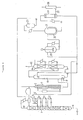
- FIG. 1 A flow diagram of this embodiment of the present invention is shown in Fig. 1.
- the process of the present invention is a two-step process in which methanol is first converted to methylal which then is oxidized to form formaldehyde. Theoretically, this method suffers a smaller loss of methanol due to its conversion to water than the method involving oxidation of methanol.
- the present invention is further characterized in that the aqueous formaldehyde solution produced in this two-step process is separated into a formaldehyde component of low water content and a formaldehyde component of high water content, with the latter being recylced for effective use in the first stage of methylal formation.
- the unreacted formaldehyde component of high water content which results in the production of formaldehyde derivatives is similarly recycled for effective use in the first stage of methylal formation.
- the process of the present invention is thus a recycle system using methanol as an input and which produces highly concentrated formaldehyde or a derivative thereof as an output, with formaldehyde of low concentration being repeatedly produced and consumed.
- the process of the present invention has the added advantage that it does not require any special apparatus for concentrating the formaldehyde of low concentration which is inevitably produced in the system.
- the present invention successfully avoids the two major problems of the prior art, i.e., substantial energy consumption that would otherwise be required to operate a concentrating apparatus, and corrosion of the individual operating units of the system.
- This reaction proceeds over zinc chloride, ferric chloride, hydrochloric acid or any other acidic catalysts that are known to be usable in this type of reaction.
- a preferred embodiment for methylal formation in accordance with the present invention is such that two or more reactors each packed with a solid acid catalyst are connected to a single distillation tower.
- a solution containing methanol, formaldehyde and water is brought into solid-liquid contact with a solid acid catalyst and a methylal-rich component is recovered as a distillate.
- This process employs a distillation tower, and two or more reactors which communicate individually with the middle stage of the distillation tower and are each packed with the solid acid catalyst. In each of the reactors, a solution containing methanol, formaldehyde, water and the resulting methylal is circulated.
- the vapor in the distillation tower that undergoes gas-liquid contact with this solution after it has been subjected to solid-liquid contact in the reactor communicating with the lower side of the distillation tower is brought into another gas-liquid contact with the same solution which has undergone solid-liquid contact by circulation in the reactor communicating with a higher stage of the distillation tower.
- the concentration of methylal in the vapor phase is progressively increased.
- methylal is obtained in a yield of 95% or higher based on the formaldehyde feed.
- solid acid catalyst for use in the present invention examples include cation-exchange resins, sulfonated fluoroalkylene resin derivatives, and crystalline aluminosilicates.
- Cation-exchange resins that can be used in the present invention may be carboxylated or sulfonated derivatives, but sulfonated derivatives are preferred because of the high reaction yield that can be attained.
- Ion-exchange resins that can be used may be gel-type cation-exchange resins or macroporous (macroreticular) cation-exchange resins, but the latter as examplified by Amberlite 200C of Organo Co,, Ltd. and Lewatit SP112 of Bayer A.G. are preferred because of the high reaction yield that can be attained.
- useful ion-exchange resins include a styrene-divinylbenzene copolymer, an acrylic acid-divinylbenzene copolymer, a methacrylic acid-divinylbenzene copolymer, etc.
- a sulfonated tetrafluoroethylene resin derivative (trade name, Nafion H) is preferably used as a sulfonated fluoroalkylene resin derivative.
- Crystalline aluminosilicates for use as a solid acid catalyst in the present invention include those described in JP-A-58-162546 (the term "JP-A” as used herein means an "unexamined published Japanese patent application") which have a silica-to-alumina molar ratio of at least 10, and preferably 20 to 200.
- JP-A as used herein means an "unexamined published Japanese patent application”
- a preferred example is a mordenite-type crystalline aluminosilicate.
- the reactor for use in step (A) may be of any type so long as the solid acid catalyst is present in the column and if allows a solution containing formaldehyde and methanol to be brought into solid-liquid contact with the catalyst to form methylal.
- reactors include vessels or towers in which the particles of a solid acid catalyst are tightly packed, vessels or towers in which the solid acid catalyst is dispersed in slurry form, and vessels or towers in which the particles of solid acid catalyst are loosely packed.
- the solution containing formaldehyde, methanol, water, and the resulting methylal is allowed to circulate in these reactors.
- step (A) which contains a solid acid catalyst and the mode of gas-liquid contact to be made between the methylal-containing vapor and the solution containing methanol, formaldehyde, water and the resulting methylal which has undergone solid-liquid contact with the solid acid catalyst are not limited in any particular way and an illustrative example is shown in Fig. 2.
- two feeds i.e., an aqueous formaldehyde solution and methanol
- feed pipes 5 and 2 respectively.
- Three reactor units X, Y and Z each packed with a solid acid catalyst are connected in that order to the middle stage of the distillation tower 1, with reactor unit X being in the highest position and Z being the lowest.
- a solution containing methanol, formaldehyde, water and the resulting methylal is circulated by such means as a pump.
- step (A) an aqueous formaldehyde solution is chiefly used as the formaldehyde feed, but it may contain trioxane.
- Methanol is normally used in an amount that is at least equal to its stoichiometric ratio to formaldehyde which is 2.
- methanol is used in an amount of from 1.0 to 1.2 times this stoichiometric value, with the range of from 1.0 to 1.1 being particularly preferred.
- methanol is preferably used in an amount 1.1 times the stoichiometic value; if only methylal is to be obtained, methanol is preferably used in an amount equal to the stoichiometiric value; if a distillate intermediate between the two is to be obtained, methanol is preferably used in an amount of from 1.0 to 1.1 times the stoichiometric value.
- the aqueous formaldehyde solution is preferably fed into the distillation tower at a position higher than any of the reactor units connected thereto so that it will make counter current gas-liquid contact with the methylal- and methanol-containg vapor ascending through the distillation tower.
- step (A) methanol is fed into the reactor that is connected to the distillation tower at the position (or stage) closest to the top.
- an aqueous formaldehyde solution is fed to a stage of the tower that is higher than the reactor supplied with methanol.
- formaldehyde and methanol are fed into the reactor that is connected to the distillation tower at the position closest to its top.
- An aqueous solution containing formaldehyde is supplied to a feed stage that is higher in position that any of the reactors, so that the supplied aqueous solution is brought into countercurrent gas-liquid contact with the vapor ascending in the distillation tower which contains methylal and methanol.
- the solution in the reactor that is positioned closest to the top of the distillation tower may or may not be allowed to circulate.
- forced circulation is preferably effected in a reactor at a lower position in order to enhance the efficiency of the reaction.
- methylal synthesis In the step of methylal synthesis, it is normally preferred to employ at least three beds of solid acid catalyst. In some instances, 3 to 5 reactor units are used, and in other cases, 3 to 7 reactor units are employed.
- composition of the solution to be circulated in the reactor units usually consists of from 20 to 65 parts by weight of methanol, 0.001 to 20 parts by weight of formaldehyde, 34 to 79 parts by weight of water and 0.001 to 30 parts by weight of methylal, provided, however, that the concentration of each component varies with the position of each reactor unit.
- the temperature in the reactor units is normally within the range of 45 to 90°C but will slightly vary with the composition of the solution circulating in the reactor units and with the operating pressure in the distillation tower. Normally, the closer to the top of the distillation tower, the lower the temperature of the solution that is circulated in the reactor.
- the operating temperature is in the ranges of 45 to 70°C, 55 to 75°C, 60 to 85°C, 65 to 85°C, 70 to 90°C, 70 to 90°C and 70 to 90°C, the first-mentioned range being for the reactor unit positioned closest to the top of the distillation tower and the last-mentioned range being for the reactor unit positioned the farthest away from the top.
- the distillation tower is operated either at atmospheric pressure or within the range of 1 to 3 atmospheres. Depending on the operating pressure, the temperature of the solution under circulation may sometimes reach 60 to 100°C.
- the solution is circulated in the reactor units in an amount that normally ranges from 2 to 100 parts by weight, preferably from 25 to 50 parts by weight, per part by weight of the methylal vapor that is recovered as a distillate from the top of the distillation tower.
- a solid acid catalyst of a strong acidic cation-exchange resin is used in an amount of from 0.02 to 2 parts by weight for one reactor unit per part by weight of the methylal vapor to be recovered from the top of the distillation tower.
- the preferred range is from 0.05 to 1 parts by weight, which varies with the number of reactor units used.
- the temperature at which each stage of the distillation tower is operated in the step of methylal formation depends on the number of reactor units used and the temperature of the solution circulating in each reactor unit. With four reactor units, the operating temperature of the distillation tower is within the ranges of 45 to 70°C, 55 to 75°C, 60 to 85°C and 65 to 90°C, the first-mentioned range being for the stage which communicates with the reactor unit positioned the closest to the top of the distillation tower, and the last- mentioned range for the stage which communicates with the reactor unit positioned the farthest away from the top.
- the operating temperature of the distillation tower is in the ranges of 45 to 70°C, 55 to 75°C, 60 to 85°C, 65 to 90°C and 70 to 90°C, and with six reactor units, the operating temperature is within the ranges of 45 to 70°C, 55 to 75°C, 60 to 85°C, 65 to 85°C, 70 to 90°C, and 70 to 90°C.
- distillation equipment may be employed in which 5 to 20 stages of distillation are provided between the reactor unit in the highest position and the top of the distillation tower, and at least 10 stages of distillation are provided between the reactor unit connected at the lowest position in the distillation tower and the bottom of the distillation tower.
- distillation equipment may be employed in which an aqueous solution of formaldehyde is supplied to a position at least three stages above the reactor unit in the highest position of the tower.
- the molar ratio of the distillate from the top of the distillation tower to the reflux to its top may be within the range of from 2:1 to 4:3.
- aqueous solutions containing formaldehyde of different concentrations are supplied to the distillation tower through two inlets such that the solution having the larger molar ratio of formaldehyde to water is fed together with methanol into the reactor units connected to the distillation tower whereas the solution having the smaller molar ratio of formaldehyde to water is fed to stages of the tower higher than the reactor units.
- trioxane may be present in the solution having the larger molar ratio of formaldehyde to water.
- the composition of the aqueous solution having the larger molar ratio of formaldehyde to water is such that it consists of from 25 to 40 mol% of formaldehyde, 50 to 75 mol% of water, 0.2 to 1 mol% of trioxane and 3 to 10 mol% of methanol.
- the composition of the aqueous solution having the smaller molar ratio of formaldehyde to water is preferably such that it consists of 5 to 20 mol% of formaldehyde, 70 to 93 mol% of water and 2 to 15 mol% of methanol.
- the aqueous solution having the larger molar ratio of formaldehyde to water may be supplied as a mixture with methanol to the reactor units connected to the distillation tower.
- step (A) of the process of the present invention the solid acid catalyst can be readily separated from the solution containing unreacted methanol, formaldehyde, water, etc.
- homogeneous catalysts such as sulfuric acid
- separation from the reaction solution requires additional operations including distillation and neutralization, but these operations are not necessary in step (A).
- a system having a plurality of reactor units are connected in communication with the distillation tower allows continuous operation for a prolonged period. Stated more specifically, the reactor units permit forced circulation of the feed. If backup reactor units are installed, some of the reactor units can be stopped for catalyst regeneration, change-out and recovery without discontinuing the production of methylal.
- the methylal thus produced is transferred to the next step of oxidation where it is converted to formaldehyde gas.
- oxidation catalyst examples include: silver, copper oxide, molybdenum, vanadium, iron molybdate, iron, molybdenum activated with manganese, magnesium, cadmium, calcium, etc., as well as phosphorus oxide and molybdenum oxide that are activated with manganese, magnesium, cadmium, calcium, etc. More preferred catalysts are those described in JP-A-57-134432 which contain as effective components iron, molybdenum and at least one metal element selected from among alkali metals, bismuth, chromium, tungsten, nickel and cobalt.
- catalysts achieve high selectivity for formaldehyde with reduced production of carbon monoxide, dimethyl ether and methyl formate as co-products.
- the proportions of the respective catalyst components are preferably such that molybdenum is 1.5 to 3.0 and the total amount of alkali metals, bismuth, chromium, tungsten, nickel and cobalt is 0.001 to 0.1 with respect to iron in terms of metal atomic ratio.
- Such catalysts have the added advantage of a long useful life.
- formaldehyde gas is produced by oxidizing methylal using an oxide that contains as effective components iron and molybdenum or an oxide that contains as effective components iron, molybdenum and at least one metal element selected from among alkali metals, bismuth, chromium, tungsten, cobalt and nickel.
- the atomic ratio of molybdenum to iron (Mo/Fe) in these catalysts is normally within the range of 1.6 to 4.5, preferably 1.6 to 3.0, more preferably 1.6 to 2.5, and most preferably 1.6 to 1.9.
- the oxidation catalyst is packed in tubular reactor units and a gas containing methylal and oxygen is allowed to flow through the catalyst bed to generate formaldehyde.
- the packed catalyst may be in the form of granules, cylinders, Rasching rings, spoke rings, etc.
- the oxide catalyst in the first entrance half of the tube has an atomic ratio of molybdenum to iron (Mo/Fe) of from 1.6 to 2.5, whereas the oxide catalyst in the second half of the tube has a Mo/Fe atomic ratio of from 1.6 to 4.5. It is particularly preferred that the first entrance half of the tube is packed with an oxide catalyst having a Mo/Fe atomic ratio of from 1.6 to 2.5 or 1.6 to 2.0 and the second half of the tube is also packed with an oxide catalyst having a Mo/Fe atomic ratio of from 2.0 to 4.5 or 2.0 to 3.5.
- Mo/Fe molybdenum to iron
- the concentrations of the methylal and oxygen to be supplied to the reactor units satisfy the following condition (1): 7.0 ⁇ X ⁇ 2.0 and 1.04X - 3.9 ⁇ X ⁇ 1.04Y - 5.9 (1) where X is the volume % of gaseous metnylal supplied to the reactor units, and Y is the volume % of oxygen supplied to the reactor units.
- the methylal feed may contain methanol.
- the feed concentrations of methylal, methanol and oxygen preferably satisfy the following condition (2): 7.0 ⁇ X + Z/2 ⁇ 2.0 and where X and Z are the volume % of gaseous methylal and methanol supplied to the reactors, respectively; Y is the volume % of oxygen supplied to the reactors; and X, Z, m and n satisfy the following relationships: 0.5 ⁇ n > 0, 1>m ⁇ 0.5 .
- condition (1) which sets forth the relationship between the concentration of methylal X(vol%) and the concentration of oxygen Y(vol%), the concentration of methylal exceeds 1.04Y-3.9, it is difficult to maintain the activity of reaction for an extended period.
- the selectivity for formaldehyde also tends to decrease with time, as evidenced by increased production of carbon monoxide as a by-product. If the concentration of methylal becomes lower than 1.04Y-5.9, the potential hazard of explosion will increase.
- the concentration of methylal in the vapor phase in contact with the catalyst bed is normally within the range of from 2 to 7 vol%, preferably 3 to 6 vol%, more preferably 4 to 5 vol%, and most preferably 4 to 4.5 vol%.
- the concentrations of oxygen and methylal in the gas phase to be supplied to the reactor units must be controlled to lie within the ranges specified by condition (1) or (2).
- the reaction product which contains formaldehyde gas is prepared by mixing air and methylal with the oxygen-lean gas that is obtained by absorbing formaldehyde in a water-containing absorption tower.
- the present inventors have found that when methylal either alone or in admixture with methanol is oxidized in an oxygen-containing vapor phase to produce formaldehyde, greater stable formaldehyde production can be achieved by performing the oxidation reaction of methylal over the catalyst under the conditions that satisfy the following relation: [the rate of oxygen consumption per unit weight of catalyst]/[oxygen partial pressure] ⁇ 1.0 mol/hr.(g-catalyst).(atm) (3)
- the “rate of oxygen consumption per unit weight of catalyst” in (3) means the number of moles of oxygen that are consumed in one hour of reaction per gram of catalyst, and the “oxygen partial pressure” is the partial pressure in atmospheres of oxygen in the reaction gas. The faster the rate of oxygen consumption, the faster the rate of oxidation reaction.
- Oxygen partial pressure can also be calculated from such factors including the initial oxygen partial pressure prior to contact with the catalyst bed, the rate of oxygen consumption and the material balance of the reaction product.
- the rate of reaction and the chemistry of reaction can be calculated by simulating the reaction in the reaction system. This simulation is based on reaction analysis and the temperature distribution in the reaction system as determined from such factors including the overall heat transfer coefficient.
- the value of [the rate of oxygen consumption per unit weight of catalyst]/[oxygen partial pressure] is preferably 1.0 or less, more preferably 0.7 or less, and most preferably 0.5 or less.
- the value of [the rate of oxygen consumption per unit weight of catalyst]/[oxygen partial pressure] in the catalyst-filled tube correlates to the reaction temperature elevation curve. Stated more specifically, this value increases as the reaction temperature increases, and reaches a maximum just before the reaction temperatures peaks, and then decrease as the reaction temperature decreases.
- the maximum value of [the rate of oxygen consumption per unit weight of catalyst]/[oxygen partial pressure] is important and this is influenced by such factors as the temperature of heat medium, the concentration of methylal, the degree of catalyst dilution (the degree by which the catalyst is diluted with an inert substance) and the linear speed of reactants.
- step (B) the oxidation reaction of methylal or methylal-methanol mixed gas is normally performed in the temperature range of from 250 to 400°C.
- a preferred range is from 250 to 380°C, and a particularly preferred range is from 250 to 360°C.
- a gas containing methylal and oxygen is passed through the catalyst bed in the tube.
- Industrially employed reactor units are each composed of 5,000 to 50,000 tubes having an inside diameter of 15 to 25 mm and a length of 600 to 2,000 mm.
- the reaction temperature is controlled by passing a heat medium over the outside of the tubes within the reactor unit so that it will impart heat to, or remove heat from the reactants in the tubes.
- Suitable heat media that can be used are inorganic salts, heat-resistant organic media, etc.
- the heat media are usually employed at temperature in the range of from 240 to 310°C. Normally, the temperature of heat media is raised as the reaction proceeds.
- the linear speed of reactants in the reactor units is normally within the range of from 1.0 to 3.0 Nm3/m2 ⁇ sec, more preferably 1.3 to 2.3 Nm3/m2 ⁇ sec.
- step (B) The conversion of methylal to formaldehyde in step (B) depends on the reaction conditions employed and is normally in the range of from 85 to 95%. As the reaction temperature decreases, the methylal conversion decreases. This is also the case when the reaction temperature is excessive because of the accurance of side reactions such as the formation of carbon monoxide.
- the formaldehyde-containing gas obtained as the oxidation reaction product of step (B) is supplied to an absorption tower where it is absorbed into water or an aqueous formaldehyde solution.
- absorption tower Any type of absorption tower that is commonly employed in the art may be used and examples include packed towers or columns, towers provided with a plurality of trays, and wet-walled columns.
- a countercurrent system is normally employed in the absorption tower, in which the formaldehyde-containing gas is introduced to the lower part or bottom of the tower, and an absorption medium is supplied to the top of the tower.
- Water or an aqueous solution of formaldehyde may be employed as an absorption medium and in the latter case, an aqueous formaldehyde solution of high water content (e.g., 5 wt% or more) that will be separated in a subsequent step is preferably employed.
- an aqueous formaldehyde solution of high water content e.g., 5 wt% or more
- the aqueous formaldehyde solution of low water content that is to be separated and recovered in the subsequent step may be employed as an absorption medium.
- An externally supplied separated aqueous solution of high or low water content may also be employed as an absorption medium.
- the water-rich aqueous solution of formaldehyde that has been obtained by direct oxidation of methanol is also suitable for use as an absorption medium.
- the aqueous formaldehyde solution obtained from the bottom of the absorption tower is recycled to its top.
- the quantity of water or aqueous formaldehyde solution to be used in the absorption step may be properly determined in accordance with the desired concentration of the aqueous formaldehyde solution that emerges from the absorption tower.
- an aqueous formaldehyde solution is used as an absorption medium in a smaller amount than water.
- Two absorption towers may be employed in one method for the absorption of formaldehyde gas.
- the oxidation reaction product gas is absorbed into an aqueous formaldehyde solution of low concentration in the first absorption tower to obtain an aqueous formaldehyde solution of high concetration (e.g., 60 to 80 wt%) and part of the remaining oxidation reaction product gas, which is not absorbed in the first absorption tower, is absorbed into water or an aqueous formaldehyde solution in the second absorption tower to produce an aqueous formaldehyde solution of low concentration (e.g., 30 to 55 wt%, preferably 40 to 50 wt%) which is subsequently supplied to the first absorption tower.
- an aqueous formaldehyde solution of low concentration is sprayed using a spray nozzle in the first absorption tower.
- the second absorption tower is furnished with a filler or some other means for effecting gas-liquid contact.
- a problem associated with the case where a high concentration of formaldehyde is present in said product gas is that formaldehyde will be easily deposited as scale and the chance of clogging of the absorption tower is increased.
- the following method may be adopted when the formaldehyde-containing gas obtained by oxidation of methylal is absorbed into water or an aqueous formaldehyde solution: Before the formaldehyde-containing gas is supplied to the packing or trays in the absorption tower or to some other gas-liquid contact equipment, the water content of the gas is increased and only thereafter is the gas subjected to gas-liquid contact with the packing or trays in the absorption tower or a gas-liquid contact apparatus such as a wetted-wall column.
- the reaction product gas obtained by oxidation of methylal usually has a water content in the range of 4 to 10 vol%. This water content is preferably elevated to at least 15 vol% before the gas is introduced into the absorption tower.
- a preferred method for increasing the water content of the formaldehyde-containing gas is to bring it into contact with the aqueous formaldehyde solution that emerges from the absorption tower. The temperature of this aqueous formaldehyde solution is preferably elevated before it is brought into contact with the formaldehyde-containing gas.
- condition (4) is desirably satisfied: 1.02M + 9 ⁇ T ⁇ 1.02M + 19 (4)
- M is the concentration in wt% of the aqueous formaldehyde solution
- T is the temperature in °C of this solution.
- absorption towers is not the only method of absorption that can be employed in step (C).
- Other methods include: i) bubbling the formaldehyde-containing gas into an aqueous solution in a bubbling vessel; and ii) allowing he formaldehyde-containing gas to make countercurrent contact with an absorption medium in a tube.
- the concentration of the aqueous formaldehyde solution to be obtained as a result of absorption in step (C) can be appropriately adjusted in accordance with the relationship between the quantities of formaldehyde gas and absorption medium used.
- a preferred concentration of the aqueous formaldehyde solution is within the range of from 60 to 80 wt%, with the range of 65 to 75 wt% being more preferred.
- the aqueous formaldehyde solution obtained in step (C) is subsequently separated into formaldehyde having a higher water content and a lower water content than said aqueous solution.
- the formaldehyde of a lower water content is recovered as the end product from the system, whereas the formaldehyde of a higher water content is recycled to step (A) as a feed for methylal formation.
- Example 2 Any method that is well know in the art may be used as a separation technique in step (D).
- a preferred method is employed in Example 2 as follows: The aqueous formaldehyde solution is reacted with an alcohol such as polyethylene glycol, cyclohexanol or trimethylolpropane to form hemiacetal, which then is heated in a decomposing vessel to be separated into a water-lean formaldehyde gas and a water-rich aqueous formaldehyde solution.
- an alcohol such as polyethylene glycol, cyclohexanol or trimethylolpropane
- the water-lean formaldehyde thus separated and recovered may be used, for example, as a material for the production of acetal homopolymers.
- aqueous formaldehyde solution obtained in step (C) is converted to a derivative such as trioxane, which then is recovered as the end product from the system, water-rich formaldehyde is separated as unreacted formaldehyde as described in Example 1. The separated water-rich formaldehyde is recycled to step (A) for further use in methylal formation.
- various formaldehyde derivatives may be obtained, including paraformaldehyde and the condensation product of phenol and formaldehyde.
- the concentration of the water-lean formaldehyde is usually adjusted to a water content of not more than 5 wt%.
- the concentration of the water-rich formaldehyde is normally adjusted to a water content of 5 wt% or more, preferably 5 to 50 wt%, more preferably 10 to 45 wt%.
- the distillation tower 1 was a packed tower having a height of 2.5 m.
- the middle portion of the distillation tower 1 was furnished with stages from which liquid components were withdrawn and pumped to the reactor units X, Y and Z.
- the liquid components were circulated to make solid-liquid contact with a catalyst.
- the reaction solutions containing the resulting methylal which emerged from the reactor units X, Y and Z were returned to the distillation tower 1, where they made gas-liquid contact with the vapor ascending from the bottom of the tower 4 to its top 3 so that the concentration of methylal would progressively increase.
- the reflux was returned to the top of the distillation tower 1 so as to hold the top temperature at 42°C.
- the distillate was withdrawn from the top 3 at a rate of 204 g per hour and reserved in a tank.
- the purity of methylal in the distillate 2 was 99%.
- An aqueous solution containing 0.5% formaldehyde and 0.01% methanol was discharged from the bottom 4 at a rate of 16.5 g per hour.
- the resulting methylal was supplied to the oxidation reaction system employing an iron tube 6 (i.d., 21 mm; length, 100 cm) that was packed with an iron molybdate-molybdenum trioxide catalyst (Mo/Fe atomic ratio, 2.3) in the form of a spokes ring.
- the first 50-cm portion (the upper portion in Fig. 2) of the catalyst bed was composed of 75 vol% of the catalyst and 25 vol% of a ceramic Raschig ring.
- the second 50-cm portion (the lower portion in Fig. 2) of the catalyst bed was solely composed of the catalyst.
- An organic heat-resistant oil (trade name, SK Oil) was circulated at 260°C over the outside of the tube 7.
- a gas consisting of 4 vol% methylal, 8.3 vol% oxygen, 2 vol% water and the balance nitrogen was supplied to the catalyst bed through a conduit 8 at a linear speed of 1.2 Nm3/m2 ⁇ sec.
- a fine hollow syringe needle having an inside diameter of 1 mm and an outside diameter of 1.5 mm was inserted through the center of the catalyst bed in the tube from top to bottom and a thermocouple was passed through this needle for measurement of the temperature in the tube.
- the value of [the rate of oxygen consumption per unit weight of catalyst]/[oxygen partial pressure] in the catalyst bed was determined.
- a maximum value of 0.44 mol/hr ⁇ (g-catalyst)(atm) was attained.
- the highest reaction temperture was 330°C.
- the selectivity for formaldehyde from methylal was 94% and the conversion to formaldehyde was 93%.
- the amount of by-product carbon monoxide was 3% of the product formaldehyde.
- the reaction product gas was then introduced into an absorption tower filled with a Dickson packing.
- the gas was bubbled into an aqueous formaldehyde solution in the bottom of the absorption tower. After the bubbling, the gas was brought into gas-liquid contact in the packed portion.
- Makeup water was fed to the absorption tower from it stop and its quantity was adjusted in such a way that the concentration of formaldehyde in the aqueous formaldehyde solution in the bottom of the absorption tower would be held at 65%.
- a gas containing 8.5 vol% oxygen and 4.5 vol% methylal that satisified condition (1) was supplied to the catalyst bed at a liner speed of 1.5 Nm3/m2 ⁇ sec.
- the supplied gas contained 2 vol% of water.
- the value of [the rate of oxygen consumption per unit weight of catalyst]/[oxyge partial pressure] in the catalyst bed was determined.
- a maximum value of 0.45 mol/hr ⁇ (g-catalyst)(atm) was attained.
- the oxidation step was continued for 3 months and the selectivity for formaldehyde remained at the initial 94%.
- the oxidation catalyst was withdrawn from the tube for examination; a black deposit of molybdenum dioxide was barely noticeable.
- trioxane which is a derivative of formaldehyde, was produced from methanol.
- Methylal synthesis was conducted using a distillation tower 1 and three reactor units X, Y and Z as shown in Fig. 3.
- Each of the reactor unit X, Y and Z was filled with 300 cc of a macroreticular strong acidic cation-exchange resin (trade name, Amberlite 200C).
- a 35% aqueous formaldehyde solution (containing 1% trioxane) was supplied through a feed pipe 5 at a rate of 188 g per hour.
- Methanol was supplied through a feed pipe 2 at a rate of 246 g per hour, and a 70% aqueous formaldehyde solution was supplied through a feed pipe 2′ at a rate of 69 g per hour.
- the distillation tower 1 was a packed tower having a height of 2.5 m.
- the middle portion of the distillation tower 1 was furnished with stages from which liquid components were withdrawn and pumped to the reactor units X, Y, and Z where they were circulated to make solid-liquid contact with a catalyst.
- the reaction solutions containing the resulting methylal which emerged from the reactor units X, Y and Z were returned to the distillation tower 1, where they made gas-liquid contact with the vapor ascending from the bottom of the tower 4 to its top 3 so that the concentration of methylal would progressively increase.
- the reflux was returned to the top of the distillation tower 1 so as to hold the top temperature at 42°C.
- the distillate was withdrawn from the top 3 at a rate of 295 g per hour and reserved in a tank.
- the purity of methylal in the distillate was 99%.
- An aqueous solution containing 0.5% formaldehyde and 0.01% methanol was discharged from the bottom 4 at a rate of 208 g per hour.
- the resulting methylal was supplied to the oxidation reaction system employing an iron tube 6 (i.d., 21 mm; length, 100 cm) that was packed with an iron molybdate-molybdenum trioxide catalyst (Mo/Fe atomic ratio, 2.3) in the form of a spokes ring.
- the first 50-cm portion (the upper portion in Fig. 3) of the catalyst bed was composed of 75 vol% of the catalyst and 25 vol% of a ceramic Rasching ring.
- the second 50-cm portion (the lower portion in Fig. 3) of the catalyst bed was solely composed of the catalyst.
- An organic heat-resistant oil (trade name, SK Oil) was circulated at 260°C over the outside of the tube 7.
- a gas consisting of 4 vol% methylal, 8.3 vol% oxygen, 2 vol% water and the balance nitrogen was supplied to the catalyst bed through a conduit at a linear speed of 1.7 Nm3/m2 ⁇ sec.
- a fine hollow syringe needle having an inside diameter of 1 mm and an outside diameter of 1.5 mm was inserted through the center of the catalyst bed in the tube from top to bottom, and a thermocouple was passed through this needle for measurement of the temperature in the tube.
- the value of [the rate of oxygen consumption per unit weight of catalyst]/[oxygen partial pressure] in the catalyst bed was determined.
- a maximum value of 0.42 mol/hr ⁇ (g-catalyst)(atm) was attained.
- the highest reaction temperature was 330°C.
- the selectivity for formaldehyde from methylal was 94% and the conversion to formaldehyde was 92%.
- the amount of by-product carbon monoxide was 3% of the product formaldehyde.
- the reaction product gas was then introduced into the first spray tower 10 that was equipped with a heater 9 to hold the solution temperature at 85°C.
- the introduced gas was converted to a highly concentrated aqueous formaldehyde solution in the spray tower 10.
- the gas leaving the spray tower 10 was introduced into the second absorption tower 10a and subjected to gas-liquid contact in the packed portion 11.
- Makeup water was supplied to the second absorption tower at an area close to its top 12, and the bottoms from the second absorption tower were supplied as spray water to the spray tower 10.
- the amount of makeup water supplied to the second absorption tower was adjusted in such a way that the concentration of formaldehyde in the aqueous formaldehyde solution in the bottom of the spray tower would be held at 70%.
- Example 1 employs a two-tower absorption system having the spray tower 10 and the second absorption tower 10a.
- the resulting 70% aqueous formaldehyde solution (containing 1% methanol) was supplied both to a reactor 13 for trioxane synthesis and to the distillation tower 1 for methylal synthesis.
- the 3-liters reactor 13 was supplied with the 70% aqueous formaldehyde solution (containing 1% methanol) at a rate of 386 g/hr.
- the reactor 13 contained 2% sulfuric acid.
- the contents of the reactor were boiled by means of a heater 14.
- the resulting trioxane-containing vapor was supplied to a 30-stage distillation tower 15.
- An aqueous solution containing 51% trioxane, 17 % unreacted formaldehyde, and the remainder methanol, methyl formate, methylal, formic acid, etc. was withdrawn from the top 16 at a rate of 385 g/hr.
- the withdrawn aqueous solution consisting of trioxane, formaldehyde, etc.
- trioxane-benzene solution was supplied at a rate of 385 g/hr to the top of a 30-stage rotary disk extraction tower 17, which was supplied from the bottom 18 with benzene at a rate of 300 g/hr.
- a trioxane-benzene solution was withdrawn from the top 19 at a rate of 496 g/hr, and an aqueous solution containing 35% formaldehyde, 2% trioxane and 0.5% benzene was withdrawn from the bottom 20 at a rate of 190 g/hr.
- the trioxane-benzene solution was supplied to the middle stage of a distillation tower 21, where it was separated into high-purity trioxane and benzene by a commonly known method.
- the trioxane was withdrawn from the bottom 22 whereas the benzene was withdrawn from the top 23.
- the benzene was supplied to the middle stage of a subsequent distillation tower 21a, where methanol, methyl formate and other impurities in the benzene were further removed from the top 24.
- the purified benzene was recycled from the bottom 25 to the bottom 18 of the rotary disk extraction tower 17.
- the aqueous solution containing formaldehyde and trioxane that was withdrawn from the bottom 20 of the extraction tower 17 was supplied to the middle stage of another distillation tower 26, where a trace amount of benzene was removed from the top 27.
- aqueous solution containing formaldehyde and trioxane was withdrawn from the bottom 28 at a rate of 188 g/hr and reserved in a tank 29.
- the concentration of formaldehyde in the withdrawn aqueous solution was 35%.
- the recovered aqueous formaldehyde solution was recycled to the distillation tower 1 for methylal synthesis.
- the recovered methanol-containing methylal was then subjected to an oxidation step.
- the iron tube 6 used in this step was of the same type as the one employed in Referential Example 1 and the jacket 7 was similarly heated with a heat medium.
- the oxidation step was operated as in Referential Example 1 except that a gas consisting of 3.8 vol% methylal, 1.0 vol% methanol, 8 vol% oxygen, 2 vol% water and the balance nitrogen was supplied to the catalyst bed in the tube. Reaction analysis showed that the value of [the rate of oxygen consumption per unit weight of catalyst]/[oxygen partial pressure] reached a maximum at 0.45 mol/hr ⁇ (g-catalyst)(atm). The highest reaction temperature was 340°C.
- the conversion of the methanol/methylal mixture to formaldehyde was 92%.
- the amount of by-product carbon monoxide was 3% of the product formaldehyde.
- Example 1 the reaction product gas was introduced into a spray tower 10 for effecting gas-liquid contact.
- Makeup water was supplied to an absorption tower 10a in an area close to its top 12. With the temperature in the spray tower 10 held a 80°C by means of a heater 9, the supply of makeup water was adjusted in such a way that the concentration of formaldehyde in its aqueous solution would be held at 65%. Part of the resulting aqueous formaldehyde solution was withdraw from the bottom of spray tower 10 and supplied through a conduit 5′ both to the distillation tower 1 for methylal synthesis and to a hemiacetalizing vessel 30 for generating formaldehyde gas.
- hemiacetalizing vessel 30 a 65% aqueous formaldehyde solution (containing 1% methanol) and hemiacetalized polyethylene glycol 400 were mixed at respective rates of 380 g/hr and 500 g/hr.
- the hemiacetalized reaction product was supplied to a vacuum dehydration vessel 31 at a rate of 880 g/hr.
- the vacuum dehydration vessel 31 was heated with a jacket 32 to remove moisture under vacuum.
- An aqueous solution of 27% formaldehyde distilled at a rate of 170 g/hr and was reserved in a container 33.
- the dehydrated hemiacetal was supplied to a hemiacetal decomposing vessel 34 heated at 140°C.
- a crude formaldehyde gas containing 4% water was generated in the bottom 35 at a rate of 210 g/hr.
- the resulting formaldehyde gas was passed through a five-stage cooling trap 36 at 0°C to obtain a pure gas of formaldehyde polymerization grade.
- Part of the hemiacetalized polyethylene glycol leaving the hemiacetal decomposing vessel 34 was returned as described above to the hemiacetalizing vessel 30.
- the aqueous formaldehyde solution withdrawn from the bottom of the absorption tower was introduced into the discharge gas pipe from the oxidation reaction zone.
- the oxidation reaction product gas supplied to the absorption tower made gas-liquid contact with said aqueous formaldehyde solution.
- the liquid phase that had been subjected to gas-liquid contact was returned to the bottom of the absorption tower whereas the gas phase was subjected to another gas-liquid contact in the packed portion.
- the other operations were the same as those performed in Example 2.
- the system could be operated continuously for one week without causing any detectable scale deposition in the packed area of the absorption tower.
- the aqueous formaldehyde solution at the bottom of the absorption tower was sprayed and circulated in that tower.
- the gas leaving the oxidation reaction step was supplied to the zone of spraying with the aqueous formaldehyde solution.
- the other operations were the same as those performed in Example 3.
- the system could be operated continuously for one week without causing any detectable scale deposition in the packed area of the absorption tower.
- a spray tower was connected to the absorption tower.
- the gas leaving the oxidation reaction step was supplied to the spray tower.
- the oxidation reaction product gas emerging from the top of the spray tower was then introduced into the absorption tower.
- the bottoms from the absorption tower were supplied to the spray tower and circulated in it.
- the resulting aqueous formaldehyde solution was withdrawn from the bottom of the spray tower.
- the other operations were the same as those performed in Example 4.
- the system can be operated continuously for one week without causing any detectable precipitation of paraformaldehyde in the packed area of the absorption tower or in the produced aqueous formaldehyde solution.
- a heater was installed at the bottom of the spray tower and the bottoms of the spray tower were circulated at a controlled temperature of 83°C.
- the concentration of formaldehyde in the aqueous formaldehyde solution obtained from the bottom of the absorption tower was adjusted to 65%.
- the other operations were the same as those performed in Example 1.
- the system could be operated continuously for one week without causing any detectable precipitation of paraformaldehyde in the packed area of the absorption tower or in the produced aqueous formaldehyde solution.
- Example 1 The procedures of Example 1 were repeated except that the temperature at the bottom of the spray tower was held at 85°C and the concentration of formaldehyde in the produced aqueous formaldehyde solution was adjusted to 70%.
- the system could be operated continuously for one week without causing any detectable formation of paraformaldehyde in the packed area of the absorption tower or in the produced aqueous formaldehyde solution.
- the gas leaving the oxidation reaction step was introduced into the bottom of the absorption tower as in Example 1 except that a 43% aqueous formaldehde solution prepared by silver-catalyzed oxidation of methanol was supplied to the top of the absorption tower in place of water.
- the oxidation product gas was bubbled in the absorption tower so that it made gas-liquid contact in the packed zone of the absorption tower.
- the supply of the 43% aqueous formaldehyde solution was adjusted in such a way that the concentration of the aqueous formaldehyde solution in the bottom of the absorption tower was 70%.
- the resulting aqueous formaldehyde solution was supplied to the reactor for trioxane synthesis. Excess aqueous formaldehyde solution was withdrawn from the system so as to attain material balance.
- Example 1 The procedures of Example 1 were repeated except that the supply of water to the absorption tower was adjusted in such a way that the concentration of the aqueous formaldehyde solution leaving the bottom of the absorption tower was 60%.
- the 70% aqueous formaldehyde solution produced in Example 1 was dissolved in urea in such an amount that the molar ratio of formaldehyde to urea was 2:1 and water was subsequently evaporated.
- the aqueous solution obtained by condensation had a formaldehyde concentration of 7%.
- the recovered aqueous formaldehyde solution was added to a 70% aqueous formaldehyde solution to make a 40% aqueous formaldehyde solution which was then mixed with a 40% aqueous formaldehyde solution that had been separately prepared and fed to the distilation tower for methylal synthesis.
- the resulting mixture (40% aqueous formaldehyde solution) was supplied at a rate of 200 g per hour and treated as in Example 1 to prepare methylal.
- the methylal was then supplied to the oxygenator and the resulting oxidation reaction product gas was absorbed as in Example 1 to obtain a 70% aqueous formaldehyde solution.
- the process of the present invention is capable of producing highly concentrated formaldehyde or derivatives thereof from methanol in an efficient way It also has the added advantage that it does not require any special apparatus for concentrating the formaldehyde of low concentration which inevitably forms in the system.
- the present invention successfully avoids the two major problems of the prior art, i.e., substantial energy consumption that would otherwise be required to operate a concentrating apparatus and corrosion of the individual operating units of the system.
Landscapes
- Chemical & Material Sciences (AREA)
- Organic Chemistry (AREA)
- Chemical Kinetics & Catalysis (AREA)
- General Chemical & Material Sciences (AREA)
- Crystallography & Structural Chemistry (AREA)
- Organic Low-Molecular-Weight Compounds And Preparation Thereof (AREA)
- Low-Molecular Organic Synthesis Reactions Using Catalysts (AREA)
Applications Claiming Priority (2)
| Application Number | Priority Date | Filing Date | Title |
|---|---|---|---|
| JP2187288 | 1988-02-03 | ||
| JP21872/88 | 1988-02-03 |
Publications (3)
| Publication Number | Publication Date |
|---|---|
| EP0327343A2 true EP0327343A2 (fr) | 1989-08-09 |
| EP0327343A3 EP0327343A3 (fr) | 1991-05-08 |
| EP0327343B1 EP0327343B1 (fr) | 1994-04-27 |
Family
ID=12067221
Family Applications (1)
| Application Number | Title | Priority Date | Filing Date |
|---|---|---|---|
| EP89300977A Expired - Lifetime EP0327343B1 (fr) | 1988-02-03 | 1989-02-01 | Procédé pour la préparation de formaldéhyde et de ses dérivés |
Country Status (5)
| Country | Link |
|---|---|
| US (1) | US4967014A (fr) |
| EP (1) | EP0327343B1 (fr) |
| KR (1) | KR910003822B1 (fr) |
| CN (1) | CN1020450C (fr) |
| DE (1) | DE68914858T2 (fr) |
Cited By (3)
| Publication number | Priority date | Publication date | Assignee | Title |
|---|---|---|---|---|
| RU2150995C1 (ru) * | 1995-04-11 | 2000-06-20 | Флориалл Холдингс Лимитед | Способ и реактор для гетерогенного экзотермического синтеза формальдегида |
| RU2156160C2 (ru) * | 1995-04-11 | 2000-09-20 | Флориалл Холдингс Лимитед | Способ и реактор для гетерогенного экзотермического синтеза формальдегида |
| FR2912403A1 (fr) * | 2007-02-13 | 2008-08-15 | Arkema France | Procede de fabrication du chlorure de methylene. |
Families Citing this family (31)
| Publication number | Priority date | Publication date | Assignee | Title |
|---|---|---|---|---|
| US5625579A (en) * | 1994-05-10 | 1997-04-29 | International Business Machines Corporation | Stochastic simulation method for processes containing equilibrium steps |
| JP2906220B2 (ja) * | 1994-10-27 | 1999-06-14 | 旭化成工業株式会社 | トリオキサンの製造法 |
| US5826065A (en) * | 1997-01-13 | 1998-10-20 | International Business Machines Corporation | Software architecture for stochastic simulation of non-homogeneous systems |
| US6379507B1 (en) | 1998-08-03 | 2002-04-30 | Asahi Kasei Kabushiki Kaisha | Process for producing methylal |
| US6015875A (en) * | 1998-08-11 | 2000-01-18 | Catalytic Distillation Technologies | Process for making acetals |
| US6160174A (en) * | 1998-11-12 | 2000-12-12 | Bp Amoco Corporation | Preparation of polyoxymethylene dimethyl ethers by catalytic conversion of dimethyl ether with formaldehyde formed by oxy-dehydrogenation of methanol |
| US6160186A (en) * | 1998-11-12 | 2000-12-12 | Bp Amoco Corporation | Preparation of polyoxymethylene dimethyl ethers by catalytic conversion of dimethyl ether with formaldehyde formed by dehydrogenation of dimethyl ether |
| US6265528B1 (en) | 1998-11-12 | 2001-07-24 | Bp Corporation North America Inc. | Preparation of polyoxymethylene dimethyl ethers by acid-activated catalytic conversion of methanol with formaldehyde formed by oxy-dehydrogenation of dimethyl ether |
| US5959156A (en) * | 1998-11-12 | 1999-09-28 | Bp Amoco Corporation | Preparation of polyoxymethylene dimethyl ethers by catalytic conversion of dimethyl ether with formaldehyde formed by oxy-dehydrogenation of dimethyl ether |
| US20030171534A1 (en) * | 1998-11-12 | 2003-09-11 | Hagen Gary P. | Preparation of polyoxymethylene dimethyl ethers by catalytic conversion of formaldehyde formed by oxy-dehydrogenation of dimethyl ether |
| US6437195B2 (en) * | 1998-11-12 | 2002-08-20 | Bp Corporation North America Inc. | Preparation of polyoxymethylene dimethyl ethers by acid-activated catalytic conversion of methanol with formaldehyde formed by dehydrogenation of methanol |
| US6504055B1 (en) | 2000-06-01 | 2003-01-07 | Board Of Trustees Of Michigan State University | Catalysts and processes for the conversion of succinates to citraconates or itaconates |
| DE10062814A1 (de) * | 2000-12-15 | 2002-06-20 | Ticona Gmbh | Verfahren zur Entfernung von Methanol aus formaldeyhdhaltigen Lösungen |
| US20060100412A1 (en) * | 2003-02-28 | 2006-05-11 | Fraunhofer-Gesellschaft Zur Foerderung Der Angewandten Forschung E.V. | Phenol urea/melamine formaldehyde copolymers, method for the production thereof and use of the same |
| DE102004059334A1 (de) † | 2004-12-09 | 2006-06-22 | Ticona Gmbh | Verfahren zur Herstellung von Acetalen |
| CN100463719C (zh) * | 2007-08-31 | 2009-02-25 | 聊城大学 | 活性炭负载的磷钼钨杂多酸银盐催化剂及其制备方法与应用 |
| CN102295542A (zh) * | 2011-07-01 | 2011-12-28 | 福建省永安林业(集团)股份有限公司 | 一种甲醛生产过程中的热能综合利用方法 |
| CN102351666A (zh) * | 2011-09-16 | 2012-02-15 | 中国海洋石油总公司 | 一种连续生产高浓度甲缩醛的方法 |
| WO2013076289A1 (fr) | 2011-11-24 | 2013-05-30 | Ticona Gmbh | Procédé de recyclage d'une source de formaldéhyde durant un processus de polymérisation |
| CN104341279A (zh) * | 2013-08-05 | 2015-02-11 | 华东理工大学 | 一种由甲醇和甲醛制备聚甲氧基二甲醚的方法 |
| CN106268247A (zh) * | 2015-05-22 | 2017-01-04 | 中国科学院大连化学物理研究所 | 一种甲醛的催化吸收方法 |
| CN106748703A (zh) * | 2017-01-06 | 2017-05-31 | 江苏凯茂石化科技有限公司 | 一种高浓甲醛生产与纯态甲醛的联产生产的工艺装置和方法 |
| CN107011135A (zh) * | 2017-04-28 | 2017-08-04 | 无锡智归科技有限公司 | 一种以甲醛含量低的物料制备浓甲醛的方法 |
| CN107488109A (zh) * | 2017-07-03 | 2017-12-19 | 湖北三里枫香科技有限公司 | 一种甲缩醛直接制备浓甲醛的方法 |
| EP3774762B1 (fr) | 2018-03-29 | 2023-08-30 | Celanese Sales Germany GmbH | Procédé de production d'un acétal cyclique dans un système réactionnel hétérogène |
| DE102018121607A1 (de) * | 2018-09-05 | 2020-03-05 | Rheinisch-Westfälische Technische Hochschule (Rwth) Aachen | Verfahren zur Herstellung von Dimethoxymethan |
| CN109456158B (zh) * | 2018-11-09 | 2022-02-01 | 陕西黑猫焦化股份有限公司 | 一种铁钼法甲醛吸收过程中聚甲醛的处理方法 |
| CN111072626B (zh) * | 2019-12-24 | 2022-11-15 | 湖南阿斯达新材料有限公司 | 一种环状二磺酸亚甲酯化合物的制备方法 |
| CN113636925B (zh) * | 2020-04-27 | 2024-04-30 | 西安市尚华科技开发有限责任公司 | 一种甲缩醛制备高浓度甲醛的系统和方法 |
| CN111808067B (zh) * | 2020-06-17 | 2021-06-01 | 中化学科学技术研究有限公司 | 以甲醇为原料制备三聚甲醛的工艺 |
| CN120518578B (zh) * | 2025-07-21 | 2025-11-07 | 凯瑞环保科技股份有限公司 | 一种三聚甲醛的催化合成工艺和装置 |
Family Cites Families (4)
| Publication number | Priority date | Publication date | Assignee | Title |
|---|---|---|---|---|
| US2467223A (en) * | 1945-01-11 | 1949-04-12 | Du Pont | Preparation of formaldehyde |
| JPS57134432A (en) * | 1981-02-13 | 1982-08-19 | Asahi Chem Ind Co Ltd | Production of formaldehyde |
| US4442307A (en) * | 1982-10-07 | 1984-04-10 | Shell Oil Company | Conversion of dimethyl ether to formaldehyde using Bi-Mo-Fe catalyst |
| US4439624A (en) * | 1982-10-07 | 1984-03-27 | Shell Oil Company | Conversion of dimethyl ether to formaldehyde using Bi-Mo-Cu catalyst |
-
1989
- 1989-02-01 EP EP89300977A patent/EP0327343B1/fr not_active Expired - Lifetime
- 1989-02-01 DE DE68914858T patent/DE68914858T2/de not_active Expired - Lifetime
- 1989-02-02 CN CN89102007A patent/CN1020450C/zh not_active Expired - Lifetime
- 1989-02-03 US US07/305,596 patent/US4967014A/en not_active Expired - Lifetime
- 1989-02-03 KR KR1019890001295A patent/KR910003822B1/ko not_active Expired
Cited By (5)
| Publication number | Priority date | Publication date | Assignee | Title |
|---|---|---|---|---|
| RU2150995C1 (ru) * | 1995-04-11 | 2000-06-20 | Флориалл Холдингс Лимитед | Способ и реактор для гетерогенного экзотермического синтеза формальдегида |
| RU2156160C2 (ru) * | 1995-04-11 | 2000-09-20 | Флориалл Холдингс Лимитед | Способ и реактор для гетерогенного экзотермического синтеза формальдегида |
| FR2912403A1 (fr) * | 2007-02-13 | 2008-08-15 | Arkema France | Procede de fabrication du chlorure de methylene. |
| FR2912402A1 (fr) * | 2007-02-13 | 2008-08-15 | Arkema France | Procede de fabrication du chlorure de methylene |
| WO2008104690A1 (fr) * | 2007-02-13 | 2008-09-04 | Arkema France | Procede de fabrication du chlorure de methylene |
Also Published As
| Publication number | Publication date |
|---|---|
| US4967014A (en) | 1990-10-30 |
| CN1020450C (zh) | 1993-05-05 |
| EP0327343B1 (fr) | 1994-04-27 |
| DE68914858T2 (de) | 1994-08-11 |
| EP0327343A3 (fr) | 1991-05-08 |
| KR910003822B1 (ko) | 1991-06-12 |
| CN1036755A (zh) | 1989-11-01 |
| DE68914858D1 (de) | 1994-06-01 |
| KR890012928A (ko) | 1989-09-20 |
Similar Documents
| Publication | Publication Date | Title |
|---|---|---|
| EP0327343B1 (fr) | Procédé pour la préparation de formaldéhyde et de ses dérivés | |
| EP0253409B1 (fr) | Diluants anhydres pour les réactions oxydatives de propylène en acroléine et d'acroléine en acide acrylique | |
| US4147885A (en) | Process for producing acrylic acid from propylene | |
| EP0523728B1 (fr) | Procédé continu de préparation du carbonate de diméthyle | |
| EP0257565B1 (fr) | Procédé d'oxydation de propylène en acroléine et d'oxydation de l'acroléine en acide acrylique au sein de diluants anhydres | |
| JPS6041056B2 (ja) | シクロヘキサンの酸化法 | |
| US4744869A (en) | Process for purifying methanol | |
| US4359587A (en) | Method for preparing carbonyl compounds | |
| US6057481A (en) | Processes for the manufacture of methylmercaptopropanal | |
| WO1997036848A9 (fr) | Procedes de production de methylmercaptopropanal | |
| US6166263A (en) | Processes for the manufacture of acrolein | |
| US5534648A (en) | Process for continuously producing dimethyl carbonate | |
| US4380663A (en) | Process for the preparation of practically formic acid-free acetic acid | |
| US4337356A (en) | Catalytic liquid-phase oxidation of butane | |
| WO1999016760A1 (fr) | Recuperation de 3,4-epoxy-1-butene a partir d'effluents d'oxydation du 1,3-butadiene | |
| JPS61238745A (ja) | アリルアルコ−ルの製造法 | |
| JPH0542436B2 (fr) | ||
| JP2795360B2 (ja) | 炭酸ジメチルの連続的製法 | |
| CN212335079U (zh) | 一种醋酸甲酯和甲醛合成甲基丙烯酸甲酯的生产工艺装置 | |
| US4440960A (en) | Continuous preparation of 3-alkyl-buten-1-als | |
| JPH01287051A (ja) | ホルムアルデヒドおよびその誘導体の製造法 | |
| GB2024201A (en) | Process for producing methacrylic acid | |
| JP2514071B2 (ja) | 酢酸アリルの製造法 | |
| US4162268A (en) | Process for preparing diacetylbenzene | |
| US3674839A (en) | Production of glycerol acetates |
Legal Events
| Date | Code | Title | Description |
|---|---|---|---|
| PUAI | Public reference made under article 153(3) epc to a published international application that has entered the european phase |
Free format text: ORIGINAL CODE: 0009012 |
|
| AK | Designated contracting states |
Kind code of ref document: A2 Designated state(s): BE DE FR GB |
|
| PUAL | Search report despatched |
Free format text: ORIGINAL CODE: 0009013 |
|
| AK | Designated contracting states |
Kind code of ref document: A3 Designated state(s): BE DE FR GB |
|
| 17P | Request for examination filed |
Effective date: 19911014 |
|
| 17Q | First examination report despatched |
Effective date: 19930426 |
|
| GRAA | (expected) grant |
Free format text: ORIGINAL CODE: 0009210 |
|
| AK | Designated contracting states |
Kind code of ref document: B1 Designated state(s): BE DE FR GB |
|
| REF | Corresponds to: |
Ref document number: 68914858 Country of ref document: DE Date of ref document: 19940601 |
|
| ET | Fr: translation filed | ||
| PLBE | No opposition filed within time limit |
Free format text: ORIGINAL CODE: 0009261 |
|
| STAA | Information on the status of an ep patent application or granted ep patent |
Free format text: STATUS: NO OPPOSITION FILED WITHIN TIME LIMIT |
|
| 26N | No opposition filed | ||
| PGFP | Annual fee paid to national office [announced via postgrant information from national office to epo] |
Ref country code: GB Payment date: 19980123 Year of fee payment: 10 |
|
| PGFP | Annual fee paid to national office [announced via postgrant information from national office to epo] |
Ref country code: FR Payment date: 19980210 Year of fee payment: 10 |
|
| PGFP | Annual fee paid to national office [announced via postgrant information from national office to epo] |
Ref country code: BE Payment date: 19980320 Year of fee payment: 10 |
|
| PG25 | Lapsed in a contracting state [announced via postgrant information from national office to epo] |
Ref country code: GB Free format text: LAPSE BECAUSE OF NON-PAYMENT OF DUE FEES Effective date: 19990201 |
|
| PG25 | Lapsed in a contracting state [announced via postgrant information from national office to epo] |
Ref country code: BE Free format text: LAPSE BECAUSE OF NON-PAYMENT OF DUE FEES Effective date: 19990228 |
|
| BERE | Be: lapsed |
Owner name: ASAHI KASEI KOGYO K.K. Effective date: 19990228 |
|
| GBPC | Gb: european patent ceased through non-payment of renewal fee |
Effective date: 19990201 |
|
| PG25 | Lapsed in a contracting state [announced via postgrant information from national office to epo] |
Ref country code: FR Free format text: LAPSE BECAUSE OF NON-PAYMENT OF DUE FEES Effective date: 19991029 |
|
| REG | Reference to a national code |
Ref country code: FR Ref legal event code: ST |
|
| PGFP | Annual fee paid to national office [announced via postgrant information from national office to epo] |
Ref country code: DE Payment date: 20080124 Year of fee payment: 20 |