EP0327472A1 - Procédé et dispositif pour l'adressage à un destinataire - Google Patents
Procédé et dispositif pour l'adressage à un destinataire Download PDFInfo
- Publication number
- EP0327472A1 EP0327472A1 EP89400322A EP89400322A EP0327472A1 EP 0327472 A1 EP0327472 A1 EP 0327472A1 EP 89400322 A EP89400322 A EP 89400322A EP 89400322 A EP89400322 A EP 89400322A EP 0327472 A1 EP0327472 A1 EP 0327472A1
- Authority
- EP
- European Patent Office
- Prior art keywords
- recipient
- code
- coordinates
- identifier
- exit
- Prior art date
- Legal status (The legal status is an assumption and is not a legal conclusion. Google has not performed a legal analysis and makes no representation as to the accuracy of the status listed.)
- Withdrawn
Links
Images




Classifications
-
- G—PHYSICS
- G09—EDUCATION; CRYPTOGRAPHY; DISPLAY; ADVERTISING; SEALS
- G09B—EDUCATIONAL OR DEMONSTRATION APPLIANCES; APPLIANCES FOR TEACHING, OR COMMUNICATING WITH, THE BLIND, DEAF OR MUTE; MODELS; PLANETARIA; GLOBES; MAPS; DIAGRAMS
- G09B29/00—Maps; Plans; Charts; Diagrams, e.g. route diagram
- G09B29/10—Map spot or coordinate position indicators; Map reading aids
- G09B29/106—Map spot or coordinate position indicators; Map reading aids using electronic means
-
- B—PERFORMING OPERATIONS; TRANSPORTING
- B07—SEPARATING SOLIDS FROM SOLIDS; SORTING
- B07C—POSTAL SORTING; SORTING INDIVIDUAL ARTICLES, OR BULK MATERIAL FIT TO BE SORTED PIECE-MEAL, e.g. BY PICKING
- B07C3/00—Sorting according to destination
-
- B—PERFORMING OPERATIONS; TRANSPORTING
- B07—SEPARATING SOLIDS FROM SOLIDS; SORTING
- B07C—POSTAL SORTING; SORTING INDIVIDUAL ARTICLES, OR BULK MATERIAL FIT TO BE SORTED PIECE-MEAL, e.g. BY PICKING
- B07C3/00—Sorting according to destination
- B07C3/18—Devices or arrangements for indicating destination, e.g. by code marks
Definitions
- this document provides for the creation of standardized envelopes or special cards, the data of which must be read by the computer.
- the data correspond exclusively to postal indications: name, address and postal code. Note that the postal code is common to a very large number of recipients and has no individual character.
- the present invention provides a solution to the routing problem and has an almost universal scope. It is in the industrial field of immaterial transfers (computer data) or materials: transport of physical objects from one place to another.
- the present invention deviates absolutely from these elementary codifications by making it possible to create a real means of control usable by anyone for carrying out transfer and transport processes and, however, which contains no private confidential element.
- the subject of the invention is a method for addressing to a recipient either a message, in particular a computer message, or an object such as document, fold, letter, package, parcel, burden and others, characterized in that one assigns to each message, or subject, two landmarks called respectively "identifier" and "locating" which together correspond to the sole recipient, the identifier being formed by the combination of a geographic location code and a telephone number of the recipient, while the locator is formed by coordinates, preferably in the form of numbers, from a frame that coordinates are established for a given geographic area which correspond to a mesh of the frame representing as precisely as possible the geographic location of the recipient.
- the geographic location code is formed by the official code of an administrative area such as a Department for France, a "County” for the United States and the United Kingdom, a "Land Vietnamese” for Germany, and the like ;
- - the geographic location code is formed by the postal code of the recipient's address;
- - the frame is formed by the cadastre representing numbered plots, the coordinates being either the combination of abscissa and ordinate, or the number of the plots;
- - the frame is a grid; the frame comprises at least one set of zones determined individually by marks, at least some of these zones comprising a grid associated with coordinates;
- the grid of the zones corresponding to cities has a tighter mesh than that of the grid of the zones corresponding to the countryside.
- the invention also relates to a device for implementing the above method, characterized in that it comprises, possibly in separate places, firstly a memory containing for each possible recipient, his name and its address in clear as well as its "identifier” and its "locator”, secondly a computer and at least one data processing software, thirdly a device intended to mark objects such as documents, folds , letters, packages, parcels, burdens and others, either directly or through labels, plates and the like so that each object carries both clear data, identifying and locating it as well as possibly a coded automatic reading, such as that known under the name of "bar code”, and a fourth part of the unit sorting means and grouping of the marked objects with a view to their dispatch.
- this device includes means of unit sorting and grouping of marked objects, before distribution to recipients;
- the means for unitary sorting and grouping of the objects marked before distribution comprise a carousel associated with at least one object arrival and at least one object outlet, this outlet, respectively each outlet, being provided with a movable guide between two positions in one of which it is located on the course of the carousel with a view to directing towards the corresponding exit the object located on the carousel and intended to leave this one by said exit and in the other of which it is out the route of the carousel in order to allow each object to pass to avoid said exit;
- - It includes display means such as a screen for viewing graphic representations of geographic areas and their corresponding frame.
- the elements to be conveyed are associated with a mark consisting not of a simple code but of a real "identifier" since it includes signs (preferably numbers only) which correspond to public and even international elements. , and which identify with certainty and precision any recipient subscribed to the telephone in his country.
- the identifier includes two essential parts, of different natures and which overlap to act together as a key and to avoid any error: the first part is formed by a geographic location code.
- the geographic location code includes two groups.
- the first group can, depending on the country, consist of one, two or three digits and constitutes the international code which identifies the Country of the recipient for automatic telephone calls.
- the number 1 which identifies the United States
- the second the number 48 which identifies Poland
- the third the number 49 which identifies Federal Germany
- the fourth the number 33 which identifies France
- the fifth the number 40 which identifies Romania
- the sixth the number 70 which identifies the USSR , for the seventh, the number 972 which identifies Israel
- the eighth the number 886 which identifies the Republic of China and for the ninth and last example of this table, the number 81 which identifies Japan.
- the second group of figures is made up of the part of the official administrative postal code known to all and of free access which characterizes in France the Department and in most countries a comparable administrative division: County,plast, etc.
- the first recipient the number 222 which indicates the County containing the city of Arlington; for the second, the number 32 which indicates the district in which the town of Szczecinek is located; for the third, the number 80 consisting of the first two digits of the Kunststoff postal code; for the fourth the number 64 corresponding to the department of Pyrénées Atlantics, for the fifth the number 18 which corresponds to "l'Albaiulia" (Romanian equivalent of the French Department) containing the city of Sarmizecetuza, for the sixth the number 100 which is the code postal code of Moscow, for the seventh, the number 6 which is the postal code of Tel Aviv, for the eighth the number 10 which is the postal code of Taipei and for the ninth and last example of this table, the number 100 which is the Tokyo postal code.
- the identifier that we have just described must be completed if we want to ensure the delivery of objects: mail, items ordered by mail, supply of stores by suppliers, etc.
- the so-called "locating" complement makes it possible to determine the geographic position of the recipient with the greatest precision and, in combination with the identifier, makes it possible to secure orders for automatic machines and installations.
- the method according to the invention therefore has no functional territorial limits. But, to fix the ideas without excessively complicating the description, we will start from a country and not from the whole world.
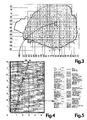
- FIG. 3 the city of Paris is shown intra muros, that is to say excluding its suburbs and the entire urban area of the crown.
- the Municipality has divided the city into regular plots represented by rectangular plans or "plates" which constitute a grid and which each carry markers.
- the horizontal alignments are numbered from a common origin plot rates from bottom to top and vertical columns from left to right.
- the tens digits are larger than the unit digits. We see that for each plot, there are eighty horizontal lines and fifty five vertical columns.
- FIG. 5 shows an extract from the official directory of telephone subscribers classified "by streets". For example, we used the case of rue Saint Denis which we drew in a thicker line than the others on map 08 14. We can see that the building located at number 107 and appearing on plot 08 14 has the coordinates 11 13 if we adopt the convention of placing the abscissa in the first row and the ordinates in the second and, conversely, 13 11 if we adopt the convention of placing the ordered in the first row and the abscissa in the second.
- the name and address of the recipient must be clearly displayed because the final operations for delivering an object are not done by machines but by the intervention of a person: factor , deliveryman, concierge, etc.
- the process however simplifies the initial entry because, at least in France, it is possible to obtain by a computer terminal provided by the Telecommunications Administration named "MINITEL" the postal details of a person whose number is known phone. It is then easy to carry out the automatic seizure by means of a printer or a computer interface, the operator being able very well to understand nothing with the words and even with the writing since it is enough for him to consider the phone number digits. For the clear entry, it is enough to carry out a graphic entry of the information appearing on the screen, as is well known.
- the department number is the only purely geographic use code for the identifier, but the first number in the international telephone code also has significant geographic significance. major: identification of the country, it seems preferable to place it at the head.
- CIDEX Postal Administration
- the identifier corresponds to a single person, it suffices to use this location (ten or twelve digits depending on whether or not the international code is involved) to direct traffic between two points: the point of emission sends by telematics a list of identifiers and the reception point interrogates the base storing the information, so that it is collected automatically and at high speed locating each identifier and the name and address in plain text.
- the entry can be made by a numeric keyboard only (right part of a computer keyboard or calculator), thanks to which the essential reason of routing errors is eliminated, these coming mainly from 'alpha-numeric entry errors.
- the first imperative is the departure of heavy trucks, in order to be able to remedy various mishaps: tire puncture, breakdown, accident, slowdown, etc. So if the list of recipients is not ready, the truck leaves anyway. While on the road, the list of recipients can be transmitted by telex, fax or telematics to the ad hoc office in Rungis. Currently, for such clear transmission and transcription on labels and slips of 150 orders: name and address of each recipient, description and various references it takes two and a half hours. If the heavy truck leaves without a list and the transmission begins five minutes after its departure, the transmission will be completed 35 minutes after its arrival. This delay can be further aggravated and can reach two and a half hours if transmission begins when the heavy truck arrives at Rungis. In reality, it is not possible to start sorting and grouping before all of the products and the complete list of recipients are simultaneously in Rungis.
- this transmission time is reduced from two and a half hours to ten or fifteen minutes.
- a device advantageously comprises, in addition to a computer (and / or a terminal of the MINITEL type) associated with software which will be described later, an encoder which makes it possible to edit labels, possibly self-adhesive, on each which the identifier 1 and the location 2 of a recipient appear in barcode, near the name and the address in clear 3.
- an encoder which makes it possible to edit labels, possibly self-adhesive, on each which the identifier 1 and the location 2 of a recipient appear in barcode, near the name and the address in clear 3.
- Figure 6 preparation of shipments from a center (production, regrouping, distribution, etc.) up to individual delivery to a distant recipient by going through all the intermediate stages of sorting, regrouping, rational placement in vehicles, unbundling, etc.
- the process according to the invention allows the automation of industrial operations providing for the action of a device on tracking, sorting, moving, storage, collection, grouping objects etc.
- the simultaneous presence of clear text and a bar code allows us to reconsider as a whole the conduct of the complex process which goes from the preparation of shipments from a center (production, regrouping, distribution, etc.) until individual delivery to a distant recipient by going through all the intermediate stages of sorting, regrouping, rational placement in vehicles, unbundling, etc.
- the operations at the two ends of this process are practically the only ones which call for human intervention: taking the original initiative and individual delivery, and it is on these two occasions that the clear indication of the recipient is necessary.
- all the phases of the physical process itself can be triggered, conducted and terminated by more or less automated mechanical means.
- the software adapted to this work of grouping works of course with the identifiers and the situants and finally provides a state of deliveries according to the precise coordinates of each plot and here we only retain the plot 08 14, as shown in Figure 8
- the first column is that of the x and y coordinates
- the second is that of the identifiers of the senders
- the third that of the identifiers of the recipients and finally for each shipment, the number of packages and their weight as well as their summary.
- carousel of a type known per se (not shown) comprising a carrier with a closed course on itself, for example like those which are at airports for the delivery of luggage upon arrival of travelers, and on which the packages arrive in any order, through at least one entry. It can be postal packages, parcels of all kinds, packaged food products, cases, cartons, etc.
- This conveyor comprises one or more pointers also of known type, often called “gendarme” which, under the effect of an engine, pivots to be placed either outside the course of the packages to let them continue their movement, or obliquely on said course to force a particular spotted package to leave the transporter and direct it to a storage area, another transporter, a receptacle, etc.
- pointers also of known type, often called “gendarme” which, under the effect of an engine, pivots to be placed either outside the course of the packages to let them continue their movement, or obliquely on said course to force a particular spotted package to leave the transporter and direct it to a storage area, another transporter, a receptacle, etc.
- the packages are each provided with its bar code label and the installation includes a reader of said code.
- an ope rator manipulates a mobile reader or "optical pencil” on labels placed variously.
- the latter is part of an electronic assembly which interprets each bar code and which is capable of controlling the motor of the turnout, respectively of each turnout, according to each package, according to its destination.
- the electronic assembly is associated with software that has been designed in a more or less elaborate manner depending on the applications.
- This software can, for example, include a detailed geographic location program to the point of containing in memory all the possible delivery points by zone and their access modality: authorization and prohibition hours, specific regulations, lane width , approach conditions (prohibited directions, regulated parking, etc.). It is therefore possible to manage not only the sorting of parcels sector by sector (parcel by parcel) but also to group them by truck and, even, distribute the parcels in the order of deliveries so that the parcels of the last recipient are loaded in first, at the front of the truck, and the first recipient's packages last, at the back of the truck.
- the software has in memory all the geographical elements of the routes and it becomes easy to edit by a printer a "road map" for each truck driver, so that it is automatically guided according to the route the safest and the most profitable: either the shortest or the fastest, for example.
- the software sorts the packages by sectors, or parcels, and then by routes and routes. From the schedule in Figure 8, we extract, for the description below, deliveries to rue Saint Denis. That- it is one way from North to South.
- the optimization of the tour is provided by the software which provides for entry into rue Saint Denis by its angle with rue Réaumur, which is one way from West to East because this angle is the first possible access for the situation of the first customer.
- the delivery truck must therefore arrive either by the west of rue de Réaumur, or by the north of rue Saint Denis, or even by boulevard de Sébastopol and rue du Caire depending on the starting point of the truck considered .
- the loading of the truck will have been done in the correct order to optimize the route, taking into account its length in kilometers and time, as follows:
- the loading started by the last recipient and finished by the first: 75 42 60 21 44 08 14 11 13 : 20 packages, 208 kilos 75 45 08 87 02 08 14 15 35 : 12 packages, 60 kilos 75 42 33 92 76 08 14 15 35 : 11 packages, 110 kilos 75 42 33 27 37 08 14 15 35 : 27 packages, 372 kilos 75 42 33 30 38 08 14 17 38 : 28 packages, 362 kilos 75 45 08 42 70 08 14 20 49 : 25 packages, 418 kilos
- Grouping, organized before departure, can actually be done using pallets, containers, box-pallets, etc.
- the invention provides for the control of devices by means of public access numbers, it makes it possible to simplify the production of certain installations which, at present, are very complicated, even impracticable.
- the device is associated with software which "answers" this question by giving in the order of the route a series of very characteristic coordinates: squares, monuments, main routes or pre-established circuits, or else by displaying the circuit graphically, by at least schematic reproduction of the area concerned, taking into account prohibited directions, rush hours in certain places, regulatory prohibitions, etc.
- the invention applies to any physical transport other than courier packages and in the first place to the delivery of mail. It makes it possible to organize collection, sorting, routing and distribution up to and including garnishing, organizing and filling the postman's individual bag, house by house, mailbox by mailbox, without any manual intervention.
- the machines known per se are used for this, which perform the sorting and grouping combined with land, sea or air transport.
- the bar code is particularly well suited to the treatment of letters whose morphology is sufficiently constant to allow the use of automatic machines for affixing and reading at high speed this code, letter by letter.
- a sorting center can fairly easily be equipped with a device according to the invention which performs fine sorting and complete scheduling of mail bag by bag but, even without going so far, it is possible to considerably rationalize sorting more rude currently performed.
- the organization collects the identifiers of the customers from elements which can be the current information usually provided during payments: identity card, check, credit card, etc. .
- the identifiers are collected, classified and stored. Software then makes it possible to process these elements in any desired manner: statistically and / or graphically.
- the geographic approach to finding people For example, a temporary employment agency may, for a given and geographically located client, choose that of the people corresponding to the request of the client who has the domicile closest to the workplace, or to the direct metro line, etc.
- a person searches in a big city for a television repairman, he currently finds in the directory (printed or electronic by MINITEL in France) a large quantity of possible answers but he cannot very effectively choose the most close to his home because all the possible convenience stores are listed in alphabetical order and it would therefore be necessary to browse the whole list and note in passing the name, address and telephone number of all those whose address suggests that they are located nearby. Thanks to the invention, it suffices to introduce the location of the person who is looking for this convenience store for software to answer the question asked with the greatest precision by giving only one or two perfect answers.
Landscapes
- Engineering & Computer Science (AREA)
- Physics & Mathematics (AREA)
- Theoretical Computer Science (AREA)
- Mathematical Physics (AREA)
- Business, Economics & Management (AREA)
- Educational Administration (AREA)
- Educational Technology (AREA)
- General Physics & Mathematics (AREA)
- Management, Administration, Business Operations System, And Electronic Commerce (AREA)
- Sorting Of Articles (AREA)
- Discharge Of Articles From Conveyors (AREA)
Applications Claiming Priority (2)
| Application Number | Priority Date | Filing Date | Title |
|---|---|---|---|
| FR8801258A FR2626504B1 (fr) | 1988-02-03 | 1988-02-03 | Procede et dispositif pour l'adressage a un destinataire |
| FR8801258 | 1988-02-03 |
Publications (1)
| Publication Number | Publication Date |
|---|---|
| EP0327472A1 true EP0327472A1 (fr) | 1989-08-09 |
Family
ID=9362907
Family Applications (1)
| Application Number | Title | Priority Date | Filing Date |
|---|---|---|---|
| EP89400322A Withdrawn EP0327472A1 (fr) | 1988-02-03 | 1989-02-03 | Procédé et dispositif pour l'adressage à un destinataire |
Country Status (8)
| Country | Link |
|---|---|
| EP (1) | EP0327472A1 (da) |
| JP (1) | JPH02503070A (da) |
| AU (1) | AU627165B2 (da) |
| DK (1) | DK486389D0 (da) |
| FR (1) | FR2626504B1 (da) |
| MC (1) | MC2059A1 (da) |
| NO (1) | NO893910L (da) |
| WO (1) | WO1989007018A1 (da) |
Cited By (9)
| Publication number | Priority date | Publication date | Assignee | Title |
|---|---|---|---|---|
| EP0424728A3 (en) * | 1989-10-24 | 1992-04-08 | International Business Machines Corporation | System and method for deferred processing of ocr scanned mail |
| EP0509280A3 (en) * | 1991-04-19 | 1993-05-05 | International Business Machines Corporation | Barcode translation for deferred optical character recognition mail processing |
| WO1996007170A1 (en) * | 1994-08-31 | 1996-03-07 | Nac Geographic Products Inc. | A geodetic coding system |
| WO1995032812A3 (de) * | 1994-05-21 | 1996-03-28 | Phat Chon Chau | Postrationalisierung |
| WO1997002098A1 (en) * | 1995-07-04 | 1997-01-23 | Ilias Tsamourgelis | A method of distribution of correspondence and relative things in the interior of a country and abroad, by using post numbers (p.n.) |
| WO1997036432A1 (en) * | 1996-03-27 | 1997-10-02 | British Telecommunications Public Limited Company | Telecommunications network with store for data associated with an area code |
| WO2000041158A1 (fr) * | 1998-12-31 | 2000-07-13 | Sion Serge Samama | Installation telematique associee a un reseau telephonique distinct et comprenant des representations geographiques |
| CN1071152C (zh) * | 1996-12-27 | 2001-09-19 | 林耀宗 | 自动化邮件区分方法 |
| US6332019B1 (en) | 1996-03-27 | 2001-12-18 | British Telecommunications Public Limited Company | Telecommunications network with store for data associated with an area code |
Families Citing this family (2)
| Publication number | Priority date | Publication date | Assignee | Title |
|---|---|---|---|---|
| US5612889A (en) * | 1994-10-04 | 1997-03-18 | Pitney Bowes Inc. | Mail processing system with unique mailpiece authorization assigned in advance of mailpieces entering carrier service mail processing stream |
| JP2738405B2 (ja) * | 1995-12-14 | 1998-04-08 | 日本電気株式会社 | 物品配送車両用移動局及び配送管理用指令局並びに物品配送管理システム |
Citations (4)
| Publication number | Priority date | Publication date | Assignee | Title |
|---|---|---|---|---|
| US3858054A (en) * | 1973-10-01 | 1974-12-31 | Xerox Corp | Commutator disk for zip code sorting |
| US4122526A (en) * | 1976-12-20 | 1978-10-24 | Pitney-Bowes, Inc. | Calculating and postal zip code-to-postal zone converting apparatus |
| FR2414962A1 (fr) * | 1978-01-20 | 1979-08-17 | Delaby Francois | Enveloppe permettant le triage automatique du courrier |
| EP0272355A1 (en) * | 1986-12-23 | 1988-06-29 | King Lee | Mail sorting and distribution system |
-
1988
- 1988-02-03 FR FR8801258A patent/FR2626504B1/fr not_active Expired - Lifetime
-
1989
- 1989-02-03 WO PCT/FR1989/000044 patent/WO1989007018A1/fr not_active Ceased
- 1989-02-03 JP JP1502106A patent/JPH02503070A/ja active Pending
- 1989-02-03 AU AU30472/89A patent/AU627165B2/en not_active Ceased
- 1989-02-03 MC MC89FR8900044D patent/MC2059A1/xx unknown
- 1989-02-03 EP EP89400322A patent/EP0327472A1/fr not_active Withdrawn
- 1989-10-02 NO NO89893910A patent/NO893910L/no unknown
- 1989-10-03 DK DK486389A patent/DK486389D0/da not_active Application Discontinuation
Patent Citations (4)
| Publication number | Priority date | Publication date | Assignee | Title |
|---|---|---|---|---|
| US3858054A (en) * | 1973-10-01 | 1974-12-31 | Xerox Corp | Commutator disk for zip code sorting |
| US4122526A (en) * | 1976-12-20 | 1978-10-24 | Pitney-Bowes, Inc. | Calculating and postal zip code-to-postal zone converting apparatus |
| FR2414962A1 (fr) * | 1978-01-20 | 1979-08-17 | Delaby Francois | Enveloppe permettant le triage automatique du courrier |
| EP0272355A1 (en) * | 1986-12-23 | 1988-06-29 | King Lee | Mail sorting and distribution system |
Cited By (12)
| Publication number | Priority date | Publication date | Assignee | Title |
|---|---|---|---|---|
| EP0424728A3 (en) * | 1989-10-24 | 1992-04-08 | International Business Machines Corporation | System and method for deferred processing of ocr scanned mail |
| EP0509280A3 (en) * | 1991-04-19 | 1993-05-05 | International Business Machines Corporation | Barcode translation for deferred optical character recognition mail processing |
| WO1995032812A3 (de) * | 1994-05-21 | 1996-03-28 | Phat Chon Chau | Postrationalisierung |
| WO1996007170A1 (en) * | 1994-08-31 | 1996-03-07 | Nac Geographic Products Inc. | A geodetic coding system |
| WO1997002098A1 (en) * | 1995-07-04 | 1997-01-23 | Ilias Tsamourgelis | A method of distribution of correspondence and relative things in the interior of a country and abroad, by using post numbers (p.n.) |
| GR950100254A (el) * | 1995-07-04 | 1997-03-31 | Μεθοδος διακινησης αλληλογραφιας και συναφων στο εσωτερικο και εξωτερικο με χρηση ταχυδρομικων αριθμων (τ.α.) | |
| AU703552B2 (en) * | 1995-07-04 | 1999-03-25 | Ilias Tsamourgelis | A method of distribution of correspondence and relative things in the interior of a country and abroad, by using post numbers (P.N.) |
| WO1997036432A1 (en) * | 1996-03-27 | 1997-10-02 | British Telecommunications Public Limited Company | Telecommunications network with store for data associated with an area code |
| US6332019B1 (en) | 1996-03-27 | 2001-12-18 | British Telecommunications Public Limited Company | Telecommunications network with store for data associated with an area code |
| CN1071152C (zh) * | 1996-12-27 | 2001-09-19 | 林耀宗 | 自动化邮件区分方法 |
| WO2000041158A1 (fr) * | 1998-12-31 | 2000-07-13 | Sion Serge Samama | Installation telematique associee a un reseau telephonique distinct et comprenant des representations geographiques |
| FR2789252A1 (fr) * | 1998-12-31 | 2000-08-04 | Sion Serge Samama | Installation telematique associee a un reseau telephonique distinct et comprenant des representations graphiques |
Also Published As
| Publication number | Publication date |
|---|---|
| FR2626504B1 (fr) | 1991-02-22 |
| FR2626504A1 (fr) | 1989-08-04 |
| WO1989007018A1 (fr) | 1989-08-10 |
| AU627165B2 (en) | 1992-08-20 |
| JPH02503070A (ja) | 1990-09-27 |
| DK486389A (da) | 1989-10-03 |
| MC2059A1 (fr) | 1990-09-04 |
| NO893910L (no) | 1989-11-17 |
| DK486389D0 (da) | 1989-10-03 |
| AU3047289A (en) | 1989-08-25 |
| NO893910D0 (no) | 1989-10-02 |
Similar Documents
| Publication | Publication Date | Title |
|---|---|---|
| US6829369B2 (en) | Coding depth file and method of postal address processing using a coding depth file | |
| US8140551B2 (en) | Address matching | |
| US20170220976A1 (en) | System and Method of Code-based Shipping | |
| EP0327472A1 (fr) | Procédé et dispositif pour l'adressage à un destinataire | |
| US20090164261A1 (en) | System and method for remote baggage check-in | |
| US20030014286A1 (en) | Search and retrieval system of transportation-related flexibly defined paths | |
| RU2298830C2 (ru) | Способ доставки почтовых отправлений | |
| WO2003002273A1 (fr) | Procede de suivi dun envoi dispositif pour la mise en oeuvre de procede et appareil d'impression | |
| CN106408231A (zh) | 物流信息的可视化方法 | |
| US20060212304A1 (en) | Automated item forwarding system and method | |
| EP1295232A1 (fr) | Procede d'adressage et de traitement de courrier postal ou electronique | |
| CN106709684A (zh) | 一种快递整合方法 | |
| EP1640076B1 (en) | Method and system of providing services at a mail delivery point | |
| US20020065565A1 (en) | Electronic collection and delivery system | |
| Teo et al. | Leveraging information technology to achieve the IT2000 vision: the case study of an intelligent island | |
| US20050137990A1 (en) | Method for sending postal packets | |
| CA2541902A1 (en) | Method for capturing and processing information in a communication system | |
| WO2010070151A2 (fr) | Procédé de génération de cartes géographiques à distance | |
| Christmas | Post Boy | |
| RU2466465C2 (ru) | Способ формирования единой информационной базы данных о поверхностях носителей рекламы | |
| Weber | Destination marketing planning in Croatia: Problems and perspectives | |
| CN116629720A (zh) | 一种物流溯源方法 | |
| JP2004123379A (ja) | 施設内集荷・配達管理プログラム及び施設内集荷・配達管理システム | |
| CN117408597A (zh) | 基于送货点地图的包裹智能分拣和派签方法及系统 | |
| JP2003246460A (ja) | 新聞の誤配発見方法と当該方法を運用する物品配達方法 |
Legal Events
| Date | Code | Title | Description |
|---|---|---|---|
| PUAI | Public reference made under article 153(3) epc to a published international application that has entered the european phase |
Free format text: ORIGINAL CODE: 0009012 |
|
| AK | Designated contracting states |
Kind code of ref document: A1 Designated state(s): AT BE CH DE ES FR GB GR IT LI LU NL SE |
|
| 17P | Request for examination filed |
Effective date: 19900207 |
|
| 17Q | First examination report despatched |
Effective date: 19911030 |
|
| STAA | Information on the status of an ep patent application or granted ep patent |
Free format text: STATUS: THE APPLICATION IS DEEMED TO BE WITHDRAWN |
|
| 18D | Application deemed to be withdrawn |
Effective date: 19931103 |