EP0327497A2 - Härtbare Zusammensetzungen aus Polyethersulfon- oder Polyetherketon-Copolymeren und ungesättigten Imiden - Google Patents
Härtbare Zusammensetzungen aus Polyethersulfon- oder Polyetherketon-Copolymeren und ungesättigten Imiden Download PDFInfo
- Publication number
- EP0327497A2 EP0327497A2 EP89810057A EP89810057A EP0327497A2 EP 0327497 A2 EP0327497 A2 EP 0327497A2 EP 89810057 A EP89810057 A EP 89810057A EP 89810057 A EP89810057 A EP 89810057A EP 0327497 A2 EP0327497 A2 EP 0327497A2
- Authority
- EP
- European Patent Office
- Prior art keywords
- oder
- formula
- und
- hydrogen
- curable compositions
- Prior art date
- Legal status (The legal status is an assumption and is not a legal conclusion. Google has not performed a legal analysis and makes no representation as to the accuracy of the status listed.)
- Withdrawn
Links
Classifications
-
- C—CHEMISTRY; METALLURGY
- C08—ORGANIC MACROMOLECULAR COMPOUNDS; THEIR PREPARATION OR CHEMICAL WORKING-UP; COMPOSITIONS BASED THEREON
- C08L—COMPOSITIONS OF MACROMOLECULAR COMPOUNDS
- C08L63/00—Compositions of epoxy resins; Compositions of derivatives of epoxy resins
-
- C—CHEMISTRY; METALLURGY
- C08—ORGANIC MACROMOLECULAR COMPOUNDS; THEIR PREPARATION OR CHEMICAL WORKING-UP; COMPOSITIONS BASED THEREON
- C08G—MACROMOLECULAR COMPOUNDS OBTAINED OTHERWISE THAN BY REACTIONS ONLY INVOLVING UNSATURATED CARBON-TO-CARBON BONDS
- C08G59/00—Polycondensates containing more than one epoxy group per molecule; Macromolecules obtained by polymerising compounds containing more than one epoxy group per molecule using curing agents or catalysts which react with the epoxy groups
-
- C—CHEMISTRY; METALLURGY
- C08—ORGANIC MACROMOLECULAR COMPOUNDS; THEIR PREPARATION OR CHEMICAL WORKING-UP; COMPOSITIONS BASED THEREON
- C08G—MACROMOLECULAR COMPOUNDS OBTAINED OTHERWISE THAN BY REACTIONS ONLY INVOLVING UNSATURATED CARBON-TO-CARBON BONDS
- C08G59/00—Polycondensates containing more than one epoxy group per molecule; Macromolecules obtained by polymerising compounds containing more than one epoxy group per molecule using curing agents or catalysts which react with the epoxy groups
- C08G59/02—Polycondensates containing more than one epoxy group per molecule
- C08G59/04—Polycondensates containing more than one epoxy group per molecule of polyhydroxy compounds with epihalohydrins or precursors thereof
-
- C—CHEMISTRY; METALLURGY
- C08—ORGANIC MACROMOLECULAR COMPOUNDS; THEIR PREPARATION OR CHEMICAL WORKING-UP; COMPOSITIONS BASED THEREON
- C08G—MACROMOLECULAR COMPOUNDS OBTAINED OTHERWISE THAN BY REACTIONS ONLY INVOLVING UNSATURATED CARBON-TO-CARBON BONDS
- C08G59/00—Polycondensates containing more than one epoxy group per molecule; Macromolecules obtained by polymerising compounds containing more than one epoxy group per molecule using curing agents or catalysts which react with the epoxy groups
- C08G59/18—Macromolecules obtained by polymerising compounds containing more than one epoxy group per molecule using curing agents or catalysts which react with the epoxy groups ; e.g. general methods of curing
- C08G59/20—Macromolecules obtained by polymerising compounds containing more than one epoxy group per molecule using curing agents or catalysts which react with the epoxy groups ; e.g. general methods of curing characterised by the epoxy compounds used
- C08G59/22—Di-epoxy compounds
- C08G59/30—Di-epoxy compounds containing atoms other than carbon, hydrogen, oxygen and nitrogen
- C08G59/302—Di-epoxy compounds containing atoms other than carbon, hydrogen, oxygen and nitrogen containing sulfur
-
- C—CHEMISTRY; METALLURGY
- C08—ORGANIC MACROMOLECULAR COMPOUNDS; THEIR PREPARATION OR CHEMICAL WORKING-UP; COMPOSITIONS BASED THEREON
- C08G—MACROMOLECULAR COMPOUNDS OBTAINED OTHERWISE THAN BY REACTIONS ONLY INVOLVING UNSATURATED CARBON-TO-CARBON BONDS
- C08G65/00—Macromolecular compounds obtained by reactions forming an ether link in the main chain of the macromolecule
- C08G65/34—Macromolecular compounds obtained by reactions forming an ether link in the main chain of the macromolecule from hydroxy compounds or their metallic derivatives
- C08G65/38—Macromolecular compounds obtained by reactions forming an ether link in the main chain of the macromolecule from hydroxy compounds or their metallic derivatives derived from phenols
- C08G65/40—Macromolecular compounds obtained by reactions forming an ether link in the main chain of the macromolecule from hydroxy compounds or their metallic derivatives derived from phenols from phenols (I) and other compounds (II), e.g. OH-Ar-OH + X-Ar-X, where X is halogen atom, i.e. leaving group
- C08G65/4012—Other compound (II) containing a ketone group, e.g. X-Ar-C(=O)-Ar-X for polyetherketones
-
- C—CHEMISTRY; METALLURGY
- C08—ORGANIC MACROMOLECULAR COMPOUNDS; THEIR PREPARATION OR CHEMICAL WORKING-UP; COMPOSITIONS BASED THEREON
- C08G—MACROMOLECULAR COMPOUNDS OBTAINED OTHERWISE THAN BY REACTIONS ONLY INVOLVING UNSATURATED CARBON-TO-CARBON BONDS
- C08G65/00—Macromolecular compounds obtained by reactions forming an ether link in the main chain of the macromolecule
- C08G65/34—Macromolecular compounds obtained by reactions forming an ether link in the main chain of the macromolecule from hydroxy compounds or their metallic derivatives
- C08G65/48—Polymers modified by chemical after-treatment
-
- C—CHEMISTRY; METALLURGY
- C08—ORGANIC MACROMOLECULAR COMPOUNDS; THEIR PREPARATION OR CHEMICAL WORKING-UP; COMPOSITIONS BASED THEREON
- C08G—MACROMOLECULAR COMPOUNDS OBTAINED OTHERWISE THAN BY REACTIONS ONLY INVOLVING UNSATURATED CARBON-TO-CARBON BONDS
- C08G73/00—Macromolecular compounds obtained by reactions forming a linkage containing nitrogen with or without oxygen or carbon in the main chain of the macromolecule, not provided for in groups C08G12/00 - C08G71/00
- C08G73/06—Polycondensates having nitrogen-containing heterocyclic rings in the main chain of the macromolecule
- C08G73/10—Polyimides; Polyester-imides; Polyamide-imides; Polyamide acids or similar polyimide precursors
- C08G73/12—Unsaturated polyimide precursors
-
- C—CHEMISTRY; METALLURGY
- C08—ORGANIC MACROMOLECULAR COMPOUNDS; THEIR PREPARATION OR CHEMICAL WORKING-UP; COMPOSITIONS BASED THEREON
- C08G—MACROMOLECULAR COMPOUNDS OBTAINED OTHERWISE THAN BY REACTIONS ONLY INVOLVING UNSATURATED CARBON-TO-CARBON BONDS
- C08G75/00—Macromolecular compounds obtained by reactions forming a linkage containing sulfur with or without nitrogen, oxygen, or carbon in the main chain of the macromolecule
- C08G75/20—Polysulfones
- C08G75/23—Polyethersulfones
-
- C—CHEMISTRY; METALLURGY
- C08—ORGANIC MACROMOLECULAR COMPOUNDS; THEIR PREPARATION OR CHEMICAL WORKING-UP; COMPOSITIONS BASED THEREON
- C08L—COMPOSITIONS OF MACROMOLECULAR COMPOUNDS
- C08L71/00—Compositions of polyethers obtained by reactions forming an ether link in the main chain; Compositions of derivatives of such polymers
-
- C—CHEMISTRY; METALLURGY
- C08—ORGANIC MACROMOLECULAR COMPOUNDS; THEIR PREPARATION OR CHEMICAL WORKING-UP; COMPOSITIONS BASED THEREON
- C08G—MACROMOLECULAR COMPOUNDS OBTAINED OTHERWISE THAN BY REACTIONS ONLY INVOLVING UNSATURATED CARBON-TO-CARBON BONDS
- C08G2650/00—Macromolecular compounds obtained by reactions forming an ether link in the main chain of the macromolecule
- C08G2650/02—Macromolecular compounds obtained by reactions forming an ether link in the main chain of the macromolecule characterized by the type of post-polymerisation functionalisation
- C08G2650/20—Cross-linking
-
- C—CHEMISTRY; METALLURGY
- C08—ORGANIC MACROMOLECULAR COMPOUNDS; THEIR PREPARATION OR CHEMICAL WORKING-UP; COMPOSITIONS BASED THEREON
- C08J—WORKING-UP; GENERAL PROCESSES OF COMPOUNDING; AFTER-TREATMENT NOT COVERED BY SUBCLASSES C08B, C08C, C08F, C08G or C08H
- C08J2379/00—Characterised by the use of macromolecular compounds obtained by reactions forming in the main chain of the macromolecule a linkage containing nitrogen with or without oxygen, or carbon only, not provided for in groups C08J2361/00 - C08J2377/00
- C08J2379/04—Polycondensates having nitrogen-containing heterocyclic rings in the main chain; Polyhydrazides; Polyamide acids or similar polyimide precursors
- C08J2379/08—Polyimides; Polyester-imides; Polyamide-imides; Polyamide acids or similar polyimide precursors
-
- C—CHEMISTRY; METALLURGY
- C08—ORGANIC MACROMOLECULAR COMPOUNDS; THEIR PREPARATION OR CHEMICAL WORKING-UP; COMPOSITIONS BASED THEREON
- C08L—COMPOSITIONS OF MACROMOLECULAR COMPOUNDS
- C08L2312/00—Crosslinking
Definitions
- the present invention relates to new curable compositions and the cured products obtainable therefrom.
- polyether resins in addition to the known technical advantages, have the disadvantages in particular that they exhibit pronounced creep behavior under load at elevated temperatures and, furthermore, are insufficiently resistant to organic solvents.
- the maleimidyl, nadicimidyl or ethynyl groups are disclosed, for example, in EP-A-67,976.
- mixtures of certain copolyether sulfones or copolyether ketones and of certain unsaturated imides can be processed to give hardened products which combine desirable thermoplastic properties, such as high impact strength and flexural strength, and desirable thermosetting properties, such as high glass transition temperatures and good solvent resistance.
- R1 is preferably hydrogen or a radical of the formula IV, in which R9 and R10 are each hydrogen and q is 1.
- the indices p and q are preferably 1 and the index r is preferably 1 to 6, particularly preferably 1.
- R2 is preferably -CH2-, -C (CH3) 2-, -O- or -S-.
- R3 is preferably hydrogen.
- R4, R5 and R7 are straight-chain or branched as C1-C4alkyl. Examples include methyl, ethyl, n-propyl, isopropyl or n-butyl. Methyl is preferred.
- R4, R5 and R7 are straight-chain or branched as C1-C4alkoxy. Examples include methoxy, ethoxy, n-propoxy, isopropoxy or n-butoxy. Methoxy is preferred.
- the indices m, n and o are preferably 0.
- R6 is generally the divalent radical of a mono- or polynuclear carbocyclic-aromatic phenol, in particular the remainder of a mono- or dinuclear carbocyclic-aromatic phenol, the two aromatic nuclei being condensed or being connected to one another via a bridging group.
- Preferred radicals R6 correspond to the formulas XI to XIII in which Z1 is a direct CC bond or is a group of the formulas -C r H 2r -, in which r has the meaning defined above, -O-, -S-, -SO2-, -CO-, -C (CF3) 2-, -CH (C6H5) -, -P (O) R17- or a group of the formulas XIV or XV and R17 is methyl, cyclohexyl or phenyl.
- Very particularly preferred radicals R6 correspond to the formulas XI and XIII, in which Z1 is a direct CC bond or a group of the formulas -CH2-, -CHCH3-, -C (CH3) 2-, -CH (C2H5) -, -C (CH3) (C2H5) -, -O-, -S- or -P (O) R17- is.
- X and Y preferably have the same meaning.
- R8 is preferably allyl, methallyl, prop-1-enyl or 2-methylprop-1-enyl, especially allyl or methallyl.
- R9 and R10 are preferably hydrogen.
- R11 is preferably hydrogen.
- A is in particular a radical of the formula VIIa or a radical of the formula VIIb, in which s is 1.
- R 12 and R 13 are preferably hydrogen and s is preferably 1 or 2, especially 1.
- R14 is straight-chain or branched as C1-C20alkyl. Straight chain residues are preferred. Examples of these radicals R14 are methyl, ethyl, n-propyl, isopropyl, n-butyl, sec-butyl, pentyl, hexyl, heptyl, octyl, nonyl, 2-ethylhexyl, decyl, undecyl, dodecyl, tetradecyl, hexadecyl, octadecyl or Eicosyl. Preferred radicals R14 are C1-C6alkyl.
- R14 is as C5-C12cycloalkyl, for example cyclopentyl, cyclohexyl, cycloheptyl, cyclooctyl or cyclododecyl; cyclohexyl is preferred.
- R14 is as C6-C18Aryl a mono- to trinuclear carbocyclic aromatic radical, which can optionally carry one or more inert substituents, such as alkyl or alkoxy. Multinuclear residues can be condensed or connected to one another via a bridge group. Examples of bridge groups are the groups defined above for Z1.
- R14 as a C4-C18 heterocycle with one or two N, S or O atoms are five- or six-membered non-aromatic or especially aromatic groups, which preferably consist of one or two heterocyclic systems which are connected to one another via a bridging group, as defined for Z1 consist.
- R14 is preferably cyclohexyl or C6-C18Aryl.
- R14 is very particularly preferably a radical of the formulas XVII to XIX wherein Z2 has one of the meanings defined above for Z1.
- R15 as C2-C50alkylene is usually straight-chain alkylene radicals.
- C2-C20alkylene are preferred.
- R15 as C5-C12cycloalkylene is usually cyclopentylene, cyclohexylene, cycloheptylene, cyclooctylene or cyclododecylene. Cyclohexylene is preferred. However, it can also be alkyl-substituted cycloalkylene radicals or the cycloalkylene radicals are part of an aliphatic chain. An example of this is the rest of the isophoronediamine.
- R15 as C6-C18 aryls are usually mono- to trinuclear carbocyclic-aromatic radicals which can optionally carry one or more inert substituents, such as alkyl or alkoxy.
- Polynuclear radicals can be condensed or connected to one another via a bridging group, as defined above for Z 1.
- R15 as a divalent C4-C18 heterocyclic radical having one or two N, S or O atoms are divalent groups which are derived from the heterocycles described above for R14.
- R15 is preferably C2-C6alkylene or C6-C18arylene, very particularly preferably R15 is a radical of the formulas XI to XIII, as already defined above for R6, or a radical of the formula XX where Z3 has the meaning defined above for Z1. Imidyl compounds containing these residues are known from EP-A-32,745.
- R16 is preferably a radical of formula XXI wherein t is 1 to 10.
- Curable compositions in which m, n and o are 0 and p and q are 1 are preferred.
- curable compositions wherein R12 and R13 are hydrogen and s is 1.
- curable compositions are preferred in which X and Y each have the same meaning.
- Curable compositions in which R 1 is hydrogen or a group of the formulas III to V are preferred.
- Curable compositions in which component a) consists of 2 to 30 mol%, in particular 5 to 20 mol%, of recurring structural units of the formula I and from 98 to 70 mol% are very particularly preferred, preferably 95 to 80 mol%, of repeating structural units of the formula II and an average molecular weight (number average) of 2000 to 30,000, preferably from 5,000 to 20,000.
- Curable compositions in which component b) is a compound of the formula VIII or the formula IX or a mixture of such compounds are very particularly preferred, R14 is C5-C7cycloalkyl or C6-C18aryl and R15 is C6-C18arylene.
- curable compositions are particularly preferred, wherein R14 cyclohexyl or phenyl and R15 is a radical of the formula XIII defined above, wherein Z1 is a direct CC bond, -CH2-, -C (CH3) 2-, -C (CF ) Is 2-, -O-, -S-, -SO2- or -CO-.
- the polymers of component a) with hydroxyl end groups can be obtained by reacting compounds of the formulas XXII and / or XXIII and of the formulas XXIV to XXVI in a polar, aprotic solvent in the presence of a base
- the radicals R2 to R7, X and Y, and the indices m, n, o and p have the meaning defined above and Hal is a fluorine, chlorine, bromine or iodine atom, preferably a chlorine atom in the case of the sulfones and a Fluorine atom in the ketones.
- the dihalogen compounds can also be introduced in a slight stoichiometric excess and the halogen-terminated copolyether resins obtained can then be modified by reaction with an alkali metal hydroxide, such as sodium hydroxide solution.
- an alkali metal hydroxide such as sodium hydroxide solution.
- Polar, aprotic compounds for example dimethylformamide or dimethylacetamide, are generally used as solvents.
- inorganic bases such as NaOH, KOH or K2CO3 are suitable as bases.
- end group-capped components a) (R 1 # hydrogen) are desired, these can advantageously be prepared in a one-pot reaction. This is described for example in the above-mentioned EP-A-67,976.
- the corresponding dihalogen compounds of the formulas XXIV and XXVI are introduced in a slight stoichiometric excess together with the bisphenols of the formulas XXII and / or XXIII and XXV and reacted with monophenols of the formulas XXVII to XXIX at the same time, so that the resulting dihalo-terminated polymers can be capped with said monophenols the radicals R8 to R10 and A and the index q have the meaning defined above.
- Glycidyl-terminated polymer components a) are obtained in a manner known per se by reacting the corresponding hydroxyl-terminated polymers with epichlorohydrin or with ⁇ -methylepichlorohydrin in the presence of bases.
- the 1-propenyl derivatives of the formula XXIII can thus be prepared from the corresponding (meth) allyl derivatives of the formula XXII by alkaline isomerization. Examples of such reactions can be found in EP-A-14,816.
- the (meth) allyl derivatives of the formula XXII can be obtained from the corresponding (meth) allyl ethers of the bisphenols by Claisen rearrangement. Examples of such reactions can also be found in EP-A-14,816.
- Some of the bisphenols of the formula XXV and the dihalo compounds of the formulas XXIV and XXVI are commercially available. These compounds are already known as structural components for polyarylene ethers and are described, for example, in EP-A-106,023.
- the compounds of the formula XXVIII, in which R9 and / or R10 are allyl or methallyl, can be obtained, for example, by reacting allyl or methallyl chloride with the corresponding aminophenols.
- the preparation of compounds of the type of the formula XXIX is described, for example, in EP-A-67,976.
- maleimidyl compounds of the formulas XVIII to X can be prepared, for example, in analogy to the methods described in US Pat. No. 3,522,271.
- bicyclo [2.2.1) hept-5-en-2,3-dicarboximide derivatives or the allyl- or methallyl-substituted derivatives of this type can be obtained analogously to the maleimidyl compounds by instead of maleic anhydride the corresponding bicyclo [2.2.1] hept-5-en-2,3-dicarboxylic acid anhydrides.
- curable compositions according to the invention are that they can be used and processed in the manner customary for thermoplastics and, after curing, have the properties which are characteristic of thermosets, such as high strength and glass transition temperatures.
- the curable compositions generally have 1-99% by weight, preferably 60-95% by weight, of component a) and 99-1% by weight, preferably 40-5% by weight, of component b), the Percentages relate to the amount of components a) and b).
- the curable compositions can be used, for example, as molding, coating or coating compositions or for the production of films.
- the usual additives such as fillers, pigments, stabilizers or reinforcing agents such as carbon, boron or glass fibers can be added to the polyether resins present as press powder, melts or solutions in a conventional organic solvent.
- the curable mixtures can also be processed together with other thermoplastics, such as, for example, polyesters, polyamides, polyimides, polyolefins or polyurethanes, in particular with the conventional polyether resins.
- the curable compositions are preferably suitable as matrix resins for the production of fiber composite systems, it being possible to use the usual fibers used in the fiber reinforcement of materials as reinforcing fibers.
- These can be organic or inorganic fibers, natural fibers or synthetic fibers, such as aramid fibers, and can be in the form of fiber bundles or continuous fibers.
- glass, asbestos, boron, carbon and metal fibers, preferably carbon and metal fibers, are used as reinforcing fibers.
- Such fibers and fabrics are commercially available.
- the invention therefore also relates to the use of the curable compositions as matrix resins for the production of fiber composite materials.
- Another object of the present invention are also the crosslinked products obtainable by heating or irradiation with actinic radiation of the curable compositions according to the invention.
- the curable compositions can be crosslinked to give products with advantageous properties.
- thermal crosslinking this can be carried out in the presence of oxygen or, after prior oxidation using oxygen treatment, also under anaerobic conditions, e.g. in the laminating press.
- the temperatures during the thermal crosslinking are generally 220-350 ° C., preferably 250-300 ° C.
- the thermal crosslinking can, if appropriate, in the presence of free radical formers, for example inorganic or organic peroxides, such as potassium peroxide sulfate or benzoyl peroxide, azo compounds, such as azoisobutyronitrile, organic hydroperoxides such as cumene hydroperoxide or tert.-butylhydroperoxide, ⁇ -haloacetophenone, benzoin or its ethers, benzophenol, benzoin, benzophenone, benzoin, benzophenone Benzil acetals, anthraquinones, arsines, phosphines, thoureas, redox initiator systems, anaerobic initiator systems or metal salts can be carried out.
- free radical formers for example inorganic or organic peroxides, such as potassium peroxide sulfate or benzoyl peroxide, azo compounds, such as azoisobutyronitrile, organic hydroperoxide
- the amount of radical generator is generally 0.1-5% by weight, preferably 0.5-3% by weight, based on components a) and b).
- curable compositions according to the invention are crosslinked by means of actinic radiation, this can be carried out, for example, with X-rays, accelerated electrons, ⁇ -rays emitted by a 60Co source or with UV rays.
- Example A1 Analogously to Example A1), 458.38 g (1.596 mol) of 4,4′-dichlorodiphenyl sulfone, 260.22 g (1.14 mol) of 2,2-bis (4-hydroxyphenyl) propane, 164.42 g (0.532 Mol) 2,2-bis (3-allyl-4-hydroxyphenyl) propane, 254.0 g (1.84 mol) anhydrous, powdered potassium carbonate, 2.5 l dimethylacetamide and 1 l xylene reacted and as in Example A1) worked up described. 750.2 g (97.9% of theory) of a colorless polysulfone are obtained, which is clearly soluble in methylene chloride.
Landscapes
- Chemical & Material Sciences (AREA)
- Health & Medical Sciences (AREA)
- Chemical Kinetics & Catalysis (AREA)
- Medicinal Chemistry (AREA)
- Polymers & Plastics (AREA)
- Organic Chemistry (AREA)
- General Chemical & Material Sciences (AREA)
- Macromonomer-Based Addition Polymer (AREA)
- Phenolic Resins Or Amino Resins (AREA)
- Addition Polymer Or Copolymer, Post-Treatments, Or Chemical Modifications (AREA)
- Compositions Of Macromolecular Compounds (AREA)
Abstract
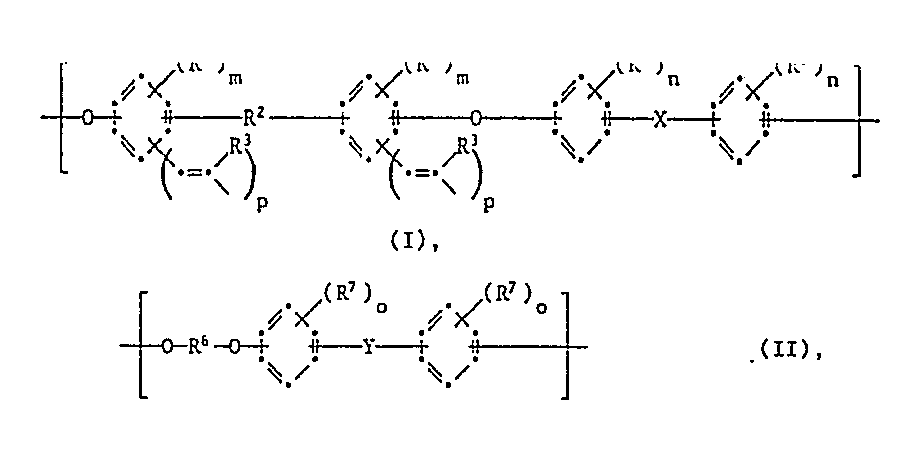
- a) ein Copolyetherharz mit direkt an Phenylkerne gebundenen Endgruppen -OR¹ und 1 bis 50 Mol % an wiederkehrenden Struktureinheiten der Formel I und 99 bis 50 Mol % an wiederkehrenden Struktureinheiten der Formel II,
- b) mindestens eine Verbindung der Formeln VIII, IX oder X
Description
- Die vorliegende Erfindung betrifft neue härtbare Zusammensetzungen sowie die daraus erhältlichen gehärteten Produkte.
- Polyetherharze weisen, wie auch andere Thermoplaste, neben den bekannten technischen Vorteilen vor allem die Nachteile auf, dass sie unter Last bei erhöhten Temperaturen ein ausgesprochenes Kriechverhalten zeigen und ferner gegenüber organischen Lösungsmitteln ungenügend beständig sind.
- Es hat nicht an Versuchen gefehlt, diese Mängel durch Vernetzung der Polyetherharze zu beheben, indem man Polyetherpolymere mit reaktiven, die Vernetzung bewirkenden Endgruppen, verkappt.
- Als solche Endgruppen werden beispielsweise in der EP-A-67,976 die Maleinimidyl-, Nadicimidyl- oder Ethinylgruppen offenbart.
- Aus der US-A-4,634,742 sind Polyarylenether bekannt, die im Polymergerüst wenigstens zwei Ethenyl- oder Ethinylgruppen tragen und die noch Endgruppen dieses Typs besitzen.
- Es wurde jetzt gefunden, dass sich Gemische aus bestimmten Copolyethersulfonen oder Copolyetherketonen und aus bestimmten ungesättigten Imiden zu gehärteten Produkten verarbeiten lassen, die wünschenswerte Thermoplasteigenschaften, wie hohe Schlagzähigkeit und Biegefestigkeit, und wünschenswerte Duroplasteigenschaften, wie hohe Glasübergangstemperaturen und gute Lösungsmittelbeständigkeit, miteinander vereinen.
- Die vorliegende Erfindung betrifft härtbare Zusammensetzungen enthaltend
- a) ein Copolyetherharz mit direkt an Phenylkerne gebundenen Endgruppen -OR¹ und 1 bis 50 Mol % an wiederkehrenden Struktureinheiten der Formel I und 99 bis 50 Mol % an wiederkehrenden Struktureinheiten der Formel II, wobei die Prozentangaben sich jeweils auf die Gesamtzahl an wiederkehrenden Struktureinheiten pro Molekül beziehen


r 1 bis 20 ist,
R³ Wasserstoff oder Methyl bedeutet,
R⁴, R⁵ und R⁷ unabhängig voneinander C₁-C₄Alkyl, C₁-C₄Alkoxy oder Chlor oder Brom sind, m, n und o unabhängig voneinander 0, 1 oder 2 bedeuten, p 1 oder 2 ist,
R⁶ ein zweiwertiger unsubstituierter oder mit ein oder zwei C₁-C₄Alkyl-, C₁-C₄Alkoxygruppen oder Chlor- oder Bromatomen substituierter Rest eines Bisphenols nach dem Entfernen beider phenolischer Hydroxylgruppen ist, X und Y unabhängig voneinander -CO- oder -SO₂- bedeuten,
R⁸ Vinyl, Ethinyl, Allyl, Methallyl, Prop-1-enyl oder 2-Methylprop-1-enyl bedeutet,
R⁹ und R¹⁰ unabhängig voneinander Wasserstoff, Allyl oder Methallyl sind,
R¹¹ Wasserstoff oder Methyl bedeutet, q 1 oder 2 ist,
A eine Gruppe der Formeln VIIa oder VIIb ist
- b) mindestens eine Verbindung der Formeln VIII, IX oder X

R¹⁴ C₁-C₂₀Alkyl, C₅-C₁₂Cycloalkyl, C₆-C₁₈Aryl, C₇-C₂₀Aralkyl oder ein C₄-C₁₈Heterocyclus mit ein oder zwei N-, O- oder S-Atomen ist,
R¹⁵ C₂-C₅₀Alkylen, C₅-C₁₂Cycloalkylen, C₆-C₁₈Arylen, C₇-C₂₀Aralkylen oder ein zweiwertiger C₄-C₁₈heterocyclischer Rest mit ein oder zwei N-, O- oder S-Atomen ist und
R¹⁶ ein t-wertiger Rest eines aromatischen Polyamins nach dem Entfernen der t Aminogruppen ist. - R¹ ist bevorzugt Wasserstoff oder ein Rest der Formel IV, worin R⁹ und R¹⁰ jeweils Wasserstoff sind und q 1 bedeutet.
- Die Indizes p und q sind vorzugsweise 1 und der Index r ist bevorzugt 1 bis 6, besonders bevorzugt 1.
- R² ist vorzugsweise -CH₂-, -C(CH₃)₂-, -O- oder -S-.
- R³ ist bevorzugt Wasserstoff.
- Die Reste -CH=C(R³)-CH₃ in Formel I befinden sich vorzugsweise jeweils in ortho-Position zum betreffenden phenolischen O-Atom.
- R⁴, R⁵ und R⁷ sind als C₁-C₄Alkyl geradkettig oder verzweigt. Beispiele dafür sind Methyl, Ethyl, n-Propyl, Isopropyl oder n-Butyl. Bevorzugt wird Methyl.
- R⁴, R⁵ und R⁷ sind als C₁-C₄Alkoxy sind geradkettig oder verzweigt. Beispiele dafür sind Methoxy, Ethoxy, n-Propoxy, Isopropoxy oder n-Butoxy. Bevorzugt wird Methoxy.
- Die Indizes m, n und o sind vorzugsweise 0.
- R⁶ ist als zweiwertiger Rest eines Bisphenols in der Regel der zweiwertige Rest eines ein- oder mehrkeringen carbocyclisch-aromatischen Phenols, insbesondere der Rest eines ein- oder zweikernigen carbocyclisch-aromatischen Phenols, wobei die beiden aromatischen Kerne kondensiert oder über eine Brückengruppe miteinander verbunden sind.
- Bevorzugte Reste R⁶ entsprechen den Formeln XI bis XIII


- Ganz besonders bevorzugte Reste R⁶ entsprechen den Formeln XI und XIII, worin Z¹ eine direkte C-C-Bindung ist oder eine Gruppe der Formeln -CH₂-, -CHCH₃-, -C(CH₃)₂-, -CH(C₂H₅)-, -C(CH₃)(C₂H₅)-, -O-, -S- oder -P(O)R¹⁷- ist.
- X und Y haben vorzugsweise die gleiche Bedeutung.
- R⁸ ist vorzugsweise Allyl, Methallyl, Prop-1-enyl oder 2-Methylprop-1-enyl, insbesondere Allyl oder Methallyl.
- R⁹ und R¹⁰ sind bevorzugt Wasserstoff.
- R¹¹ ist vorzugsweise Wasserstoff.
- A ist insbesondere ein Rest der Formel VIIa oder ein Rest der Formel VIIb, worin s 1 bedeutet.
- R¹² und R¹³ sind bevorzugt Wasserstoff und s ist vorzugsweise 1 oder 2, insbesondere 1.
- R¹⁴ ist als C₁-C₂₀Alkyl geradkettig oder verzweigt. Bevorzugt werden geradkettige Reste.
Beispiele für diese Reste R¹⁴ sind Methyl, Ethyl, n-Propyl, Isopropyl, n-Butyl, sek.Butyl, Pentyl, Hexyl, Heptyl, Octyl, Nonyl, 2-Ethylhexyl, Decyl, Undecyl, Dodecyl, Tetradecyl, Hexadecyl, Octadecyl oder Eicosyl. Bevorzugte Reste R¹⁴ sind C₁-C₆Alkyl.
R¹⁴ ist als C₅-C₁₂Cycloalkyl beispielsweise Cyclopentyl, Cyclohexyl, Cycloheptyl, Cyclooctyl oder Cyclododecyl; bevorzugt wird Cyclohexyl. R¹⁴ ist als C₆-C₁₈Aryl ein ein- bis dreikerniger carbocyclischaromatischer Rest, der gegebenenfalls ein oder mehrere inerte Substituenten, wie Alkyl oder Alkoxy, tragen kann. Mehrkernige Reste können kondensiert sein oder über eine Brückengruppe miteinander verbunden sein. Beispiele für Brückengruppen sind die weiter oben für Z¹ definierten Gruppen. - Beispiele für R¹⁴ als C₄-C₁₈Heterocyclus mit ein oder zwei N-, S-oder O-Atomen sind fünf- oder sechsgliedrige nichtaromatische oder insbesondere aromatische Gruppen, die vorzugsweise aus ein oder zwei über eine Brückengruppe, wie für Z¹ definiert, miteinander verbundenen heterocyclischen Systemen bestehen. Bevorzugt werden fünfgliedrige, einkernige aromatische Gruppen mit einem O- oder S-Atom im Ring, wie Furyl oder Thienyl, oder sechsgliedrige nichtaromatische N-heterocyclische Reste, wie Pyrrolidinyl, Imidazolidinyl, Pyrazolidinyl, Piperidyl, Piperazinyl, Morpholinyl oder Hydantoinidyl.
- R¹⁴ ist bevorzugt Cyclohexyl oder C₆-C₁₈Aryl. Ganz besonders bevorzugt ist R¹⁴ ein Rest der Formeln XVII bis XIX

- Bei R¹⁵ als C₂-C₅₀Alkylen handelt es sich in der Regel um geradkettige Alkylenreste.
- Beispiele dafür sind Ethylen, Tri-, Tetra-, Penta-, Hexa-, Hepta- Octa-, Nona-, Deca-, Undeca-, Dodeca-, Tetradeca-, Hexadeca-, Octadeca- oder Eicosamethylen.
Bevorzugt sind C₂-C₂₀Alkylenreste. - Bei R¹⁵ als C₅-C₁₂Cycloalkylen handelt es sich in der Regel um Cyclopentylen, Cyclohexylen, Cycloheptylen, Cyclooctylen oder Cyclododecylen. Bevorzugt wird Cyclohexylen. Es kann sich aber auch um alkylsubstituierte Cycloalkylenreste handeln oder die Cycloalkylenreste sind Teil einer aliphatischen Kette. Ein Beispiel dafür ist der Rest des Isophorondiamins.
- Bei R¹⁵ als C₆-C₁₈Arylen handelt es sich in der Regel um ein- bis dreikernige carbocyclisch-aromatische Reste, die gegebenenfalls ein oder mehrere inerte Substituenten, wie Alkyl oder Alkoxy, tragen können. Mehrkernige Reste können kondensiert sein oder über eine Brückengruppe, wie oben für Z¹ definiert, miteinander verbunden sein.
- Bei R¹⁵ als zweiwertigem C₄-C₁₈heterocyclischen Rest mit ein oder zwei N-, S- oder O-Atomen handelt es sich um zweiwertige Gruppen, die sich von den weiter oben für R¹⁴ beschriebenen Heterocyclen ableiten.
- R¹⁵ ist bevorzugt C₂-C₆Alkylen oder C₆-C₁₈Arylen, ganz besonders bevorzugt ist R¹⁵ ein Rest der Formeln XI bis XIII, wie bereits weiter oben für R⁶ definiert oder ein Rest der Formel XX

- R¹⁶ ist vorzugsweise ein Rest der Formel XXI

- Bevorzugt werden härtbare Zusammensetzungen, worin m, n und o 0 sind und p und q 1 bedeuten.
- Ebenfalls bevorzugt werden härtbare Zusammensetzungen, worin R¹² und R¹³ Wasserstoff sind und s 1 bedeutet.
Ferner werden härtbare Zusammensetzungen bevorzugt, worin X und Y jeweils die gleiche Bedeutung besitzen. - Bevorzugt werden härtbare Zusammensetzungen, worin R¹ Wasserstoff ist oder eine Gruppe der Formeln III bis V bedeutet.
- Von diesen letzteren Zusammensetzungen wird besonders diejenige Ausführungsform bevorzugt, worin R¹ Wasserstoff oder eine Gruppe der Formel IV ist, q 1 bedeutet und R⁹ und R¹⁰ Wasserstoff bedeuten.
- Ganz besonders bevorzugt werden härtbare Zusammensetzungen, worin Komponente a) aus 2 bis 30 Mol %, insbesondere 5 bis 20 Mol %, an wiederkehrenden Struktureinheiten der Formel I und aus 98 bis 70 Mol %, vorzugsweise 95 bis 80 Mol %, an wiederkehrenden Struktureinheiten der Formel II besteht und ein mittleres Molekulargewicht (Zahlenmittel) von 2000 bis 30000, vorzugsweise von 5000 bis 20000, aufweist.
- Ganz besonders bevorzugt werden härtbare Zusammensetzungen, worin Komponente b) eine Verbindung der Formel VIII oder der Formel IX oder ein Gemisch solcher Verbindungen ist, R¹⁴ C₅-C₇Cycloalkyl oder C₆-C₁₈Aryl ist und R¹⁵ C₆-C₁₈Arylen ist.
- Von dieser letzteren Ausführungsform werden insbesondere härtbare Zuammensetzungen bevorzugt, worin R¹⁴ Cyclohexyl oder Phenyl und R¹⁵ ein Rest der oben definierten Formel XIII ist, worin Z¹ eine direkte C-C-Bindung, -CH₂-, -C(CH₃)₂-, -C(CF)₂-, -O-, -S-, -SO₂- oder -CO-ist.
- Die Polymeren der Komponente a) mit Hydroxylendgruppen können erhalten werden, indem man Verbindungen der Formeln XXII und/oder XXIII und der Formeln XXIV bis XXVI in einem polaren, aprotischen Lösungsmittel in Gegenwart einer Base umsetzt

- Setzt man eine Verbindung der Formel XXII ein, so erfolgt während der Reaktion eine Isomerisierung zum entsprechenden 1-Propenylderivat. Zur Herstellung der hydroxyl-terminierten Copolyetherharze (R¹= Wasserstoff) sind die Mengenverhältnisse der Bisphenol- zu den Dihalogenverbindungen dabei in an sich bekannter Weise zu wählen, so dass ein geringer stöchiometrischer Ueberschuss an Bisphenolkomponenten vorliegt. Das molare Verhältnis der Verbindungen XXII/XXIV bzw. XXIII/XXIV zu den Verbindungen XXV/XXVI beträgt im allgemeinen 1:99 bis 1:1.
- Man kann allerdings auch die Dihalogenverbindungen in geringem stöchiometrischen Ueberschuss vorlegen und die erhaltenen halogen-terminierten Copolyetherharze anschliessend durch Umsetzung mit einem Alkalimetallhydroxid, wie Natronlauge modifizieren.
- Als Lösungsmittel setzt man im allgemeinen polare, aprotische Verbindungen ein, beispielsweise Dimethylformamid oder Dimethylacetamid.
- Als Basen eignen sich insbesondere anorganische Basen, wie NaOH, KOH oder K₂CO₃.
- Die Umsetzung der Bisphenole mit den aromatischen Dihalogenverbindungen zu Polyarylenethern ist an sich bekannt und beispielsweise in der EP-A 106,023 beschrieben.
- Wünscht man endgruppenverkappte Komponenten a) (R¹# Wasserstoff), so lassen sich diese vorteilhafterweise in einer Eintopfreaktion herstellen. Dies ist beispielsweise in der oben erwähnten EP-A-67,976 beschrieben.
- Dazu legt man die entsprechenden Dihalogenverbindungen der Formeln XXIV und XXVI in geringem stöchiometrischen Ueberschuss zusammen mit den Bisphenolen der Formeln XXII und/oder XXIII und XXV vor und setzt diese gleichzeitig mit Monophenolen der Formeln XXVII bis XXIX um, so dass die entstehenden dihalogen-terminierten Polymeren mit besagten Monophenolen verkappt werden können

- Glycidyl-terminierte Polymerkomponenten a) erhält man in an sich bekannter Weise durch Umsetzung der entsprechenden hydroxyl-terminierten Polymeren mit Epichlorhydrin oder mit β-Methylepichlorhydrin in Gegenwart von Basen.
- Die Zwischenprodukte der Formeln XXII bis XXVI sind an sich bekannt oder können nach an sich bekannten Verfahren erhalten werden.
- So lassen sich die 1-Propenylderivate der Formel XXIII aus den entsprechenden (Meth)allylderivaten der Formel XXII durch alkalische Isomerisation herstellen. Beispiele für solche Reaktionen findet man in der EP-A-14,816.
Die (Meth)allylderivate der Formel XXII lassen sich aus den entsprechenden (Meth)allylethern der Bisphenole durch Claisen Umlagerung erhalten. Beispiele für solche Reaktionen findet man ebenfalls in der EP-A-14,816.
Die Bisphenole der Formel XXV und die Dihalogenverbindungen der Formeln XXIV und XXVI sind teilweise im Handel erhältlich. Diese Verbindungen sind als Aufbaukomponenten für polyarylenether bereits bekannt und beispielsweise in der EP-A-106,023 beschrieben. - Die funktionalisierten Monophenole der Formeln XXVII bis XXIX sind ebenfalls an sich bekannt.
- Die Verbindungen der Formel XXVIII, worin R⁹ und/oder R¹⁰ Allyl oder Methallyl bedeuten, können beispielsweise durch Umsetzung von Allyl-oder Methallylchlorid mit den entsprechenden Aminophenolen erhalten werden. Die Herstellung von Verbindungen des Typs der Formel XXIX wird beispielsweise in der EP-A-67,976 beschrieben.
- Die Verbindungen der Formeln XVIII bis X sind ebenfalls an sich bekannt und teilweise im Handel erhältlich.
- Die Herstellung der Maleinimidylverbindungen der Formeln XVIII bis X kann beispielsweise in Analogie zu den in der US-A-3,522,271 beschriebenen Methoden erfolgen.
- Maleinimidylverbindungen der Formel X sind beispielsweise in der DE-A-2,230,874 beschrieben.
- Die entsprechenden Bicyclo[2.2.1)hept-5-en-2,3-dicarbonsäureimidderivate oder die allyl- oder methallylsubstituierten Derivate dieses Typs können in Analogie zu den Maleinimidylverbindungen erhalten werden, indem man anstelle von Maleinsäureanhydrid die entsprechenden Bicyclo[2.2.1]hept-5-en-2,3-dicarbonsäureanhydride einsetzt.
- Verbindungen dieses Typs sind beispielsweise aus der US-A-4,515,962 bekannt.
- Ein besonderer Vorteil der erfindungsgemässen härtbaren Zusammensetzungen ist darin zu sehen, dass diese in der für Thermoplasten üblichen Weise eingesetzt und verarbeitet werden können und nach der Härtung die für Duroplaste charakteristischen Eigenschaften, wie hohe Festigkeit und Glasübergangstemperaturen, aufweisen.
- Die härtbaren Zusammensetzungen weisen im allgemeinen 1-99 Gew.-%, vorzugsweise 60-95 Gew.%, an Komponente a) und 99-1 Gew.%, vorzugsweise 40-5 Gew.%, an Komponente b) auf, wobei die Prozentangaben sich auf die Menge an Komponenten a) und b) beziehen.
- Die härtbaren Zusammensetzungen können beispielsweise als Press-, Ueberzugs- oder Beschichtungsmassen oder zur Herstellung von Filmen Verwendung finden. Vor dem Applizieren können den als Presspulver, Schmelzen oder Lösungen in einem üblichen organischen Lösungsmittel vorliegenden Polyetherharzen die üblichen Zusatzstoffe, wie beispielsweise Füllstoffe, Pigmente, Stabilisatoren oder Verstärkungsmittel, wie Kohlenstoff-, Bor-oder Glasfasern, zugegeben werden. Die härtbaren Gemische können auch zusammen mit anderen Thermoplasten, wie beispielsweise Polyestern, Polyamiden, Polyimiden, Polyolefinen oder Polyurethanen, insbesondere mit den konventionellen Polyetherharzen, ver arbeitet werden.
- Vorzugsweise eignen sich die härtbaren Zusammensetzungen als Matrixharze für die Herstellung von Faserverbundsystemen, wobei man als Vestärkungsfasern die üblichen bei der Faserverstärkung von Werkstoffen verwendeten Fasern einsetzen kann. Diese können organische oder anorganische Fasern, Naturfasern oder Synthesefasern, wie Aramid-Fasern, sein und als Faserbündel oder Endlosfasern vorliegen. Beispielsweise verwendet man als Verstärkungsfasern Glas-, Asbest-, Bor-, Kohlenstoff- und Metallfasern, vorzugweise Kohlenstoff- und Metallfasern. Solche Fasern und Gewebe daraus sind im Handel erhältlich.
- Die Erfindung betrifft also auch die Verwendung der härtbaren Zusammensetzungen als Matrixharze für die Herstellung von Faserverbundwerkstoffen.
- Ein weiterer Gegenstand vorliegender Erfindung sind auch die durch Erhitzen oder Bestrahlung mit aktinischer Strahlung der erfindungsgemässen härtbaren Zusammensetzungen erhältlichen vernetzten Produkte.
- Wie eingangs erwähnt, können die härtbaren Zusammensetzungen zu Produkten mit vorteilhaften Eigenschaften vernetzt werden. Im Falle einer thermischen Vernetzung kann diese in Gegenwart von Sauerstoff oder, nach vorheriger Oxidation mittels Sauerstoffbehandlung, auch unter anaeroben Bedingungen, z.B. in der Laminierpresse, erfolgen.
- Die Temperaturen bei der thermischen Vernetzung betragen im allgemeinen 220-350°C, vorzugsweise 250-300°C.
- Die thermische Vernetzung kann gegebenenfalls in Gegenwart von Radikalbildnern, z.B. anorganischen oder organischen Peroxiden, wie Kaliumperoxidsulfat oder Benzoylperoxid, Azoverbindungen, wie Azoisobutyronitril, organischen Hydroperoxiden, wie Cumolhydroperoxid oder tert.-Butylhydroperoxid, α-Halogenacetophenon, Bezoin oder dessen Ethern, Benzophenon, Benzpinakol, Benzilacetalen, Anthrachinonen, Arsinen, Phosphinen, Thoharnstoffen, Redox-Initiatorsystemen, anaerobischen Initiatorsystemen oder Metallsalzen vorgenommen werden.
- Die Menge an Radikalbildner beträgt im allgemeinen 0,1-5 Gew.%, vorzugsweise 0,5-3 Gew.%, bezogen auf Komponenten a) und b).
- Im Falle einer Vernetzung der erfindungsgemässen härtbaren Zusammensetzungen mittels aktinischer Strahlung kann diese zum Beispiel mit Röntgenstrahlen, beschleunigten Elektronen, von einer ⁶⁰Co-Quelle ausgesandten γ-Strahlen oder mit UV-Strahlen vorgenommen werden.
- Die folgenden Beispiele erläutern die Erfindung.
- In einem 6 Liter Sulfierkolben, ausgerüstet mit Flügelrührer, Thermometer, Wasserabscheider, Intensivkühler und Gaseinleitungsrohr, werden 439,9 g (1,532 Mol) 4,4′-Dichlordiphenylsulfon, 297,2 g (1,302 Mol) 2,2-Bis-(4-hydroxyphenyl)-propan, 94,4 g (0,306 Mol) 2,2-Bis-(3-allyl-4-hydroxyphenyl)-propan, 254,3 g (1,84 Mol) wasserfreies, pulverisiertes Kaliumcarbonat, 2,5 ℓ Dimethylacetamid und 1 ℓ Xylol 2 Stunden lang bei 146°C zur Reaktion gebracht und das entstehende Reaktionswasser laufend azeotrop ausgekreist. Anschliessend wird solange Lösungsmittel abdestilliert bis die Innentemperatur 150°C erreicht hat. Dann lässt man 20 Stunden lang bei dieser Temperatur weiter reagieren und destilliert anschliessend nochmals Lösungsmittel ab, bis die Innentemperatur auf 157°C angestiegen ist. Nach weiteren 65 Minuten Reaktionsdauer werden 2 ℓ Dimethylacetamid zugegeben, das Reaktionsgemisch auf Raumtemperatur abgekühlt und dann in 15 ℓ Wasser unter intensivem Rühren mit einem Turbomischer ausgefällt. Der Niederschlag wird abgesaugt, mit Wasser gut gewaschen und im Vakuum bei 100°C getrocknet. Man erhält 713,8 g (99,1 % d. Theorie) eines farblosen Pulvers, das in Methylenchlorid klar löslich ist.
- Analytische Daten:
Gelchromatographie: Mn = 6954; Mw = 30082; Mw/Mn = 4,32.
Glasumwandlungstemperatur (Tg onset, TMA): 115°C.Elementaranalyse: berechnet gefunden 6,82 % S 6,79 % S. - Analog Beispiel A1) werden 458,38 g (1,596 Mol) 4,4′-Dichlordiphenylsulfon, 260,22 g (1,14 Mol) 2,2-Bis-(4-hydroxyphenyl)-propan, 164,42 g (0,532 Mol) 2,2-Bis-(3-allyl-4-hydroxyphenyl)-propan, 254,0 g (1,84 Mol) wasserfreies, pulverisiertes Kaliumcarbonat, 2,5 ℓ Dimethylacetamid und 1 ℓ Xylol zur Reaktion gebracht und wie in Beispiel A1) beschrieben aufgearbeitet. Es werden 750,2 g (97,9 % der Theorie) eines farblosen Polysulfons erhalten und das in Methylenchlorid klar löslich ist.
- Analytische Daten:
Gelchromatographie: Mn = 7395; Mw = 36393; Mw/Mn = 4,92.
Glasumwandlungstemperatur (Tg onset, TMA): 107°C.Elementaranalyse: berechnet gefunden 6,5 % S 6,68 % S. - 100 g Polysulfon (hergestellt nach Beispiel A1) und 15 g Bis-(4-maleinimidylphenyl)-methan werden mit einer automatischen Reibschale der Marke Pulverisette während 10 Minuten homogenisiert. Etwa 10 g dieses Pulvers werden auf ein eloxiertes Aluminiumblech gegeben und bei 200°C während 2 Minuten in der Laborpresse zu einem 0,5 mm dünnen Plättchen verpresst. Anschliessend wird je ein Viertel dieses Plättchens während 6 h bei 250°C, 6 h bei 280°C und 6 h bei 310°C polymerisiert. Die Eigenschaften des Polymeren findet man in Tabelle 1.
- 100 g Polysulfon (hergestellt nach Beispiel A2) und 25 g Bis-(4-maleinimidylphenyl)-methan werden, wie in Anwendungsbeispiel B1 beschrieben, verarbeitet und polymerisiert. Die Eigenschaften des Polymeren findet man in Tabelle 1.

Claims (12)


r 1 bis 20 ist,
R³ Wasserstoff oder Methyl bedeutet,
R⁴, R⁵ und R⁷ unabhängig voneinander C₁-C₄Alkyl, C₁-C₄Alkoxy oder Chlor oder Brom sind, m, n und o unabhängig voneinander 0, 1 oder 2 bedeuten, p 1 oder 2 ist,
R⁶ ein zweiwertiger unsubstituierter oder mit ein oder zwei C₁-C₄Alkyl-, C₁-C₄Alkoxygruppen oder Chlor- oder Bromatomen substituierter Rest eines Bisphenols nach dem Entfernen beider phenolischer Hydroxylgruppen ist,
X und Y unabhängig voneinander -CO- oder -SO₂- bedeuten,
R⁸ Vinyl, Ethinyl, Allyl, Methallyl, Prop-1-enyl oder 2-Methylprop-1-enyl bedeutet,
R⁹ und R¹⁰ unabhängig voneinander Wasserstoff, Allyl oder Methallyl sind,
R¹¹ Wasserstoff oder Methyl bedeutet, q 1 oder 2 ist,
A eine Gruppe der Formeln VIIa oder VIIb ist


R¹⁴ C₁-C₂₀Alkyl, C₅-C₁₂Cycloalkyl, C₆-C₁₈Aryl, C₇-C₂₀Aralkyl oder ein C₄-C₁₈Heterocyclus mit ein oder zwei N-, O- oder S-Atomen ist,
R¹⁵ C₂-C₅₀Alkylen, C₅-C₁₂Cycloalkylen, C₆-C₁₈Arylen, C₇-C₂₀Aralkylen oder ein zweiwertiger C₄-C₁₈heterocyclischer Rest mit ein oder zwei N-, O- oder S-Atomen ist und
R¹⁶ ein t-wertiger Rest eines aromatischen Polyamins nach dem Entfernen der t Aminogruppen ist.

Applications Claiming Priority (2)
| Application Number | Priority Date | Filing Date | Title |
|---|---|---|---|
| CH33688 | 1988-02-01 | ||
| CH336/88 | 1988-02-01 |
Publications (2)
| Publication Number | Publication Date |
|---|---|
| EP0327497A2 true EP0327497A2 (de) | 1989-08-09 |
| EP0327497A3 EP0327497A3 (de) | 1991-06-26 |
Family
ID=4184695
Family Applications (1)
| Application Number | Title | Priority Date | Filing Date |
|---|---|---|---|
| EP19890810057 Withdrawn EP0327497A3 (de) | 1988-02-01 | 1989-01-24 | Härtbare Zusammensetzungen aus Polyethersulfon- oder Polyetherketon-Copolymeren und ungesättigten Imiden |
Country Status (4)
| Country | Link |
|---|---|
| US (1) | US4883845A (de) |
| EP (1) | EP0327497A3 (de) |
| JP (1) | JPH024853A (de) |
| CA (1) | CA1318447C (de) |
Cited By (1)
| Publication number | Priority date | Publication date | Assignee | Title |
|---|---|---|---|---|
| EP0458744A3 (en) * | 1990-05-21 | 1993-04-28 | Ciba-Geigy Ag | Curable bismaleimid compositions |
Families Citing this family (1)
| Publication number | Priority date | Publication date | Assignee | Title |
|---|---|---|---|---|
| WO2021140061A1 (en) * | 2020-01-07 | 2021-07-15 | Solvay Specialty Polymers Usa, Llc | Epoxy functionalized poly(aryl ether sulfones) copolymers |
Family Cites Families (4)
| Publication number | Priority date | Publication date | Assignee | Title |
|---|---|---|---|---|
| JPS56103162A (en) * | 1980-01-21 | 1981-08-18 | Hitachi Ltd | Ether-imide and its preparation |
| DE3111403C2 (de) * | 1980-03-24 | 1987-03-12 | Mitsubishi Gas Chemical Co., Inc., Tokio/Tokyo | Härtbare Polyphenylenätherharzmasse |
| US4414269A (en) * | 1981-06-16 | 1983-11-08 | Trw, Inc. | Solvent resistant polysulfone and polyethersulfone compositions |
| US4634742A (en) * | 1984-11-08 | 1987-01-06 | The B. F. Goodrich Company | Polyarylene polyethers with pendant vinyl groups and process for preparation thereof |
-
1989
- 1989-01-23 US US07/299,294 patent/US4883845A/en not_active Expired - Fee Related
- 1989-01-24 EP EP19890810057 patent/EP0327497A3/de not_active Withdrawn
- 1989-01-30 CA CA000589488A patent/CA1318447C/en not_active Expired - Fee Related
- 1989-02-01 JP JP1023610A patent/JPH024853A/ja active Pending
Cited By (1)
| Publication number | Priority date | Publication date | Assignee | Title |
|---|---|---|---|---|
| EP0458744A3 (en) * | 1990-05-21 | 1993-04-28 | Ciba-Geigy Ag | Curable bismaleimid compositions |
Also Published As
| Publication number | Publication date |
|---|---|
| US4883845A (en) | 1989-11-28 |
| JPH024853A (ja) | 1990-01-09 |
| EP0327497A3 (de) | 1991-06-26 |
| CA1318447C (en) | 1993-05-25 |
Similar Documents
| Publication | Publication Date | Title |
|---|---|---|
| DE60116777T2 (de) | Zur kettenverknüpfung geeignete zusammensetzungen | |
| DE3030113C2 (de) | Härtbare Harzzusammensetzung | |
| DE3118356C2 (de) | Härtbare Harzmasse | |
| EP0200674B1 (de) | (Acylthiopropyl)-Polyphenole | |
| EP0327498B1 (de) | Polyethersulfon- oder Polyetherketon-Copolymere | |
| DE2255257A1 (de) | Imidhaltige mischungen und daraus hergestellte polymerzusammensetzungen | |
| DE3104028C2 (de) | Härtbare Harzmasse | |
| EP2459619B1 (de) | Schlagzähmodifizierte zusammensetzungen | |
| DE3117903C2 (de) | Härtbare Harzmasse | |
| EP0215740B1 (de) | Verzweigte Polyester | |
| EP0327497A2 (de) | Härtbare Zusammensetzungen aus Polyethersulfon- oder Polyetherketon-Copolymeren und ungesättigten Imiden | |
| EP0392979B1 (de) | Härtbare, ein Bismaleinimid und eine Propenylverbindung enthaltende Gemische | |
| EP0513488B1 (de) | Formmassen auf Basis modifizierter Polyarylether | |
| DE3421949C2 (de) | ||
| EP0630942B1 (de) | Formmassen auf der Grundlage von Polyarylenethern | |
| EP0298365A2 (de) | Thermoplastische Formmassen | |
| DE69124481T2 (de) | Polyhydroxyphenylenetherharzzusammensetzung und Verfahren zu ihrer Herstellung | |
| CH630650A5 (de) | Verfahren zur herstellung von nicht oder schwach gefaerbten, thermoplastischen xylol-formaldehyd-polymeren. | |
| DE3780092T2 (de) | Mehrfache elektrolytische behandlung von kohlenstoffasern zur verbesserung des abscherwiderstandes. | |
| EP0194423B1 (de) | Thermoplastische Formmassen | |
| EP0487452A2 (de) | Härtbares Epoxidharzgemisch | |
| EP0340705B1 (de) | Neues Polyphenol und daraus hergestellte Duromere | |
| DE3720851A1 (de) | Epoxidharze | |
| WO2003042298A1 (de) | Modifizierte epoxidharze | |
| DE3731457A1 (de) | Thermoplastische formmassen auf basis von styrolpolymerisaten und polyphenylenethern |
Legal Events
| Date | Code | Title | Description |
|---|---|---|---|
| PUAI | Public reference made under article 153(3) epc to a published international application that has entered the european phase |
Free format text: ORIGINAL CODE: 0009012 |
|
| 17P | Request for examination filed |
Effective date: 19890126 |
|
| AK | Designated contracting states |
Kind code of ref document: A2 Designated state(s): CH DE ES FR GB IT LI NL SE |
|
| PUAL | Search report despatched |
Free format text: ORIGINAL CODE: 0009013 |
|
| AK | Designated contracting states |
Kind code of ref document: A3 Designated state(s): CH DE ES FR GB IT LI NL SE |
|
| 17Q | First examination report despatched |
Effective date: 19930318 |
|
| STAA | Information on the status of an ep patent application or granted ep patent |
Free format text: STATUS: THE APPLICATION IS DEEMED TO BE WITHDRAWN |
|
| 18D | Application deemed to be withdrawn |
Effective date: 19930729 |