EP0328064B1 - Device for generating a reference pattern with a continuous probability density function derived from feature code occurrence probability distribution - Google Patents
Device for generating a reference pattern with a continuous probability density function derived from feature code occurrence probability distribution Download PDFInfo
- Publication number
- EP0328064B1 EP0328064B1 EP89102141A EP89102141A EP0328064B1 EP 0328064 B1 EP0328064 B1 EP 0328064B1 EP 89102141 A EP89102141 A EP 89102141A EP 89102141 A EP89102141 A EP 89102141A EP 0328064 B1 EP0328064 B1 EP 0328064B1
- Authority
- EP
- European Patent Office
- Prior art keywords
- feature
- pattern
- vectors
- state transition
- generating
- Prior art date
- Legal status (The legal status is an assumption and is not a legal conclusion. Google has not performed a legal analysis and makes no representation as to the accuracy of the status listed.)
- Expired - Lifetime
Links
- 238000009826 distribution Methods 0.000 title claims abstract description 32
- 239000013598 vector Substances 0.000 claims abstract description 77
- 230000007704 transition Effects 0.000 claims abstract description 32
- 238000000034 method Methods 0.000 description 6
- 238000010586 diagram Methods 0.000 description 2
- 238000004364 calculation method Methods 0.000 description 1
- 238000006243 chemical reaction Methods 0.000 description 1
- 238000001514 detection method Methods 0.000 description 1
- 238000013213 extrapolation Methods 0.000 description 1
- 238000013139 quantization Methods 0.000 description 1
Images

Classifications
-
- G—PHYSICS
- G10—MUSICAL INSTRUMENTS; ACOUSTICS
- G10L—SPEECH ANALYSIS TECHNIQUES OR SPEECH SYNTHESIS; SPEECH RECOGNITION; SPEECH OR VOICE PROCESSING TECHNIQUES; SPEECH OR AUDIO CODING OR DECODING
- G10L15/00—Speech recognition
- G10L15/08—Speech classification or search
- G10L15/14—Speech classification or search using statistical models, e.g. Hidden Markov Models [HMMs]
-
- G—PHYSICS
- G10—MUSICAL INSTRUMENTS; ACOUSTICS
- G10L—SPEECH ANALYSIS TECHNIQUES OR SPEECH SYNTHESIS; SPEECH RECOGNITION; SPEECH OR VOICE PROCESSING TECHNIQUES; SPEECH OR AUDIO CODING OR DECODING
- G10L15/00—Speech recognition
- G10L15/06—Creation of reference templates; Training of speech recognition systems, e.g. adaptation to the characteristics of the speaker's voice
- G10L15/063—Training
-
- G—PHYSICS
- G10—MUSICAL INSTRUMENTS; ACOUSTICS
- G10L—SPEECH ANALYSIS TECHNIQUES OR SPEECH SYNTHESIS; SPEECH RECOGNITION; SPEECH OR VOICE PROCESSING TECHNIQUES; SPEECH OR AUDIO CODING OR DECODING
- G10L15/00—Speech recognition
- G10L15/02—Feature extraction for speech recognition; Selection of recognition unit
-
- G—PHYSICS
- G10—MUSICAL INSTRUMENTS; ACOUSTICS
- G10L—SPEECH ANALYSIS TECHNIQUES OR SPEECH SYNTHESIS; SPEECH RECOGNITION; SPEECH OR VOICE PROCESSING TECHNIQUES; SPEECH OR AUDIO CODING OR DECODING
- G10L15/00—Speech recognition
- G10L15/08—Speech classification or search
- G10L15/14—Speech classification or search using statistical models, e.g. Hidden Markov Models [HMMs]
- G10L15/142—Hidden Markov Models [HMMs]
-
- G—PHYSICS
- G10—MUSICAL INSTRUMENTS; ACOUSTICS
- G10L—SPEECH ANALYSIS TECHNIQUES OR SPEECH SYNTHESIS; SPEECH RECOGNITION; SPEECH OR VOICE PROCESSING TECHNIQUES; SPEECH OR AUDIO CODING OR DECODING
- G10L15/00—Speech recognition
- G10L15/06—Creation of reference templates; Training of speech recognition systems, e.g. adaptation to the characteristics of the speaker's voice
- G10L15/063—Training
- G10L2015/0631—Creating reference templates; Clustering
Definitions
- This invention relates to a speech recognition system and, in particular, to a device for producing a reference pattern for use in the system.
- a speech signal having a pattern is analyzed by a feature analyzer to produce a time sequence of feature vectors.
- the time sequence of feature vectors is compared with reference patterns and are thereby identified as one of the reference patterns.
- the reference pattern is remarkably generated from a number of training speeches.
- One of known speech recognition systems has a table memorizing a plurality of code vectors and a plurality of feature codes corresponding thereto for vector quantizing the time sequence of feature vectors.
- a speech recognition system using the table is described in an article contributed by S.E. Levinson, L.R. Rabiner, and M. M. Sondhi to the Bell System Technical Journal, Volume 62, No. 4 (April 1983), pages 1035 to 1074, under the title of "An Introduction to the Application of the Theory of Probabilistic Functions of a Markov Process to Automatic Speech Recognition".
- the speech recognition system comprises a code vector table for memorizing a plurality of code vectors and a plurality of feature codes corresponding thereto.
- a plurality of speech signals are used which are produced by a plurality of utterances and are representative of the expected input pattern with its variations.
- a converter is used in converting the plurality of feature vector time sequences into a plurality of time sequences of feature codes, respectively, with reference to the code vectors.
- a forming circuit is connected to the converter and has a state transition network or table.
- the state transition network has a plurality of states which vary from one to another with a state transition probability in accordance with time elapsing. Therefore, for the feature code time sequences, the feature codes appear in each state in the state transition network. When attention is directed to a particular code among the feature codes, the particular code has a probability of occurrence in each state in the transition network.
- the forming circuit is responsive to the feature code time sequences and calculates the state transition probability distribution and the occurrence probability distribution of the feature codes for each state to generate a reference pattern comprising the both probability distributions.
- the reference pattern is generated in this manner in response to each predetermined input pattern by a reference pattern generating device which comprises the code vector table, the converter, and the forming circuit.
- the reference pattern generating device is rapidly operable because the reference pattern can he obtained with relatively little calculation processing.
- the reference pattern is, however, liable to cause erroneous speech recognition because of quantizing error.
- a reference pattern generating device comprises a speech analyzer and a function generator.
- the speech analyzer produces a plurality of feature vector time sequences representative of a predetermined input pattern of a plurality of varieties.
- a function generator is coupled to the speech analyzer and calculates, in response to the feature vector time sequences, a state transition probability distribution in the state transition network and a probability density function which allows to approximate a probability distribution of occurrence of the feature vectors for each state.
- the function generator generates a reference pattern in response to the state transition probability distribution and the probability density function.
- the reference pattern generating device can generate the reference pattern which enables speech recognition with a reduced error because no vector quantization is used.
- the device is, however, incapable of rapidly generating the reference pattern because the processing is increased for calculating the reference pattern.
- a feature vector time sequence representative of an unknown speech signal is directly compared with the reference patterns without being converted into a feature code time sequence so as to recognize the speech signal as one of the reference pattern.
- a speech recognition system shown therein comprises a feature analyzer 10 for analyzing an input pattern of a speech signal to produce a time sequence of feature vectors representative of the input pattern, a reference pattern generator 11 for generating and memorizing patterns of training speeches as reference patterns, an identifier 12 for comparing a time sequence of feature vectors of a speech signal of an unknown utterance with the reference patterns to identify the utterance, and a mode selection switch 13 for selectively connecting the feature analyzer 10 to the reference pattern generator 11 and the identifier 12.
- the feature analyzer 10 analyzes an input pattern of in incoming speech signal S due to an utterance by a known analyzing method, such as, the melcepstrum or the linear prediction coding and produces a time sequence of feature vectors V.
- the mode selection switch 13 is switched to the reference pattern generator 11 during a training mode. Accordingly, the time sequence of feature vectors V is applied to the reference pattern generator 11 from the feature analyzer 10 through the mode selection switch 13.
- the time sequence of feature vectors V represents an input pattern of a training speech.
- the reference pattern generator 11 comprises a code vector table 14 for memorizing a plurality of code vectors and a plurality of feature codes corresponding thereto, a converting circuit 15 for converting the time sequence of feature vectors V into a time sequence of feature codes with reference to the code vector table 14, a first pattern forming circuit 16 responsive to a plurality of time sequences of feature codes for forming a first pattern comprising a state transition probability distribution and a probability distribution of occurrence of the feature codes for each state in a state transition network, a function generator 17 for generating a probability density function from the probability distribution of occurrence of the feature codes with reference to the code vector table 14, and a second pattern forming circuit 18 for forming a second pattern which comprises the state transition probability distribution and the feature code occurrence probability density function and holding the second pattern as the reference pattern.
- Each of these code vectors R is previously prepared from iterative utterance of a different known vocabulary by the known clustering. Then, a feature code is determined for each of the code vectors R.
- the code vector table 14 also memorizes a plurality of feature codes corresponding to the code vectors, respectively.
- the converting circuit 15 receives the time sequence of feature vectors V from the feature analyzer 10 and detects likelihood of the time sequence of feature vectors V and the code vectors R.
- the detection of likelihood is effected by use of one of the known likelihood detecting methods. In the present embodiment, a method is used where the square distance D is detected between each of the feature vectors V t and each of code vector R i as follows:
- an optimum code vector R i is detected as a specific code vector which makes the square distance D minimum, and a specific one of the feature codes c i is obtained in correspondence to the optimum code vector R i .
- the feature vector V t is converted into the specific feature code c i .
- Similar conversion is effected for all of feature vectors V and a time sequence of feature codes C is obtained for the time sequence of feature vectors V.
- the time sequence of feature codes C is applied to the first pattern forming circuit 16.
- Similar process is repeated by a predetermined number of times for iterative utterance of the same known training vocabulary.
- K time sequences of feature codes are obtained.
- the K time sequences of feature codes are represented by C1, C2, C3, ..., C K , respectively, and are collectively represented by C k (1 ⁇ k ⁇ K) .
- the first pattern forming circuit 16 has the state transition network or table.
- the first pattern forming circuit 16 receives the K time sequences of feature codes C k and carries out extrapolation of an optimum state transition probability distribution A and a probability distribution B of occurrence of the feature codes for each state in the state transition network from C k by the Baum-Welch algorithm.
- P is a number of states.
- Q is a number of states to which transition is possible from the state p. Accordingly, a pq (1 ⁇ q ⁇ Q) represents a transition probability from the state p to g states. While, b pi (1 ⁇ i ⁇ I) represents an occurrence probability of the feature code R i in the state p.
- a first pattern which comprises the state transition probability distribution A and the feature code occurrence probability distribution B.
- the state transition probability distribution A is applied to the second pattern forming circuit 18 from the first pattern forming circuit 16 while the feature code occurrence probability distribution B is applied to the function generator 17.
- the function generator 17 produces an approximate continuous probability density function from the feature code occurrence probability distribution B with reference to code vectors R in the code vector table 14.
- the Gaussian probability density function and the Poisson probability density function can be used as the approximate probability density function.
- the Gaussian probability density function is used.
- the Gaussian probability density function is represented by: Parameters ⁇ and ⁇ 2 are a mean value and a covariance, respectively.
- the mean value and the covariance are ones of the code vectors R. Therefore, those parameters ⁇ and ⁇ 2 are obtained by the following equations: R i is read from the code vector table 14 and b pi is given by the feature code occurrence probability distribution B.
- the function generator 17 produces the approximate continuous probability density function Bc which is applied to the second pattern forming circuit 18.
- the second pattern forming circuit 18 receives the state transition probability distribution A from the first pattern forming circuit 16 and the approximate continuous probability density function Bc from the function generator 17 and combines them to form a second pattern.
- the second pattern forming circuit 18 memorizes the second pattern as the reference pattern P.
- Reference patterns are generated and memorized for different training speeches in the similar manner as described above.
- the mode selection switch 13 is switched to the identifier 12.
- the feature analyzer 10 receives the speech signal S due to an unknown utterance and produces the time sequence of feature vectors V as Vs.
- the time sequence of feature vectors Vs is applied to the identifier 12 through the mode selection switch 13.
- the identifier 12 comprises a probability generator 21 and a selector 22.
- the probability generator 21 is connected to the second pattern forming circuit 18 and the feature analyzer 10.
- the probability generator 21 generates occurrence probabilities P(V
- P) can be calculated by use of the Viterbi algorithm with the dynamic programming technique or the Forward-Backward algorithm.
Landscapes
- Engineering & Computer Science (AREA)
- Physics & Mathematics (AREA)
- Computational Linguistics (AREA)
- Health & Medical Sciences (AREA)
- Audiology, Speech & Language Pathology (AREA)
- Human Computer Interaction (AREA)
- Acoustics & Sound (AREA)
- Multimedia (AREA)
- Artificial Intelligence (AREA)
- Probability & Statistics with Applications (AREA)
- Image Analysis (AREA)
- Time-Division Multiplex Systems (AREA)
Abstract
Description
- This invention relates to a speech recognition system and, in particular, to a device for producing a reference pattern for use in the system.
- In speech recognition systems, a speech signal having a pattern is analyzed by a feature analyzer to produce a time sequence of feature vectors. The time sequence of feature vectors is compared with reference patterns and are thereby identified as one of the reference patterns.
- Considering variation of the pattern of the speech signal due to a plurality of utterances, the reference pattern is avantageously generated from a number of training speeches.
- One of known speech recognition systems has a table memorizing a plurality of code vectors and a plurality of feature codes corresponding thereto for vector quantizing the time sequence of feature vectors. For example, such a speech recognition system using the table is described in an article contributed by S.E. Levinson, L.R. Rabiner, and M. M. Sondhi to the Bell System Technical Journal, Volume 62, No. 4 (April 1983), pages 1035 to 1074, under the title of "An Introduction to the Application of the Theory of Probabilistic Functions of a Markov Process to Automatic Speech Recognition".
- According to the Levinson et al article, the speech recognition system comprises a code vector table for memorizing a plurality of code vectors and a plurality of feature codes corresponding thereto.
- In generating the reference pattern, a plurality of speech signals are used which are produced by a plurality of utterances and are representative of the expected input pattern with its variations. Connected to the feature analyzer and to the code vector table, a converter is used in converting the plurality of feature vector time sequences into a plurality of time sequences of feature codes, respectively, with reference to the code vectors. A forming circuit is connected to the converter and has a state transition network or table.
- The state transition network has a plurality of states which vary from one to another with a state transition probability in accordance with time elapsing. Therefore, for the feature code time sequences, the feature codes appear in each state in the state transition network. When attention is directed to a particular code among the feature codes, the particular code has a probability of occurrence in each state in the transition network.
- The forming circuit is responsive to the feature code time sequences and calculates the state transition probability distribution and the occurrence probability distribution of the feature codes for each state to generate a reference pattern comprising the both probability distributions.
- In the Levinson et al speech recognition system, the reference pattern is generated in this manner in response to each predetermined input pattern by a reference pattern generating device which comprises the code vector table, the converter, and the forming circuit. The reference pattern generating device is rapidly operable because the reference pattern can he obtained with relatively little calculation processing. The reference pattern is, however, liable to cause erroneous speech recognition because of quantizing error.
- Another speech recognition system is disclosed in US-A-4,783,804. According to said patent, a reference pattern generating device comprises a speech analyzer and a function generator. The speech analyzer produces a plurality of feature vector time sequences representative of a predetermined input pattern of a plurality of varieties. A function generator is coupled to the speech analyzer and calculates, in response to the feature vector time sequences, a state transition probability distribution in the state transition network and a probability density function which allows to approximate a probability distribution of occurrence of the feature vectors for each state. The function generator generates a reference pattern in response to the state transition probability distribution and the probability density function.
- The reference pattern generating device according to US-A-4 783 804 can generate the reference pattern which enables speech recognition with a reduced error because no vector quantization is used. The device is, however, incapable of rapidly generating the reference pattern because the processing is increased for calculating the reference pattern.
- It is an object of the present invention to provide a reference pattern generating device which is capable of rapidly generating the reference pattern which enables speech recognition with a reduced error.
- It is another object of the present invention to provide a speech recognition system which is capable of rapidly recognizing speech with little error.
- These objects are solved with the features of the claims.
- In a speech recognition system of the reference pattern generating device, a feature vector time sequence representative of an unknown speech signal is directly compared with the reference patterns without being converted into a feature code time sequence so as to recognize the speech signal as one of the reference pattern.
- Fig. 1 is a block diagram view of a speech recognition system according to an embodiment of the present invention; and
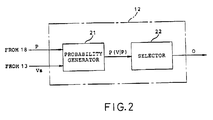
- Fig. 2 is a block diagram view of an identifier in the speech recognition system of Fig. 1.
- Referring to Fig. 1, a speech recognition system shown therein comprises a
feature analyzer 10 for analyzing an input pattern of a speech signal to produce a time sequence of feature vectors representative of the input pattern, a reference pattern generator 11 for generating and memorizing patterns of training speeches as reference patterns, anidentifier 12 for comparing a time sequence of feature vectors of a speech signal of an unknown utterance with the reference patterns to identify the utterance, and amode selection switch 13 for selectively connecting thefeature analyzer 10 to the reference pattern generator 11 and theidentifier 12. - The
feature analyzer 10 analyzes an input pattern of in incoming speech signal S due to an utterance by a known analyzing method, such as, the melcepstrum or the linear prediction coding and produces a time sequence of feature vectors V. The time sequence of feature vectors V is represented by:

where Vt represents a feature vector at a time instant t and T represents an entire time duration of the incoming speech signal. Each of feature vectors Vt is an N-order vector and is represented by;

- The
mode selection switch 13 is switched to the reference pattern generator 11 during a training mode. Accordingly, the time sequence of feature vectors V is applied to the reference pattern generator 11 from thefeature analyzer 10 through themode selection switch 13. The time sequence of feature vectors V represents an input pattern of a training speech. - The reference pattern generator 11 comprises a code vector table 14 for memorizing a plurality of code vectors and a plurality of feature codes corresponding thereto, a converting
circuit 15 for converting the time sequence of feature vectors V into a time sequence of feature codes with reference to the code vector table 14, a firstpattern forming circuit 16 responsive to a plurality of time sequences of feature codes for forming a first pattern comprising a state transition probability distribution and a probability distribution of occurrence of the feature codes for each state in a state transition network, afunction generator 17 for generating a probability density function from the probability distribution of occurrence of the feature codes with reference to the code vector table 14, and a secondpattern forming circuit 18 for forming a second pattern which comprises the state transition probability distribution and the feature code occurrence probability density function and holding the second pattern as the reference pattern. - The code vector table 14 memorizes a plurality of code vectors


- Each of these code vectors R is previously prepared from iterative utterance of a different known vocabulary by the known clustering. Then, a feature code is determined for each of the code vectors R.
- The code vector table 14 also memorizes a plurality of feature codes corresponding to the code vectors, respectively.
- The converting
circuit 15 receives the time sequence of feature vectors V from thefeature analyzer 10 and detects likelihood of the time sequence of feature vectors V and the code vectors R. The detection of likelihood is effected by use of one of the known likelihood detecting methods. In the present embodiment, a method is used where the square distance D is detected between each of the feature vectors Vt and each of code vector Ri as follows:
- Then, an optimum code vector Ri is detected as a specific code vector which makes the square distance D minimum, and a specific one of the feature codes ci is obtained in correspondence to the optimum code vector Ri. Thus, the feature vector Vt is converted into the specific feature code ci. Similar conversion is effected for all of feature vectors V and a time sequence of feature codes C is obtained for the time sequence of feature vectors V. The time sequence of feature codes C is represented by:

- The time sequence of feature codes C is applied to the first
pattern forming circuit 16. - Similar process is repeated by a predetermined number of times for iterative utterance of the same known training vocabulary. When the utterance is repeated K times, K time sequences of feature codes are obtained. The K time sequences of feature codes are represented by C₁, C₂, C₃, ..., CK, respectively, and are collectively represented by

- The first
pattern forming circuit 16 has the state transition network or table. The firstpattern forming circuit 16 receives the K time sequences of feature codes Ck and carries out extrapolation of an optimum state transition probability distribution A and a probability distribution B of occurrence of the feature codes for each state in the state transition network from Ck by the Baum-Welch algorithm. - The state transition probability distribution A and the feature code occurrence probability distribution B are represented by:


respectively. P is a number of states. Assuming that A₁, A₂, A₃, ..., Ap, ..., and AP are collectively represented by Ap and B₁, B₂, B₃, ..., Bp, ..., and BP are collectively represented by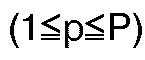


respectively. Q is a number of states to which transition is possible from the state p. Accordingly,


- Thus, a first pattern is formed which comprises the state transition probability distribution A and the feature code occurrence probability distribution B.
- The state transition probability distribution A is applied to the second
pattern forming circuit 18 from the firstpattern forming circuit 16 while the feature code occurrence probability distribution B is applied to thefunction generator 17. - The
function generator 17 produces an approximate continuous probability density function from the feature code occurrence probability distribution B with reference to code vectors R in the code vector table 14. - The Gaussian probability density function and the Poisson probability density function can be used as the approximate probability density function.
- In the present embodiment, the Gaussian probability density function is used. The Gaussian probability density function is represented by:

Parameters µ and σ² are a mean value and a covariance, respectively. In the embodiment, the mean value and the covariance are ones of the code vectors R. Therefore, those parameters µ and σ² are obtained by the following equations:
Ri is read from the code vector table 14 and bpi is given by the feature code occurrence probability distribution B. - Thus, the
function generator 17 produces the approximate continuous probability density function Bc which is applied to the secondpattern forming circuit 18. - The second
pattern forming circuit 18 receives the state transition probability distribution A from the firstpattern forming circuit 16 and the approximate continuous probability density function Bc from thefunction generator 17 and combines them to form a second pattern. The secondpattern forming circuit 18 memorizes the second pattern as the reference pattern P. - Reference patterns are generated and memorized for different training speeches in the similar manner as described above.
- In the recognition mode, the
mode selection switch 13 is switched to theidentifier 12. - The
feature analyzer 10 receives the speech signal S due to an unknown utterance and produces the time sequence of feature vectors V as Vs. The time sequence of feature vectors Vs is applied to theidentifier 12 through themode selection switch 13. - Referring to Fig. 2, the
identifier 12 comprises aprobability generator 21 and aselector 22. - The
probability generator 21 is connected to the secondpattern forming circuit 18 and thefeature analyzer 10. Theprobability generator 21 generates occurrence probabilities P(V|P) of the time sequence of feature vectors Vs for all of the reference patterns P. Each of the probability P(V|P) can be calculated by use of the Viterbi algorithm with the dynamic programming technique or the Forward-Backward algorithm.
Claims (4)
- A reference pattern generating device including:
a feature analyzer (10) responsive to a speech signal representative of an input pattern (S) for producing a time sequence of feature vectors (V) representative of said input pattern; a table (14) for memorizing a plurality of code vectors and a plurality of feature codes corresponding thereto; converting means (15) connected to said feature analyzer and said table for converting a plurality of time sequences of feature vectors (V) to a plurality of time sequences of feature codes (C) with reference to said table, said plurality of time sequences of the feature vectors (V) being produced in response to a plurality of speech signals (S) including the first-mentioned speech signal; and first forming means (16) for forming, in response to said plurality of time sequence of the feature codes (C), a state transition probability (A) in a state transition network and a probability density distribution (B) of occurrence of the feature codes in each state in said state transition network;
characterized by:
function generating means (17) connected to said table (14) and said first forming means (16) for generating a probability density function (Bc) approximating said probability distribution (B) with said code vectors (R) used as parameters in said function: and
second forming means (18) connected to said first forming means (16) and said function generating means (17) for forming a reference pattern (P) for said plurality of speech signals (S), said reference pattern (P) being defined by said state transition probability distribution (A) and said probability density function (Bc). - A device as claimed in Claim 1, said function generating means generates as the probability density function a Gaussian probability density function which is expressed by:


- A speech recognition system for recognizing a speech, which comprises:
a feature analyzer (10) responsive to a speech signal (S) representative of an input pattern for producing a time sequence of feature vectors (V) representative of said input pattern;
mode selection switch means (13) for selecting one of a training mode and a recognition mode;
reference pattern generating means (11) being coupled with said feature analyzer through said mode selection switch means (13) selecting said training mode and for generating and memorizing a plurality of reference patterns;
said reference pattern generating means comprises;
a table (14) for memorizing a plurality of code vectors and a plurality of feature codes corresponding thereto;
converting means (15) connected to said feature analyzer and said table (14) for converting a plurality of time sequences of feature vectors (V) to a plurality of time sequences of feature codes (C) with reference to said table, said plurality of time sequences of the feature vectors being produced in response to a plurality of speech signals including the first-mentioned speech signal;
first forming means (16) for forming, in response to said plurality of time sequence of the feature codes, a first pattern comprising a state transition probability (A) in a state transition network and a probability density distribution of occurrence (B) of the feature codes in each state in said state transition network;
function generating means (17) connected to said table (14) and said first forming means (16) for generating a probability density function (Bc) approximating said probability distribution with said code vectors used as parameters in said function; and
second forming means (18) connected to said first forming means and said function generating means for forming and memorizing a second pattern for said plurality of speech signals, said second pattern being defined by said state transition probability and said probability density function, said second forming means memorizing said second pattern as one of said reference patterns; and
identifying means (12) connected to said second forming means and connected to said feature analyzer through said mode selection switch means (13) when recognizing an unknown speech signal for identifying, in response to an identifying time sequence of feature vectors representative of said unknown speech signal as the time sequence of feature vectors from said feature analyzer, said identifying time sequence of feature vectors as one of said reference patterns in said second forming means. - A system as claimed in Claim 3, wherein said identifying means comprises:
generating means coupled with said second forming means and responsive to said identifying time sequence of feature vectors for generating an occurrence probability of said identifying time sequence of feature vectors for each of the reference patterns; and
selecting means coupled with said generating means for selecting a specific one of the reference patterns which makes the occurrence probability maximum to produce said specific reference pattern as an identifying output.
Applications Claiming Priority (2)
| Application Number | Priority Date | Filing Date | Title |
|---|---|---|---|
| JP29450/88 | 1988-02-09 | ||
| JP63029450A JP2545914B2 (en) | 1988-02-09 | 1988-02-09 | Speech recognition method |
Publications (3)
| Publication Number | Publication Date |
|---|---|
| EP0328064A2 EP0328064A2 (en) | 1989-08-16 |
| EP0328064A3 EP0328064A3 (en) | 1989-11-02 |
| EP0328064B1 true EP0328064B1 (en) | 1993-05-19 |
Family
ID=12276447
Family Applications (1)
| Application Number | Title | Priority Date | Filing Date |
|---|---|---|---|
| EP89102141A Expired - Lifetime EP0328064B1 (en) | 1988-02-09 | 1989-02-08 | Device for generating a reference pattern with a continuous probability density function derived from feature code occurrence probability distribution |
Country Status (5)
| Country | Link |
|---|---|
| US (1) | US6047256A (en) |
| EP (1) | EP0328064B1 (en) |
| JP (1) | JP2545914B2 (en) |
| CA (1) | CA1337727C (en) |
| DE (1) | DE68906559T2 (en) |
Families Citing this family (7)
| Publication number | Priority date | Publication date | Assignee | Title |
|---|---|---|---|---|
| JPH03155599A (en) * | 1989-11-13 | 1991-07-03 | Nec Corp | Speech recognition device |
| EP0481107B1 (en) * | 1990-10-16 | 1995-09-06 | International Business Machines Corporation | A phonetic Hidden Markov Model speech synthesizer |
| GB2285700B (en) * | 1994-01-12 | 1998-06-24 | Drallim Ind | Monitoring apparatus and method |
| DE19640587A1 (en) * | 1996-10-01 | 1998-04-02 | Siemens Ag | Method for calculating a threshold value for the speech recognition of a keyword |
| JP3885523B2 (en) * | 2001-06-20 | 2007-02-21 | 日本電気株式会社 | Server / client type speech recognition apparatus and method |
| US7216313B2 (en) * | 2004-07-30 | 2007-05-08 | International Business Machines Corporation | Incorporation of uncertainty information in modeling a characteristic of a device |
| EP3443450A1 (en) * | 2016-05-13 | 2019-02-20 | Maluuba Inc. | Two-stage training of a spoken dialogue system |
Family Cites Families (4)
| Publication number | Priority date | Publication date | Assignee | Title |
|---|---|---|---|---|
| US4783804A (en) * | 1985-03-21 | 1988-11-08 | American Telephone And Telegraph Company, At&T Bell Laboratories | Hidden Markov model speech recognition arrangement |
| JPS62231993A (en) * | 1986-03-25 | 1987-10-12 | インタ−ナシヨナル ビジネス マシ−ンズ コ−ポレ−シヨン | Voice recognition |
| US4805219A (en) * | 1987-04-03 | 1989-02-14 | Dragon Systems, Inc. | Method for speech recognition |
| US4803729A (en) * | 1987-04-03 | 1989-02-07 | Dragon Systems, Inc. | Speech recognition method |
-
1988
- 1988-02-09 JP JP63029450A patent/JP2545914B2/en not_active Expired - Fee Related
-
1989
- 1989-02-08 CA CA000590485A patent/CA1337727C/en not_active Expired - Fee Related
- 1989-02-08 EP EP89102141A patent/EP0328064B1/en not_active Expired - Lifetime
- 1989-02-08 DE DE8989102141T patent/DE68906559T2/en not_active Expired - Fee Related
-
1993
- 1993-06-17 US US08/077,506 patent/US6047256A/en not_active Expired - Fee Related
Also Published As
| Publication number | Publication date |
|---|---|
| DE68906559D1 (en) | 1993-06-24 |
| EP0328064A3 (en) | 1989-11-02 |
| JPH01202798A (en) | 1989-08-15 |
| JP2545914B2 (en) | 1996-10-23 |
| DE68906559T2 (en) | 1993-09-02 |
| EP0328064A2 (en) | 1989-08-16 |
| US6047256A (en) | 2000-04-04 |
| CA1337727C (en) | 1995-12-12 |
Similar Documents
| Publication | Publication Date | Title |
|---|---|---|
| EP0891618B1 (en) | Speech processing | |
| EP0907949B1 (en) | Method and system for dynamically adjusted training for speech recognition | |
| US5289562A (en) | Pattern representation model training apparatus | |
| CA2073991C (en) | Speech recognition apparatus having a speech coder outputting acoustic prototype ranks | |
| EP0302663B1 (en) | Low cost speech recognition system and method | |
| EP0128288B1 (en) | Method and system for adaptive automatic discrete utterance recognition | |
| CA2013247C (en) | Vector quantizer search arrangement | |
| US5613037A (en) | Rejection of non-digit strings for connected digit speech recognition | |
| US4811399A (en) | Apparatus and method for automatic speech recognition | |
| EP0121248B1 (en) | Speaker verification system and process | |
| EP0240679A1 (en) | Improving the training of Markov models used in a speech recognition system | |
| EP0312209A2 (en) | Speech recognition system using Markov models | |
| EP0686965A2 (en) | Speech recognition apparatus with speaker adaptation using acoustic category mean value calculus | |
| US6003003A (en) | Speech recognition system having a quantizer using a single robust codebook designed at multiple signal to noise ratios | |
| CA2055749C (en) | Method and system for speech recognition without noise interference | |
| EP0328064B1 (en) | Device for generating a reference pattern with a continuous probability density function derived from feature code occurrence probability distribution | |
| US5159637A (en) | Speech word recognizing apparatus using information indicative of the relative significance of speech features | |
| EP0421744B1 (en) | Speech recognition method and apparatus for use therein | |
| US5737488A (en) | Speech recognizer | |
| US5220609A (en) | Method of speech recognition | |
| EP0469577A2 (en) | Reference pattern adapting device trainable by a small number of training patterns | |
| US5606645A (en) | Speech pattern recognition apparatus utilizing multiple independent sequences of phonetic segments | |
| EP0177854B1 (en) | Keyword recognition system using template-concatenation model | |
| JP3011421B2 (en) | Voice recognition device | |
| Weber et al. | A comparison between hidden Markov models and vector quantization for speech independent speaker recognition |
Legal Events
| Date | Code | Title | Description |
|---|---|---|---|
| PUAI | Public reference made under article 153(3) epc to a published international application that has entered the european phase |
Free format text: ORIGINAL CODE: 0009012 |
|
| 17P | Request for examination filed |
Effective date: 19890208 |
|
| AK | Designated contracting states |
Kind code of ref document: A2 Designated state(s): DE FR GB |
|
| PUAL | Search report despatched |
Free format text: ORIGINAL CODE: 0009013 |
|
| AK | Designated contracting states |
Kind code of ref document: A3 Designated state(s): DE FR GB |
|
| 17Q | First examination report despatched |
Effective date: 19920521 |
|
| GRAA | (expected) grant |
Free format text: ORIGINAL CODE: 0009210 |
|
| AK | Designated contracting states |
Kind code of ref document: B1 Designated state(s): DE FR GB |
|
| REF | Corresponds to: |
Ref document number: 68906559 Country of ref document: DE Date of ref document: 19930624 |
|
| ET | Fr: translation filed | ||
| PLBE | No opposition filed within time limit |
Free format text: ORIGINAL CODE: 0009261 |
|
| STAA | Information on the status of an ep patent application or granted ep patent |
Free format text: STATUS: NO OPPOSITION FILED WITHIN TIME LIMIT |
|
| 26N | No opposition filed | ||
| REG | Reference to a national code |
Ref country code: GB Ref legal event code: IF02 |
|
| PGFP | Annual fee paid to national office [announced via postgrant information from national office to epo] |
Ref country code: GB Payment date: 20030205 Year of fee payment: 15 |
|
| PGFP | Annual fee paid to national office [announced via postgrant information from national office to epo] |
Ref country code: FR Payment date: 20030210 Year of fee payment: 15 |
|
| PGFP | Annual fee paid to national office [announced via postgrant information from national office to epo] |
Ref country code: DE Payment date: 20030220 Year of fee payment: 15 |
|
| PG25 | Lapsed in a contracting state [announced via postgrant information from national office to epo] |
Ref country code: GB Free format text: LAPSE BECAUSE OF NON-PAYMENT OF DUE FEES Effective date: 20040208 |
|
| PG25 | Lapsed in a contracting state [announced via postgrant information from national office to epo] |
Ref country code: DE Free format text: LAPSE BECAUSE OF NON-PAYMENT OF DUE FEES Effective date: 20040901 |
|
| GBPC | Gb: european patent ceased through non-payment of renewal fee |
Effective date: 20040208 |
|
| PG25 | Lapsed in a contracting state [announced via postgrant information from national office to epo] |
Ref country code: FR Free format text: LAPSE BECAUSE OF NON-PAYMENT OF DUE FEES Effective date: 20041029 |
|
| REG | Reference to a national code |
Ref country code: FR Ref legal event code: ST |