EP0328169B2 - Procédé de fabrication de perborate de sodium monohydraté, perborate de sodium monohydraté partiellement cristallisé et poudres à lessiver les textiles - Google Patents
Procédé de fabrication de perborate de sodium monohydraté, perborate de sodium monohydraté partiellement cristallisé et poudres à lessiver les textiles Download PDFInfo
- Publication number
- EP0328169B2 EP0328169B2 EP89200067A EP89200067A EP0328169B2 EP 0328169 B2 EP0328169 B2 EP 0328169B2 EP 89200067 A EP89200067 A EP 89200067A EP 89200067 A EP89200067 A EP 89200067A EP 0328169 B2 EP0328169 B2 EP 0328169B2
- Authority
- EP
- European Patent Office
- Prior art keywords
- phase
- air
- sodium perborate
- dehydration
- bed
- Prior art date
- Legal status (The legal status is an assumption and is not a legal conclusion. Google has not performed a legal analysis and makes no representation as to the accuracy of the status listed.)
- Expired - Lifetime
Links
- 238000000034 method Methods 0.000 title claims abstract description 44
- XSVSPKKXQGNHMD-UHFFFAOYSA-N 5-bromo-3-methyl-1,2-thiazole Chemical compound CC=1C=C(Br)SN=1 XSVSPKKXQGNHMD-UHFFFAOYSA-N 0.000 title claims abstract description 33
- 239000000843 powder Substances 0.000 title claims abstract description 7
- 239000004753 textile Substances 0.000 title claims abstract description 5
- 238000005406 washing Methods 0.000 title claims abstract description 5
- 238000004519 manufacturing process Methods 0.000 title description 4
- 230000018044 dehydration Effects 0.000 claims abstract description 49
- 238000006297 dehydration reaction Methods 0.000 claims abstract description 49
- 239000012418 sodium perborate tetrahydrate Substances 0.000 claims abstract description 22
- IBDSNZLUHYKHQP-UHFFFAOYSA-N sodium;3-oxidodioxaborirane;tetrahydrate Chemical compound O.O.O.O.[Na+].[O-]B1OO1 IBDSNZLUHYKHQP-UHFFFAOYSA-N 0.000 claims abstract description 22
- 239000003570 air Substances 0.000 claims description 72
- QVGXLLKOCUKJST-UHFFFAOYSA-N atomic oxygen Chemical compound [O] QVGXLLKOCUKJST-UHFFFAOYSA-N 0.000 claims description 18
- 239000001301 oxygen Substances 0.000 claims description 18
- 229910052760 oxygen Inorganic materials 0.000 claims description 18
- 239000012080 ambient air Substances 0.000 claims description 12
- 229960001922 sodium perborate Drugs 0.000 claims description 8
- YKLJGMBLPUQQOI-UHFFFAOYSA-M sodium;oxidooxy(oxo)borane Chemical compound [Na+].[O-]OB=O YKLJGMBLPUQQOI-UHFFFAOYSA-M 0.000 claims description 8
- 239000000463 material Substances 0.000 claims description 5
- 238000003860 storage Methods 0.000 claims description 4
- 230000004580 weight loss Effects 0.000 claims description 4
- 238000002844 melting Methods 0.000 claims description 2
- 230000008018 melting Effects 0.000 claims description 2
- 230000001105 regulatory effect Effects 0.000 claims 2
- 238000010586 diagram Methods 0.000 abstract 1
- 239000012071 phase Substances 0.000 description 41
- 208000005156 Dehydration Diseases 0.000 description 35
- XLYOFNOQVPJJNP-UHFFFAOYSA-N water Substances O XLYOFNOQVPJJNP-UHFFFAOYSA-N 0.000 description 8
- 239000002245 particle Substances 0.000 description 3
- 229920006395 saturated elastomer Polymers 0.000 description 3
- IJGRMHOSHXDMSA-UHFFFAOYSA-N Atomic nitrogen Chemical compound N#N IJGRMHOSHXDMSA-UHFFFAOYSA-N 0.000 description 2
- DGAQECJNVWCQMB-PUAWFVPOSA-M Ilexoside XXIX Chemical compound C[C@@H]1CC[C@@]2(CC[C@@]3(C(=CC[C@H]4[C@]3(CC[C@@H]5[C@@]4(CC[C@@H](C5(C)C)OS(=O)(=O)[O-])C)C)[C@@H]2[C@]1(C)O)C)C(=O)O[C@H]6[C@@H]([C@H]([C@@H]([C@H](O6)CO)O)O)O.[Na+] DGAQECJNVWCQMB-PUAWFVPOSA-M 0.000 description 2
- 230000007423 decrease Effects 0.000 description 2
- 150000004682 monohydrates Chemical class 0.000 description 2
- 229910052708 sodium Inorganic materials 0.000 description 2
- 239000011734 sodium Substances 0.000 description 2
- NASFKTWZWDYFER-UHFFFAOYSA-N sodium;hydrate Chemical compound O.[Na] NASFKTWZWDYFER-UHFFFAOYSA-N 0.000 description 2
- 238000001179 sorption measurement Methods 0.000 description 2
- 150000004685 tetrahydrates Chemical class 0.000 description 2
- 238000011144 upstream manufacturing Methods 0.000 description 2
- 238000004438 BET method Methods 0.000 description 1
- 238000002441 X-ray diffraction Methods 0.000 description 1
- 230000015556 catabolic process Effects 0.000 description 1
- 238000006243 chemical reaction Methods 0.000 description 1
- 239000002178 crystalline material Substances 0.000 description 1
- 230000003247 decreasing effect Effects 0.000 description 1
- 238000006731 degradation reaction Methods 0.000 description 1
- 238000003795 desorption Methods 0.000 description 1
- 239000003599 detergent Substances 0.000 description 1
- 238000004090 dissolution Methods 0.000 description 1
- 230000001747 exhibiting effect Effects 0.000 description 1
- 230000004927 fusion Effects 0.000 description 1
- 239000007789 gas Substances 0.000 description 1
- 238000012423 maintenance Methods 0.000 description 1
- 239000000203 mixture Substances 0.000 description 1
- 230000000877 morphologic effect Effects 0.000 description 1
- 229910052757 nitrogen Inorganic materials 0.000 description 1
- 230000001590 oxidative effect Effects 0.000 description 1
- 239000012286 potassium permanganate Substances 0.000 description 1
- 238000002360 preparation method Methods 0.000 description 1
- 239000007790 solid phase Substances 0.000 description 1
- 239000000126 substance Substances 0.000 description 1
- 238000004448 titration Methods 0.000 description 1
Classifications
-
- C—CHEMISTRY; METALLURGY
- C01—INORGANIC CHEMISTRY
- C01B—NON-METALLIC ELEMENTS; COMPOUNDS THEREOF; METALLOIDS OR COMPOUNDS THEREOF NOT COVERED BY SUBCLASS C01C
- C01B15/00—Peroxides; Peroxyhydrates; Peroxyacids or salts thereof; Superoxides; Ozonides
- C01B15/055—Peroxyhydrates; Peroxyacids or salts thereof
- C01B15/12—Peroxyhydrates; Peroxyacids or salts thereof containing boron
Definitions
- the invention relates to a process for the manufacture of sodium perborate monohydrate by dehydration of sodium perborate tetrahydrate.
- Sodium perborate monohydrate with the crude formula NaBO 3 .H 2 O, finds an important outlet in the preparation of washing powders, due to its high content of active oxygen and its high rate of dissolution in water.
- a technique commonly used to obtain sodium perborate monohydrate consists in dehydrating sodium perborate tetrahydrate (of crude formula NaBO 3 .4 H 2 O) in a fluidized bed, by means of a current of hot air.
- sodium perborate tetrahydrate of crude formula NaBO 3 .4 H 2 O
- operating conditions have generally been sought which make it possible to obtain sodium perborate monohydrate of high hardness, so that it has a high resistance to attrition.
- ambient air is used, preheated to a temperature of at least 180 ° C, preferably between 180 and 210 ° vs.
- the use of such high temperatures is however expensive and it implies taking precautions taking into account the oxidizing nature of sodium perborate.
- the invention aims to remedy the drawbacks of known methods, by providing a method new which makes it possible to obtain, by dehydration of sodium perborate tetrahydrate, perborate sodium monohydrate simultaneously exhibiting a high resistance to attrition and good stability in regarding its active oxygen content.
- the invention therefore relates to a process for the production of sodium perborate monohydrate by dehydration of a bed of sodium perborate tetrahydrate in a stream of air.
- an air current is used which is first humid in a first dehydration phase, then dry in a second phase of dehydration, absolute humidity in the second phase being lower than that of the first phase, said method being implemented in a succession of two reactors in series, the first of which is supplied with more humid air and the next one with dry air.
- the air used at the inlet of the sodium perborate bed tetrahydrate is hot air, the temperature of which is generally above 60 ° C and, preferably, at least equal to 80 ° C; it is desirable that its temperature does not exceed 180 ° C.
- the temperatures between 90 and 150 ° C are the most suitable.
- the air flow rate to be used depends on various parameters, including in particular the particle size of the sodium perborate tetrahydrate, the volume of the bed and the area of its section as well as the specific mass sought for the sodium perborate monohydrate ; it must be adjusted to ensure a stable fluidized bed for the duration of the dehydration.
- the air flow rate, at the inlet of the bed can for example be set between 0.5 and 30 Nm 3 per hour and per kg of sodium perborate tetrahydrate, the values between 1 and 20 Nm 3 being the most adequate in the majority of cases.
- Dry air is by definition anhydrous air or, more generally, air taken from the atmosphere, including the partial pressure of water vapor does not exceed the saturated vapor pressure under the conditions normal pressure and temperature; it is therefore, most often, ambient air presenting a relative humidity between 40 and 100% under normal atmospheric pressure conditions and of temperature.
- the humid air used in the first phase of dehydration is air whose humidity absolute is greater than that of the dry air used in the second phase of dehydration.
- the total amount of water in the air should humid at the entrance to the bed is less than that corresponding to the saturated vapor pressure of the air at the temperature he got out of bed.
- the optimum value of the total amount of water in the humid air put in work in the first phase of dehydration therefore depends on other operating conditions such as the temperature and flow of moist air at the inlet of the bed and the temperature of the bed; she may be easily determined in each particular case by routine laboratory work.
- each phase of dehydration depends the quality of the sodium perborate tetrahydrate used and the characteristics sought for sodium perborate monohydrate (especially its hardness and stability with regard to its content active oxygen).
- the duration of the first phase of dehydration does not exceed 50% of the total duration of dehydration. It is desirable that the duration of the first phase is at least equal to 2% of the total duration of dehydration, the values between 5 and 40% being preferred.
- the moisture content of the air used in each phase of dehydration so that the relative humidity of the air, thermal equilibrium with the solid phase at the exit from the bed, ie between 15 and 80% at the first phase and between 10 and 60% in the second phase.
- Preferred values for the relative air humidity at the out of bed are those between 20 and 70% in the first phase and between 15 and 50% in the second phase, the relative humidity of the air in the first phase being higher than that of the air in the second phase.
- the temperature the air that is introduced into the bed is identical in the two phases of dehydration, so that the bed temperature in the first phase of dehydration is higher than it has in the second phase.
- the difference between the temperatures of the bed in the first phase and in the second phase of dehydration is established between 1 and 10 ° C.
- the values between 2 and 7 ° C for said difference are preferred.
- temperatures can easily be obtained in the bed by setting the air temperature at the entry of the bed, between 80 and 180 ° C, the temperatures between 90 and 150 ° C being preferred.
- the preferred temperatures for the bed are those between 52 and 62 ° C. in the first phase of dehydration and between 50 and 60 ° C in the second phase.
- the properties of sodium perborate monohydrate obtained after process according to the invention will depend on those of the sodium perborate tetrahydrate used.
- the attrition resistance of sodium perborate monohydrate is generally better the better the sodium perborate tetrahydrate. It is therefore advantageous to use sodium perborate tetrahydrate having an attrition resistance high, characterized for example by an index not exceeding 4.5% according to ISO 5937. It is specially recommended to use sodium perborate tetrahydrate whose resistance index to attrition according to ISO 5937 does not exceed 3%, preferably 2.5%.
- the product according to the invention can be prepared discontinuously in a single bed reactor fluidized which is successively supplied with moist air and with dry air.
- the method according to the invention can be run continuously in a succession of two fluidized bed reactors, one of which is fed with moist air and the other with dry air.
- the sodium perborate monohydrate produced during the first dehydration phase has a preponderance of amorphous matter, while that formed during the second phase of dehydration is mostly in the crystalline state.
- the perborate of sodium obtained by means of the process according to the invention therefore comprises a mixture of crystalline material and amorphous matter that have been identified by the X-ray diffraction method. combines high attrition resistance and good stability characterized by a moderate speed of its loss of active oxygen over time. Without wishing to be bound by a theoretical explanation, the plaintiff thinks that these superior properties of sodium perborate monohydrate would attributable to the morphological structure of its grains, which would have a crystalline nucleus in a envelope in an amorphous state.
- the process according to the invention makes it possible to obtain sodium perborate monohydrate whose specific surface is greater than that obtained with the known process described in BE-A-807724.
- the invention therefore also relates to sodium perborate monohydrate, which can be obtained by the process according to the invention, which is in a partially crystallized state and which has a material content amorphous at most equal to 60% by weight, a attrition rate equal to at most 10% and a stability corresponding to a weight loss of active oxygen of less than 60% of its original content, after 50 days of storage in ambient air at 55 ° C.
- the wear rate at attrition is defined according to ISO 5937 standard.
- the invention relates in particular to sodium perborate monohydrate which contains between 20 and 60% by weight of amorphous material, for example between 35 and 60%, and between 150 and 160 g of active oxygen per kg and which has a attrition rate of between 2 and 8% and a stability corresponding to a weight loss of active oxygen between 20 and 55% of its original content, after 50 days of storage in air at 55 ° C.
- a specially advantageous variety of sodium perborate monohydrate according to the invention has a specific surface of less than 10 m 2 / g, for example between 4 and 8 m 2 / g.
- the sodium perborate monohydrate according to the invention finds an interesting outlet in the manufacture of powders for laundry textiles.
- the invention therefore also relates to laundry powders for textiles, which contain sodium monohydrate according to the invention.
- dry air designates air taken from the atmosphere, in accordance with the definition which has been given above.
- the attrition resistance is defined according to ISO standard 5937.
- the active oxygen content was determined by titrimetry using potassium permanganate and is expressed in g of O 2 per kg of material.
- sodium perborate tetrahydrate having the following characteristics was used: - average particle diameter 388 microns - apparent specific mass 0.84 kg / dm 3 - attrition resistance 2% - active oxygen content 102 g / kg.
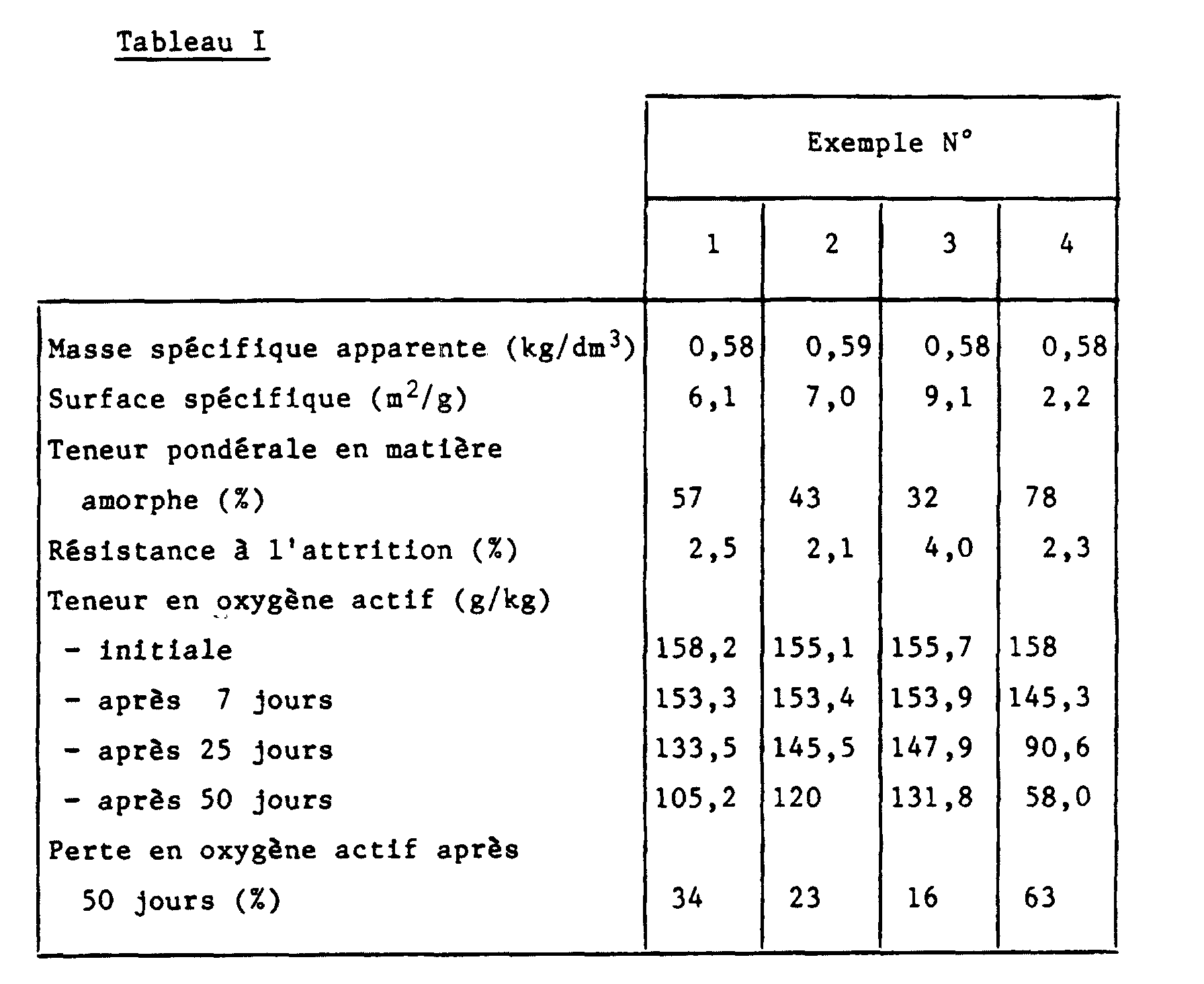
- Examples 1 and 2 relate to two tests which were carried out under conditions in accordance with the invention.
- Examples 3 and 4 relate to reference tests which were carried out in conditions which are not in accordance with the process according to the invention.
- step 1 which lasted 7 minutes, the sodium perborate bed was supplied with air ambient preheated to 100 ° C, as described above.
- stage 2 which lasted 43 minutes, steam was introduced into the air, upstream of the bed.
- step 3 which lasted 50 minutes, the steam supply was stopped, so that the air admitted to the bed was ambient air as it was.
- step 3 the temperature of the bed increased rapidly, indicating the end of the conversion of the sodium perborate from the tetrahydrate form to the monohydrate form.
- Example 1 The conditions of Example 1 were reproduced, except as regards the durations of steps nos. 2 and 3, which were respectively 28 minutes (step # 2) and 70 minutes (step # 3). The temperature of the lit was established at approximately the same values as those in Example 1.
- Example 1 The conditions of Example 1 were reproduced, with the only exception that we omitted to introduce water vapor in the air during step 2 (first phase of dehydration).
- the bed was therefore continuously supplied with dry air for 100 minutes.
- the temperature of the bed stabilized at 53 ° C and the relative humidity of the air leaving the bed was 28%.
- the bed temperature increased to 66.7 ° C.
- Example 1 The conditions of the test of Example 1 were modified, by introducing steam into the air, upstream of the bed, during the two phases of dehydration (Steps nos. 2 and 3). During dehydration, the bed temperature was established at 60.5 ° C and the relative humidity of the air leaving the bed was established at 45%. After 100 minutes of treatment, the bed temperature rose to 67.7 ° C.
- the attrition resistance was measured by the ISO 5937 method.
- the content of active oxygen after 7, 25 and 50 days was determined after maintenance of sodium perborate monohydrate in contact with ambient air at 55 ° C.
- sodium perborate tetrahydrate having the following characteristics was used: - average particle diameter 302 microns - apparent specific mass 0.83 kg / dm 3 - attrition resistance 4.1% - active oxygen content 102.1 g / kg.
- Example 5 relates to a test which was carried out under conditions in accordance with the method according to the invention.
- Examples 6 and 7 relate to reference tests under conditions which are not according to the process according to the invention.
- the operation of the bed consisted of three stages nos. 1, 2, 3 defined above in Example 1; these were executed under the following conditions: - Step 1 . duration (min) 7 - Step 2 . duration (min) 43 . bed temperature (° C) 60 . relative air humidity at the end of the bed (%) 40 - Step 3 . duration (min) 55 . bed temperature (° C) 55 . relative air humidity at the end of the bed (%) 30 - Final bed temperature (° C) 67.
- Example 5 The conditions of Example 5 were reproduced, except that we omitted to introduce water vapor into air, during step # 2.
- the total duration of the treatment in the fluidized bed reactor was also 105 minutes, during which the bed was therefore supplied with dry air only.
- the bed temperature stabilized at 53.5 ° C and the relative humidity of the air leaving the bed stabilized at 28%. After dehydration, the bed temperature rose to 66 ° C.
- Example 5 The conditions of the test of Example 5 were modified, using ambient air, in which was also introduced a surplus of water vapor during the entire treatment of dehydration which lasted 108 minutes. During dehydration, the bed temperature settled at 61.5 ° C and the relative humidity of the air at the exit of the bed was established at 40%. After dehydration, the bed temperature rose to 66 ° C.
- Example 5 A comparison of the results of Examples 5, 6 and 7 shows that sodium perborate monohydrate of Example 5 (according to the invention) combines optimum characteristics of attrition resistance and stability with regard to the active oxygen content.
Landscapes
- Chemical & Material Sciences (AREA)
- Organic Chemistry (AREA)
- Inorganic Chemistry (AREA)
- Detergent Compositions (AREA)
- Organic Low-Molecular-Weight Compounds And Preparation Thereof (AREA)
- Paper (AREA)
- Chemical Or Physical Treatment Of Fibers (AREA)
- Artificial Filaments (AREA)
Description
| - diamètre moyen des particules | 388 microns |
| - masse spécifique apparente | 0,84 kg/dm3 |
| - résistance à l'attrition | 2 % |
| - teneur en oxygène actif | 102 g/kg. |
| - Etape n ° 1 | . durée (min) | 7 |
| - Etape n ° 2 | . durée (min) | 43 |
| . température du lit ( ° C) | 57,9 | |
| . humidité relative de l'air à la sortie du lit (%) | 46 | |
| - Etape n ° 3 | . durée (min) | 50 |
| . température du lit (°C) | 52 | |
| . humidité relative de l'air à la sortie du lit (%) | 28 | |
| - Température finale du lit ( ° C) | 66,2. |
| - diamètre moyen des particules | 302 microns |
| - masse spécifique apparente | 0,83 kg/dm3 |
| - résistance à l'attrition | 4,1 % |
| - teneur en oxygène actif | 102,1 g/kg. |
| - Etape n° 1 | . durée (min) | 7 |
| - Etape n° 2 | . durée (min) | 43 |
| . température du lit (°C) | 60 | |
| . humidité relative de l'air à la sortie du lit (%) | 40 | |
| - Etape n° 3 | . durée (min) | 55 |
| . température du lit (°C) | 55 | |
| . humidité relative de l'air à la sortie du lit (%) | 30 | |
| - Température finale du lit (°C) | 67. |

Claims (13)
- Procédé de fabrication de perborate de sodium monohydraté par déshydratation d'un lit de perborate de sodium tétrahydraté dans un courant d'air, caractérisé en ce qu'on met en oeuvre un courant d'air qui est d'abord humide dans une première phase de la déshydratation, puis sec dans une deuxième phase de la déshydratation, l'humidité absolue de l'air dans la deuxième phase étant inférieure à celle de la première phase, ledit procédé étant mis en oeuvre dans une succession de deux réacteurs en série dont le premier est alimenté avec un air plus humide et le suivant avec l'air sec.
- Procédé selon la revendication 1, caractérisé en ce que l'on met en oeuvre pour l'air sec, de l'air ambiant présentant une humidité relative comprise entre 40 et 100 % dans les conditions normales de température et de pression atmosphérique.
- Procédé selon la revendication 1 ou 2, caractérisé en ce qu'on règle la teneur en humidité de l'air mis en oeuvre, pour que l'humidité relative de l'air à la sortie du lit soit comprise entre 15 et 80 % à la première phase de la déshydratation et entre 10 et 60 % à la deuxième phase, l'humidité relative de l'air provenant de la première phase étant supérieure à celle de l'air provenant de la deuxième phase.
- Procédé selon l'une quelconque des revendications 1 à 3, caractérisé en ce que la durée de la première phase de la déshydratation est comprise entre 2 et 50 % de la durée totale de la déshydratation.
- Procédé selon l'une quelconque des revendications 1 à 4, caractérisé en ce que la température de l'air que l'on introduit dans le lit est identique dans les deux phases de la déshydratation, de manière que la température du lit dans la première phase de la déshydratation soit supérieure à celle qu'il a dans la deuxième phase.
- Procédé selon la revendication 5, caractérisé en ce qu'on règle la température et l'humidité de l'air à l'entrée du lit, pour que la différence entre les températures du lit dans la première phase et dans la deuxième phase de la déshydratation soit comprise entre 1 et 10°C.
- Procédé selon l'une quelconque des revendications 5 ou 6, caractérisé en ce que la température du lit dans la première phase de la déshydratation est au maximum égale à la température de fusion du perborate de sodium.
- Procédé selon la revendication 7, caractérisé en ce que la température du lit est comprise entre 52 et 62 ° C dans la première phase de la déshydratation et entre 50 et 60°C dans la deuxième phase.
- Procédé selon l'une quelconque des revendications 1 à 8, caractérisé en ce qu'on met en oeuvre du perborate de sodium tétrahydraté qui présente un indice de résistance à l'attrition, selon la norme ISO 5937, qui n'excède pas 4,5 %.
- Perborate de sodium monohydraté partiellement cristallisé, qui présente une teneur en matière amorphe au maximum égale à 60 % en poids, un taux d'usure à l'attrition, selon la norme ISO 5937, égale à 10% au maximum et une stabilité correspondant à une perte pondérale en oxygène actif inférieure à 60 % de sa teneur d'origine, après 50 jours de stockage dans de l'air ambiant à 55 ° C.
- Perborate de sodium monohydraté selon la revendication 10, caractérisé en ce que sa teneur en matière amorphe est comprise entre 20 et 60 %, sa teneur originelle en oxygène actif est comprise entre 150 et 160 g par kg, son taux d'usure à l'attrition est compris entre 2 et 8 % et sa stabilité correspond à une perte pondérale en oxygène actif comprise entre 20 et 55 % après 50 jours de stockage dans de l'air ambiant à 55°C.
- Perborate de sodium selon la revendication 10 ou 11, caractérisé en ce que sa surface spécifique est comprise entre 4 et 8 m2/g.
- Poudres à lessiver des textiles, contenant du perborate de sodium monohydraté conforme à l'une quelconque des revendications 10 à 12.
Priority Applications (1)
| Application Number | Priority Date | Filing Date | Title |
|---|---|---|---|
| AT89200067T ATE96762T1 (de) | 1988-01-26 | 1989-01-13 | Verfahren zur herstellung von natriumperboratmonohydrat, teilweise kristallisiertes natriumperboratmonohydrat und textilwaschpulver. |
Applications Claiming Priority (2)
| Application Number | Priority Date | Filing Date | Title |
|---|---|---|---|
| IT1921188 | 1988-01-26 | ||
| IT19211/88A IT1218198B (it) | 1988-01-26 | 1988-01-26 | Procedimento di fabbricazione di perborato di sodio monoidrato,perborato di sodio monoidrato parzialmente cristallizzato e polveri per lisciviare materiali tessili |
Publications (3)
| Publication Number | Publication Date |
|---|---|
| EP0328169A1 EP0328169A1 (fr) | 1989-08-16 |
| EP0328169B1 EP0328169B1 (fr) | 1993-11-03 |
| EP0328169B2 true EP0328169B2 (fr) | 2001-07-11 |
Family
ID=11155836
Family Applications (1)
| Application Number | Title | Priority Date | Filing Date |
|---|---|---|---|
| EP89200067A Expired - Lifetime EP0328169B2 (fr) | 1988-01-26 | 1989-01-13 | Procédé de fabrication de perborate de sodium monohydraté, perborate de sodium monohydraté partiellement cristallisé et poudres à lessiver les textiles |
Country Status (9)
| Country | Link |
|---|---|
| US (1) | US5104631A (fr) |
| EP (1) | EP0328169B2 (fr) |
| JP (1) | JP2901261B2 (fr) |
| AT (1) | ATE96762T1 (fr) |
| AU (1) | AU608941B2 (fr) |
| CA (1) | CA1340258C (fr) |
| DE (1) | DE68910342T3 (fr) |
| ES (1) | ES2061927T5 (fr) |
| IT (1) | IT1218198B (fr) |
Families Citing this family (2)
| Publication number | Priority date | Publication date | Assignee | Title |
|---|---|---|---|---|
| DE4316320A1 (de) * | 1993-05-15 | 1994-11-17 | Degussa | Verfahren zur Herstellung von Natriumperborat-monohydrat |
| DE69517005T2 (de) * | 1994-10-13 | 2000-12-21 | Koninklijke Philips Electronics N.V., Eindhoven | Verfahren und vorrichtung zur ermittlung der ganzen spielzeit eines bandes |
Family Cites Families (10)
| Publication number | Priority date | Publication date | Assignee | Title |
|---|---|---|---|---|
| DE1930286B2 (de) * | 1968-07-17 | 1979-09-06 | Solvay & Cie., Bruessel | Verfahren zur Herstellung von Natriumperborat-monohydrat |
| DE1801470B1 (de) * | 1968-10-05 | 1970-01-15 | Kali Chemie Ag | Verfahren zum Entwaessern von Natriumperborattetrahydrat |
| AU476316B2 (en) * | 1972-11-29 | 1976-09-16 | Peroxid Chemie Gmbh | Process for the production of abrasion-resistant sodium perborate monohydrate |
| DE2258319C3 (de) * | 1972-11-29 | 1978-04-13 | Peroxid-Chemie Gmbh, 8023 Hoellriegelskreuth | Verfahren zur Herstellung von abriebfestem Natriumperboratmonohydrat |
| DE2444780C2 (de) * | 1974-09-19 | 1987-02-19 | Peroxid-Chemie GmbH, 8023 Höllriegelskreuth | Verfahren zur Herstellung von abriebfestem Natriumperboratmonohydrat |
| US4020148A (en) * | 1975-07-15 | 1977-04-26 | Fmc Corporation | Process for drying sodium carbonate peroxide |
| LU73751A1 (fr) * | 1975-11-06 | 1977-06-03 | ||
| LU77095A1 (fr) * | 1977-04-08 | 1978-11-03 | ||
| FR2417470A1 (fr) * | 1978-02-16 | 1979-09-14 | Air Liquide | Procede de preparation de perborate de sodium anhydre |
| FR2577916B1 (fr) * | 1985-02-26 | 1987-04-17 | Atochem | Procede de fabrication en continu de perborate de sodium monohydrate a partir de perborate de sodium tetrahydrate |
-
1988
- 1988-01-26 IT IT19211/88A patent/IT1218198B/it active
-
1989
- 1989-01-13 EP EP89200067A patent/EP0328169B2/fr not_active Expired - Lifetime
- 1989-01-13 AT AT89200067T patent/ATE96762T1/de not_active IP Right Cessation
- 1989-01-13 DE DE68910342T patent/DE68910342T3/de not_active Expired - Lifetime
- 1989-01-13 ES ES89200067T patent/ES2061927T5/es not_active Expired - Lifetime
- 1989-01-24 CA CA000589001A patent/CA1340258C/fr not_active Expired - Fee Related
- 1989-01-24 AU AU28756/89A patent/AU608941B2/en not_active Ceased
- 1989-01-26 JP JP1017390A patent/JP2901261B2/ja not_active Expired - Lifetime
- 1989-01-26 US US07/301,686 patent/US5104631A/en not_active Expired - Lifetime
Also Published As
| Publication number | Publication date |
|---|---|
| DE68910342T3 (de) | 2002-05-29 |
| IT1218198B (it) | 1990-04-12 |
| AU2875689A (en) | 1989-07-27 |
| US5104631A (en) | 1992-04-14 |
| ES2061927T5 (es) | 2002-03-01 |
| JP2901261B2 (ja) | 1999-06-07 |
| DE68910342D1 (de) | 1993-12-09 |
| AU608941B2 (en) | 1991-04-18 |
| CA1340258C (fr) | 1998-12-15 |
| EP0328169A1 (fr) | 1989-08-16 |
| EP0328169B1 (fr) | 1993-11-03 |
| IT8819211A0 (it) | 1988-01-26 |
| ATE96762T1 (de) | 1993-11-15 |
| ES2061927T3 (es) | 1994-12-16 |
| DE68910342T2 (de) | 1994-05-19 |
| JPH01294519A (ja) | 1989-11-28 |
Similar Documents
| Publication | Publication Date | Title |
|---|---|---|
| CA1072733A (fr) | Persels mixtes stables en melange lixiviel | |
| CA2082441A1 (fr) | Procede de preparation de carbures metalliques a grande surface specifique a partir de mousses de carbone activees | |
| FR2497803A1 (fr) | Procede de preparation d'un catalyseur a l'argent pour la production d'oxyde d'ethylene | |
| EP0396448A1 (fr) | Nitrure de bore amorphe ou turbostratique, notamment à morphologie sphérique et son procédé de préparation | |
| EP0328169B2 (fr) | Procédé de fabrication de perborate de sodium monohydraté, perborate de sodium monohydraté partiellement cristallisé et poudres à lessiver les textiles | |
| WO1992015520A1 (fr) | Synthese directe de peroxyde d'hydrogene par catalyse heterogene, catalyseur pour ladite synthese et procede de preparation dudit catalyseur | |
| EP0346962B1 (fr) | Procédé pour la fabrication de cristaux de titanate de baryum et/ou de strontium | |
| EP0823917A1 (fr) | Procede de purification d'alcool polyvinylique | |
| FR2486056A1 (fr) | Percarbonate granulaire creux et procede de preparation de celui-ci | |
| EP1715949A1 (fr) | Composition a base d'or et d'un oxyde reductible, procede de preparation et utilisation comme catalyseur, notamment pour l'oxydation du monoxyde de carbone | |
| EP1868940B1 (fr) | Obtention de cristaux de dinitroamidure d'ammonium (adn) | |
| EP0546616B1 (fr) | Procédé pour la fabrication de peroxyde d'hydrogène | |
| EP0948457B1 (fr) | Procede de regeneration des derives de l'anthraquinone au cours du procede de synthese de l'eau oxygenee | |
| EP0001533B1 (fr) | Procédé de purification de sulfate de sodium renfermant des traces de méthionine | |
| EP0194952A1 (fr) | Procédé de fabrication en continu de perborate de sodium monohydrate à partir de perborate de sodium tétrahydraté | |
| WO2023118749A1 (fr) | Réactivation de catalyseur d'hydrogénation | |
| FR2856399A1 (fr) | Procede de preparation d'une ethanolamine d'une qualite de couleur amelioree | |
| FR2670945A1 (fr) | Procede de fabrication de pastilles combustibles nucleaires frittees a partir de solutions et comportant une precipitation a l'aide de peroxyde d'hydrogene en milieu acide. | |
| EP0369979B1 (fr) | Procédé pour la fabrication d'une poudre comprenant au moins un oxyde métallique | |
| EP0797539B1 (fr) | Oxynitrures de germanium et de cadmium, levr preparation, ainsi que leurs applications comme capteurs de gaz et catalyseurs | |
| WO2006042986A1 (fr) | Procede de production d'un gaz de synthese presentant un ratio h2/co inferieur a 2,5 | |
| WO2002048026A2 (fr) | Poudre de nitrure de bore et procede pour sa preparation | |
| FR2487323A1 (fr) | Procede de preparation d'acide phosphorique, ayant une meilleure teneur en uranium, par voie humide | |
| FR2848784A1 (fr) | Cigarette comprenant dans son filtre un catalyseur a base d'oxyde de cerium pour le traitement des fumees | |
| FR2495138A1 (fr) | Procede de preparation de l'acide gloxylique |
Legal Events
| Date | Code | Title | Description |
|---|---|---|---|
| PUAI | Public reference made under article 153(3) epc to a published international application that has entered the european phase |
Free format text: ORIGINAL CODE: 0009012 |
|
| AK | Designated contracting states |
Kind code of ref document: A1 Designated state(s): AT BE CH DE ES FR GB IT LI NL SE |
|
| 17P | Request for examination filed |
Effective date: 19900131 |
|
| 17Q | First examination report despatched |
Effective date: 19920507 |
|
| GRAA | (expected) grant |
Free format text: ORIGINAL CODE: 0009210 |
|
| AK | Designated contracting states |
Kind code of ref document: B1 Designated state(s): AT BE CH DE ES FR GB IT LI NL SE |
|
| PG25 | Lapsed in a contracting state [announced via postgrant information from national office to epo] |
Ref country code: SE Effective date: 19931103 |
|
| REF | Corresponds to: |
Ref document number: 96762 Country of ref document: AT Date of ref document: 19931115 Kind code of ref document: T |
|
| REF | Corresponds to: |
Ref document number: 68910342 Country of ref document: DE Date of ref document: 19931209 |
|
| ITF | It: translation for a ep patent filed | ||
| PG25 | Lapsed in a contracting state [announced via postgrant information from national office to epo] |
Ref country code: LI Effective date: 19940131 Ref country code: CH Effective date: 19940131 |
|
| GBT | Gb: translation of ep patent filed (gb section 77(6)(a)/1977) |
Effective date: 19940204 |
|
| PLBI | Opposition filed |
Free format text: ORIGINAL CODE: 0009260 |
|
| 26 | Opposition filed |
Opponent name: DEGUSSA AG, FRANKFURT - ZWEIGNIEDERLASSUNG WOLFGAN Effective date: 19940728 |
|
| REG | Reference to a national code |
Ref country code: CH Ref legal event code: PL |
|
| NLR1 | Nl: opposition has been filed with the epo |
Opponent name: DEGUSSA AG |
|
| REG | Reference to a national code |
Ref country code: ES Ref legal event code: FG2A Ref document number: 2061927 Country of ref document: ES Kind code of ref document: T3 |
|
| PLAW | Interlocutory decision in opposition |
Free format text: ORIGINAL CODE: EPIDOS IDOP |
|
| APAA | Appeal reference recorded |
Free format text: ORIGINAL CODE: EPIDOS REFN |
|
| APAC | Appeal dossier modified |
Free format text: ORIGINAL CODE: EPIDOS NOAPO |
|
| APAC | Appeal dossier modified |
Free format text: ORIGINAL CODE: EPIDOS NOAPO |
|
| APAE | Appeal reference modified |
Free format text: ORIGINAL CODE: EPIDOS REFNO |
|
| PGFP | Annual fee paid to national office [announced via postgrant information from national office to epo] |
Ref country code: NL Payment date: 19980130 Year of fee payment: 10 |
|
| PLAB | Opposition data, opponent's data or that of the opponent's representative modified |
Free format text: ORIGINAL CODE: 0009299OPPO |
|
| R26 | Opposition filed (corrected) |
Opponent name: DEGUSSA-HUELS AG PATENTE UND MARKEN Effective date: 19940728 |
|
| PG25 | Lapsed in a contracting state [announced via postgrant information from national office to epo] |
Ref country code: NL Free format text: LAPSE BECAUSE OF NON-PAYMENT OF DUE FEES Effective date: 19990801 |
|
| NLR1 | Nl: opposition has been filed with the epo |
Opponent name: DEGUSSA-HUELS AG PATENTE UND MARKEN |
|
| APAC | Appeal dossier modified |
Free format text: ORIGINAL CODE: EPIDOS NOAPO |
|
| PLAW | Interlocutory decision in opposition |
Free format text: ORIGINAL CODE: EPIDOS IDOP |
|
| PUAH | Patent maintained in amended form |
Free format text: ORIGINAL CODE: 0009272 |
|
| STAA | Information on the status of an ep patent application or granted ep patent |
Free format text: STATUS: PATENT MAINTAINED AS AMENDED |
|
| 27A | Patent maintained in amended form |
Effective date: 20010711 |
|
| AK | Designated contracting states |
Kind code of ref document: B2 Designated state(s): AT BE CH DE ES FR GB IT LI NL SE |
|
| GBTA | Gb: translation of amended ep patent filed (gb section 77(6)(b)/1977) |
Effective date: 20011018 |
|
| BECN | Be: change of holder's name |
Effective date: 20011009 |
|
| REG | Reference to a national code |
Ref country code: GB Ref legal event code: IF02 |
|
| REG | Reference to a national code |
Ref country code: ES Ref legal event code: DC2A Kind code of ref document: T5 Effective date: 20011010 |
|
| REG | Reference to a national code |
Ref country code: ES Ref legal event code: PC2A |
|
| REG | Reference to a national code |
Ref country code: FR Ref legal event code: CD |
|
| APAH | Appeal reference modified |
Free format text: ORIGINAL CODE: EPIDOSCREFNO |
|
| PGFP | Annual fee paid to national office [announced via postgrant information from national office to epo] |
Ref country code: ES Payment date: 20080218 Year of fee payment: 20 |
|
| PGFP | Annual fee paid to national office [announced via postgrant information from national office to epo] |
Ref country code: GB Payment date: 20080109 Year of fee payment: 20 Ref country code: IT Payment date: 20080128 Year of fee payment: 20 Ref country code: DE Payment date: 20080110 Year of fee payment: 20 |
|
| PGFP | Annual fee paid to national office [announced via postgrant information from national office to epo] |
Ref country code: AT Payment date: 20080114 Year of fee payment: 20 |
|
| PGFP | Annual fee paid to national office [announced via postgrant information from national office to epo] |
Ref country code: FR Payment date: 20080108 Year of fee payment: 20 |
|
| PGFP | Annual fee paid to national office [announced via postgrant information from national office to epo] |
Ref country code: BE Payment date: 20080403 Year of fee payment: 20 |
|
| REG | Reference to a national code |
Ref country code: GB Ref legal event code: PE20 Expiry date: 20090112 |
|
| REG | Reference to a national code |
Ref country code: ES Ref legal event code: FD2A Effective date: 20090114 |
|
| PG25 | Lapsed in a contracting state [announced via postgrant information from national office to epo] |
Ref country code: GB Free format text: LAPSE BECAUSE OF EXPIRATION OF PROTECTION Effective date: 20090112 |
|
| PG25 | Lapsed in a contracting state [announced via postgrant information from national office to epo] |
Ref country code: ES Free format text: LAPSE BECAUSE OF EXPIRATION OF PROTECTION Effective date: 20090114 |