EP0328640B1 - Sensor für verbrennungsgas - Google Patents
Sensor für verbrennungsgas Download PDFInfo
- Publication number
- EP0328640B1 EP0328640B1 EP87904947A EP87904947A EP0328640B1 EP 0328640 B1 EP0328640 B1 EP 0328640B1 EP 87904947 A EP87904947 A EP 87904947A EP 87904947 A EP87904947 A EP 87904947A EP 0328640 B1 EP0328640 B1 EP 0328640B1
- Authority
- EP
- European Patent Office
- Prior art keywords
- electrode
- flammable
- gas
- working electrode
- gas sensor
- Prior art date
- Legal status (The legal status is an assumption and is not a legal conclusion. Google has not performed a legal analysis and makes no representation as to the accuracy of the status listed.)
- Expired - Lifetime
Links
- 239000000758 substrate Substances 0.000 claims abstract description 20
- 230000005669 field effect Effects 0.000 claims abstract description 7
- 239000007789 gas Substances 0.000 claims description 100
- BASFCYQUMIYNBI-UHFFFAOYSA-N platinum Chemical group [Pt] BASFCYQUMIYNBI-UHFFFAOYSA-N 0.000 claims description 33
- 229910052751 metal Inorganic materials 0.000 claims description 27
- 239000002184 metal Substances 0.000 claims description 27
- PCHJSUWPFVWCPO-UHFFFAOYSA-N gold Chemical compound [Au] PCHJSUWPFVWCPO-UHFFFAOYSA-N 0.000 claims description 7
- 239000010931 gold Substances 0.000 claims description 7
- 229910052709 silver Inorganic materials 0.000 claims description 7
- 239000004332 silver Substances 0.000 claims description 7
- 229910052737 gold Inorganic materials 0.000 claims description 6
- 230000010354 integration Effects 0.000 abstract 1
- 238000006479 redox reaction Methods 0.000 abstract 1
- 239000010408 film Substances 0.000 description 34
- UFHFLCQGNIYNRP-UHFFFAOYSA-N Hydrogen Chemical compound [H][H] UFHFLCQGNIYNRP-UHFFFAOYSA-N 0.000 description 17
- 238000005259 measurement Methods 0.000 description 12
- 230000008859 change Effects 0.000 description 10
- 238000006243 chemical reaction Methods 0.000 description 10
- 238000004519 manufacturing process Methods 0.000 description 8
- 230000009467 reduction Effects 0.000 description 8
- 229910052697 platinum Inorganic materials 0.000 description 7
- KDLHZDBZIXYQEI-UHFFFAOYSA-N Palladium Chemical compound [Pd] KDLHZDBZIXYQEI-UHFFFAOYSA-N 0.000 description 6
- BQCADISMDOOEFD-UHFFFAOYSA-N Silver Chemical compound [Ag] BQCADISMDOOEFD-UHFFFAOYSA-N 0.000 description 6
- 238000007254 oxidation reaction Methods 0.000 description 6
- 239000012466 permeate Substances 0.000 description 5
- -1 polytetrafluoroethylene Polymers 0.000 description 5
- 239000007784 solid electrolyte Substances 0.000 description 5
- 239000010409 thin film Substances 0.000 description 5
- 230000003197 catalytic effect Effects 0.000 description 4
- 238000001514 detection method Methods 0.000 description 4
- 238000000034 method Methods 0.000 description 4
- 230000003647 oxidation Effects 0.000 description 4
- 229920001343 polytetrafluoroethylene Polymers 0.000 description 4
- 239000004810 polytetrafluoroethylene Substances 0.000 description 4
- UGFAIRIUMAVXCW-UHFFFAOYSA-N Carbon monoxide Chemical compound [O+]#[C-] UGFAIRIUMAVXCW-UHFFFAOYSA-N 0.000 description 3
- 229910002091 carbon monoxide Inorganic materials 0.000 description 3
- 229920001577 copolymer Polymers 0.000 description 3
- 239000003792 electrolyte Substances 0.000 description 3
- 238000004880 explosion Methods 0.000 description 3
- 230000006872 improvement Effects 0.000 description 3
- 150000002500 ions Chemical class 0.000 description 3
- 238000006116 polymerization reaction Methods 0.000 description 3
- 230000002441 reversible effect Effects 0.000 description 3
- BFKJFAAPBSQJPD-UHFFFAOYSA-N tetrafluoroethene Chemical group FC(F)=C(F)F BFKJFAAPBSQJPD-UHFFFAOYSA-N 0.000 description 3
- QAOWNCQODCNURD-UHFFFAOYSA-N Sulfuric acid Chemical compound OS(O)(=O)=O QAOWNCQODCNURD-UHFFFAOYSA-N 0.000 description 2
- QYKIQEUNHZKYBP-UHFFFAOYSA-N Vinyl ether Chemical compound C=COC=C QYKIQEUNHZKYBP-UHFFFAOYSA-N 0.000 description 2
- AQTIRDJOWSATJB-UHFFFAOYSA-K antimonic acid Chemical compound O[Sb](O)(O)=O AQTIRDJOWSATJB-UHFFFAOYSA-K 0.000 description 2
- 238000010438 heat treatment Methods 0.000 description 2
- 239000000463 material Substances 0.000 description 2
- 150000002739 metals Chemical class 0.000 description 2
- 229910052763 palladium Inorganic materials 0.000 description 2
- 239000002245 particle Substances 0.000 description 2
- 230000035699 permeability Effects 0.000 description 2
- 238000001179 sorption measurement Methods 0.000 description 2
- OBTWBSRJZRCYQV-UHFFFAOYSA-N sulfuryl difluoride Chemical compound FS(F)(=O)=O OBTWBSRJZRCYQV-UHFFFAOYSA-N 0.000 description 2
- XOLBLPGZBRYERU-UHFFFAOYSA-N tin dioxide Chemical compound O=[Sn]=O XOLBLPGZBRYERU-UHFFFAOYSA-N 0.000 description 2
- 229910000166 zirconium phosphate Inorganic materials 0.000 description 2
- LEHFSLREWWMLPU-UHFFFAOYSA-B zirconium(4+);tetraphosphate Chemical compound [Zr+4].[Zr+4].[Zr+4].[O-]P([O-])([O-])=O.[O-]P([O-])([O-])=O.[O-]P([O-])([O-])=O.[O-]P([O-])([O-])=O LEHFSLREWWMLPU-UHFFFAOYSA-B 0.000 description 2
- RRZIJNVZMJUGTK-UHFFFAOYSA-N 1,1,2-trifluoro-2-(1,2,2-trifluoroethenoxy)ethene Chemical compound FC(F)=C(F)OC(F)=C(F)F RRZIJNVZMJUGTK-UHFFFAOYSA-N 0.000 description 1
- 239000004215 Carbon black (E152) Substances 0.000 description 1
- 108091006146 Channels Proteins 0.000 description 1
- LFQSCWFLJHTTHZ-UHFFFAOYSA-N Ethanol Chemical compound CCO LFQSCWFLJHTTHZ-UHFFFAOYSA-N 0.000 description 1
- 102000004129 N-Type Calcium Channels Human genes 0.000 description 1
- 108090000699 N-Type Calcium Channels Proteins 0.000 description 1
- 229920000557 Nafion® Polymers 0.000 description 1
- 238000009825 accumulation Methods 0.000 description 1
- 239000007864 aqueous solution Substances 0.000 description 1
- 229940075397 calomel Drugs 0.000 description 1
- 229910010293 ceramic material Inorganic materials 0.000 description 1
- 239000011248 coating agent Substances 0.000 description 1
- 238000000576 coating method Methods 0.000 description 1
- 238000000354 decomposition reaction Methods 0.000 description 1
- 230000003247 decreasing effect Effects 0.000 description 1
- 230000007547 defect Effects 0.000 description 1
- ZOMNIUBKTOKEHS-UHFFFAOYSA-L dimercury dichloride Chemical compound Cl[Hg][Hg]Cl ZOMNIUBKTOKEHS-UHFFFAOYSA-L 0.000 description 1
- 230000000694 effects Effects 0.000 description 1
- 229930195733 hydrocarbon Natural products 0.000 description 1
- 150000002430 hydrocarbons Chemical class 0.000 description 1
- 239000012535 impurity Substances 0.000 description 1
- 230000001939 inductive effect Effects 0.000 description 1
- 230000007246 mechanism Effects 0.000 description 1
- 230000004048 modification Effects 0.000 description 1
- 238000012986 modification Methods 0.000 description 1
- 230000001590 oxidative effect Effects 0.000 description 1
- 230000008569 process Effects 0.000 description 1
- 239000000047 product Substances 0.000 description 1
- 239000004065 semiconductor Substances 0.000 description 1
- 230000006641 stabilisation Effects 0.000 description 1
- 238000011105 stabilization Methods 0.000 description 1
- 239000000126 substance Substances 0.000 description 1
Images




Classifications
-
- G—PHYSICS
- G01—MEASURING; TESTING
- G01N—INVESTIGATING OR ANALYSING MATERIALS BY DETERMINING THEIR CHEMICAL OR PHYSICAL PROPERTIES
- G01N27/00—Investigating or analysing materials by the use of electric, electrochemical, or magnetic means
- G01N27/26—Investigating or analysing materials by the use of electric, electrochemical, or magnetic means by investigating electrochemical variables; by using electrolysis or electrophoresis
- G01N27/403—Cells and electrode assemblies
- G01N27/414—Ion-sensitive or chemical field-effect transistors, i.e. ISFETS or CHEMFETS
- G01N27/4141—Ion-sensitive or chemical field-effect transistors, i.e. ISFETS or CHEMFETS specially adapted for gases
-
- G—PHYSICS
- G01—MEASURING; TESTING
- G01N—INVESTIGATING OR ANALYSING MATERIALS BY DETERMINING THEIR CHEMICAL OR PHYSICAL PROPERTIES
- G01N27/00—Investigating or analysing materials by the use of electric, electrochemical, or magnetic means
- G01N27/26—Investigating or analysing materials by the use of electric, electrochemical, or magnetic means by investigating electrochemical variables; by using electrolysis or electrophoresis
- G01N27/416—Systems
-
- G—PHYSICS
- G01—MEASURING; TESTING
- G01N—INVESTIGATING OR ANALYSING MATERIALS BY DETERMINING THEIR CHEMICAL OR PHYSICAL PROPERTIES
- G01N27/00—Investigating or analysing materials by the use of electric, electrochemical, or magnetic means
- G01N27/26—Investigating or analysing materials by the use of electric, electrochemical, or magnetic means by investigating electrochemical variables; by using electrolysis or electrophoresis
- G01N27/403—Cells and electrode assemblies
- G01N27/404—Cells with anode, cathode and cell electrolyte on the same side of a permeable membrane which separates them from the sample fluid, e.g. Clark-type oxygen sensors
- G01N27/4045—Cells with anode, cathode and cell electrolyte on the same side of a permeable membrane which separates them from the sample fluid, e.g. Clark-type oxygen sensors for gases other than oxygen
Definitions
- the present invention relates to a flammable-gas sensor.
- a flammable-gas sensor there has been proposed a device wherein, as shown in Fig. 13, an element 21, such as SnO2, which is sensitive to flammable gases and whose resistance changes as it reacts to such gases, is arranged in series with a direct current source 22, an ammeter 23, etc. and also a heater 24 which is designed to heat said element 21 up to approximately 100 °C - 400 °C is connected in series with an electric source 25.
- an electric source 25 consists of, as shown in Fig.
- a casing 31 which contains an aqueous solution of sulfuric acid 32 as an electrolyte, has openings 33, 34 and is provided with gas-permeable polytetrafluoroethylene film 35, 36 at set positions inside, and on the inner side of said gas-permeable polytetrafluoroethylene film 35, 36 there are formed at set positions a working electrode 37, a counter electrode 38 and a reference electrode 39, all formed by coating platinum black (the electric potential between the working electrode 37 and the reference electrode 39 is maintained constantly by means of a potentiostat circuit 40).
- Still another device proposed is a hydrogen-gas sensor of the field-effect transistor type (hereinafter abbreviated as "FET type") wherein the gate electrode of the field-effect transistor is formed of palladium (Pd).
- FET type field-effect transistor type
- Pd palladium
- a flammable-gas sensor shown in Fig. 13 is designed to produce current signals corresponding to the amount of adsorption of flammable-gas particles, and therefore, saturation of the flammable-gas particles that occurs when the adsorption reaches a certain amount renders the sensor unable to continue to detect the concentrations of the flammable gas.
- the necessity of heating up the element 21 to approximately 100°C-400°C by a heater 24 for the detection of flammable gas not only makes the device complicated in mechanism but also constitutes a cause of possibly inducing a gas explosion by the heater 24.
- Complication characterizes such a flammable-gas sensor both in production and adjustment for the use, because the element 21, influenced by production conditions, etc., tends to result in wide variations in characteristics, and consequently, it becomes necessary to adjust the compensating circuit, etc. to the varied characteristics of the element.
- the electrical heating which is indispensable before a sensor becomes ready for functioning requires much time and the operation requires much electrical energy.
- the selectivity for gases is inappropriate, a sensor reacting to flammable gases of like nature alike, such as hydrogen gas and a hydrocarbon gas.
- a sensor though designed to detect a leak of flammable gas, also reacts to the alcohol gas which rises from the pot when sake is warmed up, and, in such cases, may bring about the same situation as when it detects a leak of flammable gas.
- a hydrogen-gas sensor of FET type is so designed that the catalytic action of palladium (Pd) causes H+ ion to be formed by decomposition and accumulated only at the gate electrode.
- said accumulation provides a basis for measuring the change of the concentration of hydrogen gas but not for measuring the value of the absolute concentration.
- the present invention has for its object to provide a flammable-gas sensor which is satisfactory in structural simplification, in minimizing irregularities in characteristics, in improving the selectivity for flammable gases, and in ensuring a high accuracy in measurement over long periods of time.
- a flammable-gas sensor which comprises an insulating substrate 1, a working electrode 2 provided at a surface of said insulating substrate 1, a counter electrode 4 provided at said surface of said insulating substrate 1 and with a predetermined gap from said working electrode 2, and a gas-permeable proton-conductive film 5 which covers said working electrode 2 and said counter electrode 4 and forms an integrated whole with said working electrode 2 and said counter electrode 4.
- a flammable-gas sensor which further comprises a reference electrode 3 provided at said surface of said insulating substrate 1 and positioned with predetermined gaps from said working electrode 2 and said counter electrode 4, wherein said gas-permeable, proton-conductive film 5 further covers said reference electrode 3 and forms an integrated whole with said working electrode 2, counter electrode 4 and reference electrode 3.
- said reference electrode and counter electrode in the form of coaxial circles with said working electrode at a center.
- said reference electrode is positioned between said working electrode and counter electrode. It is preferable for said working electrode to be formed of a metal of the platinum group or gold and for said reference electrode to be formed of a metal which does not react with flammable gases.
- said counter electrode it is also practical for said counter electrode to be positioned between said working electrode and counter electrode to be formed of a metal of the platinum group or gold.
- said working electrode and counter electrode while positioned relative to each other on said insulating substrate according to predetermined arrangement, to have such dimensional relations that the counter electrode is larger in area than the working electrode by ten times or more, or preferably by 100 times or more.
- a flammable-gas sensor structurally arranged as above and with a bias given between the working electrode and the counter electrode at the surface of the insulating substrate, permeation of flammable gas through the gas-permeable, proton-conductive film to the surface of the working electrode causes oxidation reaction to take place at the surface of the working electrode and an electric current proportional to the degree of the oxidation reaction to flow to the working electrode.
- the protons produced as a result of the oxidation migrate to the counter electrode.
- the proton produced as a result of the oxidation is thus prevented from remaining at the surface of the working electrode so that current signals proportional to the amount of flammable gas are always obtainable.
- a working electrode, a reference electrode and a counter electrode are placed at the surface of said insulating substrate so that the potential at the surface of the working electrode can be prevented from variation by controlling the potential between the working electrode and the reference electrode.
- said reference electrode and counter electrode are formed in the form of coaxial circles with the working electrode at the center, the potential between the working electrode and reference electrode can be controlled quickly and assuredly even when the influence of oxidation or reduction occurs only locally to the working electrode.
- said reference electrode is placed between said working electrode and counter electrode, the potential between the working electrode and reference electrode can be controlled more quickly and more assuredly.
- said working electrode is formed of a metal of the platinum group or gold and the counter electrode is of a metal which does not react with flammable gases, the use of costly metals of the platinum group or gold can be decreased quantitatively, so that the cost of a sensor as a whole can thus be lowered.
- Positioning of said counter electrode between said working electrode and reference electrode affects the control of the potential between the working electrode and the reference electrode which reacts to changes of the potential of the counter electrode, the ability to respond being lowered somewhat, but the measurement is done with a substantially high accuracy.
- a metal of the platinum group or gold forms each of said working electrode and counter electrode, as compared with the use of a metal, such as silver or lead, that does not react with flammable gases, electrode characteristics of the counter electrode is so improved that improvement in accuracy of measurement is achieved.
- the use of costly metals of the platinum group can be reduced to a minimum requirement.
- the potential at the surface of the working electrode can, by virtue of the enlarged ratio in area between said two electrodes, be rendered as stable as where a reference electrode is provided.
- a flammable-gas sensor wherein either of the gate electrode and the source electrode of a field-effect transistor is formed of a metal of the platinum group and the other electrode is formed of a metal which does not react with flammable gases while a gas-permeable proton conductive film covers both said gate electrode and source electrode and forms an integrated whole with these electrodes.
- silver can be employed as a metal which does not react with flammable gases.
- the gas-permeable, proton-conductive film permits a flammable gas to permeate there through to the electrode formed of a metal of the platinum group, where said flammable gas, by the catalytic action of said platinum group metal, is decomposed into electrons and protons, the electrons being deposited at said electrode and the protons being allowed to freely move through said gas-permeable, proton-conductive film, which is, for example, a film of antimonic acid, zirconium phosphate, copolymer of tetrafluoroethylene and perfluorovinyl ether, or the like, so as to be prevented from reunion with said electrons, and the potential of the electrode formed of a metal which does not react with flammable gases being maintained at a set value without being influenced by the concentration of the flammable gas.
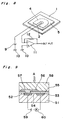
- Fig. 1 illustrates an embodiment of the present invention in a schematic perspective representation.
- Fig. 2 is a schematic cross-sectional view of the above embodiment.
- Fig. 3 diagrammatically explains the performance of maintaining the potential difference constant between a working electrode and a reference electrode.
- FIG. 4 through 8 illustrate other embodiments of the present invention, each in a schematic perspective representation.
- Fig. 9 schematically illustrates another embodiment of the present invention.
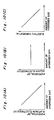
- Figs. 10 (A), (B) and (C) schematically show characteristics describing the performance of the embodiment shown in Fig. 9.
- Fig. 11 schematically illustrates another embodiment of the present invention.
- Fig. 12 diagrammatically shows a characteristic.
- Figs. 13 and Fig. 14 each schematically illustrate a conventional flammable-gas sensor.
- Fig. 1 shows a flammable-gas sensor embodying the present invention in a schematic perspective representation
- Fig. 2 is a schematic view of a cross section of the embodiment wherein, at a surface of an insulating substrate 1, a working electrode 2, a reference electrode 3 and a counter electrode 4 are positioned relative to each other according to a set arrangement, and a gas-permeable proton-conductive film 5 covers these electrodes in such a manner as to form an integrated whole with them.
- said insulating substrate 1 for example, is formed of a ceramic material
- said working electrode 2 is a thin film electrode of Pt
- said reference electrode 3 is a thin film electrode of Ag
- said counter electrode 4 is a thin film electrode formed of a material which is in general use for electrodes, each electrode connected with a lead terminal 7 through a wiring pattern 6.
- Said gas-permeable proton-conductive film 5 is formed of a material (trade-named Nafion, made by Dupont Co.) which is a copolymer of tetrafluoroethylene and perfluorosulfonylfluoride vinyl ether.
- a potentiostat circuit by connecting the inverted input terminal of an operational amplifier 8, whose output terminal is connected to the lead terminal of the counter electrode, to the lead terminal of the reference electrode and by connecting the non-inverted input terminal with the earth 10 through a direct current power source 9 (the electromotive force is set at v).
- the output terminal connected to the inverted input terminal through a feedback resistance 12 is used as a terminal for drawing signals of the detected concentration.
- a flammable-gas sensor constituted as above operates as follows.
- the proton-conductive film 5 permits the gas to permeate there through to the working electrode 2 consisting of Pt, at the surface of which, by the catalytic action of Pt, there occurs a reaction expressed by CO + H2O ⁇ CO2 + 2H+ + 2e, whereby proton H+ and electron e are formed. If, then, the proton stays there unremoved, there occurs a reaction expressed by 2H+ + 1/2 O2 + 2e ⁇ H2O, which is considered not to cause an electric current to flow in through the working electrode 2.
- the proton moves freely in the proton-conductive film 5 so that the reduction mentioned above is effectively prevented from occurring at the surface of the working electrode 2 and an electric current proportional to the degree of said oxidizing reaction flows in through the working electrode 2.
- the proton donates itself to the reduction mentioned above at the surface of the counter electrode 4, so that preclusion is accomplished with respect to possibility of protons being present in excess in the proton-conductive film 5, and accordingly, chances are eliminated for the reversible reaction to take place at the surface of the working electrode 2.
- the potentiostat circuit causes the potential of the reference electrode 3 to automatically change, so that the potential difference between the working electrode 2 and the reference electrode 3 can be maintained at v. Therefore, with the potential at the surface of the working electrode 2 maintained constant, current signals corresponding to the concentrations of the CO gas can be obtained, converted to voltage signals by the operational amplifier 11, and thus signals for the detected CO gas concentrations can be produced with high accuracy.
- the concentrations of CO gas and H2 gas in the environment under detection can be measured with a high accuracy.
- a flammable-gas sensor provided according to the description above can be produced not only in a simple manner by a technique of forming thin films but also with uniformity of a high order in characteristics between products. The characteristics are stabilized over long periods of time while general dimensional reduction and reduction in production cost can be easily accomplished by introducing the sensors hereinbefore described.
- a flammable-gas sensor as the other embodiment in a schematic perspective representation.
- This sensor differs from the one in Fig. 1 only in that the working electrode 2 is formed in a linear shape, whereas the reference electrode 3 and the counter electrode 4 are in the shape of halves of ellipses.
- this embodiment is capable of performance in a manner similar to the performance of the embodiment in Fig. 1.
- this peculiarity of the arrangement of the electrodes markedly improves the function of the reference electrode 3 to adjust its potential to change of the potential of the counter electrode 4 as compared with the embodiment in Fig. 1, and accordingly a marked improvement is achieved in the accuracy with which the concentrations of flammable gases are measured. Therefore, even when the ionic conductivity of the proton-conductive film 5 is low, the stability, the potential difference between the reference electrode 3 and the working electrode 2, can be improved so as to maintain a high accuracy with respect to measurement of flammable gas concentrations.
- a flammable-gas sensor as another embodiment in a schematic perspective representation.
- This sensor differs from the embodiments in the foregoing descriptions only in that the reference electrode 3 and the counter electrode 4 are arranged in coaxial circles with the working electrode 2 at the center.
- the working electrode 2 it is practical for the working electrode 2 to be formed of Au or a platinum group metal other than Pt, for the reference electrode 3 to be formed of a metal other than Ag, such as Pb, which is free from change of the potential in the presence of a flammable gas, and for the proton-conductive film 5, to be formed of antimonic acid, zirconium phosphate, or the like.
- the proton-conductive film 5 it is preferable to use a copolymer of tetrafluoroethylene and perfluorosulfonyl fluoride vinyl ether, as mentioned in the foregoing description of embodiments, especially one obtained by plasma polymerization.
- a copolymer of tetrafluoroethylene and perfluorosulfonyl fluoride vinyl ether as mentioned in the foregoing description of embodiments, especially one obtained by plasma polymerization.
- the permeability of flammable gases can be adjusted as desired by controlling the thickness of the film and the degree of polymerization.
- a flammable-gas sensor as another embodiment in a schematic perspective representation. This sensor differs from the embodiment shown in Fig. 5 only in that the reference electrode 3 and the counter electrode 4 are positioned oppositely between the two embodiments.
- the potential at the reference electrode 3 changes in accordance with change of the potential at the counter electrode 4, thus voltage signals proportional to the concentrations of flammable gas being output while the potential difference between the working electrode 2 and the reference electrode 3 is maintained at a constant value.
- the performance of follow-up of the potential of a reference electrode 3 is somewhat lowered as compared with the embodiment in Fig. 5, but use of a Pt electrode, which is excellent in electrode characteristics, for the counter electrode counterbalances the lowered follow-up enabling measurement of the flammable gas concentrations with high accuracy.
- a flammable-gas sensor as another embodiment in a schematic perspective representation.
- This embodiment differs from the embodiments in the foregoing descriptions only in that there is provided on the insulating substrate 1 a temperature sensor 13 which is formed of Pt in the form of thin film.
- This embodiment is capable of detecting temperature by the temperature sensor 13, besides detecting flammable-gas concentrations.
- the device therefore, is useful in a fire alarm system or the like where the alarm is based on both flammable-gas concentration and temperature.
- a signal processing circuit such as a bridge circuit, can also be incorporated into the sensor system.
- circuits incorporated therein may increase, introduction of a technique on semi-conductor integrated circuits reduces complication of the manufacturing process drastically.
- FIG. 8 there is shown another embodiment in a schematic perspective representation, which differs from the embodiment in Fig. 1 only in that a reference electrode 3 is not used, the counter electrode 4 is approximately 100 times as large in area as the working electrode 2, an operational amplifier 8 is omitted, and a direct current source 9 is connected directly with the counter electrode 4.
- This embodiment is characterized by simplified use of electrodes and stabilization of the surface potential of the working electrode resulting from striking enlargement of the counter electrode 4 in area, so that the detection of the flammable-gas concentrations can be done with a high accuracy.
- the present invention should not be restricted to the above mentioned embodiments.
- the reference electrode 3 and the counter electrode 4 can be positioned, each in the place of the other; and furthermore, each electrode can be set in the insulating substrate 1 in the manner of embedding.
- Various changes or modifications can be made in adapting the embodiments to particular uses within the scope and spirit of the present invention.
- This embodiment consists of only an insulating substrate, at least a working electrode and a counter electrode formed thereon, and a proton-conductive film to cover said electrodes in such a manner as to form an integrated whole with the electrodes, so that the sensor exhibits characteristics showing no irregularities between one another and stability in measurement over long periods of time of use.
- the embodiment also lends itself to general dimensional reduction and reduction in production cost besides being produced in a simplified process.
- a flammable-gas sensor as another embodiment, wherein an n type source region 52 and a drain region 53 are formed at predetermined positions on the surface of a p type substrate 51; an n type channel region 54 is formed between said source region 52 and drain region 53, and except for a part at said source region 52, the surface of said p type substrate 51 is entirely covered with an insulating film 55; there is formed a gate electrode 56 formed of platinum on said insulating film 55 at the position opposite to that of said channel region 54; there is formed a source electrode 57 formed of silver in such a manner as to be in contact with said source region 52; and a solid electrolyte film 58 as a gas-permeable, proton-conductive film is formed so as to cover said gate electrode 56, source electrode 57 and insulating film 55.
- Numeral 59 denotes a direct current power source and 60 an ammeter, both of which are connected in series, and arranged between said source region 52 and drain region 53.
- a flammable-gas sensor constituted as above operates as follows.
- the source electrode 57 the silver not reacting to hydrogen gas, continues to maintain a set potential (see Fig. 10 (B)) irrespective of the change of the concentration of the hydrogen gas.
- a potential corresponding to the concentration of the hydrogen gas is formed between the source electrode and gate electrode, and when a set voltage is applied between the source electrode and drain electrode, a current characteristic showing a decrease is seen as the concentration of the hydrogen gas increases (see Fig. 10 (C)).
- Carbon monoxide gas also undergoes a reversible reaction as does hydrogen gas as follows: CO + H2O ⁇ CO2 + 2H+ + 2e 2H+ + 1/2 O2 + 2e ⁇ H2O Accordingly, the electron generated in the above reaction is used to measure concentrations of carbon monoxide gas.
- FIG. 11 there is shown schematically another embodiment, which differs from the above described embodiment only in that the gate electrode 56 is formed of silver and the source electrode 57 is formed of platinum.
- the potential of the gate electrode 56 is maintained at a set value irrespective of the concentration of the hydrogen gas, whereas the source electrode 57 assumes a deep negative potential as the concentration of the hydrogen gas increases.
- a potential which depends on the concentration of hydrogen gas and changes inversely as compared with the above mentioned embodiment is formed between the source electrode and gate electrode, and when a set voltage is applied between the source electrode and gate electrode, a current characteristic showing an increase is seen as the concentration of the hydrogen gas increases (see Fig. 12).
- a calomel electrode can be substituted for a silver electrode and a metal of the platinum group, other than platinum, can be substituted for a platinum electrode; the gas permeability of the solid electrolyte film 58 can be changed so as to change the range of the measurement; and a plurality of flammable-gas sensors whose ranges of measurement have been changed can be arranged in parallel and selectively operated by switches, etc. (not shown in drawings).
- a field-effect transistor is formed by using an electrode, which reacts to flammable gases, and an electrode, which does not react to flammable gases. Since the surface of the field-effect transistor is covered with a gas-permeable, proton-conductive film, concentrations of flammable gases can be measured accurately without involving the danger of a gas explosion.
- the surface of a flammable-gas sensor, provided by the present invention is covered with a gas-permeable, proton-conductive film. This feature assuredly eliminates the danger of gas explosion from the use of a flammable gas sensor, and also helps to introduce compact models and to reduce the production cost. Measurement of the concentrations of flammable gases can be carried out with accuracy.
- the sensors provided according to the present invention therefore, can be used advantageously in fire alarm systems and in chemical industry.
Landscapes
- Chemical & Material Sciences (AREA)
- Life Sciences & Earth Sciences (AREA)
- Health & Medical Sciences (AREA)
- Biochemistry (AREA)
- Chemical Kinetics & Catalysis (AREA)
- Electrochemistry (AREA)
- Physics & Mathematics (AREA)
- Analytical Chemistry (AREA)
- Molecular Biology (AREA)
- General Health & Medical Sciences (AREA)
- General Physics & Mathematics (AREA)
- Immunology (AREA)
- Pathology (AREA)
- Engineering & Computer Science (AREA)
- Microelectronics & Electronic Packaging (AREA)
- Investigating Or Analyzing Materials By The Use Of Electric Means (AREA)
Claims (12)
- Sensor für zündbare Gase, mit:
einem Isoliersubstrat (1),
einer an einer Oberfläche des Isoliersubstrats (1) vorgesehenen Arbeitselektrode (2),
einer an der Oberfläche des Isoliersubstrats (1) vorgesehenen Gegenelektrode (4), die durch einen vorbestimmten Spalt von der Arbeitselektrode (2) getrennt ist, und
einem gasdurchlässigen, Protonen leitenden Film (5), der die Arbeitselektrode (2) und die Gegenelektrode (4) abdeckt und eine integrierte Gesamtheit mit der Arbeitselektrode (2) und der Gegenelektrode (4) bildet. - Sensor für zündfähige Gase nach Anspruch 1, bei welchem die Gegenelektrode eine um einen Faktor von 10 oder mehr größere Fläche aufweist als die Arbeitselektrode.
- Sensor für zündfähige Gase nach Anspruch 1 oder 2, bei welchem weiterhin eine Bezugselektrode (3) vorgesehen ist, die an der Oberfläche des Isoliersubstrats (1) angebracht und durch vorbestimmte Spalte von der Arbeitselektrode (2) und der Gegenelektrode (4) beabstandet ist, wobei der gasdurchlässige, Protonen leitende Film (5) weiterhin die Bezugselektrode (3) abdeckt und eine integrierte Gesamtheit mit der Arbeitselektrode (2), der Gegenelektrode (4) und der Bezugselektrode (3) bildet.
- Sensor für zündfähige Gase nach Anspruch 3, bei welchem die Bezugselektrode und die Gegenelektrode koaxial Kreise mit der Arbeitselektrode im Zentrum bilden.
- Sensor für zündfähige Gase nach Anspruch 3, bei welchem die Bezugselektrode zwischen der Arbeitselektrode und der Gegenelektrode angeordnet ist.
- Sensor für zündfähige Gase nach Anspruch 3, bei welchem die Gegenelektrode zwischen der Arbeitselektrode und der Bezugselektrode angeordnet ist.
- Sensor für zündfähige Gase nach Anspruch 3, bei welchem die Arbeitselektrode aus einem Metall der Platingruppe besteht, und die Gegenelektrode aus einem Metall besteht, welches nicht mit zündfähigen Gasen reagiert.
- Sensor für zündfähige Gase nach Anspruch 3, bei welchem die Arbeitselektrode aus Gold besteht, und die Gegenelektrode aus einem Metall besteht, welches nicht mit zündfähigen Gasen reagiert.
- Sensor für zündfähige Gase nach Anspruch 7, bei welchem sowohl die Arbeitselektrode als auch die Gegenelektrode aus einem Metall der Platingruppe besteht.
- Sensor für zündfähige Gase nach Anspruch 8, bei welchem sowohl die Arbeitselektrode als auch die Gegenelektrode aus Gold besteht.
- Sensor für zündfähige Gase, bei welchem entweder eine Gate-Elektrode (56) oder eine Source-Elektrode (52) eines Feldeffekttransistors aus einem Metall der Platingruppe und die andere dieser beiden Elektroden aus einem Metall besteht, welches nicht mit zündfähigen Gasen reagiert, sowie ein gasdurchlässiger, Protonen leitender Film (58) vorgesehen ist, um diese beiden Elektroden abzudecken und mit diesen beiden Elektroden eine integrierte Gesamtheit zu bilden.
- Sensor für zündfähige Gase nach Anspruch 11, bei welchem das Metall, welches nicht mit zündfähigen Gasen reagiert, Silber ist.
Applications Claiming Priority (1)
| Application Number | Priority Date | Filing Date | Title |
|---|---|---|---|
| PCT/JP1987/000551 WO1989001148A1 (fr) | 1987-07-28 | 1987-07-28 | Detecteur de gaz combustible |
Publications (3)
| Publication Number | Publication Date |
|---|---|
| EP0328640A1 EP0328640A1 (de) | 1989-08-23 |
| EP0328640A4 EP0328640A4 (en) | 1991-01-16 |
| EP0328640B1 true EP0328640B1 (de) | 1993-12-15 |
Family
ID=13902778
Family Applications (1)
| Application Number | Title | Priority Date | Filing Date |
|---|---|---|---|
| EP87904947A Expired - Lifetime EP0328640B1 (de) | 1987-07-28 | 1987-07-28 | Sensor für verbrennungsgas |
Country Status (5)
| Country | Link |
|---|---|
| US (1) | US4913792A (de) |
| EP (1) | EP0328640B1 (de) |
| KR (1) | KR960009768B1 (de) |
| DE (1) | DE3788519T2 (de) |
| WO (1) | WO1989001148A1 (de) |
Families Citing this family (27)
| Publication number | Priority date | Publication date | Assignee | Title |
|---|---|---|---|---|
| CH678660A5 (de) * | 1988-02-24 | 1991-10-15 | Matsushita Electric Works Ltd | |
| JPH03183943A (ja) * | 1989-12-14 | 1991-08-09 | Hitachi Ltd | 酸素センサ |
| US5246576A (en) * | 1990-12-10 | 1993-09-21 | Ppg Industries, Inc. | Cathode in a layered circuit and electrochemical cell for a measurement of oxygen in fluids |
| FR2672158B1 (fr) * | 1991-01-24 | 1993-04-09 | Commissariat Energie Atomique | Capteur pour la detection d'especes chimiques ou de photons utilisant un transistor a effet de champ. |
| US5858739A (en) * | 1991-05-18 | 1999-01-12 | Capteur Sensors & Analysers, Ltd. | Gas sensor |
| JPH07505952A (ja) * | 1992-04-22 | 1995-06-29 | ザ ダウ ケミカル カンパニー | 重合体フィルムに基づく電気化学センサー装置 |
| US5262037A (en) * | 1992-05-22 | 1993-11-16 | Biomedical Sensors, Ltd. | Electrochemical sensor |
| FR2695481B1 (fr) * | 1992-09-07 | 1994-12-02 | Cylergie Gie | Dispositif de mesure ampérométrique comportant un capteur électrochimique. |
| SE513477C2 (sv) * | 1993-11-08 | 2000-09-18 | Volvo Ab | Sensor för detektering av kväveoxidföreningar |
| GB9418292D0 (en) | 1994-09-10 | 1994-10-26 | Atomic Energy Authority Uk | Formaldehyde vapour detector |
| US5650054A (en) * | 1995-01-31 | 1997-07-22 | Atwood Industries, Inc. | Low cost room temperature electrochemical carbon monoxide and toxic gas sensor with humidity compensation based on protonic conductive membranes |
| US5573648A (en) * | 1995-01-31 | 1996-11-12 | Atwood Systems And Controls | Gas sensor based on protonic conductive membranes |
| US6360888B1 (en) * | 1999-02-25 | 2002-03-26 | Minimed Inc. | Glucose sensor package system |
| US6955750B2 (en) * | 2001-10-22 | 2005-10-18 | Perkinelmer Instruments Llc | Electrochemical sensor compensated for relative humidity |
| US7052588B2 (en) * | 2002-11-27 | 2006-05-30 | Molecular Nanosystems, Inc. | Nanotube chemical sensor based on work function of electrodes |
| US20040200734A1 (en) * | 2002-12-19 | 2004-10-14 | Co Man Sung | Nanotube-based sensors for biomolecules |
| DE10326476A1 (de) * | 2003-06-12 | 2005-01-13 | Micronas Gmbh | Verfahren und Sensor zum Bestimmen eines chemischen Elementes |
| US20050214197A1 (en) * | 2003-09-17 | 2005-09-29 | Molecular Nanosystems, Inc. | Methods for producing and using catalytic substrates for carbon nanotube growth |
| WO2005025734A2 (en) * | 2003-09-17 | 2005-03-24 | Molecular Nanosystems, Inc. | Methods for producing and using catalytic substrates for carbon nanotube growth |
| US20080128285A1 (en) * | 2006-12-04 | 2008-06-05 | Electronics And Telecommunications Research Institute | Electrochemical gas sensor chip and method of manufacturing the same |
| GB0721179D0 (en) * | 2007-10-30 | 2007-12-05 | Anaxsys Technology Ltd | A method of monitoring gas composition |
| DE102008042859A1 (de) * | 2008-10-15 | 2010-04-22 | Robert Bosch Gmbh | Elektronisches Bauelement |
| US8366894B2 (en) * | 2009-02-20 | 2013-02-05 | Giner, Inc. | Multi-gas microsensor assembly |
| EP2759832B1 (de) * | 2013-01-23 | 2020-11-11 | Sciosense B.V. | Elektrochemische Sensorvorrichtung |
| US9513247B2 (en) | 2014-02-27 | 2016-12-06 | Ams International Ag | Electrochemical sensor |
| CN105761439B (zh) * | 2014-12-17 | 2019-09-13 | 富泰华工业(深圳)有限公司 | 侦测空气污染的移动终端、系统及方法 |
| CN114069250A (zh) * | 2020-08-07 | 2022-02-18 | 香港科技大学 | 偶极子共振电阻式吸收器 |
Family Cites Families (11)
| Publication number | Priority date | Publication date | Assignee | Title |
|---|---|---|---|---|
| US4020830A (en) * | 1975-03-12 | 1977-05-03 | The University Of Utah | Selective chemical sensitive FET transducers |
| US4076596A (en) * | 1976-10-07 | 1978-02-28 | Leeds & Northrup Company | Apparatus for electrolytically determining a species in a fluid and method of use |
| US4171253A (en) * | 1977-02-28 | 1979-10-16 | General Electric Company | Self-humidifying potentiostated, three-electrode hydrated solid polymer electrolyte (SPE) gas sensor |
| GB1597414A (en) * | 1978-02-28 | 1981-09-09 | Gen Electric | Electrochemical gas-sensing device |
| JPS59619Y2 (ja) * | 1978-10-27 | 1984-01-09 | 横河電機株式会社 | ガス検出器 |
| JPS5564760A (en) * | 1978-11-08 | 1980-05-15 | Lotte Co Ltd | Method of making multilayered and viscous candy and mold used for making the same |
| JPS58118956A (ja) * | 1982-01-11 | 1983-07-15 | Hitachi Ltd | ガス検出方法とその装置 |
| US4521290A (en) * | 1984-03-16 | 1985-06-04 | Honeywell Inc. | Thin layer electrochemical cell for rapid detection of toxic chemicals |
| JPS62172257A (ja) * | 1986-01-27 | 1987-07-29 | Figaro Eng Inc | プロトン導電体ガスセンサ |
| US4795543A (en) * | 1987-05-26 | 1989-01-03 | Transducer Research, Inc. | Spin coating of electrolytes |
| US4820386A (en) * | 1988-02-03 | 1989-04-11 | Giner, Inc. | Diffusion-type sensor cell containing sensing and counter electrodes in intimate contact with the same side of a proton-conducting membrane and method of use |
-
1987
- 1987-07-28 KR KR1019890700314A patent/KR960009768B1/ko not_active Expired - Lifetime
- 1987-07-28 WO PCT/JP1987/000551 patent/WO1989001148A1/ja not_active Ceased
- 1987-07-28 US US07/295,599 patent/US4913792A/en not_active Expired - Fee Related
- 1987-07-28 EP EP87904947A patent/EP0328640B1/de not_active Expired - Lifetime
- 1987-07-28 DE DE87904947T patent/DE3788519T2/de not_active Expired - Fee Related
Also Published As
| Publication number | Publication date |
|---|---|
| KR890702022A (ko) | 1989-12-22 |
| DE3788519T2 (de) | 1994-05-11 |
| DE3788519D1 (de) | 1994-01-27 |
| WO1989001148A1 (fr) | 1989-02-09 |
| US4913792A (en) | 1990-04-03 |
| KR960009768B1 (ko) | 1996-07-24 |
| EP0328640A4 (en) | 1991-01-16 |
| EP0328640A1 (de) | 1989-08-23 |
Similar Documents
| Publication | Publication Date | Title |
|---|---|---|
| EP0328640B1 (de) | Sensor für verbrennungsgas | |
| US5716506A (en) | Electrochemical sensors for gas detection | |
| US4227984A (en) | Potentiostated, three-electrode, solid polymer electrolyte (SPE) gas sensor having highly invariant background current characteristics with temperature during zero-air operation | |
| US4326927A (en) | Method and device for the detection and measurement of electrochemically active compounds | |
| US7258773B2 (en) | Solid polymer electrolyte oxygen sensor | |
| JP3851561B2 (ja) | フィルム形固体ポリマーイオノマーセンサー及びセンサーセル | |
| US4377446A (en) | Carbon dioxide measurement | |
| US12535453B2 (en) | Electrochemical gas sensor assembly | |
| US4152233A (en) | Apparatus for electrochemical gas detection and measurement | |
| US4839000A (en) | Buffer compensation in enzyme-modified ion sensitive devices | |
| US4201634A (en) | Method for the detection of hydrazine | |
| US4948496A (en) | Gas sensor | |
| JPH02297054A (ja) | ガス状または液状測定試料中のアンモニアまたはヒドラジンを測定するための電気化学的測定セル | |
| US5085760A (en) | Electrochemical gas sensors | |
| US4428817A (en) | Sensor cell structure for oxygen-combustibles gas mixture sensor | |
| JPH0731153B2 (ja) | 可燃性ガスセンサ | |
| JPH0797095B2 (ja) | 一酸化炭素ガスセンサ | |
| US3743589A (en) | Electrochemical vapor detector | |
| US6176989B1 (en) | Electrochemical gas sensor | |
| US20060254908A1 (en) | Electrochemical solid electrolyte sensor for the detection of oxygen, hydrocarbons and moisture in vacuum environments | |
| CA1114021A (en) | Potentiostated, three-electrode, solid polymer electrolyte (spe) gas sensor having highly invariant background current characteristics with temperature during zero-air operation | |
| US20050155871A1 (en) | Electrochemical sensor | |
| JPH01127943A (ja) | 可燃性ガスセンサ | |
| JPWO1989001148A1 (ja) | 可燃性ガスセンサ | |
| JPH0519944B2 (de) |
Legal Events
| Date | Code | Title | Description |
|---|---|---|---|
| PUAI | Public reference made under article 153(3) epc to a published international application that has entered the european phase |
Free format text: ORIGINAL CODE: 0009012 |
|
| AK | Designated contracting states |
Kind code of ref document: A1 Designated state(s): AT BE CH DE FR GB IT LI LU NL SE |
|
| 17P | Request for examination filed |
Effective date: 19890713 |
|
| RAP1 | Party data changed (applicant data changed or rights of an application transferred) |
Owner name: DAIKIN INDUSTRIES, LIMITED |
|
| RBV | Designated contracting states (corrected) |
Designated state(s): DE FR NL |
|
| RIN1 | Information on inventor provided before grant (corrected) |
Inventor name: FURUYA, K. C/O SHIGA WORKS OF DAIKIN IND., LTD. Inventor name: SATO, SATORU C/O DAIKIN INDUSTRIES, LTD. Inventor name: NAGATA, Y. C/O SHIGA WORKS OF DAIKIN IND. LTD. |
|
| RBV | Designated contracting states (corrected) |
Designated state(s): DE FR GB NL |
|
| A4 | Supplementary search report drawn up and despatched |
Effective date: 19901128 |
|
| AK | Designated contracting states |
Kind code of ref document: A4 Designated state(s): AT BE CH DE FR GB IT LI LU NL SE |
|
| 17Q | First examination report despatched |
Effective date: 19920812 |
|
| GRAA | (expected) grant |
Free format text: ORIGINAL CODE: 0009210 |
|
| AK | Designated contracting states |
Kind code of ref document: B1 Designated state(s): DE FR GB NL |
|
| REF | Corresponds to: |
Ref document number: 3788519 Country of ref document: DE Date of ref document: 19940127 |
|
| ET | Fr: translation filed | ||
| PLBE | No opposition filed within time limit |
Free format text: ORIGINAL CODE: 0009261 |
|
| STAA | Information on the status of an ep patent application or granted ep patent |
Free format text: STATUS: NO OPPOSITION FILED WITHIN TIME LIMIT |
|
| 26N | No opposition filed | ||
| PGFP | Annual fee paid to national office [announced via postgrant information from national office to epo] |
Ref country code: GB Payment date: 20000726 Year of fee payment: 14 |
|
| PGFP | Annual fee paid to national office [announced via postgrant information from national office to epo] |
Ref country code: FR Payment date: 20010712 Year of fee payment: 15 |
|
| PGFP | Annual fee paid to national office [announced via postgrant information from national office to epo] |
Ref country code: DE Payment date: 20010723 Year of fee payment: 15 |
|
| PG25 | Lapsed in a contracting state [announced via postgrant information from national office to epo] |
Ref country code: GB Free format text: LAPSE BECAUSE OF NON-PAYMENT OF DUE FEES Effective date: 20010728 |
|
| PGFP | Annual fee paid to national office [announced via postgrant information from national office to epo] |
Ref country code: NL Payment date: 20010730 Year of fee payment: 15 |
|
| GBPC | Gb: european patent ceased through non-payment of renewal fee |
Effective date: 20010728 |
|
| PG25 | Lapsed in a contracting state [announced via postgrant information from national office to epo] |
Ref country code: NL Free format text: LAPSE BECAUSE OF NON-PAYMENT OF DUE FEES Effective date: 20030201 Ref country code: DE Free format text: LAPSE BECAUSE OF NON-PAYMENT OF DUE FEES Effective date: 20030201 |
|
| PG25 | Lapsed in a contracting state [announced via postgrant information from national office to epo] |
Ref country code: FR Free format text: LAPSE BECAUSE OF NON-PAYMENT OF DUE FEES Effective date: 20030331 |
|
| NLV4 | Nl: lapsed or anulled due to non-payment of the annual fee |
Effective date: 20030201 |
|
| REG | Reference to a national code |
Ref country code: FR Ref legal event code: ST |