EP0328861A2 - Paralleles, mehrere Einheiten umfassendes, anpassungsfähiges Musterklassifizierungssystem, das Korrelationen zwischen den Einheiten und eine Klassentrennungsmethodologie innerhalb der Einheiten benutzt - Google Patents
Paralleles, mehrere Einheiten umfassendes, anpassungsfähiges Musterklassifizierungssystem, das Korrelationen zwischen den Einheiten und eine Klassentrennungsmethodologie innerhalb der Einheiten benutzt Download PDFInfo
- Publication number
- EP0328861A2 EP0328861A2 EP89100157A EP89100157A EP0328861A2 EP 0328861 A2 EP0328861 A2 EP 0328861A2 EP 89100157 A EP89100157 A EP 89100157A EP 89100157 A EP89100157 A EP 89100157A EP 0328861 A2 EP0328861 A2 EP 0328861A2
- Authority
- EP
- European Patent Office
- Prior art keywords
- generalizer
- prototype
- pattern
- separator
- prototypes
- Prior art date
- Legal status (The legal status is an assumption and is not a legal conclusion. Google has not performed a legal analysis and makes no representation as to the accuracy of the status listed.)
- Granted
Links
Images



Classifications
-
- G—PHYSICS
- G06—COMPUTING OR CALCULATING; COUNTING
- G06F—ELECTRIC DIGITAL DATA PROCESSING
- G06F18/00—Pattern recognition
- G06F18/20—Analysing
- G06F18/25—Fusion techniques
- G06F18/254—Fusion techniques of classification results, e.g. of results related to same input data
Definitions
- This invention relates to adaptive information processing systems. More particularly, it relates to self-organizing input-output devices which function to separate and identify classes of patterns including those that are not linearly separable.
- the above-referenced patents to Cooper et al. disclose methods and apparatus (systems) that can learn to classify "patterns” or real world “events” even when representations of the same are not linearly separable.
- the patterns or events are detected by some data acquisition device and encoded into a set of measurements or features the results of which are represented by the signal S, comprised of individual signals s1, s2, . . . s k .
- the signal S could be, for example, a signal coming from a camera registering a scene (pattern), or the output of a microphone detecting some sound (pattern), or from a data base representing events, historical records, etc. (abstract patterns).
- a system of this type is an extremely powerful pattern class separator and identifier.
- the system can be trained by a learning procedure which does not require the operator to specify the (possibly) complex geography of the pattern class in the multidimensional pattern space in which the input event is represented.
- the input event S is preprocessed into an intermediate signal F representing only certain prescribed features of the original pattern.
- Subjecting the input signal S (representing the pattern) to this preprocessing step - referred to herein as encoding - should preserve enough information to permit patterns to be distinguished from each other.
- Information irrelevant for learning one class may be important to distinguish some other class. For this reason, it may be difficult to choose a single preprocessing strategy that removes all irrelevant information without jeopardizing the ability to distinguish some classes.
- a class is well separated from all others in the pattern space of a given unit and to the extent that it is not widely distributed throughout that space, then that unit will have a natural "aptitude" for learning this class.
- learning other pattern classes may require pooling the resources of several component units, none of which alone has sufficient discriminating skills, by virtue of its pre-processing and encoding properties, to distinguish these classes.
- the system identifies an example of such a class by correlating the responses of a set of units.
- the multi-unit Nestor System disclosed in the above patent application is organized to first attempt separation of pattern classes within individual code spaces and secondly, for those classes for which that is not possible, to subsequently correlate the responses of multiple units to produce an identification.
- Such a system works best when, within the pattern spaces of the various events, class distributions are largely (but not necessarily wholly) non-overlapping.
- effective mapping of the areas can be rapidly achieved by showing the system a suitable training set of patterns that is a representative sample of the classes in question. Those portions of a class territory that overlap with some other class (or classes) must still be properly mapped out ("covered").
- This territory must be mapped out for each of the classes laying claim to it in the pattern space. If this is done and the pattern spaces of the various units in the multi-unit system are sufficiently different from one another (ideally, but not necessarily, orthogonal) then the overlapping class regions of one pattern space will not be reproduced in some other. (Two pattern spaces are orthogonal if, for any event, its representation in one space is completely uncorrelated with its representation in the other space.) Accordingly, correlation of unit responses from multiple units will serve to identify the pattern. As an example of multi-unit correlation, consider a two unit system in which Unit 1 ((U1) had degenerate class territories for classes A and B while Unit 2 (U2) had degenerate regions for B and C. An example of a class B pattern would result in the "confused" responses A or B from U1 and B or C from U2, which could be correlated to produce the identification B.
- Still another object of the present invention is to provide a specific software-implemented embodiment of the present invention which is capable of achieving the objects stated immediately above.
- a pattern classification and identification system comprised of (a) a plurality of classification units, connected in parallel and which receive an input signal S, representing each pattern, and (b) a class selection device (CSD), responsive to the output signals produced by the classification units, for producing a single output response R representing the class of each respective pattern.
- the classification units include both "generalizers” and “separators” which store “generalizer prototypes” and “separator prototypes,” respectively.
- the system operates to compare each input pattern, first to the generalizer prototypes to determine whether such pattern falls within the region of influence of at least one generalizer prototype. If a unique and certain response to a particular input pattern cannot be produced by such comparison, the system compares such input pattern with the separator prototypes to determine whether the input pattern falls within a region of influence of at least one of these separator prototypes.
- the system is a modification of the multi-unit Nestor System disclosed in the above-referenced U. S. Patent No. 4,760,604.
- This system is called "GENSEP” for "generalizer/separator.”
- GENSEP Generalizer/separator
- the individual units train first to develop mappings that cover the class territories with prototypes called generalizers.
- Generalizer prototypes are not explicitly configured to achieve separation of classes in the code space of a unit. Rather, the system correlates the multi-unit responses of firing generalizers to achieve class separation.
- Another class of prototypes, called separators develop in the system to effect class separation based upon feature subsets of the generalizer coding units.
- Each classification with U i sees an input S (the output of the data acquisition device, or devices, characterizing the input event) and can apply a "code" to the signal to extract from it a set of values F1 . . . F k .
- each Nestor Adaptive Module is trained, it develops a unique set of prototypes for classification of incoming patterns.
- Generalizer prototypes are committed to the memory assigned to a particular unit in order to cover class territories as represented in that unit's coding space.
- Separator prototypes are committed between certain pairs of generalizer prototypes in order to separate class confusions that can be discriminated on the basis of appeal to a small subset of information in the code space of the given unit.
- Each generalizer prototype has associated with it a set of weighting factors (one for each input line), the prototype vector, P, and a threshold ⁇ , governing whether it is "on” or “off” (firing or not firing) in response to an input pattern.
- the threshold defines a "region of influence” for the prototype.
- the region of influence is the set of all input events which will cause the prototype to fire.
- This threshold may be modifiable. If modifiable, it is adjusted so as to gradually increase the size of the prototype region of influence, but it is typically not beyond some fixed percentage of the dimensionality of the code space (ranging approximately from 5 percent to 50 percent).
- Each generalizer prototype has a class, C, associated with it.
- each generalizer prototype belongs to a particular unit in the system. The unit is specified by an index u.
- the data set defining a generalizer prototype consists of [P; ⁇ g ; C; u].
- each separator prototype has associated with it a set of weighting factors (one for each input line), the prototype vector, S, and a threshold ⁇ s , partially governing whether it is "on” or “off” in response to an input pattern.
- this threshold defines a "region of influence” for the separator. This threshold is modifiable and adjusted by the system in such a way as to decrease the size of the influence field of the separator.
- Separators whose influence field is below some minimum size are considered phase II (P2) separators; those above the minimum are called phase I (P1) separators.
- P2 phase II
- P1 separators phase I separators
- each separator is associated with a pair of generalizers, (i, j). More than one separator may be associated with the same generalizer pair.
- Each separator has associated with it an index, k, specifying a portion of the code values of the pattern space holding the generalizer prototypes with which it is associated. In particular, if a given code space represents the pattern event in terms of measurements F1 . . . F m , then the index associated with a separator will be some number k on the interval (1, m).
- each separator has a class associated with it. Unlike the class association of a generalizer, the association of a class with a separator is a negation. In particular, if a generalizer prototype for class C fires in response to an input event, the system will tend towards the assignment of class C to the pattern. However, if a separator for class C fires in response to the pattern, the system will tend not to assign C as an identification of the pattern. Briefly, if a generalizer for C fires, it says “C"; if a separator for C fires, it is saying "not C.”
- the set of data defining a separator can be listed as [i, j; k; S, ⁇ s ; C].
- An input pattern appears to a generalizer prototype as a set of signals occurring on its N input lines.
- the operation of comparing a pattern and a generalizer prototype can take any of several forms depending on whether the input signals to the prototype are binary or continuous valued. Either type of signal can be processed.
- the prototype weighting factor assigned to that line is itself a binary number.
- the total prototype activity is a count of the number of input lines on which the bit value of the pattern signal, f j , does not match the bit value of the weighting vector, P j .
- the operations of comparing a pattern with a set of prototypes can occur in parallel; that is to say, the comparison of a pattern with each prototype can occur simultaneously. Additionally, in the comparison of a pattern with a given prototype, the operation performed on a given input line (bit comparison for binary valued inputs or multiplication for continuous valued signals) can be performed simultaneously on all input lines. This rich parallelism is an inherent feature of the Nestor System.
- Pattern processing by separator prototype is similar to that by generalizers. A set of signals occurring at the M input lines of the separator prototype are compared with the separator weighting factor values, an unmatched bit count is determined and tested against the separator threshold.
- M is the information appearing at the input lines of the generalizer.
- the feature index, k associated with the separator specifies a member of the continuous-valued set F.
- the binary equivalent of F k will appear as input to the separator S.
- ⁇ be a binary mapping that converts F k to a binary valued vector (b1 . . . b m ).
- the response of a unit to an incoming pattern consists of the classes associated with its firing prototypes.
- those classes are organized into two lists, the generalizer class list and the separator class list.
- the generalizer class list of a given unit is empty, the separator class list for that unit will be empty as well.
- the system response to an incoming pattern is determined by the Class Selection Mechanism (CSM) as a function of the output class lists (from both generalizers and separators) of the system units.
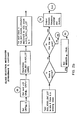
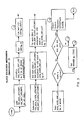
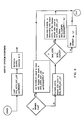
- the CSM can evaluate the contents of the class lists of all units in a variety of ways as a function of unit priority. Two preferred embodiments of the class selection mechanism are illustrated in Figures 2 and 3, respectively.
- units in the GENSEP system can be arranged hierarchically, according to priority.
- Unit priorities are numbers that take on integer values 1, 2, 3, etc.
- a unit of priority n is said to operate at level n in the system.
- the CSM In determining the system response, the CSM considers the output of each unit in order of decreasing priority. (The highest priority is 1.)
- the CSM updates a system vote count for each class and checks to determine if any particular class has satisfied the system identification criterion to allow for an unambiguous response.
- the CSM can update the system vote count in different ways.
- the CSM polls the system units twice, in each case starting with the highest priority unit and moving through the units in order of descending priority.
- the CSM updates the system vote count on the basis of the generalizer class list. If a winning class has not been found by the time all the generalizer class lists of the lowest priority units have been polled, then the CSM initiates a second polling of the units. It begins by thresholding the system class list and throwing out all those classes below some specified minimum vote count. Then, beginning with the highest priority units, the CSM updates the system vote count as a function of the classes in the separator class lists for these units.
- the appearance of a class in the separator class list causes the system vote count for that class to be decremented by 1. Again, after a unit's separator class list has been used to update the system vote count, if a winning class has not been found, then the unit of next lowest priority is processed.
- the CSM polls each unit only once.
- the system vote count is updated as a function of the net number of votes for a class given the composition of both the generalizer and the separator class lists for the given unit. For example, the appearance of a class in the generalizer class list would increment its system vote count by 1; the appearance of a class in the separator class list would reduce its vote by 1.
- the system tends to rely less upon correlations between unit responses as a means of distinguishing classes and more on the internal discriminating ability of individual coding units at the level of single feature distinctions.
- the GENSEP system offers, as final output, a system class list (CLASSL) and a response type (SYSRSP).
- Training the GENSEP system requires a specification of the true identify of the pattern, the output response of the system and the representations of the input pattern.
- the mechanisms of training are (1) the commitment of new generalizer prototypes; (2) the adjustment (enlargement) of generalizer prototype influence fields; (3) the commitment of separator prototypes and (4) the adjustment (reduction) of separator prototype influence fields.
- the object of training is to effect an internal change in the system such that, if the pattern were to be immediately represented to the system, the system's response would be, if not to correctly classify the pattern, at least to produce a confusion set that would include the correct classification.
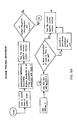
- Training is orchestrated by the System Training Mechanism (STM) illustrated in Figure 5.
- STM System Training Mechanism
- separators During training, patterns unidentifiable by correlation among the responses of different coding units will cause separators to be committed to memory. This occurs in an effort to find some feature or combination of features that will be useful to distinguish among the classes in question.
- the system may commit a host of candidate separators; those that are of no reliable predictive value will be trained out to phase II status, playing essentially no role in future system responses.
- the strategy can be likened to the system postulating a number of hypotheses and eliminating from use all those that prove incorrect.
- the STM activates the CSM, initiating the polling of system units in order to recompose the system response.
- the CSM is controlled by the STM in the following way (see Figure 5). If a unit is polled and its generalizer class list does not contain the correct class of the input pattern, then the training mechanism commits a new prototype for this class based upon the code vector for the pattern in this unit.
- This prototype commitment procedure is the same as that described in the above-referenced patent application, with the exception being that the influence field is fixed at some pre-set size, generally a percentage of the dimensionality of the code space. (In previous systems the initial influence field size was a function of distance to prototypes for different classes.) Otherwise, as in previous prototype commitment procedures, the code vector of the pattern becomes the prototype vector and the class of the pattern becomes the class of the prototype.
- generalizer influence fields are enlarged in response to an input pattern. If the System Training Mechanism polls a unit whose generalizer class list includes the correct class, then some of the correct class generalizer prototype may be candidates for influence field expansion.
- the growth ring of a prototype to be all those points whose unmatched sign distance with the prototype d r obeys the following inequality: ⁇ g ⁇ d r ⁇ ⁇ g where ⁇ g is the threshold defining the influence field of the generalizer, and ⁇ is some real number on the interval (0, 1). (A typical value for ⁇ is on the interval [0.80, 0.90]
- the System Training Mechanism attempts to commit separator prototypes between pairs of generalizers from the same unit whose classes are represented in the system confusion set. Each such pair is constituted from a firing generalizer for the correct class and a firing generalizer for some other class in the system confusion set.
- the STM is attempting separator commitment for such a "correct-class, opposite-class" pair, it attempts to commit a pair of separators for each feature in the generalizer prototype vector pair.
- F the pattern code vector
- the binary distance between real-valued features P( ⁇ ) j and P( ⁇ ) j is computed by first converting each feature into its binary equivalent and subsequently performing an unmatched sign count on the resulting binary representations.
- a pair of separator prototypes is committed for the j th feature if the binary distance between P( ⁇ ) j and P( ⁇ ) j exceeds some minimum amount, ⁇ s .
- ⁇ s is the threshold for separator commitment.
- the System Training Mechanism uses a variety of mechanisms to select the subset of correct-class/opposite-class firing generalizers for which separator commitment is to be attempted.
- the correct class of the pattern be C0.
- G i is the total number of firing generalizers for class C i .
- the sets ⁇ P j (C0) ⁇ X ⁇ P k (C1) ⁇ P jk (0,1) . .
- the STM attempts commitment of separators for all such generalizer pairs.
- the STM attempts commitment for one member only of each of the P jk (0,i) sets.
- the closest-opposed generalizer pair member i.e., the generalizer pair with the smallest inter-prototype vector distance
- This embodiment is preferred in those situations where the number of separators committed is to be minimized.
- the GENSEP system has special utility in those pattern recognition applications where class territories in a given pattern space are largely overlapping. In such cases there is much more territory in the pattern space to be covered by P2 prototypes.
- classes A and B are degenerate in one region; C and D in another.
- some P1 prototypes would initially be committed for the various classes and eventually so reduced in size as to become P2 prototypes.
- separators can develop to take advantage of whatever separability is possible in the space.
- separators will develop for the x feature component in the code vector to separate A from C, and A from D; and, as well, B from C and B from D.
- the only mechanism available for separation within this unit would be P1 prototypes.
- class territories are largely overlapping (as opposed to partially overlapping) the number of P1 prototypes that survive is greatly reduced.
- Class A conceptual definition of a group of patterns which elicits the same response from a pattern class separator and identifier. All vector signals S representing patterns within this group will produce the identical output response R.
- a Nestor R adaptive module does not have any preset or preconceived classes before it is trained.
- Classification Unit One of a number of conceptually (or physically) separate units of the system. These units operate in parallel, or in sequence, and each comprise both an encoding portion and a classification portion.
- the encoding portion transforms the vector signal S into an encoded vector signal F; the classification portion attempts to translate the vector signal F into a unique output response R identifying the class of the input pattern represented by the vector signal S.
- Each classification unit is designated by its own hierarchy level or "priority" within the system.
- Confusion Zone An area in multi-dimensional pattern space associated with more than one pattern class. Typically, such areas are covered with at least two overlapping layers of phase 2 prototypes, each layer being associated with a different class. In some cases, these zones may also be covered by overlapping influence fields of phase 1 prototypes for different classes.
- Correlation The selection of the correct class from among several output responses of a number of Nestor adaptive modules, each of which has been presented with an encoded vector signal F representing the same input pattern.
- Encode A transformation of an incoming vector signal S, representing an input pattern, into an encoded vector signal F, using a code "c.”
- the transformation depends upon the presence or absence of particular features in the pattern.
- the purpose of the transformation is to eliminate irrelevant information contained in the signal S.
- Event A real world occurrence which may be detected and represented by a vector signal S.
- the event may be a visual pattern, detectable by a camera, or a sound pattern, detectable by a microphone.
- the term “event” may be used synonymously with "pattern.”
- Influence Field of a Prototype A variable-sized region or territory in the multi-dimensional pattern space centered on a prototype. Upon presentation, an input pattern that falls within this territory will cause the prototype to fire.
- Neighbor Search A search within a Nestor adaptive module for neighboring prototypes within a certain distance, in the multi-dimensional pattern space, from the point representing an input pattern.
- Nestor Adaptive Module A device or method disclosed and claimed in one or more of the following U.S. patents: 3,950,733; 4,044,243; 4,254,474, 4,326,259 and 4,760,604.
- Pattern A particular set of data, resulting from a real world "event" and represented by a vector signal S, which is to be classified by a pattern class separator and identifier.
- each pattern presented to the pattern class separator and identifier may be at least slightly different from every other pattern previously presented, it can be grouped into one of an arbitrary number of classes.
- Pattern Signal A vector signal S comprised of individual scalar signals s1, s2 ...s k , which represents an input pattern to a pattern class separator and identifier.
- Phase 1 Prototype A type of prototype which, when "fired,” will direct the response of a Nestor adaptive module and cause a particular output response to occur.
- Phase 2 Prototype A type of prototype which, when "fired" can only indicate that an incoming pattern may fall within a designated one of a number of classes.
- Prototype A prototypical representation of a pattern as stored in a Nestor adaptive module memory. Each prototype is defined in memory by (1) a vector in the multi-dimensional pattern space; (2) a "region of influence" within the pattern space; (3) a particular pattern class with which the prototype is associated, and (4) a label specifying the phase of the prototype.
- Prototype "Commitment” The establishment of a new prototype (either phase 1 or phase 2 prototype) in a Nestor adaptive module in association with, and as a result of the presentation of, an input pattern. Upon presentation, during training, every input pattern will either fall within the influence field of an existing prototype, or cause the formation of a new prototype.
- a prototype is said to "fire” when an input pattern, represented by a vector signal S, falls within the influence field of that prototype. This causes the Nestor adaptive module, in which the prototype resides, to produce an output response.
- System Level A collection of classification units having the same priority.
- Vote Counting A correlation technique which is used when an input pattern falls within a "confusion zone" in the multi-dimensional pattern space.
- NUM_UNIT array of pattern code vectors
- NUM_UNIT list of classes associated with firing separators for a
Landscapes
- Engineering & Computer Science (AREA)
- Data Mining & Analysis (AREA)
- Theoretical Computer Science (AREA)
- Computer Vision & Pattern Recognition (AREA)
- Bioinformatics & Cheminformatics (AREA)
- Bioinformatics & Computational Biology (AREA)
- Artificial Intelligence (AREA)
- Evolutionary Biology (AREA)
- Evolutionary Computation (AREA)
- Physics & Mathematics (AREA)
- General Engineering & Computer Science (AREA)
- General Physics & Mathematics (AREA)
- Life Sciences & Earth Sciences (AREA)
- Image Analysis (AREA)
Applications Claiming Priority (2)
| Application Number | Priority Date | Filing Date | Title |
|---|---|---|---|
| US07/156,830 US4958375A (en) | 1988-02-17 | 1988-02-17 | Parallel, multi-unit, adaptive pattern classification system using inter-unit correlations and an intra-unit class separator methodology |
| US156830 | 1988-02-17 |
Publications (3)
| Publication Number | Publication Date |
|---|---|
| EP0328861A2 true EP0328861A2 (de) | 1989-08-23 |
| EP0328861A3 EP0328861A3 (de) | 1992-03-25 |
| EP0328861B1 EP0328861B1 (de) | 1993-09-08 |
Family
ID=22561275
Family Applications (1)
| Application Number | Title | Priority Date | Filing Date |
|---|---|---|---|
| EP89100157A Expired - Lifetime EP0328861B1 (de) | 1988-02-17 | 1989-01-05 | Paralleles, mehrere Einheiten umfassendes, anpassungsfähiges Musterklassifizierungssystem, das Korrelationen zwischen den Einheiten und eine Klassentrennungsmethodologie innerhalb der Einheiten benutzt |
Country Status (4)
| Country | Link |
|---|---|
| US (1) | US4958375A (de) |
| EP (1) | EP0328861B1 (de) |
| JP (1) | JP2976053B2 (de) |
| DE (1) | DE68908910T2 (de) |
Cited By (3)
| Publication number | Priority date | Publication date | Assignee | Title |
|---|---|---|---|---|
| EP0435660A3 (en) * | 1989-12-29 | 1992-02-12 | Canon Kabushiki Kaisha | Method of evaluating object based upon image processing, and inspection apparatus using said method |
| EP0640935A3 (de) * | 1993-08-26 | 1995-05-03 | Ibm | Mustenerkennung durch neuronales Netzwerk. |
| RU2160467C1 (ru) * | 1999-07-08 | 2000-12-10 | Яхно Владимир Григорьевич | Способ адаптивного распознавания информационных образов и система для его осуществления |
Families Citing this family (50)
| Publication number | Priority date | Publication date | Assignee | Title |
|---|---|---|---|---|
| JPH02109160A (ja) * | 1988-10-18 | 1990-04-20 | Japan Atom Energy Res Inst | ベクトル計算機用演算装置 |
| US5257394A (en) * | 1988-10-18 | 1993-10-26 | Japan Atomic Energy Research Institute | Logical expression processing pipeline using pushdown stacks for a vector computer |
| US6272241B1 (en) * | 1989-03-22 | 2001-08-07 | British Telecommunications Public Limited Company | Pattern recognition |
| JP2940933B2 (ja) * | 1989-05-20 | 1999-08-25 | 株式会社リコー | パターン認識方式 |
| US5123057A (en) * | 1989-07-28 | 1992-06-16 | Massachusetts Institute Of Technology | Model based pattern recognition |
| US5075896A (en) * | 1989-10-25 | 1991-12-24 | Xerox Corporation | Character and phoneme recognition based on probability clustering |
| US5063521A (en) * | 1989-11-03 | 1991-11-05 | Motorola, Inc. | Neuram: neural network with ram |
| US5214744A (en) * | 1990-12-14 | 1993-05-25 | Westinghouse Electric Corp. | Method and apparatus for automatically identifying targets in sonar images |
| US5239594A (en) * | 1991-02-12 | 1993-08-24 | Mitsubishi Denki Kabushiki Kaisha | Self-organizing pattern classification neural network system |
| JP3088171B2 (ja) * | 1991-02-12 | 2000-09-18 | 三菱電機株式会社 | 自己組織型パタ−ン分類システム及び分類方法 |
| US5222155A (en) * | 1991-03-26 | 1993-06-22 | Massachusetts Institute Of Technology | Computer apparatus and method for fuzzy template shape matching using a scoring function |
| US5337371A (en) * | 1991-08-09 | 1994-08-09 | Matsushita Electric Industrial Co., Ltd. | Pattern classification system |
| CA2077324C (en) * | 1991-10-07 | 1997-06-24 | Michael R. Campanelli | Image editing system and method having improved automatic object selection |
| US10361802B1 (en) | 1999-02-01 | 2019-07-23 | Blanding Hovenweep, Llc | Adaptive pattern recognition based control system and method |
| US6850252B1 (en) | 1999-10-05 | 2005-02-01 | Steven M. Hoffberg | Intelligent electronic appliance system and method |
| US6418424B1 (en) | 1991-12-23 | 2002-07-09 | Steven M. Hoffberg | Ergonomic man-machine interface incorporating adaptive pattern recognition based control system |
| US6400996B1 (en) | 1999-02-01 | 2002-06-04 | Steven M. Hoffberg | Adaptive pattern recognition based control system and method |
| US5903454A (en) | 1991-12-23 | 1999-05-11 | Hoffberg; Linda Irene | Human-factored interface corporating adaptive pattern recognition based controller apparatus |
| US7242988B1 (en) | 1991-12-23 | 2007-07-10 | Linda Irene Hoffberg | Adaptive pattern recognition based controller apparatus and method and human-factored interface therefore |
| US8352400B2 (en) | 1991-12-23 | 2013-01-08 | Hoffberg Steven M | Adaptive pattern recognition based controller apparatus and method and human-factored interface therefore |
| US5337370A (en) * | 1992-02-28 | 1994-08-09 | Environmental Research Institute Of Michigan | Character recognition method employing non-character recognizer |
| JP3131287B2 (ja) * | 1992-05-27 | 2001-01-31 | 株式会社日立製作所 | パターン認識装置 |
| JP3163185B2 (ja) * | 1992-11-27 | 2001-05-08 | 株式会社東芝 | パターン認識装置およびパターン認識方法 |
| US5479574A (en) * | 1993-04-01 | 1995-12-26 | Nestor, Inc. | Method and apparatus for adaptive classification |
| US5455872A (en) * | 1993-04-26 | 1995-10-03 | International Business Machines Corporation | System and method for enhanced character recogngition accuracy by adaptive probability weighting |
| US5522011A (en) * | 1993-09-27 | 1996-05-28 | International Business Machines Corporation | Speech coding apparatus and method using classification rules |
| US5875264A (en) * | 1993-12-03 | 1999-02-23 | Kaman Sciences Corporation | Pixel hashing image recognition system |
| US6167390A (en) * | 1993-12-08 | 2000-12-26 | 3M Innovative Properties Company | Facet classification neural network |
| US5493619A (en) * | 1994-03-11 | 1996-02-20 | Haley; Paul H. | Normalization method for eliminating false detections in side scan sonar images |
| US5493539A (en) * | 1994-03-11 | 1996-02-20 | Westinghouse Electric Corporation | Two-stage detection and discrimination system for side scan sonar equipment |
| US5519786A (en) * | 1994-08-09 | 1996-05-21 | Trw Inc. | Method and apparatus for implementing a weighted voting scheme for multiple optical character recognition systems |
| US5822741A (en) * | 1996-02-05 | 1998-10-13 | Lockheed Martin Corporation | Neural network/conceptual clustering fraud detection architecture |
| KR100207426B1 (ko) * | 1996-05-08 | 1999-07-15 | 전주범 | 무늬의 크기와 방향성을 이용한 텍스쳐 분류 장치 |
| US6092059A (en) * | 1996-12-27 | 2000-07-18 | Cognex Corporation | Automatic classifier for real time inspection and classification |
| US6097834A (en) * | 1997-06-13 | 2000-08-01 | Paystation America Inc. | Financial transaction processing systems and methods |
| US7096192B1 (en) | 1997-07-28 | 2006-08-22 | Cybersource Corporation | Method and system for detecting fraud in a credit card transaction over a computer network |
| US7403922B1 (en) | 1997-07-28 | 2008-07-22 | Cybersource Corporation | Method and apparatus for evaluating fraud risk in an electronic commerce transaction |
| US6032136A (en) | 1998-11-17 | 2000-02-29 | First Usa Bank, N.A. | Customer activated multi-value (CAM) card |
| US6606402B2 (en) | 1998-12-18 | 2003-08-12 | Cognex Corporation | System and method for in-line inspection of stencil aperture blockage |
| US7966078B2 (en) | 1999-02-01 | 2011-06-21 | Steven Hoffberg | Network media appliance system and method |
| US6366897B1 (en) | 1999-07-26 | 2002-04-02 | Hnc Software, Inc. | Cortronic neural networks with distributed processing |
| US6505168B1 (en) | 1999-08-16 | 2003-01-07 | First Usa Bank, Na | System and method for gathering and standardizing customer purchase information for target marketing |
| US6941365B2 (en) * | 2000-07-28 | 2005-09-06 | Lockheed Martin Corporation | Computer resource allocation layout description |
| US7831467B1 (en) | 2000-10-17 | 2010-11-09 | Jpmorgan Chase Bank, N.A. | Method and system for retaining customer loyalty |
| US6904408B1 (en) * | 2000-10-19 | 2005-06-07 | Mccarthy John | Bionet method, system and personalized web content manager responsive to browser viewers' psychological preferences, behavioral responses and physiological stress indicators |
| US7095875B2 (en) * | 2001-05-15 | 2006-08-22 | Lockheed Martin Corporation | Method and system for address result arbitration |
| US7865427B2 (en) | 2001-05-30 | 2011-01-04 | Cybersource Corporation | Method and apparatus for evaluating fraud risk in an electronic commerce transaction |
| US8175908B1 (en) | 2003-09-04 | 2012-05-08 | Jpmorgan Chase Bank, N.A. | Systems and methods for constructing and utilizing a merchant database derived from customer purchase transactions data |
| US7313158B2 (en) * | 2005-02-08 | 2007-12-25 | Photodigm, Inc. | Integrated high speed modulator for grating-outcoupled surface emitting lasers |
| US7729533B2 (en) * | 2006-09-12 | 2010-06-01 | Boston Scientific Scimed, Inc. | Systems and methods for producing classifiers with individuality |
Family Cites Families (7)
| Publication number | Priority date | Publication date | Assignee | Title |
|---|---|---|---|---|
| US3601802A (en) * | 1966-09-09 | 1971-08-24 | Kokusai Denshin Denwa Co Ltd | Pattern matching character recognition system |
| US3950733A (en) * | 1974-06-06 | 1976-04-13 | Nestor Associates | Information processing system |
| US4030068A (en) * | 1976-01-12 | 1977-06-14 | Decision Data Computer Corporation | Optical character recognition system |
| US4044243A (en) * | 1976-07-23 | 1977-08-23 | Nestor Associates | Information processing system |
| US4254474A (en) * | 1979-08-02 | 1981-03-03 | Nestor Associates | Information processing system using threshold passive modification |
| US4326259A (en) * | 1980-03-27 | 1982-04-20 | Nestor Associates | Self organizing general pattern class separator and identifier |
| US4760604A (en) * | 1985-02-15 | 1988-07-26 | Nestor, Inc. | Parallel, multi-unit, adaptive, nonlinear pattern class separator and identifier |
-
1988
- 1988-02-17 US US07/156,830 patent/US4958375A/en not_active Expired - Lifetime
-
1989
- 1989-01-05 EP EP89100157A patent/EP0328861B1/de not_active Expired - Lifetime
- 1989-01-05 DE DE89100157T patent/DE68908910T2/de not_active Expired - Fee Related
- 1989-02-17 JP JP1039180A patent/JP2976053B2/ja not_active Expired - Fee Related
Cited By (5)
| Publication number | Priority date | Publication date | Assignee | Title |
|---|---|---|---|---|
| EP0435660A3 (en) * | 1989-12-29 | 1992-02-12 | Canon Kabushiki Kaisha | Method of evaluating object based upon image processing, and inspection apparatus using said method |
| US5638460A (en) * | 1989-12-29 | 1997-06-10 | Canon Kabushiki Kaisha | Method of evaluating object based upon image processing and inspection apparatus using said method |
| EP0640935A3 (de) * | 1993-08-26 | 1995-05-03 | Ibm | Mustenerkennung durch neuronales Netzwerk. |
| US5832108A (en) * | 1993-08-26 | 1998-11-03 | International Business Machines Corporation | Pattern recognition method using a network and system therefor |
| RU2160467C1 (ru) * | 1999-07-08 | 2000-12-10 | Яхно Владимир Григорьевич | Способ адаптивного распознавания информационных образов и система для его осуществления |
Also Published As
| Publication number | Publication date |
|---|---|
| EP0328861A3 (de) | 1992-03-25 |
| DE68908910D1 (de) | 1993-10-14 |
| DE68908910T2 (de) | 1994-04-14 |
| JP2976053B2 (ja) | 1999-11-10 |
| JPH01315886A (ja) | 1989-12-20 |
| EP0328861B1 (de) | 1993-09-08 |
| US4958375A (en) | 1990-09-18 |
Similar Documents
| Publication | Publication Date | Title |
|---|---|---|
| EP0328861B1 (de) | Paralleles, mehrere Einheiten umfassendes, anpassungsfähiges Musterklassifizierungssystem, das Korrelationen zwischen den Einheiten und eine Klassentrennungsmethodologie innerhalb der Einheiten benutzt | |
| EP0191407B1 (de) | Paralleler, adaptiver, nichtlinearer Musterklassentrenner und -erkenner in mehreren Einheiten | |
| US5054093A (en) | Parallel, multi-unit, adaptive, nonlinear pattern class separator and identifier | |
| US5822741A (en) | Neural network/conceptual clustering fraud detection architecture | |
| Senior | A combination fingerprint classifier | |
| JP2940933B2 (ja) | パターン認識方式 | |
| US6247002B1 (en) | Method and apparatus for extracting features characterizing objects, and use thereof | |
| US5917941A (en) | Character segmentation technique with integrated word search for handwriting recognition | |
| EP0336608B1 (de) | System und Verfahren für automatische Zellenklassifizierung, basierend auf ein Neuronalnetzwerk | |
| CN111181939A (zh) | 一种基于集成学习的网络入侵检测方法及装置 | |
| US5005205A (en) | Handwriting recognition employing pairwise discriminant measures | |
| EP1323078A1 (de) | Dokumentkategorisierungssystem | |
| Ishibuchi et al. | Selecting fuzzy rules by genetic algorithm for classification problems | |
| EP1297480A1 (de) | Verfahren und vorrichtung zum extrahieren ausgewählter merkmalsinformationen und zum klassifizieren heterogener regionen n-dimensionaler rdumlicher daten | |
| US5970171A (en) | Apparatus and method of fusing the outputs of multiple intelligent character recognition (ICR) systems to reduce error rate | |
| US7233692B2 (en) | Method and computer program product for identifying output classes with multi-modal dispersion in feature space and incorporating multi-modal structure into a pattern recognition system | |
| US5995652A (en) | Pattern searching method using neural networks and correlation | |
| JPH02238588A (ja) | 文字認識装置 | |
| EP0851379B1 (de) | Verfahren und Vorrichtung zur Vorauswahl von Fingerabdruckskarten | |
| Bennette et al. | Hierarchical open-set recognition for automatic target recognition | |
| Beheim et al. | Problem of optimal pertinent parameter selection in buried conductive tag recognition | |
| Marmo et al. | A neural network for classification of chambers arrangement in foraminifera | |
| Senior et al. | Fingerprint classification by decision fusion | |
| JPH05258117A (ja) | 文字認識装置 | |
| Dasarathy | Adaptive fusion processor |
Legal Events
| Date | Code | Title | Description |
|---|---|---|---|
| PUAI | Public reference made under article 153(3) epc to a published international application that has entered the european phase |
Free format text: ORIGINAL CODE: 0009012 |
|
| AK | Designated contracting states |
Kind code of ref document: A2 Designated state(s): BE DE ES FR GB IT NL |
|
| PUAL | Search report despatched |
Free format text: ORIGINAL CODE: 0009013 |
|
| AK | Designated contracting states |
Kind code of ref document: A3 Designated state(s): BE DE ES FR GB IT NL |
|
| 17P | Request for examination filed |
Effective date: 19920921 |
|
| 17Q | First examination report despatched |
Effective date: 19930128 |
|
| GRAA | (expected) grant |
Free format text: ORIGINAL CODE: 0009210 |
|
| AK | Designated contracting states |
Kind code of ref document: B1 Designated state(s): BE DE ES FR GB IT NL |
|
| PG25 | Lapsed in a contracting state [announced via postgrant information from national office to epo] |
Ref country code: BE Effective date: 19930908 Ref country code: ES Free format text: THE PATENT HAS BEEN ANNULLED BY A DECISION OF A NATIONAL AUTHORITY Effective date: 19930908 Ref country code: NL Effective date: 19930908 Ref country code: IT Free format text: LAPSE BECAUSE OF FAILURE TO SUBMIT A TRANSLATION OF THE DESCRIPTION OR TO PAY THE FEE WITHIN THE PRESCRIBED TIME-LIMIT;WARNING: LAPSES OF ITALIAN PATENTS WITH EFFECTIVE DATE BEFORE 2007 MAY HAVE OCCURRED AT ANY TIME BEFORE 2007. THE CORRECT EFFECTIVE DATE MAY BE DIFFERENT FROM THE ONE RECORDED. Effective date: 19930908 |
|
| REF | Corresponds to: |
Ref document number: 68908910 Country of ref document: DE Date of ref document: 19931014 |
|
| ET | Fr: translation filed | ||
| NLV1 | Nl: lapsed or annulled due to failure to fulfill the requirements of art. 29p and 29m of the patents act | ||
| PGFP | Annual fee paid to national office [announced via postgrant information from national office to epo] |
Ref country code: LU Payment date: 19940331 Year of fee payment: 7 |
|
| EPTA | Lu: last paid annual fee | ||
| PLBE | No opposition filed within time limit |
Free format text: ORIGINAL CODE: 0009261 |
|
| STAA | Information on the status of an ep patent application or granted ep patent |
Free format text: STATUS: NO OPPOSITION FILED WITHIN TIME LIMIT |
|
| 26N | No opposition filed | ||
| PGFP | Annual fee paid to national office [announced via postgrant information from national office to epo] |
Ref country code: FR Payment date: 19960627 Year of fee payment: 8 |
|
| PG25 | Lapsed in a contracting state [announced via postgrant information from national office to epo] |
Ref country code: FR Effective date: 19960930 |
|
| REG | Reference to a national code |
Ref country code: FR Ref legal event code: ST |
|
| PGFP | Annual fee paid to national office [announced via postgrant information from national office to epo] |
Ref country code: GB Payment date: 19990104 Year of fee payment: 11 |
|
| PG25 | Lapsed in a contracting state [announced via postgrant information from national office to epo] |
Ref country code: GB Free format text: LAPSE BECAUSE OF NON-PAYMENT OF DUE FEES Effective date: 20000105 |
|
| GBPC | Gb: european patent ceased through non-payment of renewal fee |
Effective date: 20000105 |
|
| PGFP | Annual fee paid to national office [announced via postgrant information from national office to epo] |
Ref country code: DE Payment date: 20020730 Year of fee payment: 14 |
|
| PG25 | Lapsed in a contracting state [announced via postgrant information from national office to epo] |
Ref country code: DE Free format text: LAPSE BECAUSE OF NON-PAYMENT OF DUE FEES Effective date: 20030801 |